Source: Latest Israeli Submarine’s Big Sail Seen In New Images | The Drive
The the much elongated sail of the INS Drakon is a change from earlier Israeli subs and may point to a vertical launch system.
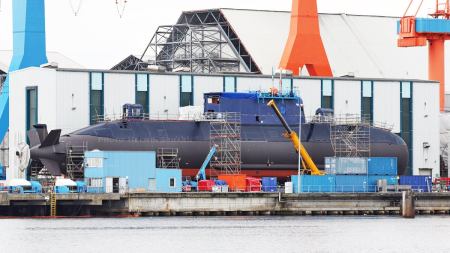
The first photos have emerged showing the completed Israeli Navy submarine INS Drakon. With Israel being historically shy in regards to its submarine assets, having a chance to see its newest boat before its launch is rare.
The photos were taken by German photographer Helwin Scharn on August 1, 2023, and he kindly shared them with The War Zone. They show INS Drakon — the latest and most advanced of Israel’s Dolphin II class attack submarines — after it came out of the construction hall in Kiel, northern Germany.
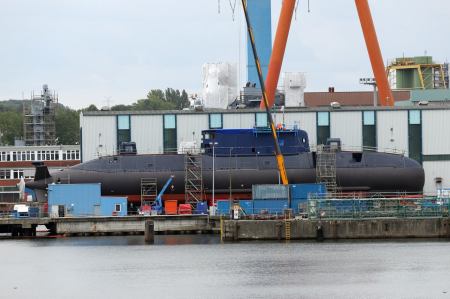
INS Drakon after it emerged out of the construction hall, in Kiel, Germany, on August 1, 2023. Helwin Scharn
One of the most striking features visible is the enormous sail, by far the largest ever seen on an Israeli submarine. Although unconfirmed, it’s widely believed that INS Drakon will have a vertical launch system (VLS) module for submarine-launched cruise missiles, installed either abaft the sail or perhaps within it, which might explain the size increase in this area.
While at this point we can only guess what the sail might contain, it’s notable that concept imagery of Israel’s follow-on Dakar class submarine also reveals a much-enlarged sail, the implications of which we have discussed in detail in the past. So, the Drakon is acting as something of a bridge between the Dolphin class and the new Dakar class.

A visualization of the future Dakar class submarine by TKMS. Note the prominent sail similar to the INS Drakon. TKMS
Regardless, INS Drakon and the future Dakar class of advanced air-independent propulsion (AIP) submarines are certainly among the most anticipated non-nuclear submarines in the world.
A brief history of Israeli Navy submarines
After World War II, the Israel Navy began to use former U.K. Royal Navy T-class and S-class submarines. These were followed by the first purpose-designed Gal (Type 540) class submarines, a modified variant of the German Type 206 class, one of the diesel-electric workhorses of the Cold War.
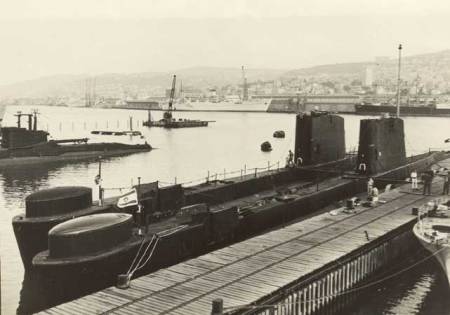
The T-class submarines INS Dolphin (TZ-79), INS Leviathan (TZ-75), and INS Tanin (TZ-71), seen in 1971. Photo by Moshe Ben-Naftali
Due to political sensitivities, the Gal class boats were built in the United Kingdom where they were known also as the Vickers Type 540 class. In the late 1990s, the Gal class submarines were replaced with the new, much larger Dolphin I class submarines built by Howaldtswerke-Deutsche Werft (HDW) in Germany. These were largely based on the export-only German Type 209 class submarines but were modified and enlarged.
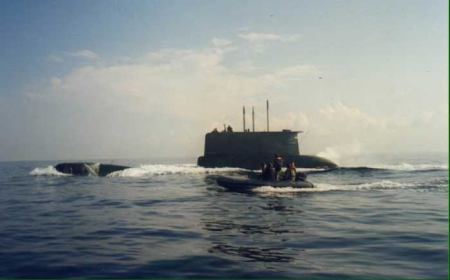
Two views of Gal (Type 540) class submarines training with IDF special forces. Author’s collection
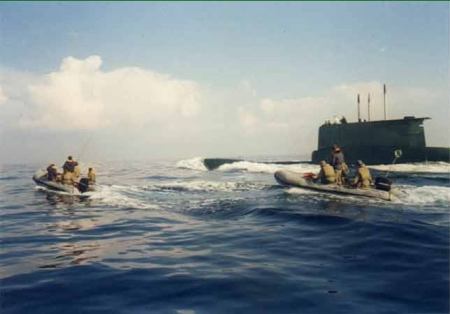
Author’s collection
The Type 209 family of submarines was designed by IKL in the late 1960s, under the leadership of Ulrich Gabler. It was largely based on the previous Type 206 class but added additional equipment and became the backbone of several navies around the world.
Five distinct variants (Type 209/1100, 209/1200, 209/1300, 209/1400, and 209/1500), including several modifications, were built by HDW as well as the Nordseewerke shipyards and were exported to 15 countries. In total, 90 submarines were built and commissioned between 1971 and 2021.
Key features of the Type 209 class submarines include low noise signatures; flexible weapon load-outs including torpedoes, missiles, and mines; advanced sonar capabilities; and an integrated weapon command and control system.
Gal (Type 540) class submarines INS Gal, INS Tanin, and INS Rahav underway. Author’s collection
Even now, Type 209 class submarines are considered among the best diesel-electric designs in the world and can be found in many navies including in Argentina, Brazil, Colombia, Greece (the first operator), South Korea, Turkey (the largest operator, with 14 submarines), and many others.
Israel’s current submarine fleet
The Dolphin II class boats are the largest to have been built in Germany since World War II and are the most expensive single assets operated by the Israel Defense Forces (IDF). They are specifically designed for operations in the Mediterranean Sea, with a focus on underwater surveillance and special operations. Two Dolphin II class boats have already been commissioned, INS Tanin and INS Rahav. The Israeli Navy currently operates five submarines, including a pair of the older Dolphin I class boats, as follows:
Dolphin I class:
INS Dolphin — commissioned in 1999, in active service
INS Leviathan (meaning Whale, or Leviathan) — commissioned in 1999, in active service
INS Tekumah (Revival) — commissioned in 2000, in active service
Dolphin II class:
INS Tanin (Crocodile) — commissioned in 2014, in active service
INS Rahav (Splendor) — commissioned in 2016, in active service
INS Drakon (Dragon) — under construction
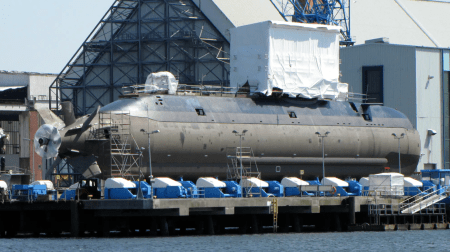
INS Tanin, the first of the Dolphin II subclass, at the HDW shipyard in Kiel in 2012. This boat was commissioned into service in 2014. Marco Kuntzsch/Wikimedia Commons
The main difference between the two batches is that the Dolphin II boats use an AIP propulsion system, whereas the Dolphin I is powered by a standard diesel-electric propulsion plant. AIP gives the submarine a greater range, speed, and operational flexibility without the need for a telltale snorkeling procedure to recharge its batteries. Modern AIP submarines can be extremely quiet and can remain submerged for weeks at a time. The Doplphin II class uses a fuel cell AIP concept which is very advanced and extremely quiet. You can read all about AIP submarines here.
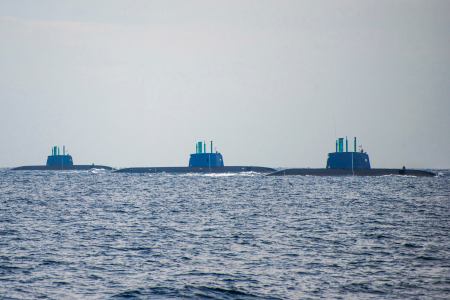
Dolphin I and Dolphin II class submarines. Israeli Navy
Dolphin II class boats are also larger, displacing an additional 500 tons when submerged (for a total of 2,400 tons compared to 1,900 tons), and are longer by some 10 meters (33 feet). The submarines incorporate Atlas Elektronik’s ISUS 90-1 Tactical Control System (TCS) for automatic sensor management, weapon control, navigation, and other operations.

Two photos of the control room of the Dolphin I class lead boat, INS Dolphin. Israeli Navy
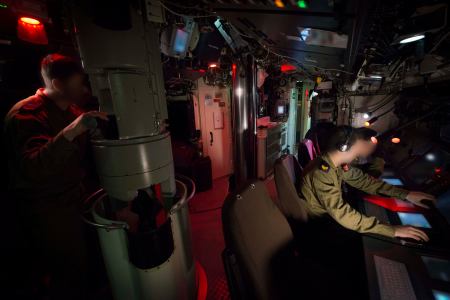
Israeli Navy
The armament for both batches consists of six 533mm and four 650mm torpedo tubes able to launch heavyweight wire-guided torpedoes. These comprise the SeaHake Mod 4, an export version of the DM2A4 Seehecht originally developed by Atlas Elektronik for German Navy submarines. The larger torpedo tubes can also be used for launching cruise missiles and swimmer delivery vehicles (SDVs) carrying combat swimmers.
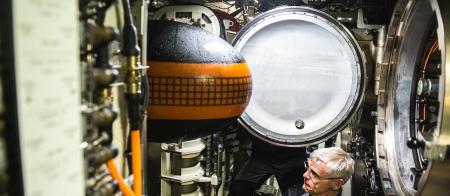
Two impressions of a German Navy Type 212A Batch II class submarine loading a DM2A4 Seehecht heavyweight torpedo. Photo by Olav StandalTangen
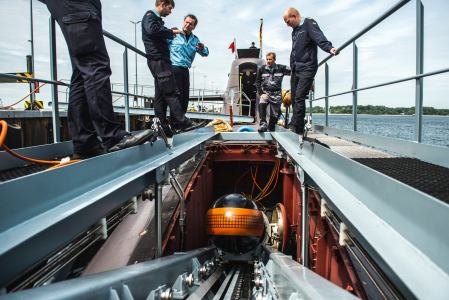
Photo by Olav StandalTangen
Weapon storage can accommodate up to 16 torpedoes and/or mines as well as the Popeye Turbo — a turbofan-powered submarine-launched cruise missile (SLCM) with a range of at least 1,500 kilometers (932 miles). It is widely believed that the Popeye Turbo missiles can be armed with a 200-kiloton nuclear warhead, providing Israel with a second-strike capability as part of its undisclosed nuclear arsenal. Currently, these missiles are launched via torpedo tubes.

One of the only photos of Israel’s shadowy Popeye Turbo submarine-launched cruise missile. Missilethreat.CSIS.org
Israeli Navy submarines — the future
As the final boat of the Dolphin II class, INS Drakon is very different from her sister boats, featuring the aforementioned massive sail, far larger than those on any of the previous Dolphin class submarines.

Side-by-side comparison of the INS Drakon (above) and the INS Tanin together with INS Rahav (below). The difference in the sail size is obvious, although the overall hull length seems to be roughly the same. Photos by Helwin Schran (above) and HDW (below)

From the photos released so far, we can assume that the hull dimensions and displacement of INS Drakon are roughly the same as the other Dolphin II class boats.
As yet, there’s no visible evidence of the expected VLS compartment. It could be that it was moved from abaft the sail and incorporated into it, which would explain the size increase. A VLS module isn’t the only reason for an enlarged sail, of course. It could also contain a special release compartment for unmanned underwater vehicles (UUVs), aerial drones, and/or other special operations and intelligence-gathering equipment. The revised sail could also be related to some kind of proof-of-concept for technology to be used in the upcoming Dakar class.
The following is taken from our previous discussion of a VLS module, in relation to the Dakar class, but it applies equally to INS Drakon:
Should the enlarged sail be intended to contain missiles, it would accommodate vertical launch system (VLS) cells. These could be used to launch additional cruise missiles, for extra overall capacity, while also freeing up the torpedo tubes for their primary weapons… Above all else, significantly extending the length and upgrading the Popeye Turbo missile would provide Israel with the ability to strike targets over longer ranges, which would enhance the country’s second-strike deterrent by a significant degree. These missiles may be too long to be stored and deployed vertically from the hull, but a VLS that extended through the sail would be able to accommodate their length. A mix of these updated weapons now, and possibly a ballistic missile later, is also a possibility.
It’s also worth noting that broader regional security issues, especially in light of Iranian developments, including fears that Tehran might suddenly decide to pursue a nuclear weapon, may very well also be driving the development of a more robust Israeli second-strike capability. Here, a submarine-based strategic system would offer clear benefits.
So far only a handful of photos of the INS Drakon have been released by the IDF and these were taken during its construction, showing the submarine’s hull. In the photos below we can see the sail area under construction, with the massive base giving the first hint of how large it will be. Also visible is the access hatch. The interior shots show cabling and piping ready for equipment installation.

Two photos showing INS Drakon under construction, including the base of the large sail and the access hatch. IDF
IDF
The initial batch of Dolphin I class submarines will be replaced in early 2030 by the advanced Dakar class, which also features a very large sail. Ever since the first renders of the Dakar class were released, speculation began to circulate that the sail will include a VLS module.
Two more views of INS Drakon under construction. The access hatch is visible, as is the interior with cabling ready for equipment installation. IDF
IDF
Last year, ThyssenKrupp Marine Systems (TKMS) and the Israeli Ministry of Defense agreed on a deal for three Dakar class submarines.
TKMS, the prime contractor and builder of the Dakar class, describes the design as “completely new [and] specifically engineered to fulfill the operational requirements of the Israeli Navy.”
Given the secrecy that usually surrounds all Israeli submarines, we can only propose an educated guess on the technology and capabilities these submarines will actually incorporate.
With that in mind, it’s no surprise that the appearance of the INS Drakon with its massive sail has immediately sparked speculation about what it may contain.
Israeli submarines are already among the most advanced non-nuclear boats in the world, designed specifically for the extremely challenging waters of the Mediterranean. The worldwide naval community will be looking very closely at the future INS Drakon and Dakar class submarines as they will undoubtedly provide more hints of what the future of conventionally-powered submarine technology might look like.





 anneinpt
 artaxes
 danmillerinpanama
 davidking1530
 Peter Hofman
 Joseph Wouk
 Peter
Peter Louisiana Steve
 WarSclerotic
Recent Comments