Both countries determined ‘that Iran will never acquire a nuclear weapon,’ US secretary of state says in Jerusalem; Lapid emphasizes shared ‘vision of peace through strength’
By LAZAR BERMAN Today, 1:35 pm

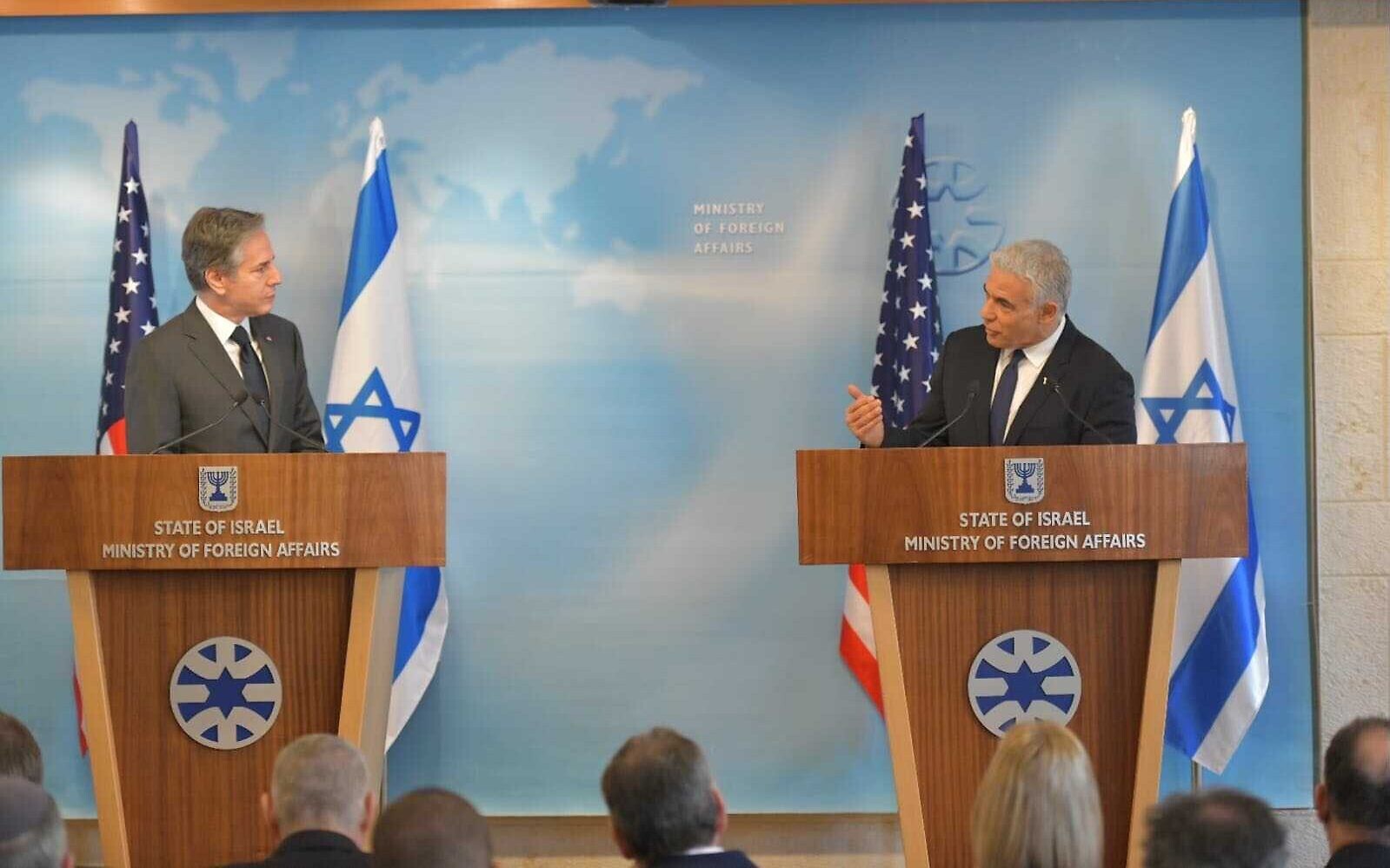
US Secretary of State Antony Blinken (R) and Foreign Minister Yair Lapid (L) at a press conference in Jerusalem, March 27, 2022 (Foreign Ministry)
The US and Israel are committed to ensuring that Iran does not acquire a nuclear weapon, US Secretary of State Antony Blinken said at a Sunday press conference in Jerusalem, as the allies acknowledged differences over negotiations with Tehran.
“When it comes to the most important element, we see eye to eye. We are both committed, both determined, that Iran will never acquire a nuclear weapon,” Blinken told reporters in Jerusalem alongside Foreign Affairs Minister Yair Lapid.
At the same time, he said that the Joint Comprehensive Plan of Action (JCPOA) was the best way “to put Iran’s nuclear program back in the box it was in,” as Lapid reiterated Israel’s “disagreements” with Washington over negotiations to revive the 2015 nuclear accord with Tehran.
Israel has firmly opposed the terms of the 2015 deal and has said that reactivating the original deal is insufficient to curb the Iranian threat.
Lapid noted that military and diplomatic strength “guarantees peace,” emphasizing that the US and Israel shared “a vision of peace through strength.”
Get The Times of Israel’s Daily Editionby email and never miss our top storiesNewsletter email addressGET IT
By signing up, you agree to the terms
He added that “Israel will do anything we believe is needed to stop the Iranian nuclear program. Anything. From our point of view, the Iranian threat is not theoretical. The Iranians want to destroy Israel. They will not succeed. We will not let them.”
“The world cannot afford a nuclear Iran,” Lapid said.
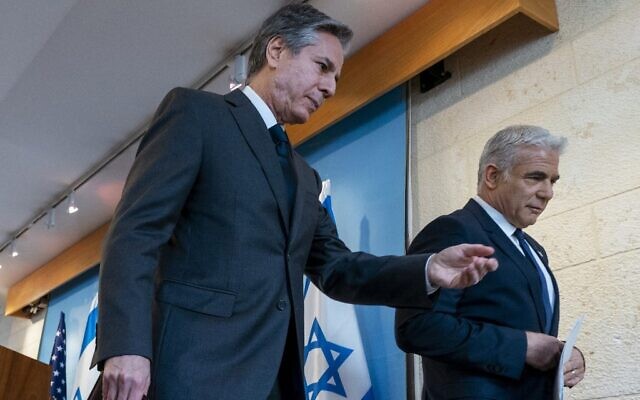
US Secretary of State Antony Blinken (L) walks by the side of Israel’s Foreign Minister Yair Lapid, following a joint press conference at the Foreign Ministry in Jerusalem, on March 27, 2022. (Jacquelyn Martin / POOL / AFP)
Blinken also condemned Iran-backed Houthi attacks on Saudi and Emirati civilians and infrastructure.
“Beyond its nuclear efforts, Iran continues to engage in a whole series of destabilizing activities,” Blinken said.
“The US will continue to stand up to Iran when it threatens us or when it threatens our allies and partners,” he said, noting the US was “fully committed to expanding cooperation through the Abraham Accords,” ahead of Sunday’s Negev Summit with foreign ministers from four Arab countries.
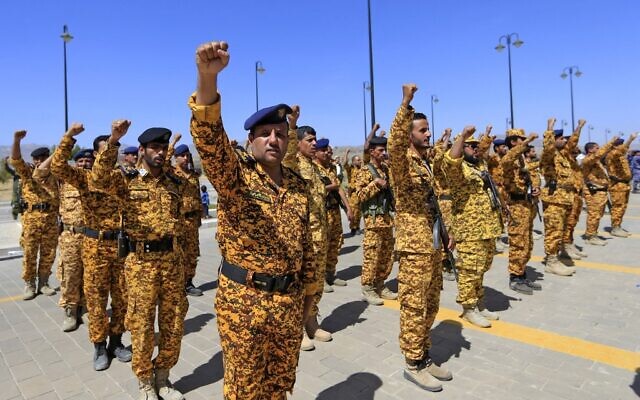
Forces loyal to Yemen’s Iran-backed Houthis take part in a mass funeral for fighters killed in battles with Saudi-backed government troops, in Yemen’s capital Sanaa, on April 8, 2021. (Mohammed Huwais/AFP)
He thanked Lapid for his leadership in finding new opportunities for the Abraham Accords and noted Israel’s efforts to mediate in the ongoing war in Ukraine.
“We greatly appreciate Israel’s strong repudiation of Russia’s aggression against Ukraine,” he said, adding that he appreciates Israel’s stated determination not to be used as a sanctions bypass.
Blinken was briefed by Israel’s senior expert on the issue before the press conference.
The top US envoy also praised Prime Minister Naftali Bennett’s mediation efforts in the conflict, and Israel’s Shining Star field hospital in Mostyska, western Ukraine.

A Ukrainian flag hangs at a schoolhouse that has been converted into a field hospital, in Mostyska, western Ukraine, March 24, 2022. (AP Photo/Nariman El-Mofty)
He said the people of Israel were standing with Ukraine, citing protests in Tel Aviv and the work of the United Hatzalah emergency service.
Blinken said he will discuss the effects of the Ukraine conflict in the region with regional partners at the upcoming Negev Summit. “Normalization [of Arab countries with Israel] is becoming the new normal,” he said.
He noted the US funding of Iron Dome system, and condemned last week’s stabbing attack in Beersheba.
Blinken added he will reiterate to Palestinian Authority President Mahmoud Abbas the Biden administration’s commitment to strengthening ties with the PA.

Demonstrators gather at Habima Square in Tel Aviv on March 20, 2022, to watch a televised video address by Ukraine’s President Volodymyr Zelensky. (Jack Guez/ AFP)
Earlier Sunday, Prime Minister Naftali Bennett said Israel was enjoying a period of good foreign relations.
“To anyone who has not noticed – Israel’s foreign policy is in a good period,” he said at the start of the weekly cabinet meeting. “Israel is an important actor on the world and regional stage. We are cultivating old ties and building new bridges.”
He said “the old peace” — with Egypt — is meeting “the new peace” of the Abraham Accords.
Also on Sunday, US special envoy Robert Malley said the United States will maintain sanctions on Iran’s Revolutionary Guards even if there is a deal to limit the country’s nuclear program.
“The IRGC will remain sanctioned under US law and our perception of the IRGC will remain,” Malley told a conference in Doha, despite Iran’s demands that the Corps be taken off a US terrorist list as a condition for a revived nuclear accord.
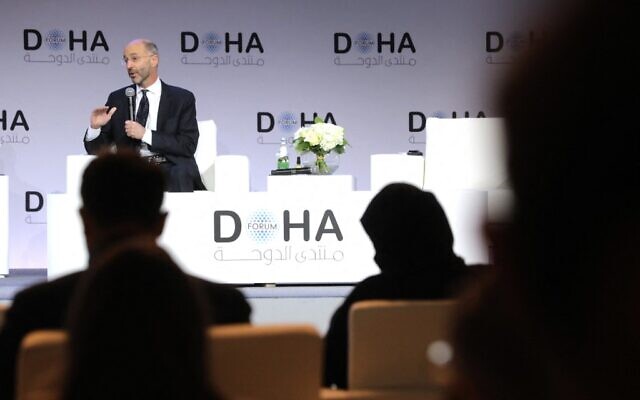
US Special Representative for Iran, Robert Malley, participates in a panel at the Doha Forum in Qatar’s capital on March 27, 2022. (MARWAN TAHTAH / MOFA / DOHA FORUM)
“We’re pretty close,” Malley said of the negotiations, but added: “We’ve been pretty close now for some time. And I think that tells you all you need to know about the difficulty of the issues.”
Bennett and Lapid had previously said: “The attempt to delist the IRGC as a terrorist organization is an insult to the victims and would ignore documented reality supported by unequivocal evidence.”
Over the weekend, the European Union’s foreign policy chief said that a deal with Iran will likely be renewed “in a matter of days.”
Times of Israel staff and Agencies contributed to this report





 anneinpt
 artaxes
 danmillerinpanama
 davidking1530
 Peter Hofman
 Joseph Wouk
 Peter
Peter Louisiana Steve
 WarSclerotic

Recent Comments