Archive for August 2021

Israel warns of ‘overt and covert’ response if Hezbollah rocket fire continues

August 6, 2021


IDF carries out artillery strikes in response to 19-rocket barrage by terror group, first since 2006 war; UNIFIL: Rockets were fired outside our operating area

By EMANUEL FABIAN and JUDAH ARI GROSSToday, 4:23 pm  

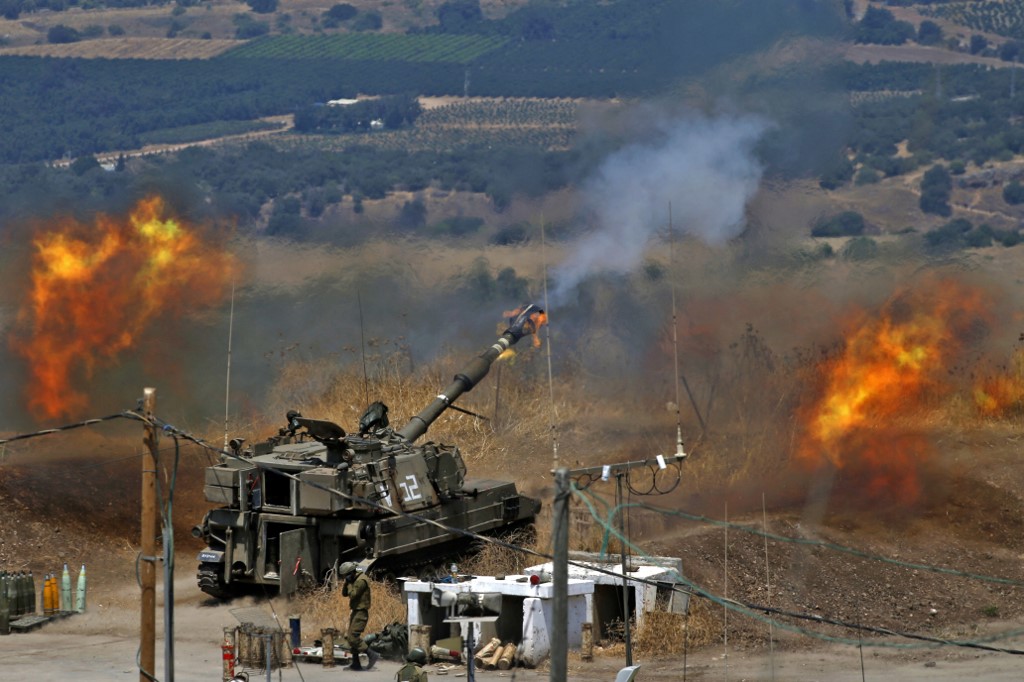
Israeli self-propelled howitzers fire toward Lebanon from a position near the northern town of Kiryat Shmona following rocket fire by the Lebanese terror group Hezbollah, August 6, 2021. (Jalaa Marey/AFP)

Israeli self-propelled howitzers fire toward Lebanon from a position near the northern town of Kiryat Shmona following rocket fire by the Lebanese terror group Hezbollah, August 6, 2021. (Jalaa Marey/AFP)

Israel is preparing a wide range of military and covert responses to a barrage of 19 rockets fired at Israel on Friday by the Hezbollah terror group, a defense official said, noting that the severity will depend on how the situation develops.

“The Israel Defense Forces has in recent days taken action with large-scale strikes in Lebanon, mostly with artillery and with strikes on infrastructure with fighter jets, as we haven’t done for years,” the official said in a statement.

“The defense establishment is preparing additional options for a response through different means — overt and covert — in accordance with developments [in the field]. The continuation of our activities will be in accordance with operational needs and a timeframe that is best suited for Israel,” the official added.

The UN peacekeeping mission in Lebanon, known by its acronym UNIFIL, said the situation was “very dangerous” and that the rockets launched at Israel were fired outside of its area of operation in southern Lebanon.

“This is a very dangerous situation, with escalatory actions seen on both sides over the past two days,” UNIFIL said in a statement.Get The Times of Israel’s Daily Editionby email and never miss our top storiesNewsletter email addressGET ITBy signing up, you agree to the terms

“UNIFIL is actively engaging with the parties through all formal and informal liaison and coordination mechanisms to prevent the situation from spiraling out of control,” the mission added.Smoke rise from Israeli shelling near the southern Lebanese village of Kfar Shouba, after Hezbollah fired rockets at ISrael, Friday, Aug. 6, 2021. (AP Photo/Mohammed Zaatari)

Meanwhile, Lebanon’s caretaker Prime Minister Hassan Diab called on the United Nations to pressure Israel to stop “violating Lebanese sovereignty,” and restore calm to the area.

Nineteen rockets were fired into northern Israel from Lebanon on Friday morning, sending residents in a number of towns in the Golan Heights and Galilee Panhandle scrambling to shelters.

The Israel Defense Forces said 10 projectiles were intercepted by the Iron Dome missile defense system and six landed in open areas around Mount Dov. Another three rockets failed to clear the border and landed in Lebanese territory, according to the military.

The Iran-backed Hezbollah terror group confirmed it had fired the projectiles on Friday, which it said came in response to recent Israeli airstrikes in Lebanon. “The Islamic Resistance shelled open areas near the Shebaa Farms with dozens of 122mm rockets,” it said in a statement carried in Arabic-language media, referring to the Mount Dov area.

The barrage was believed to be the first to be formally acknowledged by Hezbollah since the 2006 Second Lebanon War.

Israel responded with artillery strikes. Witnesses reported artillery fire by Israeli forces on the Lebanese side of Shebaa Farms and outside the town of Kfar Shouba.Israeli self-propelled howitzers fire towards Lebanon from a position near the northern Israeli town of Kiryat Shmona following rocket fire from the Lebanese side of the border, on August 6, 2021.(Photo by JALAA MAREY / AFP)

Shebaa Farms is an enclave where the borders of Israel, Lebanon and Syria meet. Israel says it is part of the Golan Heights, which it captured from Syria in 1967 and later annexed. Lebanon and Syria say Shebaa Farms belong to Lebanon, while the United Nations says the area is part of Syria.

The attack sparked tensions between locals and Hezbollah. Videos circulated on social media after the rocket attack showing two vehicles, including a mobile rocket launcher, being stopped by villagers in the southeastern village of Shwaya in Hasbaya region near the border with the Golan Heights.

Some angry villagers, who belong to the Druze sect, could be heard saying: “Hezbollah is firing rockets from between homes so that Israel hits us back.”https://platform.twitter.com/embed/Tweet.html?dnt=true&embedId=twitter-widget-0&features=eyJ0ZndfZXhwZXJpbWVudHNfY29va2llX2V4cGlyYXRpb24iOnsiYnVja2V0IjoxMjA5NjAwLCJ2ZXJzaW9uIjpudWxsfSwidGZ3X2hvcml6b25fdHdlZXRfZW1iZWRfOTU1NSI6eyJidWNrZXQiOiJodGUiLCJ2ZXJzaW9uIjpudWxsfSwidGZ3X3NwYWNlX2NhcmQiOnsiYnVja2V0Ijoib2ZmIiwidmVyc2lvbiI6bnVsbH19&frame=false&hideCard=false&hideThread=false&id=1423561729745821702&lang=en&origin=https%3A%2F%2Fwww.timesofisrael.com%2Fisrael-warns-of-overt-and-covert-response-if-hezbollah-rocket-fire-continues%2F&sessionId=221f192df73abb6150230b258e3c96d9e78ae97c&siteScreenName=timesofisrael&theme=light&widgetsVersion=1890d59c%3A1627936082797&width=550px

Hezbollah later issued a statement saying that the rockets were fired from remote areas, adding that the fighters were stopped in Shwaya on their way back.

“The Islamic Resistance was and will always be most keen about the safety of its people and avoiding any harm to them through its acts of resistance,” the statement said.A rocket launcher placed on a pick up truck that was used by Hezbollah to fire rockets at Israel, is seen in the southeastern village of Shwaya, near the border with the Golan Heights, Friday, Aug. 6, 2021. T(AP Photo/Mohammed Zaatari)

The Lebanese army said it arrested the four people who had launched the rockets and seized the rocket launcher after it was intercepted by villagers.

Thursday’s early morning airstrikes were in response to a previous rocket attack from Lebanon on Wednesday.

Prime Minister Naftali Bennett, Defense Minister Benny Gantz, IDF Chief of Staff Aviv Kohavi and other security officials were to hold talks to review Israel’s potential courses of action following Friday’s attack.

Gantz held an earlier meeting with Kohavi and other senior officers, with a statement from his office saying he stressed “the importance of maintaining close contact and providing the home front with ongoing updates.”

The Defense Minister also spoke with mayors of northern border communities and asked them to remain in close contact with the military.Defense Minister Benny Gantz meets with IDF Chief of Staff Aviv Kohavi and other top officers at the Kirya military headquarters in Tel Aviv on August 6, 2021. (Ariel Hermoni/Defense Ministry)

Military spokesperson Ran Kochav told reporters on Friday that Israel has “no intention of going to war, but we do not want to turn the Lebanon border into a line of confrontation.”

“The incident shows Hezbollah is deterred, as it fired at open areas,” Kochav added.

He also asserted Hezbollah intentionally fired the rockets at open areas and not at Israeli towns or communities. Still, the Iron Dome system was activated to intercept some of the rockets, which is usually only done when projectiles are heading for populated areas, military bases or key infrastructure.Incoming IDF Spokesperson Ran Kochav speaks during a ceremony at the IDF Spokesperson’s Unit’s headquarters in northern Tel Aviv on June 6, 2021. (Israel Defense Forces)
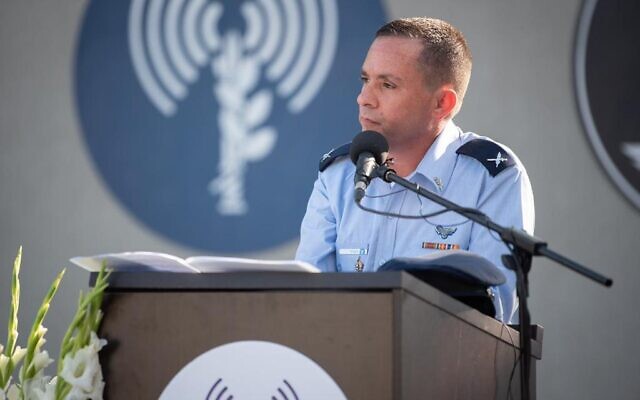
“This is a moderate response from Hezbollah, as to not escalate the situation,” Kochav said.

Recent attacks had been blamed on local Palestinian groups in Lebanon, and not the powerful Hezbollah. However, Hezbollah maintains tight control over southern Lebanon, making it unlikely that such attacks would be conducted from this area without at least its tacit approval.

On Wednesday, three rockets were fired into northern Israel from Lebanon. Two rockets hit open areas, while the third fell short of the border.

In response, the Israel Defense Forces fired artillery shells at targets in Lebanon just after the attack. Some two hours later it followed up with a second and a third round before conducting airstrikes toward “terror infrastructure” and rocket launching sites, according to the military.

Rocket fire from Lebanon has been exceedingly rare in the 15 years since the 2006 Second Lebanon War Israel fought against Hezbollah, though it has occurred sporadically. Recent months, however, have seen a slight uptick, with 10 launches aimed at Israel during May’s 11-day war in Gaza, as well as last month, leading to fears among some that the phenomenon could become more common, as has happened in areas on the Gaza border.https://platform.twitter.com/embed/Tweet.html?dnt=true&embedId=twitter-widget-1&features=eyJ0ZndfZXhwZXJpbWVudHNfY29va2llX2V4cGlyYXRpb24iOnsiYnVja2V0IjoxMjA5NjAwLCJ2ZXJzaW9uIjpudWxsfSwidGZ3X2hvcml6b25fdHdlZXRfZW1iZWRfOTU1NSI6eyJidWNrZXQiOiJodGUiLCJ2ZXJzaW9uIjpudWxsfSwidGZ3X3NwYWNlX2NhcmQiOnsiYnVja2V0Ijoib2ZmIiwidmVyc2lvbiI6bnVsbH19&frame=false&hideCard=false&hideThread=false&id=1423072147170332683&lang=en&origin=https%3A%2F%2Fwww.timesofisrael.com%2Fisrael-warns-of-overt-and-covert-response-if-hezbollah-rocket-fire-continues%2F&sessionId=221f192df73abb6150230b258e3c96d9e78ae97c&siteScreenName=timesofisrael&theme=light&widgetsVersion=1890d59c%3A1627936082797&width=550px

Israel has conveyed to Lebanon via UN peacekeepers that it could intensify its response if calm is not returned to the border.

“Without getting into the identity of who shot the rockets, it’s clear that the Lebanese government bears full responsibility for any fire at the State of Israel’s territory,” the IDF said in a Hebrew-language statement. “The Lebanese state lacks control over terror groups operating within it.”

Agencies contributed to this report
By EMANUEL FABIAN and JUDAH ARI GROSSToday, 4:23 pm  

Israeli self-propelled howitzers fire toward Lebanon from a position near the northern town of Kiryat Shmona following rocket fire by the Lebanese terror group Hezbollah, August 6, 2021. (Jalaa Marey/AFP)

Israel is preparing a wide range of military and covert responses to a barrage of 19 rockets fired at Israel on Friday by the Hezbollah terror group, a defense official said, noting that the severity will depend on how the situation develops.

“The Israel Defense Forces has in recent days taken action with large-scale strikes in Lebanon, mostly with artillery and with strikes on infrastructure with fighter jets, as we haven’t done for years,” the official said in a statement.

“The defense establishment is preparing additional options for a response through different means — overt and covert — in accordance with developments [in the field]. The continuation of our activities will be in accordance with operational needs and a timeframe that is best suited for Israel,” the official added.

The UN peacekeeping mission in Lebanon, known by its acronym UNIFIL, said the situation was “very dangerous” and that the rockets launched at Israel were fired outside of its area of operation in southern Lebanon.

“This is a very dangerous situation, with escalatory actions seen on both sides over the past two days,” UNIFIL said in a statement.Get The Times of Israel’s Daily Editionby email and never miss our top storiesNewsletter email addressGET ITBy signing up, you agree to the terms

“UNIFIL is actively engaging with the parties through all formal and informal liaison and coordination mechanisms to prevent the situation from spiraling out of control,” the mission added.Smoke rise from Israeli shelling near the southern Lebanese village of Kfar Shouba, after Hezbollah fired rockets at ISrael, Friday, Aug. 6, 2021. (AP Photo/Mohammed Zaatari)

Meanwhile, Lebanon’s caretaker Prime Minister Hassan Diab called on the United Nations to pressure Israel to stop “violating Lebanese sovereignty,” and restore calm to the area.

Nineteen rockets were fired into northern Israel from Lebanon on Friday morning, sending residents in a number of towns in the Golan Heights and Galilee Panhandle scrambling to shelters.

The Israel Defense Forces said 10 projectiles were intercepted by the Iron Dome missile defense system and six landed in open areas around Mount Dov. Another three rockets failed to clear the border and landed in Lebanese territory, according to the military.

The Iran-backed Hezbollah terror group confirmed it had fired the projectiles on Friday, which it said came in response to recent Israeli airstrikes in Lebanon. “The Islamic Resistance shelled open areas near the Shebaa Farms with dozens of 122mm rockets,” it said in a statement carried in Arabic-language media, referring to the Mount Dov area.

The barrage was believed to be the first to be formally acknowledged by Hezbollah since the 2006 Second Lebanon War.

Israel responded with artillery strikes. Witnesses reported artillery fire by Israeli forces on the Lebanese side of Shebaa Farms and outside the town of Kfar Shouba.Israeli self-propelled howitzers fire towards Lebanon from a position near the northern Israeli town of Kiryat Shmona following rocket fire from the Lebanese side of the border, on August 6, 2021.(Photo by JALAA MAREY / AFP)

Shebaa Farms is an enclave where the borders of Israel, Lebanon and Syria meet. Israel says it is part of the Golan Heights, which it captured from Syria in 1967 and later annexed. Lebanon and Syria say Shebaa Farms belong to Lebanon, while the United Nations says the area is part of Syria.

The attack sparked tensions between locals and Hezbollah. Videos circulated on social media after the rocket attack showing two vehicles, including a mobile rocket launcher, being stopped by villagers in the southeastern village of Shwaya in Hasbaya region near the border with the Golan Heights.

Some angry villagers, who belong to the Druze sect, could be heard saying: “Hezbollah is firing rockets from between homes so that Israel hits us back.”https://platform.twitter.com/embed/Tweet.html?dnt=true&embedId=twitter-widget-0&features=eyJ0ZndfZXhwZXJpbWVudHNfY29va2llX2V4cGlyYXRpb24iOnsiYnVja2V0IjoxMjA5NjAwLCJ2ZXJzaW9uIjpudWxsfSwidGZ3X2hvcml6b25fdHdlZXRfZW1iZWRfOTU1NSI6eyJidWNrZXQiOiJodGUiLCJ2ZXJzaW9uIjpudWxsfSwidGZ3X3NwYWNlX2NhcmQiOnsiYnVja2V0Ijoib2ZmIiwidmVyc2lvbiI6bnVsbH19&frame=false&hideCard=false&hideThread=false&id=1423561729745821702&lang=en&origin=https%3A%2F%2Fwww.timesofisrael.com%2Fisrael-warns-of-overt-and-covert-response-if-hezbollah-rocket-fire-continues%2F&sessionId=221f192df73abb6150230b258e3c96d9e78ae97c&siteScreenName=timesofisrael&theme=light&widgetsVersion=1890d59c%3A1627936082797&width=550px

Hezbollah later issued a statement saying that the rockets were fired from remote areas, adding that the fighters were stopped in Shwaya on their way back.

“The Islamic Resistance was and will always be most keen about the safety of its people and avoiding any harm to them through its acts of resistance,” the statement said.A rocket launcher placed on a pick up truck that was used by Hezbollah to fire rockets at Israel, is seen in the southeastern village of Shwaya, near the border with the Golan Heights, Friday, Aug. 6, 2021. T(AP Photo/Mohammed Zaatari)

The Lebanese army said it arrested the four people who had launched the rockets and seized the rocket launcher after it was intercepted by villagers.

Thursday’s early morning airstrikes were in response to a previous rocket attack from Lebanon on Wednesday.

Prime Minister Naftali Bennett, Defense Minister Benny Gantz, IDF Chief of Staff Aviv Kohavi and other security officials were to hold talks to review Israel’s potential courses of action following Friday’s attack.

Gantz held an earlier meeting with Kohavi and other senior officers, with a statement from his office saying he stressed “the importance of maintaining close contact and providing the home front with ongoing updates.”

The Defense Minister also spoke with mayors of northern border communities and asked them to remain in close contact with the military.Defense Minister Benny Gantz meets with IDF Chief of Staff Aviv Kohavi and other top officers at the Kirya military headquarters in Tel Aviv on August 6, 2021. (Ariel Hermoni/Defense Ministry)

Military spokesperson Ran Kochav told reporters on Friday that Israel has “no intention of going to war, but we do not want to turn the Lebanon border into a line of confrontation.”

“The incident shows Hezbollah is deterred, as it fired at open areas,” Kochav added.

He also asserted Hezbollah intentionally fired the rockets at open areas and not at Israeli towns or communities. Still, the Iron Dome system was activated to intercept some of the rockets, which is usually only done when projectiles are heading for populated areas, military bases or key infrastructure.Incoming IDF Spokesperson Ran Kochav speaks during a ceremony at the IDF Spokesperson’s Unit’s headquarters in northern Tel Aviv on June 6, 2021. (Israel Defense Forces)

“This is a moderate response from Hezbollah, as to not escalate the situation,” Kochav said.

Recent attacks had been blamed on local Palestinian groups in Lebanon, and not the powerful Hezbollah. However, Hezbollah maintains tight control over southern Lebanon, making it unlikely that such attacks would be conducted from this area without at least its tacit approval.

On Wednesday, three rockets were fired into northern Israel from Lebanon. Two rockets hit open areas, while the third fell short of the border.

In response, the Israel Defense Forces fired artillery shells at targets in Lebanon just after the attack. Some two hours later it followed up with a second and a third round before conducting airstrikes toward “terror infrastructure” and rocket launching sites, according to the military.

Rocket fire from Lebanon has been exceedingly rare in the 15 years since the 2006 Second Lebanon War Israel fought against Hezbollah, though it has occurred sporadically. Recent months, however, have seen a slight uptick, with 10 launches aimed at Israel during May’s 11-day war in Gaza, as well as last month, leading to fears among some that the phenomenon could become more common, as has happened in areas on the Gaza border.https://platform.twitter.com/embed/Tweet.html?dnt=true&embedId=twitter-widget-1&features=eyJ0ZndfZXhwZXJpbWVudHNfY29va2llX2V4cGlyYXRpb24iOnsiYnVja2V0IjoxMjA5NjAwLCJ2ZXJzaW9uIjpudWxsfSwidGZ3X2hvcml6b25fdHdlZXRfZW1iZWRfOTU1NSI6eyJidWNrZXQiOiJodGUiLCJ2ZXJzaW9uIjpudWxsfSwidGZ3X3NwYWNlX2NhcmQiOnsiYnVja2V0Ijoib2ZmIiwidmVyc2lvbiI6bnVsbH19&frame=false&hideCard=false&hideThread=false&id=1423072147170332683&lang=en&origin=https%3A%2F%2Fwww.timesofisrael.com%2Fisrael-warns-of-overt-and-covert-response-if-hezbollah-rocket-fire-continues%2F&sessionId=221f192df73abb6150230b258e3c96d9e78ae97c&siteScreenName=timesofisrael&theme=light&widgetsVersion=1890d59c%3A1627936082797&width=550px

Israel has conveyed to Lebanon via UN peacekeepers that it could intensify its response if calm is not returned to the border.

“Without getting into the identity of who shot the rockets, it’s clear that the Lebanese government bears full responsibility for any fire at the State of Israel’s territory,” the IDF said in a Hebrew-language statement. “The Lebanese state lacks control over terror groups operating within it.”

Agencies contributed to this report
Hezbollah fires rocket barrage at Israel; IDF responds with artillery fire

August 6, 2021


Military says majority of over 10 projectiles were intercepted by air defenses; Defense Minister Gantz to hold immediate consultation at IDF headquaters

By EMANUEL FABIANToday, 11:11 am  

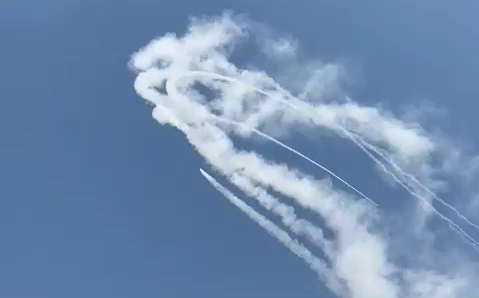
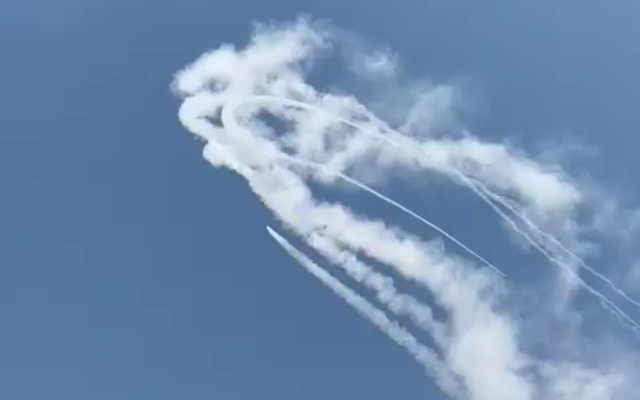
Iron Dome interceptor missiles are seen over the Golan Heights, as over 10 rockets were fired from southern Lebanon on August 6, 2021. (Video screenshot)

Iron Dome interceptor missiles are seen over the Golan Heights, as over 10 rockets were fired from southern Lebanon on August 6, 2021. (Video screenshot)

Over ten rockets were fired into northern Israel from Lebanon on Friday morning, sending residents in a number of towns in the Golan Heights and Galilee Panhandle scrambling to shelters.

The Israel Defense Forces said most of the rockets were intercepted by the Iron Dome missile defense system, while some landed in open areas of land in Mount Dov.

The alarms sounded shortly before 11 a.m. in Ein Quiniyye, Neveh Ativ and Snir, near Israel’s northern border with Lebanon and Syria.

The Iran-backed Hezbollah terror group confirmed it had fired the projectiles on Friday, which it said came in response to recent Israeli airstrikes in Lebanon.

“The Islamic Resistance shelled open areas near the Sheba Farms with dozens of 122mm rockets,” it said in a statement carried in Arabic-language media.Get The Times of Israel’s Daily Editionby email and never miss our top storiesNewsletter email addressGET ITBy signing up, you agree to the terms

Thursday’s early morning airstrikes were in response to a previous rocket attack from Lebanon on Wednesday.

There were no immediate reports of casualties or damage. The Magen David Adom ambulance service said it was not aware of any injuries.

The IDF said it had begun a wave of artillery strikes toward the source of the rocket fire.

The military added that there were no special instructions for residents in the area. “Civilian life adjacent to the Lebanese border continues in full routine,” the IDF said in a statement.

Amid the rocket barrage, video footage showed a number of interceptor missiles from the Israeli Iron Dome defense system that was activated

Defense Minister Gantz is to hold a discussion with top military brass to review Israel’s potential courses of action following Friday’s attack, Channel 12 news reported.

On Wednesday, three rockets were fired into northern Israel from Lebanon. Two rockets hit open areas, while the third fell short of the border.

In response, the Israel Defense Forces fired artillery shells at targets in Lebanon just after the attack. Some two hours later it followed up with a second and a third round before conducting airstrikes toward “terror infrastructure” and rocket launching sites, according to the military.

Rocket fire from Lebanon has been exceedingly rare in the 15 years since the 2006 Second Lebanon War Israel fought against Hezbollah, though it has occurred sporadically. Recent months, however, have seen a slight uptick, with 10 launches aimed at Israel during May’s 11-day war in Gaza, as well as last month, leading to fears among some that the phenomenon could become more common, as has happened in areas on the Gaza border

Israel has conveyed to Lebanon via UN peacekeepers that it could intensify its response if calm is not returned to the border.

“Without getting into the identity of who shot the rockets, it’s clear that the Lebanese government bears full responsibility for any fire at the State of Israel’s territory,” the IDF said in a Hebrew-language statement. “The Lebanese state is lacking control over terror groups operating within it.”

Aaron Boxerman and Times of Israel staff contributed to this report.

Amid rising tensions, Gantz says Israel is ready to strike in Iran

August 5, 2021

But defense minister adds that what is needed is global mobilization against Tehran for its malign activities, as Islamic Republic is linked to recent maritime attacks

By EMANUEL FABIANToday, 12:59 pm  

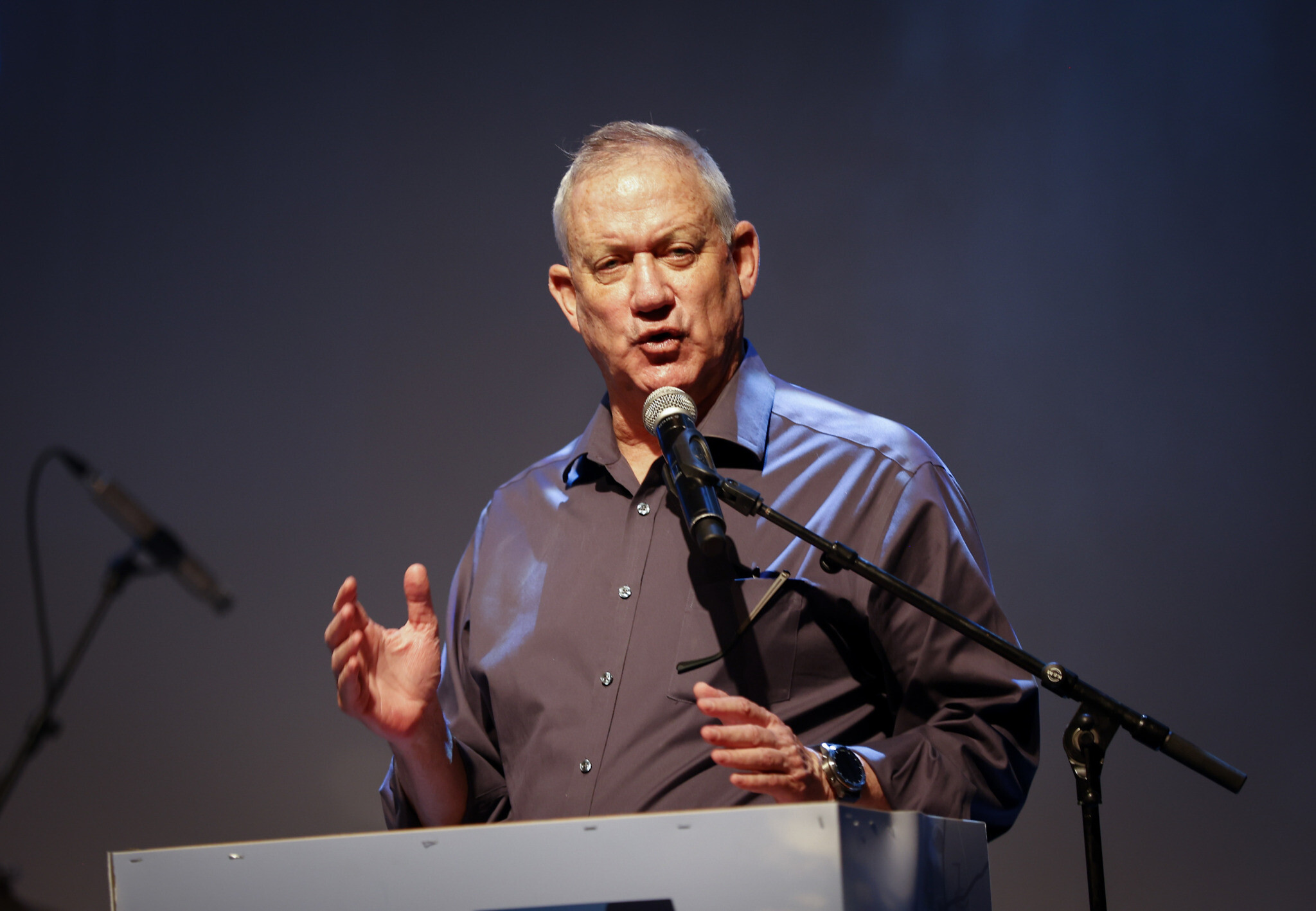
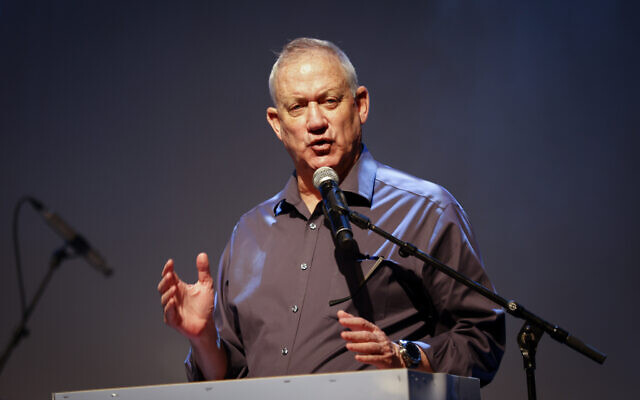
Defense Minister Benny Gantz attends a conference in the Eshkol region, southern Israel. on July 13, 2021. (Flash90)

Defense Minister Benny Gantz attends a conference in the Eshkol region, southern Israel. on July 13, 2021. (Flash90)

Defense Minister Benny Gantz on Thursday said the country is prepared to engage militarily directly with Iran, amid rising tensions in the region as Iran increases its nuclear capabilities and as hardliner Ebrahim Raisi is sworn into the presidency.

Asked in an interview with the Ynet news site whether Israel was ready to strike in Iran if need be, Gantz responded simply, “Yes.”

Still, he added, Israel was focused on an effort to mobilize the international community to rein Tehran in, “because we can’t tag Iran as solely an Israeli problem and absolve the rest of the world from this issue.

“The world needs to deal with Iran, the region needs to deal with Iran, and Israel also needs to do its part in this situation,” he declared.

When asked if he was referring to the world also getting involved in military action against Iran, the defense minister answered in the affirmative.Get The Times of Israel’s Daily Editionby email and never miss our top storiesNewsletter email addressGET ITBy signing up, you agree to the terms

Gantz and Foreign Minister Yair Lapid on Wednesday named the Iranian commanders they said were behind last week’s deadly drone attack on an oil tanker off the coast of Oman.

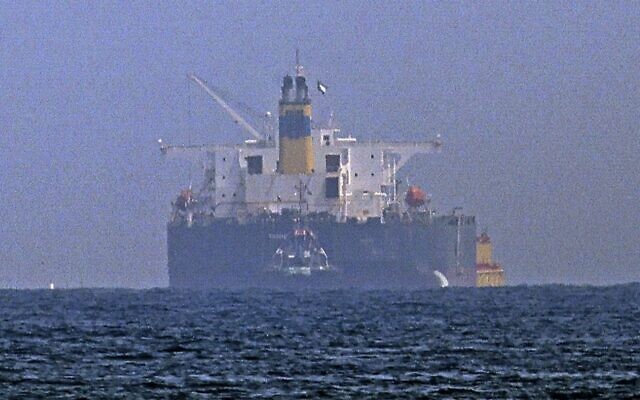
Tugboats are moored next to the Israeli-linked tanker MT Mercer Street, off the Fujairah port in the United Arab Emirates, on August 3, 2021. (Karim Sahib/AFP)

“Amir Ali Hajizadeh, commander of the IRGC’s Air Force, is behind dozens of terror attacks in the region employing UAVs and missiles,” Gantz told envoys from countries on the United Nations Security Council during a briefing at the Foreign Ministry in Jerusalem. “For the first time ever, I will also expose the man who is directly responsible for the launch of suicide UAVs — his name is Saeed Ara Jani and he is the head of the IRGC’s UAV command.”

Israel is seeking to convene the UN Security Council over the deadly drone attack on the MT Mercer Street oil tanker, blamed on Iran by Israel and the international community. The attack killed a Briton and a Romanian.

Israeli believes the ship was targeted due to it being operated by a company owned by an Israeli. Iran has denied involvement in the attack.

On Tuesday, Israel’s Ambassador to the UN Gilad Erdan sent a letter to the Security Council demanding it urgently address the incidents at sea and condemn Iran over the drone attack on the Mercer Street.

The briefing came a day after Iranian-backed forces also reportedly took control of a tanker in the Gulf of Oman in an incident British authorities described as “a potential hijack.” The ship was eventually released. Details of the event remain unclear.

Tensions in the region come as new Iranian President Ebrahim Raisi takes the oath before parliament Thursday. He has been branded by Israel as the “Hangman of Tehran” over his alleged involvement in the mass killings of prisoners toward the end of the 1980-1988 war between Iran and Iraq.

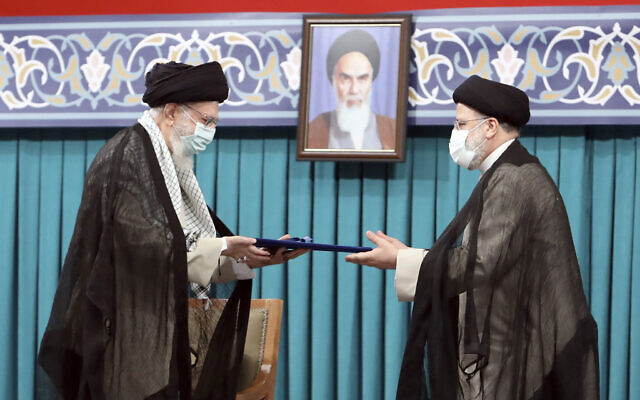
Iran’s Supreme Leader Ayatollah Ali Khamenei, left, gives his official seal of approval to newly elected President Ebrahim Raisi in an endorsement ceremony in Tehran, Iran, August 3, 2021. (Office of the Iranian Supreme Leader via AP)

The maritime incidents come amid heightened tensions between Iran and the West over Tehran’s tattered nuclear deal with world powers and as commercial shipping in the region has found itself caught in the crosshairs.

Gantz also warned in the Wednesday briefing to the envoys that Iran was just some 10 weeks away from acquiring enough enriched uranium to build a nuclear bomb.

US President Joe Biden has signaled his readiness to return to the 2015 nuclear deal and has engaged in indirect negotiations with Iran alongside formal talks with the agreement’s remaining parties, Britain, China, France, Germany and Russia.

Israel has long been against the nuclear deal and opposes Biden’s stated intentions to reenter the treaty, which former US president Donald Trump backed out of.

Lazar Berman and agencies contributed to this report.

US, UK know Iran attacked oil tanker, but are unlikely to strike back

August 3, 2021

Blinken promises a ‘collective response,’ but any military reaction will have to come from Israel

Lazar Berman

By LAZAR BERMANToday, 4:01 am  

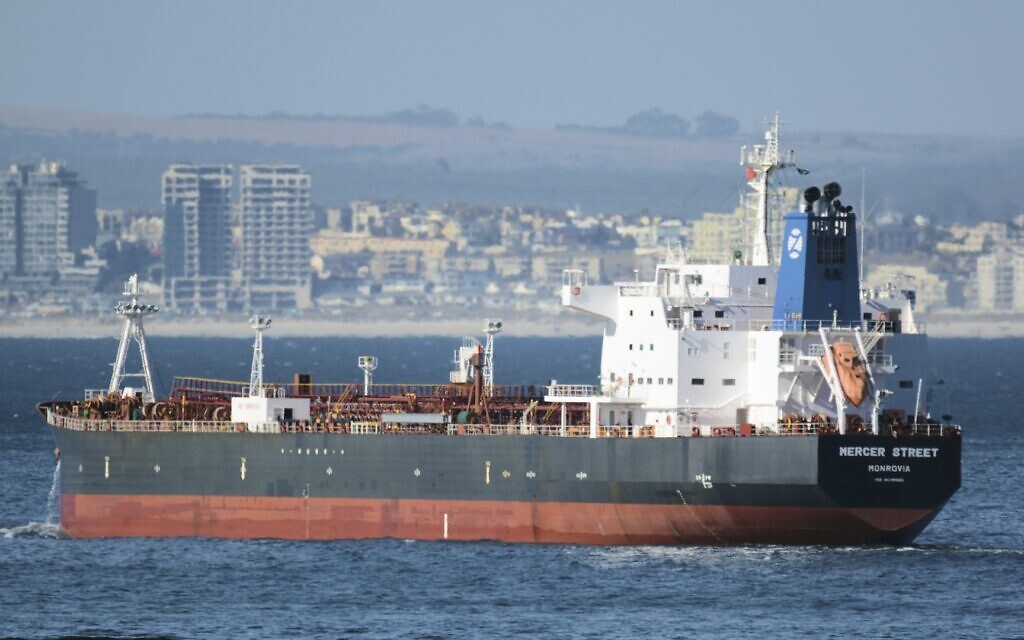
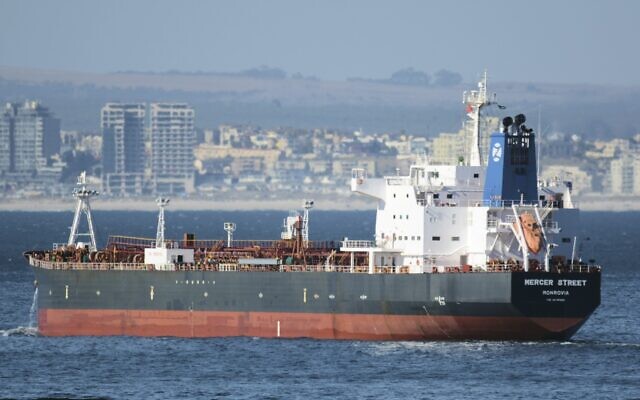
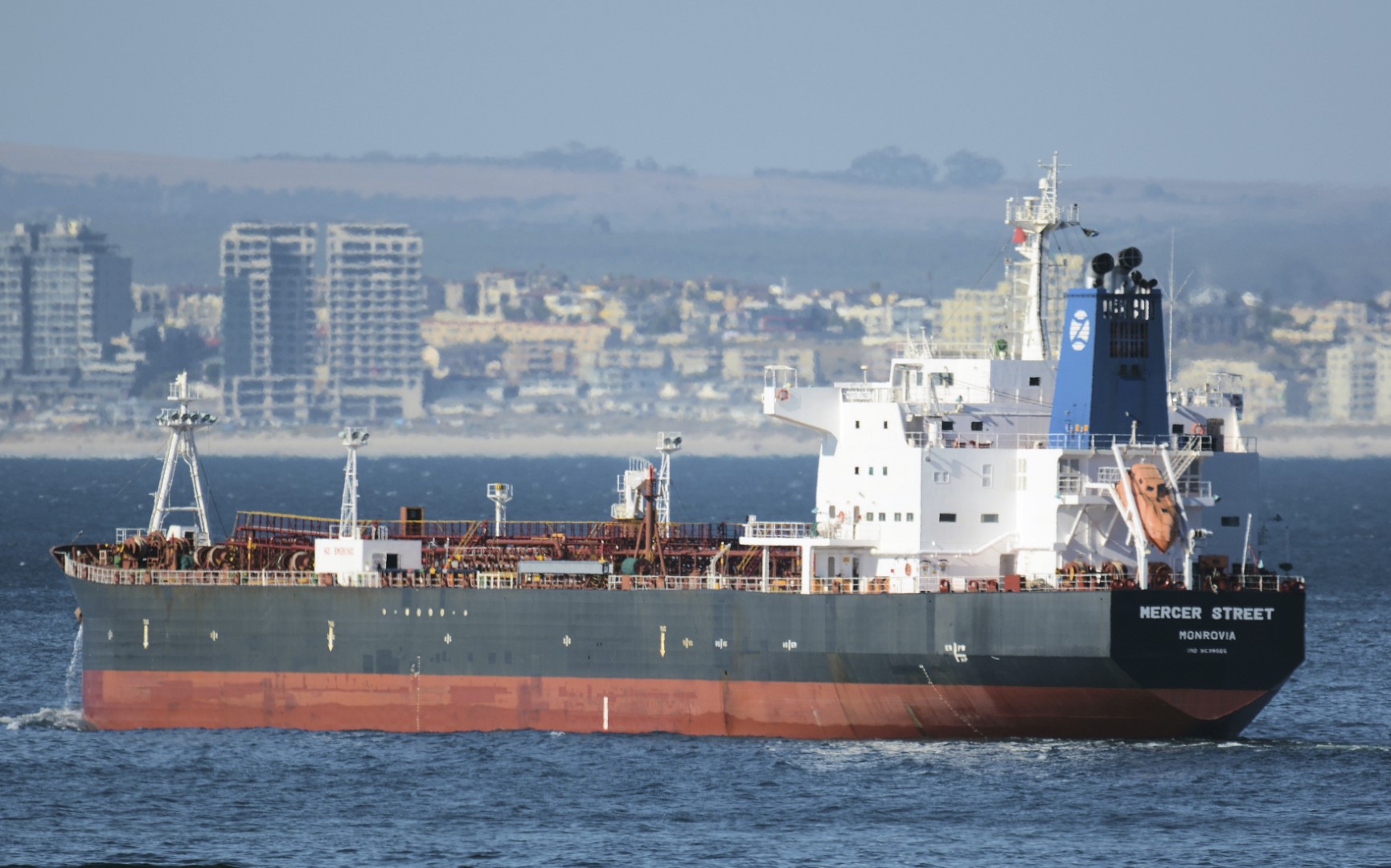
This Jan. 2, 2016 file photo shows the Liberian-flagged oil tanker Mercer Street off Cape Town, South Africa. (Johan Victor via AP)

This Jan. 2, 2016 file photo shows the Liberian-flagged oil tanker Mercer Street off Cape Town, South Africa. (Johan Victor via AP)

The once-covert maritime war between Israel and Iran seemed to escalate further on Thursday night, when an oil tanker operated by an Israeli-owned company was struck by armed drones off the coast of Oman.

Two ship crewmen, a British and a Romanian national, died in the attack on the Mercer Street, a ship operated by Zodiac Maritime, a London-based company belonging to Israeli tycoon Eyal Ofer.

Analysts said the attack bore all the hallmarks of tit-for-tat exchanges in the shadow war between Israel and Iran, in which vessels linked to each nation have been targeted in waters around the Gulf.

But the latest incident seemed like a significant and perhaps dangerous departure from the established rules of the game, in that it was the first known fatal attack after years of assaults on commercial shipping in the region.

The US and Britain followed Israel in blaming Iran for the attack, with US Secretary of State Antony Blinken promising Monday that “there will be a collective response.”Get The Times of Israel’s Daily Editionby email and never miss our top storiesNewsletter email addressGET ITBy signing up, you agree to the terms

Earlier Monday, Iran pledged that it would “not hesitate to protect its security and national interests, and will immediately and decisively respond to any possible adventurism.

Despite the widespread belief that Iran was directly responsible for the lethal strike, the attack should not be seen as a significant chapter in the long struggle between Iran and Israel. Nor should Israel expect major world powers to act militarily against Tehran, despite Blinken’s tough-sounding message.

“I don’t think it’s going to change the big picture,” said Yoel Guzansky, a senior research fellow at the Institute for National Security Studies in Tel Aviv.

Iran’s modus operandi

The attacks on Israel-linked ships come as Iran is being blamed for a parallel campaign against US forces in Iraq and western Syria. Bases housing US troops and contractors have been struck by missiles and drones launched by Iranian-backed militias in Iraq.

Iran has made sure to avoid any direct involvement in these low-level, rather unsophisticated strikes, and Islamic Revolutionary Guard Corps leader Esmail Ghaani was even said to have tried unsuccessfully to urge the militias to refrain from attacks on Americans until after the nuclear deal, known as the JCPOA, is reconstituted.In this photo released by the official website of the Office of the Iranian Supreme Leader, Gen. Esmail Ghaani, newly appointed commander of Iran’s Revolutionary Guards Quds Force, weeps while praying over the coffin of the force’s previous head Gen. Qassem Soleimani at the Tehran University Campus in Tehran, Iran on January 6, 2020. (Office of the Iranian Supreme Leader via AP)

“The shipping attacks are a bit different because they’re clearly carried out by the Iranians,” said Jack Watling, a research fellow at the Royal United Services Institute in the United Kingdom.

Though Iran vehemently denies any involvement in Thursday’s maritime strike, it has no proxies that could have carried it out. The only Iran-backed group that could operate drones that far south is the Houthis in Yemen, but they don’t have the means of carrying out such a sophisticated attack.

The Houthis do, however, have a record of claiming responsibility for drone and missiles attacks that were clearly the work of Iranian forces. The Houthis, for example, said they carried out the September 2019 Aramco strikes that temporarily cut Saudi oil production in half, but major world powers, as well as the Saudis, agreed it was an Iranian operation.

“The Houthis have a long history of activity where their claims don’t match up with what happened, where they’re claiming actions that the Iranians conducted,” Watling pointed out. “I think it’s pretty clear that Iran is responsible and not the Houthis in this case.”During a trip organized by the Saudi information ministry, workers fix the damage in Aramco’s oil separator at processing facility after the September 14 attack in Abqaiq, near Dammam in the Kingdom’s Eastern Province, September 20, 2019. (AP Photo/Amr Nabil)

“The Mercer Street attack marks the confluence of two trends in Iranian regional aggression: attacking commercial vessels at sea and using drones,” Ari Cicurel, a senior policy analyst at the Jewish Institute for National Security of America, told The Times of Israel.

“This latest attack represents a growing tendency by Iran and its proxies to use drones, particularly armed suicide drones across the Middle East, which are challenging for existing air defense systems to intercept,” he said.

It is unclear exactly what Iran was seeking to accomplish with the attack, though it seemed to fit an Iranian pattern of striking Israel-linked vessels in response to Israeli actions in Syria or at sea.

On February 26, a blast struck the Israeli-owned MV Helios Ray, a Bahamian-flagged cargo ship, in the Gulf of Oman. The operation seemed to have been carefully planned, and mirrored a series of attacks on tankers in 2019 and an Iranian campaign against shipping vessels four decades ago.This picture taken on February 28, 2021 shows a view of the Israeli-owned Bahamian-flagged MV Helios Ray cargo ship docked in Dubai’s Mina Rashid (Port Rashid) cruise terminal. (Giuseppe CACACE / AFP)

In subsequent months, other Israeli-owned ships came under missile fire in the Indian Ocean.

The Mercer Street strike would appear to fit that pattern.

Tehran certainly didn’t intend to sink the Mercer Street, as the drones carried a small payload and targeted the superstructure, not the hull, of the ship, similar to the strikes against other Israel-linked ships.

The attack might also have been influenced by the stalled Vienna nuclear talks.

“Iranian projectile attacks seek to increase Tehran’s influence in the Middle East and pressure the United States to reenter the JCPOA,” said Cicurel. “With a hardline Iranian president taking office, Iran may be testing the resolve of the new Israeli government, as well as the UK and US governments.”File: Russia’s envoy to the International Atomic Energy Agency (IAEA), Mikhail Ulyanov, stands in front of the Grand Hotel Vienna where closed-door nuclear talks with Iran take place, in Vienna, Austria, Wednesday, June 2, 2021. (AP Photo/Lisa Leutner)

Iran and the US have been holding indirect talks in Vienna since April over a return to the 2015 deal, which granted Tehran sanctions relief in exchange for significant curbs on its nuclear program.

The sixth round of talks adjourned in late June, and while the Biden administration has expressed interest in returning to the negotiating table, US officials have voiced increasing pessimism regarding the chances for an agreement.

There is also the possibility that the drone strike was not part of a broad Iranian strategy. The Iranian system is not especially well-integrated, especially between the executive branch and the IRGC, and attacks have been carried out in the past without the knowledge of the president.

The queen’s gambit

The Mercer Street is managed by a London-based company, but it is unlikely that Iran was looking to specifically target the UK.

Because the attack killed a British citizen, London will be forced to respond in some way. Still, based on past incidents, Israel should not anticipate a kinetic attack by UK forces.Iranian Revolutionary Guards patrol around the British-flagged tanker Stena Impero while it is anchored off the Iranian port city of Bandar Abbas, on July 21, 2019. (Hasan Shirvani / MIZAN NEWS AGENCY / AFP)

In July 2019, the IRGC navy seized a British tanker — ignoring warnings from a British warship — and held it for two months. The UK did not strike Iran militarily in response to the brazen move.

Nor did the British military act when 15 Royal Navy personnel were seized by Iranian forces in the Persian Gulf in 2007.

If the British do act, it will likely be in the diplomatic or economic spheres.

“In the UK’s case, there is a preference to say that if you cause the UK problems in one area, we will demonstrate a capacity to cause you problems in a seemingly unrelated area,” Watling explained.

The Biden administration isn’t likely to act either, according to Guzansky, who said, “I don’t see the climate right now. Bear in mind there are the negotiations in Vienna.”

“The public statements [about Iranian complicity] may be about providing a green light for an Israeli response,” said Cicurel.

Israel’s options

Israel, however, has shown that it is willing to strike Iranian assets and allies in Syria, and even at sea — a form of deterrence by punishment.

“Unlike the UK, Israel is quite comfortable engaging in this type of behavior,” said Watling.Screen capture from video said to show the Iranian ship MV Saviz, on fire following an explosion as it was anchored off the coast of Yemen. (Screenshot: Twitter)

In March, the Wall Street Journal reported that Israel has targeted at least 12 ships bound for Syria, most of them transporting Iranian oil, with mines and other weapons, starting in late 2019.

Israel is also believed to be behind the April attack on the Saviz in the Red Sea,  described as an IRGC “mothership.”

But this attack won’t necessarily lead to another retaliatory strike by Israel on Iranian shipping.

“I don’t get a sense at the moment that the Israeli government feels that this is beyond acceptable,” said Watling.

Moreover, while Israel’s operations in Syria seem to have forced decision-makers in Tehran to accept that they would be wise to avoid attacking Israeli soldiers and infrastructure from across the border, the Persian Gulf and Gulf of Oman are different stories entirely.An Israeli Navy Dolphin-class submarine. (Moshe Shai/Flash90)

Israel has little capacity – beyond submarines — to project power there, while Iran has invested heavily in pursuing hegemony over the seas in its neighborhood, including the Strait of Hormuz, a key shipping lane.

“The experience that we have is that the Iranians are not hesitating to escalate in an area where the Israeli Navy has no capability to operate,” said Prof. Shaul Chorev, head of the University Of Haifa’s Maritime Policy & Strategy Research Center.

“It’s a bit of an overstretch,” said Guzansky. “I would advise Israel to leave it. Iran made a mistake and it will pay for it in the international arena.”

So far, Israel is pursuing the diplomatic avenue aggressively.

On Friday, Lapid said he had ordered Israeli diplomats to push for UN action against “Iranian terrorism.”

“I’ve instructed the embassies in Washington, London and the UN to work with their interlocutors in government and the relevant delegations in the UN headquarters in New York,” Lapid said on Twitter.

Marshalling a firm international response would be a major achievement by the Lapid-Bennett government. But with the Vienna talks looking increasingly fragile, many world powers have bigger issues on their minds.

US, UK know Iran attacked oil tanker, but are unlikely to strike back

August 3, 2021

Blinken promises a ‘collective response,’ but any military reaction will have to come from Israel

Lazar Berman

By LAZAR BERMANToday, 4:01 am  

This Jan. 2, 2016 file photo shows the Liberian-flagged oil tanker Mercer Street off Cape Town, South Africa. (Johan Victor via AP)

This Jan. 2, 2016 file photo shows the Liberian-flagged oil tanker Mercer Street off Cape Town, South Africa. (Johan Victor via AP)

The once-covert maritime war between Israel and Iran seemed to escalate further on Thursday night, when an oil tanker operated by an Israeli-owned company was struck by armed drones off the coast of Oman.

Two ship crewmen, a British and a Romanian national, died in the attack on the Mercer Street, a ship operated by Zodiac Maritime, a London-based company belonging to Israeli tycoon Eyal Ofer.

Analysts said the attack bore all the hallmarks of tit-for-tat exchanges in the shadow war between Israel and Iran, in which vessels linked to each nation have been targeted in waters around the Gulf.

But the latest incident seemed like a significant and perhaps dangerous departure from the established rules of the game, in that it was the first known fatal attack after years of assaults on commercial shipping in the region.

The US and Britain followed Israel in blaming Iran for the attack, with US Secretary of State Antony Blinken promising Monday that “there will be a collective response.”Get The Times of Israel’s Daily Editionby email and never miss our top storiesNewsletter email addressGET ITBy signing up, you agree to the terms

Earlier Monday, Iran pledged that it would “not hesitate to protect its security and national interests, and will immediately and decisively respond to any possible adventurism.

Despite the widespread belief that Iran was directly responsible for the lethal strike, the attack should not be seen as a significant chapter in the long struggle between Iran and Israel. Nor should Israel expect major world powers to act militarily against Tehran, despite Blinken’s tough-sounding message.

“I don’t think it’s going to change the big picture,” said Yoel Guzansky, a senior research fellow at the Institute for National Security Studies in Tel Aviv.

Iran’s modus operandi

The attacks on Israel-linked ships come as Iran is being blamed for a parallel campaign against US forces in Iraq and western Syria. Bases housing US troops and contractors have been struck by missiles and drones launched by Iranian-backed militias in Iraq.

Iran has made sure to avoid any direct involvement in these low-level, rather unsophisticated strikes, and Islamic Revolutionary Guard Corps leader Esmail Ghaani was even said to have tried unsuccessfully to urge the militias to refrain from attacks on Americans until after the nuclear deal, known as the JCPOA, is reconstituted.In this photo released by the official website of the Office of the Iranian Supreme Leader, Gen. Esmail Ghaani, newly appointed commander of Iran’s Revolutionary Guards Quds Force, weeps while praying over the coffin of the force’s previous head Gen. Qassem Soleimani at the Tehran University Campus in Tehran, Iran on January 6, 2020. (Office of the Iranian Supreme Leader via AP)

“The shipping attacks are a bit different because they’re clearly carried out by the Iranians,” said Jack Watling, a research fellow at the Royal United Services Institute in the United Kingdom.

Though Iran vehemently denies any involvement in Thursday’s maritime strike, it has no proxies that could have carried it out. The only Iran-backed group that could operate drones that far south is the Houthis in Yemen, but they don’t have the means of carrying out such a sophisticated attack.

The Houthis do, however, have a record of claiming responsibility for drone and missiles attacks that were clearly the work of Iranian forces. The Houthis, for example, said they carried out the September 2019 Aramco strikes that temporarily cut Saudi oil production in half, but major world powers, as well as the Saudis, agreed it was an Iranian operation.

“The Houthis have a long history of activity where their claims don’t match up with what happened, where they’re claiming actions that the Iranians conducted,” Watling pointed out. “I think it’s pretty clear that Iran is responsible and not the Houthis in this case.”During a trip organized by the Saudi information ministry, workers fix the damage in Aramco’s oil separator at processing facility after the September 14 attack in Abqaiq, near Dammam in the Kingdom’s Eastern Province, September 20, 2019. (AP Photo/Amr Nabil)

“The Mercer Street attack marks the confluence of two trends in Iranian regional aggression: attacking commercial vessels at sea and using drones,” Ari Cicurel, a senior policy analyst at the Jewish Institute for National Security of America, told The Times of Israel.

“This latest attack represents a growing tendency by Iran and its proxies to use drones, particularly armed suicide drones across the Middle East, which are challenging for existing air defense systems to intercept,” he said.

It is unclear exactly what Iran was seeking to accomplish with the attack, though it seemed to fit an Iranian pattern of striking Israel-linked vessels in response to Israeli actions in Syria or at sea.

On February 26, a blast struck the Israeli-owned MV Helios Ray, a Bahamian-flagged cargo ship, in the Gulf of Oman. The operation seemed to have been carefully planned, and mirrored a series of attacks on tankers in 2019 and an Iranian campaign against shipping vessels four decades ago.This picture taken on February 28, 2021 shows a view of the Israeli-owned Bahamian-flagged MV Helios Ray cargo ship docked in Dubai’s Mina Rashid (Port Rashid) cruise terminal. (Giuseppe CACACE / AFP)

In subsequent months, other Israeli-owned ships came under missile fire in the Indian Ocean.

The Mercer Street strike would appear to fit that pattern.

Tehran certainly didn’t intend to sink the Mercer Street, as the drones carried a small payload and targeted the superstructure, not the hull, of the ship, similar to the strikes against other Israel-linked ships.

The attack might also have been influenced by the stalled Vienna nuclear talks.

“Iranian projectile attacks seek to increase Tehran’s influence in the Middle East and pressure the United States to reenter the JCPOA,” said Cicurel. “With a hardline Iranian president taking office, Iran may be testing the resolve of the new Israeli government, as well as the UK and US governments.”File: Russia’s envoy to the International Atomic Energy Agency (IAEA), Mikhail Ulyanov, stands in front of the Grand Hotel Vienna where closed-door nuclear talks with Iran take place, in Vienna, Austria, Wednesday, June 2, 2021. (AP Photo/Lisa Leutner)

Iran and the US have been holding indirect talks in Vienna since April over a return to the 2015 deal, which granted Tehran sanctions relief in exchange for significant curbs on its nuclear program.

The sixth round of talks adjourned in late June, and while the Biden administration has expressed interest in returning to the negotiating table, US officials have voiced increasing pessimism regarding the chances for an agreement.

There is also the possibility that the drone strike was not part of a broad Iranian strategy. The Iranian system is not especially well-integrated, especially between the executive branch and the IRGC, and attacks have been carried out in the past without the knowledge of the president.

The queen’s gambit

The Mercer Street is managed by a London-based company, but it is unlikely that Iran was looking to specifically target the UK.

Because the attack killed a British citizen, London will be forced to respond in some way. Still, based on past incidents, Israel should not anticipate a kinetic attack by UK forces.Iranian Revolutionary Guards patrol around the British-flagged tanker Stena Impero while it is anchored off the Iranian port city of Bandar Abbas, on July 21, 2019. (Hasan Shirvani / MIZAN NEWS AGENCY / AFP)

In July 2019, the IRGC navy seized a British tanker — ignoring warnings from a British warship — and held it for two months. The UK did not strike Iran militarily in response to the brazen move.

Nor did the British military act when 15 Royal Navy personnel were seized by Iranian forces in the Persian Gulf in 2007.

If the British do act, it will likely be in the diplomatic or economic spheres.

“In the UK’s case, there is a preference to say that if you cause the UK problems in one area, we will demonstrate a capacity to cause you problems in a seemingly unrelated area,” Watling explained.

The Biden administration isn’t likely to act either, according to Guzansky, who said, “I don’t see the climate right now. Bear in mind there are the negotiations in Vienna.”

“The public statements [about Iranian complicity] may be about providing a green light for an Israeli response,” said Cicurel.

Israel’s options

Israel, however, has shown that it is willing to strike Iranian assets and allies in Syria, and even at sea — a form of deterrence by punishment.

“Unlike the UK, Israel is quite comfortable engaging in this type of behavior,” said Watling.Screen capture from video said to show the Iranian ship MV Saviz, on fire following an explosion as it was anchored off the coast of Yemen. (Screenshot: Twitter)

In March, the Wall Street Journal reported that Israel has targeted at least 12 ships bound for Syria, most of them transporting Iranian oil, with mines and other weapons, starting in late 2019.

Israel is also believed to be behind the April attack on the Saviz in the Red Sea,  described as an IRGC “mothership.”

But this attack won’t necessarily lead to another retaliatory strike by Israel on Iranian shipping.

“I don’t get a sense at the moment that the Israeli government feels that this is beyond acceptable,” said Watling.

Moreover, while Israel’s operations in Syria seem to have forced decision-makers in Tehran to accept that they would be wise to avoid attacking Israeli soldiers and infrastructure from across the border, the Persian Gulf and Gulf of Oman are different stories entirely.An Israeli Navy Dolphin-class submarine. (Moshe Shai/Flash90)

Israel has little capacity – beyond submarines — to project power there, while Iran has invested heavily in pursuing hegemony over the seas in its neighborhood, including the Strait of Hormuz, a key shipping lane.

“The experience that we have is that the Iranians are not hesitating to escalate in an area where the Israeli Navy has no capability to operate,” said Prof. Shaul Chorev, head of the University Of Haifa’s Maritime Policy & Strategy Research Center.

“It’s a bit of an overstretch,” said Guzansky. “I would advise Israel to leave it. Iran made a mistake and it will pay for it in the international arena.”

So far, Israel is pursuing the diplomatic avenue aggressively.

On Friday, Lapid said he had ordered Israeli diplomats to push for UN action against “Iranian terrorism.”

“I’ve instructed the embassies in Washington, London and the UN to work with their interlocutors in government and the relevant delegations in the UN headquarters in New York,” Lapid said on Twitter.

Marshalling a firm international response would be a major achievement by the Lapid-Bennett government. But with the Vienna talks looking increasingly fragile, many world powers have bigger issues on their minds.

Iran warns it will respond to any action over tanker attack

August 2, 2021

Tehran dismisses UK, US comments linking it to drone strike; Britain summons Iranian ambassador over incident

By AFP and TOI STAFFToday, 5:03 pm  

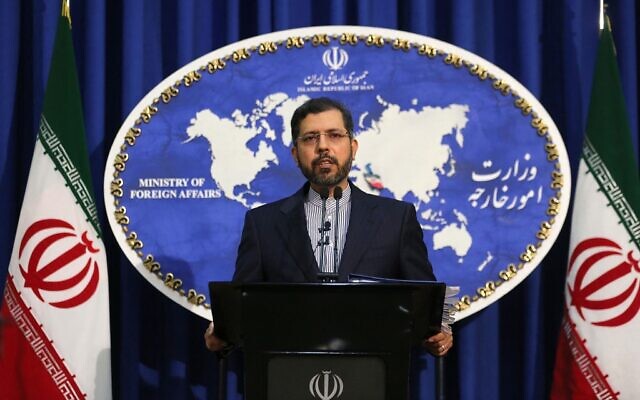
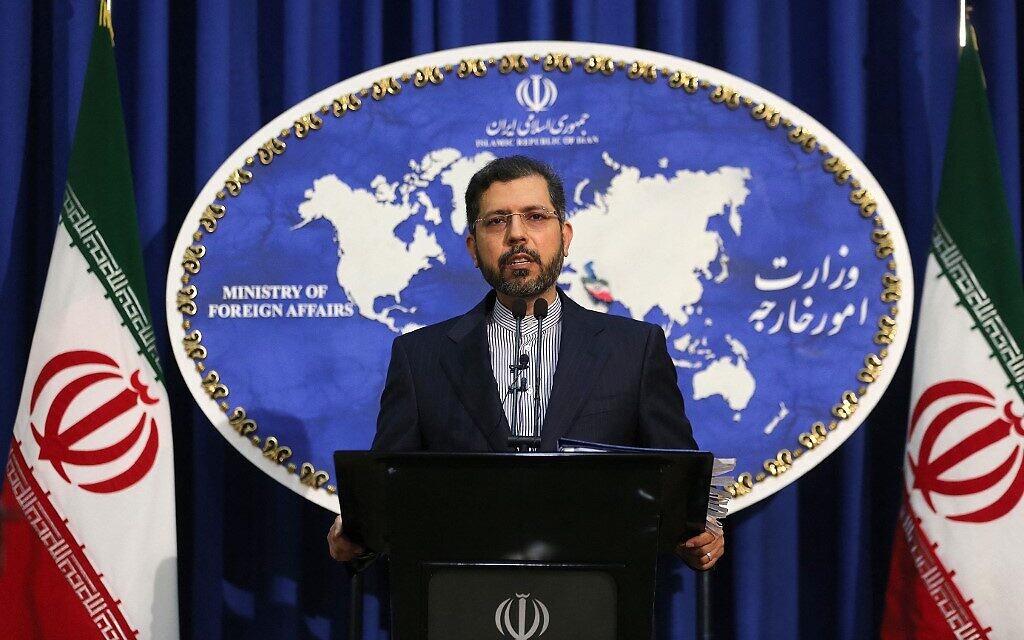
Iranian Foreign Ministry spokesman Saeed Khatibzadeh during a press conference in Tehran, on February 22, 2021. (Atta Kenare / AFP)

Iranian Foreign Ministry spokesman Saeed Khatibzadeh during a press conference in Tehran, on February 22, 2021. (Atta Kenare / AFP)

Iran on Monday vowed to respond to any “adventurism” after the US and Britain joined Israel in blaming Tehran for a deadly tanker attack, claims it denies.

Iran “will not hesitate to protect its security and national interests, and will immediately and decisively respond to any possible adventurism,” Iran’s foreign ministry spokesman Saeed Khatibzadeh said in a statement.

He dismissed US and Britain’s allegations as “contradictory,” and said that “if they have any evidence to support their baseless claims they should provide them.”

The MT Mercer Street, managed by prominent Israeli billionaire Eyal Ofer, was attacked on Thursday off Oman.

A British security guard and a Romanian crew member were killed in what the United States, Britain, and the vessel’s operator Zodiac Maritime said appeared to be a drone strike.Get The Times of Israel’s Daily Editionby email and never miss our top storiesNewsletter email addressGET ITBy signing up, you agree to the terms

Israel blamed Iran for the attack, accusations rejected by Tehran.

Khatibzadeh said Sunday that Israel “must stop such baseless accusations.”

The US and Britain followed Israel in blaming Iran for the attack, with Washington vowing an “appropriate response

Khatibzadeh on Monday accused the US and UK of effectively supporting “terrorist attacks against and sabotage of Iran’s commercial ships” through their “silence.”

Britain summoned Iran’s ambassador to London in response to the tanker attack.

“The Iranian ambassador to the UK, Mohsen Baharvand, was summoned today to the Foreign, Commonwealth & Development Office… in response to the unlawful attack committed on MV Mercer Street on 29 July,” said a Monday British government statement.

“Iran must immediately cease actions that risk international peace and security,” it added, saying that “vessels must be allowed to navigate freely in accordance with international law.”

Foreign Secretary Dominic Raab said on Sunday that Britain “believes the attack… was carried out by Iran and was deliberate, targeted and unlawful.”

Romania as well pinned responsibility on Iran for the drone attack that killed one of its citizens.

This Jan. 2, 2016 file photo shows the Liberian-flagged oil tanker Mercer Street off Cape Town, South Africa. (Johan Victor via AP)

“There is no justification whatsoever for deliberately attacking civilians. We continue to coordinate with our partners for an appropriate response,” Romanian Foreign Minister Bogdan Aurescu said in a statement on Monday.

The Iranian ambassador was summoned to the foreign ministry in Bucharest, according to Romania’s national news agency.

US Navy forces came to the aid of the crew in response to an emergency distress call and saw evidence of the attack, said a US military statement.

Analysts said the attack bore all the hallmarks of tit-for-tat exchanges in the “shadow war” between Israel and Iran, in which vessels linked to each nation have been targeted in waters around the Gulf.

The MT Mercer Street was in the northern Indian Ocean, traveling from Dar es Salaam in Tanzania to Fujairah in the United Arab Emirates with no cargo on board when the attack occurred.

Iran’s state TV channel in Arabic Al-Alam, citing “informed regional sources,” said the attack was a “response to a recent Israeli attack” targeting an airport in central Syria. It did not provide further details.

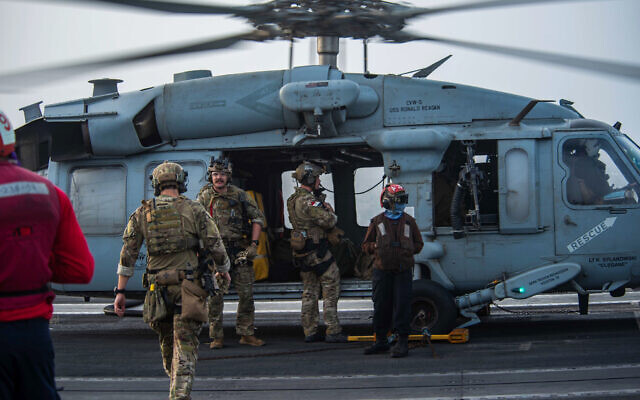
In this photo provided by the US Navy, sailors assigned to an explosive ordnance unit board an MH-60S Seahawk helicopter on the flight deck of aircraft carrier USS Ronald Reagan to head to an oil tanker that was attacked off the coast of Oman in the Arabian Sea on July 30, 2021 (Mass Communication Specialist 2nd Class Quinton A. Lee/U.S. Navy, via AP)

There have been several recent reported attacks on Iranian ships that Tehran has blamed on Israel.

Iranian Vice President Eshaq Jahangiri said on Monday that over a dozen Iranian tankers had been damaged by US and Israeli bomb attacks during the time Donald Trump was serving as US president.

“Trump and his team stood to prevent us from selling even one barrel of oil,” Jahangiri said, according to the Iranian Fars news agency. “They exploded or damaged 12 of our oil tankers. The Israelis stepped onto one of our oil tankers and exploded it.”

In March, Iran said it was “considering all options” after an attack on a cargo ship in the Mediterranean that it blamed on Israel.

In April, Tehran said its freighter Saviz was hit by an “explosion” in the Red Sea, after media reports said Israel had targeted the ship. The New York Times reported at the time that it was an Israeli “retaliatory” attack, after “Iran’s earlier strikes on Israeli ships.”

Iran has also accused Israel of sabotaging its nuclear sites and killing a number of its nuclear scientists.