Archive for May 11, 2021
Yet another deepening round of conflict shows Israel still unable to deter Hamas
May 11, 2021Gaza’s terror chiefs manifestly have no compunction in sowing devastation in Israel ‘every Monday and Thursday,’ notes a former national security adviser, pleading for a rethink

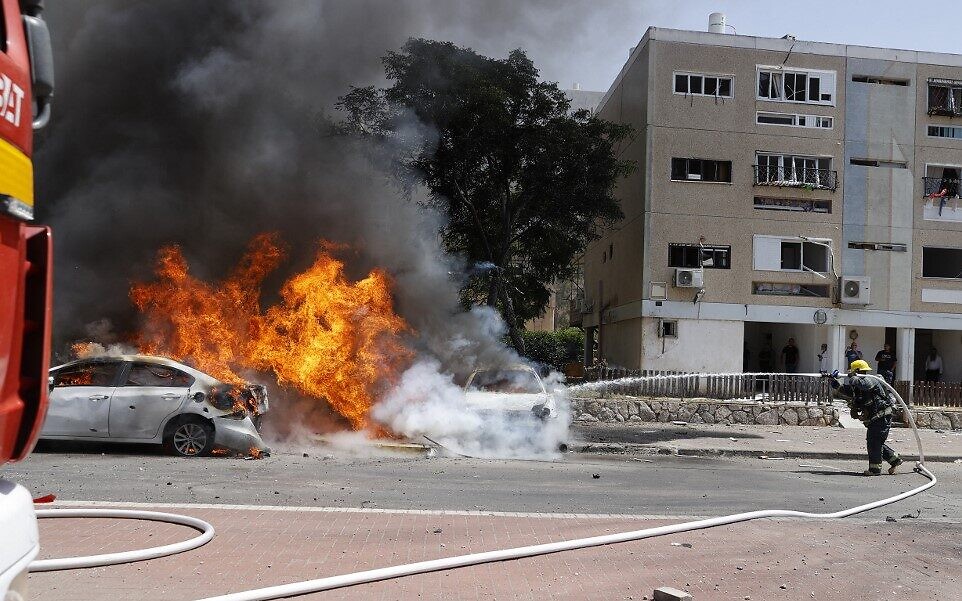
An Israeli firefighter extinguishes a burning vehicle after a rocket launched from the Hamas-run Gaza Strip hit the southern Israeli city of Ashkelon on May 11, 2021. (JACK GUEZ / AFP)
Much of the grisly escalation of violence into which we have been plunged starting with Hamas’s rocket barrage at Jerusalem at 6 p.m. last night is dismally familiar from the years of previous conflicts since the Islamist terror group forced out Mahmoud Abbas’s Fatah forces from Gaza in 2007.
Israel is being battered by incessant rocket fire, spreading death, destruction and panic through a widening swath of southern Israel. The IDF is hitting back in Gaza, targeting Hamas and other terror groups’ installations, rocket launch teams, and numerous terror commanders. The battle over the narrative is in full sway, with Hamas bragging of the indiscriminate harm it is wreaking in Israel while simultaneously protesting the Israeli counterstrikes. The Hamas-run Health Ministry in Gaza is highlighting what it says are the deaths of children in IDF strikes, while the Israeli army declines to comment on specific incidents but says at least some of the Gaza civilian fatalities, including children, were caused by the terror groups’ own rockets misfiring or landing inside the Strip.
In Ashdod, Ashkelon and beyond on Tuesday, families run for cover, shelter with their crying babies in the stairwells of buildings many of which still are not equipped with bomb shelters. Radio and TV reports on the injury and damage from the last strike are interrupted by warning sirens signaling the next incoming barrage.

A medic carries a wounded child from an apartment building in Ashkelon hit by a rocket fired from the Gaza Strip on May 11, 2021 (Flash90)
Familiar, too, is the Israeli political and military leadership quandary: Though Hamas knows the IDF will hit back from the air, it is plainly not deterred from the frequent battering of the Israeli home front with its rocket fire. An Israeli resort to a ground offensive could prove more of a deterrent but would lead without question to greater loss of Israeli life, and might not achieve any definitive, long-lasting success. A full-scale Israeli effort to reconquer Gaza and oust Hamas would be immensely complex and deadly, and its gains would be reversed the moment the IDF pulled back — thereby necessitating a semi-permanent military presence that successive Israeli governments have adamantly rejected.
On Monday evening, the IDF gave this round of conflict a formal name — “Operation Guardian of the Walls” — suggesting, perhaps, that it does not anticipate the hostilities ending in the very near future. But the path to long-term or even medium-term calm remains as elusive as ever.
Said the former Mossad and military officer Sima Shine in a Tuesday afternoon Channel 12 interview, soon after the first two Israeli fatalities were confirmed, “There is no policy.”
The differences
There are some telling differences in the violence and its context this time, however.
Militarily, Hamas claims to have improved its rocket capabilities. Israel has gradually improved and broadened its range of rocket defenses, notably Iron Dome. But Hamas, as far as can be assessed, no longer has the secret weapon it invested so much of Gaza’s scant resources in developing — its terrorist tunnels under the Israeli border. Israel’s underground barrier along the border would appear to have neutered that pernicious threat.
Politically, Hamas is plainly widening its effort to eclipse Abbas’s Palestinian Authority as the main representative of the Palestinian people and cause. The escalation of hostilities has seemingly been triggered by Jerusalem-centered controversies, including the looming evictions of Palestinian families from the Sheikh Jarrah neighborhood, and — most significantly — Hamas assertion of responsibility as the protector of the Al-Aqsa compound atop the Temple Mount. (Its Monday night rocket fire followed the expiration of its self-styled “ultimatum” demanding that Israel remove its security forces from the compound — the holiest place in Judaism, and site of the third-holiest shrine in Islam.) The Islamists, recognizing that Abbas canceled this month’s planned Palestinian parliamentary elections, and July’s presidential vote, because he knew he would lose, are seeking a victory nonetheless: rendering the PA irrelevant on the ground, having been denied the opportunity to do so at the ballot box.
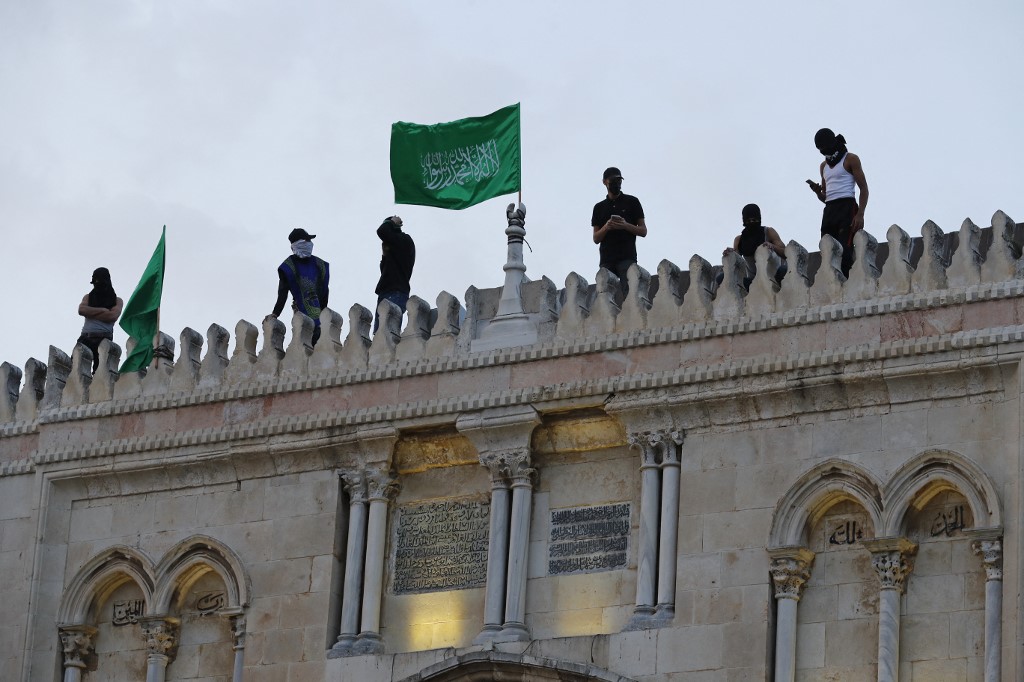
Palestinians place Hamas flags atop al-Aqsa mosque in Jerusalem’s Old City on May 10, 2021. (Ahmad GHARABLI / AFP)
Politically for Israel, the timing of this escalation could prove momentous. The diverse array of anti-Benjamin Netanyahu parties, led by Yamina’s Naftali Bennett and Yesh Atid’s Yair Lapid, were reportedly hoping to complete negotiations on a majority government on Monday evening, with a crucial meeting planned with Mansour Abbas, leader of the Ra’am party, whose support is vital for a majority.
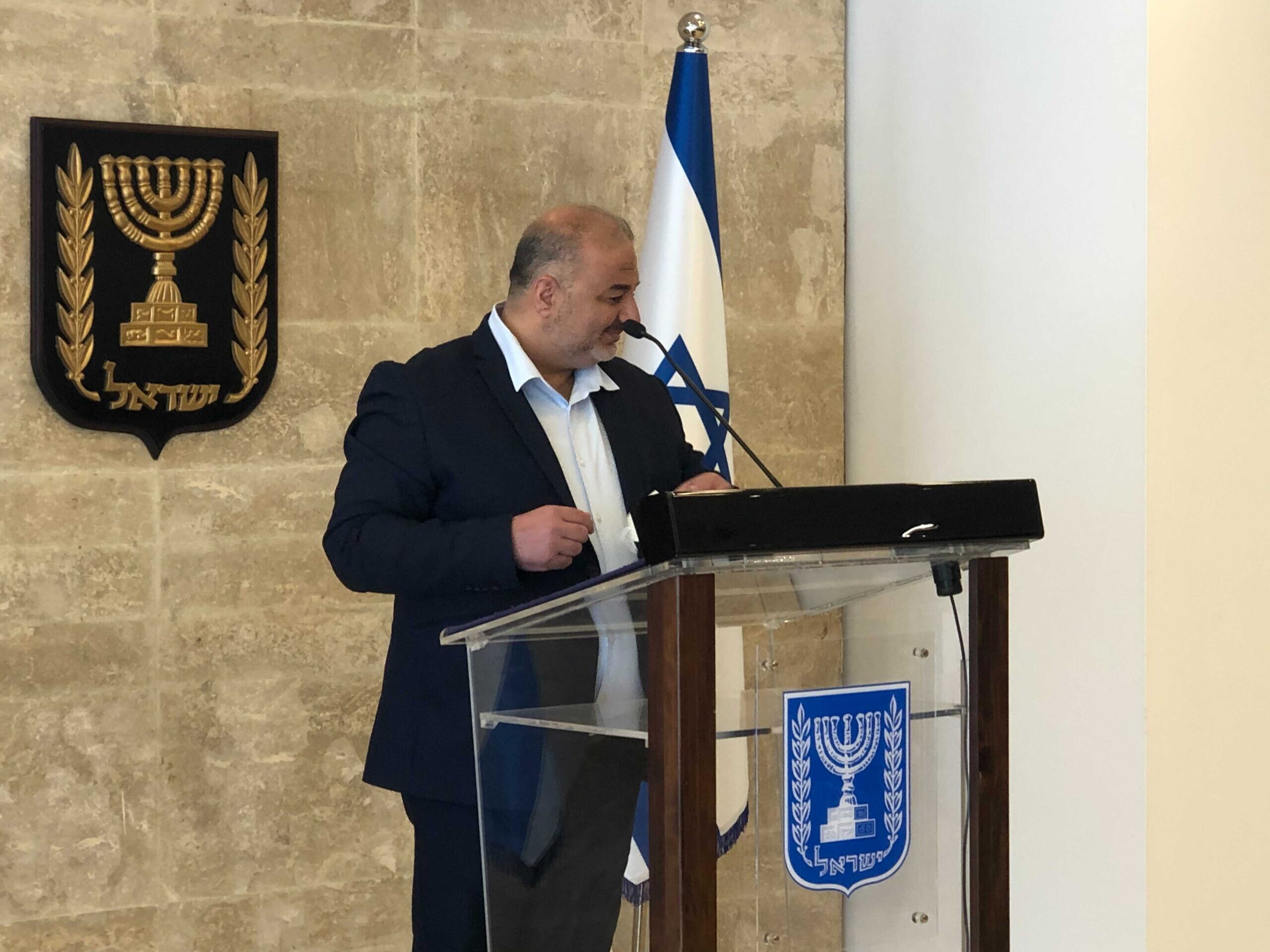
Ra’am party chief Mansour Abbas speaks with reporters, April 19, 2021 (Tal Schneider/Zman Yisrael)
But the Ra’am leader, who has been calling for improved relations between Jews and Arabs in Israel, canceled that meeting because he apparently saw himself in an increasingly untenable position: One of the other atypical characteristics of this round of violence is the degree to which some in the Arab Israeli community are overtly joining the anti-Israel chorus — coming to Jerusalem to participate in protests and riots and, over the last few days, demonstrating and rioting in Arab and Jewish-Arab cities all over northern and central Israel.
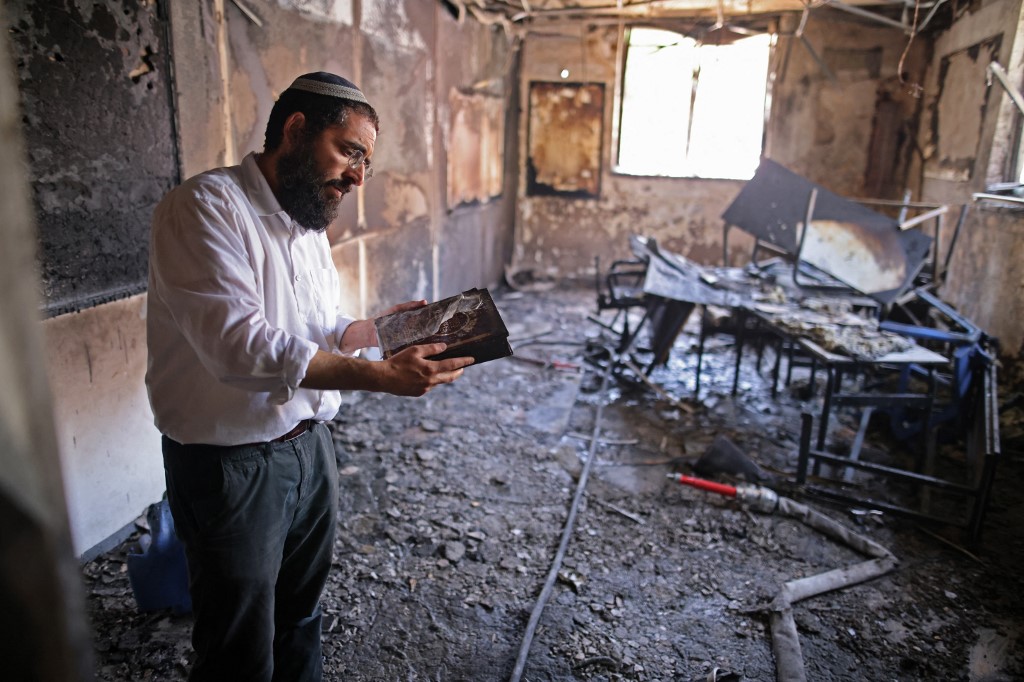
A rabbi inspects the damage inside a religious school in the central Israeli city of Lod, on May 11, 2021. The school was allegedly torched by a mob of local Arab residents on the night of May 10. (Ahmad GHARABLI / AFP)
Alternative thinking
Former national security adviser and ex-IDF operations chief Giora Eiland noted on Tuesday afternoon that since Hamas is plainly not deterred from launching rocket attacks on Israel “every Monday and Thursday,” and since Israel is evidently disinclined to reconquer the Strip, the Israeli government needs to at least consider alternate tactics and strategies.
His specific suggestion, he told this writer in a brief telephone interview, is that Israel acknowledge that Gaza meets the formal definitions of a state — since Hamas has control of defined territory, a centralized governing hierarchy, independent foreign policy, and an army — and begin treating it as such.

Giora Eiland (Kai Mörk / Munich Security Conference / via Wikipedia)
Elaborating, he noted that Hezbollah has not attacked Israel since 2006 because it has too much to lose in Lebanon, where it is at the core of the government and would be blamed by the populace if it invited Israeli counterattacks on Lebanon’s national infrastructure.
Gaza is so impoverished, and so lacking in national infrastructure, that its Hamas government can afford to attack Israel with abandon, Eiland said, knowing that Gaza has nothing to lose in the inevitable Israeli counterstrikes and that its people will not blame it for precipitating the conflict. Were Israel in a first step, by contrast, to encourage, say, France to build a power plant for Gaza that would ensure 24-hour electricity in the Strip, Hamas might think twice about attacking Israel during its construction, knowing that the French engineers would flee, the under-construction plant would be leveled by the IAF, and the Gazan public would hold its Hamas government responsible.
“I’ve been saying this kind of thing for about seven years,” said Eiland, “but what’s most important is not whether this particular idea is right or wrong, but that the Israeli government and leadership consider such alternatives. And I can tell you, on good authority, that no such intensive discussion has been held for years” on how to handle Gaza.
“Instead of choosing the best alternative, we just keep returning to the default option.”
Which, all too plainly, isn’t working.
PM says Hamas to suffer ‘unexpected blows’ after 2 Israelis killed from rockets
May 11, 2021Gaza terrorists fire over 250 rockets into Israel in less than 24 hours. Hamas threatens to turn Ashkelon “into hell,” says will use “new weapons” in further escalation. Defense Minister Gantz greenlights IDF plans for a wide-scale assault on terror targets in the Strip.
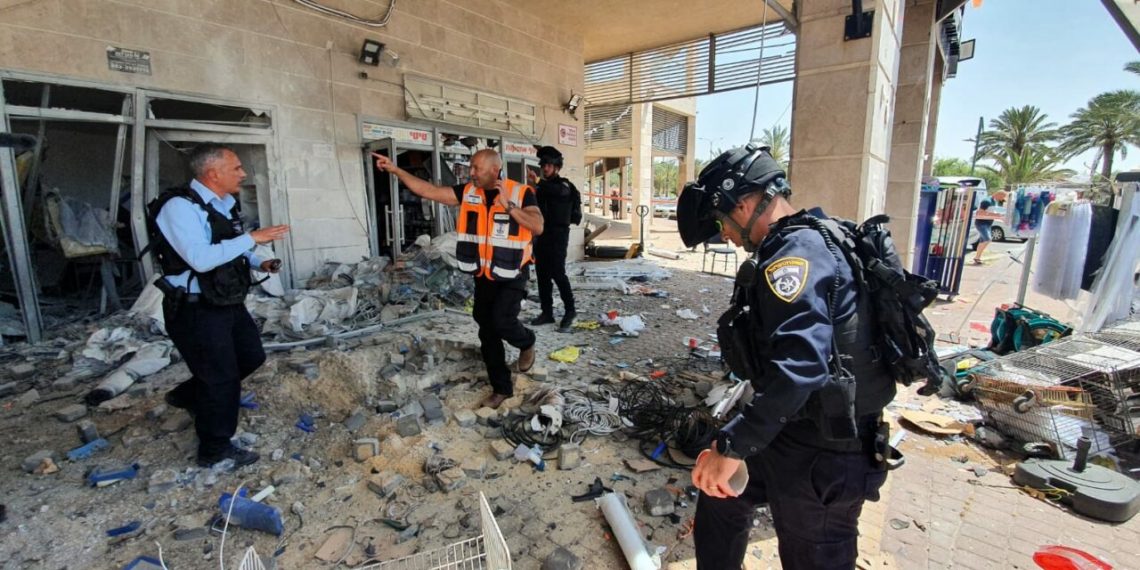
Israeli first responders at the scene of a rocket hit in southern Israel, May 11, 2021 | Photo: Israel Police
Prime Minister Benjamin Netanyahu visited the Israel Defense Forces Southern Command on Tuesday hours after Hamas and other terrorist groups started firing incessant barrages on Israeli communities from the Gaza Strip.
Speaking at the command headquarters, Netanyahu said, “We will increase our strikes and their intensity; Hamas will be dealt unexpected blows.”
Netanyahu added that the IDF has carried out “hundreds of attacks against Hamas and the Palestinian Islamic Jihad” and noted that Israel “has assassinated commanders and hit many high-quality targets” in the first 2 days of Operation Guardian of the Wall, which began on Monday.
Two civilians were killed in Ashkelon following a massive barrage around noon on Tuesday, Israeli first responders said following the rocket attacks from Gaza.
The cities of Ashkelon and Ashdod were hit with dozens of rockets from 1 p.m. onwards until roughly 2 p.m., resulting in some casualties, mostly treated for minor injuries and shock, as well as direct hits on various buildings, as well as a school in Ashkelon, whose residents were told to remain in shelter until further notice.
Defense Minister Benny Gantz on Tuesday greenlighted the IDF’s plans for continued airstrikes on terrorist targets in the Gaza Strip following a massive rocket barrage on Israel’s south. He further signed off on calling up 5,000 reservists as the military campaign may expand in the coming days.
Hamas and Palestinian Islamic Jihad (PIJ) fired over 250 rockets into Israel since Monday night, as the Israeli military mounted multiple strikes against Hamas positions as well as hubs operated by other terrorist groups in the coastal enclave, killing 15 terrorists and destroying over 130 targets as of Tuesday morning.
The IDF said that the targets destroyed included weapon mills, several arsenals, training facilities, two terror tunnels, a Hamas intelligence-gathering office, and the home of a senior Hamas operative. The military campaign has been given an official name: Operation Guardian of the Walls.
Hamas launched a rocket barrage on the southern Israeli city of Ashkelon in the early hours of Tuesday morning, saying it was retaliation over IDF strikes on a civilian apartment block near Gaza city.
Video showed dozens of rockets being fired at the city as the Iron Dome defense system engaged immediately. Still, at least two buildings in Ashkelon sustained a direct hit. Paramedics reported five people sustained minor injuries and one in serious condition.
Hamas said in a statement that it will “turn Ashkelon into hell” if the IDF continues to target civilian buildings in Gaza.
The Islamist terrorist group said it would “use new weapons” in any further escalation. One of Hamas’ TV channels said the current flare-up includes the use of Iranian-made A-120 rockers, which have a range of 100 kilometers (62 miles).
IDF Spokesperson Brig. Gen. General Hidai Zilberman said in a statement that the military struck 130 Hamas and Islamic Jihad targets in Gaza, killing 15 terrorists.
“The campaign in Gaza is one that we have been preparing for,” he said, adding that of the 200 projectile fired at Israel so far, 90% have been intercepted and dozens landed inside the Strip.
“There are many casualties in Gaza as a result of these misfires,” he noted.
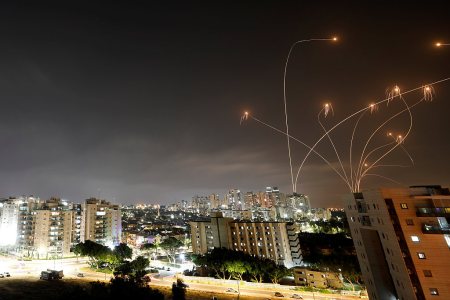
Zilberman noted that the IDF plans to “continue its high-intensity strikes over the coming day. We have bolstered the deployment of Iron Dome batteries in the southern and central sectors. We are ready for any scenario, including a wide-scale escalation.”
Addressing reports that Palestinian civilians have been killed in IDF strikes, Zilberman said, “We’re doing everything we can to avoid such incidents, but Hamas hides amid civilians.
Sirens wailed across communities adjacent to the Israel-Gaza border almost nonstop starting at 6 p.m. Monday.
On Monday night, a home in the southern community in Shaar Hanegev Regional Council also sustained a direct hit, with only minor injuries recorded.

Gantz declared a “special security situation” in an area stretching 80 kilometers (50 miles) from the border, placing parts of central Israel on alert as well. Schools were canceled in dozens of cities. The Home Front Command has instructed the residents of southern Israel to remain near fortified areas.
Hamas leader Ismail Haniyeh issued a statement saying the terrorist group has “changed the balance of power on the ground. We will prevail against any external threat from the forces of the occupation.
“The link between Gaza and Jerusalem is fixed and it will not change. When Jerusalem asked for our help, we heeded the call. We have decided to continue the struggle unless the occupation stops all expressions of aggression and terrorism in Jerusalem and the blessed Al-Aqsa Mosque.”
A statement by the Islamic Jihad said, “Israel started the aggression against Jerusalem, and if the aggression against Jerusalem does not stop, then there is no point to any ceasefire efforts.”
US Secretary of State Antony Blinken said the rocket attacks from Gaza against Israel should stop “immediately.” He urged all sides to take steps to reduce tensions.
The United Nations Security Council held an urgent meeting Monday on the unrest in Jerusalem but issued no immediate statement, with diplomats saying the United States believed public comments would be counterproductive.
The negotiations among the 15 nations on the Security Council were over a text that could be watered down from an initial draft proposed by Norway, diplomats said.
The United States, according to one diplomat, said in the closed-door video conference that it was “working behind the scenes” to calm the situation and that it was “not sure that a statement at this point would help.”
After further discussion on the possibility of a joint text calling for de-escalation of the violence, several diplomats told AFP there would be no Security Council statement Monday.
“The United States is engaging constructively to ensure any action by the Security Council is helpful in de-escalating tensions,” a spokesperson for the US mission to the UN said.
Ignoring rocket fire, most foreign media focus on Israel’s airstrikes
May 11, 2021The most anti-Israel coverage, unsurprisingly, is in the Iranian and Turkish media. Iran and Turkey both support Hamas.


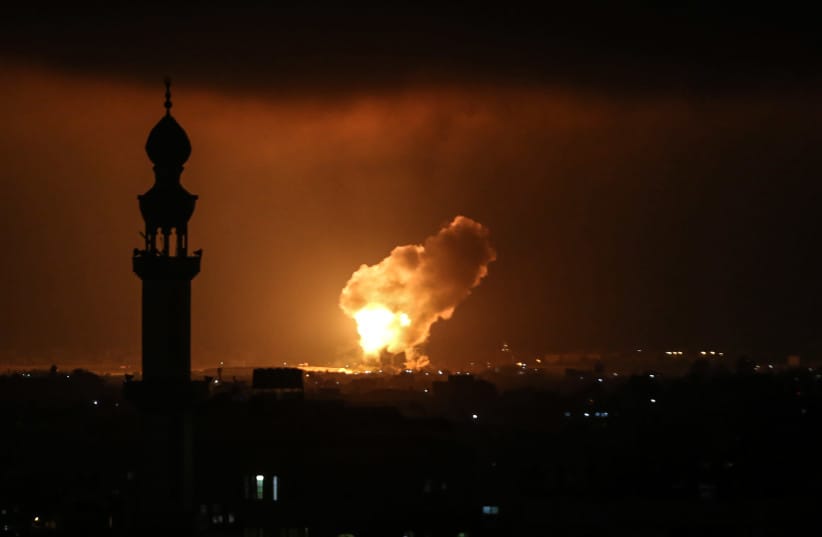
Smoke and flames rise after an Israeli airstrike in a site of the Izz al-Din al-Qassam Brigades, the armed wing of Hamas, in the west of Khan Yunis, in the southern Gaza Strip, on May 11, 2021.
(photo credit: ABED RAHIM KHATIB/FLASH90)
The coverage of the clashes in Jerusalem and the rocket fire that followed has focused disproportionately on Israel’s actions, either on the airstrikes that occurred or the threatened evictions in Sheikh Jarrah and clashes in al-Aqsa Mosque.
This may not be surprising, but it also has helped frame the current conflict as largely a product of Israel’s alleged aggression, as opposed to a cycle set in motion partly by Hamas.
The most anti-Israel coverage, unsurprisingly, is in the Iranian and Turkish media. Iran and Turkey both support Hamas.
Turkey’s Anadolu Agency, a state-run news agency, has about a dozen stories on Israel, and each is more anti-Israel than the last. One says Israel has killed 24 civilians, and another says Israel arrested Arabs who protested in Jerusalem and reports about “Israeli attacks on al-Aqsa Mosque.”
Ankara has stoked protests against Israeli diplomatic posts in Turkey, even though the regime has prevented other protests, such as the recent May Day ones.
Turkey uses the COVID-19 pandemic to shut down all critics, but then it encourages anti-Israel protests, the flames being fanned by pro-government media. Turkey has vowed to “defend” the Palestinians. Anadolu also says its journalists were attacked in Jerusalem.
Ankara has spoken to the Jordanian king and says Israeli forces are “storming al-Aqsa.” This is largely a fabricated story. The use of the expression “storming al-Aqsa” is used by anti-Israel voices who try to pretend that securing the Temple Mount against violent protesters is “storming.” In no other place in the world is securing a holy site “storming.”
The Turkish Foreign Ministry claims that “many innocent civilians” have been killed in Gaza.
Iranian media have also emphasized the “brutal repression” of Palestinians in “al-Quds,” the Press TV term used for Jerusalem. Al-Quds is also the Arabic and Islamic term, but for major media to replace the word Jerusalem with “Quds” illustrates an agenda that is about more than just terminology.
“Palestinian resistance launched operation Al-Quds Sword as Israel kills 25 in Gaza raids,” is how Press TV says the events unfolded. This makes it seem like Hamas attacked Jerusalem with rockets in retaliation, when in fact the opposite happened.
For CNN, the story is headlined: “Israel launches airstrikes after rockets fired from Gaza in day of escalation.” NBC says: “Jerusalem tensions boil over with rocket fire and at least 20 killed in Gaza.” This neatly captures a more accurate picture of what has transpired.
There have been “pleas for calm as violence escalates,” says the BBC. The Guardian, however, sought to emphasize the “twenty-four dead in Gaza after Jerusalem violence spreads.”
In most of the reports, the Palestinian rocket fire – targeting Jerusalem and aiming some 200 rockets at communities around Gaza – is emphasized. The discussions of the rocket fire were often put further down in the articles or were made to seem like retaliation for something Israel had done.
“The rockets came on the anniversary of Israel’s capture of the Old City of Jerusalem and its eastern neighborhoods in the 1967 Six Day War,” NBC reported. “Explosions and air raid sirens were heard in Jerusalem after Hamas set a deadline for Israel to remove its security forces from flash points in Jerusalem and release Palestinians detained in the latest clashes.”
The Independent in the UK said: “At least 24 people – including nine children – have been killed amid a new wave of Israeli airstrikes on Gaza that continued throughout the night into Tuesday morning, the Palestinian health ministry has said. The youngest victim was 10 years old, Gaza health officials told The Independent. More than 700 Palestinians have been injured since the outbreak of violence in the West Bank, Gaza and Jerusalem, including around al-Aqsa Mosque compound.”
It isn’t clear from the report that Hamas had fired any rockets until the reader gets past the first several paragraphs. The report made it appear Israel just carried out this “wave” of airstrikes, killing children, and then Hamas fired rockets. The report did note the UK had condemned the attack on Israel, however.
In the US, Fox News said Gaza militants were killed as Israel “hits Hamas.” This seemed to be one of the rare headlines that put Hamas in the title, noting the actual perpetrator of incitement and attacks on Israel.
CBS wrote: “Israel hits Gaza after militants launch rocket attack.” That headline at least explained the timeline of how this recent conflict had unfolded.
Prior to most of the coverage of the airstrikes, a lot of the spotlight has been on Sheikh Jarrah.
On social media, many have posted a video without context showing Israelis cheering at the Western Wall on Jerusalem Day as a fire rages near al-Aqsa Mosque. The video is presented in such a way as to claim Israelis are cheering attacks on al-Aqsa, when in fact the context is very different.
Scant coverage seems to have focused on the rioting in many places in Israel and the West Bank or Hamas incitement as part of the cycle.
The IDF launches “significant” operation against Palestinian rocket offensive. Iran pulls the strings from Beirut
May 11, 2021IDF strikes Gaza, Iran manages Hamas rockets

After 7 rockets were aimed at Jerusalem from Gaza on Saturday, Israel’s security cabinet ordered the IDF to go forward with a “significant” operation against Palestinian terrorist targets in the Gaza Strip. The operation to seriously incapacitate Hamas and Islamic Jihad, which by Tuesday morning, May 11, had shot 250 rockets into Israel, was confined to an aerial offensive to be rolled out over several days. Ground incursions were ruled out for now. Its designation as “Guardian of the Walls” denoted the operation’s defensive rather than offensive nature.
The guidelines given to the IDF and its Air Force had the same goal of “containment” aimed at restoring calm, which the police had received in its effort to quell Palestinian mob violence in Jerusalem. (Picture shows blaze caused by rocket at Jerusalem hill village.)
Hamas’ ultimatum to Israel on Saturday, followed by a 7-rocket barrage on Jerusalem, betrayed the regional slant acquired by the unending Israel-Palesitnian duel. When Israel ignored the first ultimatum, Hamas’ military arm’s spokesman, Abu Obeida issued another one after midnight, warning Israel to “end the siege of a group barricaded inside Al Aqsa Mosque.” Jihad leader Ziyad Nahala chipped in to say: “Israel started the aggression in Jerusalem and if does not stop, there is no point in diplomatic efforts for a ceasefire.”
DEBKAfile’s intelligence sources reveal that, throughout this interchange on Monday, the Palestinian organizations of the Gaza Strip were being directed by a shadowy master: Iran had been managing the crisis through its Lebanese proxy Hizballah from Beirut. In fact, Tehran had set up at Hizballah HQ a joint war-room manned by the Revolutionary Guards, Hizballah and the Palestinian Hamas, Popular Front and Islamic Jihad. The intensive efforts made by Egypt, Jordan and Qatar to negotiate a ceasefire slammed fruitlessly against this wall.
2 women killed by rockets in Ashkelon amid massive barrages from Gaza
May 11, 2021Rocket directly hits home of elderly woman; dozens of Israelis hurt in unremitting volleys on south; Islamic Jihad commanders said among those killed in IDF strikes
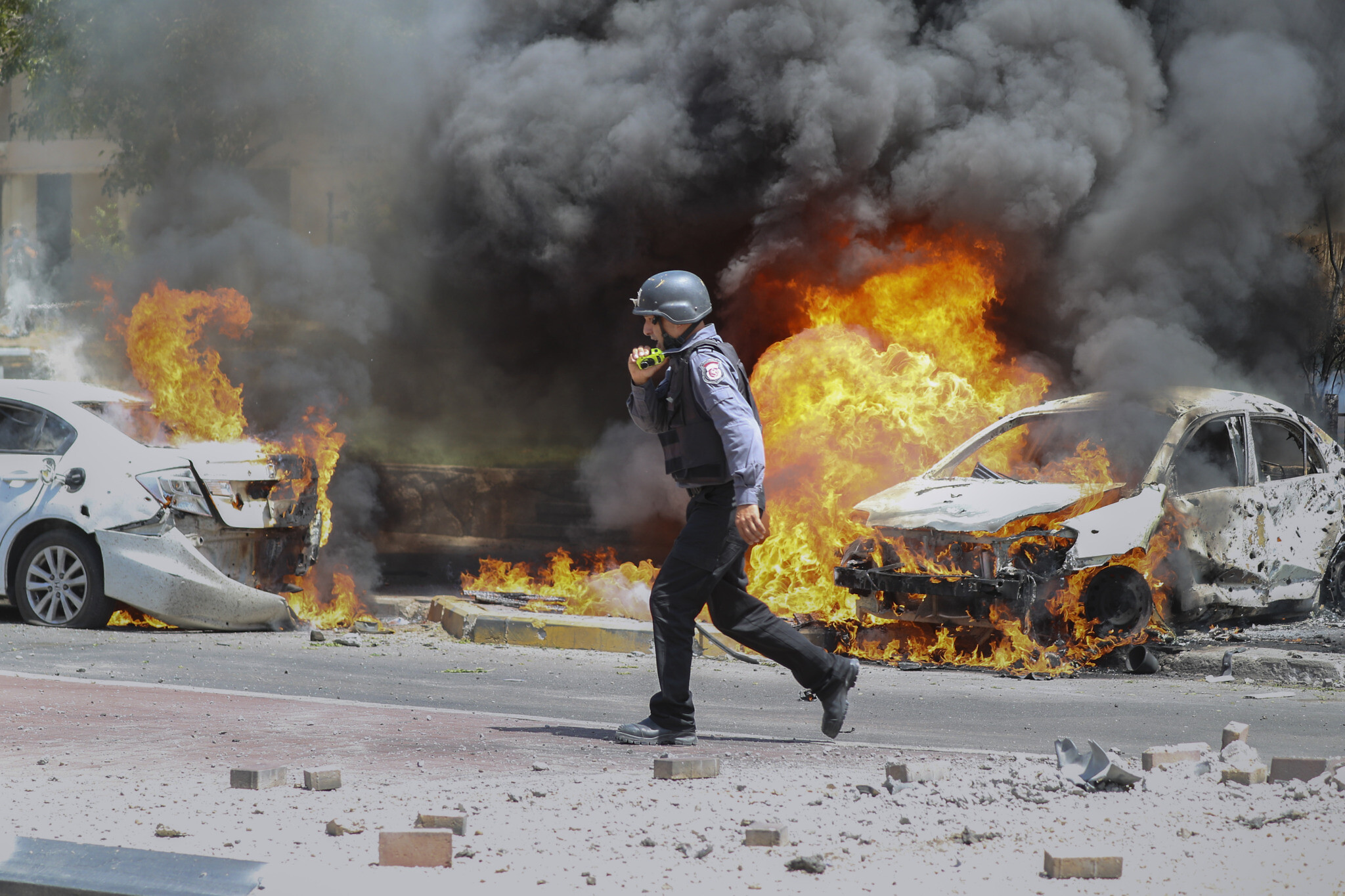
An Israeli firefighter walks next to cars hit by a rocket fired from Gaza Strip, in the southern Israeli town of Ashkelon, May 11, 2021. (AP Photo/Ariel Schalit)
Two Israeli women were killed and dozens injured, including two seriously, when Palestinian terror groups in the Gaza Strip fired massive barrages of rockets at southern Israel throughout Tuesday, drawing deadly retaliatory airstrikes from the Israel Defense Forces.
The deaths marked the first Israeli fatalities in the round of fighting with Gaza terrorist groups that began Monday evening, which has seen hundreds of rockets fired at Israeli territory.
The Hamas terror group claimed that at one stage on Tuesday it fired 137 rockets in around five minutes in an apparent attempt to overwhelm the Iron Dome missile defense system.
In a subsequent barrage on the southern coastal city of Ashkelon, less than an hour later, two women were killed by rockets in apparently separate hits. There were no immediate details on their identities.
Channel 12 reported that the deadly rocket attack directly struck a home where an elderly woman and her caregiver, who did not manage to get to a public shelter in time, lived. One of the women was killed, the network said, without identifying the victim.
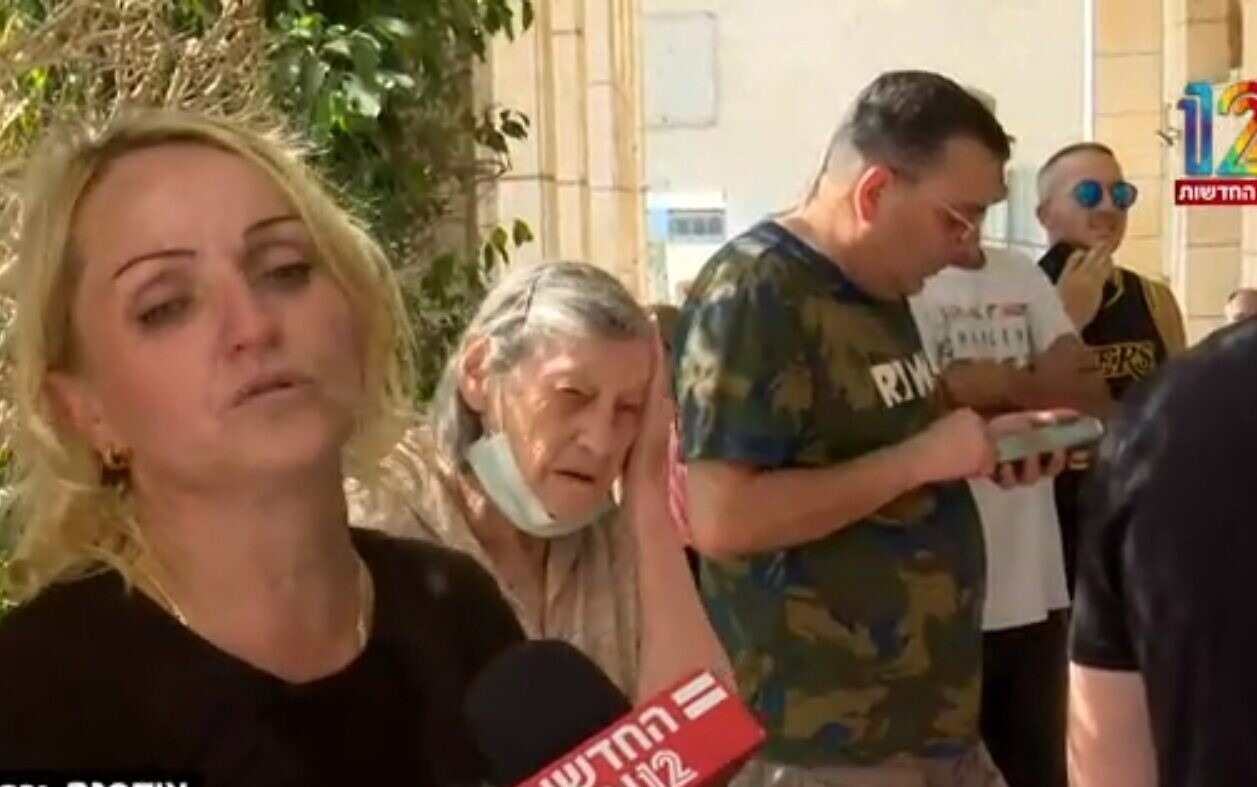
Residents of the Ashkelon apartment bloc in which two women were killed by rocket fire from Gaza on May 11, 2021, speak to reporters outside the building (Channel 12 screenshot)
The network reported that the shelter is at least a minute’s run away from the woman’s home. The home did not have a safe room of its own.
The Barzilai Medical Center in Ashkelon said that it treated 74 casualties, including two seriously wounded and two in moderate condition. Forty-nine people received treatment for light injuries, with the remainder suffering from anxiety.
With a number of buildings in the city suffering direct hits over the course of the day, and concerns over the number of residential buildings without bomb shelters, the Israel Defense Forces instructed residents to remain in reinforced areas. The restriction was later lifted — followed, minutes later, by additional rocket alert sirens on the city.
Ashkelon Mayor Tomer Glam said some 25 percent of residents don’t have access to a protected area when rockets are fired at the city.
“It is impossible when normal life becomes a state of emergency within minutes,” he told Army Radio. “There are houses from the 1960s where there is no basic protection — it is time for treasury officials and decision-makers to understand what is happening here in the city.”
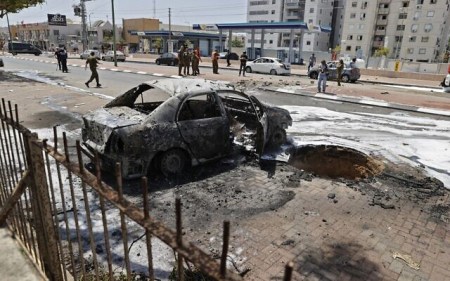
A picture shows a burnt vehicle in Ashkelon as rockets were fired from the Gaza Strip on May 11, 2021 (JACK GUEZ / AFP)
Hundreds of rockets were fired at Israel from Monday evening through Tuesday afternoon, many of which were intercepted by Iron Dome missile defense batteries while others fell short of their targets and landed inside the Strip.
Tuesday afternoon saw the rocket attacks shift slightly northward, with projectiles fired at Ashdod including a rocket that directly hit a residential building. Buildings were also hit in Ashkelon, including an empty school.
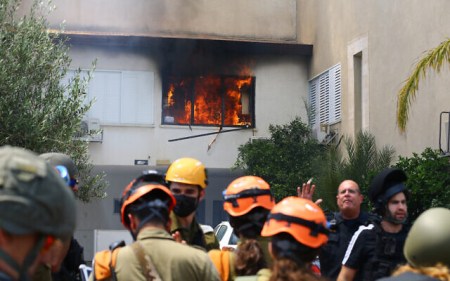
Israeli security forces at an Ashdod home hit by a rocket fired from the Gaza Strip on May 11, 2021 (Flash90)
On Monday night, a rocket directly struck a house in the Sha’ar Hanegev region, damaging it but not injuring its occupants.
In the early hours of Tuesday, a missile hit a residential building in Ashkelon, wounding six Israelis, four of them members of the same family: parents in their 40s, an 8-year-old and an 11-year-old. The father was seriously hurt with a head wound, and the others sustained light injuries from shrapnel.
The assaults continued Tuesday after a night of almost constant rocket fire on Israeli communities near the Gaza Strip and as the IDF conducted strikes on more than 100 targets in the coastal enclave, as part of what it has called “Operation Guardian of the Walls,” the military said. The previous day saw a major outbreak of violence from Gaza, including rare rocket fire on Jerusalem, where Palestinians have been clashing with police for days.
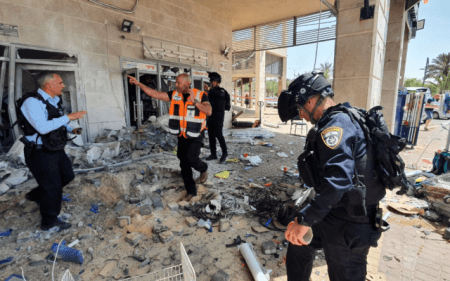
The scene after a rocket hit Ashkelon, May 11, 2021 (Israel Police)
In response to the ongoing rocket rockets, IDF fighter jets, aircraft and tanks struck some 130 targets in the Gaza Strip, most of them associated with Hamas, but also some linked to other terror groups in the enclave, including the Palestinian Islamic Jihad.
Hamas and the Palestinian Islamic Jihad terror groups reported that several high-ranking commanders were killed in Israeli raids, including three top PIJ leaders in a drone strike on a building in the upscale Rimal neighborhood of Gaza City.
One of those killed was the brother of another top PIJ commander, Baha Abu al-Ata, who was killed in an Israeli strike in November 2019, kicking off a major round of fighting in the Strip. Islamic Jihad vowed revenge for the death of the three commanders in its armed wing, saying the response will be “harsh.”
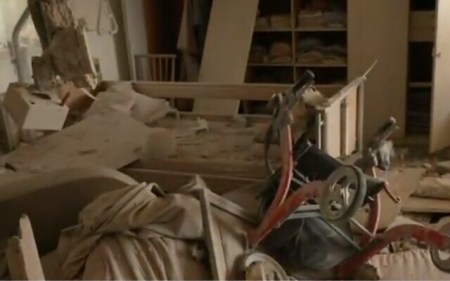
The devastated Ashkelon apartment in which a woman was killed by rocket fire from Gaza, May 11, 2021 (Channel 12 screenshot)
Additionally, the IDF said it killed the head of Islamic Jihad’s special rocket unit, in an operation carried out in cooperation with the Shin Bet. Sameh Abed al-Mamluk was killed along with several other senior rocket officials, the army said.
According to the IDF, the military’s targets also included the home of a top Hamas commander, Hamas’s intelligence headquarters in southern Gaza, two attack tunnels that approached the border with Israel, rocket production and storage sites, observation posts, military installations and launchpads.
The IDF said it was also targeting terrorist operatives as they fired rockets or attempted to launch anti-tank missiles at Israel. On Monday, an Israeli man was lightly injured when Palestinian terrorists fired an anti-tank guided missile at his car.
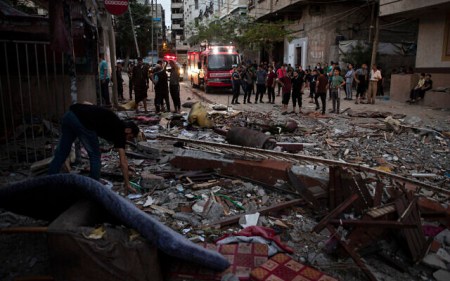
A Palestinian man inspects the rubble of a partially destroyed residential building after it was said to have been hit by Israeli retaliatory strikes on the al-Shati refugee camp in Gaza City, May. 11, 2021. (AP Photo/Khalil Hamra)
Palestinian media also reported strikes around the southern cities of Rafah and Khan Younis and on an apartment building in the al-Shati camp near Gaza city. A building was also destroyed in Gaza City’s upscale Tel al-Hawa neighborhood.
The Hamas Health Ministry said 28 Gazans were killed, including nine minors, and 125 wounded in the ongoing escalation with Israel. Fifteen Gazans sustained serious injuries, according to Hamas Health Ministry spokesperson Ashraf al-Qidra. Israel said more than half were Hamas fighters.
IDF Spokesperson Hidai Zilberman said a number of those killed in Gaza, including at least three children, were hit by errant rockets fired by Palestinian terrorists, not by Israeli airstrikes.
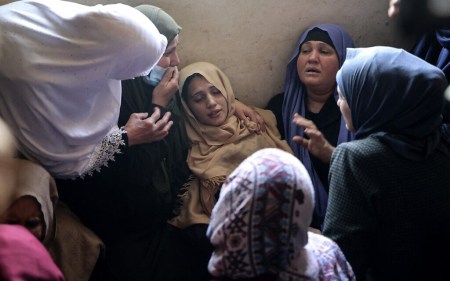
The mother of Palestinian Hussien Hamad, 11, is comforted by mourners during his funeral in Beit Hanoun in the northern Gaza Strip on May 11, 2021 (MAHMUD HAMS / AFP)
The IDF spokesperson said Israel was taking steps to avoid Palestinian civilian casualties, but that they were liable to occur anyway as Hamas deliberately operates within a densely populated area, using the residents of the Strip as human shields.
Israel on Tuesday showed no indications that it was interested in an immediate ceasefire, as Zilberman said the fighting was expected to last at least several days.
IDF Chief of Staff Aviv Kohavi on Tuesday afternoon gave the military a green light to keep targeting Hamas and PIJ members operating in the Strip and bombing sites connected to the terror groups’ rocket production and storage efforts.
Soldiers from the IDF’s Golani Infantry Brigade and 7th Armored Brigade were sent to the Gaza border as reinforcements and additional troops were called in to aerial defense, intelligence and air force units, the military said. The police said that eight reserve companies of Border Police would be called up to help deal with disturbances across the country.
Zilberman said the military was deploying additional air defenses throughout the country, notably in the Tel Aviv metropolitan area. Tel Aviv had yet to be targeted as of Tuesday afternoon, but the IDF suspected that rocket fire may be directed there as well.
Defense Minister Benny Gantz said the IDF would continue striking Hamas and other terrorists in the Strip until “long-term and complete quiet” is restored. Gantz also threatened Hamas’s leadership, saying its commanders would “be held responsible and pay the price for the aggression.”
In light of the ongoing rocket attacks, Gantz declared the area within 80 kilometers (50 miles) of the Gaza Strip to be under military control, giving the IDF the power to issue directives to civilians there. The IDF ordered schools closed in communities near Gaza on Tuesday and limited gatherings to groups of 10 people outdoors and 50 people indoors. Businesses would be allowed to open only if they had easy access to bomb shelters.
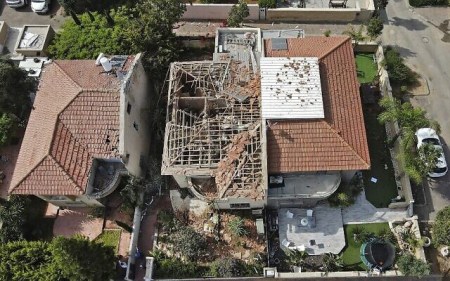
An overhead view of an Ashkelon home badly damaged by a rocket fired from Gaza on May 11, 2021. A man was seriously hurt in the attack. (JACK GUEZ / AFP)
The military also limited gatherings in the Tel Aviv metropolitan area and the Shfela region around Beit Shemesh to 30 people outdoors and 50 people indoors. Schools and businesses there could also only be opened if they had easy access to a bomb shelter. A number of cities in central Israel announced they were preemptively canceling schools on Tuesday as a precautionary measure.
Meanwhile, the Hamas-run Health Ministry in Gaza said that the Strip’s sole power plant was running low on diesel fuel after Israel closed all of its crossings on Monday evening in response to the hundreds of rockets fired.
The coastal enclave normally receives most of its fuel through the Kerem Shalom commercial crossing with Israel, and according to the Gaza Electrical Company, one of the plant’s generators has already been turned off and the plant as a whole will likely shut down “soon” due to lack of fuel, threatening to severely restrict the number of hours of electricity Gazans receive.
Al-Qidra said that an electrical shortage would threaten the effectiveness of Gaza’s health care system.
“This will have a serious effect on public health and the health of our society,” al-Qidra said.
Hamas, which is officially dedicated to the destruction of the State of Israel, took effective control of the Gaza Strip in 2007 from the Palestinian Authority in a violent coup. Since then, Israel has imposed a naval blockade on the enclave, as well as stiff control over what can enter the Strip, maintaining that it is necessary in order to prevent terror groups from smuggling weapons into the area.
The military initially believed that Hamas was not interested in a large-scale conflict with Israel at this time, but that assessment changed over the past two days and the IDF began preparing accordingly.
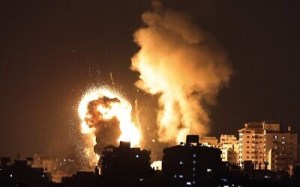
Fire billows from Israeli airstrikes in the Gaza Strip, controlled by the Palestinian Islamist movement Hamas, on May 10, 2021. (MAHMUD HAMS / AFP)
Palestinian terror groups have tied the attacks to the unrest in Jerusalem connected to both prayer on the Temple Mount during the Muslim holy month of Ramadan and the pending eviction of a number of Palestinian families from their homes in East Jerusalem’s Sheikh Jarrah neighborhood.
Israel has fought three large operations against Hamas and other terror groups in the Gaza Strip since 2008, most recently in 2014 with a 51-day war known as Operation Protective Edge.
Times of Israel staff contributed to this report.
Gaza terrorists fire hundreds of rockets at Israel; IDF pummels Hamas targets
May 11, 2021At least 24 Israelis hurt, one seriously; 23 Palestinians said killed, among them children; military says most were Hamas members or were killed by errant Gazan rockets
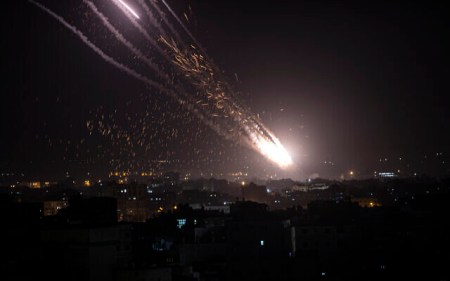
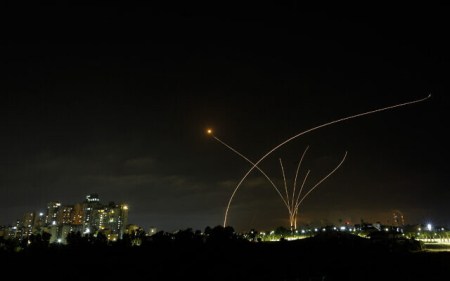
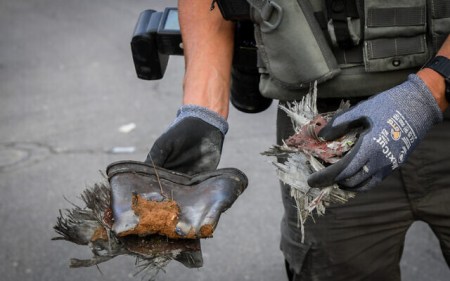
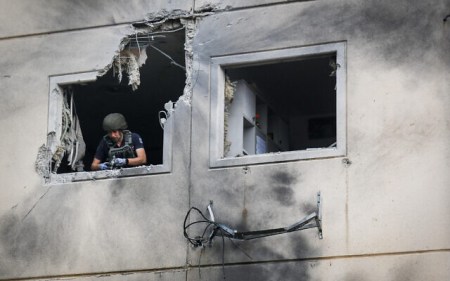


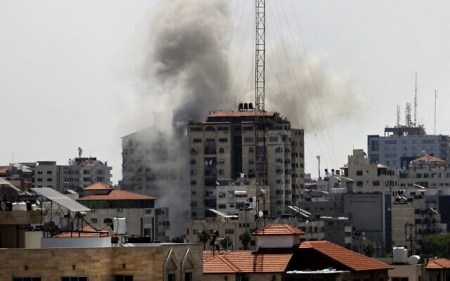
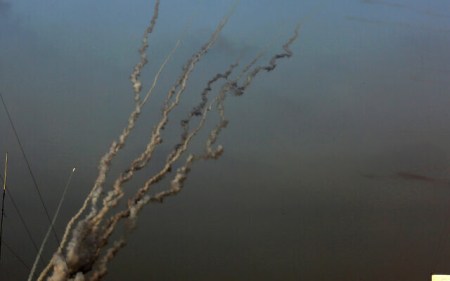
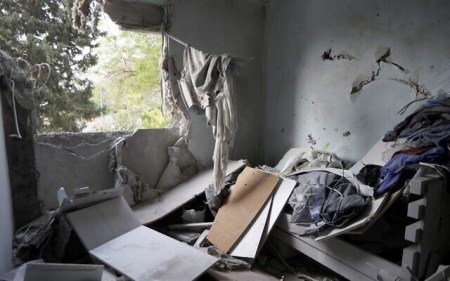
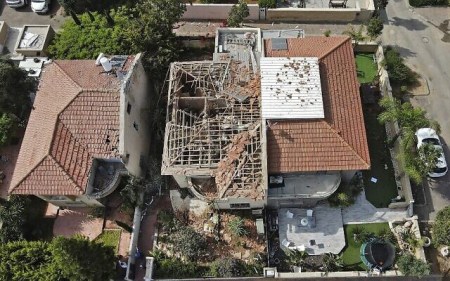
Palestinian terror groups in the Gaza Strip fired a massive barrages of rockets at southern Israel throughout Tuesday, wounding at least 24 people and drawing deadly retaliatory airstrikes from the Israel Defense Forces.
The assaults continued a night of almost constant rocket fire on Israeli communities near the Gaza Strip and as the IDF conducted strikes on more than 100 targets in the coastal enclave, as part of what it has called “Operation Guardian of the Walls,” the military said. The previous day saw a major outbreak of violence from Gaza, including rare rocket fire on Jerusalem, where Palestinians have been clashing with police for days.
According to Gaza’s Hamas-run Health Ministry, at least 23 people in the Strip were killed on Monday night and Tuesday, including nine minors. Another 107 Palestinians were injured to varying degrees, the ministry said. The IDF said at least 15 of those killed were members of the Hamas terror group who were launching rockets or anti-tank guided missiles at Israel.
IDF Spokesperson Hidai Zilberman said a number of those killed in Gaza, including at least three children, were hit by errant rockets fired by Palestinian terrorists, not by Israeli airstrikes.
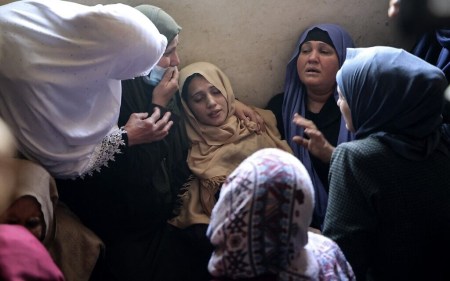
The mother of Palestinian Hussien Hamad, 11, is comforted by mourners during his funeral in Beit Hanoun in the northern Gaza Strip on May 11, 2021 (MAHMUD HAMS / AFP)
Hamas and the Palestinian Islamic Jihad terror groups reported that several high-ranking commanders were killed in Israeli raids on Tuesday, including two top PIJ leaders in a drone strike on a building in the upscale Rimal neighborhood of Gaza City, one of whom was the brother of another top PIJ commander, Baha Abu al-Ata, who was killed in an Israeli strike in November 2019, kicking off a major round of fighting in the Strip.
IDF Chief of Staff Aviv Kohavi on Tuesday afternoon gave the military a green light to keep targeting Hamas and PIJ members operating in the Strip and bombing sites connected to the terror groups’ rocket production and storage efforts.
The IDF spokesperson said Israel was taking steps to avoid Palestinian civilian casualties, but that they were liable to occur anyway as Hamas deliberately operates within a densely populated area, using the residents of the Strip as human shields.
Israel on Tuesday showed no indications that it was interested in an immediate ceasefire, as Zilberman said the fighting was expected to last at least several days and that the coming hours would be particularly punishing for Hamas.
“We have an intense day ahead of us,” Zilberman told reporters on Tuesday morning, adding, “We have a goal and we will not stop until we’ve reached it.”
Soldiers from the IDF’s Golani Infantry Brigade and 7th Armored Brigade were sent to the Gaza border as reinforcements and additional troops were called in to aerial defense, intelligence and air force units, the military said.
“The chief of staff said the IDF will continue to act determinedly in order to return security to residents of the south, and all headquarters should prepare for a wider conflict, which has no time limit,” the IDF said.

Smoke billows from a building targeted by in an Israeli strike on Gaza City amid rocket fire from the Strip on May 11, 2021 (MOHAMMED ABED / AFP)
Asked about the potential for a ground invasion or targeted killing of top terrorist commanders, Zilberman said the military “was prepared for anything.”
According to the IDF, over 200 rockets and mortar shells were fired from the Gaza Strip toward Israel from 6 p.m. Monday to 6 a.m. Tuesday, dozens of which were intercepted by Iron Dome missile defense batteries. The military said the Iron Dome had a successful interception rate of over 90 percent of projectiles heading toward populated areas.
According to Zilberman, roughly a third of the projectiles fired from Gaza landed inside the Strip.
Most of the others landed in open fields, where they caused no injuries, but a small number landed inside Israeli communities, causing damage to nearby buildings and infrastructure. One rocket directly struck a house in the Sha’ar Hanegev region on Monday night, damaging it but not injuring its occupants, and two hit apartment buildings in Ashkelon on Tuesday morning, injuring those inside.
Video footage of the Tuesday morning attack showed dozens of rockets being fired at Ashkelon, with Iron Dome interceptor missiles screaming up into the gray morning sky to try and bring them down.
Six Israelis were wounded in that attack, four of them members of the same family: parents in their 40s, an 8-year-old and an 11-year old. The father was seriously hurt with a head wound, and the rest sustained light injuries from shrapnel. A 63-year-old man was also moderately injured by shrapnel, and a man and a woman in their 80s were lightly injured, medics said. On Monday, an Israeli man was lightly injured when Palestinian terrorists fired an anti-tank guided missile at his car.
In total, Ashkelon’s Barzilai Medical Center and Beersheba’s Soroka Medical Center said they was treating 24 people who were wounded on Monday night and Tuesday morning, 22 of them with light injuries. In addition to those hit by rocket fire, a number of those were hospitalized for injuries sustained while running to bomb shelters, and eight people suffered acute anxiety attacks brought on by rocket sirens, medics said.
In response to the ongoing rocket rockets, IDF fighter jets, aircraft and tanks struck some 130 targets in the Gaza Strip, most of them associated with Hamas, but also some linked to other terror groups in the enclave, including the Palestinian Islamic Jihad.
According to the IDF, they included the home of a top Hamas commander, Hamas’s intelligence headquarters in southern Gaza, two attack tunnels that approached the border with Israel, rocket production and storage sites, observation posts, military installations and launchpads. The IDF said it was also targeting terrorist operatives as they fired rockets at Israel. The military released footage of some of its strikes, including the attack on the Hamas officer’s apartment building (below).
Hamas in Gaza said it had launched the morning attack on Ashkelon in response to the IDF strike on the commander’s apartment building. The terror group said it would “turn Ashkelon into hell” if Israel targeted civilians in Gaza.
Palestinian media also reported strikes around the southern cities of Rafah and Khan Younis and on an apartment building in the al-Shati camp near Gaza city. A building was also destroyed in Gaza City’s upscale Tel al-Hawa neighborhood.
Zilberman said the military was deploying additional air defenses throughout the country, notably in the Tel Aviv metropolitan area. Tel Aviv had yet to be targeted as of Tuesday morning, but the IDF suspected that rocket fire may soon be directed there as well.
Earlier, the Hamas military wing issued an ultimatum that it would carry out a massive attack by 2 a.m. if Israel did not vacate its forces from the Temple Mount. It later claimed that it had suspended plans for the attack after police withdrew from the holy site.
There was no confirmation from Israel that police had left the compound.
Defense Minister Benny Gantz said the IDF would continue striking Hamas and other terrorists in the Strip until “long-term and complete quiet” is restored.
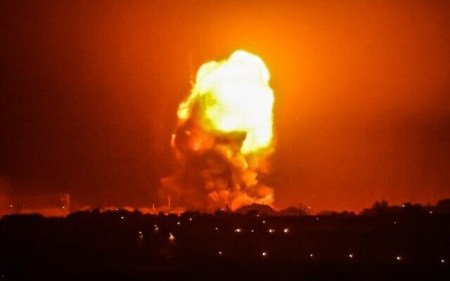
Fire billows from Israeli air strikes in Rafah, in the southern Gaza Strip, on May 11, 2021.(Photo by SAID KHATIB / AFP)
Gantz also threatened Hamas’s leadership, saying its commanders would “be held responsible and pay the price for the aggression.”
The waves of rocket fire began at 6 p.m., the time Hamas had earlier threatened it would attack Israel if it did not remove its security forces from the Temple Mount and the neighborhood of Sheikh Jarrah in East Jerusalem, following weeks of unrest in the capital. Monday saw widespread clashes between Palestinians and Israel Police officers on the Temple Mount, as well as multiple attacks by Palestinian rioters against Israeli civilians. Hundreds of Palestinians were reportedly injured, along with dozens of police officers and a number of Israeli civilians.
In addition to the attack on the capital — the first time Jerusalem was targeted by rocket fire since the 2014 Gaza war — Palestinian terror groups fired rockets and mortar shells at Israeli cities and towns near the Gaza border, mostly at Ashkelon and Sderot, as well as smaller communities in the Sha’ar Hanegev region of southern Israel.
An anti-tank guided missile was also fired at an Israeli civilian’s car that was traveling on a hill south of Sderot, lightly injuring him, the military said. The Palestinian Islamic Jihad took responsibility for the attack and later released footage of the strike.
In the video, the Israeli man can be seen approaching the jeep from a hill overlooking the Gaza Strip. As he gets close, the anti-tank missile is fired at the car, causing a large blast. The man was reportedly blown back from the vehicle by the blast and sustained shrapnel wounds to the face and extremities.
The Israeli Air Force began conducting retaliatory airstrikes on Hamas-controlled targets in the Strip around 6:30 p.m. in response to the attacks from the enclave, including at rocket-launching teams.
The military said its fighter jets bombed a Hamas attack tunnel in the northern Gaza Strip. A number of Hamas members were believed to be inside the tunnel at the time and were killed in the strike. It was not immediately clear if the tunnel crossed into Israeli territory.
In light of the ongoing rocket attacks, Gantz declared the area within 80 kilometers (50 miles) of the Gaza Strip to be under military control, giving the IDF the power to issue directives to civilians there. The IDF ordered schools closed in communities near Gaza on Tuesday and limited gatherings to groups of 10 people outdoors and 50 people indoors. Businesses would be allowed to open only if they had easy access to bomb shelters.
The military also limited gatherings in the Tel Aviv metropolitan area and the Shfela region around Beit Shemesh to 30 people outdoors and 50 people indoors. Schools and businesses there could also only be opened if they had easy access to a bomb shelter. A number of cities in central Israel announced they were preemptively canceling schools on Tuesday as a precautionary measure.
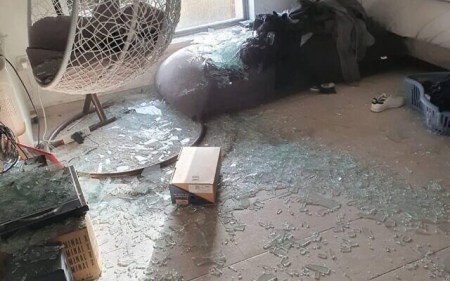
Damage caused to a house outside of Jerusalem that was struck by debris after a rocket fired from the Gaza Strip landed nearby on May 10, 2021. (Courtesy)
Hamas claimed responsibility for firing the seven rockets at Jerusalem, one of which was intercepted by the Iron Dome missile defense system, according to the IDF. One rocket landed near a home in a community outside Jerusalem, causing light damage, but no injuries. Some of the others sparked fires in the forests surrounding the capital, which were quickly extinguished.
The attack triggered sirens in the capital, as well as in Beit Shemesh and surrounding towns. The Knesset plenum was evacuated, as was the Western Wall complex, where thousands of Israelis had gathered to celebrate Jerusalem Day, which marks the reunification of the city after the IDF captured its eastern neighborhoods and the Old City in the 1967 Six Day War.
Zilberman, the military spokesman, said a number of terror groups conducted the rocket launches, but all with the approval and at the direction of Hamas, the de facto ruler of the Gaza Strip.
“We have a clear address: that is Hamas. The group will pay a dear price for its actions. We will respond fiercely,” he said.
Over the past day, the IDF has significantly boosted its presence along the Gaza border both in terms of ground troops and air defense systems, Zilberman said.
The military initially believed that Hamas was not interested in a large-scale conflict with Israel at this time, but that assessment changed over the past two days and the IDF began preparing accordingly.
Recent days have seen a number of rocket and mortar shell attacks from the Gaza Strip, as well as a major return of balloon-borne incendiary and explosive devices being launched from Gaza, which have burned large swaths of southern Israel.
Palestinian terror groups have tied the attacks to the unrest in Jerusalem connected to both prayer on the Temple Mount during the Muslim holy month of Ramadan, and the pending eviction of a number of Palestinian families from their homes in East Jerusalem’s Sheikh Jarrah neighborhood.
Israel has fought three large operations against Hamas and other terror groups in the Gaza Strip since 2008, most recently in 2014 with a 51-day war known as Operation Protective Edge.
Hamas, which is officially dedicated to the destruction of the State of Israel, took effective control of the Gaza Strip in 2007 from the Palestinian Authority in a violent coup. Since then, Israel has imposed a naval blockade on the enclave, as well as stiff control over what can enter the Strip, maintaining that it is necessary in order to prevent terror groups from smuggling weapons into the area.
Times of Israel staff contributed to this report.




 anneinpt
 artaxes
 danmillerinpanama
 davidking1530
 Peter Hofman
 Joseph Wouk
 Peter
Peter Louisiana Steve
 WarSclerotic
Recent Comments