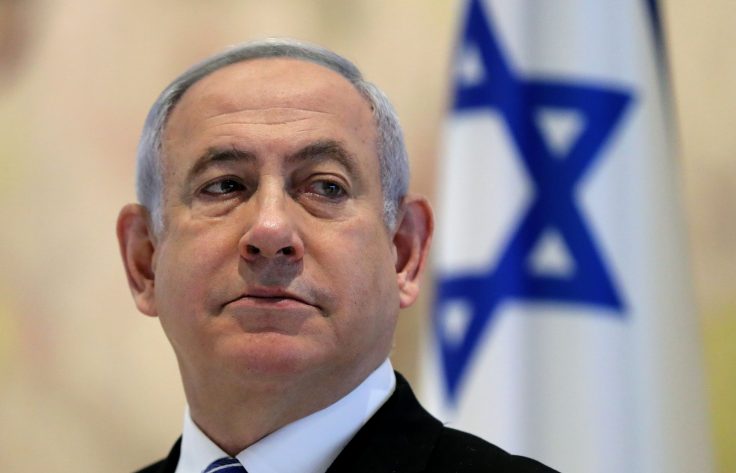
Israel is pursuing four more peace deals with countries in the region and elsewhere, Prime Minister Benjamin Netanyahu said on Tuesday.
“I brought four peace agreements, and there are another four on the way,” Netanyahu said. “I talked about one of them yesterday.” He added that one such regional leader spoke with him by phone Monday night. The prime minister did not dispel rumors of other peace agreements in the works with nations such as Niger, Mauritania, and Indonesia.
The longtime Israeli leader also touted the four other agreements he forged last year with Muslim-majority countries in the Middle East and Africa—Bahrain, United Arab Emirates, Morocco, and Sudan—which thawed decades of cold relations.
Israel is inching toward normalizing relations with Saudi Arabia, a key partner in the coalition against Iran due to its size, wealth, and military force. Netanyahu met with Saudi Arabian crown prince Mohammed bin Salman in November. Under the Trump administration, senior officials hinted at prospects of budding relations between Riyadh and Jerusalem in the wake of the historic Abraham Accords signed in August 2020.
Normalization with gulf countries has already borne significant fruit for Israel. Tourism and trade continues to grow apace between Israel and the UAE, with some even remarking that they feel safer wearing traditional Jewish clothing in Dubai than in France now.
The Trump administration furthered such agreements between Israel and regional partners as a senior broker by strongly backing Israel and pressuring Iran. The realignment in the Middle East was appraised by former secretary of state Henry Kissinger as “brilliant.” He emphasized that the Biden administration must build on the progress made in peaceful regional ties by continuing Trump-era policies in the region.
It is unclear, however, the extent to which the Biden administration will pursue additional peace. Both President Biden and Secretary of State Antony Blinken assure Iran that they have interest in pursuing renewed nuclear talks, and several senior level appointments throughout the administration’s foreign policy regime marked themselves as leading critics of the Trump administration’s policies toward Iran and Israel.
But Israeli officials tell Insider the statement from the environmental minister directly blaming Iran released Wednesday was premature as the military and intelligence services have yet to make a final determination on both Iranian culpability and the appropriate level of response to what would be the most brazen act of environmental terrorism in recent history.
“That statement should have never been made,” a former Israeli intelligence official, who still consults for the government and therefore cannot be named, told Insider. “The IDF and Mossad are responsible for investigating attacks on the Israeli homeland, determining the responsibility and suggesting a course of action to respond. That process is underway and it is not the portfolio of the environmental minister to start wars with Iran.”
For the past two weeks, tons of crude oil have washed ashore on Israel and Lebanon’s beaches destroying wildlife and causing ecological damage that could take years to restore, according to environmental experts. But after the minister directly accused Iran of a complex operation to drop the oil offshore, the issue took on a new dimension as fears in Washington ands Europe rose over the possibility of an Israeli response.
When pressed on whether Israeli military and intelligence services suspect an Iranian operation as described by the minister – who said a Libya-flagged ship sailed from Iran to Israel and dumped the oil offshore before stopping in Syria and returning to Iran – the former official conceded that was the case.
“Well yes, it does look that way but there’s a process for gathering all the intelligence and evidence and synthesizing into useful information that can help decision-making,” said the official. “It’s being treated as a direct attack on Israel by a foreign enemy, the most potentially serious since 2006 [attack by Hezbollah to kidnap two Israeli soldiers]. The [prime minister’s office] was already undergoing determination about the attack by Iran on [the ship]. Strike options were already being considered on that alone.”
With that attack firmly blamed on Iran, there is growing concern that Israeli intelligence will make the same determination as the environmental ministry – that the oil spill is an Iranian operation. Israel could use the double provocations as a reason to strike Iran just as Europe and the United States hope to re-start nuclear talks with Iran in exchange for a reopening of economic trade and more peaceful relations.
“Iran is very good at managing escalation, but if both incidents were their work this represents a gamble because both operations have made the Israelis substantially angrier than normal provocations,” said a European diplomat in the region, who refused to be named because of extreme sensitivity.
“Iran must know that Israel is looking for a good reason to escalate things themselves because of fears that Biden will ignore them in cutting a new deal on the nuclear program,” said the diplomat. “And while I normally welcome nations not rushing to conclusions, I suspect I’d prefer if [Israel Prime Minister Binyamin Netanyahu] would go on television shouting and waving pictures of dead sea turtles. Until he gives that performance there’s a concern it means the planners are working on a substantial response, which would be a problem for those of use who want a nuclear deal.”
“Everyone knows Bibi wants to slow down any resumption of talks on the nukes and is looking for an excuse to force some action that can’t be undone,” said the official. “But obviously there are hardliners in Tehran who agree and keep offering him excuses. It’s hard to preach patience when Iran is acting in this aggressive manner.”




 anneinpt
 artaxes
 danmillerinpanama
 davidking1530
 Peter Hofman
 Joseph Wouk
 Peter
Peter Louisiana Steve
 WarSclerotic
Recent Comments