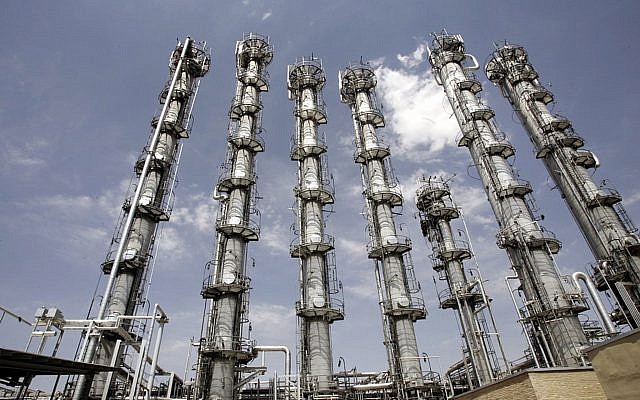
A view of the heavy-water production plant in the central Iranian town of Arak, August 26, 2006. (AP/ ISNA, Arash Khamoushi)
Iran will “cold test” its revamped Arak nuclear reactor as a prelude to its full inauguration later in the year, the country’s Atomic Energy Organization said on Friday, according to a Reuters report.
Cold testing of reactors usually includes the initial startup of fluid systems and support systems. The nuclear agency spokesperson Behrouz Kamalvandi said it will take place sometime early in the Iranian new year, which begins Sunday, the report said.
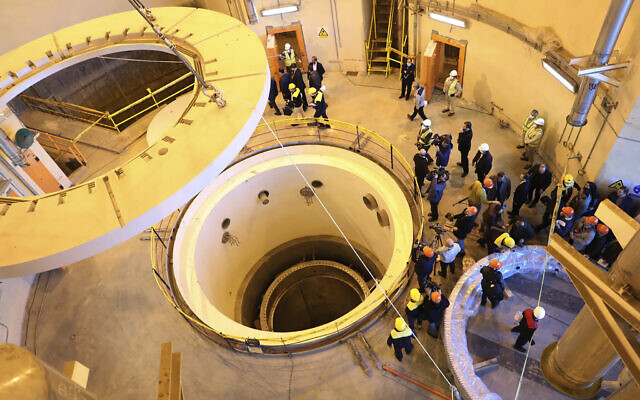
While Iran had agreed to shut down the reactor at the Arak facility under the 2015 deal, Tehran says it has been working on redesigning it for medical and agricultural use.
The plant was permitted to make some of the heavy water used to help cool reactors, producing plutonium as a byproduct that can potentially be used in nuclear weapons.
Spokesman of the Atomic Energy Organization of Iran Behrouz Kamalvandi speaks in a press briefing in Tehran, Iran, July 7, 2019. (Ebrahim Noroozi/AP)
The announcement of the tests came a day after French President Emmanuel Macron, standing alongside President Reuven Rivlin, urged Iran to stop aggravating the already grave crisis over its nuclear program by multiplying violations of the 2015 deal with world powers.
Iran has repeatedly taken steps to violate the agreement and turn up the heat on the US, including by enriching uranium past the accord’s limits and barring UN inspections of its nuclear facilities.
Former US president Donald Trump withdrew from the deal in 2018 and put punishing sanctions on Iran. US President Joe Biden and his administration have repeatedly said they will return to the agreement if Tehran first returns to compliance.
Iran has insisted the US remove sanctions before it returns to the deal’s terms, putting the two sides at a stalemate.
Technicians work at the Arak heavy water reactor’s secondary circuit, as officials and media visit the site, near Arak, 150 miles (250 kilometers) southwest of the capital Tehran, Iran, December 23, 2019. (Atomic Energy Organization of Iran via AP)
Israeli officials, including Prime Minister Benjamin Netanyahu, have already begun voicing opposition to the Biden administration’s desire to rejoin the deal, putting Jerusalem and Washington at odds on the issue. Some leading Israeli officials in recent months have warned of military action to halt Iran’s nuclear program.
In addition, Iran has for months threatened retaliation against Israel over the killing of its chief military nuclear scientist, Mohsen Fakhrizadeh, in an operation Tehran has blamed on the Mossad, Israel’s spy agency. An attempted bombing near the Israeli embassy in India last month, as well as the recent mine attack on an Israeli cargo ship in the Gulf of Oman, have both been attributed to Iran by Israel.
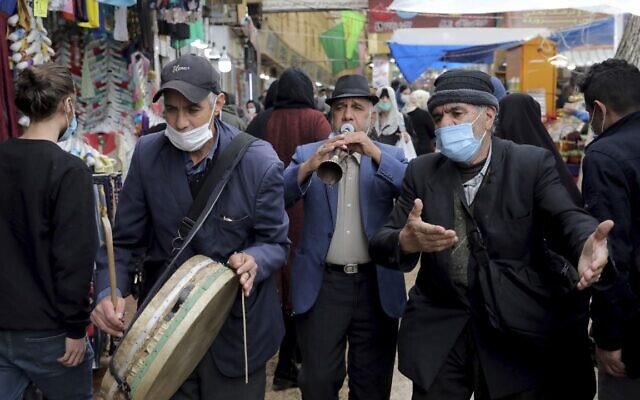
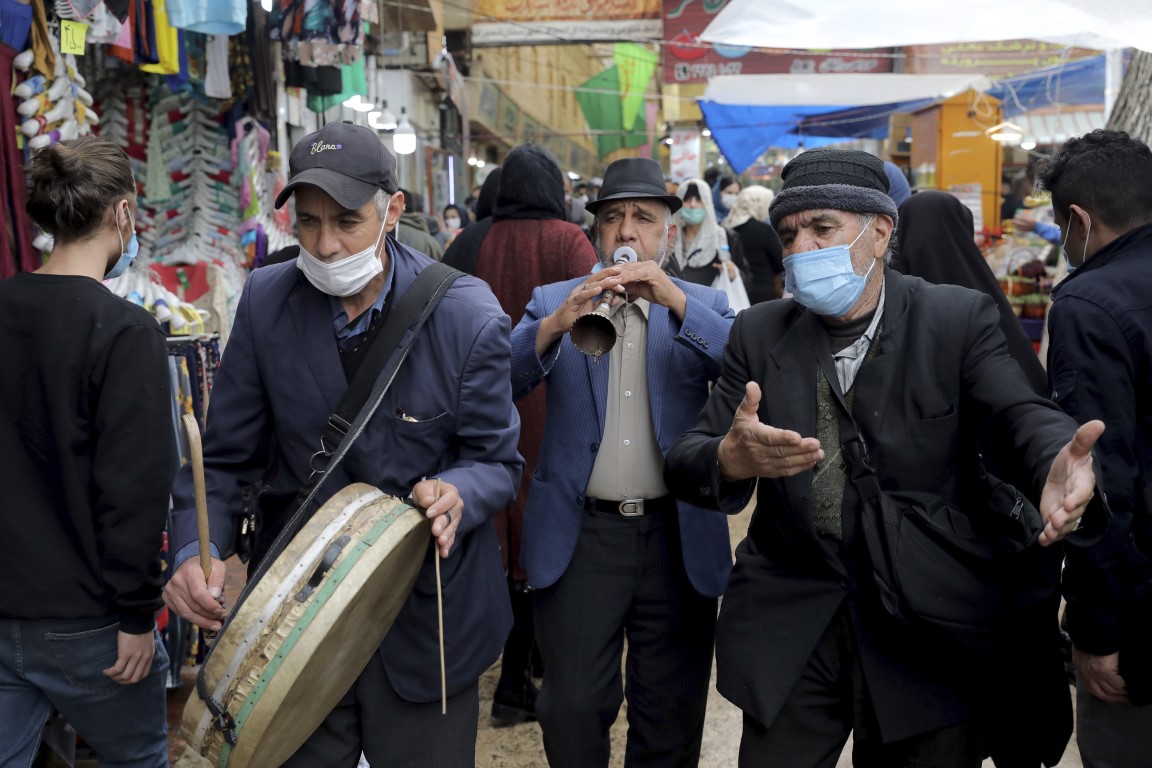
Performers play folklore music welcoming Persian New Year, or Nowruz, meaning ‘New Day,’ in northern Tajrish Square, Tehran, Iran, Wednesday, March 17, 2021. (AP Photo/Ebrahim Noroozi)
TEHRAN, Iran (AP) — The Persian New Year, Nowruz, begins on the first day of spring and celebrates all things new. But as families across Iran hurried to greet the fresh start — eating copious crisp herbs, scrubbing their homes and buying new clothes — it was clear just how little the country had changed.
A year into the coronavirus pandemic that has devastated Iran, killing over 61,500 people — the highest death toll in the Middle East — the nation is far from out of the woods. And although Iranians had welcomed the election of President Joe Biden with a profound sigh of relief after the Trump administration’s economic pressure campaign, the sanctions that have throttled the country for three years remain in place.
“I was counting down the seconds to see the end of this year,” said Hashem Sanjar, a 33-year-old food delivery worker with a bachelor’s degree in accounting. “But I worry about next year.”
Once again, Nowruz, a joyous two-week celebration rooted in gatherings — at homes, in parks and squares — will be stifled by the pandemic. Gone from Tehran’s streets are the performers dressed as “Hajji Firuz,” the ancient folk figure who dances, sings and bangs tambourines to ring in the holiday. Gone too are the usual piles of old furniture, which families can no longer afford to throw out for the new year.
A nightly curfew in the capital forbids residents from venturing out after 9 p.m. Health officials are pleading with the public to stay home. And the government has banned travel to cities hardest-hit by the virus.
Mask-clad shoppers look at items in a shop ahead of the Persian New Year, or Nowruz, in northern Tajrish traditional bazaar, in Tehran, Iran, Wednesday, March 17, 2021. (AP Photo/Ebrahim Noroozi)
Still, authorities will allow families to travel to the Caspian Sea and other vacation spots with lower infection rates, a bid to boost Iran’s slumping retail sales. Before the pandemic, domestic travel revenue accounted for an estimated $1.2 billion over the holiday. Police warned of heavy traffic from Tehran to the northern coast as residents hit the road.
Last year as Nowruz approached, the country of 83 million had become a global epicenter of the coronavirus. The virus coursed across Iran as heads of shrines called on pilgrims to keep coming and authorities dismissed alarm over rising deaths. Desperate to salvage its ailing economy, the government resisted a nationwide lockdown, further spreading the disease.
Now, the pain of the pandemic runs too deep to deny. The virus has touched all aspects of daily life, infecting some 1.78 million people, overwhelming hospitals, filling vast cemeteries and pummeling an economy already reeling from US sanctions.
Iran’s economy shrank 5 percent last year, according to the International Monetary Fund. Over 1 million people lost their jobs in 2020, reported the Interior Ministry. Inflation has soared to nearly 50% compared to 10% in 2018, before then-President Donald Trump withdrew from Tehran’s nuclear accord with world powers and re-imposed sanctions. The prices of basic goods, including Nowruz staples like spiced nuts and clothes, have doubled or tripled.
A vendor waits for customers ahead of the Persian New Year, or Nowruz, at Tajrish traditional bazaar in northern Tehran, Iran, Wednesday, March 17, 2021. (AP Photo/Ebrahim Noroozi)
Casual laborers bear the brunt of the fallout. The poverty rate has surged to 55%. The government’s $40 stipends for poor families have failed to plug the gap.
Payman Fadavi, a 48-year-old electronics shop owner in a Tehran mall, said he faces financial ruin.
“The virus led to economic problems for the whole world, but in Iran it is worse, we are experiencing sanctions along with coronavirus,” he said, adding the pandemic forced him to fire most of his staff. “I think I have to close the store soon.”
Rasul Hamdi, a 38-year-old cleaner, struggles because clients “wouldn’t let me come and clean their homes out of fear of the virus.” The outbreak has altered his life in other ways, as people around him fell ill. Now, all his next-door neighbors are gone — a whole family dead from COVID-19.
Amid the misery, and despite the chilling rain, signs of life were returning to Tehran ahead of the holiday.
Mask-clad commuters leave a metro station at Tehran’s Grand Bazaar, ahead of the Persian New Year, or Nowruz, in Iran, Monday, March 15, 2021. (AP Photo/Vahid Salemi)
Through pandemics, wars and disasters, the ancient Zoroastrian festival of Nowruz, or “New Day” in Farsi, has been celebrated continuously for over 3,000 years, predating the region’s Muslim conquest. Some 300 million people in Iran and beyond gather around tables replete with ancient symbols of renewal, prosperity and luck: green wheat sprouts, apples, gold coins and oranges or goldfish in bowls of water.
This week, throngs of mask-clad shoppers packed the metro and jockeyed to buy last-minute gifts and sweets at Tehran’s storied Grand Bazaar. In the northern Tajrish Square, vendors hawked candles and flowers, calling out wishes for a joyous new year. Even as the infection rates have dropped from peaks reached last fall, the crowded scenes pointed to pandemic fatigue and public intransigence rather than national recovery, especially as Iran’s vaccine rollout lags.
Still waiting for big shipments from COVAX, the global initiative to provide doses to low- and middle-income countries, Iran so far has inoculated only several thousand health care and front-line workers. Around a hundred people continue to die of COVID-19 each day, according to government statistics. Daily infection counts have hovered at around 8,000 since the discovery of a fast-spreading variant earlier this year.
Customers buy flowers to celebrate the Persian New Year, or Nowruz, in northern Tajrish Square, Tehran, Iran, Wednesday, March 17, 2021. (AP Photo/Ebrahim Noroozi)
Many in Iran find the seasonal symbols on their Nowruz tables in increasingly short supply. Hopes for a rapid return to the nuclear deal are dimming as the Biden administration, grappling with congressional opposition, a litany of higher priorities and pressure to wring more concessions from Iran, refuses to lift sanctions. The US insists that Iran come back into compliance with the nuclear accord first.
As Iran’s frustration deepens, the country is hurtling toward a different sort of renewal — a presidential election in mid-June. Disappointment with continued sanctions under relative moderate President Hassan Rouhani could play a critical role in the vote, said Behnam Maleki, a Tehran-based economist. Rouhani, who is term-limited from running again, faces strong opposition from hard-liners, narrowing the window for a diplomatic breakthrough with the US.
But on Saturday at 1:07 p.m., the exact moment of the spring equinox, Iranian families will pay little heed to their country’s mounting crises. Over hearty meals, they will embrace and kiss, hoping for better times.
But hope it does. Biden and Kerry would be really pissed.
Ha ha ha.
The Algemeiner 25 February 2021.
Jerusalem is currently in talks with the kingdoms of Saudi Arabia, Bahrain, and the United Arab Emirates on establishing a four-nation defense alliance, according to an exclusive i24News report.
While Jerusalem does not have official diplomatic relations with Riyadh, foreign media report that the two countries have long-standing clandestine ties.
The reported defense alliance talks likely come in response to the “growing Iranian threat” in the region, specifically regarding its budding nuclear program along with its expanding influence in the Middle East with countries like Syria and Iraq.
In 1962, President John F. Kennedy observed that “The great enemy of the truth is very often not the lie, but the myth—persistent, persuasive and unrealistic.” When it comes to Iran’s nuclear weapons program there is no shortage of either lies or myths. And regrettably, in the West, there is no shortage of those who are willing to disseminate them.
Among the most persistent myths is that of the so-called Iranian nuclear fatwa.
In recent reports, mainstream news outlets like AP have claimed that a “fatwa, or religious edict” by Iran’s “Supreme Leader Ayatollah Ali Khamenei states that nuclear weapons are forbidden.” A Washington Postdispatch uncritically quoted Mahmoud Alavi, the regime’s intelligence minister, who asserted: “Our nuclear program is peaceful, and the fatwa by the Supreme Leader has forbidden nuclear weapons.” However, Alavi, warned, “if they push Iran in that direction, then it wouldn’t be Iran’s fault but those who pushed it.”
Iran’s spy chief is doing more than threatening the United States and those who seek to prevent the regime’s development of illegal nuclear weapons. Alavi is also engaged in a longstanding, and recently renewed, disinformation campaign.
As the Middle East Media Research Institute (MEMRI) noted in an April 6, 2015 report: “such a fatwa has never been issued, and to his day no one has been able to show it.” Indeed, in a November 27, 2013 column, the Washington Post’s own Fact Checker warned, “U.S. officials should be careful about saying the fatwa prohibits the development of nuclear weapons, as that is not especially clear anymore.”
What is clear, however, is that Tehran has long used claims of a nuclear fatwa as part of its propaganda campaign.
Indeed, the regime has been doing so for years.
In May 2012, shortly before he became president, Hassan Rouhani asserted that the fatwa was issued in 2004 in a November 5 Friday sermon at Tehran University. That sermon, he claimed, was a fatwa against nuclear weapons.
Western press and policymakers alike bought into Rouhani’s fabrication. In September 24, 2013, remarks before the UN General Assembly, then-President Barack Obama said, “The Supreme Leader has developed a fatwa against the development of nuclear weapons.” Both Hillary Clinton and John Kerry also echoed Obama’s remarks.
But as MEMRI noted in its translation of that 2004 sermon, Iran’s Supreme Leader did not say that possessing, storing, or using nuclear weapons was “prohibited (haram).” Rather, he just said that it was “problematic.”
No written evidence of an actual fatwa has been brought forth, only conflicting claims. Indeed, the fatwa has been variously dated as having been issued in the 1990s or in 2003, 2004, 2005, 2007, or 2012—all during moments in which there was intense international focus about Iran’s nuclear program.
In April 2010, Khamenei wrote a letter to the Tehran International Conference on Disarmament and Non-Proliferation referring to nuclear weapons as prohibited. But this is not a fatwa. A 2014 analysis by Bahman Aghai Diba, an Iranian international law expert, noted that the “regime’s failure to publish the actual text of the fatwa, coupled with its reliance on a letter by Khamenei to a conference in Tehran, constitute a breach of Shi’ite custom, according to which a published fatwa consists of a question posed to a senior ayatollah together with his reply.”
Since 2004, Iran has published hundreds of newly issued fatwas online. They run the gamut from political to religious and cultural issues, addressing subjects as varied as dancing to taking medicine that contains alcohol. No fatwa against nuclear weapons has surfaced.
And if a fatwa were to surface, it is worth noting that it would only be as good as the regime’s word. As Shiite theologian Mehdi Khalaji and Michael Eisenstadt of the Washington Institute for Near East Policy noted, religious edicts in the Islamic Republic are “grounded not in Islamic law but rather in the regime’s doctrine of expediency, as interpreted by the Supreme Leader . . . if the Islamic Republic’s leaders believe that developing, stockpiling, or using nuclear weapons is in its interests, then religious considerations will not constrain these actions.”
Although there isn’t any evidence of an Iranian nuclear fatwa, there is growing evidence of Iran’s nuclear activity.
On April 30, 2018, Israel revealed that its intelligence operatives had managed to remove thousands of documents from Tehran, subsequently authenticated by the United States, which showed that Iran had not only lied about its nuclear program, but was engaged in hiding it during negotiations with the United States and others. As the Committee for Accuracy in Middle East Reporting and Analysis highlighted in a Nov. 8, 2018 op-ed, the documents disproved a 2007 National Intelligence Estimate (NIE) which claimed that Iran had ceased work on its program.
That 2007 NIE, like the mythical fatwa, has long been bandied about by those who view the Islamic Republic as a good-faith actor. But facts—not fantasy—suggest otherwise.
Sean Durns is a Senior Research Analyst for CAMERA, the 65,000-member, Boston-based Committee for Accuracy in Middle East Reporting and Analysis.


 A vendor waits for customers ahead of the Persian New Year, or Nowruz, at Tajrish traditional bazaar in northern Tehran, Iran, Wednesday, March 17, 2021. (AP Photo/Ebrahim Noroozi)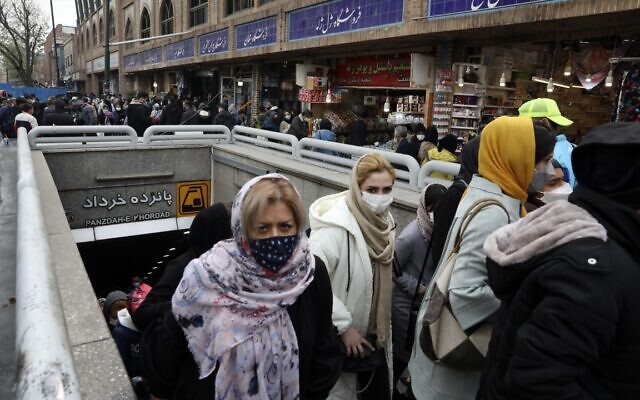





 anneinpt
 artaxes
 danmillerinpanama
 davidking1530
 Peter Hofman
 Joseph Wouk
 Peter
Peter Louisiana Steve
 WarSclerotic

Recent Comments