Archive for February 2021

Netanyahu: Israel will prevent a nuclear Iran whether or not a deal is in place

February 24, 2021


PM issues warning after Tehran begins restricting access to IAEA inspectors, in further breach of nuke deal; top Israeli officials hold policy meeting as US seeks to reenter accord

By TOI STAFFToday, 12:31 am  1

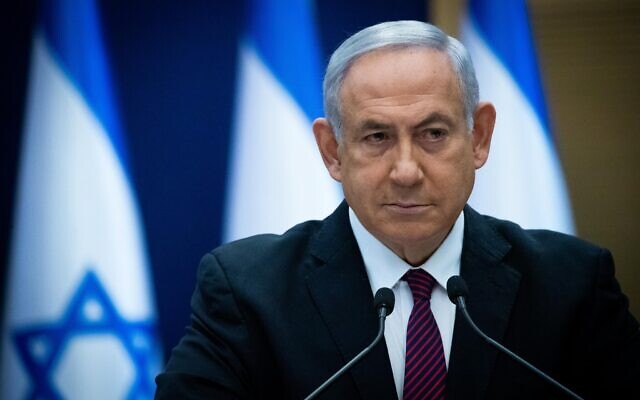
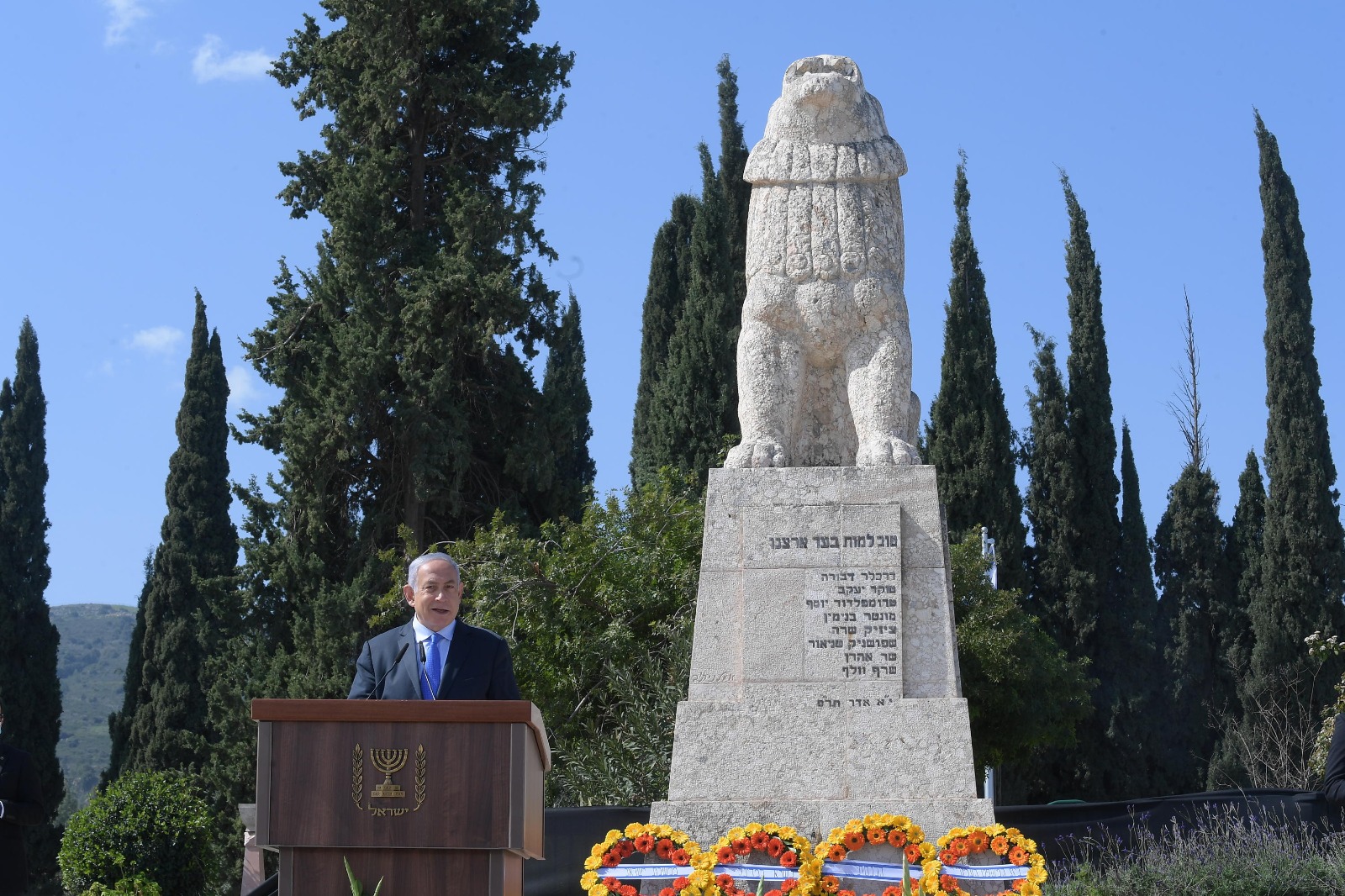
Prime Minsiter Benjamin Netanyahu gives a speech at a memorial ceremony in Tel Hai on February 23, 2021. (Amos Ben Gershom/GPO)

Prime Minsiter Benjamin Netanyahu gives a speech at a memorial ceremony in Tel Hai on February 23, 2021. (Amos Ben Gershom/GPO)

Prime Minister Benjamin Netanyahu on Tuesday vowed Israel would prevent Iran from obtaining a nuclear weapon, regardless of whether a multilateral accord is in place to prevent Tehran from doing so.

The comments came hours after Iranian state TV reported that the Islamic Republic has officially begun restricting international inspections of its nuclear facilities.

“On the eve of the Purim holiday, I say to those who seek to harm us — Iran and its proxies in the Middle East: 2,500 years ago, another Persian tyrant tried to destroy the Jewish people and just as he failed then – you too will fail,” Netanyahu said at a memorial ceremony in the northern town of Tel Hai, referencing the Purim story.

Addressing Iranian leaders, Netanyahu said Israel wouldn’t allow “your extremist and aggressive regime” to acquire nuclear arms.

“We did not make the generations-long journey for thousands of years back to the Land of Israel, to allow a delusional regime of the ayatollahs to end the story of the resurrection of the Jewish people,” he said.

“We do not place our trust in any agreement with an extremist regime like yours,” Netanyahu said, in remarks likely to make the Biden administration uneasy as it seeks to reenter the 2015 nuclear deal limiting Iran’s nuclear program, which former president Donald Trump unilaterally withdrew the US from in 2018.
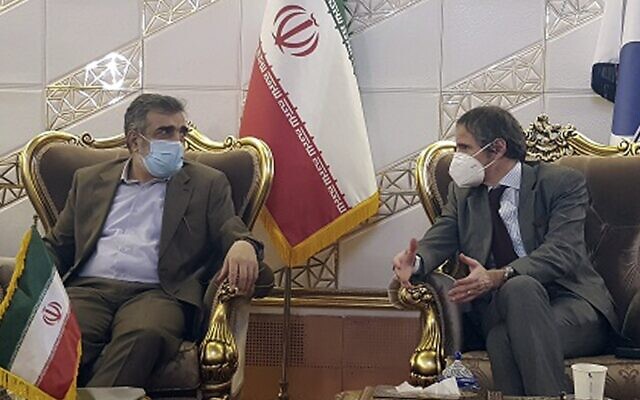
In this February 20, 2021, photo, Director General of International Atomic Energy Agency, IAEA, Rafael Mariano Grossi, right, speaks with the spokesman of Iran’s atomic agency Behrouz Kamalvandi upon his arrival at Tehran’s Imam Khomeini airport, Iran. (Atomic Energy Organization of Iran via AP)

The premier added: “We have already seen the nature of agreements with extremist regimes like yours, in the past century and also in this century, with the North Korean government. With an agreement or without an agreement, we will do whatever is necessary so you do not arm yourselves with nuclear weapons.”

On Monday, Netanyahu held the first major intra-ministerial meeting to discuss Israel’s policy vis-a-vis Iran since US President Joe Biden took office.

Among the senior officials who took part in the meeting were Defense Minister Benny Gantz, Foreign Minister Gabi Ashkenazi, IDF Chief of Staff Aviv Kohavi, Mossad chief Yossi Cohen and Israel’s Ambassador to the US Gilad Erdan.

Also participating were former national security council chairmen Yaakov Amidror and Yaakov Nagel, who Netanyahu is bringing on as external advisers on the issue, the Walla news site reported. Both of them are considered to have a hawkish stance on Iran more in line with Netanyahu’s.

Amidror was national security adviser while the agreement was being crafted and sparred with his American counterpart at the time, Susan Rice. Nagel, a nuclear expert, also served as an adviser during that period but stayed on longer, leading talks with the Trump administration to institute its “maximum pressure” sanctions campaign.
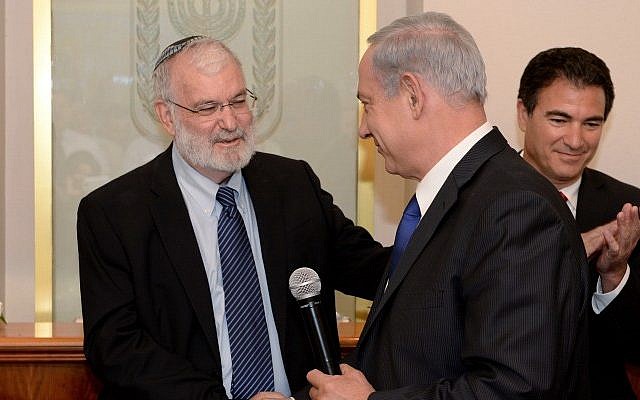
Outgoing national security adviser Yaakov Amidror with Prime Minister Benjamin Netanyahu at a farewell ceremony in Amidror’s honor, on November 3, 2013. (Kobi Gideon/GPO/Flash90)

Also expected to serve as an external adviser on the matter is longtime Netanyahu aide and Erdan’s predecessor Ron Dermer, who is set to return to Israel in the coming weeks.

During Monday’s meeting, Kohavi and Cohen emphasized the importance of working to build goodwill with the new US administration by not sparring publicly with Washington over the Iran deal, Walla reported.

“We have not moved from our position against returning to the nuclear deal, but we want to work together with the administration and have a constructive discussion with it, not a confrontation,” a senior official said.

Additionally, Netanyahu plans to delegate talks on Iran to senior staff to prevent any personal tension between him and Biden, according to Reuters.

“The intent is to work everything out at that level, and to keep that communication channel open,” a senior official told Reuters. “Obviously this has benefits where there is a risk of a ‘cold shoulder’ at chief-executive level.”
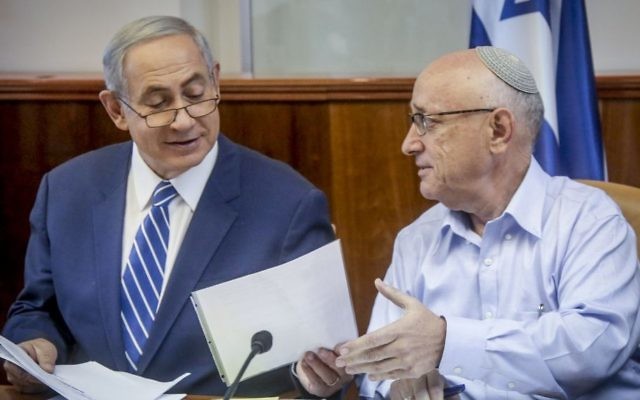
Prime Minister Benjamin Netanyahu (L) sits with former interim Israeli National Security Adviser Yaakov Nagel (R) at the weekly cabinet meeting at the Prime Minister’s Office in Jerusalem on September 18, 2016. (Marc Israel Sellem/Flash90)

Jerusalem is hoping to keep disputes with the new administration “under the radar” for the time being, Army Radio reported.

Also Tuesday, the Kan public broadcaster reported that senior Israeli and Saudi officials have recently held several phone calls to discuss the Biden administration’s plans to rejoin the Iran nuclear deal.

During the conversations, the Saudis also expressed concern over the new US administration and lamented its focus on human rights violations in the kingdom, the report said. Israel and Saudi Arabia do not have diplomatic relative but have maintained clandestine ties. Netanyahu visited Saudi Arabia in November for the first known meeting between Israeli and Saudi leaders.
IAEA deeply troubled by possible nuclear material at Iran site flagged by Israel

February 24, 2021


Sources say no indication Tehran facility was used for processing uranium, but may have been used for storing it as late as 2018, around when Netanyahu revealed site to UN

By AFP and TOI STAFFToday, 12:58 am  0

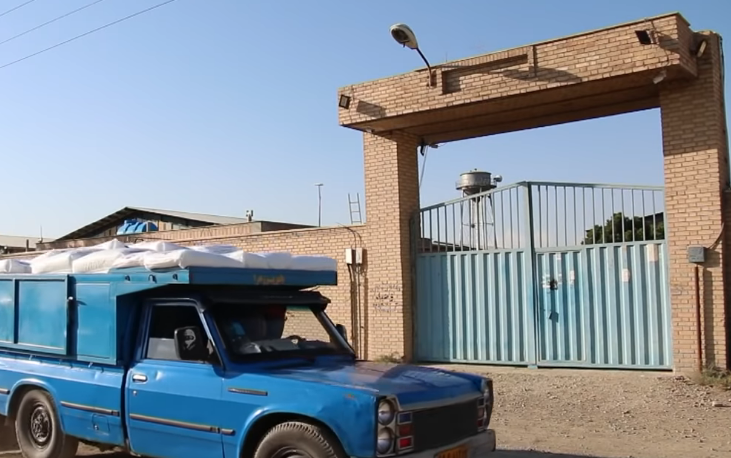
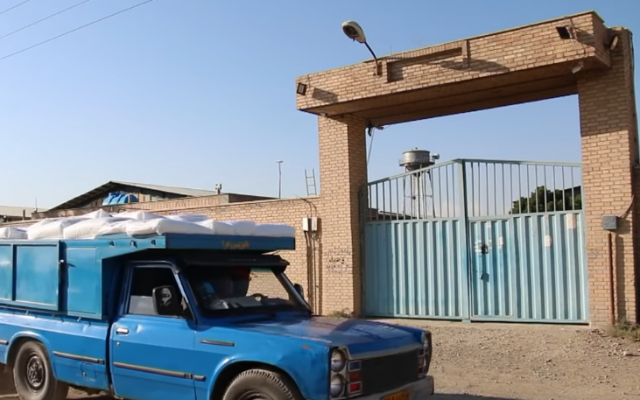
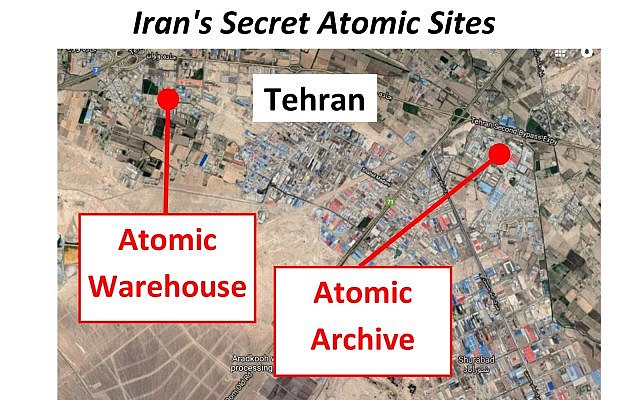
Illustrative: Iran's alleged atomic warehouse in Turquzabad, Tehran. (YouTube screenshot)

Illustrative: Iran’s alleged atomic warehouse in Turquzabad, Tehran. (YouTube screenshot)

The UN’s atomic watchdog said Tuesday that it was “deeply concerned” by the possible presence of nuclear material at an undeclared site in Iran that Prime Minister Benjamin Netanyahu has declared was a “secret atomic warehouse.”

“The agency is deeply concerned that undeclared nuclear material may have been present at this undeclared location and that such nuclear material remains unreported by Iran under its safeguards agreement,” a report from the International Atomic Energy Agency seen by AFP said.

“After 18 months, Iran has not provided the necessary, full and technically credible explanation for the presence of the nuclear material particles,” the report said.

The site in question is in the Turquzabad district of Tehran, previously identified by Israel as an alleged site of secret atomic activity.

Inspectors from the International Atomic Energy Agency visited the site several times after Netanyahu identified it in a 2018 address to the UN General Assembly, took soil samples, and later definitively concluded that there were “traces of radioactive material” there, Channel 13 news reported in 2019.

Sources told AFP Tuesday that there is no indication the site has been used for processing uranium, but that it could have been used for storing it as late as the end of 2018.

An image from a placard displayed by Prime Minister Benjamin Netanyahu during his speech to the United Nations General Assembly showing a suspected “secret atomic warehouse” in the Turquzabad district of Tehran containing up to 300 tons of nuclear material. (GPO)

In a separate report also issued on Tuesday, the IAEA said that Iran’s stockpile of enriched uranium is now more than 14 times over the limit set down in its 2015 deal with world powers.

The report said that, as of February 16, Iran’s total enriched uranium stockpile was 2,967.8 kilograms.

The limit in the 2015 deal was set at 300 kilos (660 pounds) of enriched uranium in a particular compound form, which is the equivalent of 202.8 kilos of uranium in non-compound form.

The latest IAEA reports came on the day that Iran began to restrict some site inspections by the IAEA in a further violation of the nuclear deal, which Tehran has steadily stepped away from since president Donald Trump withdrew the US from the agreement in 2018 and reimposed sanctions.

As Iran plays chicken with Biden, it also moves closer to the bomb

February 24, 2021


Tehran appears to be jockeying for position ahead of nuke deal talks by blackballing inspectors and threatening to increase enrichment, but the posturing carries dangerous risks

By LAZAR BERMAN23 February 2021, 11:40 pm  1

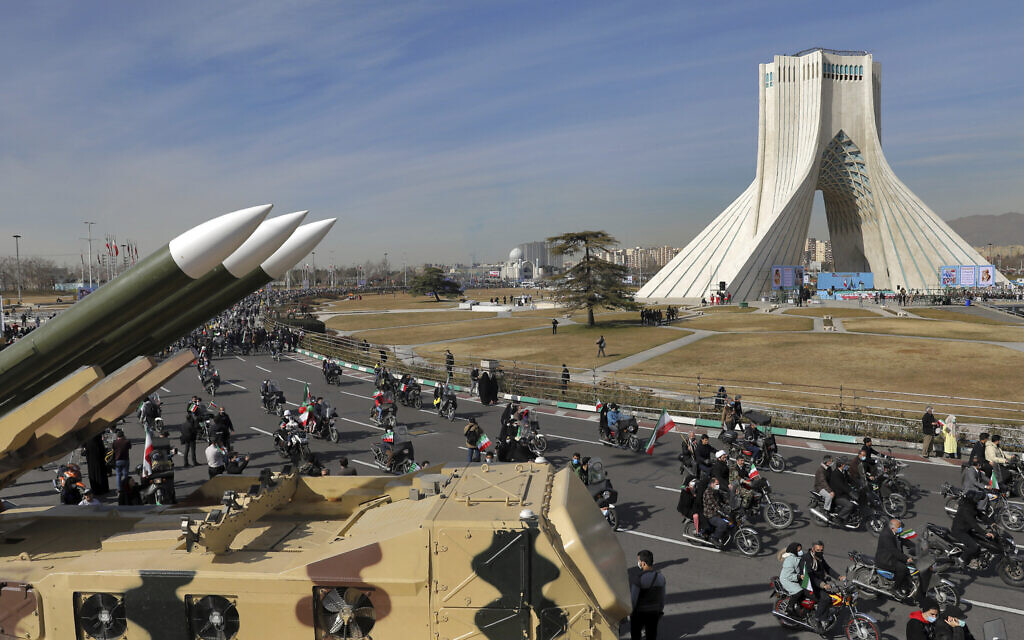
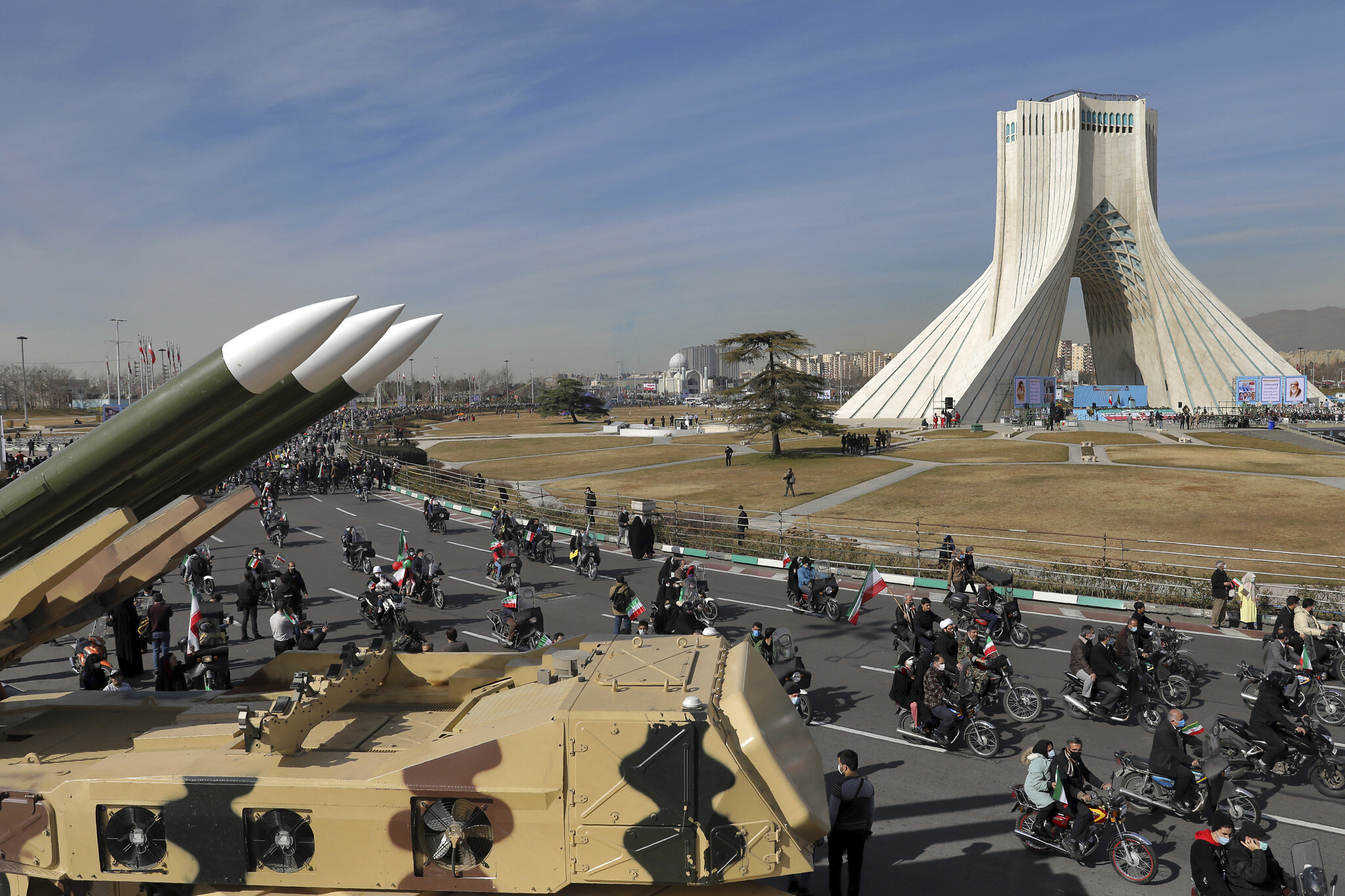
Iranians drive past missiles on motorcycles during a rally marking the 42nd anniversary of the Islamic Revolution, at Azadi (Freedom) Square in Tehran, Iran, Wednesday, February 10, 2021. (AP/Ebrahim Noroozi)

Iranians drive past missiles on motorcycles during a rally marking the 42nd anniversary of the Islamic Revolution, at Azadi (Freedom) Square in Tehran, Iran, Wednesday, February 10, 2021. (AP/Ebrahim Noroozi)

With each step Iran takes to advance its nuclear program, a path out of the dangerous quagmire becomes even more murky.

On Tuesday, Tehran officially suspended its implementation of the Non-Proliferation Treaty Additional Protocol, which gave nuclear inspectors increased access to Iran’s nuclear program, including the ability to carry out snap inspections at undeclared sites.

“As of midnight tonight, we will not have… commitments beyond safeguards. Necessary orders have been issued to the nuclear facilities,” said Kazem Gharibabadi, Iran’s envoy to international organizations in Vienna.

A day earlier Iranian Supreme Leader Ali Khamenei said that Tehran could enrich uranium to 60% purity if it so desired. US State Department spokesman Ned Price said the comment “sounds like a threat” and referred to it as “posturing.”

Analysts believe both the move to limit inspections and the enrichment threat are aimed at bolstering Iran’s negotiating position as it and US President Joe Biden’s administration maneuver ahead of expected talks aimed at bringing Washington back into the 2015 nuclear deal. But even if intended as bargaining chips, they carry the risk of moving Iran significantly closer to nuclear weapons capabilities.

“Biden is paying a game of chicken over who will reverse course first,” said Joab Rosenberg, former deputy head analyst in the Israel Defense Force’s Military Intelligence Directorate. “There is an extremely unstable situation here, and a vector of deterioration and Iranian progress toward a bomb.”

The 2015 nuclear deal limits the Islamic Republic to 3.67% enrichment, a threshold it long ago passed as part of a series of escalating violations of the Joint Comprehensive Plan of Action between Iran and six world powers, better known as the Iran nuclear deal.

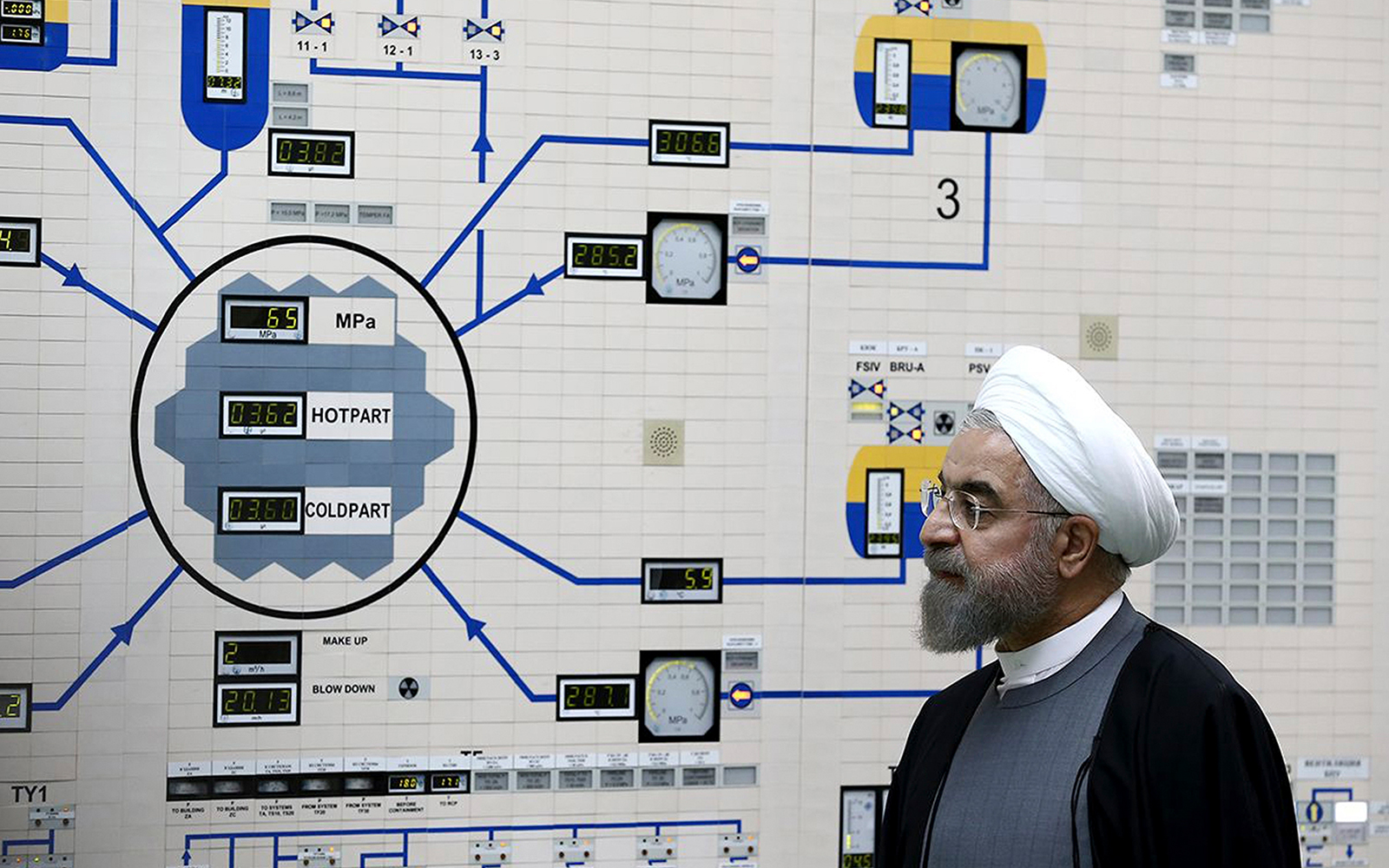
Uranium enriched to 60% is short of what Iran needs to make a nuclear weapon, but it would show that Tehran is going beyond the 20% to which it began enriching in January.Illustrative: Iranian President Hassan Rouhani visits the Bushehr nuclear power plant just outside of Bushehr, Iran, Jan. 13, 2015. (AP Photo/Iranian Presidency Office, Mohammad Berno, File)



Levels above 20% are considered highly enriched uranium, or HEU, with few non-military uses. The jump from 20% to 90% enrichment, the level needed for most weapons-grade applications, is fairly simple, and any move to begin enriching above 20% is liable to raise major alarm bells.

In 2013, Iran’s parliament pushed for a bill to enrich to 60%, which it said was allowed for nuclear-powered submarines. At the time it claimed it was developing such naval vessels, but today is not known to have any in its fleet, raising suspicions that the plans had been a feint.

While Iran’s nuclear program progresses, the International Atomic Energy Agency’s ability to keep an eye on Tehran’s nuclear program is moving in the other direction. On Sunday, IAEA chief Rafael Grossi told reporters after an emergency trip to Tehran that Iran’s government would begin offering “less access” to UN weapons inspectors — involving unspecified changes to the type of activity the watchdog can carry out.

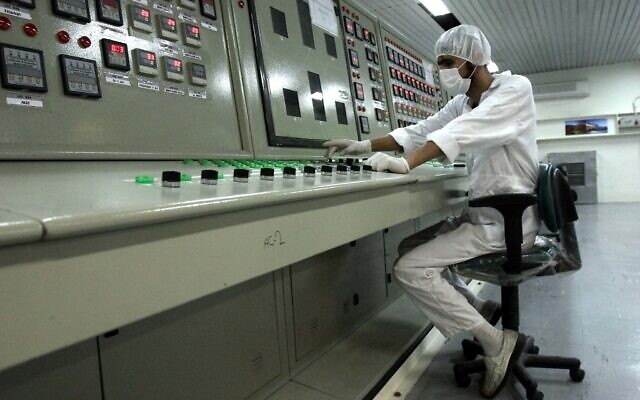
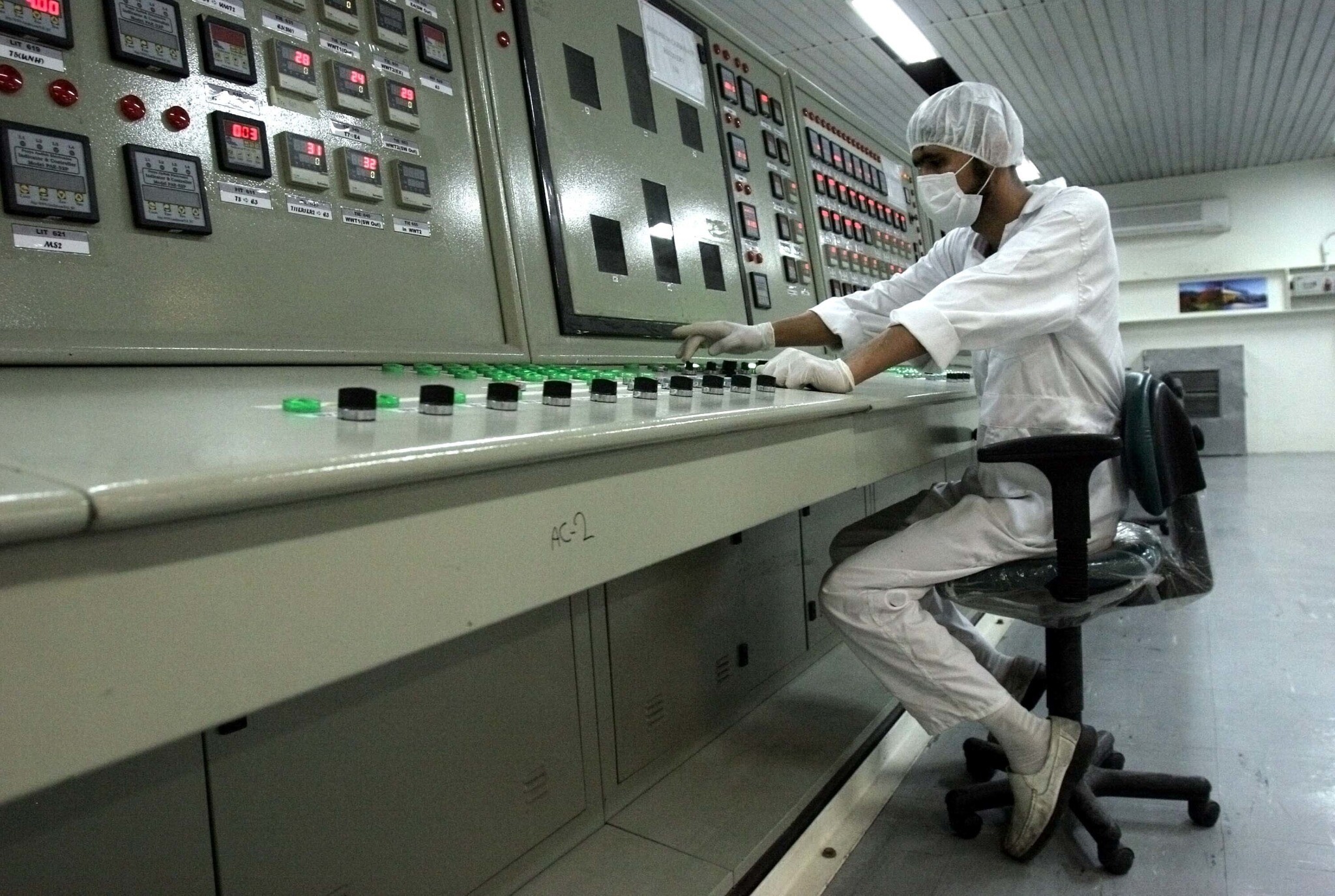
“It is totally clear that from Tuesday, the oversight of Iran will be damaged,” said Rosenberg.In this Feb. 3, 2007 file photo, a technician works at the Uranium Conversion Facility just outside the city of Isfahan, Iran. (AP Photo/Vahid Salemi, File)

The move to restrict inspectors was in line with a law passed by Iran’s parliament in December requiring the government to cease implementation of the Additional Protocol on Tuesday.

“This law exists, this law is going to be applied, which means that the Additional Protocol, much to my regret, is going to be suspended,” Grossi said, referring to a confidential inspections agreement between Tehran and the IAEA reached as part of the nuclear deal.

Tehran has been gradually suspending its compliance with most of the limits set by the agreement in response to Washington’s abandonment of the nuclear deal, which provided sanctions relief in exchange for enrichment restrictions, and the failure of other parties to the deal to make up for the reimposed US penalties.

In July 2019, Iran announced it had exceeded the 300 kilogram limit of its 3.67% low-enriched uranium stockpile. A week later it began enriching uranium to 4.5% at the Natanz plant.

In September of that year, Iranian President Hassan Rouhani announced that “all of the commitments for research and development under the JCPOA will be completely removed by Friday.” The IAEA verified in November that Iran’s heavy water stockpile had exceeded the JCPOA’s 130 metric ton limit.

On January 5, 2020, Iran announced its fifth planned violation, forgoing any limits on the number of centrifuges it operates.

In January 2021, Tehran revealed that it was taking steps to produce uranium metal, days after it resumed enriching uranium to 20% purity at the underground Fordo facility.

According to a report Friday, International Atomic Energy Agency inspectors last summer found uranium particles at two Iranian nuclear sites to which Iran tried to block access.Director-General of the International Atomic Energy Agency (IAEA) Rafael Mariano Grossi, center left, speaks with Iran’s Foreign Minister Mohammad Javad Zarif, center, before a meeting in Tehran, Iran, August 25, 2020. (AP Photo/Vahid Salemi)

Iranian authorities had stonewalled the inspectors from reaching the sites for seven months before the inspection, and Iranian officials have failed to explain the presence of the uranium, the Reuters news agency reported, citing diplomats familiar with the UN agency’s work.

The inspections took place in August and September of 2020, the report said. The IAEA keeps its findings secret and only shared the details of the find with a few countries.

The Wall Street Journal reported the suspicious findings earlier this month, without identifying the material.

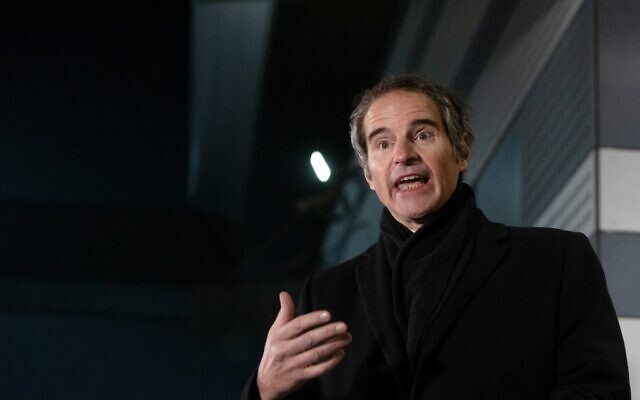
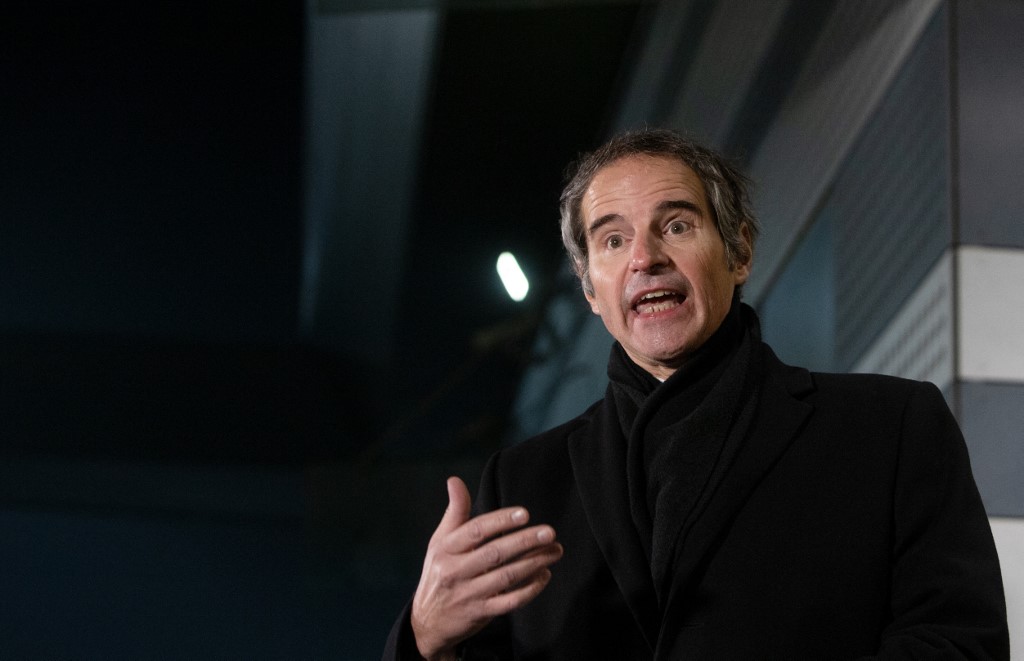
IAEA chief Grossi tried to put Monday’s agreement on inspections in a positive light, stressing that monitoring would continue in a “satisfactory” manner, pointing to a three-month “technical understanding” reached to ensure some type of inspections would continue.IAEA Director Rafael Mariano Grossi speaks to the media after returning from Iran, at Vienna International Airport, Sunday, Feb. 21, 2021. (AP/Ronald Zak)

“My hope, the hope of the IAEA, has been to stabilize a situation that was very unstable. And I think this technical understanding does it, so that other political consultations at other levels can take place,” Grossi told reporters.

But the IAEA has refused to detail what the deal allows and critics fear that it will still give Iran more leeway to make progress in its nuclear program while dictating what kind of access international inspectors will have.

“Based on Grossi’s evasiveness, it doesn’t seem like he achieved much in this agreement,” said Rosenberg.File: Fighters with Iran-backed militias in Iraq, known as the Popular Mobilization Forces, wave Iraqi flags while mourners and family members prepare to bury the body of Abu Mahdi al-Muhandis, a deputy commander of the militias who was killed in a US airstrike in Iraq, during his funeral procession in Najaf, Iraq, January 8, 2020. (Anmar Khalil/AP)

He noted the possibility that Iran actually made more significant concessions but that Grossi agreed not to go into detail so as not to arouse criticism of the government from Iran’s parliament, which nonetheless termed the agreement “illegal.”

Richard Goldberg, a senior adviser at the Foundation for the Defense of Democracies, assailed the lack of demands for clarity from the White House.

“The US should not accept that the terms of this agreement are secret,” he said.

While the administration of former US president Donald Trump had pursued a “maximum pressure” policy against Iran, Biden has signaled a more conciliatory approach, albeit while leaving the reimposed sanctions in place. On Friday, Biden said the US was “prepared to reengage in negotiations with the P5+1 on Iran’s nuclear program.”

Goldberg said the Iranians had been testing their boundaries by violating the nuclear deal, and were now seeing how far they could push the Biden administration. He noted an attack by Iranian-backed militias on Erbil in northern Iraq, in which a foreign contractor was killed and an American service member was injured, which carried “no consequences for Iran.”

“Next they will test existing sanctions and whether they will be enforced,” Goldberg predicted. “Unenforced sanctions are the same as lifting sanctions.”

Iran’s Khamenei says ‘no one can stop Tehran’ from getting a nuclear weapon | Al Arabiya English

February 23, 2021

Iran’s Khamenei says ‘no one can stop Tehran’ from getting a nuclear weapon

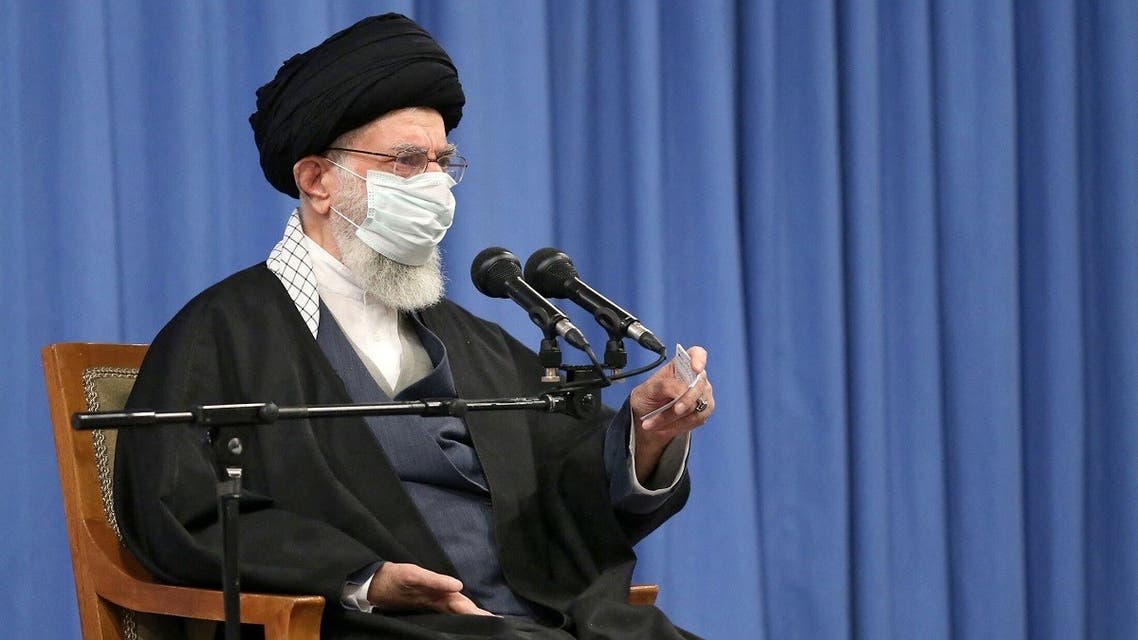
Iran's Supreme Leader Ayatollah Ali Khamenei meets with members of the Iranian Assembly of Experts in Tehran, Feb. 21, 2021. (AFP)

Iran’s Supreme Leader Ayatollah Ali Khamenei meets with members of the Iranian Assembly of Experts in Tehran, Feb. 21, 2021. (AFP)

Reuters

Published: 22 February ,2021: 11:17 AM GSTUpdated: 22 February ,2021: 09:24 PM GST

Iran’s Supreme Leader Ayatollah Ali Khamenei said on Monday that Tehran may enrich uranium up to 60 percent purity if the country needed it, state TV reported, adding that Tehran will never yield to the US pressure over the country’s nuclear work.

“Iran’s uranium enrichment level will not be limited to 20 percent. We will increase it to whatever level the country needs … We may increase it to 60 percent,” state quoted Ayatollah Ali Khamenei as saying.

He said Tehran had never sought a nuclear weapon but if it wanted to, “no one could stop Tehran from acquiring it.”

“Americans and the European parties to the deal have used unjust language against Iran…Iran will not yield to pressure. Our stance will not change,” Khamenei said.

US President Joe Biden’s administration said last week it was ready to talk to Iran about both nations returning to the accord abandoned by Biden’s predecessor Donald Trump.

Secretary of State Antony Blinken said on Monday Washington would aim to bolster and extend the 2015 pact, which aimed to limit Iran’s enrichment potential – a possible pathway to atomic bombs – in exchange for a lifting of most sanctions.

Iran and the United States have been at odds over who should take the first step to revive the accord. Iran insists the United States must first rescind US sanctions while Washington says Tehran must first return to full compliance.

Rare visit to Israel by Egypt’s oil minister sends signals to Biden, Erdogan

February 22, 2021


The trip, following similar delegations of Greek and Cypriot leaders, is intended to show that the regional allies are united and coordinated, both against friends and foes

By LAZAR BERMANToday, 3:02 am  0

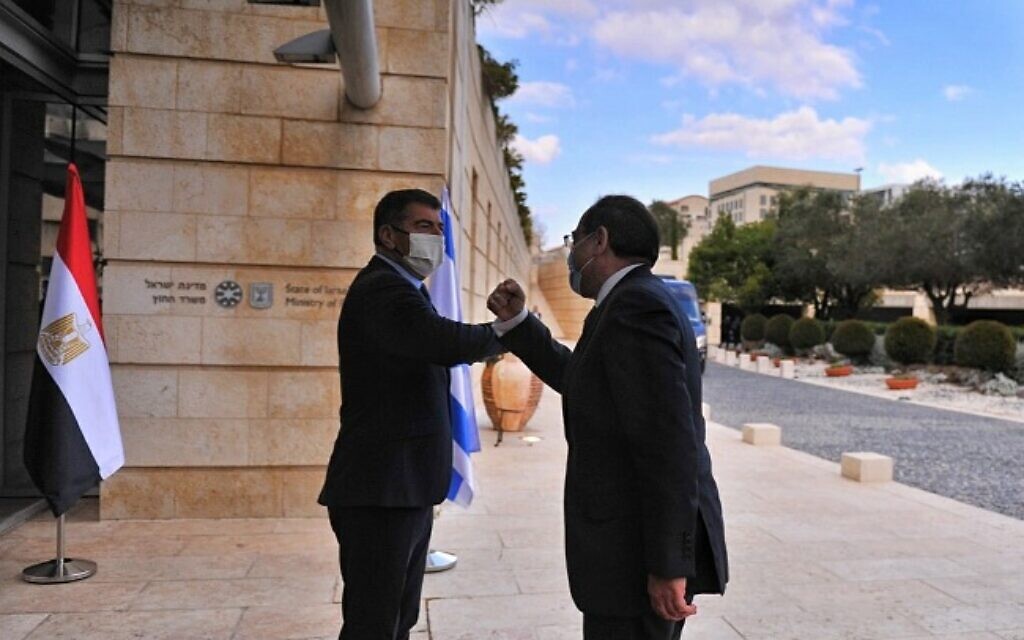
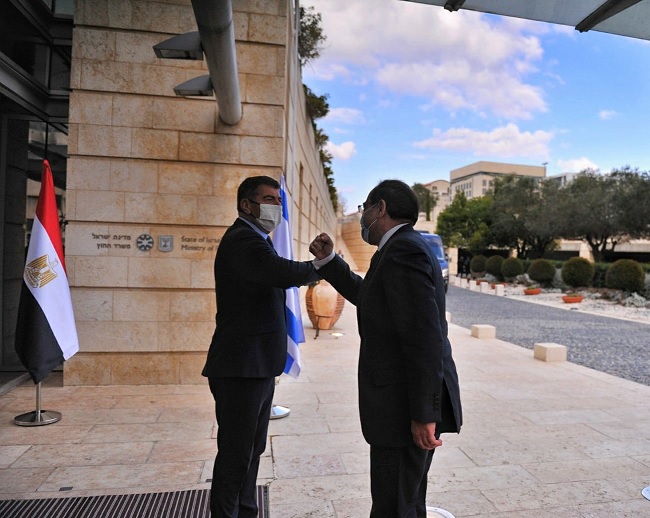
Foreign Minister Gabi Ashkenazi meets Egyptian Petroleum Minister Tarek El-Molla meet in Jerusalem, February 21, 2021 (photo credit: MFA)

Foreign Minister Gabi Ashkenazi meets Egyptian Petroleum Minister Tarek El-Molla meet in Jerusalem, February 21, 2021 (photo credit: MFA)

Although the visit of Egypt’s Petroleum and Mineral Resources Minister to Israel on Sunday had the trappings of a routine discussion about energy cooperation by regional partners, it also sent a message to rivals and to the United States.

Tarek el-Molla’s trip was noteworthy for the mere fact that he was the first Egyptian minister to visit Israel since foreign minister Sameh Shoukry met with Netanyahu in 2016.

And El-Molla is no minor player. “El-Molla is very close to Sisi,” pointed out Gabriel Mitchell of the Mitvim Institute, an Israel-based think tank. “He is arguably one of the most visible Egyptian ministers outside the presidency.”

There is certainly no shortage of weighty energy issues for El-Molla to discuss with Israel. Israel and Egypt agreed Sunday to link up Israel’s Leviathan natural gas field with Egyptian liquid natural gas facilities through an underwater pipeline, from which it can be exported to European markets.

What’s more, a UAE-Israel plan to pump oil from Eilat on the Red Sea to Ashkelon on the Mediterranean concerns Egypt, but Cairo has largely refrained from publicly criticizing the project. A deal to provide Israeli natural gas to Gaza is nearing approval, and anything that happens in the coastal enclave could have a direct impact on Egyptian security.

And analysts say that one of the key purposes of the meetings — beyond the energy discussions —  was to send a message to Turkey, and its president Recep Tayyip Erdogan.Turkey’s President Recep Tayyip Erdogan speaks during a news conference, in Ankara, Turkey, October 26, 2020. (Turkish Presidency via AP, Pool)

For the better part of a decade, Turkey has been engaged in a bitter rivalry with Egypt that began when Erdogan backed the Muslim Brotherhood after the group was ousted from power in Cairo

In the Mediterranean, Egypt has aligned itself with Greece and Cyprus, which accuse Turkey of illegally drilling for natural gas in their exclusive economic zones. Together with Israel, the countries formed the EastMed Gas Forum, headquartered in Cairo, and have conducted joint military exercises.

“A meeting between Israel and Egypt, even if it isn’t the primary purpose of the visit, does send a message to Turkey, especially in the context of the other meetings that are taking place this month,” said Mitchell.

Greek Prime Minister Kyriakos Mitsotakis visited Israel on February 8,  and Cypriot President Nicos Anastasiades met with Netanyahu on February 14.Prime Minister Benjamin Netanyahu hosts Greek Prime Minister Kyriakos Mitsotakis in Jerusalem on February 8, 2021 (Haim Zach / GPO)

“There s a clear message of unity, that these partners are working together, that they have their diplomatic ducks in a row, they have their energy ducks in a row.”

The East Mediterranean Gas Forum (EMGF), which comprises Israel, Egypt, Cyprus, Greece, and the Palestinian Authority, was formally launched in September. The forum intends to cooperate on the establishment of a natural gas pipeline connecting Israel, Greece and Cyprus to Italy and on to Europe. The eventual aim is to supply the continent with ten percent of its gas.

Israel joined the EMGF last September in a development formally establishing the brainchild of Energy Minister Yuval Steinitz and el-Molla as a regional intergovernmental organization, based in Cairo.

The visit was also meant to send a message to the Biden Administration.

Egypt anticipates increased pressure from the US government over its human rights record.

“We won’t tolerate assaults or threats by foreign governments against American citizens or their family members,” State Department spokesperson Ned Price said last week after President Abdel Fattah el Sisi’s government arrested the family of a political activist who is also a US citizen.

As a presidential candidate, Biden tweeted “No more blank checks for Trump’s ‘favorite dictator.

“I have no doubt that the Egyptians have worries about the Biden Administration,” said Eran Lerman, vice president of the Jerusalem Institute for Strategy and Security and past deputy director of Israel’s National Security Council.

“The Egyptians understand well how important expressions of normalization like this are for Israel,” said Moshe Albo, a modern Middle East historian and researcher at the Dado Center for Interdisciplinary Military Studies. “Therefore the hidden message is that Egypt is working with Israel, and expects Israel to help it with the US; and a message for the US, who will see Egypt cooperating with Israel.”Greek Prime Minister Kyriakos Mitsotakis (C), his Israeli counterpart Benjamin Netanyahu (R) and Cypriot President Nikos Anastasiadis pose in Athens on January 2, 2020, ahead of the signing of an agreement for the EastMed pipeline project designed to ship gas from the eastern Mediterranean to Europe. (ARIS MESSINIS / AFP)

“All the eastern Mediterranean is arranging itself so that Biden hears a unified position from us,” argued Lerman.

Lerman sees the visits by the Greek and Cypriot leaders as part of the regional coordination process directed partially at Biden. “They weren’t here just to talk about tourism,” he said.

The visit, during which el-Molla visited Palestinian officials in Ramallah, also allowed Egypt to present itself as an invaluable mediator between Israel and the Palestinians, as it has sought to do since Biden’s electoral victory. In December, Sisi said that Cairo was working to advance the two-state solution. A week before Biden took office, Egypt hosted the Jordanian, French, and  German foreign ministers to discuss reviving Israeli-Palestinian peace talks.

The more Egypt can present itself as a source of stability and cooperation in the region, the logic goes, the less pressure it will face from the US over its human rights record.A crane vessel makes its way to Israel to help set up the Leviathan natural gas platform. (Noble Energy)

In their comments, Israeli leaders sought to emphasize Egypt’s positive influence in the Middle East. “Egypt plays a vital role in the region promoting security, stability, and peace,” said Foreign Minister Gabi Ashkenazi.

He was also sure to play up the appearance of increasing normalization with Egypt. “Egypt was the first country to sign a peace agreement with Israel,” said Ashkenazi, “and we hope that the paradigm shift of the Abraham Accords and all the normalization, we will be able together to expand the peace circle around the region.”

Mitchell believes that relations between Israel and Egypt are noticeably warmer than they have been in the past. “Cooperation has never been so diverse, and never been so meaningful in the entire history of bilateral relations,” he argued.

“There is a trend of normalization,” Lerman agreed. “I’ll remind you that the Egyptians gave their support for the Abraham Accords.”

Albo is unconvinced that the Egyptians are trying to show that they intend to pursue noticeably warmer relations with Israel. “Egypt is presenting the visit internally as one that advances Egypt’s interests, one of its commitments as part of Egypt’s vision for the EastMed, in which el-Molla is meeting both the Palestinian and Israeli energy ministers.”

UN nuclear chief concedes Iran to grant ‘less access’ to inspectors at its sites

February 22, 2021

After meeting with officials in Tehran, IAEA head says watchdog will continue necessary monitoring and verification of Iranian program

By AGENCIES and TOI STAFF21 February 2021, 11:44 pm  1

Director General of the International Atomic Energy Agency (IAEA) Rafael Mariano Grossi addresses media after his arrival at Vienna International Airport on February 21, 2021. (ALEX HALADA / AFP)

Director General of the International Atomic Energy Agency (IAEA) Rafael Mariano Grossi addresses media after his arrival at Vienna International Airport on February 21, 2021. (ALEX HALADA / AFP)

The head of the United Nations’ nuclear watchdog said that Iran will begin offering its inspectors “less access,” but will still allow the agency to monitor its atomic program.

Rafael Grossi made the comments on arrival in Vienna late Sunday night after holding talks with officials in Tehran. He was careful to say that there still would be the same number of inspectors, but there would be “things we lose.”

“What we agreed is something that is viable — it is useful to bridge this gap that we are having now, it salvages the situation now,” Grossi told reporters.

“There is less access, let’s face it. But still, we were able to retain the necessary degree of monitoring and verification work,” he said.

Iran’s conservative-dominated parliament passed a law in December demanding the country suspend some inspections if the US failed to lift sanctions.

The law is due to go into effect on Tuesday.

“This law exists, this law is going to be applied, which means that the Additional Protocol, much to my regret, is going to be suspended,” Grossi said, referring to a confidential inspections agreement between Tehran and the IAEA reached as part of the nuclear deal.

Grossi did not give details of precisely which activities the IAEA would no longer be able to do, but confirmed that the number of inspectors in Iran would not be reduced and that snap inspection could continue under the temporary arrangement.

In a joint statement, the IAEA and the Atomic Energy Organization of Iran said that “a temporary bilateral technical understanding” had been reached “whereby the IAEA will continue with its necessary verification and monitoring activities for up to three months.”

The two sides further agreed to keep the understanding under regular review to “ensure it continues to achieve its purposes.”Iranian Foreign Minister Mohammad Javad Zarif listens to Russian Foreign Minister Sergey Lavrov during talks in Moscow, Russia, January 26, 2021. (Russian Foreign Ministry Press Service via AP)

Iranian Foreign Minister Mohammad Javad Zarif, who under President Hassan Rouhani helped reach the nuclear deal, said the cameras of the International Atomic Energy Agency would be shut off despite Grossi’s visit.

“This is not a deadline for the world. This is not an ultimatum,” Zarif told the government-run, English-language broadcaster Press TV in an interview aired before he met Grossi Sunday. “This is an internal domestic issue between the parliament and the government.”

“We have a democracy. We are supposed to implement the laws of the country. And the parliament adopted legislation — whether we like it or not.”

Zarif’s comments marked the highest-level acknowledgement yet of what Iran planned to do when it stopped following the so-called “Additional Protocol.”

Under the protocol with Iran, the IAEA “collects and analyzes hundreds of thousands of images captured daily by its sophisticated surveillance cameras,” the agency said in 2017. The agency also said then that it had placed “2,000 tamper-proof seals on nuclear material and equipment.”

In his interview, Zarif said authorities would be “required by law not to provide the tapes of those cameras.” It wasn’t immediately clear if that also meant the cameras would be turned off entirely as Zarif called that a “technical decision, that’s not a political decision.”

“The IAEA certainly will not get footage from those cameras,” Zarif said.

Grossi made his trip to Tehran as Iran has been trying to pressure Europe and the new Biden administration into returning to the 2015 nuclear deal, which former US president Donald Trump unilaterally withdrew America from in 2018, before imposing punishing sanctions on Iran that ravaged its economy.

Iran’s conservative-dominated parliament months ago demanded that, if the US does not lift sanctions by this Sunday, Iran will suspend some IAEA inspections from Tuesday.

But Iran has stressed it will not cease working with the IAEA or expel its inspectors.

Grossi met earlier Sunday with Ali Akbar Salehi, the head of Iran’s civilian nuclear program. Iran’s ambassador to the IAEA, Kazem Gharibabadi, later tweeted that “Iran and the IAEA held fruitful discussions based on mutual respect, the result of which will be released this evening.”

Uranium particles found

According to a report Friday, International Atomic Energy Agency inspectors last summer found uranium particles at two Iranian nuclear sites that Iran tried to block access to.

Iranian authorities had stonewalled the inspectors from reaching the sites for seven months before the inspection, and Iranian officials have failed to explain the presence of the uranium, the Reuters news agency reported, citing diplomats familiar with the UN agency’s wor.

The inspections took place in August and September of 2020, the report said. The IAEA keeps its findings secret and only shared the details of the find with a few countries.

The Wall Street Journal reported the suspicious findings earlier this month, without identifying the material.

The Reuters report did not identify the sites. Earlier reports said one of the sites was in Abadeh, south of Isfahan — a location that in September 2019 was flagged by Prime Minister Benjamin Netanyahu as the site of an alleged secret nuclear facility. Iran denies that it seeks nuclear weapons; Netanyahu is adamant that the regime is fooling the world, and has said that a trove of nuclear documents concerning its rogue program, smuggled out of Tehran by the Mossad two years, proves Iran’s duplicity.Prime Minister Benjamin Netanyahu revealing what he says is a nuclear weapons development site in Abadeh, Iran, at the Prime Ministers Office, on September 9, 2019. (Screenshot: YouTube)

Walking away

Already, Iran has slowly walked away from all the nuclear deal’s limitations on its stockpile of uranium and has begun enriching up 20%, a technical step away from weapons-grade levels.

It also has begun spinning advanced centrifuges barred by the deal, which saw Iran limit its program in exchange for the lifting of economic sanctions.This photo released November 5, 2019, by the Atomic Energy Organization of Iran, shows centrifuge machines in the Natanz uranium enrichment facility in central Iran. (Atomic Energy Organization of Iran via AP, File)

An escalating series of incidents since Trump’s withdrawal has threatened the wider Mideast. Over a year ago, a US drone strike killed a top Iranian general, causing Tehran to later launch ballistic missiles that wounded dozens of American troops in Iraq.

A mysterious explosion also struck Iran’s Natanz nuclear facility, which Iran has described as sabotage. In November, Iranian scientist Mohsen Fakhrizadeh, who founded the country’s military nuclear program some two decades earlier, was killed in an attack Tehran blames on Israel.

Zarif brought up the attacks in his interview with state TV, saying the IAEA must keep some of its information confidential for safety reasons.

“Some of them may have security ramifications for Iran, whose peaceful nuclear sites have been attacked,” Zarif said. “For a country whose nuclear scientists have been murdered in terrorist operations in the past — and now recently with Mr. Fakhrizadeh — confidentiality is essential.”

Pompeo slams Biden over desire to restart Iran nuclear talks

February 21, 2021

Mike Pompeo ripped the Biden administration for wanting to restart nuclear talks with Iran.

Mike Pompeo ripped the Biden administration for wanting to restart nuclear talks with Iran.Saul Loeb/Pool via REUTERS/File Photo

Former Secretary of State Mike Pompeo blasted the Biden administration’s willingness to restart nuclear talks with Iran, fearing they could lead to sanctions relief and concessions — but little substantive change in the country’s nuclear policy.

“The ayatollah understands only strength. I led a response to the Iranian threat that protected the American people from its terror and supported the Jewish state of Israel,” Pompeo told the Washington Free Beacon on Thursday. “Adopting the European Union model of accommodation will guarantee Iran a path to a nuclear arsenal.”

Pompeo’s remarks came the same day the State Department said it would welcome an invitation to restore diplomacy with Iran.

In 2018, the Trump administration pulled out of the deal three years after it was brokered by the Obama administration with Britain, France, Germany Russia, China and the European Union. The accord reduced sanctions against Iran in exchange for the country reducing its stockpile of enriched uranium needed to fuel nuclear weapons.

Since the US’s withdrawal, Iran has admitted it’s breached the 2015 deal by using advanced uranium-enriching centrifuges in an underground plant.

Pompeo credited the Trump administration’s steadfastness, saying that European nations “wanted to appease the Iranian theocracy for my entire time as secretary of state.”

“We refused,” he said.

Earlier this week, Pompeo said America needs to show strength when it comes to dealing with Iran.

“When the Iranians sense weakness, they’ll attack,” Pompeo said on “Fox News @ Night.” “What we did is that when they came after an American, we made this very clear: Whether they attacked an American through a proxy force in Iraq, whether they attacked an American through Hezbollah in Syria, wherever it was, wherever Iran was responsible, we were going to hold the Iranians accountable. That’s the kind of strength that built the deterrence model that we had with respect to Iran. I hope that this current administration won’t give up on that.”

Israel reportedly expands Dimona nuclear complex

February 20, 2021


Construction work at top-secret facility visible in satellite imagery, The Guardian reports

By TOI STAFFToday, 4:25 am  1

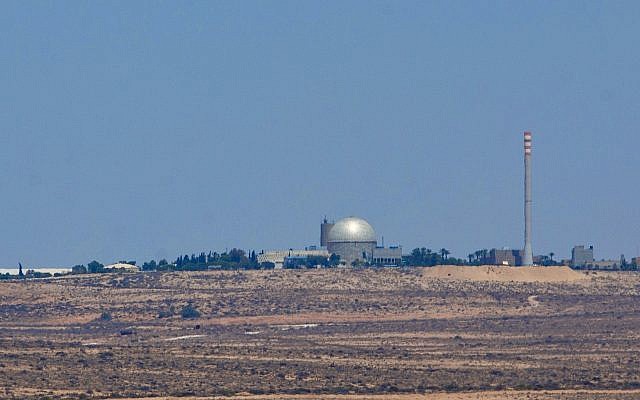
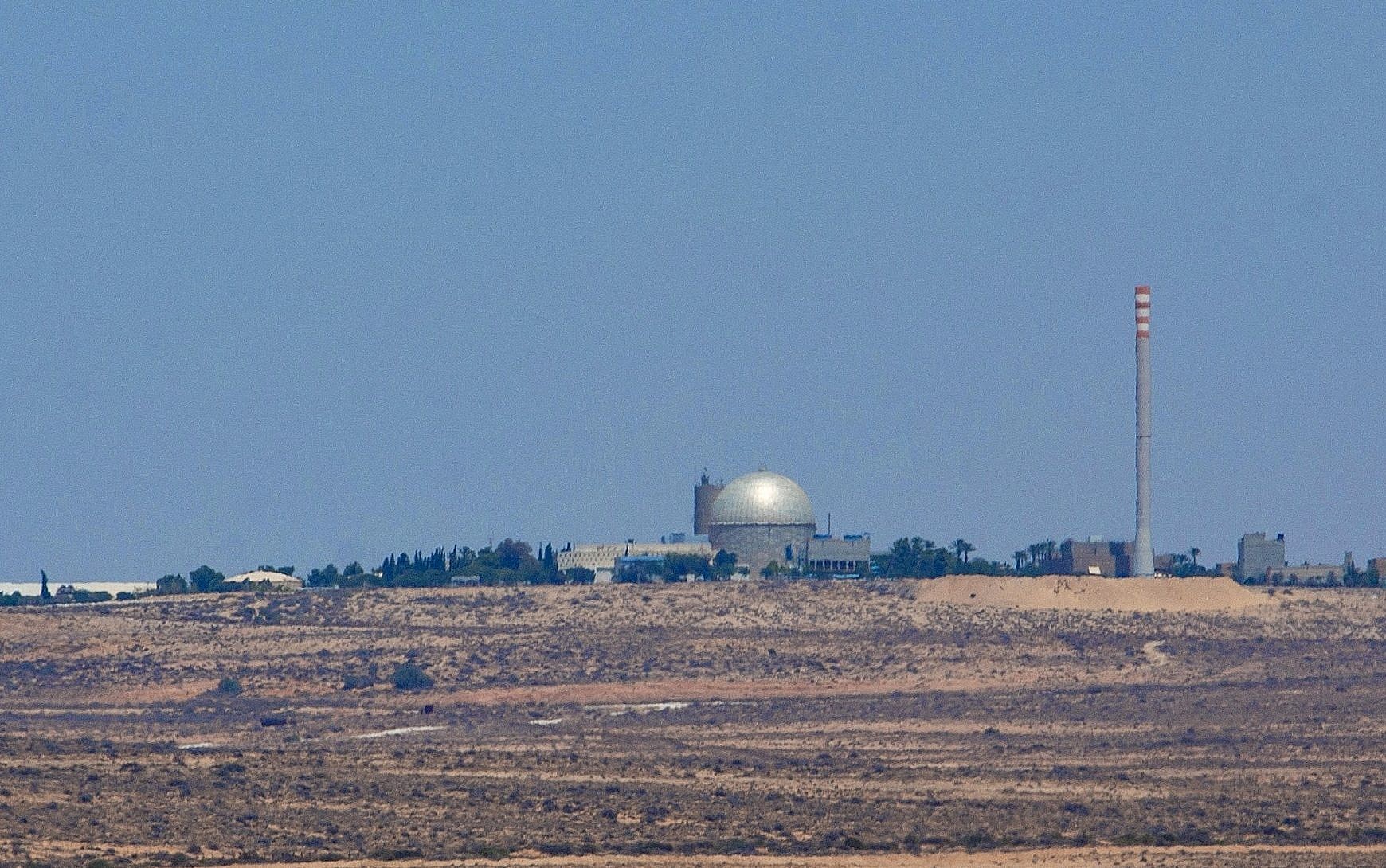
View of the nuclear reactor in Dimona, southern Israel, in 2016. (Moshe Shai/Flash90)

View of the nuclear reactor in Dimona, southern Israel, in 2016. (Moshe Shai/Flash90)

Israel’s top-secret nuclear research facility near the southern city of Dimona is undergoing a major expansion, according to a British report.

The UK’s Guardian newspaper reported the development on Thursday, saying the construction work is visible in satellite imagery published by an independent expert group.

The section of the complex under construction is several hundred meters (yards) from the complex’s reactor and reprocessing plant, and the purpose of the construction is not known, the report said.

A researcher with the International Panel on Fissile Material, which first noticed the construction in the satellite images, told The Guardian that the construction appeared to have started in early 2019 or late 2018.

Israel’s Dimona nuclear research facility is officially called the Shimon Peres Negev Nuclear Research Center.

To this day, Israel has never acknowledged that it has a nuclear arsenal, instead maintaining a policy of “nuclear ambiguity” while vowing that it will not be the first to use nuclear weapons in the Middle East.

In major speech, Biden indicates US ready to reengage with Iran on nuke deal

February 20, 2021


President says US ‘prepared to reengage in negotiations’ within UN Security Council framework; tells Munich Security Conference: ‘We must tackle Iran’s destabilizing activity’

By AGENCIES and TOI STAFF19 February 2021, 7:37 pm  3

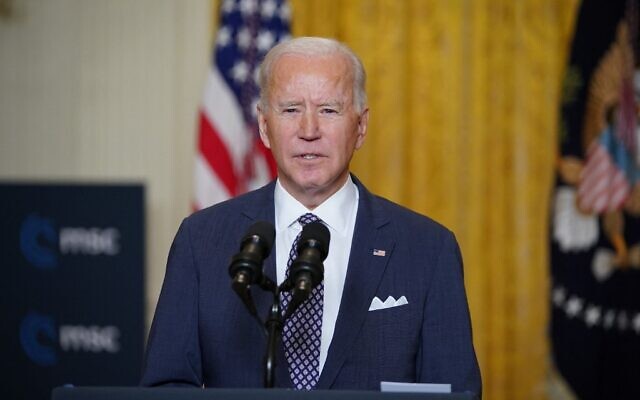
US President Joe Biden speaks virtually to the Munich Security Conference in Germany, from the East Room of the White House in Washington, DC, on February 19, 2021. (MANDEL NGAN / AFP)

US President Joe Biden speaks virtually to the Munich Security Conference in Germany, from the East Room of the White House in Washington, DC, on February 19, 2021. (MANDEL NGAN / AFP)

US President Joe Biden indicated Friday he is ready to reengage with Iran on the 2015 nuclear accord, which was abandoned by the Trump administration and which Iran has since been avowedly breaching.

Addressing the Munich Security Conference, Biden said his administration was ready to reenter talks with the UN Security Council on Tehran’s nuclear program.

“We’re prepared to reengage in negotiations with the P5+1 on Iran’s nuclear program,” he said. The P5+1 countries are the six world powers that negotiated the deal with Iran — the five permanent members of the UN Security Council and Germany.

Biden said it was imperative that the United States work with other leading global powers to curb Iran’s “destabilizing” ambitions

“We must also address Iran’s destabilizing activities across the Middle East, and we’re going to work in close cooperation with our European and other partners as we proceed,” Biden said, according to a transcript of the speech released by the White House.

Biden’s administration had said Thursday it was ready to join talks with Iran and world powers to discuss a return to the 2015 nuclear deal. Iran has demanded that the US lift sanctions before it returns to talks. It has also rejected discussing other issues, such as its regional activities.

Israeli leaders, including Prime Minister Benjamin Netanyahu, have long opposed the agreement and repeatedly warned against the US returning to the deal.

In a statement Friday afternoon, Netanyahu said Israel believes the old agreement will “pave Iran’s path to a nuclear arsenal.”

Biden was making his first big appearance on the global stage as president, offering allies and other foreign leaders a glimpse into his plans to dramatically reshape US foreign policy even as he deals with a number of international crises that are coming to a head.

A picture taken on February 19, 2021 at the Elysee Palace in Paris shows the screen as French President Emmanuel Macron attend a video-conference meeting with US President Joe Biden and German Chancellor Angela Merkel during 2021 Munich Security Conference, amidst the coronavirus outbreak. (BENOIT TESSIER / POOL / AFP)

In advance of Biden’s virtual appearances at a G-7 meeting and the Munich Security Conference, the White House sought to underscore that the new administration will move quickly to reorient the US away from Donald Trump’s “America First” mantra by announcing major reversals of Trump administration policies.

Biden declared that the “transatlantic alliance is back,” and that “The United States is determined, determined to reengage with Europe, to consult with you, earn back our position of trusted leadership.”

He said his administration was again stressing alliance building, in contrast to Trump’s isolationist policies and abrasive treatment of US partners.

“Our partnerships have endured and grown through the years because they are rooted in the richness of our shared democratic values. They’re not transactional. They’re not extractive,” Biden said in clear reference to Trump’s emphasis on redefining allies as economic rivals.

Biden said he was not seeking a return to “the rigid blocs of the Cold War,” insisting that the international community must work together on issues like the coronavirus pandemic and climate change, even where deep disagreements exist on other issues.

But he delivered harsh warnings about the threats he said are posed by Russia and China.

“The Kremlin attacks our democracies and weaponizes corruption to try and undermine our system of governance,” he said. President Vladimir Putin “seeks to weaken the European project and our NATO alliance.”

Again urging Western unity, Biden said, “it’s so much easier for the Kremlin to bully and threaten individual states than to negotiate with a strong, closely united transatlantic community.”

Similarly, US partners should stand together against “the Chinese government’s economic abuses and coercion that undercut the foundations of the international economic system,” he said.

“Chinese companies should be held to the same standard” as US and European companies facing onerous restrictions on their presence in China, he said.

French President Emmanuel Macron attends a video-conference meeting with US President Joe Biden (on the screen), during 2021 Munich Security Conference at the Elysee Palace in Paris on February 19, 2021 amidst the coronavirus outbreak. (BENOIT TESSIER / POOL / AFP)

And he called on European allies to double down on commitments to fight climate change, warning of a “global existential crisis.”

“We can no longer delay or do the bare minimum to address climate change,” Biden said, just hours after the United States formally rejoined the Paris accord on global warming.

“This is a global existential crisis. We will all suffer consequences.”

“Our partnerships have endured and grown through the years because they are rooted in the richness of our shared democratic values,” Biden said. “They’re not transactional. They’re not extractive. They’re built on a vision of the future where every voice matters.”

His message was girded by an underlying argument that democracies — not autocracies — are models of governance that can best meet the challenges of the moment.

“We are in the midst of a fundamental debate about the future direction of our world,” Biden said. “Between those who argue that – given all of the challenges we face, from the fourth industrial revolution to a global pandemic – autocracy is the best way forward and those who understand that democracy is essential to meeting those challenges.”

On Thursday at the United Nations, the Biden administration notified the Security Council that it had withdrawn Trump’s September 2020 invocation of the so-called “snapback” mechanism under which it maintained that all UN sanctions against Iran had been reimposed. That determination had been vigorously disputed by nearly all other UN members and had left the US isolated at the world body.

In another move, officials said the administration has eased extremely strict limits on the travel of Iranian diplomats accredited to the United Nations. The Trump administration had imposed the severe restrictions, which essentially confined them to their UN mission and the UN headquarters building in New York.

Iran’s Foreign Minister Mohammad Javad Zarif talks with Russian Foreign Minister Sergey Lavrov in Moscow, Russia, June 16, 2020. (Russian Foreign Ministry Press Service via AP)

“The idea here is to take steps to remove unnecessary obstacles to multilateral diplomacy by amending the restrictions on domestic travel. Those had been extremely restrictive,” a State Department official told reporters.

Also Thursday, US Secretary of State Antony Blinken and the foreign ministers of Britain, Germany and France urged Iran to allow continued United Nations nuclear inspections and stop nuclear activities that have no credible civilian use. They warned that Iran’s actions could threaten delicate efforts to bring the US back into the 2015 deal and end sanctions damaging Iran’s economy.

Prime Minister Benjamin Netanyahu gives a statement to the media in the Knesset in Jerusalem, on November 2, 2020. (Yonatan Sindel/Flash90)

Iran is “playing with fire,” said German Foreign Minister Heiko Maas, who took part in the talks Thursday in Paris with his British and French counterparts. Blinken had joined via videoconference.

Iran has said it will stop part of International Atomic Energy Agency inspections of its nuclear facilities next week if the West doesn’t implement its own commitments under the 2015 deal. The accord has been unraveling since Trump pulled the US out of the agreement.

Inspectors found suspicious uranium particles at Iranian nuclear sites — report

February 20, 2021


IAEA visited the 2 locations last summer after Iran tried for months to block it, Reuters reports; finding could complicate US return to negotiations with Tehran

By TOI STAFFToday, 2:43 am  0In this Feb. 3, 2007

In this Feb. 3, 2007 file photo, a technician works at the Uranium Conversion Facility just outside the city of Isfahan, Iran. (AP Photo/Vahid Salemi, File)

file photo, a technician works at the Uranium Conversion Facility just outside the city of Isfahan, Iran. (AP Photo/Vahid Salemi, File)

International Atomic Energy Agency inspectors found uranium particles at two Iranian nuclear sites that Iran tried to block access to, according to a Friday report.

Iranian authorities had stonewalled the inspectors from reaching the sites for seven months before the inspection, and Iranian officials have failed to explain the presence of the uranium, the Reuters news agency reported, citing diplomats familiar with the UN agency’s work.

The inspections took place in August and September of 2020, the report said. The IAEA keeps its findings secret and only shared the details of the find with a few countries.

The Wall Street Journal reported the suspicious findings earlier this month, without identifying the material.

The Reuters report did not identify the sites. Earlier reports said one of the sites was in Abadeh, south of Isfahan — a location that in September 2019 was flagged by Prime Minister Benjamin Netanyahu as the site of an alleged secret nuclear facility. Iran denies that it seeks nuclear weapons; Netanyahu is adamant that the regime is fooling the world, and has said that a trove of nuclear documents concerning its rogue program, smuggled out of Tehran by the Mossad two years, proves Iran’s duplicity.Prime Minister Benjamin Netanyahu reveals what he says is a nuclear weapons development site in Abadeh, Iran, at the Prime Ministers Office, on September 9, 2019. (Screenshot: YouTube)

The sites the inspectors visited are believed to have been out of use for years. The IAEA and Western intelligence services all believe Iran had a clandestine nuclear weapons program until 2003, though Tehran denies ever attempting to obtain such weapons.

Enriched uranium can be utilized as part of the core of a nuclear weapon, and Iran is required to account for all of its uranium so inspectors can make sure it is not being used for weapons.

The IAEA asked Iran to explain the presence of the uranium particles, but Iranian authorities failed to adequately explain its presence, the report said.

A senior Iranian official told Reuters, “We have nothing to hide. That is why we allowed the inspectors to visit those sites.”

The Iranian ambassador to the IAEA, and the agency, both declined to comment on the report.Illustrative: Iranian President Hassan Rouhani visits the Bushehr nuclear power plant just outside of Bushehr, Iran, Jan. 13, 2015. (AP Photo/Iranian Presidency Office, Mohammad Berno, File)

The uranium the inspectors found was not enriched, the report said, but could indicate there were clandestine nuclear activities or other hidden materials at the sites.

The findings, and Iran’s failure to explain them, may complicate the Biden administration’s efforts to resume negotiations with Iran. The new administration has repeatedly said it is willing to return to a “longer and stronger” version of the deal, if Iran first returns to compliance.

The landmark 2015 deal between Iran and the United States, China, Russia, Britain, France, and Germany to curb Tehran’s nuclear ambitions has been largely in tatters since former US president Donald Trump withdrew from it in 2018 and reimposed harsh sanctions on the Islamic Republic.

Iran has since been steadily violating restrictions on the amount of uranium it can enrich and the purity it is allowed to enrich to, and other limits.

The White House formally announced on Thursday it was ready to resume discussions on the Iranian nuclear program, and US President Joe Biden said Friday in his first major foreign policy speech that his administration was ready to “reengage in negotiations” and also address Iran’s “destabilizing activities” in the Middle East.

Iran has demanded that the US lift sanctions before it returns to talks. It has also rejected discussing other issues, such as its regional activities.

Israeli leaders, including Netanyahu, have long opposed the nuclear agreement and repeatedly warned against the US returning to the deal.

In a statement Friday afternoon, Netanyahu said Israel believes the old agreement will “pave Iran’s path to a nuclear arsenal.”

On Thursday, US Secretary of State Antony Blinken and the foreign ministers of Britain, Germany and France urged Iran to allow continued United Nations nuclear inspections and stop nuclear activities that have no credible civilian use. They warned that Iran’s actions could threaten delicate efforts to bring the US back into the 2015 deal and end sanctions damaging Iran’s economy.

Iran is “playing with fire,” said German Foreign Minister Heiko Maas, who took part in the talks Thursday in Paris with his British and French counterparts. Blinken had joined via videoconference.

Iran has said it will stop part of IAEA inspections of its nuclear facilities next week if the West doesn’t implement its own commitments under the 2015 deal. The agency is also expected to put out a quarterly report on Iranian nuclear activities next week.