Archive for January 28, 2021

Israeli Army Chief: Iran Could Be ‘Weeks Away’ from Atomic Bomb

January 28, 2021

5,524

Israeli army chief of staff Aviv Kohavi delivers a speech during a ceremony marking the arrival of the first of four new German-built Saar 6 naval vessels (unseen) purchased by the navy, in the northern Haifa city naval base, on December 2, 2020. - Israel received the first of its …
HEIDI LEVINE/POOL/AFP via Getty

DEBORAH BRAND27 Jan 20211,7203:37

Israel’s military chief on Tuesday warned Iran’s uranium enrichment of up to 20 percent purity could mean the country was “months, maybe even weeks” away from obtaining the bomb.

Earlier this month, Iran announced it was enriching uranium at 20 percent purity.

Once 20 percent purity is reached, it is a short technical step for centrifuges to obtain weapons-grade 90 percent enrichment or even higher.

“No one has any doubt. Iran hopes, wants, identified and built the capabilities necessary to be a military nuclear power. And maybe even use them when it decides it wants to,” Israel Defense Forces Chief of Staff Aviv Kohavi (pictured) said in an address to Tel Aviv University’s Institute for National Security Studies.

“There needs to be serious effort so that by the end, there won’t not only not be a bomb but there won’t be an ability to rush to a bomb,” he said.

He warned against President Joe Biden’s plans to reenter the 2015 nuclear deal. Kohavi said:

The Iran of today is not the Iran of 2015 when the deal was signed. Iran now is under enormous pressure — financial pressure, massive inflation, bitterness and unrest in the population, whose salaries have tanked — because of the American sanctions. These pressures must continue. No matter what happens. Anything that releases that pressure gives them oxygen, gives them air and will allow them to continue to violate the current agreement.

A return to the 2015 nuclear agreement, or even if it is a similar accord with several improvements, is a bad thing and it is not the right thing to do from an operational and strategic point of view.

The military leader added rejoining the deal would likely trigger a “nuclear arms race” in the Middle East with other countries, like Saudi Arabia, jostling for the bomb to maintain the balance of power.

He revealed he had ordered his forces to lay the groundwork for strikes against Iran.

“Iran can decide that it wants to advance to a bomb, either covertly or in a provocative way. In light of this basic analysis, I have ordered the IDF to prepare a number of operational plans, in addition to the existing ones. We are studying these plans and we will develop them over the next year,” he said.

“The government will of course be the one to decide if they should be used. But these plans must be on the table, in existence and trained for.”

Iranian President Hassan Rouhani’s chief of staff Mahmoud Vaezi responded by dismissing Kohavi’s remarks as psychological warfare.

“They talk more and seek psychological warfare, and they have virtually no plan, no ability, and no capability to do so,” Vaezi said.

According to Israeli media, the head of the Mossad spy agency Yossi Cohen is slated to travel to the U.S. to meet with Biden and outline Israel’s demands for a future Iran deal, which would include curtailing its ballistic missile program and its backing of terror proxies like Hezbollah.

Vaezi said he believed the Biden administration would not be as accommodating to Israeli demands as the Trump administration was.

“Of course, some officials of the Zionist regime think that whatever they say, Washington will accept it,” Vaezi said.

He charged former President Donald Trump’s son-in-law and special adviser Jared Kushner of being a “Zionist agent in Washington.”

“But I think the new US administration, like other countries, has its independence,” Vaezi said.
US suspends $23 billion sale of F-35s to UAE that followed Abraham Accords

January 28, 2021


Washington reviewing foreign arms sales made by Trump administration, including deal reached as part of Israel normalization, as well as accord with Saudi Arabia

By JACOB MAGID and AGENCIES27 January 2021, 10:12 pm  1

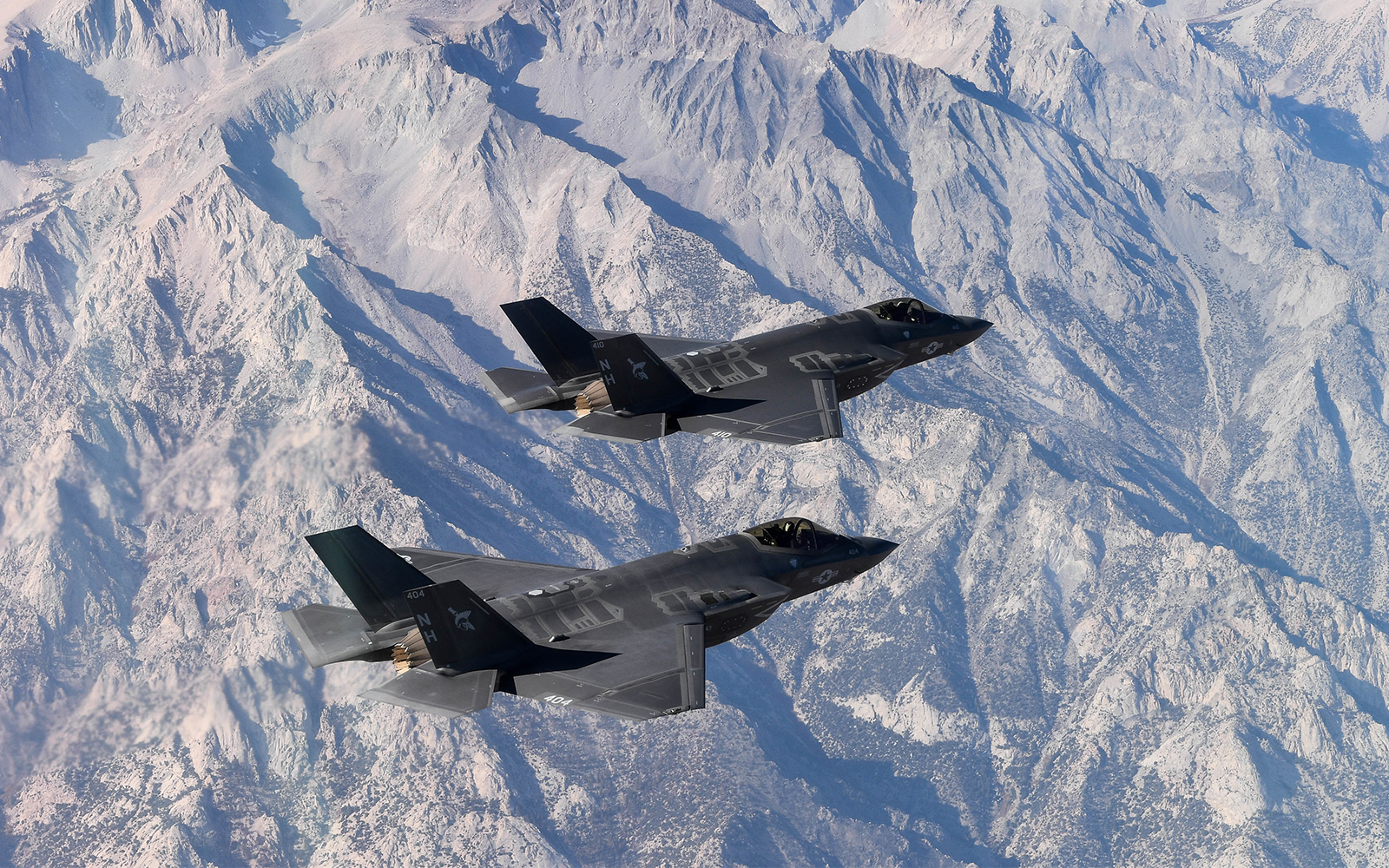
Two US Navy F-35C Lightning II jets fly in formation during an exercise out of Naval Air Station Lemoore, California, November 16, 2018. (US Navy/Chief Mass Communication Specialist Shannon E. Renfroe)

Two US Navy F-35C Lightning II jets fly in formation during an exercise out of Naval Air Station Lemoore, California, November 16, 2018. (US Navy/Chief Mass Communication Specialist Shannon E. Renfroe)

WASHINGTON — The Biden administration has put a temporary hold on several major foreign arms sales initiated by former US president Donald Trump, including the deal to provide 50 F-35 advanced fighter jets to the United Arab Emirates, which was fast-tracked by Washington after Abu Dhabi agreed to normalize relations with Israel.

In addition to the massive $23 billion transfer of stealth F-35 fighters to the United Arab Emirates, another deal being paused is the planned major sale of munitions to Saudi Arabia. Both sales were harshly criticized by Democrats in Congress.

“The department is temporarily pausing the implementation of some pending US defense transfers and sales under Foreign Military Sales and Direct Commercial Sales to allow incoming leadership an opportunity to review,” the State Department said in a statement.

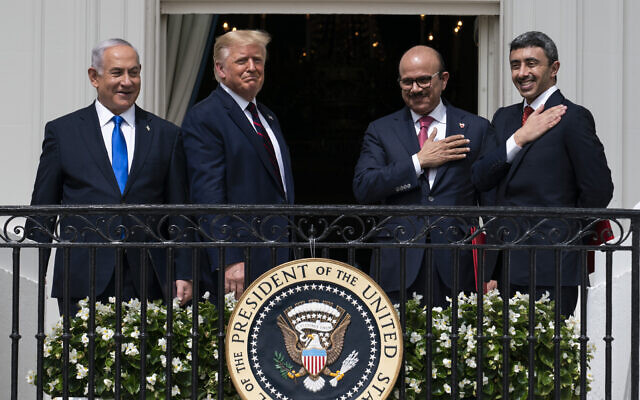
“When it comes to arms sales, it is typical at the start of an administration to review any pending sales, to make sure that what is being considered is something that advances our strategic objectives and advances our foreign policy,” Secretary of State Antony Blinken said later Wednesday at a press briefing.From left to right: Prime Minister Benjamin Netanyahu, US President Donald Trump, Bahrain Foreign Minister Abdullatif al-Zayani and United Arab Emirates Foreign Minister Abdullah bin Zayed al-Nahyan are seen on the Blue Room Balcony after signing the Abraham Accords during a ceremony on the South Lawn of the White House in Washington, September 15, 2020. (AP Photo/Alex Brandon)
The Trump administration’s announcement on the F-35 sale came shortly after the Republican president lost the November 6 election to now-President Joe Biden and followed the signing of the Abraham Accords between Israel, Bahrain and the UAE, under which the Arab states agreed to normalize relations with Israel.

Trump had explicitly backed arms sales on commercial grounds, saying that the Saudis were creating US jobs by buying from US manufacturers.

Congressional critics have expressed disapproval with such sales, including the deal with Saudi Arabia, that then-Secretary of State Mike Pompeo pushed through after bypassing lawmakers by declaring an emergency required it. The critics have alleged the weapons could be used to aid Saudi Arabia’s war in Yemen, which is the home of one of the world’s worst humanitarian crises.

Less than a month after the UAE sale was announced, an effort to block the deal fell short in the Senate, which failed to halt it.

Senators argued the sale of the defense equipment had unfolded too quickly and with too many questions. The Trump administration billed it as a way to deter Iran, but the UAE would have become the first Arab nation — and only the second country in the Middle East, after Israel — to possess the stealth warplanes.

The deal was approved by the UAE during Trump’s final hour in the White House, a US official revealed.

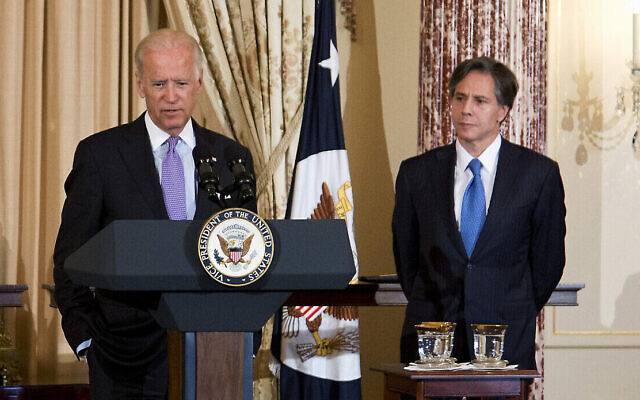
The exact nature of the agreement signed that day was not clear though, nor whether it represented the contract itself. A contract would be more binding and could place financial penalties on parties who fail to follow through with the deal.Then-Vice President Joe Biden (left) and then-Deputy Secretary of State Tony Blinken, June 30, 2015, at the State Department in Washington. (AP Photo/Manuel Balce Ceneta)


“We very much support the Abraham Accords. We think that Israel normalizing relations with its neighbors and other countries in the region is a very positive development” Blinken said Wednesday.

“We’re also trying to make sure that we have a full understanding of any commitments that may have been made in securing those agreements, and that’s something we’re looking at right now,” he added.

In a November interview with The Times of Israel, Biden’s eventual Secretary of State Antony Blinken panned the apparent “quid pro quo” nature of the F-35 sale that immediately followed the normalization agreement.

“The Obama-Biden administration made those planes available to Israel and only Israel in the region,” said Blinken, who served as Biden’s national security adviser, deputy national security adviser to the president and deputy secretary of state during the Obama administration.

Israeli analyst Neri Zilber noted on Twitter that it “will be interesting to see if UAE begins slow-rolling normalization with Israel in response” to Biden’s hold on the weapons deal.

Israel and the UAE signed a US-brokered normalization deal in September. The Trump administration formally notified Congress of its planned weapons sale to Abu Dhabi two months later.

On the record, the three countries have insisted that the arms deal was not part of negotiations that brought about the so-called Abraham Accords.

Screen capture from video of Blue and White party leader Defense Minister Benny Gantz during an interview with Channel 13 news, January 12, 2021. (Channel 13 news)

But Trump officials have acknowledged that the agreement put Abu Dhabi in a better position to receive such advanced weaponry, and a source with direct knowledge of the talks told The Times of Israel that both the US and Israel knew that the arms deal was “very much part of the deal.”

Israel announced in October that it would not oppose the sale, an about-face from its previous opposition to the deal on the grounds that it would harm the Jewish state’s military edge in the region. That decision came after meetings held between Defense Minister Benny Gantz and his US counterpart at the time, Mark Esper, at the conclusion of which the sides signed an agreement further codifying Washington’s commitment to maintaining Israel’s federally-protected military edge in the region.

Gantz is also believed to have secured an American commitment to a substantial military package to compensate for the weapons that the Pentagon was preparing to sell to one of Israel’s neighbors.

Because the transfer of such weapons takes years to come about, the Biden administration could block the deal, but there’s little precedent for a president to scrap such agreements made by a predecessor.

Biden Freezes Arms Sales To Saudis & UAE, Including Large F-35 Jet Transfer

January 28, 2021

BY TYLER DURDENWEDNESDAY, JAN 27, 2021 – 22:20

On Wednesday the Biden administration issued a freeze of all US arms sales to Saudi Arabia and the United Arab Emirates at a moment Congressional scrutiny of America’s support to the Saudi-led coalition waging war in Yemen grows. US involvement in the war goes all the way back to the Obama administration, with Trump also in the last months of his presidency approving billions in new arms sales to the kingdom.

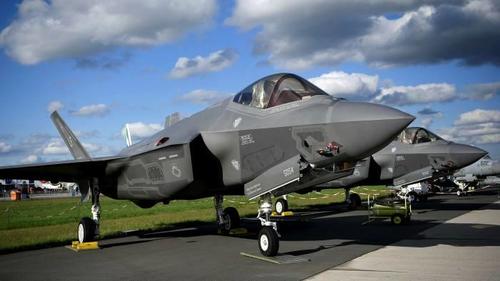
In particular Lockheed Martin produced F-35 stealth fighters that were set to be transferred to the UAE the have been “temporarily” blocked along with munitions to the Saudis, among other sales. Prior reports suggested the prior Trump deal was to send as many as 50 advanced F-35 fighters to the UAE.

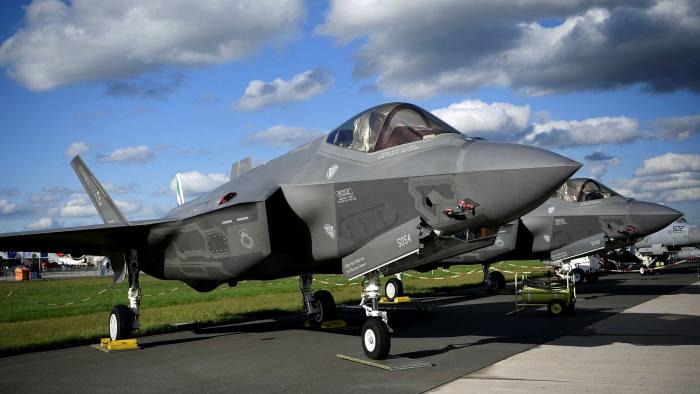
The Lockheed Martin produced F35 fighter jet, via FT/dpa

The AP cited officials who identified “that among the deals being paused is a massive $23 billion transfer of stealth F-35 fighters to the United Arab Emirates.”

“That sale and several other massive purchases of U.S. weaponry by Gulf Arab countries had been harshly criticized by Democrats in Congress,” the report added.

The State Department said of the “temporary pause” that it is “temporarily pausing the implementation of some pending U.S. defense transfers and sales under Foreign Military Sales and Direct Commercial Sales to allow incoming leadership an opportunity to review.”

And Axios further details that “The sales of F-35 jets and attack drones to the UAE and a large supply of munitions to Saudi Arabia will be paused pending a review.” It added that it “signals a major policy shift from the Trump era, and may herald sharp tensions with both Gulf countries.

In response the UAE appealed to the need for “interoperability” with US forces in the Gulf while underscoring the close military cooperation as a reliable partner force:https://platform.twitter.com/embed/index.html?dnt=false&embedId=twitter-widget-1&frame=false&hideCard=false&hideThread=false&id=1354527969356746754&lang=en&origin=https%3A%2F%2Fwww.zerohedge.com%2Fgeopolitical%2Fbiden-freezes-arms-sales-saudis-uae-including-large-f-35-jet-transfer&siteScreenName=zerohedge&theme=light&widgetsVersion=ed20a2b%3A1601588405575&width=550px

So far the Saudis have had no comment after the somewhat expected move, which also follows Biden previously on the campaign trail vowing to get tougher on the “pariah” stateas he called the kingdom during a debate.

Months ago an attempt in the Senate led by New Jersey Democrat Bob Menendez to block Trump arms sales to the Saudis was narrowly defeated.