Archive for January 27, 2021

Responding to IDF chief, Iran says it’s ‘serious’ about defending itself

January 27, 2021


After Kohavi announces he’s ordered fresh plans to hit Iranian nuclear sites, top Tehran official scoffs at Israel’s capabilities
By TOI STAFFToday, 1:40 pm  1

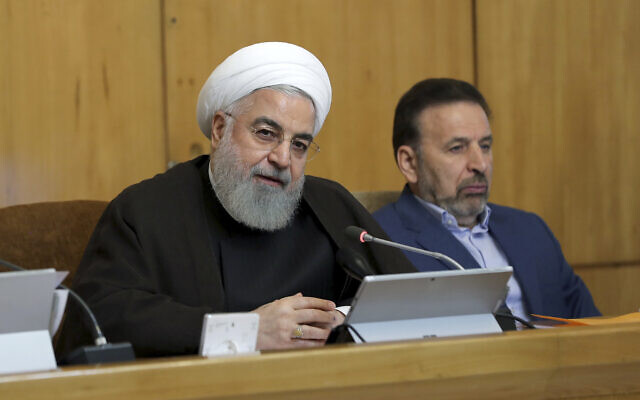
Iranian President Hassan Rouhani speaks during a cabinet meeting, as his chief of staff Mahmoud Vaezi sits at right, in Tehran, Iran, July 10, 2019. (Iranian Presidency Office via AP)

Iranian President Hassan Rouhani speaks during a cabinet meeting, as his chief of staff Mahmoud Vaezi sits at right, in Tehran, Iran, July 10, 2019. (Iranian Presidency Office via AP)

A senior Iranian official on Wednesday dismissed as psychological warfare remarks by the Israeli chief of staff regarding the preparation of plans to hit Iran’s nuclear sites and said the Jewish state doesn’t have the ability to carry out such a plan anyway.

“We are serious in defending the country,” said Mahmoud Vaezi, Iranian President Hassan Rouhani’s chief of staff.

Speaking to reporters on the sidelines of a cabinet meeting in Tehran, Vaezi was responding to a Tuesday speech by IDF Chief of Staff Aviv Kohavi in which he said he had directed the military to prepare fresh operational plans to strike Iran to block its nuclear program.

“They talk more and seek psychological warfare, and they have virtually no plan, no ability, and no capability to do so,” Vaezi said, according to Iranian media reports.

Vaezi also indicated he believes the Biden administration will not be as responsive to Israeli demands as Donald Trump’s was.

“Of course, some officials of the Zionist regime think that whatever they say, Washington will accept it,” Vaezi said. He accused Trump’s son-in-law and special adviser Jared Kushner of being a “Zionist agent in Washington.”

“But I think the new US administration, like other countries, has its independence,” Vaezi said.

He also dismissed what he said was lobbying by Israel and other countries in the region — “such as Saudi Arabia, which is our enemy” — that oppose a US return to the 2015 nuclear deal between Iran and world powers.

“We should not take such things seriously” even though the US does, Vaezi said.IDF Chief of Staff Aviv Kohavi speaks at the Institute for National Security Studies think tank’s annual conference on January 26, 2021. (Screen capture/INSS)
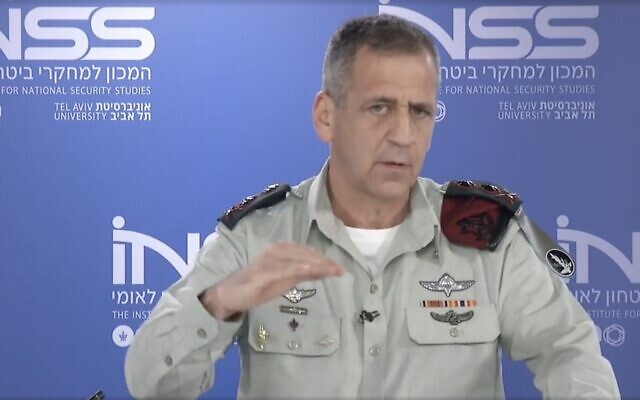
Kohavi made his remarks during a live-streamed speech at the Institute for National Security Studies think tank’s annual conference, which was held this year entirely online due to the coronavirus pandemic.

“Iran can decide that it wants to advance to a bomb, either covertly or in a provocative way. In light of this basic analysis, I have ordered the IDF to prepare a number of operational plans, in addition to the existing ones. We are studying these plans and we will develop them over the next year,” Kohavi said.

According to Kohavi, due to its improved centrifuges and growing stockpile of enriched uranium, Iran, were it to now “rush ahead,” could be “months, maybe even weeks” from a bomb.

In a rare public comment on American foreign policy, the IDF chief warned that US President Joe Biden should not rejoin the 2015 nuclear agreement, as the American leader has indicated he plans to do provided Tehran returns to compliance with the deal.

“Returning to the 2015 nuclear agreement or even to an agreement that is similar but with a few improvements is a bad thing and it is not the right thing to do,” Kohavi said.

Trump in 2018 pulled the US out of the deal, known formally as the Joint Comprehensive Plan of Action, and applied stiff sanctions that have played havoc with the Iranian economy. Other parties to the deal have worked to keep it going, but Iran has responded by steadily dropping its own commitments to the pact, which was intended to prevent it from being able to develop nuclear weapons.

Earlier this month, Tehran announced it was beginning to enrich uranium up to 20 percent — far beyond the 3.5 percent permitted under the JCPOA and just a small technical step away from the 90 percent needed for a nuclear weapon. Iran also said it was beginning research into uranium metal, a material that technically has civilian uses but is overwhelmingly seen as a step toward a nuclear bomb.

Iran said Tuesday it would also move to restrict short-notice inspections of suspect nuclear facilities from late February.

Israel has twice conducted military strikes against the nuclear programs of its enemies — Iraq in 1981 and Syria in 2007 — under what’s become known as the Begin Doctrine, which maintains that Jerusalem will not allow an enemy country to obtain an atomic weapon.
UAE, Bahrain: We need ‘unified voice’ with Israel on Iran’s missiles, nukes

January 27, 2021


Speaking to FM Ashkenazi, ministers from Gulf states say Jerusalem and its new allies can together ‘exert greater influence on the US’

By LAZAR BERMAN26 January 2021, 6:56 pm  1

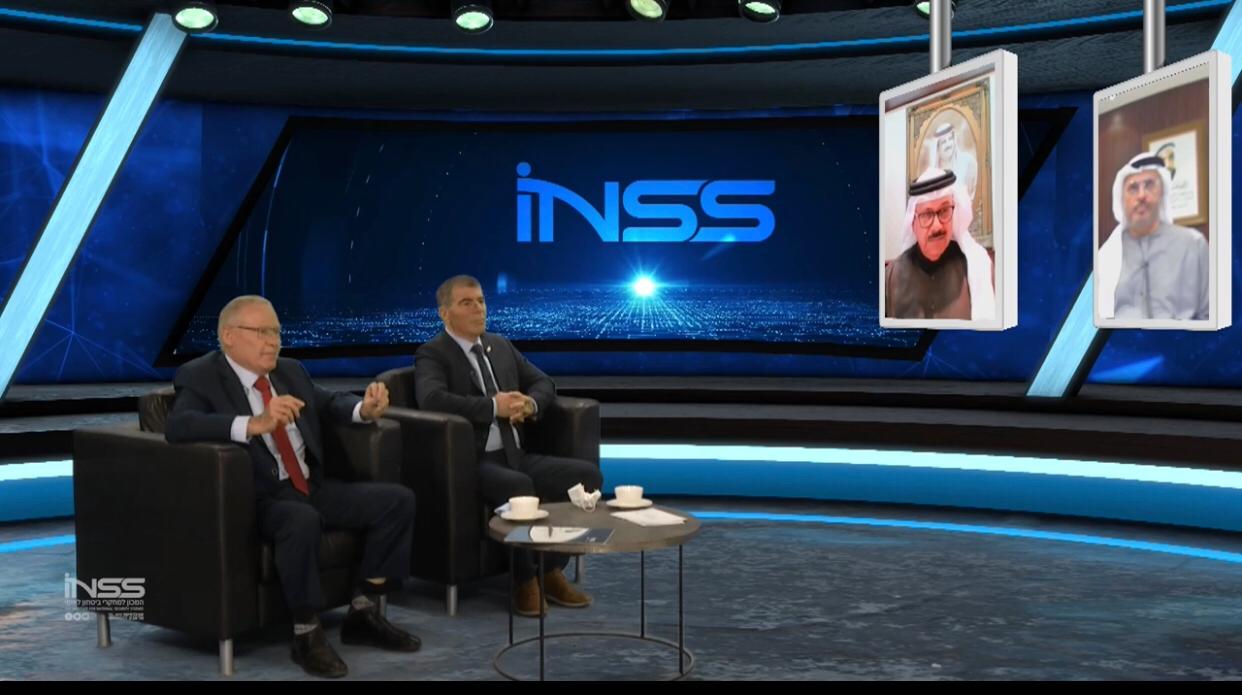
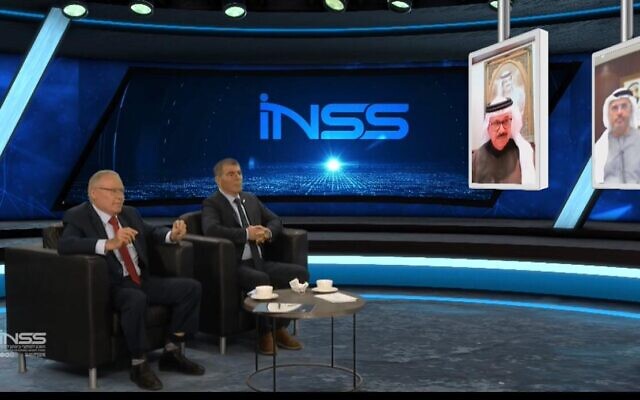
Foreign Minister Gabi Ashkenazi (2L) speaks to his Bahraini and Emirati counterparts at the INSS conference. January 26, 2021 (Courtesy of INSS)

Foreign Minister Gabi Ashkenazi (2L) speaks to his Bahraini and Emirati counterparts at the INSS conference. January 26, 2021 (Courtesy of INSS)

The United Arab Emirates and Bahrain called on Tuesday for a coordinated effort with Israel to press the new US administration on Iran.

Speaking alongside Israel’s Foreign Minister Gabi Ashkenazi, Bahraini Foreign Minister Abdullatif bin Rashed Alzayani stressed the concern the countries share over Tehran’s nuclear program, ballistic missiles, and activities across the Middle East.

“A joint regional position on these issues will exert greater influence on the United States,” Alzayani said.

The Bahraini and Israeli foreign ministers and Emirati minister of state for foreign affairs spoke on the first day of the Institute for National Security Studies’s 14th annual international conference, which is being held virtually this year because of COVID-19 restrictions. The panel was moderated by INSS Director General (ret.) Amos Yadlin.

US President Joe Biden has indicated his desire to rejoin the 2015 Joint Comprehensive Plan of Action, while Israel is pushing for any return to the agreement to include fresh limitations on Iran’s ballistic missile program and support for terror and destabilization around the world.Foreign Minister Gabi Ashkenazi greets Bahraini Industry, Commerce and Tourism Minister Zayed R. Alzayani in Jerusalem on December 2, 2020 (Shlomi Amsalem/GPO)
The Islamic Republic’s foreign minister warned last week that his country would not accept changes to the terms of the 2015 pact, which currently does not deal with Iran’s missile program or regional proxies.

“We must respond to Iran’s missile program,” Alzayani continued, “its support for proxies in the region, and its interference in the domestic affairs of states across the region, in order to bring about a broader peace and stability for the Middle East.”

The JCPOA was signed by Iran and six world powers known as the P5+1 in 2015. Then-president Trump unilaterally pulled the US out of the deal in 2018, opting instead for a “maximum pressure” sanctions effort.https://www.youtube.com/embed/S_s6mea6rss?feature=oembed&showinfo=0&rel=0&modestbranding=1

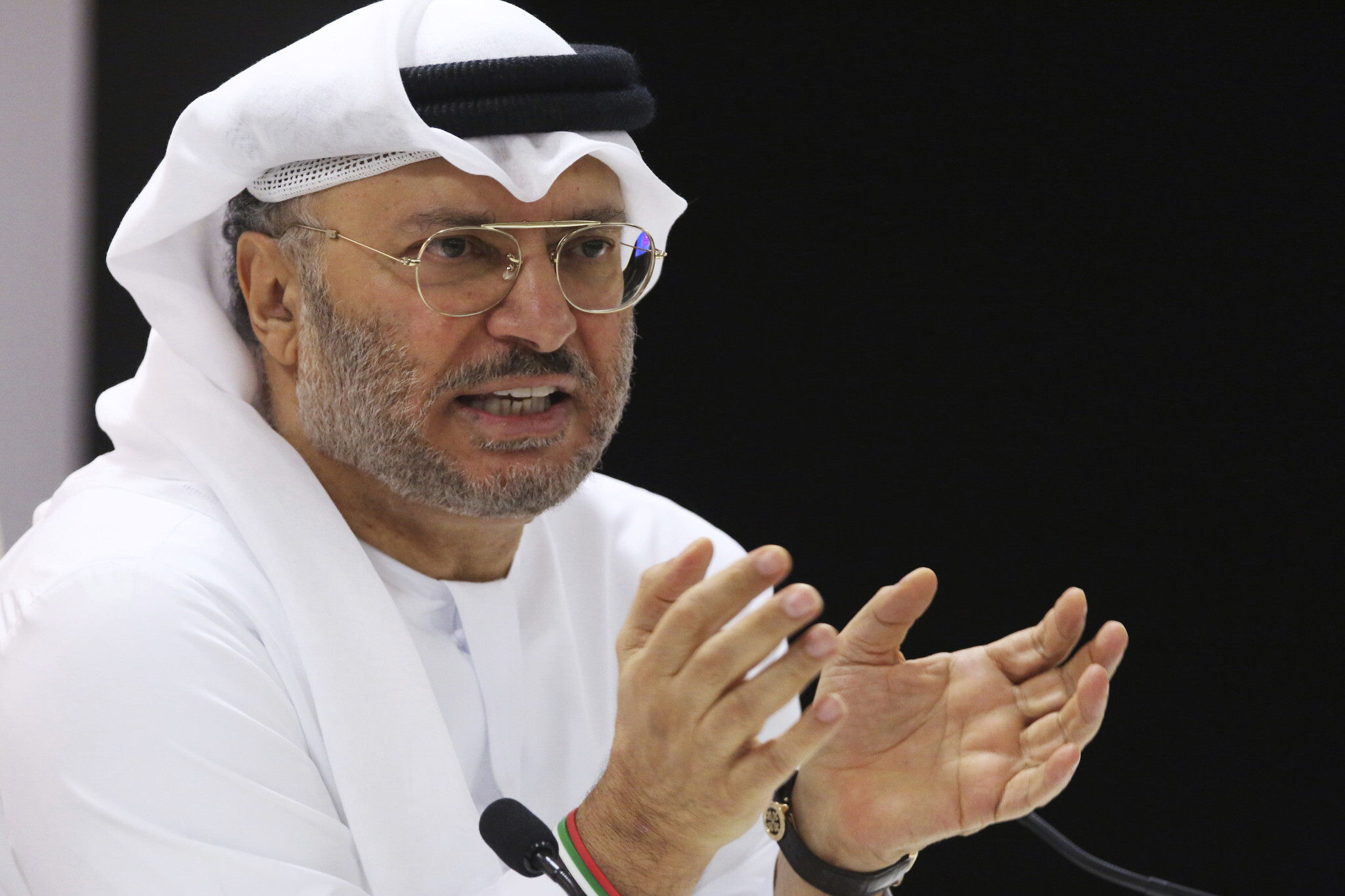
One of the JCPOA’s “failures,” argued UAE Minister of State for Foreign Affairs Anwar Gargash on Tuesday, was the “absence of a regional voice therein.”

Iran drafted conditions for returning to compliance with the nuclear deal, one of which is that no new signatories — understood to mean Arab Gulf states —  may be added to the agreement.

Since 2019, Tehran has suspended its compliance with most of the limits set by the agreement in response to Washington’s abandonment of sanctions relief and the failure of other parties to the deal to make up for it. It is now enriching uranium to 20 percent, just a short step away from weapons-grade levels.

Israel, UAE, and Bahrain all seek to dissuade the Biden administration from returning to the JCPOA in its original form.Emirati Minister of State for Foreign Affairs Anwar Gargash speaks to journalists in Dubai, United Arab Emirates, Monday, June 18, 2018. (AP/Jon Gambrell)

Alzayani suggested that the terms of the deal must be changed in light of the signing of the 2020 Abraham Accords, the US-brokered agreements which normalized ties between Israel and the UAE, Bahrain, Morocco and Sudan.

“Any future agreement with Iran will need to reflect the new reality in the region and be acceptable to all states in the region.”

Ashkenazi, a former IDF chief of staff, agreed that the accords “strengthened the regional voice” and stressed the importance of maintaining a credible military option in Israel’s policy toward Iran.

He also warned against a “confrontational policy in the press” in order to sway the Biden administration, instead calling for a “professional conversation, real, transparent…to strive for a situation in which Israel’s concerns” are made clear to senior US officials.

The Gulf ministers also discussed their support for a two-state solution between Israel and the Palestinians.

They argued that the Abraham Accords would spur progress on Israeli-Palestinian peace. The pact “created an incentive for such progress and put the brakes on steps that would have reversed the process,” said Alzayani.

In exchange for official ties with the UAE, Israel agreed to suspend plans to annex large parts of the West Bank under the Israeli-Palestinian peace plan drawn up by the Trump administration. The move opened a rift between Abu Dhabi and Ramallah, which saw normalization with Israel as premature given the lack of an Israeli-Palestinian peace deal, though the UAE says it is still committed to the Palestinian cause.

“After 40-50 years we arrived at the conclusion that disengagement from Israel was not effective, but rather we could more effectively respond to our disagreements with her through dialogue, interaction, trust, and compromise,” Gargash explained.UAE Foreign Minister Abdullah bin Zayed Al-Nahyan, US President Donald Trump, Bahrain Foreign Minister Abdullatif al-Zayani and Israeli Prime Minister Benjamin Netanyahu talk at the ceremony for the signing of the Abraham Accords, at the White House in Washington, DC, September 15, 2020. (Avi Ohayon / GPO)

The fruits of peace

The diplomats laid out their visions for the next stage in the normalization process between Israel and its new Gulf partners. Gargash stressed the importance of providing “meaning to the peace for the average citizen – freedom of movement and more opportunities,” adding that the UAE was eager to welcome more Israeli tourists.

Over 70,000 Israelis have visited the UAE, said Ashkenazi. The Washington Post reported that over 150 Emirati restaurants have begun serving kosher food.

Alzayani sounded a more cautious note, warning that peace requires patience, and that governments must create the environment in which ties can develop organically.

Over 1,000 Israeli and Gulf companies are involved in some sort of collaboration, Ashkenazi revealed, and the three nations are drafting over 40 agreements that will serve as the practical basis for cooperation moving forward.

Israel’s first ambassador to the UAE, Eitan Na’eh, told The Times of Israel that the growing ties with the Gulf would have widespread economic ramifications, and that he expected trade with the Gulf to lower the cost of living in Israel.

IDF chief says he’s ordered fresh military plans to thwart Iran’s nuke program

January 27, 2021


Kohavi warns US against rejoining 2015 nuclear deal or even a slightly improved version, calling it ‘a bad thing to do’ that would lead to an Iranian bomb, which Israel won’t allow

By JUDAH ARI GROSS26 January 2021, 9:28 pm  1

IDF Chief of Staff Aviv Kohavi speaks at the Institute for National Security Studies think tank's annual conference on January 26, 2021. (Screen capture/INSS)

IDF Chief of Staff Aviv Kohavi speaks at the Institute for National Security Studies think tank’s annual conference on January 26, 2021. (Screen capture/INSS)

Israel Defense Forces Chief of Staff Aviv Kohavi on Tuesday said he has directed the military to prepare fresh operational plans to strike Iran to block its nuclear program.

“Iran can decide that it wants to advance to a bomb, either covertly or in a provocative way. In light of this basic analysis, I have ordered the IDF to prepare a number of operational plans, in addition to the existing ones. We are studying these plans and we will develop them over the next year,” Kohavi said.

He added: “The government will of course be the one to decide if they should be used. But these plans must be on the table, in existence and trained for.”

According to Kohavi, due to its improved centrifuges and growing stockpile of enriched uranium, Iran, were it to now “rush ahead,” could be “months, maybe even weeks” from a bomb.

Israel has twice conducted military strikes against the nuclear programs of its enemies — Iraq in 1981 and Syria in 2007 — under what’s become known as the Begin Doctrine, which maintains that Jerusalem will not allow an enemy country to obtain an atomic weapon.IDF Chief of Staff Aviv Kohavi speaks at the Institute for National Security Studies think tank’s annual conference on January 26, 2021. (Screen capture: INSS)

Kohavi made his remarks during a livestreamed speech at the Institute for National Security Studies think tank’s annual conference, which was held this year entirely online due to the coronavirus pandemic.

In a rare public comment on American foreign policy, the IDF chief warned that US President Joe Biden should not rejoin the 2015 nuclear agreement, as the American leader has indicated he plans to do provided Tehran returns to compliance with the deal.

Left: US President-elect Joe Biden on January 14, 2021, in Wilmington, Delaware (AP Photo/Matt Slocum); Right: Iranian President Hassan Rouhani in Tehran, Iran, December 9, 2020. (Iranian Presidency Office via AP)

“With the changing of the administration in the United States, the Iranians have said they want to return to the previous agreement. I want to state my position, the position that I give to all my colleagues when I meet them around the world: Returning to the 2015 nuclear agreement or even to an agreement that is similar but with a few improvements is a bad thing and it is not the right thing to do,” Kohavi said.

Due to the close relationship between the American and Israeli militaries, as well as the IDF’s general preference to keep out of political arguments, it is highly uncommon for military officials to criticize allies’ foreign policy.

In his speech, Kohavi spoke out harshly not only against the possibility of the United States rejoining the 2015 deal, known formally as the Joint Comprehensive Plan of Action (JCPOA), but also against the original agreement. Kohavi’s predecessor, as well as other senior Israeli defense officials, were not devout champions of the agreement, but described it as an imperfect way to take the Iranian nuclear issue off the table for at least a few years, allowing them to focus their attentions more on other issues.

Kohavi denounced the deal entirely, specifically for its so-called “sunset clauses,” the terms of the agreement limiting different aspects of Iran’s nuclear program that end after a certain number of years. Critics of the JCPOA see these as allowing Iran to eventually develop an accepted nuclear program, while proponents of the deal argue that these could have been pushed back further with additional agreements.

The consensus view among Israeli defense officials opposes a return to the exact terms of the 2015 nuclear agreement, under the belief that the leverage from recent sanctions would allow for a stronger deal to be negotiated. But Kohavi’s speech marked the first time an improved version of the deal has also been described as wholly unacceptable from an Israeli security standpoint.

This photo released November 5, 2019 shows centrifuge machines in the Natanz uranium enrichment facility in central Iran. (Atomic Energy Organization of Iran via AP, File)

“If the 2015 nuclear deal were carried out, Iran would be able to get itself a weapon because the agreement did not include limits to prevent this when [the agreement] ended. As of today, Iran has increased the amount of enriched material beyond what was permitted. It enriched it to levels beyond what was permitted. It developed and manufactured centrifuges that will allow it to rush ahead and produce a weapon at a much faster rate, within months, maybe even weeks,” Kohavi said.

Earlier this month, Tehran announced it was beginning to enrich uranium up to 20 percent — far beyond the 3.5 percent permitted under the JCPOA and just a small technical step away from the 90 percent needed for a nuclear weapon. Iran also said it was beginning research into uranium metal, a material that technically has civilian uses but is overwhelmingly seen as a step toward a nuclear bomb.

Iran said Tuesday it would also move to restrict short-notice inspections of suspect nuclear facilities from late February.

“No one has any doubt. Iran hopes, wants, identified and built the capabilities necessary to be a military nuclear power. And maybe even use them when it decides it wants to,” Kohavi said.

The military chief warned that a return to the Iran deal would also likely prompt a “nuclear arms race” in the Middle East as other countries in the region — like Saudi Arabia, which also sees Iran as a major threat — would also seek to obtain an atomic weapon in order to maintain the balance of power.

In his speech, the IDF commander called for the United States to use the leverage over Iran gained during the presidency of Donald Trump through his so-called “maximum pressure” campaign of financial sanctions on Tehran, which has crippled the already-weak Iranian economy. Kohavi said the US should use this situation to negotiate a better deal that would end Iran’s nuclear program entirely, not just its military aspects.

“There needs to be serious effort so that by the end, there won’t not only not be a bomb but there won’t be an ability to rush to a bomb,” he said.

Iranian police officers take position while protesters gather in front of Amir Kabir University in Tehran, Iran, to remember victims of a Ukrainian airplane shot down by an Iranian missile; during a rally on January 11, 2020. (AP Photo/File)

“The Iran of today is not the Iran of 2015 when the deal was signed. Iran now is under enormous pressure — financial pressure, massive inflation, bitterness and unrest in the population, whose salaries have tanked — because of the American sanctions. These pressures must continue. No matter what happens. Anything that releases that pressure gives them oxygen, gives them air and will allow them to continue to violate the current agreement,” Kohavi said.

Biden administration officials have indicated that Israel will be involved in its decision-making process regarding Iran’s nuclear program.

According to a Channel 12 report, the head of the Mossad Yossi Cohen is expected to travel to the United States shortly to meet with Biden and lay out Israel’s demands for a future Iran deal, which would include not only Tehran’s nuclear program, but also its missile program and support for proxies throughout the Middle East.