But Iranian president says Tehran will only do so if pact’s other signatories ‘resume all of their commitments’; hints he won’t sign bill to increase uranium enrichment to 20%
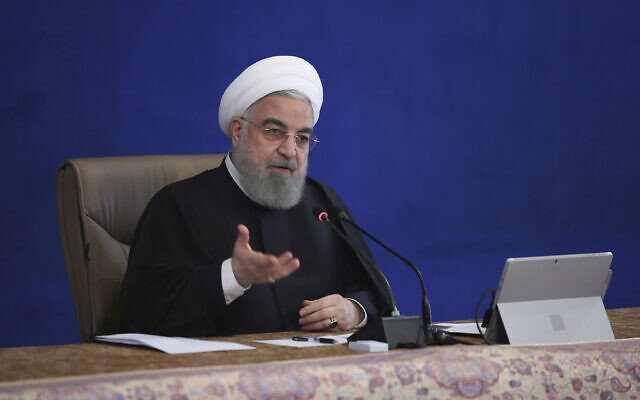
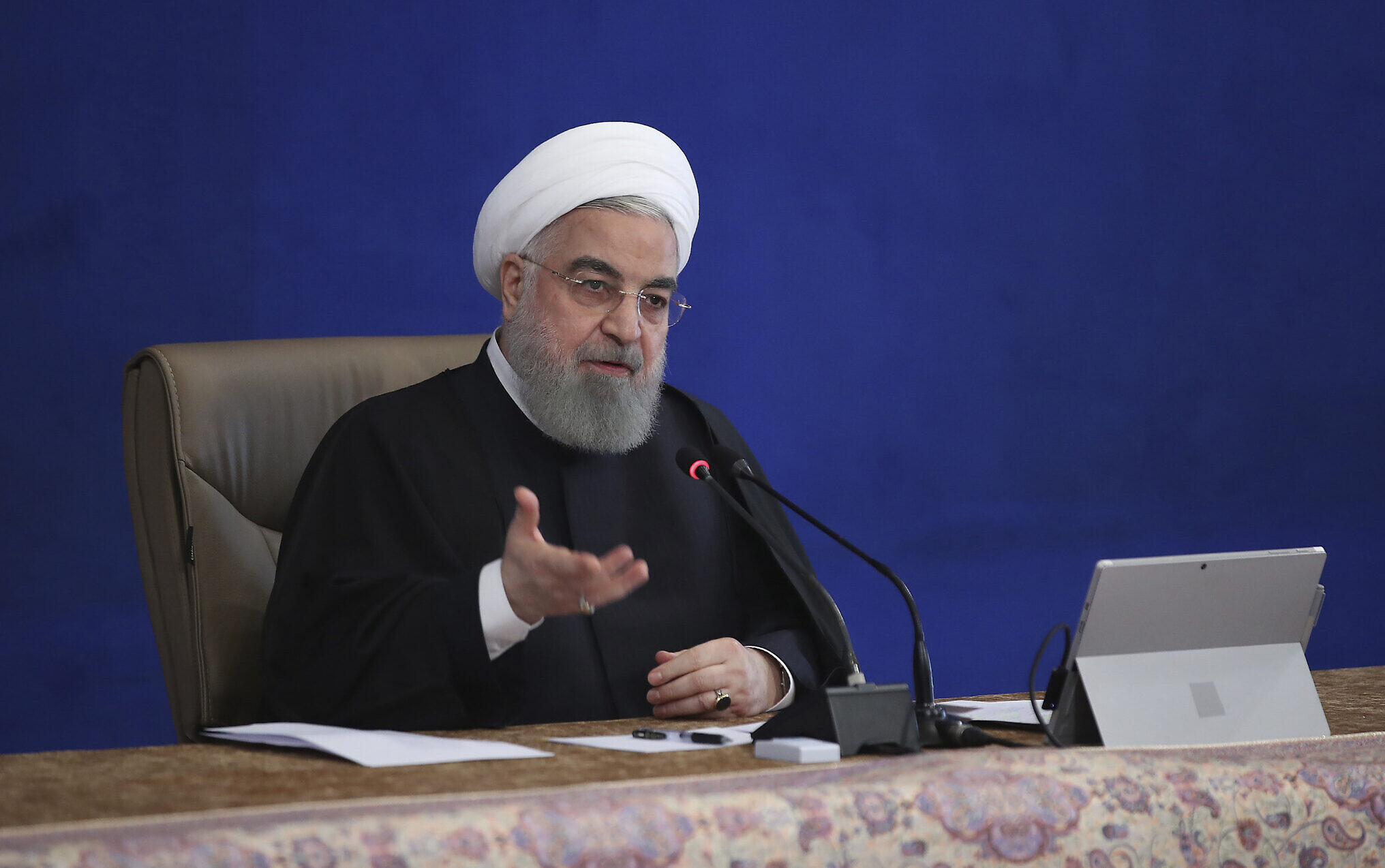
By AFPToday, 4:54 pm 0In this photo released by the official website of the office of the Iranian Presidency, President Hassan Rouhani speaks in a cabinet meeting in Tehran, Iran, December 2, 2020. (Iranian Presidency Office via AP)
TEHRAN, Iran — Iran is ready to return to full compliance with a 2015 nuclear deal with major powers as soon as the other parties honor their commitments, Iranian President Hassan Rouhani said Wednesday.
The agreement between Iran and major powers has teetered on the brink of collapse since outgoing US President Donald Trump pulled out of it in 2018 and reimposed crippling unilateral sanctions.
US President-elect Joe Biden has expressed readiness to return to the agreement but over the past 18 months Iran has suspended the implementation of some of its own obligations, including key limits to its uranium enrichment program.
“Just as soon as the 5+1 or 4+1 resume all of their commitments, we will resume all of ours,” Rouhani said.
He was referring to the five veto-wielding permanent members of the UN Security Council plus Germany with whom Iran reached the nuclear deal.
“I’ve said it before — it doesn’t take time, it’s just a question of willing,” he said in comments to his cabinet aired by state television
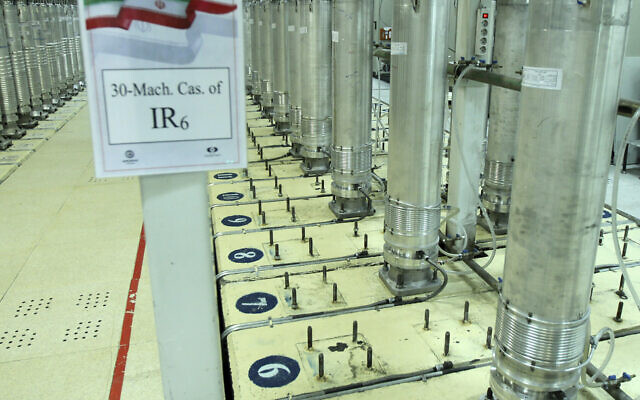
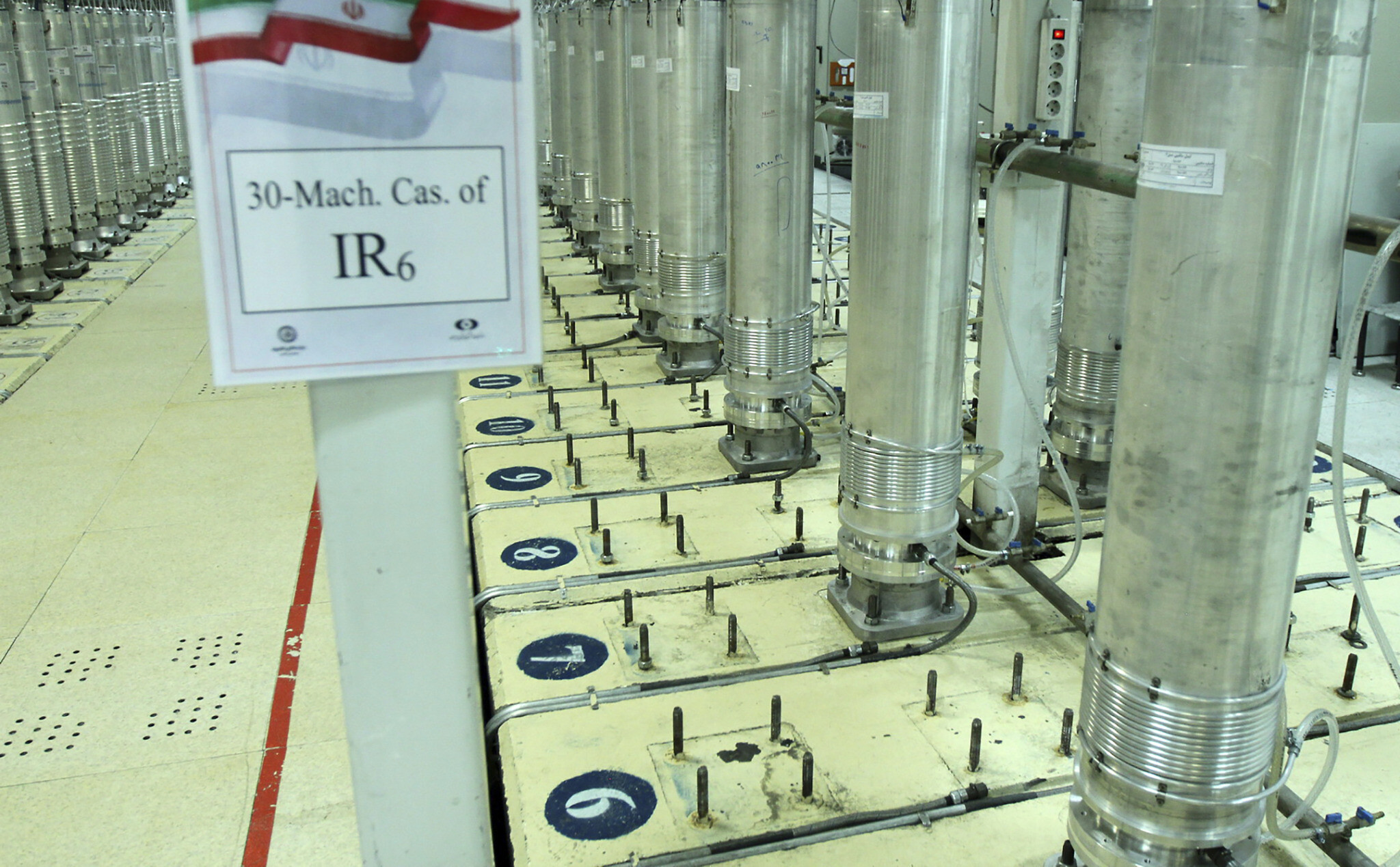
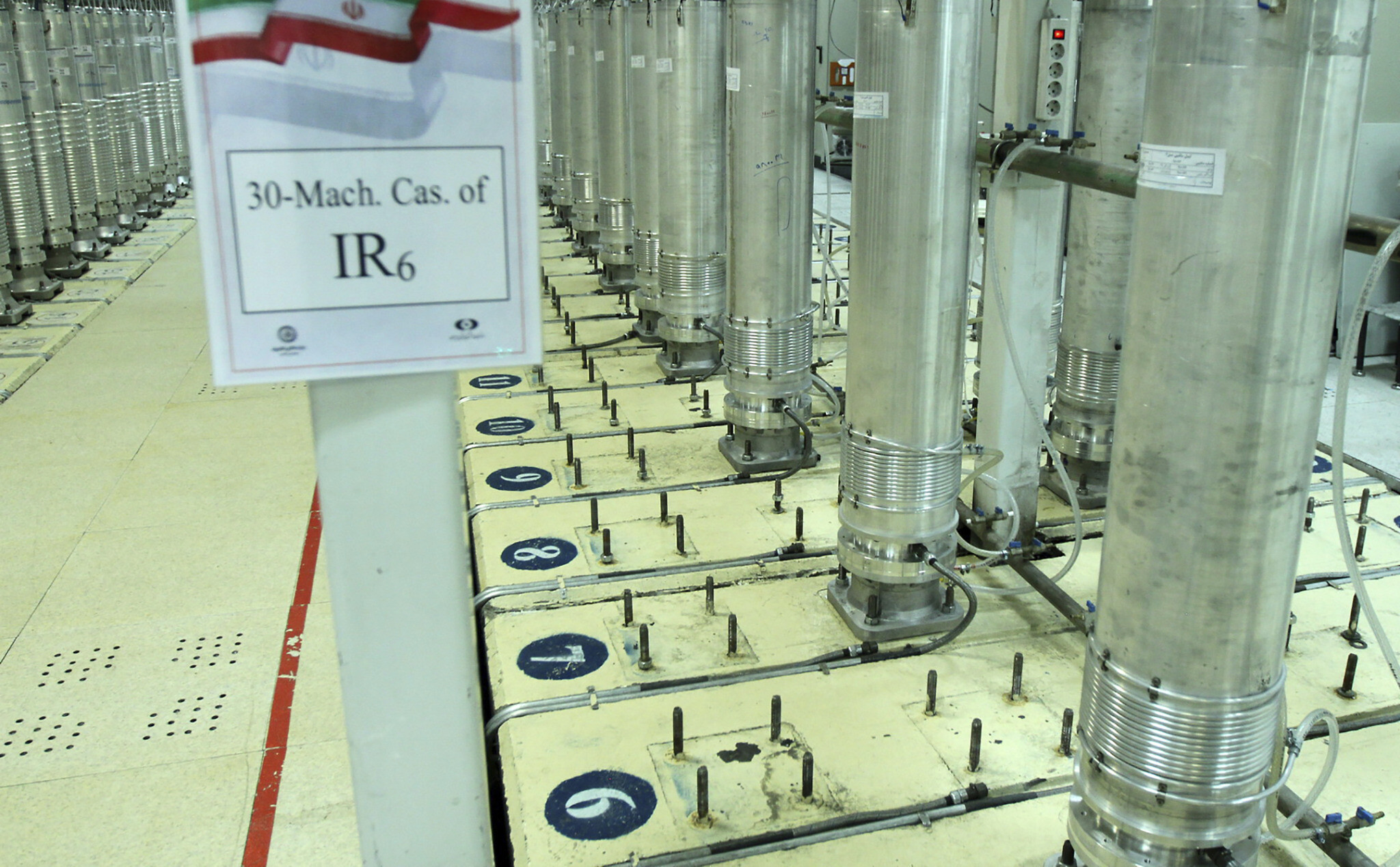
This photo released November 5, 2019, by the Atomic Energy Organization of Iran, shows centrifuge machines in the Natanz uranium enrichment facility in central Iran. (Atomic Energy Organization of Iran via AP, File)
Defying criticism from Iran’s ultra-conservatives, Rouhani reiterated his determination to seize the “opportunity” presented by the change of US president in January.
Parliament, which has been controlled by conservatives since a February election marred by record low turnout, passed a bill last week that threatens the prospects for a thaw in relations with Washington.
The bill, which still has to be signed into law by Rouhani, would relaunch Iran’s enrichment of uranium to 20 percent purity and threaten other future measures that would likely sound the death knell of the nuclear deal.
In a blow to the president, the Guardian Council, which arbitrates disputes between parliament and the government, approved the bill last week.
But in his comments on Wednesday, Rouhani appeared to suggest that he would withhold his signature from the bill.
“It is vital that we speak with a single voice,” the president told ministers.
“People voted for a platform… and they want four years of action,” said Rouhani, who won re-election in 2017 with more than 57 percent of the vote.
People wearing face masks to help prevent the spread of the coronavirus wait at a bus stop in downtown Tehran, Iran, December 5, 2020. (AP Photo/Vahid Salemi)
Rouhani said Iran remained unable to purchase COVID-19 vaccines because banks were unwilling to process the transaction for fear of falling foul of US sanctions.
Iran is the Middle Eastern country hardest-hit by the coronavirus pandemic with more than 51,000 deaths from nearly 1.1 million cases, according to official figures.
Vaccines and other humanitarian goods are supposed to be exempt from the US sanctions but in practice few if any banks are willing to take the chance.
“We want to buy the vaccine… the money is… ready but no bank will handle the transaction,” Rouhani told ministers.
France, Germany and UK say announcement by Tehran violates nuclear deal, reiterate commitment to 2015 pact
By AGENCIES and TOI STAFFToday, 1:17 pm 0Centrifuge machines in the Natanz uranium enrichment facility in central Iran, November 5, 2019. (Atomic Energy Organization of Iran via AP, File)
Plans by Iran to install advanced centrifuges at its main nuclear enrichment plant in Natanz are “deeply worrying,” France, Germany and the UK said on Monday.
The three governments, dubbed the E3, said the plans were contrary to the 2015 agreement between Tehran and world powers that aimed to restrain Iran’s nuclear program by barring sophisticated centrifuges.
The development came days after Iran informed the International Atomic Energy Agency (IAEA) that it planned to install several cascades, or clusters, of advanced uranium-enriching centrifuges at the Natanz plant in violation of its commitments under the nuclear deal.
“In a letter dated 2 December 2020, Iran informed the Agency that the operator of the Fuel Enrichment Plant (FEP) at Natanz ‘intends to start installation of three cascades of IR-2m centrifuge machines at FEP,” a confidential IAEA report to its member states said, Reuters reported Friday.
Under the deal, Iran is only permitted to use the less advanced, less efficient first-generation IR-1 centrifuges at the fortified underground plant.
The US imposed crippling sanctions on Iran after President Donald Trump unilaterally withdrew from the nuclear agreement in 2018. In response, Iran began publicly exceeding enrichment limits set by the agreement while saying it would quickly return to compliance if the United States did the same.
The three European countries said Monday that the deal, officially called the Joint Comprehensive Plan of Action (JCPOA), was the best and currently the only way to monitor and constrain Iran’s nuclear program.
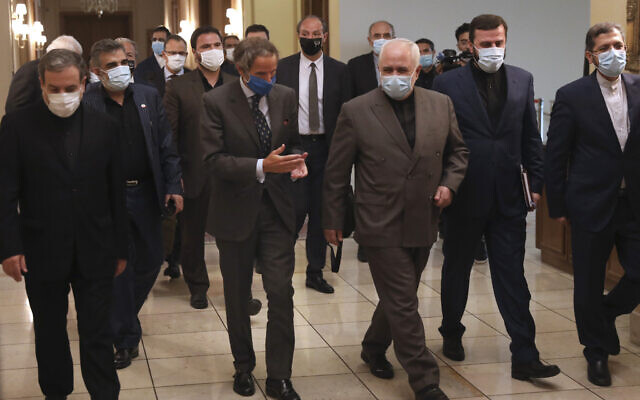
The director general of the International Atomic Energy Agency (IAEA), Rafael Mariano Grossi, center left, speaks with Iran’s Foreign Minister Mohammad Javad Zarif, center, before a meeting in Tehran, Iran, August 25, 2020. (AP Photo/Vahid Salemi)
The IAEA, the UN’s nuclear watchdog, said last month that Iran had installed and begun operating advanced centrifuges at an underground section at Natanz.
“Iran’s recent announcement to the IAEA that it intends to install an additional three cascades of advanced centrifuges at the Fuel Enrichment Plant in Natanz is contrary to the JCPOA and deeply worrying,” the E3 said.
Since May last year, Iran has taken steps to violate that limit and several others laid down in the deal in retaliation for Trump’s withdrawal from the accord in 2018 and subsequent reimposition of sanctions.
Iran is seeking to step up pressure on the incoming Joe Biden US administration to return to the original deal. Biden has indicated he will return to the accord but said he wants to institute changes.
Iran’s Foreign Minister Mohammad Javad Zarif attends a news conference with Venezuela’s Foreign Minister Jorge Arreaza in Caracas, Venezuela, November 5, 2020. (AP Photo/Matias Delacroix)
Iranian Foreign Minister Mohammad Javad Zarif said Thursday his country wouldn’t agree to renegotiate elements of the international accord limiting its nuclear program.
“It will never be renegotiated. Period,” Zarif told a conference in Italy, speaking remotely.
Meanwhile, Israel’s Prime Minister Benjamin Netanyahu doubled down on his stance that Biden’s plan to re-enter the nuclear deal would be misguided.
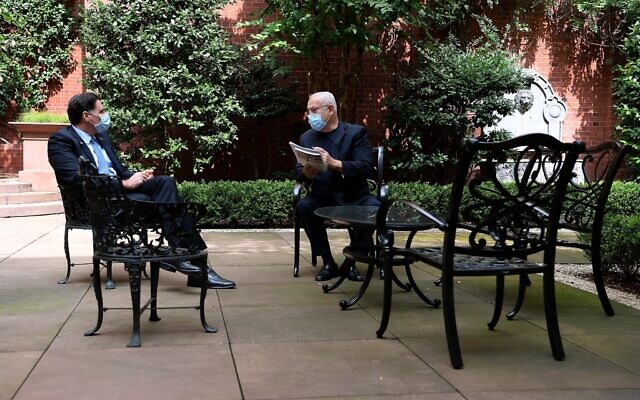
“It’s a mistake to go back to the JCPOA. You shouldn’t go back to that flawed agreement,” he said in a televised interview with the DC-based Hudson Institute’s Michael Doran.
Last Wednesday, a key Iranian panel signed off on a bill — approved by parliament the previous day — to suspend UN inspections and boost uranium enrichment, sending it to Iran’s President Hassan Rouhani, who opposes the measure.
The move appeared to be a show of defiance after the killing — reportedly by Israel — of Mohsen Fakhrizadeh, a key figure in Iran’s nuclear program seen as the father of its plans to build an atomic bomb.
Report says ex-PM Olmert played top-secret recording of Fakhrizadeh for President Bush in decisive 2008 meeting that boosted US-Israel cooperation against Iran’s nuclear program
Israel intelligence managed to recruit an Iranian official close to the recently assassinated Mohsen Fakhrizadeh and recorded the nuclear scientist speaking about his efforts to produce “five warheads” on behalf of the Islamic Republic, according to a Friday report in the Yedioth Ahronoth daily.
This top-secret recording was played in 2008 by former prime minister Ehud Olmert for then-president George W. Bush during a visit by Bush to Israel and was a key element in convincing the Americans to step up efforts to combat Iran’s nuclear program, the report said.
The report quoted several unnamed Israeli and Middle Eastern intelligence officials, along with recollections from former prime minister Ehud Barak, who was then serving as Olmert’s defense minister.
It said Olmert was so concerned about safeguarding the source of the recording that he refused to play it while anyone else was in the room, including Bush’s national security adviser Stephen Hadley.Israeli Prime Minister Ehud Olmert welcomes US President George W. Bush to Israel, at Ben Gurion International Airport on May 14, 2008. (Nati Shohat/Flash90)
Fakhrizadeh, the scientist said by Israel and the US to head Iran’s rogue nuclear weapons program, was killed in a military-style ambush last Friday on the outskirts of Tehran. The attack reportedly saw a truck bomb explode and gunmen open fire on Fakhrizadeh.
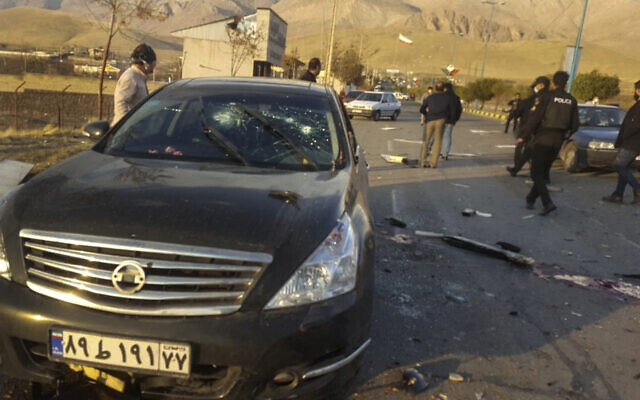
Iran has accused Israel of carrying out the November 27 hit, and threatened revenge. Israel, which has been linked to a succession of killings of Iranian nuclear scientists, has not publicly commented on the allegations that it was responsible. It has warned its citizens traveling abroad that they may be targets of Iranian terror attacks in the wake of the killing.This photo released by the semi-official Fars News Agency shows the scene where Mohsen Fakhrizadeh was killed in Absard, a small city just east of the capital, Tehran, Iran, Friday, Nov. 27, 2020. (Fars News Agency via AP)
According to the Yedioth report, written by the newspaper’s well-connected investigative reporter Ronen Bergman, Israel had been compiling a dossier on Fakhrizadeh for nearly three decades, long discounting the scientist’s claims that he had nothing to do with any weapons program.
For Israel, the recordings were the final proof that Iran’s nuclear program was not peaceful, as Tehran repeatedly claimed.
Olmert was methodical in the way he revealed the material to Bush, the report said.
The US president had come to Israel in May 2008 as the country marked the 60th anniversary of its founding.Former National Security Advisor to president George W. Bush Stephen Hadley at the Saban Forum on December 5, 2015 (YouTube screen grab)
Olmert hosted a dinner at the Prime Minister’s Residence in Jerusalem and just before dessert, Olmert, Bush, Hadley and Barak, who was defense minister at the time, headed to a side-room. It was there that Barak asked Bush if the US could supply Israel with a series of weapons it did not have in its arsenal, according to the report. Yedioth said these were believed to be vertical take-off and landing aircraft, along with bunker-busting bombs.
Hadley in the previous weeks had been briefing Bush about Israeli desires to carry out a strike against Iran’s nuclear program and Bush immediately understood what Barak wanted the weapons for.
According to Barak, Bush responded to the request by pointing at the defense minister and saying, “This guy frightens me.”
Bush then got to the point. “I want you to know the official position of the United States government. The US strongly opposes Israel taking action against the Iranian nuclear program,” Barak recalled the president replying.
“And in order not to be vague, I will tell you that the United States does not intend to act either as long as I serve as president,” Bush added, according to Barak.
Seemingly expecting the negative response from Bush, Olmert decided he’d make use of the recording the next day when he was meeting the president and Hadley at his office.US President George W. Bush visits the historical Masada site together with Israeli Prime Minister Ehud Olmert, May 15, 2008. (Ariel Jerozolimski/Flash90)
According to the report, Olmert asked the national security adviser to leave the room. Hadley insisted on staying, arguing that protocol required him to be present when matters of national security were being discussed.
But Olmert was adamant and Bush assured Hadley it was okay for him to be left alone with the prime minister, the report said.
“I’m going to play you something, but I ask that you not talk about it with anyone, not even with the director of the CIA,” the report quoted Olmert as telling Bush from within the closed-door meeting. Bush reportedly agreed to the request.
Olmert pulled out a recording device, hit play and a man could be heard speaking in Persian.
“The man speaking here is Mohsen Fakhrizadeh,” Olmert reportedly explained. “Fakhrizadeh is the head of the “AMAD” program, Iran’s secret military nuclear project. The one it denies exists at all,” Olmert told Bush according to the report.
The prime minister then revealed that Israeli intelligence services had managed to recruit an Iranian agent close to Fakhrizadeh who had been feeding Jerusalem information on the nuclear scientist for years.
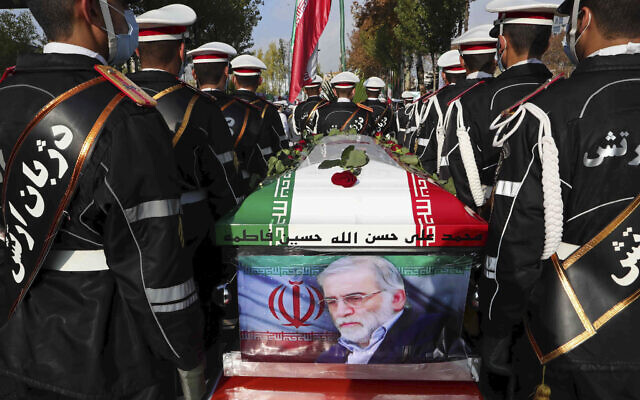
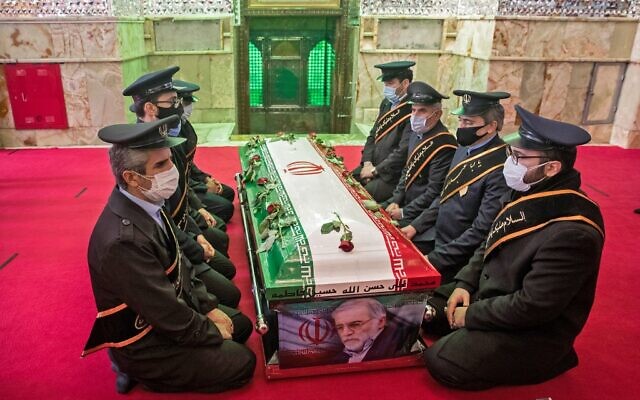
Military personnel stand near the flag-draped coffin of Mohsen Fakhrizadeh, a nuclear scientist who was killed on Friday, during a funeral ceremony in Tehran, Iran, November 30, 2020. (Iranian Defense Ministry via AP)
Olmert provided Bush with an English-language transcript of what Fakhrizadeh had said in Persian.
According to the report, Fakhrizadeh could be heard giving details about the development of Iranian nuclear weapons. However, the Yedioth report only quotes selected phrases, without the word nuclear. The scientist complains that the government is not providing him with sufficient funds to carry out his work. On the one hand, Fakhrizadeh says, in an apparent reference to his superiors, “they want five warheads,” but on the other, “they aren’t letting me work.”
Fakhrizadeh then goes on to criticize colleagues in the defense ministry and the Islamic Revolutionary Guard Corps, according to the report.
Bush read the recording’s translation and reacted with silence. Yedioth claimed the recording served as a “smoking atomic gun” for Olmert.
The premier recognized that Bush would not sell Israel the weapons it was looking for, so he made a new request: full intelligence cooperation on the Iranian nuclear issue.
When Bush agreed, Olmert decided to up the ante and proposed that the two carry out joint operations against Iran’s nuclear project, Yedioth said.
This photo released by the semi-official Fars News Agency shows the scene where Mohsen Fakhrizadeh was killed in Absard, a small city just east of the capital, Tehran, Iran, Friday, Nov. 27, 2020. (Fars News Agency via AP)
The president agreed to this as well, the report said.
Senior officials in Olmert’s office at the time told Yedioth the recording served as a “defining moment” in the two countries’ joint effort to prevent Iran from obtaining a nuclear bomb.
One apparent instance of such cooperation was the Stuxnet computer virus, which was uncovered in 2010 and was widely reported to have been developed together by US and Israeli intelligence. Stuxnet penetrated Iran’s rogue nuclear program, taking control and sabotaging parts of its enrichment processes by speeding up its centrifuges. Up to 1,000 centrifuges out of 5,000 were eventually damaged by the virus, according to reports, setting back the nuclear program.
Yedioth speculated that the Stuxnet plan, called Operation Olympic Games, was born as a result of Olmert’s revelation of the Fakhrizadeh recording to Bush.
However, other reports have said that Bush gave the go-ahead for the operation as early as 2006.
The recording was just one part of the trove of evidence that Israel has gathered on Fakhrizadeh and Iran’s nuclear program over the years, Yedioth noted.
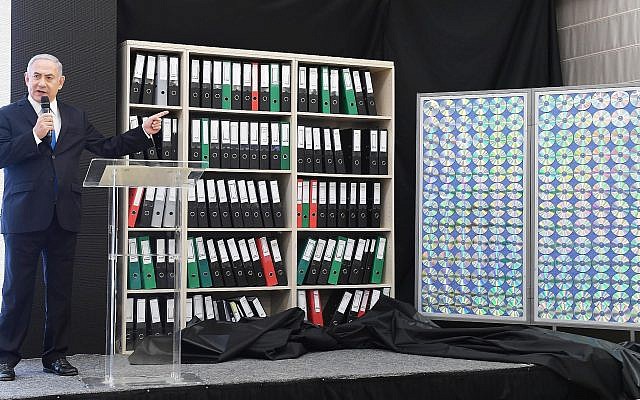
In 2018, the Mossad spirited a huge trove of documentation out of a warehouse in Tehran, detailing Iran’s rogue nuclear program.Prime Minister Benjamin Netanyahu stands in front of a picture of Mohsen Fakhrizadeh, who he named as the head of Iran’s nuclear weapons program, April 30, 2018 (YouTube screenshot)
When Prime Minister Benjamin Netanyahu revealed in April 2018 that Israel had attained the archive, which he said proved that Iran had lied about not seeking a nuclear weapons arsenal, he specified that Fakhrizadeh oversaw the program and said: “Remember that name, Fakhrizadeh.”
Faisal bin Farhan says talks are only path to a sustainable agreement; reiterates Saudis ‘completely open’ to normalizing with Israel once Palestinian state established
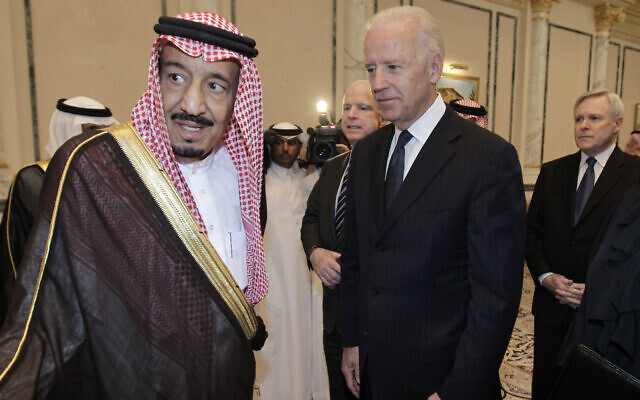
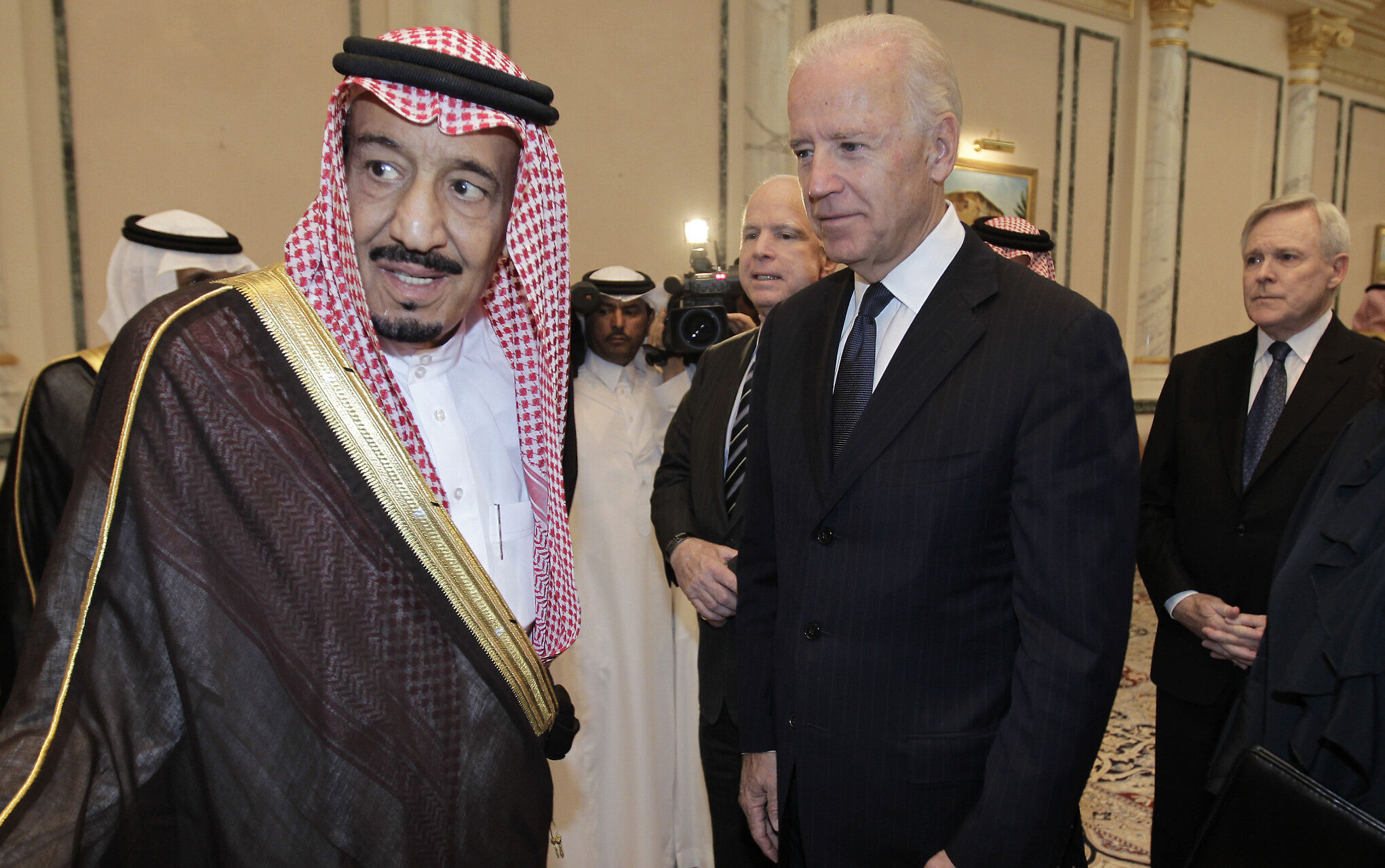
By AGENCIES and TOI STAFF5 December 2020, 5:55 pm 0Then-US vice president Joe Biden, right, offers his condolences to Prince Salman bin Abdel-Aziz upon the death of on his brother Saudi Crown Prince Sultan bin Abdul-Aziz Al Saud, at Prince Sultan palace in Riyadh, Saudi Arabia, October 27, 2011 . (AP Photo/Hassan Ammar, File)
The Gulf states must be consulted if a US nuclear accord with Iran is revived, Saudi Arabia’s top diplomat said Saturday, warning it is the only path towards a sustainable agreement.
US President-elect Joe Biden has signaled he will return the United States to a nuclear accord with Iran and that he still backs the 2015 deal negotiated under Barack Obama, from which Donald Trump withdrew.
A return to the agreement, known formally as the Joint Comprehensive Plan of Action (JCPOA), would delight US allies in Europe, but concern the Gulf states, who have criticized US engagement with Tehran.
Biden has indicated he will bring Iran’s US-allied Arab neighbors, such as Saudi Arabia, which sees Iran as its arch-rival, into the process.
“Primarily what we expect is that we are fully consulted, that we and our other regional friends are fully consulted in what goes on vis a vis the negotiations with Iran,” Saudi Foreign Minister Prince Faisal bin Farhan told AFP.Saudi Foreign Minister Faisal bin Farhan al-Saud addresses the Manama Dialogue security conference in the Bahraini capital, on December 5, 2020. (Mazen Mahdi/AFP)
“The only way towards reaching an agreement that is sustainable is through such consultation,” he said on the sidelines of a security conference in Bahrain’s Manama.
“I think we’ve seen as a result of the after-effects of the JCPOA that not involving the regional countries results in a build up of mistrust and neglect of the issues of real concern and of real effect on regional security.”
Asked whether the Biden administration was already in touch about the shape of a revived Iran deal, Prince Faisal said there were no contacts as yet, but that “we are ready to engage with the Biden administration once they take office.”
“We are confident that both an incoming Biden administration, but also our other partners, including the Europeans, have fully signed on to the need to have all the regional parties involved in a resolution,” he said.
The US imposed crippling sanctions on Iran after Trump unilaterally withdrew from the nuclear agreement in 2018. In response, Iran began publicly exceeding limits set by the agreement while saying it would quickly return to compliance if the United States did the same.
Biden told The New York Times this week that if Iran returned to compliance, the US would rejoin, after which he would seek to tighten Iran’s nuclear constraints and address concerns about both its missile program and Iran’s support for militants in the region.
According to the Times report, Biden and his team are working on the premise that if the deal is restored on both sides there will need to be new negotiations on the length of time for restrictions on the production of the fissile material necessary for producing a bomb, originally set at 15 years under the 2015 Joint Comprehensive Plan of Action, or JCPOA.
Additionally, Biden said, steps would need to be taken to address Tehran’s terror activities through regional proxies in Lebanon, Syria, Iraq and Yemen.Iran’s Foreign Minister Mohammad Javad Zarif attends a news conference with Venezuela’s Foreign Minister Jorge Arreaza in Caracas, Venezuela, November 5, 2020. (AP Photo/Matias Delacroix)
The report said that the future Biden administration would want the talks with Tehran to include not only the original parties to the deal — Iran, the United States, Russia, China, Britain, France, Germany and the European Union — but also key regional players Saudi Arabia and the United Arab Emirates.
Iranian Foreign Minister Mohammad Javad Zarif said Thursday his country won’t agree to renegotiate elements of the international accord limiting its nuclear program.
He also said Iran won’t agree to any curbs on its missile program or backing of regional proxies unless Western countries stop their “malign behavior” in the Middle East.
No normalization without Palestinian state
In his remarks, Bin Farhan reiterated that Saudi Arabia won’t normalize relations with Israel until a Palestinian state is established.
“We have as we have always been… completely open to full normalize relations with Israel. We think Israel will take its place in the region, but in order for that to happen and for that to be sustainable, we do need the Palestinians to get their state and we do need to settle that situation,” he said.
The comments came after Prime Minister Benjamin Netanyahu reportedly held a secret rendezvous last month with Saudi Crown Prince Mohammed bin Salman in the Saudi Red Sea city of Neom, alongside US Secretary of State Mike Pompeo.
It was the first known visit to Saudi Arabia by an Israeli leader, but the talks on Iran and possible normalization reportedly yielded no substantial progress.
The Trump administration had hoped Saudi Arabia would join the UAE and Bahrain in recognizing Israel and forging diplomatic ties, a move seen as increasingly distant in the wake of Joe Biden’s election as US president. But Saudi leaders have hitherto indicated that Israeli-Palestinian peace will have to come first.
It is believed that the two countries have long held clandestine ties, particularly on the issue of Iran.
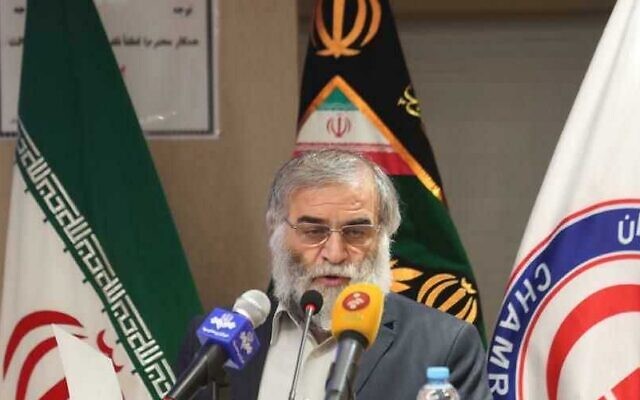
Mohsen Fakhrizadeh, said to be Iran’s senior-most nuclear scientist, was assassinated Nov. 27. Iranian media announced Fakhrizadeh had been killed within 30 minutes of the attack.
It is unprecedented for Iranian state media to acknowledge an incident of this gravity so quickly. Fakhrizadeh was a mysterious figure who was rarely seen or photographed in public but the reports of his death quickly included several pictures of him never seen previously, as if they were ready to announce the news.
Moreover, the regime’s rapidly changing and improbable narratives of how he died, cast doubts on anything that has previously been officially stated about Fakhrizadeh.
The flurry of rapidly changing and even contradictory narratives put out by the Iranian regime and top officials raise doubts about who killed Fakhrizadeh and why. Iran’s past record of falsely blaming internal killings on Israelis and the CIA, or its pattern of complete silence, denial and Internet shut downs when other alleged acts of “terrorism” occur only add to the questions about this man’s death.
For seasoned Iran watchers, the pattern of contradictory narratives to hide the real truth is a familiar one. It happened when Iran shot down Ukraine International Airlines Flight 752 and would not immediately acknowledge its own missiles hit the plane. It happened last month when a top al-Qaida official was assassinated in Tehran, but the mullahs denied it ever happened.
In 2012, Iran tried to frame Majid Jamali Fashi as an Israeli spy who murdered the Iranian quantum field theorist Masoud Alimohammadi, who likely was killed by an Iranian government hitman. The Iranians similarly framed Mazyar Ebrahimi as an Israeli assassin for killing other Iranian nuclear scientists when he says he was tortured into a confession.
Judging by the regime’s previous track record in situations of such high sensitivity, one would have expected the internet to be shut down within minutes of Fakhrizadeh’s death. But pictures and videos of the scene were also immediately posted online by eyewitnesses without any security prevention or interference.
The killing quickly became headline news around the world, with the narrative that yet another “Iranian nuclear scientist” was assassinated by a foreign secret service agency, likely to be the Israelis. To back this conclusion, the mainstream media all pointed to the fact that the Israeli Prime Minister Benjamin Netanyahu had mentioned Fakhrizadeh by name three times in 2018 while unveiling Iran’s nuclear archive, which Israel shipped out from a secret outpost in Tehran’s outskirts. “Remember his name,” Netanyahu said.
Who was Mohsen Fakhrizadeh, full name Mohsen Fakhrizadeh Mahabad, and what exactly happened in Absard, 70 kilometers east of Tehran, in this green picturesque small town with its yellowish hills overlooking the Alborz mountains?
Little is known about Fakhrizadeh’s life before 1979. He was born in 1957, in the religious city of Qom, the main hub of Iran’s Shia seminaries.
He then got involved with the Iranian Revolutionary Guard Corps (IRGC) and various military and defense projects. Since 2005-2006, the International Atomic Energy Agency (IAEA) had asked to interview Fakhrizadeh, but Iran refused to make him available.
A UN Security Council resolution in 2007 identified him as a senior scientist in Iran’s Ministry of Defense and Logistic of Armed Forces and as the former head of the Physics Research Center (PHRC) at Lavizan-Shian, an alleged undeclared nuclear site northeast of Tehran, where 140 metric tons of topsoil reportedly were removed to sanitize the site before an IAEA inspection.
More recently, Fakhrizadeh became the head of the AMAD project and then finally its successor, the Organization of Defensive Innovation and Research, or known by its Persian acronym SPND.
Iran’s official narrative of his assassination has changed substantially in just a few days, raising questions about what happened. The contradicting versions raise fundamental doubts about what exactly happened and who was responsible for Fakhrizadeh’s assassination.
Initially, a truck driver interviewed by state media claimed he saw a blue Nissan pickup truck van explode, followed by a gunfight from both sides of the road. He then saw one of the assailants lying on the road shooting at him, which prompted him to reverse away from the scene. He told state TV that five or six people were involved in the shootout.
Fereydoon Abbasi-Davaani, the former head of Iran’s Atomic Energy Organization, gave a more detailed account on Iran’s state television about a Nissan pickup truck stopping in front of Fakhrizadeh’s convoy and exploding to stop Fakhrizadeh’s car, and then an assault squad consisting of two snipers and four gunmen in a Hyundai Santa Fe opened fire. Four motorcycles were also reportedly used by the assailants.
The pro-regime Iranian documentary filmmaker, Javad Mogouei, who knew one of Fakhrizadeh’s bodyguards, then posted more details of what had happened on his Instagram account. Mogouei said there were 12 assailants in total, and only four bodyguards were protecting Fakhrizadeh and his family members. Mogouei also claimed that one of the bodyguards, Haamed Asghari, was killed after he threw himself on Fakhrizadeh trying to protect him.
Iranian news media also reported the death of the bodyguard and praised his ultimate sacrifice and martyrdom to protect the country’s top scientist.
State TV also interviewed Iran’s defense minister, Brigadier General Amir Hatami, who claimed Fakrizadeh was targeted “Because he had recently innovated a Corona test kit which was instrumental in our struggle against the coronavirus and they didn’t want us to succeed in this struggle.”
While the narrative of the 12 enemy assailants against only four heroic bodyguards explained the why the “enemy” won the day against an “invincible” Iranian security service, due to their superior numbers, it also raised questions as to how 12 attackers could have gotten away so quickly and disappeared into the thin air.
There is just one road between Absard and the nearest towns in both directions. How could 12 attackers manage to kill Iran’s top scientist in broad daylight and get away with it, in a high security designated area where many of Iran’s top rank revolutionary guards have their weekend homes?
Pictures of Fakhrizadeh’s Nissan Teana raise other questions. Taken from different angles, the pictures show a car that seemed remarkably intact with a few bullet holes in its windshield and the small rear window. The images do not match the dramatic shootout described by Iranian state media.
Later, official news denied that bodyguard Haamed Asghari had been killed, saying he suffered slight injuries as a result of his heroic action and will soon leave the hospital.
This report was followed by a completely revised narrative published by the official Fars News Agency. It claimed that there were no assailants at the scene, but Fakhrizadeh was killed by a remote controlled machine gun with Israeli military markings that was on the back of the Nissan pickup truck.
Later, Iran’s Secretary of the Supreme National Security Council (SNSC), Ali Shamkhanimade a bizarre claim that Iran “knew Fakhrizadeh was going to be assassinated and when and where the hit was to take place and we were ready for it. However, they used a new professional specialized technique unknown to us.”
At the same time, the regime issued posters of four Arab separatists wanted in conjunction with the assassination.
Based on all the above, there can be many different scenarios as to what actually happened. Was he killed by a highly elite foreign agency? Or is it possible that it was yet another internal purge that got rid of Fakhrizadeh?
Without committing to any of the possible scenarios, there are definite advantages for the regime from Fakhrizadeh’s death. One is that if the Islamic Republic is keen to get back to renegotiating the nuclear deal, given the possibility of a new administration in the United States, they no longer have to worry about a precondition of letting the IAEA interview Fakhrizadeh.
Claiming Israel was behind the assassination also provides Iran with the justification to further violate the nuclear accords by enriching more uranium, for Iran lobbyists and Israel haters like the former CIA chief John Brennan to accuse Israel of violating international laws, and to justify possible Iranian retaliatory missile launches.
As the world collectively bemoans this “criminal act” and almost gives a license to Iran to retaliate against Israel, the only ones really smiling today are the mullahs in Iran.
NATIONAL SECURITY: MIDDLE EAST / MARK ALEXANDER / DEC. 2, 2020
More “shock and awe” against Islamic tyrants, brought to you by, somebody…PRINTLISTEN
“There is a rank due to the United States, among nations, which will be withheld, if not absolutely lost, by the reputation of weakness. If we desire to avoid insult, we must be able to repel it; if we desire to secure peace, one of the most powerful instruments of our rising prosperity, it must be known that we are at all times ready for war.” —George Washington (1793)
If you’re under the age of 45, or have family members who are, you may be familiar with a TV series called “Breaking Bad.” I rarely had the inclination to tune in, both because I didn’t have the time and because in the few episodes I did watch with others, there was nothing remotely redeeming about any of the characters — just a predictable progression toward darkness. (Apparently, that darkness and lack of redemption were the art of the series.)
I did, however, watch the final episode, in which — spoiler alert — the main character, Walter White, dying of cancer, takes revenge on those who betrayed his illicit drug business. (See what I mean about “dark”?) In that episode, Walt rigs a 7.62×51mm M60 machine gun to a remote-controlled turret in the trunk of his car. Once activated, the weapon takes out all the “badder” of the bad guys.
After that episode, I observed that, logistically, the operating mechanics of the M60 remote were completely unrealistic.
It might be that my occasional editorializing about the historical or technical accuracy of theatrics explains why some people resist asking me to watch such programs with them — with apologies to my wife.
And that observation about remote-fired weapons brings me to the events of last week…
Utilizing a method that sent a bigger message than the target, another of Iran’s deadliest actors was terminated last Friday. The target was Mohsen Fakhrizadeh, described by Iran’s Supreme Leader Ayatollah Ali Khamenei as “the country’s prominent and distinguished nuclear and defensive scientist.” But this rodent’s extermination was very different than the precision strike ordered by President Donald Trump a year ago, which took out Iran’s elite terrorist Corps-Quds leader, Gen. Qasem Soleimani, and his Iraqi counterpart, paramilitary commander Abu Mahdi al-Mohandes.
It’s one thing to launch a precision missile against a target — something that could not have also been arranged with Fakhrizadeh because it would have betrayed the perpetrator — but quite another to use, as reliable sources report in this case, a remote-control machine gun mounted in the back of a pickup truck on Iranian soil.
To fully appreciate the “shock and awe” message somebody sent to Iran’s Islamist dictators — the message that they are no longer safe anytime or anywhere — political analyst Dennis Prager notes: “To appreciate how remarkable this operation was, consider this: Fakhrizadeh traveled a different route to work every day, traveled in a bulletproof car and was accompanied by three personnel carriers that transported heavily armed bodyguards. The assassins had cut off electricity to the area surrounding the assassination and disabled all video cameras in the area. They exploded a car next to Fakhrizadeh’s car and had a remote-control machine gun fire at Fakhrizadeh. The entire operation took three minutes.”
The vehicle and weapons system self-destructed after the attack.
Fakhrizadeh was the fifth Iranian nuclear scientist killed since 2007, and the most direct beneficiary of those deaths is, of course, Israel. Israelis are very good at leaving no trace, no fingerprints, but there is little doubt that they had a hand in these attacks.
Israel rightfully has a “zero tolerance” policy on regional Islamic conventional and nuclear threats to its homeland.
Sometimes that hand is overt. Operation Opera in June of 1981 — the Israeli air strike against an Iraqi nuclear reactor under construction southeast of Baghdad — destroyed an Osiris-class reactor provided to then-dictator Saddam Hussein by France. Always the French…
Other times, however, the hand is covert, the work of Israel’s Mossad intelligence agency in conjunction with opposition parties on the ground. The most recent attack on Iran’s nuclear weapons capability was the considerable damage in July to the Natanz nuclear facility, which produces advanced centrifuges for the weaponization of uranium. That explosion “coincided” with other explosions at different facilities.
By way of disclaimer in the latest of what The Washington Post described as “a series of unusual explosions,” Israel’s defense minister, Benny Gantz, insisted: “Not every incident that happens in Iran is necessarily connected to us. All those systems are complex, they have very high safety constraints and I’m not sure [the Iranians] always know how to maintain them.”
OK (wink and nod), it must’ve been simultaneous malfunctions at different locations!
The latest attacks have been directly against Iranian targets rather than Islamic terror proxies like Hezbollah. Clearly, Israel is getting in a few last shots before President Trump leaves office.
Predictably, Barack Obama’s former CIA director, John Brennan, the thug leader of the deep-state coup to take down Trump, condemned the assassination as “a criminal act” and “highly reckless,” labelling it as “murder” and “state-sponsored terrorism.”
For context, Trump has achieved an astounding number of Middle East policy successes, the latest being the historic brokered Saudi/Israeli meeting. Trump’s impressive foreign policy record in the region has earned him three Nobel Prize nominations. (I note “earned” because, unlike the ludicrous Nobel trophy given to Barack Obama for having merely shown up, Trump has actually accomplished substantial objectives in the region and globally.)
These Middle East successes, though, don’t overshadow his policies to contain the greatest external existential threat to the future of American Liberty, Xi Jinping’s oppressive Red Chinese regime, the originator of the devastating CV19 pandemic and puppeteer controller of dictator Kim Jong-un’s North Korea. (Here I note “external” because Joe Biden, Kamala Harris, and their socialist Democrat Party represent the greatest internal threat to the freedom of American citizens.)
Will Biden, as Obama did before him, embrace Iran and the other bad actors in the region?
Secretary of State Mike Pompeo, the most effective SecState in decades, said after his meeting with Biden-Harris policy officials: “Iran is more isolated than it has ever been, [and] the Gulf states are now working together in ways that literally four years ago I don’t think anybody would have believed was possible. … So whether it’s in the Gulf states or Israel, I think they have come to appreciate that the policies that this administration put in place are the ones that are best for them, for their relationship and partnership with the United States of America.”
That was Pompeo’s effort to make nice, but he knows that Biden will likely follow the “Obama plan” in the region and, if so, Israel’s U.S. support will once again plummet, and the region’s Islamist tyrants will once again gain strength.
P.S. Patriots, the most cost-effective investment you can make to ensure the future of Liberty is to support The Patriot Post. We’re the Web’s most influential grassroots journal for promoting freedom and challenging the dominant Leftmedia narrative. We rely 100% on the voluntary financial support of Patriots like you, so please support our Year-End Campaign today. Thank you.
Semper Vigilans Fortis Paratus et Fidelis Pro Deo et Libertate — 1776
Please join us in prayer for our nation’s Military Patriots standing in harm’s way in defense of Liberty, for their families, and for our nation’s First Responders. We also ask prayer for your Patriot team, and our mission to, first and foremost, support and defend our Republic’s Founding Principles of Liberty, and to ignite the fires of freedom in the hearts and minds of our countrymen.
Iran’s nuclear weapons chief is a trusted Netanyahu loyalist, and his preferred choice to steer Israel through the coming regional chaos
By HAVIV RETTIG GURToday, 6:30 am1Main image by Miriam Alster / Flash90 shows Prime Minister Benjamin Netanyahu and then-national security adviser Yossi Cohen at a press conference at the Foreign Ministry in Jerusalem, October 15, 2015
In August 2019, people close to Prime Minister Benjamin Netanyahu heard him utter a startling sentence.
“There are two people I consider fit to lead Israel — Yossi Cohen and Ron Dermer,” he was quoted by unnamed associates as saying, referring to the head of the Mossad and to Israel’s ambassador to Washington, respectively.
It was uncharacteristic of Netanyahu to speculate about his replacement, or indeed about anything that might suggest an end to his tenure as Israel’s longest-serving prime minister. That fact alone led some to interpret the leaked comment, which was never denied, as a calculated signal to Likud MKs and leadership hopefuls that Netanyahu doesn’t see his politician-colleagues as his equals and plans to throw his support behind an outside loyalist when the time comes.
But others took the comment at face value, and for good reason. Dermer and Cohen are carefully chosen and crisis-tested loyalists who oversee for Netanyahu the two central pillars of his policy – and in his mind, his legacy: The complicated but vital relationship with the US, and the bitter, unrelenting campaign against the Iranian regime.
More than their predecessors, and likely more than their successors, both men are kings of their policy domain, enjoying the prime minister’s trust and able to drive daring policy moves even in uncharted, controversial waters.
Dermer famously orchestrated Netanyahu’s 2015 address to Congress to lambast the Iran nuclear deal, a move taken despite angry resistance from the Obama White House. He was also the key figure in the close relationship Netanyahu would later develop with the Trump White House.
Prime Minister Benjamin Netanyahu with Israel’s Ambassador to the US Ron Dermer in Washington DC on September 14, 2020, a day before the Abraham Accords signing ceremony at the White House. (Avi Ohayon/GPO)
But Dermer, Dermer, it is generally believed, doesn’t seek a political career after his tenure as ambassador comes to an end.
It is spymaster Cohen, the long-time Mossad operations man who is widely believed to be behind the dramatic killing of Iran’s nuclear weapons chief Mohsen Fakhrizadeh last week, who seems willing to take on the mantle of leadership, and seems to have Netanyahu’s blessing for it.
Cohen’s influence is hard to exaggerate. Since he took over the reins of Israel’s spy agency in 2016, the Mossad has grown rapidly in budgets and manpower, expanded its operational infrastructure and engaged in some of the most daring espionage actions the region has ever seen (according to foreign reports, of course). It has all but replaced Israel’s professional diplomatic corps and Foreign Ministry in the most strategically critical theaters, such as Israel’s burgeoning alliances with the Sunni Arab world.
First as national security adviser and then as Mossad director, Cohen has played a key role in helping Netanyahu centralize the most sensitive and significant strategic policy questions within the Prime Minister’s Office, cutting competing institutions and power bases, from the defense and foreign ministries to the security cabinet, out of the loop.
Into the limelight
Shortly after Netanyahu’s 2018 announcement that Israel had acquired Iran’s secret nuclear archive in an astonishing nighttime raid on a facility near Tehran, prominent Hebrew-language media let it be known that anonymous sources had confirmed to them that Cohen himself had personally overseen the daring operation.
Prime Minister Benjamin Netanyahu showcases material he says was obtained by Israeli intelligence from Iran’s nuclear weapons archive, in Tel Aviv on April 30, 2018. (Amos Ben-Gershom (GPO)
In April of this year, amid the first coronavirus lockdown, it was again leaked to the press that the Mossad had engaged its “strategic assets” to bring to Israel vitally needed equipment to battle the pandemic, including ventilators and masks. In a moment of unguarded braggadocio by an unnamed Mossad official, it was suggested to reporters that the equipment had been daringly snatched from other unsuspecting nations.
It was a strange and clumsy effort by the vaunted spy agency, the sort that reveals more in its tone than in the information being conveyed. The claim that the Mossad had stolen medical equipment from other nations in the midst of a pandemic turned out to be an ill-judged attempt to imply there was a substantive cloak-and-dagger reason for assigning the purchase of medical equipment to the spy agency. Why hadn’t the Defense Ministry’s procurements division or the Health Ministry, both of which have more experience than the Mossad in negotiating and implementing large purchases abroad, been given the task? Did Israel really steal medical supplies?
It later emerged that the procurements were less exciting than initially suggested. The Mossad had turned to friendly governments and purchased from them equipment they believed they could spare. It made some errors in selecting the equipment, and some have suggested that it paid higher-than-market rates, but these mistakes remain unconfirmed reports, since all details surrounding Mossad activities (all details not leaked by the Mossad, that is) are classified.
And that’s the point. The Mossad’s activities are not accountable to the public in any direct sense. There is no easy way to verify or critique its activities. The organization answers to Netanyahu, and so credit for its successes need not be shared.Mossad chief Yossi Cohen speaks at a Tel Aviv University cyber conference on June 24, 2019. (Flash90)
Those features — secrecy, loyalty and a hierarchy answerable directly to the prime minister — make the spy agency the perfect vehicle for a man like Cohen, with Netanyahu’s encouragement and support, to build his brand and public presence. Cohen broke longstanding Mossad tradition in recent years by appearing in public to speak about the agency’s challenges, giving interviews to the press, and sitting in the front row at diplomatic functions, sometimes even smiling to the cameras.
That publicity, alongside his oft-mentioned role in the negotiations leading to Israel’s recent normalization agreements, Netanyahu’s repeated public praise for the spy chief, and a steady stream of leaks to the media about the agency’s exploits in recent years, have made Cohen by far the most visible Mossad chief in the organization’s history.
Dangers mount
But Netanyahu’s faith in Cohen runs deeper than his personal loyalty or the desire to groom a successor.
Cohen comes from a right-wing religious-Zionist family. He is the scion of eight generations of Jerusalemites and the son of a fighter in the right-wing pre-state Etzel militia. He shares a basic cultural and political orientation with the prime minister.Yossi Cohen, then the national security adviser, is seen in a committee meeting at the Israeli parliament on December 8, 2015, sitting behind Prime Minister Benjamin Netanyahu. (Yonatan Sindel/Flash90)
And he shares something else. Cohen and Dermer both agree with Netanyahu’s understanding of the chaos that is to come.
Netanyahu’s defining policy concern flows from his analysis of regional trends. He sees a Middle East set to grow far more dangerous and chaotic in the coming years as the Iranian regime is unleashed from international restrictions and runs roughshod over a politically and militarily debilitated Arab world.
Iran’s defiance of — and determination to overturn — the Westphalian state system in the region has already sparked a return throughout the Middle East to older, deeper loyalties and identities. It no longer makes sense to have an Iran policy distinct from a Lebanon policy, or an Iraq policy that assumes the central government in Baghdad is calling the shots in the country. The region is dividing along more fundamental alliances, between Shiite and Sunni, between conservative and Islamist.
Iranian army troops march at a military parade marking the 39th anniversary of the outset of the Iran-Iraq war, in front of the shrine of the late revolutionary founder Ayatollah Khomeini, just outside Tehran, Iran, September 22, 2019. (Iranian Presidency Office via AP)
In the wake of the Fakhrizadeh assassination, former CIA chief John Brennan took to Twitter to rail against the “state-sponsored terrorism” and “flagrant violation of international law” represented in the killing of a senior Iranian military official.
It’s an understandable view for a former senior American official, but the moral panic rings hollow in the Middle East. Even a cursory glance around the region reveals that the regime led by Ali Khamenei is determinedly transnational, funding, arming and controlling militias in Lebanon, Yemen, Syria and Iraq. It has sent agents to bomb Jewish communities around the world and has spent the better part of the past 25 years trying to escape the strictures of the nuclear non-proliferation treaty.
Not only is the Iranian regime no big believer in the sanctity of state sovereignty (except its own, of course), it shares with other Islamist movements a guiding creed that views the modern state system imposed on the Middle East by European powers a century ago as a straitjacket responsible for no small part of the weakness and disarray in the heartland of Islam.
Brennan’s response and the diplomatic outcry in some quarters that followed Fakhrizadeh’s assassination are viewed in Israel and in large parts of the Sunni Arab world as a kind of willful myopia that offers no safety or answers for those in the region who must contend with the hard reality of an expansionist Iran.
The Middle East is thus entering a dangerous time, according to this view, with powerful adversaries arming quickly, deploying vast arsenals of precision missiles, transnational proxy militias, and even nuclear weapons; with weak states and a quickly evaporating international security architecture as the American retreat leaves behind a vacuum only partly filled by local powers like Israel and Turkey.
Enter Cohen
Israel’s current spymaster rose through the Mossad ranks as an operations man, gaining a reputation for daring and clever exploits and winning the job of deputy director in 2011. It was from that post that he was plucked out by Netanyahu and appointed national security adviser in 2013.
CCTV footage allegedly showing a Mossad operative during the 2010 assassination of Mahmoud al-Mabhouh in Dubai, as released by the Dubai police. (Screenshot via YouTube)
Those years were a difficult period for Mossad’s operations branch. The killing of Hamas weapons smuggling pointman Mahmoud al-Mabhouh in Dubai in 2010 was caught on security cameras that reportedly exposed the faces of a massive Mossad hit team. After that fiasco, the organization was said to take a step back from daring international escapades. Under agency chief Tamir Pardo, who led the organization from 2011 to 2016, few operations were approved.
Cohen got Netanyahu’s nod for Mossad chief in 2016 after promising the prime minister a return to bold and strategically significant operations — and a laser-like focus on Iran.
Cohen was reportedly key to the retooling of the Mossad’s operations in response to the challenges revealed in the Mabhouh hit: Namely, the ubiquity of cameras, biometric scanners (11 of the alleged Mossad hit team members reportedly had their retinas scanned as a routine measure at Dubai’s airport, scans later shared with Interpol), and other instruments of mass surveillance.
Former Mossad director Tamir Pardo participates in the Meir Dagan Conference for Strategy and Defense at the Netanya Academic College, March 21, 2018. (Meir Vaaknin/Flash90)
“To you it seems fun, that Instagram thing, that your cellphone can identify heads with a yellow square and a person can identify themselves almost automatically using automatic systems almost everywhere,” Cohen told a 2018 Finance Ministry conference. “But a great deal of the problems or challenges faced by [the Mossad] are tied to the fact that your actual passport is your fingerprint, your iris, your face…. Try to imagine in what world Mossad’s operational staff, Mossad’s warriors, are operating.”
The response, according to a detailed report in Haaretz from 2018: the Mossad under Cohen has shifted away from employing Israeli agents directly in foreign operations. In the December 2016 hit on Hamas drone engineer Mohammad a-Zawari in Tunisia, widely attributed to the Mossad, a large and complex international team, each part responsible for only a tiny portion of the operation and probably unaware of the other parts, carried out the strike. The hitmen themselves were reportedly Bosnian nationals.
That new modus operandi, the focus on mercenaries and unwitting accomplices, is likely responsible for the clean getaways in the cases of the stolen nuclear archive (confirmed by Netanyahu as a Mossad operation) and the Fakhrizadeh assassination (on which Israel is officially mum).
Indeed, if even half the reports about the Mossad’s activities since 2016 are correct, Cohen has delivered in spades on his promise to Netanyahu. And Netanyahu has responded with a growing reliance on Cohen and a dramatic expansion of his agency’s budget and personnel.
Benjamin Netanyahu and Yossi Cohen look over documents in a photo posted on social media by Netanyahu on December 7, 2015, shortly after he named Cohen as the new Mossad chief. (PMO/Facebook)
The Mossad’s budget is now reportedly estimated at well over NIS 10 billion ($3 billion) and with a workforce numbering, according to unconfirmed media reports, more than 7,000 — larger than all comparable spy agencies except the CIA. It’s no accident that Cohen’s 2018 comments about espionage in the digital age were made to a conference of the Finance Ministry’s Budgets Department. Officials familiar with the agency’s operations say no budget request made by Cohen is denied.
The Mossad under Cohen has become an instrument of grand strategy for a prime minister worried about very large strategic threats. Its unique place in the Israeli government hierarchy gives it an independence and a flexibility that allows Netanyahu to conduct policy, unobstructed by political adversaries or public scrutiny.
And that has made Cohen himself the indispensable architect of Netanyahu’s far-reaching and many-layered campaign to disrupt Iran’s nuclear and precision-missile programs and construct new strategic alliances against the looming chaos.
Netanyahu sees in Cohen not merely a protégé, but the daring strategist Israel will need to safely weather the coming crisis. His patronage is as much a statement about where Netanyahu believes the Middle East is headed as it is about whom he deems a worthy successor to himself.
Fakhrizadeh’s assassination, if indeed it is Cohen’s handiwork, is only the beginning.
President-elect says Iran’s terror proxies must be curbed, raises concern of Mideast nuclear arms race; Rouhani rejects his parliament’s ‘harmful’ bill to boost uranium enrichment
By TOI STAFF and AGENCIESToday, 11:54 am 0This photo released Nov. 5, 2019, by the Atomic Energy Organization of Iran, shows centrifuge machines in the Natanz uranium enrichment facility in central Iran. (Atomic Energy Organization of Iran via AP, File)
US President-elect Joe Biden said that the US would rejoin the nuclear deal with Iran if Tehran went back to strict compliance with the agreement, and promised to take steps to curb the influence of the Islamic Republic’s regional proxies.
Biden told The New York Times in an interview published overnight Tuesday that “there’s a lot of talk about precision missiles and all range of other things that are destabilizing the region,” but “the best way to achieve getting some stability in the region” is to address those issues within the nuclear program.
“In consultation with our allies and partners, we’re going to engage in negotiations and follow-on agreements to tighten and lengthen Iran’s nuclear constraints, as well as address the missile program,” he said, noting that the US always has the option to return to sanctions if necessary.
He raised concerns that if Iran were to get a nuclear bomb, it would increase pressure on Saudi Arabia, Turkey, Egypt and other nations in the region to acquire such weapons.
US President-elect Joe Biden at The Queen theater, November 25, 2020, in Wilmington, Delaware (AP Photo/Carolyn Kaster)
“And the last goddamn thing we need in that part of the world is a buildup of nuclear capability,” Biden said.
“It’s going to be hard, but yeah,” Biden told the Times when specifically asked about an essay he wrote that was published in September.
Biden wrote in the article for CNN prior to the election that “if Iran returns to strict compliance with the nuclear deal, the United States would rejoin the agreement as a starting point for follow-on negotiations.”
According to the Times report, Biden and his team are working on the premise that if the deal is restored on both sides there will need to be new negotiations on the length of time for restrictions on the production of the fissile material necessary for producing a bomb, originally set at 15 years under the 2015 the Joint Comprehensive Plan of Action, or JCPOA.
The US imposed crippling sanctions on Iran after US President Donald Trump unilaterally withdrew from the nuclear agreement in 2018. In response, Iran began publicly exceeding limits set by the agreement while saying it would quickly return to compliance if the United States did the same.
Additionally, Biden said, steps would need to be taken to address Tehran’s terror activities through regional proxies in Lebanon, Syria, Iraq and Yemen.
The report said that the future Biden administration would want the talks with Tehran to include not only the original parties to the deal — Iran, the United States, Russia, China, Britain, France, Germany and the European Union — but also key regional players Saudi Arabia and the United Arab Emirates.
Iranian President Hassan Rouhani in a pre-recorded message played during the 75th session of the United Nations General Assembly, at UN headquarters in New York, September 22, 2020. (UNTV via AP)
The comments came as Iran’s President Hassan Rouhani on Wednesday rejected a bill approved by parliament that would have suspended UN inspections and boosted uranium enrichment, saying it was “harmful” to diplomatic efforts aimed at restoring the 2015 nuclear deal and easing US sanctions.
The tug-of-war over the bill, which gained momentum after the killing of a prominent Iranian nuclear scientist last month, allegedly by Israel, reflects the rivalry between Rouhani and hardline lawmakers who dominate parliament and favor a more confrontational approach to the West.
The bill would have suspended UN inspections and required the government to resume enriching uranium to 20 percent if European nations failed to provide relief from crippling US sanctions on the country’s oil and banking sectors. That level falls short of the threshold needed for nuclear weapons but is higher than that required for civilian purposes.
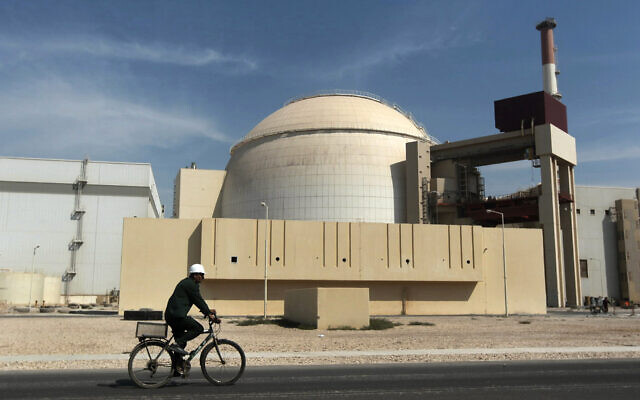
The Bushehr nuclear power plant outside the southern city of Bushehr, Iran. (AP Photo/Mehr News Agency, Majid Asgaripour, File)
Speaking at a cabinet meeting, Rouhani said his administration “does not agree with that and considers it harmful for the trend of diplomatic activities.” He implied the lawmakers were positioning themselves ahead of Iran’s elections planned for June.
He added that “today, we are more powerful in the nuclear field than at any other time.”
The bill is expected to have little if any impact, as Iran’s Supreme Leader Ayatollah Ali Khamenei has the final say on all major policies, including those related to the nuclear program. Rather, it appeared to be a show of defiance after Mohsen Fakhrizadeh, a key figure in Iran’s nuclear program, was killed in an attack Iranian officials have blamed on Israel.
Some analysts have argued the killing was aimed at making it more difficult for Biden to reenter the nuclear deal with Iran.
Prime Minister Benjamin Netanyahu had warned about the threat posed by Fakhrizadeh as early as 2018 and just days ago cautioned against Biden’s plans to reenter the nuclear accord.
Military personnel stand near the flag-draped coffin of Mohsen Fakhrizadeh, a nuclear scientist who was killed on Friday, during a funeral ceremony in Tehran, Iran, November 30, 2020. (Iranian Defense Ministry via AP)
Fakhrizadeh headed a program that Israel and the West have alleged was a military operation looking at the feasibility of building a nuclear weapon. The International Atomic Energy Agency says that the “structured program” ended in 2003, while Israel says Iran is still aiming to develop nuclear weapons, pointing to its work on ballistic missiles and other technologies.
Iran insists its nuclear program is entirely peaceful, though a trove of Iranian documents stolen from Tehran by the Mossad, which were revealed by Netanyahu in 2018, showed plans by Iran to attach a nuclear warhead to a ballistic missile.
Iran has suffered several devastating attacks this year, including the killing of top general Qassem Soleimani in a US drone strike in January, and a mysterious explosion and fire in the summer that crippled an advanced centrifuge assembly plant at the Natanz uranium enrichment facility, which is widely believed to have been an act of sabotage.
Fakhrizadeh assassination adds to Tehran’s growing list of grievances and could force it to retaliate; still, it doesn’t diminish Iran’s desire to return to a sanction-ending deal
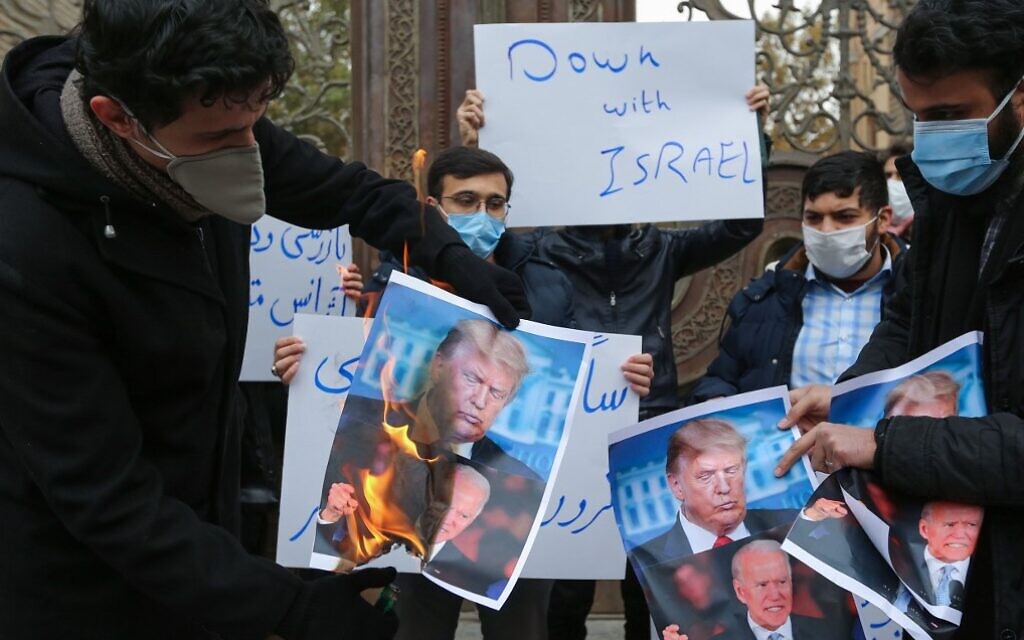
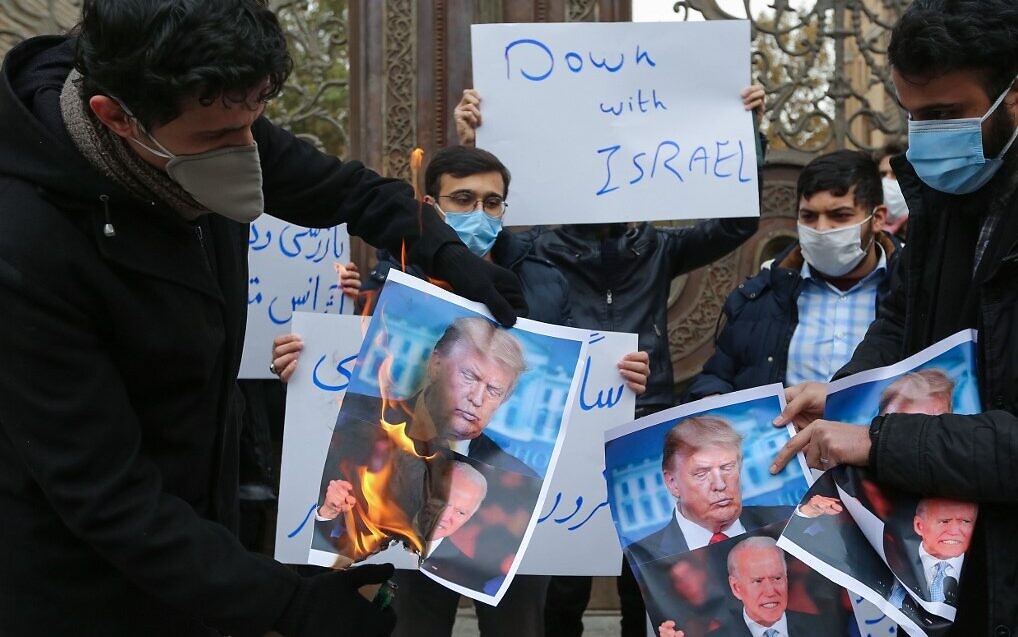
By JACOB MAGIDToday, 5:00 am 1Students of Iran’s Basij paramilitary force burn posters depicting US President Donald Trump (top) and President-elect Joe Biden, during a rally in front of the foreign ministry in Tehran, on November 28, 2020, to protest the killing of prominent nuclear scientist Mohsen Fakhrizadeh a day earlier near the capital. (Atta Kenare/AFP)
NEW YORK — Within hours of Mohsen Fakhrizadeh’s assassination on Friday, social media accounts affiliated with Iran’s Islamic Revolutionary Guard Corps began posting propaganda images depicting the slain nuclear scientist alongside former IRGC commander Qassem Soleimani and Iraqi comrade Abu Mahdi al-Muhandis, who were killed in a similar targeted attack.
The message coming from the highest levels of the Islamic Republic was that Iran planned not only to avenge the death of the most recent “martyr,” but the killings of Soleimani and al-Muhandis as well.
The operation that took out Fakhrizadeh has been widely attributed to Israel, whereas the January drone strike on Soleimani and al-Muhandis was carried out by the US. To Tehran though, they are part of the same growing list of grievances that many analysts speculate will make President-elect Joe Biden’s plans to re-enter the Iran nuclear accord a much more difficult task.
Several regional experts who spoke with The Times of Israel Monday acknowledged the degree to which Fakhrizadeh’s killing complicates matters for the incoming Biden administration, yet they also argued that Iran’s interest in reaching an agreement to ease crippling American sanctions remains undiminished.
The killing of Fakhrizadeh, the scientist that Israel and the US accused of heading Iran’s rogue nuclear weapons program, was part of an effort to “salt the field for Biden and lock the Iranians into a position of intransigence,” argued Hussein Ibish of the Arab Gulf States Institute in Washington (AGSIW).
The Middle East analyst maintained that even before the military-style ambush on the outskirts of Tehran, efforts by Iranian President Hassan Rouhani were vulnerable to the “willingness and ability of hardliners [in the Islamic Republic] to agitate against any resumed dialogue with Washington.”
“The risk any Iranian leaders will be taking in reengaging with the US has [now] greatly increased,” Ibish said.
AGSIW Iran expert Ali Alfoneh went further, arguing that the “nuclear deal was Israel’s real target in the latest assassination.” Jerusalem has not commented on Fakhrizadeh’s killing, but three Western intelligence officials told The New York Times last week that the Jewish state was responsible.Members of Iranian forces pray around the coffin of slain nuclear scientist Mohsen Fakhrizadeh during the burial ceremony at Imamzadeh Saleh shrine in northern Tehran, on November 30, 2020. (HAMED MALEKPOUR / TASNIM NEWS / AFP)
Prime Minister Benjamin Netanyahu had warned about the threat posed by Fakhrizadeh as early as 2018 and just days ago cautioned against Biden’s plans to re-enter the nuclear accord officially known as the Joint Comprehensive Plan of Action.
Alfoneh said that despite the attempt by perpetrators of the Friday strike to “lure” Iran into direct confrontation, he expected Tehran to stick with its practice of “strategic patience” in deciding when to respond to such attacks.
“This is good news for the Biden administration and the prospects for US-Iran negotiations,” he added, while warning that “strategic patience comes at a domestic price, as the Iranian public questions the abilities of the regime’s security services” to protect its most senior officials.
Sanctions relief vs. national honor
Brookings Institute Iran expert Suzanne Maloney appeared less optimistic, saying that Fakhrizadeh’s killing shifted the sides “back into escalation mode.”
“I’m less concerned about the [assassination’s] fallout for the nuclear deal,” she said. “What I am concerned about is how Iran will play its cards throughout the region and how this will impact Israeli and US security.”
However, Maloney argued that “anxiety over prospects of diplomacy is overstated.”A photo released by the semi-official Fars News Agency shows the scene where Mohsen Fakhrizadeh was killed in Absard, a small city just east of the capital, Tehran, Iran, Friday, Nov. 27, 2020 (Fars News Agency via AP); insert: Mohsen Fakhrizadeh in an undated photo (Courtesy)
What drove Iran toward negotiations with the Obama administration that led to the 2015 agreement was “a fundamental need to re-access the international financial system,” Maloney maintained, asserting that that need remains as crucial as ever.
She acknowledged that Iran’s pursuit of a nuclear program and regional hegemony are “inherently connected,” but argued that Tehran won’t “retaliate to the latest killing by withholding their willingness to talk with US about re-entry into the nuclear deal. They are going to retaliate in the region though.”
The Washington Institute for Near East Policy’s Kate Bauer was not as convinced of the certainty of an Iranian retaliation, be it by slamming the door on the possibility for talks with the Biden administration or by combating US or Israeli interests in the region.
She said Iran is not interested in “flipping the narrative” that has seen European sympathies for Tehran grow amid the Trump administration’s snapback of sanctions against the Islamic Republic following Washington’s 2018 withdrawal from the internationally-backed JCPOA.Prime Minister Benjamin Netanyahu stands in front of a picture of Mohsen Fakhrizadeh, who he named as the head of Iran’s nuclear weapons program, April 30, 2018 (YouTube screenshot)
“There are reasons you can use to argue that Iran will likely to respond, but they probably understand that doing so would put at risk the opportunity to receive relief, which is what they need,” Bauer said, while acknowledging that her stance was reliant on a bit of “wishful thinking.”
Regardless, she maintained that the strike complicates things for Biden, who would have had a hard time returning to the Iran deal even before Fakhrizadeh’s killing.
While Biden has talked about re-entering the JCPOA only after Iran begins complying with the terms of the accord, Tehran has held that it wants to see sanctions relief upfront. Moreover, the president-elect’s aides have said an American re-entry into the deal will require a commitment from Iran to enter follow-up negotiations that will cover non-nuclear issues — a demand that even so-called moderates in the Islamic Republic will have a hard time accepting given that parliamentary elections are just months away.
Leverage or sabotage?
In a January address days after Soleimani’s killing, US Secretary of State Mike Pompeo described the strike as part of a larger plan to “re-establish deterrence” against Iran along with Washington’s sweeping sanctions regime.
Some backers of the administration’s “maximum pressure” policy toward Iran have made the same argument in the aftermath of the Fakhrizadeh assassination, arguing that like sanctions, it could be used as leverage by the Biden administration, which will have an easier time negotiating with a weakened and embarrassed Tehran.Iran’s Judiciary Chief Ayatollah Ebrahim Raisi pays his respect to the body of slain scientist Mohsen Fakhrizadeh among his family, in Tehran, Iran, November 28, 2020. (Mizan News Agency via AP)
But AGSIW’s Ibish argued that the two policies cannot be conflated. “Sanctions are actions that have consequences for an entire society and are ongoing pressure points that can be eased or intensified, like a valve,” he said.
“The killing of a one man — even if he was engaged in nefarious activity — is a different matter because once it’s done it’s done.”
“The sanctions are useable as leverage, [Fakhrizadeh’s killing] is sabotage,” Ibish maintained.
He argued that inside the Iranian regime, it is possible to have “rational conversations” with officials regarding sanctions. “But assassinating senior officials puts them in vengeance [mode] where there’s nothing that can be accomplished. It becomes about pride and honor… which aren’t natural issues to be negotiated.”
Iraqi security forces and local militias sources say Muslim Shahdan and three others died when their vehicle, carrying weapons, was hit just inside Syria after crossing from Iraq
By TOI STAFFToday, 12:24 am 0Iran’s Revolutionary Guard troops march in a military parade marking the 36th anniversary of Iraq’s 1980 invasion of Iran, in front of the shrine of late revolutionary founder Ayatollah Khomeini, just outside Tehran, Iran, September 21, 2016. (AP Photo/ Ebrahim Noroozi, File)
A senior commander in Iran’s Revolutionary Guard was killed in an apparent drone strike along the Syrian-Iraqi border, according to widely circulated reports in Arabic-language media Monday.
Iraqi security sources told Saudi-based al-Arabiya News that a drone killed Muslim Shahdan, a senior commander in the Islamic Revolutionary Guards Corps, in a targeted strike on his car.
Other sources in the Iraqi security services told Lebanese-based al-Hadath that three of his companions perished with him.
The reports did not say who was behind the strike, which reportedly happened early Sunday or late Saturday.
It was the latest in a rapid escalation in military action over the past few weeks that have seen a top Iranian nuclear scientist assassinated and unconfirmed reports of air strikes that have killed pro-Iranian fighters or Iranian troops in Syria. The attacks have all been attributed to Israel.
Two Iraqi security officials separately said that Shahdan’s vehicle was carrying weapons and was hit shortly after it crossed the border from Iraq into Syria, Reuters reported.
Israel and the US have accused Iran and its proxies of attempting to smuggle weapons via Iraq to Syria and Lebanon to be used against the Jewish state.
On Sunday, IDF chief Aviv Kohavi said that Israel would not let up its campaign aimed at keeping Iran-backed fighters from gaining a foothold in Syria.
The campaign has included thousands of airstrikes on targets linked to Iran and alleged weapons convoys, according to reports and accounts from officials speaking anonymously.
However, alleged Israeli strikes on the Syria-Iraq border region are more rare.
Tehran made the threat following a major Israeli assault in response to what Jerusalem said was a failed Iranian explosives attack on the Golan Heights.
Shahdan’s reported assassination comes days after the killing of prominent Iranian nuclear scientist Mohsin Fakhrizadeh, in an ambush on his convoy outside Tehran on Friday. Israel has been widely reported to be the perpetrator of the targeted killing, although Jerusalem has stayed mum on the issue.
Fakhrizadeh’s death has put Israel and Jewish institutions around the world on high alert, as Iran has publicly vowed revenge and repeatedly claimed Israel stands behind the assassination.
In January, a US drone strike killed senior Revolutionary Guards commander Qassem Soleimani. Iran responded by firing missiles at US bases in Iraqi that caused dozens of injuries.


 Saudi Foreign Minister Faisal bin Farhan al-Saud addresses the Manama Dialogue security conference in the Bahraini capital, on December 5, 2020. (Mazen Mahdi/AFP)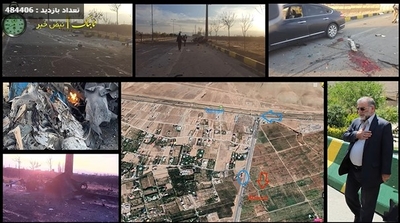


 Mossad chief Yossi Cohen speaks at a Tel Aviv University cyber conference on June 24, 2019. (Flash90)
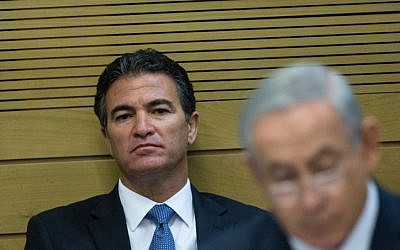 Yossi Cohen, then the national security adviser, is seen in a committee meeting at the Israeli parliament on December 8, 2015, sitting behind Prime Minister Benjamin Netanyahu. (Yonatan Sindel/Flash90)



 Members of Iranian forces pray around the coffin of slain nuclear scientist Mohsen Fakhrizadeh during the burial ceremony at Imamzadeh Saleh shrine in northern Tehran, on November 30, 2020. (HAMED MALEKPOUR / TASNIM NEWS / AFP)
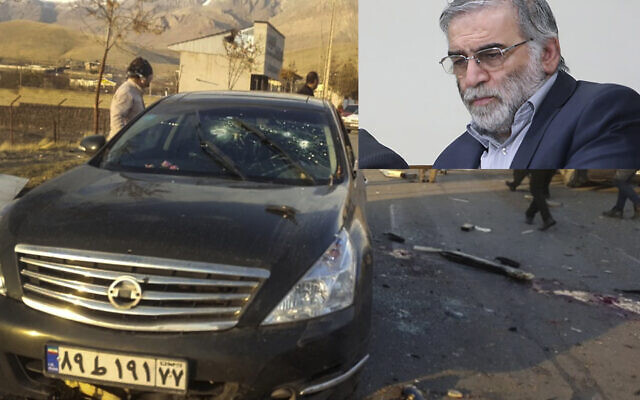 A photo released by the semi-official Fars News Agency shows the scene where Mohsen Fakhrizadeh was killed in Absard, a small city just east of the capital, Tehran, Iran, Friday, Nov. 27, 2020 (Fars News Agency via AP); insert: Mohsen Fakhrizadeh in an undated photo (Courtesy)
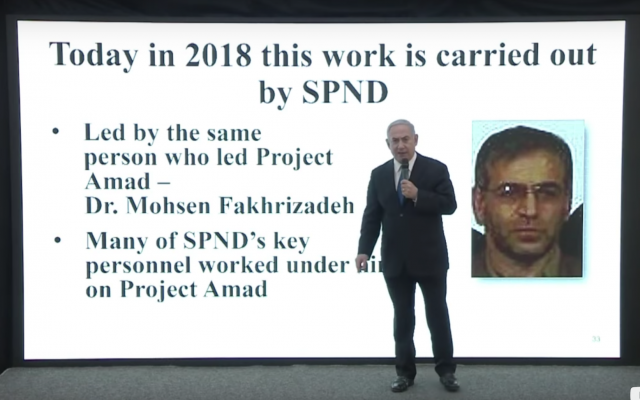 Prime Minister Benjamin Netanyahu stands in front of a picture of Mohsen Fakhrizadeh, who he named as the head of Iran’s nuclear weapons program, April 30, 2018 (YouTube screenshot)
 Iran’s Judiciary Chief Ayatollah Ebrahim Raisi pays his respect to the body of slain scientist Mohsen Fakhrizadeh among his family, in Tehran, Iran, November 28, 2020. (Mizan News Agency via AP)




 anneinpt
 artaxes
 danmillerinpanama
 davidking1530
 Peter Hofman
 Joseph Wouk
 Peter
Peter Louisiana Steve
 WarSclerotic

Recent Comments