As concerns increase, Guterres says Tehran should comply with 2015 agreement, notes Israeli intel about probable Iranian missiles in Libya
By EDITH M. LEDERERToday, 7:46 am 1
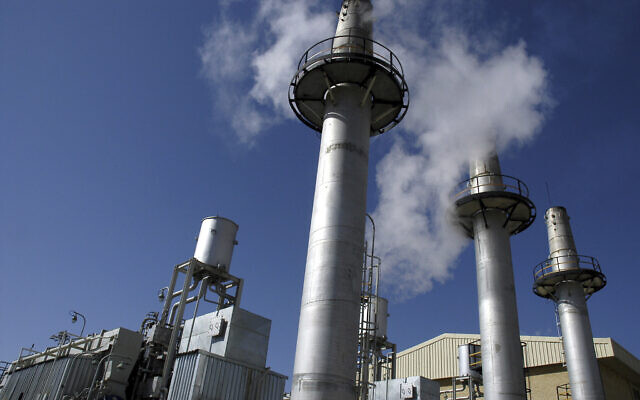
The exterior of the Arak heavy water production facility in Arak, Iran, 360 kilometers southwest of Tehran, October 27, 2004. (AP Photo)
UNITED NATIONS (AP) — Secretary-General Antonio Guterres is urging Iran to address concerns raised about its nuclear and ballistic missile programs and return to “full implementation” of its 2015 nuclear deal with major powers.
The UN chief expressed regret in a report to the Security Council obtained Tuesday by The Associated Press that the Trump administration withdrew from the agreement in 2018 and re-imposed sanctions against Tehran, and at Iran’s 2019 decision to violate limits in the deal including on centrifuges and enriching uranium.
Guterres said in the report on implementation of a council resolution endorsing the 2015 nuclear agreement that for the last five years the nuclear deal “has been largely viewed by the international community as a testament to the efficacy of multilateralism, diplomacy and dialogue, and a success in nuclear nonproliferation.”
But US President Donald Trump has waged war on the nuclear agreement, denouncing it during the 2016 campaign as the worst deal ever negotiated, and he has kept up opposition in the years since the US pullout in 2018.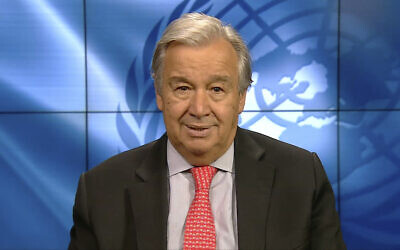
UN Secretary General Antonio Guterres speaks at an online video conference on September 3, 2020 (Ministry of Environment Government of Japan via AP)
The Trump administration maintains the agreement — the Joint Comprehensive Plan of Action or JCPOA — is fatally flawed because certain restrictions on Iran’s nuclear activity gradually expire and will allow the country to eventually develop atomic weapons. In August, Secretary of State Mike Pompeo formally notified the UN that it was invoking a provision of the 2015 deal to restore UN sanctions, citing significant Iranian violations and declaring: “The United States will never allow the world’s largest state sponsor of terrorism to freely buy and sell planes, tanks, missiles and other kinds of conventional weapons … (or) to have a nuclear weapon.”
But the remaining parties to the JCPOA — Russia, China, Britain, France and Germany — as well as the overwhelming majority of the Security Council called the US action illegal because the US had withdrawn from the treaty. The council and the secretary-general both said there would be no action on the US demands — which meant there would be no UN demand for countries to re-impose UN sanctions on Iran.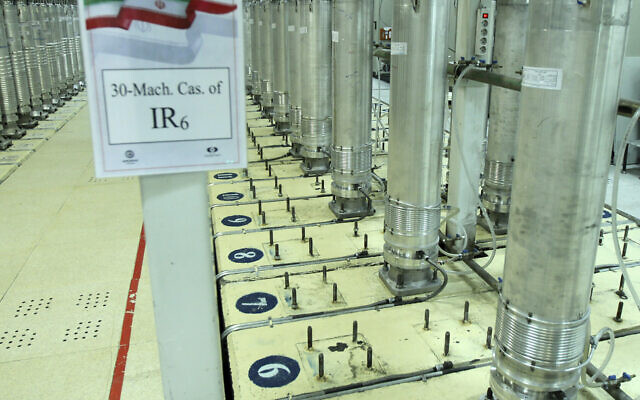
This photo released November 5, 2019, by the Atomic Energy Organization of Iran, shows centrifuge machines in the Natanz uranium enrichment facility in central Iran. (Atomic Energy Organization of Iran via AP, File)
Nonetheless, concerns by the US as well as the European parties to the JCPOA have increased, especially with Iran continuing to violate the deal’s limits. Iran has openly announced all its violations of the nuclear deal in advance and said they are reversible.
The deal promised Iran economic incentives in exchange for the curbs on its nuclear program. Since the US withdrawal and its imposition of new sanctions, Tehran has tried to put pressure on the remaining parties using the violations to come up with new ways to offset the economy-crippling actions by Washington.
Secretary-General Guterres recounted the US actions and Security Council response in the report and stressed again “the importance of initiatives in support of trade and economic relations with the Islamic Republic of Iran, especially during the current economic and health challenges posed by the COVID-19 pandemic.”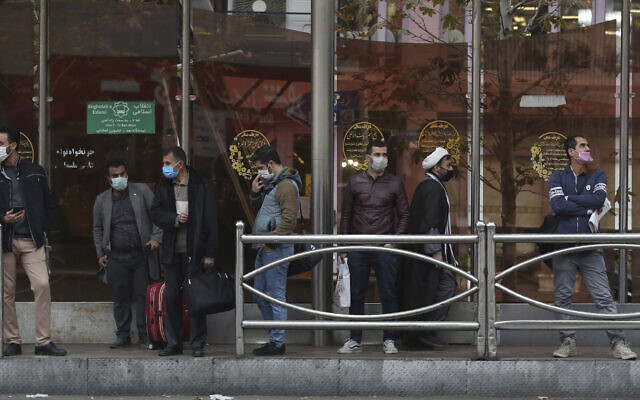
People wearing face masks to help prevent the spread of the coronavirus wait at a bus stop in downtown Tehran, Iran, December 5, 2020. (AP Photo/Vahid Salemi)
As for implementation of the 2015 Security Council resolution endorsing the JCPOA, the secretary-general said he focused on restrictions on nuclear, ballistic missile, and arms-related transfers to or from Iran.
He said Israel provided information about the presence of four alleged Iranian Dehlavieh anti-tank guided missiles in Libya in June. On the basis of photographic evidence, he said, one missile “had characteristics consistent with the Iranian-produced Dehlavieh” but the UN Secretariat has been unable to determine if it had been transferred to Libya in violation of the resolution.
On Australia’s June 2019 arms seizure, Guterres said analysis of high-definition images of some material determined that “the 7.62 mm ammunition in this seizure were not of Iranian manufacture.”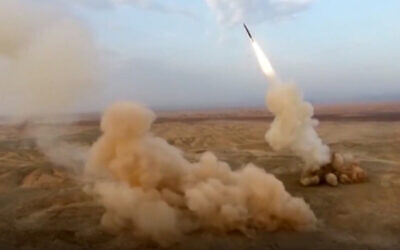
Illustrative — This frame grab from video shows the launching of underground ballistic missiles by the Iranian Revolutionary Guard during a military exercise. (Sepahnews via AP)
The secretary-general said the UN received information that an unnamed “entity” on the sanctions blacklist took actions “inconsistent” with its frozen assets and actions to ship “valves, electronics, and measuring equipment suitable for use in ground testing of liquid propellant ballistic missiles and space launch vehicles” to Iran. He said the UN Secretariat is seeking further information.
The Security Council is scheduled to discuss the report on Dec. 22.





 anneinpt
 artaxes
 danmillerinpanama
 davidking1530
 Peter Hofman
 Joseph Wouk
 Peter
Peter Louisiana Steve
 WarSclerotic

Recent Comments