Report says ex-PM Olmert played top-secret recording of Fakhrizadeh for President Bush in decisive 2008 meeting that boosted US-Israel cooperation against Iran’s nuclear program
By TOI STAFF4 December 2020, 8:41 pm 2
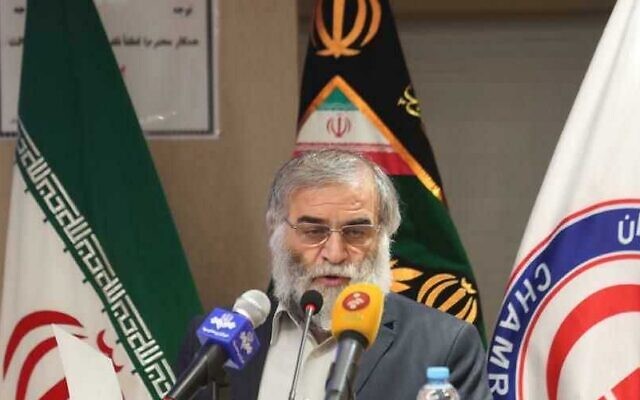
Iranian nuclear scientist Mohsen Fakhrizadeh. (Agencies)
Israel intelligence managed to recruit an Iranian official close to the recently assassinated Mohsen Fakhrizadeh and recorded the nuclear scientist speaking about his efforts to produce “five warheads” on behalf of the Islamic Republic, according to a Friday report in the Yedioth Ahronoth daily.
This top-secret recording was played in 2008 by former prime minister Ehud Olmert for then-president George W. Bush during a visit by Bush to Israel and was a key element in convincing the Americans to step up efforts to combat Iran’s nuclear program, the report said.
The report quoted several unnamed Israeli and Middle Eastern intelligence officials, along with recollections from former prime minister Ehud Barak, who was then serving as Olmert’s defense minister.
It said Olmert was so concerned about safeguarding the source of the recording that he refused to play it while anyone else was in the room, including Bush’s national security adviser Stephen Hadley.Israeli Prime Minister Ehud Olmert welcomes US President George W. Bush to Israel, at Ben Gurion International Airport on May 14, 2008. (Nati Shohat/Flash90)
Fakhrizadeh, the scientist said by Israel and the US to head Iran’s rogue nuclear weapons program, was killed in a military-style ambush last Friday on the outskirts of Tehran. The attack reportedly saw a truck bomb explode and gunmen open fire on Fakhrizadeh.
Iran has accused Israel of carrying out the November 27 hit, and threatened revenge. Israel, which has been linked to a succession of killings of Iranian nuclear scientists, has not publicly commented on the allegations that it was responsible. It has warned its citizens traveling abroad that they may be targets of Iranian terror attacks in the wake of the killing.This photo released by the semi-official Fars News Agency shows the scene where Mohsen Fakhrizadeh was killed in Absard, a small city just east of the capital, Tehran, Iran, Friday, Nov. 27, 2020. (Fars News Agency via AP)
According to the Yedioth report, written by the newspaper’s well-connected investigative reporter Ronen Bergman, Israel had been compiling a dossier on Fakhrizadeh for nearly three decades, long discounting the scientist’s claims that he had nothing to do with any weapons program.
For Israel, the recordings were the final proof that Iran’s nuclear program was not peaceful, as Tehran repeatedly claimed.
Olmert was methodical in the way he revealed the material to Bush, the report said.
The US president had come to Israel in May 2008 as the country marked the 60th anniversary of its founding.Former National Security Advisor to president George W. Bush Stephen Hadley at the Saban Forum on December 5, 2015 (YouTube screen grab)
Olmert hosted a dinner at the Prime Minister’s Residence in Jerusalem and just before dessert, Olmert, Bush, Hadley and Barak, who was defense minister at the time, headed to a side-room. It was there that Barak asked Bush if the US could supply Israel with a series of weapons it did not have in its arsenal, according to the report. Yedioth said these were believed to be vertical take-off and landing aircraft, along with bunker-busting bombs.
Hadley in the previous weeks had been briefing Bush about Israeli desires to carry out a strike against Iran’s nuclear program and Bush immediately understood what Barak wanted the weapons for.
According to Barak, Bush responded to the request by pointing at the defense minister and saying, “This guy frightens me.”
Bush then got to the point. “I want you to know the official position of the United States government. The US strongly opposes Israel taking action against the Iranian nuclear program,” Barak recalled the president replying.
“And in order not to be vague, I will tell you that the United States does not intend to act either as long as I serve as president,” Bush added, according to Barak.
Seemingly expecting the negative response from Bush, Olmert decided he’d make use of the recording the next day when he was meeting the president and Hadley at his office.US President George W. Bush visits the historical Masada site together with Israeli Prime Minister Ehud Olmert, May 15, 2008. (Ariel Jerozolimski/Flash90)
According to the report, Olmert asked the national security adviser to leave the room. Hadley insisted on staying, arguing that protocol required him to be present when matters of national security were being discussed.
But Olmert was adamant and Bush assured Hadley it was okay for him to be left alone with the prime minister, the report said.
“I’m going to play you something, but I ask that you not talk about it with anyone, not even with the director of the CIA,” the report quoted Olmert as telling Bush from within the closed-door meeting. Bush reportedly agreed to the request.
Olmert pulled out a recording device, hit play and a man could be heard speaking in Persian.
“The man speaking here is Mohsen Fakhrizadeh,” Olmert reportedly explained. “Fakhrizadeh is the head of the “AMAD” program, Iran’s secret military nuclear project. The one it denies exists at all,” Olmert told Bush according to the report.
The prime minister then revealed that Israeli intelligence services had managed to recruit an Iranian agent close to Fakhrizadeh who had been feeding Jerusalem information on the nuclear scientist for years.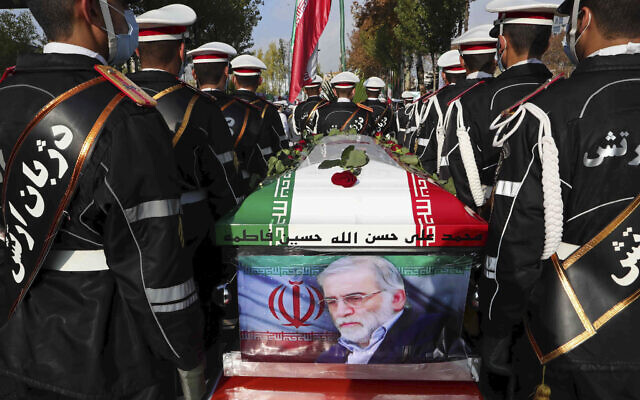
Military personnel stand near the flag-draped coffin of Mohsen Fakhrizadeh, a nuclear scientist who was killed on Friday, during a funeral ceremony in Tehran, Iran, November 30, 2020. (Iranian Defense Ministry via AP)
Olmert provided Bush with an English-language transcript of what Fakhrizadeh had said in Persian.
According to the report, Fakhrizadeh could be heard giving details about the development of Iranian nuclear weapons. However, the Yedioth report only quotes selected phrases, without the word nuclear. The scientist complains that the government is not providing him with sufficient funds to carry out his work. On the one hand, Fakhrizadeh says, in an apparent reference to his superiors, “they want five warheads,” but on the other, “they aren’t letting me work.”
Fakhrizadeh then goes on to criticize colleagues in the defense ministry and the Islamic Revolutionary Guard Corps, according to the report.
Bush read the recording’s translation and reacted with silence. Yedioth claimed the recording served as a “smoking atomic gun” for Olmert.
The premier recognized that Bush would not sell Israel the weapons it was looking for, so he made a new request: full intelligence cooperation on the Iranian nuclear issue.
When Bush agreed, Olmert decided to up the ante and proposed that the two carry out joint operations against Iran’s nuclear project, Yedioth said.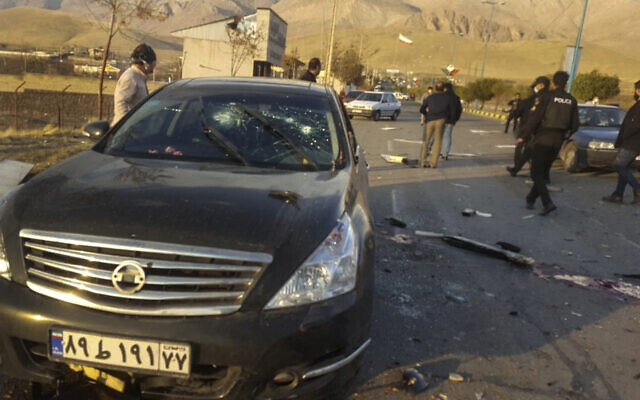
This photo released by the semi-official Fars News Agency shows the scene where Mohsen Fakhrizadeh was killed in Absard, a small city just east of the capital, Tehran, Iran, Friday, Nov. 27, 2020. (Fars News Agency via AP)
The president agreed to this as well, the report said.
Senior officials in Olmert’s office at the time told Yedioth the recording served as a “defining moment” in the two countries’ joint effort to prevent Iran from obtaining a nuclear bomb.
One apparent instance of such cooperation was the Stuxnet computer virus, which was uncovered in 2010 and was widely reported to have been developed together by US and Israeli intelligence. Stuxnet penetrated Iran’s rogue nuclear program, taking control and sabotaging parts of its enrichment processes by speeding up its centrifuges. Up to 1,000 centrifuges out of 5,000 were eventually damaged by the virus, according to reports, setting back the nuclear program.
Yedioth speculated that the Stuxnet plan, called Operation Olympic Games, was born as a result of Olmert’s revelation of the Fakhrizadeh recording to Bush.
However, other reports have said that Bush gave the go-ahead for the operation as early as 2006.
The recording was just one part of the trove of evidence that Israel has gathered on Fakhrizadeh and Iran’s nuclear program over the years, Yedioth noted.
In 2018, the Mossad spirited a huge trove of documentation out of a warehouse in Tehran, detailing Iran’s rogue nuclear program.Prime Minister Benjamin Netanyahu stands in front of a picture of Mohsen Fakhrizadeh, who he named as the head of Iran’s nuclear weapons program, April 30, 2018 (YouTube screenshot)
When Prime Minister Benjamin Netanyahu revealed in April 2018 that Israel had attained the archive, which he said proved that Iran had lied about not seeking a nuclear weapons arsenal, he specified that Fakhrizadeh oversaw the program and said: “Remember that name, Fakhrizadeh.”
 Saudi Foreign Minister Faisal bin Farhan al-Saud addresses the Manama Dialogue security conference in the Bahraini capital, on December 5, 2020. (Mazen Mahdi/AFP)
 Iran’s Foreign Minister Mohammad Javad Zarif attends a news conference with Venezuela’s Foreign Minister Jorge Arreaza in Caracas, Venezuela, November 5, 2020. (AP Photo/Matias Delacroix)



 anneinpt
 artaxes
 danmillerinpanama
 davidking1530
 Peter Hofman
 Joseph Wouk
 Peter
Peter Louisiana Steve
 WarSclerotic
Recent Comments