Hmmm…
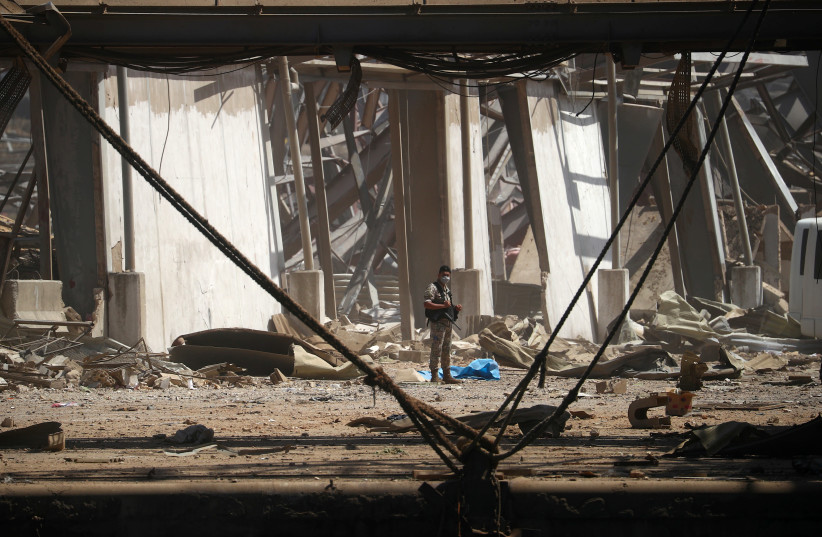
Videos circulating online, as well as rumors and reports, indicate that “tunnels” have been found in the wake of the Beirut explosions. Some have asserted that this is evidence of Hezbollah “tunnels” storing weapons at the Port of Beirut, while others think they were used for human trafficking. Both SkyNews and Russia’s Sputnik News claimed there was a “labyrinth network of tunnels.”
The Lebanese Armed Forces have denied the existence of tunnels, just as Hezbollah has denied doing anything at Beirut Port. It’s unclear how the army could refute the claims without investigating the images and videos already circulating online. Nevertheless, the army denied the existence of tunnels.
Yet Sky News did show a ceiling of a subterranean chamber and noted that people had hope that loved ones might have survived the blast in the tunnels. The Sky News report, which was posted online on Sunday, said the people excavating the site and searching for survivors “know there is a labyrinth of subterranean chambers here; they have discovered the opening of one of them.”
This comment appears to indicate that the search-and-rescue teams and officials know about these chambers.
Are these “tunnels,” or is there another explanation for these underground rooms? There may be a more prosaic explanation for underground rooms or other aspects of the urban environment having underground infrastructure, such as tunnels for electrical, water and sewage facilities.
For now, the question of the “tunnels” appears to feed stories that Hezbollah was using the area for illicit trafficking of weapons or munitions. However, the investigators who found the opening to one alleged tunnel were not wearing any kind of suits or using devices as if the area was full of unexploded ordnance. That means there didn’t appear to be a concern that they would find missiles and dangerous items inside these areas.
Nevertheless, the quick denial by Lebanon that these areas exist and the video of the subterranean chamber or “tunnel” seems to illustrate that Lebanon is still afraid to fully investigate the area for fear of finding the suspicious activities that those critical of Hezbollah allege were taking place here.
Hezbollah is known to have expertise in building tunnels and underground bunkers.
POSTED ON THURSDAY, 12 MARCH 2020 13:41
Kiel shipbuilders can build corvettes in record time. Just two years and a month after construction began, the first of the four new corvettes of the Israeli Navy successfully passed its first test drive on the Baltic Sea last Tuesday and Wednesday.
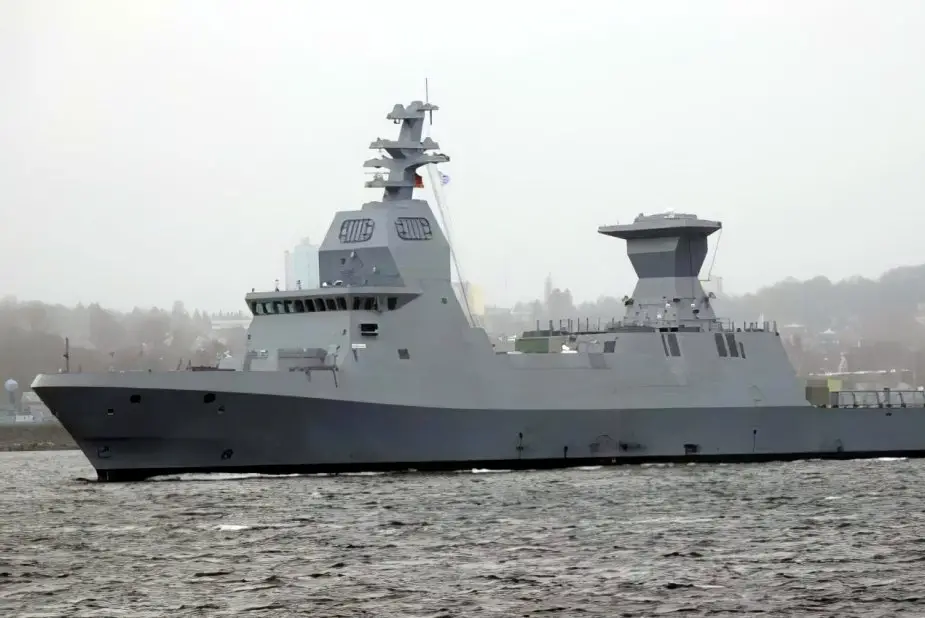
Israel Navy’s first SA’AR 6-class corvette INS Magen (Picture source: Twitter account: Defensa_Israel)
The first SA’AR-6 class corvette was named INS Magen in May 2019. German shipbuilder ThyssenKrupp Marine Systems (TKMS) acts as General Contractor to build four corvettes of this class for the Israeli Navy.
Each ship will carry an Oto Melara 76 mm main gun, two Typhoon Weapon Stations, 40 Barak 8 naval surface-to-air missiles to intercept and destroy all types of airborne threats such as anti-ship missiles, cruise missiles, combat aircraft, helicopters and unmanned aerial systems (UAS).
The ships will also be fitted with 16 anti-ship missiles such as Gabriel, RGM-84 Harpoon and RBS-15 Mk 3 to attack enemy ships and boats. The armament will also include two torpedo launchers for MK54 Lightweight Torpedo, and two 30mm Rafael Typhoon remote weapon stations.
The four corvettes were christened INS Magen, INS Oz, INS Independence and INS Victory in April 2018. The vessels are expected to be commissioned by the Israeli Navy between 2020 and 2022.
The warships will be used to conduct patrol duties in Israel’s Exclusive Economic Zone (EEZ) to protect the country’s gas reserves, shipping lanes and other strategic assets in the Mediterranean.
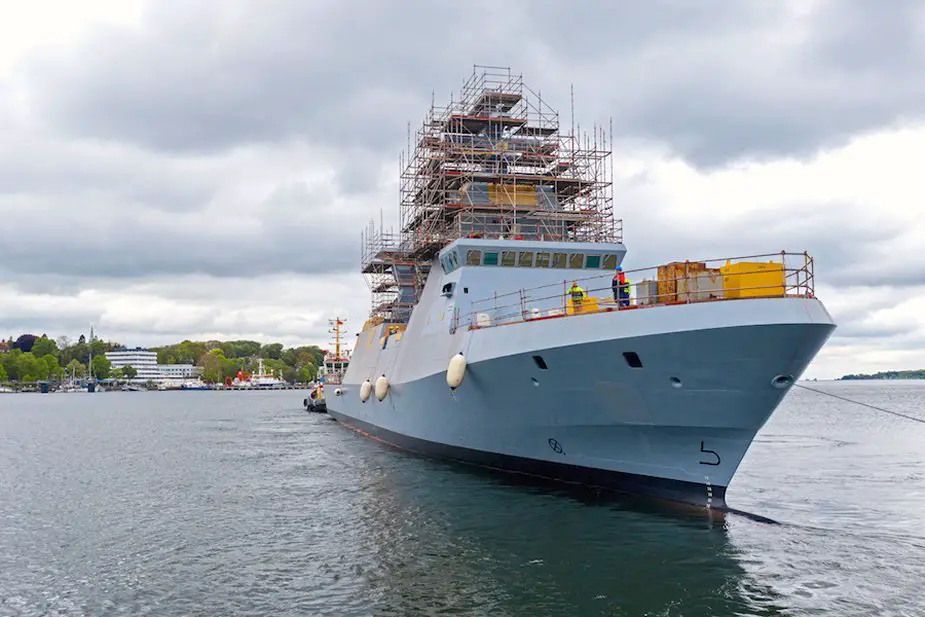
Israel Navy’s first SA’AR 6-class corvette INS Magen at the Kiel shipyard (Picture source: Thyssenkrupp Marine Systems)
The Merkava has been the main battle tank for Israel’s Defense Forces since 1979. Though originally lacking in mobility and sheer armor protection, the Merkava has a unique design that greatly enhances the survivability of its crew. In this video, I talk about the events leading up to the Merkava’s development, how it was designed, the problems in encountered, and what my overall opinion on it is.
Thans to Spookston
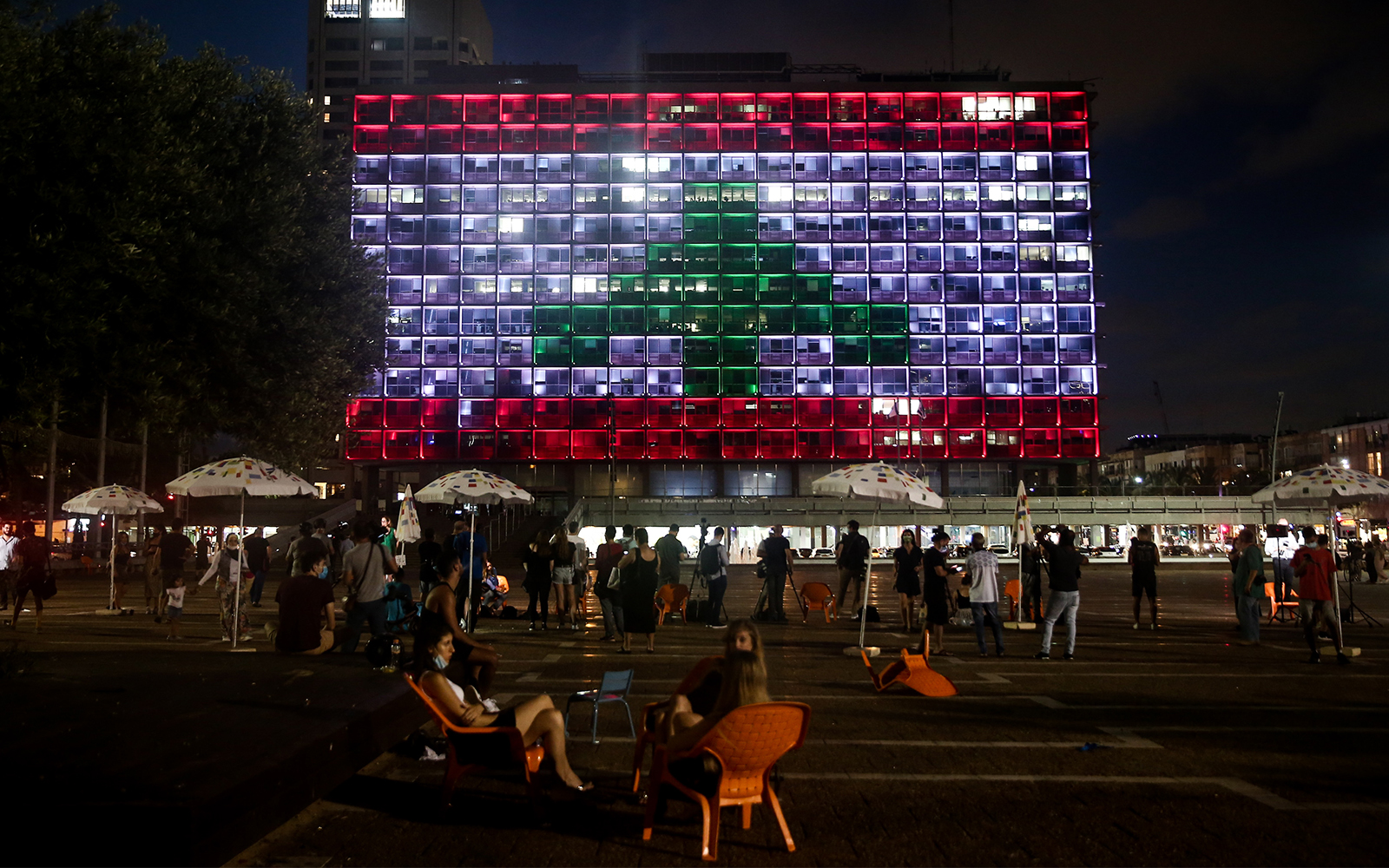
By TOI STAFFToday, 11:31 amUpdated at 12:57 pm 1Tel Aviv municipality in Rabin square is lit up with the Lebanese flag in solidarity with the victims of the the Beirut port explosion, August 5, 2020. (Miriam Alster/Flash90)
If you thought the backlash to the Tel Aviv municipality projecting a Lebanese flag on the side of its building was strong inside Israel, try the backlash inside Lebanon.
Many Lebanese took to social media on Wednesday to express their ire over the attempted gesture of solidarity by the Tel Aviv municipality with the victims of the previous night’s Beirut port explosion. The blast, which was apparently caused by the ignition of 2,750 metric tons of ammonium nitrate, has claimed at least 135 lives, and left over 5,000 injured and 300,000 homeless.
“Sure, they’re raising our flag now, but soon enough they’ll destroy our country and violate our country’s sovereignty,” wrote one Twitter user.
Israel announced Tuesday night that it had reached out to offer humanitarian aid to Lebanon after the massive blast rocked Beirut. The disaster has pushed Lebanon, already laboring under an unprecedented economic crisis, to the brink, and hospitals have struggled to cope with the influx of injured.
“This evening we will light up City Hall with the flag of Lebanon. Humanity comes before any conflict, and our heart is with the Lebanese people following the terrible disaster that befell them,” Tel Aviv Mayor Huldai wrote on Twitter.
Yair Netanyahu, the son of Prime Minister Benjamin Netanyahu, tweeted that he was opposed to displaying the colors, falsely claiming that it was illegal. The Prime Minister’s office, however, sent out a photo of the Lebanese flag, accompanied by a statement affirming “support [for] the Lebanese people.”
Many other countries, including Jordan, Iran, and the United Arab Emirates, also lit up major public buildings to express solidarity with the victims of the blasts.https://platform.twitter.com/embed/index.html?dnt=true&embedId=twitter-widget-0&frame=false&hideCard=false&hideThread=false&id=1291077104940048388&lang=en&origin=https%3A%2F%2Fwww.timesofisrael.com%2Ftheyll-destroy-our-country-lebanese-unmoved-by-tel-aviv-show-of-solidarity%2F&siteScreenName=timesofisrael&theme=light&widgetsVersion=223fc1c4%3A1596143124634&width=550px
Using the hashtag “We don’t want it,” many Lebanese expressed their rejection of both Israeli solidarity and offers of medical aid. Some also shared remarks by politician Moshe Feiglin, leader of the Zehut party, who had said that the Beirut port blast was a “wonderful celebration.”
“As a Lebanese citizen, it disgraces me for Tel Aviv to show Lebanon solidarity. Anyone who circulates those photos I will consider a collaborator,” another user wrote of the brightly lit municipality building.
ٍSome users — especially those supportive of Hezbollah — said that they hoped for violence.
“We will be the ones to light up Tel Aviv — with our rockets. Tel Aviv is already lit by the ghost of Imad and Jihad [Mughniyeh],” wrote Mohammad Ali Sakr, referring to two leaders in the terror group — a father and his son — allegedly killed by Israel.
“We don’t want anything from you, you are our enemies… you who killed the children of Qana,” wrote Saad Dai’ri. Around 106 Lebanese civilians died in the 1996 incident in the village of Qana, when Israel shelled a United Nations position in an attempt to strike back at Hezbollah fire. The prime minister at the time, Shimon Peres, expressed “bitter surprise” that civilians were in the area.
Others posted photos of Ramallah, where the Palestinian Authority’s central broadcasting station had also been lit by a projection of the Lebanese flag.
Israel has fought two major wars against Lebanese forces, which many in the country recall painfully. In 1982, Israel invaded after repeated cross-border attacks by the Palestinian Liberation Organization, and ended up occupying a strip of southern Lebanon until 2000. In 2006, Israeli forces entered Lebanon again following the abduction of two Israeli soldiers by Hezbollah.
“Israel is the largest source of martyrs and wounded in all of Lebanon…it is absolute evil. Working with it is forbidden,” wrote Jamal Chaiito, posting photos of First Lebanon War destruction and the Qana incident.
Some appeared to disagree, saying that they welcomed Israeli aid.
“But we do want it — peace, that is. Screw Iranian ideas,” wrote Hussein Nasr, who describes himself as a resident of south Lebanon.
Tel Aviv has in the past lit up its City Hall with the colors of other countries going through disasters. The municipality’s tribute to Egypt’s flag after an attack on Christian Copts in May 2017 was the first time the gesture was made toward an Arab country, although unlike Lebanon, Egypt has a peace accord and ties with Israel.
Ha ha ha, losers.
The saga of Iran’s fake aircraft carrier, intended as a propaganda coup, is turning into an own goal. The Iranian armed forces, particularly the IRGC-N (Islamic Revolutionary Guard Corps Navy) delight in attacking the mock U.S. Navy aircraft carrier. It makes their war games more dramatic. And it may be intended to symbolize that they could, if called upon, sink an American carrier. The carrier itself, actually an elaborate target barge, is not intended to sink, however. It is meant to be reusable and has been symbolically ‘destroyed’ twice already. But now it really has sunk. And in very much the wrong place.
The stricken carrier can be seen, capsized, in commercial satellite imagery. The dramatic view above has been shared by Aurora Intel and shows PLEIADES satellite imagery (material © CNES 2020, Distribution Airbus DS, all rights reserved. Acquired through ShadowBreak Intl). The image is taken from above, and shows that the carrier is listing at about 90 degrees. The starboard (right-hand) side is facing upwards. As you look at the image, the carrier was heading from right to left of the image when it succumbed to the waves.
It began to sink when it was being towed back to Bandar Abbas after being attacked. Sebastien Roblin wrote for Forbes on July 31 that the vessel was “listing steeply to one side, with nearly half of the flight deck submerged.” Since then the situation has deteriorated.
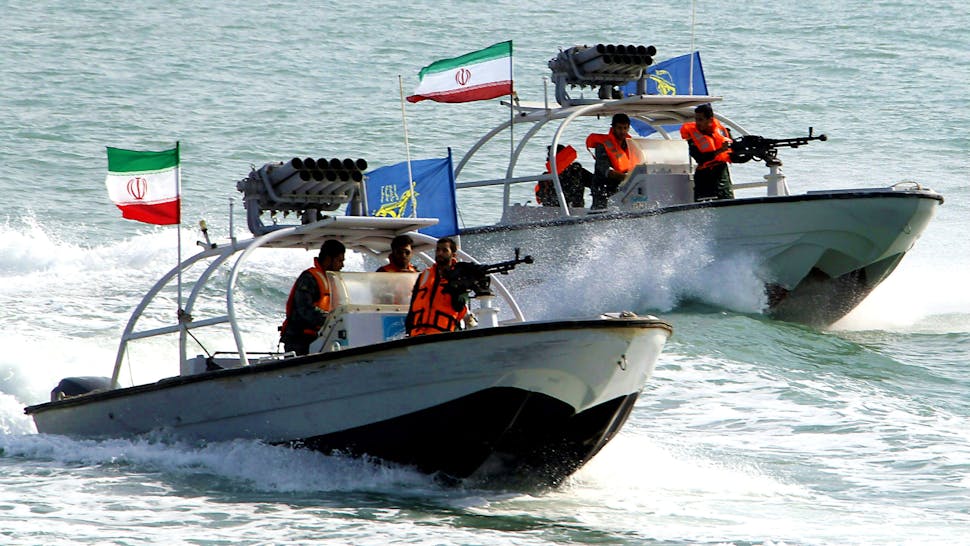
The carrier is very large, but still much smaller than the U.S. Navy super-carriers it is designed to represent. We know that it is meant to symbolize U.S. carriers because the mock aircraft have U.S. Navy markings painted on them. It was built in 2013-14 and then dramatically ‘destroyed’ during war games in February 2015. Recently it has been repaired in Bandar Abbas and towed back out to sea. It was then attacked again on July 28 as part of the ‘Prophet Mohammed 14th’ war games. It was circled by speed boats, likely including some of the 100 new vessels unveiled in June, and hit by missiles.
The location of the sinking will likely create a serious headache for the Iranian Navy and IRGC-N. It is just outside the harbor entrance to Bandar Abbas, near to the main approach channel.
The water there is approximately 45 ft deep, which is shallow. This makes it worse for Iran because it cannot be left to sink. It is so shallow that other ships face a very real risk of catastrophic damage if they sail over it. In fact, at least as of a couple of days ago, it was partly above water. This is a serious shipping hazard.
So it will have to be salvaged. But the effort required, and time, will strain Iranian resources. Although Iran has recovered vessels and aircraft from the sea, it does not appear to have a serious salvage capability to call on. This may be why it appears abandoned in the satellite imagery. Last year Iran did recover substantial parts of the U.S. Navy Global Hawk drone it shot down. But there are serious doubts as to whether any of this was salvaged from the depths. Floating wreckage is one thing, dismantling a large sunken vessel is another.
With such a bad place to have a wreck, it will be telling of Iranian capabilities if it is left there a long time.
Thanks to niz196
A day with Patrol Squadron 916 on their “Devorot” FAC (Fast Attack Craft) made in Israel and equipped with Jet propulsion, sophisticated detection means, mighty weapon and highly trained crew. The craft name SHALDAG (the hebrew word for the kingfisher bird)
This is the main Naval unit combatting Gaza terrorist’s יום עם לוחמי פלגת הבט”ש הדרומי 916 מבסיס חיה”י באשדוד על ספינות השלדג שלהם.
I served in this unit in Sharem El Sheik and Eilat in the 80’s.
The author makes what really are speculative statements as if they were accepted facts (like bold bit), but anyway…
https://www.jpost.com/opinion/israels-unique-methods-against-the-iranian-threat-637148
The brilliance in Israel’s alleged reactions lay in how they have managed to face Iran on a number of fronts: in Iran, in Syria and in Lebanon.




 WarSclerotic
Recent Comments