Archive for July 21, 2020

How lethally effective is Iran’s air defense system? – DEBKAfile

July 21, 2020

Source: How lethally effective is Iran’s air defense system? – DEBKAfile

The intentions behind the high alert ordered for Iran’s air defenses – reported by US sources from “several” indications – are as opaque as the mystery behind the recent string of explosions at Iran’s key nuclear, military and missile sites.

International speculation has centered on Israel as being responsible for some of the attacks, although this is not confirmed. The only comment came from Defense Minister Benny Gantz on July 5. He said: “Not all the incidents in Iran have anything to do with us.  … All their systems are complex; they have very high security constraints and I am not sure that they always know how to maintain them.”

But if there are opposition groups on the ground in Iran carrying out attacks on key facilities there, it is not clear whether they are acting on directives or funding from external sources. None alone is capable supporting the sweeping effort involved in more than half a dozen strikes at the heart of Iran’s most secure infrastructure since late June.

One of the most critical attacks occurred on July 2, when a fire caused significant damage to the advanced centrifuge production building at the Natanz uranium enrichment center. It is calculated to have retarded Iran’s nuclear program by a year or more. Another blew up a missile production amenity and tunnel network near the Parchin military compound. The most recent was the setting of seven ships on fire at Iran’s southern port of Bushehr.

No one has yet suggested that aerial attacks by hostile fighters, bombers or missiles were the cause of those incidents. Only possible sabotage from the ground or cyberattack has been mentioned. So what moved the Revolutionary Guards (IRGC) to put the country’s air defenses on high alert?  DEBKAfile’s military and Middle East sources postulate a number of considerations:

  1. Preparations for unleashing a retaliatory attack on Israel in the expectation of deadly counteraction, as some Arab media suggest.
  2. Some of the explosions may have been caused by stealth drones which no one has so far admitted. The air defense alert would act as deterrence.
  3. Nervousness at not knowing where the attacks come from, who is responsible and when the next one is coming.
  4. Anxiety lest the next surprise blow – if and when it comes – will endanger the Islamic regime.

So how effective is Iran’s air defense system?

In June 2019, the IRGC claimed to have shot down a large, slow-flying US Global Hawk drone over the Strait of Hormuz with a Khordad 3 missile, a version of the SAM Raad. The Khordad 15 is capable of detecting, intercepting, and destroying six targets simultaneously. The system is said able to detect fighter jetscruise missiles and unmanned combat aerial vehicles (UCAV) from 150 km away and is able to track them within a range of 120km

Iran has 32 batteries of Russian-made S-300 ground-to-air missiles delivered since 2016 (in the face of Israel’s efforts to prevent the transaction). Iran’s aviation industry has also developed home-made versions of this system, including Bavar 373, SAM Tabas and SAM Raad, which are regularly showcased on military parades. They are seen as posing a serious threat. Their radar system is also believed to be highly effective.

The Sayyad-3 missile, used by the SAM system, has a range of 200 km. The system can also detect stealth targets from a distance of 85km. Missiles fired from the much older SA-15 are designed when they explode to pepper flying targets with shrapnel penetrating the fuselages of aircraft and drones.

The most advanced of all these systems are arrayed around Iran’s nuclear-related facilities.

The European Aviation Safety Agency reacted to the Iranian alert without delay on Thursday, July 13, by warning passenger jets against flying through Iranian air space lest they are accidentally targeted by the country’s air defense systems. “The hazardous security situation, poor coordination between Iran’s civil aviation and military operations” were cited as high risk.

The warning came shortly after Tehran admitted to mistakenly shooting down a Ukraine airliner in January killing all 176 passengers aboard  The Iranian government explained that the “misalignment of an air defense unit’s radar system” was the key “human error” that led to the accidental downing of the airliner.

At the time, Tehran’s air defenses had been on high alert following an Iranian attack on US troops in Iraq after the killing of top general Qasem Soleimani by a US drone.

Following the Ukrainian disaster, the US is also concerned that Iran’s unreliability in the operation of its air defense systems means that the transition to a high state of alert could also pose a threat in itself.

Iran, and others, watching Israel stumble over coronavirus

July 21, 2020

Source: Iran, and others, watching Israel stumble over coronavirus – The Jerusalem Post

When Israel had Corona under control, the message conveyed was of a strong, resilient country with a great deal of solidarity able to weather all kinds of storms, even a pandemic.

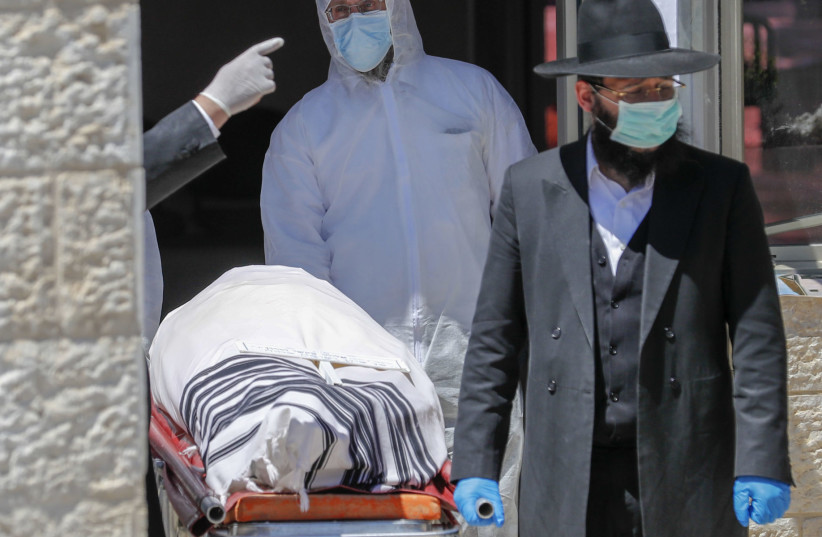
An Israeli rabbi walks alongside the body of Eliahu Bakshi-Doron, the former Sephardic chief rabbi of Israel, who died from complications of the coronavirus (photo credit: AHMAD GHARABLI VIA GETTY IMAGES/JTA)
An Israeli rabbi walks alongside the body of Eliahu Bakshi-Doron, the former Sephardic chief rabbi of Israel, who died from complications of the coronavirus
(photo credit: AHMAD GHARABLI VIA GETTY IMAGES/JTA)
“Which country will triumph in the post-pandemic world,” read an intriguing headline to an op-ed in the New York Times on Monday. And the sub-headline was even more interesting – “Hint: It’s not the United States or China.”

And, no, it’s also not Israel.

Rather, according to Ruchir Sharma, a “global investor,” it is Germany. Why Germany? Well, for starters because it has managed the coronavirus crisis with great aplomb.

“imagine a country, a major Western economic power, where the coronavirus arrived late but the government, instead of denying and delaying, acted early. It was ready with tests and contact tracing to ‘flatten the curve’ swiftly and limited its death rate to orders of magnitude lower than that of any other major Western industrial nation,” Sharma wrote.

“Containing the virus allowed for a brief and targeted lockdown, which helped limit unemployment to only 6 percent. Amid a shower of international praise, the country’s boringly predictable leader experienced a huge spike in popular approval, to 70 percent from 40 percent,” he continued in a piece that fell under the genre of “show me how a country is dealing with COVID-19, and I’ll show you its future.”

So what does that all say about Israel?

If in late April, around Independence Day when it seemed Israel had a good handle on the crisis, pundits wrote that Israel’s successful management of the crisis was sending an important political message to Israel’s foes, then what message is being sent today when Jerusalem is fumbling on the issue?When Israel had Corona under control, the message conveyed was of a strong, resilient country with a great deal of solidarity able to weather all kinds of storms, even a pandemic. This is a particularly important message in a hostile neighborhood where it is always strategically important for Israel to project a sense that it can overcome any and all forms of adversity.

But today, three months later, what image is Israel presenting now?

“Let’s say we are sitting in Tehran,” Maj.-Gen Israel Ziv (ret.), a former head of the IDF’s Operations Directorate, said in a Kan Bet interview on Monday. “We are interested in what is happening in Israel, and what do we see?

“We see that the country that is supposed to be experiencing a crisis is drowning in its own crisis, which is getting worse. The state looks confused, as if it is not being managed, looking like Nasrallah’s spider web.”

This was a reference to Hezbollah head Hassan Nasrallah’s famous speech celebrating Israel’s withdrawal from Lebanon in 2000 when he said that with all its might and weaponry, Israel is as feeble as a spider web.

“When we were watching what was happening in the Arab world during what was called the Arab Spring, we felt a degree of satisfaction – look, they are unstable; look, they are failing,” Ziv said.

“How do we now look in the eyes of the Arabs? We have a managerial crisis, a mess on the street – they are certainly hoping that it will go from demonstrations to anarchy – there is no budget, and the government can’t even make a decision to give the Defense Ministry, which is supposed to always keep its eyes above water, [budgetary] exemptions. And if I’m Iran, I’m thinking this is an extraordinary opportunity.”

Israel’s enemies, Ziv said, are closely watching what is happening here, and the conclusions they draw could have long-lasting ramifications. “We must recover, take matters into our hands, change the national framework for dealing with the crisis, and show the strong Israel.”

In Ziv’s telling, the way Israel deals with the crisis is not only a health or economic issue, but also one that has far-reaching strategic ramifications. Israel’s foes are carefully watching to see, and perhaps exploit, the country’s weaknesses that are on full display.

But not only Israel’s foes are watching, so too are countries who have an image of Israel as a can-do state with tremendous technological prowess and an uncanny ability to deal with short term problems.

Prime Minister Benjamin Netanyahu has adroitly leveraged that perception of the Jewish state over the last decade into significant diplomatic capital.   During this time Israel has made tremendous diplomatic inroads in Asia, Africa, Latin America and the Persian Gulf on the strength of the idea that it is the innovation nation, as Netanyahu likes to call it, which has a great deal to offer.

China, India, Saudi Arabia, the UAE, Ethiopia, Kenya, Uganda, Chad, Brazil and Argentina have all forged closer ties to Israel over the last decade – some more openly than others – not because they suddenly became Zionists, but because ties with Jerusalem benefited them. To a certain extent they looked at Israel as a model.

In the early days of the virus, Netanyahu repeated often that countries around the world were looking to learn from Israel about how to deal with the virus. That is something that raises the stature of a country in the eyes of others.

But what will happen to this leverage if these countries look at how Israel is dealing with the pandemic now, and conclude that it is doing no better – and perhaps even worse – than they themselves are? What does that say about what the country has to offer?

Israel’s image as an efficient, innovative country full of solutions and able to meet any challenge has strategic and diplomatic significance. It is an image it can’t afford to have tarnished. Dealing more effectively with the virus is not only a health and economic imperative, but also a strategic one.

