Archive for June 2020

Israel vs Iran GDP per capita

June 10, 2020

I’ve said it before and I’ll say it again.

It really does suck to be you, Iran.

Israel GDP per capita about $US35,000.

Iran? About $US7,000. Ha ha

See this  post here:

http://elderofziyon.blogspot.com/2020/05/israel-vs-iran-gdp-per-capita.html

gdp

There are various ways you can calculate this, relating to how you convert currency values, but the above chart is based on the methodology at link below (using constant 2010 US$).

It has a listing of latest values for all countries. Interestingly Australia is $US56,900 (thank you mining sector), just ahead of the US at $US54,800. West Bank and Gaza (combined) is $US 2,700 and the value for the world (ie global average) is $US10,900.

https://data.worldbank.org/indicator/NY.GDP.PCAP.KD

At the bottom of the list are country groupings and these are quite interesting. For example, the Arab world is a lowly $US6,500. Ha ha. All that oil and bugger all to show for it…


Israel’s growing security challenges, Part 2 – Jerusalem Studio 521 

June 10, 2020


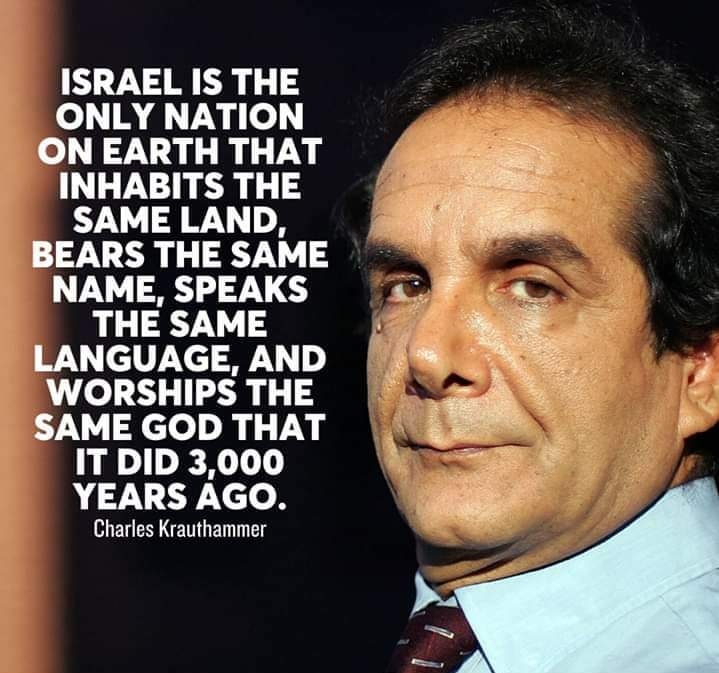
Food for thought: Charles Krauthammer

June 10, 2020

I came across this the other day.

I read it several times, deeply thinking about all it says and what it means.

Simply amazing.

Image


Netanyahu calls for sanctions on Iran, vows to curb its ‘aggression’ 

June 9, 2020

Source: Netanyahu calls for sanctions on Iran, vows to curb its ‘aggression’ | The Times of Israel

PM accuses Tehran of ‘systematically’ breaching 2015 nuclear deal by hiding uranium sites and enriching fissure material

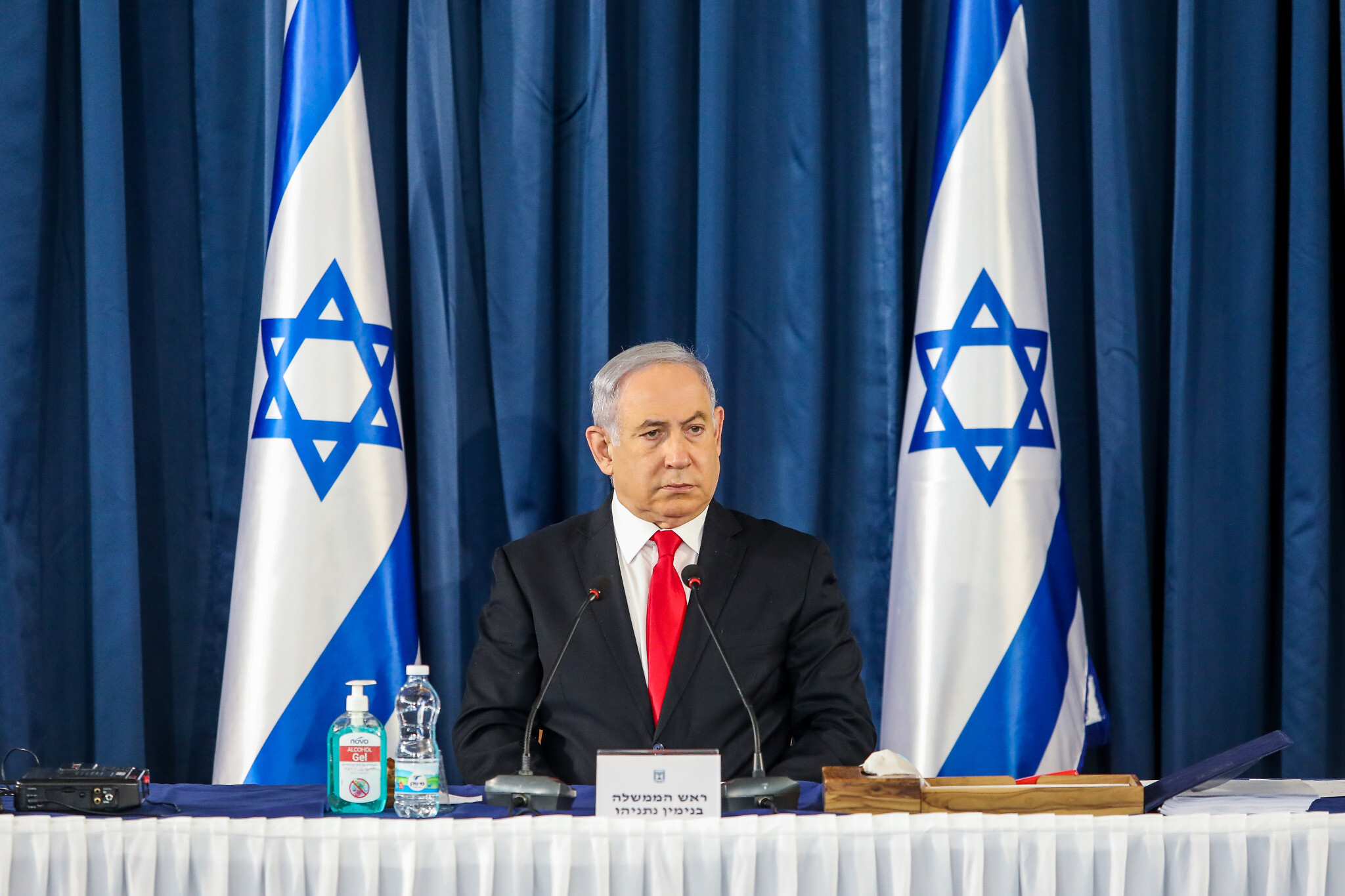
Prime Minister Benjamin Netanyahu chairs the weekly cabinet meeting in Jerusalem on June 7, 2020. (Marc Israel Sellem/POOL)

Prime Minister Benjamin Netanyahu urged world powers Sunday to reimpose tough sanctions against Iran, vowing to curb Tehran’s regional “aggression” hours after another deadly strike, thought to be carried out by Israel, on pro-Iranian fighters in Syria.

“The International Atomic Energy Agency has determined that Iran refused to give the agency’s inspectors access to secret sites where Iran conducted secret nuclear military activity,” the prime minister said at the start of the weekly cabinet meeting in Jerusalem.

The UN nuclear watchdog said Friday that Iran had accumulated enriched uranium at nearly eight times the limit under a landmark 2015 deal, and has for months blocked inspections at sites where nuclear activity may have taken place.

Netanyahu accused Iran of “systematically violating its commitments by hiding sites, enriching fissile material and in other ways.”

“In light of these discoveries, the international community must join the US and reimpose crippling sanctions on Iran,” he said.

Iran has been progressively rolling back on its commitments under the 2015 agreement in response to US President Donald Trump’s unilateral 2018 withdrawal from the accord and re-imposition of sanctions.

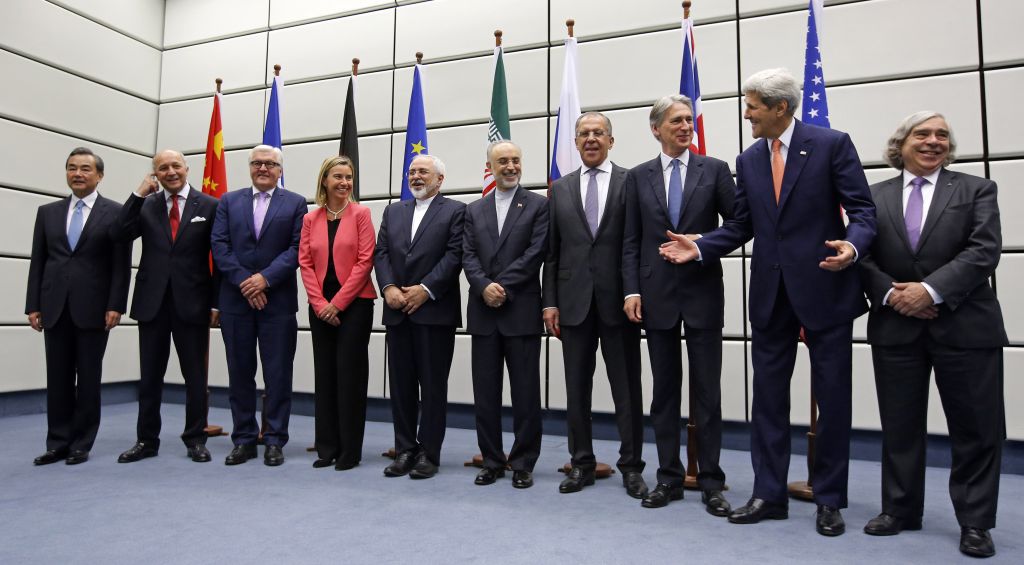
The deal to curb Iran’s nuclear activities in return for sanctions relief was signed with the United States — under Trump’s predecessor Barack Obama — along with Britain, France, Germany, Russia and China.

Participants in the talks on the Iran nuclear deal pose for a group photo at the UN building in Vienna, Austria, on July 14, 2015. (Carlos Barria, Pool Photo via AP)

Tehran has accused the remaining signatories of failing to sufficiently support it in the wake of Washington’s withdrawal.

In his Sunday remarks, Netanyahu reiterated Israel’s longstanding vow to “act against Iran’s aggression” and “not let Iran obtain nuclear weapons.”

Israel “will continue to act systematically against Iran’s attempts to establish a military presence on our borders,” he said.

Late Saturday evening, at least 12 Iraqi and Afghan fighters in a pro-Iran base in eastern Syria’s rural Deir Ezzor province died in eight strikes by unidentified aircraft.

The Britain-based Syrian Observatory for Human Rights could not identify the aircraft, but said Israel was likely behind the attack.

Israel has carried out hundreds of strikes targeting regime and Iranian-backed forces.

A spokeswoman for the IDF refused to comment on the Saturday evening strikes.


Report: 12 Pro-Iran Militia Killed in Strike in Syria

June 7, 2020

https://www.youtube.com/watch?v=IPL50e0ge-Q


UN atomic watchdog says Iran now violating all restrictions of nuclear deal

June 6, 2020

Source: UN atomic watchdog says Iran now violating all restrictions of nuclear deal | The Times of Israel

Confidential report says Tehran continues to increase its stockpiles of enriched uranium and enriching beyond levels allowed under nuclear deal

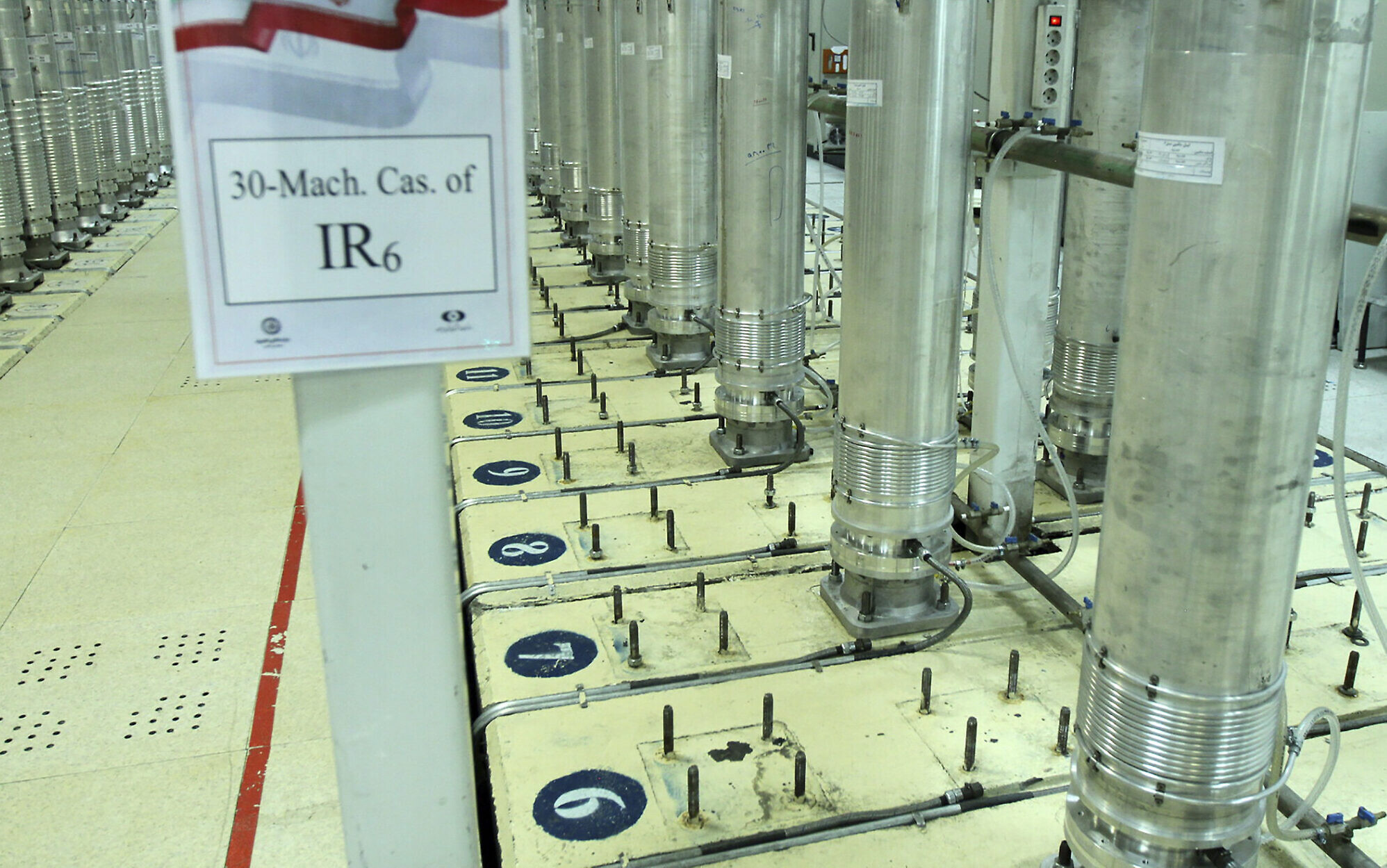
This photo released by the Atomic Energy Organization of Iran on November 5, 2019, shows centrifuge machines at Natanz uranium enrichment facility in central Iran. (Atomic Energy Organization of Iran via AP)

This photo released by the Atomic Energy Organization of Iran on November 5, 2019, shows centrifuge machines at Natanz uranium enrichment facility in central Iran. (Atomic Energy Organization of Iran via AP)

VIENNA (AP) — Iran has continued to increase its stockpiles of enriched uranium and remains in violation of its deal with world powers, the United Nations’ atomic watchdog said Friday.

The International Atomic Energy Agency reported the finding in a confidential document distributed to member countries and seen by The Associated Press.

The agency said that as of May 20, Iran’s total stockpile of low-enriched uranium amounted to 1,571.6 kilograms (1.73 tons), up from 1,020.9 kilograms (1.1 tons) on Feb. 19.

Iran signed the nuclear deal in 2015 with the United States, Germany, France, Britain, China and Russia. Known as the Joint Comprehensive Plan of Action, or JCPOA, it allows Iran only to keep a stockpile of 202.8 kilograms (447 pounds).

The IAEA reported that Iran has also been continuing to enrich uranium to a purity of up to 4.5%, higher than the 3.67% allowed under the JCPOA. It is also above the pact’s limitations on heavy water.

The nuclear deal promised Iran economic incentives in return for the curbs on its nuclear program. President Donald Trump pulled the US out of the deal unilaterally in 2018, saying it needed to be renegotiated. Iran has since slowly violated the restrictions to try and pressure the remaining nations to increase the incentives to offset new, economy-crippling US sanctions.
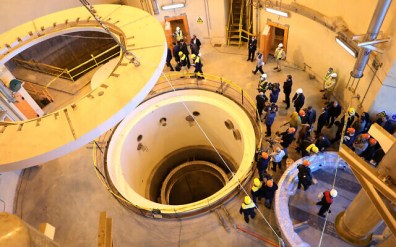
In this photo released by the Atomic Energy Organization of Iran, technicians work at the Arak heavy water reactor’s secondary circuit, as officials and media visit the site, near Arak, southwest of the capital Tehran, Iran, Monday, Dec. 23, 2019 (Atomic Energy Organization of Iran via AP)

The ultimate goal of the JCPOA is to prevent Iran from developing a nuclear bomb. Since the US withdrawal, Iran has stockpiled enough uranium to produce a weapon, although the government in Tehran insists it has no such goal and that its atomic program is only for producing energy.

According to the Washington-based Arms Control Association, Iran would need roughly 1050 kilograms (1.16 tons) of low-enriched uranium — under 5% purity — and would then need to enrich it further to weapons-grade, or more than 90% purity, to make a nuclear weapon.

With the nuclear deal in place, Iran’s so-called breakout time — the period Tehran would need to build a bomb if it chose to — stood at around a year. As Iran has stepped away from the limits of the 2015 deal, it slowly has narrowed that window.

However, that doesn’t mean Iran would immediately rush toward building a bomb if all the materials were in place.

Before agreeing to the nuclear deal, Iran enriched its uranium up to 20% purity, which is just a short technical step away from the weapons-grade level of 90%. In 2013, Iran’s stockpile of enriched uranium was already more than 7,000 kilograms (7.72 tons) with higher enrichment, but it didn’t pursue a bomb.

Israel and the US accuse Iran, which has repeatedly vowed to destroy the Jewish state, of lying about it’s nuclear program.
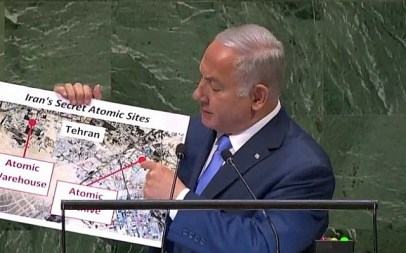
Screen capture from video of Prime Minister Benjamin Netanyahu showing a diagram of what he said was a previously unknown Iranian nuclear site, during his address to the 73rd UN General Assembly, September 27, 2018. (United Nations)

As the country has expanded its nuclear program, Iran has been open about the violations and continues to allow inspectors for the UN atomic agency access to facilities to monitor their operations.

It is now in violation of all restrictions outlined by the JCPOA, which Tehran says it hopes will pressure the other nations involved to increase economic incentives to make up for hard-hitting sanctions imposed by Washington after the U.S. withdrawal.

Though Iran has been hard hit by the new coronavirus pandemic, the IAEA said it has maintained its verification and monitoring activities in the country, primarily by chartering aircraft to fly inspectors to and from Iran.

It cited “exceptional cooperation” from authorities in Austria, where it is based, and Iran in facilitating the operation.
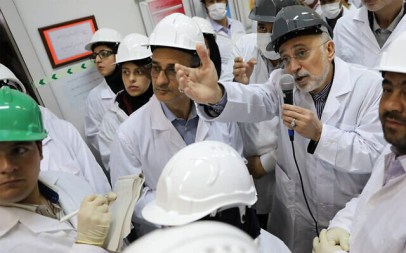
In this photo released on Monday, Nov. 4, 2019 by the Atomic Energy Organization of Iran, Ali Akbar Salehi, head of the organization, speaks with media while visiting Natanz enrichment facility, in central Iran. (Atomic Energy Organization of Iran via AP)

The agency raised concerns, however, about access to two of three locations it identified in March as places where Iran possibly stored undeclared nuclear material or undertook nuclear-related activities without declaring them to international observers.

Activities at all three sites are thought to have been from the early 2000s. The IAEA said in its current report that it had determined that one site had undergone “extensive sanitization and leveling” in 2003 and 2004 and there would be no verification value in inspecting it.

It said Iran has still blocked access to the other two locations, one of which was partially demolished in 2004 and the other at which the agency observed activities “consistent with efforts to sanitize” the facility from July 2019 onward.
 

1967 Six Day War: British Military Analysis 

June 5, 2020

https://www.youtube.com/watch?v=PZ16CcbxoiY


June 5 is the anniversary.

Iran’s regional activities in the face of Israeli active resistance – Jerusalem Studio 519

June 3, 2020


IAI tests short-range ballistic missile, hitting 2 small floating targets at sea 

June 3, 2020

Source: IAI tests short-range ballistic missile, hitting 2 small floating targets at sea | The Times of Israel

Defense contractor deems trials of its LORA system a success, striking pads with ‘utmost precision’ from 90 and 400 kilometers away

The Israel Aerospace Industries defense contractor performed two tests with one of its short-range ballistic missiles at sea on Tuesday, successfully hitting floating targets at two distances, the firm said.

The Long-Range Artillery Weapon System, known by the acronym LORA, was fired first at a target 90 kilometers (56 miles) away and then at a target 400 kilometers (250 miles) away, IAI said.

“Under both scenarios, the missile was launched to its trajectory, navigated its course to the target, and hit it with utmost precision,” the company said in a statement.

The firm said the trials were conducted at sea for safety reasons and that the launches were done remotely due to coronavirus restrictions. They were fired from aboard a ship, but using a land launcher and with a command and control trailer nearby.

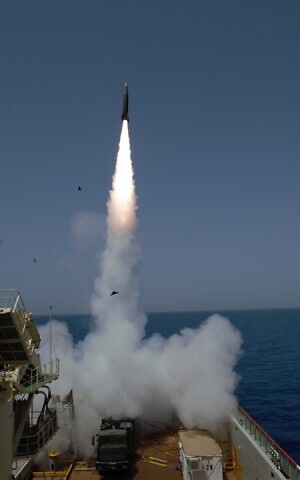
A LORA ballistic missile, produced by the Israel Aerospace Industries defense firm, strikes a target at sea during a test on June 2, 2020. (Israel Aerospace Industries)

“Both the weapon system and the missile successfully met all of the trial’s objectives,” the firm said.

The LORA system completed its first trials in 2017, also at sea, ahead of that year’s Paris Air Show.

A LORA ballistic missile, produced by the Israel Aerospace Industries defense firm, is test-fired at sea on June 2, 2020. (Israel Aerospace Industries)

The missile was developed by IAI’s Systems, Missiles & Space Group, also known by the Hebrew acronym MALAM, which is best known for its air defense systems, including the Arrow 2 and 3 and the Barak 8.

According to the company, the LORA has a range of 400 kilometers and is accurate to within 10 meters.

Both Israel and Azerbaijan are believed to operate the system, though IAI has expressed interest in selling it to other countries.

“The complex trial, performed under COVID-19 limitations, demonstrated the advanced capabilities of both IAI and LORA, our strategic missile system. The trial was executed according to a fully functional design, which tested the system’s maneuvering, strike, and precision, as well as technological developments and enhancements introduced by our engineers,” said Boaz Levy, an IAI vice president and head of the Systems, Missiles & Space Group.


Monitor: 5 pro-Iran fighters killed in Syria strike blamed on Israel

June 1, 2020

Source: Monitor: 5 pro-Iran fighters killed in Syria strike blamed on Israel | The Times of Israel

Syrian Observatory for Human Rights says pre-dawn Sunday bombing hit three trucks belonging to Iran-backed paramilitary fighters near the Iraqi border

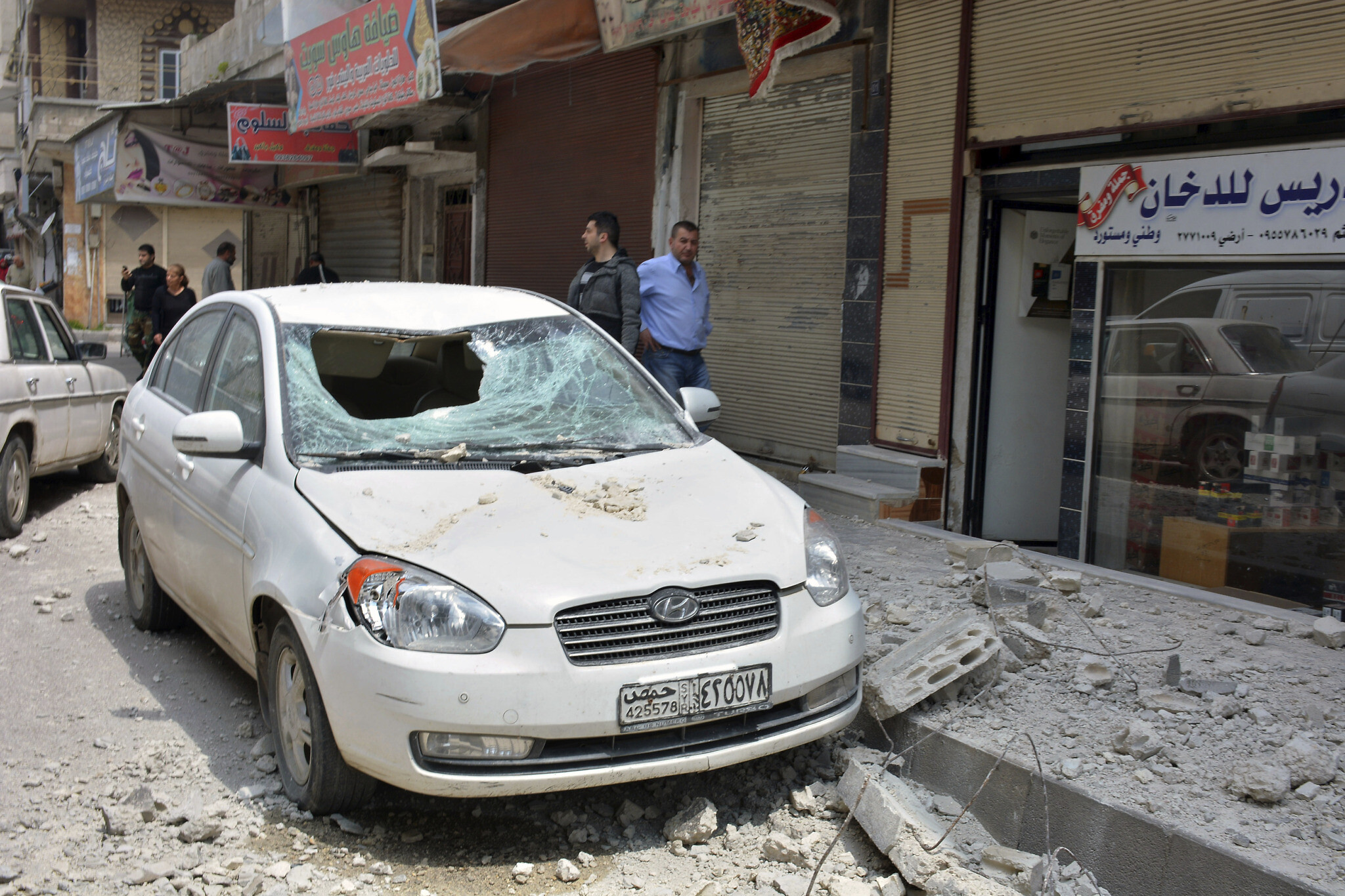
Illustrative: People stand near a car that was damaged due to flying debris from a Syrian military base housing a weapons warehouse, in the country's central province of Homs, Syria, May 1, 2020. (SANA, the Syrian official news agency, via AP)

Illustrative: An explosion seen near the city of Homs in Syria attributed to Israeli airstrikes on March 5, 2020 (video screen capture)

BEIRUT, Lebanon — An airstrike in eastern Syria on Sunday killed five non-Syrian fighters backed by Iran, a Britain-based war monitor said.

The strike targeted three military vehicles belonging to Iran-backed paramilitary fighters near the Iraqi border, the Syrian Observatory for Human Rights said.

The monitor did not say who was behind the attack near the border town of Albu Kamal.

But Observatory head Rami Abdul Rahman said that “Israel was likely responsible.”

Earlier, Sky News Arabia reported that unidentified aircraft carried out a pre-dawn bombing and also said that the targets were Tehran-linked forces.

The website did not identify who was behind the reported airstrike nor did it provide information on what specifically was hit in the attack.

Israel has launched hundreds of strikes in Syria since the start of the civil war in 2011, targeting government troops, allied Iranian forces and fighters from the Lebanese Shiite terror group Hezbollah.

It rarely confirms details of its operations in Syria, but says Iran’s presence in support of President Bashar Assad is a threat and has vowed to continue its strikes.

Iranian-backed militias and their allies command a significant presence in eastern Syria south of the Euphrates Valley.

Earlier this month, air strikes on a base controlled by Iran-backed forces near Albu Kamal killed seven fighters, according to the Observatory.

The monitor said that military reinforcements for Iranian militias and their allies had arrived in the area days before.

Omar Abu Laila, a Europe-based activist from Syria’s eastern Deir el-Zour province, confirmed at the time that a strike hit Iran-backed Iraqi fighters in the area, but had no exact word on casualties.

Israel did not immediately comment on the attack.

Israel, as a rule, does not comment on specific airstrikes, but does generally acknowledge carrying out attack inside Syria against Iranian forces and Iranian proxy militias.

There have been several reports of suspected Israeli strikes inside Syria in the past month, including one on May 4 that left 14 Iranian-backed fighters dead, according to the Observatory.