Archive for April 2020

Israel’s first 100 virus deaths: More men than women; nearly 1/4 from Jerusalem

April 12, 2020

Source: Israel’s first 100 virus deaths: More men than women; nearly 1/4 from Jerusalem | The Times of Israel

( My town, Eilat, as of this morning has 18 ifected, 4 recovered and no deaths. – JW )

Majority of victims over the age of 70; youngest victim was 37 and oldest was 98; Bnei Brak has highest infection rate per capita
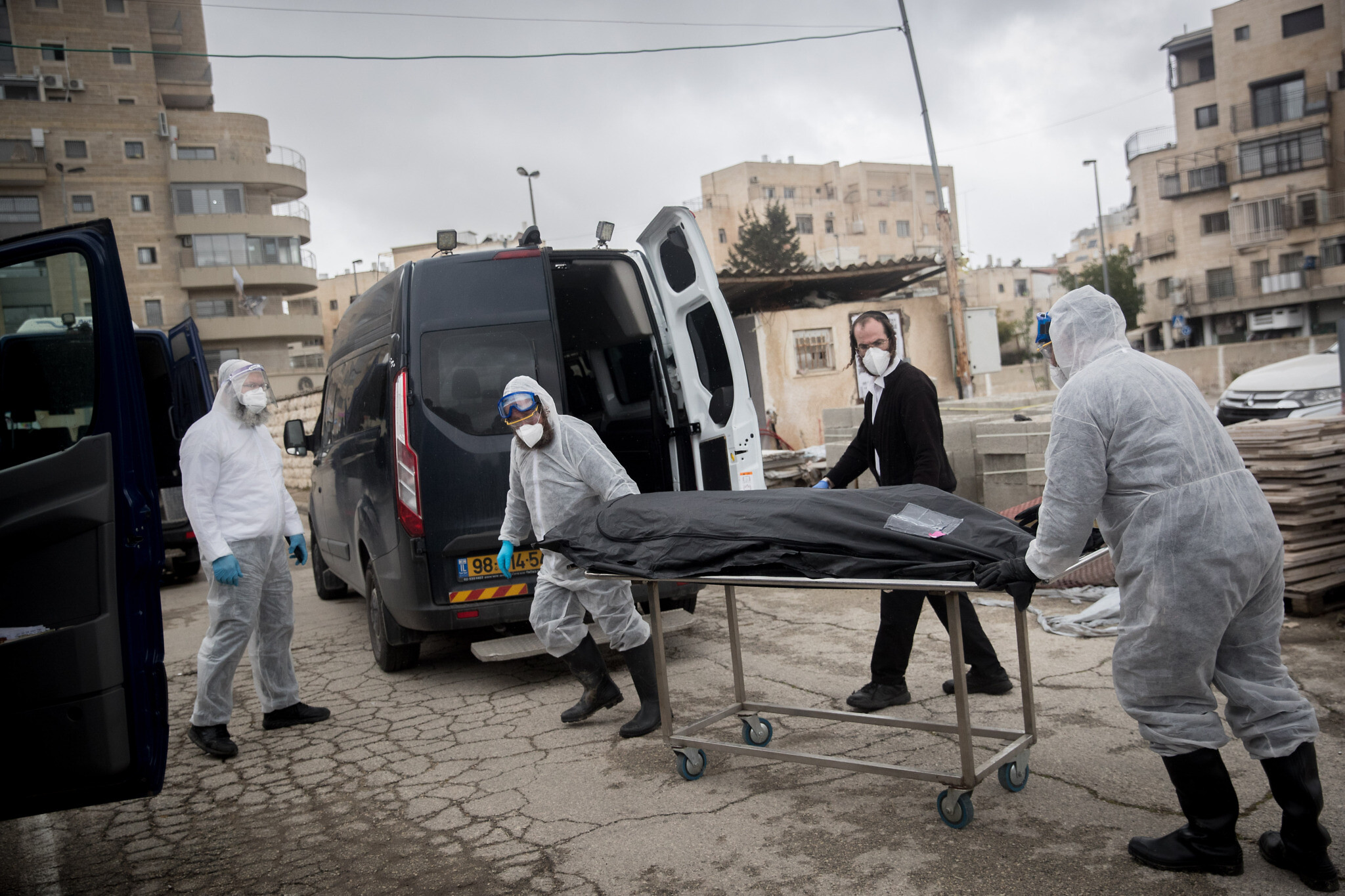
Workers wearing protective clothes carry the body of a patient who died from complications of coronavirus, at the Shamgar Funeral Home in Jerusalem on April 1, 2020 (Yonatan Sindel/Flash90)

Workers wearing protective clothes carry the body of a patient who died from complications of coronavirus, at the Shamgar Funeral Home in Jerusalem on April 1, 2020 (Yonatan Sindel/Flash90)

Data released by the Health Ministry showed that a slight majority of Israel’s coronavirus fatalities were men, a statistic that appears in line with a global trend, and the city that saw the highest death rate was Jerusalem.

The Health Ministry figures are Israel’s official tally and only include deaths in hospitals or assisted living facilities. It is unknown whether there have been fatalities in private homes or other locations. As of Sunday, the ministry said 103 people have died of the virus.

According to the Health Ministry figures released Saturday, which are based on 96 fatalities and were collated last week, 51 men died in Israel from COVID-19, compared with 45 women. This appears to tally with statistics from Asia and Europe, where a slightly higher proportion of fatalities were male.

Globally, men are statistically more likely to smoke, which is thought to possibly play a role in susceptibility to COVID-19, and men are also more likely to have underlying problems that could act as a contributing factor, such as heart disease. In addition, there are some studies that suggest hormones may play a role in the severity of the disease.
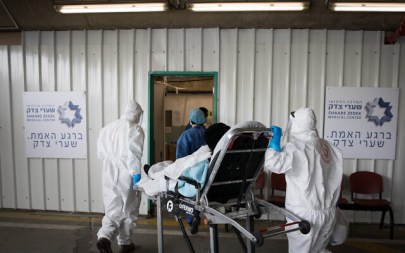
Magen David Adom workers wearing protective clothing with a patient with suspected coronavirus at Shaare Zedek hospital in Jerusalem on April 10, 2020 (Nati Shohat/Flash90)

Israel’s oldest victim was 98 years old and the youngest was 37 years old. The majority of those who died were over the age of 70, according to the figures.  Almost all of those who have died from COVID-19 in Israel have suffered from preexisting conditions, according to hospital officials.

The city that has seen the largest number of fatalities among its residents is Jerusalem — 22 people who lived in the capital have died as a result of COVID-19, according to the Health Ministry, almost a quarter of all deaths. Jerusalem is also the largest city in the country.

Eleven people from the southern city of Beersheba have died as a result of the virus, according to the calculations made last week, a number that reflects the outbreak at the city’s Mishan assisted living facility, which is now reportedly at the center of a police probe into alleged negligence.

The novel coronavirus has been spreading quickly in nursing homes around the country, raising intense concern for the safety of elderly residents.

The ministry on Sunday released figures on infection rates within cities that revealed that the predominantly ultra-Orthodox city of Bnei Brak has the highest concentration of virus cases, with 925 infections diagnosed per every 100,000 people. The Tel Aviv suburb has been closed off from the rest of the country but on Friday restrictions were eased somewhat, with residents allowed to travel outside the city for work and some other essential needs.

Ultra-Orthodox Jewish men and children wearing protective masks in the ultra-Orthodox city of Bnei Brak near Tel Aviv on April 2, 2020, during the novel coronavirus pandemic. (MENAHEM KAHANA / AFP)

The second highest rate is in the ultra-Orthodox town of Kiryat Ye’arim, which has 683 cases per 100,000. Jerusalem has a relatively low overall rate of 214 cases per 100,000 people, but previous statistics have shown that the proportion is much higher in certain neighborhoods than others within the capital.

Several Jerusalem neighborhoods with high coronavirus infection rates will be locked down starting Sunday afternoon, Prime Minister Benjamin Netanyahu’s office said. The order to close off parts of the capital was approved by the government following a late-night cabinet meeting and days of discussion on how to contain the spread of the virus in the capital.

The Health Ministry on Sunday morning said two people died of COVID-19 overnight, taking Israel’s death toll to 103. According to Health Ministry figures Sunday morning, Israel has 10,878 confirmed coronavirus cases, including 174 in serious condition and 123 people on ventilators. Another 155 people were in moderate condition, the ministry said, with the rest having mild symptoms.

Israeli health officials are expecting a surge in coronavirus deaths in the next 10 days, according to a Friday report. The rise in deaths does not signify an increase in infections, however. Patients who are already hospitalized and on ventilators are likely to succumb to the virus in the coming days, according to predictive models from the Health Ministry, Channel 13 reported. Experts have pointed to the relatively slow rise in the number of patients on ventilators as a source of potential encouragement, and also note the relatively slow rise in the number of new cases.

 

PM stops all flights to Israel until quarantine hotels can be legally mandated

April 11, 2020

Source: PM stops all flights to Israel until quarantine hotels can be legally mandated | The Times of Israel

Order comes after flight from virus-stricken New York area lands Saturday morning and passengers go home in taxis without checks; flights already en route will be allowed to land

The empty arrival hall at the Ben Gurion International Airport on March 11, 2020 (Flash90)

Prime Minister Benjamin Netanyahu on Saturday halted all flights to Israel until legal steps could be taken to allow the Home Front Command to transfer all travelers arriving in Israel to a quarantine hotel for 14 days.

Flights that are already en route to Israel will be allowed to land but no new flights will be permitted until the situation is resolved, the Prime Minister’s Office said.

The move came after passengers on a flight from the virus-stricken New York area  arrived at Ben Gurion Airport on Saturday morning and were allowed to travel home in taxis without having their temperatures checked or filling in forms detailing where they would be quarantined for the requisite 14 days.

The incident came despite Netanyahu last week ordering all incoming passengers to Israel to be quarantined at specially designated hotels around the country.

Prime Minister Benjamin Netanyahu speaks during a press conference about the coronavirus, at the Prime Minister’s Office in Jerusalem on March 25, 2020. (Olivier Fitoussi/Flash90)

However, legally passengers can’t be forced to move into the quarantine hotels, with neither the police, nor the military which operates the facilities, legally able to compel travelers to go there.

A Health Ministry source told The Times of Israel on Friday that passengers who could prove they could self-isolate were allowed to leave the airport independently and return to their homes, while those who could not were sent to state-supervised hotels for a 14-day quarantine period.

The official said that while the ministry would prefer for all passengers to be sent to hotels, complications deriving from a legal opinion submitted by the Attorney General were preventing that from happening. He called the opinion a “complete misunderstanding” of the situation.

No response had been received from the Attorney General’s office by the time of writing.

A Magen David Adom ambulance at Tel Aviv’s Dan Panorama hotel, which was turned into quarantine facility, on March 26, 2020. (Gili Yaari /Flash90)

According to data from the Corona National Information and Knowledge Center, approximately one third of infections in Israel are in people who have returned from abroad, Channel 12 reported, noting that many of those cases were in people traveling from New York.

The Saturday morning flight had received exceptional approval from authorities to land in Israel despite the current lockdown. According to Channel 13 news, only seven out of around 80 passengers on the New York flight were taken to quarantine hotels.

Medical personnel transport a body from a refrigerated container at Kingsbrook Jewish Medical Center, Wednesday, April 8, 2020, in the Brooklyn borough of New York (AP Photo/Mary Altaffer)

A Health Ministry official told Channel 13 news on Saturday that “the continued arrival of flights from New York and failure to transfer passengers to [specially designated] hotels is negligent.”

“All landings must be transferred to the hotels, which are mostly empty. People landing at Ben Gurion Airport refuse to move to hotels, and right now there is no real desire to force them as emergency regulations allow,” the unnamed official said.

Current procedure at Ben Gurion Airport is supposed to be that upon arrival, passengers have their temperature checked by Magen David Adom ambulance service personnel and have to fill out a questionnaire about their health and who they have been in contact with.

Health Ministry representatives are then supposed to hand a list of those passengers who were found to be at risk, or who did not sign a self-isolation guarantee, to the Home Front Command, which is then responsible for transporting those persons to a designated quarantine hotel. The hotels are also under the responsibility of the Home Front Command.

Defense Minister Naftali Bennett of Yamina, left, and Prime Minister Benjamin Netanyahu during a meeting of right-wing parties, March 4, 2020. (Yonatan Sindel/Flash90)

The Defense Ministry, which is in charge of implementation of the plan, has cited “legal and procedural complications,” that prevent it from sending all incoming passengers to quarantine and only enable it to send to quarantine hotels those passengers who have not signed a declaration that they have an independent arrangement for self-isolation.

In late March, Defense Minister Naftali Bennett presented a plan for mandatory quarantine of all arrivals. However, he later acknowledged that the plan had been shelved.

On April 1, a day after Bennett’s acknowledgement, Netanyahu reinstated the plan to require all arrivals from abroad to be quarantined in a hotel or other designated facility for 14 days.

A statement from the Prime Minister’s Office at the time said that the policy was effective immediately. Netanyahu promised in a national broadcast that it would be implemented right away, but passengers have continued to arrive in Israel and head home independently.

The Hebrew language Ynet website reported Thursday that incoming passengers on a United Airlines flight from New Jersey that landed earlier that day, in the midst of a particularly stringent nationwide closure imposed for the start of Passover, traveled home by taxi, despite an explicit prohibition on moving between towns.

One passenger told the website that he had signed the self-isolation guarantee although he did not in fact have any arrangement in place for the quarantine period.

“I still don’t know where I’ll go into self-isolation,” he said. “But first I’ll go home and then I’ll figure it out.”


Iran virus deaths pass 4,000, but regime says number of new cases dropping 

April 10, 2020

Source: Iran virus deaths pass 4,000, but regime says number of new cases dropping | The Times of Israel

Khamenei calls on Iranians to pray at home during the upcoming Ramadan

Iran’s Supreme Leader Ayatollah Ali Khamenei addresses the nation in a televised speech, April 9, 2020. (Office of the Iranian Supreme Leader via AP)

Iran’s health ministry on Thursday said 117 new deaths from the novel coronavirus took the total to 4,110 in one of the countries worst hit by the pandemic.

But ministry spokesman Kianoush Jahanpour said the latest figures showed there was a downward trend in the number of new coronavirus infections.

“Today we are clearly seeing a decline in the number of new cases,” Jahanpour said in a televised news conference. “We have identified 1,634 new cases, bringing the total number of confirmed cases to 66,220.”

The spokesman praised the people of Iran for following guidelines aimed at stopping the spread of the COVID-19 disease.

“We owe the reduction in the number of cases of the disease to… our beloved people, as well as to the intervention of our colleagues in the health system,” said Jahanpour.

“In the past 24 hours we have lost 117 people. We have had a total of 4,110 deaths due to the COVID-19 disease.”

Iranian women, members of the paramilitary Basij organisation, make face masks and other protective items at a mosque in the capital Tehran, amid the coronavirus pandemic crisis, April 5, 2020. (Photo by ATTA KENARE / AFP)

Iran, which announced its first coronavirus cases on February 19, is by far the worst hit by the pandemic in the Middle East, according to official tolls.

But there has been speculation abroad that the real number of deaths and infections in the country could be higher. Opposition sources in the country have claimed that the real toll could be as much as four times higher.

In response to the health crisis, Iran shut schools and universities as well as cinemas, stadiums and holy Shiite Muslim shrines.

Authorities have repeatedly appealed to the public to refrain from gatherings, especially over the Persian New Year holidays that ended last week.

Iran’s President Hassan Rouhani on Sunday flagged a gradual reopening of “low-risk” businesses within the next week.

But authorities have yet to specify which businesses qualify for the first phase of measures aimed at protecting Iran’s sanctions-hit economy.

The parliament, or Majles, convened on Tuesday for the first time since the outbreak forced its closure on February 25. At least 31 of the legislature’s 290 members have tested positive for the novel coronavirus.

Supreme leader Ayatollah Ali Khamenei on Thursday called on Iranians to pray at home during the upcoming Muslim fasting month of Ramadan.

“In the absence of public gatherings during Ramadan, such as prayers, speeches… which we are deprived of this year, we should not neglect worship, invocation and humility in our loneliness,” he said in a televised speech. “We need to create humility and supplication in our families and in our rooms.”

Ramadan is set to start in the last week of April this year.

Times of Israel staff contributed to this report.


Israel’s death toll from virus rises to 94, while cases surpass 10,000 

April 10, 2020

Source: Israel’s death toll from virus rises to 94, while cases surpass 10,000 | The Times of Israel

Six new deaths from pathogen reported; 125 people on ventilators, while 1,061 have recovered

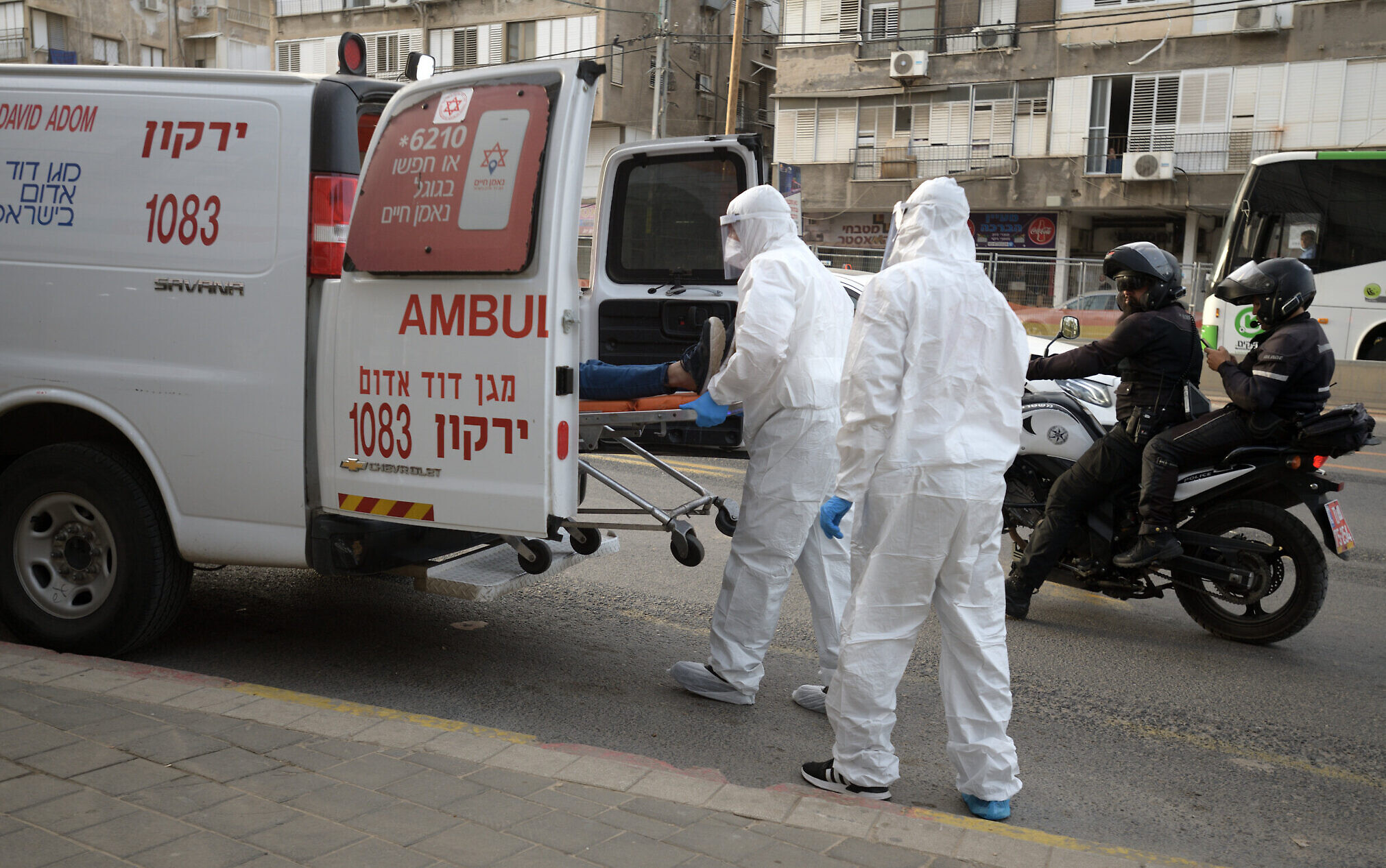
An illustrative photo of Magen David Adom paramedics transferring a man suspected of carrying the virus to an ambulance in the Tel Aviv suburb of Bnei Brak, March 31, 2020. (Gili Yaari/Flash90)

An illustrative photo of Magen David Adom paramedics transferring a man suspected of carrying the virus to an ambulance in the Tel Aviv suburb of Bnei Brak, March 31, 2020. (Gili Yaari/Flash90)

The national death toll from the coronavirus pandemic rose to 94 Friday, with six new deaths reported by the Health Ministry, as Israel’s number of confirmed cases surpassed 10,000.

Meanwhile, officials reported 127 new diagnosed cases, putting the updated national number at 10,095. Of those cases, 164 were in serious condition, with 125 on ventilators. Another 178 people were in moderate condition, with the rest having mild symptoms. And 1,061 have recovered from the illness.

Two of the dead were women, 86 and 84 years old, who had been hospitalized at Jerusalem’s Shaare Zedek Medical Center. The hospital said they had both suffered from complex preexisting conditions. The two were residents of the same assisted living facility in Jerusalem.

Two woman, in their 80s, died at Laniado Hospital in Netanya. One 90-year-old man, a resident of an old-age home in the northern town of Yavne’el, died at the Hillel Yaffe Hospital in Hadera. Another woman, Lea Schwartz, 85, died at a geriatric hospital in Jaffa.

The novel coronavirus has been spreading quickly in nursing homes around the country, raising intense concern for the safety of elderly residents. The Health Ministry said Thursday it was conducting tests over Passover at assisted living facilities where there have been confirmed COVID-19 cases, adding that 3,000 tests were expected to be performed on each of the coming days.

Almost all of those who have died from COVID-19 in Israel have been elderly and suffered from preexisting conditions, according to hospital officials.

While the death toll has continued to steadily climb, experts have pointed to the relatively slow rise in the number of patients on ventilators as a source of potential encouragement.

Putting a dent in the optimism, health officials are projecting that Israel will fall short of testing 10,000 people a day for the coronavirus in the immediate term because of a shortage of a key reagent.

A national lockdown barring intercity travel came into effect Tuesday ahead of the Passover holiday and was lifted Friday morning. Separately, a curfew was maintained over the first night of the holiday on Wednesday, to prevent further spread of the virus, and lifted at 7 a.m. on Thursday morning.


A Passover Message From the IDF Chief of General Staff

April 9, 2020


Happy Passover! Chag Pesach Sameach

April 8, 2020

PM Netanyahu’s Passover Greeting to the Jewish People Around the World 

April 8, 2020


Mideast Strategic security challenges amid COVID19 – Jerusalem Studio 503

April 8, 2020


We Are Living The Passover Story 

April 8, 2020


Israel PM Netanyahu Announces Nationwide Lockdown During Passover Holiday

April 7, 2020

https://www.youtube.com/watch?v=1Lv0TFCqklk