Iranian versions of the American RQ-170 drone which were used in a military exercise in the Gulf in Iran, involving dozens of drones, are seen on the a runway, in this undated handout photo.
(photo credit: REUTERS/TASNIM NEWS AGENCY)
Iran’s Defense Ministry unveiled a mass of new drones over the weekend for the Islamic Republic’s army and air force. According to Tehran the drones have new capabilities, and can fly more than 1,000 km., which means they could reach Israel from Iran.
Iran has been producing drones since the 1980s and is an innovator in drone warfare. It used 25 drones and cruise missiles to attack Saudi Arabia last September, and has flown drones into Israeli airspace.
Iran’s Defense Minister Brig.-Gen. Amir Hatami showed off the drones on Saturday. He said that one jet-powered UAV could fly at speeds of 900 km. per hour at an altitude of 12,000 meters. This would rival the best drones that the US and other countries are now using. These drones have a range of up to 1,500 km., he said, and can fly for several hours. It is a message to Israel, the US and their allies: We can reach you.
Iran says it has provided a “mass delivery” of the Ababil-3 and Karar drones to the air force. The country has a new drone unit that it established in recent years and its IRGC has been using drones to target various enemies, including ISIS. The Ababil-3, Hatami says, can fly 150 km., and the Karar is armed with various weapons that now give the drones “pinpoint” attack abilities. The implication is that these drones have guided bombs and can operate like cruise missiles.
The Ababil-3 is a redesign of earlier Iranian drones, with twin tails. It is likely based on a South African design which itself may have been borrowed from old Israeli designs, such as the Israeli Hunter or Mastiff. The Ababil-3 is supposed to be a medium-range reconnaissance drone, but Iran says it has “combat” potential and can carry other payloads as well. It has an electro-optical add-on that enables it to collect footage. Iran used this capability in September 2018 to target Kurdish dissidents in Iraq, filming its missile attacks with a drone.
Meanwhile, the Karar is designed to be a “strategic” drone that Iran says can be used as a kamikaze drone – basically like a cruise missile. Iran has successfully deployed these kinds of technologies to the Houthi rebels in Yemen, who have used them against Saudi Arabia in dozens of attacks.
The new drones allegedly have some sort of guided missile or smart bomb ordnance. It’s not clear if Iran has perfected the technology and ranges it ascribes to its drones, but attacks in Iraq, Syria and Saudi Arabia are evidence that Iran’s drone threat is increasing.Iranian drones have been sent to Syria’s T-4 base. One of them flew into Israeli airspace in February 2018 and was shot down by a helicopter. Iranian-backed Hezbollah also deployed drones in the Golan in the fall of 2019. Israel carried out an airstrike in August 2019 to neutralize the Hezbollah drone team.
Iran has recently seen some of its shipments of drone parts stopped by the US Navy on the way to Yemen. These included gyroscopes and other technology that Tehran has used elsewhere in drone exports and drone warfare.
THE REASON Iran is unveiling its drones now is linked to its annual army day. However, Iran also used army day to showcase efforts to fight the coronavirus. Iran has more than 5,000 dead from COVID-19, and the drone unveiling is therefore a way to show that Iran continues its technological advances despite US sanctions and the pandemic. Iranian IRGC fast boats harassed the US Navy last week in the Persian Gulf – and in the past, Iranian drones have flown over a US aircraft carrier and provoked American ships. The USS Boxer downed an Iranian drone last year.
Iran’s drones are its version of an air force. Since Iran does not have a very strong army, the drones are used to pose a strategic threat to enemies. Tehran uses the drones to threaten attacks on infrastructure in other states, and it exports them to what it calls the “axis of resistance,” its proxies across the region. Its goal is to upgrade the abilities of groups such as Hezbollah and the Houthis, groups which don’t have air forces and are ostensibly at the mercy of much more powerful adversaries when it comes to air power.
But the drone threat, in Iran’s view, can be a game changer, by posing a threat that is difficult to detect or stop. That was illustrated in the attack on Saudi Arabia, when Iranian drones penetrated both radar defenses and air defenses.
Since Iranian drones are generally not very fast moving and have no stealth abilities, they can be easily detected. Iran has attempted to get around that by using them like cruise missiles, or claiming it has new jet-powered advances. Since the Islamic Republic already has an advanced rocketry program for ballistic missiles, there is no doubt that it has the ability to build different systems. Until they are used, however, it is unclear what their real capabilities are. In Saudi Arabia, Iranian-designed drones have flown hundreds of kilometers, penetrating deep into the country’s interior.
Iran has continued to threaten Israel through shipments of precision guided munitions to Hezbollah. Its drone arm is one of many technologies it uses in these continuing efforts.
Joe Biden is not a friend of Israel. He never has been. In fact, if elected POTUS he would take U.S-Israel relations back to the horror of the Obama years. A time when the U.S publicly vilified Israel. A time when the U.S undermined Israel’s security at the UN. A time when the U.S embraced Israel-haters such as Morsi and Erdogan. A time when the U.S emboldened the genocidal mullah’s in Iran, and a time when the U.S coddled the neo-Nazi Palestinian Authority. Sadly the vast majority of Jewish Americans will still vote for Joe Biden over the pro-Jewish and pro-Israel Donald Trump in November. It’s a disgrace. #Jexodus.
Joe Biden has made a habit of describing himself as a loyal, stalwart friend and ally of Israel. At a campaign stop earlier this month, for instance, he declared: “I’m so proud of the Obama-Biden administration’s unprecedented support for Israel’s security.” But a careful examination of Biden’s track record reveals his long and extremely troubling history of undermining Israel’s security and public image. Some lowlights:
1982: Biden’s Angry Exchange with Menachem Begin
At a Senate Foreign Relations Committee meeting on June 22, 1982, an animated Senator Biden, banging the desk in front of him with his fist, warned then-Prime Minister Menachem Begin that if Israel did not stop establishing new Jewish settlements in the West Bank,[1] U.S. aid to that country might be cut off.
Don’t threaten us with cutting off your aid. It will not work. I am not a Jew with trembling knees. I am a proud Jew with 3,700 years of civilized history. Nobody came to our aid when we were dying in the gas chambers and ovens. Nobody came to our aid when we were striving to create our country. We paid for it. We fought for it. We died for it. We will stand by our principles. We will defend them. And, when necessary, we will die for them again, with or without your aid.
And with regard to Biden’s theatrical furniture-banging, Begin said:
This desk is designed for writing, not for fists. Don’t threaten us with slashing aid. Do you think that because the U.S. lends us money it is entitled to impose on us what we must do? We are grateful for the assistance we have received, but we are not to be threatened. I am a proud Jew. Three thousand years of culture are behind me, and you will not frighten me with threats. Take note: we do not want a single soldier of yours to die for us.
1995-2020: Biden’s Stance on the Relocation of the U.S. Embassy in Israel
Biden voted for the Jerusalem Embassy Act of 1995, which recognized Jerusalem as the capital of Israel and required the U.S. president to relocate the American embassy from Tel Aviv to Jerusalem, though the law allowed the president to waive the move every six months if he believed that a delay would further the interests of national security.
When he ran for vice president with Barack Obama in 2008, Biden said: “I think we should move the embassy, but you don’t have a [Israeli] government asking us to move the embassy there. Let them make the judgment.”
Throughout the eight years that followed, the Obama-Biden administration never even hinted that it might contemplate relocating the U.S. embassy. Indeed, the administration refused even to affirm that Jerusalem was Israel’s capital. For example, in March 2012, an Obama-Biden State Department spokeswoman, Victoria Nuland, told a gathering of journalists: “With regard to our Jerusalem policy, it’s a permanent-status issue. It’s got to be resolved through the negotiations between the parties…. We are not going to prejudge the outcome of those negotiations, including the final status of Jerusalem….. [O]ur embassy, as you know, is located in Tel Aviv.”
When Donald Trump announced in December 2017 that he not only recognized Jerusalem as Israel’s capital but also planned to move the embassy to that city, Biden remained silent. Nor did he issue a statement when the embassy was actually physically relocated in May 2018. More recently, in a November 2019 interview with PBS, Biden was asked if he, as president, would reverse Trump’s move. He replied: “Not now. I wouldn’t reverse it. I wouldn’t have done it in the first place.”
2009-2017: The Obama-Biden Administration’s Strained Relationship with Israel
No American presidential administration ever had so strained a relationship with Israel as did Obama-Biden. As Israeli Ambassador Michael Oren said in 2010, “Israel’s ties with the United States are in their worst crisis since 1975 … a crisis of historic proportions.” Author and scholar Dennis Prager concurred, “Most observers, right or left, pro-Israel or anti-Israel, would agree that Israeli-American relations are the worst they have been in memory.” In the spring of 2011, David Parsons, spokesman for the International Christian Embassy Jerusalem, lamented that the “traditional, special relationship between America and Israel” was being thrown “out the window in a sense.” And in October 2012, Israeli lawmaker Danny Danon, chairman of Likud’s international outreach branch, said that the Obama administration’s policies vis-a-vis Israel had been “catastrophic.”
2010: The Obama-Biden Administration Criticizes Israeli Settlements:
While Vice President Biden was visiting Israel in March 2010, a Jerusalem municipal office announced plans to build some 1,600 housing units for Jews in a section of that city. In response, Biden told Prime Minister Benjamin Netanyahu that this development “endangers regional peace” in the Middle East. In a separate statement, Biden added, “I condemn the decision by the government of Israel to advance planning for new housing units in East Jerusalem,” calling it “precisely the kind of step that undermines the trust we need right now” for constructive peace talks.
Ten days later, Netanyahu traveled to Washington in an effort to put the U.S.-Israel relationship back on more solid footing, but as the Wall Street Journal reported, the prime minister “was snubbed at a White House meeting with President Obama — no photo op, no joint statement, and he was sent out through a side door.” Washington Post columnist and Middle East expert Jackson Diehl wrote that “Netanyahu is being treated as if he were an unsavory Third World dictator.” And ambassador Michael Oren called Israel’s rift with America “the worst with the U.S. in 35 years.”
2010-2015: The Obama-Biden Administration’s Repeated Leaks to the Press About Israel
In 2010, the Obama-Biden administration – determined to do everything in its power to turn public opinion against a possible Israeli military strike targeting Iranian nuclear facilities – leaked information about a covert deal between Israel and Saudi Arabia, whereby the Saudis had agreed that they would allow Israel to use their airspace in order to wage an attack against Iran and its nuclear facilities.
On March 22, 2012, the Obama-Biden administration leaked to The New York Times the results of a classified war game which predicted that an Israeli strike against Iran’s nuclear facilities could lead to a wider regional war and result in hundreds of American deaths. Institute for National Security Studies analyst Yoel Guzansky interpreted the motives behind the Obama-Biden leaks as follows: “It seems like a big campaign to prevent Israel from attacking. I think the [Obama-Biden] administration is really worried Jerusalem will attack and attack soon. They’re trying hard to prevent it in so many ways.” In a May 29, 2012 column in the Israeli newspaper Yedioth Ahronoth, longtime defense commentator Ron Ben-Yishai noted that the leaks would “make it more difficult for Israeli decision-makers to order the IDF [Israeli Defense Forces] to carry out a strike, and what’s even graver, [would] erode the IDF’s capacity to launch such strike with minimal casualties.”
On April 8, 2012, the New Yorker reported that according to information leaked by the Obama-Biden administration, the Israeli intelligence agency Mossad was helping to fund and train the Iranian opposition group Mujahideen-e-Khalq (MEK). This revelation was intended to portray Israel as being unwilling to negotiate in good faith with the government in Tehran, and to thereby undermine any moral authority that Israel might claim in the event of a future military strike against Iran.
In early May 2013, two Obama-Biden administration officials leaked classified information to the media indicating that Israel was behind a May 3rd airstrike against a shipment of advanced surface-to-surface missiles at the airport in Damascus, Syria. Israeli security analysts said that the leak could not only endanger any Israeli agents who were still on the ground in Syria, but could also increase the likelihood that Syrian President Bashar Assad would retaliate against the Jewish state. Again, the purpose of the leak was to paint Israel as an unnecessarily aggressive, bellicose nation.
For similar purposes, in early November 2013 an Obama-Biden administration official leaked to CNN the fact that Israeli warplanes had attacked a Syrian base in the port of Latakia. The planes were specifically targeting Russian-made SA-8 Gecko Dgreen mobile missiles, so as to prevent their delivery to the terrorist organization Hezbollah. Israeli officials called the leak “scandalous” and “unthinkable.”
In January 2015, the Obama-Biden administration — which opposed the notion of imposing any new economic sanctions against the Iranian regime — leaked information indicating that an unnamed Mossad official had recently acknowledged that the enactment of such sanctions would be akin to “throwing a grenade into the [nuclear negotiation] process.” The leak’s implication was that the Mossad official was privately opposed to sanctions. But approximately 12 hours later, that official – Mossad leader Tamir Pardo – stepped forth and, by means of a written statement issued by his office, clarified exactly what he had said and meant:
Contrary to what has been reported, the head of the Mossad did not say that he opposes imposing additional sanctions on Iran…. Regarding the reported reference to ‘throwing a grenade,’ the head of the Mossad did not use this expression regarding the imposition of sanctions, which he believes to be the sticks necessary for reaching a good deal with Iran. He used this expression as a metaphor to describe the possibility of creating a temporary crisis in the negotiations, at the end of which talks would resume under improved conditions.
2013: The Obama-Biden Administration’s Secret Negotiations with Iran
In early November 2013, it was reported that the Obama-Biden administration had begun softening U.S. sanctions against Iran (vis-a -vis the latter’s nuclear program) soon after the election, five months earlier, of that country’s new president, Hassan Rouhani. This move set the stage, in turn, for the United States — in conjunction with Britain, France, Russia, China, and Germany — to propose a short-term “first step agreement” with Iran at a November meeting in Geneva. The deal, which sought to freeze Iran’s nuclear program for approximately six months in order to create an opportunity for a more comprehensive and lasting bargain to be negotiated later, required Iran to stop enriching uranium to a weapons-grade level, to refrain for six months from activating its plutonium reactor at Arak, and to stop using its most advanced and powerful centrifuges. “In return,” said the London Telegraph, “America would ease economic sanctions, possibly by releasing some Iranian foreign exchange reserves currently held in frozen accounts. In addition, some restrictions affecting Iran’s petrochemical, motor and precious metals industries could be relaxed.”
On November 8, 2013, the Israeli government, which the Obama-Biden administration had not informed of the negotiations, was stunned to learn of the secret talks with Iran. News of the agreement led to the canceling of a joint media appearance between U.S. Secretary of State John Kerry and Israeli Prime Minister Benjamin Netanyahu. One Israeli official was quoted saying that “the Iranians are leading the Americans by the nose.”
Netanyahu, outraged at the prospect of this agreement, said that the Iranians “got everything … they wanted” – most notably “relief from sanctions after years of a grueling sanctions regime” – “and paid nothing.” “It’s the deal of a century for Iran,” Natanyahu added, “it’s a very dangerous and bad deal for peace and the international community.”
Eventually, this 2013 agreement would evolve into the famous Iran Nuclear Deal of 2015 – officially known as the Joint Comprehensive Plan of Action (JCPOA) – where the Obama-Biden administration joined the governments of Britain, France, Russia, China, and Germany in signing an accord with Iran.
2014: The Obama-Biden Administration Threatens to Shoot Down Israeli Fighter Jets
In 2014, not long after Israel had discovered that the U.S. and Iran had been involved in the aforementioned secret negotiations regarding Iran’s nuclear program, the Netanyahu government prepared a military operation designed to destroy that program. The Kuwaiti newspaper Al-Jarida reported that when an unnamed Israeli minister revealed the attack plan to Secretary of State John Kerry, President Obama threatened to shoot down the Israeli jets before they could get within striking distance of their targets in Iran.
2014: The Obama-Biden Administration Tells Israel to Stop Assassinating Iranian Nuclear Scientists
On March 3, 2014, the Associated Press reported that the Obama-Biden administration had told Israeli authorities to stop their targeted killings of Iranian nuclear scientists. According to AP: “Israel’s Mossad spy agency has supposedly taken out [mostly with car bombs] at least five top Iranian nuclear experts in an attempt to slow the country’s nuclear program … An unidentified U.S. official disclosed the program to CBS while claiming [that] the … administration is leaning on its Middle Eastern ally to stop the targeted killings and wait for the current deal to disarm to play out.”
2015: The Obama-Biden Administration Is Enraged by Netanyahu’s Acceptance of John Boehner’s Invitation to Address Congress
On January 21, 2015, Republican House Speaker John Boehner invited Israeli Prime Minister Netanyahu, who was strongly oposed to the emerging U.S. agreement with Iran regarding the latter’s nuclear program, to speak (on March 3) to a joint session of Congress about the security threat posed by Iran. In response to Boehner’s action, an outraged Obama-Biden administration accused the House Speaker of having violated “protocol” by extending the invitation on his own initiative instead of asking the executive branch to extend an invitation.
When it was subsequently announced that Obama would not be meeting personally with Netanyahu during the latter’s March 3rd visit, the president offered this explanation: “We don’t meet with any world leader two weeks before their election. I think that’s inappropriate.” “As a matter of long-standing practice and principle,” added White House officials, “we do not see heads of state or candidates in close proximity to their elections,” so as to “avoid the appearance of influencing a democratic election in a foreign country.”
The Obama-Biden administration also urged members of the Congressional Black Caucus to boycott Netanyahu’s speech, and to speak out against it publicly as well. Vice President Joe Biden, for his part, vowed to skip the speech.
In early February 2015, it was learned that the Obama-Biden White House’s tale of having been blindsided by Boehner and Netanyahu was a lie. This was made evident by a correction added to a New York Times article that stated: “Correction: An earlier version of this article misstated when Prime Minister Benjamin Netanyahu of Israel accepted Speaker John A. Boehner’s invitation to address Congress. He accepted after the [Obama-Biden] administration had been informed of the invitation, not before.”
Also in February 2015, it was learned that the Obama-Biden administration’s claim that its decision not to meet with Netanyahu in Washington was based on a desire to avoid “inappropriate[ly]” influencing the upcoming Israeli election, was also a lie. This was evidenced by the fact that during the weekend of February 7-8, Vice President Biden and Secretary of State John Kerry traveled to Munich, Germany to meet with Israeli Labor leader Isaac Herzog, Netanyahu’s opponent in the election.
2015: Declassification of a Document Revealing Israel’s Nuclear Program
In early February 2015, – when the Obama-Biden administration was enraged by the recent announcement that Prime Minister Netanyahu would soon be addressing a joint session of the U.S. Congress regarding Iran’s nuclear program — the Pentagon quietly declassified a top-secret, 386-page Defense Department document from 1987 containing extensive details of Israel’s nuclear program. The document was entitled “Critical Technological Assessment in Israel and NATO Nations.” As the Israel National News (INN) explained, the Jewish state’s nuclear program was “a highly covert topic that Israel has never formally announced [so as] to avoid a regional nuclear arms race, and which the U.S. until now has respected by remaining silent [about it].” Added INN: “[A] highly suspicious aspect of the document is that while the Pentagon saw fit to declassify sections on Israel’s sensitive nuclear program, it kept sections on Italy, France, West Germany and other NATO countries classified, with those sections blocked out in the document.”
2015-2018: Biden & The Iran Nuclear Deal
On July 14, 2015, the Obama-Biden administration – along with the leaders of Britain, France, Russia, China, and Germany – together finalized a nuclear agreement with Iran. The key elements of the deal were as follows:
Iran would be permitted to keep some 5,060 centrifuges, one-third of which would continue to spin in perpetuity.
Iran would receive $150 billion in sanctions relief – “some portion” of which, according to Obama-Biden National Security Adviser Susan Rice, “we should expect … would go to the Iranian military and could potentially be used for the kinds of bad behavior that we have seen in the region up until now.”
Russia and China would be permitted to continue to supply Iran with weapons.
Iran would have the discretion to block international inspectors from military installations and would be given 14 days’ notice for any request to visit any site.
Only inspectors from countries possessing diplomatic relations with Iran would be given access to Iranian nuclear sites; thus there would be no American inspectors.
The embargo on the sale of weapons to Iran would be officially lifted in 5 years.
Iran’s intercontinental ballistic missile (ICBM) program would remain intact and unaffected; indeed it was never even discussed as an issue in the negotiations.
The heavy water reactor in Arak and the underground nuclear facility in Fordo would remain open, violating the “red lines” that Obama had repeatedly cited.
Iran would not be required to disclose information about its past nuclear research and development.
The U.S. would provide technical assistance to help Iran develop its nuclear program, supposedly for peaceful domestic purposes.
Sanctions would lifted on critical parts of Iran’s military, including a previously existing travel ban against Qasem Suleimani, leader of the terrorist Quds force of the Islamic Revolutionary Guard Corps.
Iran would not be required to release American prisoners like Iranian-American Christian missionary Saeed Abedini, Iranian-American Washington Post journalist Jason Rezaian, or U.S. Marine Amir Hekmati.
The U.S. and its five negotiating partner nations would provide Iranian nuclear leaders with training courses and workshops designed to strengthen their ability to prevent and respond to threats to their nuclear facilities and systems.
Iran would not be required to renounce terrorism against the United States, as the Obama-Biden administration deemed such an expectation to be “unrealistic.”
Iran would not be required to affirm its “clear and unambiguous … recognition of Israel’s right to exist” – a requirement that Prime Minister Benjamin Netanyahu had pleaded for. As Obama-Biden State Department spokeswoman Marie Harf said, “This is an agreement that is only about the nuclear issue … [and] doesn’t deal with any other issues, nor should it.” Similarly, State Department spokeswoman Jen Psaki said “we do not see a need that both sides recognize this position [accepting Israel’s right to exist] as part of the final agreement.”
Whatever restrictions were placed on Iran’s nuclear program, would begin to expire – due to so-called “sunset clauses” – at various times over the ensuing 5 to 26 years. Specifically: the ban on Iranian arms exports would expire in 2020; the ban on Iran’s manufacture of advanced centrifuges would begin to expire in 2023; unilateral or multilateral nuclear sanctions against Iran would become extremely difficult to re-impose after 2023; the cap of 5,060 IR-1 centrifuges at Iran’s Natanz facility would expire in 2026; and restrictions on the number and types of centrifuges and enrichment facilities operated by Iran, would expire in 2031.
Joe Biden took on the role of being the administration’s leading public promoter of the Iran deal. He casually dismissed the concerns of critics – most notably Netanyahu – who warned that the sunset clauses for key parts of the agreement would “pave Iran’s path to a bomb.” Those people, Biden said, simply “don’t get it, they’re wrong.”
2017-2020: Biden Opposes Trump’s Withdrawal from the Iran Nuclear Deal
After President Trump decided to pull America out of the Iran nuclear deal, Biden characterized Trump’s strategy as “a self-inflicted disaster” that would make “military conflict” and “another war in the Middle East” much “more likely.”
During a January 2020 presidential campaign event, Biden called on Trump to rejoin the Iran agreement. “The seeds of danger were planted by Donald Trump himself on May 8, 2019 — the day he tore up the Iran Nuclear Deal,” said Biden, forgetting that the date on which the U.S. withdrew from the agreement was actually May 8, 2018. Biden added that Trump had “turned his back on our closest European allies” by selfishly “decid[ing] that it was important to destroy any progress that the Obama-Biden administration did.”
2015: The Obama-Biden Administration Criticizes Netanyahu for Seeming to Abandon Support for a Two-State Solution
The Obama-Biden administration was angered in March 2015 when Israeili Prime Minister Netanyahu, late in his re-election campaign, told the Israeli news outlet Maariv that he would not allow the creation of a Palestinian state on his watch — a position which Obama-Biden viewed as a shift away from Netanyahu’s previous assertion (in 2009) that his “vision of peace” included “two free peoples” — i.e., Israelis and Palestinians — living in separate, independent, adjacent states. Responding to Netanyahu, State Department spokeswoman Jen Psaki said: “The prime minister’s recent statements call into question his commitment to a two-state solution. We’re not going to prejudge what we would do if there was a U.N. action” — implying that Obama-Biden might depart from America’s customary practice of vetoing United Nations Security Council resolutions opposed by Israel.
Netanyahu subsequently clarified that he remained open to a two-state solution, but only if “the Palestinian leadership [would agree] to abandon their pact with Hamas and engage in genuine negotiations with Israel.” Notwithstanding the prime minister’s clarification, White House spokesman Josh Earnest stated that “[w]ords matter” and that there could be “consequences” for Netanyahu’s initial remarks in this instance.
2016: Biden Publicly Ridicules Israel After a Terrorist Bombing Wounds 21 Jews
Just a few hours after an April 18, 2016 terrorist bus bombing in Jerusalem had wounded at least 21 people, Vice President Biden delivered a speech to the Israel advocacy group J Street, an organization that traces the Mideast conflict chiefly to the notion that “Israel’s settlements in the occupied territories have, for [many] years, been an obstacle to peace.” In the course of his talk, Biden said: “I firmly believe that the actions that Israel’s government has taken over the past several years — the steady and systematic expansion of settlements, the legalization of outposts, land seizures — they’re moving us, and, more importantly, they’re moving Israel in the wrong direction.” “The present course Israel’s on is not one that’s likely to secure its existence as a Jewish, democratic state,” Biden added. Conversely, he singled out for praise a young left-wing member of Israel’s parliament, Stav Shaffir, who was a harsh critic of Benjamin Netanyahu: “May your views begin to once again become the majority opinion in the Knesset,” Biden said to Shaffir.
2016: The Obama-Biden Administration Urges Israel to Exercise “Restraint” in the Wake of Palestinian Terror Attack
In the immediate aftermath of a June 7, 2016 terrorist attack in which two Palestinian gunmen had shot nine Israelis (killing four) in a Tel Aviv shopping complex, the Obama-Biden State Department cautioned the Israeli government to “exercise restraint” in carrying out its vow to increase security control over the West Bank and its residents.
2016: The Obama-Biden Administration Again Condemns Israeli Settlements
In the summer of 2016, the Obama-Biden administration renewed its attacks against Israeli settlements. In what journalist and scholar Caroline Glick characterized as a “shockingly hostile assault” against Israel, the State Department issued the following statement:
We are deeply concerned by reports today that the government of Israel has published tenders for 323 units in East Jerusalem settlements. This follows Monday’s announcement of plans for 770 units in the settlement of Gilo. We strongly oppose settlement activity, which is corrosive to the cause of peace. These steps by Israeli authorities are the latest examples of what appears to be a steady acceleration of settlement activity that is systematically undermining the prospects for a two-state solution…. We are also concerned about recent increased demolitions of Palestinian structures in the West Bank and East Jerusalem, which reportedly have left dozens of Palestinians homeless, including children…. This is part of an ongoing process of land seizures, settlement expansion, legalizations of outposts, and denial of Palestinian development that risk entrenching a one-state reality of perpetual occupation and conflict. We remain troubled that Israel continues this pattern of provocative and counter-productive action, which raises serious questions about Israel’s ultimate commitment to a peaceful, negotiated settlement with the Palestinians.
2016: The Obama-Biden Administration Abstains on U.N. Vote Regarding Israeli Settlements
On December 24, 2016, the Obama-Biden administration – in a major departure from traditional U.S. policy – abstained from voting on a United Nations Security Council resolution condemning the existence and construction of Israeli settlements in the West Bank. The resolution also declared that all of eastern Jerusalem – including Judaism’s most sacred site, the Temple Mount – was “Palestinian territory” that was being illegally “occupied” by Israel in “a flagrant violation under international law.” The Obama-Biden abstention allowed this resolution to pass, prompting Israeli Prime Minister Netanyahu to condemn the administration’s “shameful betrayal.” “From the information that we have,” Netanyahu added, “we have no doubt that the Obama administration initiated [the abstention], stood behind it, coordinated on the wording, and demanded that it be passed.”
2019: Biden Draws a Moral Equivalence Between Israel & the Palestinians
During his current presidential campaign, Biden, drawing a moral equivalence between the Israelis and the Palestinians, has stated that “neither the Israeli nor Palestinian leadership seems willing to take the political risks necessary to make progress through direct negotiations.”
2019: Biden Reaches Out to J Street
In November 2019, Biden sent a video message conveying his support and friendship to a conference of the aforementioned organization J Street. One of the featured speakers at this conference was Osama Qawasma, a spokesman for the terrorist Fatah organization created by the late Yasser Arafat, mass murderer of Jews. Qawasma is also a member of the Fatah Revolutionary Council; an advisor to the Palestinian Authority’s current anti-Semitic president, Mahmoud Abbas; and an opponent of “the American-Israeli attempts to denounce Hamas as terrorist.”
Another Islamic extremist who spoke at the J Street conference which Biden saluted was Saeb Erekat, Secretary-General of the PLO Executive Committee, who has openly defended Hamas and the funding of Islamic terrorists.
2019-2020: Biden Demands a Two-State Solution and Condemns the Israeli “Occupation”
Biden today maintains that “there’s no answer” to the Arab-Israeli conflict other than “a two-state solution,” adding that “I think the [Israeli] settlements are unnecessary.” Asked if he considers the “occupation” to be “a human rights crisis,” Biden replies, “I think occupation is a real problem, a significant problem.” He reaffirms that “I will insist on Israel, which I’ve done, to stop the occupation of those territories, period.”
PM’s office says ‘pilot’ to be conducted allowing some industries to resume operations if they meet Health Ministry guidelines; exercise up to 500 meters from home to be permitted
People walk through Jerusalem’s mostly shuttered Mahane Yehuda Market on April 16, 2020. (Yonatan Sindel/Flash90)
Prime Minister Benjamin Netanyahu green-lighted a general plan to ease restrictions on economic activity and “stay home” orders, potentially allowing some businesses to open as soon as next week.
A statement from Netanyahu’s office described the plan, which still must be approved by the full cabinet, as “responsible, cautious and gradual” and said it would allow for a limited opening of businesses.
No specific timeline for the plan was detailed, but according to Hebrew media reports some businesses could reopen as early as next week.
According to Netanyahu’s office, the Finance Ministry will draw up a “pilot plan” for some sectors of the economy to open in accordance with Health Ministry social distancing guidelines. Criteria will be drawn up for certification that will allow businesses to open.
Among the criteria likely to be included are regular disinfecting, taking customers’ temperatures and abiding by social distancing regulations, according to reports.
The industries and businesses that would be allowed to take part in the pilot would be decided on in the next two days, but malls, open-air markets and businesses that involve physical contact will not yet be allowed to reopen.
Israelis in the central city of Lod outside a pharmacy on April 12, 2020. ( Yossi Aloni/Flash90)
The statement also said that restrictions on movement will be slightly eased, with Israelis allowed to exercise in pairs up to 500 meters from their homes, up from the 100 meter limit currently in place.
Special education would also be allowed to resume but preschools and schools will not yet reopen.
A final decision will be brought for cabinet approval Saturday evening,
“Changes are likely during the deliberations over the next days,” the statement said.
A Israelis wearing face masks walk with eggs on Ben Yehuda Street in Jerusalem on April 16, 2020. (Olivier Fitoussi/Flash90)
Quoting sources close to Defense Minister Naftali Bennett, Hebrew media reports said numerous industries would be allowed to resume operations Sunday, though there was no confirmation of this in the statement from the Prime Minister’s Office.
Almost all factories will be allowed to resume work under the plan, according to Channel 12 news.
There was no indication from the statement that restrictions banning group prayer would be eased, despite a push by ultra-Orthodox ministers for more freedom for religious gatherings.
Interior Minister Aryeh Deri, who heads the ultra-Orthodox Shas party, urged the government to permit prayer gatherings of 10-15 people, provided the services are held outdoors and the worshipers stand apart in accordance with social distancing rules.
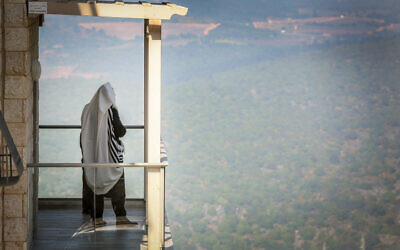
A man prays on a balcony in the northern city of Safed on April 13, 2020. (David Cohen/Flash90)
Israeli officials have been mulling in recent days how to begin to roll back some restrictions in response to figures which appear to indicate that the spread of the coronavirus has been halted or slowed in most communities.
As of Thursday evening, there have been 12,758 confirmed coronavirus cases in Israel, with 143 deaths. New daily cases have remained steady at 300-450 per 24-hour period, and serious cases and those on ventilators have not risen significantly for at least a week, according to Health Ministry figures.
Netanyahu met Thursday with ministers and top officials for the first discussion of a strategy to ease the coronavirus restrictions and revive the economy, with officials from the health and finance ministries clashing over the proper approach.
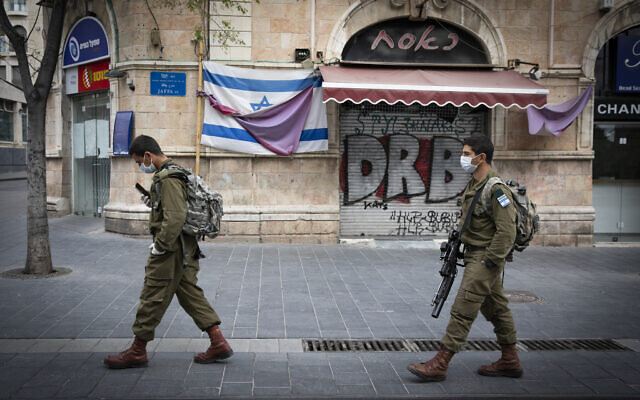
Soldiers patrol in downtown Jerusalem to enforce the Passover curfew, April 09, 2020. (Olivier Fitoussi/Flash90)
While the Health Ministry has recommended a particularly slow and cautious strategy that would see businesses stay closed for at least another month, the Finance Ministry is demanding that restriction begin being eased as early as possible.
Most experts believe any gradual reopening of economic activity will involve a process of trial and error that may necessitate some restrictions being reimposed.
Border police officers block a main road following the government’s measures to help stop the spread of the coronavirus, in Bnei Brak, April 3, 2020. (AP Photo/Oded Balilty,)
Earlier in the day, the ministerial committee formulating Israel’s response to the coronavirus outbreak approved a decision to relax lockdown restrictions in the ultra-Orthodox city of Bnei Brak, while extending closure rules in Jerusalem neighborhoods until April 19.
The ultra-Orthodox town of 200,000 near Tel Aviv has the second highest infection numbers in the country — 2,150 as of Thursday morning. Jerusalem leads with 2,418 cases.
Two weeks ago Bnei Brak was placed under a strict lockdown, with residents only allowed to leave municipal boundaries to work in key industries or to receive medical care. Some two dozen Jerusalem neighborhoods were put under lockdown on Sunday, most of them ultra-Orthodox.
Israeli police patrol in Dizengoff square in Tel Aviv to check people are not disobeying the government’s orders on a partial lockdown in order to prevent the spread of the coronavirus, April 14, 2020. (Miriam Alster/Flash90)
For the second time in a week, Israel was under a complete lockdown as authorities sought to prevent people taking part in celebrations for the end of the Passover holiday and the Mimouna festival, fearing gatherings could cause a spike in conronaviris infections.
From Tuesday at 5 p.m. until Thursday at 5 a.m., Israelis will be barred from leaving their hometowns, or in the case of Jerusalem, the neighborhoods in which they live, according to the restrictions.
Some 9,000 police and Border Police will enforce the lockdown and 44 roadblocks will be set up on intercity roads. The focus of the police effort was expected to begin Wednesday evening for the start of Mimouna, a North African holiday, that normally sees people hosting large gatherings and traveling from home to home.
Bakeries and restaurants will remain closed until Thursday morning at 2 a.m., though supermarkets will be permitted to operate from Wednesday evening and food deliveries are permitted. This was to prevent crowds from gathering after Passover ends to purchase breads and other “unleavened” goods that many traditionally refrain from consuming during the holiday.
Public transportation has been canceled until Thursday at 5 a.m.
The rules do not apply to Arab communities.
Prime Minister Benjamin Netanyahu and his wife Sara attend the Jewish Moroccan celebration of Mimouna, in Hadera on April 17, 2017. (Ido Erez/POOL)
Prime Minister Benjamin Netanyahu on Monday night directed Israelis to celebrate the last night of Passover and Mimouna only with those they live with, as was the case for the first night of the holiday last week.
Netanyahu said the government was working on a plan to gradually lift restrictions on economic and educational activities and would decide on steps later this week, while stressing that these would be “slow and responsible.”
“I say to you from here: We’ll go out to a different reality from the one we knew before the global crisis,” he said.
He warned that even if the outbreak is contained, there is no way to prevent the virus from returning until a vaccine is developed.
“Only when a coronavirus vaccine is found will we be able to move on to the world of tomorrow, which will be like the world of yesterday,” he said. “But this is not the situation at the moment; therefore, everything will continue to be managed responsibly in order to protect the most precious thing we have – life itself.”
Israeli Police officers at a temporary checkpoint in Jerusalem on April 14, 2020. (Yonatan Sindel/Flash90)
The new lockdown announced by Netanyahu came after he held consultations with ministers earlier in the day, with the Health Ministry reportedly concerned that the festive atmosphere during the last day of Passover and Mimouna would lead to a slackening of social distancing that has been a central plank in the country’s strategy for curbing the virus spread.
Israel is already under partial lockdown orders requiring all citizens to remain within 100 meters of their homes unless attending essential industries and jobs. Schools, leisure sites and most stores have been shuttered. The public has been ordered to only leave home for essential needs and all public gatherings have been banned. Intercity travel is generally permitted, provided the requirements for travel are met.
However, additional lockdown orders were applied Sunday to several Jerusalem neighborhoods with high coronavirus infection rates, with around 100 checkpoints set up around the capital to prevent travel to and from the restricted zones.
As of Tuesday evening, 119 people have died in Israel of COVID-19, the disease caused by the coronavirus. The Health Ministry updated Israel’s number of confirmed coronavirus cases to 11,868, including 136 people on ventilators.
The empty Rothschild Boulevard in Tel Aviv on April 11 2020. (Photo by Miriam Alster/Flash90)
Israelis are required to wear faces masks when venturing outside in accordance with a new Health Ministry directive that came into effect on Sunday morning. The measure was approved by the government this past week.
Under the new rules, masks must be worn when leaving home and should cover the nose and the mouth. This does not apply to children under age 6; people with emotional, mental or medical conditions that would prevent them from wearing a mask; drivers in their cars; people alone in a building; and two workers who work regularly together, provided they maintain social distancing.
The masks can be homemade, makeshift, or bought, according to the authorities. The order had previously been issued as a recommendation.
“A face mask greatly reduces the likelihood of being infected and infecting others,” the ministry said, adding that it obstructed respiratory droplets.
Police will delay enforcing this measure in its initial stages. Authorities are enforcing other directives which have been in place for several weeks, such as gatherings of no more than two people, and staying within 100 meters from home when outside.
Israelis are allowed outdoors under certain conditions, such as to buy food and medicine.
The Health Ministry sent out a reminder on Saturday about the new regulation and aired an infomercial during the nightly news about the benefits of wearing a face mask including instructions on how to fashion one using a bandana and hair ties.
The face mask order came as the World Health Organization (WHO) questioned the effectiveness of such a policy.
The WHO released updated guidelines Tuesday on face masks, saying there was “limited evidence” suggesting a mask worn by a person with the coronavirus would protect those around them, and “no evidence” it was effective for those who are healthy.
Moreover, it warned people to reserve medical masks for health care professionals and cautioned of a false sense of security by mask-wearers.
It added: “The use of masks made of other materials (e.g., cotton fabric), also known as nonmedical masks, in the community setting has not been well evaluated. There is no current evidence to make a recommendation for or against their use in this setting.”













 anneinpt
 artaxes
 danmillerinpanama
 davidking1530
 Peter Hofman
 Joseph Wouk
 Peter
Peter Louisiana Steve
 WarSclerotic
Recent Comments