Archive for February 2020

Netanyahu Says Work on Annexation Map Has Begun: ‘We Are Turning Parts of the Homeland in Judea and Samaria Into Part of the State of Israel Forever’

February 19, 2020

I’ll believe it when it happens.

Sorry, if it happens…

Netanyahu Says Work on Annexation Map Has Begun: ‘We Are Turning Parts of the Homeland in Judea and Samaria Into Part of the State of Israel Forever’

Israel’s government has established a team to map out areas of the West Bank that it will annex in accordance with President Donald Trump’s recently released peace plan, Israeli Prime Minister Benjamin Netanyahu said on Sunday.

Speaking at the weekly cabinet meeting, Netanyahu said, “In recent weeks, we brought enormous news for the State of Israel and the Land of Israel. My friend President Trump clearly stated that he would recognize Israeli sovereignty over the Jordan Valley, the northern Dead Sea, and all Jewish communities in Judea and Samaria, as well as a broad area encompassing them.”

“We have formed an Israeli team to work with the American team on the work of mapping, which has already begun — it is underway,” Netanyahu announced.

The team, he said, includes Minister of Tourism and Aliyah and Integration Yariv Levin, National Security Council chief Meir Ben-Shabbat, and the Prime Minister’s Office Director-General Ronen Peretz, with assistance from the Israeli Ambassador to the US, Ron Dermer.

“This team will work closely with settlement and, of course, security officials in order to complete the work quickly,” Netanyahu said.

“For their part, the Americans will work with us,” he added. “We will complete the work as quickly as possible.”

“We are turning parts of the homeland in Judea and Samaria into part of the State of Israel forever,” the prime minister declared.

The Trump peace plan, which has already been rejected by the Palestinians, provides for Israeli annexation of almost all current Jewish settlements in the West Bank, or Judea and Samaria as the area is referred to in Hebrew.

This includes annexation of Israeli enclaves deep in West Bank territory, which is fiercely opposed by the Palestinians. In previous negotiations, the Palestinians have been offered over 90% of the West Bank, but turned it down. Under Trump’s plan, they would receive 70% of the territory, with Israel annexing the rest.

While most observers, whether supportive or not, view the Trump plan as the most generous toward Israel ever offered, settler leaders have been disappointed that Netanyahu did not immediately annex the territories guaranteed under the plan.

While US Ambassador to Israel David Friedman intimated that Israel was free to annex the territory following the release of the plan, Netanyahu backed off the idea, reportedly under pressure from the White House.

With ‘suicide drones’ and rocket attacks, Navy simulates war with Hezbollah 

February 17, 2020

Source: With ‘suicide drones’ and rocket attacks, Navy simulates war with Hezbollah | The Times of Israel

Times of Israel joins the 3rd Flotilla of missile ships as it holds an exercise preparing for possible conflict off the northern coast

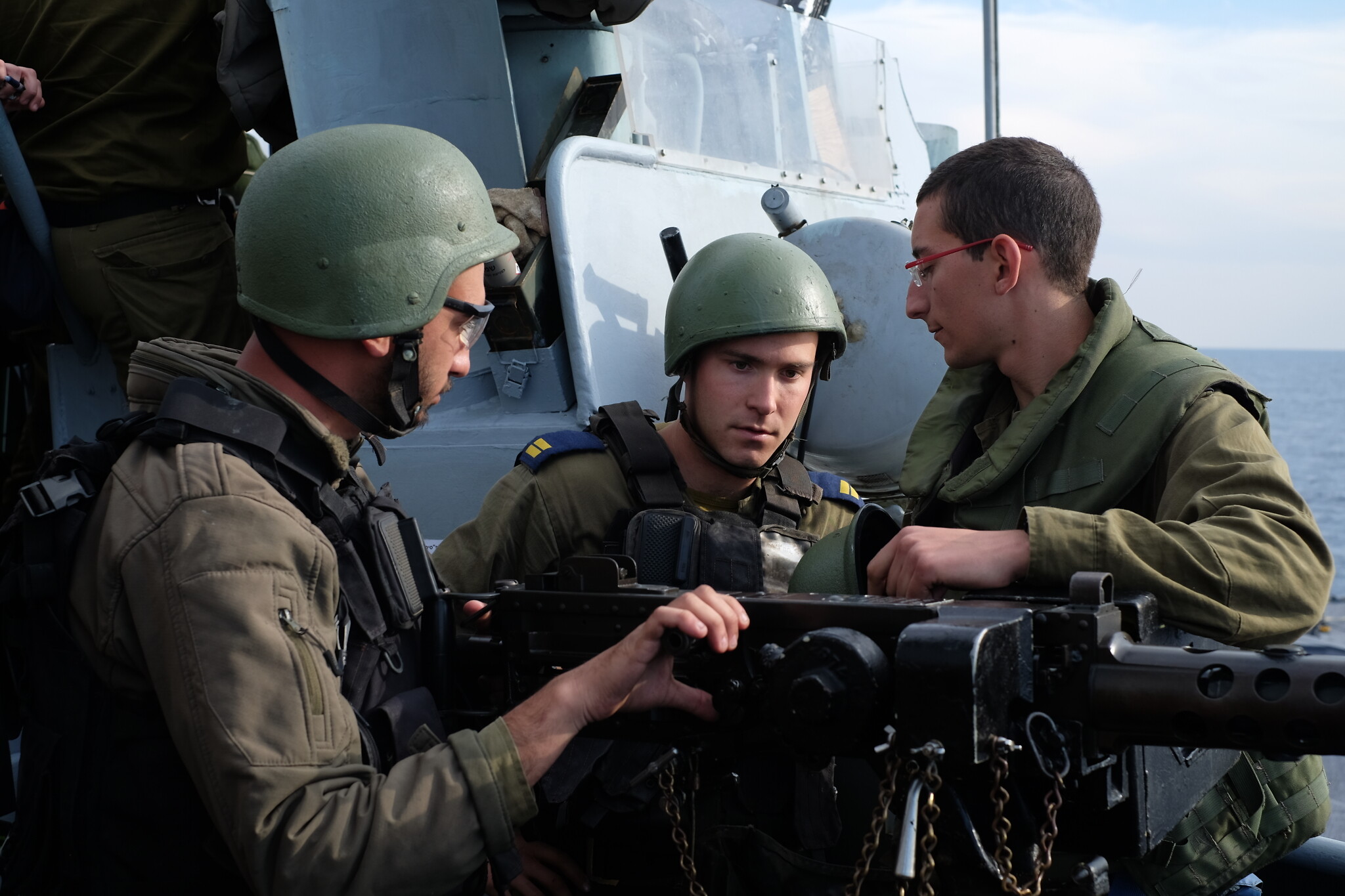
Israeli sailors prepare to fire a machine gun during a naval exercise off the coast of the northern Israeli city of Haifa on February 3, 2020. (Judah Ari Gross/Times of Israel)

Israeli sailors prepare to fire a machine gun during a naval exercise off the coast of the northern Israeli city of Haifa on February 3, 2020. (Judah Ari Gross/Times of Israel)

ABOARD THE I.N.S. KESHET — In the next conflict with the Hezbollah terror group, Israel’s Navy knows that one of its main goals will be to protect Israel’s burgeoning natural gas infrastructure and shipping in the Eastern Mediterranean Sea.

Hezbollah has long identified the maritime platforms as a potential target for attack, with verbal threats by the terror group’s leader Hassan Nasrallah and his deputies over the years, as well as ominous videos and graphics putting the structures in cross-hairs.

Moreover, the military assumes that the terror group possesses the capabilities necessary to carry out those threats and stage potentially successful attacks not only on the gas platforms but on the commercial shipping lanes that bring in nearly all of Israel’s imported goods.

Last week, the navy’s 3rd Flotilla of missile ships — known in Hebrew by the acronym satilim — simulated such a war with a week-long exercise at sea, including deadly missile strikes on Israeli vessels, attempted suicide boat bombings and drone attacks.

Lt. Col. Guy Barak, commander of the 34th Anti-Submarine Squadron, onboard the INS Keshet during a naval exercise off Israel’s northern coast in February 2020. (Israel Defense Forces)

“We assume [Hezbollah] will try to attack on the maritime front. They see it as a very important arena,” Lt. Col. Guy Barak, commander of the 34th Anti-Submarine Squadron, told The Times of Israel, on board the INS Keshet, a 67-meter (220-foot) Sa’ar 4.5-model “submarine hunter” missile ship, during the second day of the five-day drill.

“With an enemy like Hezbollah, a surprise can come on the tenth day of a war or within the first hour,” he said. “So we have to know how to go from zero to 60 fast.”

Barak declined to comment on the specific types of weapons that the IDF believes the Tehran-backed Hezbollah has in its arsenals, but said generally that this included shore-to-sea missiles, suicide drones, submarine capabilities and others.

“We have to think that whatever Iran has, Hezbollah — and Hamas — can also have,” he said.

An image from a video by the Lebanese terror group Hezbollah threatening to attack Israeli offshore gas platforms. (Screen capture)

Barak said the military is both directly tracking Hezbollah’s weapons development closely and also making assessments based on the “vectors” that the terror group was already on.

In the 2006 Second Lebanon War, Hezbollah forces fired an anti-ship missile at the INS Hanit that killed four Israeli soldiers — one of the most significant, and in Israel, infamous, events of the 34-day conflict.

The strike on the Hanit on July 14 crippled the ship but did not destroy it. It was the first direct strike on an Israeli warship in decades and Hezbollah celebrated it as among its biggest victories of the war.

Though much of the exercise was conducted virtually, one aspect that was simulated with live fire was an attack by a “suicide drone” packed with explosives, a weapon that Hezbollah and other Iran-backed militias are known to have.

A civilian company was brought in to fly a Styrofoam glider around the participating ships, as machine gunners tried to shoot them down.

On board the INS Keshet, it took 94 bullets from one of the ship’s .50-caliber machine gun to send the drone crashing into the sea.

An Israeli sailor prepares to fire a machine gun during a naval exercise off Israel’s northern coast in February 2020. (Israel Defense Forces)

Asked why only one drone was used in the operation, when it’s possible a swarm of them could actually be used in a future war, Barak recognized that this was true not only of drones but of all aspects of the exercise, and that the decision to only use one was something of an arbitrary one.

“It can be one suicide boat or several, one drone or several, one rocket or several,” he said.

Israel is an island

Though surrounded on three sides by land, the State of Israel effectively functions as an island economy, importing and exporting nearly all of its goods through the sea — rather than by land — making the maritime arena one of critical value to the normal functioning of the country. The recent discovery of natural gas reserves in Israel’s territorial waters and the construction of one extraction platform in easy view of northern Israeli coastal communities has only added to the importance to the sea.

To assist in defending these new resources, the Israeli military has purchased four Sa’ar 6-model missile ships to be delivered beginning next year that will come equipped with two Iron Dome air defense batteries to defend the natural gas platforms from missile and rocket attacks.
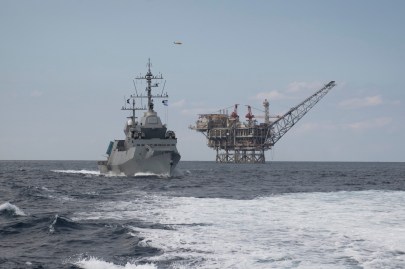
An Israeli Navy Sa’ar 5 corvette defends a natural gas extraction platform off Israel’s coast, in an undated photograph. (Israel Defense Forces)

In the meantime, the Israeli Navy is protecting the extraction platforms with slightly smaller Sa’ar 5-model missile ships, also equipped with Iron Dome batteries.

In addition to their strategic importance to the State of Israel, these platforms also represent a highly visible targets for Hezbollah, which could provide it with what military officials refer to as a “victory picture,” like the Raising the Flag on Iwo Jima from World War II or the Israeli paratroopers at the Western Wall from the 1967 Six Day War. A massive fireball erupting out of the extraction rig less than 10 kilometers from the Israeli shore could serve a similar function for Hezbollah.

“But that’s less my concern,” Barak said. “My concern is defending national infrastructure installations — regardless of how things look.”

Israeli sailors take part in a naval exercise off Israel’s northern coast in February 2020. (Israel Defense Forces)

To accomplish this task, Israel’s missile ships are equipped with a dizzying array of sensors and detection systems — radar, sonar, electro-optical and more — active defense systems that can intercept incoming attacks, as well as ship-to-ship and ship-to-shore missiles.

While other navies around the world maintain fleets of different varieties of ships capable of performing specific tasks and mission, Barak said, “we need our missile ships to do everything.”

All of these systems are controlled from the warships’ combat information center — known in Hebrew by the acronym MIK, or Merkaz Yediyat Krav — a pitch black, cramped room in the belly of the vessel whose walls are covered in a myriad of screens and information panels.

Barak said these detection systems and weapons make the missile ships critical for defensive and offensive operations “not just on the sea, but above it and below it.”

However, he stressed, the navy cannot use these tools solely for the maritime front and must serve an integral part of the overall war effort.

Naval officials often point to the case of the 1973 Yom Kippur War, in which the military’s air and ground forces suffered heavy losses while the navy performed far better. Despite the navy’s significant successes on its front, the war in general is seen as having been far less than a decisive victory for Israel.
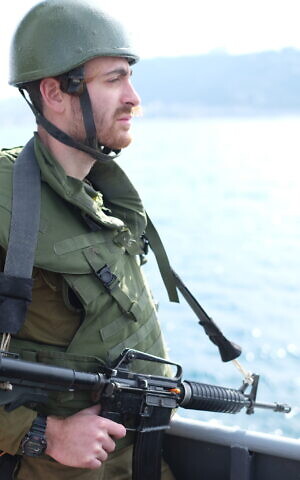
An ultra-Orthodox Israeli sailor holds a rifle during a naval exercise off Israel’s northern coast in February 2020. (Judah Ari Gross/Times of Israel)

“It’s no longer the military telling the navy, ‘Just keep the sea clean,’” he said.

Barak said the navy, especially the 3rd Flotilla and the 7th Flotilla of submarines, does have a slightly different mindset than the rest of the military, as the vessels they use are not only war machines, but also their homes, on which they can remain for extended periods of time.

“The sailors see this as their house and the other crew members as their family, so when they fight, they’re fighting for their home,” he said. “We go out to war and we come back when we’ve won. We don’t know for how long.”

Despite this singular quality, the navy works closely with the other branches of the IDF, especially the Israeli Air Force, Barak said, giving the specific example of the air force-operated Iron Dome batteries on board navy ships.

But in order to maintain the ability to fight more traditional naval warfare, last week’s exercise also included fleet-on-fleet combat.

The drill also simulated the death of the captain of the INS Romach from the direct strike of a Hezbollah rocket, fires and flooding onboard ships, emergency helicopter evacuations and other emergencies.

“The exercise took the commanders to extremes and tested their functioning under pressure,” the military said.

The 3rd Flotilla’s ship-to-shore missiles and other weaponry ensures that it will also play an active role in any future war against Hezbollah in Lebanon, as it did in the 2006 Second Lebanon War and against Hamas in Gaza in the 2014 conflict there.

“Hezbollah knows that if an all-out war breaks out, the IDF will display force like never before, and that will include a ‘punch’ from the sea from the 3rd Flotilla,” Barak said.

 

Rouhani vows US pressure will not force Iran into talks

February 17, 2020

Source: Rouhani vows US pressure will not force Iran into talks | The Times of Israel

( Does this ‘phony moderate’ terrorist actually know NOTHING about Trump ? – JW )

President says Washington’s ‘maximum pressure’ campaign is doomed to fail, Trump won’t start a war because it would ruin his reelection chances

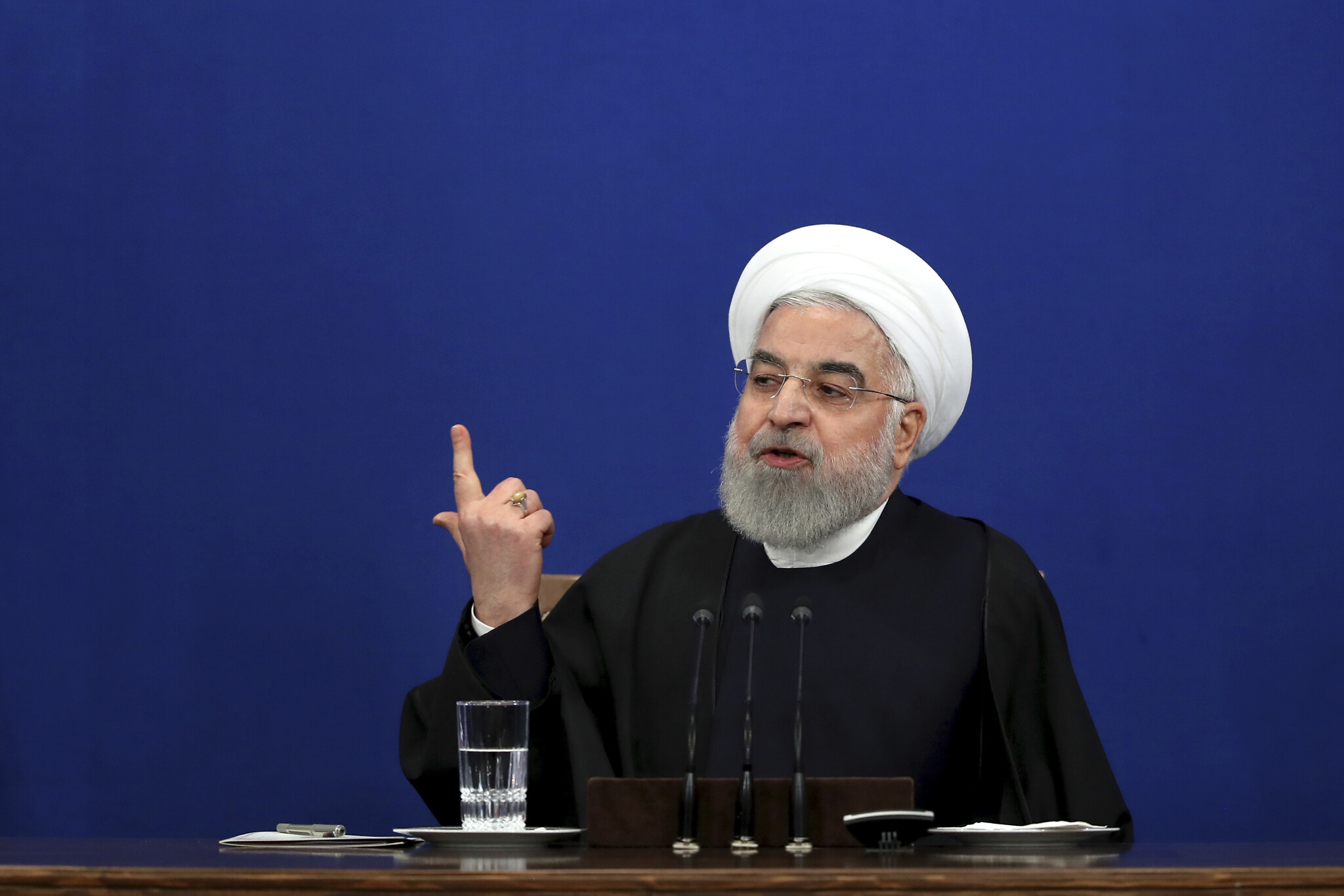
Iran's President Hassan Rouhani gives a press conference in Tehran, Iran, February 16, 2020. (Ebrahim Noroozi/AP)

Iran’s President Hassan Rouhani gives a press conference in Tehran, Iran, February 16, 2020. (Ebrahim Noroozi/AP)

Iran’s President Hassan Rouhani on Sunday vowed that US sanctions would not force his country to negotiate new terms for the moribund 2015 nuclear deal and declared that Washington’s pressure campaign was doomed to fail.

“We will never go to the negotiation table in a position of weakness,” Rouhani said at a press conference in Tehran, according to a report by Iran’s Mehr news agency.

He reiterated that the US should rejoin the nuclear deal — which it left in 2018 — if it wants to return to negotiations.

“We will finally get the enemy to sit at the negotiating table some day, like before,” said Rouhani, referring to the US.

He said he didn’t believe the US would pursue war with his country, because it would harm US President Donald Trump’s 2020 reelection bid.

Trump knows that war with Iran will “ruin” his chances of winning the 2020 US presidential election, he assessed.

The Iranian leader added that war would be harmful to US interests and those of its regional allies, as well as Iran.

“I think the Americans aren’t after war since they know what harm it could do them,” said Rouhani in a news conference.

He said that Persian Gulf nations like the United Arab Emirates, Bahrain and Qatar stood a lot to lose if conflict between Iran and the US turns to war.

Iran would always play a key role in the region’s stability, Rouhani declared.

“It is clear to the entire world that peace and stability in this region are impossible without a powerful and great country like Iran,” he said.

Tehran and Washington came close to an open conflict in January, when a US drone strike killed Iran’s top general, Qasem Soleimani, outside Baghdad. Iran retaliated with missile strikes on a base housing US troops in Iraq.

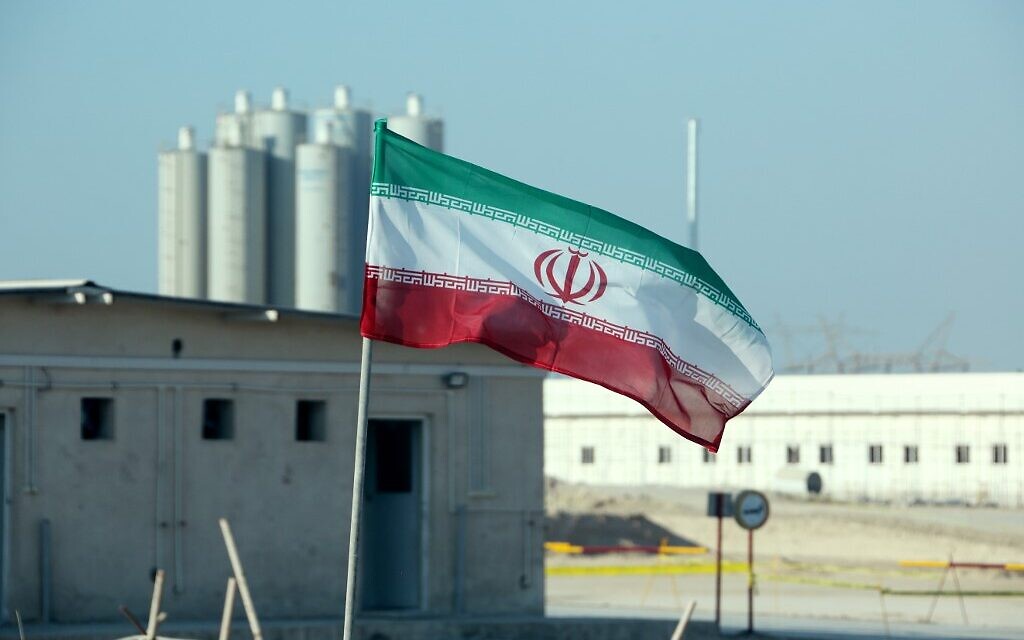
An Iranian flag flutters at Iran’s Bushehr nuclear power plant on November 10, 2019. (Atta Kenare/AFP)

In May 2018 Trump pulled out of the nuclear deal between Iran and world powers, then reinstated severe economic sanctions under a “maximum pressure” campaign to force Iran to renegotiate the pact.

The so-called Joint Comprehensive Plan of Action saw previous international sanctions lifted from Iran in return for it agreeing to curb its nuclear program to limit it from being able to produce weapons.

The Trump administration claims the JCPOA doesn’t go far enough in stopping Iran from obtaining nuclear weapons and also did not address the country’s ballistic missile program. Strict sanctions have targeted Iran’s vital oil industry, ravaging its economy.

As the other signatories to the deal struggle to keep the pact alive, Iran has also dropped some of its commitments to the deal, restarting processes that experts say shorten the breakout time it needs to produce enough enriched uranium to make an atomic bomb.

Iran has said it is only prepared to open talks on the deal if the US first removes its sanctions.

At his Sunday press conference, Rouhani conceded that “sanctions will naturally create problems for the people,” but predicted “these sanctions will be fruitless for our enemies.”

Washington knows that “the path and strategy they chose was based on a miscalculation and will not affect the great Iranian nation,” he said and claimed that for the first time in its history Iran was managing without its oil industry to keep the economy going.

Last month three European signatories to the JCPOA — Britain, France and Germany — announced action under the nuclear agreement paving the way for possible sanctions in response to Tehran’s attempts to roll back parts of the deal.

The three countries, which signed the international agreement along with the United States, Russia and China, triggered its “dispute mechanism,” ratcheting up pressure on the Islamic Republic.


If Russia can’t curb Iran in Syria, the Saudis ask: How can Israel? – DEBKAfile

February 17, 2020

Source: If Russia can’t curb Iran in Syria, the Saudis ask: How can Israel? – DEBKAfile

The Saudi paper Sharq al-Awsat reported on Feb. 15 that the Russians had given up on curbing Iran’s military presence in Syria. It cited Saudi intelligence sources in eastern Syria where the Saudis took control of Syria’s eastern oil region in December under the US aegis. Those sources wonder how Israel can hope to succeed where the Russians have failed.

On Thursday, Feb. 13, they note, Israel took out four Iranian officers in an attack on a new Iranian weapons consignment delivered in the Damascus area. Two of the dead were Revolutionary Guards generals – Riday Mahmadi, commander of Iranian forces in the Damascus region, and Haj Hossein, who was in charge of arming Iranian forces in Syria.

While this was yet another impressive Israeli intelligence feat, its impact will be short-lived, say DEBKAfile’s military sources. Tehran will rapidly replace the two officers, in the same way as it quickly slotted a Hizballah loyalist close to Hassan Nasrallah into the vacancy left by the US assassination of Al Qods chief Qassem Soleimani on Jan. 3. The Guards don’t leave missing links in their chain of command – either in Syria or in Iraq.

The systematic destruction by Israeli missiles of Iran’s weapons consignments landing in Syria is likewise of provisional value. While the IDF is exceptionally effective in spotting and targeting the incoming arms shipments, a certain quantity must be presumed to be getting through to destination, else how account for periodic reports on the rising numbers of precision missiles in the hands of Iran’s proxy, the Lebanese Hizballah? This question also applies to the Palestinian Hamas in the Gaza Strip.

IDF commander Lt. Gen. Aviv Kochavi addressed the Iranian and other threats to Israel’ security when he presented his new multi-year military program last week, He pointed out in his preamble that Israel’s armed forces must contend with “surrounding terrorist armies in Syria, Lebanon, the Gaza Strip and Sinai, which are not under state control,” as well as Iran, which “currently holds a stock of 1,000 precision missiles capable of reaching Tel Aviv, some of which have multiple independently targetable reentry vehicles (MIRV) that are difficult to intercept.” He stressed too that “Hizballah is advancing in its own precision rockets project.”

Our military sources pose this question. How can Hizballah make such advances after three years of constant Israeli attacks? And how come that terrorist groups from the Gaza Strip and Sinai are still allowed to pose a strategic threat to national security?

The new IDF plan, dubbed “Momentum,” speaks of “strengthening the capabilities of the ground forces, and taking advantage of aerial range to enable combat units to attack and destroy a maximum number of targets in as short a time as possible.” However, say DEBKAfile’s sources, one lesson learned from long experience of wars is that no-one can predict how a conflict, once started, will end. None can be counted on to achieve a rapid in-and-out bang-bang victory. In countering Iran, Israel is more likely to come up against the same obstacles as Russia encountered in Syria – a lingering, constantly evolving presence that is hard to pin down.

There is nothing innovative about Gen. Kochavi’s decision to establish an Iran Command headed by a general. IDF generals have filled this position in the past, the last appointee was Maj. Gen. NItzan Alon, after whom the position vanished without explanation.

While “Momentum” was approved by the prime minister and defense minister, PM Binyamin Netanyahu added a rider criticizing the plan as needing a sharper offensive strategy.

Naftali Bennett returned last week from his first Washington visit and talks in the Pentagon as defense minister. He reported an agreement for a division of labor to push back Iranian expansion: the Americans would operate in Iraq, while the IDF would continue to take on the Iranians in Syria.

No US officials has confirmed or, for that matter, denied the existence of this deal. Neither has any reference been made any other competent Israeli official in the caretaker government that is officiating in Jerusalem up until the March 2 general election.


Israel’s trophy Active Protection System 

February 17, 2020

https://www.youtube.com/watch?v=gB0WJlkny9Y

Israel’s trophy Active Protection System

The World’s First and Only Fully Operational, Combat-Proven APS
By proactively detecting, locating, and (if necessary) neutralizing anti-armor threats, TROPHY™ dramatically increases platform survivability, and creates a new paradigm of networked threat awareness for maneuver forces.

BENEFITS:

Defeats all known anti-armor, shaped charge weapons (missiles, rockets, tank-fired HEAT) before they strike the platform
Enables networked threat awareness by pinpointing and Reporting shooter location across the battle management system
Greatly improves platform protection, with very low risk of collateral injury, without increasing armor or sacrificing vehicle performance
Networked Threat Awareness ensures freedom of movement and maneuver, retaining the initiative and maintaining offensive momentum.


PM Netanyahu speaks about Israel’s power and the significance of the Trump plan 

February 17, 2020

https://www.youtube.com/watch?v=huCOpXadqgY


Speech given Feb 16, 2020.

Iranian FM: Trump, led by novice advisers, brought region close to war 

February 16, 2020

Source: Iranian FM: Trump, led by novice advisers, brought region close to war | The Times of Israel

Zarif claims ‘cowardly’ killing of Soleimani backfired, served as ‘the beginning of the end of the US in the region’; says Pompeo sent Tehran ‘inappropriate,’ threatening letter

In this Aug. 29, 2019 file photo, Iranian Foreign Minister Mohammad Javad Zarif attends a forum titled "Common Security in the Islamic World" in Kuala Lumpur, Malaysia (AP Photo/Vincent Thian, File)

In this Aug. 29, 2019 file photo, Iranian Foreign Minister Mohammad Javad Zarif attends a forum titled “Common Security in the Islamic World” in Kuala Lumpur, Malaysia (AP Photo/Vincent Thian, File)

US President Donald Trump was misled by “novice” advisers to bring his country and Iran to the brink of war in January, Iranian Foreign Minister Mohammad Javad Zarif said Friday night.

In an interview with NBC News, Zarif said “Trump was misled to believe that the United States would get away with this, that this would augment US security. It worked the other way around, it’s the beginning of the end of the US in the region.”

He said the January 3 drone strike that killed top general Qassem Soleimani was a “cowardly” act. “They couldn’t confront Soleimani in the battlefield so they hit him during the dark of night.”

It brought the sides “very close to a war,” he stated.

Zarif said the Iranian response — a missile strike on US troops in Iraq that did not kill anyone but left over 100 soldiers with traumatic brain injury — was a “proportionate” response. “The intention was not to kill anybody. The intention was to send a message, a very clear message to the United States, that if they kill Iranians, we will hit back.”

He said the US killing of Soleimani, “based on misinformation, based on ignorance and arrogance… brought the region very close to the brink.

“It is important for President Trump to listen to advisers who have better knowledge of our region, rather than novices who know nothing about our region.”

Zarif also said that in the days following the US strike US Secretary of State Mike Pompeo wrote an “extremely inappropriate letter to Iran” that contained “threats,” though he refused to divulge its details. “Let him say what he put in that letter.”

Soleimani, as head of the Islamic Revolutionary Guards Corps’ Quds Force, ran Iran’s overseas military operations and was Tehran’s pointman on Iraqi affairs.

Soleimani and eight others were killed in the strike outside Baghdad’s International Airport that Iraq’s government slammed as a violation of its sovereignty.

Following the attack, which Iran has alleged also came from the US base in Iraq that it later attacked, Baghdad threatened to oust the roughly 5,200 US troops stationed in Iraq. Trump said he would to hit Iraq with severe sanctions if it expelled the American forces.

Iran enjoys tremendous political and military sway in Iraq, and is the country’s most important regional partner.

But losing access to American funds would have devastating ramifications for the country.

Mourners attend a funeral ceremony for Iranian Gen. Qassem Soleimani and his comrades, who were killed in Iraq in a US drone strike, in the city of Kerman, Iran, January 7, 2020 (Erfan Kouchari/Tasnim News Agency via AP)

On Thursday the US Senate approved a bipartisan measure limiting Trump’s authority to launch military operations against Iran.

The measure, authored by Democratic Senator Tim Kaine of Virginia, says Trump must win approval from Congress before engaging in further military action against Iran. Eight Republicans joined with Democrats to pass the resolution by a 55-45 vote.

Kaine and other supporters said the resolution was not about Trump or even the presidency, but instead was an important reassertion of congressional power to declare war.

Trump argued in tweets Wednesday that “We are doing very well with Iran and this is not the time to show weakness. Americans overwhelmingly support our attack on terrorist Soleimani.

US President Donald Trump speaks during a meeting with Ecuadorian President Lenin Moreno in the Oval Office of the White House, February 12, 2020, in Washington. (AP Photo/Evan Vucci)

“If my hands were tied, Iran would have a field day. Sends a very bad signal. The Democrats are only doing this as an attempt to embarrass the Republican Party. Don’t let it happen!”

The New York Times reported Wednesday that Emirati and Iranian officials held secret talks in the United Arab Emirates capital of Abu Dhabi in September in an effort to cool Middle East tensions amid escalating violence between Tehran and Washington.

The meeting was held behind Washington’s back and alarmed the White House and American security officials, who worried that Washington’s regional effort to oppose Iran could be falling apart.

The UAE is a firm ally to the US in the region, and had encouraged Washington to take an assertive stance against Tehran.

The secret meeting came amid the Trump administration’s “maximum pressure” campaign of financial measures aimed at curbing Iranian aggression and nuclear ambitions. Instead of bowing to the pressure, Iran launched attacks in several countries on oil installations, fuel tankers, and US forces.

Washington’s failure to respond to those attacks prompted doubts about its commitment in its Middle East allies, including the Emiratis, especially after Trump’s firing in September of National Security Adviser John Bolton, who long advocated for a tough stance against Iran.


IDF strikes Gaza after two rockets fired at Israel 

February 16, 2020

Source: IDF strikes Gaza after two rockets fired at Israel | The Times of Israel

Military says raids targeted Hamas sites in central Gaza; no immediate reports of damage or injuries

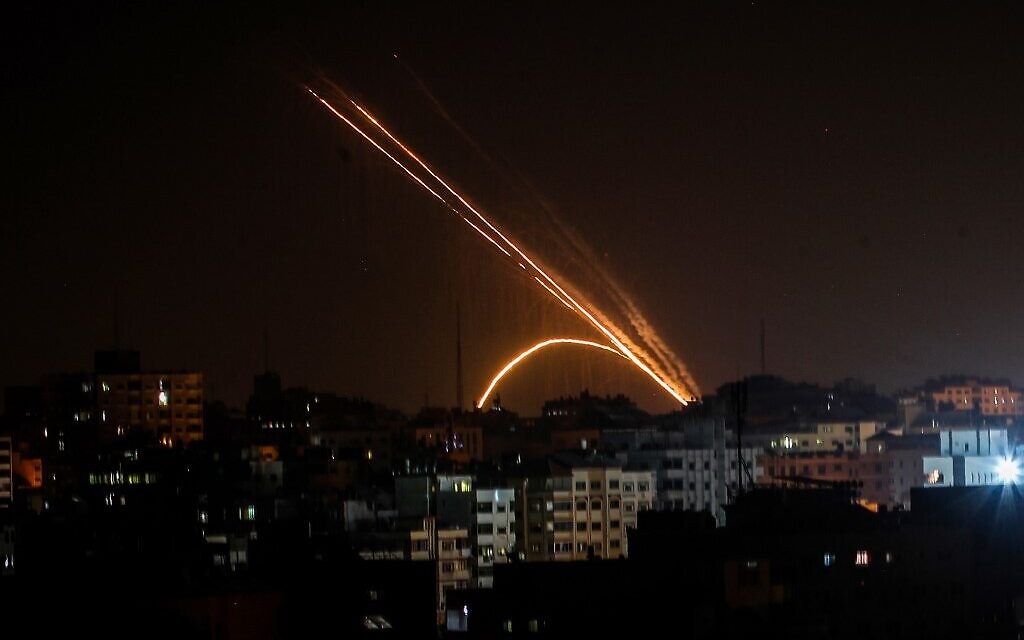
Illustrative: Rockets are fired from the Gaza Strip toward Israel on November 13, 2019. (Anas Baba/AFP)

Illustrative: Rockets are fired from the Gaza Strip toward Israel on November 13, 2019. (Anas Baba/AFP)

Israeli jets carried out airstrikes in the Gaza Strip overnight Saturday-Sunday in response to rocket fire from the restive Palestinian enclave, the army said.

The raids in central Gaza targeted Hamas installations, according to the Israel Defense Forces. The IDF said the strikes undermined the terror organization’s military capabilities and said Israeli forces remained “on high alert for various scenarios,” without elaborating.

There were no immediate reports of damage or injuries in the retaliatory strikes.

Palestinian terrorists fired at least two rockets at southern Israel on Saturday night, apparently hitting open fields and causing no injuries, despite recent reports from both sides of the border of a ceasefire agreement, the military said.

The rockets appeared to strike outside the community of Kibbutz Kissufim, just east of the Gaza border, in the Eshkol region. Residents of the area reported hearing the sound of an explosion.

Security forces began searching the area for the impact sites, an Eshkol spokesperson said.

The army later announced that it had cancelled the revocation of some 500 permits allowing businessmen out of Gaza, an increase on the fishing zone, and an agreement to allow cement to be imported into the Strip.

The retaliatory sanctions that Israel put in place against Palestinians in the Strip were to be eased in exchange for the cessation of attacks, an Israeli defense official told reporters on Thursday.

Defense Minister Naftali Bennett attends the campaign launch of his right-wing Yamina party, ahead of the general elections, February 12, 2020 (Tomer Neuberg/FLASH90)

The official had said that Hamas “sent messages to Israel that they’d decided unilaterally to stop launching balloons and rocket fire at Israel.”

Saturday’s attack came less than an hour after Defense Minister Naftali Bennett boasted in an interview on Channel 12 news that rocket fire from the Gaza Strip had decreased dramatically under his four-month tenure as defense minister, though it was not immediately clear how he reached this claim.

“From the three months before to the three months after I entered [the position of defense minister], the number of rockets dropped by 80 percent, and the riots on the border stopped completely,” Bennett said.

It was unclear how Bennett calculated this 80 percent drop, as just his first two days as defense minister saw a massive battle with the Palestinian Islamic Jihad terror group in Gaza in which hundreds of rockets were fired at Israel, compared to the 13 rockets and mortar shells fired at Israel in the three months prior to his entering the position, according to statistics from the Shin Bet security service.

The defense minister also made a somewhat dubious claim about the Israel Defense Forces’ response to the launching of balloon-borne explosive devices from the Gaza Strip into Israel.

“We are blowing up Hamas bases because of balloon launches, something we never did before,” Bennett said. The IDF did, in fact, conduct airstrikes on Hamas positions in response to these airborne explosives attacks multiple times over the years under previous defense ministers.

Saturday’s rocket fire came amid reports of an emerging ceasefire between Israel and terror groups in the Strip, following weeks of tensions and low-level clashes around the border, with regular rocket attacks and the daily launching of balloon-borne explosive devices into the country’s south.

Balloons carrying an incendiary device floats after being released near Gaza’s Bureij refugee camp, along the Israel-Gaza border fence, on February 10, 2020. (MAHMUD HAMS / AFP)

A Hamas official told a Lebanese newspaper on Saturday that the terror group had in fact decided to reduce the number of incendiary balloons launched toward Israel, not stop them entirely.

The Lebanese pro-Hezbollah Al-Akhbar newspaper, citing an unnamed Hamas official, said that the number of launches would be reduced only after Israel met the group’s demands.

Indeed, bunches of balloons carrying suspected explosive devices from the Gaza Strip landed in Israel throughout the day on Friday and Saturday. Police sappers were called to the scenes. Nobody was hurt in any of the incidents.

Thursday saw a number of balloon-borne incendiary devices explode over Israeli communities near the Gaza border, including one that detonated above a school.

The potential breakthrough between Israel and the terror group came after the Egyptian military and the United Nations intervened last week, sending in delegations on Monday and Wednesday, respectively, according to Palestinian reports.

Al-Akhbar, citing unnamed sources in Palestinian terror groups, reported on Tuesday that the Egyptian delegation had conveyed a message from Prime Minister Benjamin Netanyahu to Hamas in which he demanded “a return to calm.”

The sources told the daily that Netanyahu’s message, which the Egyptian delegation received from Israeli security officials in Tel Aviv on Sunday, included a threat that Israel would “deliver a major blow to Hamas with American and international cover” if calm is not restored.

This week, Israeli politicians publicly threatened a harsh military response if attacks from the Gaza Strip continued.

“I want to make this clear: We won’t accept any aggression from Gaza. Just a few weeks ago, we took out the top commander of Islamic Jihad in Gaza, and I suggest that Islamic Jihad and Hamas refresh their memories,” Netanyahu said, at the opening of the weekly cabinet meeting at his office in Jerusalem on Sunday.

“I won’t lay out in detail all our actions and plans in the media, but we’re prepared for crushing action against the terror groups in Gaza. Our actions are powerful, and they’re not finished yet, to put it mildly,” he said.

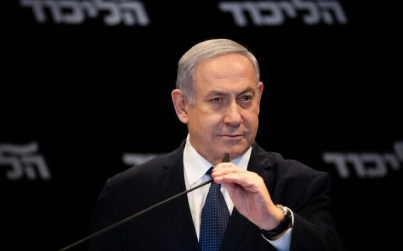
Prime Minister Benjamin Netanyahu at the Orient Hotel in Jerusalem on January 1, 2020. (Yonatan Sindel/Flash90)

Bennett similarly issued a warning to Hamas leaders in Gaza last Sunday, warning that Israel would take “lethal action against them” if their “irresponsible behavior” didn’t cease.

No Israelis have been injured directly by the latest round of rocket and airborne explosives. In response to the attacks, the Israel Defense Forces conducted strikes on Hamas targets in the Gaza Strip, which have not injured Palestinians. However, last month, a group of three Palestinians armed with explosives crossed the security fence into southern Israel from Gaza and, once surrounded, attacked a group of Israeli soldiers, who returned fire, killing the trio.

Israeli defense officials believe that the Gaza-ruling Hamas terror group was trying to increase pressure on Israel in a bid to extract greater concessions in the ceasefire negotiations.

Fears have also mounted in recent weeks of an escalation of violence in Gaza and the West Bank following the release last month of a US peace plan that is seen as heavily favoring Israel and which Palestinian leaders have rejected.

Times of Israel staff contributed to this report.


Israel’s F-35i ‘Adir’ Stealth Fighter Is a Beast (And Now A Second Squadron Is Ready) 

February 15, 2020

https://www.youtube.com/watch?v=u1ZiBfzT_nM


Israel unveiled its second F-35i squadron to coincide with the n
ew year at its Nevatim Airbase where its F-35s are based.

This is a milestone for Israel which received its first F-35s in 2016 and declared its first squadron operation in December 2017.

Israel’s F-35i is a modified version with unique features.

Israel is expected to acquire at least 50 of the Lockheed Martin jets amid rising tension with Iran. It fulfills Israel’s desire to have a qualitative military edge over adversaries throughout the Middle East.

The F-35i has been kept under wraps and extreme security by Israel, however, the country has been slowly illustrating the plane’s effectiveness.

In photos shown in May 2018 the F-35 was pictured flying over Beirut. At the same time, the plane was said to have carried out its first combat sorties from Israel.

Also, Israel recently hosted its Blue Flag exercise where its F-35s flew alongside Italian F-35s and US warplanes. Israel has said that its Air Force has carried out more than 1,000 airstrikes in Syria against Iranian targets over the last years and Israel has also hinted that it has struck Iranian-backed militias in Iraq.

Israel’s security challenges amid escalating tensions – Jerusalem Studio 488

February 14, 2020