Archive for January 2020

Iran admits to using hacking to avoid US sanctions on news website 

January 26, 2020

Source: Iran admits to using hacking to avoid US sanctions on news website – The Jerusalem Post

An official admitted that the company had restored the domain to Fars by using DNS spoofing, a type of hacking that redirects users to the wrong website when they try to access a certain URL.

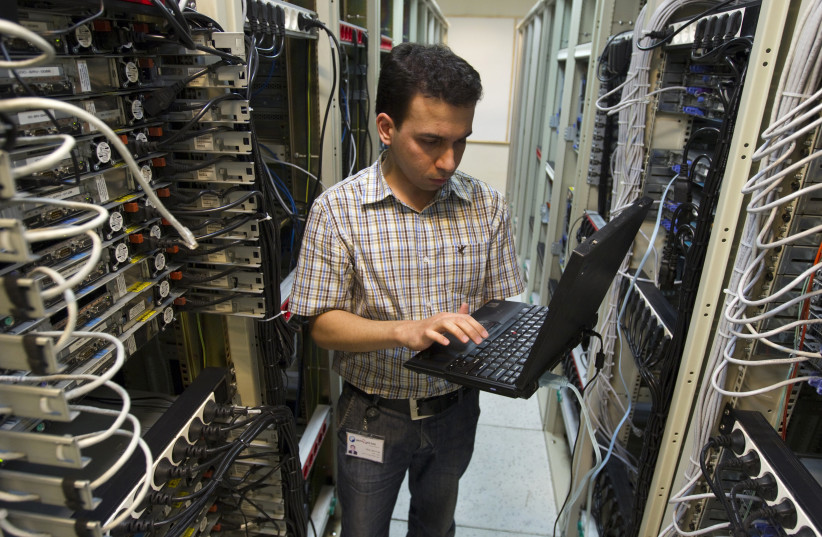
A computer engineer checks equipment at an internet service provider in Tehran February 15, 2011 (photo credit: CAREN FIROUZ / REUTERS)
A computer engineer checks equipment at an internet service provider in Tehran February 15, 2011
(photo credit: CAREN FIROUZ / REUTERS)
The Iranian Fars News Agency used DNS spoofing, a type of computer hacking, to restore its ‘.com’ domain after it was blocked by the US Treasury’s Office of Foreign Assets Control’s order on Saturday, according to Radio Farda.

One official from a company owned by Iran’s Ministry of Telecommunications admitted that the company had restored the domain to Fars by using DNS spoofing, a type of hacking that redirects users to the wrong website when they try to access a certain URL.
Sajad Bonabi, a member of the Board of Directors of Telecommunications Infrastructures Company, admitted to the DNS spoofing, also known as DNS cache poisoning, in a tweet on Saturday.
Bonabi added that websites and companies “that suspect they would be targeted by the cowardly sanctions of the United States” could contact the company he works for in order to learn precautionary measures.
“For the first time in Iran’s Internet history, the Iranian regime has confirmed that the DNS Spoofing was done. DNS Spoofing is a method used by hackers to redirect the traffic of a particular website to another destination,” said London-based digital security expert Amin Sabeti to Radio Farda.

At the time of writing, Fars’ websites in English and Farsi were not accessible from Israel. The news site was available from an Iranian ‘.ir’ domain and continued to publish tweets. Fars called the blocking of the ‘.com’ domain an “uncivilized move” and a “flagrant violation of the freedom of expression.”

Fars reported that it received a letter from the international service provider saying “the US Treasury Department’s Office of Foreign Assets Control (OFAC) has included the news agency in its SDN list and ordered it to stop domain services to Fars News Agency.”

Former Shin Bet officials told the Jerusalem Post earlier this month that Iran may use advanced cybertools from China against Israel or the US in the wake of the assassination of former IRGC Quds Force commander Qasem Soleimani.
In March, Iranian intelligence hacked into the phone of Blue and White leader Benny Gantz, according to the Shin Bet (Israel Security Agency), and took all its contents – including sensitive information, according to Channel 12.
In April, Google blocked access to the YouTube and Gmail accounts of Iranian state broadcasters Press TV and Hispan TV, according to Forbes. Press TV claimed that Google blocked access “without prior notice” and that they had received a message telling them that their “Google Account was disabled and can’t be restored because it was used in a way that violates Google’s policies.”
Iranian state TV and media companies have been earning advertising revenue from YouTube content and have garnered a following internationally.
It is unclear how US sanctions could affect this source of revenue for Iranian state TV.
The Shahrvand newspaper in Tehran reported that managers of the state-run Islamic Republic of Iran Broadcasting (IRIB) located outside of Iran can still claim the advertising money, even though YouTube and Google are under US law. The Iranian state TV’s YouTube channels are officially based outside of Iran.
State TV channels have also been able to garner a following internationally through social media and live broadcasts, as a Press TV director explained in an interview with the Iranian Fars News Agency.
Radio Farda estimated that the IRIB can earn up to a hundred thousand dollars a year, and that number could continue to rise.
Press TV and Hispan TV’s YouTube channels are still open, but no new content can be uploaded.
Facebook also shut down multiple Iran-sponsored groups and accounts in April, saying that “the pages routinely amplified Iranian state narratives, targeting Israel, the United States, and Saudi Arabia, especially for their roles in the Middle East, and focusing on the Yemen and Palestine conflicts. The pages often shared articles from websites which reproduced, verbatim, content from Iranian state or state-allied outlets, such as Press TV.”
Habib Abdul Hussein, director of Press TV’s website and social networks, told Fars that the agency’s budget is a small fraction of the budget of international media, and that it is still able to combat other narratives from external media.
Gil Hoffman and Yonah Jeremy Bob contributed to this report.


Iran has passed low uranium enrichment threshold for a nuke – official 

January 26, 2020

Source: Iran has passed low uranium enrichment threshold for a nuke – official – The Jerusalem Post

Actual nuke still requires decision to weaponize, deliver

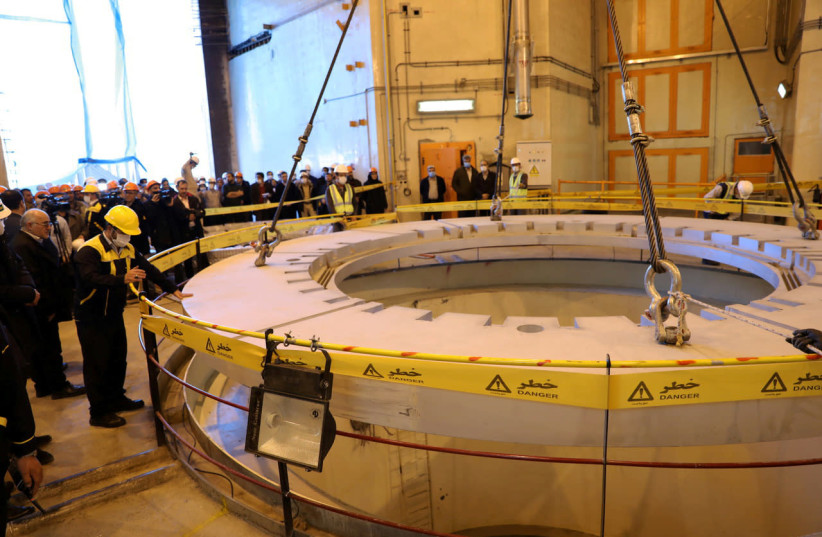
FILE PHOTO: Members of the media and officials tour the water nuclear reactor at Arak, Iran December 23, 2019. WANA (West Asia News Agency) via REUTERS  (photo credit: REUTERS)
FILE PHOTO: Members of the media and officials tour the water nuclear reactor at Arak, Iran December 23, 2019. WANA (West Asia News Agency) via REUTERS
(photo credit: REUTERS)
Iran’s Deputy Atomic Energy Organization Director Ali Asghar Zarean posted a surprising report on Saturday stating that it had passed 1,200 kg. of low level enriched uranium. The IAEA and a number of Iran-watch groups regard 1,000 kg.’s of low-enriched uranium as enough for a nuclear bomb, which means that if the announcement is not disinformation, it could be a major turning point.

If true, the news could substantially accelerate the point at which Israel and the US might need to decide if they will intervene militarily before Iran develops a nuclear weapon.

There is still time for Israel and the US to deliberate, as to fire a nuclear missile, Iran would still need to decide to enrich the 1,200 kg. to 90% weaponized uranium and would need to develop a method to deliver the nuclear material – something IDF Chief-of-Staff Lt. Gen. Aviv Kochavi has said could take another year.

The announcement was shocking as the last update about the Islamic Republic’s uranium stock set it at under 400 kg. and less than two weeks ago Kochavi predicted that Tehran would not reach 1,300 kg. until the end of 2020.

Other top officials like former IDF intelligence chief Amos Yadlin had predicted Iran would not reach this threshold until the summer or early fall. Even former IAEA official Olli Heinonen (now at the Stimson Center) had not predicted Iran would get to this point as fast, suggesting April might be the earliest.

Prior to the 2015 nuclear deal, Iran had roughly ten times as much uranium – enough for 10 nuclear bombs – but never enriched any uranium above the 20% level – a medium level that it has not yet reached this time.

Two sources The Jerusalem Post spoke to were unsure whether the announcement was accurate or a disinformation campaign.Neither Prime Minister Benjamin Netanyahu nor Blue and White leader Benny Gantz had responded by press time and the IDF would not address such a foreign report.

In the announcement, Zarean said Iran has the capacity to enrich uranium at any percentage if Iranian authorities decide to do so.

“At the moment, if [Iranian authorities] make the decision, the Atomic Energy Organization, as the executor, will be able to enrich uranium at any percentage,” Ali Asghar Zarean said.

Iran said earlier this month it would scrap limitations on enriching uranium, taking a further step back from commitments to the 2015 nuclear deal with six major powers, but pledged to continue cooperating with the UN nuclear watchdog the International Atomic Energy Agency.

Washington withdrew from the nuclear deal in May 2018 and reimposed sanctions to throttle Iran’s oil exports as part of a “maximum pressure” policy.

The United States says it aims to force Tehran to agree to a broader deal that puts stricter limits on its nuclear work, curbs a ballistic missile program and ends regional proxy wars. Iran says it will not negotiate while sanctions remain in place.

Tehran has steadily been reducing its compliance with the deal, which prompted Britain, France and Germany to formally accuse it in mid-January of violating the terms and activating a dispute mechanism in the deal, which could eventually lead to the reimposition of UN sanctions.

Iranian Foreign Minister Mohammad Javad Zarif said last week that if Iran’s nuclear file is sent to the Security Council, the country will withdraw from the Non-Proliferation Treaty (NPT), according to the official IRNA news agency.

Reuters contributed to this report. 


IDF jets strike Gaza targets in response to launch of incendiary devices

January 26, 2020

Source: IDF jets strike Gaza targets in response to launch of incendiary devices | The Times of Israel

Multiple sites targeted in Hamas-run enclave; earlier, explosive device resembling RPG found near Sde Boker

Footage reportedly showing an explosion during an Israeli airstrike in Gaza on January 25, 2020. (screen capture: Twitter)

Footage reportedly showing an explosion during an Israeli airstrike in Gaza on January 25, 2020. (screen capture: Twitter)

Israeli jets struck a number of targets in the southern Gaza Strip late Saturday night in response to incendiary devices being launched over the border, the Israel Defense Forces said Saturday.

Recent days have seen several instances of balloon bunches carrying incendiary devices and explosive packages which made their way into Israel, the IDF spokesperson’s office said in a statement.

The targets included a weapon-manufacturing depot and a military post operated by Hamas, the Palestinian terror group that rules Gaza.

There were no reports of injuries from the airstrikes in the southern Gaza Strip.

The IDF said that it would “continue to act as necessary against attempts to harm its citizens.”

“The Hamas terror group is responsible for everything that occurs in the Gaza Strip and will bear the consequences for terror attacks against Israeli citizens,” the military said.

Video reportedly showing an airstrike was shared by Hebrew-language media.

כאן חדשות

@kann_news

בתגובה לשיגור בלוני הנפץ מעזה, מטוסי קרב של צה”ל תקפו כמה יעדים של חמאס@Itsik_zuarets

כאן חדשות

@kann_news

תיעוד: תקיפת צה”ל בדרום רצועת עזה
(צילום: חפ”ק מרחב ארצי 24/7)http://bit.ly/2TVLugk 

Embedded video

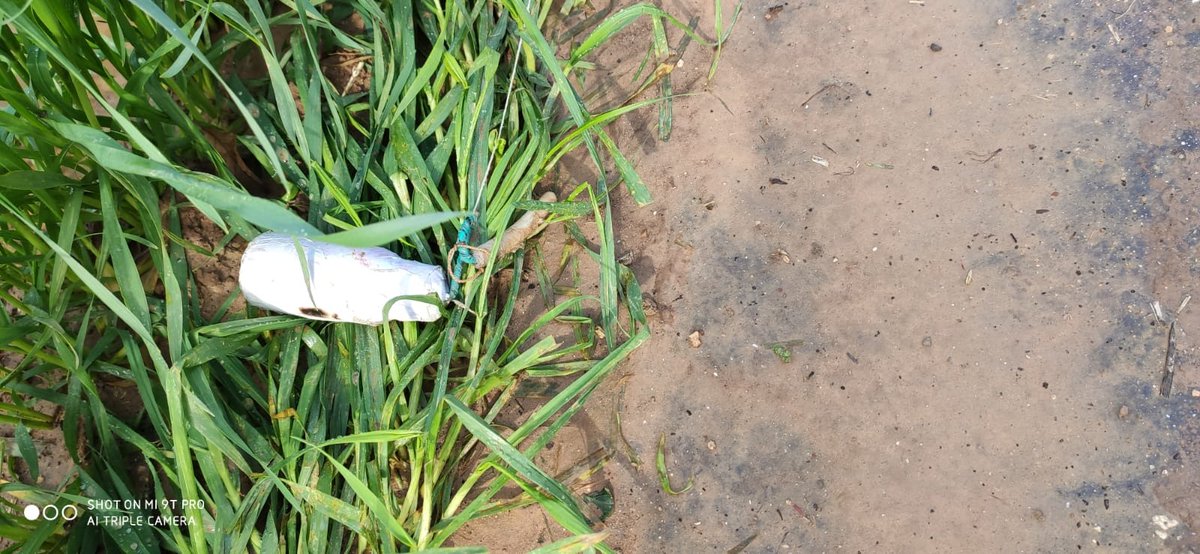
On Saturday morning, a bunch of balloons tied to a suspected bomb was found near Kibbutz Sde Boker in the Negev. The airborne device is believed to have come from the Gaza Strip, from which numerous balloons carrying incendiary and explosive packages have been launched in recent days.

Images of the suspected explosive shared on social media showed a device similar in appearance to a rocket-propelled grenade.

The balloon was discovered by security staff at the Midreshet Ben-Gurion educational center. Police sappers were called to the scene and neutralized the device.

Sde Boker is located some 40 kilometers (25 miles) from the Strip.

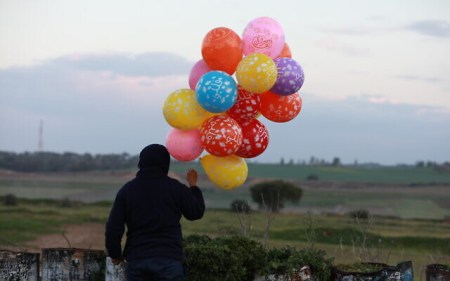
A bunch of balloons attached to an incendiary device is prepared to be flown into Israel, near the Israel-Gaza border east of Al-Bureij refugee camp in the central Gaza Strip, January 22, 2020. (Ail Ahmed/Flash90)

A second batch of balloons connected to an incendiary device was later discovered in the Ramat Negev Regional Council. It was neutralized by sappers as well.

Terror groups in Gaza have continued to launch incendiary devices attached to balloons into Israel in recent days, undeterred by Israel’s threats to respond forcefully to such incidents.

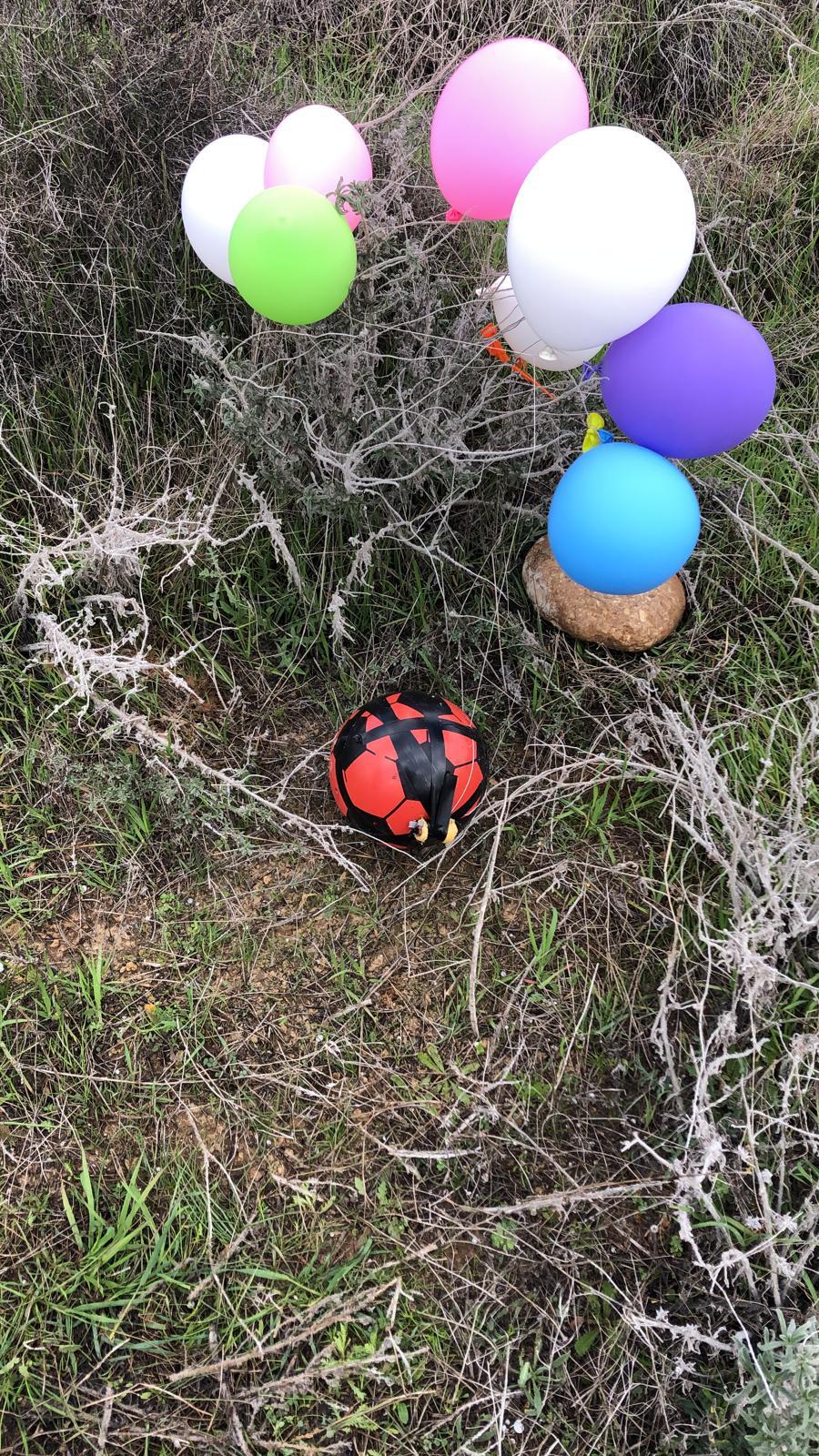
On Thursday, five suspicious balloons were floated into Israel, including a soccer ball attached to an explosive device that landed in an open area of the Sha’ar Hanegev Regional Council.

Soldiers from the IDF’s Engineering Corps were called to the scene and defused the device. No was injured by the explosives-laden ball, which appeared to be another attempt to target children. Many of the attacks have been launched via brightly colored balloons and local children have been warned not to approach them.

כאן חדשות

@kann_news

אותר צרור בלונים עם כדורגל, אליו הוכנסו חומרי נפץ, באזור אתר חץ שחור בעוטף עזה@Itsik_zuarets

View image on Twitter

On Friday another suspicious object apparently flown from Gaza with balloons was found in the Sha’ar Hanegev Regional Council. Police officers were dispatched to a field where the device landed.

חדשות 13

@newsisrael13

צרור בלונים עם מטען נחת בשטחים החקלאיים של קיבוץ שער הנגב. כוחות המשטרה נמצאים במקום @bokeralmog

View image on Twitter

On Thursday evening, a rocket warning siren sounded in a community near the Gaza border. The army said it was triggered by an unexplained explosion inside Gaza, and not a rocket launch.

The siren raised tensions in the south amid threats from Gaza’s Hamas rulers to escalate violence in order to pressure Israel during informal truce talks now underway via Egyptian mediation.

Israeli television this week reported that Egypt is involved in “intense efforts” to get Hamas to end the arson balloon attacks on Israel from Gaza amid fears of a return to violence.

There was no official confirmation of the report from Egypt or Hamas.

A senior Hamas official said Tuesday that the recent spate of balloons was a signal to Israel to accelerate unofficial “understandings” meant to ease the blockade on the territory ruled by the terror group.

Speaking to journalists, Hamas official Khalil al-Hayya said the balloons had been launched by disgruntled individuals, not Hamas. But he said his group was “satisfied” with the launches and is ready to send more “if the occupation doesn’t pick up the message.”

The UN’s Mideast envoy, Nickolay Mladenov, called the renewed balloon launches “concerning and regrettable” in a briefing to the Security Council on Tuesday. “These actions are a risk to the civilian population,” he said.


Trump rejects Iran talks opening as enriched uranium stockpile swells

January 26, 2020

Source: Trump rejects Iran talks opening as enriched uranium stockpile swells | The Times of Israel

US president rebuffs overture for negotiations if sanctions lifted; nuclear official says Tehran has almost three times as much enriched material as allowed under nuke deal

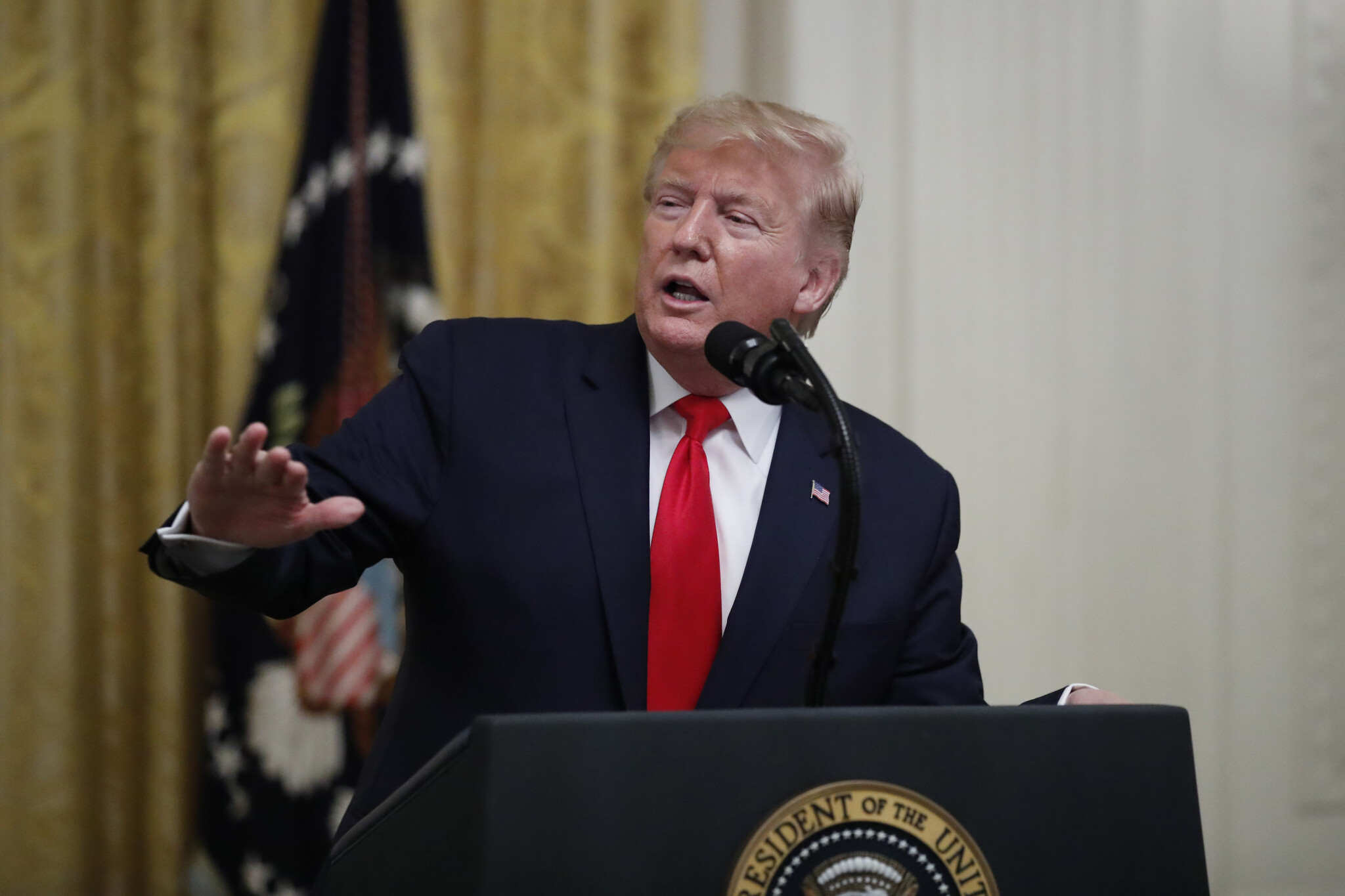
President Donald Trump speaks to a bipartisan group of mayors in the East Room of the White House, Friday, Jan. 24, 2020, in Washington. (AP/Alex Brandon)

President Donald Trump speaks to a bipartisan group of mayors in the East Room of the White House, Friday, Jan. 24, 2020, in Washington. (AP/Alex Brandon)

US President Donald Trump turned down the possibility of talks with Tehran after Iran’stop diplomat said his country was still willing to negotiate over its nuclear program if Washington lifts sanctions.

Iranian Foreign Minister Mohammed Javad Zarif told Germany’s Der Spiegel magazine that he would “never rule out the possibility that people will change their approach and recognize the realities,” in an interview published Saturday.

“Iranian Foreign Minister says Iran wants to negotiate with The United States, but wants sanctions removed,” Trump tweeted Saturday night. “No Thanks!”

He later repeated the tweet in Persian.

Donald J. Trump

@realDonaldTrump

There has been growing tension between Washington and Tehran since in 2018, when Trump pulled the United States out of the nuclear deal with Iran. The US has since reimposed tough sanctions that have crippled Iran’s economy.

Tensions hit a boiling point after the US killed top Iranian General Qassem Soleimani earlier this month, though the sides stepped away from armed conflict after no Americans were killed in an Iranian reprisal missile strike on a US base in Iraq.

Zarif suggested Iran was still willing to talk to the US, though reiterated his country’s previous demand that first the US would have to lift sanctions.

“For us, it doesn’t matter who is sitting in the White House, what matters is how they behave,” he said, according to Der Spiegel, which conducted the interview in Tehran Friday. “The Trump administration can correct its past, lift the sanctions and come back to the negotiating table. We’re still at the negotiating table. They’re the ones who left.”

Iranian Foreign Minister Mohammad Zarif smiles as he meets French Minister of Foreign Affairs Jean-Yves Le Drian (not seen) on September 22, 2019 in New York City. (Johannes EISELE / AFP)

Meanwhile on Saturday, Ali Asghar Zarean, an aide to Iran’s nuclear chief, said Iran’s enriched uranium stockpile has exceeded 1,200 kilograms (2,646 pounds), which is far beyond the 2015 nuclear deal between Tehran and world powers allowed.

“Iran is increasing its stockpile of the enriched uranium with full speed,” he said. The claim has not been verified by the UN’s nuclear watchdog.

Following the US drone strike on January 3 that killed Revolutionary Guard general Soleimani, Iran announced it would no longer abide by any of the deal’s limitations to its enrichment activities.

In November, the International Atomic Energy Agency said Iran’s stockpile of low-enriched uranium had grown to 372.3 kilograms (821 pounds) as of November 3. The nuclear deal limited the stockpile to 202.8 kilograms (447 pounds).

In this photo released on November 6, 2019 by the Atomic Energy Organization of Iran, a lift truck carries a cylinder containing uranium hexafluoride gas for the purpose of injecting the gas into centrifuges in Iran’s Fordo nuclear facility.(Atomic Energy Organization of Iran via AP)

Iran has routinely vowed to begin enriching its stockpile of uranium to higher levels closer to weapons grade if world powers fail to negotiate new terms for the nuclear accord following the US decision to withdraw from the agreement and restore crippling sanctions. European countries opposed the US withdrawal and have repeatedly urged Iran to abide by the deal.

Under the agreement, Iran agreed to limit its enrichment of uranium under the watch of UN inspectors in exchange for the lifting of sanctions.

Trump has maintained that the 2015 nuclear deal needs to be renegotiated because it didn’t address Iran’s ballistic missile program or its involvement in regional conflicts. The other signatories to the nuclear deal — Germany, France, Britain, China and Russia — have been struggling to keep it alive.

Zarif did suggest Iran was also still prepared for conflict with the US, though was not specific.

“The US has inflicted great harm on the Iranian people,” he said. “The day will come when they will have to compensate for that. We have a lot of patience.”


Iranian FM: We’re still willing to negotiate with US 

January 25, 2020

Source: Iranian FM: We’re still willing to negotiate with US | The Times of Israel

Zarif says despite tensions with Washington, Tehran not ruling out ‘possibility that people will change their approach and recognize the realities’

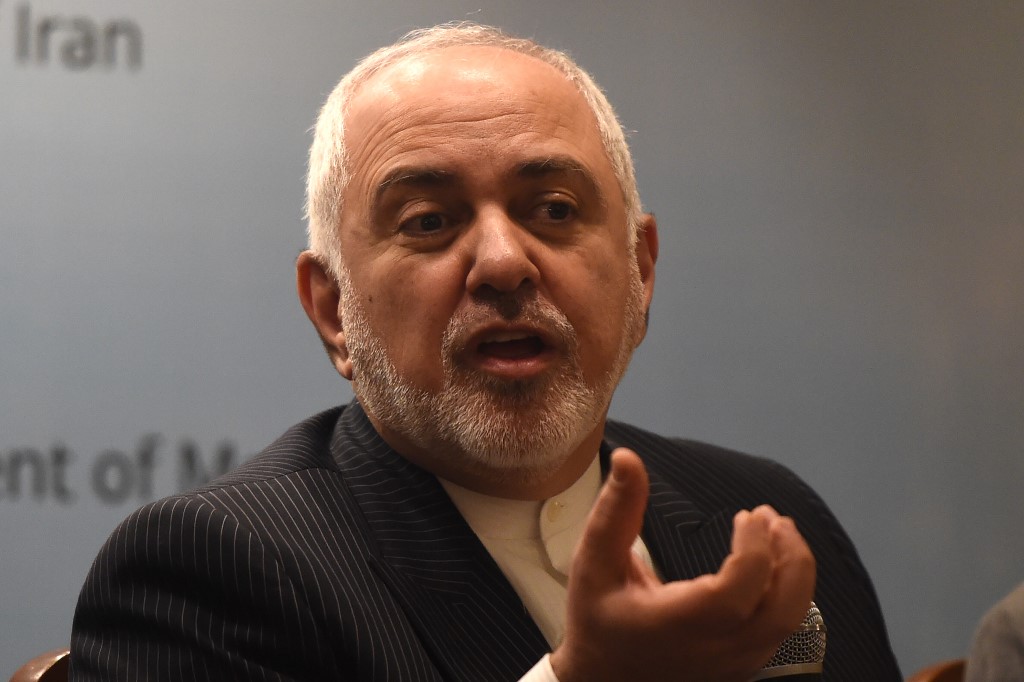
Iran’s Foreign Minister Mohammad Javad Zarif addressees a gathering at the All India Association of Industries (AIAI) in Mumbai on January 17, 2020. (Punit PARANJPE / AFP)

Iran is not ruling out negotiations with the United States even after an American drone strike that killed a top Iranian general, the country’s foreign minister said in an interview released Sunday.

Mohammad Javad Zarif told Germany’s Der Spiegel magazine that he would “never rule out the possibility that people will change their approach and recognize the realities,” in an interview conducted Saturday in Tehran.

There has been growing tension between Washington and Tehran since 2018, when President Donald Trump pulled the United States out of the nuclear deal with Iran. The US has since reimposed tough sanctions that have crippled Iran’s economy.

But Zarif suggested Iran was still willing to talk, though he reiterated his country’s previous demand that first the US would have to lift sanctions.

Iranian Foreign Minister Mohammad Javad Zarif during talks in Moscow, Russia, December 30, 2019. (Alexander Zemlianichenko/AP)

“For us, it doesn’t matter who is sitting in the White House, what matters is how they behave,” he said, according to Der Spiegel. “The Trump administration can correct its past, lift the sanctions and come back to the negotiating table. We’re still at the negotiating table. They’re the ones who left.”

Trump has maintained that the 2015 nuclear deal needs to be renegotiated because it didn’t address Iran’s ballistic missile program or its involvement in regional conflicts. The other signatories to the nuclear deal — Germany, France, Britain, China and Russia — have been struggling to keep it alive.

Following the US drone strike on January 3 that killed Revolutionary Guard General Qassem Soleimani, Iran announced it would no longer abide by any of the deal’s limitations to its enrichment activities. It then retaliated on January 8, launching ballistic missiles at two bases in Iraq housing American troops, causing injuries but no fatalities among soldiers there.

Zarif did suggest Iran was also still prepared for conflict with the US, though he was not specific.

“The US has inflicted great harm on the Iranian people,” he said. “The day will come when they will have to compensate for that. We have a lot of patience.”

A warning from the US

Meanwhile, on Friday, America’s top Iran policy official warned of a repeat of its January 3 killing of Soleimani if the latter’s successor follows in his footsteps and kills Americans.

Esmail Ghaani, who took over command of the Revolutionary Guard’s Quds Force the very day Soleimani was killed, has repeatedly promised to exact “revenge” on the US for the assassination, including in a Tuesday speech where he vowed to “hit his enemies in a manly fashion.”

“If he follows a similar path of killing Americans, he will meet the same fate,” Brian Hook, the US special representative for Iran, said of Ghaani in an interview published Thursday with the Asharq al-Awsat Arabic-language daily.

“The president has made clear for years that any attacks against American personnel or interests in the region will be met with a decisive response, and the President demonstrated that on January 2nd,” Hook said, according to an English transcript posted by the newspaper.

“So this is not a new threat. The president has always said that he will act decisively in defense of American interests. And I think the regime now understands that they cannot attack America at will and expect to get away with it. So we will hold the regime and its proxies accountable for any attacks on Americans, or on American interests in the region,” Hook said.

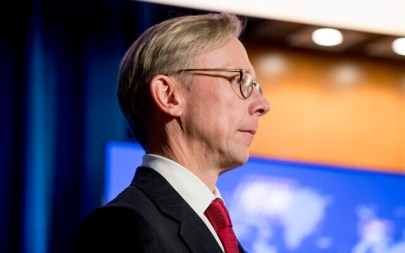
US special representative on Iran Brian Hook at a news conference at the State Department in Washington, November 18, 2019. (Andrew Harnik/AP)

An Iranian spokesman responded to Hook’s warning by calling it “governmental terrorism.”

“These words are an official announcement and a clear unveiling of America’s targeted and governmental terrorism,” Iranian Foreign Ministry spokesman Abbas Mousavi said Thursday, according to Reuters, citing the official IRIB news agency.

Mousavi also urged the international community to condemn the American official’s comments.

In his interview, conducted at the World Economic Forum at Davos, Hook defended the killing of Soleimani and Trump’s combative policies toward the Islamic Republic.

“We took the world’s most dangerous terrorists off the battlefield… and as a consequence, the region is going to be safer because Soleimani was the glue that held together the proxies, and his death will create a void that the regime will not be able to fill,” he said.

Worshipers in Iran chant slogans during Friday prayers ceremony by a banner showing slain Iranian Revolutionary Guard general Qassem Soleimani, left, and Iraqi Shiite senior militia commander Abu Mahdi al-Muhandis, who were killed in Iraq in a US drone attack on January 3, and a banner which reads in Persian: ‘Death To America,’ at Imam Khomeini Grand Mosque in Tehran, Iran, January 17, 2020. (Office of the Iranian Supreme Leader via AP)

He also insisted Iran had been weakened by US sanctions and pressure.

“Iran is not able to get away with the kind of terrorist attacks that they used to. That doesn’t mean that we’ve eliminated Iran’s ability to conduct asymmetric attacks, but our new policy is making a difference,” Hook said. “The regime has never been weaker financially in its 40-year history, and it has never been under more domestic political unrest than it is now. And this is a consequence of the president’s new approach to Iran.”

In his Monday speech, Ghaani lashed the US strike as a “cowardly act,” saying “there are freedom-seekers across the world who want revenge for him with God’s help, and God willing, we will hit his enemy chivalrously.

“Our enemy understands no language but force and therefore, we should stand against them strongly,” he added, according to the Fars news agency.

The Quds Force is part of the 125,000-strong Revolutionary Guard, a paramilitary organization that answers only to Iran’s Supreme Leader Ayatollah Ali Khamenei. The Guard oversees Iran’s ballistic missile program, has its naval forces shadow the US Navy in the Persian Gulf and includes an all-volunteer Basij force.

A burning vehicle at the Baghdad International Airport following an airstrike in Baghdad, Iraq, in which Iranian Gen. Qassem Soleimani was killed January 3, 2020. (Iraqi Prime Minister Press Office via AP)

Trump ordered the drone strike in Iraq that killed Soleimani. At the time, Trump said the Quds Force head was planning attacks against US troops in the region, though he later stepped back from that assertion.

In response to the drone strike, Iran fired volleys of ballistic missiles at Iraqi bases housing US troops. There were no reported casualties at the time but it has since been revealed that 34 US troops suffered traumatic brain injuries.


Pentagon now says 34 troops suffered brain injuries in Iran missile strike

January 25, 2020

Source: Pentagon now says 34 troops suffered brain injuries in Iran missile strike | The Times of Israel

Casualty total at odds with Trump’s claim following attack on bases in Iraq that no US personnel were harmed; army previously said 11 service members suffered concussions

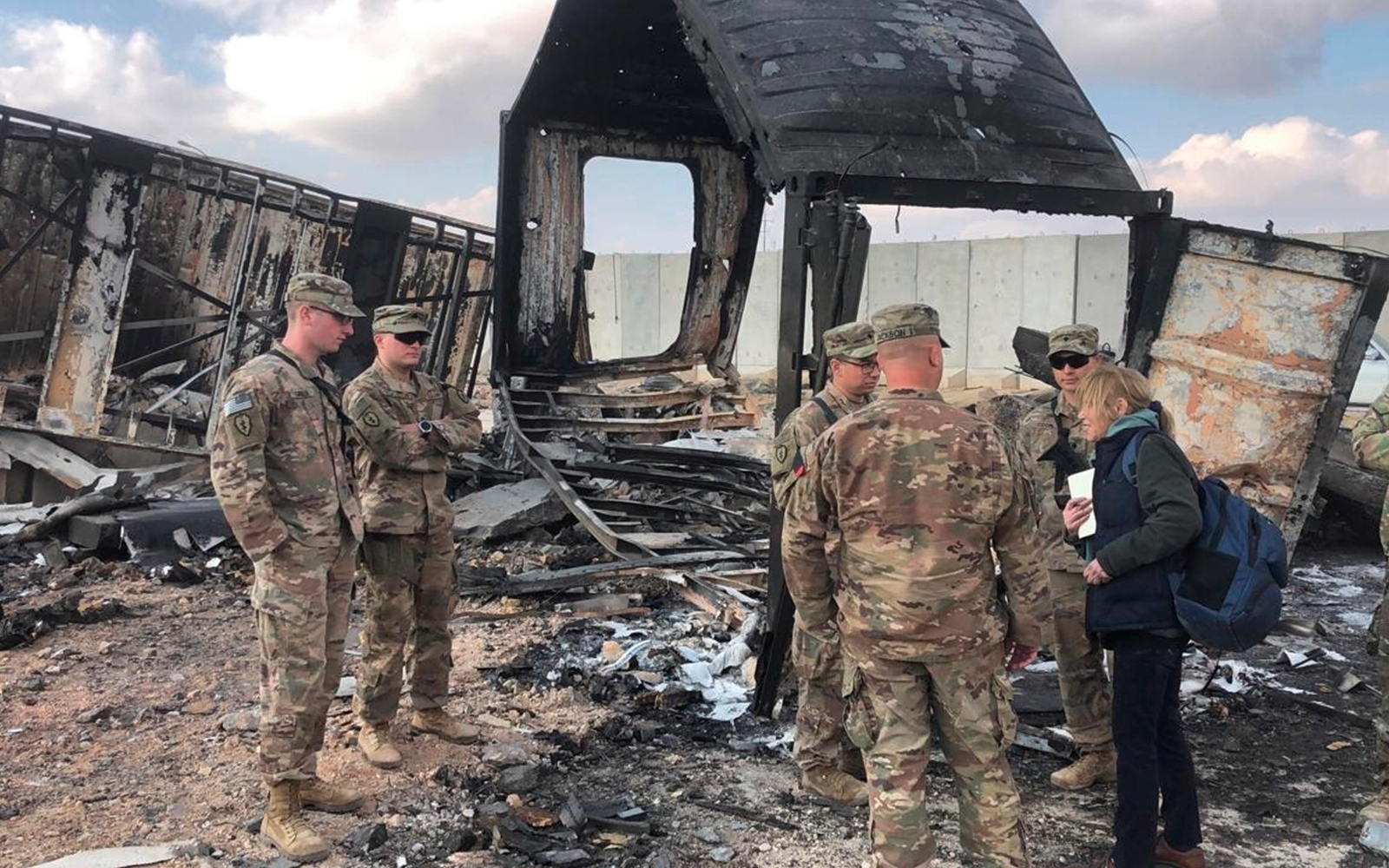
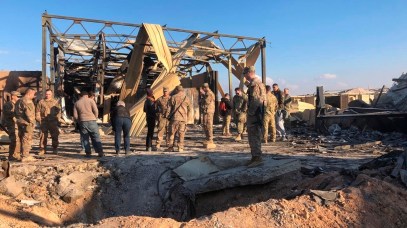
US soldiers stand amid damage at a site of Iranian bombing at Ain al-Asad air base, in Anbar, Iraq, January 13, 2020. (AP/Qassim Abdul-Zahra)

AP — The Pentagon disclosed on Friday that 34 US service members suffered traumatic brain injuries in Iran’s missile strike this month on an Iraqi air base, and although half have returned to work, the casualty total belies US President Donald Trump’s initial claim that no Americans were harmed. He later characterized the injuries as “not very serious.”

Eight of the injured arrived in the United States on Friday from Germany, where they and nine others had been flown days after the January 8 missile strike on Iraq’s Ain al-Asad air base. The nine still in Germany are receiving treatment and evaluation at Landstuhl Regional Medical Center, the largest US military hospital outside the continental United States.

Jonathan Hoffman, the chief Pentagon spokesman, said the eight in the US will be treated at Walter Reed National Military Medical Center in Bethesda, Maryland, or at their home bases. The exact nature of their injuries and their service and unit affiliations were not disclosed.

Trump had initially said he was told that no troops had been injured in the strike, which Iran carried out as retaliation for a US drone strike in Baghdad that killed Iran’s most powerful general, Qassem Soleimani, on January 3. The military said symptoms of concussion or traumatic brain injury were not immediately reported after the strike and in some cases became known days later. Many were in bunkers before nearly a dozen Iranian ballistic missiles exploded in their area.

The question of American casualties took on added importance at the time of the Iranian strike because the degree of damage was seen as influencing a US decision on whether to counterattack and risk a broader war with Iran. Trump chose not to retaliate, and the Iranians then indicated their strike was sufficient for the time being. Tensions have since eased.

After the Pentagon reported on January 17 that 11 service members had been evacuated from Iraq with concussion-like symptoms, Trump said, “I heard they had headaches and a couple of other things… and I can report it is not very serious.” He said he did not consider the injuries to be as severe as those suffered by troops who were hit by roadside bombs in Iraq.

Senator Jack Reed, a Rhode Island Democrat and former Army Ranger, called on Trump to apologize.

“TBI is a serious matter,” Reed said in a statement. “It is not a ‘headache,’ and it’s plain wrong for President Trump to diminish their wounds. He may not have meant to disrespect them, but President Trump’s comments were an insult to our troops. He owes them an apology.”

US soldiers stand at the site of an Iranian bombing at Ain al-Asad air base in Anbar, Iraq, Monday, Jan. 13, 2020. (AP/Qassim Abdul-Zahra)

Traumatic brain injury, or TBI, has become a growing concern for the military in recent years as medical science improves its understanding of the injury’s causes and effects on brain function. It can involve varying degrees of impairment of thinking, memory, vision, hearing and other functions. The severity and duration of the injury can vary widely.

The US Defense Department has said more than 375,000 incidents of TBI occurred in the military between the years 2000 and 2018.

Jefferson Kinney, a neuroscience researcher at the University of Nevada at Las Vegas, where he is chair of the department of brain health, said Friday that much remains to be learned about TBI, including its effects on behavior.

“It depends a lot on how severe the damage is and where the damage is,” among other factors, he said. “There is huge variability across individuals. Some people will undergo a trauma that they seem to recover from very quickly, and others seem to be much more impacted by it for a longer duration.”

The Centers for Disease Control and Prevention says a severe TBI may lead to death or result in an extended period of coma or amnesia.

Hoffman’s disclosure that 34 had been diagnosed with TBI was the first official update of the number injured since the Pentagon announced the evacuation of the first 11. On January 21, officials said more had been sent out of Iraq for further diagnosis and treatment, but the Pentagon declined to provide firm figures or say whether any had been returned to duty.

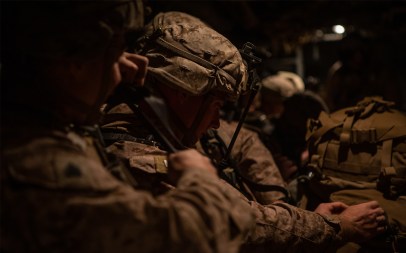
US Marines prepare to deploy from Kuwait in support of a crisis response mission, December 31, 2019. (US Marine Corps/Sgt. David Bickel)

Hoffman said that of the 34 with TBI, 18 were evacuated from Iraq to US medical facilities in Germany and Kuwait, and 16 stayed in Iraq. The one American sent to Kuwait has since returned to duty in Iraq. All 16 who stayed in Iraq have since returned to duty there, Hoffman said.

No one was killed in the attack on Ain al-Asad, even though the US had no missile defense systems there to protect from potential attack. Hoffman said Friday that deploying one or more Patriot anti-missile systems to Iraq is among options now being weighed by military commanders. The US had deployed numerous Patriot systems to other countries in the region as protection against Iranian missile attack, including in Saudi Arabia, but a strike on Iraq was seen as less likely.

Some members of Congress this week pressed the Pentagon for more clarity on the scope of the TBI cases resulting from the Iranian attack. Representative Bill Pascrell, a New Jersey Democrat and founder of the Congressional Brain Injury Task Force, wrote to senior Pentagon officials on Thursday requesting additional details on casualties from the attack.

On Friday morning, US Defense Secretary Mark Esper directed the Pentagon’s acting undersecretary of defense for personnel and readiness, Matthew Donovan, to begin working with the staff of the Joint Chiefs to review how military injuries are tracked and reported — not just TBI cases but battlefield injuries of all kinds, Hoffman told reporters.

“The goal is to be as transparent, accurate, and to provide the American people and our service members with the best information about the tremendous sacrifices our war fighters make,” Hoffman said.


Under Trump deal, Israel said to retain security control over Palestinian state 

January 25, 2020

Source: Under Trump deal, Israel said to retain security control over Palestinian state | The Times of Israel

Offering ostensible new details of imminent plan, TV report says US expects Palestinians to reject it, would encourage them to rethink; Trump says reports on content ‘speculative’

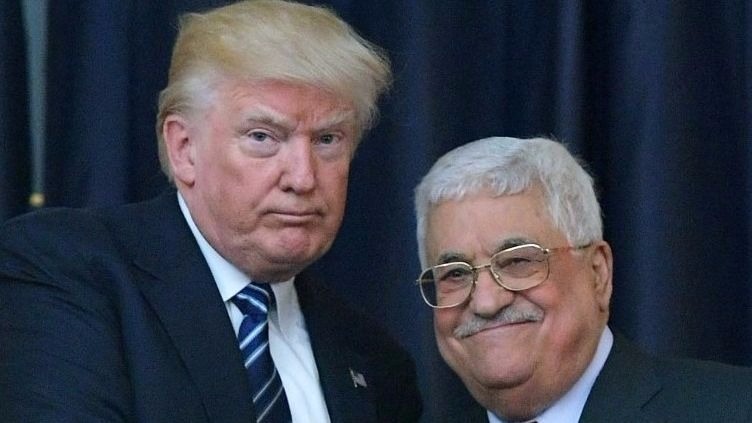
US President Donald Trump, left, and Palestinian leader Mahmoud Abbas pose for a photograph during a joint press conference at the presidential palace in the West Bank city of Bethlehem on May 23, 2017. (AFP/Mandel Ngan)

US President Donald Trump, left, and Palestinian leader Mahmoud Abbas pose for a photograph during a joint press conference at the presidential palace in the West Bank city of Bethlehem on May 23, 2017. (AFP/Mandel Ngan)

Under the terms of the soon-to-be released Trump administration peace plan, Israel would retain overall security control of the entire West Bank even if a Palestinian state is established in parts of it, Israeli TV reports said Friday night.

Adding fresh ostensible details regarding the content of the plan, Channel 13 said it ultimately provides for a demilitarized Palestinian state in some 80 percent of the West Bank, under overall Israeli control. That state would not be empowered to maintain an army and sign military treaties, and Israel would control its borders, further reports on Friday said.

The Channel 13 report said the US expects the Palestinians to reject the plan, but would encourage them to think again, and would say that the 80% of West Bank territory intended for their state would be kept for them for several years.

The various Israeli reports on the plan to date have made no mention of the intended fate of the Hamas-controlled Gaza Strip.

US President Donald Trump, who said Thursday that he has invited Israel’s Prime Minister Benjamin Netanyahu and rival Benny Gantz to the White House next Tuesday to discuss the plan, and that he would likely release it before that meeting, has dismissed reports on its ostensible content as “purely speculative.”

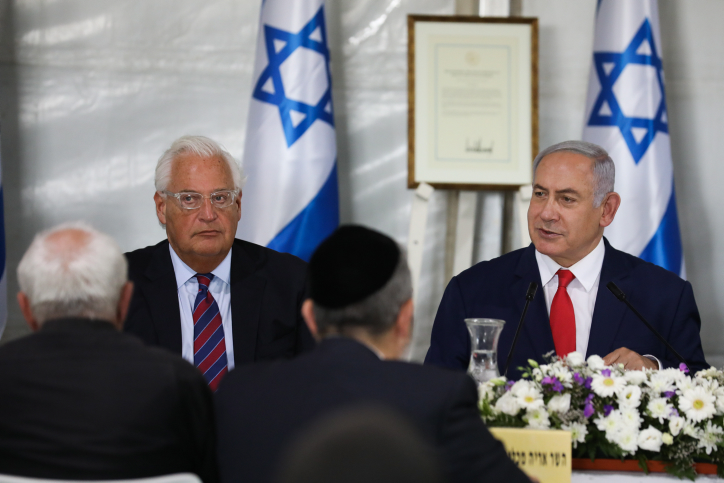
US Ambassador to Israel David Friedman and Prime Minister Benjamin Netanyahu at cornerstone laying ceremony for the new town Ramat Trump, named for US President Donald Trump in the Golan Heights, June 16, 2019. (David Cohen/Flash90)

Israeli reports have described the deal as the “most pro-Israel plan ever presented” by a US administration.

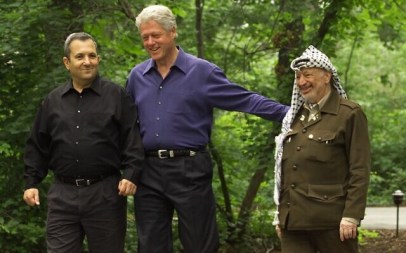
In the Clinton era, prime minister Ehud Barak offered to relinquish over 90% of the West Bank to the Palestinians; in 2008, prime minister Ehud Olmert offered what amounted to 100% of the West Bank with one-for-one land swaps, a capital in East Jerusalem, and the Old City under international control.

US President Clinton, center, accompanied by Prime Minister Ehud Barak, left, and Palestinian leader Yasser Arafat, right, walk on the grounds of Camp David, Md. in this July 11, 2000 file photo, during a Mideast summit. (AP Photo/Ron Edmonds, File)

Based on what it said were briefings given by US Ambassador to Israel David Friedman to various Israeli politicians in recent days, the Channel 13 report also said the Jordan Valley will be defined in the plan as Israel’s eastern security border. If Israel wants to annex that area, however, it would have to give the Palestinians territory in return in the Negev close to the Gaza Strip.

Elaborating on a Channel 12 report Thursday, the Channel 13 item said Israel would annex all 100-plus settlements, but that minor settlements among them would not expand further; building there would be frozen. Dozens of illegal outposts would be evacuated.

Again echoing Thursday’s report, Channel 13 said Israel would be sovereign in Jerusalem — though it added that several Arab neighborhoods formally inside Jerusalem that are located on the West Bank side of the security barrier would go to the Palestinians.

Israel would be sovereign at the Temple Mount and other Old City holy sites, but the Palestinians would have a role in their administration, it said.

Quoting sources in Gantz’s Blue and White party, Channel 13 reported that Israel would not be allowed to start annexing West Bank settlements and other areas unless it accepted the full plan.

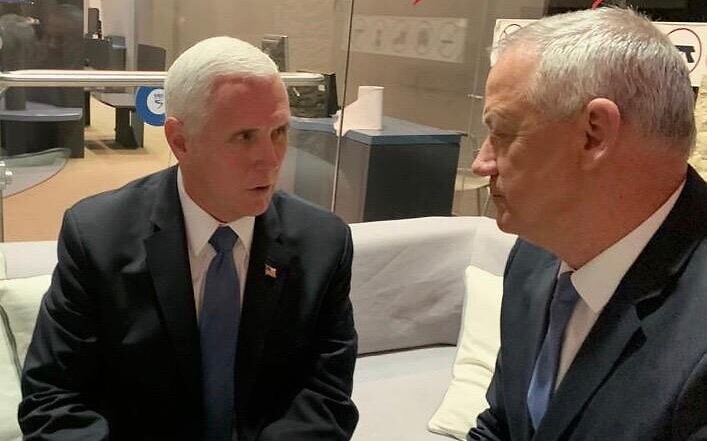
Blue and White chair Benny Gantz (R) meets with US Vice President Mike Pence in Jerusalem on January 23, 2020. (Courtesy)

Gantz, who initially was inclined to accept Trump’s invitation to the White House, is now leaning against going, Friday night TV reports said, regarding the timing of the plan’s release as a “trap,” with the trip likely to be utilized to boost Netanyahu and undermine him ahead of the March 2 elections. Gantz is to make a statement on the issue on Saturday evening.

The Palestinian Authority has preemptively rejected the plan, and is reportedly threatening to cancel its security coordination with Israel in the West Bank if it moves ahead. The PA has had no substantive dealings with the US administration since Trump recognized Jerusalem as Israel’s capital in December 2017.

The US is seeking to encourage allied Arab foreign ministers to attend Tuesday’s White House meeting, thus far to no avail, Channel 12 said.

In its report on the plan Thursday, Channel 12 said it provides for full Israeli sovereignty throughout Jerusalem, for Israel to annex all 100-plus West Bank settlements, and for no significant “return” to Israel of Palestinian refugees. It provides for the establishment of a Palestinian state, but on condition that the Hamas terror group gives up its weapons and the Palestinians recognize Israel as a Jewish state with Jerusalem as its capital.

It also said if Israel accepts the plan and the Palestinians reject it, Israel would have US support to begin annexing settlements unilaterally — a detail contradicted in Friday’s Channel 13 report.


US builds up Mid-East strength against rising tension over “Deal of the Century and Iran – DEBKAfile

January 25, 2020

Source: US builds up Mid-East strength against rising tension over “Deal of the Century and Iran – DEBKAfile

The USS Bataan strike group and the 2,400-strong 26th Marine Expeditionary Unit are being deployed to the Mid-East ready for unexpected trouble arising from spiraling tension with Iran and potential reactions to the release of Donald Trump’s “Deal of the Century” – a plan for an Israel-Palestinian peace –  early next week.

On Friday, Jan. 24, the USS Bataan amphibious assault ship, escorted by two other battleships, had reached the Red Sea opposite the eastern coast of the Arabian Peninsula. They had taken part in a naval exercise with Morocco, which was interrupted for their new mission.

US intelligence watchers believe that Iran is getting ready to expand its assaults on US and allied targets, including Israel and Saudi Arabia, in escalating payback for the US assassination of Al Qods chief Gen. Qassem Soleimani on Jan. 3.

On Friday, the Pentagon revealed that 34 US servicemen had suffered “traumatic brain injury” from Iran’s missile strikes on the US Ain al-Asad air base in Iraq on Jan. 8. Earlier, only 11 were reported injured, while President Trump had stated initially that no US troops had been hurt in the attack.

Gen. Frank McKenzie, head of the US Central Command in the Middle East, speaking from the deck of the Bataan, said, “Although the Soleimani killing was a deterrent, Iran continues to pose a very real threat.”

DEBKAfile’s military sources additionally attribute the latest American military movements to a reassessment of the tasks assigned to the US forces stationed in Iraq. Their new focus has moved to the semiautonomous Kurdish Republic (KRG) in northern Iraq. The three US airbases in other parts of the country, Ain al Asad, Balad and Taiji, will remain in place. However, three new American bases are under construction in Kurdistan.


Warning of Iran, PM tells Holocaust forum: We remember the world turned its back

January 24, 2020

Source: Warning of Iran, PM tells Holocaust forum: We remember the world turned its back | The Times of Israel

Netanyahu condemns ‘tyrants of Tehran,’ says Jews learned they can only rely on themselves for defense; Rivlin: ‘Racism and anti-Semitism is a malignant disease’

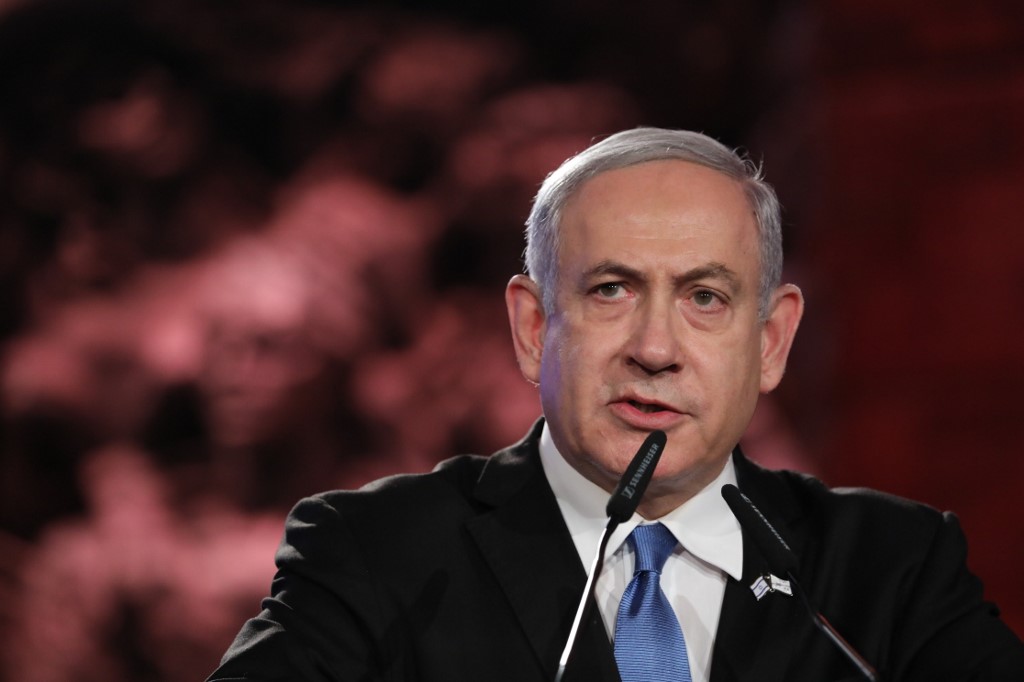
Prime Minister Benjamin Netanyahu delivers a speech during the Fifth World Holocaust Forum at the Yad Vashem Holocaust memorial museum in Jerusalem on January 23, 2020 (Abir SULTAN / POOL / AFP)

Prime Minister Benjamin Netanyahu delivers a speech during the Fifth World Holocaust Forum at the Yad Vashem Holocaust memorial museum in Jerusalem on January 23, 2020 (Abir SULTAN / POOL / AFP)

Prime Minister Benjamin Netanyahu on Thursday told Holocaust survivors and world leaders that the world turned its back on Jews during the Holocaust, teaching the Jewish people that under threat they can only rely on themselves.

Speaking at the World Holocaust Forum’s memorial to commemorate the 75th liberation of the Auschwitz-Birkenau death camp at Yad Vashem, Netanyahu said the world was similarly failing to unify against Iran, which he charged was the most anti-Semitic regime on the planet.

“Israel is eternally grateful for the sacrifice made by the Allies. Without that sacrifice there would be no survivors today. But we also remember that some 80 years ago, when the Jewish people faced annihilation, the world turned its back on us,” Netanyahu said.

“For many, Auschwitz is the ultimate symbol of evil. It is certainly that. The tattooed arms of those who passed under its infamous gates, the piles of shoes and eyeglasses seized from the dispossessed in their final moments, the gas chambers and crematoria that turned millions of people into ash, all these bear witness to the horrific depths to which humanity can sink,” he said.

“But for the Jewish people, Auschwitz is more than the ultimate symbol of evil. It is also the ultimate symbol of Jewish powerlessness. It is the culmination of what can happen when our people have no voice, no land, no shield.”

He continued: “The Jewish people have learned the lessons of the Holocaust: to take, always to take seriously the threats of those who seek our destruction; to confront threats when they are small; and above all, even though we deeply, deeply appreciate the great support of our friends, to always have the power to defend ourselves by ourselves. We have learned that Israel must always remain the master of its fate.”

While the world learned the lesson about evil, it did not necessarily learn the lesson about pre-emption, he argued.

“There are some signs of hope – and this extraordinary gathering is one of them. Today, the dangers of racism, hateful ideologies, and anti-Semitism are better understood. Many recognize a simple truth: that what starts with the hatred of the Jews doesn’t end with the Jews,” he said.

But, he added, “I am concerned. I am concerned that we have yet to see a unified and resolute stance against the most anti-Semitic regime on the planet – a regime that openly seeks to develop nuclear weapons and annihilate the one and only Jewish state.”

Calling the ayatollahs’ regime the “tyrants of Tehran,” Netanyahu said Israel “salutes President Trump and Vice President Pence for confronting the Tyrants of Tehran that subjugate their own people, and threaten the peace and security of the entire world. They threaten the peace and security of everyone in the Middle East and everyone beyond. I call on all governments to join the vital effort of confronting Iran.”

And he vowed: “I wish to assure again our people and all our friends, Israel will do whatever it must do to defend our state, defend our people and defend the Jewish future.”

Pence, Russian President Vladimir Putin, French President Emmanuel Macron, Britain’s Prince Charles and German President Frank-Walter Steinmeier are also due to address the gathering. and other leaders were slated to speak at the ceremony, which brought 40-plus world leaders to Jerusalem.

President Reuven Rivlin thanked the world leaders in attendance “for your commitment to remembering the Shoah, for your commitment to the citizens of the world, to those who believe in the dignity of man.”

President Reuven Rivlin speaks during the Fifth World Holocaust Forum at the Yad Vashem Holocaust memorial museum in Jerusalem, 23 January 2020 (Yonatan Sindel/FLASH90)

Rivlin said that democracy must not be taken for granted and that the Jewish people know that “if we do not remember then history can be repeated.”

Anti-Semitism “does not only stop with Jews. Racism and anti-Semitism is a malignant disease that dismantles peoples and countries, and no democracy and no society is immune to that,” Rivlin said.yi

Former chief rabbi and Holocaust survivor Israel Meir Lau and Yad Vashem’s chairman Avner Shalev were also set to speak, and survivors were to light memorial flames.

The event, headlined “Remembering the Holocaust, Fighting Antisemitism,” is co-organized by the office of Rivlin, Jerusalem’s Yad Vashem Holocaust memorial center and the World Holocaust Forum Foundation. It marks the third-largest gathering of world leaders ever hosted by Israel, after the funerals of Yitzhak Rabin and Shimon Peres, and comes several days before International Holocaust Remembrance Day on January 27.

Off Topic:  ‘This crime had accomplices’: Full text of Putin’s World Holocaust Forum speech

January 24, 2020

Source: ‘This crime had accomplices’: Full text of Putin’s World Holocaust Forum speech | The Times of Israel

Those who helped the Nazis ‘were often crueler than their masters,’ Russian president says. ‘The Holocaust was deliberate annihilation. The Nazis intended the same fate for others’

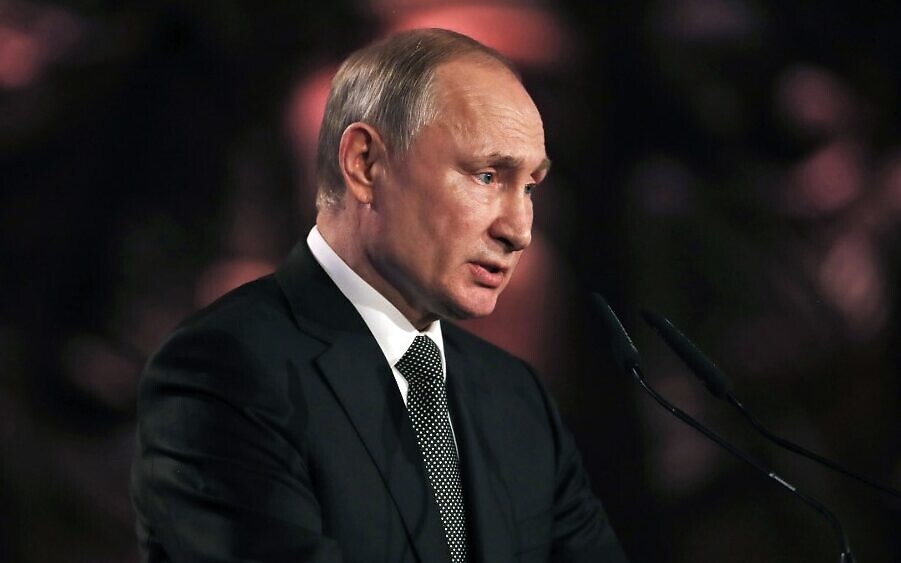
Russian President Vladimir Putin delivers a speech at Yad Vashem Holocaust memorial center in Jerusalem on January 23, 2020, to mark 75 years since the liberation of Auschwitz (RONEN ZVULUN / POOL / AFP)

Russian President Vladimir Putin delivers a speech at Yad Vashem Holocaust memorial center in Jerusalem on January 23, 2020, to mark 75 years since the liberation of Auschwitz (RONEN ZVULUN / POOL / AFP)

Full text of Russian President Vladimir Putin’s speech at the “Remembering the Holocaust: Fighting Antisemitism” World Holocaust Forum event at Yad Vashem, Jerusalem, Jauary 23, 2020.

Mr President, Mr Prime Minister, colleagues, friends, ladies and gentlemen,

Today we are brought together at the international forum to honour the victims of the Holocaust by a shared responsibility, our duty to the past and the future.

We mourn all the victims of the Nazis, including the six million Jews tortured in ghettos and death camps and killed cruelly during raids. Forty percent of them were citizens of the Soviet Union, so the Holocaust has always been a deep wound for us, a tragedy we will always remember.

Before visiting Jerusalem, I looked through original documents, reports by Red Army officers after the liberation of Auschwitz. I must tell you, colleagues, it is very difficult, unbearable to read these military reports, documents describing in detail how the camp was set up, how the cold-blooded killing machine worked.

Many of them were hand-written by soldiers and officers of the Red Army on the second or third day after the liberation of the prisoners and convey the shock that the Red Army soldiers and officers experienced from what they saw there, from testimonies that caused pain, indignation and compassion.

Red Army Field Marshal Konev, who then led the military operation to capture the densely populated Silesian industrial region of Germany, used tactics to spare as many civilians as possible and, having received a report about the atrocities committed at Auschwitz, forbade himself from even seeing this camp. Later he wrote in his memoirs that he had no right to lose his moral strength, so that a fair sense of revenge would not have blinded him during military operations and would not have caused additional suffering and casualties among the civilian population of Germany.

January 27 marks the 75th anniversary of the liberation of Auschwitz. In this hell, where people from different countries were brought for torture, monstrous experiments and mass killing, hundreds of thousands of people of different ethnicities died. More than half of them were Jews.

The crimes committed by the Nazis, their deliberate, planned, and as they said, ”final solution to the Jewish issue,“ is one of the darkest and most shameful pages of modern world history.
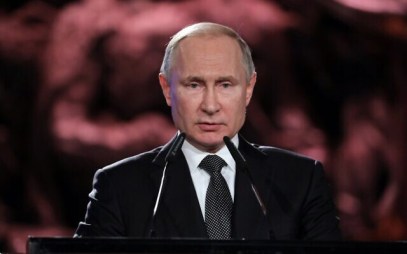
Russian President Vladimir Putin delivers a speech during the Fifth World Holocaust Forum at the Yad Vashem Holocaust memorial museum in Jerusalem on January 23, 2020. (Abir SULTAN / POOL / AFP)

But we should not forget that this crime also had accomplices. They were often crueler than their masters. Death factories and concentration camps were served not only by the Nazis, but also by their accomplices in many European countries.

In the occupied territories of the Soviet Union, where these criminals were operating, the largest number of Jews were killed. Thus, about 1.4 million Jews were killed in Ukraine, and 220,000 people were killed in Lithuania. I draw your attention, friends, to the fact that this is 95 percent of the pre-war Jewish population of this country. In Latvia, 77,000 Jewish people were killed. Only a few hundred Latvian Jews survived the Holocaust.

The Holocaust was deliberate annihilation of [a] people. But we must remember that the Nazis intended the same fate for many other peoples. Russians, Belarusians, Ukrainians, Poles and many other peoples were declared Untermensch. Their land was meant to serve as living space for the Nazis, providing for their prosperous existence, while the Slavs and other peoples were meant either to be exterminated or to become slaves without rights, culture, historical memory and language.

Back in 1945, it was first of all the Soviet people who put an end to these barbaric plans. As it has just been said, they protected their Fatherland and liberated Europe from Nazism. We paid a price no nation could even imagine in their worst dreams: a toll of 27 million deaths.

We will never forget this. The memory of the Holocaust will serve as a lesson and a warning only if it remains fully intact, without any omissions. Unfortunately, today the memory of war and its lessons and legacy often fall subject to the immediate political situation. This is completely unacceptable. It is the duty of current and future politicians, state and public figures to protect the good name of the living and fallen heroes, civilians and victims of the Nazis and their allies.

We must use everything we have – our informational, political and cultural capabilities as well as the reputation and influence our countries have in the world – to this end. I am sure that everyone present here today, in this audience, shares these concerns and is ready to protect truth and justice together with us.

We are all responsible for making sure that the terrible tragedies of this war will not happen again, that the generations to come will remember the horrors of the Holocaust, the death camps and the siege of Leningrad – Prime Minister Netanyahu has just said that today a monument to the victims of the siege was unveiled here in Jerusalem – Babi Yar, and the burned-down village of Khatyn, remember that we must remain alert and must not overlook when the first seeds of hate, chauvinism and antisemitism take root, or when people start to indulge in xenophobia or other similar manifestations.

Destruction of the past and lack of unity in the face of threats can lead to terrible consequences. We must have the courage to be straight about this and do everything to defend peace.

I think an example could and should be set by the founding countries of the United Nations, the five powers that bear special responsibility for the preservation of civilisation.

We have discussed this with several of our colleagues and, as far as I know, have received a generally positive response to holding a meeting of the heads of state of the five permanent members of the UN Security Council: Russia, China, the United States, France and Britain. We can hold it in any country, in any place that our colleagues would find convenient. Russia is ready for such a serious discussion. We intend to send this proposal to the leaders of the Five without delay.

We are faced with many challenges. We discussed one of them recently at the initiative of German Chancellor Angela Merkel. This is about Libya. But we will have to return to this issue at the Security Council and adopt a relevant resolution.

There are many other problems as well. I consider it important and symbolic to hold the proposed meeting this year. After all, we are celebrating 75 years since the end of World War II and the foundation of the United Nations.

A summit of the states that made the main contribution to the routing of the aggressor and the formation of the postwar world order can play a big role in searching for collective ways of responding to current challenges and threats and would demonstrate our common commitment to the spirit of allied relations, historical memory and the lofty ideals and values for which our predecessors, our grandfathers and fathers fought shoulder to shoulder.

In conclusion, I would like to thank our Israeli colleagues for a warm, very hospitable reception here in Jerusalem, and to wish peace, prosperity and all the best to everyone at the conference, and, of course, to the citizens of Israel.

Thank you.