Archive for January 2020

Islam’s reformation: an Arab-Israeli alliance is taking shape in the Middle East

January 3, 2020

Hmmm…

https://www.spectator.co.uk/2019/12/islams-reformation-an-arab-israeli-alliance-is-taking-shape-in-the-middle-east/

When Benjamin Netanyahu visited Oman in 2018 in a gesture of goodwill to Israel’s neighbours, the welcome was not universal. For an Israeli Prime Minister to be warmly greeted in a proud Arab state was, for some, far too much. The Omani foreign minister, Yusuf bin Alawi bin Abdullah, was asked on Al Jazeera why the visit had been allowed. The reply went viral: ‘Why not? Is it forbidden to us? Israel is a nation among the nations of the Middle East. We should embark on a new journey for the future.’

A new narrative is emerging in the Middle East. New maps of the Muslim mind are being drawn and old hatreds are on the run. The anti-Semitic craze to destroy Israel was powerful in the 1960s, uniting Egypt’s President Nasser with his fellow Arabs. But now, Sunni Arab neighbours are changing course. Islamist leaders are losing their appeal — at a time when Iran, with its brand of theological fascism, poses a threat to Israel and the Arab world alike.

Polls show that the percentage of Arabs expressing trust in Islamist parties has fallen by well over a third since the uprisings of 2011. Three-quarters of Iraqis say they do not trust Islamist parties at all, and the number of young people who say they’re ‘not religious’ is also on the rise. This generation wants Arab leaders to increase economic prosperity and minimise political conflicts. And to build alliances, including with Israel.

This has been the ‘Year of Tolerance’ in the United Arab Emirates. In February, an open-air mass for 170,000 Catholics was celebrated by Pope Francis, the first pontiff to visit the Arabian peninsula. To commemorate the Pope’s visit, the Crown Prince of Abu Dhabi, Mohammed bin Zayed, announced the construction in the UAE capital of the Abrahamic Family House: a synagogue, a church and a mosque within a single complex, a hub for highlighting history and a symbol of hope for a new future of co-existence.

In Dubai, Jews have been worshipping at a synagogue for several years now. Rabbis from Israel, America, Australia and Europe have been attending annual international Muslim peace conferences held in Abu Dhabi by Abdullah bin Bayyah, a renowned Muslim theologian, for two years. In full rabbi dress.

King Hamad of Bahrain has also led a path towards more open relations between Islam and Judaism. In 2016 he celebrated Hanukkah with orthodox Jews from New York, his courtiers singing and dancing. The scenes were striking: Jews with hats and beards, Muslims with keffiyeh and robes, joining together in songs of peace. This groundbreaking gesture elicited condemnation from Iran-backed Hamas, but favourable comments erupted on social media. In return, Bahraini peace delegations have visited Israel.

There have even been signs of a religious glasnost in Saudi Arabia. The Mecca-based Muslim World League, which for five decades promoted hard-line Wahhabism, has started meetings with various Jewish organisations. Several Saudi bloggers, YouTubers and Twitter personalities have been praising Israel in Arabic. Mohamed Saud, a social media activist, visited Israel in July and spoke in fluent Hebrew that he learned in Riyadh. This infuriated Palestinian radicals, who encouraged children to pelt him with stones — as if furious that their old world, with its politicised hatred, is fading.

I’ve noticed a change of mood on my own travels. I regularly meet Egyptians and others who desperately want to normalise relations with Israel and they offer three reasons. First, the events of the Arab Spring exposed the fanaticism of the Muslim Brotherhood and other related Islamists, with the hardliners now being viewed as a threat to both Islam as a faith and Muslims as a people. Isis and other ‘Islamic states’ are, of course, the logical outcome of Islamism. Now that this creed has been tested to destruction, it is being seen for what it is — and rejected.

Second, the need to stand firm against Iran is becoming a cause that unites Israel with Sunni Arabs and anti-Tehran Shiite Muslims in Iraq, Syria and Lebanon. It’s well-known that mullahs in Tehran support Hezbollah, which is dedicated to destroying Israel. But they also meddle in Bahrain, Saudi Arabia, Iraq, Lebanon, Syria and Yemen. So against this menace of Shiite political Islamism, committed to destroying Muslim secular governments and exporting Shiite revolutionary ideology, Israel is coming to be regarded as a benign neighbour.

Finally, and most intriguingly, Israel is being seen by moderate Arab governments as a trade and security partner as the West sends mixed signals. Barack Obama abandoned his Arab allies when they faced threats from the Muslim Brotherhood or Iran. He deserted Egypt’s President Hosni Mubarak — to the horror of the Saudis and Emiratis — and cheered on the popular uprising in Syria. When America signed the nuclear agreement with Iran towards the end of the Obama presidency, Israel and its Arab neighbours were united in uproar. This lesson in unreliability has not been forgotten. As one Arab prince said recently at a private meeting: ‘Who else will fly in joint missions against Iranian targets with us?’

For his part, Netanyahu is optimistic. ‘What is happening in practice with Arab states has never happened in our history, even when we signed peace agreements,’ he has said. Of course, there is a lot of history to overcome. For 70 years the Arab world was driven by an anti-Semitic ideological craze to wipe out Israel. But before that came a far-longer history of co-existence and respect. The people of Israel are honoured repeatedly in the Quran, which confirms that Jews have every right to settle in and around Jerusalem. It was Omar, a friend of the prophet, who invited Jews back into Jerusalem in 637 after five centuries of being banished by the Romans.

There are enough historical and scriptural narratives of Muslim-Jewish fraternity to form the basis for rapprochement. The enmity has, historically, been a recent blip. With an assertive Iran and an uninterested West, the Arabs and Jews have a shared interest in building a lasting alliance with each other. This may yet be the decade of peace.
Pompeo thanks Netanyahu for support after Iraq embassy attack 

January 2, 2020

Source: Pompeo thanks Netanyahu for support after Iraq embassy attack | The Times of Israel

Foreign Minister Katz urges international community to fight ‘murderous’ Iran after pro-Tehran protesters storm Green Zone

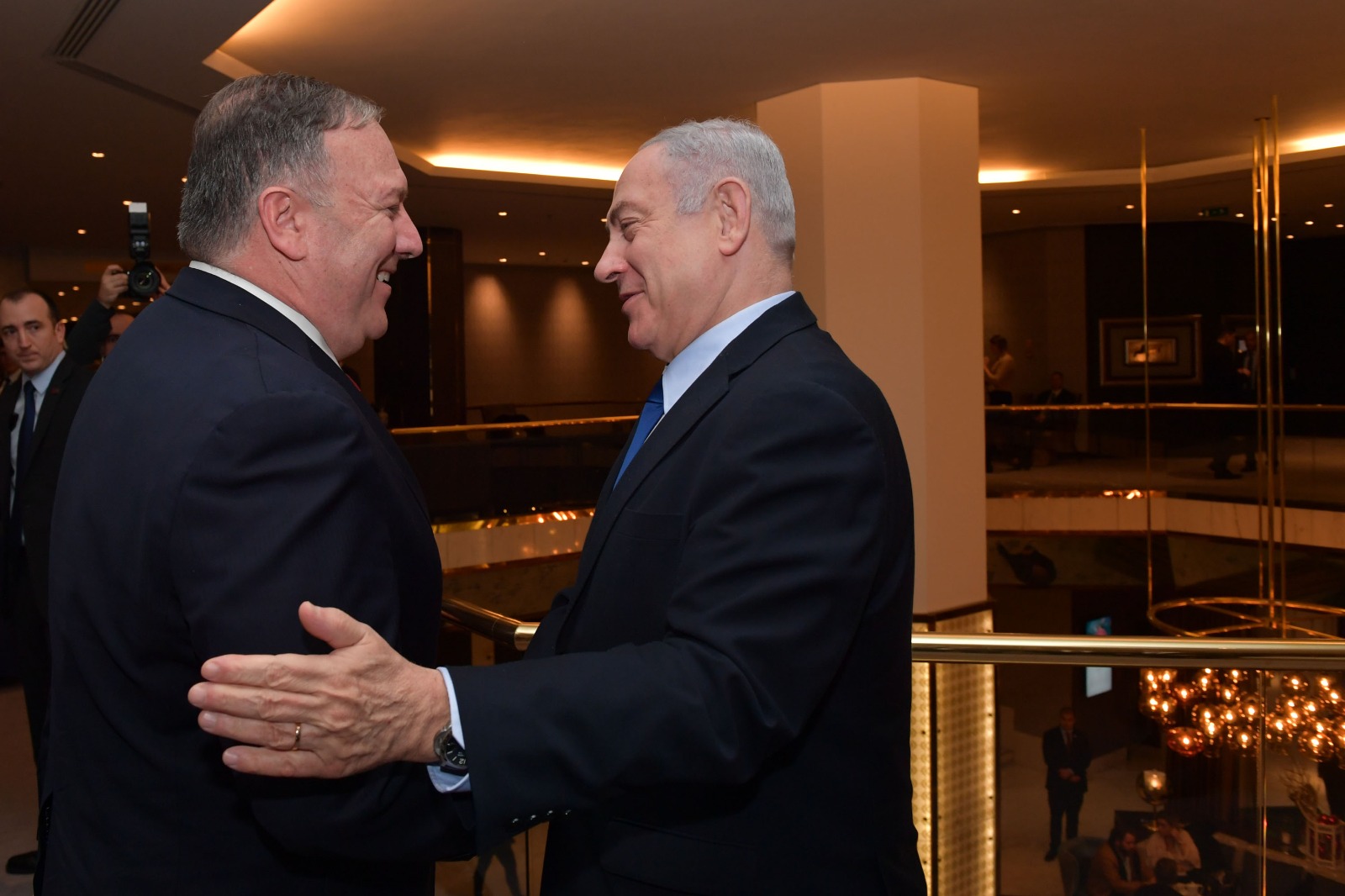
US Secretary of State Mike Pompeo, left, and Prime Minister Benjamin Netanyahu meet in Lisbon, Portugal, December 4, 2019. (Kobi Gideon/GPO)

US Secretary of State Mike Pompeo spoke late Wednesday to Prime Minister Benjamin Netanyahu, thanking him for Israel’s support in efforts to combat Iran and after the attack on the US Embassy in Iraq.

“Secretary Pompeo thanked Prime Minister Netanyahu for Israel’s unwavering commitment to countering Iran’s malign regional influence and its condemnation of the December 31 attack on the US Embassy in Baghdad,” the State Department said in a statement.

“The Secretary and Prime Minister reaffirmed the unbreakable bonds between the United States and Israel,” the statement said.

There was no immediate readout of the call from the Israeli side.

Secretary Pompeo

@SecPompeo

Pompeo also spoke with officials from Qatar.

The breach of the US Embassy compound in Baghdad also prompted Pompeo to postpone his trip to Ukraine and four other countries.

Pompeo was to arrive in Ukraine late Thursday in his first visit to the country at the center of US President Donald Trump’s impeachment, then on to Belarus, Kazakhstan, Uzbekistan and Cyprus.

He delayed the trip “to continue monitoring the ongoing situation in Iraq and ensure the safety and security of Americans in the Middle East,” State Department spokeswoman Morgan Ortagus said Wednesday. She said he intends to reschedule soon.

Israel earlier Wednesday condemned an attack by pro-Iranian groups on the US embassy in Baghdad, accusing Tehran of erring by ordering the coordinated assault.

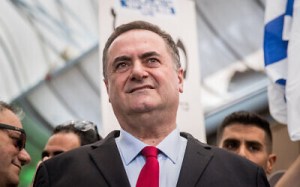
Foreign Minister Israel Katz at a Likud election campaign stop in Jerusalem, September 16, 2019. (Yonatan Sindel/Flash90)

The comments by Foreign Minister Israel Katz came hours after pro-Iran demonstrators left the besieged US embassy in Baghdad after the Hashed al-Shaabi paramilitary force ordered them to withdraw a day after their dramatic incursion.

Thousands of Iraqi supporters of the largely Iranian-trained Hashed had encircled and vandalized the embassy compound Tuesday, outraged by US airstrikes that killed 25 Hashed fighters over the weekend.

“Iran made a grave mistake by attempting to harm American diplomats in Iraq,” Katz said in a statement.

“We call on the international community to stand determinedly against the crimes of the murderous regime in Tehran,” he added.

Katz linked the latest incident to Iran-linked attacks on diplomatic missions worldwide, including the deadly 1992 bombing of Israel’s embassy in Buenos Aires by the Iran-backed Hezbollah terrorist group, in which 29 people were killed.

In a radio interview Wednesday, the foreign minister said Iran could attack Israeli interests next, though he acknowledged the possibility was slim.

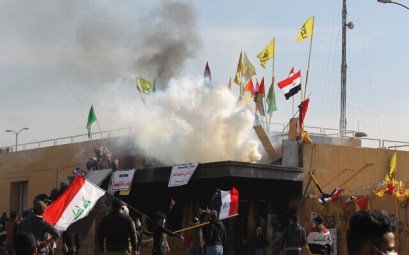
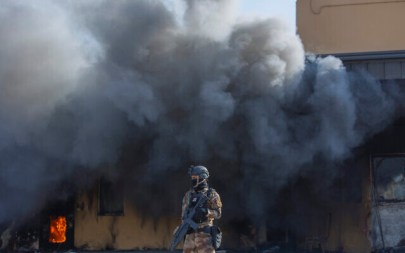
An Iraqi soldier stands guard in front of smoke rising from a fire set by pro-Iranian militiamen and their supporters in the US embassy compound , in Baghdad, Iraq, Wednesday, Jan. 1, 2020. (AP Photo/Nasser Nasser)

“There is a possibility — the chances are not high, but it exists — that the Iranians could harm Israel and drag us into this,” Katz told Army Radio. “It must be clear to them that we will respond with great force to any attack.”

Tensions lingered on Wednesday after the Popular Mobilization Forces, an umbrella group of state-allied militias — many backed by Iran — called on its supporters to withdraw in response to an appeal by the Iraqi government, saying “your message has been received.”

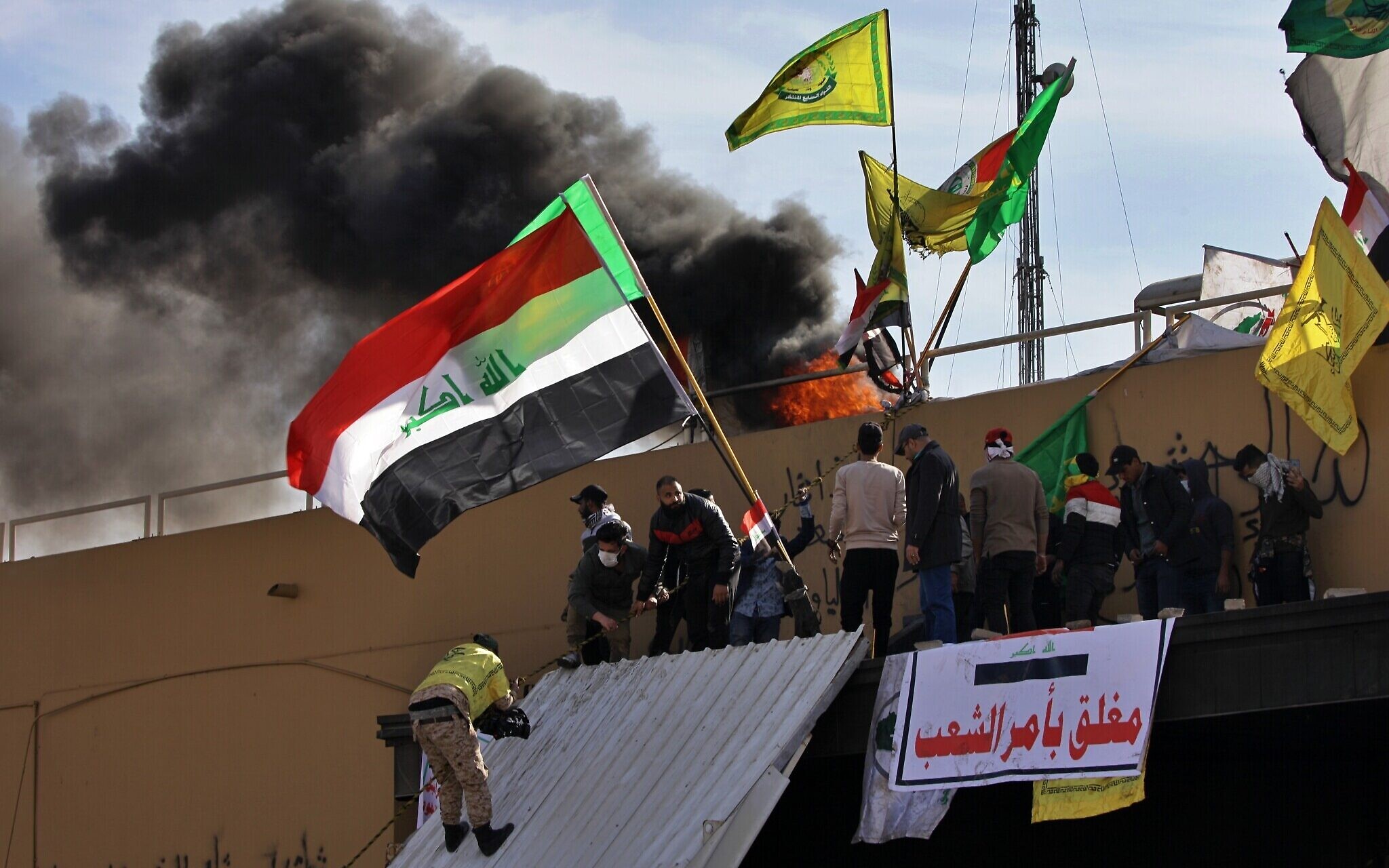
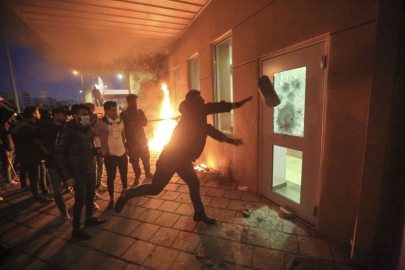
In an orchestrated assault Tuesday, hundreds of militiamen and their supporters broke into the embassy compound, destroying a reception area, smashing windows, chanting “Death to America” and spraying pro-Iran graffiti on the walls.

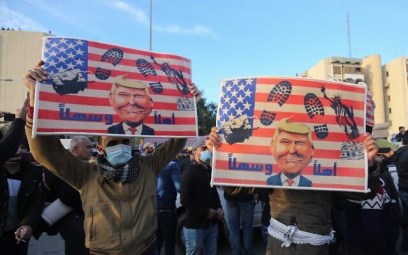
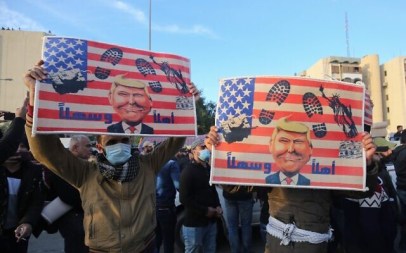
Supporters of Iraq’s Hashed al-Shaabi paramilitary force hold placards depicting trampled US symbols reading in Arabic ‘Welcome’ during a protest outside the US embassy in the Iraqi capital Baghdad on January 1, 2020 to condemn the US air strikes that killed 25 Hashed fighters over the weekend. (Ahmad Al-Rubaye/AFP)

The protesters set up a tent camp overnight and on Wednesday set fire to the reception area and hurled stones at US Marines guarding the compound, who responded with tear gas.

There were no injuries on either side and no American staff were evacuated from the compound.

Tuesday’s embassy attack was the latest episode in spiraling tensions between the United States and Iran since Washington abandoned a landmark nuclear deal with Tehran in 2018.

Many of those tensions have played out in Iraq, which has close ties with both governments.

US forces have faced a spate of rocket attacks in recent months, blaming them on pro-Iran Hashed factions.

US forces (unseen) fire teargas canisters at supporters and members of the Hashed al-Shaabi paramilitary force during a demonstration outside the US embassy in the Iraqi capital Baghdad on January 1, 2020. (Ahmad Al-Rubaye/AFP)

Last week, one of those attacks killed a US contractor, prompting the retaliatory US air strikes that killed 25 fighters from Kataeb Hezbollah (Hezbollah Brigades).

President Donald Trump and other US officials have blamed Iran for attacks on US forces and the embassy.

“They will pay a very BIG PRICE! This is not a Warning, it is a Threat,” Trump wrote on Twitter, adding “Happy New Year!”

Iran’s supreme leader Wednesday condemned US strikes on Iraq and warned his country was ready to hit back.

“First of all, you can’t do a damn thing! This has nothing to do with Iran,” Ayatollah Ali Khamenei said in a speech on state television.

“If the Islamic Republic decides to oppose or fight against a country, it will do this explicitly,” he said.


Israel’s F 15I Ra’am רעם (Thunder) IAF 

January 2, 2020

https://www.youtube.com/watch?v=FokMMqxyeZM

Israel’s F 15I Ra’am רעם (Thunder) IAF

The F-15I is operated by the Israeli Air Force where it is known as the Ra’am (רעם – “Thunder”). It is a dual-seat ground attack aircraft powered by two Pratt & Whitney F100-PW-229 engines, and is based on the F-15E.

The F-15I Ra’am is similar to the F-15E, but features several different avionic systems to meet Israeli requirements. To facilitate night-time strikes, the F-15Is were initially fitted with Sharpshooter targeting pods designed for Israeli F-16s. The Sharpshooter pod was less capable than the LANTIRN pods used on USAF F-15Es; Israel later purchased 30 LANTIRN pods. The F-15Is initially lacked Radar Warning Receivers, Israel installed its own electronic warfare equipment, the Elisra SPS-2110, as well as a new central computer and embedded GPS/INS system. All sensors can be slaved to the Display And Sight Helmet (DASH) helmet-mounted sight, providing both crew members a means of targeting which the F-15E lacks.

The F-15I uses the APG-70I radar; its terrain mapping capability can locate targets difficult to spot while under adverse weather conditions. The radar can detect large airliner-sized targets at 150 nautical miles (170 mi; 280 km), and fighter-sized targets at 56 nmi (64 mi; 104 km), it has a reduced resolution one-third below the standard USAF APG-70.[118] In January 2016, Israel approved an upgrade of the F-15I fleet that includes structural changes, an AESA radar, updated avionics, and new (unspecified) weapon systems.

From Military TV


Israel: Iran made ‘grave mistake’ with attack on US embassy in Baghdad

January 2, 2020

Source: Israel: Iran made ‘grave mistake’ with attack on US embassy in Baghdad | The Times of Israel

Foreign Minister Katz urges international community to fight ‘murderous’ Iran after pro-Tehran protesters storm Green Zone

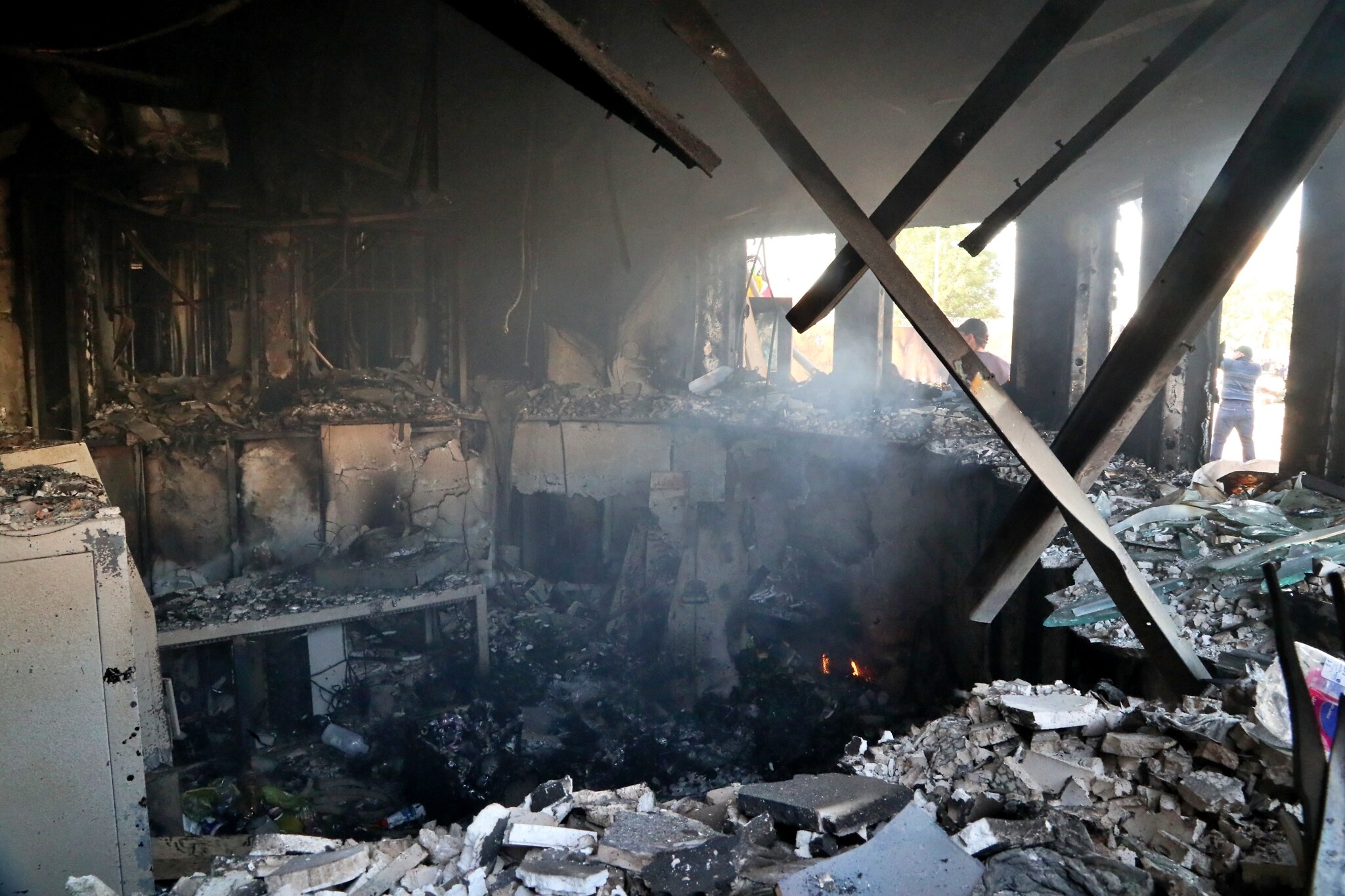
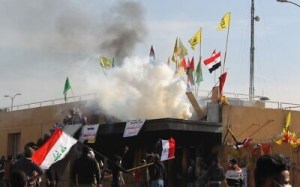
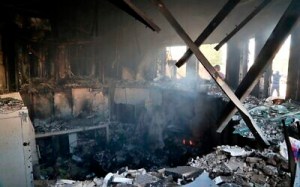
Smoke rises from the reception room of the US embassy that was burned by Pro-Iranian militiamen and their supporters, in Baghdad, Iraq, Wednesday, Jan. 1, 2020.  (AP Photo/Khalid Mohammed)

Smoke rises from the reception room of the US embassy that was burned by Pro-Iranian militiamen and their supporters, in Baghdad, Iraq, Wednesday, Jan. 1, 2020. (AP Photo/Khalid Mohammed)

Israel on Wednesday condemned an attack by pro-Iranian groups on the US embassy in Baghdad, accusing Tehran of erring by ordering the coordinated assault.

The comments by Foreign Minister Israel Katz came hours after pro-Iran demonstrators left the besieged US embassy in Baghdad after the Hashed al-Shaabi paramilitary force ordered them to withdraw a day after their dramatic incursion.

Thousands of Iraqi supporters of the largely Iranian-trained Hashed had encircled and vandalized the embassy compound Tuesday, outraged by US airstrikes that killed 25 Hashed fighters over the weekend.

“Iran made a grave mistake by attempting to harm American diplomats in Iraq,” Katz said in a statement.

“We call on the international community to stand determinedly against the crimes of the murderous regime in Tehran,” he added.

Katz linked the latest incident to Iran-linked attacks on diplomatic missions worldwide, including the deadly 1992 bombing of Israel’s embassy in Buenos Aires by the Iran-backed Hezbollah terrorist group, in which 29 people were killed.

In a radio interview Wednesday, the foreign minister said Iran could attack Israeli interests next, though he acknowledged the possibility was slim.

An Iraqi soldier stands guard in front of smoke rising from a fire set by pro-Iranian militiamen and their supporters in the US embassy compound , in Baghdad, Iraq, Wednesday, Jan. 1, 2020. (AP Photo/Nasser Nasser)

“There is a possibility — the chances are not high, but it exists — that the Iranians could harm Israel and drag us into this,” Katz told Army Radio. “It must be clear to them that we will respond with great force to any attack.”

Tensions lingered on Wednesday after the Popular Mobilization Forces, an umbrella group of state-allied militias — many backed by Iran — called on its supporters to withdraw in response to an appeal by the Iraqi government, saying “your message has been received.”

In an orchestrated assault Tuesday, hundreds of militiamen and their supporters broke into the embassy compound, destroying a reception area, smashing windows, chanting “Death to America” and spraying pro-Iran graffiti on the walls.

Supporters of Iraq’s Hashed al-Shaabi paramilitary force hold placards depicting trampled US symbols reading in Arabic ‘Welcome’ during a protest outside the US embassy in the Iraqi capital Baghdad on January 1, 2020 to condemn the US air strikes that killed 25 Hashed fighters over the weekend. (Ahmad Al-Rubaye/AFP)

The protesters set up a tent camp overnight and on Wednesday set fire to the reception area and hurled stones at US Marines guarding the compound, who responded with tear gas.

There were no injuries on either side and no American staff were evacuated from the compound.

Tuesday’s embassy attack was the latest episode in spiraling tensions between the United States and Iran since Washington abandoned a landmark nuclear deal with Tehran in 2018.

Many of those tensions have played out in Iraq, which has close ties with both governments.

US forces have faced a spate of rocket attacks in recent months, blaming them on pro-Iran Hashed factions.

US forces (unseen) fire teargas canisters at supporters and members of the Hashed al-Shaabi paramilitary force during a demonstration outside the US embassy in the Iraqi capital Baghdad on January 1, 2020. (Ahmad Al-Rubaye/AFP)

Last week, one of those attacks killed a US contractor, prompting the retaliatory US air strikes that killed 25 fighters from Kataeb Hezbollah (Hezbollah Brigades).

President Donald Trump and other US officials have blamed Iran for attacks on US forces and the embassy.

“They will pay a very BIG PRICE! This is not a Warning, it is a Threat,” Trump wrote on Twitter, adding “Happy New Year!”

Iran’s supreme leader Wednesday condemned US strikes on Iraq and warned his country was ready to hit back.

“First of all, you can’t do a damn thing! This has nothing to do with Iran,” Ayatollah Ali Khamenei said in a speech on state television.

“If the Islamic Republic decides to oppose or fight against a country, it will do this explicitly,” he said.


Barricade In Baghdad 

January 2, 2020


Iran’s Republican Guards chief: We can ‘break’ US but are not heading for war

January 2, 2020

Source: Iran’s Republican Guards chief: We can ‘break’ US but are not heading for war | The Times of Israel

Hossein Salami says Iranians are unconcerned by threats from Washington after Trump threatened action over embassy violence

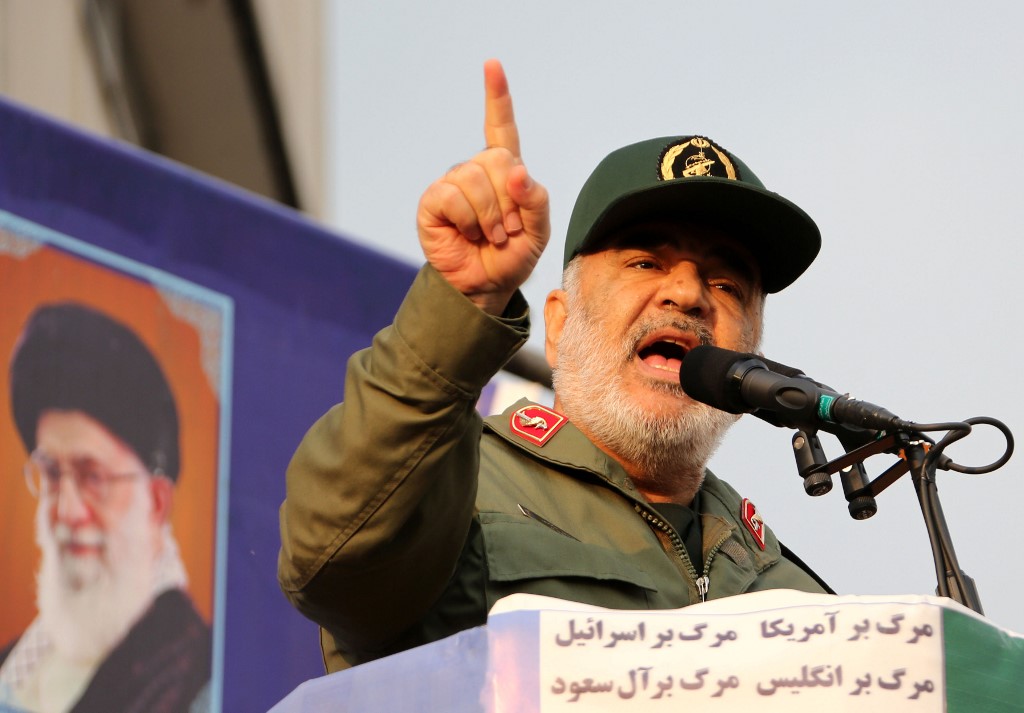
Iranian Revolutionary Guards commander Major General Hossein Salami speaks during a pro-government rally in the capital Tehran’s central Enghelab Square on November 25, 2019. (ATTA KENARE / AFP)

The head of Iran’s powerful Islamic Revolutionary Guard Corps on Thursday said his country is not concerned by threats from the US, which it can “break” several times over.

“We are not leading the country to war, but we are not afraid of any war and we tell America to speak correctly with the Iranian nation,” Guards Commander Major General Hossein Salami was quoted as saying by Reuters, citing Iran’s Tasnim news agency.

“We have the power to break them several times over and are not worried,” he said.

Salami’s remarks came after the US President Donald Trump blamed Iran and threatened it with a response for an assault on the US embassy in Iraq during which pro-Iranian demonstrators breached the perimeter wall and burned property on the inside.

On Wednesday Iran’s Supreme Leader Ayatollah Ali Khamenei also dismissed US threats over the embassy violence saying Washington “can’t do anything.”

The rioting Tuesday and Wednesday at the US Baghdad embassy was sparked by weekend US airstrikes on an Iran-backed militia located in Iraq that Washington said was responsible for a rocket attack that killed a US civilian contractor. The US strikes killed 25 members of the Ketaeb Hezbollah group, a part of the state-sponsored Popular Mobilization Forces. There was wide public outrage in Iraq at the strikes, which were seen as a violation of Iraqi sovereignty.

Pro-Iranian militiamen and their supporters set a fire during a sit-in in front of the US embassy in Baghdad, Iraq, January 1, 2020. (AP Photo/Khalid Mohammed)

On Tuesday Trump threatened Iran with strong action over the embassy clashes.

“Iran will be held fully responsible for lives lost, or damage incurred, at any of our facilities,” he said on Twitter.

“They will pay a very BIG PRICE! This is not a Warning, it is a Threat,” wrote Trump, adding “Happy New Year!”

Later, he said he did not foresee war with Tehran over the embassy incident.

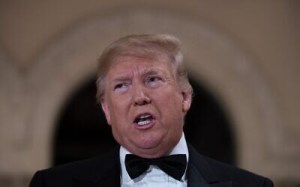
US President Donald Trump speaks to the press outside the grand ballroom as he arrives for a New Year’s celebration at Mar-a-Lago in Palm Beach, Florida, on December 31, 2019. (JIM WATSON/AFP)

“I don’t see that happening,” Trump said at his holiday retreat in Florida when a reporter asked about the possibility of war with the Islamic Republic. “I like peace.”

US officials said there were no plans to evacuate the mission, and no US personnel were reported injured.

Meanwhile, Tehran summoned an official from the Swiss embassy, which represents US interests in Iran, to complain about American “warmongering” in Iraq, the foreign ministry said on Wednesday.

In a Wednesday statement, the Iranian foreign ministry said it had asked the Swiss charge d’affaires to inform the United States that “Iraq is an independent country.”

“The American army has martyred at least 25 young Iraqis and has wounded countless more without presenting the slightest evidence of them being at fault,” it said. “Naturally the people of Iraq react to the country that has occupied their country and kills their young people.”


BRYEN: The Unyielding Iranian Menace 

January 1, 2020

Source: BRYEN: The Unyielding Iranian Menace | The Daily Wire

DailyWire.com
BAGHDAD, IRAQ - DECEMBER 31: Outraged Iraqi protesters storm the U.S. Embassy in Baghdad, protesting Washington's attacks on armed battalions belong to Iranian-backed Hashd al-Shaabi forces on December 31, 2019. At least 25 people were killed in weekend U.S. airstrikes on positions of Kataib Hezbollah, an Iranian-backed militia group, in Iraq and Syria. Hundreds of Iraqi protesters gathered early Tuesday near the embassy to show their anger at the U.S. move.
Murtadha Sudani/Anadolu Agency via Getty Images

This will not be Tehran 1979. Nor Benghazi 2012.

There were, apparently two groups of invaders at the U.S. embassy in Baghdad — hordes of rioting protesters in the streets and well-covered, professional-looking, careful militia members entering the out building. Security forces (and some contractors) used tear gas and stun guns against the demonstrators as the United States protected its embassy compound — sovereign American territory by international convention.

A bit of U.S.-Iranian history is instructive here. When the Iranians overran the U.S. embassy in Tehran in 1979, President Jimmy Carter dubbed the Ayatollah Khomeini “a holy man” with whom, presumably, one could do business. President Barak Obama was certain, in 2015, that “the only alternative to the JCPOA is war with Iran,” presumably meaning that the so-called “Iran nuclear deal” was the way to avoid war and restore Iran to the family of nations.

The result of Carter’s assistance to the ayatollah, and Obama’s lapse in memory — the Iranians had, actually, been in a declared state of war with the United States (and Israel) since 1979 — was to allow the juggernaut of Shiite expansionist theology to ruin Iran, invade Iraq, incubate ISIS, occupy Syria, bring its proxy to power and ruin Lebanon, run the Houthi war in Yemen, undermine Bahrain, attack Saudi Arabia, and spread its tentacles across Africa. And this transpired all while Iran violated the U.N. ban on Iranian arms imports and exports, the U.N. ban on the development of Iranian ballistic missiles, and the P5+1-ratified-by-the-U.N. ban on the development of nuclear weapons technology.

President Donald Trump harbors no such fantasies. He has already shown that retaliation for acts of war is in his playbook. But he has also shown that it isn’t necessary to retaliate every time for every single thing — including Iran’s attack on Saudi oil facilities.

As Iran’s tentacles have spread farther, it has begun to show signs of “imperial overreach.” The re-imposition of American sanctions means Iran has fewer and fewer resources to stoke the flames of revolution extraterritorially. Rebellion against the clerical regime actually began in December 2017 — not 2019, when The New York Times began to report on it. Uprisings in Lebanon and Iraq began earlier this year — both decidedly anti-Iran and anti-clerical. And, as Iran watches Russia swallow Syria’s reconstruction money for its own purposes, the mullahs appear to have decided it is now time for Iran to reassert itself.

Iranian forces are out in the streets of multiple Iranian cities and the U.S. confirms that the death toll among demonstrators is more than 1,500, including hundreds of women. The ayatollahs have cut off the internet, to the extent they can, to prevent Western understanding of the devastation. Iranian-backed Shiite militias have been out in force in Iraq — not only in Baghdad, but in Shiite cities across the south of the county. The Lebanese Armed Forces (LAF) plus Hezbollah militias are trying to get Lebanon under control with some brutal tactics.

It hasn’t been working very well.

A wounded adversary is the most dangerous. The 1944 Battle of the Bulge reflected Hitler’s understanding that the Allies would not be held off forever, so he wanted to make it harder and bloodier to reach V-E Day. Emperor Hirohito’s determination that every Japanese civilian would fight to the death on the mainland — knowing defeat was inevitable — was the impetus for President Truman’s use of the atomic bomb (in part) to short-circuit the casualty count, assessed by analysts to be in the millions.

This is NOT a suggestion that the U.S. storm Iran — or heaven forbid, use an atomic or other weapon against Iranian cities. Not, not, not!

It is, however, a reminder of what we face. Iran has been begging for the sort of American retaliation that it could (A) use to try to bring its population together in opposition to the “Great Satan,” or (B) use to launch Hezbollah to attack Israel, presenting the U.S. with the conundrum that legitimate American retaliation might harm an ally. The death of an American contractor and wounding of several American soldiers last week in Iraq — in a barrage of more than 30 rockets — followed weeks of Pentagon warnings that Iranian-backed groups in Iraq were likely to attack U.S. forces there.

American retaliation was precise, hitting three sites: Weapons storage facilities and locations the militia used to plan attacks against coalition forces.

What happens next is unclear. At this writing, reinforcements for the U.S. embassy have been called in. But there is a clear understanding in Washington that this is not an uprising of Iraqis against the United States. These are Iranian acts of war. Where American retaliation goes will, no doubt, take that into account.


WATCH: U.S. Forces Arrive At Embassy In Baghdad To Stop Attack; Trump Drops Big Statement 

January 1, 2020

Source: WATCH: U.S. Forces Arrive At Embassy In Baghdad To Stop Attack; Trump Drops Big Statement | The Daily Wire

DailyWire.com
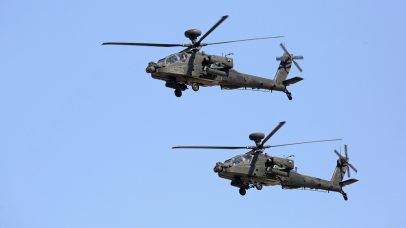
DUBAI, UNITED ARAB EMIRATES - NOVEMBER 17, 2019: Boeing AH-64 Apache attack helicopters perform at the 2019 Dubai Airshow.
Marina LystsevaTASS via Getty Images

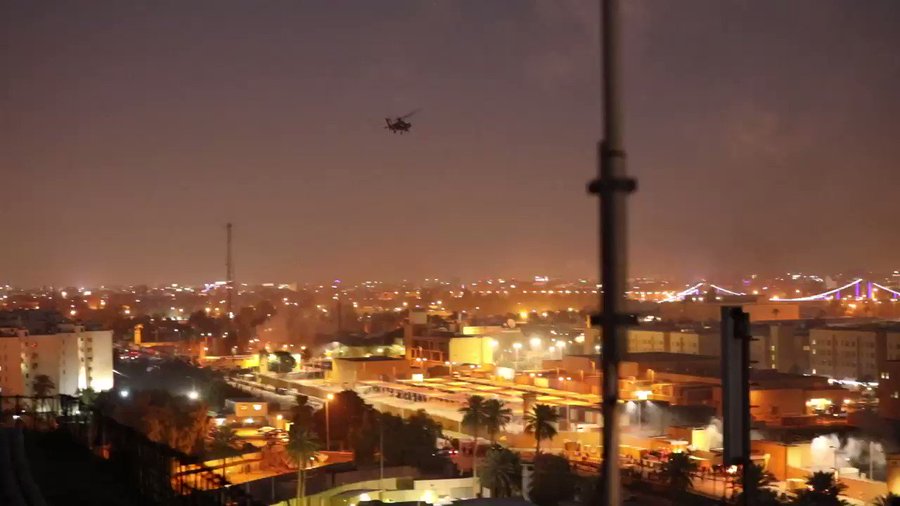
American military forces arrived on scene at the U.S. Embassy in Baghdad, Iraq, on Tuesday to stop a terrorist attack against the embassy that was being carried out by thousands of attackers.

President Donald Trump announced that Iran would be held “fully responsible” for any lives lost or damage to the facility and that they would pay “a very big price.”

“The U.S. Embassy in Iraq is, & has been for hours, SAFE! Many of our great Warfighters, together with the most lethal military equipment in the world, was immediately rushed to the site,” Trump tweeted. “Thank you to the President & Prime Minister of Iraq for their rapid response upon request Iran will be held fully responsible for lives lost, or damage incurred, at any of our facilities. They will pay a very BIG PRICE! This is not a Warning, it is a Threat. Happy New Year!”

Donald J. Trump

@realDonaldTrump

Donald J. Trump

@realDonaldTrump

….Iran will be held fully responsible for lives lost, or damage incurred, at any of our facilities. They will pay a very BIG PRICE! This is not a Warning, it is a Threat. Happy New Year!

Dan Scavino Jr, Assistant to President Trump, tweeted out a video of the Marines loading up their weapons and deploying to the embassy.

Dan Scavino Jr.🇺🇸

@Scavino45

Ryan Browne

@rabrowne75

View image on Twitter

Myles B. Caggins III, official military Spokesperson for Operation Inherent Resolve (OIR), tweeted out a video of AH-64 Apache helicopters arriving at the embassy to provide backup support.

OIR Spokesman Col. Myles B. Caggins III

@OIRSpox

Embedded video

The terrorist attack on the U.S. Embassy started early on Tuesday morning when thousands of supporters of the Kataeb Hezbollah terrorist organization attacked the facility in response to U.S. forces killing dozens of terrorists from the organization just a few days ago.

The terrorist supporters shouted “Down, down USA!” and “Death to America” and “Death to Israel” as they attacked the facility.

Democrats and far-left media pundits politicized the terrorist attack to attack Trump and suggest that the attack was Trump’s Benghazi, however, critics quickly fired back at the claims.

Trump responded to attacks from the far-left by writing on Twitter: “The Anti-Benghazi!”

Donald J. Trump

Democrat Senator Chris Murphy (CT) tweeted: “The attack on our embassy in Baghdad is horrifying but predictable. Trump has rendered America impotent in the Middle East. No one fears us, no one listens to us. America has been reduced to huddling in safe rooms, hoping the bad guys will go away. What a disgrace.”

Rep. Lee Zeldin (R-NY) responded: “Because ISIS & others feared the US under Pres Obama right? The victims in Benghazi btw never safely made it out of a safe room & the bad guys did get away. The amt of Dems spending New Years Eve rooting & working against America just bc of hate for POTUS is the disgrace!”

Lee Zeldin

@RepLeeZeldin

The victims in Benghazi btw never safely made it out of a safe room & the bad guys did get away.

The amt of Dems spending New Years Eve rooting & working against America just bc of hate for POTUS is the disgrace! https://twitter.com/ChrisMurphyCT/status/1212019681688727552 

Chris Murphy

@ChrisMurphyCT

The attack on our embassy in Baghdad is horrifying but predictable.

Trump has rendered America impotent in the Middle East. No one fears us, no one listens to us.

America has been reduced to huddling in safe rooms, hoping the bad guys will go away.

What a disgrace.

Radio host Dale Jackson noted: “Reading these comments about the situation in #Iraq and it is clear that the media and their Democrats wanted a straight up Benghazi disaster. Odd, considering they claimed what happened at Benghazi was no big deal. This is who they are, they are telling you, believe them.”

Dale Jackson@TheDaleJackson

Odd, considering they claimed what happened at Benghazi was no big deal.

This is who they are, they are telling you, believe them. https://twitter.com/realsaavedra/status/1212126753977556992 

Ryan Saavedra

@RealSaavedra

WATCH: U.S. Forces Arrive At Embassy In Baghdad To Stop Attack; Trump Drops Big Statement https://www.dailywire.com/news/watch-u-s-forces-arrive-at-embassy-in-baghdad-to-stop-attack-trump-drops-big-statement/ 

Jason Howerton, who works for The Blaze, mocked the notion that the terrorist attack at the U.S. Embassy in Baghdad was the same thing at the Benghazi attack by noting the differences between the two attacks: “Benghazi: -13-hour attack -No military response -4 Americans dead. Iraq: -Militiamen (or “mourners according to NYT) storm US embassy -immediate military response -Air support -Marines dispatched to reinforce -No deaths so far, thank God. Yeah, those sound exactly the same.”


Hardliners resist as pro-Iran militia in Iraq orders pullback from US embassy 

January 1, 2020

Source: Hardliners resist as pro-Iran militia in Iraq orders pullback from US embassy | The Times of Israel

Kataeb Hezbollah commander insists group will stay put outside Baghdad mission after powerful Hashed al-Shaabi paramilitary force tells supporters to retreat

Pro-Iranian militiamen and their supporters set a fire during a sit-in in front of the US embassy in Baghdad, Iraq, January 1, 2020. (AP Photo/Khalid Mohammed)

Some supporters of Iraq’s Hashed al-Shaabi force began dismantling their sit-in outside the US embassy in Baghdad on Wednesday, but hardliners insisted they would stay put.

The Hashed, a powerful paramilitary network integrated into Iraq’s state security forces, ordered its backers to end their protest outside the US mission.

“You delivered your message,” it said in a statement.

Thousands had massed outside the embassy in anger at deadly weekend US airstrikes on the pro-Iran Hashed faction Kataeb Hezbollah. Those strikes were in response to a rocket attack on an Iraqi army base that killed a US contractor.

Iraq’s caretaker prime minister, Adel Abdel Mahdi, had called on the Hashed supporters to leave the embassy on Tuesday but most spent the night in dozens of tents pitched outside the perimeter wall.

On Wednesday, the Hashed called on supporters to regroup outside the high-security Green Zone where the mission is located.

An AFP photographer saw some protesters beginning to dismantle their tents.

But a leading Kataeb Hezbollah commander told AFP they would stay outside the embassy.

“We in Kataeb Hezbollah won’t withdraw even if the others do,” said the commander, who was among those outside.

On Wednesday morning, US Marines guarding the embassy fired tear gas as more crowds arrived and after the protesters lit a fire on the roof of the reception area. Smoke rose from the building. There have been no reports of any injuries since the protests began.

Smoke rises from the reception room of the US embassy that was burned by Pro-Iranian militiamen and their supporters, in Baghdad, Iraq, Wednesday, January 1, 2020. (AP Photo/Khalid Mohammed)

Dozens of Iran-allied militiamen and their supporters had camped out at the gates of the embassy overnight, a day after they broke into the compound, trashing a reception area and smashing windows before pulling back. It was one of the worst attacks on a US diplomatic mission in years.

The violence comes as Iran and its allies have faced unprecedented mass protests in recent months and after heavy US sanctions on Iran that have cratered its economy and raised tensions across the region. In Iraq, the protesters have been angered at their own government’s corruption and economic mismanagement, as well as its close ties to Tehran.

US President Donald Trump blamed Iran for the attack on the embassy and Defense Secretary Mark Esper later announced the immediate deployment of an infantry battalion of about 750 soldiers from the Army’s 82nd Airborne Division to the Middle East. He did not specify their destination, but a US official familiar with the decision said they will go to Kuwait.

Iran has denied any involvement in the attack on the embassy. Foreign Ministry spokesman Abbas Mousavi was quoted by state media on Tuesday as warning the US against any “miscalculation” in the worsening standoff, and Iranian Supreme Leader Ayatollah Ali Khamenei on Wednesday said that US President Donald Trump was powerless to do anything to Iran.


Happy New Year from the Israel Defense Force ! 

January 1, 2020

https://www.youtube.com/watch?v=ucQy_EKdZU8