Archive for January 2020

Pompeo, Netanyahu discuss Iran’s ‘malign influence’ after Soleimani strike 

January 5, 2020

Source: Pompeo, Netanyahu discuss Iran’s ‘malign influence’ after Soleimani strike | The Times of Israel

PM and US secretary of state talk by phone for third time this week, with the latter hailing ‘Israel’s steadfast support in defeating terrorism’

US Secretary of State Mike Pompeo (L) and Prime Minister Benjamin Netanyahu shake hands after delivering a joint statement during their meeting in Jerusalem on March 20, 2019/ (Jim Young/Pool/AFP)

US Secretary of State Mike Pompeo (L) and Prime Minister Benjamin Netanyahu shake hands after delivering a joint statement during their meeting in Jerusalem on March 20, 2019/ (Jim Young/Pool/AFP)

US Secretary of State Mike Pompeo spoke Saturday with Prime Minister Benjamin Netanyahu, following the American airstrike on top Iranian military commander Qassem Soleimani.

“Netanyahu and I just spoke and underscored the importance of countering Iran’s malign influence and threats to the region. I am always grateful for Israel’s steadfast support in defeating terrorism,” Pompeo wrote on Twitter.

He added: “The bond between Israel and the United States is unbreakable.”

A statement from the US State Department said the two discussed the situation in Iraq, where Soleimani was killed, and Iran’s “continued provocations and threats to the region.”

There was no immediate readout from the Prime Minister’s Office on the phone call, the third in the past week between Netanyahu and Pompeo.

Iranians march with a banner bearing an illustration of Quds Force General Qassem Soleimani during a demonstration in Tehran on January 3, 2020, against the killing of the top commander in a US strike in Baghdad. (Atta Kenare/AFP)

According to Israeli television reports Friday, Pompeo is believed to have briefed Netanyahu ahead of time about US plans to kill Soleimani, the powerful head of Iran’s elite Quds Force.

Pompeo phoned Netanyahu on Wednesday night, ostensibly to thank him for Israel’s support in efforts to combat Iran and after the attack on the US embassy in Iraq.

Before departing for Athens on Thursday morning, Netanyahu alluded to “very, very dramatic things” happening in the region.

“We know that our region is stormy; very, very dramatic things are happening in it. We are alert and are monitoring the situation. We are in continuous contact with our great friend the US, including my conversation yesterday afternoon,” he told reporters at Ben Gurion International Airport.

Hours later, Soleimani and several top officials from Iran’s Islamic Revolutionary Guard Corps were killed in a US airstrike at Baghdad’s international airport, along with an Iranian-backed Iraqi militia commander.

It was not clear if other US allies were warned.

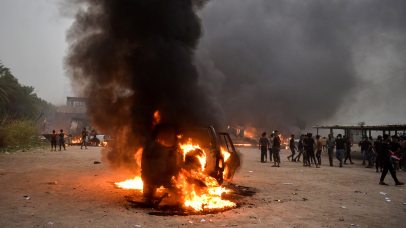
This photo released by the Iraqi Prime Minister Press Office shows a burning vehicle at the Baghdad International Airport following an airstrike in Baghdad, Iraq, January 3, 2020. (Iraqi Prime Minister Press Office via AP)

Pompeo has been working the phones extensively since the targeted killing of Soleimani, which in State Department readouts of his calls with officials around the globe was described as “defensive action in response to imminent threats to American lives.”

After the news of the strike, Netanyahu on Friday praised the United States and President Donald Trump for killing Soleimani.

“Trump is worthy of full appreciation for acting with determination, strongly and swiftly,” he told reporters before departing Greece to return to Israel. “We stand fully by the United States in its just battle for security, peace and self-defense.”

The prime minister said “Israel has the right to defend itself. The US has the same right exactly. Soleimani is responsible for the deaths of innocent US citizens and many others. He was planning further attacks.”

Netanyahu cut short his visit to Greece amid concerns Iran could exact revenge on the Jewish state for the US overnight strike. He had been visiting the country to sign a major deal for a gas pipeline.
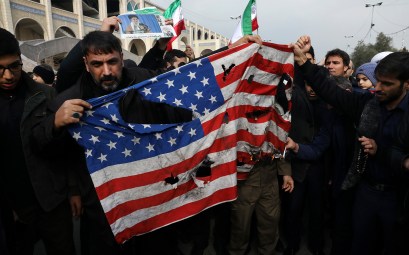
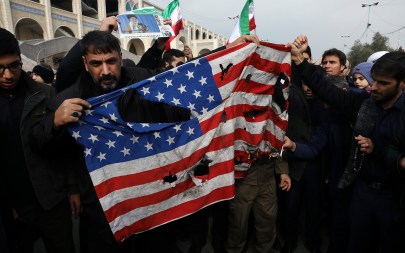
Protesters burn a US flag during a demonstration against the killing of Iranian general Qassem Soleiman in Tehran, Iran, Jan. 3, 2020. (AP Photo/Vahid Salemi)

Israel has reportedly raised its security alert at missions worldwide, and the Israel Defense Forces has heightened its alert, amid Iranian revenge threats against the US and the “Zionist regime.”

The security cabinet is set to convene Sunday.

General Gholamali Abuhamzeh, the commander of the Iranian Revolutionary Guard Corps in the southern province of Kerman, on Saturday threatened that some 35 US targets in the Middle East, “as well as Tel Aviv,” were within the reach of Tehran to avenge the killing of Soleimani.

Though Iran is seen as unlikely to retaliate by striking Israel, Channel 12 news reported Saturday that the military has upped its readiness on the borders in the case of a “spontaneous” response from Iran-backed terror groups, such as Lebanon’s Hezbollah or Hamas and Palestinian Islamic Jihad in the Gaza Strip.
 

With hours’ notice, US fast-response force flies to Mideast 

January 5, 2020

Source: With hours’ notice, US fast-response force flies to Mideast | The Times of Israel

Total of 3,500 American soldiers to ship to region this week; paratroopers, families caught off guard by New Year’s Eve deployment order; UK sends warships to Strait of Hormuz

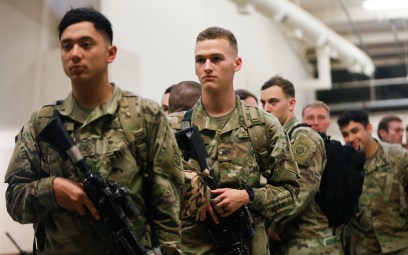
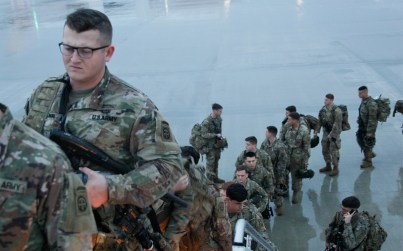
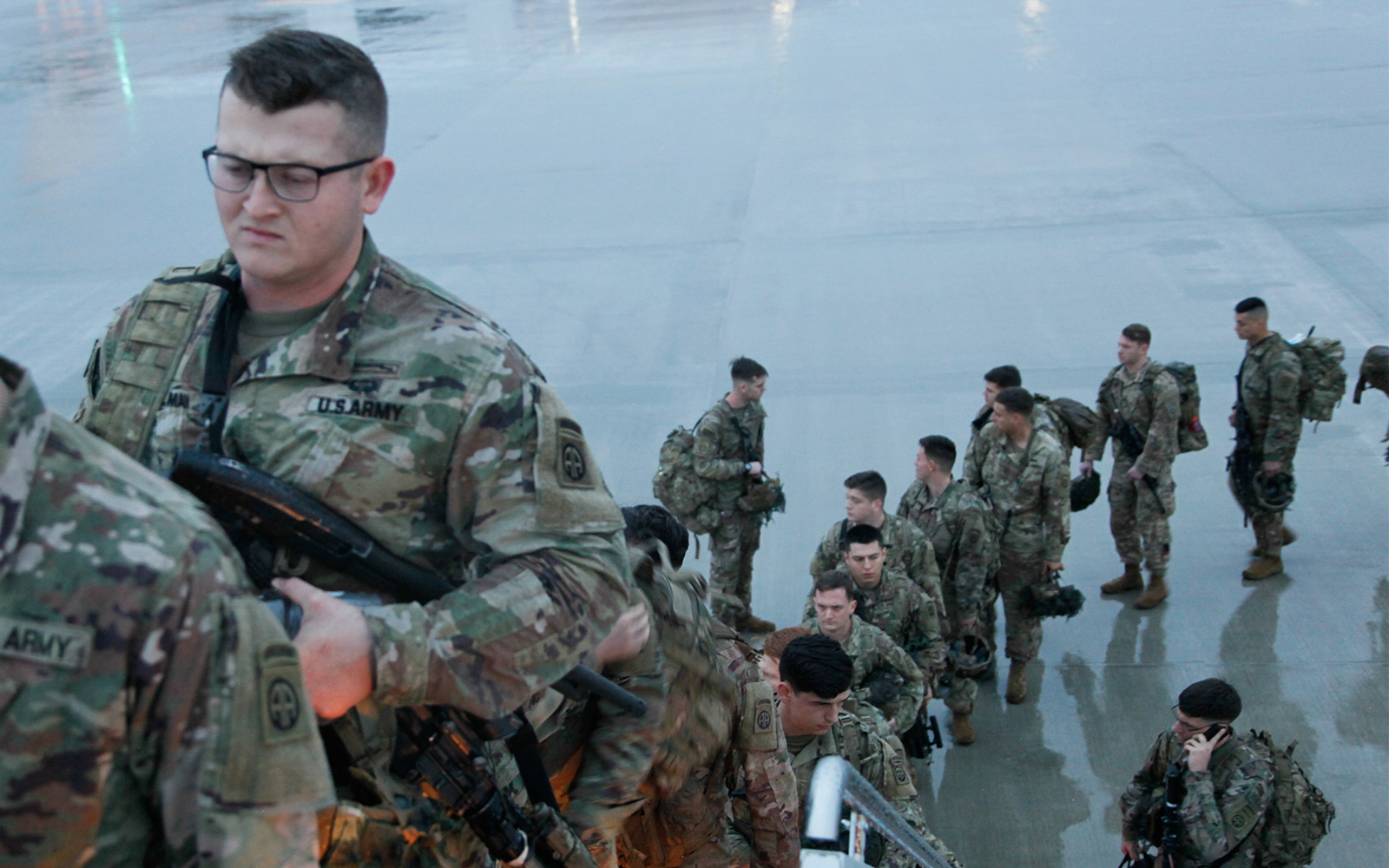
US paratroopers prepare equipment and load aircraft for deployment from Fort Bragg, North Carolina, January 4, 2020. (US Army/Spc. Hubert Delany III)

US paratroopers prepare equipment and load aircraft for deployment from Fort Bragg, North Carolina, January 4, 2020. (US Army/Spc. Hubert Delany III)

Hundreds of US soldiers deployed Saturday from Fort Bragg, North Carolina, to Kuwait to serve as reinforcements in the Middle East amid rising tensions following the US killing of Iranian general Qassem Soleimani.

Lt. Col. Mike Burns, a spokesman for the 82nd Airborne Division, told The Associated Press that 3,500 members of the division’s quick-deployment brigade, known officially as its Immediate Response Force, will have deployed within a few days. The most recent group of service members to deploy will join about 700 who left earlier in the week, Burns said.

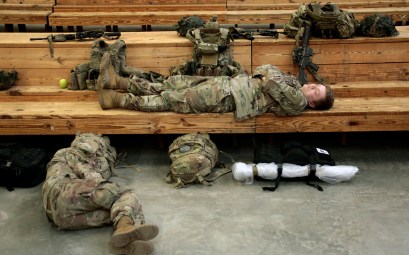
A loading ramp at Fort Bragg was filled Saturday morning with combat gear and restless soldiers. Some tried to grab a last-minute nap on wooden benches. Reporters saw others filing onto buses.

The additional troop deployments reflect concerns about potential Iranian retaliatory action in the volatile aftermath of Friday’s drone strike that killed Soleimani, the head of Iran’s elite Quds Force who has been blamed for attacks on US troops and American allies going back decades.

US President Donald Trump ordered the airstrike near Baghdad’s international airport. Iran has vowed retribution, raising fears of an all-out war, but it’s unclear how or when a response might come.

Reporters weren’t able to interview the soldiers leaving Fort Bragg on Saturday, but an airman loading one of the cargo planes told an Army cameraman he was making New Year’s plans when he got a call to help load up the soldiers, according to video footage released by the military.

“We’re responsible for loading the cargo. Almost our whole squadron got alerted. Like a bunch of planes are coming over here,” the unnamed airman said. “I was getting ready to go out for New Year’s when they called me.”

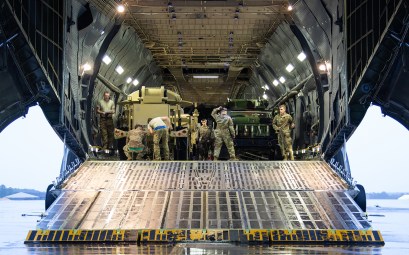
In the gray early morning light Saturday, Army video showed soldiers dressed in camouflage fatigues filing into planes, carrying rucksacks and rifles. Humvees were rolled onto another cargo plane and chained in place for the flight to the Middle East.

US soldiers prepare to ship to the Middle East from Fort Bragg, North Carolina, January 4, 2020. (US Army/Sgt. 1st Class Zachary Vandyke)

Burns said the soldiers within the Immediate Response Force train constantly to be ready to respond quickly to crises abroad. When called by their superiors, they have two hours to get to base with their gear and must maintain a state of readiness so that they can be in the air headed to their next location within 18 hours.

“So whether they were on leave, whether they were home drinking a beer, whether they were, you know, hanging out, throwing the kids up in the yard, you get the call and it’s time to go,” he said.

He said that soldiers typically keep individual “go-bags” of their personal gear with them at their living quarters.

The wife of a member of the 82nd Airborne who deployed earlier this week said his departure was so abrupt she didn’t have the chance to say goodbye in person or by phone.

US paratroopers assigned prepare equipment and load aircraft for deployment from Fort Bragg, North Carolina, January 4, 2020. (US Army/Spc. Hubert Delany III)

April Shumard said she was at work on New Year’s Eve and he was watching their five children when he texted her that he had to rush to base. He wasn’t sure if it was a drill or a deployment. She said her husband has been in the military since 2010 and has already deployed twice to Afghanistan. But with those prior deployments, the family had much more time to prepare and say goodbye. This time, she got a second message confirming he was leaving, and he departed in a plane on the afternoon of New Year’s Day.

“The kids kept going, ‘When’s Dad going to be home?’” said Shumard, 42. “It’s literally thrown me for a loop. And him as well. He’s still in disbelief of where he’s gone. Our heads are spun.”

She said that Fayetteville is a tight-knit community, and she expects people to work together to support families who are suddenly missing a parent.

US Army soldiers rest before heading out from Fort Bragg, North Carolina, to the Middle East, January 4, 2020. (AP Photo/Chris Seward)

“This was so last-minute,” she said, urging people to reach out to 82nd Airborne families. “Just try to help out whoever you know who might need some babysitting or help or just get some groceries and bring it to their house.”

Similarly, Bri’anna Ferry’s husband got the call on New Year’s Eve, and she said he was on a plane to the Middle East within hours. She fears he could miss milestones with their young daughter but also wants him to focus on his mission.

“I told him, don’t worry about us. We’ll be fine,” she said. “Focus on your mission.”

The UK was meanwhile sending navy ships to the Strait of Hormuz to protect shipping, The Guardian reported. Some 20 percent of the world’s traded oil passes through the strait off Iran’s coast, which forms the narrow mouth to the Persian Gulf.

UK-flagged commercial ships would be accompanied through the waterway by the Royal Navy in light of the threat from Iran. UK Defense Secretary Ben Wallace said the HMS Montrose frigate and HMS Defender destroyer would be deployed to the fraught maritime passage.

“The government will take all necessary steps to protect our ships and citizens at this time,” Wallace said.

Iran seized a British-flagged oil tanker in July as it passed through the Strait of Hormuz, releasing the ship in September.

The seizure came after British authorities took control of an Iranian tanker earlier in July off the coast of the British overseas territory of Gibraltar. The Iranian-flagged ship was suspected of carrying crude oil to Syria in violation of European Union sanctions.


Trump threatens to hit 52 Iranian sites if Tehran attempts reprisal 

January 5, 2020

Source: Trump threatens to hit 52 Iranian sites if Tehran attempts reprisal | The Times of Israel

US president cautions Iran against taking revenge for Soleimani killing, saying targets will be hit ‘very fast and very hard,’ as tensions soar amid fears of all-out war

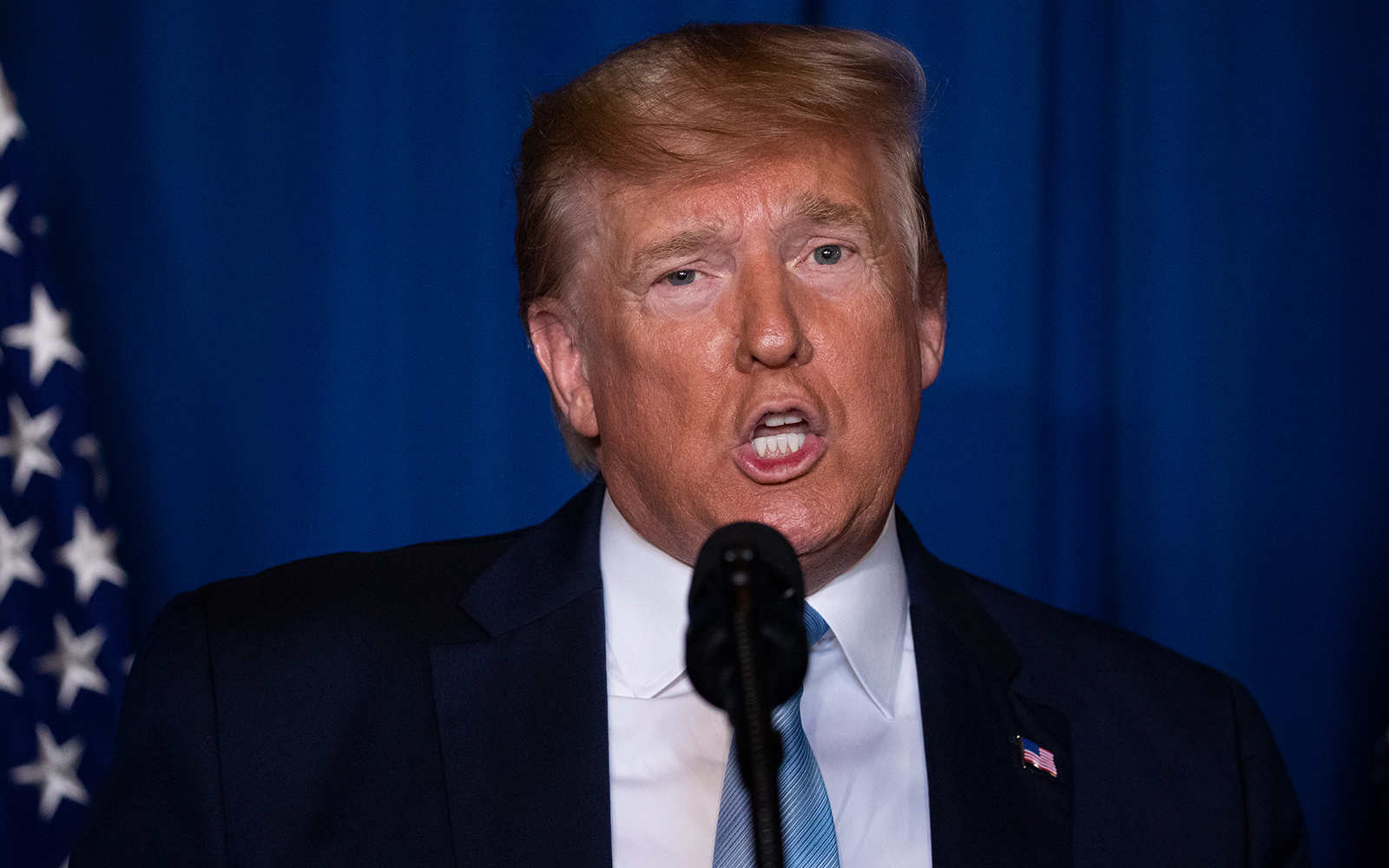
US President Donald Trump delivers remarks on Iran at his Florida Mar-a-Lago property, Jan. 3, 2020. (AP Photo/ Evan Vucci)

US President Donald Trump on Saturday issued stern warnings to Iran as tensions soared following the US killing of Iranian general Qassem Soleimani, threatening to his dozens of sites should Tehran attempt to take revenge.

Trump blamed Soleimani for recent attacks on Americans in his response to threats from Iranian officials, who have vowed retribution for the killing.

“Iran is talking very boldly about targeting certain USA assets as revenge for our ridding the world of their terrorist leader who had just killed an American,” Trump wrote on Twitter.

“If Iran strikes any Americans, or American assets, we have targeted 52 Iranian sites,” Trump wrote. “Some at a very high level & important to Iran & the Iranian culture, and those targets, and Iran itself, WILL BE HIT VERY FAST AND VERY HARD.”

Donald J. Trump

@realDonaldTrump

….hundreds of Iranian protesters. He was already attacking our Embassy, and preparing for additional hits in other locations. Iran has been nothing but problems for many years. Let this serve as a WARNING that if Iran strikes any Americans, or American assets, we have…..

Donald J. Trump

@realDonaldTrump

….targeted 52 Iranian sites (representing the 52 American hostages taken by Iran many years ago), some at a very high level & important to Iran & the Iranian culture, and those targets, and Iran itself, WILL BE HIT VERY FAST AND VERY HARD. The USA wants no more threats!

He said the number of sites represented “the 52 American hostages taken by Iran many years ago,” apparently referring to the 1979 Tehran embassy crisis.

Late Saturday night, the president tweeted again, this time warning Iran that the US will hit Iran “harder than they have ever been hit before!”

Trump followed up with another tweet, saying the US would use its “brand new beautiful” military equipment “without hesitation” if the Iranians retaliate.

Donald J. Trump

@realDonaldTrump

They attacked us, & we hit back. If they attack again, which I would strongly advise them not to do, we will hit them harder than they have ever been hit before! https://twitter.com/dancrenshawtx/status/1213583859402657793 
Dan Crenshaw

@DanCrenshawTX

For those claiming there’s “no plan,” that this was “reckless”:

Step #1 of any strategy is to stop letting terrorist regimes attack us without repercussion.

Why is this basic truth of foreign policy so controversial?https://foreignpolicy.com/2020/01/03/petraeus-on-qassem-suleimani-killing-says-trump-helped-reestablish-deterrence/ 

Iran has vowed harsh retaliation for the death of Soleimani, the mastermind of its regional military strategy. He was killed early Friday near the Baghdad international airport along with senior Iraqi militants in a targeted US airstrike ordered by Trump.

The strike has raised fears of an all-out war, but it’s unclear how or when Iran might respond. Any retaliation was likely to come after three days of mourning declared in both Iran and Iraq. All eyes were on Iraq, where America and Iran have competed for influence since the 2003 US-led invasion.

Trump said he ordered the strike, a high-risk decision that was made without consulting Congress or US allies, to prevent a conflict. US officials say Soleimani was plotting a series of attacks that endangered American troops and officials, without providing evidence.

In his Saturday Twitter thread, Trump said that Soleimani “badly wounded many” Americans, and killed many people in his lifetime, including recently “hundreds of Iranian protesters.”

He blamed Soleimani for attacks on the US embassy in Baghdad earlier this week and said the Iranian was was “preparing for additional hits in other locations.”

Iranian revolutionary students stormed the American embassy in Tehran in 1979 and took 52 US staffers hostage for 444 days, less than nine months after the toppling of Iran’s American-backed shah. The US broke off diplomatic relations with Iran in 1980 and ties have been frozen ever since.

Protesters burn a US flag during a demonstration against the killing of Iranian general Qassem Soleimani in Tehran, Iran, Jan. 3, 2020. (AP Photo/Vahid Salemi)

On Friday, Trump said “Soleimani was plotting imminent and sinister attacks on American diplomats and military personnel, but we caught him in the act and terminated him.”

“We took action last night to stop a war. We did not take action to start a war,” he said, adding: “We do not seek regime change.”

Before deciding on the strike, Trump was reportedly angered for days about the killing of a US contractor in Iraq on December 27, and ordered the airstrike on the Iranian general’s convoy as a response to the contractor’s killing and the storming of the US embassy by pro-Iranian protesters.

The US is seeing indications that Iran has stepped up its readiness to launch short- and medium-range ballistic missiles, according to a Saturday CNN report. US intelligence is conducting surveillance by various means to assess when the missiles could be ready to launch, the report said, citing an unnamed US official with direct knowledge of the issue.

Meanwhile, another unnamed US official told CNN that American defense chiefs were holding intense discussions as they try to ascertain whether Iran plans to retaliate in the next few days, with “conflicting views” on when a major attack may come.

An assault was definitely expected “within weeks” at maximum, the official said.

On Saturday a contingent of US troops set out from Fort Bragg, North Carolina, to Kuwait to serve as Middle East reinforcements. A US military spokesperson said that a total of 3,500 American soldiers will be deployed within a few days.

US paratroopers prepare equipment and load aircraft for deployment from Fort Bragg, North Carolina, January 4, 2020. (US Army/Spc. Hubert Delany III)

The UK sent two warships Saturday to protect shipping in the Strait of Hormuz at the mouth of the Persian Gulf.

US Secretary of State Mike Pompeo on Saturday spoke to Prime Minister Benjamin Netanyahu about Iraq and the Iranian threat to the region. It was the pair’s third phone conversation in the past week; Pompeo is believed to have briefed Netanyahu about the strike ahead of time.

Iranian Supreme Leader Ali Khamenei has said Tehran will react with “harsh revenge” to the hit on the popular general, who was his personal friend.

A senior Iranian commander on Saturday threatened that some 35 US targets in the Middle East, as well as Tel Aviv, were within reach of Tehran to avenge the killing of Soleimani.

Soleimani was the architect of Iran’s regional policy of mobilizing militias across Iraq, Syria and Lebanon, including in the war against the Islamic State group. He was also blamed for attacks on US troops and American allies going back decades.

An image published on Ali Khamenei’s official website on September 25 showing Khamenei, the Iranian supreme leader, left, alongside Hezbollah chief Hassan Nasrallah, center, and Islamic Revolutionary Guards Corps Quds Force commander Qassem Soleimani. (Khamenei.ir)

After the early Friday attack, the US-led coalition has scaled back operations and boosted “security and defensive measures” at bases hosting coalition forces in Iraq, a coalition official said on the condition of anonymity according to regulations.

In a thinly veiled threat, one of the Iran-backed militia, Kataeb Hezbollah, or Hezbollah Bridages, called on Iraqi security forces to stay at least 1,000 meters (0.6 miles) away from US bases starting Sunday night.

“The leaders of the security forces should protect their fighters and not allow them to become human shields to the occupying Crusaders,” the warning statement said, in reference to the coalition bases. The group is founded by Abu Mahdi al-Muhandis, a senior Iraqi militia commander who was killed in the same strike.

On Saturday evening, a series of rockets were launched and fell inside or near the Baghdad Green Zone, which houses government offices and foreign embassies, including the US Embassy.

No one was injured by a Katyusha rocket that fell inside a square less than one kilometer from the embassy, according to an Iraqi security official who spoke on condition of anonymity because he was not authorized to speak to reporters. Another rocket in Baghdad landed about 500 meters from As-Salam palace where the Iraqi President Barham Salih normally stays in Jadriya, a neighborhood adjacent to the Green Zone, the official said.

Another security official said three rockets fell outside an air base north of Baghdad were American contractors are normally present. The rockets landed outside the base in a farm area and there were no reports of damages, according to the official.


Iran poised to strike US forces, pulls militia chiefs out of Iraq. Trump: We have targeted 52 Iranian sites – DEBKAfile

January 5, 2020

Source: Iran poised to strike US forces, pulls militia chiefs out of Iraq. Trump: We have targeted 52 Iranian sites – DEBKAfile

Iran began gearing up for a revenge strike on US targets in Iraq on Saturday night, Jan 4, DEBKAfile’s exclusive military sources report. The Revolutionary Guards (IRGC) took their medium-range ballistic missiles out of storage and began positioning them at various points along Iran’s border with Iraq, ready for launch.

Their range covers most of the US bases in the country. Another strong indication that Tehran was poised to strike back for the death of the IRGC Al Qods chief Qssem Soleimani came from the hurried withdrawal during the day of most of the Iraq Shiite militia chiefs and their senior staff. They crossed the border into Iran and were taken to IRGC bases.

Saturday night, too, the Kata’ib Hezballah militia warned Iraqi army units and security agents to be out of US military facilities by Sunday 7 p.m. A red flag was unfurled over the revered Jamkaran Mosque of Qom, Iran’s religious center, denoting the Islamic Republic’s coming retaliation for the death of Qassem Soleimani at American hands.

Responding to Iran’s preparations for war, President Donald Trump warned in a series of tweets that if Iran strikes any Americans, or American assets, “We have … targeted 52 Iranian sites, some at a very high level & important to Iran & the Iranian culture… Iran itself, WILL BE HIT VERY FAST AND VERY HARD.”  The figure 52 recalled the 52 American hostages held at the Tehran embassy by Shiite revolutionaries in 1979-81. It also raised the stakes against Tehran’s threat to strike “35 American targets, including warships in the Persian Gulf and Strait of Hormuz and Tel Aviv.”

Some 3,000 US troops form the 82nd Airborne Division have been deployed to the Middle East, joining the 750 soldiers shipped earlier to Kuwait.

On Saturday morning, DEBKAfile reported that the US had begun targeting Iraq’s pro-Iranian militia chiefs after terminating their master

The US air force continued to hunt down pro-Iran militia chiefs early Saturday, Jan 4, after killing their master, thus revealing America’s follow-up tactics for ridding Baghdad of Tehran’s grip. Those tactics started unfolding 24 hours earlier. Killed alongside Qassem Soleimani, the mastermind of Iran’s network of proxies, was also Abu Mahdi al-Muhandis, head of the Popular Mobilization Units (PMU) the umbrella grouping of Iran’s Shiite militias in Iraq.

Since cutting down their master, the Trump administration has clearly launched a systematic war to eliminate the militia chiefs through whom Tehran maintains its grip on Baghdad.

Early Saturday, another US air strike hit the convoy of Shebl al-Zaidi, head of the Imam Ali Battalions, near Camp Taji military compound north of Baghdad. Six people were killed, most likely including Al Zaidi and his lieutenants, according to US officials. The PMU while confirming the strike claimed it hit “a medical convoy” – evidently taken aback by the new tempo of American attacks.

Shebl al-Zaidi, reportedly one of the more vicious Shiite leaders, was jailed during the US occupation of Iraq, and has been photographed with Qassem Soleimani,

In any event, the US strike happened and it attested to the new orders issued to the US command in Iraq:  go on the offensive against the pro-Iranian Iraqi militias and target them with planes, helicopters or drones whenever their leaders try moving about on the roads and highways.

These tactics spearhead the Trump administration’s preset goals:

  1. To end the extremist Shiite militias’ control of Baghdad and push them out to the periphery.
  2.  To establish mainstream Iraqi government rule in the capital – initially under an American air force and military shield.
  3. To use the impetus created by the ending of Qassem Soleimani’s career and that of his Iraqi agent Al-Muhandis for terminating the reign of those militia chiefs and their hierarchies.

This extremely ambitious, long-term program, which relies on first-rate intelligence, is the Trump administration’s answer to the critics who claim that the high-risk assassination of Qassem Soleimani was performed without a strategy or follow-up planning.

It is most likely to be an American initiative without European coalition partners. Secretary of State Mike Pompeo said on Friday that European allies had not been as “helpful” as he had hoped over the Soleimani killing. Later, French President Emmanuel Macron urged those involved to act with “restraint,” while British Foreign Secretary Dominic Raab said de-escalation would be key. “The Brits, the French, the Germans all need to understand that what we did, what the Americans did, saved lives in Europe as well,” Pompeo said.

Nonetheless, coalition spokesman Col. Myles Coggins contradicted the Pentagon’s statement about the fresh air strike on Saturday, stating, “The OIR did NOT conduct airstrikes near Camp Taji (north of Baghdad) in recent days.”

Moving forward, the Pentagon assigned a first batch of 750 extra troops to the Middle East for the protection of American personnel, to be followed by 4,000 more.  DEBKAfile adds: A US brigade of 700 officers and men is on standby in Italy to fly to a military airfield made ready for its intake at Halat in north Lebanon, should it be necessary to defend the Beirut embassy against potential attack by the pro-Iran Hizballah militia of Lebanon.


Pelosi Stands Up For Brutal Terrorist, Scolds Trump For ‘Disproportionate’ Hit On Soleimani

January 4, 2020

Source: Pelosi Stands Up For Brutal Terrorist, Scolds Trump For ‘Disproportionate’ Hit On Soleimani | The Daily Wire

DailyWire.com
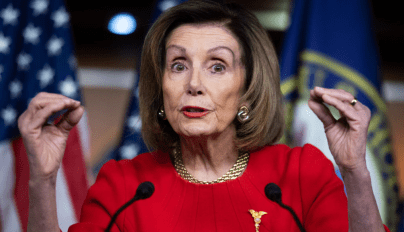
Speaker of the House Nancy Pelosi, D-Calif., conducts her weekly news conference in the Capitol Visitor Center on Thursday, December 19, 2019.
Photo By Tom Williams/CQ-Roll Call, Inc via Getty Images

On Friday, House Speaker Nancy Pelosi (D-CA) took a stand for brutal terrorist and Iranian general Qassem Soleimani, scolding President Donald Trump for taking a “disproportionate” hit on the terrorist.

“American leaders’ highest priority is to protect American lives and interests,” the Democrat leader posted via social media hours after the Soleimani-kill was confirmed. “But we cannot put the lives of American servicemembers, diplomats and others further at risk by engaging in provocative and disproportionate actions.”

Nancy Pelosi

Pelosi Statement on Airstrike in Iraq Against High-Level Iranian Military Officials

“American leaders’ highest priority is to protect American lives and interests.

speaker.gov

“Soleimani was the head of the Iranian and Iranian-backed forces carrying out those operations killing American troops” during the Iraq War, Fox News reported. “According to the State Department, 17 percent of all deaths of U.S. personnel in Iraq from 2003 to 2011 were orchestrated by Soleimani.”

Moreover, as reported by The Daily Wire’s Ryan Saavedra on Friday afternoon, Soleimani was in the process of “coordinating” attacks on U.S. personnel, according to the State Department.

“We can confirm that in the past several days, General Soleimani had been traveling in the Middle East coordinating further imminent large-scale attacks against U.S. diplomats and service members. These threats were highly credible and the intelligence is sound,” the State Department said.

Ryan Saavedra

Pelosi continued to attack the Trump administration, ripping the president for killing the dangerous terrorist without consulting Congress.

“The Trump Admin has conducted strikes in Iraq targeting high-level Iranian military officials and killing Iranian Quds Force Commander Qasem Soleimani without an AUMF against Iran,” wrote the California rep. “Further, this action was taken without the consultation of the Congress.”

Nancy Pelosi

Amercan leaders’ highest priority is to protect American lives and interests. But we cannot put the lives of American servicemembers, diplomats and others further at risk by engaging in provocative and disproportionate actions. https://www.speaker.gov/newsroom/1220 

Pelosi Statement on Airstrike in Iraq Against High-Level Iranian Military Officials

“American leaders’ highest priority is to protect American lives and interests.

speaker.gov

Nancy Pelosi

The Trump Admin has conducted strikes in Iraq targeting high-level Iranian military officials and killing Iranian Quds Force Commander Qasem Soleimani without an AUMF against Iran. Further, this action was taken without the consultation of the Congress.

In the past, however, Pelosi did not have an issue with President Obama executing the disastrous Iran Deal without congressional approval. In fact, the Democrat called it a “diplomatic masterpiece” in 2015, according to USA Today.

“Former national security adviser Ben Rhodes, the architect of the Iran nuclear deal, purposely structured the JCPOA as a treaty that was not a treaty because he and his boss, President Obama, had no intention whatsoever of doing with the JCPOA what the Constitution mandates for all treaties, which is to obtain the approval of two-thirds of the Senate,” explained National Review writer Kyle Smith on Friday. “Rhodes and Obama simply rammed through what was in effect a treaty without seeking the approval of even one Senator.”

Daily Wire Editor-in-Chief Ben Shapiro remarked on Democrats’ outrage over the Trump-ordered hit on Soleimani by outlining “Team Obama” foreign policy:

“Team Obama overthrew Qaddafi, failed to protect our Benghazi embassy, lied about it, and withdrew. Then they tried to bribe the Iranian terrorist regime without any strings attached. Now they have advice after Trump defended the Baghdad embassy and killed Soleimani. No,” he posted.

Ben Shapiro

Pelosi wasn’t the only high-profile Democrat to attack Trump for killing one of the most dangerous terrorists in the world. Far-left Rep. Ilhan Omar (D-MN) claimed Trump is trying to start a war with Iran to help him win reelection:

Ilhan Omar

Real question is, will those with congressional authority step in and stop him? I know I will. https://twitter.com/chrismurphyct/status/1212913952436445185 

Chris Murphy

Soleimani was an enemy of the United States. That’s not a question.

The question is this – as reports suggest, did America just assassinate, without any congressional authorization, the second most powerful person in Iran, knowingly setting off a potential massive regional war?


Airstrikes Kill More Top Iranian-Backed Terrorist Leaders In Airstrikes, Reports Say 

January 4, 2020

Source: Airstrikes Kill More Top Iranian-Backed Terrorist Leaders In Airstrikes, Reports Say | The Daily Wire

DailyWire.com
This picture taken on October 25, 2019 shows a burning car at the scene of anti-government demonstrations outside the burning local government headquarters in Nasiriyah, the capital of Iraq's southern province of Dhi Qar.
October 25, 2019 — Photo AFP via Getty Images

The Associated Press reported: “Iraqi official says airstrike hits cars carrying Iran-backed militia north of Baghdad.”

Zeke Miller

@ZekeJMiller

In the early morning hours on Saturday in Iraq, OIR Spokesman Col. Myles B. Caggins III, official military Spokesperson for Operation Inherent Resolve (OIR), reported that the International Coalition for Operation Inherent Resolve did not have anything to do with the airstrikes.

OIR Spokesman Col. Myles B. Caggins III

“Air strikes targeting Iraq’s Popular Mobilization Forces umbrella grouping of Iran-backed Shi’ite militias near camp Taji north of Baghdad have killed six people and critically wounded three, an Iraqi army source said late on Friday,” Reuters reported. “Two of the three vehicles making up a militia convoy were found burned, the source said, as well as six burned corpses. The strikes took place at 1:12 am local time, he said.”

The strike comes only one day after a strike that was authorized by President Donald Trump took out Qasem Soleimani, the head of the Iranian Revolutionary Guard Corps-Quds Force, a U.S.-designated Foreign Terrorist Organization.

The strike that killed Soleimani also killed top Iraqi paramilitary commander Abu Mahdi al-Mohandes, the head of the Iranian-linked Popular Mobilization Forces.

The two were killed when an American MQ-9 Reaper drone targeted a convoy that the two men were riding in that was leaving Baghdad International Airport.

Soleimani was responsible for killing hundreds of American soldiers in Iraq dating back to the start of the Iraq war in 2003.

Lucas Tomlinson

Qasem Soleimani led all Iranian and Iranian-backed forces in those operations.
17% of U.S. troops killed in Iraq from 2003 to 2011 orchestrated by Iran, State Dept. says

On Friday, Trump said that he ordered the military to take out Soleimani because he “was plotting imminent and sinister attacks on American diplomats and military personnel, but we caught him in the act and terminated him.”

“For years the Islamic Revolutionary Guard Corps and its ruthless Quds force under Soleimani’s leadership has targeted, injured, and murdered murder hundreds of American civilians and servicemen,” Trump continued. “Soleimani made the death of innocent people his sick passion, contributing to terrorist plots as far as way as New Delhi and London. … Recently Soleimani led the brutal representation of protesters in Iran where more than 1,000 innocent civilians were tortured and killed by their own government.”

The Department of Defense said: “General Soleimani was actively developing plans to attack American diplomats and service members in Iraq and throughout the region. General Soleimani and his Quds Force were responsible for the deaths of hundreds of American and coalition service members and the wounding of thousands more. He had orchestrated attacks on coalition bases in Iraq over the last several months – including the attack on December 27th – culminating in the death and wounding of additional American and Iraqi personnel. General Soleimani also approved the attacks on the U.S. Embassy in Baghdad that took place this week.”

The Department of State said: “We can confirm that in the past several days, General Soleimani had been traveling in the Middle East coordinating further imminent large-scale attacks against U.S. diplomats and service members. These threats were highly credible and the intelligence is sound. General Soleimani’s travel also violated the ban imposed by the United Nations Security Council. Recent orders given by General Soleimani dramatically escalated Iran’s campaign of violence and terrorism against Americans and American interests in the Middle East. He orchestrated a series of attacks against American forces in Iraq in the past several months, culminating in the rocket attack on December 27, 2019, which resulted in the death of an American citizen, wounded four American service members, and threatened the lives of many more American personnel. General Soleimani also ordered the assault on the American Embassy in Baghdad. General Soleimani continued to command Iranian supported proxies in Iraq, which posed an escalating threat to the lives of Americans.”

This report has been updated.


Israeli Navy to Upgrade its Combat Surface Fleet Of Missile Boats 

January 4, 2020

https://www.youtube.com/watch?v=bMzli5aB3m8

Israeli Navy to Upgrade its Combat Surface Fleet OF Missile Boats

The Israeli Navy oversees the formation of the IDF naval forces. The naval commander also defines the objectives of the navy: to protect the State of Israel from maritime threats, to give an alarm in the event of imminent conflict, and to fulfill specific missions during a conflict.

The need to create and develop a Jewish maritime force was formulated in January 1948. At that time, Jewish communities faced the threat of Arab countries. On March 17, 1948, an order was made to set up a naval branch under the command of Marine Captain Gershon Zak. His first recruits included sailors, fishermen, port workers, coastal residents, volunteers from the British Navy, etc.

The missions of the Israeli Navy are to:

Protect and defend the State of Israel from maritime threats
Secure the vital maritime operations of the State of Israel
Assist the rest of the Israeli army in case of conflict
Shoot enemy targets
Produce and evaluate photographs of maritime space
Transport equipment and soldiers
Perform search-and-rescue missions at sea
Train the naval forces of the IDF
Execute certain ground missions within the framework of the instructions of the army

Bases:
Instruction: The objective of the training base is to train Navy recruits for their future task in their unit
Haifa: The missions of the Haifa base are: securing Israel’s sea routes, strengthening the operational capability of the navy, and deepening cooperation between the Israeli Navy and other IDF armed forces.
Ashdod: Responsible for the southern part of the Mediterranean coast of the State of Israel and mainly deals with routine security operations in this maritime area.
Atlit: Home to one of the IDF’s elite units, Shayetet 13 (Navy Special Forces). The base is located south of Haifa and is not open to visitors.
Eilat: The Navy’s headquarters in the Red Sea since the final withdrawal of naval forces from Sharm el-Sheikh under the 1979 peace accords with Egypt.
Shipyard: The Israeli Navy shipyard, located in Haifa, is the place where ship repair and improvement works are carried out. The shipyard is also responsible for weaponry development, marine coastal inspection systems, and the corps’ equipment.
Equipment: The logistics base of the Navy. Its role is to provide for the logistical needs of the various units of the corps.
Headquarters: Located in Tel Aviv in the Kirya, which houses the headquarters of the IDF’s different corps. The role of the headquarters is to manage the corp, to determine general policies, and to train the naval force.

Structure and principal units:
Routine Security Company (Palgot Habatash): The regular security forces guard the maritime border of the State of Israel and prevent any threat to harm the security of Israel and its citizens.
Missile boats (Shayetet 3): The mission of this squadron is to fight the enemy fleet in time of war, sink enemy ships, prevent Israel’s enemies from blocking its sea routes, and and assist the ground forces with incursions into enemy territory.
Submarines (Shayetet 7): This unit’s missions are the destruction of enemy ships, controlling port entrances, the carrying out of secret espionage activities, and assisting other units during combat.
Special Forces of the Navy (Shayetet 13): Shayetet 13 is the marine commando which operates at sea, on land, and in the air; its permanent base is at Atlit. It is one of the most daring units of the IDF.
Naval control unit: This naval command unit is responsible for all military exercises and naval operations. This unit is divided into four companies: command, communication, electronics, and human resources. The unit is also responsible for the operations of naval combatants, both in emergency and routine situations. The mission of this unit is to inspect the operations of the units of the Israeli Navy.

How Qassem Soleimani was targeted by 230mph laser guided Hellfire missile fired from drone | Daily Mail Online

January 4, 2020

Source: How Qassem Soleimani was targeted by 230mph laser guided Hellfire missile fired from drone | Daily Mail Online

  • Qassem Soleimani, 62, was targeted as he was leaving Baghdad airport in his car
  • A near-silent US MQ-9 Reaper drone launched the laser-guided Hellfire missile   
  • Soleimani was under near-constant surveillance by US, Saudi and Israeli forces   
  • He had survived several assassination attempts over the past two decades

He had escaped many previous assassination attempts. But Qassem Soleimani had little warning of the deadly missiles which targeted his car with pinpoint accuracy as he was leaving Baghdad airport.

A near-silent US MQ-9 Reaper drone launched the laser-guided weapons at the two-car convoy, killing the general, an Iraqi militia commander and their entourage.

The White House said the air strike was carried out ‘at the direction’ of President Donald Trump, who tweeted an image of the US flag hours after the attack.

He gave the orders without any apparent warning to his Western allies, including Britain, or to senior Democrats in the US. Secretary of State Mike Pompeo said the US made an ‘intelligence-based assessment’ to save American lives in the region amid reports Soleimani was ‘actively plotting’ attacks.

This prompted Mr Trump to order the air strike, following years of escalating tensions between Washington and Tehran.

Iran’s highest-ranking military commander arrived at the airport in the early hours of yesterday morning on a flight from Syria.

Two Toyota SUVs drove on to the tarmac and he was greeted by Abu Mahdi al-Muhandis, the deputy commander of Iranian-backed militia forces operating in Iraq.

The two men and their most senior aides travelled in one car and their bodyguards in the other.

Moments later, as the cars passed through a cargo area on an access road out of the airport, the convoy was hit by up to four missiles.

Grainy black and white CCTV footage showed a massive explosion which instantly reduced the vehicles to twisted metal.

Soleimani’s bloodied remains were identified in the debris only by a distinctive ring he wore. Iran’s state media said ten were killed in the attack, including four senior Iranian military aides, four Iraqi militia leaders and al-Muhandis. 

Hunter-killer drone struck at 230mph 

Local militia commander Abu Muntather al-Hussaini said two missiles hit the car carrying Soleimani, 62, and al-Muhandis, 66. The second car was struck by a single missile. They were said to have been launched by an unmanned MQ-9 ‘hunter-killer’ drone sent from the US Central Command headquarters in Qatar.

Piloted by a two-man crew hundreds of miles away, the 230mph drone can carry out precision strikes and relay images of the attack to commanders anywhere in the world. The $64million (£49million) Reaper carries four laser-guided Hellfire missiles with 38lb warheads capable of destroying a tank, along with Paveway bombs.

Aviation experts said its flight was ‘nearly silent’, meaning its intended victims would have had little or no warning of its approach.

Iran’s highest-ranking military commander arrived at the airport in the early hours of yesterday morning on a flight from Syria. Iran’s state media said ten were killed in the attack

Iran’s highest-ranking military commander arrived at the airport in the early hours of yesterday morning on a flight from Syria. Iran’s state media said ten were killed in the attack

A Gulf newspaper reported the strike involved modified Hellfire R9X ‘Ninja’ missiles, which have warheads with pop-out spinning blades designed to minimise collateral damage.

Instead of exploding, the missile is armed with six long blades that extend just before impact, effectively shredding their targets.

CCTV footage from the airport appeared to show a large explosion, and the charred wreckage of the convoy suggested it had been ripped apart by the force of a massive blast. The Pentagon refused to give details of the strike and Iranian officials claimed it was carried out by helicopter.

Years of intelligence that led to the strike 

Precision drone strikes rely on detailed intelligence, and Soleimani was kept under near-constant surveillance by US, Saudi and Israeli security forces.

The New York Times reported that the Pentagon used highly classified information from informants, electronic intercepts, reconnaissance aircraft and other surveillance techniques to track the Iranian general’s movements.

The strike was carried out by the Joint Special Operations Command, although the White House said it was done ‘at the direction’ of President Trump.

Iranian demonstrators chant slogans during a protest against the assassination of Soleimani and Iraqi militia commander Abu Mahdi al-Muhandis

Iranian demonstrators chant slogans during a protest against the assassination of Soleimani and Iraqi militia commander Abu Mahdi al-Muhandis

Soleimani’s bloodied remains were identified in the debris only by a distinctive ring he wore

Soleimani’s bloodied remains were identified in the debris only by a distinctive ring he wore

A source told CNN that Soleimani was involved in planning attacks on US interests in multiple countries in the region, including against US service personnel.

Force protection levels for all US military personnel in the region were increased in the 24 hours before the strike amid fears the attacks could be imminent.

A senior Trump administration official said intelligence suggested Soleimani was travelling to Baghdad to plan future attacks against US interests.

The official told CNN: ‘The President made a rapid and decisive decision on this.’ The Pentagon accused Soleimani of having previously orchestrated rocket attacks on coalition military bases in Iraq, including one last Friday which killed a US civilian contractor and injured several military personnel.

He was also said to have approved the attacks on the US Embassy in Baghdad.

Did Trump breach rules with ‘secret’ attack? 

Senior Democrats accused the President of breaching protocol by launching the air strike without notifying leading members of Congress. The ‘Gang of Eight’, including Speaker Nancy Pelosi, are typically briefed over sensitive military actions which could have significant consequences for the US.

The four Democrats in the Gang of Eight said they were not briefed, although it was unclear if any of the Republicans were told ahead of time.

Senator Lindsey Graham, who is not a member of the group but is a close Trump ally, said he was briefed about the potential operation when he was with Mr Trump in Florida earlier in the week.

President Donald Trump delivers remarks in West Palm Beach, Florida, following the US Military airstrike against Soleimani

President Donald Trump delivers remarks in West Palm Beach, Florida, following the US Military airstrike against Soleimani

Trump tweeted an image of the US flag hours after the attack. He gave the orders without any apparent warning to his Western allies, including Britain

Trump tweeted an image of the US flag hours after the attack. He gave the orders without any apparent warning to his Western allies, including Britain

The Times reported that the strike was approved at the same time as the President authorised last Sunday’s attack on Kataeb Hezbollah bases in Iraq and Syria.

US presidents can act without congressional approval when US personnel or interests are facing an imminent threat.

In its statement, the Pentagon said: ‘At the direction of the President, the US military has taken decisive defensive action to protect US personnel abroad by killing Qassem Soleimani. This strike was aimed at deterring future Iranian attack plans.’

General was assassins’ target for decades 

Soleimani had survived several assassination attempts by Western, Israeli and Arab agencies over the past two decades.

But Mr Trump’s predecessors Barack Obama and George W Bush both baulked at plans to kill him, in the apparent belief that the consequences would be too great.

Last year Tehran said it foiled an assassination attempt by Israeli and Arab spies, who tried to buy a property next to a mosque built by Soleimani’s father in the city of Kerman so they could


Iraq in Turmoil: The Context of the Soleimani Killing 

January 4, 2020


President Trump Statement on Death of Iranian Gen. Qassem Soleimani 

January 4, 2020

https://www.youtube.com/watch?v=xw89mMq5-JY


SKIP NAVIGATION