Archive for January 2020

Israel unveils breakthrough laser to intercept missiles, aerial threats 

January 9, 2020

Source: Israel unveils breakthrough laser to intercept missiles, aerial threats – The Jerusalem Post

Technology expected to take down a variety of aerial threats including rockets, drones, anti-tank missiles.

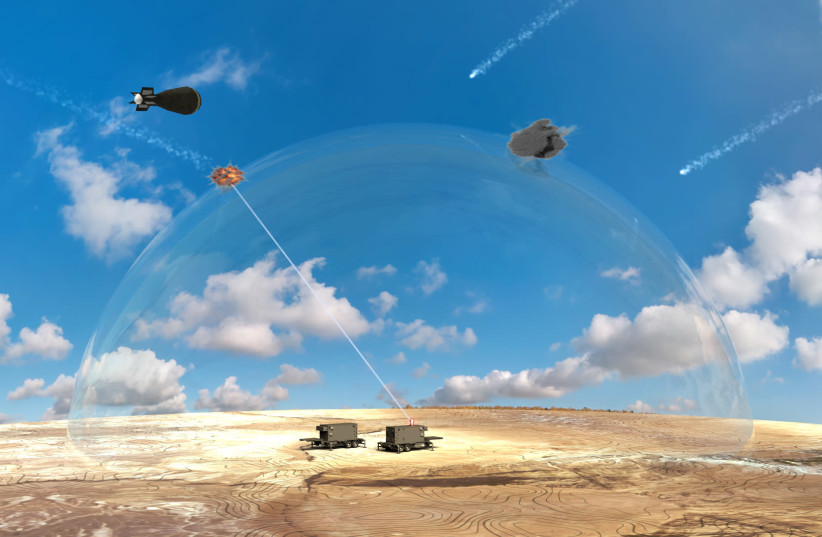
Artistic depiction of how innovative laser defense system would function on the battle field  (photo credit: Courtesy)
Artistic depiction of how innovative laser defense system would function on the battle field
(photo credit: Courtesy)
The Defense Ministry has made a technological breakthrough in the development of lasers that can intercept aerial threats, including rockets and anti-tank guided missiles, it announced Wednesday.

New laser technology “makes the security apparatus more lethal, more powerful and more advanced,” Defense Minister Naftali Bennett said Wednesday evening.

Speaking about this new addition to the existing tools of war employed by Israel, he said that “we will add a laser sword when dealing with threats from the North or the South.”

The enemies of Israel better not test our resolve or our abilities,” Bennett said.

Brig.-Gen. Yaniv Rotem, head of the Defense Ministry’s Directorate of Research and Development, said: “We are entering a new age of energy warfare in the air, land and sea. The R&D investments made by the DD [Directorate of Defense] R&D in recent years have placed the State of Israel among the leading countries in the field of high-energy laser systems.”

The ministry has been working for more than 10 years on powerful laser technology to enable the development of platforms to intercept a variety of threats, he said. It has carried out a number of successful interceptions of targets, including mortar shells, drones and antitank missiles, at a variety of ranges over the years.

“This is a dramatic solution to rocket fire,” said Dubi Oster, head of the DDR&D Optronics Department. “We have been working on this for years. But it is challenging to get a good-quality beam to stay the size you need at the range you need… for example, a beam the diameter of a coin from here [in Tel Aviv] to Herzliya.”While most developments over the years – both in Israel and abroad – have been ineffective, significant achievements have been made over the past year and a half as a result of collaboration between the ministry and defense companies, including Rafael and Elbit Systems, as well as academic institutions. The breakthrough recently made by the ministry is based on the precision of the laser beam, which can be focused on long-range targets and which can overcome atmospheric disturbances such as clouds and dust storms.

According to Oster, the ministry was able to take several laser beams and, with an advanced algorithm, connect them to get one strong beam that is able to intercept and take down a variety of threats. Based on high-energy electric lasers rather than chemical laser technology, the robust system will complement the other layers of Israel’s aerial defenses and will be a strategic change in the defense capabilities of the state, the ministry said.

According to Rotem, some of the advantages of the high-energy lasers include the ability to continually use the system at lower cost, higher effectiveness and with efficient management. They will also allow for a decrease in the number of missile interceptors used and the future potential to intercept a variety of threats, including unmanned aerial vehicles, drones and guided rockets.

“During a war, missile interceptors will at one point run out, but with this system, as long as you have electricity, you have a never-ending supply,” he said.

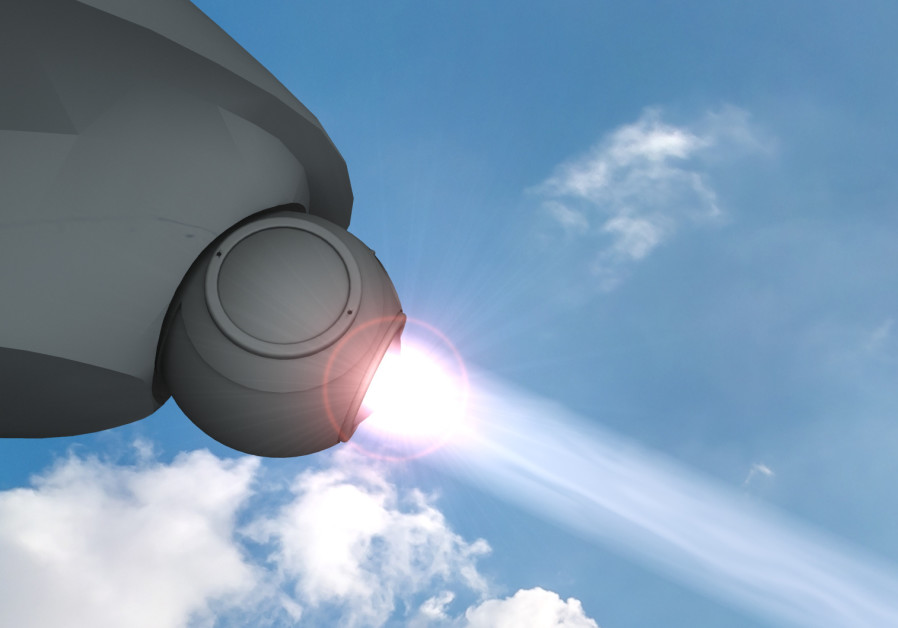
Artistic depiction of how innovative laser defense system would function on the battle field/ Courtesy

Artistic depiction of how innovative laser defense system would function on the battle field/ Courtesy

“This is a weapon that you can’t see or hear,” Rotem said, adding that while it is not free since it runs on electricity, every interception will only cost a few dollars, as opposed to interceptor missiles that can run into the thousands.

The use of two different and complementary technologies – kinetic air-defense-like systems, such as the Iron Dome, and laser platforms – “is a game-changer,” Rotem said.

As a result of the breakthrough, the ministry has launched three programs for the development of high-energy laser demonstration systems in cooperation with the two companies: a ground-based laser system to complement the capabilities of the Iron Dome, development of a maneuverable platform-mounted laser system to defend troops in the field and the development of a laser demo system mounted on an air platform to intercept threats above cloud covers and for the defense of wide areas.

“This is one system with many options – the weapon of the future,” Rotem said.

Throughout the year there will be several trials of the demos’ capabilities, the ministry said. If effective, they will be deployed to the Gaza border area.

“This technology enables the development of highly effective operational systems that will serve as an additional layer of defense to secure the State of Israel by air, land and sea,” the ministry said.


Trump and Netanyahu discuss ‘critical’ issues after Iran missile strikes

January 9, 2020

Source: Trump and Netanyahu discuss ‘critical’ issues after Iran missile strikes | The Times of Israel

Brief statement from White House says says two leaders speak of unspecified ‘bilateral and regional issues’; PM earlier warned Tehran against hitting Israel

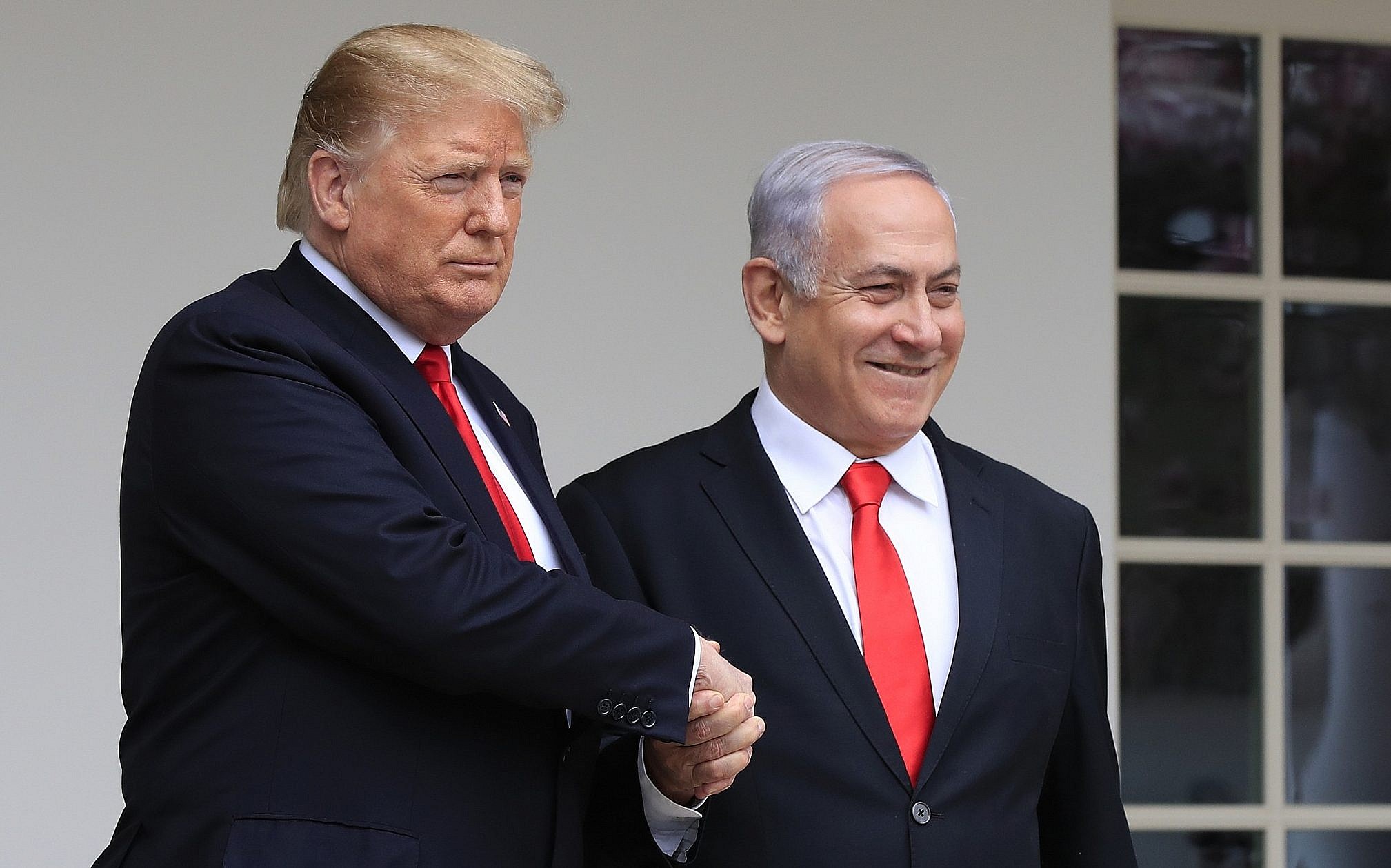
US President Donald Trump, left, welcomes visiting Prime Minister Benjamin Netanyahu to the White House in Washington, March 25, 2019. (Manuel Balce Ceneta/AP)

US President Donald Trump, left, welcomes visiting Prime Minister Benjamin Netanyahu to the White House in Washington, March 25, 2019. (Manuel Balce Ceneta/AP)

US President Donald Trump spoke Wednesday with Prime Minister Benjamin Netanyahu following an Iranian missile strike on US forces in Iraq, the White House said.

A brief statement said the two leaders discussed “critical bilateral and regional issues,” giving no further details. There was no immediate confirmation or comment from Israel.

Earlier Wednesday, Netanyahu warned Iran against attacking Israel in response to the American killing last week of senior military commander Qassem Soleimani and congratulated Trump for ordering the strike.

“We’re standing steadfast against those who seek our lives. We’re standing with determination and with force. Whoever tries to attack us will receive a crushing blow in return,” he declared at a conference in Jerusalem.

Netanyahu was speaking after Iran fired over a dozen missiles at US bases in Iraq. Iran claimed 80 US troops were killed in the strikes, and warned that it could strike next at Israel; the US said there were no casualties.

In recent days a senior commander in Iran’s Islamic Revolutionary Guard Corps has warned that Tel Aviv could also be targeted, while a former head of the IRGC threatened to turn Israeli cities “to dust” if the US attacks targets in Iran.

“Qassem Soleimani was responsible for the death of countless innocent people,” Netanyahu said. “He destabilized many countries. For decades, he sowed fear and misery and anguish. And he was planning much worse.

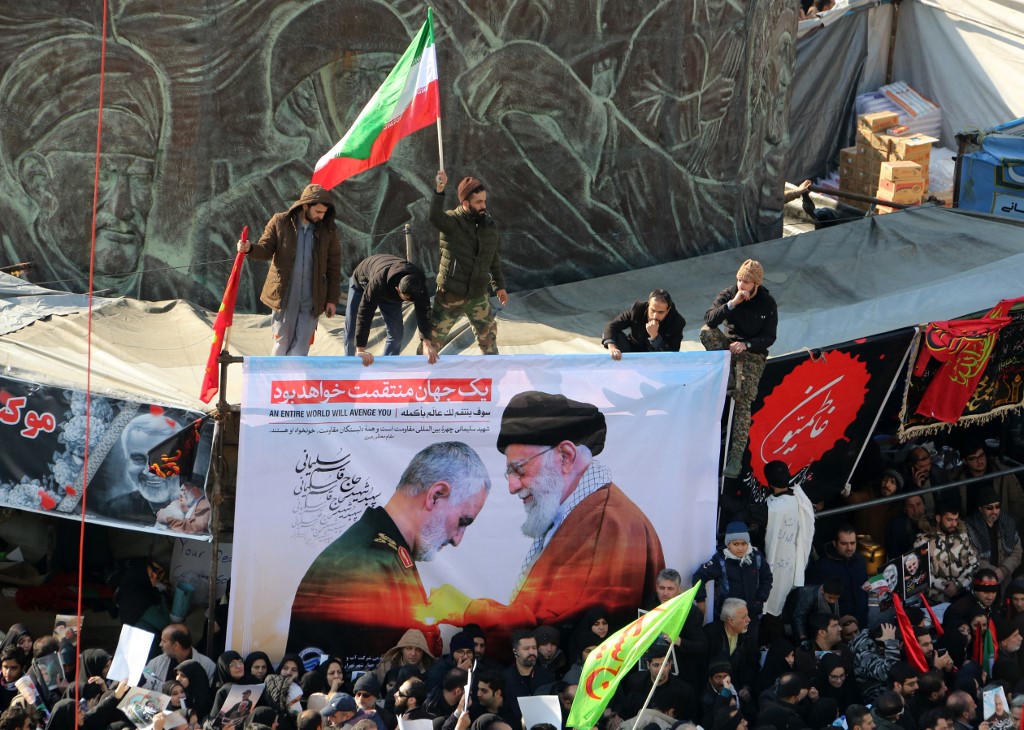
Iranian mourners carry a picture of Iran’s Supreme Leader Ayatollah Ali Khamenei (R) granting the Order of Zolfaghar, the highest military honor of Iran, to general Qassem Soleimani, during the latter’s funeral procession in the capital Tehran on January 6, 2020. (ATTA KENARE/AFP)

“President Trump should be congratulated for acting swiftly, boldly and resolutely against this terrorist-in-chief, who was the architect and driver of Iran’s campaign of terror throughout the Middle East and throughout the world,” he added.

“In the Middle East, no day is like any other. The regional upheaval continues. The struggle between extremists and moderates continues unabated,” the prime minister went on.

“On one side is radical Islam led by Iran, which seeks to grasp large sections of the area by means of murderous terrorism, and to grasp, strangle and eliminate us, because they understand that the strongest force of Western culture is here, in the State of Israel. They understand this very well.”

Many leaders in the Middle East agree with him, the prime minister said. The region is split between radical Islamists and a “pragmatic camp” that is threatened by the extremists.

“This camp well understands the campaign for existence, for life and for the future,” Netanyahu said. “The State of Israel is the anchor of stability in these stormy waters. The challenges that we are dealing with are not lessening — on the contrary.”

Netanyahu also reiterated Israel’s full support for the United States in its military confrontation with the Islamic Republic.

“It’s very important to say that Israel stands completely beside the United States,” he added. “America has no better friend than Israel, and Israel has no better friend than America.”

Later Wednesday, Trump signaled he would not retaliate militarily to Iran’s missile strikes.

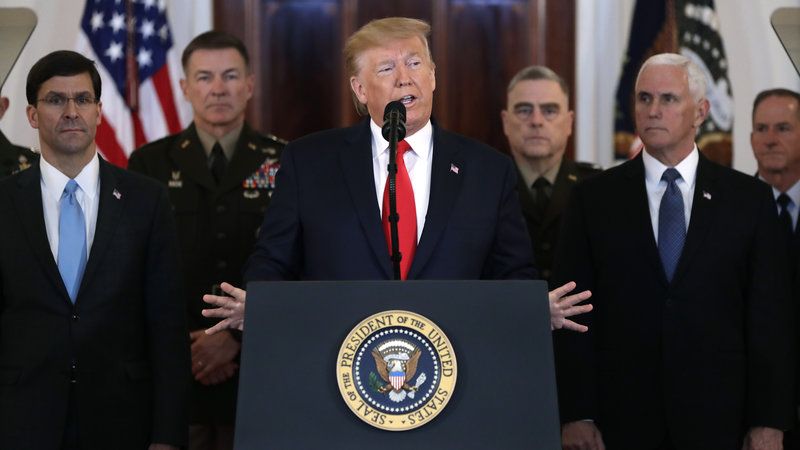
Speaking from the White House, Trump seemed intent on deescalating the crisis: “Iran appears to be standing down, which is a good thing for all parties concerned and a very good thing for the world,” he said.

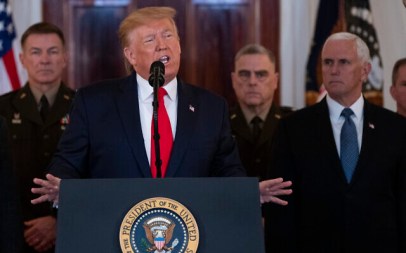
US President Donald Trump addresses the nation from the White House on the ballistic missile strike that Iran launched against Iraqi air bases housing US troops, January 8, 2020. (AP Photo/ Evan Vucci)

Despite such conciliatory talk, the region remained on edge, and American troops, including a quick-reaction force dispatched over the weekend, were on high alert. Last week Iranian-backed militias besieged the US Embassy in Baghdad, and Tehran’s proxies in the region remain able to carry out attacks such as the one on December 27 that killed a US contractor and set off the most recent round of hostilities.

Israeli officials, however, believe Iran is unlikely to attack Israel in retaliation for the US airstrike that killed Soleimani in Iraq.

According to several officials who were present at a security cabinet meeting Monday and spoke to Hebrew media, several scenarios were presented regarding Iran’s possible response to the attack, with the security officials saying the chances of an attack on Israel were low.

“Israel was not involved in the killing and there’s no reason it will be dragged into it,” one senior official said.

Agencies contributed to this report.


Iran army chief threatens more severe revenge on US soon 

January 9, 2020

Source: Iran army chief threatens more severe revenge on US soon | The Times of Israel

Top commander vows Iranian regime will launch further attacks in response to slaying of Quds Force general in American drone strike

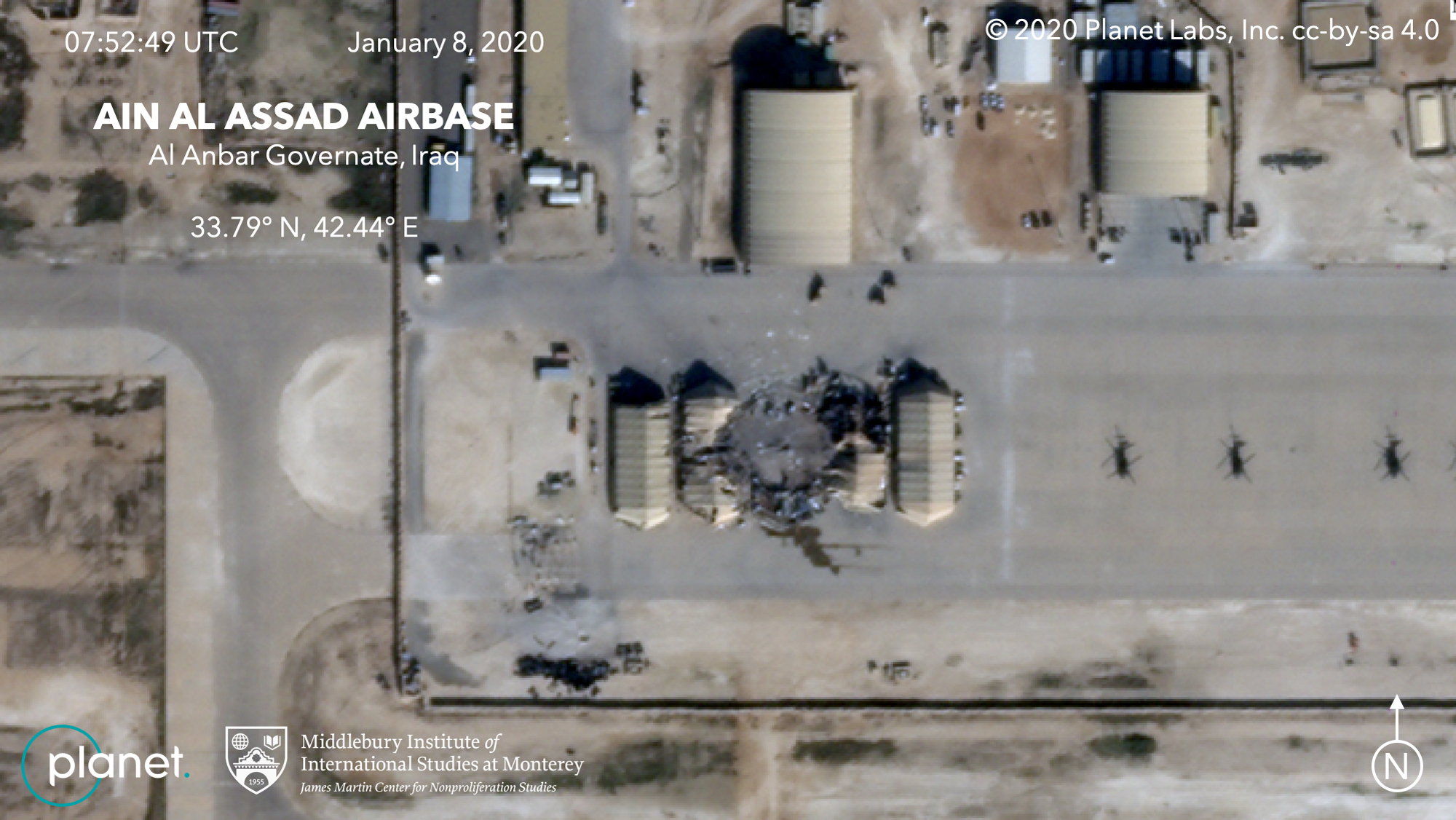
This satellite image provided on January 8, 2020, by Middlebury Institute of International Studies and Planet Labs Inc. shows the damage caused from an Iranian missile strike at the Ain al-Asad air base in Iraq. (Planet Labs Inc./Middlebury Institute of International Studies via AP)

The most senior figure in Iran’s armed forces threatened Thursday that his country will soon seek even heavier revenge against the US, following a recent barrage of missiles fired at American forces stationed at two bases in Iraq, the Iranian Tasnim news agency reported.

The report attributed the remarks to the “chief of general staff,” saying the commander had warned “the regime that will impose a more severe revenge on the enemy in the near future.”

Iran’s chief of general staff is Major-General Mohammad Bagheri, a member of the Islamic Revolutionary Guard Corps.

On Wednesday Iran fired over a dozen missiles at US bases in Iraq. The missiles were fired in response to the American killing last week of senior military IRGC commander Qassem Soleimani.

Iran’s chief of staff General Mohammad Hossein Bagheri speaking at a military parade September 21, 2016 (Screen capture: Press TV)

Iran claimed 80 US troops were killed in the strikes, and warned that it could strike next at Israel; the US said there were no casualties.

Iran’s Supreme Leader Ayatollah Ali Khamenei, speaking on Wednesday, said the overnight strike was not necessarily the totality of Iran’s response.

“Last night they received a slap,” Khamenei said. “These military actions are not sufficient (for revenge). What is important is that the corrupt presence of America in this region comes to an end.”

A senior commander in Iran’s Islamic Revolutionary Guard Corps warned recently that Tel Aviv could also be targeted, while a former head of the IRGC threatened to turn Israeli cities “to dust” if the US attacks targets in Iran.

Iran, for days, had promised to respond forcefully to Soleimani’s killing, but its limited strike on two bases — one in the northern Iraqi city in Irbil and the other at Ain al-Asad in western Iraq — appeared to signal that it was also uninterested in a wider clash with the US.

After the missile strikes, Iran’s Foreign Minister Mohammad Javad Zarif tweeted that the country had “concluded proportionate measures in self-defense.”


Trump says “Iran appears to be standing down” after missile attacks on US bases – DEBKAfile

January 9, 2020

Source: Trump says “Iran appears to be standing down” after missile attacks on US bases – DEBKAfile

US President Donald Trump noted on Wednesday, Jan. 8 that Iran’s missile attacks that morning on two US bases in Iraq caused no loss of American or Iraqi life and minimal damage.

“Iran appears to be standing down,” he said in an address to the nation. If Iran changes its behavior and abandons terrorism and destruction, of which Qassem Soleimani was the architect, “we will evaluate our options,” he said. Tehran must understand that a deal will make the world a better place and bring prosperity to Iran itself. “We must all work for a better deal with Iran,” he said. Meanwhile, Trump announced new economic sanctions on the Islamic Republic and reiterated, “We will never let Iran acquire a nuclear weapon.

US military sources noted that while Iran for the first time attacked US military targets with ballistic missiles, a third failed and significant facilities were missed.

DEBKAfile reported earlier on Jan. 8: The US Ain al-Assad air base in W. Iraq and a US facility at Irbil, capital of the Kurdish republic, were hit by 35 missiles early Wednesday, Jan. 8, Tehran announced. Sources linked to Iran’s Revolutionary Guards said that these attacks were part of a series still to come in revenge for the killing of Gen. Qassem Soleimaini. The source of the attack was not immediately clear – whether it came from Iran or a local Shiite militia. And although extent of the damage and casualties was equally unclear, the attack definitely notched up the friction prevailing between Tehran and the US over the killing of the powerful Al Qods general last Friday.

After urgent consultations at the White House and the Pentagon on how to handle this latest attack, President Donald Trump made this comment on Twitter: “All is well! Missiles launched from Iran at two military bases located in Iraq. Assessment of casualties & damage taking place now. So far, so good! We have the most powerful and well-equipped military anywhere in the world by far! I will be making a statement tomorrow morning.”

DEBKAfile’s military sources: The missile strikes on the two US bases occurred shortly after the Soleimani funeral ended. It was in line with the revenge attacks that Iran has threatened to launch against the US military in Iraq and across the Middle East. US military facilities were already on the ready. On Tuesday, top war preparedness was declared at all US facilities in the region and by the armies of America’s allies, including Israel, Saudi Arabia and the United Arab Emirates. The statement issued by Israel’ security cabinet on Monday, that Israel is not involved in the heightened tension between America and Iran following the killing of Qassem Soleimani, was simply an attempt to calm public concerns.


American Mainstream Media Mourns Death Of Iran Terrorist Leader

January 9, 2020

Typical. And oh so predictable…

Disgusting.

Text in this post is from the first link. Other link is in a similar vein.

https://www.dailywire.com/news/watch-american-mainstream-media-mourns-death-of-iran-terrorist-leader

U.S. Journalists Mourn Death of Iranian Terrorist

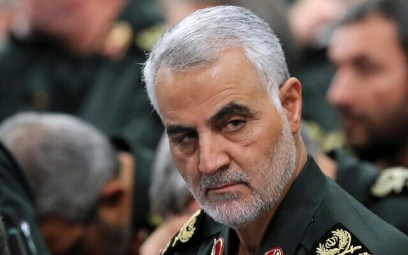
(FILES) In this picture taken on September 14, 2013, the commander of the Iranian Revolutionary Guard's Quds Force, Gen. Qassem Soleimani, is seen as people pay their condolences following the death of his mother in Tehran. For a man widely reported to be playing a key role in helping Iraq's routed military recover lost ground, Qassem Soleimani, 57, the commander of Iran's feared Quds Force, remains invisible.

On Monday, Grabien founder Tom Elliott released a new video montage that showed many in the American mainstream media idolizing and mourning terrorist Qassim Suleimani, leader of Iran’s Islamic Revolutionary Guard Corps’s Quds Force, after he was killed by American forces last week in Iraq.

Suleimani’s funeral was this week after the terrorist leader was killed last week in a Trump-authorized drone strike by the U.S. military on a convoy that he was riding in as he left Baghdad International Airport.

Video:

  • CBS’s Holly Williams described him as a “revered figure” and a “war hero.” “He wasn’t well-known in the United States, but he was one of the most powerful figures in the Middle East, sometimes even touted as a possible future leader of Iran.” “For America, though, General Suleimani was a problem.” “Even many of Soleimani’s enemies admitted he was a military genius. He spearheaded Iran’s involvement in a Syrian Civil War hoping to shore up the Syrian regime’s grip on power. … By killing Qasem Suleimani, the U.S. has stripped Iran of an inspirational military leader. But it’s also further inflamed dangerously high tensions. Iran has already vowed to take, quote, harsh revenge.”


  • CNN’s Fareed Zakaria said Suleimani was “revered” in Iran: “Imagine the French Foreign Legion, at the height of the French empire. This guy is regarded in Iran as a completely heroic figure, personally very brave.”


  • CNN’s Anderson Cooper, likened Suleimani to the World War II leader, Charles DeGaulle, calling him “personally incredibly brave” and reporting that “the troops love him.”


  • CBS’s National Security Contributor Michael Morell praised Suleimani’s military prowess, calling him an “evil genius.”


  • ABC’s Martha Raddatz — reporting from Iran in a headscarf — appeared awestruck at the display: “I have been in the midst of anti-America protests in Iran before, but nothing like this. A powerful combination of grief and anger with shouts of ‘death to America’ echoing through the streets around us. This morning, mourners filling the streets of Iran’s capital of Tehran for the funeral of General Suleimani killed by that U.S. drone strike last week. Aerial images capturing the sea of Iranians packing the streets to pay tribute to a man revered by many here.”


  • NBC’s Richard Engel, also reporting from Iran, said the United States had elevated the terror mastermind into martyr status: “Now, after this killing, you saw people not only going out in the streets in millions, as Ali was describing, he was there, but throwing articles of their own clothing up onto the coffin so that attendants could rub it on the coffin so that they would have some sort of memento of an object that was close to Qassim Suleimani’s body. They turned him into a martyr, if not a saint. And we’re seeing now all around the region Shiite groups, allies of Iran speaking in one voice, and that is that U.S. troops have to leave the region, should be forced out of the region starting with Iraq.”


Iran will suffer ‘crushing blow’ if it attacks Israel, Netanyahu warns

January 8, 2020

Source: Iran will suffer ‘crushing blow’ if it attacks Israel, Netanyahu warns | The Times of Israel

At same conference, US Ambassador Friedman says US has strongest army in the world, prays for ‘overwhelming’ victory over Tehran

Prime Minister Benjamin Netanyahu speaks during press conference at the Orient Hotel in Jerusalem on January 1, 2020. (Yonatan Sindel/Flash90)

Prime Minister Benjamin Netanyahu speaks during press conference at the Orient Hotel in Jerusalem on January 1, 2020. (Yonatan Sindel/Flash90)

Prime Minister Benjamin Netanyahu on Wednesday warned Iran against attacking Israel in response to the American killing last week of senior military commander Qassem Soleimani.

“We’re standing steadfast against those who seek to kill us. We’re standing with determination and with force. Whoever tried to attack us will suffer a most crushing blow,” he declared at a conference in Jerusalem.

“Qassem Soleimani was responsible for the death of countless innocent people,” Netanyahu said. “He destabilized many countries. For decades, he sowed fear and misery and anguish. And he was planning much worse.

“President Trump should be congratulated for acting swiftly, boldly and resolutely against this terrorist-in-chief, who was the architect and driver of Iran’s campaign of terror throughout the Middle East and throughout the world,” he added.

Many leaders in the Middle East agree with him, the prime minister said. The region is split between radical Islamists and the moderate forces they are fighting, he went on. “Israel is the stable anchor in these turbulent waters.”

Netanyahu also reiterated Israel’s full support for the United States in its ongoing military confrontation with the Islamic Republic.

“It’s very important to say that Israel stands completely beside the United States,” he added. “America has no better friend than Israel, and Israel has no better friend than America.”

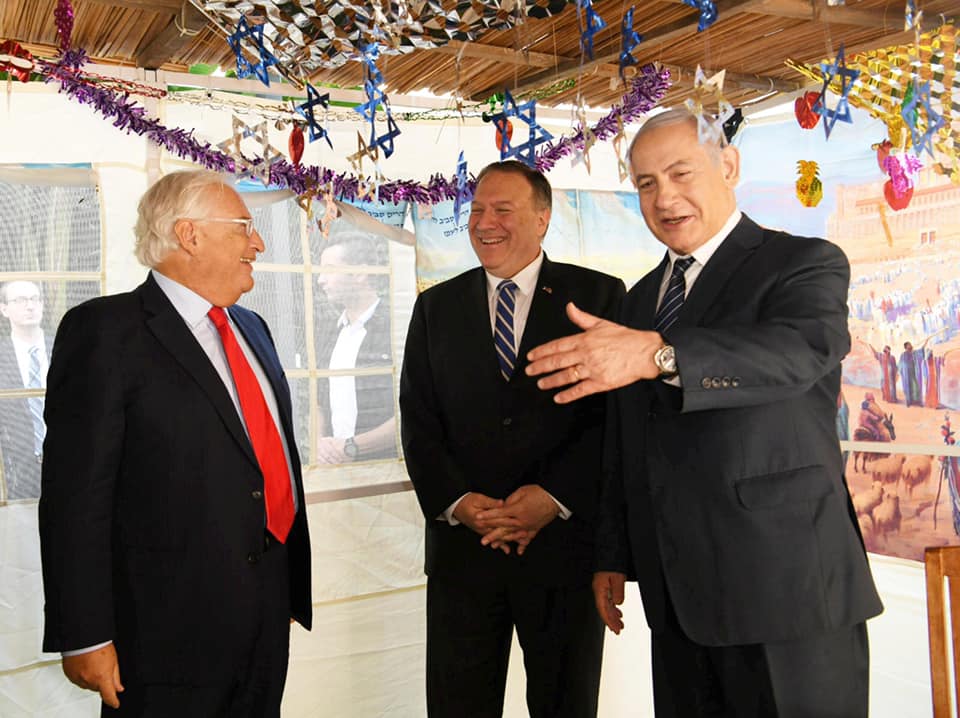
US Secretary of State Mike Pompeo visits the prime minister’s Sukkah, during talks with Prime Minister Benjamin Netanyahu on October 18, 2019. At left is US Ambassador to Israel David Friedman (Amos Ben Gershom / GPO)

Before the prime minister spoke, US Ambassador to Israel David Friedman briefly addressed the Iranian attack on a US base in Iraq overnight Tuesday-Wednesday.

“We’re all watching closely the event in the regions,” he said at the conference at the Begin Center in Jerusalem, organized by the right-wing Kohelet Forum think tank.

“Initial assessments are positive. We pray that these reports are true,” he said.

“Our military is by far the strongest in the world and our cause is just,” Friedman added. “We pray to God that we will prevail overwhelmingly.”

A senior commander in Iran’s Islamic Revolutionary Guard Corps has warned that Tel Aviv could also be targeted, while a former head of the IRGC threatened to turn Israeli cities “to dust” if the US attacks targets in Iran.

Still, on Monday, Israeli security officials told the high-level security cabinet that Iran is unlikely to attack Israel in retaliation for the US airstrike that killed Soleimani in Iraq.

According to several officials who were present at the cabinet meeting and spoke to Hebrew media, several scenarios were presented regarding Iran’s possible response to the attack, with the security officials saying the chances of an attack on Israel were low.

“Israel was not involved in the killing and there’s no reason it will be dragged into it,” one senior official said.

Also on Monday, in the first public comments by a senior Israeli military official on Soleimani’s killing, IDF Southern Command head Maj. Gen. Herzi Halevi distanced the Jewish state from the incident and said it was part of the ongoing struggle between Iran and the US for influence in Iraq.

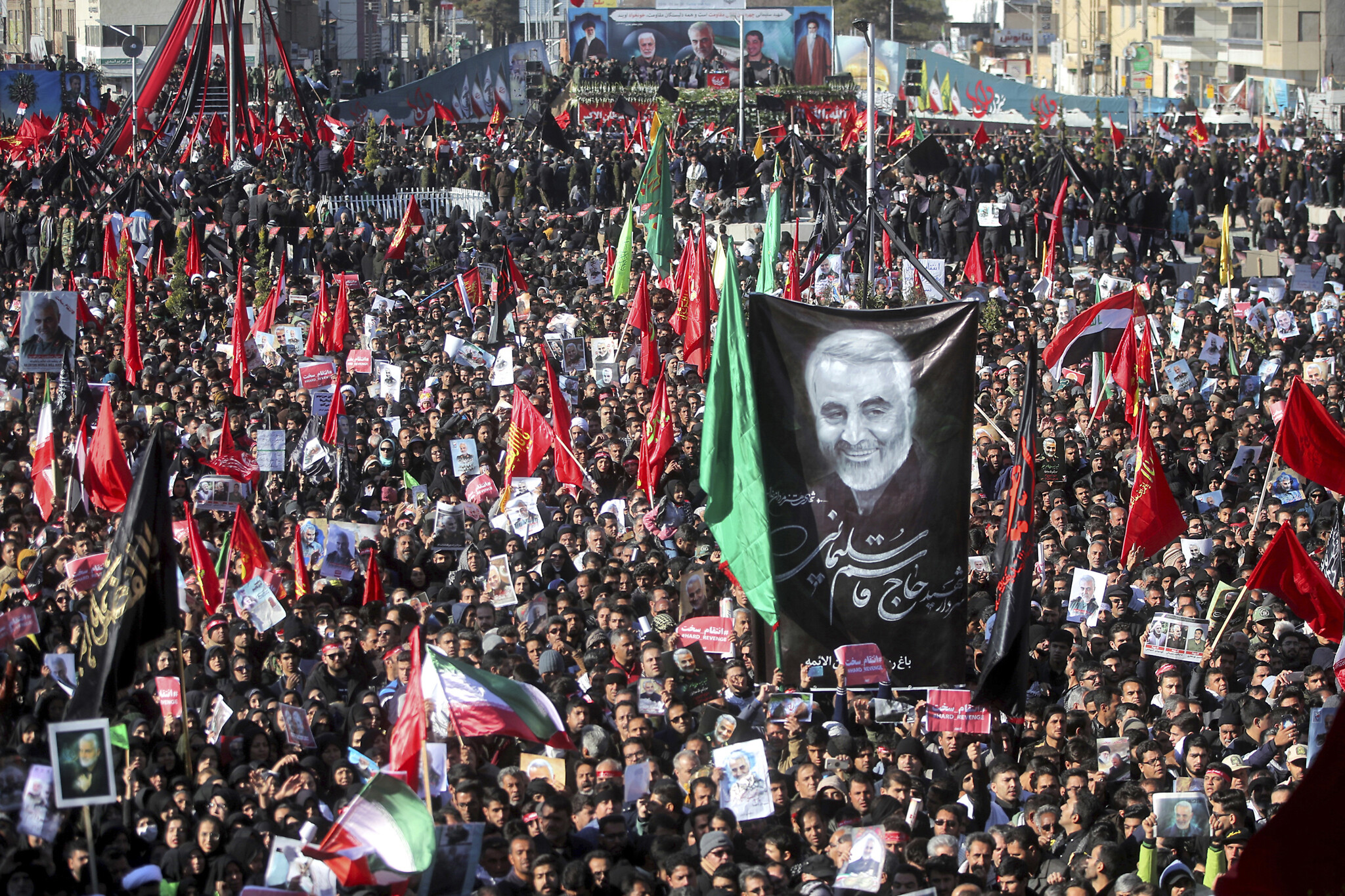
Mourners attend a funeral ceremony for Iranian Gen. Qassem Soleimani and his comrades, who were killed in Iraq in a US drone strike, in the city of Kerman, Iran, January 7, 2020 (Erfan Kouchari/Tasnim News Agency via AP)

“Soleimani hurt American interests and represented a significant danger to Americans in the region. We must look at the assassination as part of a fight between Iran and the United States over Iraq’s character. That is the story,” Halevi said.

“The assassination also has ramifications for us as Israelis, and we must follow it closely, but we aren’t the main story here — and it’s good that it happened far away,” he said.

Halevi said Israel was ready to launch a “very significant response” if the Islamic Republic’s retaliation for the hit included operations by its Palestinian allies such as Gaza-based Palestinian Islamic Jihad.

The US embassy in Israel, however, released a travel advisory to its nationals in Israel, the West Bank, and Gaza, warning of the possibility of sudden rocket fire at the country.

One of Israel’s leading national security think tanks warned Monday there is a growing risk of large-scale war along Israel’s northern borders in the coming year, in part due to Iran’s increasing “determination and daring.”

Times of Israel staff contributed to this report.


Iran strikes back at US with missile attack at bases in Iraq

January 8, 2020

Source: Iran strikes back at US with missile attack at bases in Iraq

16 minutes ago
FILE – In this Dec. 26, 2018, file photo, members of the military wait outside facilities where President Donald Trump and first lady Melania Trump are visiting at Ain al-Asad air base, Iraq. Iran said Wednesday, Jan. 8, 2020, it has launched “tens” of surface-to-surface missiles at Iraq’s Ain al-Asad air base housing U.S. troops over America’s killing of a top Iranian general. (AP Photo/Andrew Harnik, File)

TEHRAN, Iran (AP) — Iran struck back at the United States early Wednesday for killing a top Revolutionary Guards commander, firing a series of ballistic missiles at two military bases in Iraq housing American troops in a major escalation between the two longtime foes.

It was Iran’s most direct assault on America since the 1979 seizing of the U.S. Embassy in Tehran, and Iranian state TV said it was in revenge for the U.S. killing of Revolutionary Guard Gen. Qassem Soleimani, whose death last week in an American drone strike near Baghdad prompted angry calls to avenge his slaying. A U.S. and Iraqi officials said there were no immediate reports of casualties, though buildings were still being searched.

The strikes, which came as Iran buried Soleimani, raised fears that the two longtime foes were closer to war. But there were some indications that there would not be further retaliation on either side, at least in the short term.

‘All is well!’ President Donald Trump tweeted shortly after the missile attacks, adding, ‘So far, so good’ regarding casualties. Moments earlier, Iran’s foreign minister tweeted that Tehran had taken “& concluded proportionate measures in self-defense,” adding that Tehran did “not seek escalation” but would defend itself against further aggression.

The killing of Soleimani — a national hero to many in Iran — and strikes by Tehran came as tensions have been rising steadily across the Mideast after Trump’s decision to unilaterally withdraw America from Tehran’s nuclear deal with world powers. They also marked the first time in recent years that Washington and Tehran have attacked each other directly rather than through proxies in the region. It raised the chances of open conflict erupting between the two enemies, who have been at odds since Iran’s 1979 Islamic Revolution and the subsequent U.S. Embassy takeover and hostage crisis.

Adding to the chaos and overall jitters, a Ukrainian airplane carrying at least 170 people crashed outside Tehran on Wednesday morning, state TV reported. There was no immediate word on casualties. The plane had taken off from Imam Khomeini International Airport and mechanical issues were suspected to be the cause, the report said.

Iran initially announced only one missile strike, but U.S. officials confirmed both. U.S. defense officials were at the White House, likely to discuss options with Trump, who launched the attack on Soleimani while facing an upcoming impeachment trial in the Senate,

Iran’s Revolutionary Guard warned the U.S. and its regional allies against retaliating over the missile attack against the Ain al-Asad air base in Iraq’s western Anbar province. The Guard issued the warning via a statement carried by Iran’s state-run IRNA news agency.

“We are warning all American allies, who gave their bases to its terrorist army, that any territory that is the starting point of aggressive acts against Iran will be targeted,” the Guard said. It also threatened Israel.

After the strikes, a former Iranian nuclear negotiator posted a picture of the Islamic Republic’s flag on Twitter, appearing to mimic Trump who posted an American flag following the killing of Soleimani and others Friday.

Ain al-Asad air base was first used by American forces after the 2003 U.S.-led invasion that toppled dictator Saddam Hussein, and later saw American troops stationed there amid the fight against the Islamic State group in Iraq and Syria. It houses about 1,500 U.S. and coalition forces. The U.S. also acknowledged another missile attack targeting a base in Irbil in Iraq’s semiautonomous Kurdish region.

The Iranians fired a total of 15 missiles, two U.S. officials said. Ten hit Ain al-Asad and one the base in Irbil. Four failed, said the officials, who were not authorized to speak publicly about a military operation.

Two Iraqi security officials said at least one of the missiles appeared to have struck a plane at the Ain al-Asad base, igniting a fire. There were no immediate reports of casualties from the attacks, according to the officials, who spoke on condition of anonymity as they had no permission to brief journalists.

About 70 Norwegian troops also were on the air base but no injuries were reported, Brynjar Stordal, a spokesperson for the Norwegian Armed Forces told The Associated Press.

Trump visited the sprawling Ain al-Asad air base, about 100 miles or 60 kilometers west of Baghdad, in December 2018, making his first presidential visit to troops in the region. Vice President Mike Pence also has visited the base.

“As we evaluate the situation and our response, we will take all necessary measures to protect and defend U.S. personnel, partners and allies in the region,” said Jonathan Hoffman, an assistant to the U.S. defense secretary.

Wednesday’s revenge attack happened a mere few hours after crowds in Iran mourned Soleimani at his funeral. It also came the U.S. continued to reinforce its own positions in the region and warned of an unspecified threat to shipping from Iran in the region’s waterways, crucial routes for global energy supplies. U.S. embassies and consulates from Asia to Africa and Europe issued security alerts for Americans. The FAA also warned of a “potential for miscalculation or mis-identification” for civilian aircraft in the Persian Gulf amid in an emergency flight restriction.

A stampede broke out Tuesday at Soleimani’s funeral, and at least 56 people were killed and more than 200 were injured as thousands thronged the procession, Iranian news reports said. Shortly after Iran’s revenge missile attack early Wednesday, Soleimani’s shroud-wrapped remains were lowered into the ground as mourners wailed at the grave site.

Tuesday’s deadly stampede took place in Soleimani’s hometown of Kerman as his coffin was being borne through the city in southeastern Iran, said Pirhossein Koulivand, head of Iran’s emergency medical services.

There was no information about what set off the crush in the packed streets, and online videos showed only its aftermath: people lying apparently lifeless, their faces covered by clothing, emergency crews performing CPR on the fallen, and onlookers wailing and crying out to God.

Hossein Salami, Soleimani’s successor as leader of the Revolutionary Guard, earlier addressed a crowd of supporters in Kernan and vowed to avenge Soleimani.

“We tell our enemies that we will retaliate but if they take another action we will set ablaze the places that they like and are passionate about,” Salami said.

Soleimani was laid to rest between the graves of Enayatollah Talebizadeh and Mohammad Hossein Yousef Elahi, two former Guard comrades killed in Iran’s 1980s war with Iraq. They died in Operation Dawn 8, in which Soleimani also took part. It was a 1986 amphibious assault that cut Iraq off from the Persian Gulf and led to the end of the war that killed 1 million.

The funeral processions in major cities over three days have been an unprecedented honor for Soleimani, seen by Iranians as a national hero for his work leading the Guard’s expeditionary Quds Force.

The U.S. blames him for killing U.S. troops in Iraq and accused him of plotting new attacks just before he was killed. Soleimani also led forces supporting Syrian President Bashar Assad in that country’s civil war. Russian President Vladimir Putin met with Assad in Syria on Tuesday amid the tensions between Washington and Tehran.

Soleimani’s slaying has led Tehran to abandon the remaining limits of its 2015 nuclear deal with world powers as his successor and others vow to take revenge.

In Iraq, pro-Iranian factions in parliament have pushed to oust American troops from Iraqi soil following Soleimani’s killing. Germany and Canada announced plans to move some of their soldiers in Iraq to neighboring countries.

The FAA warning issued barred U.S. pilots and carriers from flying over areas of Iraqi, Iranian and some Persian Gulf airspace. The region is a major East-West travel hub and home to Emirates airline and Dubai International Airport, the world’s busiest for international travel. It earlier issued warnings after Iran shot down a U.S. military surveillance drone last year that saw airlines plan new routes to avoid the Strait of Hormuz, the narrow mouth of the Persian Gulf.

The U.S. Maritime Administration warned ships across the Mideast, citing the rising threats. Oil tankers were targeted in mine attacks last year that the U.S. blamed on Iran. Tehran denied responsibility, although it did seize oil tankers around the Strait of Hormuz, through which 20% of the world’s crude oil travels.

The U.S. Navy’s Bahrain-based 5th Fleet said it would work with shippers in the region to minimize any possible threat.

___

Gambrell reported from Dubai, United Arab Emirates. Associated Press writers Matthew Lee, Lolita C. Baldor and Zeke Miller in Washington, Qassim Abdul-Zahra in Baghdad and Zeina Karam in Beirut contributed.
 

BREAKING VIDEO: Multiple Missiles From Iran Hit Air Base In Iraq Housing American Troops 

January 8, 2020


Trump insists ‘All is well!’ after Iran missile attack

January 8, 2020

Source: Trump insists ‘All is well!’ after Iran missile attack | The Times of Israel

US president says initial outlook after Iranian strikes on Iraqi bases housing US troops was, ‘So far, so good!’

US President Donald Trump speaks during a meeting with Greek Prime Minister Kyriakos Mitsotakis in the Oval Office of the White House, Tuesday, Jan. 7, 2020, in Washington. (Alex Wong/Getty Images/AFP)

WASHINGTON (AP) — US President Donald Trump insisted “All is well!” on Tuesday after Iran fired surface-to-surface missiles at two Iraqi bases housing US troops. He promised to make a statement to the nation Wednesday morning about the increasingly precarious situation with Iran.

Trump offered no immediate indication of whether he would retaliate, and stayed out of sight Tuesday night as news of the missile strikes emerged.

But he tweeted that an assessment of casualties and damages was under way. The initial outlook, he said, was “So far, so good!”

The Iranian missiles came in retaliation for an American drone strike that killed top Iranian Gen. Qassem Soleimani. Trump and his advisers are under pressure to disclose more details about the intelligence that led to the US strike.

Donald J. Trump

@realDonaldTrump

Trump said Tuesday that his decision saved American lives and that members of Congress will get a briefing on the reasons for the US attack.

“They were planning something,” he said of the Iranians.

Hours later, Iran struck back, firing the missiles at bases housing US troops and warning the United States and its allies in the region not to retaliate. The White House said the president was monitoring the situation closely and consulting with his national security team.

So far, Trump and top national security officials have justified the airstrike with general statements about the threat posted by Soleimani, who commanded proxy forces outside Iran and was responsible for the deaths of American troops in Iraq.

But the details have been scarce.

“He’s no longer a monster. He’s dead,” Trump said. “And that’s a good thing for a lot of countries. He was planning a very big attack and a very bad attack for us and other people and we stopped him and I don’t think anybody can complain about it.”

Senior Revolutionary Guard commander Gen. Qassem Soleimani, center, attends a meeting with Supreme Leader Ayatollah Ali Khamenei (not seen) and Revolutionary Guard commanders in Tehran, Iran, September 18, 2016 photo. (Office of the Iranian Supreme Leader via AP)

Soleimani was targeted while he was at an airport in Baghdad with Abu Mahdi al-Muhandis, a veteran Iraqi militant who also was killed.

Trump said they weren’t in Baghdad to discuss vacation plans or visit a “’nice resort,” but were there to talk over “’bad business.”’

The lack of detail doesn’t sit well with Democrats, who recall how President George W. Bush justified his invasion of Iraq by accusing Saddam Hussein of having non-existent weapons of mass destruction. Lawmakers in recent days have been pressing for more detail to explain why Trump ordered the killing — a decision that previous administrations passed up because of fears it would unleash even more violence.

Soleimani traveled frequently and relatively openly, with visits to Baghdad more frequent in recent months. He also often showed up in Syria, including along the border between Iraq and Syria.

Senate Minority Leader Chuck Schumer and Senator Bob Menendez, the top Democrat on the Senate Foreign Relations Committee, have called on Trump to declassify the written notification he sent to Congress after the strike. The notification was required under the War Powers Resolution Act of 1973, which requires the president to report to Congress when American forces are sent into hostile situations.

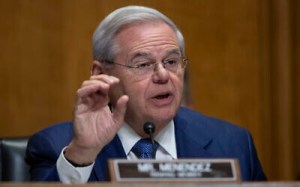
Democratic Senator Robert Menendez of New Jersey speaks during a Senate Foreign Relations Committee hearing, December 3, 2019 in Washington, on Capitol Hill. (AP Photo/Alex Brandon)

“’The president must come to Congress and present clear and compelling intelligence as to why the strike against Soleimani was absolutely necessary,” Menendez said in a speech on the Senate floor. “In the wake of all its misleading statements we must make clear to the administration that the president by himself does not have the authority to launch a war against Iran.”

Trump stressed that the strike was in retaliation for Iranian attacks and that the US is prepared to attack again — “’very strongly.” He also said that while he eventually wants to pull US troops out of Iraq, now is not the time because it would allow Iran to gain a bigger foothold there.

Trump’s top national security officials made several public appearances on Tuesday to further defend the strike.

“We had deep intelligence indicating there was active plotting to put American lives at risk,” and Iraqi lives too, said Secretary of State Mike Pompeo.

In this image from video, Secretary of Defense Mark Esper talks to the press on Iran and Iraq, January 7, 2020, at the Pentagon in Washington. (divids via AP)

Asked if the threat was imminent in days or weeks, Defense Secretary Mark Esper said: “I think it’s more fair to say days, for sure.”

Esper said the intelligence was precise — “razor thin.” He said top Republicans and Democrats in the House and Senate plus the chairmen and vice chairmen of the intelligence committees in both chambers were getting a classified briefing Tuesday afternoon on what led to the decision to kill Soleimani. He said other lawmakers will be provided general details about the attack.

He said Soleimani was in Baghdad to coordinate additional attacks against the US “To somehow suggest that he wasn’t a legitimate target, I think, is fanciful,” Esper said.

Democratic lawmakers are not yet convinced it was the right decision.

Senator Dianne Feinstein called the US strike on Soleimani a mistake and said “I have yet to see how killing this man will prevent Iran from posing an even greater threat against the United States and our interests.”

In the wake of the killing, Iran has announced that it will no longer be bound by the 2015 nuclear agreement and vowed to retaliate against the US, its allies and American interests. Iraq’s parliament also voted to expel US troops from Iraq, which would undermine efforts to fight Islamic State militants in the region and strengthen Iran’s influence in the Mideast.


US confirms Iranian missile barrages at Iraqi bases housing its troops

January 8, 2020

Some videos at the link.

https://www.timesofisrael.com/iran-says-its-fired-barrage-of-missiles-at-iraqi-air-base-housing-us-troops/

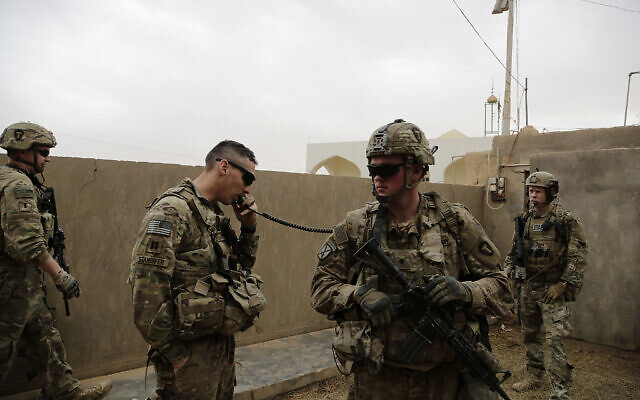
Illustrative: In this January 25, 2018 photo, American troops coordinate with Iraqi counterparts to launch airstrikes and artillery from a small complex in the town of Qaim, Iraq. (AP Photo/Susannah George)

Iranian state TV describes attack as Tehran’s revenge operation over last week’s killing of Qassem Soleimani

Iran struck back at the United States early Wednesday for the killing of a top Iranian general last week, firing a series of surface-to-surface missiles at an Iraqi air base housing US troops and warning the United States and its allies in the region not to retaliate.

The Pentagon confirmed the strike at Ain Assad as well as another at a separate base housing US troops.

“At approximately 5:30 p.m. (EST) on January 7, Iran launched more than a dozen ballistic missiles against US military and coalition forces in Iraq,” the Pentagon said in a statement. “It is clear that these missiles were launched from Iran and targeted at least two Iraqi military bases hosting US military and coalition personnel at Al-Assad and Irbil.”

US Defense Department spokesman Jonathan Hoffman said the US was “working on initial battle damage assessments.”

The White House said in a separate statement that US President Donald Trump was “monitoring the situation closely and consulting with his national security team.”

There was no immediate word on injuries.

Iranian state TV said the attack was in revenge for the killing of Revolutionary Guard general Qassem Soleimani, whose funeral Tuesday in his hometown of Kerman prompted angry calls to avenge his death, which drastically raised tensions in the Middle East.

Iran’s Revolutionary Guard warned the US and its regional allies against retaliating over the missile attack against the Ain Assad air base in Iraq’s western Anbar province. The Guard issued the warning via a statement carried by Iran’s state-run IRNA news agency.

“We are warning all American allies, who gave their bases to its terrorist army, that any territory that is the starting point of aggressive acts against Iran will be targeted,” the Guard said. It also threatened Israel.

Ain Assad air base was first used by American forces after the 2003 US-led invasion that toppled dictator Saddam Hussein. It later saw American troops stationed there amid the fight against the Islamic State group in Iraq and Syria.

Iran state TV said the operation’s name was “Martyr Soleimani.” It said the Guard’s aerospace division that controls Iran’s missile program launched the attack. Iran said it would release more information later.

Wednesday’s revenge attack came a mere few hours after crowds in Iran mourned Soleimani and as the US continued to reinforce its own positions in the region and warned of an unspecified threat to shipping from Iran in the region’s waterways, crucial routes for global energy supplies. US embassies and consulates from Asia to Africa and Europe issued security alerts for Americans. The US Air Force launched a drill with 52 fighter jets in Utah, just days after Trump threatened to hit 52 sites in Iran.

The US blames Soleimani for killing US troops in Iraq and accused him of plotting new attacks just before he was killed. Soleimani also led forces supporting Syrian President Bashar Assad in that country’s civil war, and he also served as the point man for Iranian proxies in countries like Iraq, Lebanon and Yemen. Russian President Vladimir Putin met with Assad in Syria on Tuesday amid the tensions between Washington and Tehran.

Soleimani’s slaying already has led Tehran to abandon the remaining limits of its 2015 nuclear deal with world powers as his successor and others vow to take revenge.

In Iraq, pro-Iranian factions in parliament have pushed to oust American troops from Iraqi soil following Soleimani’s killing. Germany and Canada announced plans to move some of their soldiers in Iraq to neighboring countries.

According to a report on Tuesday by the semi-official Tasnim news agency, Iran has worked up 13 sets of plans to avenge Soleimani’s death. The report quoted Ali Shamkhani, the secretary of Iran’s Supreme National Security Council, as saying that even the weakest among them would be a “historic nightmare” for the U.S. He declined to elaborate,

“If the US troops do not leave our region voluntarily and upright, we will do something to carry their bodies horizontally out,” Shamkhani said.

Categories: Uncategorized

Comments: Be the first to comment