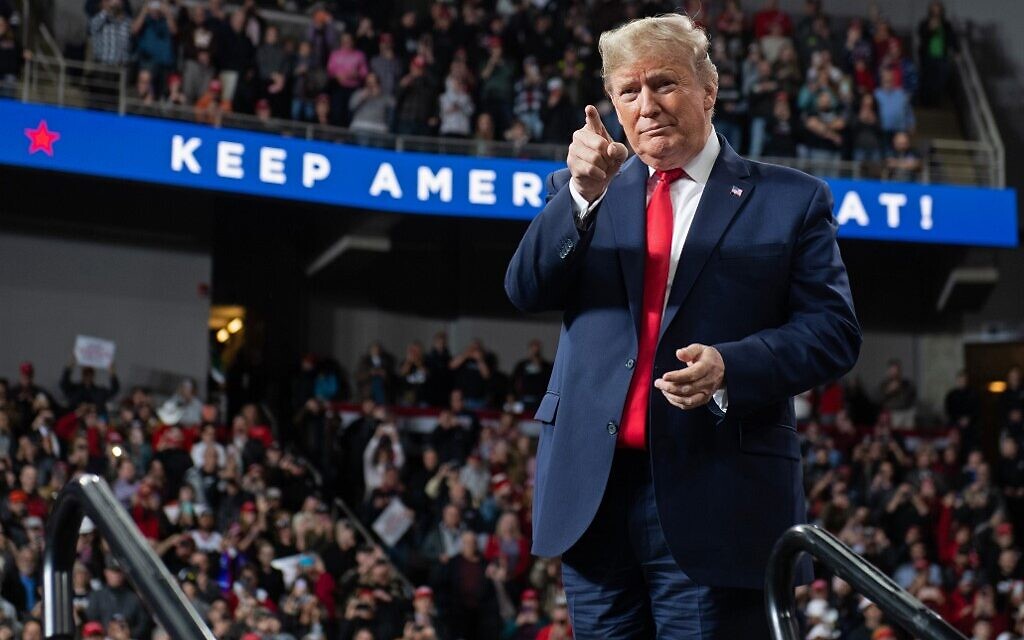
US President Donald Trump arrives for a campaign rally at in Toledo, Ohio, on January 9, 2020. (Saul Loeb/AFP)
US President Donald Trump said Friday that he believes Iranian general Qassem Soleimani was planning attacks against four US embassies before he was killed last week in an American airstrike in Baghdad.
“I can reveal that I believe it would have been four embassies,” Trump said in an excerpt from an interview due to air Friday night on Fox News. “Probably it was going to be the embassy in Baghdad.”
The remarks added some detail to a series of often vague claims made by US officials when asked why Trump, who faces an impeachment trial and a tough reelection fight, ordered the high-risk operation to kill Soleimani.
The administration has pushed back against accusations that Trump acted recklessly, insisting that Soleimani was on the brink of launching an attack and had to be stopped.
US Secretary of State Mike Pompeo has said the US had “specific information” on “imminent” attacks “against American facilities, including American embassies, military bases.”
In response to the January 3 strike on Soleimani, Iran on Wednesday fired volleys of ballistic missiles at Iraqi bases housing US troops, without causing casualties.
While Trump said he would not respond further militarily, Washington is intent on maintaining pressure on Tehran, announcing new sanctions on Iran’s already crippled economy.
The sanctions mean “we will cut off billions of dollars of support to the Iranian regime,” US Treasury Secretary Steven Mnuchin told reporters at the White House.
The measures targeting Iran’s steel industry and eight state officials came on top of massive sanctions already aimed at bringing the country’s economy to its knees.
The US has been at loggerheads with Iran, a fierce regional rival of American allies Israel and Saudi Arabia, for decades.
Soon after Trump came into office he withdrew from an international accord meant to give Iran the ability to develop civilian nuclear power while under supervision. Trump accused Tehran of cheating and trying to obtain a nuclear weapon.
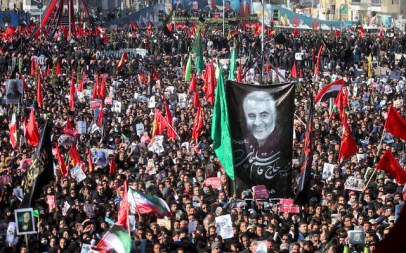
Mourners holding posters of Iranian general Qassem Soleimani attend a funeral ceremony in Tehran, Iran, January 6, 2020. (AP Photo/Ebrahim Noroozi)
Also in the Fox interview, Trump dismissed calls by Iraqi officials for US troops to leave Iraq amid uproar from Iraqi Shi’ite groups over Soleimani’s killing.
“That’s what they [the Iraqis] say publicly. They don’t say that privately,” he said.
The comments as the US State Department bluntly rejected a request from Iraq’s caretaker prime minister to work out a road map for an American troop withdrawal, saying the two sides should instead talk about how to “recommit” to their partnership.
Thousands of anti-government protesters turned out Friday in Baghdad and southern Iraq, many calling on both Iran and America to leave Iraq, reflecting their anger and frustration over the two rivals — both allies of Iraq — trading blows on its soil.
The request from Iraqi Prime Minister Adel Abdul-Mahdi pointed to his determination to push ahead with demands for US troops to leave Iraq, stoked by the drone strike on Soleimani. In a phone call Thursday night, Abdul-Mahdi told Pompeo that recent US actions were unacceptable breaches of Iraqi sovereignty and a violation of their security agreements, his office said.
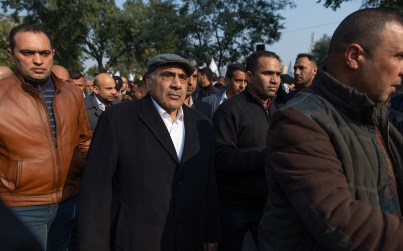
Iraqi acting Prime Minister Adel Abdel Mahdi takes part in the funeral of Iran’s top general Qassem Soleimani in Baghdad, Iraq, January 4, 2020. (AP Photo/Nasser Nasser)
He asked Pompeo to “send delegates to Iraq to prepare a mechanism” to carry out the Iraqi Parliament’s resolution on withdrawing foreign troops, according to the statement.
Abdul-Mahdi signaled he was standing by the push for US forces to leave despite signs of de-escalation by Tehran and Washington after Iran’s retaliation.
The State Department said US troops are crucial for the fight against the Islamic State extremist group and it would not discuss removing them.
Pompeo indicated Friday the troops would remain, adding that the US would continue its mission to help train Iraqi security forces and counter Islamic State.
“Our mission set there is very clear. We’ve been there to perform a training mission to help the Iraqi security forces be successful and to continue the campaign against ISIS, to continue the counter-Daesh campaign,” he said during an unrelated appearance at the White House, using alternate acronyms for the militant group.
There are some 5,200 US troops in Iraq assisting and providing training to Iraqi security counterparts to fight IS. An American pullout could deeply set back efforts to crush remnants of the jihadist group amid concerns of its resurgence during the political turmoil.
After denying responsibility, Tehran says its military targeted the plane, blames ‘human error’; crash came hours after Iranian missile attack on US forces in Iraq
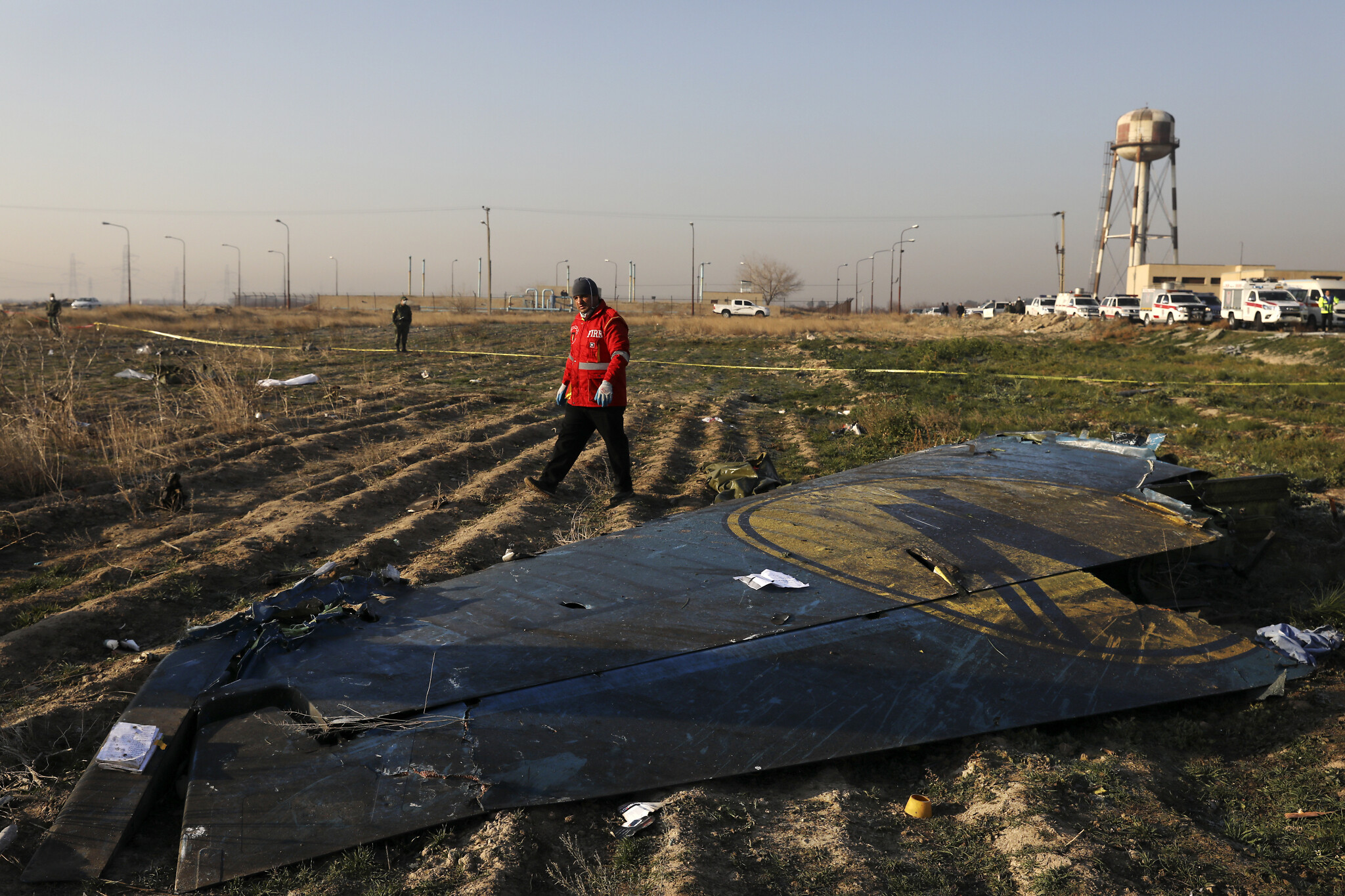
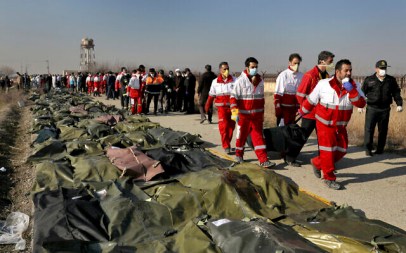
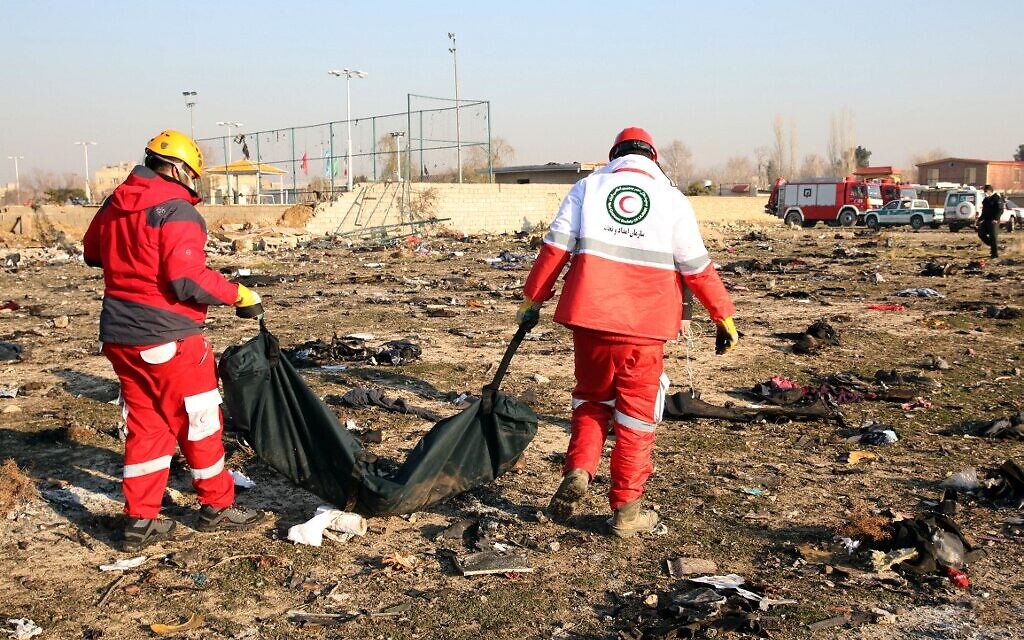
Rescue workers carry the body of a victim of a Ukrainian plane crash in Shahedshahr, southwest of Tehran, Iran, January 8, 2020 (AP/Ebrahim Noroozi)
Iran announced Saturday that its military “unintentionally” shot down the Ukrainian jetliner that crashed earlier this week outside Tehran, killing all 176 aboard, after the government had repeatedly denied Western accusations that it was responsible.
The plane was shot down early Wednesday, hours after Iran launched a ballistic missile attack on two military bases housing US troops in Iraq in retaliation for the killing of Iranian general Qassem Soleimani in an American airstrike in Baghdad. No one was wounded in the attack on the bases.
A military statement carried by Iranian state media said the plane was mistaken for a “hostile target” after it turned toward a “sensitive military center” of the Islamic Revolutionary Guard Corps. The military was at its “highest level of readiness,” it said, amid the heightened tensions with the United States.
“In such a condition, because of human error and in a unintentional way, the flight was hit,” the statement said. It apologized for the disaster and said it would upgrade its systems to prevent such “mistakes” in the future.
It also said those responsible for the strike on the plane would “immediately” face military justice.
“We assure you that by pursuing fundamental reforms in operational processes at the armed forces’ level we will make it impossible to repeat such errors,” the general staff added in a press release.
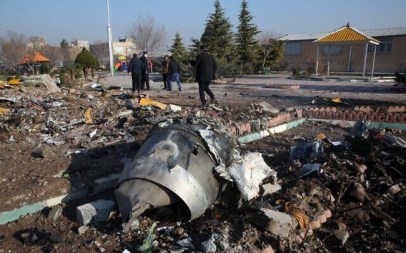
A bulldozer seen working as rescue workers search the scene where an Ukrainian plane crashed in Shahedshahr, southwest of the capital Tehran, Iran, Wednesday, Jan. 8, 2020. (AP Photo/Ebrahim Noroozi)
The jetliner, a Boeing 737 operated by Ukrainian International Airlines, went down on the outskirts of Tehran shortly after taking off from Imam Khomeini International Airport.
Iran had denied for several days that a missile caused the crash. But then the US and Canada, citing intelligence, said they believed Iran shot down the aircraft.
The plane, en route to the Ukrainian capital of Kyiv, was carrying 167 passengers and nine crew members from several countries, including 82 Iranians, at least 57 Canadians and 11 Ukrainians, according to officials. The Canadian government had earlier lower the nation’s death toll from 63.
Iranian Foreign Minister Javad Zarif said “Human error at time of crisis caused by US adventurism led to disaster.”
“Our profound regrets, apologies and condolences to our people, to the families of all victims, and to other affected nations,” Zarif wrote on Twitter.
Javad Zarif
✔@JZarif
A sad day. Preliminary conclusions of internal investigation by Armed Forces:
Human error at time of crisis caused by US adventurism led to disaster
Our profound regrets, apologies and condolences to our people, to the families of all victims, and to other affected nations.
Iranian President Hassan Rouhani tweeted that “investigations continue to identify & prosecute this great tragedy & unforgivable mistake.”
Hassan Rouhani
✔@HassanRouhani
Armed Forces’ internal investigation has concluded that regrettably missiles fired due to human error caused the horrific crash of the Ukrainian plane & death of 176 innocent people.
Investigations continue to identify & prosecute this great tragedy & unforgivable mistake. #PS752
Iran had denied on Friday that it was responsible for the crash.
Iran’s acknowledgement of responsibility for the crash was likely to inflame public sentiment against authorities after Iranians had rallied around their leaders in the wake of Soleimani’s killing on January 3. The general was seen as a national icon, and hundreds of thousands of Iranians had turned out for funeral processions across the country in an unprecedented display of grief and unity.
But sentiments in Iran are still raw over the government’s crackdown on large-scale protests late last year sparked by the worsening economic situation. Several hundred protesters were reported to have been killed in the clampdown.
Those fissures could quickly break open again following the admission of responsibility for the deaths of 176 mainly Iranian and dual Iranian-Canadian citizens.
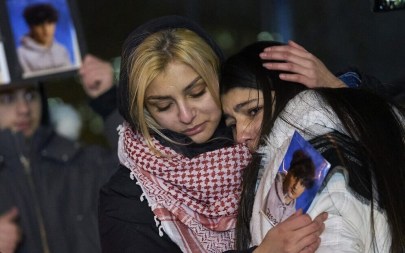
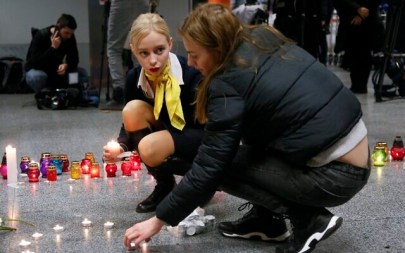
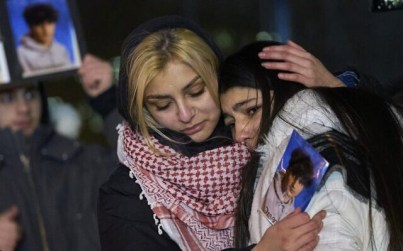
Mourners console each other during a vigil for the victims of Ukrainian Airlines flight 752 which crashed in Iran at Mel Lastman Square in Toronto, Ontario, January 9, 2020 (Geoff Robins/AFP)
Iran at first said it would not allow Boeing to take part in the probe, going against prevailing international norms on crash investigations. It later invited the US accident-investigating agency to take part in the investigation.
US, Canadian and British officials said Thursday it was “highly likely” that Iran shot down the the aircraft.
Canadian Prime Minister Justin Trudeau said “we have intelligence from multiple sources including our allies and our own intelligence.”
The US officials did not say what intelligence they had that pointed to an Iranian missile, believed to be fired by a Russian Tor system, known to NATO as the SA-15. But they acknowledged the existence of satellites and other sensors in the region, as well as the likelihood of communication interceptions and other similar intelligence.
Volume 90%
Iranian officials initially said the plane appeared to have crashed because of technical difficulties.
A preliminary Iranian investigative report released Thursday said that the airliner pilots never made a radio call for help and that the aircraft was trying to turn back for the airport when the burning plane went down.
The Iranian report suggested that a sudden emergency struck the plane just minutes after taking off.
“This is the right step for the Iranian government to admit responsibility, and it gives people a step toward closure with this admission,” said Payman Parseyan, a prominent Iranian-Canadian in western Canada who lost a number of friends in the crash.
“I think the investigation would have disclosed it whether they admitted it or not. This will give them an opportunity to save face,” he said.
The breakthrough achieved by Iran in upgrading the precision of its ballistic missiles was displayed in its Jan. 8 attack on the big US Ain Al-Asad airbase in W. Iraq. US President Donald Trump laid stress on the absence of casualties and “minimal damage” caused, adding “our early warning system worked very well.”
Then, on Jan. 9, the Iranian Revolutionary Guards Aerospace chief Brig. Gen. Amir Ali Hajizadeh said: “Our goal was to destroy the central command room of the base and that is what we did.”
But meanwhile, the US commercial Planet company stepped in with revealing satellite photos of the attack and its impact, showing that at least five structures at the Ain al-Asad airbase in western Iraq – hangars and buildings – were “hit hard by a barrage of Iranian missiles.” They were precise enough to strike some individual buildings “dead center,” said one analyst.
DEBKAfile’s military sources affirm that Iran fired in all 13 Qiam-1 ballistic missiles, designated as “short range.” They are elderly weapons developed by Iran from the Shahab-2 that was a copy of the North Korean North Korean Hwasong-6, which in turn replicated the Soviet-era Scud-C missile. The Qiam 1 has a range of 750km and 500m accuracy.
The president was not asked about the failure of the most advanced US anti-missile systems to intercept the Iranian missiles at Ain Al-Asad. (The second US base targeted by Iran at Irbil in Kurdistan was evacuated some days earlier.) This could be down to three alternative breakdowns: either the early warning systems did not detect the missiles’ launch from Iran; or the interceptors did not react when the missiles exploded inside the base; or both.
Clearly, in the five months since its missile/drone attack on Saudi oil facilities on Sept. 14, Iran has made further strides in developing the precision of its missiles, whereas the US early warning systems were not correspondingly upgraded.
Iran therefore brought off the first missile attack on US military targets since the Korean War.
The implications for America’s military deterrence are plain, but no less grave are the implications for Israel. The Iranian general stressed that the missile attack on American bases in neighboring Iraq was “only the start of a series of attacks that will take place across the entire region.”
Israel has no illusions about its standing with America on the front line against Iran. And if the US military is short of answers for defense against Iran’s ballistic missiles, Israel whose early warning and anti-missile systems are based on American models is in the same boat.
The Iranian strike on US bases in Iraq on Jan. 8 must serve as an immediate red alert for Israel on what to expect. Instead of telling the Israeli public fairy stories about their country’s non-involvement in the spiraling armed contest between the US and Iran, it would be better for the government to tell the people frankly that Israel is more exposed than ever to Iranian missile aggression.
Israel accused of attack on arms depots, vehicles carrying missiles, amid simmering tensions following Soleimani killing; US-led military coalition denies carrying out strike
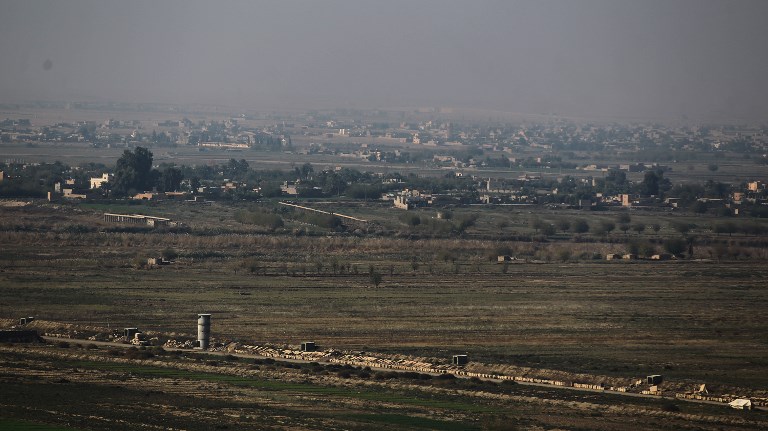
A picture taken on November 12, 2018 from al-Qaim in Iraq’s border al-Anbar province shows the Syrian border city of Albu Kamal in the Deir Ezzor region. (AHMAD AL-RUBAYE / AFP)
An airstrike in eastern Syria killed eight fighters from Iraq’s Iran-backed Hashed al-Shaabi (Popular Mobilization Force) militia overnight, a monitoring group said Friday.
“Unidentified aircraft targeted vehicles and arms depots in the Albu Kamal area, causing a large explosion. At least eight Iraqi Hashed fighters were killed,” said Rami Abdel Rahman, the head of the Syrian Observatory for Human Rights.
He said several others were wounded.
Through a spokesman contacted by AFP, the US-led military coalition operating in Syria and Iraq denied carrying out the strike.
Abdel Rahman, of the Britain-based organization which documents the war in Syria through a network of activists on the ground, said three villages in the Albu Kamal area known for housing forces loyal to Tehran have been targeted by drone strikes since Wednesday, causing no casualties.
An Iraqi security official and a PMF official said warplanes targeted two vehicles carrying missiles on the Syrian side of the border. The strike was most likely carried out by Israeli warplanes, they said but offered no evidence.
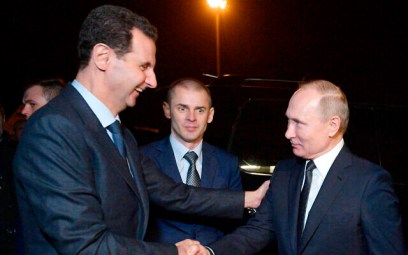
The area struck is key to a land corridor for Tehran that links Iran across Iraq and Syria through Lebanon. The Observatory report claimed that Russian President Vladimir Putin had informed Syrian President Bashar Assad this week of a US intention to “close” the land corridor for good.
Russian President Vladimir Putin, right, and Syrian President Bashar Assad shake hands during their meeting in Damascus, Syria, January 7, 2020. (Alexei Druzhinin, Sputnik, Kremlin Pool Photo via AP)
Explosions were reported late Thursday at a base near the Iraqi-Syria border thought to be used by Shiite militias, in what was a suspected airstrike.
According to local news site DeirEzzor24, a weapons shipment to Lebanese terror group Hezbollah was targeted in the attack. The weapons reportedly included ballistic missiles belonging to the Imam Ali Brigade, a Shiite militia under the Iran-backed Popular Mobilization Forces umbrella.
The Lebanese Al-Mayadeen news outlet claimed that the raid was carried out by Israeli aircraft, citing sources in the field. It said the raid targeted a weapons transport.
There was also no immediate response from Israel, which does not generally comment on foreign reports of individual strikes.
The strike came amid sky-high tensions in the region, following a deadly US drone strike on Iranian Quds Force commander Qassem Soleimani and Abu Mahdi al-Muhandis, the effective head of the PMF, last week.
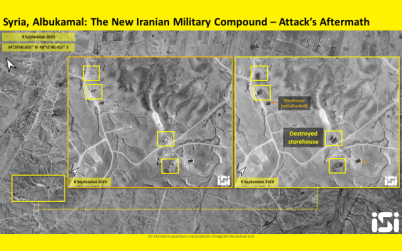
In September, large strikes in the same area that destroyed major parts of a weapons storehouse known as the Imam Ali compound were attributed to Israel.
Satellite image showing the aftermath of an overnight airstrike on an alleged Iranian military base in Syria’s Albu Kamal region, near the Iraqi border, on September 9, 2019. (ImageSat International)
Israel reportedly believed the base, which was overseen by Soleimani’s Quds Force, was a key element in Tehran’s effort to develop a so-called “land bridge” that would allow the Islamic Republic to easily move weapons, fighters, and war materiel from Iran through Iraq, Syria and Lebanon.
Shortly after that strike, members of a Shiite militia in Syria fired a number of rockets toward Mount Hermon on the Israeli Golan Heights from the outskirts of Damascus, according to the Israeli military.
The projectiles fell short of the border and landed inside Syrian territory.
Israel views Iran as its greatest threat, and has acknowledged carrying out scores of airstrikes in Syria in recent years aimed primarily at preventing the transfers of sophisticated weapons, including guided missiles, to the Iran-backed Hezbollah.
UK says ‘body of information’ points to missile strike, possibly accidental, joining US and Canada; Iran denies hitting liner, asks Canada to share intel
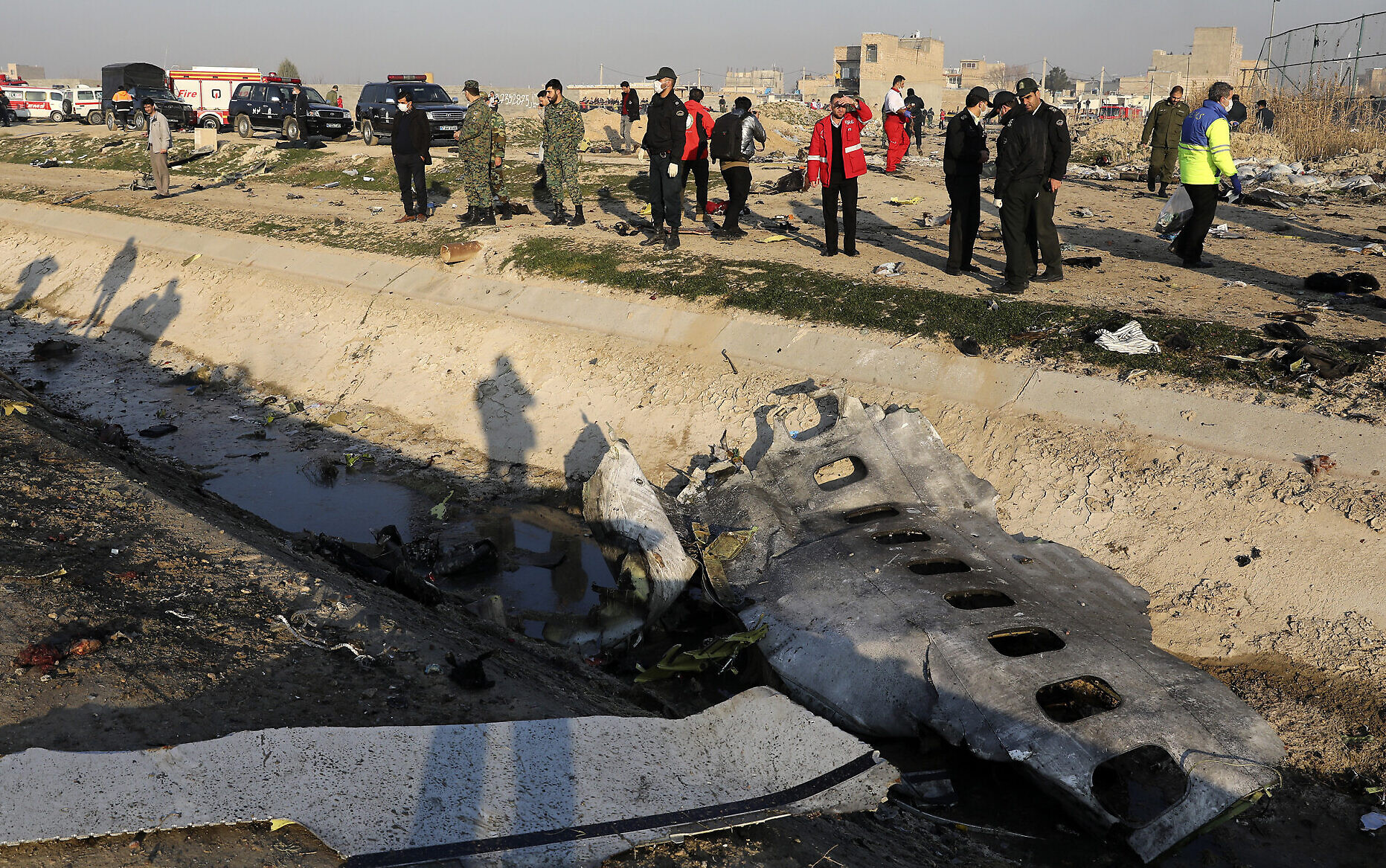
In this Wednesday, Jan. 8, 2020 photo a rescue worker searches the scene where a Ukrainian plane crashed in Shahedshahr southwest of the capital Tehran, Iran. (AP/Ebrahim Noroozi)
Video appearing to show a missile hitting a Ukrainian jetliner shortly after takeoff in Tehran emerged Thursday as Western countries said evidence showed it was “highly likely” that Iranian anti-aircraft fire downed the plane a day earlier.
Iran cast doubt over the claims late Thursday, and asked Canada to share what evidence it had. It also invited the plane’s manufacturer Boeing to take part in the official inquiry into the crash, apparently reversing an earlier decision to not share black box information from the jet’s final moments.
The video, published by The New York Times and independent research outfit Bellingcat, appears to show a missile explode as it hits a low-flying object.
According to the Times, which said it verified the video, the missile only damaged the jet, causing it to burst into flames. It attempted to return to the Imam Khomenei airport south of Tehran, but crashed into the ground shortly after, killing all 176 people aboard.
We are analyzing this new video supposedly showing a mid-air explosion. By our initial estimation, the video shows an apartment block in western Parand (35.489414, 50.906917), facing northeast. This perspective is directed approximately towards the known trajectory of #PS752.
Bellingcat said the video was taken from Parand, a suburb southwest of Tehran near the airport and below the plane’s flight path. The video was initially shared online publicly via Telegram and Twitter and a high resolution version was later obtained by The New York Times.
The Ukrainian International Airlines took off at 6:12 a.m. Wednesday, Tehran time, after nearly an hour’s delay at Tehran’s Imam Khomeini Airport, the main airport for travelers in Iran. It gained altitude heading west, reaching nearly 8,000 feet, according to both an Iranian report on the crash Thursday and flight-tracking data.
Eyewitnesses, including the crew of another flight passing above, described seeing the plane engulfed in flames before crashing at 6:18 a.m., the Iranian report said. The crash caused a massive explosion when the plane hit the ground, likely because the aircraft had been fully loaded with fuel for the flight to Kyiv, Ukraine.
A second video appears to show the plane on fire as it attempts to return to the airport, before crashing into the ground.
The plane was carrying 167 passengers and nine crew members from several countries, including 82 Iranians, at least 63 Canadians and 11 Ukrainians, according to officials. Many of the passengers were believed to be international students attending universities in Canada; they were making their way back to Toronto by way of Kyiv after visiting with family during the winter break.
US and Canadian officials said Thursday that evidence indicates it is “highly likely” that an Iranian anti-aircraft missile downed the Ukrainian jetliner near Tehran. They said the strike, which killed all 176 people on board, could well have been a mistake amid intentional airstrikes and high tensions throughout the region.
They were later joined by British Prime Minister Boris Johnson, who said there was now “a body of information” that an Iranian missile brought down the plane.
“There is now a body of information that the flight was shot down by an Iranian Surface to Air Missile. This may well have been unintentional,” Johnson said in a statement on the air disaster in which four British passengers died.
Canadian Prime Minister Justin Trudeau, whose country lost at least 63 citizens in the downing, said in a Thursday press conference in Toronto: “We have intelligence from multiple sources including our allies and our own intelligence. The evidence indicates that the plane was shot down by an Iranian surface-to-air missile.”
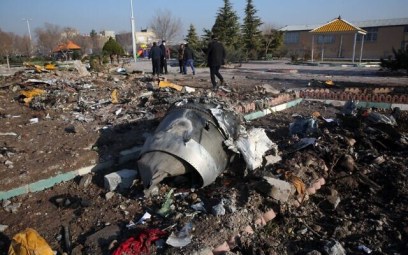
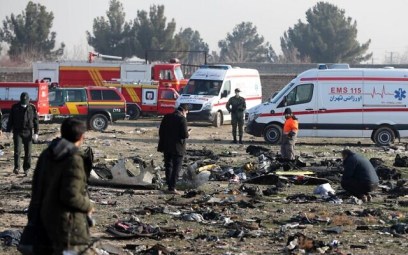
Rescue teams work amid debris after a Ukrainian plane carrying 176 passengers crashed near Imam Khomeini airport in the Iranian capital Tehran early in the morning on January 8, 2020, killing everyone on board. (AFP)
Earlier Thursday, US President Donald Trump suggested he believed Iran was responsible for the shootdown but wouldn’t directly blame the Iranians. He dismissed Iran’s initial claim that it was a mechanical issue.
“Somebody could have made a mistake on the other side.” Trump said, noting the plane was flying in a “pretty rough neighborhood.”
“Some people say it was mechanical,” Trump added. “I personally don’t think that’s even a question.”
Four US officials, speaking on the condition of anonymity to discuss sensitive intelligence, wouldn’t say what intelligence they had that pointed to an Iranian missile. But they acknowledged the existence of satellites and other sensors in the region, as well as the likelihood of communication interceptions and other similar intelligence.
Colleagues of the flight crew members of the Ukrainian 737-800 plane that crashed on the outskirts of Tehran, light candles at a memorial inside Borispil international airport outside Kyiv, Ukraine, Wednesday, Jan. 8, 2020. A Ukrainian airplane carrying 176 people crashed on Wednesday shortly after takeoff from Tehran’s main airport, killing all onboard, Iranian state TV and officials in Ukraine said. (AP Photo/Efrem Lukatsky)
Unnamed officials told US media satellite, radar and electronic data indicated Tehran’s air defense units downed the aircraft.
ABC News reported that an unnamed official said it was “highly likely” the plane was brought down by two surface-to-air missiles.
Two additional US officials said the intelligence pointing to likely Iranian responsibility became clearer overnight into Thursday.
It was not immediately clear how the US and its allies would react to the downing of the airliner. At least 63 Canadians and 11 Ukrainians were among the dead.
Despite efforts by Washington and Tehran to step back from the brink of possible war, the region remained on edge after the killing of the Iranian general and Iran’s retaliatory missile strikes. U.S. troops were on high-alert.
The latest assessment comes just a day after US Defense Secretary Mark Esper and Army Gen. Mark Milley, chairman of the Joint Chiefs of Staff, said they hadn’t had a chance to review the intelligence on the incident. Both spent much of the day at the White House and on Capitol Hill briefing the administration on on the killing of general Qassem Soleimani and the resulting attacks by Iran.
Mourners attend a funeral ceremony for Iranian Gen. Qassem Soleimani and his comrades, who were killed in Iraq in a US drone strike, in the city of Kerman, Iran, January 7, 2020 (Erfan Kouchari/Tasnim News Agency via AP)
Ukraine, meanwhile, said it considered a missile strike as one of several possible theories for the crash, despite Iran’s early denials.
The preliminary Iranian investigative report released Thursday suggests that a sudden emergency struck the Boeing 737 operated by Ukrainian International Airlines late Tuesday, when it crashed, just minutes after taking off from Imam Khomeini International Airport in Tehran. However it said that the airliner pilots never made a radio call for help and that the aircraft was trying to turn back for the airport when the burning plane went down.
Investigators from Iran’s Civil Aviation Organization offered no immediate explanation for the disaster, however. Iranian officials initially blamed a technical malfunction for the crash, something backed by Ukrainian officials before they said they wouldn’t speculate amid an ongoing investigation.
Before the US assessment, Iran’s state-run IRNA news agency quoted Hasan Rezaeifa, the head of the of civil aviation accident investigation commission, claiming that “the topics of rocket, missile or anti-aircraft system is ruled out.”
Rescue teams work amidst debris after a Ukrainian plane carrying 176 passengers crashed near Imam Khomeini airport in the Iranian capital Tehran on January 8, 2020, killing everyone on board. (AFP)
The report also confirmed that both of the “black boxes” that contain data and cockpit communications from the plane had been recovered, though they sustained damage and some parts of their memory was lost.
Hours before the plane crash the US Federal Aviation Administration had issued an emergency flight restriction barring US carriers and pilots from flying over areas of Iraqi, Iranian and some Persian Gulf airspace warning of the “potential for miscalculation or misidentification” for civilian aircraft due to heightened political and military tensions.
Oleksiy Danilov, secretary of Ukraine’s Security Council, told Ukrainian media that officials had several working theories regarding the crash, including a missile strike.
Iran did not immediately respond to the Ukrainian comments. However, Gen. Abolfazl Shekarchi, the spokesman of the Iranian armed forces, denied a missile hit the airplane in a comments reported Wednesday by the semiofficial Fars news agency. He dismissed the allegation as “psychological warfare” by foreign-based Iranian opposition groups.
The US accident investigator, the National Transportation Safety Board, is talking to the State Department and the Treasury Department about traveling to Iran to inspect the US-built aircraft and working with Iranian authorities despite US economic sanctions against that country. Federal officials are concerned about sending employees to Iran because of the heightened tensions.
‘We can say with certainty that no missile hit the plane,’ head of national aviation department says, as world leaders assert intelligence shows otherwise
Debris is seen from an Ukrainian plane which crashed as authorities work at the scene in Shahedshahr, southwest of the capital Tehran, Iran, Wednesday, Jan. 8, 2020 (AP Photo/Ebrahim Noroozi)
TEHRAN, Iran (AP) — Iran on Friday denied Western allegations a Ukrainian jetliner that crashed outside Tehran was brought down by an Iranian missile and called on the US and Canada to share any information they have on the crash, which killed all 176 people on board.
Western leaders said the plane appeared to have been unintentionally hit by a surface-to-air missile near Tehran, just hours after Iran launched a series of ballistic missiles at two US bases in Iraq to avenge the killing of its top general in an American airstrike last week.
“What is obvious for us, and what we can say with certainty, is that no missile hit the plane,” Abedzadeh, head of Iran’s national aviation department, told a press conference.
“If they are really sure, they should come and show their findings to the world” in accordance with international standards, he added.
Rescue workers carry the body of a victim of a Ukrainian plane crash in Shahedshahr, southwest of the capital Tehran, Iran, Jan. 8, 2020 (AP Photo/Ebrahim Noroozi)
Hassan Rezaeifar, the head of Iranian investigation team on Friday told the same press conference that recovering data from the black box flight recorders could take more than a month and that the entire investigation could stretch into next year.
He also said Iran may request help from international experts if it is not able to extract the flight recordings.
The ballistic missile attack on the bases in Iraq caused no casualties, raising hopes that the standoff over the killing of Gen. Qassem Soleimani would end relatively peacefully, though Iran has sent mixed signals over whether its retaliation is complete.
If the US or Canada were to present incontrovertible evidence that the plane was shot down by Iran, even if unintentionally, it could have a dramatic impact on public opinion in Iran.
The Iranian public had rallied around the leadership after the killing of Soleimani last Friday, with hundreds of thousands joining the general’s funeral processions in several cities, in an unprecedented display of grief and unity.
Mourners attend a funeral ceremony for Iranian Gen. Qassem Soleimani and his comrades, who were killed in Iraq in a US drone strike, in the city of Kerman, Iran, January 7, 2020 (Erfan Kouchari/Tasnim News Agency via AP)
But sentiments in Iran are still raw over the government’s crackdown on large-scale protests late last year sparked by the worsening economic situation. Several hundred protesters were reported to have been killed in the clampdown.
Those fissures could quickly break open again if public evidence is presented that Iranian authorities were responsible for the deaths of 176 people, mainly Iranians or dual Iranian-Canadian citizens.
The state-run IRNA news agency quoted a Foreign Ministry spokesman as saying Iran “has invited both Ukraine and the Boeing company to participate in the investigations.” The spokesman, Abbas Mousavi, said it will also welcome experts from other countries’ whose citizens died in the crash.
Iran had initially said it would not allow Boeing to take part in the probe, going against prevailing international norms on crash investigations. It later invited the US accident-investigating agency to take part in the investigation.
Rescue teams work amidst debris after a Ukrainian plane carrying 176 passengers crashed near Imam Khomeini airport in the Iranian capital Tehran early in the morning on January 8, 2020, killing everyone on board (AFP)
The National Transportation Safety Board said late Thursday that it would “evaluate its level of participation,” but its role could be limited by US sanctions on Iran. US officials have also expressed concern about sending employees to Iran because of the heightened tensions.
Under rules set by a United Nations aviation organization, the NTSB is entitled to participate because the crash involved a Boeing 737-800 jet that was designed and built in the US.
There was no immediate comment from Boeing.
US, Canadian and British officials said Thursday it is “highly likely” that Iran shot down the Boeing 737 that crashed near Tehran late Tuesday. US officials said the jetliner might have been mistakenly identified as a threat.
Canadian Prime Minister Justin Trudeau, whose country lost at least 63 citizens in the downing, said “we have intelligence from multiple sources including our allies and our own intelligence.”
“The evidence indicates that the plane was shot down by an Iranian surface-to-air missile,” he said. UK Prime Minister Boris Johnson and Australian Prime Minister Scott Morrison offered similar statements.
Mourners console each other during a vigil for the victims of Ukrainian Airlines flight 752 which crashed in Iran during a vigil at Mel Lastman Square in Toronto, Ontario on January 9, 2020 (Geoff Robins / AFP)
The US officials did not say what intelligence they had that pointed to an Iranian missile, believed to be fired by Russian Tor system, known to NATO as the SA-15. But they acknowledged the existence of satellites and other sensors in the region, as well as the likelihood of communication interceptions and other similar intelligence.
Western countries may hesitate to share information on such a strike because it comes from highly classified sources.
Ukraine’s President Volodymyr Zelenskiy said “the missile theory is not ruled out, but it has not been confirmed yet.”
In a Facebook post, he reiterated his call “on all international partners” — the US, Britain and Canada in particular — to share data and evidence relevant to the crash. He also announced plans to discuss the investigation with US Secretary of State Mike Pompeo later on Friday.
Iranian officials initially said the plane appeared to have crashed because of technical difficulties.
A preliminary Iranian investigative report released Thursday said that the airliner pilots never made a radio call for help and that the aircraft was trying to turn back for the airport when the burning plane went down.
The Iranian report suggested that a sudden emergency struck the Boeing 737, operated by Ukrainian International Airlines, just minutes after taking off from Imam Khomeini International Airport in Tehran early Wednesday.
Abedzadeh, the senior aviation official, had earlier said that by law there is “full coordination” between the country’s air defenses and the civil aviation system. He said it is “absolutely impossible” that the armed forces would shoot down a civilian plane.
Candles light a photo of one of the victims of Ukrainian Airlines flight 752 which crashed in Iran earlier, during a vigil at Mel Lastman Square in Toronto, Ontario on January 9, 2020 (Geoff Robins / AFP)
He said authorities have recovered two black box flight recorders, saying they are “damaged” but readable, which may shed further light on what caused the crash.
Ukraine said Iranian authorities allowed Ukrainian investigators to examine fragments of the plane late Thursday.
“It is too early on in the investigation to reveal specific details,” the statement from the Ukraine president’s office said. It added that DNA is being collected from relatives of Ukrainians who died in the crash in order to identify the bodies.
Rescue teams recover a body after a Ukrainian plane carrying 176 passengers crashed near Imam Khomeini airport in the Iranian capital Tehran on January 8, 2020, killing everyone on board. (AFP)
US officials believe Iran accidentally shot down a Ukrainian airliner, killing all of the 176 people on board, US media reported Thursday.
Newsweek, CBS and CNN quoted unnamed officials saying they were increasingly confident that Iranian air defense systems accidentally downed the aircraft, based on satellite, radar and electronic data.
Newsweek reported that several sources had informed it that the Ukrainian Airlines passenger jet that went down in Iran on Wednesday had been hit by a Russian-built surface-to-air missile.
US President Donald Trump said he had “suspicions” about the crash.
“It was flying in a pretty rough neighborhood and somebody could have made a mistake,” he said.
“Some people say it was mechanical. I personally don’t think that’s even a question,” Trump said, adding that “something very terrible happened.”
According to the unnamed sources quoted by Newsweek, who were identified as US and Iraqi intelligence officials and a Pentagon official, Ukraine International Airlines flight 752 from Tehran to Kyiv was accidentally struck by a Tor-M1 shortly after takeoff.
The crash came immediately after Iran launched a ballistic missile attack against Iraqi military bases housing US troops amid a confrontation with Washington over its killing of an Iranian Revolutionary Guard general in a drone strike last week.
The plane was carrying 167 passengers and nine crew members from several countries, including 82 Iranians, at least 63 Canadians and 11 Ukrainians, according to officials. The crash just before dawn scattered flaming debris and passengers’ belongings across a wide stretch of farmland.
Rescue workers carry the body of a victim of a Ukrainian plane crash in Shahedshahr, southwest of the capital Tehran, Iran, January 8, 2020 (AP Photo/Ebrahim Noroozi)
Eyewitnesses, including the crew of another passing flight, described seeing the plane engulfed in flames before crashing, the report said. The crash caused a massive explosion when the plane hit the ground, likely because the aircraft had been fully loaded with fuel for the flight to Kyiv, Ukraine.
Oleksiy Danilov, secretary of Ukraine’s Security Council, initially told Ukrainian media that officials had several working theories regarding the crash, including a missile strike.
“A strike by a missile, possibly a Tor missile system, is among the main [theories], as information has surfaced on the internet about elements of a missile being found near the site of the crash,” Danilov said.
He later told AFP that for the moment there was no reason to believe that the airliner had been hit by a missile.
An investigation team from Bellingcat, a journalism website that focuses on fact-finding, tweeted that it had seen an image purported to be Russian missile debris, but the angle of the picture meant it would be impossible to geolocate and prove it was at the crash site of the jetliner near Tehran.
Bellingcat
✔@bellingcat
The problem with this photo of the remains of an AA missile is it’s been taken at an angle where it’ll be next to impossible to geolocate, so unless another image appears which can be geolocated it won’t be possible to verify it’s in Iran.https://twitter.com/AshkanMonfared_/status/1214956002455375872 …
Ukrainian investigators who arrived in Iran earlier on Thursday were awaiting permission from Iranian authorities to examine the crash site and look for missile fragments, Danilov said.
The Tor is a Russian-made missile system. Russia delivered 29 Tor-M1s to Iran in 2007 as part of a $700 million contract signed in December 2005. Iran has displayed the missiles in military parades.
Investigators have previously blamed Russian missiles on the 2014 crash of a Malaysia Airlines that crashed in Ukraine as it returned home from Amsterdam, killing 298 people including 193 Dutch nationals.
Reuters had previously reported that Western intelligence agencies believed that the plane suffered a technical malfunction and was not shot down.
The wire service quoted five unnamed security sources — three American, one European and one Canadian — as saying the initial assessment was that Tehran’s explanation was accurate. The Canadian source was quoted as saying there was evidence one of the aircraft’s engines had overheated.
A Russian Tor-M1 missile systems launcher vehicle is seen during military exercises somewhere in undisclosed location in Russia, in this July 28, 2005 file picture. (AP Photo)
Qassem Biniaz, a spokesman for Iran’s Road and Transportation Ministry, said it appeared a fire erupted in one of its engines and the pilot lost control of the plane, according to the state-run IRNA news agency. The news report did not explain how Iranian authorities knew that.
British Prime Minister Boris Johnson called Thursday for a “full, credible and transparent” investigation into the crash.
A spokesman said reports about what happened were “very concerning.”
Johnson spoke to Ukrainian President Volodymyr Zelensky in a phone call in which he offered his condolences for the loss of life and received an update on Ukraine’s efforts to establish the facts, the spokesman said.
“The prime minister said that there needed to be a full, credible and transparent investigation into what happened,” the spokesman said.
He added: “The reports we have seen are very concerning and we are urgently looking into them.”
In Kyiv, the Ukrainian presidency said Zelensky invited Britain to join the probe, and also called for a “transparent, thorough and objective investigation that can quickly establish the facts of this tragedy.”
Ottawa also called Thursday for its own experts be allowed to join the investigation into the crash.
In a rare phone call with his Iranian counterpart Javad Zarif late Wednesday, Canada’s Foreign Minister Francois-Philippe Champagne called for Iran to allow Canadian investigators in to the country, the Canadian foreign ministry said in a statement.
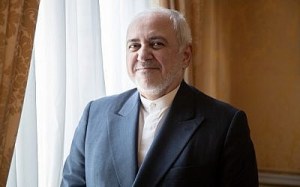
Iranian Foreign Minister Mohammad Javad Zarif poses for a photograph during an interview with AFP at the residence of Iran’s ambassador in Paris on August 23, 2019. (Geoffroy Van Der Hasselt/AFP)
“Minister Champagne stressed the need for Canadian officials to be quickly granted access to Iran to provide consular services, help with identification of the deceased and take part in the investigation of the crash,” the statement said.
Iran is refusing to hand over for analysis the black boxes from the plane, Iranian media reported Wednesday.
But Zelensky said Iranian President Hassan Rouhani had assured him of full cooperation in investigating the fatal crash and that Iran would provide experts access to all data.
By NASSER KARIMI, AMIR VAHDAT and JON GAMBRELLyesterday
This satellite image provided on Wednesday, Jan. 8, 2020, by Middlebury Institute of International Studies and Planet Labs Inc. shows the damage caused from an Iranian missile strike at the Ain al-Asad air base in Iraq. Iran’s actions were in response to the U.S. killing of Revolutionary Guard Gen. Qassem Soleimani. (Planet Labs Inc./Middlebury Institute of International Studies via AP)
TEHRAN, Iran (AP) — Iran struck back at the United States early Wednesday for killing its most powerful military commander, firing a barrage of ballistic missiles at two Iraqi military bases that house American troops in what the Iranian supreme leader said was a “slap” against the U.S. military presence in the region.
The dramatic blast of more than a dozen missiles caused no casualties, however, and U.S. President Donald Trump said hours later that Iran “appears to be standing down.
It was a signal that both sides were stepping away from an immediate spiral of more direct exchanges that could throw the Middle East into great turmoil.
Speaking at the White House, Trump said the U.S. would impose new “punishing economic sanctions” on Iran to force it to stop its nuclear program and what he called its “hostilities” in the region. But he also said Washington was open to a deal with Tehran.
Iran, in turn, appeared to have calibrated its attack to avoid stoking further U.S. retaliation, giving some early warning to its Iraqi allies to avoid casualties.
“Last night they received a slap,” Supreme Leader Ayatollah Ali Khamenei said of the Americans in a speech after the missile strikes.
He made clear that Iran’s actions were in response to the U.S. killing of Revolutionary Guard Gen. Qassem Soleimani, whose death last week in a drone strike in Baghdad prompted angry calls for vengeance and drew massive crowds of Iranians to the streets in mourning. Khamenei himself wept at the funeral in a sign of his bond with the commander.
“These military actions are not sufficient (for revenge). What is important is that the corrupt presence of America in this region comes to an end.”
Satellite imagery showed at least five impact sites on the Ain al-Asad base in Iraq’s western Anbar province, each leaving charred blast marks that damaged or destroyed buildings. One obliterated a structure in a row of buildings next to a line of helicopters, though none of the aircraft appeared damaged, according to the imagery provided by Planet Labs, Inc.
Iran’s foreign minister tweeted that Tehran had taken and “concluded proportionate measures in self-defense,” adding that Tehran did “not seek escalation” but would defend itself against further aggression.
Iraqi Prime Minister Adel Abdul-Mahdi said he received notification from Iran just after midnight that its retaliation “was starting or would start soon” and would focus only on U.S. positions. The militaries of Finland and Lithuania, which had personnel at one of the targeted bases, said they received information about an imminent attack and had time to move to shelters or leave the base.
Iran’s attacks “appeared designed for maximum domestic effect with minimum escalatory risk,” said Henry Rome, analyst with Eurasia Group.
“For a president who wants to avoid a war in the Middle East during an election year, the Iranians have provided an off-ramp he will likely take,” Rome said.
The Iranian attacks on the bases marked the first time in recent years that Iran has directly attacked U.S. positions rather than through proxies in the region.
Tehran and Washington have been at odds since Iran’s 1979 Islamic Revolution and the subsequent U.S. Embassy takeover and hostage crisis.
Adding to the chaos, a Ukrainian airplane with 176 people crashed after takeoff just outside Tehran on Wednesday morning, killing all on board, Iranian and Ukrainian officials said. Iran said mechanical issues were suspected, although Ukraine declined to offer a cause while an investigation continues.
The Boeing 737-800 had taken off from Imam Khomeini International Airport, bound for the Ukrainian capital, Kyiv. The plane carried 167 passengers and nine crew members. Ukrainian Foreign Minister Vadym Prystaiko said there were 82 Iranians, 63 Canadians and 11 Ukrainians on board — the Ukrainian nationals included two passengers and the nine crew. The rest were Swedish, Afghan, German and British nationals.
The U.S. Federation Aviation Administration earlier warned of a “potential for miscalculation or mis-identification” for civilian aircraft in the Persian Gulf. The agency barred U.S. carriers from flying over areas of Iraqi, Iranian and some Persian Gulf countries.
The U.S. has been deploying more troops in the region. U.S. Gulf allies that host thousands of American troops are concerned about a direct conflict. Saudi Arabia and the United Arab Emirates have called for de-escalation.
“The situation is not currently a war situation,” UAE Energy Minister Suhail Al-Mazrouei said, stressing that Iran is a neighbor and the last thing the country wants is more regional tension.
Iran’s Revolutionary Guard warned the U.S. and its allies against retaliating over the missile attack.
“We are warning all American allies, who gave their bases to its terrorist army, that any territory that is the starting point of aggressive acts against Iran will be targeted,” the Guard said in a statement carried by Iran’s state-run IRNA news agency. It also threatened Israel.
The Iranians fired 15 missiles Wednesday, two U.S. officials said. Ten hit Ain al-Asad and one targeted a base in Irbil in Iraq’s semi-autonomous Kurdish region. Four failed, said the officials, who were not authorized to speak publicly about a military operation.
“As we evaluate the situation and our response, we will take all necessary measures to protect and defend U.S. personnel, partners and allies in the region,” said Jonathan Hoffman, an assistant to the U.S. defense secretary.
Satellite image shows the damage caused from an Iranian missile strike. (Planet Labs Inc./Middlebury Institute of International Studies via AP)
Two Iraqi security officials said a missile appeared to have hit a plane at Ain al-Asad, igniting a fire. There were no immediate reports of casualties from the attacks, according to the officials, who spoke on condition of anonymity because they did not have permission to talk to journalists.
Ain al-Asad was first used by American forces after the 2003 U.S.-led invasion that toppled dictator Saddam Hussein, and it later was used by American troops in the fight against the Islamic State group. It houses about 1,500 U.S. and coalition forces. Trump went there in December 2018, making his first presidential visit to troops in the region. Vice President Mike Pence also has visited.
As Iran reels from the loss of life in the plane crash, it is also contending with the aftermath of a deadly stampede Tuesday at Soleimani’s funeral in his hometown of Kerman, killing 56 people and injuring more than 200. Shortly after Wednesday’s missile attack, Soleimani’s shroud-wrapped remains were lowered into the ground as mourners wailed at the grave site.
“We tell our enemies that we will retaliate, but if they take another action we will set ablaze the places that they like and are passionate about,” Hossein Salami, who commands the Revolutionary Guard, told a crowd in Kerman.
The general’s funeral procession in major cities spanning three days was an unprecedented honor for Soleimani, seen by Iranians as a national hero for his work leading the Guard’s expeditionary Quds Force in the face of U.S. pressure.
The U.S. blames him for killing U.S. troops in Iraq. The Trump administration alleges he’d been plotting new attacks just before he was killed.
Many Sunni Muslims in the region, however, view him as a destabilizing figure who commanded dangerous and deadly Shiite proxy militias. Soleimani led forces supporting Syrian President Bashar Assad in that country’s civil war.
Since his killing Jan. 3, Tehran has abandoned the remaining limits of its 2015 nuclear deal with world powers. In Iraq, lawmakers and pro-Iranian factions in parliament have voted to oust American troops from Iraqi territory.
Kuwait said Wednesday that its state-run KUNA news agency’s Twitter account was hacked and posted a false story on U.S. troops withdrawing from the nation. The fake alert went out on its account, Kuwait said. More than 13,000 U.S. troops are stationed in Kuwait, with more now on the way.
___
Gambrell reported from Dubai, United Arab Emirates. Associated Press writers Aya Batrawy in Dubai, Matthew Lee, Lolita C. Baldor and Zeke Miller in Washington, Qassim Abdul-Zahra in Baghdad; Hussain al-Qatari in Kuwait City and Zeina Karam in Beirut contributed.
Iran’s Supreme leader Ayatollah Ali Khamenei prays near the coffins of Iranian Major Qassem Soleimani and Iraqi militia commandr Abu Mahdi al-Muhandis who were killed in last wee;s US air strike at Baghdad airport.
(photo credit: REUTERS)
Four months ago we argued that while Democratic presidential candidates backed a recommitment of the United States to the Iran nuclear deal, there might be no deal, as we know it, to return to when the next president takes office. These fears have now proven out, in the wake of President Trump’s ordering of the targeted assassination of Qasem Soleimani, a terrorist who was widely known as the second most powerful person in Iran and who was taken out at Baghdad’s airport Friday.
The news of this operation left the US standing almost alone, as countries distanced themselves from us or remained silent. Iraq’s parliament voted to expel US troops from the nation, dealing a severe blow to the ongoing campaign to snuff out what remains of the Islamic State. In Tehran, after Iran’s lawmakers chanted in unison “Death to America,” the mullahs announced that the Islamic Republic would stop respecting the terms of the nuclear accord it signed in 2015. Trump’s reaction to all of this was his usual blend of dissembling and gas-lighting, as he told reporters that his actions were designed to prevent a war, rather than start one.
It’s hard to find anyone of good faith genuinely mourning the death of Suleimani, whose stock-in-trade was death and destruction across the Middle East. He orchestrated the murder and maiming of thousands of American troops in Iraq. Iran’s own citizens were victims of his evil, as he was an architect of the regime’s repressive measures against protesters and dissidents.
Nevertheless, the decision to assassinate him leaves the specter of full-blown war looming over the region. Aside from the immediate prospect of armed conflict, we must also turn our attention to the long-term implications of the Islamic Republic’s decision to void the nuclear accord. Following the White House’s choice to “tear up” the pact in May 2018, our allies in Europe had kept the agreement on life support, dangling incentives in front of the Iranians in order to try to keep them in line. Many of our political party’s presidential contenders still hoped the deal would remain viable enough that come the election of a Democrat to the White House this November, it could be revived, with significant modifications. But the Iran deal is now, in its current form anyway, irretrievably dead.
This administration’s hardliners might be thrilled at this news, but there is little reason to celebrate. No diplomatic agreement is perfect, and this nuclear accord of blessed memory was no exception. Nonetheless, despite its flaws, the accord imposed substantial constraints on the Islamic Republic’s nuclear program, restricting for many years the extent to which it could enrich uranium, and requiring the nation to submit to third-party inspections of its facilities. President Obama’s will to reach across divides and engage with Iran also emboldened its moderates.
AND IT was mostly working.
Notwithstanding Iran’s several violations of the deal last year, it was still significantly far from having enough enriched uranium for a weapon. Now, at best, the clock needs to be restarted.Many have speculated on Trump’s political motives in ordering Suleimani’s assassination. It would come as no surprise if the action was intended to distract from current impeachment proceedings, or to create a “rally around the flag” effect in which Democrats could be depicted as unpatriotic.
Or it might have been intended to distinguish the Trump administration from the Obama administration. Trump, it seems, will go to any length to do whatever Obama didn’t – for better or worse.
Whatever the case, Democrats must not be caught flat-footed or dumbfounded. While the Iran deal is kaput, we must insist on reengaging with Iran to rein in its nuclear program and find a path forward, keeping all options on the table. Democrats should seek to build on the rubble of the current deal, offering sanctions relief in exchange for tangible commitments to refrain from the enrichment of uranium and dismantle facilities that could be used to build an atomic bomb.
But to accomplish this before next year, it could not happen the Trump way. His fantasy of a Kim Jong Un-like one-on-one meeting with Iran’s President Hassan Rouhani is now clearly forever impossible. And the irony that two of the P5+1 nations supporting the original deal are among Trump’s favorites – Russia and China – should also not be lost on those truly seeking to return to an Iran deal anytime soon.
Democrats must also stress how the president’s actions – without full preparation of what’s to come – have truly imperiled not only of the safety of Americans throughout the world, but also that of our allies, foremost among them Israel, which would be first in the nearby firing line of Iran and its proxies. Democrats should point to the blatant hypocrisy at the heart of the president’s actions. While Trump ran on a promise of preventing costly military engagements overseas and often played to the public’s understandable war fatigue, he has now brought the US to the precipice of another bloody quagmire.
However, there is a larger lesson that Democrats must highlight from all these unforced errors: The president has been disastrous across the board, and nowhere more than on foreign policy and diplomacy. Even though the world is better off without Qassem Suleimani in it, Trump’s predilection to go it alone, to insult and abandon allies such as our friends in Europe and Kurdistan, to pander to enemies like North Korea and Russia – not to mention the man’s overall capriciousness – have driven our credibility and standing on the international scene to its lowest point in modern history.
This is not an abstract question of prestige or national pride. It has ramifications for our security interests and could perhaps even cost the lives of our children in uniform by numbers greater than it already has.
The writers are veterans of Capitol Hill and numerous US presidential campaigns who head Bluelight Strategies, a Washington consulting firm. Working with the White House and president Obama, the two ran the No Nukes for Iran Project, informing the American Jewish community about the Iran nuclear deal.
















 anneinpt
 artaxes
 danmillerinpanama
 davidking1530
 Peter Hofman
 Joseph Wouk
 Peter
Peter Louisiana Steve
 WarSclerotic
Recent Comments