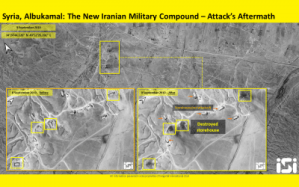
Archive for December 2019

In tacit threat, Israeli intel firm releases photo of suspected Iranian tunnel 

December 11, 2019

Source: In tacit threat, Israeli intel firm releases photo of suspected Iranian tunnel | The Times of Israel

Satellite images show apparent underground storage passage on an alleged IRGC base in eastern Syria, near the Iraqi border

Satellite images showing an alleged Iranian tunnel on a military base near the border crossing in Syria’s Boukamal region, near the Iraqi border, on December 10, 2019. (ImageSat International)

In an apparent threat, an Israeli intelligence firm on Tuesday released photographs of what it said is an Iranian tunnel being dug along the Syria-Iraq border to assist in the movement of weapons throughout the Middle East.

According to the private satellite image analysis company ImageSat International, the tunnel is likely being used to store Iranian missiles en route to Tehran’s proxies throughout the region.

In some cases in the past, suspected areas of Iranian military entrenchment have been identified and publicized by ImageSat International shortly before the sites were targeted in airstrikes attributed to Israel.

The tunnel, whose entrance can be seen in satellite images, is located on a suspected Iranian military base, known as the Imam Ali base, in Syria’s Boukamal region, near the Iraqi border. The base has been the site of several Israeli airstrikes in the past year, including some in the past few days, according to Syrian media.

Satellite images showing an alleged Iranian tunnel on a military base near the border crossing in Syria’s Boukamal region, near the Iraqi border, on December 10, 2019. (ImageSat International)

ImageSat said the tunnel appears to have been built in response to these airstrikes, as a means to protect high-quality munitions from Israeli attacks.

“Currently, the estimated tunnel’s width is 4-5 meters and its length is unknown. Due to the area’s rigid flat terrain, it is unlikely that the tunnel will be extended significantly,” it wrote in its report.

The firm said the capacity makes it large enough to “securely store weapon systems, possibly advanced, for protecting them from airstrikes.”

Satellite images showing an alleged Iranian tunnel on a military base near the border crossing in Syria’s Boukamal region, near the Iraqi border, on December 10, 2019. (ImageSat International)

The Boukamal region in Syria is seen as critical to Tehran’s effort to establish a land corridor from Iran, through Iraq and Syria, and out to the Mediterranean Sea in order to more easily move weapons and fighters throughout the Middle East. Israel has vowed to prevent Iran from establishing a military presence in Syria.

On Sunday, Defense Minister Naftali Bennett said Israel was taking action to force Iran’s military out of Syria.

“We are telling the Iranians: Syria will become your Vietnam,” he said, referring to the disastrous American war.

“If you don’t leave, you will become entrenched and you will bleed because we will work without hesitation to remove aggressive forces from Syria,” Bennett said.

Satellite images showing ongoing construction at an alleged Iranian military base near the border crossing in Syria’s Boukamal region, near the Iraqi border, on December 10, 2019. (ImageSat International)

The defense minister’s comments came shortly after reports emerged of an airstrike on three Iranian-controlled weapons depots the night before, which killed several members of Tehran-supported militias, according to Syrian media outlets.

The outlets said the attack was carried out by unidentified aircraft, though many analysts speculated that Israel was behind the raid.

The Israeli military as a rule does not comment on specific airstrikes in Syria, save for those that are in retaliation for attacks on Israel.

Some news sites reported that four fighters were killed in the strike, while others said five. The Syrian government did not immediately release an official tally.

According to the Syrian Step News agency, the airstrikes occurred around 10 p.m. on Saturday, targeting three munitions storehouses. The outlet cited “well-placed sources” as saying that the four people killed were guards at the storehouses who were members of militias backed by Iran.

The Britain-based Syrian Observatory for Human Rights monitor said that at least five militiamen were killed in the strike.
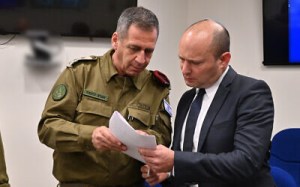
New Defense Minister Naftali Bennett (R) meets with IDF Chief of Staff Aviv Kohavi on November 13, 2019. (Ariel Hermoni/Defense Ministry

The Saturday night strikes came days after reports of a similar raid in the same region.

Last Wednesday, unidentified aircraft bombed other Iranian-controlled weapons storehouses in Boulkamal, causing a massive explosion, according to Step News.

The outlet reported that the planes fired several missiles at warehouses belonging to Iran’s Islamic Revolutionary Guard Corps at the al-Hamdan airport, outside Deir Ezzor. Troops on the ground fired anti-aircraft weapons at the attacking planes, the news site said. There were no reports of casualties in that raid.

Satellite image showing the aftermath of an overnight airstrike on an alleged Iranian military base in Syria’s Boukamal region, near the Iraqi border, on September 9, 2019. (ImageSat International)

Last month, Iranian troops fired several rockets at northern Israel from Syria and the Israel Defense Forces retaliated with a series of airstrikes on Iranian and Syrian military targets.

According to a Syrian war monitor, at least 23 combatants were killed in those strikes, 16 of them likely Iranians. An Israeli official said the military believed that to be an inflated number, with the actual death toll estimated to be closer to 10.

Though it does not generally comment on specific attacks, Israel has generally acknowledged carrying out hundreds of airstrikes in Syria against Iranian targets over the last several years. Iran has forces based in Syria, Israel’s northern neighbor, and supports Hezbollah and Gaza terrorists.
 

New Jersey kosher supermarket shooters ‘targeted the location,’ mayor says

December 11, 2019

Source: New Jersey kosher supermarket shooters ‘targeted the location,’ mayor says | The Times of Israel

Off Topic:  At least six dead in gun battle; two identified as store owner Leah Minda Ferencz and Moshe Deutsch, both Hasidim; police officer also killed

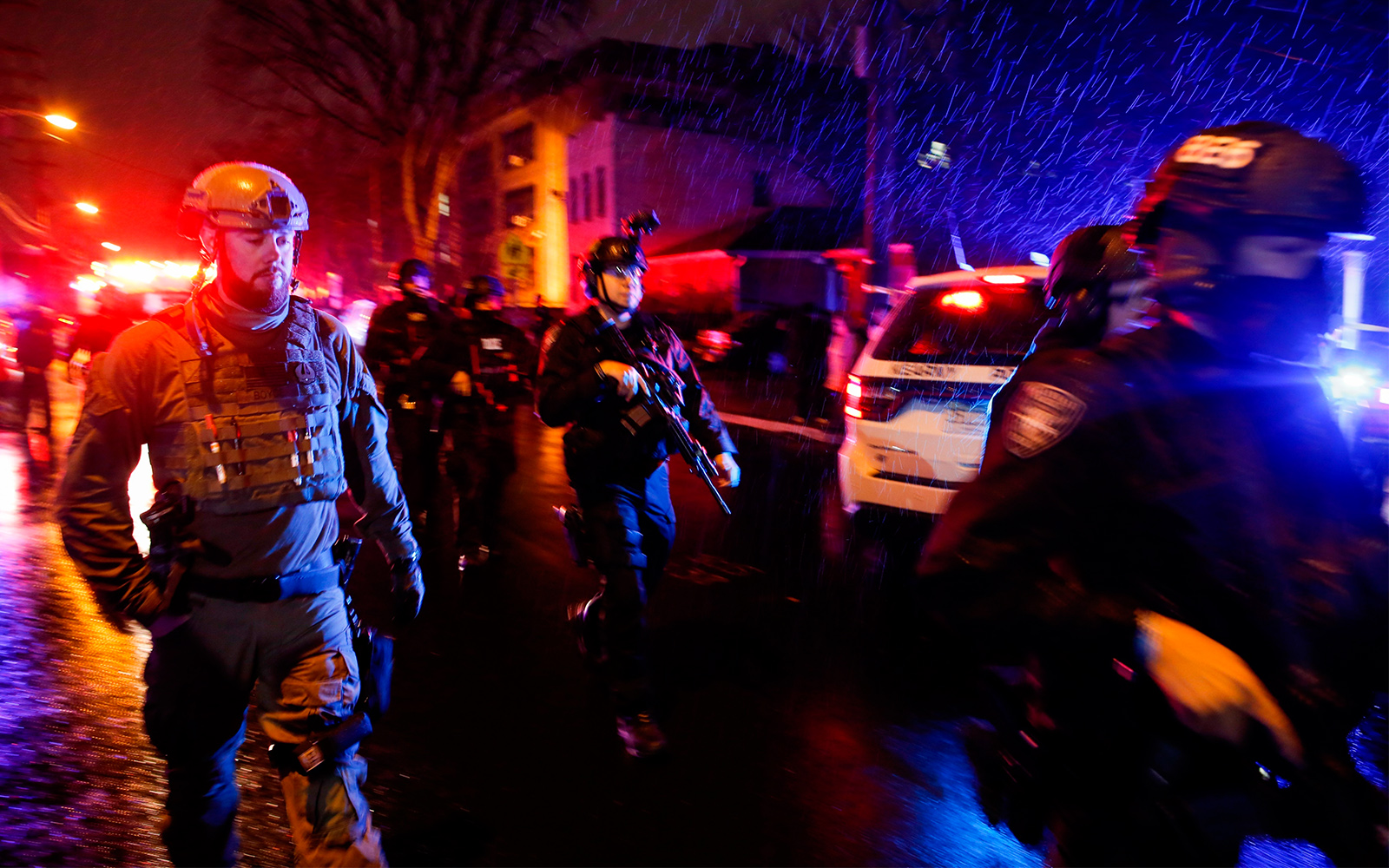
Law enforcement personnel walk near the scene of a shooting in Jersey City, New Jersey, Dec. 10, 2019. (AP Photo/Eduardo Munoz Alvarez)

Law enforcement personnel walk near the scene of a shooting in Jersey City, New Jersey, Dec. 10, 2019. (AP Photo/Eduardo Munoz Alvarez)

Investigators believe that the gunmen in a Tuesday shootout at a kosher supermarket in New Jersey deliberately attacked the store, though there was no immediate word on their suspected motive.

“Based on our initial investigation (which is ongoing) we now believe the active shooters targeted the location they attacked,” Jersey City Mayor Steven Fulop said.

Authorities had initially said that they did not believe that the JC Kosher Supermarket had been singled out. Fulop did not elaborate on why authorities now believe the market was targeted.

The gun battle left at least six people dead — three bystanders, one police officer and two suspected shooters.

Authorities have not released information on the bystanders or gunmen who were killed, but Chabad identified two of the dead as store owner Leah Minda Ferencz and Moshe Deutsch, both members of the local Hasidic community.

The slain police officer was identified as Detective Joseph Seals, 40.

Steven Fulop

@StevenFulop

The shooting took place at multiple locations, starting at a cemetery, where the officer was gunned down, and continuing at the kosher supermarket about a mile away, where five more bodies were found, Jersey City Police Chief Michael Kelly said.

Fulop said that there were no signs of further threats, although earlier reports had said a third gunman may have escaped the scene, and said he had been in close contact with Jersey City’s Jewish community following the attack.

“I know the entire Jersey City community stands together with the Jewish Community during these challenging times,” Fulop said.

Next to the store, the only kosher supermarket in the area and a central fixture for the growing community, are a yeshiva and a synagogue. Around 100 Jewish families live in the area in the city’s Greenville neighborhood, with most of the families having moved there from Brooklyn in the last few years.

Chabad Rabbi Moshe Schapiro, who shops at the store and attends the synagogue next door, said he spoke with the store owner, Moishe Ferencz, before Ferencz learned that his wife had been killed in the attack.

“He told me he had just walked out of the store into the synagogue not five feet away just before this happened, and then he couldn’t get back for hours,” Schapiro said. “His wife was inside the store. He said, ‘I hope my wife is safe.’”

New York City councilman Chaim Deutsch, a member of the city’s Jewish caucus, said that New York City police was providing extra security to synagogues and other sites.

Seals was credited by his superiors with having led the department in the number of illegal guns removed from the streets in recent years, and might have been trying to stop an incident involving such weapons when he was cut down by gunfire that erupted near the cemetery, authorities said.

The bullets started flying early in the afternoon in the city of about 270,000 people, situated across the Hudson River from New York City. Seals, who worked for a unit called Cease Fire, was shot around 12:30 p.m. The gunmen then drove a stolen rental van to another part of the city and engaged police in a lengthy shootout.

Kelly said that when police responded to the area of the kosher store, officers “were immediately engaged by high-power rifle fire.”

“Our officers were under fire for hours,” the chief said.

Inside the grocery store, police found the bodies of who they believed were the two gunmen and three other people who apparently happened to be there when the assailants rushed in, authorities said. Police said they were confident the bystanders were shot by the gunmen and not by police.

A police officer pushes pedestrians back from the scene of a shooting in Jersey City, New Jersey, Dec. 10, 2019. (AP Photo/Seth Wenig)

The shooting spread fear through the neighborhood, and the nearby Sacred Heart School was put on lockdown as a precaution.

SWAT teams, state police and federal agents converged on the scene, and police blocked off the area, which in addition to the school and supermarket included a hair salon and other shops. Dozens of bystanders pressed against the police barrier to capture the action on their cellphones, some whooping when bursts of fire were heard.

Video shot by residents recorded loud volleys of gunfire reverberating along one of the city’s main streets and showed a long line of law enforcement officers pointing guns as they advanced, yelling to bystanders, “Clear the street! Get out of the way!”

US President Donald Trump said he had been briefed on the incident, which he called a “horrific shootout,” adding that the White House would be monitoring the situation and assisting local officials.

“Our thoughts & prayers are w/ the victims & their families during this very difficult & tragic time,” Trump wrote on Twitter.

New Jersey Governor Phil Murphy said, “Our thoughts and prayers are with the men and women of the Jersey City Police Department, especially with the officers shot during this standoff, and with the residents and schoolchildren currently under lockdown.”

“I have every confidence in our law enforcement professionals to ensure the safety of the community and resolve this situation,” Murphy said.

Police officers arrive at the scene of a shooting in Jersey City, New Jersey on December 10, 2019. (Kena Betancur/AFP)

One umbrella US Jewish group, the Conference of Presidents of Major American Jewish Organizations, released a statement Tuesday expressing “solidarity for the Jewish community and all the residents of Jersey City, where it appears members of the community were wounded by gunfire, as were members of the police force responding to gunfire from active shooters. We do not know at this point if the kosher supermarket from which they were firing was an intended target. We pray for the safety of all those involved.”

Israel’s consul general in New York, Dani Dayan, praised Seals for making “the ultimate sacrifice.”

“His life was inspirational. His death was heroic. He will be remembered,” Dayan said.

Jonathan Greenblatt, CEO of the Anti-Defamation League, said he was “heartbroken by the loss of life.”

Halie Soifer, executive director of the Jewish Democratic Council of America, said she was “deeply saddened by the horrific loss of life.”

Palestinian-American activist Linda Sarsour, who is from New York and is a supporter of the boycott movement against Israel, said she was “praying this wasn’t a hate-filled act. Unfortunately, there have been instances in the near past that keep our communities on edge especially our Jewish neighbors.”

Democratic presidential candidate Cory Booker, a senator from New Jersey, said that “once again, we’re faced with scenes of carnage, fear, and loss. It’s reprehensible that in America, residents are shot while grocery shopping.”

Presidential candidates Elizabeth Warren and Andrew Yang similarly condemned the attack.


Iran shuts south Syrian command center opposite Golan, consolidates Abu Kamal hub – DEBKAfile

December 11, 2019

Source: Iran shuts south Syrian command center opposite Golan, consolidates Abu Kamal hub – DEBKAfile

DEBKAfile Exclusive: Iranian Revolutionary Guards Al Qods Brigades have just finished emptying out and shuttering Al Kiswah, their main command center in southern Syria.

Our military sources report that this command post, situated 15km south of Damascus, was the Iranian military’s nearest point to Israel’s Golan border. In 2017, the IRGC invested substantial resources in expanding the facility to accommodate 500 combatants with covered sheds for vehicles and ammo stores. Some of those structures recently stood empty, apparently for fear of Israeli air strikes.

In the last six months, an Al Qods unit was deployed to Al Kiswah armed with medium-range surface rockets. The base was targeted by the Israeli air force when the first rockets were fired against the IDF’s Mt. Hermon outposts.

According to our sources, the pullout from Al Kiswah takes place amid Iran’s overall troop drawdown from Syria, in response to the pressure to economize on funds that are sharply depleted by U.S sanctions. Around 50 percent of Iran military manpower in Syria has been sent home, reducing the total to the unprecedented level of 2,300-2,500.

Shutting down Al Kiswah is also part of a revised strategy by Tehran to pull its forces back from proximity to the Syrian-Israeli border and focus instead on concentrating its limited resources on deployment in the eastern regions near the Iraqi border. Our military sources report that the strategists in Tehran stand by their decision to build up the IRGC complex near Abu Kamal, regardless of continuous air attacks. They are also planning to augment this hub of operations with small air bases for different types of drones for use by the Iraqi Shiite militias posted there.


Russian Su-35 jets scrambled to stop Israel over Syria – reports

December 9, 2019

Source: Russian Su-35 jets scrambled to stop Israel over Syria – reports – Jerusalem Post

The reports claim that “Israeli fighters had to flee from the Russian Su-35” and at the same time that “Iran delivered unknown air defense systems to Syria.”

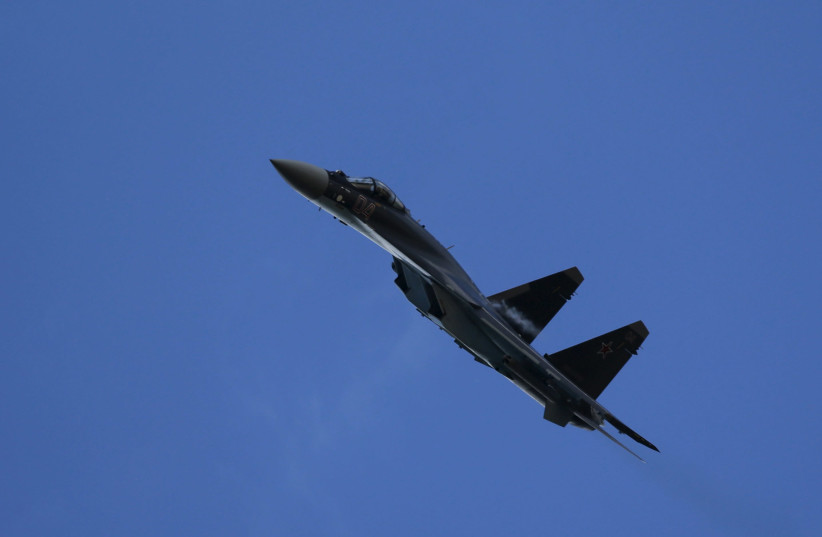
A Sukhoi SU-35 fighter aircraft performs during the "Aviadarts" military aviation competition at the Dubrovichi range near Ryazan, Russia, August 2, 2015. (photo credit: REUTERS/MAXIM SHEMETOV)
A Sukhoi SU-35 fighter aircraft performs during the “Aviadarts” military aviation competition at the Dubrovichi range near Ryazan, Russia, August 2, 2015.
(photo credit: REUTERS/MAXIM SHEMETOV)
Iranian and Russian media reported that Russian Su-35s were scrambled from Russia’s Khmeimim air base in Syria to intercept an alleged Israeli attack near T-4 earlier this month. The report, first put online in a blog at Avia and then picked up by the website Almasdar News and then Tasnim News in Iran claimed that the Su-35s sought to intercept Israeli planes over Syria.

The reports claim that “Israeli fighters had to flee  from the Russian Su-35” and at the same time that “Iran delivered unknown air defense systems to Syria.” The incident occurred over T-4 or Tiyas base east of Homs in Syria. The base is a well-known transit point for Iranian weapons and has Russian personnel at it. Israel has been accused of striking the area in the past. In May 2018 Ynet said that Israel had carried out an airstrike to  destroy an Iranian 3rd Khordad Air Defense system at T-4. Syria claimed more airstrikes hit the area in June and July of this year and September last year.

The reports at the Avia website follow other reports at the same site that often write sensational accounts about alleged Israeli actions in Syria. For instance the same site reported on December 8 that “Israel is preparing new strikes on Syria.” Al-Masdar News reported that the Iranian Bavar-373 air defense was deployed to the area. Both reports appeared to rely on a Twitter account named @Syrian_MC for their information. That account indicated that  Russia had scrambled its jets and that the “incident” ended on December 6.

The National Interest reported that Su-35s had been scrambled in August and “forced Israeli aircraft out of Syrian airspace,” and the website DefenseWorld made a similar claim  in September. Other defense websites have argued the SU-35 is a capable fighter, deployed to Syria in small numbers after it became operational in 2014. Russia’s TASS said in 2018 the fighter is “battle tested in Syrian skies.” It is a 4th Generation “plus” fighter that is super maneuverable and can fly up to 2,500 kilometers an hour. That’s a bit faster than an F-16.

Iran’s Tasnim media appeared to celebrate the claim that Russia had “pursued” Israeli aircraft and “forced” them to leave. The story emerged at the same  time as reports  that satellite images had shown a  cargo plane land at T-4  and unload munitions that could be used in a “revenge attack” by Iran against Israel, according to Israel HaYom. Those images were from November 21, a  day after the airstrikes Israel says it carried out against Iranian IRGC targets in Syria. “A large cargo trailer on the runway of the Iran operated T-4 base located in Homs district,” was shown. “Israel reportedly refrained from targeting the T-4 base due to its division into three areas controlled by Russian, Iranian and Syrian army, raising challenges that would require precise coordination with Moscow on top of the base’s more formidable security arsenal that include the S-300 anti-aircraft system.” Russia provided S-300s to Syria in October 2018 after a Syrian S-200 shot down a Russian plane during an Israeli airstrike in Latakia. The incident caused a momentary crises with Russia at the time.

Syrian air defense  is known for shooting its S-200s wildly, one time shooting a missile that hit Cyprus by mistake in July 2019, and in 2017 firing a missile that had to be downed by an Arrow air defense system over Jordan, according to the BBC.

Russia released information on November 21 accusing Israel of four days of attacks in Syria in November, including the November 20 raids and an airstrike at Albukamal and two near Damascus on November 12 and November 19. US Secretary of State Mike Pompeo is meeting his Russian counterpart Sergei Lavrov today to discuss various issues, including Syria. Pompeo met Prime Minister Benjamin Netanyahu in Portugal last week and Oman’s foreign minister on November 26. When Netanyahu met Pompeo on December 5 he said that Israel was actively countering Iranian aggression. Pompeo expressed support for Israel’s countering of Iran in August and October. On December 5 the New York Times reported Iran is transferring short range ballistic missiles to Iraq that threaten Israel. Airstrikes Saturday near Albukamal killed five pro-Iranian fighters.


Tehran accuses Israel of testing ‘a nuke-missile, aimed at Iran’ 

December 9, 2019

Source: Tehran accuses Israel of testing ‘a nuke-missile, aimed at Iran’ | The Times of Israel

Israel’s Defense Ministry had earlier confirmed rocket propulsion test, gave no details; accusation comes days after Iran slammed for working on nuclear-capable missiles

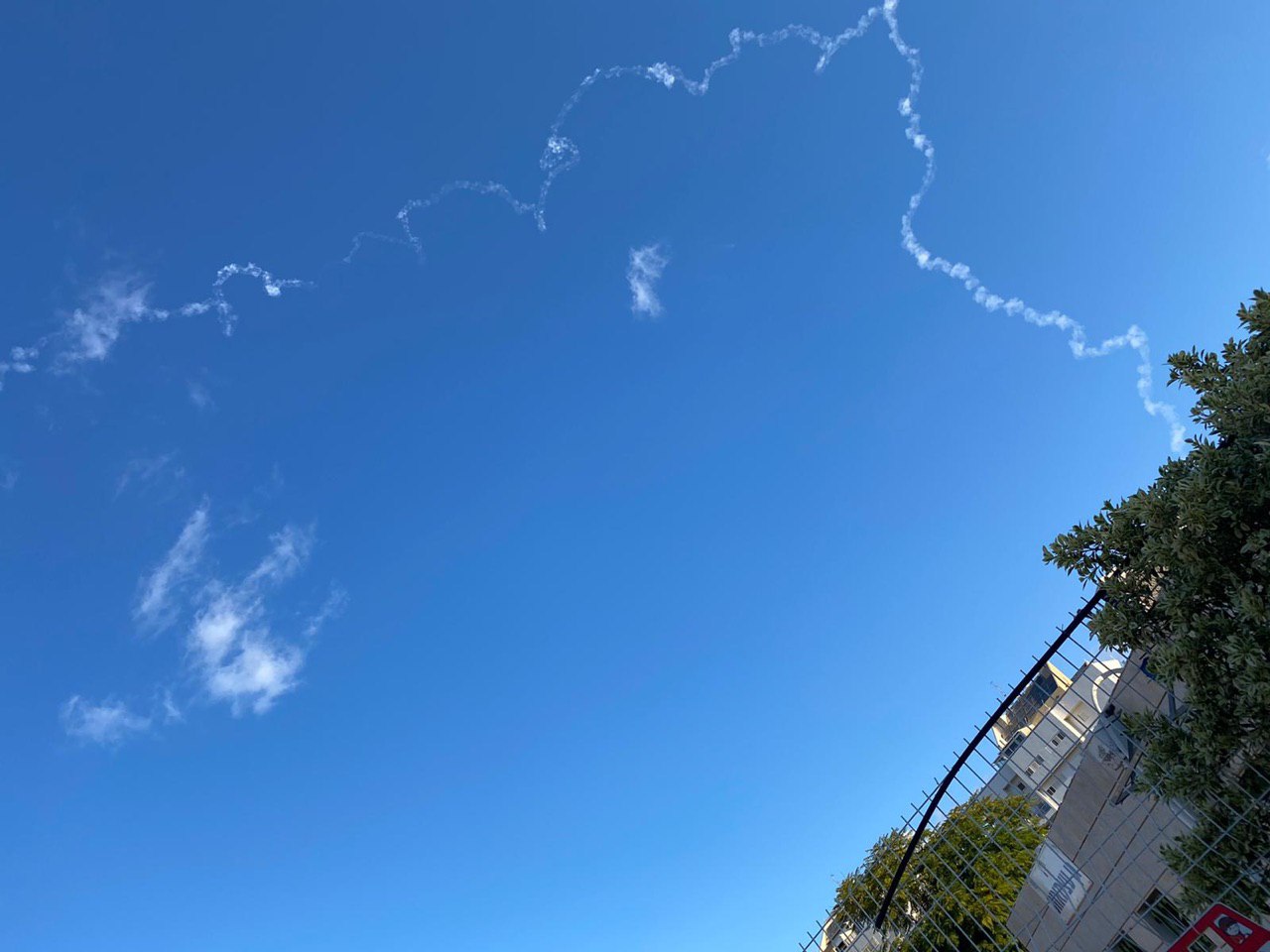
Trails left behind by the launch of a rocket from a base in central Israel as part of a test on December 6, 2019. (Courtesy)

Trails left behind by the launch of a rocket from a base in central Israel as part of a test on December 6, 2019. (Courtesy)

Tehran on Friday accused Israel of testing a nuclear-capable missile “aimed at Iran,” after the Defense Ministry carried out a launch of what it described as a “test of a rocket propulsion system.”

“Israel today tested a nuke-missile, aimed at Iran,” tweeted Iranian Foreign Minister Mohammad Javad Zarif.

Zarif was likely speaking figuratively as Israel usually test fires missiles to the West over the Mediterranean and not towards Iran in the East.

“E3 & US never complain about the only nuclear arsenal in West Asia — armed with missiles actually DESIGNED to be capable of carrying nukes — but has fits of apoplexy over our conventional & defensive ones,” he said.

Javad Zarif

@JZarif

E3 & US never complain about the only nuclear arsenal in West Asia—armed with missiles actually DESIGNED to be capable of carrying nukes—but has fits of apoplexy over our conventional & defensive ones. https://www.i24news.tv/en/news/israel/diplomacy-defense/1575622953-israel-rocket-trails-over-tel-aviv-as-idf-conducts-unannounced-test 

i24NEWS – Israel: Rocket trails over Tel Aviv as IDF conducts unannounced test

The test disrupted flight patterns at Ben Gurion airport, requiring take-off and landings’ to shift north

i24news.tv

His comments come a day after France, Germany and the United Kingdom said “Iran’s developments of nuclear-capable ballistic missiles” go against a UN Security Council resolution calling on Tehran not to undertake any activity related to such missiles.

The Israeli Defense Ministry gave few details on the missile test conducted Friday morning.

“The defense establishment conducted a launch test a few minutes ago of a rocket propulsion system from a base in the center of the country,” the ministry said.

“The test was scheduled in advance and was carried out as planned.”

Iranian Foreign Minister Mohammad Javad Zarif (2nd-L) speaks with his Japanese counterpart Taro Kono (not pictured) during their meeting at a hotel in Yokohama, Japan, on August 27, 2019. (Kazuhiro Nogi/Pool/AFP)

The Defense Ministry refused to comment on the nature of the rocket being tested, leading to speculation that it was a ballistic missile.

Residents of the area reported seeing a white trail left behind by the rocket.

Israel does not publicly acknowledge having ballistic missiles in its arsenals, though according to foreign reports, the Jewish state possesses a nuclear-capable variety known as the Jericho that has a multi-stage engine, a 5,000-kilometer range and is capable of carrying a 1,000-kilogram warhead.

These types of tests are conducted as part of the development of several different types of projectiles, from offensive ballistic missiles to defensive interceptors and satellite launchers. Though in cases of interceptors and satellite launchers, the Defense Ministry generally reveals additional details about the nature of the test.

While foreign sources have estimated Israel has an arsenal of dozens to hundreds of nuclear weapons, the Jewish state has neither publicly confirmed nor denied such reports in keeping with its policy of so-called nuclear ambiguity.

The rocket test required incoming flights en route to Ben Gurion Airport to be temporarily diverted.

The three European nations urged UN Secretary-General Antonio Guterres in a letter circulated Wednesday to inform the council in his next report that Iran’s ballistic missile activity is “inconsistent” with the call in a council resolution endorsing the 2015 nuclear deal with Iran.

The letter cites footage released on social media April 22, 2019, of a previously unseen flight test of a new Shahab-3 medium-range ballistic missile variant “equipped with a maneuverable re-entry vehicle.” It says: “The Shahab-3 booster used in the test is a Missile Technology Control Regime category-1 system and as such is technically capable of delivering a nuclear weapon.”

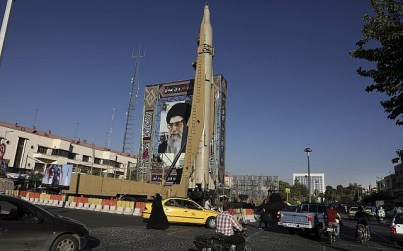
A Shahab-3 surface-to-surface missile is on display next to a portrait of Iranian Supreme Leader Ayatollah Ali Khamenei at an exhibition by Iran’s army and paramilitary Revolutionary Guard celebrating ‘Sacred Defense Week’ marking the 39th anniversary of the start of 1980-88 Iran-Iraq war, at Baharestan Square in downtown Tehran, Iran, September 25, 2019. (AP Photo/Vahid Salemi)

The Europeans noted that a 2015 report by the International Atomic Energy Agency on possible military dimensions of Iran’s nuclear program concluded “that extensive evidence indicated detailed Iranian research in 2002-2003 on arming the Shahab-3 with a nuclear warhead.”

Officials in the Trump administration also have said Iran is working to obtain nuclear-capable missiles, something the Iranians deny.

US President Donald Trump withdrew from the nuclear agreement in May 2018. But it is still supported by the five other parties — France, Britain, Russia and China, which are all veto-wielding Security Council members, and Germany, which is currently serving a two-year term on the council.

The letter says “France, Germany and the United Kingdom assert once again our firm conclusion that Iran’s development of nuclear-capable ballistic missiles and related technologies is inconsistent” with the missile provision in the council resolution.

That provision urges Iran “not to undertake any activity related to ballistic missiles designed to be capable of delivering nuclear weapons.” But it does not require Tehran to halt such activity, and the Iranian government insists all its missile activities are legal and not nuclear-related.

The Security Council has scheduled a Dec. 19 meeting to discuss implementation of the 2015 resolution on the Iran nuclear deal.

During last year’s meeting, US Secretary of State Mike Pompeo urged the council to again ban Iranian ballistic missiles capable of delivering nuclear weapons and to maintain an arms embargo that is scheduled to be lifted in 2020 under the nuclear deal.

AP contributed to this report


Systematic air strikes are dismantling the Al Qods compound at Abu Kamal – DEBKAfile

December 9, 2019

Source: Systematic air strikes are dismantling the Al Qods compound at Abu Kamal – DEBKAfile

The air strike of Saturday night, Dec. 7, was the fourth this week in a campaign for breaking up the Iranian Al Qods strategic hub which houses Iraqi Shiite militias outside Abu Kamal near the Iraqi border. The strikes aim not only to stem the flow of arms convoys from Iraq, but to level its buildings in order to put the facility permanently out of commission.

DEBKAfile’s military sources report the campaign’s intensity is being gradually notched up. The latest bombardment was therefore the heaviest. The damage caused was excessive and the casualty count ran into dozens, according to Western military and intelligence estimates – mostly Iraqi Shiite militiamen but also Iranian Al Qods officers.

Defense Minister Naftali Bennett had this raid in mind when on Sunday, he said, “We must shift from prevention to the offensive, as the only way to drive Iranian aggression out of Syria.” In typical hyperbole, he declared: “We say to them (the Iranians) that Syria will be their Vietnam. You will bleed until your forces quit Syria!”

Eastern Syria is turning into an arena for combined US and Israeli aerial operations, in the face of which Iran and the Iraqi militias have so far held silent. DEBKAfile postulates three reasons for their non-response:

  1. They have no air force units available in the arena for defense.
  2. Iran’s supreme commander in the region, Al Qods chief Gen. Qassem Soleimani, is deeply mired in an all-out effort to salvage Tehran’s grip on Iraq’s Shiite community against swelling anti-Iran resistance in the south and Baghdad. Iraq comes first in Tehran’s order of priorities ahead of Abu Kamal.
  3. Soleimani is waiting for an opportune moment for hitting back.


Nikki Haley For President 2024 ! 

December 8, 2019


Nikki Haley, former Governor of South Carolina and Ambassador to the UN in a December 16, 2020 interview on the “Glenn Beck Podcast.”

Even if you dislike Glenn Beck, just LISTEN to Nikki Haley…


Iran says new budget, Russia loan will ‘stop US, Israel’ from weakening Tehran

December 8, 2019

Source: Iran says new budget, Russia loan will ‘stop US, Israel’ from weakening Tehran | The Times of Israel

Rouhani tells parliament the ‘resistance budget’ will beat American embargoes; says $5 billion loan from Moscow being finalized

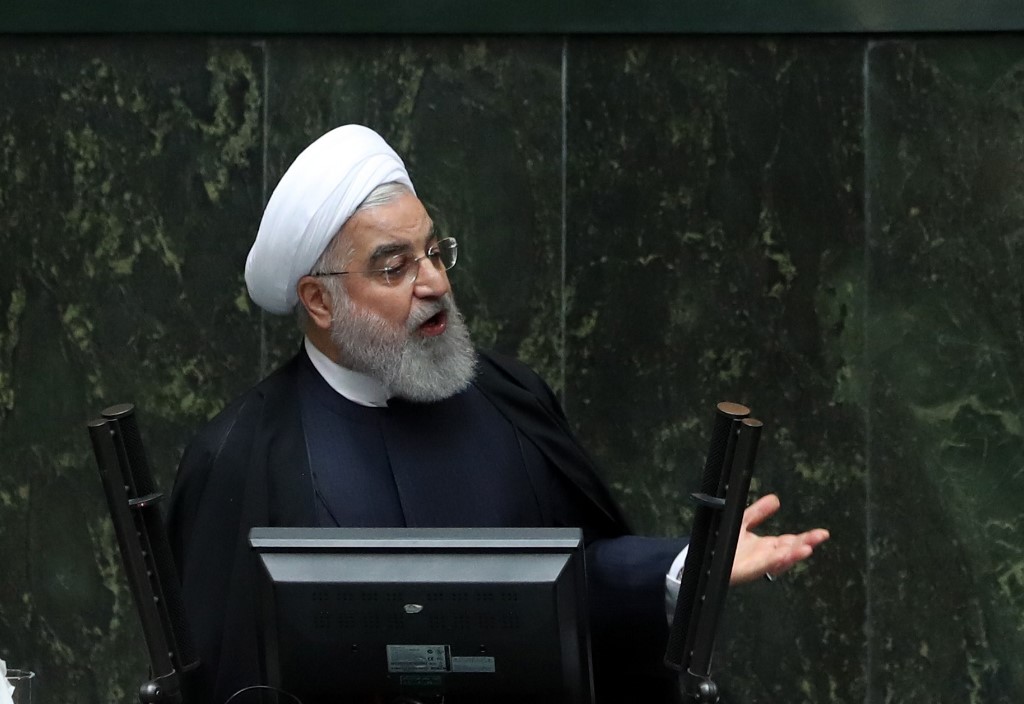
Iran's President Hassan Rouhani delivers a speech to present the budget for the financial year starting late March 2020 to the parliament in Tehran on December 8, 2019. (STR/AFP)

Iran’s President Hassan Rouhani delivers a speech to present the budget for the financial year starting late March 2020 to the parliament in Tehran on December 8, 2019. (STR/AFP)

TEHRAN, Iran — Iran’s president said on Sunday his country will depend less on oil revenue next year, in a new state “budget of resistance” that is designed to resist crippling US trade embargoes.

Iran is in the grips of an economic crisis. In May 2018, the US began re-imposing sanctions that block Iran from selling its crude oil abroad, following US President Donald Trump’s decision to withdraw from Tehran’s 2015 nuclear deal with world powers over its continued development of ballistic missile programs and support for terror groups in the region. That accord had given Iran sanctions relief in return for limits on its nuclear program.

“Next year, similar to the current year, our budget is a budget of resistance and perseverance against sanctions. This budget sends a message to the world that despite sanctions we will manage the country, especially in terms of oil,” Iranian President Hassan Rouhani told the opening session of Parliament.

The budget will counter “maximum pressure and sanctions” by the US, he said.

Rouhani added that the Iranian government will also benefit from a $5 billion loan from Russia that’s being finalized.

Shops that were destroyed during demonstrations against petrol price hikes, are pictured on November 20, 2019 in Shahriar, west of Tehran. (Atta Kenare/AFP)

He said the US and Israel will remain “without hope” despite their goal of weakening Iran through sanctions.

The next Iranian fiscal year begins March 20, with the advent of the Persian New Year. The budget is set to be about $40 billion, some 20% higher than in 2019. The increase comes as the country is suffering from a 40% inflation rate.

Rouhani also announced in the speech a 15% increase for public sector wages as a stopgap to offset the effects of inflation.

The International Monetary Fund has forecast that Iran’s economy will contract by 9.5% this year.

Iran’s economic woes led to fuel price hikes in mid-November that helped trigger nationwide protests last month. Iranian security forces violently suppressed the protests, killing over 200 people, according to Amnesty International.


Katz says military strike to stop Iran remains ‘an option’

December 8, 2019

Source: Katz says military strike to stop Iran remains ‘an option’ | The Times of Israel

In Italy, foreign minister laments lack of European support for sanctions on Tehran, says Israel won’t talk with Syria’s Assad while he hosts Iranian forces

Foreign Minister Israel Katz at a Likud election campaign stop in Jerusalem, September 16, 2019. (Yonatan Sindel/Flash90)

Israel is prepared to attack Iran militarily if sanctions don’t force it to curtail its nuclear program and attacks on Israel, Foreign Minister Israel Katz told an Italian daily over the weekend.

Asked by the Italian newspaper Corriere Della Sera on Friday if a military strike on Iran were a possibility, Katz affirmed “it’s an option. We will not allow Iran to produce or obtain nuclear weapons. If the only option left to us is the military option, we’ll act militarily.”

Katz also said Iran was known to be planning new attacks against Gulf states, similar to its September strike against Saudi oil facilities.

“The actions against Saudi Arabia and the oil tankers make us understand that Iran still feels strong. Our intelligence information tells us that it intends to hit the Gulf countries again. The threat of sanctions is not enough. The only deterrent is a military threat directed against the regime,” Katz said.

Katz was in Rome over the weekend to attend the annual MED forum, a strategy conference for Mediterranean countries hosted by the Italian Ministry of Foreign Affairs and the Italian Institute for International Political Studies (ISPI) think tank.

He lamented that European powers eager to preserve the 2015 nuclear deal risked undermining American and international sanctions that were succeeding in reining in the regime.

ישראל כ”ץ Israel Katz

@Israel_katz

View image on Twitter

He told the paper that Israel believed “that US pressure and sanctions are effective. We expect Iran’s attempts to procure nuclear weapons and support terrorist groups to decline, but this will be easier if there is support from European countries. As long as the Iranians delude themselves that they have the support of Europe, it will be more difficult for them to bend.”

Asked by the paper about Israeli cooperation with Gulf countries and Saudi Arabia, he said he could not go into detail but affirmed that there was cooperation, and that “we have common interests” and “find ourselves working together.”

The cooperation “allows us to identify and foil any threats we are aware of. But Iran’s threat is not only against Saudi Arabia or Israel, we are talking about long-range missiles with nuclear potential. It is not for nothing that Germany, France and Great Britain turned to the UN the other day saying that Iran had contravened the agreements. There is beginning to be a broad front against the Iranian threat.”

Iranian Revolutionary Guards commander Maj. Gen. Hossein Salami (2nd-R) walks past a Khordad-3 air defense system during a visit to see an exhibition at the Islamic Revolution and Holy Defense museum in the capital Tehran on September 21, 2019. (Atta Kenare/AFP)

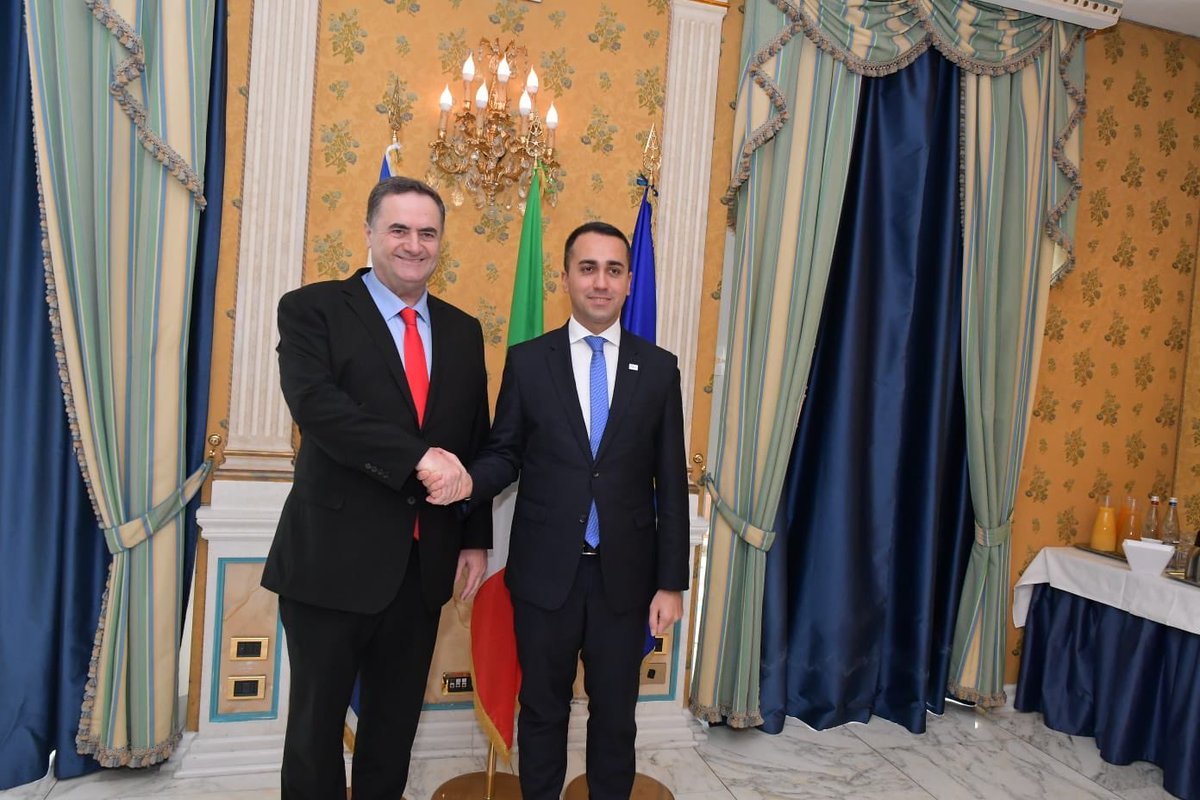
Besides his meeting with soccer star Christiano Ronaldo, Katz also met with Italian Foreign Minister Luigi Di Maio during the visit, who called for dialogue with the Assad regime in Damascus.

Katz rejected the idea, telling Corriere Della Sera that “dialogue with Bashar Assad cannot be resumed as long as Syria allows Iran to use its territory against Israel and moderate Arab states.”

The meeting with his Italian counterpart dealt with “the common fight against anti-Semitism, the promotion of bilateral trade, and expressed the desire that Italy join the regional initiative to connect the Gulf countries to Haifa and the Mediterranean ports through a railway network.”

The idea is a longtime pet project of Katz, who served for over a decade as minister of transportation.

In this September 20, 2019, file photo, taken during a trip organized by the Saudi information ministry, workers fix the damage in Aramco’s oil separator at a processing facility after the September 14 attack blamed on Iran in Abqaiq near Dammam in the Kingdom’s Eastern Province. (AP Photo/Amr Nabil, File)

Such a rail connection “frees us from the need to go through two easily [sealed] straits, Bab El-Mandeb and Hormuz, and saves us 6,500 kilometers by sea.”

On September 14, a cruise missile and drone attack on Saudi Arabian oil facilities knocked out half the kingdom’s oil production. Although Yemen’s Iranian-backed Houthi rebels claimed responsibility, the US, Britain, France, Germany, and Saudi Arabia have blamed Iran of being behind the attack.

Iran regularly threatens Israel, viewing the country as a powerful enemy allied with the United States and Sunni countries in the region against Tehran and its nuclear ambitions.

Iranian forces and Iran-backed militias, as well as fighters of Iranian proxy Hezbollah, have been fighting alongside forces loyal to Syrian President Bashar Assad in that country’s civil war since 2011.


Several said killed in airstrikes on Iranian-controlled weapons depots in Syria 

December 8, 2019

Source: Several said killed in airstrikes on Iranian-controlled weapons depots in Syria | The Times of Israel

Syrian opposition media outlet says unidentified aircraft targeted three munitions storehouses near Iraqi border

Illustrative. An explosion reportedly caused by an Israeli strike is seen at the Mazzeh military base near Damascus, Syria, on September 2, 2018. (Screen capture: Twitter)

Illustrative. An explosion reportedly caused by an Israeli strike is seen at the Mazzeh military base near Damascus, Syria, on September 2, 2018. (Screen capture: Twitter)

Unidentified aircraft bombed three Iranian-controlled weapons depots on Saturday night, killing several members of Tehran-supported militias, Syrian media reported.

Some news outlets in the country said that four fighters were killed in the strike, while others said five. The Syrian government did not immediately release an official tally.

According to the Syrian Step News agency, the airstrikes occurred around 10 p.m. on Saturday, targeting three munitions storehouses in the Boulkamal region of Syria, near the Iraqi border, an area that has reportedly been hit by many Israeli raids in the past year.

The outlet cited “well-placed sources” as saying that the four people killed were guards at the storehouses who were members of militias backed by Iran.

The Britain-based Syrian Observatory for Human Rights monitor said that at least five militiamen were killed in the strike.

There were no immediate reports of who was responsible for the strikes, though defense analysts indicated that Israel was the likely actor.

The Israeli military as a rule does not comment on specific airstrikes in Syria, save for those that are in retaliation for attacks on Israel.

New Defense Minister Naftali Bennett (R) meets with IDF Chief of Staff Aviv Kohavi on November 13, 2019. (Ariel Hermoni/Defense Ministry

On Sunday, Defense Minister Naftali Bennett said Israel was taking action to force Iran’s military presence out of Syria.

“We are telling the Iranians: Syria will become your Vietnam,” he said, referring to the disastrous American war.

“If you don’t leave, you will become entrenched and you will bleed because we will work without hesitation to remove aggressive forces from Syria,” Bennett said.

The Saturday night strikes came days after reports of a similar raid in the same region.

Last Wednesday, unidentified aircraft bombed other Iranian-controlled weapons storehouses in Boulkamal, causing a massive explosion, according to Step News.

The outlet reported that the planes fired several missiles at warehouses belonging to Iran’s Islamic Revolutionary Guard Corps at the al-Hamdan airport, outside Deir Ezzor. Troops on the ground fired anti-aircraft weapons at the attacking planes, the news site said. There were no reports of casualties in that raid.

Satellite image showing the aftermath of an overnight airstrike on an alleged Iranian military base in Syria’s Boukamal region, near the Iraqi border, on September 9, 2019. (ImageSat International)

The Abulkamal region, near Syria’s border with Iraq, is seen as a crucial region for Iran and its plans to establish a land corridor to the Mediterranean Sea in order to more easily transport materiel and fighters throughout the Middle East.

The reported attack on the IRGC weapons caches came some three weeks after a flareup between Jerusalem and Tehran, during which Iranian troops fired several rockets at northern Israel from Syria and the Israel Defense Forces retaliated with a series of airstrikes on Iranian and Syrian military targets.

According to a Syrian war monitor, at least 23 combatants were killed in those strikes, 16 of them likely Iranians. An Israeli official said the military believed that to be an inflated number, with the actual death toll estimated to be closer to 10.

Israel has repeatedly said that it will not accept Iranian military entrenchment in Syria and that it will retaliate for any attack on the Jewish state from Syria.

Though it does not generally comment on specific attacks, Israel has admitted to carrying out hundreds of airstrikes in Syria against Iranian targets over the last several years. Iran has forces based in Syria, Israel’s northern neighbor, and supports Hezbollah and Gaza terrorists.

Times of Israel staff and AFP contributed to this report.