Archive for December 2019

Netanyahu: Putin said that if I were not PM, Israel and Russia would be at war 

December 26, 2019

Source: Netanyahu: Putin said that if I were not PM, Israel and Russia would be at war | The Times of Israel

In interview ahead of Likud primary, PM refuses to answer questions on whether he will seek immunity from prosecution or what he’ll do if High Court rules he can’t form government

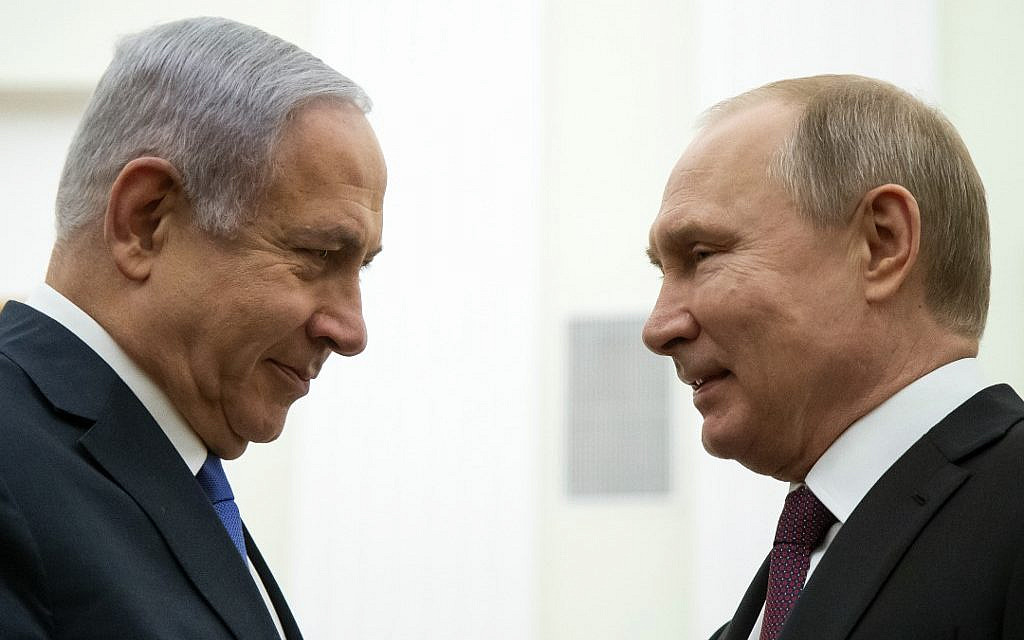
Russian President Vladimir Putin (R) speaks with Prime Minister Benjamin Netanyahu, during their meeting at the Kremlin in Moscow on April 4, 2019. (Alexander Zemlianichenko/POOL/AFP)

Russian President Vladimir Putin (R) speaks with Prime Minister Benjamin Netanyahu, during their meeting at the Kremlin in Moscow on April 4, 2019. (Alexander Zemlianichenko/POOL/AFP)

Prime Minister Benjamin Netanyahu claimed Wednesday that Russian President Vladimir Putin told him the two countries could have found themselves at war had it not been for the close relationship between their leaders.

“Putin told me that were it not for our relationship, we could have found ourselves in the midst of a military clash… Only because we meet every few months has this been avoided,” Netanyahu said in an interview with Army Radio, a day before the Likud leadership primary.

“We have four times come close to collisions — our planes in Syria’s crowded airspace almost collided with Russian planes,” the premier continued, speaking openly regarding Israel’s conduct beyond its borders.

Israel has conducted hundreds of airstrikes in Syria targeting Hezbollah weapon shipments and Iranian military installations. The raids are coordinated with Iran-allied Russia to avoid a clash in the Syrian skies.

The Russian embassy declined to comment on the remarks Netanyahu attributed to Putin.

During Wednesday’s Army Radio interview, Netanyahu branded as “absurd” the Russian court ruling to jail Israeli-American Naama Issachar for seven and a half years for carrying several grams of cannabis while in transit at Moscow’s airport. The premier expressed hope that Putin would pardon her.

“I hope Putin will exercise his pardon power,” the prime minister said, a week after an appeal for the backpacker’s release was turned down by a Russian court.

He also doubled down on his promise to secure US recognition of Israel’s control over the Jordan Valley and West Bank settlements after the March election, saying he could not, for legal reasons, take the step as leader of a caretaker government.

Earlier this month, Netanyahu told reporters that he had spoken about his plans to annex the Jordan Valley during a meeting in Portugal with US Secretary of State Mike Pompeo. But two days later, Assistant Secretary for Near Eastern Affairs David Schenker said no such topic was raised at all during the sit-down.

Netanyahu first made the promise ahead of the September election.

Prime Minister Benjamin Netanyahu, left, and Likud MK Gideon Sa’ar, right. (Flash90)

In the interview, Netanyahu evaded questions regarding whether he will ask the Knesset to grant him immunity from prosecution in three corruption cases or whether he will continue chairing the Likud party even if the High Court of Justice rules to bar him from forming a government due to the criminal charges against him.

On immunity, the prime minister did not rule out the possibility, saying he wanted to “keep up the suspense.”

The premier avoided mentioning the name of his challenger in Thursday’s primary entirely, and when asked whether he would be willing to appoint MK Gideon Sa’ar to a ministerial post if the latter loses the leadership race, Netanyahu said he was not dealing with such issues at the moment.

Sa’ar himself was later interviewed on the same Army Radio program, during which he argued that the country was missing a “historic opportunity” because of Netanyahu, who has twice been unable to form a government after a pair of inconclusive elections this year.

“Thousands in Likud understand the need for change tomorrow in order to prevent a change [to the current right-wing rule] in March,” Sa’ar said of the Likud leadership race.

“Netanyahu as a person has strengths and weaknesses. I believe I will be better off at decision making and execution,” asserted Sa’ar.

“He’s not the only one who can run the party and the country — our history has proven the opposite,” Sa’ar continued. “Indeed, only Netanyahu can’t run the country! He’s just failed [to do so] in two elections.”

Israel goes to its third election in under a year on March 2.

Netanyahu is widely expected to remain Likud leader in Thursday’s vote.


Israeli aircraft strike Gaza after rocket attack near Netanyahu event

December 26, 2019

Source: Israeli aircraft strike Gaza after rocket attack near Netanyahu event | The Times of Israel

IDF confirms it hit several Hamas sites in retaliatory raid after PM warns that whoever was behind missile fired toward Ashkelon should ‘start packing their things’

Illustrative: An Israeli airstrike in Khan Younis, in the southern Gaza Strip, November 27, 2019. (Abed Rahim Khatib/Flash90)

Illustrative: An Israeli airstrike in Khan Younis, in the southern Gaza Strip, November 27, 2019. (Abed Rahim Khatib/Flash90)

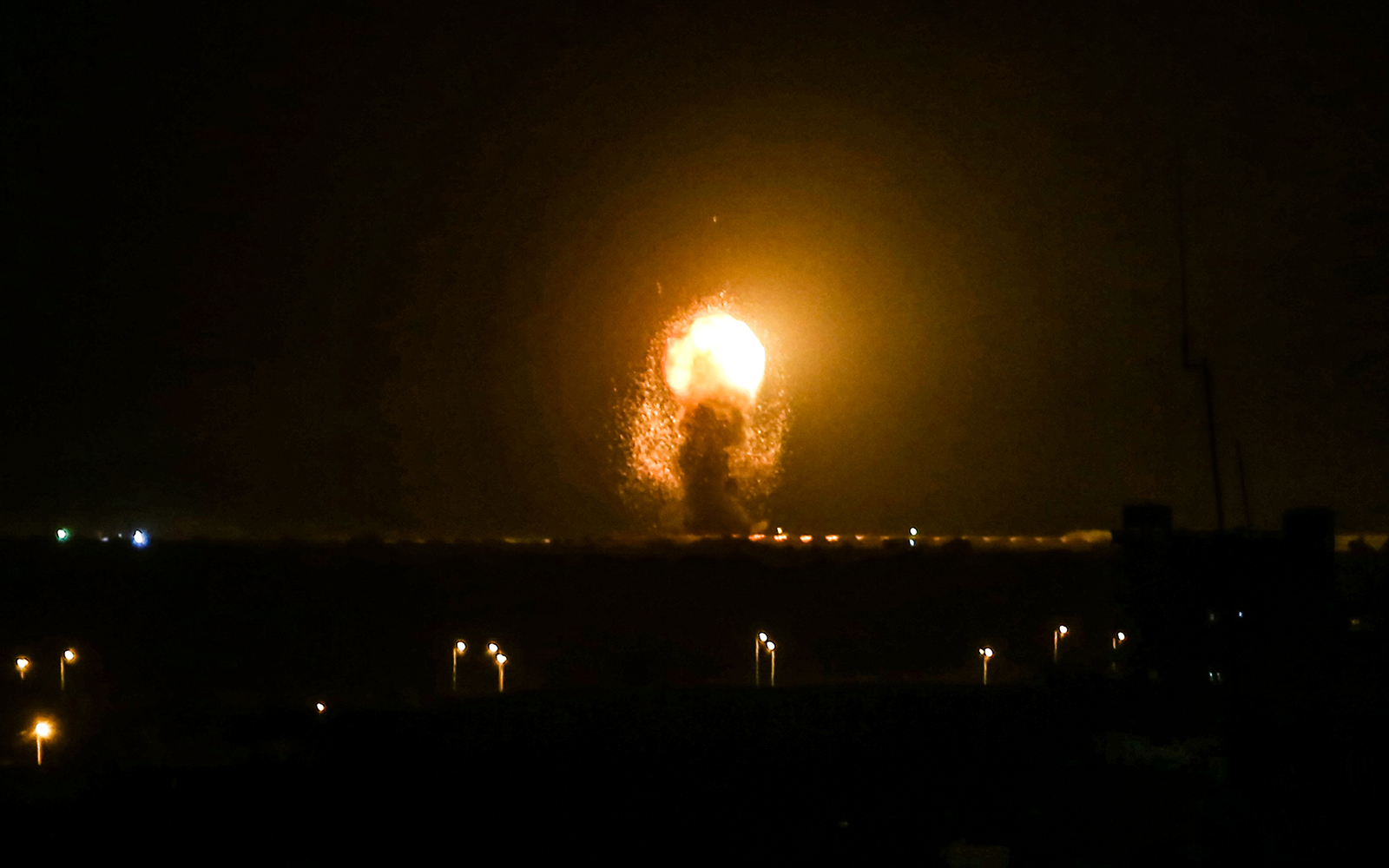
Israeli military aircraft carried out strikes in Gaza early Thursday, hours after rocket fire toward the southern city of Ashkelon forced Prime Minister Benjamin Netanyahu to halt a campaign event and take cover.

The Israeli military said warplanes and helicopter gunships struck several targets belonging to the Hamas terror group, “including the group’s military complexes.” It said the strikes were in response to Wednesday’s rocket fire.

The Hamas-linked Shehab news outlet earlier reported strikes around 1 a.m. near a port west of Khan Younis in southern Gaza.

The outlet also reported an attack on a “resistance site” in northern Gaza.

Joe Truzman@Jtruzmah

An IDF airstrike against a militant site west of City.

Embedded video

There were no immediate reports of casualties from Gazan authorities as the sites were empty.

Prime Minister Benjamin Netanyahu waves as he is taken offstage during a Likud primary campaign rally in Ashkelon as rocket alerts sound, December 25, 2019. (Screenshot: Ynet)

On Wednesday night, Palestinian terrorists broke a period of relative calm surrounding Gaza, firing a single rocket toward Ashkelon.

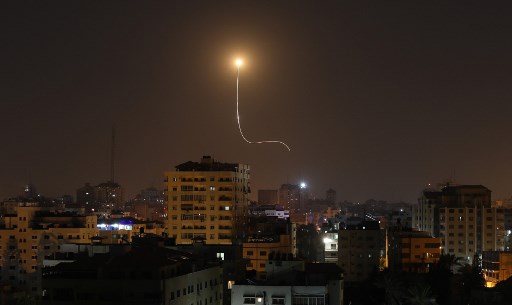
The projectile was shot down by the Iron Dome missile defense system, the IDF said.

Netanyahu was in the middle of a campaign event in Ashkelon at the time and was forced to evacuate to a bomb shelter along with the dozens of supporters in the room.

This was the second time since September that Netanyahu had to be evacuated as a result of rocket fire from Gaza during a campaign event in the south.

Two rockets were fired at Ashdod and nearby Ashkelon from Gaza a week before the September national elections, triggering sirens that forced Netanyahu to rush off stage during a live broadcast of an address to Likud supporters.

The prime minister returned to the stage on Wednesday night after approximately 15 minutes and issued a threat to the terrorists behind the attack.

“The person who fired the rocket last time is no longer with us. The person who did it this time should start packing their things,” he said.

The prime minister was referring to last month’s assassination of Baha Abu al-Ata, a Palestinian Islamic Jihad terror leader who Israel believes ordered the rocket attack in September.

No Palestinian group claimed responsibility for Wednesday’s attack. Such sporadic launches of rockets and ensuing Israeli airstrikes have happened frequently despite an Egyptian-brokered cease-fire that ended two days of fighting in November.

In a statement early Thursday, the Israeli military said it held Hamas, the de facto ruler in the Strip, responsible for any activities in the Strip. “It will suffer the consequences of activities against Israeli citizens,” the army said.

In most cases, senior politicians refrain from announcing their visits to the area surrounding the Gaza Strip ahead of time out of concerns that it could attract attacks. That was not the case with the September and Wednesday night events. In both cases, the prime minister had publicized that he would be attending in advance. The Likud leadership primary is scheduled to be held Thursday.

An Israeli missile launched from the Iron Dome defense missile system, designed to intercept and destroy incoming short-range rockets and artillery shells, is seen above Gaza City on November 13, 2019. (MAHMUD HAMS / AFP)

Last week saw a series of mortar and rocket attacks, as well as several attempts by Palestinians to breach the border fence separating Israel and the Gaza Strip.

However, on Monday Israel said it was extending the Gaza fishing zone back to 15 kilometers, a sign of a return to calm.

Agencies contributed to this report.


Iranian government shuts down Internet again to weaken planned protests 

December 25, 2019

Source: Iranian government shuts down Internet again to weaken planned protests – The Jerusalem Post

“It is possible that more provinces will be affected by the shutdown of mobile international connectivity,” ILNA said.

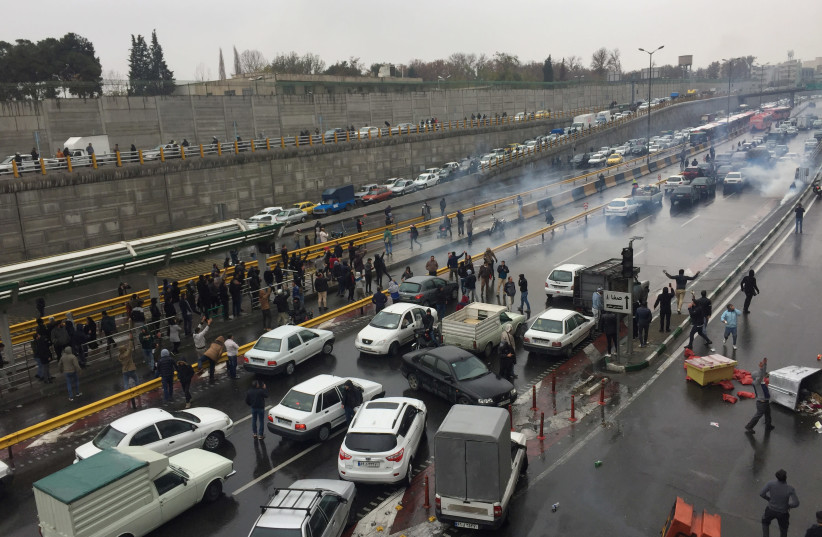
People stop their cars in a highway to show their protest for increased gas price in Tehran, Iran November 16, 2019 (photo credit: REUTERS)
People stop their cars in a highway to show their protest for increased gas price in Tehran, Iran November 16, 2019
(photo credit: REUTERS)
Iran has begun shutting off Internet access in some areas in preparation for expected protests on Wednesday, according to Iranian media.

The semi-official news agency ILNA quoted an informed source at the Communications and Information Technology Ministry as saying the shutdown was ordered by “security authorities” and covered the Alborz, Kurdestan and Zanjan provinces in central and western Iran and Fars in the south.

“According to this source, it is possible that more provinces will be affected by the shutdown of mobile international connectivity,” ILNA said. The Iranian news agency later removed the quote from their website, according to Radio Farda.

Social media users also reported a heavy presence of armed forces in Tehran and other cities on Wednesday.

Iran News Wire@IranNW

Tabriz NW – a convoy of security forces parades on the streets while the regime gets ready for and commemoration ceremonies for slain protesters called on by their families for Dec. 26.

Embedded video

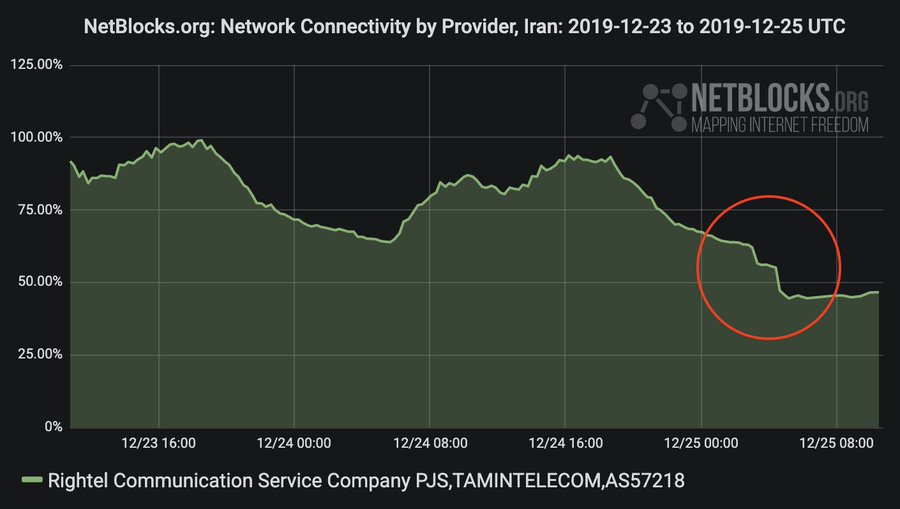
The internet watchdog NetBlocks confirmed that disruptions are affecting some mobile networks in Iran with reports of service failures in multiple cities. The data observed by NetBlocks are consistent with a targeted disruption and don’t appear to be related to any international issue, unlike an internet outage last week when internet access was lost due to an issue in European services.

NetBlocks.org

@netblocks

Confirmed: Evidence of mobile internet disruption in parts of beginning ~6:30 a.m. (03:00 UTC); real-time network data show two distinct drops in connectivity this morning amid reports of regional outages; incident ongoing 📉

📰https://netblocks.org/reports/partial-internet-disruption-registered-in-iran-oAvqX18Y 

View image on Twitter

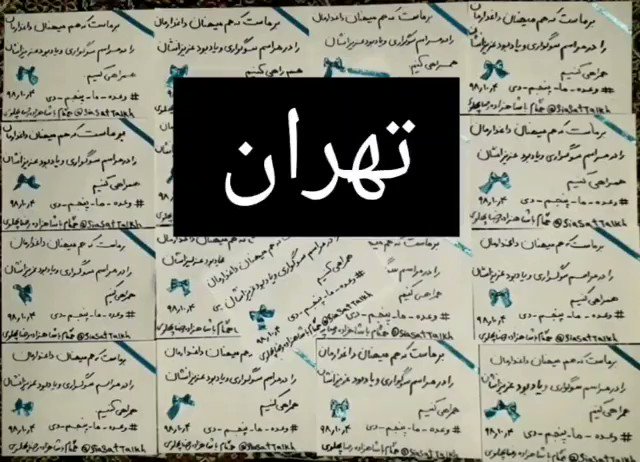
Social media posts and some relatives of people killed in unrest last month over hikes in gasoline prices have called for renewed protests and commemoration ceremonies for the dead on Thursday. Social media users are using the hashtags “see-you-Thursday” and “December 5th” in calls for protests and have begun using handwritten leaflets with hashtags in preparation for the internet outage, according to Radio Farda. A video on Twitter shows hundreds of leaflets that are being handed out by activists.

Ali@Ali43694277

پخش صدها بیانه دست نویسی توسط مبارزان ازادی خواه میهن برای دعوت از مردم
برای حضور در خیابانها

Embedded video

Video on social media claimed to show a motorcycle convoy in support of the protests planned for Thursday.

mostafa.m@MostafaMe4


Another uprising in Iran is nearing its birth
With an initiative in Najaf Abad streets, demonstrators riding a motorcycle took photos of the martyrs of the November uprising.

Embedded video

During widespread anti-government protests in November, Iran shut down Internet access throughout the country.

Iran is currently in the process of developing a national intranet system, known as the National Information Network (NIN), in order to cut the country’s dependency on international cyberspace, according to Radio Farda. The network will also prevent Virtual Private Networks (VPNs) from helping Iranians bypass the Islamic Republic’s censorship of the Internet, as data requests won’t be routed outside the country.

The plan was first announced in 2010 with an expected completion date in 2015. In May, the Supreme Council of the Cultural Revolution announced that the NIN is 80% complete.

“All domestic activities, services, applications [and] various types of contents… are included in the national Internet,” said Communications and Information Technology Minister Mahmoud Vaezi at the inauguration event in 2016, according to the BBC.

Iran has already blocked access to tens of thousands of sites and services including Twitter and Facebook, although many users use VPNs and proxy sites to bypass the filter.

Earlier in December, Iranian President Hassan Rouhani promised that the NIN would be strengthened so that “people will not need foreign [networks] to meet their needs.” The announcement came soon after the government temporarily shut down Internet access throughout the country during anti-government protests, sparking fears among Iranians that they could soon be cut off from accessing the outside world through the Internet.

The intranet would allow the government to decide what content can be accessed by users, removing the need for absolute shutdowns like the one imposed during the protests.

Some Iranian newspapers warned the government against imposing such a decision on citizens, as things could easily spark out of control as they did after gasoline prices were raised in a sudden decision by the nation’s leadership, according to the People’s Mojahedin Organization of Iran, an Iranian militant opposition group. A state-run daily called the announcement a “threatening message to the people,” while another daily asked, “will the people and the private sector tolerate the Internet shutdown?”

Reuters contributed to this report.


IDF chief: Israel will block Iran’s military efforts, ‘even at the risk of war’

December 25, 2019

Source: IDF chief: Israel will block Iran’s military efforts, ‘even at the risk of war’ | The Times of Israel

Kohavi laments that Israel alone in the fight against Tehran; says chance for a long-term ceasefire in Gaza, but threatens army won’t hesitate to use its full force if necessary

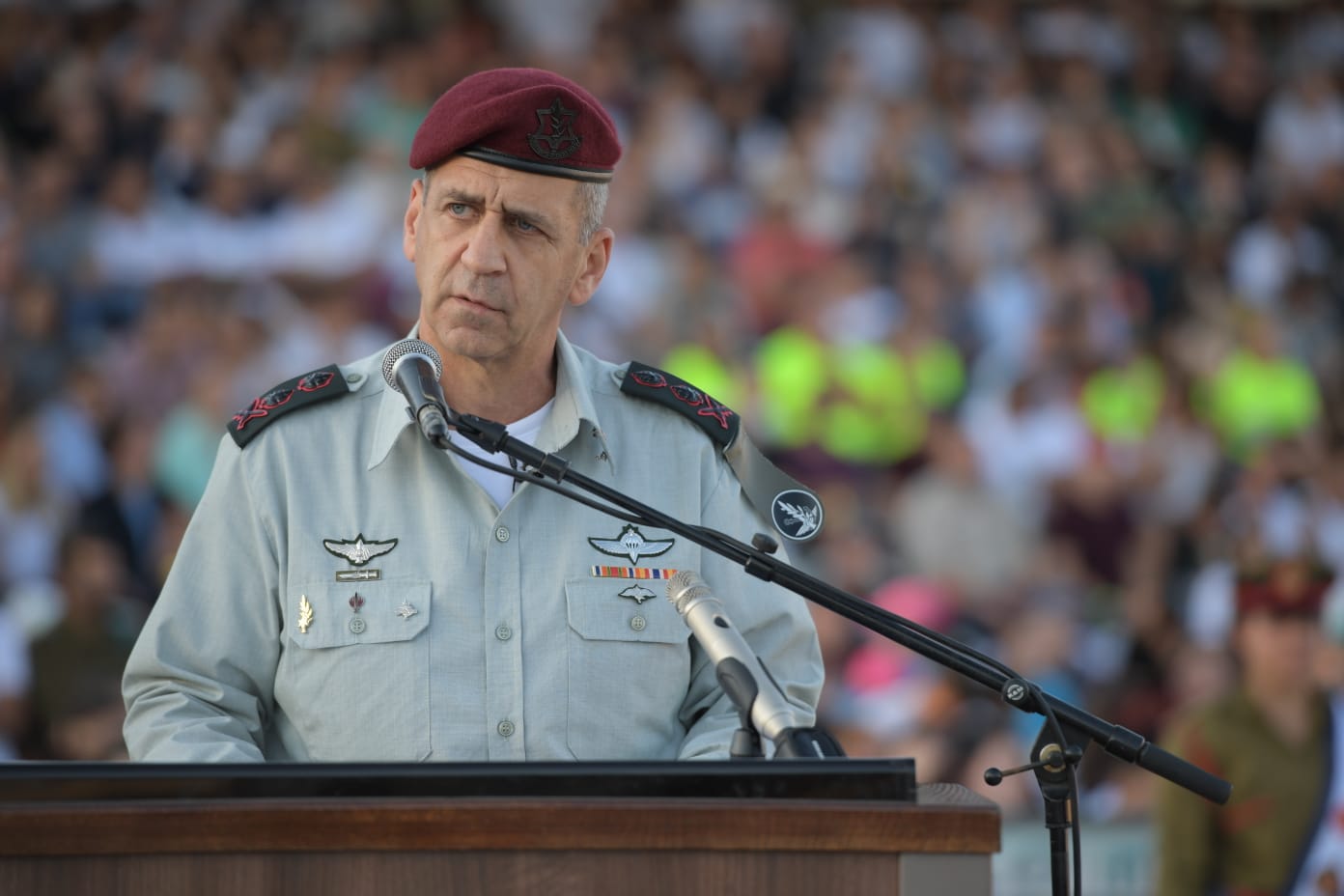
IDF chief Aviv Kohavi speaks at a graduation ceremony for new IDF officers on October 31, 2019. (Israel Defense Forces)

IDF chief Aviv Kohavi speaks at a graduation ceremony for new IDF officers on October 31, 2019. (Israel Defense Forces)

IDF Chief of Staff Aviv Kohavi on Wednesday lamented that Israel is alone in the fight against Iran and its proxies in the Middle East, as the Islamic Republic grows increasingly aggressive in the region.

“It would be better if we weren’t the only ones responding to them” using military force, Kohavi said, in an apparent criticism of the United States and Persian Gulf countries, who also see Iran as a major foe.

The army chief delivered a wide-ranging speech on Israel’s national security and the state of the Israel Defense Forces at a conference in honor of former IDF chief of staff Amnon Lipkin-Shahak at the Interdisciplinary Center in Herzliya. It was Kohavi’s first major speech on Israel’s national security since taking his position last January, speaking for a full hour.

“In recent years, Iran has changed its policies and is much more active,” Kohavi said, noting attacks in recent months on petroleum facilities in Gulf states.

“And there’s no response, there’s no retaliation, there are no reprisals,” he said.
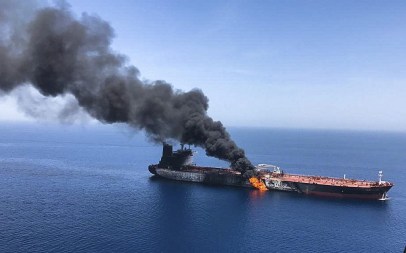
An oil tanker on fire in the Gulf of Oman, June 13, 2019, near the strategic Strait of Hormuz. where two ships were reportedly attacked. (AP Photo/ISNA)

Kohavi also addressed the situation in the Gaza Strip, where Israel has been working, with assistance from Egypt, to negotiate a long-term ceasefire with the enclave’s de facto rulers, the Hamas terror group.

“We will allow civil relief in exchange for significant security improvements in Gaza. That’s not my policy, that’s the government’s,” Kohavi said.

According to Kohavi, last month’s two-day battle between the IDF and the Palestinian Islamic Jihad, the second most powerful terror group in Gaza, made such a ceasefire more possible. Unlike in previous bouts in the Strip, Israel did not target Hamas facilities, instead focusing its attacks almost solely on the PIJ.
Palestinians check the destruction following an Israeli air strike on November 14, 2019 in Khan Yunis in the southern Gaza Strip. (SAID KHATIB / AFP)

“We wanted to put the PIJ back in its place, something Hamas wouldn’t do, so we did it,” he said.

“As I speak, there’s an opportunity. Hamas is back dictating the order of the day — even if there’s a rocket or mortar here or there, which we won’t accept,” he said, referring to recent attacks from Gaza, which military officials have indicated were the work of smaller, more radical terror groups, not Hamas.

The army chief added that Israel was prepared to go to war if needed in order to restore quiet to the Gaza region.

“War is always the last choice, but in cases where all other paths have been exhausted, war is a solution, a military operation is a solution,” he said.

Iran is everywhere

Kohavi said Iran was working to set up forward operating bases throughout the region, from which it could itself carry out attacks against Israel, with its Islamic Revolutionary Guard Corps’ expeditionary Quds Force, or order its proxies in the region, notably the Hezbollah terror group, to do so.

“We won’t allow Iran to establish a military presence in [Syria], or even in Iraq,” he said.

The military chief said the IDF was operating throughout the region — openly, covertly and clandestinely — in order to thwart the plans of Iran and its proxies, “even at the risk of war.”
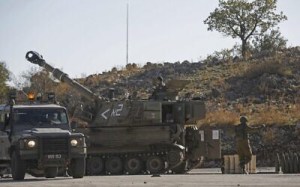
An Israeli M109 self-propelled howitzer is stationed near the border with Syria in the Israeli-annexed Golan Heights on November 19, 2019, after Israeli air defenses intercepted four rockets fired from neighboring Syria. (JALAA MAREY / AFP)

Kohavi specifically referred to efforts by Iran and Hezbollah to develop precision guided missiles — a threat that Israeli officials generally consider to be second only to a nuclear-armed Iran — as the type of issue that the IDF would risk war in order to prevent.

“We won’t allow our enemies to acquire precision weapons,” he said.

According to Kohavi, one of the defining characteristics of Israel’s current national security situation is that both the number of arenas from which the Jewish state faces threats and the number of threats within each arena are growing.

“In Syria, there are Hezbollah forces and Quds forces [in addition to the Syrian military]. In Gaza, there are also proxies of the Iranians [in addition to Hamas and the PIJ],” he said.

The army chief noted that Iraq, where Iran controls a large number of Shiite militias, has also become an area of increasing concern for Israel.
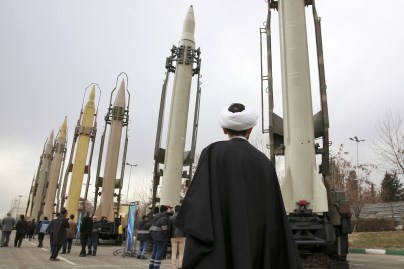
An Iranian clergyman looks at domestically built surface to surface missiles displayed by the Revolutionary Guard in a military show marking the 40th anniversary of the Islamic Revolution, at Imam Khomeini Grand Mosque in Tehran, Iran, February 3, 2019. (Vahid Salemi/AP)

Kohavi added that Iran itself had also become a direct and immediate military threat to Israel, whereas, in the past, it was “back behind the mountains, working on a nuke program.”

“Iran is continuing to develop missiles that can reach Israeli territory. This is somewhat flying under the radar,” he said.

He also addressed Iran’s recent violations of the 2015 nuclear deal by Iran, doubling its amount and level of enriched uranium beyond the approved levels of the agreement. Kohavi said these actions are currently part of an effort to exert pressure on the US and Europeans as part of negotiations, not an actual effort to develop a nuclear weapon, but that this would eventually change.

“Iran is doing this as part of a strategic dialogue with the US. But at some point, it will leave the realm of a strategic dialogue and enter into a real threat,” he said.

Preparing for war

In his address, Kohavi said he did not see war in the offing, due to effective Israeli deterrence, but made clear that the next war that the Jewish state faced — whether against Hezbollah in the north or Hamas in the south — would be more difficult and disastrous than the ones before it, owing to technical improvements of the terror groups’ capabilities.

“In terms of rockets, the number and the range and the size of the warheads and the accuracy have all grown.”

Kohavi said the IDF was, of course, aware of these threats, was prepared for them and was working to further improve its defenses, but warned that despite this, the threats of Israel’s home front remained. “We have to prepare for this,” the general said.
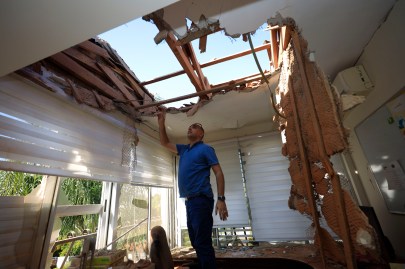
A man looks at the damage to a house in Sderot, Israel, after it was hit by a rocket fired from Gaza Strip, November 12, 2019. (Tsafrir Abayov/AP)

“You can’t have a war without casualties. I can’t promise you a short war. I’ll do what I can to shorten it, but during that time, the home front will be hit,” he said.

“We will need resilience on the home front.”

He noted that since the 2006 Second Lebanon War, Hezbollah had worked to improve its capabilities as well, putting it on par with some national armies.

“Hezbollah isn’t just running around with Kalashnikov assault rifles and anti-tank missiles. It has anti-aircraft weapons and spectrum suppression equipment,” he said, referring to electronic warfare capabilities.

Kohavi said he did not believe that Iran or its proxies would imminently launch a war against Israel.

“None of our enemies want a war at this time,” he said.

Feelings of security

In recent years, some of the most regular and vehement criticism against the IDF and Israel’s security strategies have been in regards to the military’s responses to violence from the Gaza Strip.

Kohavi rejected some of this criticism, saying the IDF had effectively blocked the majority of attacks from the Strip and that the issue was not with security but with the “feeling of security” among residents of the Gaza periphery. However, he said that a feeling of security was not unimportant, just less important than actual security.

A woman hugs her dog moments after a rocket fired by Palestinians terrorists in the Gaza Strip hit a main highway between near Ashdod, Israel, November 12, 2019. (Ariel Schalit/AP)

“Every time there’s a rocket siren interrupting the night or the party, or the shabbat dinner, people say there’s no security,” he said.

“I differentiate between security and feeling of security. Security comes before a feeling of security. But we need to give people a feeling of security,” Kohavi said.

Kohavi said he hoped a long-term ceasefire agreement with Hamas would be signed soon, but said Israel would not hold back from a military operation if necessary.

The army chief said he knew this would mean fighting in highly complicated urban areas, where Hamas has established many military facilities, believing that Israel would be more cautious and hesitant in such a densely populated location, full of civilians.

“The enemy decided to base itself in an urban environment, but we will respond forcefully,” he said. “We will warn the civilians who live there and give them time to evacuate.”

Kohavi said that the IDF would not refrain from attacking the civil infrastructure used to by terror groups to attack Israel.

“We will strike the infrastructure of the country that allows this, the gas, fuel, and roads. Countries that allow or encourage terror groups to operate in their borders must know that they will be held responsible,” he said, specifically listing Gaza, Lebanon and Syria.
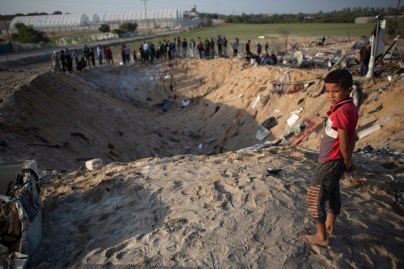
A barefoot Palestinian boy and others look into a crater made in overnight Israeli missile strikes that destroyed a house and killed eight members of the Abu Malhous family, in Deir al-Balah, central Gaza Strip, November 14, 2019. (AP Photo/Khalil Hamra)

The army chief referred to a case in last month’s battle in Gaza, in which he said “a lot of civilians were killed” when the IDF bombed a Palestinian family’s home that had apparently been incorrectly identified as a PIJ military facility, and acknowledged that errors had been made in the process of choosing the target.

“We investigated this for dozens of hours, dozens of hours. The lessons were learned,” he said.

Preparing for the future

Kohavi also discussed the military’s preparations for the future under his proposed multi-year plan known as “Momentum” in English, or “Tenufa” in Hebrew.

According to the army chief, his efforts to roll out this plan are being stymied by Israel’s current political impasse, which is preventing the passage of the necessary budget.

Illustrative: Israeli construction teams work on a concrete border wall to run above and below ground along the Gaza border, September 2016. (Screen capture: Ynet)

Kohavi said that the new security fence and underground protective barrier being constructed around the Gaza Strip in order to thwart both subterranean tunnels and above ground infiltration attacks was nearing completion.

“By the summer of 2020, the barrier will be completed,” he said.

Kohavi added that improvements were also being made along the northern border and within the West Bank in order to prevent terror attacks there.

The army chief said one of the most important lessons learned by the IDF in recent years was an understanding that the military had to win wars “quickly and decisively.”

“We need to cause our enemies to grow weary,” he said.

Kohavi offered an example of old-style military thinking that would not work today, Israel’s conquering of the Golan Height in the 1967 Six Day War.

The Syrian military until then had long been using the Golan Heights to attack nearby Israeli settlements, which prompted the IDF to capture the area. But this did not prevent Syria from attacking Israel just a few years later, in the devastating 1973 Yom Kippur War.

“It’s not enough to conquer the Golan and reach a certain line. We must destroy the assets of the enemy,” he said.

“If you reached a line, but you didn’t destroy the enemies rockets along the way, you didn’t succeed,” Kohavi said.

 

Top Iranian official: Israel ‘will regret’ attacks in Syria

December 24, 2019

Source: Top Iranian official: Israel ‘will regret’ attacks in Syria | The Times of Israel

Day after strike near Damascus, Russian news agency publishes interview with senior adviser Ali Akbar Velayati saying Israeli airstrikes ‘will not pass without a response’

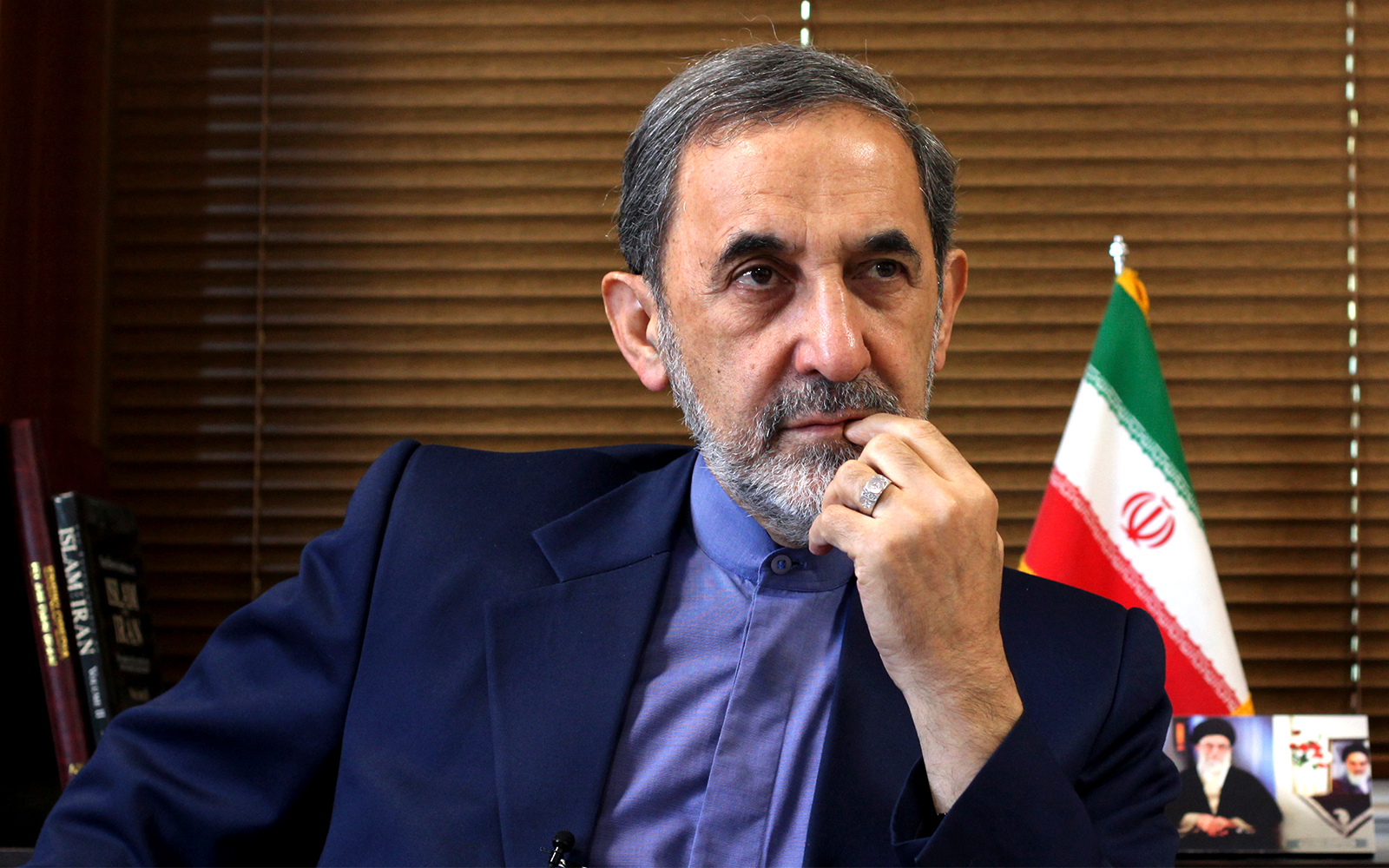
Ali Akbar Velayati, a top adviser to Iran’s supreme leader, Ayatollah Ali Khamenei, gives an interview to The Associated Press at his office in Tehran, Iran, August 18, 2013. (AP Photo/Ebrahim Noroozi, File)

A top Iranian official said that Israel “will regret” its attacks in Syria, which have reportedly targeted Iranian resources and weapons shipments.

The Israeli attacks “will not pass without a response,” Ali Akbar Velayati, a top adviser to Iran’s supreme leader, Ayatollah Ali Khamenei, said in an interview with the Russia Today’s Arabic channel that was published Monday.

His remarks came out a day after an airstrike in Syria that Damascus officials blamed on Israel and that reportedly killed three, foreign pro-regime fighters, likely Iranians. It was not clear if Velayati had spoken to the station before or after the Sunday missile attack.

Iran has increasingly been saying it will retaliate to alleged Israeli strikes in Syria.

Channel 12 TV news reported Monday that Israeli officials are concerned Iran may attempt to launch a revenge assault similar to a September 14 cruise missile and drone attack on Saudi Arabian oil facilities that knocked out half the kingdom’s oil production. Although Yemen’s Iranian-backed Houthi rebels claimed responsibility, the US, Britain, France, Germany, and Saudi Arabia have blamed Iran of being behind the attack.

Iran regularly threatens Israel, viewing the country as a powerful enemy allied with the US and Sunni countries in the region against Tehran and its nuclear ambitions.

Syrian state news agency SANA reported an attack just before midnight on Sunday.

It said Syrian air defenses fired on “hostile missiles” coming from “the Occupied Territories,” referring to Israel.

Illustrative: Explosions seen near Damascus on July 1, 2019, during a purported Israeli airstrike. (Screen capture/Twitter)

According to the UK-based Syrian Observatory for Human Rights, there were three explosions in the Damascus suburbs after the missiles targeted “Syrian regime and Iranian positions.”

It said three non-Syrian fighters were killed by a rocket blast between the suburb of Aqraba and the nearby Sayyida Zeinab neighborhood, home to a shrine revered by Shiite Muslims. It did not specify their nationality but said they were likely Iranian.

Israel has not claimed responsibility for the raids.

Lebanon’s Al Akhbar newspaper reported that the purported Israeli strike had targeted arms warehouses in the suburb of Sayyidah Zaynab south of Damascus.

Israel has repeatedly said that it will not accept Iranian military entrenchment in Syria and that it will retaliate for any attack on the Jewish state from Syria.

Though it does not generally comment on specific attacks, Israel has admitted to carrying out hundreds of airstrikes in Syria against Iranian targets over the last several years. Iran has forces based in Syria, Israel’s northern neighbor, and supports the Hezbollah terror group and Gaza terrorists.

Last month, Israel said it struck dozens of Iranian targets in Syria in a “wide-scale” operation in response to rocket fire on the Israeli-controlled Golan Heights the day before.

Earlier in November, Israel killed a senior commander of the Palestinian Islamic Jihad, an Iran-backed group in the Gaza Strip, setting off two days of heavy fighting. A separate airstrike targeted, but failed to kill, an Islamic Jihad leader in Damascus, underscoring the risk of escalation at various pressure points across the volatile region.


The cruise missiles that struck IRGC Air Force HQ in Syria – a telling blow for Iran’s Mid-East plans – DEBKAfile

December 24, 2019

Source: The cruise missiles that struck IRGC Air Force HQ in Syria – a telling blow for Iran’s Mid-East plans – DEBKAfile

The Iranian Revolutionary Guards Air Force chief, Gen. Amir-Ali Hajizadeh, escaped the fate of the “three foreigners” killed when 3-4 cruise missiles flew from warships off the Syria coast on Sunday night, Dec. 22, and crashed into his Syrian headquarters at Agraba, south of Damascus.

But the three victims were almost certainly air force officers, which sparked reports that the general was among them.

The hit clearly came a lot too close for comfort. Indicating that something important had just happened, Tehran moved fast for damage control. Within hours, Iran’s state news agency IRNA informed reporters that Gen. Hajizadeh “is in perfect health,” while also claiming that the missile attack’s targets had ranged from the tomb of the Shiite Saint Seyyeda Zeinab south of Damascus up to the big T-4 air base near Homs.

Even if the IRGC Air Force general escaped unharmed, the missiles striking his Syrian headquarters carried this message: “We know exactly where you are and are tracking your movements. Be warned.”  Gen. Hajizadeh, our sources disclose, was the master-planner, who designed and oversaw down to the last detail the execution of Iran’s massive cruise-missile-drone attack on Saudi oil infrastructure on Sept. 14, which for a while knocked out half of Saudi Arabia’s oil production.

The unidentified party which attacked his Syrian headquarters on Sunday was warning him against repeating his Saudi feat anywhere in the Middle East, especially Israel. Should he nonetheless try again, he was duly notified that he would pay the price. The missile strike on Sunday therefore raised the contest between the US and Israel on the one hand and Iran on the other to a new level, with both sides ready and willing to strike at their opponent’s core strategic assets.


PM Netanyahu’s Christmas Greeting – 2019 

December 24, 2019


Syria says air defenses fire on ‘hostile missiles’ from Israel 

December 23, 2019

Source: Syria says air defenses fire on ‘hostile missiles’ from Israel | The Times of Israel

Residents of Damascus report explosions near capital; rights group says attack targets ‘Syrian regime and Iranian positions’

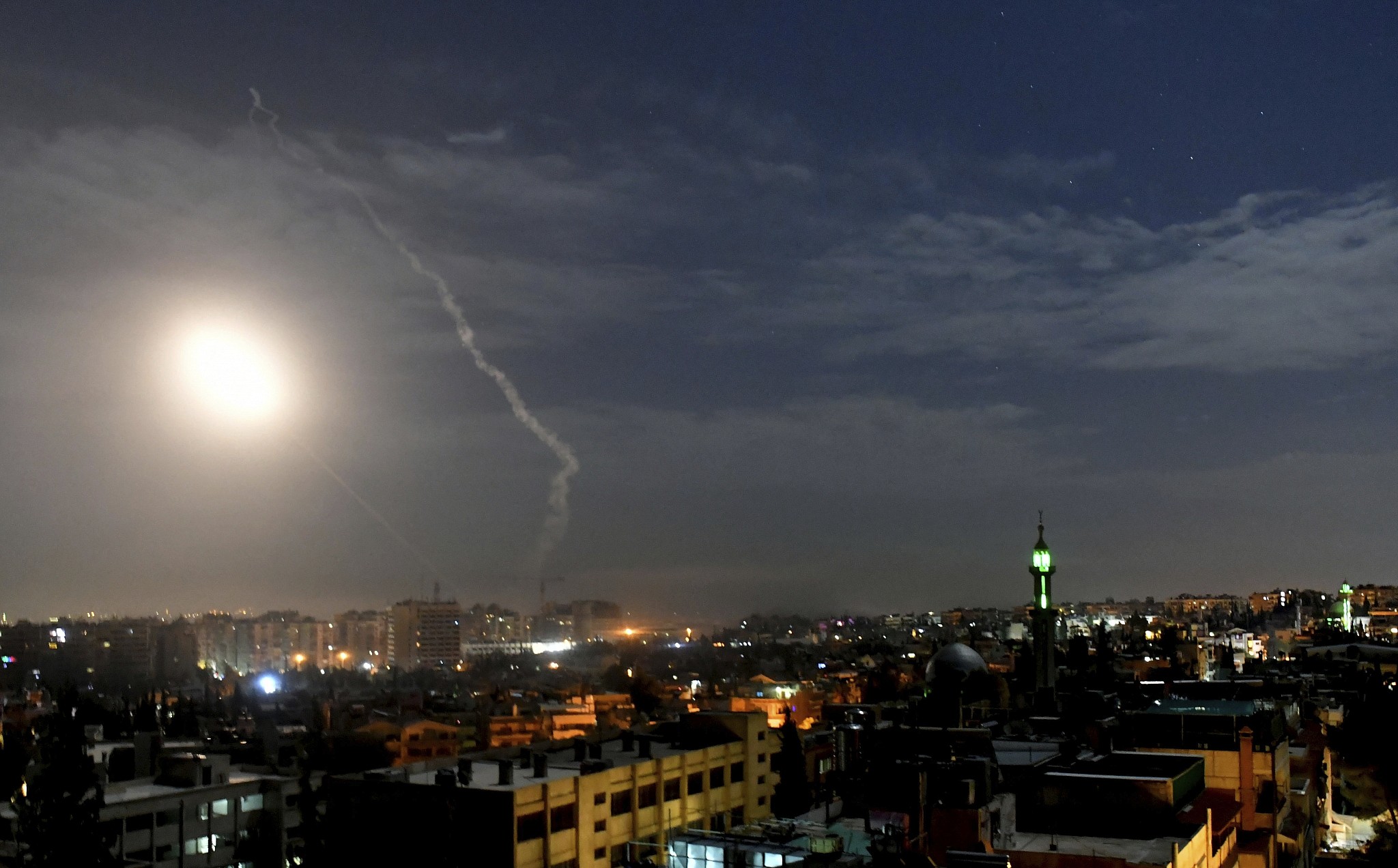
Illustrative. This photo released by the Syrian official news agency SANA, shows missiles flying into the sky near the international airport in Damascus, Syria, January 21, 2019. (SANA via AP)

Illustrative. This photo released by the Syrian official news agency SANA, shows missiles flying into the sky near the international airport in Damascus, Syria, January 21, 2019. (SANA via AP)

Syrian air defenses opened fire Sunday night on missiles fired from the direction of Israel, state media reported.

Syrian state news agency SANA claimed one of the missiles was shot down near the Damascus suburb of Aqraba but gave no further details. Residents of Damascus said explosions could be heard near the capital.

“Air defenses confront hostile missiles coming from the direction of the occupied lands,” SANA said, referring to Israel.

“There are reports of one of the hostile targets being taken down in the Aqraba area in the rural parts of Damascus,” the report said.

According to the UK-based Syrian Observatory for Human Rights, there were three explosions in the Damascus suburbs after the missiles targeted “Syrian regime and Iranian positions.”

The Observatory added that ambulances were observed heading toward where the missiles hit.

There was no immediate comment from Israel.

Shortly before the reports of the attack near Damascus, SANA said that air defenses had shot down a drone over the coastal Syrian city of Jableh. It wasn’t clear if the two incidents were related.

Two weeks ago unidentified aircraft bombed three Iranian-controlled weapons depots, killing several members of Tehran-supported militias, Syrian media reported at the time.

Those airstrikes targeted three munitions storehouses in the Boulkamal region of Syria, near the Iraqi border, an area that has reportedly been hit by Israeli raids in the past year.

There were no immediate reports of who was responsible for the strikes, though defense analysts indicated that Israel was the likely actor.

The bombing came days after reports of a similar raid in the same region.

The Israeli military does not comment on specific airstrikes in Syria, save for those that are in retaliation for attacks on Israel.

Israel has repeatedly said that it will not accept Iranian military entrenchment in Syria and that it will retaliate for any attack on the Jewish state from Syria.

Though it does not generally comment on specific attacks, Israel has admitted to carrying out hundreds of airstrikes in Syria against Iranian targets over the last several years. Iran has forces based in Syria, Israel’s northern neighbor, and supports the Hezbollah terror group and Gaza terrorists.

Last month, Israel said it struck dozens of Iranian targets in Syria in a “wide-scale” operation in response to rocket fire on the Israeli-controlled Golan Heights the day before.

Earlier in November, Israel killed a senior commander of the Palestinian Islamic Jihad, an Iran-backed group in the Gaza Strip, setting off two days of heavy fighting. A separate airstrike targeted but failed to kill an Islamic Jihad leader in Damascus, underscoring the risk of escalation at various pressure points across the volatile region.


New Iranian drone base destroyed near Abu Kamal. First Saudi unit lands at Syrian oil field – DEBKAfile

December 22, 2019

Source: New Iranian drone base destroyed near Abu Kamal. First Saudi unit lands at Syrian oil field – DEBKAfile

A new Iranian drone base near the eastern Syrian town of Abu Kamal was flattened early Saturday, Dec. 21 in this month’s fourth unidentified attack in this part of Syria.

DEBKAfile military sources report that the target was Hamadan airport, which stood derelict until recently. Iranian forces moved in, carried out repairs and lately installed drones with operational teams there for attacks on northern Israel. Early Saturday, that installation was razed before it became operational.

Our military sources report another significant event which has only just occurred. At week’s end, a Saudi military contingent landed for the first time at the Syrian oil fields in another part of eastern Syria, the Deir Ez-Zour region.

The Saudi troops took up positions around the Omar oil field, the largest in the country. They provided security for engineers and technicians of the Saudi State Aramco company who arrived to repair the pumping equipment disabled during the war years.

The Saudi oil operation and troops at Omar oil field are being secured in their turn by US military and air units and Syrian Democratic Forces.
Although the Saudi contingent is small, is arrival in Syria is a historic event of the highest order.

The takeover of Syria’s largest oil field by a Saudi military force under an American umbrella is a regional game changer, which affords both them an advantage against Russia, Iran and Syria.


Statement by PM Netanyahu 

December 20, 2019