Archive for December 19, 2019

F-35 jets let IAF ‘go wherever it needs to go,’ manufacturer says

December 19, 2019

Source: F-35 jets let IAF ‘go wherever it needs to go,’ manufacturer says | The Times of Israel

Lockheed Martin VP touts his aircraft’s advanced capabilities as Israel debates purchasing more stealth fighters or upgraded F-15s from Boeing
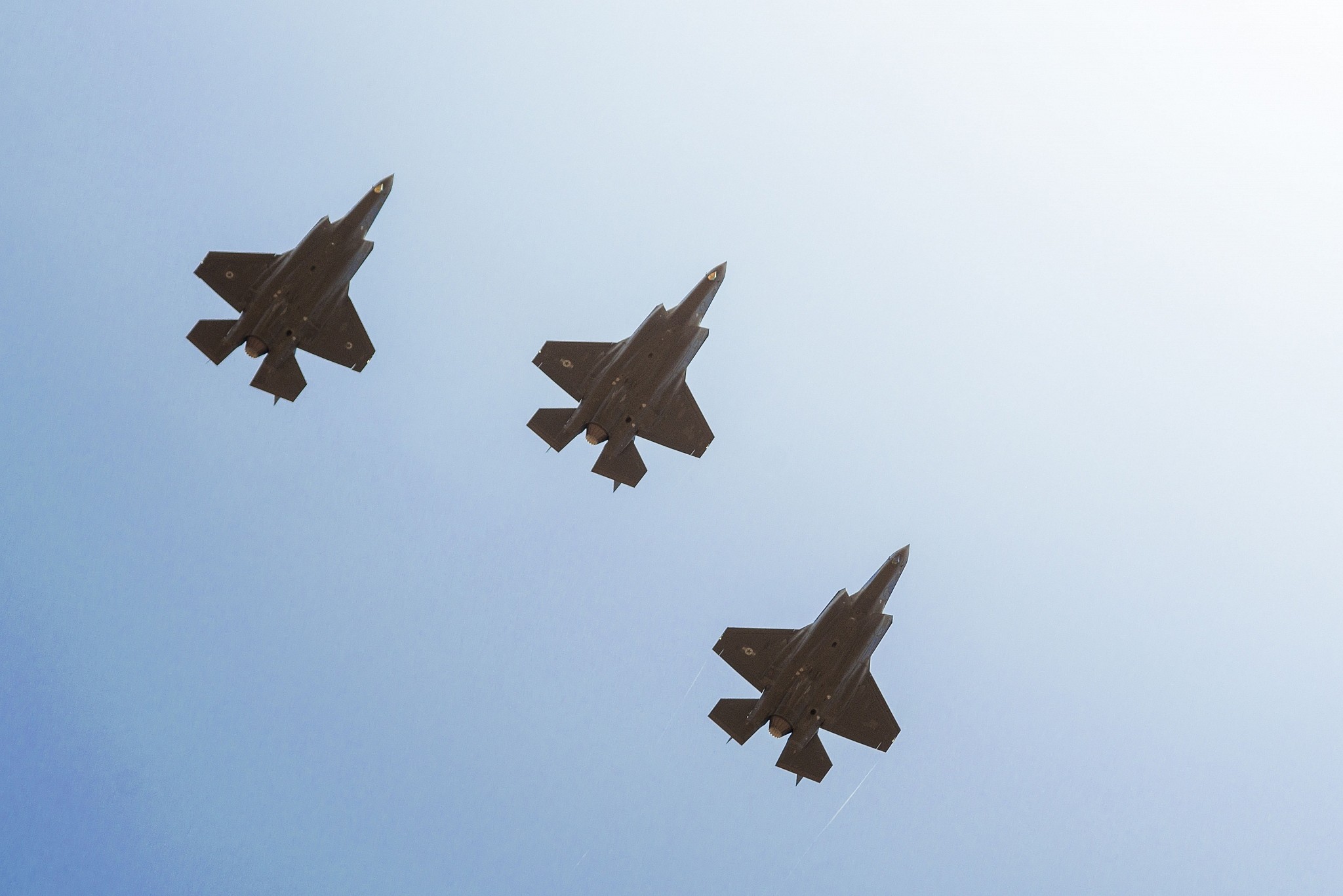
F-35 fighter jets fly over Israel in an undated photograph. (Israel Defense Forces)

F-35 fighter jets fly over Israel in an undated photograph. (Israel Defense Forces)

A senior Lockheed Martin official on Tuesday boasted that his company’s F-35 fighter jet allows the Israeli Air Force to carry out operations without detection by enemy air defenses, giving Israel an advantage in the region.

“The stealth that allows the pilots to go wherever they need to go, with the assurance that they know exactly where they can go and not be seen. The absolute situation that they have, which no other airplane can provide them at this level, is just phenomenal. It gives them such a confidence,” said Gary North, a retired US Air Force general and current vice president at Lockheed Martin, during a meeting with journalists in Israel.

Asked how the F-35 aircraft would fare against an adversary like Iran — if, for example, Israel were to try to conduct a military strike against its nuclear facilities — North said he could not comment specifically about such operational planning, but maintained that the stealth fighter can outmatch advanced air defense systems.

“I will say this: against a ‘double-digit’ high threat environment, the F-35 is absolutely the weapon of choice,” he said. North was referring to a NATO naming convention in which advanced surface-to-air missile systems are designated with double digits. For instance, Iran’s Russian-supplied S-300 is known as the SA-10, while the more outdated S-200 is referred to as the SA-5.

However, North stressed, stealth does not mean completely undetectable. “Nothing is invisible at an appropriate range, but the beauty of [the F-35’s stealth capability] is that you are stealthy for a very, very long time,” he said.

When the F-35 carries missiles externally, on its wings, the aircraft is no longer stealthy, North acknowledged, though it can again become less observable once it has dropped those bombs.

Gary L. North, a former four-star general and current Lockheed Martin executive. (US Air Force)

North visited Israel this week to meet with officials from the IAF and Defense Ministry regarding the country’s current fleet of 20 F-35 fighter jets, out of a total package of 50 planes that Israel has agreed to purchase, as well as ongoing negotiations with the Jewish state for a potential purchase of another squadron’s worth of stealth fighters.

Israel is currently deliberating purchasing either additional fifth-generation F-35 fighter jets from Lockheed Martin or so-called fourth-and-a-half generation F-15X fighter jets from its competitor, Boeing. While the F-35 has far greater stealth capabilities and other technological advantages, the F-15X — an upgraded version of the decades-old F-15 — is capable of carrying far more munitions, making it a more attractive option for use as a bomber.

North, naturally, believes that Israel should opt for his firm’s stealthy and state-of-the-art F-35, which will cost less than $80 million per aircraft beginning next year as costs of production decrease.

The retired general, who served as an air force pilot, responded to comments made by former US defense secretary Ashton Carter in Tel Aviv earlier this month, who said he believed the F-35 would be the last manned fighter jet to be manufactured by the US. North said he instead foresaw a future where pilots would become optional, not replaced entirely by artificial intelligence and remote controls.

“Advanced technologies are going to allow significant options, to be what we call optionally manned,” North said.
From left, former US secretary of defense Ash Carter, former Military Intelligence chief Amos Yadlin and former IDF chief of staff Gadi Eisenkot speak at an event at the Institute for National Security Studies in Tel Aviv on December 9, 2019. (INSS)

“We are working right now in our Skunk Works [Lockheed Martin’s research and development wing] to be able to do manned, unmanned or what we call MUMT — manned/unmanned teaming — where you can have an F-35 controlling and working in concert with either totally autonomous or remotely piloted vehicles for an operation,” he said.

The Lockheed executive noted that one of the advantages of the F-35 was its “survivability,” thanks to a host of integrated technologies that make crashes less likely. These include Lockheed Martin’s Automatic Ground Collision Avoidance System, which takes control of the plane if it appears the pilot has lost consciousness or otherwise been incapacitated.

This system is installed on all Israeli F-35 fighter jets, according to North. It wasn’t installed on a Japanese F-35 aircraft that crashed into the Pacific Ocean this summer after the pilot suffered “spatial disorientation,” he said.

North also stressed that in addition to its stealth capabilities, the F-35 also comes with built-in electronic warfare systems, which he said far surpass those of other aircraft.

“In the open market, it is nine times more powerful than any other electronic jamming platform,” he said. “It is extremely powerful, which adds to the self-protection not only of itself but of the entire formation.”

An Israeli F-35 fighter jet is seen in a hangar during the “Blue Flag” multinational aerial exercise at the Ovda air force base, north of the Israeli city of Eilat, on November 11, 2019. (Jacob Magid/Times of Israel)

North touted the aircraft’s sensitive array of radar and other sensors, which he said could allow the F-35 to shoot down incoming cruise missiles.

In recent months, the Israeli military has warned that Iran could seek to carry out an attack with cruise missiles, which unlike ballistic missiles can be remotely controlled, making them more difficult to be shot down by traditional air defense systems. Such munitions were used, along with drones, to carry out a massive attack on a Saudi petroleum facility earlier this year.

North said the aircraft’s radar array system could detect a small, low-flying cruise missile. “It is the most powerful airborne radar system in the world. It is very capable, very low observable, very low altitude, very fast speed platforms, either airplanes or cruise missiles,” he said.

“After all, a cruise missile isn’t any different from an airplane, it’s just smaller,” added the former general.

Prime Minister Benjamin Netanyahu stands in front of a F-35 fighter jet at the Israeli Air Force’s Nevatim base in southern Israel. (Amos Ben Gershom/GPO)

According to the Lockheed Martin vice president, negotiations between his company and the IAF regarding a third squadron are ongoing but have stalled somewhat due to Israel’s lack of a government, which prevents serious budget-related discussions.

“We have a request for information about a third squadron, and the company obviously takes that very seriously,” he said. “Clearly, there are some challenges as the government forms and what-have-you, but that’s an internal issue.”

Asked if the recent decision by the US government to refuse to sell the F-35 fighter jet to Turkey over its purchase of Russia’s S-400 missile defense system could lead to Israel receiving its next 30 aircraft more quickly, North said that was a possibility but was up to the Israeli government to decide if that were something it wanted to do.

So far, Lockheed Martin has delivered over 475 F-35 fighter jets to nine countries around the world, eight of which have declared it operational. Another four countries are waiting to receive their first planes.

Nearly 1,000 pilots have been trained to fly the aircraft and thousands of people are certified to perform maintenance on the plane, North said.

Barring a dramatic change in the delivery schedule, Israel’s remaining 30 F-35 fighter jets will be delivered in batches of twos and threes until 2024. Israel is the second country after the United States to receive the F-35 from Lockheed Martin and one of the few to be allowed to modify the state-of-the-art aircraft — though the extent to which Israel will be able to add its own systems is still being debated with the US.

Detractors, however, balk at the development and production delays that have plagued the aircraft, as well as its high price tag of approximately $100 million apiece initially, though the price is going down as more planes are manufactured. Lockheed Martin also boasts that the F-35 requires less maintenance than other aircraft, making it more cost effective in the long term.


Touring north, Bennett warns Iran ‘will sink in Syria’s sand dunes’ 

December 19, 2019

Source: Touring north, Bennett warns Iran ‘will sink in Syria’s sand dunes’ | The Times of Israel

Defense minister says Israel ‘increasing the pressure’ on Tehran to prevent it from establishing a military presence in neighboring territory

Defense Minister Naftali Bennett (L) speaks with IDF Chief of Staff Aviv Kohavi (R) and Brig. Gen. Avi Gil, head of Northern Command's 36th Division, in the Golan Heights on December 18, 2019. (Ariel Hermoni/Defense Ministry)

Defense Minister Naftali Bennett (L) speaks with IDF Chief of Staff Aviv Kohavi (R) and Brig. Gen. Avi Gil, head of Northern Command’s 36th Division, in the Golan Heights on December 18, 2019. (Ariel Hermoni/Defense Ministry)

Defense Minister Naftali Bennett on Wednesday said Israel was upping its efforts to prevent Iran from establishing a military presence in Syria.

“As long as Iran tries to establish itself on Syrian soil, it will sink in the sand dunes of Syria,” Bennett said, according to a statement from his office.

The defense minister was speaking in the Golan Heights, after observing a military exercise alongside IDF Chief of Staff Aviv Kohavi.

“We are increasing the pressure,” Bennett said, without elaborating. “Iran has nothing to look for on Syrian soil.”

Bennett, who was appointed interim defense minister last month, has warned Iran a number of times over its military activities in Syria since taking office.

Prime Minister Benjamin Netanyahu (L) and Defense Minister Naftali Bennett (2nd) visit an army base in the Golan Heights overlooking Syrian territory, on November 24, 2019. (Atef Safadi/Pool/AFP)

Israel has repeatedly said it will not accept Iranian military entrenchment in Syria and that it will retaliate for any attack on the Jewish state from the neighboring country.

Though it does not generally comment on specific attacks, Israel has admitted to carrying out hundreds of airstrikes in Syria against Iranian targets over the last several years. Iran has forces based in Syria, Israel’s northern neighbor, and supports Hezbollah and Gaza terrorists.

Israel has also reportedly carried out a number of recent airstrikes in Iraq on Iranian-linked targets.

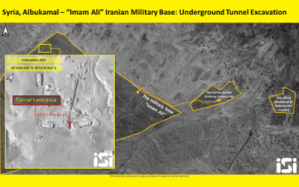
Last week, an Israeli intelligence firm released photographs of what it said is an Iranian tunnel being dug along the Syria-Iraq border to assist in the movement of weapons throughout the Middle East.

Satellite images showing an alleged Iranian tunnel on a military base near the border crossing in Syria’s Boukamal region, near the Iraqi border, on December 10, 2019. (ImageSat International)

According to the private satellite image analysis company ImageSat International, the tunnel is likely being used to store Iranian missiles en route to Tehran’s proxies throughout the region.

The tunnel, whose entrance can be seen in satellite images, is located on a suspected Iranian military base, known as the Imam Ali base, in Syria’s Boukamal region, near the Iraqi border. The base has been the site of several Israeli airstrikes in the past year, including some earlier this month, according to Syrian media.

ImageSat said the tunnel appears to have been built in response to these airstrikes, as a means to protect high-quality munitions from Israeli attacks.

The release of the photos was seen as a tacit threat, as in some past cases suspected areas of Iranian military entrenchment have been identified and publicized by ImageSat International shortly before the sites were targeted in airstrikes attributed to Israel.

Judah Ari Gross contributed to this report.


Iran begins testing much faster centrifuges as nuclear deal further unravels 

December 19, 2019

Source: Iran begins testing much faster centrifuges as nuclear deal further unravels | The Times of Israel

President Rouhani also confirms Tehran already running more advanced models to step up enrichment, in violation of 2015 pact

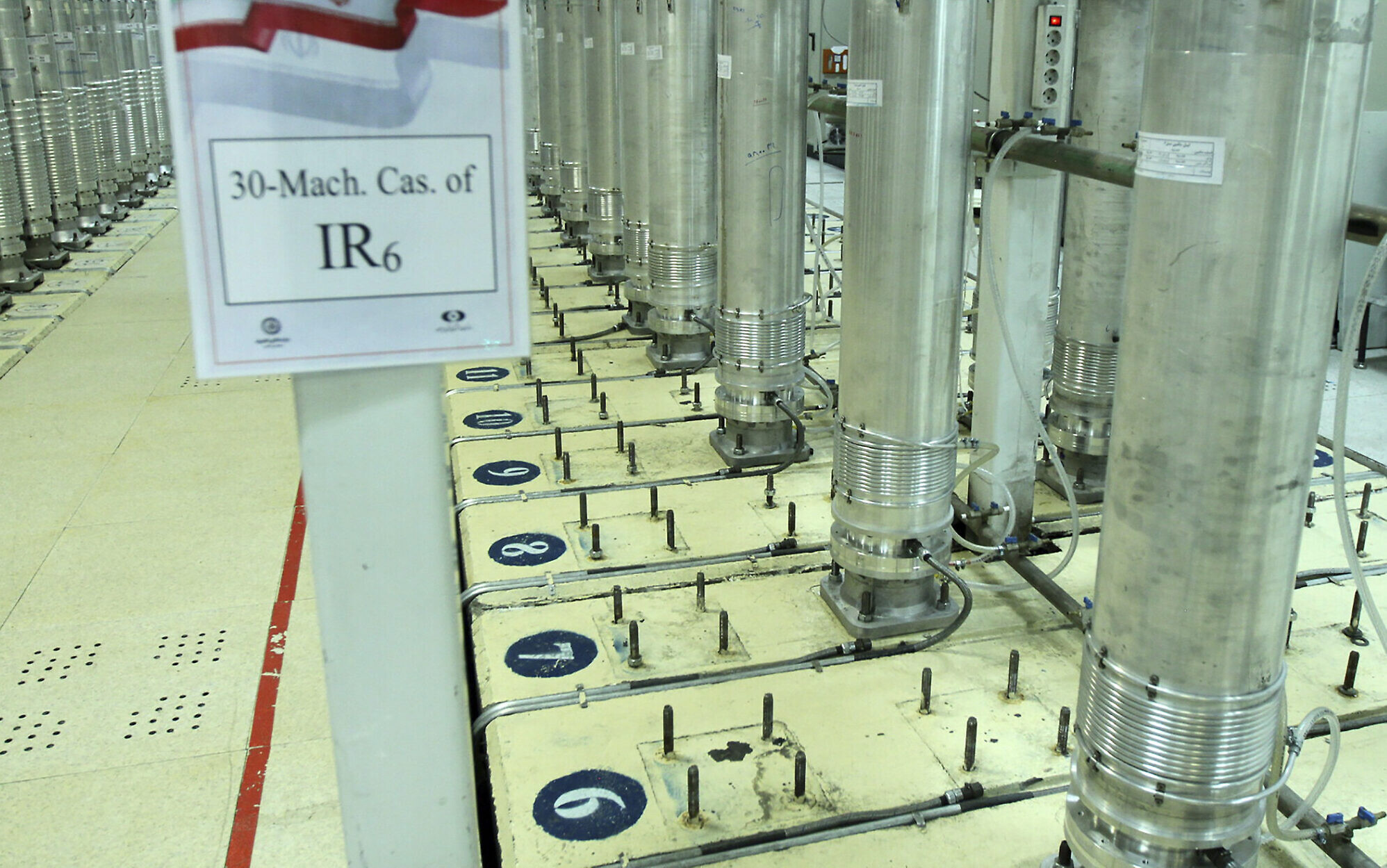
This photo released by the Atomic Energy Organization of Iran on November 5, 2019, shows centrifuge machines at Natanz uranium enrichment facility in central Iran. (Atomic Energy Organization of Iran via AP)

This photo released by the Atomic Energy Organization of Iran on November 5, 2019, shows centrifuge machines at Natanz uranium enrichment facility in central Iran. (Atomic Energy Organization of Iran via AP)

Iranian President Hassan Rouhani on Wednesday said his country has begun testing its latest, much faster, model of centrifuges in a further signal the international deal limiting its nuclear program was unraveling.

“Today, our new IR-6 centrifuges are working and the newer IR-9’s are being tested,” he said during a visit to Malaysia, according to a statement on his website.

According to Iranian officials, an IR-6 centrifuge can produce enriched uranium 10 times faster than the country’s first-generation IR-1 centrifuges.

The IR-9, for its part, works five times faster than the IR-6 and 50 times faster than the IR-1, the head of the Atomic Energy Organization of Iran, Ali Akbar Salehi, has said.

A centrifuge enriches uranium by rapidly spinning uranium hexafluoride gas, with more advanced centrifuges further cutting into the one year that experts estimate Tehran would need to have enough material for building a nuclear weapon — if it chose to pursue one.

Iran has ramped up its nuclear activities since US President Donald Trump unilaterally pulled the US out of the 2015 nuclear deal last year. The deal, negotiated between Tehran and world powers under the previous US administration of Barack Obama, was designed to see Iran curb its nuclear program in exchange for the lifting of powerful sanctions. The US has since reinstated punitive measures on Iran which have affected its struggling economy.

In this photo released by Malaysia’s Department of Information, Malaysia’s Prime Minister Mahathir Mohamad, right, and Iran’s President Hassan Rouhani, pose for a photo ahead of their meeting in Putrajaya, Malaysia, December 18, 2019. (Malaysia’s Department of Information via AP)

“Today, the entire world know[s] that the US’ withdrawal from the JCPOA was no[t] to the benefit of anyone, even themselves and their friends,” Rouhani said Wednesday, using the initials for the 2015 deal’s official name.

He denounced the US reimposition of sanctions as an “illegal move” and said he did not believe they could continue.

“Americans have no choice but to return from this path, and we will force them to do so with our resistance and steadfastness,” he said.

In response to the US sanctions, Iran in recent months has been breaching the conditions of the 2015 pact by increasing its stockpiles of enriched uranium and stepping up its enrichment capacity.

Last month, the International Atomic Energy Agency (IAEA) confirmed that Iran had breached another limit in its nuclear deal by stockpiling more heavy water than the accord allowed.

Tehran has indicated that it has taken several steps away from the accord. It now enriches uranium up to 4.5%, beyond the 3.67% allowed by the deal. Iranian officials say their stockpile of low-enriched uranium is over 500 kilograms (1,100 pounds), above the accord’s 300-kilogram (661-pound) limit. It has also begun using advanced centrifuges prohibited by the agreement and resumed enrichment at its underground Fordo facility.

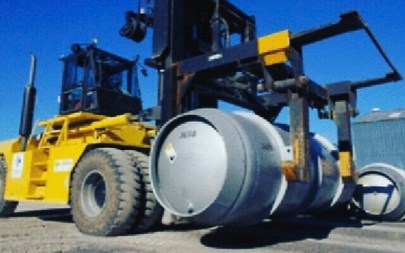
In this photo released by the Atomic Energy Organization of Iran on November 6, 2019, a forklift carries a cylinder containing uranium hexafluoride gas for the purpose of injecting the gas into centrifuges in Iran’s Fordo nuclear facility. (Atomic Energy Organization of Iran via AP)

Tehran’s violations — all announced in advance and verified by International Atomic Energy Agency inspectors — have been an attempt to pressure the other world powers involved, France, Germany, Britain, China and Russia, to offer new economic incentives to offset the effect of the American sanctions.

Iran has previously suggested it would walk back those activities if it receives the economic incentives it needs.

Also Wednesday, Rouhani accused the US and Israel of seeking to fuel domestic unrest in Iran, following recent protests in which rights groups said hundreds were killed in the government crackdown.

“The goal that the Americans and Zionists were pursuing by sanctions and putting maximum pressure on Iran was to push us into isolation, and incentivize the Iranian nation to rise against the state,” he said. “Despite what they thought, the Iranian nation resisted in spite of having hard living conditions because of unjust sanctions.”

Agencies contributed to this report.


Rocket fired from Gaza toward Israel; air force bombs Hamas arms factory 

December 19, 2019

Source: Rocket fired from Gaza toward Israel; air force bombs Hamas arms factory | The Times of Israel

Iron Dome intercepts projectile after warning sirens in Sderot, nearby communities; no reports of injury or damage; Israel strikes terror group’s facility, reduces fishing zone

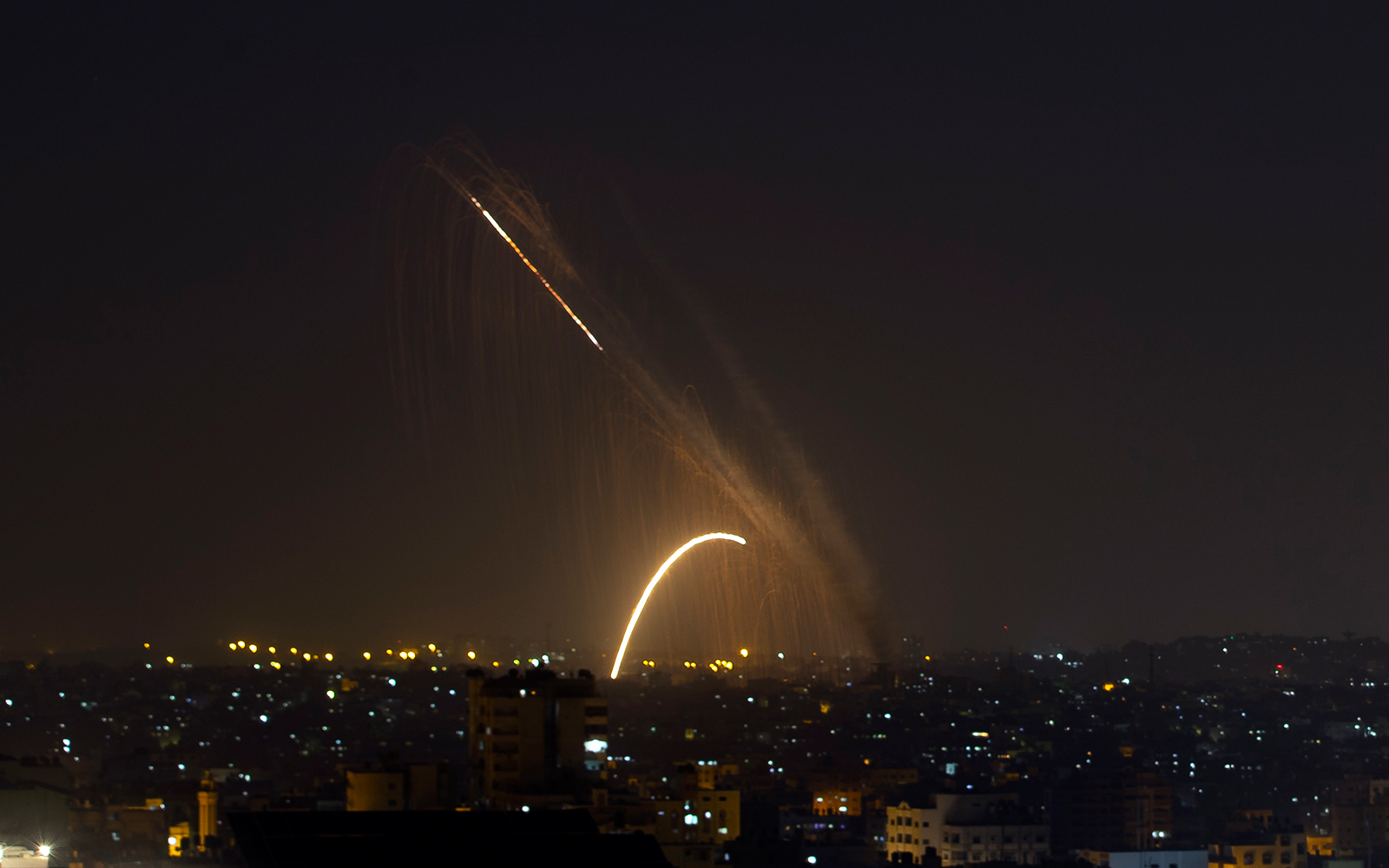
Illustrative: Rockets are launched from the Gaza Strip toward Israel, November 13, 2019. (AP Photo/Khalil Hamra)

Illustrative: Rockets are launched from the Gaza Strip toward Israel, November 13, 2019. (AP Photo/Khalil Hamra)

The air force bombed a Hamas weapons factory in the Gaza Strip before dawn Thursday after Palestinians fired a rocket at Israel which was intercepted by the Iron Dome system, the army said.

Rocket warning sirens wailed in the town of Sderot and other communities near the Gaza border just after midnight, sending residents rushing to bomb shelters.

The IDF said a single projectile was fired from Gaza and it was intercepted by the Iron Dome system. There were no reports of injury or damage.

Several hours later, the Israeli aircraft hit a Hamas weapons production facility in northern Gaza the army said, noting it holds the terror group, which rules Gaza, responsible for all violence emanating from it.

Israel later announced it had restricted the permitted fishing zone off the coast of the Gaza Strip to 10 nautical miles in response to the rocket fire.

The incident comes a day after an Israeli aircraft fired at and hit an armed Palestinian who approached the border fence between the Gaza Strip and Israel, the military said.

The military said the Palestinian was spotted by IDF observation posts as he neared the security fence in southern Gaza.

A Palestinian armed with what appears to be an assault rifle approaches the security fence between Gaza and Israel on December 17, 2019. (Screen capture: Israel Defense Forces)

Authorities in the Hamas-run Strip did not comment on the Palestinian suspect’s condition.

Footage of the incident, which was later distributed by the IDF, showed the suspect approaching the security fence armed with what appears to be an assault rifle. The video ends before the airstrike.

On Friday several thousand Palestinians protested on the Gaza border, with several hundred rioting and clashing with Israeli forces, as the coastal enclave’s Hamas rulers marked 32 years since the founding of the terror group.

The Hamas-run Gaza health ministry said five Palestinians were hurt in the clashes, which included the hurling of Molotov cocktails and other objects at IDF soldiers.

In addition to the border clashes, thousands took part in rallies in Gaza over the weekend to mark the 1987 anniversary of the Hamas terror group’s establishment.

Friday’s border demonstrations were part of the weekly March of Return protests that began last March and resumed earlier this month after a three-week hiatus following a large-scale battle in November between the IDF and Palestinian Islamic Jihad, the second largest terror group in Gaza.