Archive for November 2019

French defense chief takes aim at US for ‘unanswered’ Iran attacks

November 24, 2019

Source: French defense chief takes aim at US for ‘unanswered’ Iran attacks | The Times of Israel

Florence Parly bemoans American disengagement from region, says trend likely to continue ‘irrespective of who wins the next elections’; Saudi minister: US a ‘very dependable ally’

French Defense Minister Florence Parly at the French National Assembly in Paris, November 19, 2019. (Philippe Lopez/AFP)

French Defense Minister Florence Parly at the French National Assembly in Paris, November 19, 2019. (Philippe Lopez/AFP)

MANAMA, Bahrain (AFP) — French Defense Minister Florence Parly took aim Saturday at “gradual US disengagement” in the Middle East and said its failure to respond to provocations blamed on Iran set off a dangerous chain of events.

Since May, tensions in the Gulf have escalated alarmingly with attacks against tankers, a US unmanned drone being downed, and strikes on key Saudi oil facilities in September.

Iran was blamed but denied involvement.

Despite the attacks on its Saudi ally and having one of its own drones shot down, the United States has avoided equivalent retaliation.

“We’ve seen a deliberate gradual US disengagement,” Parly said at the annual Manama Dialogue on regional security, adding it had been “on the cards for a while” but had become clearer with recent events.

Iranian Revolutionary Guards patrolling around the British-flagged tanker Stena Impero as it was anchored off the Iranian port city of Bandar Abbas, on July 21, 2019. (Hasan Shirvani/ MIZAN NEWS AGENCY/AFP)

“When the mining of ships went unanswered, the drone got shot. When that in turn went unanswered, major oil facilities were bombed. Where does it stop? Where are the stabilizers?” she asked.

“The region is accustomed to the ebb and flow of US involvement. But this time it seemed more serious.”

Parly said the US drawback was a “slow process” and acknowledged that a US carrier strike group had just entered the Gulf.

“But the trend is, I think, quite clear and thus probably irrespective of who wins the next elections.”

The US aircraft carrier strike group Abraham Lincoln sailed through the Strait of Hormuz last week to show Washington’s “commitment” to freedom of navigation, the Pentagon said.

It was the first time a US aircraft carrier group has passed through the strait since Iran downed a US drone in June in the same area.

In this photo from the US Navy provided on November 19, 2019, the aircraft carrier USS Abraham Lincoln, left, the air-defense destroyer HMS Defender and the guided-missile destroyer USS Farragut transit the Strait of Hormuz with the guided-missile cruiser USS Leyte Gulf. (Mass Communication Specialist 3rd Class Zachary Pearson/U.S. Navy via AP)

Speaking from the same stage in Bahrain, Saudi Minister of State for Foreign Affairs Adel al-Jubeir insisted there was no US withdrawal from the region and no doubt about its commitment.

“We believe the US is very dependable ally, and has been for the past seven decades” he said of its staunch ally.

In this photo from February 4, 2019, Saudi Arabia Foreign Minister Adel al-Jubeir speaks with reporters during an European Union-Leagues Arab States ministerial meeting in Brussels. (John Thys/AFP)

“There is a desire in the US historically to try to retreat from the international scene, but that desire is not is reflected in America’s posture,” he said.

Jubeir defended Riyadh’s measured response to the September strikes, saying the kingdom was being “strategically very patient” in its investigation so there is “not a shadow of doubt” on where the drones and missiles came from.

“We have said all along we don’t want war, so to jump into war very quickly is not a rational position,” said Jubeir.

Red lines

The French defense minister also put herself at odds with the US on maritime security in the Gulf, after Washington earlier this month launched a maritime coalition based in Bahrain to protect shipping in the strategic Strait of Hormuz.

France instead favors a European mission which Parly said should be able to start “very soon.”

“We want to make clear that our policy is separate from the ‘maximum pressure’ American policy,” she said, referring to Washington’s increasing sanctions against Tehran.

“I would like to add that we are not subtracting anything, we are adding, as a number of countries would not have participated in the American initiative anyway.”

A picture obtained by AFP from Iranian News Agency ISNA on June 13, 2019, shows fire and smoke billowing from a tanker said to have been attacked in the waters of the Gulf of Oman, near the Strait of Hormuz. (ISNA/AFP)

In a wide-ranging and strongly-worded speech, Parly also spoke out on the dangers of chemical weapons again being used in Syria — an outcome that would be a red line for France.

“Yes there is a risk and when you look at [rebel-held] Idlib province there is a strong risk,” she said.

“I am convinced that if these weapons were used again that France would be ready to react again.”

US President Donald Trump, Brigitte Macron talks to French President Emmanuel Macron during the G7 family photo in in Biarritz, France, August 25, 2019. (Francois Mori/AP)

She also homed in on strains on NATO, saying it remained the cornerstone of security in Europe but that it was “time to move from the brain-dead to the brainstorm.”

French President Emmanuel Macron stirred controversy this month saying he believed NATO was undergoing “brain death,” lamenting a lack of coordination between Europe and the United States, in an interview with The Economist magazine.

Parly said proposals will be laid on the table at the alliance’s summit in London in December including for a group of “wise persons or elders to think about the future of NATO.”

 

US general warns Iran likely still plotting major Mideast attack 

November 24, 2019

Source: US general warns Iran likely still plotting major Mideast attack | The Times of Israel

Head of Central Command says US troop boost has probably not deterred Tehran from seeking to strike in region: ‘It’s the trajectory and the direction that they’re on’

In this photo from the US Navy provided on November 19, 2019, the aircraft carrier USS Abraham Lincoln, left, the air-defense destroyer HMS Defender and the guided-missile destroyer USS Farragut transit the Strait of Hormuz with the guided-missile cruiser USS Leyte Gulf. (Mass Communication Specialist 3rd Class Zachary Pearson/U.S. Navy via AP)

Iran is unlikely to have been undeterred by increased US troop deployment in the Middle East and remains on track to carry out a large-scale attack in the region, the head of the US military’s Central Command said in an interview published Saturday.

“My judgment is that it is very possible they will attack again,” Gen. Kenneth F. McKenzie told the New York Times.

Over the past summer Iran shot down an American drone with no retaliation from Washington. It has subsequently been blamed for — and denied — attacking international oil tankers and destroying large portions of a major Saudi petroleum facility.

The lack of serious consequences has led Israeli officials to warn an emboldened Tehran could seek a major attack on the Jewish state soon.

In this April1 14, 2018, file photo, then-Marine Lt. Gen. Kenneth “Frank” McKenzie speaks during a media availability at the Pentagon in Washington. (AP/Alex Brandon, File)

McKenzie himself did not address such a possibility but did warn that Gulf nations were in danger.

“It’s the trajectory and the direction that they’re on,” he stated. “The attack on the oil fields in Saudi was stunning in the depth of its audaciousness. I wouldn’t rule that out going forward.”

Earlier this month a US-led naval coalition officially launched operations in Bahrain to protect shipping in the troubled waters of the Gulf.

Iran, which has denied any responsibility for the mystery attacks, has put forward its own proposals for boosting Gulf security that pointedly exclude outside powers.

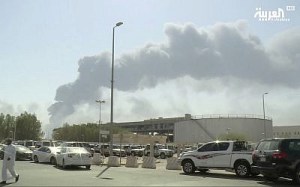
In this image made from a video broadcast on the Saudi-owned Al-Arabiya satellite news channel on September 14, 2019, a man walks through a parking lot as the smoke from a fire at the Abqaiq oil processing facility can be seen behind him in Buqyaq, Saudi Arabia. (Al-Arabiya via AP)

In June, US President Donald Trump called off a retaliatory strike after Iran downed an American drone that Tehran said entered its airspace. The US, which denied the drone entered Iranian skies, was later reported to have launched a cyberattack on Iran.

In September around half of Saudi Arabia’s oil production capacity was knocked offline due to an attack claimed by the Iranian-backed Houthi rebels in Yemen. There was no response to that attack, which the US, Israel and others also blamed on Iran.

And since May, there have been a series of attacks on oil tankers in the Persian Gulf. While Tehran denies being involved, the US Navy says Iran used magnetic mines on the vessels.

Netanyahu last month said Iran was emboldened by the lack of a response to the series of attacks attributed to it. He vowed Israel would respond forcefully to any attack.

On Tuesday, Iran’s Quds Force fired four missiles at Israel from Syria, according to the Israel Defense Forces. All four were shot down, and Israel responded a day later with a punishing round of airstrikes against Iranian and Syrian targets.

Iranian Revolutionary Guard Corps’ Quds Force commander Gen. Qassem Soleimani, center, attends a meeting with Supreme Leader Ayatollah Ali Khamenei and Revolutionary Guard commanders in Tehran, Iran, September 18, 2016. (Office of the Iranian Supreme Leader via AP)

At least 23 combatants were killed, 16 of them likely Iranians, according to a Syrian war monitor.

Israel has repeatedly said that it will not accept Iranian military entrenchment in Syria and that it will retaliate for any attack on the Jewish state from Syria.

A Lebanese newspaper on Thursday reported that Tuesday’s rocket attack on the Golan Heights from Syria was retaliation for recent Israeli strikes near a soon-to-be-opened border crossing along the Syria-Iraq frontier.

Israel fears the Albukamal crossing will be used by Iran to transport weapons, equipment and fighters through Iraq, into Syria and onward to Lebanon and other countries in the region.


PM Netanyahu’s chances of survival are drowning under a concerted political, legal, media onslaught – DEBKAfile

November 24, 2019

Source: PM Netanyahu’s chances of survival are drowning under a concerted political, legal, media onslaught – DEBKAfile

The shattering indictments for bribery and breach of faith brought against Prime Minister Binyamin Netanyahu,70, are only one stage in the relentless campaign to unseat him.

His decision to fight for his innocence and win round the voters in Israel’s third election in a year, in early 2020, has brought down on his head the full weight of the legal, political and media establishments. They have no qualms about bending the immunity law to force him to quit office without waiting for an absolute court judgement of his guilt.

If there was a concerted coup conspiracy to oust him, as he charges, it is far from over. Since the attorney general announced the indictments last Thursday, one voice after another has candidly proposed circumventing the legal process if that is the only way to remove Netanyahu as prime minister before his day in court. On Saturday, Nov. 22, a former high court justice, Eliahu Matza, joined the chorus of law enforcement voices when, in a radio interview, he pressed the Knesset to refer to the Supreme Court the decision on his competence to form a government. By law, this is the sole jurisdiction of parliament.

This was incidentally a sly attempt to exploit the crisis for promoting the court’s long machinations for asserting its authority over parliament.

On the political front, the opposition Kahol Lavan, whose leader Benny Gantz failed to form a new government, like Netanyahu before him, urged law enforcement authorities to force the prime minister to give up all his cabinet portfolios.

In answer to this chorus, Netanyahu released a video statement on Saturday pledging to abide by any court ruling in his case. “A court of trial is the only framework [for determining guilt or innocence] from beginning to end,” he said. If this declaration was intended to counter the charge that by putting up a fight, he was inciting a civil mutiny, it may have been the right way to go, but is unlikely to work. The parties who managed to throw him under the political-legal bus are not about to stop until their work is done and Netanyahu’s remarkable decade in office is brought to an end.

It is worth noting that the charges brought against his accused accomplices, Arnon Mozes, of the mass daily Yediot Aharanot, and the Elovich couple, are more serious that the cases against the prime minister. Yet they have rated little media notice. PM Netanyahu is the sole accused. He has only the slimmest hope of surviving the political bone-crusher smashing into him at every turn. With each assault, his popular support will melt and his loyalists be scared off. Shouted down are the voices claiming that all three are presumed innocent until proven guilty and if an indictment can cause the removal of a prime minister, then the police and legal authorities have seized control of government.

Israel’s founding father the late David Ben Gurion could have warned Netanyahu what was coming from his own experience. At the end of an epic career, Ben Gurion was challenged by forces determined to oust him. He fought back by invoking the legal system, demanding that a commission of inquiry get to the bottom of a failed clandestine operation. Ben Gurion also called on the voting public to vindicate him. He called in vain.

The late Yitzhak Rabin was ordered to resign as prime minister by the then Attorney General Aharon Barak, an act that signaled the historic downfall of the ruling Labor party. Yet another Israeli prime minister, the late Ariel Sharon, when he realized that law enforcement was about to close in on him, jumped the Likud ship. He established the Kadima party and switched his politics from right to moderate left, so saving his political life.
Netanyahu may or may not come up with an ingenious device for staying in office. But the way things look at present, he seems to have little choice but to quit politics and devote himself to clearing his name in court – a process that could drag on for years.


Israel’s challenge of confronting Gaza Islamist- Jerusalem Studio 467 

November 23, 2019


In US, Netanyahu indictment seen as cross-Atlantic version of Trump saga 

November 22, 2019

Source: In US, Netanyahu indictment seen as cross-Atlantic version of Trump saga | The Times of Israel

US president’s defenders and detractors, including Sen. Elizabeth Warren and pundit Mark Levin, note parallels between impeachment hearings and Israeli leader’s legal woes

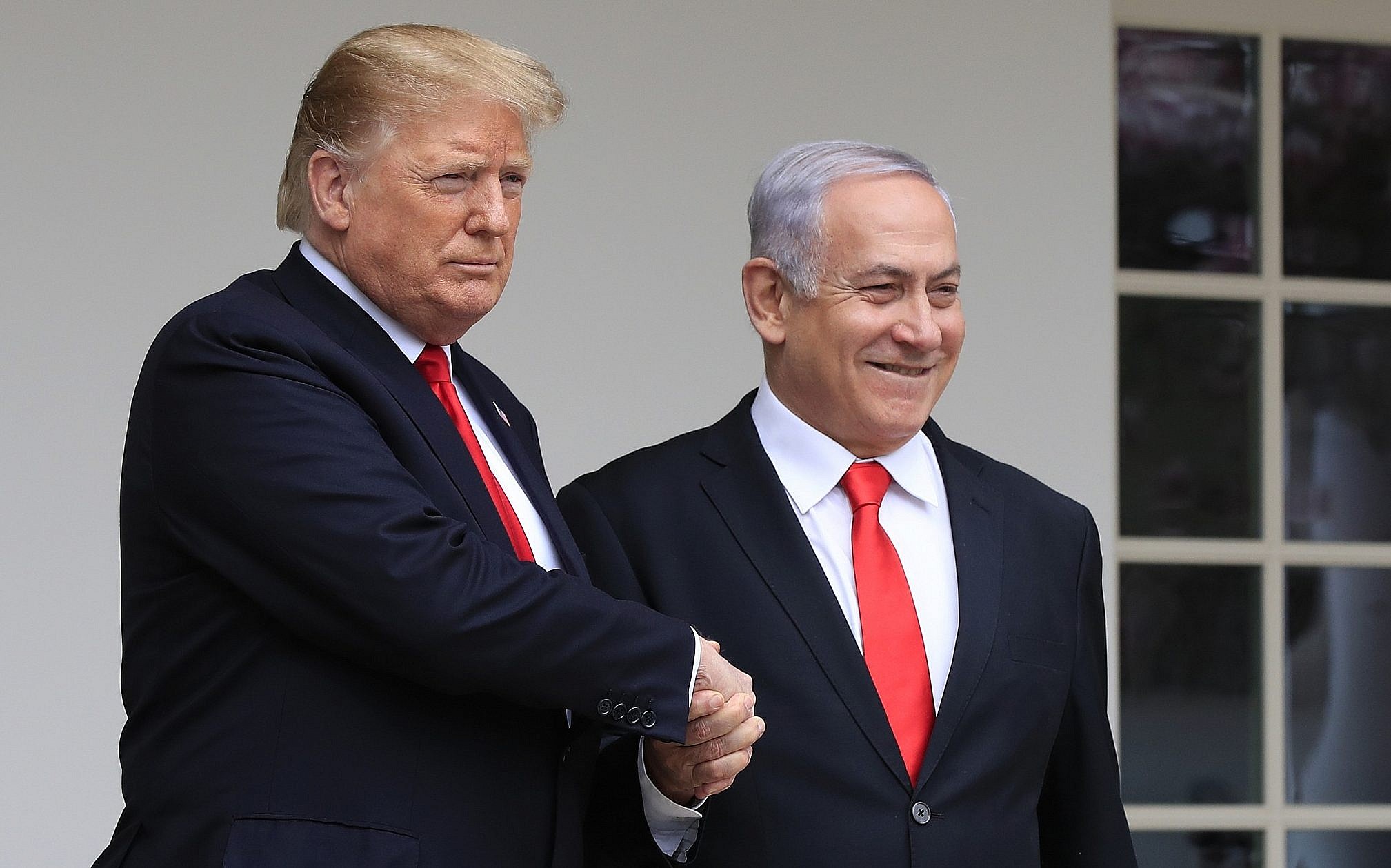
US President Donald Trump, left, welcomes visiting Prime Minister Benjamin Netanyahu to the White House in Washington, March 25, 2019. (Manuel Balce Ceneta/AP)

US President Donald Trump, left, welcomes visiting Prime Minister Benjamin Netanyahu to the White House in Washington, March 25, 2019. (Manuel Balce Ceneta/AP)

WASHINGTON — One is facing impeachment proceedings that could see him removed from office. One is being charged with bribery and fraud, and fighting for his political life.

As Attorney General Avichai Mandelblit announced Thursday that he would charge Prime Minister Netanyahu with criminal wrongdoing in three separate corruption cases against him, supporters and critics of US President Donald Trump across the Atlantic were quick to point at parallels between the two cases, drawing battle lines for and against Netanyahu.

“Netanyahu is accused of accepting bribes, trading government favors, and manipulating a free press,” tweeted Massachusetts Senator and Democratic presidential hopeful Elizabeth Warren, shortly after the charges were announced.

“Like his pal Donald Trump, he’ll stop at nothing to enrich himself and stay in power. This blatant corruption has no place in any democracy—I’ll fight it at home and abroad.”

Elizabeth Warren

@ewarren

CNN

@CNN

Israel’s attorney general has unveiled charges of bribery, fraud and breach of trust against PM Benjamin Netanyahu in three separate corruption investigations https://cnn.it/2qprWot 

“No, do NOT step down, Prime Minister Netanyahu,” tweeted right-wing talk radio host Mark Levin. “I’ve carefully reviewed these charges and they’re outrageous. This is an assault on freedom of the press and the investigation was corrupt. And your media is ever worse than ours.”

In a separate tweet, Levin, who has more than 1.8 million followers on Twitter, suggested a parallel illegitimacy between the indictment against Netanyahu and the impeachment inquiry into Trump. “Another free nation destroying itself from within,” he said.

Levin’s comments echoed those of Netanyahu himself, who responded to the announcement of the charges by delivering a televised address in which he accused the police and prosecution of an “attempted coup” and dismissed demands that he step down at least until after his trial.

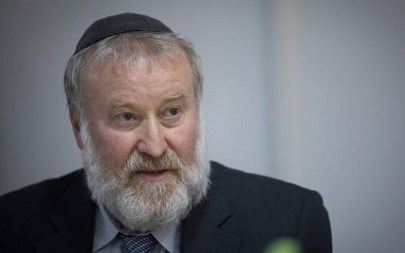
Attorney General Avichai Mandelblit holds a press conference at the Ministry of Justice in Jerusalem, announcing his decision that Prime Minister Benjamin Netanyahu will stand trial for bribery, fraud and breach of trust in three different corruption cases, dubbed by police Case 1000, Case 2000 and Case 4000. November 21, 2019. (Hadas Parush/FLASH90)

Mandelblit announced earlier in the evening that Netanyahu was being charged with fraud and breach of trust in two cases involving gifts and an alleged quid pro quo with a newspaper owner, and bribery, fraud and breach of trust in so-called Case 4000, in which he is accused of trading regulatory favors worth hundreds of millions of shekels in exchange for positive media coverage.

“Jealous of my Israeli colleagues for having an attorney general who isn’t a totally corrupt political hack,” tweeted Matt Duss, a foreign policy adviser to Vermont Senator Bernie Sanders, a frequent Netanyahu critic who is also running for the Democratic nomination.

Trump is facing impeachment proceedings in the House of Representatives over allegations he used aid money as a lever to pressure Ukrainian officials to investigate the son of former Vice President Joe Biden, seen as the front-runner in the Democratic primary.

Unlike in Israel, a US president cannot be charged with a crime while in office, though lawmakers can pass articles of impeachment against him and remove him from office. The bid is seen as a long shot, with Republicans still in control of the Senate, which must vote on removing the president.

This week saw devastating testimony against the president from several members of his administration, including his own hand-picked diplomats.

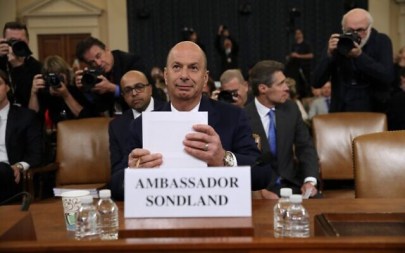
US Ambassador to the European Union, Gordon Sondland, told House members Wednesday that Trump directed him to pressure Ukraine to investigate the Bidens. “We followed the president’s orders,” he said.

Gordon Sondland, the US ambassador to the European Union, waits to testify before the House Intelligence Committee in the Longworth House Office Building on Capitol Hill November 20, 2019 in Washington, DC. (Drew Angerer/Getty Images/AFP)

Trump himself did not comment on Netanyahu’s legal woes, despite the two being seen as extremely close allies. That relationship has reportedly cooled in recent months as Netanyahu, who is technically a caretaker prime minister, has struggled to garner enough support to form a new governing coalition.

Observers have noted that both Netanyahu and Trump have used similar tactics to rally their bases while lashing out at what they see as the hostile media and the justice community.

Backing Netanyahu, frequent Trump defender and hawkish pro-Israel advocate Alan Dershowitz questioned the motives of Israel’s justice system.

Alan Dershowitz at NEP Studios in New York, February 3, 2016. (John Lamparski/Getty Images for Hulu, via JTA)

“I think we’re seeing the weaponization of criminal justice for political purposes,” he told the JNS news outlet. “In Israel, the attorney general is supposed to be outside of politics.”

Dershowitz, who appears frequently on CNN, is part of a legal team that submitted a legal brief to Mandelblit arguing it was a “dangerous threat” to a free press if Netanyahu’s seeking favorable media coverage would be considered bribery.

“Look, every politician wants good press, every politician wants to avoid bad press, and many politicians are prepared to cast votes in order to get good press and avoid bad press,” Dershowitz said. “Allowing prosecutors to probe the motives of media and politicians is an extremely dangerous road to go down.”

Despite Netanyahu vowing not to step down, the announcement was seen as welcome news to liberal American Jewish groups who regard the Israeli leader as an obstacle to a two-state solution and peace with the Palestinians.

“Netanyahu indictment confirms what we’ve said all along: he puts his own interests 1st,” tweeted T’Ruah, a progressive rabbinical group. “We look forward to new, ACTUAL leadership that can deliver justice and peace for Israelis and Palestinians.”

AIPAC and J Street did not comment on the indictment, the first time in Israeli history that a sitting head of government has been charged with criminal wrongdoing.

However, major Jewish umbrella group Conference of Presidents called the indictment announcement “deeply disturbing” but said that Netanyahu deserved due process.

“The State of Israel faces important decisions in the coming months as the legal process unfolds,” the organization said in a statement. “Israel has proven itself again to be a strong, vibrant democracy and holds even its top officials to account by the most stringent standards. No one is above the law. The Prime Minister like all citizens is entitled to his day in court and to a fair and full process.”

In Washington, Democratic Congressman John Yarmuth, who is Jewish, didn’t mince words.

“Netanyahu indicted in the middle of President Trump’s Impeachment inquiry,” he tweeted. “Bad week for criminal heads of state.”


An impassioned Netanyahu rails at ‘attempted coup’ by police, prosecutors 

November 21, 2019

Source: An impassioned Netanyahu rails at ‘attempted coup’ by police, prosecutors | The Times of Israel.

After AG says PM to stand trial for bribery, fraud and breach of trust, premier rules out quitting: ‘I won’t let the lie win. I will continue to lead this country with devotion’


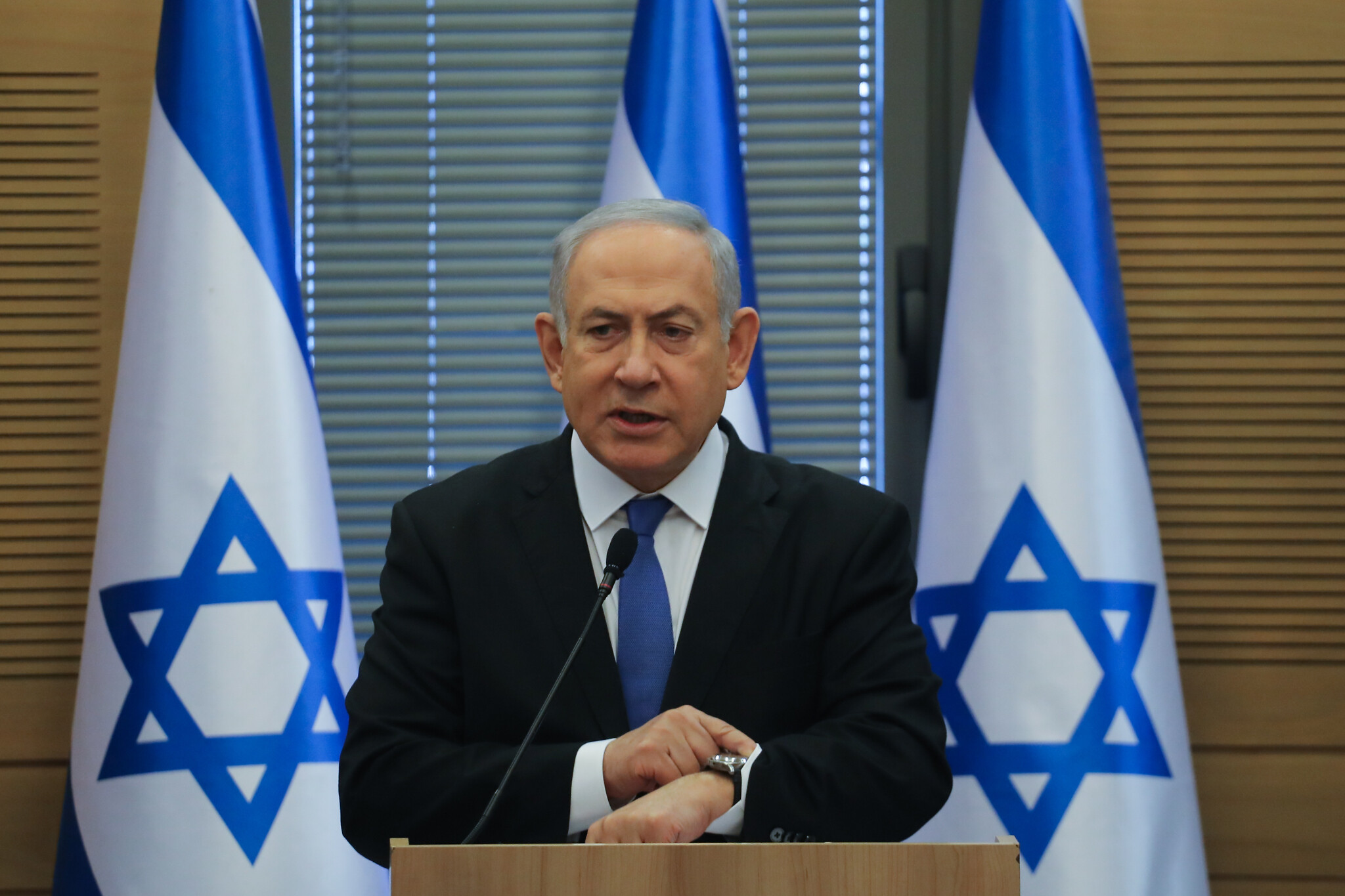
Prime Minister Benjamin Netanyahu speaks during a Likud faction meeting at the Kneeset, the Israeli parliament in Jerusalem on November 20, 2019. (Hadas Parush/Flash90)

Prime Minister Benjamin Netanyahu speaks during a Likud faction meeting at the Kneeset, the Israeli parliament in Jerusalem on November 20, 2019. (Hadas Parush/Flash90)

Prime Minister Benjamin Netanyahu on Thursday accused police and state prosecutors of an “attempted coup” against him, shortly after Israel’s attorney general announced he would be charged with criminal wrongdoing in three separate cases against him, including bribery in the far-reaching Bezeq corruption probe.

Attorney General Avichai Mandelblit’s decision, announced earlier Thursday, marked the first time in Israel’s history that a serving prime minister faces criminal charges, casting a heavy shadow over Netanyahu, Israel’s longest-serving prime minister, and his ongoing attempts to remain in power.

“I’ve given my life for this country, I fought for this country, was wounded for this country,” an emotional Netanyahu said in televised remarks Thursday night.

“I deeply respect the justice system in Israel. But you have to be blind not to see that something bad is happening to police investigators and the prosecution. We’re seeing an attempted coup by the police with false accusations” against him, he accused.

Responding to the prime minister’s speech, Blue and White chief Benny Gantz said Netanyahu “proved he must leave his position and focus on his legal affairs.” He expressed full support for the justice system and said the evening’s main takeaway was “no coup,” but rather a case of Netanyahu “entrenching” himself in power.

Blue and White leader Benny Gantz speaks to the press in Tel Aviv on November 20, 2019. (Jack Guez/AFP)

Netanyahu listed a litany of complaints about the conduct of the investigation, charging: “These facts emphasize how much this process is tainted. It’s meant to topple a right-wing prime minister, me. I, who unlike the left and the slanted media, want to institute a free market, not only in the economy but also a free market of ideas, who wants to see a strong country, not a weak, shrunken, bowed country.”

The “tainted investigation process, including inventing new crimes, has reached its apex today. It horrifies not only me, but masses of citizens in Israel, and not only on the right… This tainted process raises questions among the public about the police’s investigations and the prosecution. The public has lost trust in these institutions. It’s a process that’s taken place over many years. This is selective enforcement on steroids. It’s enforcement just for me.”

He called to establish an independent commission to investigate the conduct of investigators in his cases.

“It’s time to investigate the investigators, to investigate the prosecution that approves these tainted investigations. I respect the police, I respect the prosecutors. There are hundreds of them. But we have to understand that they’re not above criticism. This isn’t just about transparency, it’s about accountability.”

He urged Israelis “to demand: investigate the investigators.”

He brushed off calls for him to resign so he can deal with his legal troubles privately.

“My sense of justice burns within me. I cannot believe that the country I fought for and was wounded for, that I’ve brought to such achievements, that in this country, in its democracy, there will be this kind of tainted justice, of selective enforcement. I won’t let the lie win. I will continue to lead this country with devotion. For this country, for the rule of law, for justice, we have to do one thing: to finally investigate the investigators.”

According to the full indictment released by the Justice Ministry Thursday, Netanyahu will be charged with fraud and breach of trust in Cases 1000 and 2000, and bribery, fraud and breach of trust in Case 4000.

Mandelblit addressed the press in his office in the Justice Ministry in Jerusalem at 7:30 p.m. to formally announce the charges.

Prime Minister Benjamin Netanyahu chairs a cabinet meeting in Jerusalem on November 13, 2019. (Ronen Zvulun/Pool/AFP)

He called the decision “a difficult and sad day” and said his ruling was made “with a heavy heart but also without hesitation.

“Law enforcement isn’t optional. It’s not a question of politics. It’s a duty incumbent upon us…. We were not swayed by slander from all sides, and acted only to enforce the law,” he said, referring to criticism from Netanyahu supporters who have accused prosecutors of conducting a witch hunt to unseat the prime minister.

He called the accusations “dangerous” and said they were “playing with fire. It must stop. I call on everyone, and first and foremost the leaders of the state, you must distance yourself from discourse that threatens law enforcement officials. We’re not infallible or above criticism. But we acted without fear or prejudice, for the rule of law.”

In October, prosecutors and the prime minister’s legal team held several days of hearings in which Netanyahu’s attorneys sought to refute the allegations against him. The state prosecution said the premier’s defense had not managed to refute the charges.

“The attorney general’s decision on the prime minister was made after a thorough and deep examination of the numerous claims raised by the prime minister’s lawyers during the four days of the hearing in early October 2019,” the state prosecution statement said. “All claims were examined in depth as part of a regular work process deployed over many hours in which the State Attorney’s Office submitted in-depth reviews of hundreds of pages, relating to the claims raised at the hearing,” the state prosecution statement said.

Attorney General Avichai Mandelblit addresses the press after announcing his decision to indict Prime Minister Benjamin Netanyahu with bribery, fraud and breach of trust, at the justice ministry in Jerusalem on November 21, 2019 (TV screenshot)

“After all claims were reviewed, it was found that there were no claims that arose at the hearing to change the offenses attributed to the prime minister… However, some of the claims have led to changes in the indictment, even if not a change in the offense clauses themselves,” the statement added.

In Case 1000, involving accusations that Netanyahu received gifts and benefits from billionaire benefactors including Israeli-born Hollywood producer Arnon Milchan in exchange for favors, Mandelblit said he intended to charge Netanyahu with fraud and breach of trust — the latter being a somewhat murkily defined offense relating to an official violating the trust the public has placed in him. Milchan is not to be charged.

In Case 2000, involving accusations Netanyahu agreed with Yedioth Ahronoth newspaper publisher Arnon Mozes to weaken the circulation of a rival daily in return for more favorable coverage from Yedioth, Mandelblit said he would seek to charge the premier with fraud and breach of trust, while Mozes will be charged with bribery. The case is said to have been a contentious one in Mandelblit’s office, with many prosecution officials reportedly arguing that Netanyahu should be charged with bribery, while Mandelblit considered not charging the prime minister at all.

In Case 4000, widely seen as the most serious against the premier, Netanyahu is accused of having advanced regulatory decisions that benefited Shaul Elovitch, the controlling shareholder in the Bezeq telecom giant, in exchange for positive coverage from the Elovitch-owned Walla news site. In that case Mandelblit announced he intends to charge Netanyahu and Elovitch with bribery.

Israeli Prime Minister Benjamin Netanyahu speaks during a meeting of the right-wing bloc at the Knesset in Jerusalem on November 20, 2019. (GALI TIBBON / AFP)

Israeli law only requires that a prime minister step down if convicted, but experts have suggested that Netanyahu could have a “problem” if he seeks to stay in office after the formal indictment is filed. Under law and High Court of Justice precedent, ministers other than the prime minister are required to step down in such a situation. There is no clear legal rule regarding the prime minister.

It could, however, take months before formal charges are filed, as Netanyahu is expected to ask the Knesset for parliamentary immunity. The Knesset House Committee and plenum would have to rule on Netanyahu’s immunity, but the committee does not currently have any members, as no coalition agreement has yet been signed in the 22nd Knesset dividing up committee seats between the parliament’s factions.

Only once a new coalition is formed — either over the next several weeks or, failing that, after the next round of elections slated for March — can a Knesset House Committee take up the question.

Even if Netanyahu’s immunity request is rejected, it could take until May or June for the formal decision to be made. A formal indictment could still be more than seven months away.

Ehud Olmert, the country’s first former premier to serve prison time, stepped down from office in 2008 during the investigation into him, but before the intention to file charges was announced. He served 16 months in prison on corruption offenses and was released in July 2017

AG announces Netanyahu to stand trial for bribery, fraud and breach of trust

November 21, 2019

Source: AG announces Netanyahu to stand trial for bribery, fraud and breach of trust | The Times of Israel

Mandelblit’s decision is legal bombshell, marks first time in Israel’s history that serving PM faces criminal charges; premier to speak at 8:30 p.m.

Prime Minister Benjamin Netanyahu chairs a cabinet meeting in Jerusalem on November 13, 2019. (Ronen Zvulun/Pool/AFP)

Prime Minister Benjamin Netanyahu chairs a cabinet meeting in Jerusalem on November 13, 2019. (Ronen Zvulun/Pool/AFP)

In a decision that drastically shakes up Israeli politics amid already ongoing chaos, Attorney General Avichai Mandelblit announced Thursday that Prime Minister Benjamin Netanyahu will be charged with criminal wrongdoing in three separate cases against him, including bribery in the far-reaching Bezeq corruption probe.

The decision marks the first time in Israel’s history that a serving prime minister faces criminal charges, casting a heavy shadow over Netanyahu, Israel’s longest-serving prime minister, and his ongoing attempts to remain in power.

Netanyahu will be charged with fraud and breach of trust in Cases 1000 and 2000, and bribery, fraud and breach of trust in Case 4000, the state prosecution said in a statement. Mandelblit was set to address the press in his office in the Justice Ministry in Jerusalem at 7:30 p.m. to formally announce the charges. The Justice Ministry also released the full indictment, which is to be filed with the Jerusalem District Court.

“The attorney general’s decision on the prime minister was made after a thorough and deep examination of the numerous allegations raised by the prime minister’s lawyers during the four days of the hearing in early October 2019. All allegations were examined in depth as part of a regular work process deployed over many hours in which the State Attorney’s Office submitted in-depth reviews of hundreds of pages, relating to the allegations raised at the hearing,” the state prosecution statement said.

Attorney General Avichai Mandelblit attends a farewell ceremony for former justice minister Ayelet Shaked, at the Justice Ministry offices in Jerusalem on June 4, 2019. (Hadas Parush/ Flash90)

In October, prosecutors and the prime minister’s legal team held several days of hearings in which Netanyahu’s attorneys sought to refute the allegations against him.

“After all claims were reviewed, it was found that there were no claims that arose at the hearing to change the offenses attributed to the prime minister… However, some of the claims have led to changes in the indictment, even if not a change in the offense clauses themselves,” the statement added.

Netanyahu’s Likud party called on party activists to rally outside the prime minister’s Jerusalem residence to express their support for him Thursday night.

Netanyahu was set to give a statement to the media on the decision at 8:30 p.m.

The charges

According to the indictment, the prime minister “damaged the image of the public service and public trust in it,” and is suspected of abusing his position and status, and of knowingly “taking a bribe as a public servant in exchange for actions related to your position.”

The prime minister has repeatedly denied any wrongdoing in all three cases, and has alleged that the investigations against him are a “witch hunt” involving the left, the media and the police relentlessly pressuring a “weak” attorney general.

In Case 1000, involving accusations that Netanyahu received gifts and benefits from billionaire benefactors including Israeli-born Hollywood producer Arnon Milchan in exchange for favors, Mandelblit said he intended to charge Netanyahu with fraud and breach of trust — the latter being a somewhat murkily defined offense relating to an official violating the trust the public has placed in him. Milchan is not to be charged.

According to the indictment in this case, Netanyahu “damaged the image of public service and the public’s trust in it, in that while serving in public positions, and foremost as prime minister, you maintained for years an inappropriate relationship with Milchan and Packer.

“This included receiving benefits connected to your public positions totaling over NIS 700,000 (some $200,000) and acting in favor of businessman Milchan while in a severe conflict of interest.

“In your actions you allegedly abused your position and status and significantly and seriously harmed the propriety of the public administration, the integrity of public servants and public trust in public servants,” the charge sheet read.

In Case 2000, involving accusations Netanyahu agreed with Yedioth Ahronoth newspaper publisher Arnon Mozes to weaken the circulation of a rival daily in return for more favorable coverage from Yedioth, Mandelblit said he would seek to charge the premier with fraud and breach of trust, while Mozes will be charged with bribery. The case is said to have been a contentious one in Mandelblit’s office, with many prosecution officials reportedly arguing that Netanyahu should be charged with bribery, while Mandelblit considered not charging the prime minister at all.

The indictment said that Netanyahu and Mozes “recognized that the one had the ability to promote the other’s interest” in the run-up to the 2015 elections and discussed such possibilities.

“According to suspicions, in your actions while performing your duties you have committed acts that amount to breach of trust, and have caused substantial harm to the integrity [of the position] and the public’s trust.”

In Case 4000, widely seen as the most serious against the premier, Netanyahu is accused of having advanced regulatory decisions that benefited Shaul Elovitch, the controlling shareholder in the Bezeq telecom giant, in exchange for positive coverage from the Elovitch-owned Walla news site. In that case Mandelblit announced he intends to charge Netanyahu and Elovitch with bribery.

The indictment says the relationship between Netanyahu and Elovitch was “based on give and take,” and the prime minister’s actions benefiting Elovitch netted the businessman benefits to the tune of some NIS 1.8 billion ($500 million) in the period 2012-2017. In exchange, Elovitch’s Walla news site “published your political messages that you wished to convey to the public.

“You took benefits… while knowing you were taking a bribe as a public servant in exchange for actions related to your position.”

The prime minister’s actions, write state prosecutors, “were carried out amid a conflict of interests, the weighing of outside considerations relating to his own and his family’s interests, and involved the corrupting of the public servants reporting to him.”

Legal ramifications

Israeli law only requires that a prime minister step down if convicted, but experts have suggested that Netanyahu could have a “problem” if he seeks to stay in office after the formal indictment is filed. Under law and High Court of Justice precedent, ministers other than the prime minister are required to step down in such a situation. There is no clear legal rule regarding the prime minister.

It could, however, take months before formal charges are filed, as Netanyahu is expected to ask the Knesset for parliamentary immunity. The Knesset House Committee and plenum would have to rule on Netanyahu’s immunity, but the committee does not currently have any members, as no coalition agreement has yet been signed in the 22nd Knesset dividing up committee seats between the parliament’s factions.

Only once a new coalition is formed — either over the next several weeks or, failing that, after the next round of elections slated for March — can a Knesset House Committee take up the question.

Even if Netanyahu’s immunity request is rejected, it could take until May or June for the formal decision to be made. A formal indictment could still be more than seven months away.

Ehud Olmert, the country’s first former premier to serve prison time, stepped down from office in 2008 during the investigation into him, but before the intention to file charges was announced. He served 16 months in prison on corruption offenses and was released in July 2017.


Israeli President Tasks Parliament with Forming Government 

November 21, 2019


Rocket attack on Golan was response to IDF strike on Syria-Iraq border – report 

November 21, 2019

Source: Rocket attack on Golan was response to IDF strike on Syria-Iraq border – report | The Times of Israel

Russia claims Israel violated Jordanian and Iraqi airspace in recent Syria attacks, expresses ‘concern and resentment’

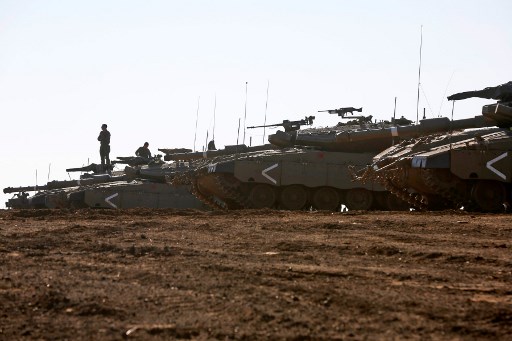
An Israeli soldier stands on a Merkava tank deployed on the Golan Heights on November 20, 2019. (JALAA MAREY / AFP)

An Israeli soldier stands on a Merkava tank deployed on the Golan Heights on November 20, 2019. (JALAA MAREY / AFP)

A Lebanese newspaper on Thursday reported that Tuesday’s rocket attack on the Golan Heights from Syria was retaliation for recent Israeli strikes near a soon-to-be-opened border crossing along the Syria-Iraq frontier.

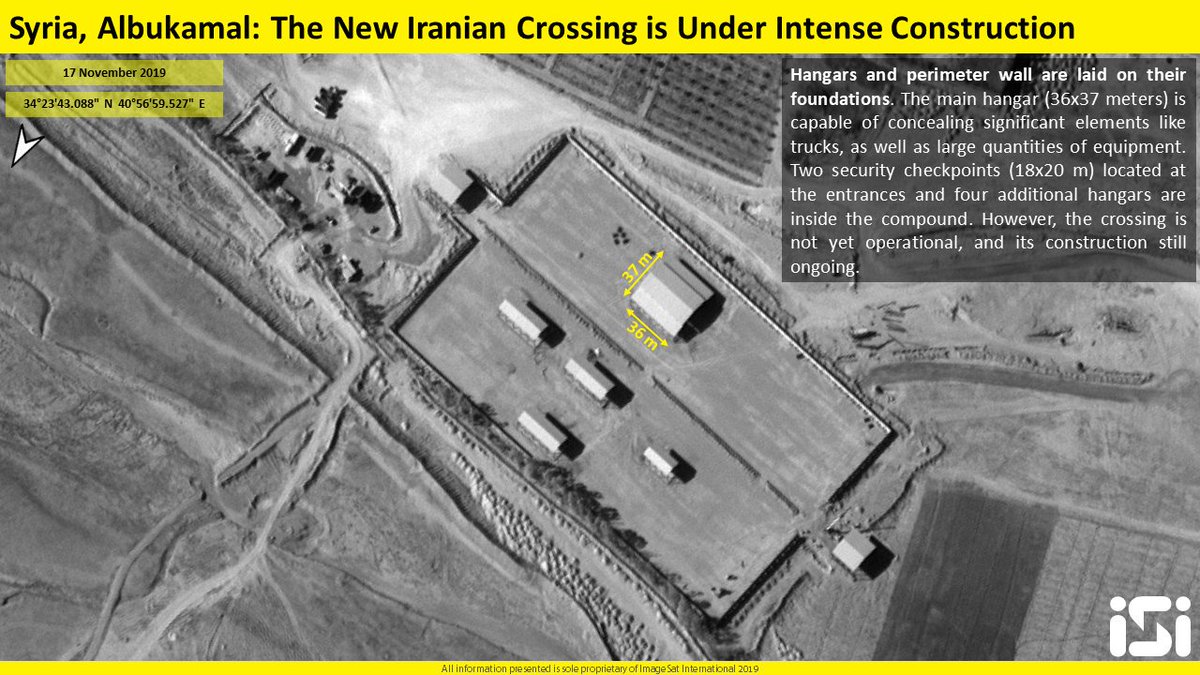
In recent months, construction has picked up around the Albukamal crossing, which Israel fears will be used by Iran to transport weapons, equipment and fighters through Iraq, into Syria and onward to Lebanon and other countries in the region.

A number of Israeli airstrikes have been reported in the Albukamal region in recent months, but the facility nevertheless appears poised to open.

According to the Lebanese newspaper al-Akhbar, citing Syrian military sources, Israel conducted such a strike eight days ago, bombing a truck that was passing through the area and killing the driver.

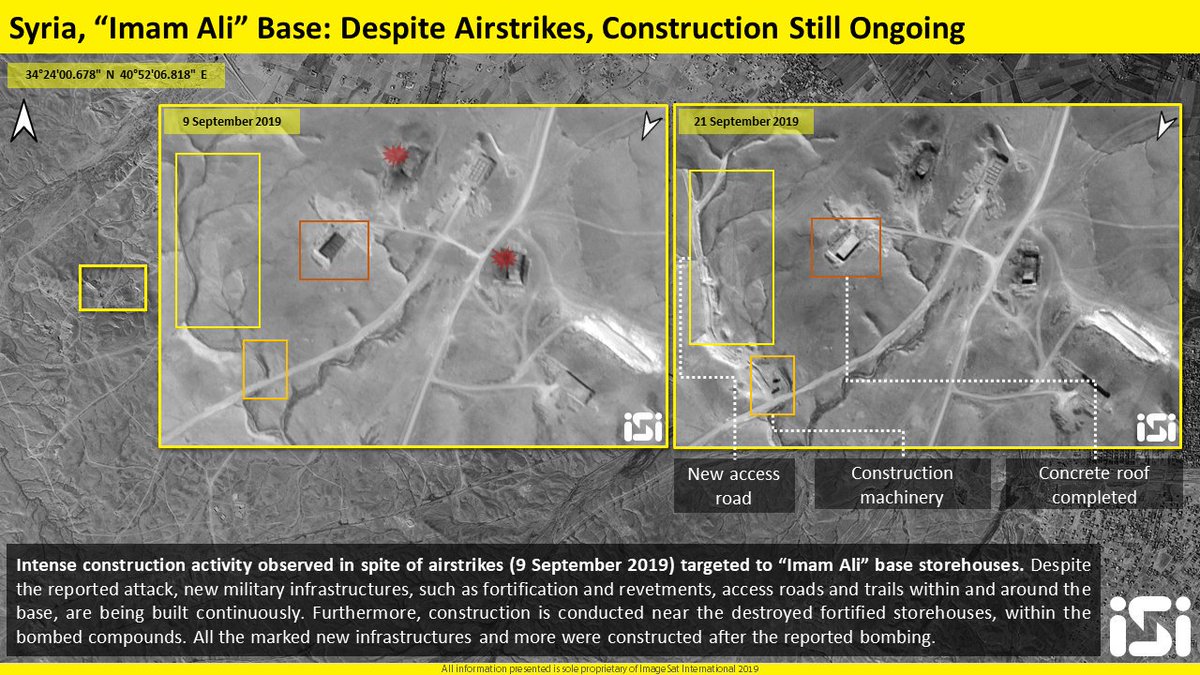
ImageSat Intl.@ImageSatIntl

4/6 – Intense construction activity is observed in spite of (9 September 2019) targeted to “” base storehouses, , .

View image on Twitter

ImageSat Intl.@ImageSatIntl

5/6 – The Iran-controlled in crossing in , near the official border crossing between and , is not yet operational, and its construction still ongoing.

View image on Twitter

The Russian Foreign Ministry late Wednesday night also said Israel conducted an attack on Monday, “with the Israeli aircraft reportedly violating the airspace of Iraq and Jordan.”

It was not immediately clear if these were two separate strikes or a discrepancy in the reported date of the same incident. The Israeli military refuses to comment on its airstrikes in Syria, save for those that are in response to attacks.

The Syrian military sources told al-Akhbar that “the enemy is seeking to destroy movement back and forth between Iraq and Syria in order to prevent the resistance axis from benefiting from that.

“The response of firing four rockets is tantamount to a message to the enemy that security in the Albukamal crossing is directly connected to the security of the state,” the Syrian sources said.

They added that the deadly strike on the truck also “demands a response in accordance with the established rules of engagement.”

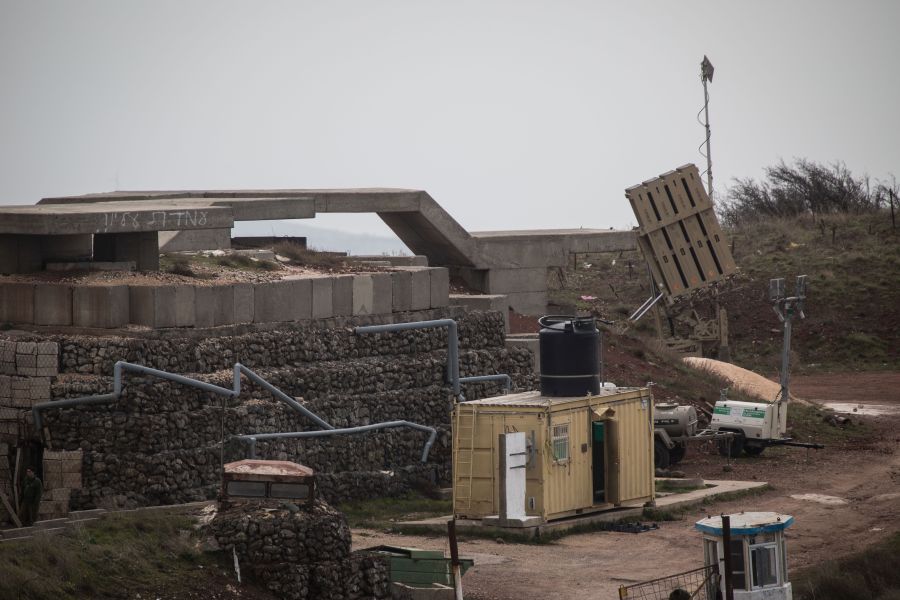
The four rockets were fired toward northern Israel from Syria early on Tuesday morning; all were intercepted by the Iron Dome missile defense system. In response, the IDF launched a series of airstrikes on dozens of Iranian and Syrian military targets in Syria in the predawn hours of Wednesday morning, killing between 10 and 20 fighters, according to a senior Israeli defense official who spoke on condition of anonymity. The death toll reported by a Syrian civil war monitor was somewhat higher.

In this photo released by the Syrian official news agency SANA, a damaged building targeted by Israeli missile strikes is seen in the Qudsaya suburb, west of the capital Damascus, Syria, Wednesday, Nov. 20, 2019. (SANA via AP)

On Wednesday night, the Russian Foreign Ministry said Israel’s airstrikes in Syria were “causing serious concern and resentment in Moscow.”

It said Israel fired 40 cruise missiles during its strikes, which were primarily focused on the Syrian capital of Damascus and the surrounding area.

Satellite images released Wednesday night showed the destruction caused by the strikes on two suspected Iranian headquarters around Damascus.

The photographs, distributed by the private Israeli intelligence firm ImageSat International, show two buildings that are believed to have been home to Iran’s Islamic Revolutionary Guard Corps’ Quds Force. One was located in Damascus’s international airport. The other was nearby at the al-Mazzeh airport just outside the capital.

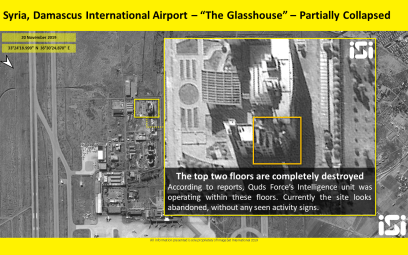
Satellite image showing the destruction caused by Israeli airstrikes to an alleged Iranian-controlled facility at the Damascus International Airport on November 20, 2019. (ImageSat International)

According to the Syrian Observatory for Human rights war monitor, at least 23 combatants were killed in Israel’s predawn airstrikes in Syria Wednesday, 16 of them likely Iranians.

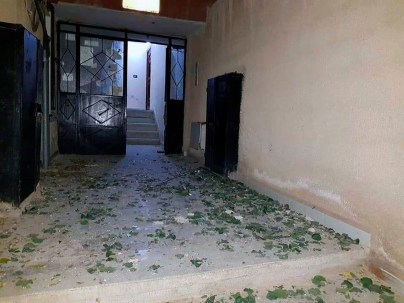
The official Syrian news outlet SANA said two civilians were killed by shrapnel when an Israeli missile hit a house in the town of Saasaa, southwest of Damascus. It said several others were wounded, including a girl in a residential building in Qudsaya, also west of the Syrian capital.

However, video footage from Syria appeared to show a Syrian air defense missile failing to launch and crashing to the ground in a heavily populated area shortly after launching, which may account for some of the civilian casualties.

The Israeli defense official disputed the Syrian figures, saying the military believes the death toll in its strikes was between 10 and 20, all of them fighters.

In Israel’s reprisal raids, the top two floors of the building at the Damascus airport — referred to by ImageSat as the Glasshouse — were destroyed.

According to the satellite imagery analysis company, the building was believed to have been used as a headquarters by the Quds Force’s intelligence unit.

“Currently the site looks abandoned, without any sign of activity,” the company said.

Satellite image showing the destruction caused by Israeli airstrikes to an alleged Iranian-controlled facility at the Damascus International Airport on November 20, 2019. (ImageSat International)

The senior defense official said the military believed that there were Iranians inside the building at the time of the strike.

“We struck a building staffed by Iranians at the Damascus airport. We assess that there are Iranians killed and injured,” the official said Wednesday.

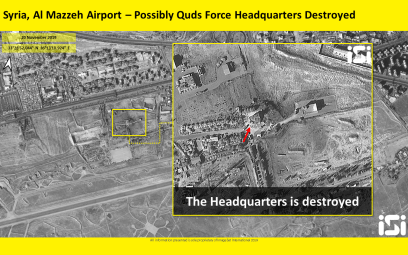
The second Quds Force headquarters at the al-Mazzeh airport was almost completely demolished in the strike.

A photograph of the site taken Tuesday showed two large rectangular buildings across from the one another. The image captured Wednesday after the strike showed one building completely leveled and the other mostly knocked down.

Satellite image showing the destruction caused by Israeli airstrikes to an alleged Iranian-controlled facility at the al-Mazzeh airport on November 20, 2019. (ImageSat International)

A long line of vehicles could also be seen around the site, apparently being used by search and rescue workers.

In addition to those two buildings, the IDF said it targeted dozens of other sites connected to the Quds Force on Syrian military bases. When Syrian air defenses fired on Israeli jets, the IDF also targeted those batteries, the military said.

The Britain-based monitoring group the Syrian Observatory for Human Rights said the airstrikes also targeted Quds Force arms depots in the Damascus suburbs of Kisweh and Qudsaya.

In this photo released by the Syrian official news agency SANA, a damaged building targeted by Israeli missile strikes is seen in Qudsaya suburb, western the capital Damascus, Syria, Wednesday, Nov. 20, 2019. (SANA via AP)

Pictures published by Syrian state news agency SANA showed heavy damage to buildings in Qudsaya, west of the capital.

Israel has repeatedly warned Syrian dictator Bashar Assad to not intervene during IDF strikes on Iranian targets in his country or else his military will also be targeted, as was the case Wednesday.

Following its reprisal raids, the Israeli military said it was readying for a potential Iranian retaliation.

An Israeli M109 self-propelled howitzer is stationed near the border with Syria in the Israeli-annexed Golan Heights on November 19, 2019, after Israeli air defenses intercepted four rockets fired from neighboring Syria. (JALAA MAREY / AFP)

“We are preparing for defense and attack, and we will respond to any attempt to retaliate,” IDF Spokesperson Hidai Zilberman told reporters first thing Wednesday morning.

Israel has repeatedly said that it will not accept Iranian military entrenchment in Syria and that it will retaliate for any attack on the Jewish state from Syria.

Israel has carried out hundreds of airstrikes in Syria against Iranian targets over the last several years, but does not generally comment on specific attacks. Iran has forces based in Syria, Israel’s northern neighbor, and supports Hezbollah and Gaza terrorists.

“Our message to the leaders of Iranian is simple: You are not immune anymore. Wherever you send your octopus tentacles — we will hack them off,” said newly installed Defense Minister Naftali Bennett on Wednesday.

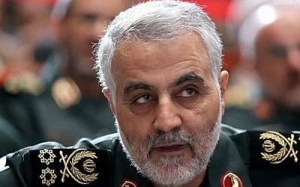
Iranian Revolutionary Guards’ Quds Force commander Maj. Gen. Qassem Soleimani. (YouTube screenshot)

Prime Minister Benjamin Netanyahu said of the strike: “I have made clear that any who attack us, we will attack them. That is what we did tonight toward military targets of the Iranian Quds Force and Syrian military targets.”

The Quds Force, led by Maj. Gen. Qassem Soleimani, is a part of the Islamic Republic Revolutionary Guards Corps responsible for extraterritorial operations, and is a key actor in Syria — both against rebels and in Tehran’s efforts to entrench itself along Israel’s border and threaten the Jewish state from there.

Times of Israel staff and AFP contributed to this report.


Israel on war alert for Iranian reprisal after IDF assaults on Al Qods’ Syrian bases – DEBKAfile

November 21, 2019

Source: Israel on war alert for Iranian reprisal after IDF assaults on Al Qods’ Syrian bases – DEBKAfile

Iran’s military array in and around Damascus was not eradicated as reported but severely damaged by Israel’s extensive air strikes early Wednesday, Nov. 20, DEBKAfile reports.

Only the Syrian air defense batteries which aimed at Israeli warplanes around Damascus and the Syrian Golan, were disabled – not its entire network. This point is important. Since the Israeli jets did not enter Syrian air space but struck from the skies of northern Israel and southern Lebanon, Syrian batteries were directed for the first time to try and down them while over Israel territory.

It is also important to note that the IDF account of the Iranian rocket attack on northern Israel of Tuesday, spoke of “heavy missiles,” a phrase that usually implies medium-range ground-to-ground ballistic missiles. This may be interpreted as a reference to Fatteh-110 missiles. They have a range of 500km and had they not been intercepted by Iron Dome defense batteries, they were therefore capable of reaching into central Israel, and not just the north.
This Iranian attack did not come out of the blue. It followed an earlier Israel strike that morning on one of its facilities near Abu Kamal close to the Syrian border with Iraq. By directing missiles at central Israel, Iran demonstrated two changes of tactics:

  1. Not only is Tehran determined to hit back for every Israeli attack, as it has threatened, but will do so in kind: For every IDF raid on its military assets deep inside Syrian or Iraqi terrain, Iran is poised to strike back similarly deep inside Israel.
  2. An attack on Israel’s central, most densely populated region, would inflict multiple civilian casualties. For that reason alone, the Iranian missile attack on Tuesday should be seen as the direct continuation of the Palestinian Islamic Jihad’s rocket fire from Gaza on the Israeli city of Beersheba on Nov. 16, i.e. three days earlier. Iron Dome batteries averted major tragedies in both cases, but while highly effective, they are not infallible.

Israeli forces are on high war alert at this moment due to the assessment that this is just the start of a major clash between the IDF and Iran’s elite Al Qods Brigades. Tehran is unlikely to let Wednesday’s massive Israeli air assault in Syria go unanswered and may well strike back within days or even hours.