Source: US policy shift on settlement leaves Obama’s legacy in the past – www.israelhayom.com
Washington’s move is a constructive step towards Israel ahead of the Trump administration’s introduction of the long-awaited “deal of the century.”
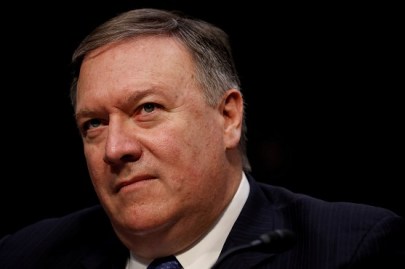
US Secretary of State Mike Pompeo | Photo: Reuters/Aaron P. Bernstein
The American recognition of Jerusalem as Israel’s capital and President Trump’s decision to recognize Israeli sovereignty over the Golan Heights are also staples on this new policy, which turned away from the thinking and action patterns of former presidents the likes of Obama and Jimmy Carter.
In this respect, a line can be drawn between the governments of Republican presidents Ronald Reagan and George W. Bush and the current president. This also stands in contrast to the policy pursued by Democratic presidents Carter and Obama, who sought a completely different path.
Carter, for example, made it a point to foster a special affinity not with Israel but rather with the Palestinians, and he spent most of his term, especially during his first two years in office, trying to establish a “homeland for the Palestinian people” while recognizing the PLO as their legitimate representative.
No one disputes the fact that it was this approach that gave rise to Carter’s firm opposition Judea and Samaria settlement enterprise, which he believed could undermine the chances of realizing the dream of the Palestinian state.
Nearly four decades later, it was Obama who produced another resounding expression of this policy, when he refrained from exercising the US veto to strike down UN Security Council Resolution 2334, which defined the settlements as “legally invalid.” This was the final tier of a long line of presidential statements that defined the settlements as “legitimate”.
This not only takes Obama right back to the Carter, but also ignored the basic American stance, formulated in the wake of the Six-Day War, which defined the settlements as a political issue that could impede the peace process in terms of political negotiation, but not as a legal issue expected to complicate the negotiations.
This uncompromising approach, based on a legal definition related to the status of the settlements, contradicted the position of Republican administrations. Those have had their reservations about the scope of settlement construction, but for the most part, they adopted a pragmatic approach on this issue. The latter created the occasional dispute between Jerusalem and Washington, but it never came close to jeopardizing the resilience and stability of the special relations between the two nations.
And so, not only did Reagan disapprove in 1981 of Carter’s approach to this issue. President George W. Bush went further and in a letter sent to then-Prime Minister Ariel Sharon on April 14, 2004, he acknowledged the “new demographic reality” created in the territories after 1967.
This reality, he implied, ruled out the possibility that Israel would be required, within the framework of the Israeli-Palestinian peace deal, to execute a full withdrawal to the 1967 lines.
Against this backdrop, Pompeo’s declaration can be seen not only as following in the footsteps of Reagan and Bush but more explicitly as an expression of the emphasis on the Trump administration placed on the historical dimension of the special US-Israel relationship.
It also puts a welcome end to the attempts by Carter and Obama to lend the issue of Israeli settlements in Judea and Samaria a dimension pertaining to international law.
It also stands to reason that it is no coincidence that Pompeo’s statement came a few days after the European Union’s top court ordered the mandatory labeling of goods produced beyond the Green Line, as it seeks to be a staunch denial of any attempt to tackle this complex issue with legal instruments.
But above all, Washington’s move can be seen as a constructive step towards Israel, hoping that on the basis of this solid friendship and demonstration of support over core issues, the Trump administration will be able to launch its “deal of the century” and expect that its Israeli partner will pull its weight in promoting it – all pending the establishment of a new government in Israel.
Source: Khamenei: Iran’s quashing of protests ‘hard blow’ to Zionism – Middle East – Jerusalem Post
Iranian leader claimed that “the enemies” spent a large amount of money designing the “conspiracy and were waiting for an opportunity to implement it with destruction, killing and villainy.”

The meeting took place during Basij, a week-long glorification of the volunteer paramilitary force associated with the Iranian Revolutionary Guards Corp (IRGC) that mostly deals with domestic security and threats, according to Radio Free Europe/Radio Liberty (RFERL).
Khamenei claimed that “the enemies” spent a large amount of money designing the “conspiracy, and were waiting for an opportunity to implement it with destruction, killing, and villainy,” adding that they thought they could use the hike in gas prices as an opportunity to carry out the “conspiracy.” “However, the Iranian nation quashed the enemy’s movement with its magnificent display,” he said.
“The magnificent movement of the Iranian nation – that began in Zanjan and Tabriz, even spread to some villages, and ended in Tehran – was a hard blow to Global Arrogance and Zionism, forcing them to retreat,” said Khamenei, stressing that the actions of the Iranian nation were more important than the actions of the police, the IRGC and the Basij.
The supreme leader called the week of protests – during which, according to Radio Farda, over 140 people were killed by security forces and up to 7,000 people were arrested throughout the country – “the highlight of the Iranian nation’s magnificence and greatness.”
Khamenei pointed out that the Basij was formed by the founder of the Islamic Republic, Ruhollah Khomeini, in the wake of the capture of the American embassy in Tehran after the US began threatening Iran. “He turned that threat into an opportunity,” said Khamenei, adding that “the main essence and logic behind the Basij is to eliminate threats and to turn them into opportunities.”
“The Islamic system is based on Islamic principles and values, and Islam is the outspoken champion of justice and freedom,” stressed Khamenei. “On the other hand, the Domineering Powers — led by tyrants — are fundamentally opposed to freedom and justice.” To emphasize this point, Khamenei pointed out that in the “Domineering Powers,” the majority of wealth belongs to a limited group and that the rest of the population must work too hard.
Khamenei compared the Basij to Hezbollah in Lebanon and the Popular Mobilization Forces (known as the Hashd al-Sha’abi) in Iraq.
“A large and magnificent group such as the Basij in Iran, or similar examples in other countries, are exposed to the hostility of the Domineering Powers more than other groups, in the same way that the Hashd al-Sha’abi in Iraq and the Hezbollah in Lebanon are opposed and confronted,” said Khamenei.
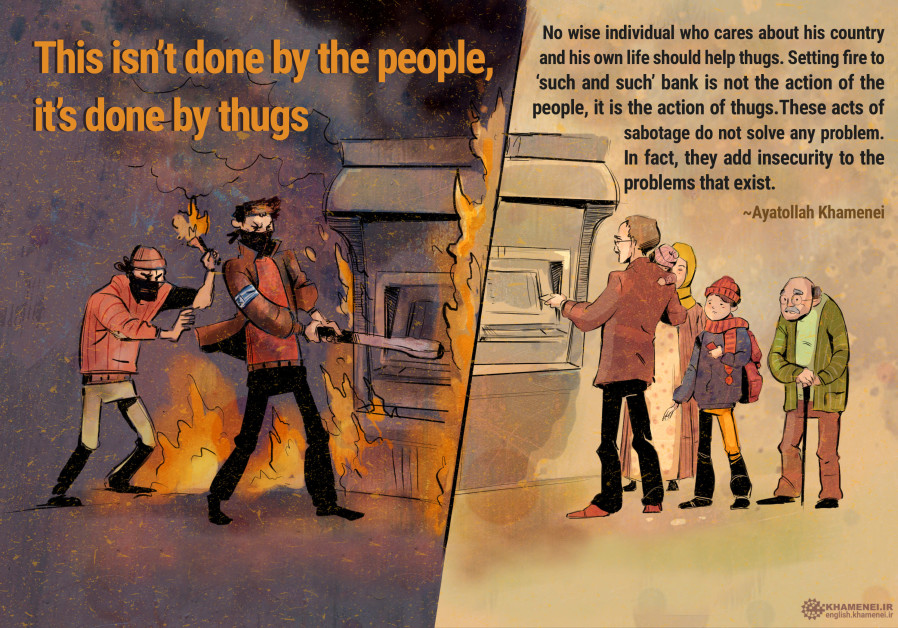
Earlier, Khamenei referred to the protests as the “action of thugs,” stressing that these actions “do not solve any problem.” Officials have previously blamed “thugs” linked to exiles and foreign foes – the United States, Israel and Saudi Arabia – for stirring up the unrest.
State authorities warned “rioters” of severe punishment if unrest continued. They said late last week that disturbances had ceased, although unverified videos, posted on social media after restrictions on Internet access were partially lifted, suggested sporadic protests were continuing in some places.
Reuters contributed to this report.
Source: Iraq demonstrators burn down Iranian consulate; protester killed, 35 injured | The Times of Israel
Iranian diplomatic staff escape unharmed through back door; 6 other protesters killed across country as death toll in anti-corruption rallies tops 350
Anti-government protesters burned down the Iranian consulate building in southern Iraq on Wednesday, while six protesters were killed by security forces who fired live rounds amid ongoing violence, Iraqi officials said Wednesday.
Protesters destroyed the Iranian consulate in the holy city of Najaf in the evening. One protester was killed and at least 35 people were wounded when police fired live ammunition to prevent them from entering the building, a police official said. Authorities declared curfew in Najaf after the incident. The official spoke on condition of anonymity, in line with regulations.
The demonstrators removed the Iranian flag from the building and replaced it with an Iraqi one. Iranian staff were not harmed and escaped the building from the back door.
The incident marked an escalation in the demonstrations that have raged in Baghdad and across the mostly Shiite southern Iraq since October 1. The protesters accuse the Shiite-led government of being hopelessly corrupt and complain of poor public services and high unemployment. They are also decrying growing Iranian influence in Iraqi state affairs.
Security forces have fired bullets, tear gas and smoke bombs on a near daily basis since the unrest began. At least 350 people have been killed and thousands wounded, in what has become the largest grassroots protest movement in Iraq’s modern history.
Two protesters were killed and 35 wounded when security forces fired live rounds to disperse them from Baghdad’s historic Rasheed Street, security and hospital officials said.

The street, which is adjacent to the strategic Ahrar bridge, has been the focus of violence for a full week, with near daily incidents of deaths as a result of security forces using live ammunition and tear gas to repel demonstrators from advancing beyond a concrete barrier. The officials spoke on condition of anonymity in line with regulations.
Protesters are occupying three key bridges in central Baghdad — Jumhuriya, Ahrar and Sinar — in a standoff with security forces. On Wednesday, they also burned tires on Ahrar Bridge to block security forces from accessing the area.
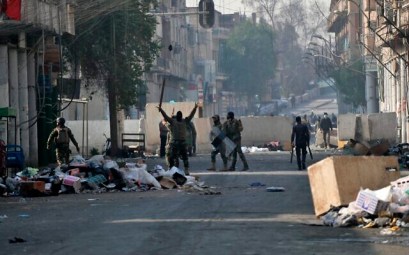
In Karbala, four protesters were killed by live fire from security forces over the previous 24 hours.
Three of the anti-government protesters were killed when security forces fired live rounds to disperse crowds in the holy city of Karbala late Tuesday, security and medical officials said. One protester died of wounds suffered when a tear gas canister struck him in clashes earlier in the day. The officials spoke on condition of anonymity, in line with regulations.
Three simultaneous explosions rocked Baghdad late Tuesday, killing five people and wounding more than a dozen, Iraqi officials said, in the first apparent coordinated attack since anti-government protests erupted. The bombings took place far from Baghdad’s Tahrir Square, the epicenter of weeks of anti-government protests that have posed the biggest security challenge to Iraq since the defeat of the Islamic State group.
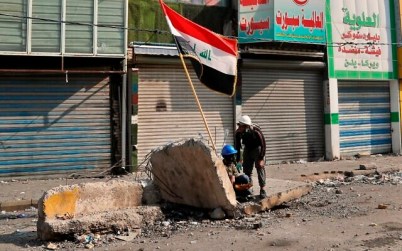
Roads between Karbala and Baghdad were blocked by protesters Wednesday. Demonstrators have burned tires and cut access to main roads in several southern provinces in recent days.
In the southern city of Basra, protesters continued to cut major roads to the main Gulf commodities ports in Umm Qasr and Khor al-Zubair, reducing trade activity by 50 percent, according to port officials who spoke on condition of anonymity, because they were not authorized to speak to reporters.
Protesters also blocked roads leading to major oil fields in West Qurna and Rumaila. A senior oil ministry official said crude production was not impacted by the closures.




 WarSclerotic
Recent Comments