Archive for November 24, 2019

U.S. calls on Facebook, Twitter to take down Iranian leaders’ accounts 

November 24, 2019

Source: U.S. calls on Facebook, Twitter to take down Iranian leaders’ accounts – Middle East – Jerusalem Post

“It is a deeply hypocritical regime. It shuts down the Internet while its government continues to use all these social media accounts,” said US Special Representative for Iran Brian Hook.

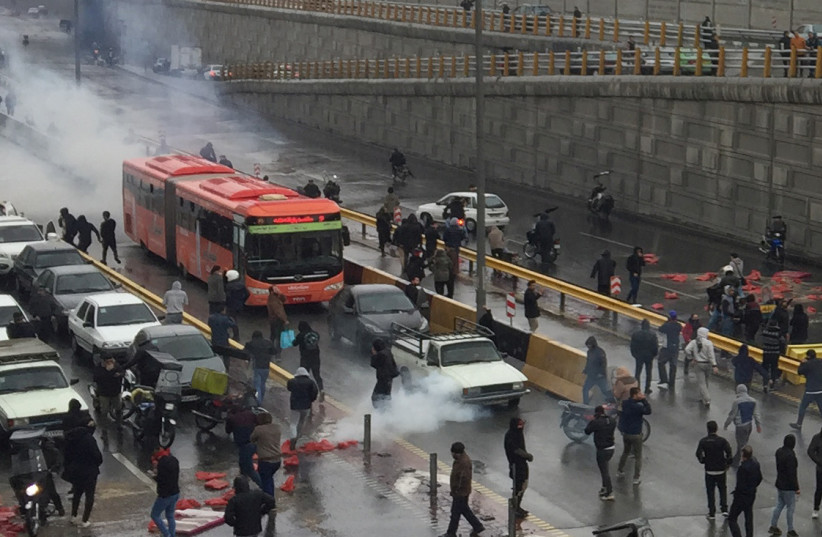
People protest against increased gas price, on a highway in Tehran, Iran November 16, 2019.
(photo credit: REUTERS)
U.S. State Department has called on social media giants such as Facebook and Twitter to take down the accounts of Iran’s Supreme leader Ali Khamenei and Iranian President Hassan Rouhani as Tehran’s authorities are carrying out a forceful crackdown against widespread protests, which included shutting off the internet.

“It is a deeply hypocritical regime. It shuts down the Internet while its government continues to use all these social media accounts. So one of the things that we are calling on are social media like Facebook and Instagram and Twitter to shut down the accounts of Supreme leader Khamenei, Foreign Minister Zarif and President Rouhani until they restore the Internet to their own people,” US Special Representative for Iran Brian Hook told Bloomberg on Saturday.

A clip from the interview has been shared by the State Department’s Twitter account.

Department of State

@StateDept

Special Representative for Iran Hook urges @Facebook, @instagram, and @Twitter to suspend the accounts of the Iranian regime’s leadership, who’ve shamelessly used social media to spew propaganda while shutting down the internet for ordinary Iranians.

Video incorporato

“Right now, the regime shut down the internet because they’re trying to hide all of the death and tragedy the regime has been inflicting on thousands of protesters around the country,” he further said.

Protests broke out all over Iran after the government announced that it would double the price of gasoline earlier this month.

From Ahwaz to Mashhad to Shiraz, tens of thousands took to the streets. Iran’s regime was initially caught off guard by the mass protest. Buildings were burned, and security forces did not respond. The regime cut off the Internet and began shooting people 24 hours later.

For 113 hours, from November 16 until Thursday, Iran was in the dark. Net Blocks, which tracks Internet connectivity, showed that at the 113th hour, a small return to connectivity had begun in Iran.Radio Farda, the Iranian branch of the U.S. government-funded Radio Free Europe/Radio Liberty, reported that Tehran’s government claimed that five people have died since the beginning of the protests, but independent human rights groups stated that the toll have reached at least 100 people.

According to AFP, Facebook, Twitter and Instagram did not immediately to a request for comment.

Seth Frantzman contributed to this report.


High Court to NGO: Don’t jump the gun on firing Netanyahu 

November 24, 2019

Source: High Court to NGO: Don’t jump the gun on firing Netanyahu – Israel News – Jerusalem Post

Netanyahu may give up other ministries.

Prime Minister Benjamin Netanyahu is right on time at the opening of the 22nd Knesset on October 3
(photo credit: MARC ISRAEL SELLEM)

High Court of Justice Judge Menachem Mazuz told an NGO Thursday evening that it had jumped the gun in asking the court to fire Prime Minister Benjamin Netanyahu, following Thursday’s decision by Attorney-General Avichai Mandelblit to issue a final indictment against him for public corruption.

Mazuz’s ruling does not mean that Netanyahu is out of the woods as much as it means that the NGO, the Movement for Quality  Government in Israel, will need to check in with Mandelblit about what actions he may take regarding the prime minister before the petition can proceed.

Further, the movement will need to double-check with Netanyahu about whether reports are accurate that he will relinquish side ministries he currently holds.

Earlier Thursday, the NGO became the first to file such a petition, with the Labor Party and others vowing to do the same in the near future.

Although the dry law of Knesset statutes only requires a prime minister to resign if convicted and after all appeals have been exhausted, it has been expected that various groups would seek to force his resignation based on a decades-old judge-made law requiring ministers to resign upon indictment.

In the petition, the movement said: “Woe to us if a prime minister under indictment drags the entire State of Israel down with him into the court room.”

In parallel to the High Court petition, a number of groups are trying to get Mandelblit and the state prosecution to intervene even before the High Court gets involved – hoping that the attorney-general will ask or instruct Netanyahu to resign or tell the prime minister that he is unfit to run for reelection.

This seems to be the focus of Mazuz’s ruling – that no petition should be filed before Mandelblit has published his opinion on the issue.

Besides the differing interpretations about whether a prime minister needs to resign, the law does not specifically address whether a serving prime minister can run for reelection once under indictment.

Another option would be for Mandelblit or the High Court to encourage or direct Netanyahu to declare himself temporarily incapacitated until the public corruption case is resolved.

The attorney-general himself is undecided at this point about what to do, but he and his top aides are consulting on the issue.

In the past, The Jerusalem Post received indications that Mandelblit believed Netanyahu would end up having to resign if indicted specifically for bribery, while he might not have had to resign if indicted for only fraud and breach of public trust.

Ultimately, Mandelblit’s charges against Netanyahu included a bribery charge.

In public statements, Mandelblit has said that all of these legal issues are unsettled – meaning there are multiple interpretations one could make – and that he would only form a concrete view if and when an indictment was issued.

At the same time, he issued a final indictment months ago against Haim Katz, but has not forced him to resign from the Knesset or begun his trial. Rather, he has only forced him to resign as a minister.

With the Knesset out of session for an extended period, there is speculation that Netanyahu and Katz could delay their trials until after a new Knesset reconvenes, since the immunity of Knesset members is usually removed by a Knesset committee.

However, there are interpretations that under the current circumstances, the immunity could be waived in various ad hoc processes.

There is also speculation that even if Mandelblit personally believes that Netanyahu should resign, he will not want to be the official who forces him out early, preferring to leave the decision to the courts or to the political process.

If Netanyahu resigns his additional ministries, that would open up the top positions in the Health, Social Welfare and Diaspora Affairs ministries, as well as the position of acting agricultural minister.


Netanyahu: We will stop Iran’s attempts to use Yemen, Iraq against Israel 

November 24, 2019

Source: Netanyahu: We will stop Iran’s attempts to use Yemen, Iraq against Israel – Israel News – Jerusalem Post

Netanyahu, who was accompanied by Defense Minister Naftali Bennett, said that Israel’s responsibility and willingness to fight against Iranain aggression is “absolute.”

Prime Minister Benjamin Netanyahu and Defense Minister Naftali Bennett tour Mount Avital in the Golan Heights (photo credit: HAIM ZACH/GPO)
Prime Minister Benjamin Netanyahu and Defense Minister Naftali Bennett tour Mount Avital in the Golan Heights
(photo credit: HAIM ZACH/GPO)
Israel will take action to thwart Iranian efforts to turn Iraq and Yemen into bases for rocket and missile attacks against Israel, Prime Minister Benjamin Netanyahu said Sunday during a tour to the Golan Heights.

“Iran’s aggression in the region and against us continues,” Netanyahu said at Mount Avital. “We are taking all the actions necessary to prevent Iran from entrenching itself in the region. This includes action necessary to thwart the transfer of lethal weapons from Iran to Syria, via the air or sea.”

Netanyahu, who was accompanied by Defense Minister Naftali Bennett, said that Israel’s responsibility and willingness to fight against Iranain aggression is “absolute,” and that Jerusalem is using all means to keep Iran for achieving its aims.

“I cannot provide any more details, but this is a process taking place all the time,” he said.

Netanyahu’s words came days after Israel and Iran traded blows in the north, with four rockets fired on Israel from Syria after an attack on an installation near Damascus. Israel  responded to the rocket attack by hitting some 20 targets in Syria.

Bennett said that the “Iranian terror units have nothing to look for in Syria.”

Should they attempt to establish their presence there, he said they will “find a strong and powerful IDF that will hurt them.”He suggested the Iranian authorities “focus on your own citizens [by] improving the lives of those who reside in Iran and not the useless attempt to harm Israeli citizens.


Lebanese magnate buys up Hitler items at auction, donates to Israeli group 

November 24, 2019

Source: Lebanese magnate buys up Hitler items at auction, donates to Israeli group | The Times of Israel

( Decency has no borders.  God bless Abdallah Chatila… – JW )

Abdallah Chatila says he purchased 10 items including fuhrer’s hat at controversial Munich sale to keep them out of hands of neo-Nazis

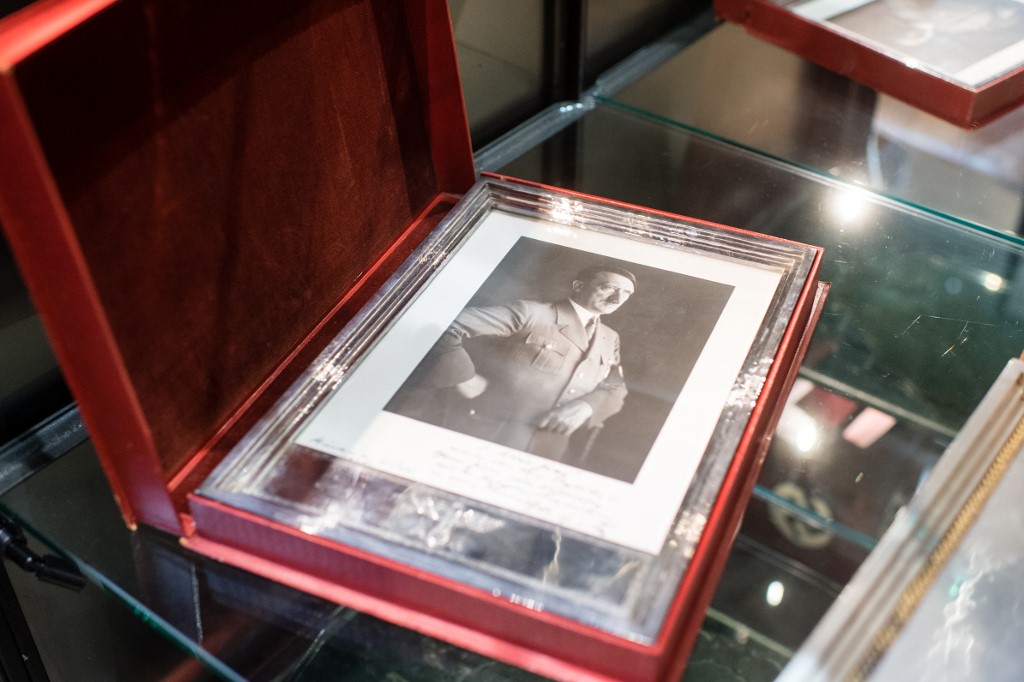
A framed portrait of Adolf Hitler is pictured on November 20, 2019, at the Hermann Historica auction house in Grasbrunn near Munich, southern Germany, prior to an auction of personal belongings from German dictator Adolf Hitler and other notorious World War II Nazi leaders. (Matthias Balk/dpa/AFP)

A framed portrait of Adolf Hitler is pictured on November 20, 2019, at the Hermann Historica auction house in Grasbrunn near Munich, southern Germany, prior to an auction of personal belongings from German dictator Adolf Hitler and other notorious World War II Nazi leaders. (Matthias Balk/dpa/AFP)

GENEVA, Switzerland — A Lebanese businessman living in Switzerland has offered Adolf Hitler’s top hat and other former possessions to the Israel-based Keren Hayesod, an umbrella body for pro-Israel fundraising in Diaspora Jewish communities.

Abdallah Chatila, who made his fortune in diamonds and real estate in Geneva, said he had bought the items at a controversial auction in Germany last week in order to keep them out of the hands of neo-Nazis.

He “wanted to buy these objects so that they would not be used for neo-Nazi propaganda purposes,” Chatila told the Swiss weekly Le Matin Dimanche. “My approach is totally apolitical and neutral.”

Chatila spent 545,000 euros ($601,000) on 10 lots at the Wednesday auction in Munich by the German auction house Hermann Historica, including a top hat worn by Hitler, his cigar box and typewriter, as well as a luxury edition of his book “Mein Kampf” embossed with an eagle and a swastika that belonged to the Nazi leader Hermann Goering, one of Hitler’s chief lieutenants.

Swiss-Lebanese businessman Abdallah Chatila. (YouTube screen capture)

“Far-right populism and anti-Semitism are spreading all over Europe and the world, I did not want these objects to fall into the wrong hands and to be used by people with dishonest intentions,” Chatila told the Swiss weekly.

Born in Beirut in 1974 to a family of Christian jewelers, Chatila is one of the 300 wealthiest people in Switzerland.

He told the paper that the Nazi artifacts “should be burned,” but that “historians think that they must be kept for the collective memory.”

He said he had made contact with Keren Hayesod, which was acting “for the building and development of the State of Israel.”

A man holds a top hat with the initials “AH” for Adolf Hitler, from the J. A. Seidl hat manufacturer, on November 20, 2019, in Grasbrunn near Munich, southern Germany, prior to an auction of personal belongings of the German dictator and other notorious World War II Nazi leaders. (Matthias Balk/dpa/AFP)

“I’m going to give them those objects… that should be exhibited in a museum.”

The auction sparked an uproar in Germany, particularly in the Jewish community.

Rabbi Menachem Margolin, president of the European Jewish Association, said earlier this month that Germany was “in the forefront in Europe with regard to the number of reported anti-Semitic incidents.”

The EJA called on “German authorities to oblige the auction houses to disclose the names of buyers,” which “could then be placed on a government list of people to watch.”


French defense chief takes aim at US for ‘unanswered’ Iran attacks

November 24, 2019

Source: French defense chief takes aim at US for ‘unanswered’ Iran attacks | The Times of Israel

Florence Parly bemoans American disengagement from region, says trend likely to continue ‘irrespective of who wins the next elections’; Saudi minister: US a ‘very dependable ally’

French Defense Minister Florence Parly at the French National Assembly in Paris, November 19, 2019. (Philippe Lopez/AFP)

French Defense Minister Florence Parly at the French National Assembly in Paris, November 19, 2019. (Philippe Lopez/AFP)

MANAMA, Bahrain (AFP) — French Defense Minister Florence Parly took aim Saturday at “gradual US disengagement” in the Middle East and said its failure to respond to provocations blamed on Iran set off a dangerous chain of events.

Since May, tensions in the Gulf have escalated alarmingly with attacks against tankers, a US unmanned drone being downed, and strikes on key Saudi oil facilities in September.

Iran was blamed but denied involvement.

Despite the attacks on its Saudi ally and having one of its own drones shot down, the United States has avoided equivalent retaliation.

“We’ve seen a deliberate gradual US disengagement,” Parly said at the annual Manama Dialogue on regional security, adding it had been “on the cards for a while” but had become clearer with recent events.

Iranian Revolutionary Guards patrolling around the British-flagged tanker Stena Impero as it was anchored off the Iranian port city of Bandar Abbas, on July 21, 2019. (Hasan Shirvani/ MIZAN NEWS AGENCY/AFP)

“When the mining of ships went unanswered, the drone got shot. When that in turn went unanswered, major oil facilities were bombed. Where does it stop? Where are the stabilizers?” she asked.

“The region is accustomed to the ebb and flow of US involvement. But this time it seemed more serious.”

Parly said the US drawback was a “slow process” and acknowledged that a US carrier strike group had just entered the Gulf.

“But the trend is, I think, quite clear and thus probably irrespective of who wins the next elections.”

The US aircraft carrier strike group Abraham Lincoln sailed through the Strait of Hormuz last week to show Washington’s “commitment” to freedom of navigation, the Pentagon said.

It was the first time a US aircraft carrier group has passed through the strait since Iran downed a US drone in June in the same area.

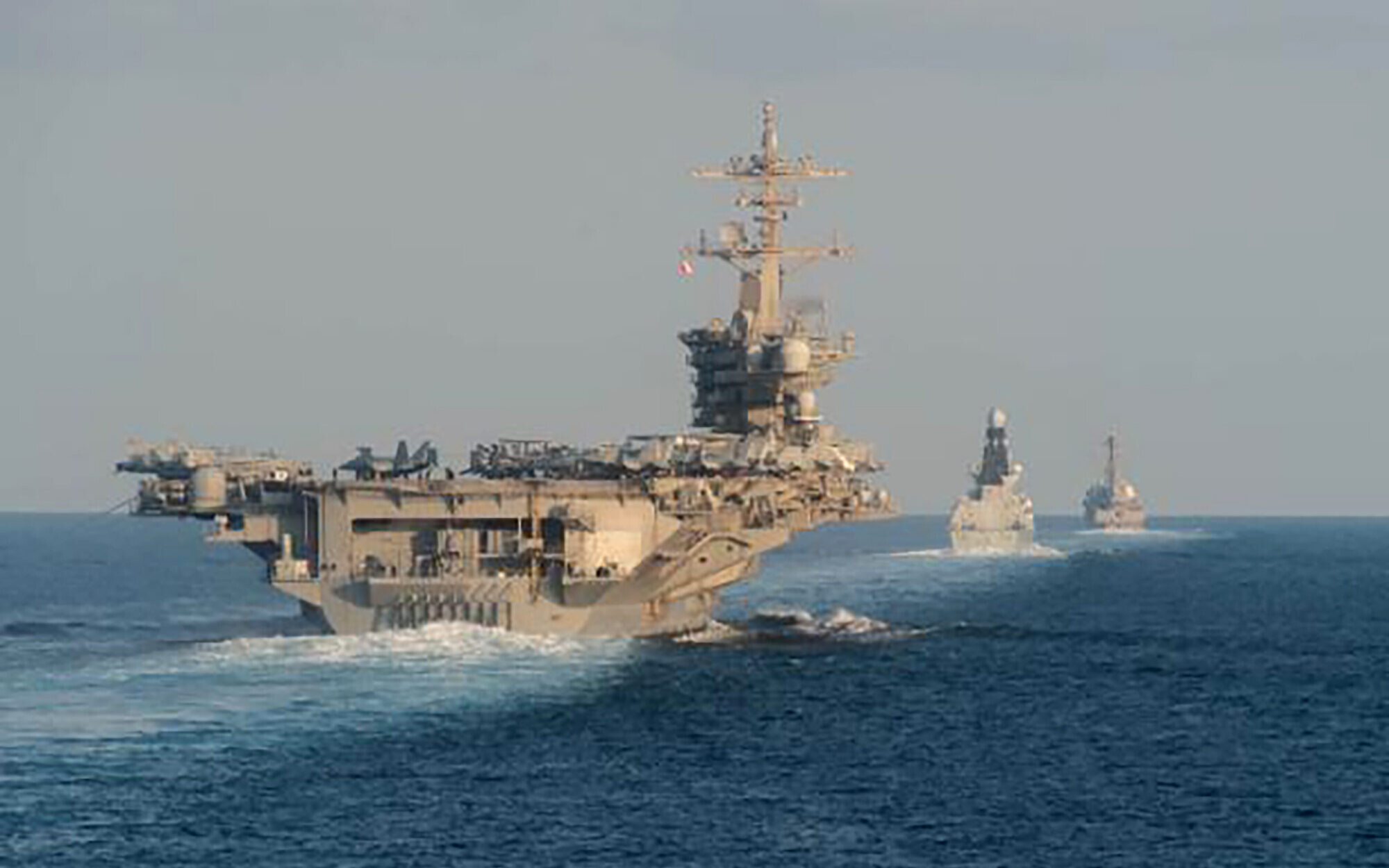
In this photo from the US Navy provided on November 19, 2019, the aircraft carrier USS Abraham Lincoln, left, the air-defense destroyer HMS Defender and the guided-missile destroyer USS Farragut transit the Strait of Hormuz with the guided-missile cruiser USS Leyte Gulf. (Mass Communication Specialist 3rd Class Zachary Pearson/U.S. Navy via AP)

Speaking from the same stage in Bahrain, Saudi Minister of State for Foreign Affairs Adel al-Jubeir insisted there was no US withdrawal from the region and no doubt about its commitment.

“We believe the US is very dependable ally, and has been for the past seven decades” he said of its staunch ally.

In this photo from February 4, 2019, Saudi Arabia Foreign Minister Adel al-Jubeir speaks with reporters during an European Union-Leagues Arab States ministerial meeting in Brussels. (John Thys/AFP)

“There is a desire in the US historically to try to retreat from the international scene, but that desire is not is reflected in America’s posture,” he said.

Jubeir defended Riyadh’s measured response to the September strikes, saying the kingdom was being “strategically very patient” in its investigation so there is “not a shadow of doubt” on where the drones and missiles came from.

“We have said all along we don’t want war, so to jump into war very quickly is not a rational position,” said Jubeir.

Red lines

The French defense minister also put herself at odds with the US on maritime security in the Gulf, after Washington earlier this month launched a maritime coalition based in Bahrain to protect shipping in the strategic Strait of Hormuz.

France instead favors a European mission which Parly said should be able to start “very soon.”

“We want to make clear that our policy is separate from the ‘maximum pressure’ American policy,” she said, referring to Washington’s increasing sanctions against Tehran.

“I would like to add that we are not subtracting anything, we are adding, as a number of countries would not have participated in the American initiative anyway.”

A picture obtained by AFP from Iranian News Agency ISNA on June 13, 2019, shows fire and smoke billowing from a tanker said to have been attacked in the waters of the Gulf of Oman, near the Strait of Hormuz. (ISNA/AFP)

In a wide-ranging and strongly-worded speech, Parly also spoke out on the dangers of chemical weapons again being used in Syria — an outcome that would be a red line for France.

“Yes there is a risk and when you look at [rebel-held] Idlib province there is a strong risk,” she said.

“I am convinced that if these weapons were used again that France would be ready to react again.”

US President Donald Trump, Brigitte Macron talks to French President Emmanuel Macron during the G7 family photo in in Biarritz, France, August 25, 2019. (Francois Mori/AP)

She also homed in on strains on NATO, saying it remained the cornerstone of security in Europe but that it was “time to move from the brain-dead to the brainstorm.”

French President Emmanuel Macron stirred controversy this month saying he believed NATO was undergoing “brain death,” lamenting a lack of coordination between Europe and the United States, in an interview with The Economist magazine.

Parly said proposals will be laid on the table at the alliance’s summit in London in December including for a group of “wise persons or elders to think about the future of NATO.”
 

US general warns Iran likely still plotting major Mideast attack 

November 24, 2019

Source: US general warns Iran likely still plotting major Mideast attack | The Times of Israel

Head of Central Command says US troop boost has probably not deterred Tehran from seeking to strike in region: ‘It’s the trajectory and the direction that they’re on’

In this photo from the US Navy provided on November 19, 2019, the aircraft carrier USS Abraham Lincoln, left, the air-defense destroyer HMS Defender and the guided-missile destroyer USS Farragut transit the Strait of Hormuz with the guided-missile cruiser USS Leyte Gulf. (Mass Communication Specialist 3rd Class Zachary Pearson/U.S. Navy via AP)

Iran is unlikely to have been undeterred by increased US troop deployment in the Middle East and remains on track to carry out a large-scale attack in the region, the head of the US military’s Central Command said in an interview published Saturday.

“My judgment is that it is very possible they will attack again,” Gen. Kenneth F. McKenzie told the New York Times.

Over the past summer Iran shot down an American drone with no retaliation from Washington. It has subsequently been blamed for — and denied — attacking international oil tankers and destroying large portions of a major Saudi petroleum facility.

The lack of serious consequences has led Israeli officials to warn an emboldened Tehran could seek a major attack on the Jewish state soon.

In this April1 14, 2018, file photo, then-Marine Lt. Gen. Kenneth “Frank” McKenzie speaks during a media availability at the Pentagon in Washington. (AP/Alex Brandon, File)

McKenzie himself did not address such a possibility but did warn that Gulf nations were in danger.

“It’s the trajectory and the direction that they’re on,” he stated. “The attack on the oil fields in Saudi was stunning in the depth of its audaciousness. I wouldn’t rule that out going forward.”

Earlier this month a US-led naval coalition officially launched operations in Bahrain to protect shipping in the troubled waters of the Gulf.

Iran, which has denied any responsibility for the mystery attacks, has put forward its own proposals for boosting Gulf security that pointedly exclude outside powers.

In this image made from a video broadcast on the Saudi-owned Al-Arabiya satellite news channel on September 14, 2019, a man walks through a parking lot as the smoke from a fire at the Abqaiq oil processing facility can be seen behind him in Buqyaq, Saudi Arabia. (Al-Arabiya via AP)

In June, US President Donald Trump called off a retaliatory strike after Iran downed an American drone that Tehran said entered its airspace. The US, which denied the drone entered Iranian skies, was later reported to have launched a cyberattack on Iran.

In September around half of Saudi Arabia’s oil production capacity was knocked offline due to an attack claimed by the Iranian-backed Houthi rebels in Yemen. There was no response to that attack, which the US, Israel and others also blamed on Iran.

And since May, there have been a series of attacks on oil tankers in the Persian Gulf. While Tehran denies being involved, the US Navy says Iran used magnetic mines on the vessels.

Netanyahu last month said Iran was emboldened by the lack of a response to the series of attacks attributed to it. He vowed Israel would respond forcefully to any attack.

On Tuesday, Iran’s Quds Force fired four missiles at Israel from Syria, according to the Israel Defense Forces. All four were shot down, and Israel responded a day later with a punishing round of airstrikes against Iranian and Syrian targets.

Iranian Revolutionary Guard Corps’ Quds Force commander Gen. Qassem Soleimani, center, attends a meeting with Supreme Leader Ayatollah Ali Khamenei and Revolutionary Guard commanders in Tehran, Iran, September 18, 2016. (Office of the Iranian Supreme Leader via AP)

At least 23 combatants were killed, 16 of them likely Iranians, according to a Syrian war monitor.

Israel has repeatedly said that it will not accept Iranian military entrenchment in Syria and that it will retaliate for any attack on the Jewish state from Syria.

A Lebanese newspaper on Thursday reported that Tuesday’s rocket attack on the Golan Heights from Syria was retaliation for recent Israeli strikes near a soon-to-be-opened border crossing along the Syria-Iraq frontier.

Israel fears the Albukamal crossing will be used by Iran to transport weapons, equipment and fighters through Iraq, into Syria and onward to Lebanon and other countries in the region.


PM Netanyahu’s chances of survival are drowning under a concerted political, legal, media onslaught – DEBKAfile

November 24, 2019

Source: PM Netanyahu’s chances of survival are drowning under a concerted political, legal, media onslaught – DEBKAfile

The shattering indictments for bribery and breach of faith brought against Prime Minister Binyamin Netanyahu,70, are only one stage in the relentless campaign to unseat him.

His decision to fight for his innocence and win round the voters in Israel’s third election in a year, in early 2020, has brought down on his head the full weight of the legal, political and media establishments. They have no qualms about bending the immunity law to force him to quit office without waiting for an absolute court judgement of his guilt.

If there was a concerted coup conspiracy to oust him, as he charges, it is far from over. Since the attorney general announced the indictments last Thursday, one voice after another has candidly proposed circumventing the legal process if that is the only way to remove Netanyahu as prime minister before his day in court. On Saturday, Nov. 22, a former high court justice, Eliahu Matza, joined the chorus of law enforcement voices when, in a radio interview, he pressed the Knesset to refer to the Supreme Court the decision on his competence to form a government. By law, this is the sole jurisdiction of parliament.

This was incidentally a sly attempt to exploit the crisis for promoting the court’s long machinations for asserting its authority over parliament.

On the political front, the opposition Kahol Lavan, whose leader Benny Gantz failed to form a new government, like Netanyahu before him, urged law enforcement authorities to force the prime minister to give up all his cabinet portfolios.

In answer to this chorus, Netanyahu released a video statement on Saturday pledging to abide by any court ruling in his case. “A court of trial is the only framework [for determining guilt or innocence] from beginning to end,” he said. If this declaration was intended to counter the charge that by putting up a fight, he was inciting a civil mutiny, it may have been the right way to go, but is unlikely to work. The parties who managed to throw him under the political-legal bus are not about to stop until their work is done and Netanyahu’s remarkable decade in office is brought to an end.

It is worth noting that the charges brought against his accused accomplices, Arnon Mozes, of the mass daily Yediot Aharanot, and the Elovich couple, are more serious that the cases against the prime minister. Yet they have rated little media notice. PM Netanyahu is the sole accused. He has only the slimmest hope of surviving the political bone-crusher smashing into him at every turn. With each assault, his popular support will melt and his loyalists be scared off. Shouted down are the voices claiming that all three are presumed innocent until proven guilty and if an indictment can cause the removal of a prime minister, then the police and legal authorities have seized control of government.

Israel’s founding father the late David Ben Gurion could have warned Netanyahu what was coming from his own experience. At the end of an epic career, Ben Gurion was challenged by forces determined to oust him. He fought back by invoking the legal system, demanding that a commission of inquiry get to the bottom of a failed clandestine operation. Ben Gurion also called on the voting public to vindicate him. He called in vain.

The late Yitzhak Rabin was ordered to resign as prime minister by the then Attorney General Aharon Barak, an act that signaled the historic downfall of the ruling Labor party. Yet another Israeli prime minister, the late Ariel Sharon, when he realized that law enforcement was about to close in on him, jumped the Likud ship. He established the Kadima party and switched his politics from right to moderate left, so saving his political life.
Netanyahu may or may not come up with an ingenious device for staying in office. But the way things look at present, he seems to have little choice but to quit politics and devote himself to clearing his name in court – a process that could drag on for years.