Archive for October 2019

Israel’s covert war against an Iranian shock attack. Gen. Kochavi prepares IDF counter-offensive – DEBKAfile

October 8, 2019

Source: Israel’s covert war against an Iranian shock attack. Gen. Kochavi prepares IDF counter-offensive – DEBKAfile

The Yom Kippur Eve message broadcast by IDF Chief Lt. Gen. Aviv Kochavi held the key to Israel’s intention: “We will not let harm come to Israel and if it does, we shall respond with power.”

This shorthand phrasing meant that if, on the 66th anniversary of the grim 1973 war, Iran’s leaders decide on another surprise attack on Israel, like the Sept. 14 cruise missile-drone assault on Saudi oil facilities, this country, unlike the US and Saudis, will hit back at strategic targets on Iranian soil. And if the attacks come from Hizballah in Lebanon or Shiite militias in Iraq, now massively armed by Iran with ballistic missiles and air defense systems, then Israel will direct its counter-offensive at those sources.

Kochavi’s words were carefully chosen. He did not say “all our power,” only “power” – thereby leaving the IDF with the option of follow-up counter-operations.

He went on to say: “We have seven eyes open, conduct day-to-day situation assessments and make professional and responsible decisions with regard to offensive action for preempting threats, while also preserving balance.”  The chief of staff was making it clear that no movement or military preparation across a vast swath of terrain in Iran, Iraq, Syria and Lebanon is lost on Israeli watchers, in the determination not to be caught off-guard like the US, Saudi Arabia and Israel itself were on Sept. 14.

DEBKAfile’s military and intelligence source stress that the IDF is now facing its most challenging mission. How to overcome the failure of a single US or Israeli radar beaming on Iran, whether ground-, ship-, air or satellite-based, to pick up on the preparations to shoot missiles against Saudi oil facilities, even after they were already airborne. No one in the region noticed anything amiss until Iran’s missiles and drones actually exploded on their Saudi targets, hitting them with exceptional accuracy.

It must be assumed that with all the precautions outlined by the chief of staff, neither Israel nor the United States has unraveled the riddle of how the Iranians managed to bamboozle all the most advanced regional and local defense systems. When Gen. Kochavi said that Israel is taking professional and responsible decisions with regard to an offensive, this indicated that, in the absence of answers to the riddle, Israel has chosen the tactic of an on-the-spot offensive response against the suspected aggressor.

Away from the public eye, Israeli and Iran are using all their brainpower in a covert mind and cyber contest. The IDF cannot promise at this stage, however, to avoid being caught out by Iran or be sure of pre-empting a surprise attack.
 

Iran leader blames ‘enemies seeking to sow discord’ for Iraq unrest 

October 7, 2019

Source: Iran leader blames ‘enemies seeking to sow discord’ for Iraq unrest | The Times of Israel

Khamenei condemns ‘conspiracy’ to incite division between two majority-Shiite countries as death toll in Iraqi protests tops 100

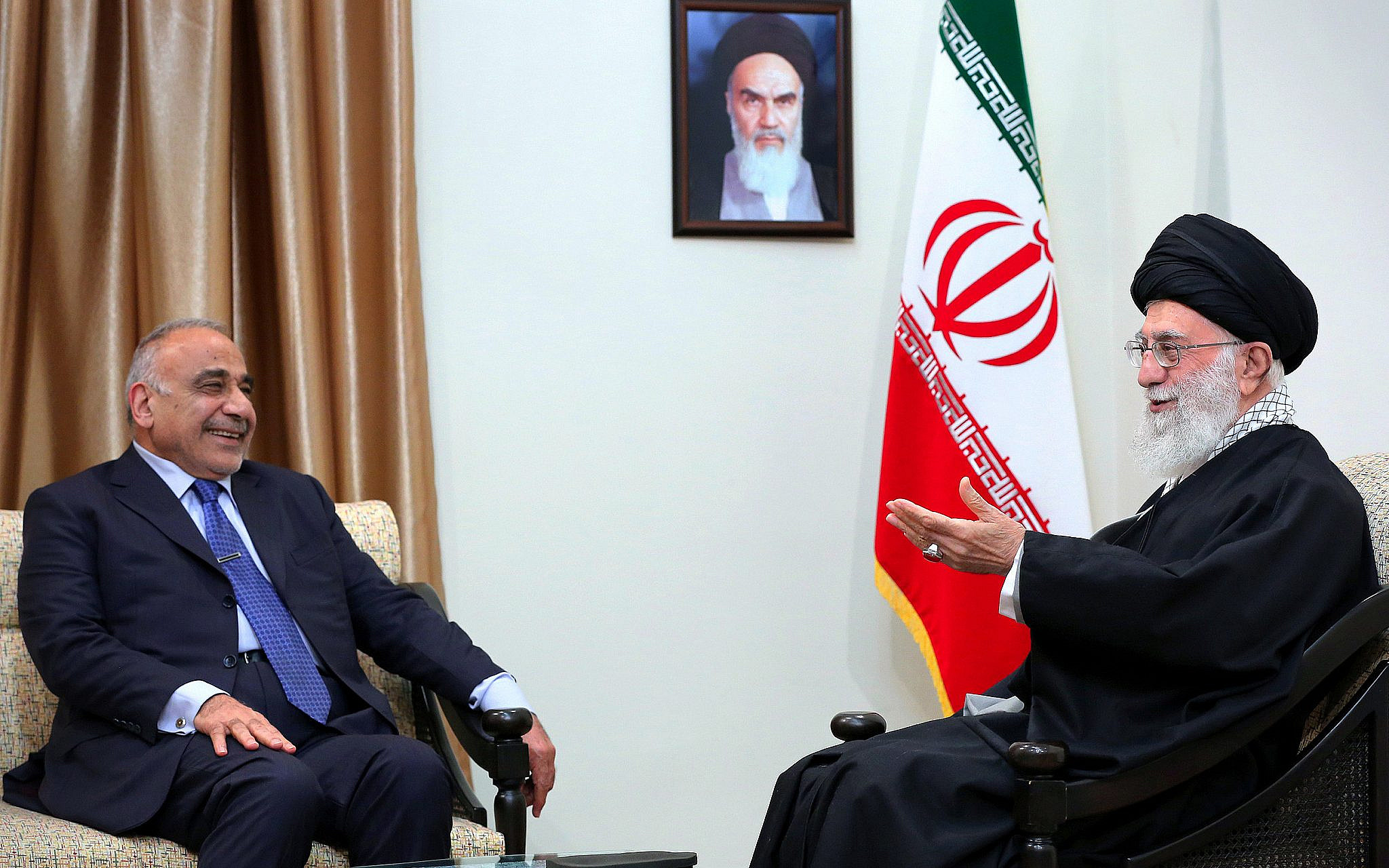
In this photo from April, 6, 2019, Supreme Leader Ayatollah Ali Khamenei, right, speaks with Iraqi Prime Minister Adel Abdel Mahdi, in Tehran, Iran. (Office of the Iranian Supreme Leader via AP, File)

In this photo from April, 6, 2019, Supreme Leader Ayatollah Ali Khamenei, right, speaks with Iraqi Prime Minister Adel Abdel Mahdi, in Tehran, Iran. (Office of the Iranian Supreme Leader via AP, File)

TEHRAN, Iran — Iranian Supreme Leader Ayatollah Ali Khamenei said “enemies” were trying to drive a wedge between Tehran and Baghdad in a tweet on Monday following deadly unrest in neighboring Iraq.

“#Iran and #Iraq are two nations whose hearts & souls are tied together… Enemies seek to sow discord but they’ve failed & their conspiracy won’t be effective,” Khamenei was quoted as saying on his office’s Twitter account.

State news agency IRNA said the supreme leader was reacting to recent violence in Iraq.

More than 100 people have been killed in Iraq since clashes erupted last week between protesters and security forces, the majority of them demonstrators struck by bullets.

The Iraqi authorities have accused “saboteurs” and unidentified snipers of targeting the protesters.

Anti-government protesters set fires and close a street during a demonstration in Baghdad, Iraq, October 5, 2019. (AP Photo/Hadi Mizban)

The unrest is the most serious challenge facing Iraq two years after the victory against the Islamic State terror group. The chaos also comes at a critical time for the government, which has been caught in the middle of increasing US-Iran tensions in the region. Iraq is allied with both countries and hosts thousands of US troops, as well as powerful paramilitary forces allied with Iran.

Iran has urged its citizens planning to take part in a major Shiite pilgrimage in Iraq to delay their travel into the country over the violence.

Tehran has close but complicated ties with Baghdad, with significant influence among its Shiite political groups.

The two countries fought a bloody war from 1980 to 1988 and Iran’s influence in the country grew after the US-led invasion of Iraq toppled veteran dictator Saddam Hussein in 2003.

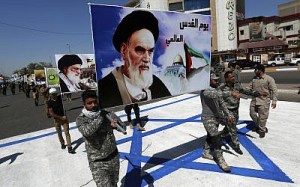
In this photo from June 23, 2017, supporters of Iraqi Hezbollah brigades march on a representation of an Israeli flag with a portrait of late Iranian leader Ayatollah Khomeini and Iran’s Supreme Leader Ayatollah Ali Khamenei, in Baghdad, Iraq. (AP Photo/Hadi Mizban, File)

The war against IS has given unprecedented clout to Iranian-backed militias known collectively as the Popular Mobilization Forces, which fought the extremist group alongside Iraq’s army and are now part of the country’s security forces. They have accumulated immense political and economic power, challenging the authority of the central government.

Prime Minister Adel Abdul-Mahdi, who came to power a year ago, promised to introduce change and fight corruption, but he has been unable to bring meaningful reform. He also been powerless to rein in the militias, and many Iraqis have grown frustrated with a government they see as increasingly subservient to Iran.

There are already indications that regional tension is at play. Some demonstrators in Baghdad have blamed Iranian-backed groups within the security forces for the violence. Media affiliated with the Iranian-backed groups have pointed toward the US and Saudi Arabia for the unrest.

In the first official statement from the government accounting for the violence, Interior Ministry spokesman Saad Maan said Sunday that 104 people had been killed in the six days of unrest, including eight members of the security forces, and more than 6,000 wounded. He said an investigation was under way to determine who was behind the most deadly day of violence, in Baghdad on Friday.

Iraq’s most senior Shiite spiritual leader, Grand Ayatollah Ali al-Sistani, has urged the protesters and the security forces to end the violence while the country’s prime minister has called on the protesters to go home. Abdul-Mahdi also pledged to meet with the protesters wherever they are and without any armed forces, to hear their demands.


Netanyahu said pushing NIS 1b air defense plan to counter Iran threats 

October 7, 2019

Source: Netanyahu said pushing NIS 1b air defense plan to counter Iran threats | The Times of Israel

Project would specifically focus on threat of cruise missiles; much of the budget approval will have to wait until next government is sworn in

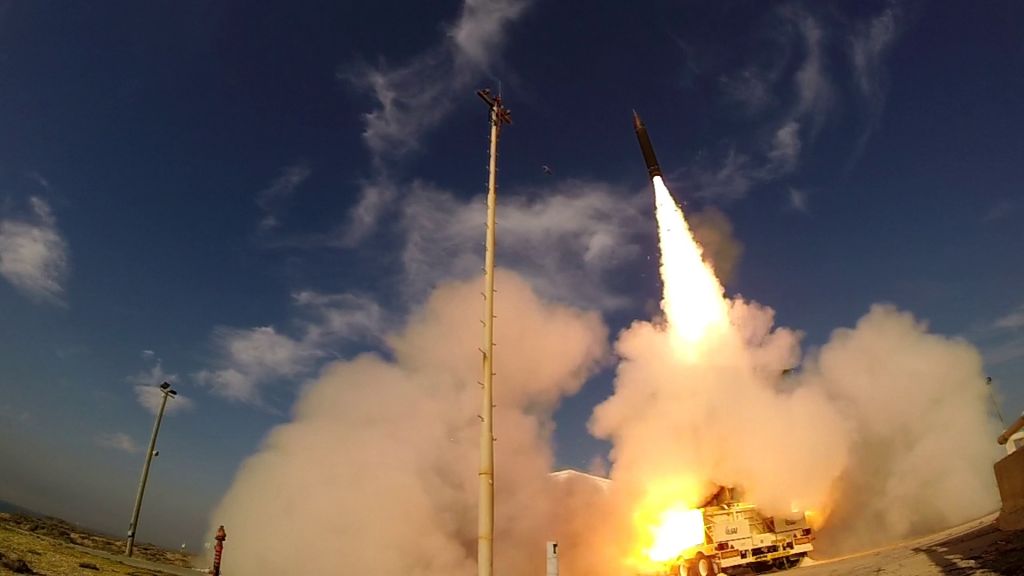
Illustrative: The Arrow 3 missile is launched from Palmachim air base in central Israel on December 10, 2015. (Defense Ministry)

Illustrative: The Arrow 3 missile is launched from Palmachim air base in central Israel on December 10, 2015. (Defense Ministry)

Prime Minister Benjamin Netanyahu is pushing to advance a huge air-defense project aimed at countering the threat of an attack from Iran, the Kan public broadcaster reported Sunday.

The NIS 1 billion ($290 million) project would place particular focus on defending the country against cruise missile attacks, similar to strikes on Saudi oil facilities last month blamed on Iran.

Treasury officials told the Kan broadcaster that the air-defense project has been under discussion for some time, but that much of the funding can only be approved after the next government is sworn in. Coalition and unity government talks have made no progress since elections last month failed to resolve a political deadlock that began after previous elections in April.

The Finance Ministry has put forward some options for funding the defense project, including from the Defense Ministry’s existing budget. However, that option seems unlikely, the report said, and costs are more likely to be covered by cutbacks in civilian budgeting and tax increases.

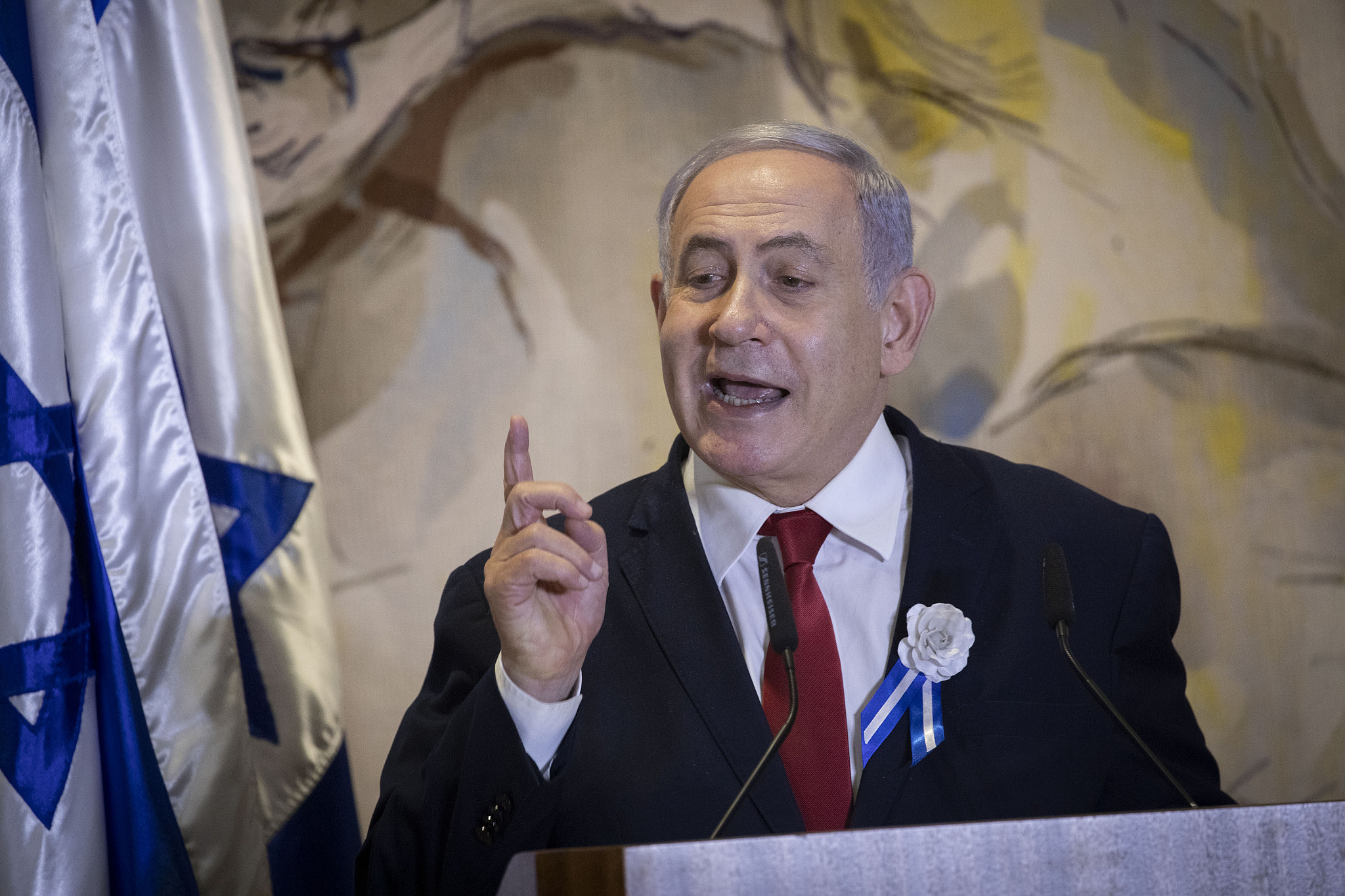
Prime Minister Benjamin Netanyahu speaks at the opening of the 22nd Knesset, on October 3, 2019. (Hadas Parush/Flash90)

On Sunday, the high-level security cabinet convened for the first time in two months, amid cryptic warnings by Israeli leaders in recent days of a growing security threat from Iran. The meeting began in the late afternoon and continued for nearly six hours.

The discussions are based on concerns that Iran, emboldened by a recent string of attacks that drew no military response from the West or its Middle Eastern foes, could set its sights on attacking Israel, Channel 12 reported.

Officials believe Iran may have publicized information about an allegedly foiled “Israel-Arab” plot to assassinate General Qassem Soleimani, the head of the elite Quds Force in Iran’s Islamic Revolutionary Guard Corps, as a pretense to attack Israel, according to Channel 12.

Both Netanyahu and President Reuven Rivlin have mentioned crucial security needs in recent days as they called for the formation of a broad unity government.

Netanyahu, during a speech Thursday at the swearing-in of the new Knesset, also called for a “broad national unity government,” saying the country’s security challenges demanded political stability.

“This isn’t spin, it’s not a whim, this is not ‘Netanyahu trying to scare us,’” he said. “Anyone who knows the situation knows that Iran is getting stronger and is attacking around the world, saying clearly, ‘Israel will disappear.’ They believe it, they are working toward it, we need to take them seriously.”

Netanyahu has sought to press rival Blue and White to join a coalition led by him and including right-wing and Haredi parties. Blue and White leader Benny Gantz has so far refused to sit in a coalition with Netanyahu, as long as the Likud leader faces corruption indictments, and is also unwilling to join a government made of hard-right and ultra-Orthodox parties. Blue and White has said a unity government with Likud could be formed “within an hour” if Netanyahu were to step down.

A September 14 cruise missile and drone attack on Saudi Arabian oil facilities knocked out half the kingdom’s oil production. Although Yemen’s Iranian-backed Houthi rebels claimed responsibility, the US, Britain, France, Germany, and Saudi Arabia have blamed Iran of being behind the attack.

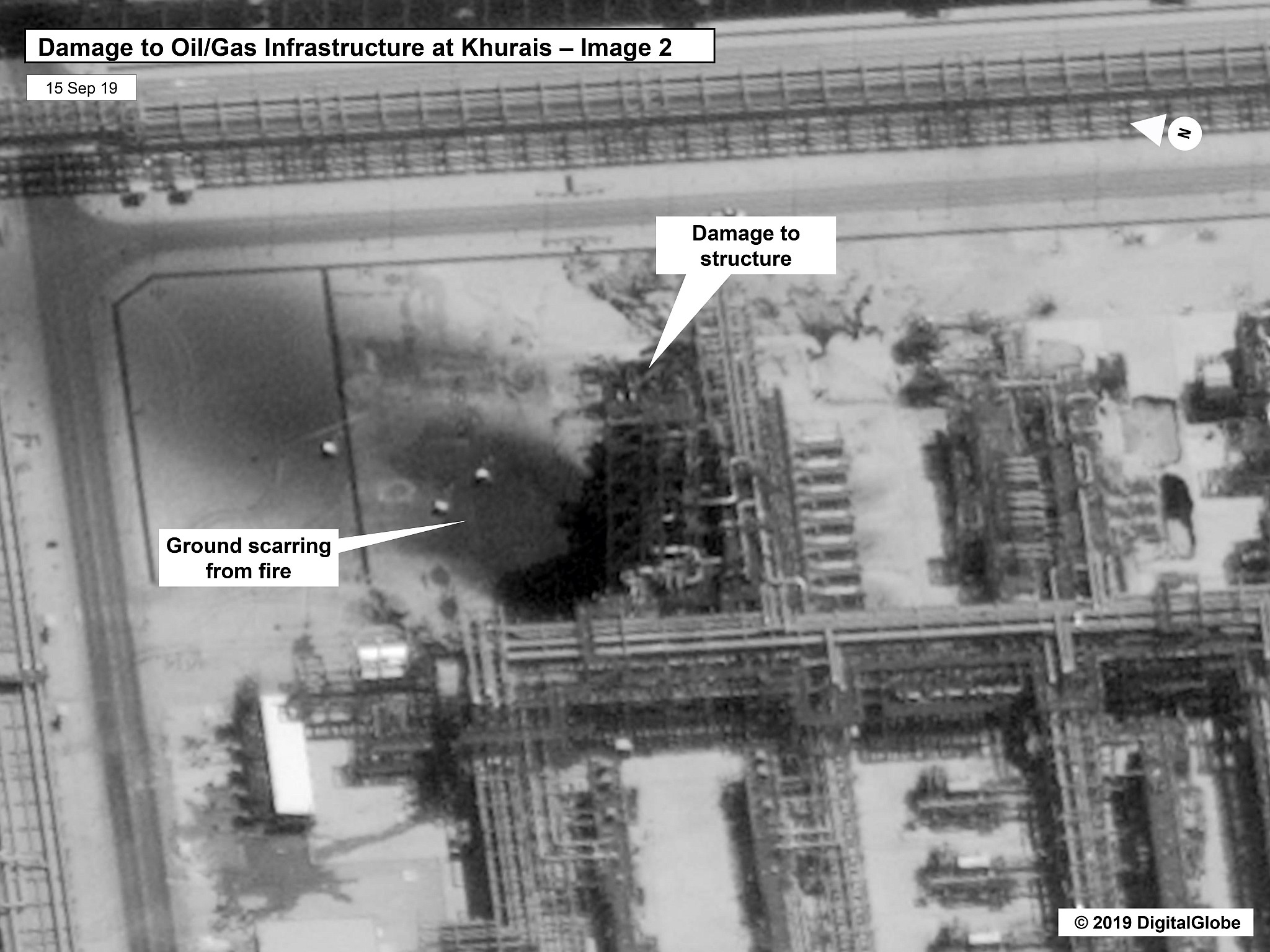
Damage to the infrastructure at at Saudi Aramco’s Kuirais oil field in Buqyaq, Saudi Arabia, on September 15, 2019. (US government/Digital Globe, including annotations, via AP)

Iran regularly threatens Israel, viewing the country as a powerful enemy allied with the United States and Sunni countries in the region against Tehran and its nuclear ambitions.

Israel has also thwarted Iranian operations in neighboring Syria where its fighters and those of Iranian proxy Hezbollah have been fighting alongside forces loyal to Syrian President Bashar Assad since 2011.

Israel has vowed to prevent Iran’s regional proxy militias from obtaining advanced weapons to use against the Jewish state and has carried out hundreds of air strikes in Syria that it says were to prevent deliver of weapons and to stop Iranian military entrenchment in that country.


Trump’s policy of inaction is whetting Iran’s appetite for aggression 

October 7, 2019

Source: Trump’s policy of inaction is whetting Iran’s appetite for aggression | The Times of Israel

Despite threats of a forceful response, US administration is pursuing the same policy of restraint as its predecessors did in the Gulf, but Tehran can sense weakness from afar

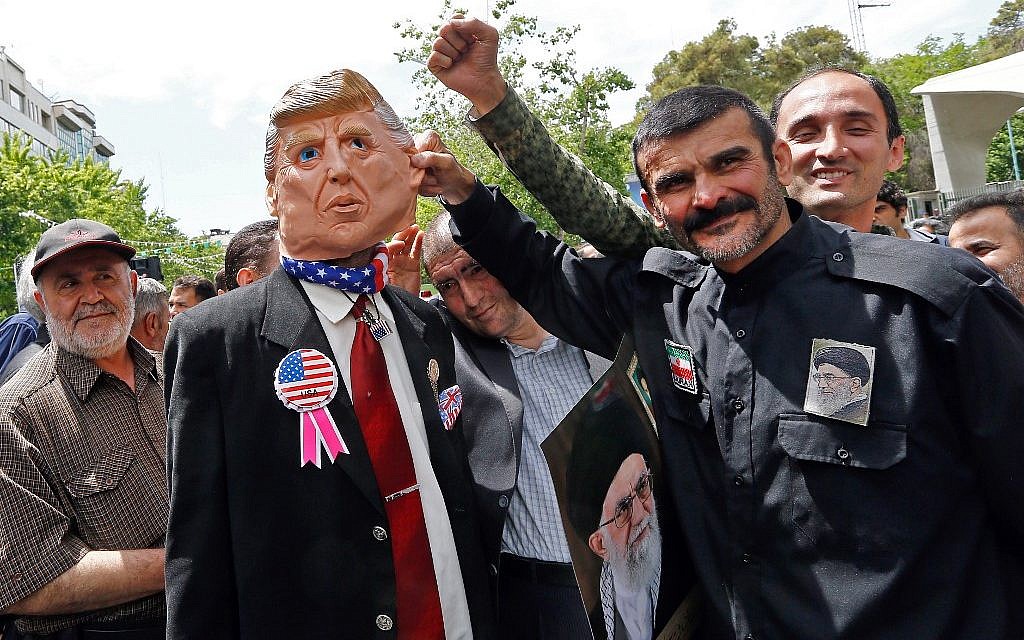
Iranian demonstrators carry a portrait of Iran's Supreme Leader Ayatollah Ali Khamenei and an effigy of US President Donald Trump, during a rally in the capital Tehran, on May 10, 2019. (Stringer/AFP)

Iranian demonstrators carry a portrait of Iran’s Supreme Leader Ayatollah Ali Khamenei and an effigy of US President Donald Trump, during a rally in the capital Tehran, on May 10, 2019. (Stringer/AFP)

The Trump administration’s disregard for the unprecedented September 15 Iranian attack on Saudi Arabia’s oil refineries and fields is reminiscent of the actions — or lack thereof — taken by former US president Barack Obama in response to Syrian President Bashar Assad’s 2013 chemical attack in Ghouta al-Sharqiya, in the country’s southwest, which left hundreds of people dead.

Back then, it was clear that an American response was imminent because Obama himself had warned that an attack using unconventional weapons, especially on civilians, would constitute crossing a “red line,” the likes of which the US would not abide. But lo and behold, the Americans refrained from responding, choosing instead to hammer out a deal that significantly reduced Syria’s chemical stockpiles.

It is difficult to criticize this policy, as it resulted in actual achievements. Nonetheless, the lack of American response came with a price for Syria and the entire Middle East: Assad’s regime understood it could continue to butcher the Syrian people uninterrupted as long as it did not use chemical weapons. After a while, it became clear that chemical attacks were still being carried out but even then, the US government refrained from responding.

Fast forward six years and Iran has conducted a widespread attack on the Saudi oil industry. A combination of cruise missiles and combat drones targeted the state-owned oil processing facilities at Abqaiq and Khurais in eastern Saudi Arabia, causing severe damage and a rapid hike in oil prices.

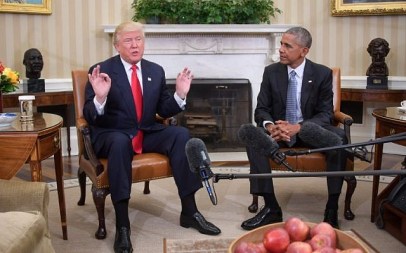
Then-president Barack Obama meets with then president-elect Donald Trump to update him on transition planning in the Oval Office at the White House, on November 10, 2016 in Washington, DC. (AFP/Jim Watson)

Washington was quick to announce that the US was gearing up to strike back on behalf of its Saudi allies, and President Donald Trump made it clear he knew exactly who was responsible for the attack. Iran’s fingerprints are all over this incident, it would appear, but the US has yet to respond.

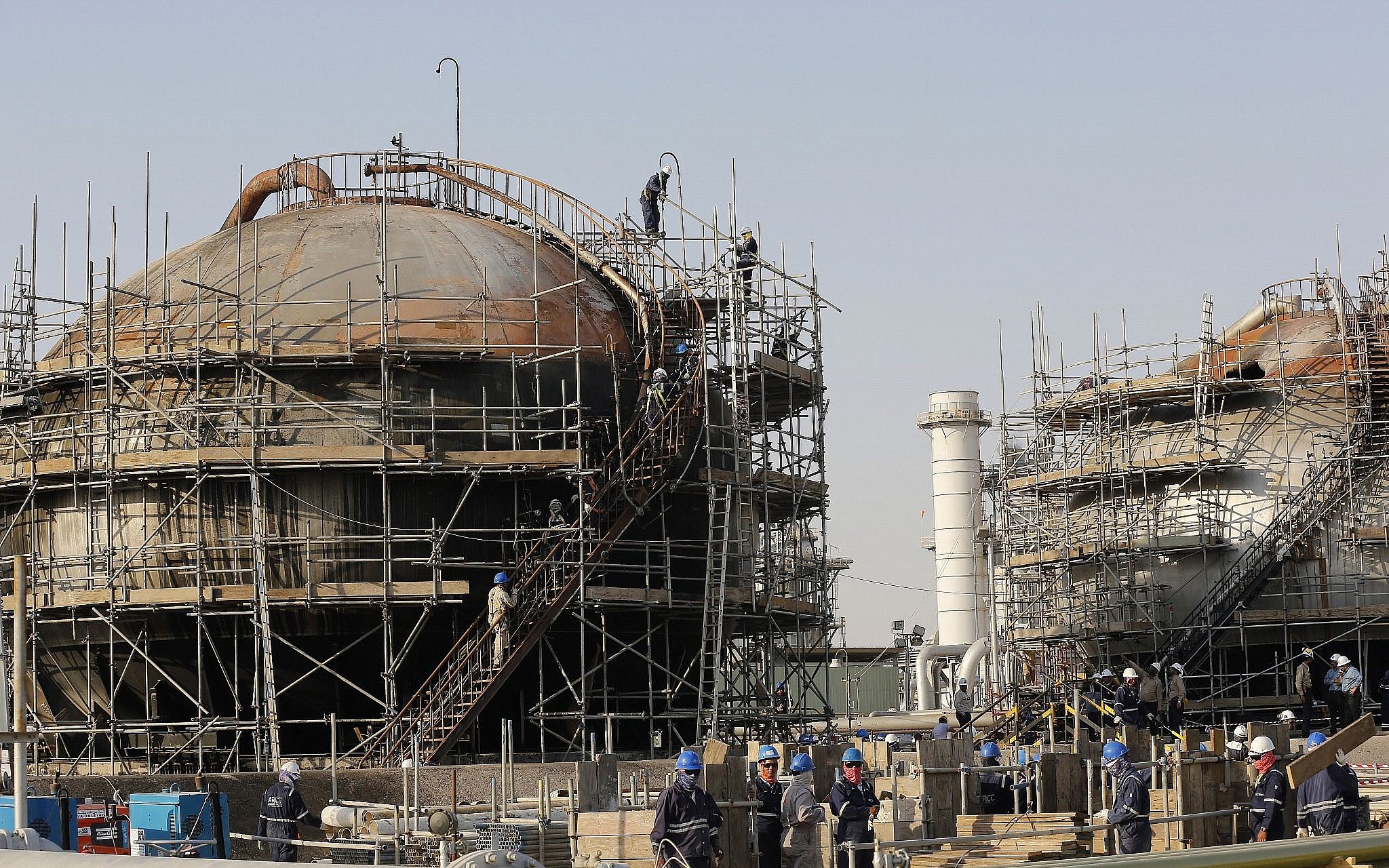
During a trip organized by the Saudi information ministry, workers fix the damage in Aramco’s oil separator at processing facility after the September 14 attack in Abqaiq, near Dammam in the Kingdom’s Eastern Province, September 20, 2019. (AP Photo/Amr Nabil)

This is not the first time that the United States has refrained from responding to Iranian aggression against its allies in the Middle East, even when such attacks involved American citizens and soldiers.

The 1980s provide ample examples for this policy: when the first massive suicide bombings struck American targets in the Middle East — the April 1983 attack on the US embassy in Beirut and, in October of that year, the attack against a Marine base in the Lebanese capital, which together left over 300 dead — US intelligence easily identified Iran as the driving force behind them.

Later, when US citizens including, in 1985, then-CIA station chief William Buckley, were abducted or murdered in Lebanon by Iranian proxy agents, the United States opted to bury its head in the sand and ignored the clearly hostile Iranian activity.

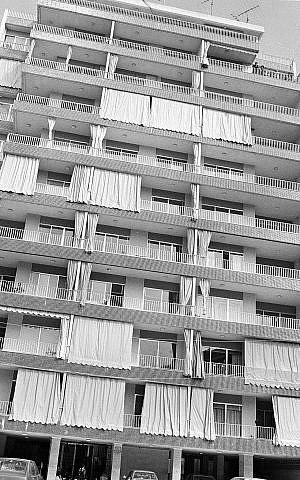
The 10-story apartment building, pictured March 16, 1984 in Beirut, Lebanon, where kidnapped US embassy political officer William Buckley lived on the top floor. (AP/Don Mell)

This disregard has not led Iran to refrain from engaging in future terrorist activities. On the contrary, the Iranian terrorism industry is present in almost every corner of the world, and it is especially rampant in the Middle East.

But even now, it seems that the administration led by Trump — who threatens to act but frequently does not — is again paralyzed.

Here, too, the considerations against a military response — the desire to avoid war and the fear of Iranian retaliation in the form of terrorist attacks — are understandable.

However, just as in Lebanon’s case in the 1980s and the more recent case in Syria, the decision to do nothing comes at a cost. And its implications may become evident in a potential conflict with Israel.

These implications are at the root of Israel’s concern over a military escalation vis-à-vis Iran and its regional proxies in the near future. There are some in Israel who believe that American inaction will lead Tehran to develop an even greater appetite for aggression and may tempt it to carry out similar hostilities against Israel, most likely in retaliation for the ongoing alleged Israeli strikes against Iranian-backed Shiite militias in Syria and Iraq.

But this assessment, too, should be qualified: The Iranians may not be in such a rush to step into what is likely to be a very complex war with Israel. Iran understands that Saudi Arabia is radically different from Israel and that the IDF’s military capabilities considerably outweigh those of the Saudi army. Even if you consider Hezbollah’s sizable rocket arsenal in Lebanon, it is doubtful that the Iranians will want to “waste” it to attack Israel without a real cause.

The Trump administration may not be without its Israeli fans, especially among Likud and right-wing voters; nevertheless, it is pursuing the same policy of restraint as its predecessors. The problem is that Tehran, as everyone knows, can sense weakness from afar.


Merkel: Iran’s call to ‘wipe Israel off the map’ not antisemitic –

October 6, 2019

Source: Merkel: Iran’s call to ‘wipe Israel off the map’ not antisemitic – World News – Jerusalem Post

Wiesenthal Center and NGO Monitor slam Germany for ignoring Iran’s genocidal antisemitism.

BY BENJAMIN WEINTHAL
 OCTOBER 6, 2019 18:29
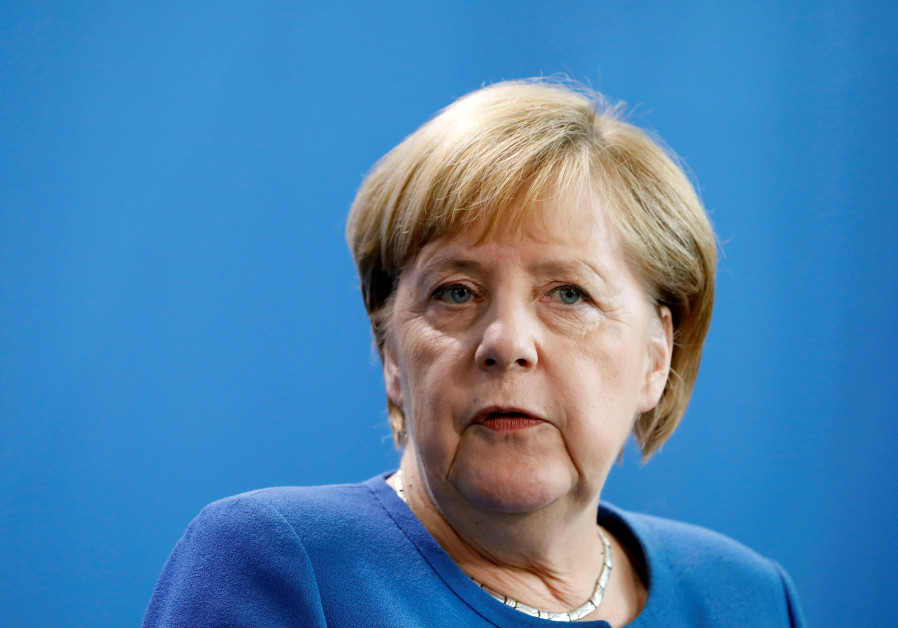
German Chancellor Angela Merkel holds a joint news conference with Dutch Prime Minister Mark Rutte (

German Chancellor Angela Merkel holds a joint news conference with Dutch Prime Minister Mark Rutte (not pictured) at the Chancellery in Berlin, Germany, October 2, 2019. (photo credit: MICHELE TANTUSSI/REUTERS)

On October 1, Merkel’s Foreign Ministry merely labeled the call to destroy Israel by commander-in-chief of Iran’s Islamic Revolutionary Guard Corps (IRGC) Gen. Hossein Salami “anti-Israel rhetoric.”

When the Post asked the Merkel administration if it agrees with the statement of its foreign ministry, a spokesman told the Post: “We have nothing to add to the reply of the foreign office.”

The Post specifically asked if Salami’s statements are antisemitic.

In late September, Salami delivered his call to exterminate the Jewish state before an audience of IRGC leaders that was publicized by the state-funded IRNA agency, as well as other Iranian regime-controlled outlets.

Salami said that “This sinister regime must be wiped off the map and this is no longer… a dream [but] it is an achievable goal.”

He added that his country has “managed to obtain the capacity to destroy the impostor Zionist regime” 40 years after the 1979 Islamic revolution.

Germany’s Foreign Ministry issued the following statement in German and English: “We condemn the recent threats by the Iranian Revolutionary Guard Corps against Israel in the strongest possible terms. Such anti-Israel rhetoric is completely unacceptable. Israel’s right to exist is not negotiable. We urge Iran to commit to maintaining peaceful relations with all states in the region and to take practical steps to de-escalate tensions.”

When asked on Twitter why German Ambassador to Iran Michael Klor-Berchtold did not tweet the statement in Persian and why the German Foreign Ministry did not translate the comment into Persian, both the Foreign Ministry and Klor-Berchtold declined to answer.

Dr. Efraim Zuroff, the chief Nazi-hunter for the Simon Wiesenthal Center, told the Post on Monday that “The condemnation by the German foreign ministry of the recent threats to destroy Israel by Hossein Salami, commander of the IRGC, seems to ignore the starkly antisemitic dimensions of his comments. To reduce them to ‘anti-Israel rhetoric’ is to ignore the obvious antisemitic component and their genocidal intent.”

Zuroff, a widely acknowledged expert on antisemitism who oversees the Wiesenthal Center’s Jerusalem office, added that “The verbal condemnation of the German Foreign Ministry should be accompanied by practical steps to expel Iran from UN and to boycott all commerce with the fanatic fundamentalist Islamic regime, instead of [Germany] promoting business with Iran and seeking ways to circumvent sanctions against a terrorist regime in Tehran.”

The United States classifies Iran’s clerical regime as the leading international state-sponsor of terrorism.

Prof. Gerald Steinberg, founder and president of NGO Monitor and professor of Political Studies at Bar-Ilan University, told the Post that “The Germans, and Merkel in particular, should be the first to condemn Iran’s genocidal threats against the Jewish state as antisemitism. Instead, by taking refuge behind the canard that ‘anti-Israel’ language can be distinguished from antisemitism, they undermine the international consensus behind the IHRA [The International Holocaust Remembrance Alliance] working definition.”

Steinberg, an expert on contemporary antisemitism, added “Every aspect of Iran’s campaign to destroy Israel is anchored in hatred of Jews and Jewish national self-determination, including many of the images that echo Nazi propaganda. In the time she remains in office, Merkel should give high priority to undoing the damage she has done by failing to confront Iran.”

In February, the German Foreign Ministry participated in a celebration of Iran’s Islamic revolution at the Iranian Embassy in Berlin. German Foreign Minister Heiko Maas said he went into politics “because of Auschwitz.”

Also in February, German President Frank-Walter Steinmeier sent a telegram to the mullah regime in Tehran that praised Iran’s revolution.


Israel’s top ministers to meet for first time in months, amid warnings on Iran

October 6, 2019

Source: Israel’s top ministers to meet for first time in months, amid warnings on Iran | The Times of Israel

Security cabinet to convene Sunday as Liberman urges PM, Gantz to agree on unity, citing ‘national emergency’ and evoking Yom Kippur War; Islamic Jihad holds Gaza rally

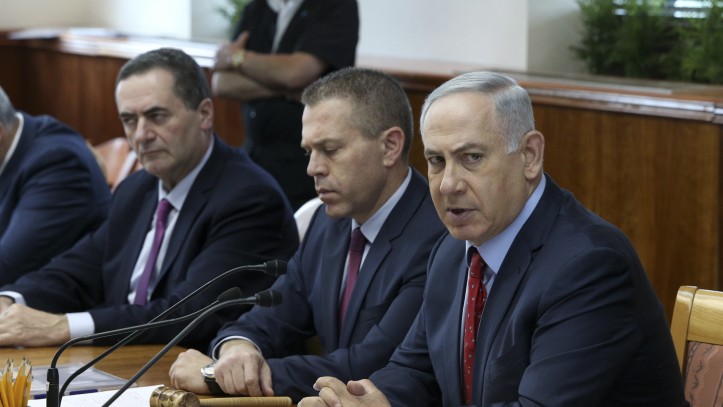
Prime Minister Benjamin Netanyahu (right), Public Security Minister Gilad Erdan (center) and Intelligence and Transportation Minister Yisrael Katz (left) during a cabinet meeting in Jerusalem in 2016, file photo (Amit Shabi/POOL/Flash90)

Prime Minister Benjamin Netanyahu (right), Public Security Minister Gilad Erdan (center) and Intelligence and Transportation Minister Yisrael Katz (left) during a cabinet meeting in Jerusalem in 2016, file photo (Amit Shabi/POOL/Flash90)

The Security Cabinet will convene Sunday for the first time in two months, amid cryptic warnings by Israeli leadership in recent days of a growing security threat.

Members of the top forum will meet at the Prime Minister’s Office in Jerusalem in the afternoon.

In recent days Hebrew media has on several occasions quoted unnamed security officials as warning of the rising threat of an attack orchestrated by Iran.

On Friday, Channel 13 news was the latest to report concerns that Tehran, emboldened by military successes against the US and Saudi Arabia, will seek to attack the Jewish state.

Both Prime Minister Benjamin Netanyahu and President Reuven Rivlin have mentioned crucial security needs in recent days as they called for the formation of a broad unity government.

The Blue and White party’s Gabi Ashkenazi, newly appointed head of the Knesset’s powerful Foreign Affairs and Defense Committee, also spoke Thursday of “many challenges in the security realm, some known to all and some that are only discussed behind closed doors.”

On Saturday evening Yisrael Beytenu chief Avigdor Liberman repeated his call for Netanyahu and Blue and White chief Benny Gantz to form a unity government, citing a “national emergency, economic challenges and security threats from south, north and further away.”

Yisrael Beytenu leader Avigdor Liberman speaks to press while touring the Sarona Market in Tel Aviv on election day, September 17, 2019. (Miriam Alster/Flash90)

Liberman noted in a Facebook post that the country on Sunday will mark 46 years since the Yom Kippur War, the most traumatic conflict in the nation’s history and one in which the country was caught off guard by its enemies, and said it was imperative to remember its legacy “of leadership and love of country.”

“We are at a political crossroads,” Liberman wrote. “The election results can lead to only one conclusion — the people want unity… I once again call on Prime Minister Netanyahu and MK Benny Gantz: Show responsibility and leadership, set aside your egos and stops the games, spin and time-wasting.”

Netanyahu, during a speech Thursday at the swearing-in of the new Knesset, also called for a “broad national unity government,” saying the country’s security challenges demanded political stability.

“No one faces as many challenges as we face, no other country. And democracies that don’t grasp that you need to unite in a time of danger suffer a heavy price,” he said.

“This isn’t spin, it’s not a whim, this is not ‘Netanyahu trying to scare us,’” he said. “Anyone who knows the situation knows that Iran is getting stronger and is attacking around the world, saying clearly, ‘Israel will disappear.’ They believe it, they are working toward it, we need to take them seriously.”

Blue and White party leaders Benny Gantz and Yair Lapid at a faction meeting at the opening of the 22nd Knesset, on October 03, 2019. (Hadas Parush/Flash90)

But Blue and White MK Ofer Shelah rejected claims of an emergency, saying: “There is no greater cynic than Netanyahu in using matter of security for political ends. Don’t believe his fear-mongering. Everything is political with him.”

Netanyahu has sought to press Blue and White to join a coalition led by him and composed of right-wing and Haredi parties. Gantz has so far refused to sit in a coalition with Netanyahu as long as the Likud leader faces corruption indictments, and is also unwilling to join a government comprised of hard-right and ultra-Orthodox parties. Blue and White has said a unity government with Likud could be formed “within an hour” if Netanyahu steps down.

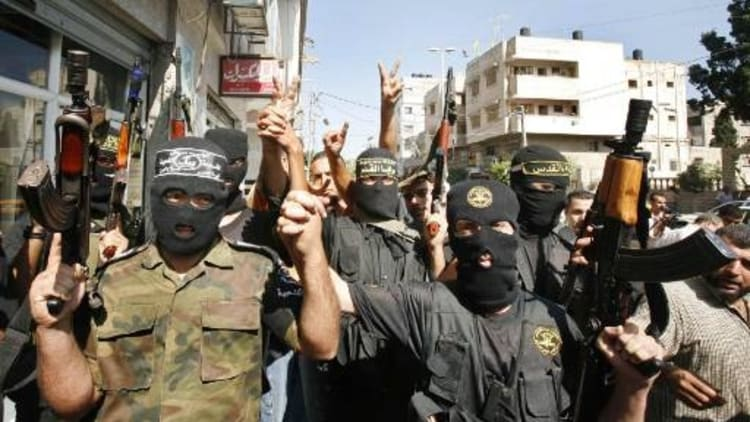
Meanwhile, the Islamic Jihad terror group on Saturday marked 32 years since its establishment, holding a rally in the Gaza Strip in which it showed off what it said was a new type of rocket.

חדשות 13

@newsisrael13

32 שנים להיווסדות הג’יהאד האסלאמי: “נמשיך להגן על עמנו” • @zeragil עם הדברים המלאים >> https://bit.ly/2Mem7B3 

(צילום: רויטרס)

View image on Twitter

“Gaza’s resistance is ready to fight together against any action directed at the Strip,” said organization leader Ziyad Al Nahale.

On Friday night two projectiles fired at Israel from Gaza fell short of the border fence, landing inside the Hamas-held territory, the Israel Defense Forces said, which triggered incoming rocket sirens in the Gaza border community of Kissufim in southern Israel.

A young protester waves a Palestinian flag while demonstrating by the border fence with Israel east of Gaza City on October 4, 2019. (MAHMUD HAMS / AFP)

The incident came hours after a Palestinian man was killed during riots along the Gaza-Israel border fence on Friday, according to the Hamas-run health ministry, as thousands took part in weekly protests.

Channel 12 reported that the IDF was bolstering troop readiness in the south, the West Bank and the northern border due to the tense situation, as well as the standard heightened alert around the Jewish holiday period.


Iran’s Guards detain Russian journalist as Israel spy. IDF on high alert for surprise Iran attack – DEBKAfile

October 4, 2019

Source: Iran’s Guards detain Russian journalist as Israel spy. IDF on high alert for surprise Iran attack – DEBKAfile

DEBKAfile: Yulia Yuzik is widely known for her researches on the jihadist terrorist movements operating in the Caucasus including Chechnya. For the past 10 years, she has reported on the subject for GQ and Foreign Policy. Her book Brides of Allah on Chechen female suicide bombers was published in ten countries.

She is currently working on a book that is at once a collection of travel notes and a detailed description of the methods that terrorists use to transform normal individuals into suicide bombers.

Word of Yuzik’s arrest in Tehran came 24 hours after Iranian intelligence claimed to have exposed an “Israeli-Arab” assassination plot against IRGC General Qassem Soleimani and to have arrested three unidentified suspects.

Tehran’s launch of a concentrated intelligence campaign to defame Israel shortly before Yom Kippur, the holiest day on the Jewish calendar, finds most Israel’s policy makers away from their desks. It may therefore be intended to manufacture pretexts for Iran to go forward with a planned surprise attack on strategic targets in Israel. This is part of the IRGC ‘s overall plan which was launched with a missile and drone assault on Saudi oil facilities on Sept. 14. Israel’s armed forces are therefore on high alert even while the country celebrates the annual festival.

Iran may have two additional motives in its anti-Israel espionage-assassination spin campaign: A raging row between the IRGC heads and President Hassan Rouhani’s faction over whether Rouhani should go ahead and meet US President Donald Trump. Diplomatic efforts to arrange the rendezvous are still ongoing while the Guards push back by stirring up an additional front. Another possible motive may be an effort by the regime in Tehran to break up the collaborative ties between Russian and Israel intelligence. But for now, Tehran’s ties with Moscow are on the line over this incident.


Netanyahu Calls for National Unity government in the face of Iran threat

October 4, 2019


Rouhani blames Trump for failure of French nuclear compromise efforts in NY 

October 3, 2019

Source: Rouhani blames Trump for failure of French nuclear compromise efforts in NY | The Times of Israel

Iranian president says he was willing to accept European framework that included lifting sanctions, but then US leader publicly declared he would increase them

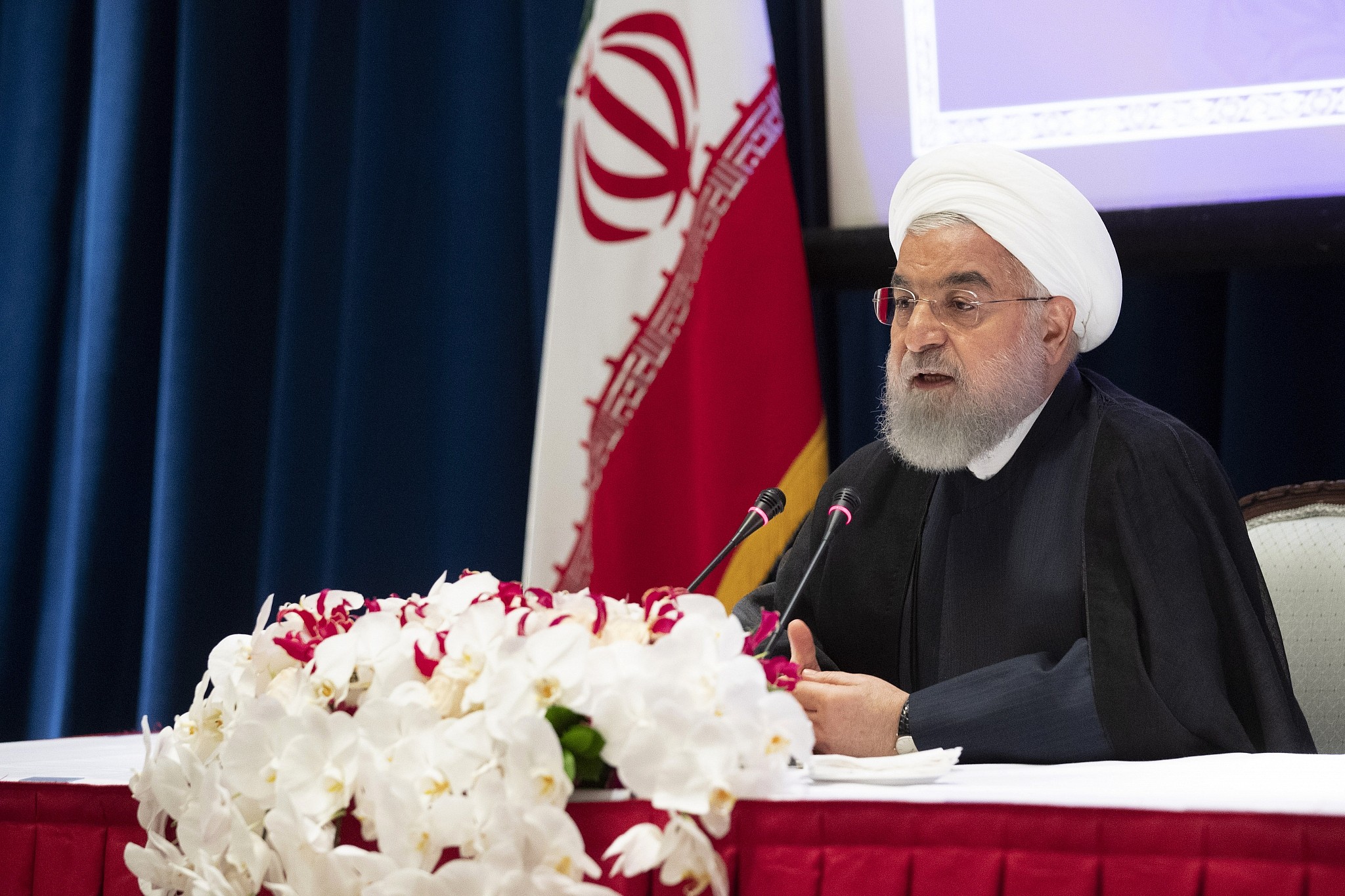
Iranian President Hassan Rouhani speaks during a news conference, in New York, September 26, 2019. (Mary Altaffer/AP)

Iranian President Hassan Rouhani speaks during a news conference, in New York, September 26, 2019. (Mary Altaffer/AP)

Iranian President Hassan Rouhani on Wednesday said that he supports a plan by European countries to bolster his country’s unraveling 2015 nuclear deal with world powers, but the proposal was scuppered by US President Donald Trump openly threatening to impose more sanctions.

Speaking during a weekly cabinet meeting in Tehran, Rouhani said: “We agree with the general framework” in which France, Britain and Germany urged Tehran to enter talks about a new arrangement on the nuclear deal, known as the Joint Comprehensive Plan of Action.

Rouhani said the plan included preventing Iran from obtaining nuclear weapons, securing its support for regional peace, lifting US sanctions and the immediate resumption of Iranian oil exports.

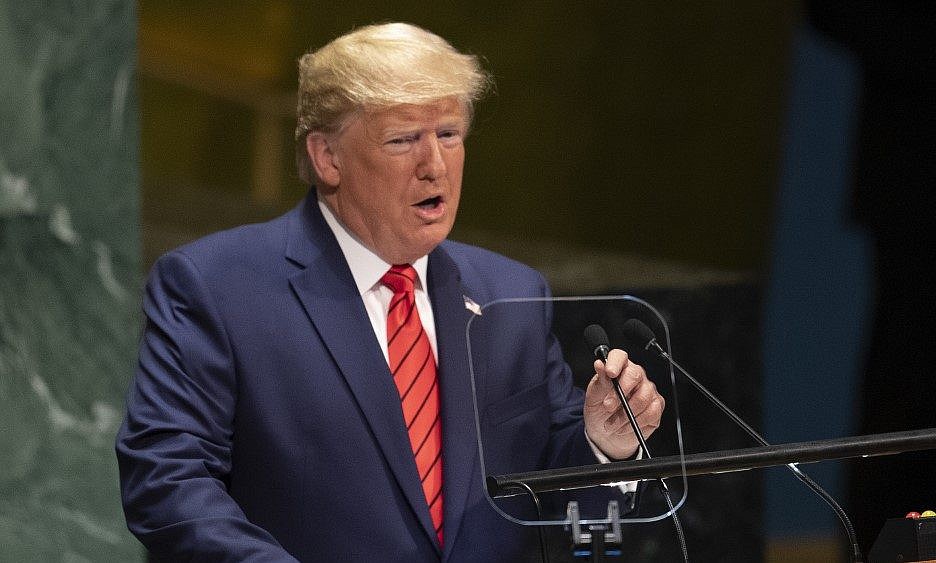
He said the plan could have been discussed during his visit in New York last week for the UN General Assembly, but that Trump sank the chances by vowing in his speech to the assembly that not only would sanctions remain in place but “they will be tightened.”

Rouhani accused Washington of sending mixed messages by privately being open to compromise but publicly calling for increased pressure on Iran.

He also thanked French President Emmanuel Macron for his personal efforts to broker direct talks between himself and Trump.

“He did his best in those 48 hours, especially in the past 24 hours, and we were supportive,” Rouhani said, according to a report from the Iran Front Page news website.

“The one who prevented us from achieving a result was the White House,” he added, according to the report. “Neither Paris nor Tokyo and other countries are to blame. All parties, along with Iran, tried hard.”

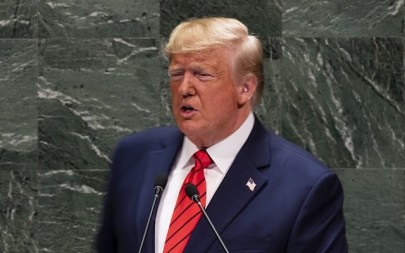
US President Donald Trump speaks during the 74th Session of the United Nations General Assembly at UN Headquarters in New York, September 24, 2019. (Don Emmert / AFP)

On Tuesday Politico reported that Trump and Rouhani agreed to a four-point plan drafted by Macron that would have seen the two leaders meet and declare a resumption of negotiations. However, the diplomatic effort fell through when Rouhani backed out, over what other reports characterized as his deep mistrust of the US administration.

Tuesday’s report followed a New Yorker report on Sunday that said Macron was close to brokering a phone call between Trump and Rouhani during the UN gathering, but the French president’s secretive effort fell apart because of the Iranian leader’s lack of trust in the US president.

Speculation was abuzz last month that the leaders could meet on the sidelines of the General Assembly.

But Rouhani said he would only hold talks with the US if Trump lifted economic sanctions on Tehran.

Macron used his 48 hours in New York to see Trump three times and Rouhani twice, urging them to engage directly.

Tensions have been escalating between Iran and the United States since May last year when Trump pulled out of the nuclear accord and began reimposing sanctions that have crippled the Iranian economy.

Iranian President Hassan Rouhani, right, shakes hands with French President Emmanuel Macron during their meeting on the sideline of the United Nations General Assembly at U.N. headquarters, September 24, 2019. (Iranian Presidency Office via AP)

Britain, France and Germany have repeatedly said they are committed to saving the deal that gave Iran relief from sanctions in exchange for curbs on its nuclear program, but their efforts have so far borne little fruit.

Tensions flared again this May when Iran began reducing its own commitments under the deal and the US deployed military assets to the region.

Since then, ships have been attacked, drones downed and oil tankers seized. Last month, twin attacks on Saudi oil infrastructure, which knocked out half the kingdom’s production, drew accusations of blame on Iran from Washington and Europe.

Tehran has denied any involvement in the attacks which were claimed by Iran-backed rebels fighting a Saudi-led coalition in Yemen.

Iran has since warned that any military retaliation would prompt a severe response that would lead to a wide conflict in the region.


Khamenei: We’ll further breach nuke deal until we get ‘desired results’ 

October 3, 2019

Source: Khamenei: We’ll further breach nuke deal until we get ‘desired results’ | The Times of Israel

Iranian supreme leader doesn’t specify what additional steps Tehran may take to violate accord, says US ‘maximum pressure’ campaign has failed

Supreme Leader Ayatollah Ali Khamenei in a meeting in Tehran, Iran, September 17, 2019. (Office of the Iranian Supreme Leader via AP)

Supreme Leader Ayatollah Ali Khamenei in a meeting in Tehran, Iran, September 17, 2019. (Office of the Iranian Supreme Leader via AP)

Iranian Supreme Leader Ayatollah Ali Khamenei on Wednesday threatened that Iran would further breach the international accord that set limits on its nuclear program until it obtains the “desired results.”

Since May, Iran has taken a number of steps in violation of the 2015 agreement, including stockpiling uranium above the permitted limit and installing advanced centrifuges for uranium enrichment.

Iran says the moves ae in protest over a lack of economic relief from the deal’s European signatories since US President Donald Trump pulled out of the accord last year and reimposed sanctions on Tehran.

“Regarding the nuclear issue, we will seriously pursue reduction of our commitments. The Government should precisely, thoroughly pursue that until we reach the desired results—and we will certainly by the Grace of God achieve the desired outcomes,” Khamenei wrote on his Twitter account.

He did not specify what additional steps Iran may take in breach of the pact.

Khamenei.ir@khamenei_ir

The Iranian leader also declared that the Trump administration’s “maximum pressure” campaigned, aimed at forcing Iran to negotiate a more stringent agreement curbing its nuclear program, had failed.

“Recently and through their European friends, they also begged to force our president to meet (Trump) to make a symbolic status for making Iran surrender,” state TV quoted Khamenei as saying during a meeting with elite Revolutionary Guard members. “They eventually did not succeed and the policy will definitely fail until the end.”

Khamenei, who has final say on all state matters, has repeatedly expressed pessimism about Europe’s intentions for saving the nuclear deal, which aimed at preventing Iran from obtaining nuclear weapons in return for lifting sanctions. Iran has routinely denied seeking a nuclear weapon.

Earlier Wednesday, Iranian President Hassan Rouhani said Iran supports a plan by European countries to bolster the nuclear deal.

Rouhani said the plan included preventing Iran from obtaining nuclear weapons, securing its support for regional peace, lifting US sanctions and the immediate resumption of Iranian oil exports.

French President Emmanuel Macron (L) and Iranian President Hassan Rouhani speak after a meeting at the United Nations headquarters on September 23, 2019, in New York. (Ludovic Marin/AFP)

Speaking during a weekly cabinet meeting, Rouhani said: “We agree with the general framework by the Europeans.” France, Britain and Germany had urged Tehran to enter talks about a new arrangement on the nuclear deal.

Rouhani’s comments come amid heightened tension between Tehran and Washington following Trump’s decision to unilaterally pull out of the nuclear deal. The US has imposed sanctions that have kept Iran from selling its oil abroad and have crippled its economy.

Rouhani said the plan could have been discussed during his New York visit last week to attend the UN General Assembly but that Trump scuppered chances by openly threatening to impose more sanctions.

He said Trump in a private message had told the Europeans he was ready but later told media outlets he wanted to intensify sanctions. Rouhani expressed gratitude for efforts by French President Emmanuel Macron regarding the plan.

Iranian Foreign Minister Mohammad Javad Zarif told state TV later Wednesday that even though Macron’s four-point plan did not include Iran’s views, “it is necessary that negotiations continue in an accurate way. We will continue the communications.”

On Tuesday, Politico reported that Trump and Rouhani agreed to a four-point plan drafted by Macron that would have seen the two leaders meet and declare a resumption of negotiations. However, the diplomatic effort fell through when Rouhani backed out, over what other reports characterized as his deep mistrust of the US administration.

US President Donald Trump speaks during the 74th Session of the United Nations General Assembly at UN Headquarters in New York, September 24, 2019. (Johannes Eisele/AFP)

Tuesday’s report followed a New Yorker report on Sunday that said Macron was close to brokering a phone call between Trump and Rouhani during the UN gathering, but the French president’s secretive effort fell apart because of the Iranian leader’s lack of trust in the US president.

Speculation was abuzz last month that the leaders could meet on the sidelines of the General Assembly.

But Rouhani said he would only hold talks with the US if Trump lifted economic sanctions on Tehran.