Archive for October 2019

Former PM Olmert slams Netanyahu for ‘strategic failure’ on Iran 

October 15, 2019

Source: Former PM Olmert slams Netanyahu for ‘strategic failure’ on Iran – Arab-Israeli Conflict – Jerusalem Post

Olmert looks at Trump’s Syria decision and Turkey’s attacks on Kurds, and argues that they are more examples of why Israel can only rely on itself.

BY SETH J. FRANTZMAN
 OCTOBER 15, 2019 15:50
Former PM Olmert slams Netanyahu for 'strategic failure' on Iran

Under Prime Minister Benjamin Netanyahu Israel focused on Iran’s nuclear threat at the expense of ignoring Iran’s penetration into Syria, said former prime minister Ehud Olmert in an scathing interview with The Jerusalem Post.

“Israel’s greatest security defense failure – the greatest in the last 50 years, since the Yom Kippur War – is that we allowed Iran to penetrate into Syria,” he said, slamming Netanyahu for playing on the politics of fear and misreading US President Donald Trump’s policies.

Olmert was attending the Rhodes Forum of the Dialogue of Civilizations over the weekend, where he spoke about Israel’s current political challenges and his own experience as prime minister. In an interview with The Post, he discussed Israel’s current dilemmas in Syria, the Trump administration and Netanyahu’s failures. Noting that Netanyahu “laid the foundations of strategic policy” in the region, he recalled that “Netanyahu was obsessed with trying to fight Iran in Iran and destroy the atomic, or what he considered the nuclear installations.”

But Iran began to penetrate into Syria, particularly in the context of the Syrian civil war, when Iran sent its Revolutionary Guard Corps to bolster Syrian regime leader Bashar Assad’s forces. “At some point while the Iranians are already in Syria, we started to attack them [with] our air attacks. [Not only that,] but following every attack we made public, provocative statements that warned and threatened the Iranians with complete destruction,” says Olmert.

“That we could attack them directly and speak about it publicly is living proof we could do the same while they were trying to enter into Syria, which changed entirely the perception of danger that we have to face in the north part of the country.” This is a great strategic failure, Olmert says. He blames Netanyahu for bombastic rhetoric that obscures failed policies.

Second, Olmert says that he is not surprised by Trump’s recent moves, including in Syria, because Trump was an isolationist from the beginning. “One can argue or have a matter of opinion, but you cannot be surprised that he is not exceptionally enthusiastic about expanding the presence of the US in the world in terms of troops and what comes with it.”

While the president has moved America’s embassy to Jerusalem and recognized Israel’s annexation of the Golan Heights, Olmert says that Trump was actually more careful than the interpretation given to these moves. “This is a declarative move: no substance. The heights were annexed in December 1981, 38 years ago.” Trump’s statement merely caused more controversy over Israel’s control of the Golan, focusing world attention on it when it had been largely ignored.

“There is not any contradiction to the strategy of Trump to reduce US involvement outside of America,” Olmert explained. “Why do we have to be surprised about the pullout from Syria? He already pulled out troops from Syria and Southeast Asia. We saw a pattern. Again this is something that has to be first and foremost analyzed and debated in America. I don’t know what is good or bad for America, they must determine that.”

The former prime minister is skeptical of the bombastic rhetoric that comes from the Trump administration. While it is accompanied by threats, the US in fact appears more ready to make concessions and negotiate – even with Iran or North Korea. “It turned out now that Trump is prepared to negotiate with Iran. The reason there are no negotiations is that Iran refuses to sit with Trump.”

SYRIA REPRESENTS the same problem. Turkey’s attack on US allies among the Kurds, which was enabled by Trump’s decision to pull out troops, resulted in warnings to Turkey that the US could harm its economy. “Turkey has violated the redlines Trump drew for their involvement,” Olmert said. “What will be the American reaction?”

The result for Israel is that we must depend on ourselves, says Olmert. “I am not surprised or disappointed or devastated, because I didn’t expect anything else. When I was prime minister, the Israeli security policy depended entirely on Israel’s ability to defend itself and not rely on Americans fighting for us.”

Here again, Olmert argues that Netanyahu’s political and strategic judgement is mistaken. “Netanyahu is entirely obsessed with the policy of fear. The policy of fear creates an exaggerated perception of dangers which do not exist, as part of a calculated attempt to convince the constituents [the public] that only a person with very long and proven experience can be at the top in such circumstances. This policy of fear ignores entirely the realistic options that we have to face, and the more balanced and responsible way in which to deal with them. Here, Netanyahu failed again.”

Netanyahu has sought to prevent Iran’s entrenchment in Syria, through air strikes and other means: Olmert gives him credit for that. However he warns that Iran has crossed a redline – an “unwritten protocol understood by both sides” – that by being in Syria, Iran knows it will receive Israeli opposition. “But when we didn’t prevent them and they established their presence, they knew Israel would need to react – and they are capable of absorbing those reactions, even when it means casualties among their people.”

Since Iran knows that it will face Israeli opposition, including attacks, Olmert argues it is unnecessary for Israel to make provocative public statements. “[IRGC Quds Force leader] Qassem Soleimani will tolerate the attacks but may not be patient with the statements. And the need for the statements is disconnected from the situation on the ground; it reflects the political constraints that characterize Netanyahu and comes to serve only his political ambitions. This is at the direct expense of the security of the State of Israel.”

 

Russian warning pauses Turkish Syria operation. US pullback from E. Syria, too, opens door to Iran – DEBKAfile

October 15, 2019

Source: Russian warning pauses Turkish Syria operation. US pullback from E. Syria, too, opens door to Iran – DEBKAfile

The Syrian army’s arrival at embattled Kurdish towns in the north east, backed by Russian threats, seemingly halted the Turkish army’s advance.

On Tuesday, Oct. 15, only minor isolated incidents were visible.  Although Turkish President Recep Erdogan boasted on Monday, Day 6, “We will not back down,” he also said, “We are coordinating with the Russians,” and praised their “positive approach.”

For now, therefore, the Turkish army looks like sidestepping direct clashes with the Syrian army, which has meanwhile entered Manbij and prevented the Turkish army from moving in. Kurdish forces remain in control there, as well as in the towns of Tal Abyad and Ras al Ayn, which Turkish sources on Monday claimed had fallen.

On Tuesday morning, it looked as though the Turkish president had paused for reflection before deciding if and how to proceed with his operation, in the light of the Russia/Syrian threat to his forces. He needs to calculate how far he can go against the Syrian army without incurring Russian military intervention. He understands that President Vladimir Putin will not put up with an artillery attack on Russian forces like the one “mistakenly” directed against US troops at the outset of the Turkish drive into northeast Syria last week.

President Donald Trump has meanwhile followed up on his order to pull 1,000 US troops out of northern Syria with a second order for their withdrawal from the eastern regions alongside the Syrian-Iraqi border. He said those troops would remain in the Middle East and keep watch on the Syrian arena from a distance. In a phone call to Erdogan, Trump demanded an immediate truce in the hostilities in northern Syria, as US sanctions were announced by the Treasury in Washington on Turkey’s war leaders, the defense and energy ministries as well as ministers of defense, energy and interior. Trump also raised by 50pc the tariffs on imported Turkish steel and halted negotiations for a $100bn trade agreement.

The US president has delayed, but never wavered from, his resolve to pull the US military presence out of Syria. In July 2018, he withdrew US support from Syrian insurgent groups in southern Syria and handed control of their regions to Russian and Syrian forces. Israel collaborated with Trump’s moves by lifting its control of the areas adjoining the Golan and allowing them to revert to the Assad regime along with the Syrian rebel groups with whom Israel had collaborated during the war.

Trump’s actions in October 2019, for transferring control of northern and eastern Syria to Russian-backed Syrian government forces, are therefore part of the same consistent policy.

Early Tuesday, US sources in Washington revealed that US forces would remain at one last Syrian location, the large garrison at Al Tanf which commands the key intersection of the Syrian, Jordanian and Iraqi borders.

From Israel’s perspective, the Trump administration’s decision to pull back from eastern Syrian positions – from which US forces were able to keep the Iranian presence tied down to one place, Abu Kamal – opens most of the Syrian-Iraqi border for Iran, Hizballah and the pro-Iranian Iraqi Shiite militias, which are already in control of the Iraqi side of the border, to gain free passage into Syria..


In one fell swoop, Trump throws US goals in Syria into disarray

October 15, 2019

Source: In one fell swoop, Trump throws US goals in Syria into disarray | The Times of Israel

One expert says troop pullout will impact US credibility for years to come; another believes president’s stock in Mideast has plummeted while Putin’s is skyrocketing

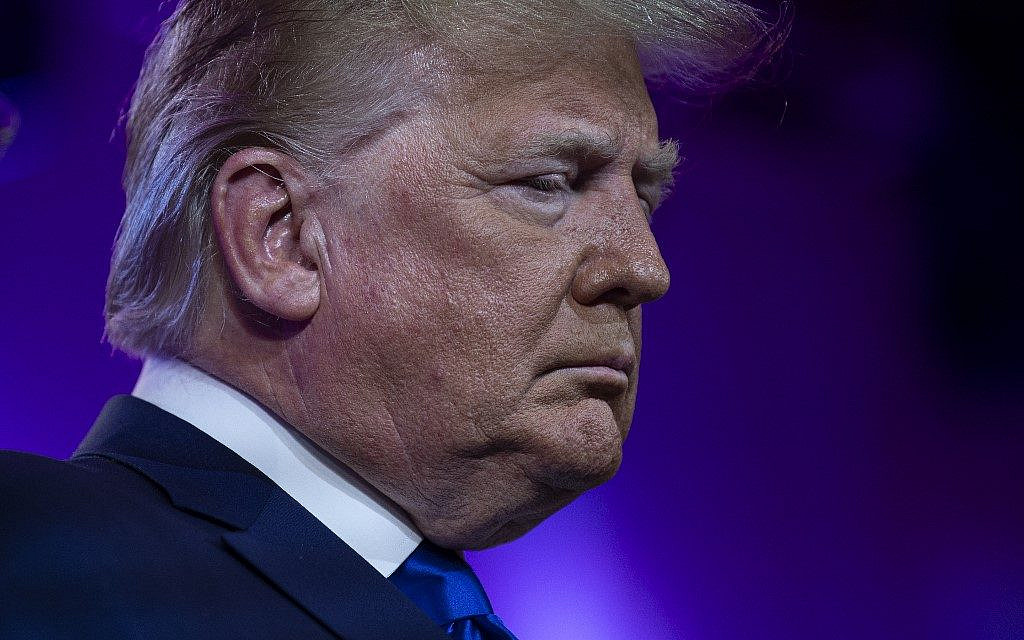
US President Donald Trump speaks at the Values Voter Summit at the Omni Shoreham Hotel on October 12, 2019 in Washington, DC. (Eric BARADAT / AFP)

US President Donald Trump speaks at the Values Voter Summit at the Omni Shoreham Hotel on October 12, 2019 in Washington, DC. (Eric BARADAT / AFP)

WASHINGTON (AFP) — Since the outbreak of Syria’s brutal civil war, the United States has stated several objectives — destroying Islamic State extremists, easing President Bashar Assad from power and limiting Iran’s influence.

In just one decision, President Donald Trump may have undone all three.

The mercurial leader pulled US troops out of northern Syria in the face of a Turkish invasion against Kurdish forces, who had led the campaign to crush the Islamic State group and with US protection had enjoyed effective autonomy.

The Kurds have reached out to Assad’s regime — allied with Iran and Russia — to redeploy for the first time in years to northern Syria to face Turkey, which is trying to eliminate a force it links to Kurdish separatists at home.

Trump, who is skeptical of US military engagements overseas, already declared a withdrawal from Syria in December before backtracking but appeared to be convinced in an October 6 telephone call with Turkish President Recep Tayyip Erdogan.

Turkish troops walk alongside an armoured personnel carrier through the town of Tukhar, north of Syria’s northern city of Manbij, on October 14, 2019, as Turkey and it’s allies continues their assault on Kurdish-held border towns in northeastern Syria. – Turkey wants to create a roughly 30-kilometre (20-mile) buffer zone along its border to keep Kurdish forces at bay and also to send back some of the 3.6 million Syrian refugees it hosts. (Photo by Aref TAMMAWI / AFP)

“We are now facing a situation that one could have foreseen in December, but it is being done in a way that it’s having all of the worst consequences that one could have feared,” said Robert Malley, president of the International Crisis Group, which studies conflict resolution.

“It raises even more questions about reliability, so many of America’s allies in the region are going to wonder what will it take for President Trump to turn around and no longer consider us partners or allies,” he said.

Damage ‘for years to come’

Elizabeth Dent, a scholar at the Middle East Institute who served as the special assistant to the US envoy in charge of defeating the Islamic State group, saw risks of a resurgence of the extremists and said that the United States could have prepared ahead of time.

“Had the US actually planned a more formal withdrawal we could have ensured that detainees were properly secured prior to pulling back forces,” she said.

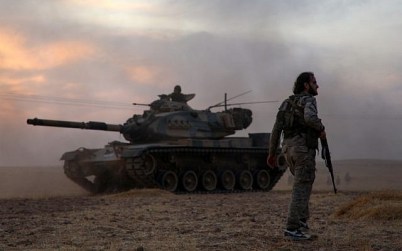
Turkey-backed Syrian fighters gather around a Turkish army US-made M60 tank in the northern outskirts of the Syrian city of Manbij near the Turkish border on October 14, 2019, as Turkey and its allies continue their assault on Kurdish-held border towns in northeastern Syria. – Turkey wants to create a roughly 30-kilometre (20-mile) buffer zone along its border to keep Kurdish forces at bay and also to send back some of the 3.6 million Syrian refugees it hosts. (Photo by Zein Al RIFAI / AFP)

She doubted that the pullout in itself would have long-term consequences for the United States in the Middle East, saying that both Russia and Iran have historically had deeper ties in Syria while Washington is more active elsewhere.

“But the way the decision was made — abruptly, with no planning, an optic of the US being forcibly removed or conceding to Turkish demands, and an abandonment of our partner force — will certainly have an impact on US credibility and reliability for years to come,” she said.

She said it was only a matter of time before Assad, who has triumphed militarily in much of the country, reached a deal with the Kurdish-led Syrian Democratic Forces.

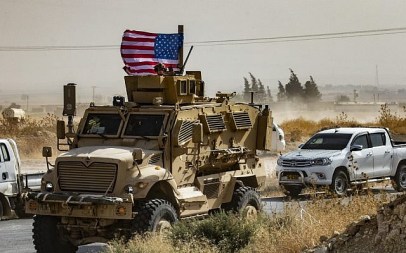
In this file photo taken on October 6, 2019 a US soldier sits atop an armored vehicle during a demonstration by Syrian Kurds against Turkish threats next to a base for the US-led international coalition on the outskirts of Ras al-Ain town in Syria’s Hasakeh province near the Turkish border (AFP)

Former president Barack Obama had called for Assad’s ouster but the United States more recently has depersonalized its position, instead calling for an inclusive political process to end one of the most devastating wars in recent memory, which has killed more than 370,000 people and displaced millions.

The Obama administration allied with the Kurds to fight the Islamic State group after deciding that Syria’s rebels were not moderate or credible enough to support.

US always ‘confused’

“America has always been confused about what it’s doing in Syria. It inflated the expectations of the Kurds well beyond what it could deliver,” said Joshua Landis, an expert on Syria at the University of Oklahoma.

“The United States was never going to be in Syria for the long haul and help establish a quasi-independent state with the Kurds. That was a pipe-dream,” he said, pointing to wide opposition in the region to Kurdish aspirations.

Landis played down the chances that the Islamic State group will benefit, saying that US military action had already decimated the extremists and that Syrian government authority was the long-term solution — “not having American police on the ground.”

But he agreed that the pullout, along with Trump’s calls for a lighter footprint in the Middle East, would boost both Iran and Russian President Vladimir Putin.

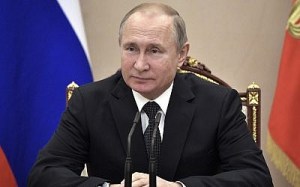
Russian President Vladimir Putin chairs a Security Council meeting in Moscow, on February 1, 2019. (Alexei Nikolsky, Sputnik, Kremlin Pool Photo via AP)

Trump since taking office has vowed to curb Iran’s influence in the region, pulling from a nuclear accord and imposing sweeping sanctions, but has also held off from military action as tensions soar.

The Pentagon ordered reinforcements Friday to Saudi Arabia after an attack on its oil plants which Washington blamed on Iran. But on Monday, the longstanding US ally was rolling out the red carpet for a high-profile visit by Putin.

“The stock of President Trump has plummeted in the Middle East and that of President Putin is skyrocketing today because nobody trusts President Trump — they feel that he is going to yank America out of the Middle East willy-nilly and they’re going to be left on their own,” Landis said.


Task of stopping Turkey passes from Trump to Putin. Syrian army defends threatened Kurdish towns – DEBKAfile

October 15, 2019

Source: Task of stopping Turkey passes from Trump to Putin. Syrian army defends threatened Kurdish towns – DEBKAfile

President Donald Trump’s decision to pull US troops back from the Turkish-Kurdish confrontation on Sunday, Oct.13 produced a lightning realignment of big power strength on the battlefield of NE Syria: the task of protecting the Kurds from the excesses of the Turkish operation passed to Vladimir Putin and the Syrian army.

By Monday, Syrian government forces had reached the Kurdish-held towns of Kobani, Manbij and Raqqa as Turkish troops were poised to move in against the first two. According to some reports, the Syrian army was already inside those towns, but, say DEBKAfile’s military sources, it can’t hold out against a Turkish advance without Russian support.

The wheels for this turnabout, as DEBKAfile predicted on Saturday, were set in motion by a deal struck by the Kurdish leaders of the US-backed Syrian Defense Forces (SDF) with Assad regime officials at the Russian command center in the Khmeimim air base near Latakia. Their meetings were chaired by Russian officers. Feeling abandoned by the US pullback, the Kurds quickly agreed to relinquish their struggle for an independent state and settle for autonomous status for their northeastern provinces in return for the Syrian army taking over the defense of their endangered towns.

The deal, which took effect within 24 hours, still has rough edges to be smoothed out, such as:

  1. The exact nature of Kurdish autonomous rule and relations with central government in Damascus.
  2. The borders of Kurdish-ruled lands.
  3. The fate of the SDF.
  4. How far will Russian President Vladimir Putin be willing to push back against Turkish President Recep Erdogan for halting his army’s advance into northern Syria.

Trump ordered American troops in northern Syria to move east, out of the way of a potential clash over the Kurdish regions, up to the areas adjoining the Iraqi border. Already now, since the Syrian government is not up to a full-scale battle with the Turkish army without Russian army and air force support, Turkey and Russian stand at the threshold of a major military clash.

How Putin handles this standoff is open to question. He may be able to resolve it by giving Erdogan a quiet ultimatum to back off or face direct hostilities with the Russian army. Meanwhile, the Russian leader comes out of the mess created by the Turkish operation having attained the overriding goal of his intervention in the Syrian conflict: to bring all parts of the country under the central rule of the Assad regime.

Most immediately, he must halt the flight of thousands of Islamist State fighters from camps in Kurdish territory in the wake of the turmoil. At least 1,000 have so far escaped, raising concerns of an ISIS resurgence.

Trump’s transfer of the Syrian mess to Putin is compatible with his avowed goal: to start withdrawing American forces from Syria after the Islamic State’s defeat.


Israel-Iran: prospects of wide-scale conflict- Jerusalem Studio 456 

October 12, 2019


The IDF’s secret weapon against Iran

October 11, 2019

Source: The IDF’s secret weapon against Iran – Israel News – Jerusalem Post

Thousands of soldiers and officers pass through its doors every year, training for positions in the IDF’s Military Intelligence Division.

BY ANNA AHRONHEIM
 OCTOBER 10, 2019 19:37
The IDF's secret weapon against Iran

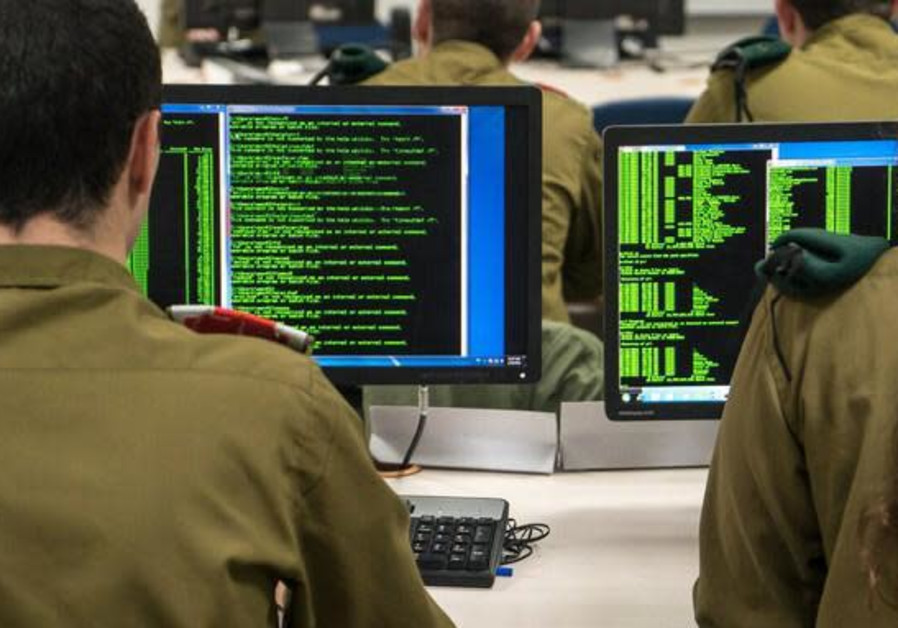
Israel’s military has a secret weapon as the war-between-war campaign against Hezbollah and Iran continues to expand: the Language Teaching Department at the Military Intelligence and Cyber Instruction Unit (MICIU), a language school where soldiers become fluent in Arabic or Farsi in under two months.

In a nondescript building in a base in the center of the country sits the largest intelligence school in the entire Middle East. Thousands of soldiers and officers pass through its doors every year, training for positions in the IDF’s Military Intelligence Division.

“It’s not like in a normal school where students are taught just a language,” Maj. V., head of the MICIU’s Language Teaching Department, told The Jerusalem Post. “We aren’t here just to learn a language; the language is a tool to get and understand the intelligence we collect.”


The school, which has existed for over 50 years, uses innovative approaches and learning environments that within weeks have soldiers understanding both the language and culture of their enemies.

V.’s name can’t be divulged for security reasons. The identity of R. and N. are similarly secret.

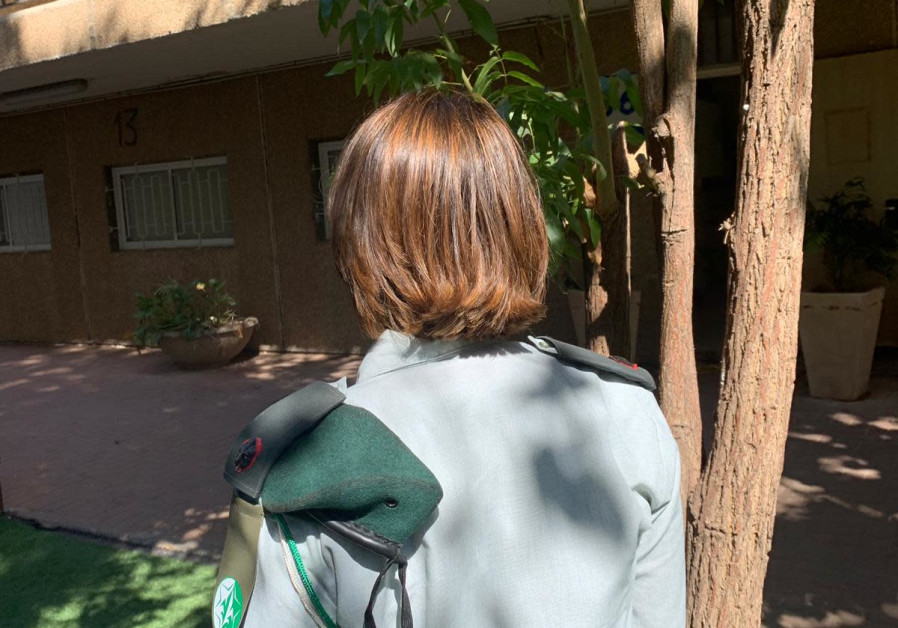
R. has been an instructor at the school for 47 years, and teaches spoken Arabic. Her daughter, Master Sgt. N., teaches written Arabic.

“It’s a challenging and hard role because we have the responsibility of the state’s security on our shoulders,” R. said. “To work in this environment is serving the country, on all levels.”
It’s not only conscripts who study at the MICIU, but officers in other security agencies whose operational activity sees them interacting with Palestinians or the Arab world on a regular basis.

V. explained that in recent years, fundamentalist Islam and the Persian language have become a more central part of the school, which for decades focused on various Arabic dialects, as well as Hebrew.

The Hebrew language courses are “a growing trend” at the school, not only for new immigrants whose mother tongue isn’t Hebrew, but for Israelis who “don’t read or write enough and therefore whose Hebrew just isn’t good enough,” V. said.

While the IDF’s language school is the largest of its kind, there are several schools across the country teaching Arabic and one which teaches Farsi, giving students the opportunity to be selected to the Intelligence Unit’s language tracks that opens the doors to the elite Unit 8200.


“It’s more challenging because [Persian] is not taught in Israeli schools,” V. said. “This is the only place in the country that researches and teaches the language so intensely. Because of the dynamic world of intelligence and changes in the intelligence, students are learning non-stop.”

Students learn from 8 a.m. until 11 p.m. daily for 10 weeks to get a matriculation certificate. This is followed by another 10 weeks of advanced courses.

Despite the growing number of computerized language translation tools available, there’s nothing better than the human mind.

“You still need people who don’t only know the language” but who can read between the lines and give the precise intelligence the military needs, according to V.

“Time is not a luxury that we have,” V said. “The soldiers have only two years where they are serving, and I want them to be as effective as possible in their work.”


Two missiles set an Iranian tanker on fire near the Saudi coast – DEBKAfile

October 11, 2019

Source: Two missiles set an Iranian tanker on fire near the Saudi coast – DEBKAfile

Explosions set a tanker belonging to National Iranian Oil Company on fire in the Red Sea on Friday, Oct. 11 when it was 95km from the Saudi port city of Jeddah. The NIOC says it was hit by two missiles. Iranian state media RNA said the explosions damaged two storerooms aboard the oil tanker and caused an oil spill into the Red Sea.

Iran’s Nour news agency, close to Iran’s Revolutionary Guards, later said the situation was under control and no crew members were injured. It gave the the vessel different names, “Sanitized” or “Sabity” or “Sinopa”

The US Navy’s 5th Fleet, which oversees the region, did not immediately respond to a request for comment.

The explosions came after a series of attacks attributed to Iran, including the shooting down of a US drone over the Strait of Hormuz, attacks on tankers sailing in the Gulf and, finally, the cruise missile-drone assault on Saudi oil facilities which halved its output.

DEBKAfile: If a missile strikes is confirmed. this would be the first time since that series of attacks began to unfold five months ago that an Iranian oil tanker was targeted.

The incident may have two possible sources:

  1. The two missiles were fired from the Saudi coast or a Saudi missile boat. This would represent Riyadh’s payback for the missile-drone assault that disabled a Saudi oil field and refinery on Sept. 14. For now, no comment has been forthcoming from any Saudi source.
  2. A third party which maintains a missile boat presence in the Red Sea.

If the Saudis were responsible, the incident is capable of triggering a major outbreak of hostilities, including the trading of missile strikes between the oil kingdom and Iran. If it was a third party, Tehran may decide to pin the blame on Israel. On Thursday, Oct. 10, Prime Minister Binyamin Netanyahu revealed for the first time that Israel was pondering a pre-emptive attack on Iran to thwart its plans for an assault on Israel.


Erdogan threatens EU with refugee influx if it criticizes Syria operation

October 10, 2019

Source: Erdogan threatens EU with refugee influx if it criticizes Syria operation | The Times of Israel

Turkish president says he will allow millions of refugees to head to Europe if bloc censures Ankara over military offensive against Kurdish forces

Turkish President Recep Tayyip Erdogan during an extended meeting with provincial heads of ruling Justice and Development (AK) Party in Ankara, Turkey, on October 10, 2019. (Adem ALTAN / AFP)

ANKARA, Turkey — Turkish President Recep Tayyip Erdogan warned the EU on Thursday that Ankara would allow millions of refugees to head to Europe if the bloc criticized Turkey’s military offensive in Syria.

“Hey EU, wake up. I say it again: if you try to frame our operation there as an invasion, our task is simple: we will open the doors and send 3.6 million migrants to you,” Erdogan said in a speech to his party.

Turkey launched an operation into Syrian territory on Wednesday, aimed at combating Kurdish militants tied to insurgents in its own territory.

Erdogan said 109 “terrorists” had been killed so far in the operation, which would soon cover ground from Manbij in northern Syria to the Iraqi border some 350 kilometers (220 miles) east.

Civilians flee amid Turkish bombardment on Syria’s northeastern town of Ras al-Ain in the Hasakeh province along the Turkish border on October 9, 2019 (Delil SOULEIMAN / AFP)

“God willing, we will crush these snakes’ heads quickly,” he said.

“What we are trying to do is prevent the establishment of a terrorist state on our southern border. This cannot happen,”

Turkey currently hosts 3.6 million refugees from the eight-year conflict in Syria — the highest number in the world.

Under a 2016 agreement with the EU, Turkey agreed to prevent refugees from leaving towards Europe in exchange for six billion euros and visa-free travel for its citizens, but has frequently criticized the lack of assistance from Brussels.

“You have never been sincere,” Erdogan said, addressing the EU.

“Now they say they will withhold three billion euros from us. Have you ever kept any promise you gave us so far? No.”

One aim of the military operation is to establish a “safe zone” in which at least one million Syrian refugees can be repatriated, after the long-term presence of refugees became an increasingly political liability.

“For those who want to return to their country but don’t have a home left anymore, we plan to build settlements for one million people, with international financing,” Erdogan said.

A woman flees with her children amid Turkish bombardment on Syria’s northeastern town of Ras al-Ain in the Hasakeh province along the Turkish border on October 9, 2019 (Delil SOULEIMAN / AFP)

He also sought to assuage concerns regarding Islamic State prisoners currently held by Kurdish forces.

“Those that need to be kept in jail we will keep in jail. We will return foreigners to their home countries if they accept them back,” he said.


Netanyahu condemns Turkish invasion of Syrian Kurdistan, offers aid

October 10, 2019

Source: Netanyahu condemns Turkish invasion of Syrian Kurdistan, offers aid | The Times of Israel

Prime minister warns against ‘ethnic cleansing’ of minority in northern Syria, does not mention decision by US president that paved way for offensive

Prime Minister Benjamin Netanyahuat a memorial ceremony at Jerusalem's Mount Herzl for those killed in the Yom Kippur War, on October 10, 2019. (Flash90)

Prime Minister Benjamin Netanyahuat a memorial ceremony at Jerusalem’s Mount Herzl for those killed in the Yom Kippur War, on October 10, 2019. (Flash90)

Prime Minister Benjamin Netanyahu on Thursday denounced Turkey’s invasion of Kurdish-controlled areas of northeastern Syria and said Israel was prepared to offer humanitarian aid to the Kurds in Syria facing an onslaught from Ankara.

The comments were the first from Netanyahu on the situation in Syria after remaining silent for several days following US President Donald Trump’s decision to withdraw American troops from the country and allow the Turkish offensive to move ahead. Several other Israeli officials have denounced the Turkish operation and urged support for the Kurds.

“Israel strongly condemns the Turkish invasion of the Kurdish areas in Syria and warns against the ethnic cleansing of the Kurds by Turkey and its proxies,” Netanyahu said in a statement released by his office. “Israel is prepared to extend humanitarian assistance to the gallant Kurdish people.”

Netanyahu did not mention the US decision to withdraw troops and essentially give Ankara the green light for the offensive.

On Wednesday, Turkey launched a broad assault on Kurdish-controlled areas in northeastern Syria, with intensive bombardment paving the way for a ground offensive made possible by the withdrawal of US troops.

Turkish President Recep Tayyip Erdogan announced the start of the attack on Twitter and soon after jets and artillery targeted Kurdish positions along the full width of the border, sending thousands of civilians fleeing their homes.

Turkey-backed Syrian opposition fighters going to Tel Abyad from Turkish gate towards Syria in Akcakale in Sanliurfa province on October 10, 2019. (BULENT KILIC/AFP)

In 2014, Netanyahu expressed support for an independent Kurdistan. He praised the Kurds’ “political commitment and political moderation,” and said they were “worthy of their own political independence.” But he has avoided criticizing Washington’s decision to pull its troops from northern Syria, which some analysts warn will create a vacuum to be filled by powers that don’t share Israel’s interests.

In what appeared to be a reference to that concern, Netanyahu declared earlier on Thursday that Israel will continue to defend itself on its own against regional threats.

“As in 1973, today we also greatly appreciate the important support of the US… At the same time, we always remember and implement the basic rule that guides us: Israel will protect itself, on its own, against any threat,” the prime minister said during a memorial ceremony at Jerusalem’s Mount Herzl national cemetery for those killed in the Yom Kippur War.

Netanyahu accused Iran of “striving to tighten its grip” on countries throughout the region, referencing the downing of a US drone and the targeting of Saudi Arabian oil refineries.

A picture taken in Akcakale at the Turkish border with Syria on October 10, 2019 shows the Turkish flag as smokes rises from the Syrian town of Tal Abyad after a mortar landed in Akcakale. (BULENT KILIC / AFP)

“Iran threatens to wipe us off the map… Time and again, [the regime] tries to attack us, so we must stand ready to protect ourselves from the danger,” the premier added.

Israel and Turkey share chilly diplomatic relations, and Netanyahu regularly criticizes Erdogan for “massacring Kurds.”

Prominent lawmakers across the political spectrum in Israel have issued statements of support for the Kurdish people as Turkey began its invasion of Syria and in the US Trump has faced rare internal pressure from Republicans over the decision to not stand by the Kurds.

On Wednesday night, New Right MK Ayelet Shaked reissued a call for Kurdish statehood, urging the West to support the Kurds as Turkey launched a military campaign in northern Syria.

Most lawmakers have avoided criticizing Trump directly, but Meretz chairman Nitzan Horwitz mentioned the US president by name.


Trump defends Syria move: For us, ‘the stupid, endless Mideast wars are ending!’

October 10, 2019

Source: Trump defends Syria move: For us, ‘the stupid, endless Mideast wars are ending!’ | The Times of Israel

‘USA should never have been in Middle East’ president tweets, amid scathing bipartisan criticism for withdrawing forces, and mounting concern in Israel

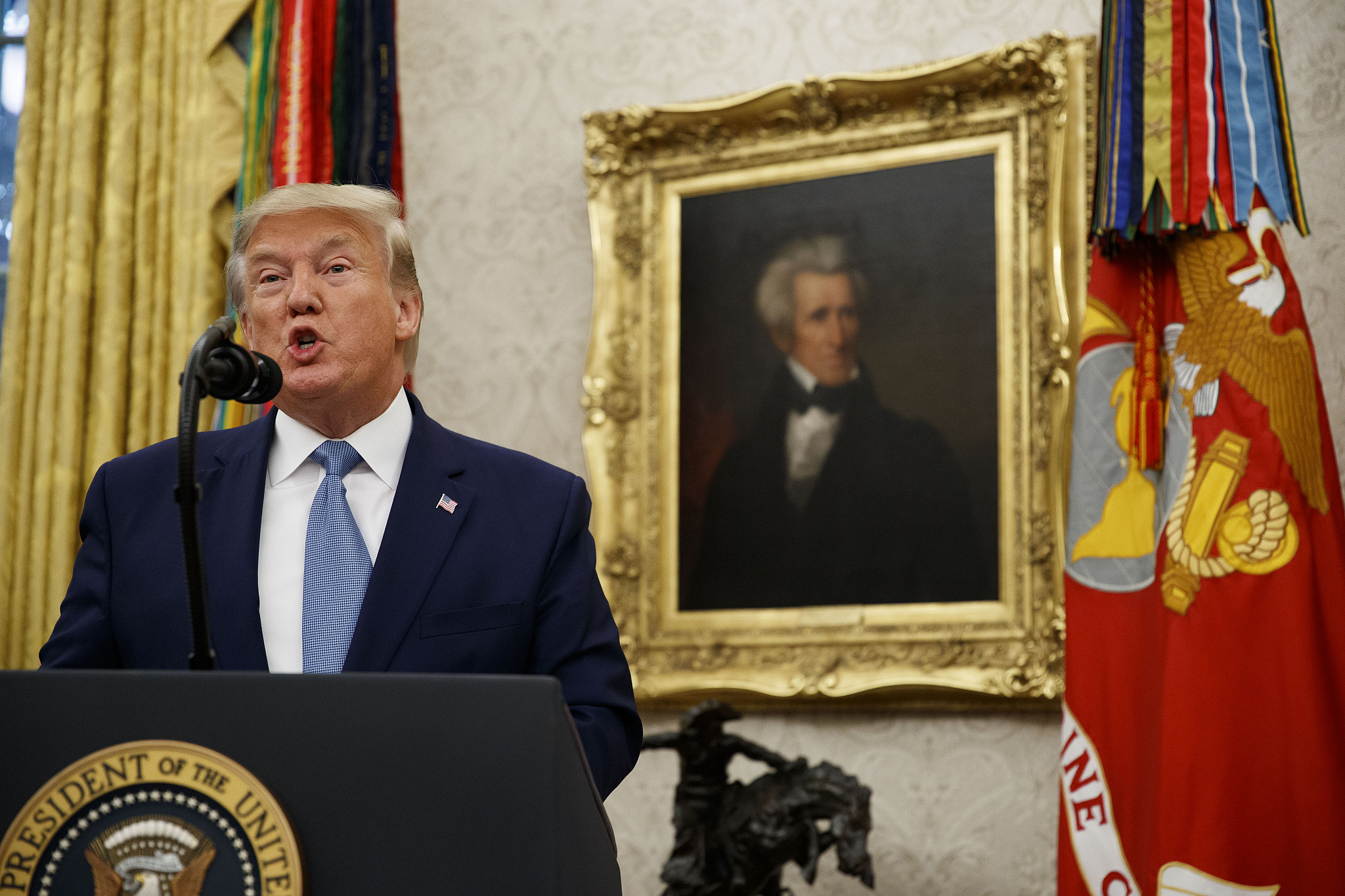
President Donald Trump speaks during a ceremony to present the Presidential Medal of Freedom to former Attorney General Edwin Meese, in the Oval Office of the White House, Tuesday, Oct. 8, 2019, in Washington. (AP Photo/Alex Brandon)

President Donald Trump speaks during a ceremony to present the Presidential Medal of Freedom to former Attorney General Edwin Meese, in the Oval Office of the White House, Tuesday, Oct. 8, 2019, in Washington. (AP Photo/Alex Brandon)

WASHINGTON (AP) — President Donald Trump lashed out Wednesday over sharp bipartisan criticism of his decision to pull back US troops from northeastern Syria, saying he is focused on the “BIG PICTURE” that does not include American involvement in “stupid endless wars” in the Middle East.

“Fighting between various groups that has been going on for hundreds of years. USA should never have been in Middle East,” Trump said in a series of morning tweets. “The stupid endless wars, for us, are ending!”

Turkey launched its offensive Wednesday against Kurdish fighters in Syria, who have helped the US against the Islamic State. Turkey views the Syrian Kurdish fighters as terrorists, and Trump’s decision to pull back US troops leaves them vulnerable to the military onslaught.

Trump’s decision is being condemned by some of his staunchest Republican allies.

Donald J. Trump

@realDonaldTrump

Twitter Moments

@TwitterMoments

The White House said Turkey will be “moving forward with its long-planned operation into Northern Syria” and will be responsible for all ISIS fighters captured in the area. https://twitter.com/i/events/1181041653827588096 

Sen. Lindsey Graham, R-S.C., a close Trump ally, stepped up his criticism of the president Wednesday, telling “Fox & Friends” that if Trump “follows through with this, it would be the biggest mistake of his presidency.”

In a series of tweets, Graham urged prayers for “our Kurdish allies who have been shamelessly abandoned by the Trump Administration,” adding, “This move ensures the reemergence of ISIS.”

Graham on Monday had warned of the consequences for Israel, saying “The US now has no leverage and Syria will eventually become a nightmare for Israel.” And former Israeli ambassador to the US, Michael Oren, told the New York Times on Tuesday that he was no longer sure Israel could “bank on” on the US, under Trump, to come to Israel’s aid at a time of serious war.

Trump defended his unpopular decision, arguing on Twitter that “GOING INTO THE MIDDLE EAST IS THE WORST DECISION EVER MADE IN THE HISTORY OF OUR COUNTRY!” He said the US went to war under a “false & now disproven premise, WEAPONS OF MASS DESTRUCTION. There were NONE!”

This photo by Hawar news, the news agency for the semi-autonomous Kurdish areas in Syria (ANHA), shows smoke rising from shelling by Turkish forces, at the outskirts of Ras al-Ayn, northeast Syria, Wednesday, Oct. 9, 2019. A spokesman for the U.S.-backed Kurdish-led force in northern Syria says Turkish warplanes have started targeting “civilian areas” in northern Syria. (ANHA via AP)

Trump said he is “slowly & carefully” bringing home “our great soldiers & military,” in line with his campaign promise to do so.

He added: “Our focus is on the BIG PICTURE! THE USA IS GREATER THAN EVER BEFORE!”

But the US military has kept a decades-long focus on the Middle East as part of a strategy of stopping or minimizing security threats before they spread to American and allied shores.

As a further sign that the military does not share Trump’s view that the fight against the extremists is over, a press release Wednesday by the US-led military coalition combating IS highlighted recent battlefield gains. It concluded by saying that “removing” IS fighters, weapons and bomb materials “remains a top priority” as the group “continues to plot attacks against innocent civilians and our partners throughout Iraq and northeast Syria.”

The US has about 1,000 troops in Syria and about 5,200 in neighboring Iraq.

Trump has long criticized President George W. Bush’s decision to invade Iraq in 2003, but the subsequent rise of extremist groups like the Islamic State has convinced many national security officials, and lawmakers such as Graham, that a precipitous US troop withdrawal from the region would leave the US and its allies even more vulnerable to extremism.

Trump also claimed the US has spent $8 trillion “fighting and policing” in the Middle East, up from the $7 trillion figure he has cited numerous times.

Trump is using an inflated estimate on the cost of wars and referring in part to predicted costs going decades into the future, not money actually spent. Some of the spending also reflects his policy decisions he made since taking office nearly three years ago.

Graham said Congress “will push back” against Turkey. He had said earlier this week that he was working on a bipartisan bill to sanction Turkey if they invade Syria, but he did not mention the proposal during Wednesday’s interview.

“We’re not giving Turkey a green light in Congress and we’re not going to abandon the Kurds,” he said. “If the President does so, we won’t.”

Trump announced Tuesday that he and Erdogan will meet at the White House on Nov. 13.