Archive for September 2019

Iran said hindering IAEA probe at alleged nuclear warehouse exposed by Netanyahu

September 3, 2019

Source: Iran said hindering IAEA probe at alleged nuclear warehouse exposed by Netanyahu | The Times of Israel

Tehran is obstructing inspectors, refusing to provide answers after radioactive traces reportedly found at site, report says
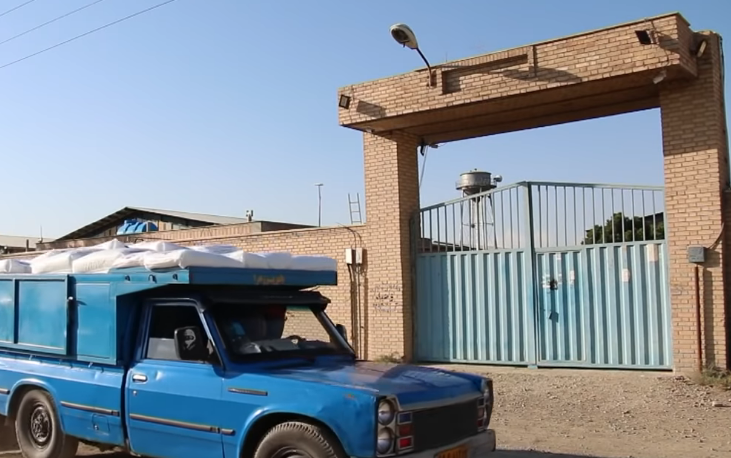
Iran's alleged 'atomic warehouse' in Turquzabad, Tehran (YouTube screenshot)

Iran’s alleged ‘atomic warehouse’ in Turquzabad, Tehran (YouTube screenshot)

Iran is obstructing a UN investigation into a site first identified by Prime Minister Benjamin Netanyahu last year as a secret nuclear warehouse used to store radioactive material, the Wall Street Journal reported Monday night.

Unidentified diplomats told the newspaper Iran was refusing to provide answers to questions posed by the International Atomic Energy Agency, in what was apparently the first instance of Tehran failing to cooperate with inspectors.

The diplomats said there were internal disagreements in the IAEA on how severely Iran should be censured over the issue. A recent IAEA report on Iran’s growing breach of the 2015 nuclear deal reportedly made only vague reference to Tehran’s lack of cooperation with inspectors, saying “Ongoing interactions between the Agency and Iran relating to Iran’s implementation of its Safeguards Agreement and Additional Protocol require full and timely cooperation by Iran.”

A July report on Israel’s Channel 13 claimed inspectors had visited the site several times after Netanyahu identified it in an address to the UN General Assembly last September, took soil samples, and had since definitively concluded that there were “traces of radioactive material” there.

The diplomats told the WSJ that the traces were likely remains from Iran’s past experimentation in nuclear weapons development. Iran has denied ever seeking nuclear weapons, though Israeli and Western intelligence disbelieve those assertions.

The diplomats said the material’s existence at the site was unlikely to indicate new work on weapons development, but would be a breach of Iran’s commitment to non-proliferation.

Iran has denied that the site was a nuclear facility or served any secretive purpose. In an initial response to Netanyahu’s UN speech, Iranian state media claimed the warehouse was actually a recycling facility for scrap metal.

Prime Minister Benjamin Netanyahu holds up a placard showing a suspected Iranian atomic site while delivering a speech at the United Nations during the United Nations General Assembly on September 27, 2018 in New York City. (Stephanie Keith/Getty Images/AFP)

Speaking at the United Nations last September, Netanyahu called on the IAEA to inspect what he said was the “secret atomic warehouse” in the Iranian capital.

He claimed some 15 kilograms (33 pounds) of radioactive material had been recently removed from the atomic warehouse and squirreled away around Tehran, endangering the capital’s residents. The site may have contained as much as 300 tons of nuclear-related equipment and material in 15 shipping containers, Netanyahu added. He did not specify what nuclear material was contained at the site.

That speech came months after Israel’s disclosure that it had spirited away what it said was a “half-ton” of Iranian nuclear documents from Tehran, with Netanyahu saying both the archive and the warehouse were proof that Iran continues to seek atomic weapons despite the 2015 international agreement to limit its nuclear program. “Iran has not abandoned its goal to develop nuclear weapons…. Rest assured that will not happen. What Iran hides, Israel will find,” Netanyahu told the UN.

Following Netanyahu’s UN appearance, the late IAEA head Yukiya Amano said at the time that nuclear inspectors had visited “all the sites and locations in Iran which it needed to visit,” while pushing back against the prime minister’s assertion that the organization had failed to act on intelligence provided by Israel on the warehouse.

Diplomats quoted in April, however, said the IAEA later visited the site in Tehran’s Turquzabad district multiple times.

Referring to Netanyahu’s statements as “ridiculous,” an Iranian state TV report said the country was committed to nonproliferation and noted Iran’s nuclear program was under surveillance of the IAEA. A state TV website briefly reported the Netanyahu accusation and called it an “illusion.”

A Tasnim News reporter who visited the warehouse last October was told by a worker from inside the facility that it was not a military site, and that the Israeli leader was “a stupid person” for believing it was a nuclear warehouse. The reporter did not enter the facility, only speaking to the worker via intercom from outside the locked gate.

Also Monday an Iranian government spokesperson warned Tehran would “take a strong step” away from its 2015 nuclear deal with world powers if Europe cannot offer the country new terms by a deadline at the end of this week, as top Iranian diplomats traveled to France and Russia for last-minute talks.

The comments from Ali Rabiei reinforced the deadline Iran had set for Friday for Europe to offer it a way to sell its crude oil on the global market. Crushing US sanctions imposed after US President Donald Trump withdrew America from the deal over a year ago have halted those sales.

The IAEA report last week said Iran’s stockpile of low-enriched uranium still exceeds the amount allowed by the so-called Joint Comprehensive Plan of Action, or JCPOA as the deal is known.

The UN agency also said Iran continues to enrich uranium up to 4.5%, above the 3.67% allowed.

Enriched uranium at the 3.67% level is enough for peaceful pursuits and is far below weapons-grade levels of 90%. At the 4.5% level, the uranium can help power Iran’s Bushehr reactor, the country’s only nuclear power plant.

It remains unclear what further step Iran will take, though it could involve restarting advanced centrifuges prohibited by the deal or further bumping up its enrichment of uranium. Iran insists the steps it has taken so far are easily reversible.

Iran’s government spokesman Ali Rabiei speaks in his regular news briefing, July 22, 2019 (AP Photo/Vahid Salemi)

Rabiei also claimed Monday that Iran’s views have been converging with those of France on ways to save the nuclear deal.

He suggested President Hassan Rouhani could meet US counterpart Donald Trump if it served Iran’s interests, while cautioning there was no need to meet an “agitator” in the current circumstances.

Rouhani has had a series of phone calls with French President Emmanuel Macron in recent weeks aimed at salvaging the 2015 nuclear deal.

The French leader has been trying to convince the United States to offer Iran some sort of relief from sanctions it has imposed on the Islamic republic since pulling out of the deal in May last year.

“In the past few weeks, there have been serious negotiations” between Rouhani and Macron, as well as talks with other European nations, said Rabiei.

“Fortunately, in many areas, our views have come closer together,” the government spokesman told a news conference.

Agencies contributed to this report.
 

Iran’s Rouhani says no intention of holding bilateral talks with US

September 3, 2019

Source: Iran’s Rouhani says no intention of holding bilateral talks with US | The Times of Israel

President tells lawmakers offers have been made over the years, but he never responds to them, threatens to further reduce commitment to 2015 nuclear deal in coming days

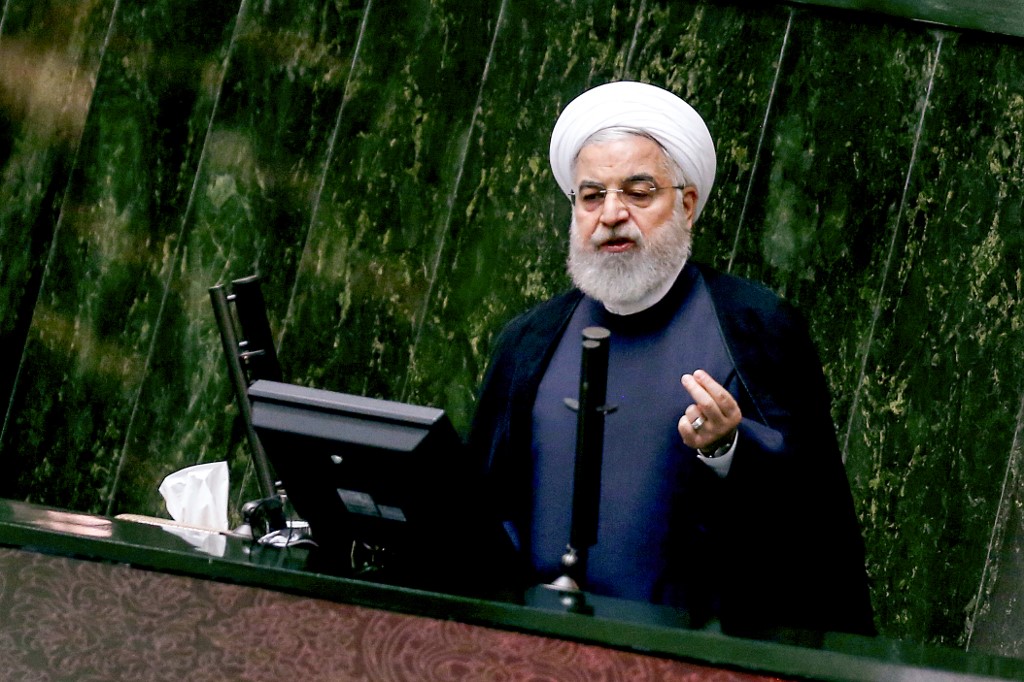
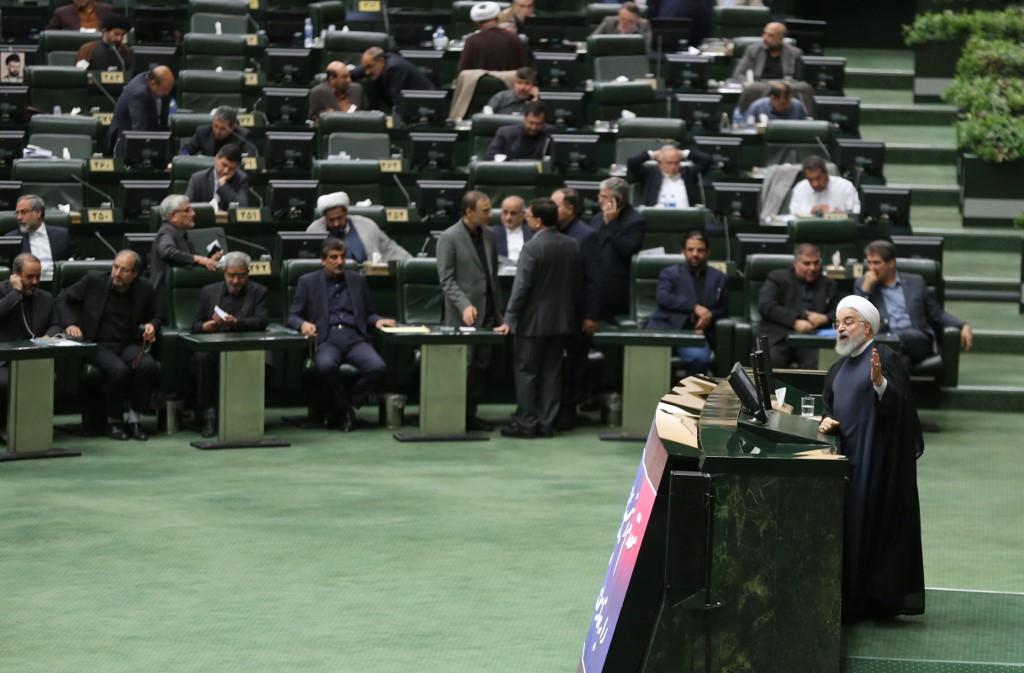
Iran's President Hassan Rouhani, right, speaks at parliament in the capital Tehran on September 3, 2019. (ATTA KENARE/AFP)

Iran’s President Hassan Rouhani, right, speaks at parliament in the capital Tehran on September 3, 2019. (ATTA KENARE/AFP)

Iran’s President Hassan Rouhani on Tuesday again ruled out holding any bilateral talks with the United States, saying the Islamic republic is opposed to such negotiations in principle.

In an address to parliament, Rouhani also said Iran was ready to further reduce its commitments to a landmark 2015 nuclear deal “in the coming days” if negotiations with other world powers yield no results by Thursday.

Rouhani’s remarks came as France has said its diplomatic efforts were bridging the gap between the US and Iran, leading to US President Donald Trump to say he would be willing to meet with Rouhani for direct talks.

“We’ve said it before time and again, and we say it again: We have no intention to hold bilateral talks with the United States,” Rouhani said, according to a report from Iran’s Mehr news agency. “We never did and never will. It has been the case in the past year and a half, and even in previous years.”

“There have been calls for talks, but we never responded to them,” Rouhani added in comments broadcast live.

Iran’s President Hassan Rouhani speaks at parliament in the capital Tehran on September 3, 2019. (ATTA KENARE/AFP)

The Iranian president reiterated that Iran will not enter talks with the United States unless Washington lifts its sanctions against Tehran first.

Rouhani also said European nations are failing to implement their commitments following the US pullout from the 2015 nuclear deal.

Iranian state TV quoted Rouhani as saying that the Europeans “did not carry out their task.”

The comments come as Iranian diplomats are in France for last-minute talks.

Iran on Monday threatened to “take a strong step” away from the deal if Europe cannot offer new terms by a deadline at the end of this week.

Iran’s oil exports have been curbed and its economy has faced freefall following crushing US sanctions imposed after Trump withdrew the US from the deal.

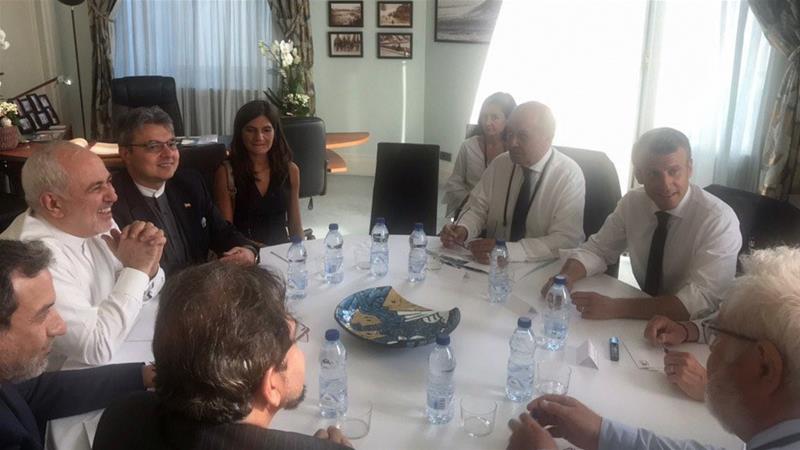
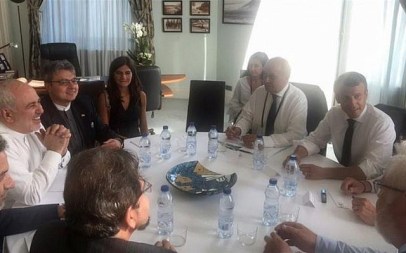
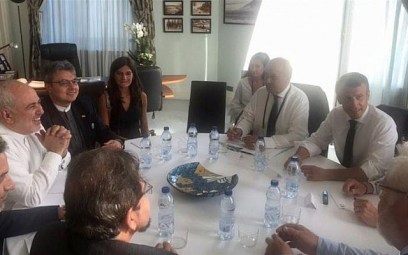
Iran’s Foreign Minister Mohammad Zarif holds talks in Biarritz on August 25, 2019 with France’s President Macron and Foreign Minister Jean-Yves Le Drian (Handout photo via AFP)

France’s President Emmanuel Macron has been one of the leading voices in the European Union for dialogue with the Islamic Republic. Last week he arranged the surprise arrival of Iran’s Foreign Minister Mohammad Javad Zarif at the G7 summit in Biarritz, France, and proposed a summit between Trump and Rouhani.

Trump showed openness to the notion, a fact that reportedly caused intense concern in Jerusalem.

Prime Minister Benjamin Netanyahu spoke Friday with Macron, urging him not to negotiate with Iran at the present time.

According to a readout from his office, the premier said that, with Tehran increasing its regional aggression and threatening Israel and others, “now is “precisely not the time” to hold conciliatory talks with the regime.


New US-led patrols in Persian Gulf raise stakes with Iran 

September 3, 2019

Source: New US-led patrols in Persian Gulf raise stakes with Iran | The Times of Israel

Coalition to safeguard oil shipping in strategic route could stumble into ‘accidental escalation’ with Tehran, analysts warn

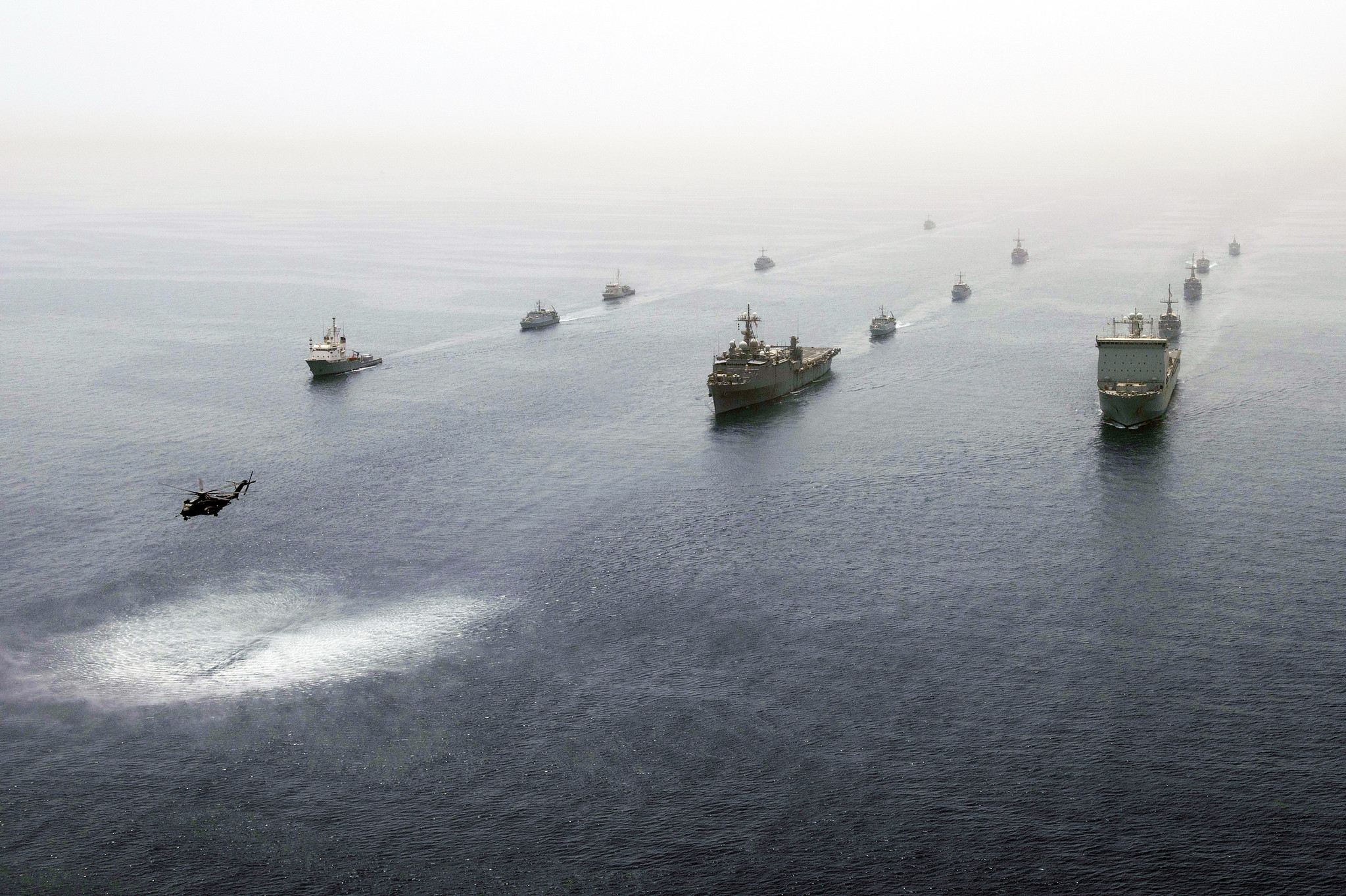
Multinational ship in formation in the Persian Gulf May 21, 2013, during an International Mine Countermeasures Exercise. (Michael Sandberg/US Navy)

Multinational ship in formation in the Persian Gulf May 21, 2013, during an International Mine Countermeasures Exercise. (Michael Sandberg/US Navy)

DUBAI, United Arab Emirates (AP) — As the US tries a new way to protect shipping across the Persian Gulf amid tensions with Iran, it finds itself sailing into uncertain waters.

For decades, the US has considered the waters of the Persian Gulf as critical to its national security. Through the gulf’s narrow mouth, the Strait of Hormuz, 20% of all crude oil sold passes onto the world market. Any disruption there likely will see energy prices spike.

The US has been willing to use its firepower to ensure that doesn’t happen. It escorted ships here in the so-called 1980s “Tanker War. ” America fought its last major naval battle in these waters in 1988 against Iran.

Now, the US Navy is trying to put together a new coalition of nations to counter what it sees as a renewed maritime threat from Iran.

But Tehran finds itself backed into a corner and ready for a possible conflict it had 30 years for which to prepare. It stands poised this week to further break the terms of its 2015 nuclear deal with world powers, over a year after President Donald Trump unilaterally withdrew America from the accord and imposed crippling sanctions on the country.

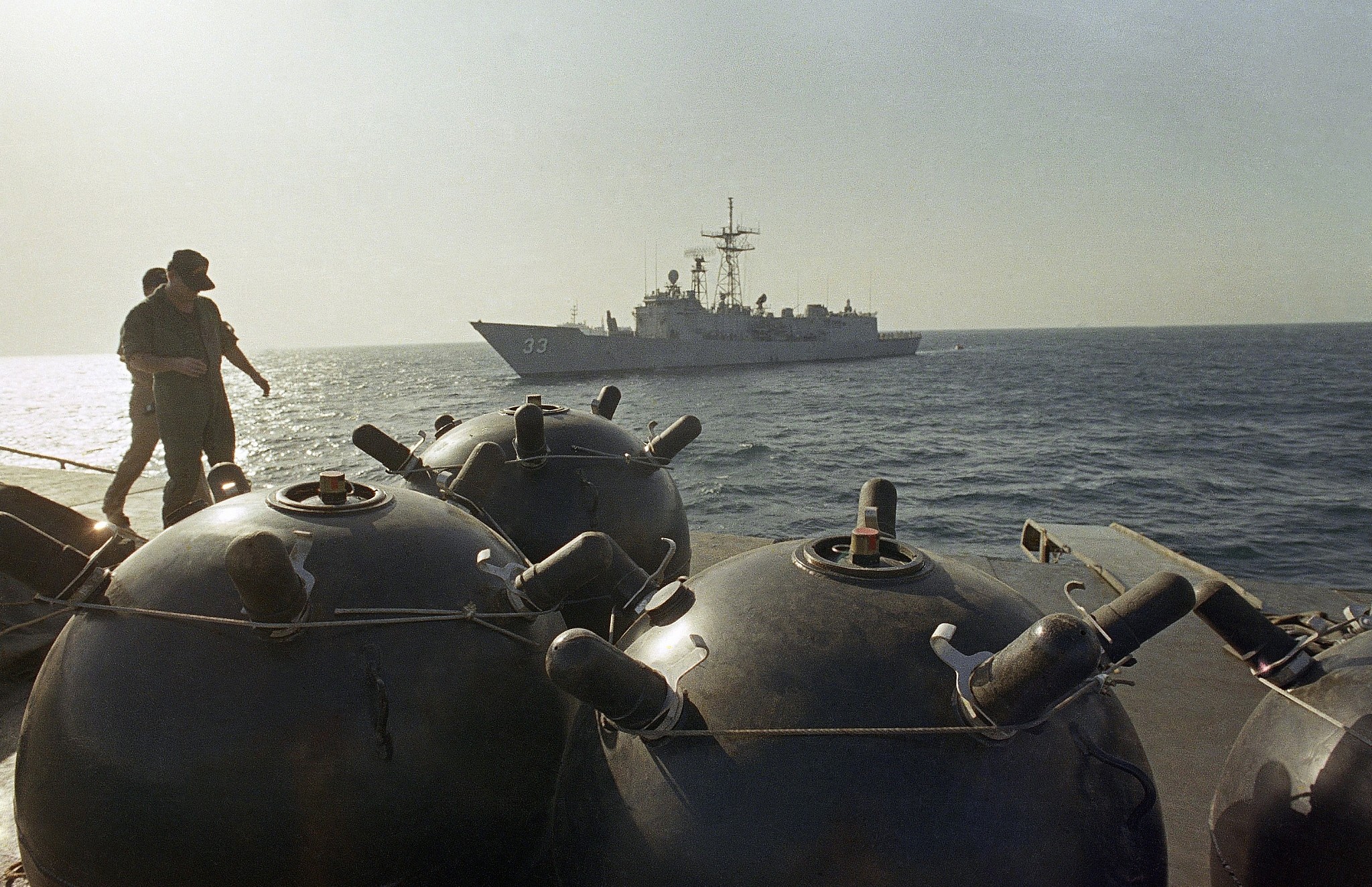
Mines aboard the ship Iran Ajr are inspected by a boarding party from the USS LaSalle in the Persian Gulf, Sept. 1987. (AP/Mark Duncan)

“It is plausible to imagine a scenario where these forces stumble into some type of accidental escalation,” said Becca Wasser, a senior policy analyst at the RAND Corp. who studies the region.

The US-led Sentinel Program’s strategy aims to secure the greater Persian Gulf region in a multipart strategy. It includes surveillance of the Strait of Hormuz and the Bab el-Mandeb, another narrow strait that connects the Red Sea and the Gulf of Aden off Yemen and East Africa. Smaller patrol boats and other craft will be available for rapid response.

The plan also allows for nations to escort their own ships through the region, said Cmdr. Joshua Frey, a spokesman for the US Navy’s 5th Fleet, which oversees the region. For now, the Bahrain-based 5th Fleet is not escorting US-flagged ships through waters, though that remains a possibility, he said.

So far, only Australia, Bahrain and the United Kingdom have said they’ll join the US program. India has begun escorting its own ships independently of the US coalition, while China has suggested it could get involved as well.

Some of what the US plan calls for already falls under the routine operations of the 5th Fleet, which has been in the region since 1995.

US Navy ships coming in and out of the Persian Gulf often find themselves shadowed by Iranian Revolutionary Guard vessels. Some incidents have seen the US fire warning shots or Iranian forces test-fire missiles nearby.

But the new forces, as well as Iran facing growing financial pressure from US sanctions, have raised the stakes for conflict, said Michael Stephens, a senior research fellow who focuses on the Mideast at London’s Royal United Services Institute for Defense and Security Studies.

“When you change the chessboard, you are effectively permanently changing the conditions under which you’re operating,” Stephens said. “How you cannot make that look like an escalation is anyone’s guess because it is an escalation.”

Iran itself hasn’t sat still. The Guard, a paramilitary force answerable only to Supreme Leader Ayatollah Ali Khamenei, pilot speedboats through the Strait of Hormuz and run drills practicing swarming larger warships. It possesses shore-to-ship missiles. It also, according to US officials, has special forces capable of sneaking up on unsuspecting ships to plant explosive mines.

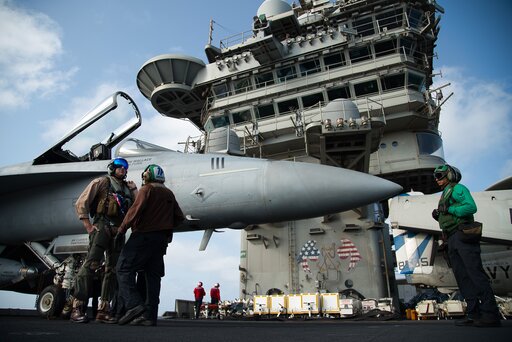
A pilot speaks to a crew member by an F/A-18 fighter jet on the deck of the USS Abraham Lincoln aircraft carrier in the Arabian Sea on June 3, 2019. (AP Photo/Jon Gambrell)

One of the immediate dangers is in the response to Iran itself. During the Somali piracy crisis of the 2000s, the rush of navies to the region saw fishermen wrongly targeted for attack in at least one incident, said Salvatore R. Mercogliano, a former merchant mariner and associate professor of history at North Carolina’s Campbell University.

While the Strait of Hormuz is just 33-kilometers (21-miles) wide at its narrowest point, there is a lot of surrounding area to cover for such a force. Trying to run convoys of ships through the areas also would slow down traffic and delay shipments. Meanwhile, the small fast boats of Iran’s Guard easily can be missed among the fishermen and traditional dhow ships moving through the busy waters.

“It’s very easy to get lured one way or another and miss something,” Mercogliano said.

Meanwhile, US authorities warn that ships in the region have reported “spoofed bridge-to-bridge communications from unknown entities falsely claiming to be US or coalition warships.” Ships also have reported interference with their GPS systems, according to the US Transportation Department’s Maritime Administration. That could see ships accidentally enter Iranian territorial waters and offer a pretense for its forces to board.

For mariners in the region, the Strait of Hormuz has been declared a temporary extended risk zone, qualifying them for a bonus and higher death and disability coverage. And while the mariners may be on Western-owned or -flagged vessels, many come from poorer countries in Eastern Europe or Asia.

“The normal seafarers are the ones being caught up in this geopolitical game,” said Jacqueline Smith, the maritime coordinator for International Transportation Workers’ Federation.


IRGC, Al Qods and Hizballah chiefs plot anti-Israel drive at secret Beirut summit – DEBKAfile

September 3, 2019

Source: IRGC, Al Qods and Hizballah chiefs plot anti-Israel drive at secret Beirut summit – DEBKAfile

DEBKAfile Exclusive:  Only an extraordinary errand would have brought two top Iranian generals, IRGC chief Maj. Gen, Hossein Salami and Al Qods’ Qassem Soleimani, flying to Beirut for a secret conclave with Hizballah’s Hassan Nasrallah. But DEBKAfile reports exclusively that this is what happened on the night of Aug. 22, shortly after the thwarting of Iran’s first attempt to launch 4 killer drones into Israel from Syria.

Our sources report the two key Iranian Guards generals, who were never before known to have flown out of Iran together, spent three and-a-half hours talking to the Hizballah chief before leaving the Lebanese capital as quietly as they came. The content of this singular meeting has not been established for sure by any intelligence agency, but it is generally believed to have been called as a counsel of war to set out a joint program of operations against US and Israeli Middle East targets in the coming weeks.

A partial parallel may be drawn between this event and a meeting 12 years ago.  On July 19, 200, Nasrallah travelled to Damascus to sit down with then Iranian President Ahmadinejad and Syrian President Bashar Assad. They met to outline a common Iranian-Hizballah-Syrian plan of action against Israel as a sequel to the 2006 Israel-Lebanon war. This time, Assad was conspicuously absent from the deliberations, evidence of his decision in recent weeks to draw some distance from Tehran and deepen his cooperation with Moscow.

It is also worth noting that Moscow hastened to step into the exchange of fire between Hizballah in Lebanon and the IDF on Sunday, Sept. 1, Russian commanders in Syria carried messages between the warring sides to keep the flareup in check and prevent it escalating into all-out war. This would have damaged Russian interests in Syria.

This and other incidents in the region in the last 10 days were evidently the outcome of last month’s extraordinary summit in Beirut. The process they set in motion is clearly only at its outset.


IDF chief to UNIFIL: Stop Hezbollah’s missile program, or we will

September 2, 2019

Source: IDF chief to UNIFIL: Stop Hezbollah’s missile program, or we will | The Times of Israel

Meeting head of UN peacekeeping force, Kohavi says Israel will not tolerate terror group’s attacks on its soldiers and civilians, nor let it build precision missiles

IDF chief Aviv Kohavi (second left) meets with the head of UNIFIL Stefano Del Col in the Israeli military's Tel Aviv headquarters on September 1, 2019. (Israel Defense Forces)

IDF chief Aviv Kohavi (second left) meets with the head of UNIFIL Stefano Del Col in the Israeli military’s Tel Aviv headquarters on September 1, 2019. (Israel Defense Forces)

IDF chief Aviv Kohavi on Sunday called on United Nations peacekeepers and the Lebanese government to take action against the Hezbollah terror group’s precision missile project, indicating that Israel would be forced to act if they didn’t.

Kohavi conveyed this position in a meeting with Maj.-Gen. Stefano Del Col, the head of the UN’s Interim Force in Lebanon (UNIFIL), following a clash along the border with Hezbollah on Sunday in which the terror group fired anti-tank guided missiles at Israeli positions near the security fence. No soldiers were injured, and the Israel Defense Forces retaliated by firing approximately 100 artillery shells and bombs at Hezbollah positions in southern Lebanon.

“We will not accept harm to our citizens or our soldiers, and we will not accept Hezbollah’s precision missile project on Lebanese soil,” Kohavi told Del Col.

This was their first meeting since the IDF chief of staff took up his position in January.

IDF chief Aviv Kohavi, left, with the head of UNIFIL Stefano Del Col in the Israeli military’s Tel Aviv headquarters on September 1, 2019. (Israel Defense Forces)

“The state of Lebanon and UNIFIL must bring an end to Iran and Hezbollah’s precision missile project in Lebanon and fully implement [UN] Security Council Resolution 1701,” Kohavi said, referring to the resolution that ended the 2006 Second Lebanon War.

“The current state of affairs is not one we can come to terms with,” he said.

UN Resolution 1701 calls for all armed groups, besides the Lebanese military, to be removed from southern Lebanon, in the area south of the country’s Litani River.

Israel has repeatedly claimed that the Hezbollah terror group, occasionally aided by the Lebanese Armed Forces, maintains an active presence in southern Lebanon of both fighters and weaponry despite this prohibition. UNIFIL, which is tasked with ensuring Resolution 1701’s implementation, has indicated that the constraints of its mandate prevent it from being able to fully investigate Israel’s claims, namely because of the peacekeepers’ inability to enter private property.

A tense calm took hold over northern Israel on Monday following the exchange of fire the day before, but Kohavi told the UNIFIL commander that the IDF remained at the ready for any new developments.

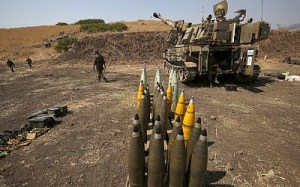
Artillery shells are lined up beside an Israeli self-propelled artillery gun, near the Lebanese border on the outskirts of the northern Israeli town of Kiryat Shemona on September 1, 2019. (JALAA MAREY / AFP)

“The IDF is in a state of preparedness for a variety of possible scenarios,” Kohavi said.

In a statement on Sunday night, Del Col said, “This is a serious incident in violation of UN Security Council resolution 1701 and clearly directed at undermining stability in the area,” Del Col said. “General calm has been restored in the area and the parties have reassured me of their continued commitment to the cessation of hostilities in accordance with Resolution 1701.”

UN chief Antonio Guterres also called on Israel and the Iran-backed Hezbollah to show “maximum restraint,” saying in a statement Sunday that he was “seriously concerned” by the recent exchange of fire along the border.

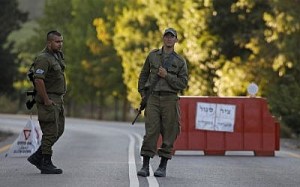
Israeli soldiers stand at a security checkpoint near the northern Israeli town of Avivim, close to the border with Lebanon, on September 1, 2019. (Jalaa MAREY / AFP)

France foreign ministry, meanwhile, said it had made “multiple contacts” to avert an escalation after Lebanon’s Prime Minister Saad Hariri contacted senior US and French officials to urge their countries and the international community to intervene.

“We are in permanent contact with all the Lebanese actors,” a spokeswoman said. “France will pursue efforts in this direction and asks all to assume their responsibilities to quickly restore calm.”

The United States voiced concern over the “destabilizing role” of Iranian proxies in the region and said it “supports Israel’s right to self defense,” a State Department official said.

“Hezbollah should refrain from hostile actions which threaten Lebanon’s security, stability and sovereignty,” the US official added.

Israel and Hezbollah, which fought a month-long war in 2006, have indicated they do not want to go to war but appeared on a collision course in recent days after Hezbollah vowed it would retaliate for a pair of Israeli strikes against the Iran-backed terrorist group — one in Syria claimed by Israel, and another, in Beirut, that the group lays at Israel’s door.

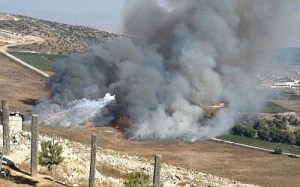
Smoke rises near the community of Avivim following an anti-tank missile attack from Lebanon on September 1, 2019. (Courtesy)

Hezbollah said it fired anti-tank missiles at Israel on Sunday and destroyed an Israeli military vehicle across the border. The IDF said no Israeli soldiers were injured by the 2-3 missiles fired by Hezbollah, which struck a military jeep and an IDF base. Pictures and videos showing injured soldiers being evacuated had been a ploy meant to trick Hezbollah into thinking it had caused casualties.

The Iranian proxy group indicated the attack was in retaliation for the Israeli airstrike in Syria last month that killed several operatives, including two of its members.

Hezbollah’s deputy leader, Naim Kassem, said Sunday night that the group “wants to preserve deterrence and the rules of engagement in order to prevent something worse from happening.”

By Sunday evening, the Israeli army allowed civilians to return to routine. Schools on Monday opened as normal and farmers were given the go-ahead to work fields near the border. However, Israeli officials said troops along the northern border remained on high alert.

“We are consulting about the next steps,” Prime Minister Benjamin Netanyahu said. “I have ordered that we be prepared for any scenario. We will decide on the next steps pending developments.”

Times of Israel staff and agencies contributed to this report.
 

Iranian oil tanker pursued by US slows to a near-halt off  Syrian coast 

September 2, 2019

Source: Iranian oil tanker pursued by US slows to a near-halt off Syrian coast | The Times of Israel

Adrian Darya 1 slows to near-stop in eastern Mediterranean as US maintains Tehran-flagged vessel intends to sell crude oil to Assad regime

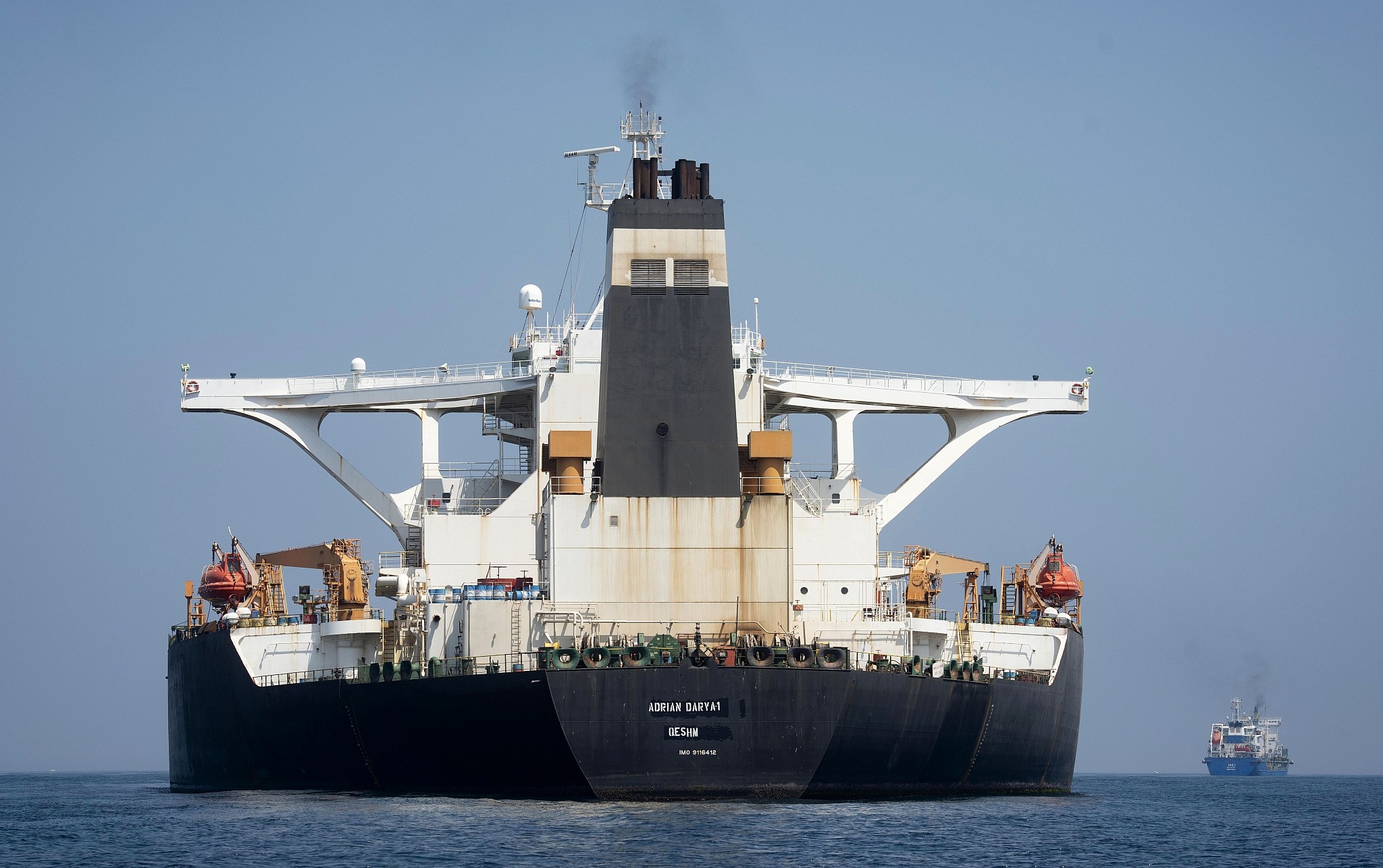
A view of the Grace 1 super tanker with the name 'Adrian Darya 1' over the place where 'Grace 1' had already been blackened out is seen in the British territory of Gibraltar, August 17, 2019. (Marcos Moreno/AP)

A view of the Grace 1 super tanker with the name ‘Adrian Darya 1’ over the place where ‘Grace 1’ had already been blackened out is seen in the British territory of Gibraltar, August 17, 2019. (Marcos Moreno/AP)

DUBAI, United Arab Emirates (AP) — An Iranian oil tanker pursued by the United States across the Mediterranean Sea slowed to a near-stop Sunday off the coast of Syria, where America’s top diplomat alleges it will be unloaded despite denials from Tehran.

The ongoing saga of the Adrian Darya 1, formerly known as the Grace 1, comes as tensions remain high between the US and Iran over its unraveling nuclear deal with world powers. Tehran is set to send a deputy foreign minister and a team of economists to Paris on Monday for talks over ways to salvage the accord after a call between Iranian President Hassan Rouhani and French President Emmanuel Macron.

The ship-tracking website MarineTraffic.com showed the Adrian Darya slowed to a near-stop on Sunday some 50 nautical miles (92 kilometers) off Syria. The ship’s Automatic Identification System does not show its destination after its mariners onboard previously listed it as ports in Greece and Turkey. Turkey’s foreign minister at one point suggested it would go to Lebanon, something denied by a Lebanese official.

The US has been warning countries not to accept the Adrian Darya, which carries 2.1 million barrels of crude oil worth some $130 million.

Manu Gómez@GDarkconrad

View image on Twitter

The US has sanctioned the Adrian Darya’s captain and has sought to impound the vessel.

Authorities in Gibraltar alleged the ship was bound for a refinery in Baniyas, Syria, when they seized it in early July. They ultimately let it go.

On Friday, US Secretary of State Mike Pompeo alleged on Twitter that the ship was still bound for Syria.

Iran’s Foreign Minister Mohammad Zarif holds talks in Biarritz on August 25, 2019 with France’s President Macron and Foreign Minister Jean-Yves Le Drian (Handout photo via AFP)

“We have reliable information that the tanker is underway and headed to Tartus, Syria,” Pompeo wrote on Twitter. “I hope it changes course.”

Iranian officials have said the oil onboard the Adrian Darya had been sold to an unnamed buyer. However, anyone buying Iranian crude oil would be subject to US sanctions.

Syrian President Bashar Assad’s adviser Bouthaina Shaaban separately told the Lebanon-based Al-Mayadeen TV that Damascus is trying to get oil that its people need “but authorities don’t know where the Iranian tanker is heading.”

Meanwhile, Iranian Deputy Foreign Minister Abbas Araghchi is due to travel to Paris with economists on Monday, the state-run IRNA news agency reported. That came after a call Saturday between Rouhani and Macron, who recently surprised the Group of Seven summit in France by inviting Iranian Foreign Minister Mohammad Javad Zarif there.

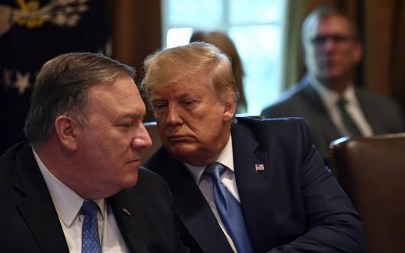
US President Donald Trump looks at Secretary of State Mike Pompeo as he participates in a Cabinet meeting at the White House on July 16, 2019 in Washington,DC. (Nicholas Kamm / AFP)

Iran is set to further break the terms of the nuclear deal on Friday if Europe fails to offer it a way to sell its crude oil on the global market. The US under President Donald Trump unilaterally withdrew from the deal over a year ago and imposed sanctions on Iran that are battering its economy.

The deal’s “terms are not changeable and all the parties need be committed to its content,” Rouhani said, according to IRNA.


Iran threatens to take ‘strong step’ away from nuke deal if no new agreement

September 2, 2019

Source: Iran threatens to take ‘strong step’ away from nuke deal if no new agreement | The Times of Israel

Tehran sets Thursday deadline; unclear whether country will restart advanced centrifuges prohibited by pact or further bump up uranium enrichment

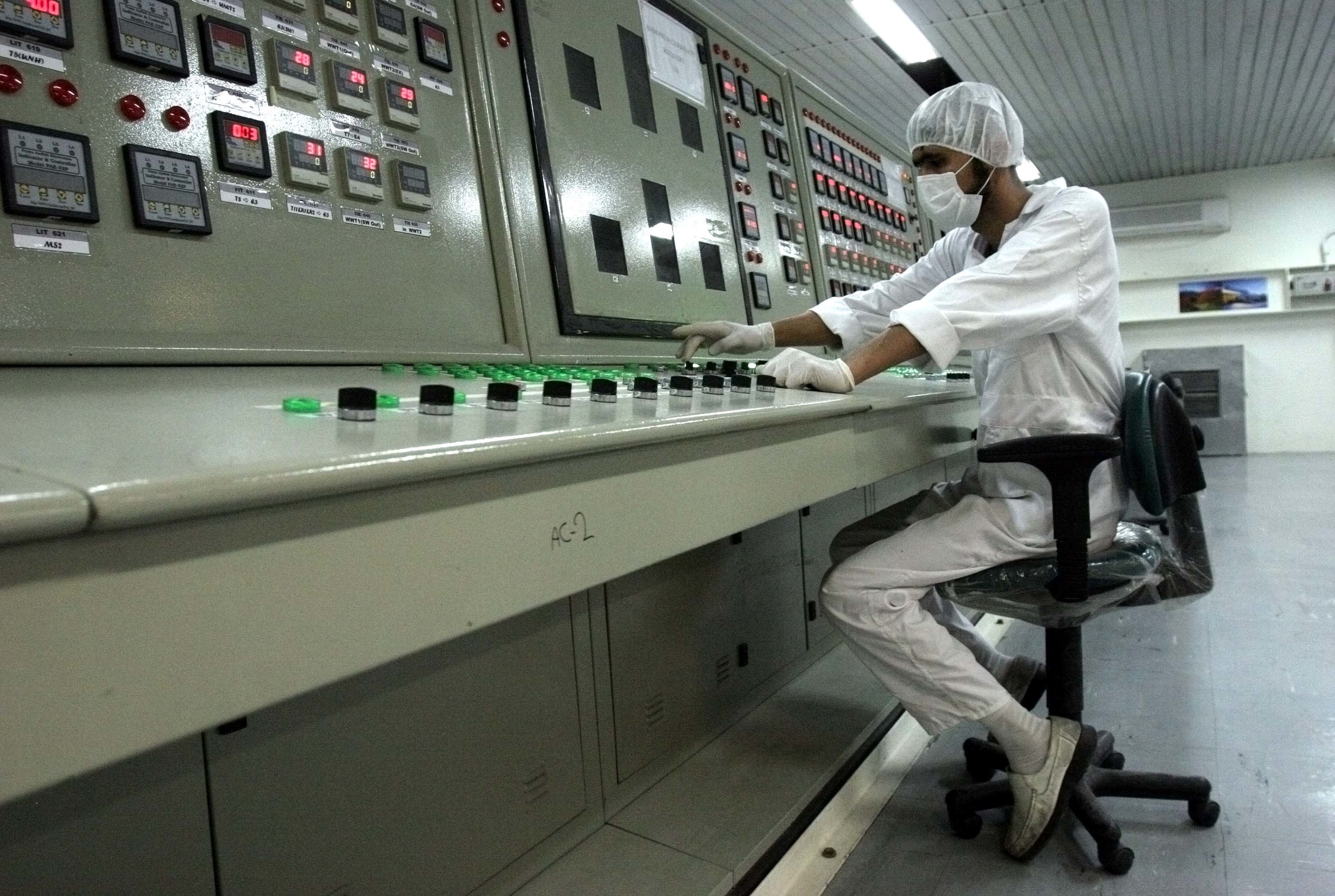
A technician at the Uranium Conversion Facility just outside the city of Isfahan, Iran, 255 miles (410 kilometers) south of the capital Tehran, February 3, 2007. (AP/Vahid Salemi/File)

A technician at the Uranium Conversion Facility just outside the city of Isfahan, Iran, 255 miles (410 kilometers) south of the capital Tehran, February 3, 2007. (AP/Vahid Salemi/File)

Iran will “take a strong step” away from its 2015 nuclear deal with world powers if Europe cannot offer the country new terms by a deadline at the end of this week, a government spokesman said Monday as top Iranian diplomats traveled to France and Russia for last-minute talks.

The comments from Ali Rabiei reinforced the deadline Iran had set for Friday for Europe to offer it a way to sell its crude oil on the global market. Crushing US sanctions imposed after US President Donald Trump withdrew America from the deal over a year ago have halted those sales.

Iranian Foreign Minister Mohammad Javad Zarif was in Moscow, while his deputy was to travel to Paris with a team of economists Monday in a renewed diplomatic push.

Rabiei described Iran’s strategy to journalists at Monday’s press conference in Tehran as “commitment for commitment.”

Iran’s government spokesman Ali Rabiei speaks in his regular news briefing, July 22, 2019 (AP Photo/Vahid Salemi)

“Iran’s oil should be bought and its money should be accessible to return to Iran,” Rabiei said. “This is the agenda of our talks.”

It’s unclear what the terms of negotiation are. In theory, anyone caught buying Iranian crude oil would be subject to US sanctions and potentially locked out of the American financial market.

Already, Iran has gone over limits set by the deal. The International Atomic Energy Agency confirmed last week that Iran’s stockpile of low-enriched uranium still exceeds the amount allowed by the so-called Joint Comprehensive Plan of Action, or JCPOA as the deal is known.

The UN agency also said Iran continues to enrich uranium up to 4.5%, above the 3.67% allowed.

Enriched uranium at the 3.67% level is enough for peaceful pursuits and is far below weapons-grade levels of 90%. At the 4.5% level, the uranium can help power Iran’s Bushehr reactor, the country’s only nuclear power plant.

It remains unclear what further step Iran will take, though it could involve restarting advanced centrifuges prohibited by the deal or further bumping up its enrichment of uranium. Iran insists the steps it has taken so far are easily reversible.

“We will announce implementation of the third step in a letter to the Europeans if the Europeans do not implement necessary measures by Thursday,” said Zarif in a Sunday interview with Iran’s parliament news agency, ICANA.

Iranian Foreign Minister Mohammad Javad Zarif, right, speaks to reporters after a forum titled “Common Security in the Islamic World” in Kuala Lumpur, Malaysia, Aug. 29, 2019 (AP Photo/Vincent Thian)

The nuclear deal is meant to keep Tehran from building atomic weapons in exchange for economic relief. It has been complicated by the unilateral withdrawal of the United States from the deal and Washington’s increased sanctions on Tehran, which have been taking a toll on the Iranian economy.

That has left the other signatories — Germany, Britain, France, Russia and China — struggling to come up with enough incentives to keep Iran in the deal.

The developments come after French President Emmanuel Macron surprised the Group of Seven summit in France by inviting Zarif last week, causing concern in Jerusalem.

Iran’s Foreign Minister Mohammad Zarif holds talks in Biarritz on August 25, 2019 with France’s President Macron and Foreign Minister Jean-Yves Le Drian (Handout photo via AFP)

Trump then said there was a possibility of a meeting between himself and Iranian President Hassan Rouhani if the right conditions were met.

Trump’s apparent openness to the notion of talks with Iran reportedly caused intense concern in Jerusalem and a Channel 13 report Thursday said Netanyahu made “frantic” efforts to reach the American leader to dissuade the US president from meeting with Zarif, but was unable to reach him.

Meanwhile Monday, an Iranian oil tanker pursued by the US that has been traveling across the Mediterranean Sea is now off the coast of Tripoli in northern Lebanon. The ship-tracking website MarineTraffic.com showed the Adrian Darya 1 moving slowly just outside the Lebanese territorial waters, after it had stood off the coast of Syria a day earlier.

US Secretary of State Mike Pompeo has alleged the ship is bound for a refinery in Syria, which was the reason that authorities had seized the vessel off the coast of Gibraltar in July. The US has warned countries not to accept the Adrian Darya, which carries 2.1 million barrels of Iranian crude oil worth some $130 million.


No fatalities, mercifully, but truth is a casualty as the IDF fools Hezbollah

September 2, 2019

Source: No fatalities, mercifully, but truth is a casualty as the IDF fools Hezbollah | The Times of Israel

Why did the IDF come clean about faking an evacuation of ‘injured soldiers’ from an APC after a terror strike Sunday? And what else got obscured in the fog of near-war?

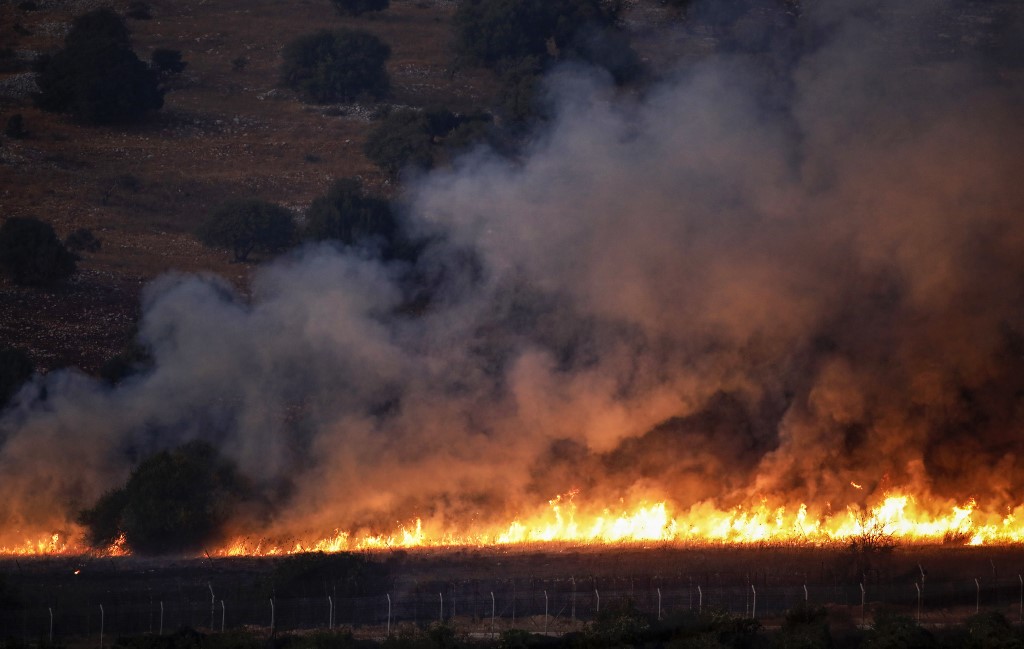
This picture taken on September 1, 2019, from a location near the northern Israeli town of Avivim, shows a fire blazing in a field along the border with Israel on the Lebanese side following an exchange of fire. (ALAA MAREY / AFP)

This picture taken on September 1, 2019, from a location near the northern Israeli town of Avivim, shows a fire blazing in a field along the border with Israel on the Lebanese side following an exchange of fire. (ALAA MAREY / AFP)

So, Israel and Hezbollah were “30 minutes away from war,” Yakov Bardugo, a presenter on Army Radio, marveled on Sunday evening.

He was speaking, in tones that mixed relief and horror, moments after the station’s military correspondent had reported that the “military ambulance” hit and destroyed by a Hezbollah anti-tank missile that afternoon was empty when it was struck, but that soldiers had been inside it a mere half-hour before.

He was speaking, moreover, amid the fog of conflict, when Hezbollah was claiming to have killed and wounded soldiers, when Israeli news media were showing footage of two “injured” soldiers being evacuated by helicopter to Haifa’s Rambam Hospital, yet when a senior Likud minister, Yoav Gallant, was also saying there had been no casualties, as far as he knew, in the Hezbollah attack.

By later Sunday evening, some of the fog had cleared. The vehicle that was hit, a Wolf armored personnel carrier that can seat up to eight, was not in fact a military ambulance; that description had been erroneous, the IDF clarified.

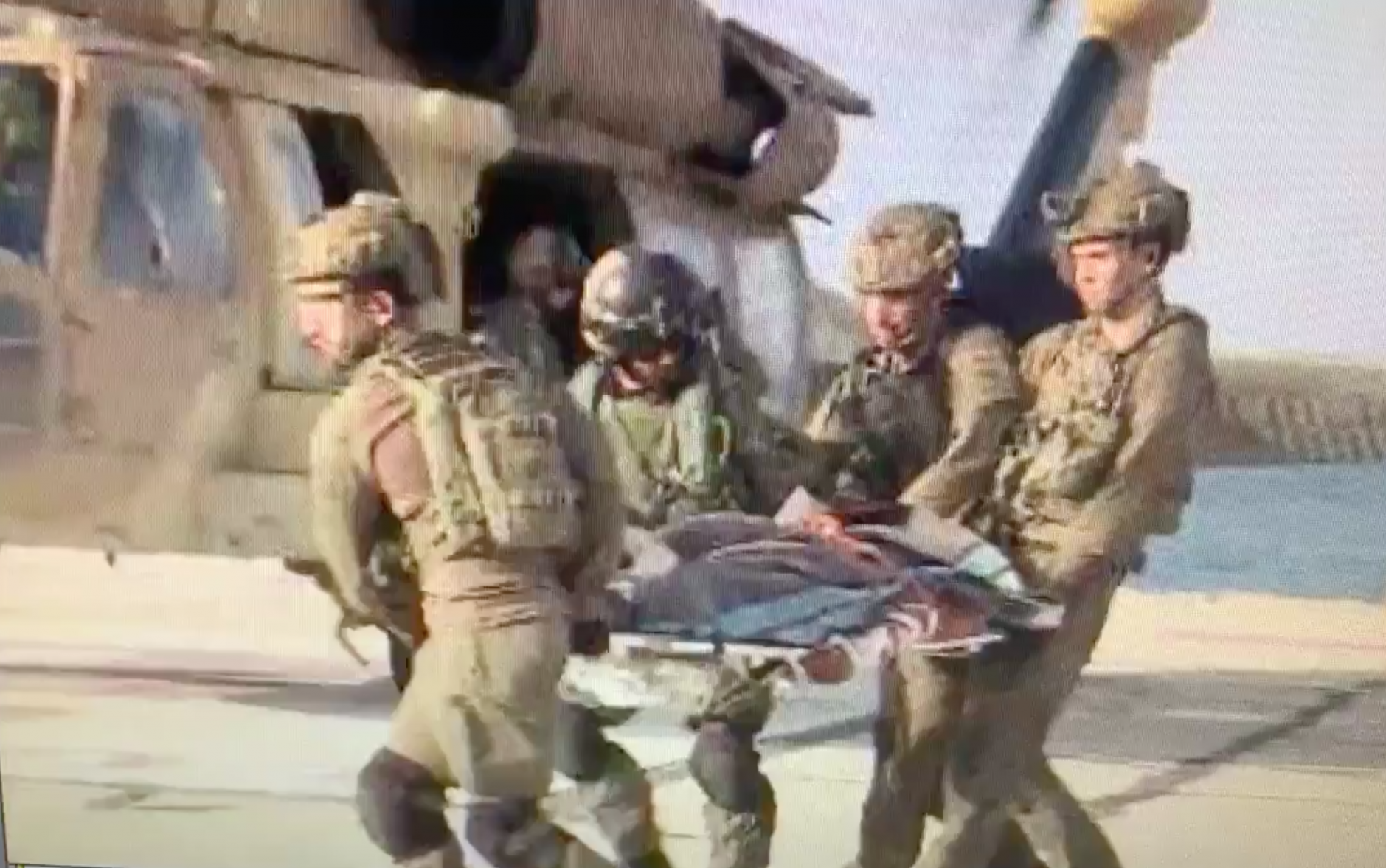
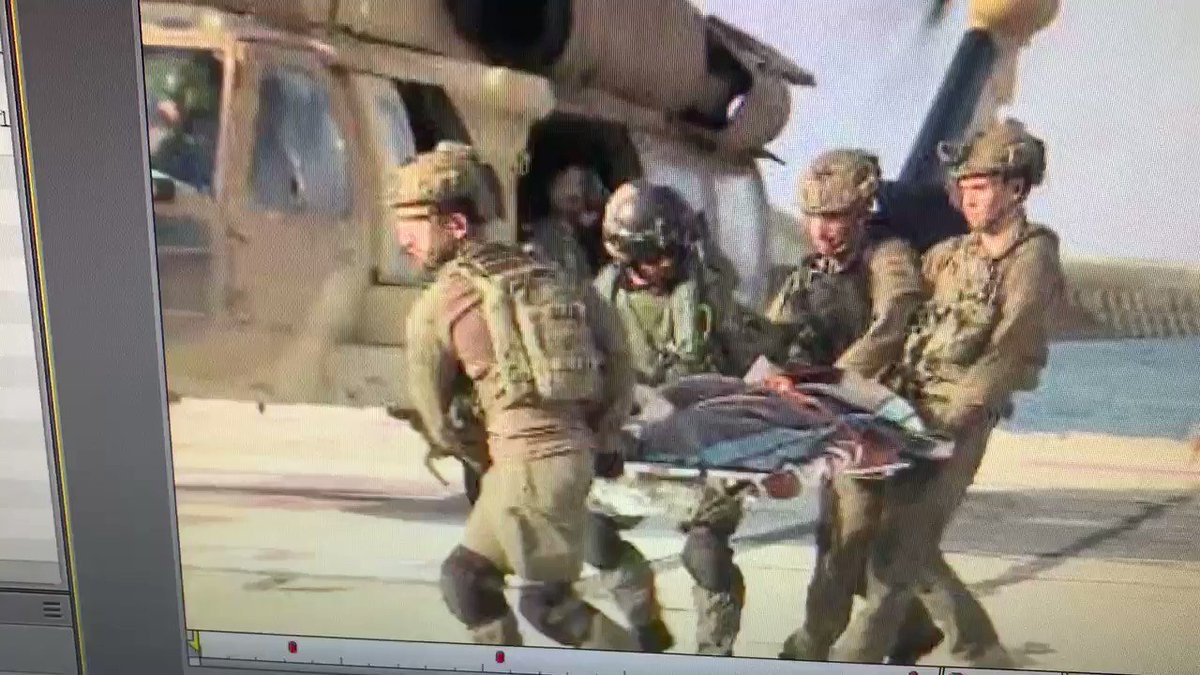
A ‘wounded’ IDF soldier, in a staged evacuation, at the scene of an APC that was struck by a Hezbollah anti-tank missile on the Lebanon border on September 1, 2019. (screen capture: Twitter)

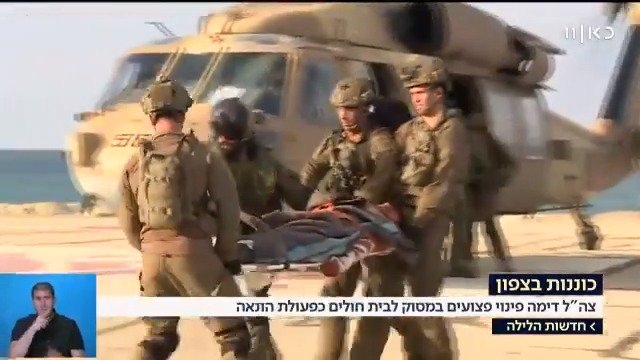
More dramatically, the “injured, evacuated” soldiers were not injured at all. The film of them being carried by stretcher to a waiting helicopter, and thence ferried to hospital, was a decoy operation — an instance of “psychological warfare” — designed to fool Hezbollah into thinking that it had, indeed, managed to harm IDF soldiers in its much-anticipated attack on troops at the northern border.

רועי שרון Roy Sharon@roysharon11

(נדרשתי לצייץ מחדש) תרגיל ההונאה שצהל נקט אחה״צ: המסוק לא פינה פצועים כי לא היו פצועים. הפינוי המוסק כולו תוכנן מראש כפעולת הונאה, שמטרתה לגרום לחיזבאללה לחשוב שהצליח לפגוע בחיילים. שימו לב לרמת ההפקה

Embedded video

And the staged evacuation appeared to have worked: Hezbollah, which was bent on avenging a preemptive Israeli strike August 24 on a site south of Damascus from which its Iranian masters were about to launch armed “killer drones” at Israel, hailed its ostensible success, Israel hit back with 100 mortar shells at various targets in southern Lebanon, and a tense calm was rapidly restored to the north.

Gallant, it further turned out, had been speaking out of turn when he vouchsafed that the IDF had sustained no casualties; Prime Minister Benjamin Netanyahu hurriedly told ministers to keep their mouths shut for a little longer — until, that is, it was clear that this episode was over,and he felt it was safe for him to personally report that no soldiers had been so much as scratched.

So confident was the Israeli military and political leadership that the flareup had indeed flared down that farmers right up against the border were back in their fields by late Sunday evening, and schoolchildren in northern Israel were told that there would be classes as usual on Monday.

Nobody believes Sunday’s incident prefaces prolonged calm, however. Hezbollah could choose to maintain the fiction that it killed and/or maimed IDF soldiers, profess itself satisfied with its missile strikes, and go back to its longer-term, Iranian-financed planning for Israel’s ultimate destruction. Or it could prepare a second reprisal attack, for the drone strike on a core component of its missile manufacturing systems, in Beirut a week ago — a strike attributed to Israel, but one that Israel has not claimed. Or, acknowledging and fuming at the Israeli deception, it could try again to avenge the August 24 Israeli strike in Syria, in which two of its fighters were killed.

From Israel’s point of view, too, further confrontation is inevitable. Iran is trying to deepen its military capabilities in both Syria and Lebanon, and Israel will continue to strike at arms warehouses, military convoys, and other targets in Lebanon, Syria, Iraq and beyond as it tries to thwart the ayatollahs’ plans.

Of specific relevance to Sunday’s escalation, Israel has also made clear it will do its utmost to thwart the Iranian/Hezbollah effort to enlarge the arsenal of precision guided missiles at Hezbollah’s disposal. The former head of IDF Military Intelligence, Amos Yadlin, said Sunday that Hezbollah has 50 such precision missiles at present, which Israel’s various rocket defense systems could handle. If there were 500, that would be harder for Israel to grapple with, he added. And 5,000 would be impossible. Thus, suggested Yadlin, the IDF would sooner or later have to launch some kind of major operation to tackle that missile infrastructure.

While it is clear that the next Hezbollah-Israel confrontation is only a matter of time, some aspects of Sunday’s dramatic border conflict remain obscured by that fog of almost-war.

For one thing, how can the military and political echelon so confidently assure Israel’s civilians that the danger has passed even as the IDF remains on wary alert at the border?

For another, why did Israel expose its decoy operation, when it had worked so effectively? Was it because Rambam hospital refused to play along, and issued a statement saying that the two evacuated soldiers were released without requiring medical treatment? Was it also because somebody, somewhere in the military or political hierarchy, decided that it would be unconscionable to maintain the fiction — to tell the Israeli public that two soldiers had been injured when they had not?

Israel’s Kan TV news on Sunday evening rebroadcast a recent interview with the IDF’s spokesman, Ronen Manelis, in which, when asked precisely about the readiness or otherwise of the spokesman’s unit to disseminate misinformation, Manelis promised that “everything that the IDF says in official statements is true” and that he would not issue “fake” news to either the Israeli public or “the other side.” Kan’s military reporter noted, in this context, that the IDF had not officially claimed that two soldiers were injured. Maybe not, but the decoy footage did the talking for it.

רועי שרון Roy Sharon@roysharon11

האירוע כולו תוכנן מראש כפעולת ל״פ על חיזבאללה, הפעולה הצליחה, חיזבאללה חישב שני פצועים במשוואה. אבל משהו לא עבד כמו בתכנון, והחור בסיפור הפצועים כבר היה בחוץ. וזה ההמשך https://twitter.com/kann_news/status/1168257236998742016 

כאן חדשות

@kann_news

התקיפה בצפון | “אירוע שיירשם בדברי הימים לוחמה הפסיכולוגית של צה״ל”: הצבא דימה פינוי פצועים במסוק לבית החולים כפעולת הונאה, אך משהו השתבש בתכנון התרגיל – אנחנו מדברים על זה כי הייתה הרגשה שמשהו לא הסתדר בתיאור האירועים, ובמערכת הביטחון לא רצו להיתפס בשקר@roysharon11 #חדשותהלילה

Embedded video

And finally, then, were Hezbollah and Israel really 30 minutes from war? Or, to put it another way, were there really IDF soldiers in that APC half an hour before Hezbollah destroyed it?

The Kan reporter, for one, was adamant that “there were soldiers in [that vehicle] until shortly before the [Hezbollah] shooting.” And maybe there were. In which case, thank heavens they got out when they did. Or maybe there weren’t. Days earlier, after all, the IDF was seen to be deploying army vehicles with dummy soldiers inside, apparently to draw Hezbollah fire.

When the fog of war is deliberately made foggier, even for the best of reasons, it gets harder to know who and what to believe.


Israel and Hezbollah Exchange Fire on Border — What’s Next? 

September 1, 2019