Archive for August 2019

Iran: ‘Deal of the century’ a crime against humanity 

August 11, 2019

Source: Iran: ‘Deal of the century’ a crime against humanity – www.israelhayom.com

In message to pilgrims performing annual hajj in Saudi Arabia, Ayatollah Ali Khamenei calls on Muslims to take an “active part in defeating this deceit by the enemy.”

Iran’s Supreme Leader Ayatollah Ali Khamenei on Saturday condemned a US blueprint to end the conflict between Israel and the Palestinians and called on hajj pilgrims to oppose it, Iranian state media reported.

“The trick called the ‘deal of the century’, which is being pushed by an oppressive America and its traitorous companions, is a crime against humanity, and not just the Palestinian people,” state television quoted Khamenei as saying in a message to Muslim pilgrims performing the annual hajj in Saudi Arabia.

“We call upon everyone to take an active part in defeating this deceit by the enemy,” Khamenei said in a message read at a rally held by Iranian pilgrims, state television reported.

Saudi officials have asked Muslims to focus on rituals of worship and warned against politicizing the rite amid regional wars and heightened tension between Sunni Muslim Saudi Arabia and Shiite Muslim Iran.

The White House has yet to unveil US President Donald Trump’s full Middle East peace plan that aims to end the conflict between Israel and the Palestinians and is led by Trump’s senior adviser and son-in-law Jared Kushner.

Kushner has so far presented a $50-billion economic revival plan for the Palestinian territories, Jordan, Egypt and Lebanon that is dependent on Israel and the Palestinians reaching a political settlement to their decades-old conflict.

The Palestinian leadership has broken off diplomatic ties with the White House, accusing Trump’s administration of bias toward Israel.

Washington has not said when it will present the full peace plan.


Iran unveils ‘improved’ radar air defense system 

August 11, 2019

Source: Iran unveils ‘improved’ radar air defense system – www.israelhayom.com

“This system has high capabilities and can detect all types of cruise and ballistic missiles and drones,” commander of the regular army’s air defense forces, says.

Iran unveiled on Saturday what authorities said was a locally upgraded radar system with a range of 250 miles that could help defend against cruise and ballistic missiles and drones.

The announcement comes at a time of rising tension between Iran and the United States. Iran shot down a US military surveillance drone in the Persian Gulf with a surface-to-air missile in June. Tehran says the drone was over its territorial waters, but Washington says it was in international airspace.

State television showed the Falaq, a mobile radar and a vehicle housing a control room, which it said was an improved version of the Gamma, a system that military experts said was of Russian origin.

Western military analysts say Iran often exaggerates its weapons capabilities, though concerns about its long-range ballistic missile program contributed to Washington last year exiting the pact that Iran sealed with world powers in 2015 to rein in its nuclear ambitions in exchange for an easing of economic sanctions.

“This system has high capabilities and can detect all types of cruise and ballistic missiles and drones,” Brig. Gen. Alireza Sabahifard, commander of the regular army’s air defense forces, was quoted as saying by the Iranian news agency Mehr.

Sabahifard said the Falaq was a locally overhauled version of a system which had been out of operation for a long time, Mehr reported. He did not give the system’s country of origin.

The Falaq is a phased-array radar system which can be incorporated into Iran’s larger integrated air defense, which includes an S-300 surface-to-air missile system that Russia delivered in 2016, state-run Press TV said.

“The Falaq system was developed in order to counter sanctions restricting access to spare parts of a previously foreign-developed system,” Press TV said on its website.


Pompeo slams Iran leader’s ‘sick’ threat against Israel ahead of Tisha B’Av

August 11, 2019

Source: Pompeo slams Iran leader’s ‘sick’ threat against Israel ahead of Tisha B’Av | The Times of Israel

US secretary of state hits back at Ayatollah Ali Khamenei and his ‘faux concern’ for Palestinians, says America has given far more aid

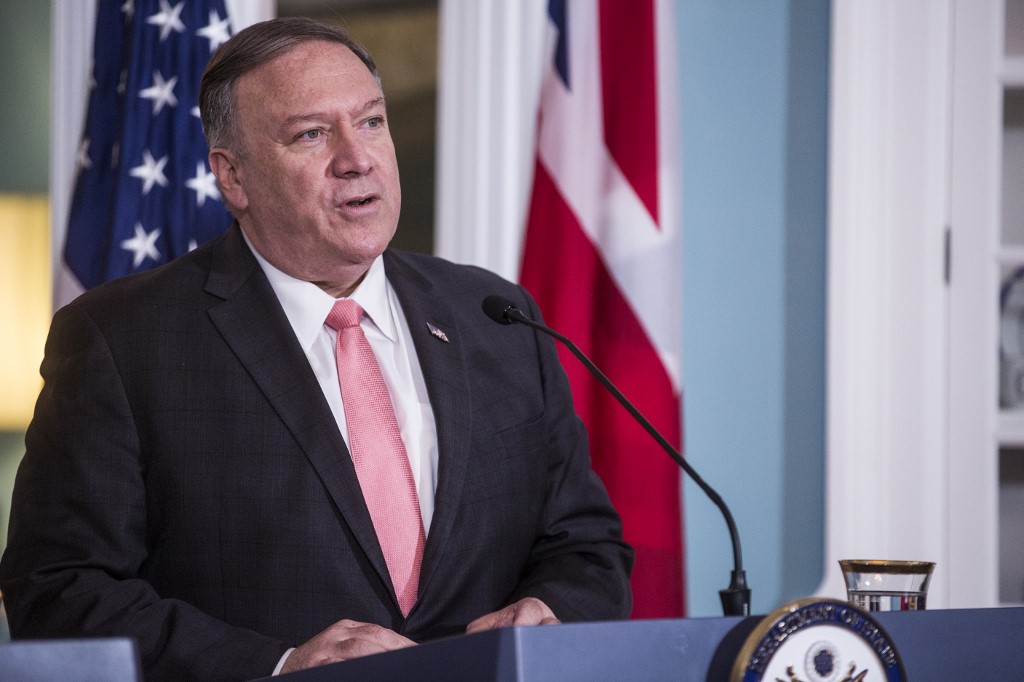
US Secretary of State Mike Pompeo speaks during a joint press event at the State Department on August 7, 2019 in Washington, DC. (Zach Gibson/Getty Images/AFP)

US Secretary of State Mike Pompeo speaks during a joint press event at the State Department on August 7, 2019 in Washington, DC. (Zach Gibson/Getty Images/AFP)

US Secretary of State Mike Pompeo on Sunday slammed Iran’s “faux concern” for the Palestinians after its supreme leader called on Muslims to oppose the Trump administration’s Mideast peace plan, accusing him of threatening violence against Israel before the fast day of Tisha B’Av.

Ayatollah Ali Khamenei on Saturday called the US plan a “a crime against human society,” and urged “active participation” in efforts to block the still-unreleased proposal. In a letter marking the Islamic hajj pilgrimage, Khamenei said the plan was a “ruse” that’s “doomed to failure.”

Khamenei, who has regularly called for Israel’s destruction, said the Palestinians had “not given in to defeat” and “stand tall on the battlefield.” “The ultimate result requires all Muslims’ assistance,” he said.

Pompeo hit back on Sunday, accusing Khamenei and the Iranian government of destabilizing the region by backing terrorist groups with millions of dollars “to kill more Jews.”

“Khamenei’s faux concern for the Palestinian people runs so deep that under his reign of terror he provided less than $20,000 in aid since 2008, while sending millions to Hamas & other terrorists,” Pompeo tweeted. “In contrast, US provided $6.3 billion in support to Palestinians since 1994.”

“It’s sick that on the eve of Tisha B’Av — a solemn day for the Jewish people — Khamenei calls for violence against the Jewish state,” he said.

Tisha B’Av, which began Saturday evening, marks the destruction of the two Jewish temples and other disasters in Jewish history.

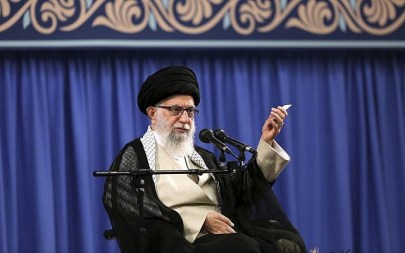
Supreme Leader Ayatollah Ali Khamenei speaks in a meeting with a group of clerics, in Tehran, Iran, July 16, 2019. (Office of the Iranian Supreme Leader via AP)

Pompeo defended the administration’s peace plan, which thus far centers on a $50 billion Palestinian investment and infrastructure proposal, but avoids core political issues that are key to resolving the dispute.

“Khamenei doesn’t see ‘progress’ as prosperity for the Palestinian people, but Palestinian terrorists switching from rocks to rockets to kill more Jews,” he said.

The US has so far kept the political elements of its plan under wraps, while the economic aspects of it were presented in June by US President Donald Trump’s son-in-law and adviser Jared Kushner at an American-led conference in Bahrain. The economic aspect of the plan would see a $50 billion investment package for the Palestinians and the wider region.

Jared Kushner (R) joins US President Donald Trump as he holds a press conference in the Rose Garden of the White House on October 1, 2018. (Chip Somodevilla/Getty Images via JTA)

The Palestinians skipped the Bahrain conference and have rejected the peace plan outright, pressing on with their boycott of the administration since Trump recognized Jerusalem as Israel’s capital in December 2017 and cut Palestinian aid.

Palestinians say the plan is an attempt to bribe the Palestinian people without addressing their demands for independence.

This year’s hajj pilgrimage in Saudi Arabia comes amid heightened tensions in the nearby Persian Gulf between the US and Iran.


Israel’s Arrow 3 Missile Test Intercepts Iran-type Ballistic Missiles 8/2/19

August 10, 2019


US tells commercial vessels to send gulf transit plans in advance

August 9, 2019

Source: US tells commercial vessels to send gulf transit plans in advance – www.israelhayom.com

US military advises crews to decline Iranian forces permission to board, says vessels have reported interference with their GPS and “spoofed” communications from unknown entities falsely claiming to be US or other warships.

The US maritime agency has told US-flagged commercial vessels they should send transit plans in advance to American and British naval authorities if they intend to sail in Gulf waters following several incidents over tankers involving Iran.

The seizure of commercial vessels and attacks on tankers near the Strait of Hormuz have unsettled shipping lanes that link Middle Eastern oil producers to global markets.

The United States, which has increased its military forces in the region, has blamed Iran for blasts on several tankers near the strait, a charge Tehran denies.

Britain said on Monday it was joining the United States in a maritime security mission in the gulf to protect vessels after Iran seized a British-flagged tanker.

“Heightened military activity and increased political tensions in this region continue to pose serious threats to commercial vessels,” the US Maritime Administration (MARAD) said in an advisory on Wednesday.

“Associated with these threats is a potential for miscalculation or misidentification that could lead to aggressive actions,” it added.

Ships should also alert the US Navy’s Fifth Fleet and the United Kingdom Maritime Trade Operations in the event of any incident or suspicious activity. It warned they could face interference to their global positioning systems (GPS).

MARAD said in at least two incidents involving commercial vessels and Iran since May 2019 ships had reported interference with their GPS and “spoofed” communications from unknown entities falsely claiming to be US or other warships.

It advised crews to decline Iranian forces permission to board if the safety of the ship and crew would not be at risk but said they should not forcibly resist any boarding party.

Traffic through the strait, through which about a fifth of the world’s oil passes, has become the focus for a standoff between Iran and the United States after President Donald Trump quit a 2015 nuclear pact and reimposed sanctions on Tehran.

Iran says the responsibility of securing these waters lies with Tehran and other countries in the region.

“The maritime coalition that US is trying to form will create more instability and insecurity,”Iran’s Defence Minister Amir Hatami was quoted as saying by Iran’s Tasnim news agency on Thursday during phone calls with his counterparts from Qatar, Oman and Kuwait.

Washington is lobbying other nations to join the coalition along with Britain, which has the largest naval presence in the area after the United States.

Britain’s P&O Cruises said it had canceled cruises around Dubai and the Gulf because of the increased tensions.


Iran says Israeli involvement in Gulf naval mission would be ‘disastrous’ 

August 9, 2019

Source: Iran says Israeli involvement in Gulf naval mission would be ‘disastrous’ | The Times of Israel

Defense chief slams Israel’s willingness to assist US-led efforts as ‘highly provocative’; IRGC chief warns Hamas and Hezbollah will cause Jewish state’s ‘collapse’ in next war

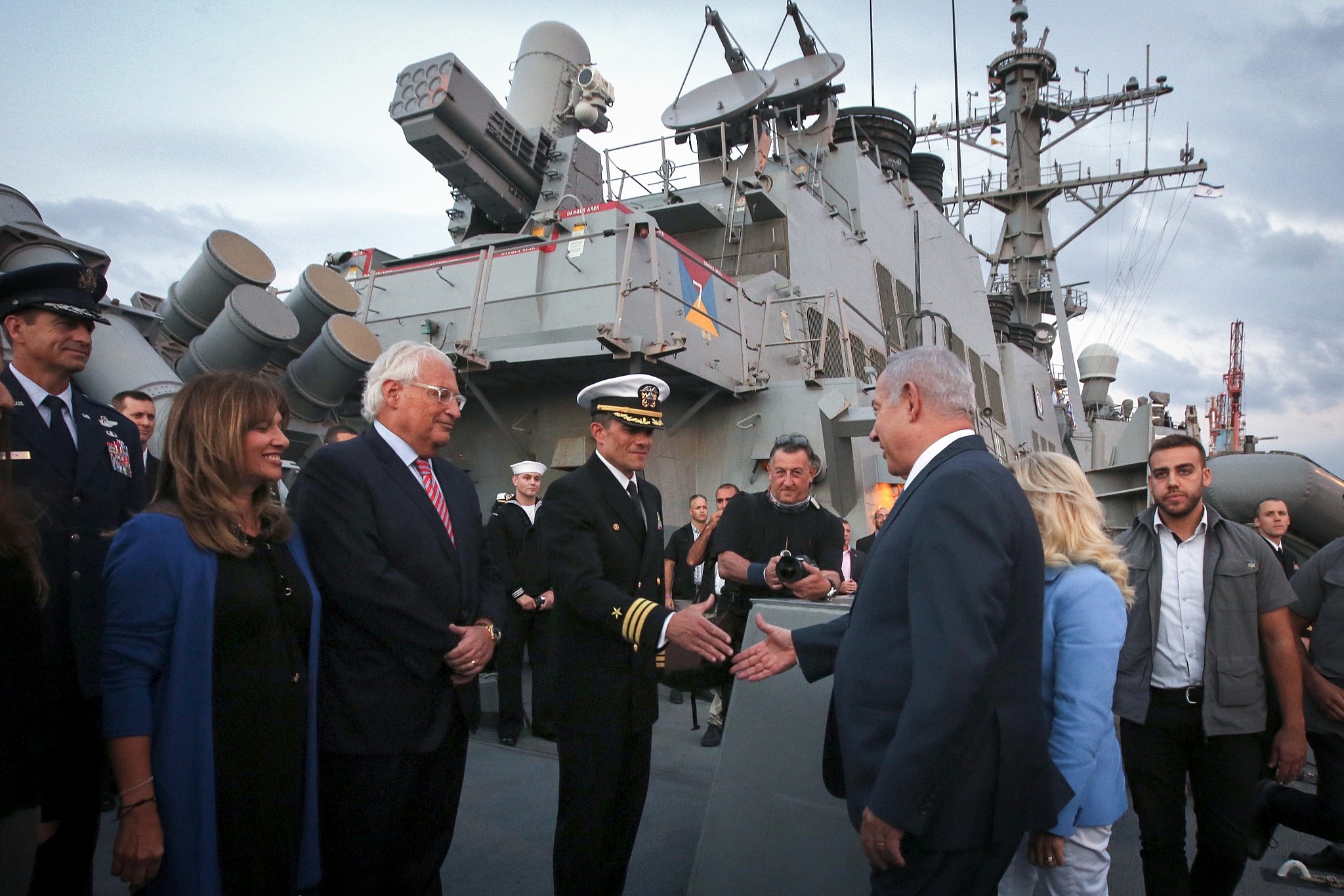
Prime Minister Benjamin Netanyahu, third right, and US Ambassador David Friedman, third left, aboard the US Navy's guided-missile destroyer USS Ross, docked at Ashdod Port on October 11, 2018. (Marc Israel Sellem/Pool/Flash90)

Illustrative: Prime Minister Benjamin Netanyahu, third right, and US Ambassador David Friedman, third left, aboard the US Navy’s guided-missile destroyer USS Ross, docked at Ashdod Port on October 11, 2018. (Marc Israel Sellem/Pool/Flash90)

Iran’s defense minister said Thursday that the formation of a US-led flotilla in the Gulf would “increase insecurity” and any Israeli involvement would have “disastrous consequences” for the region.

Tehran and Washington have been locked in a battle of nerves since US President Donald Trump withdrew from a landmark 2015 nuclear deal with Iran last year and reimposed sanctions.

Tensions have soared in the region, with drones downed and tankers mysteriously attacked in Gulf waters.

The US and its Gulf allies have accused the Islamic Republic of the tanker attacks, which Tehran denies. In response, the US has been seeking to form a coalition whose mission — dubbed Operation Sentinel — it says is to guarantee freedom of navigation in the Gulf.
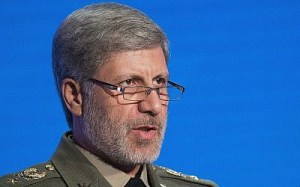
Iranian Defense Minister Amir Hatami speaks at the Conference on International Security in Moscow, Russia, April 4, 2018. (AP Photo/Alexander Zemlianichenko)

“The military coalition that America is seeking to form with the excuse of securing maritime transport will only increase insecurity in the region,” Defense Minister Amir Hatami said in a conference call with counterparts from Kuwait, Oman and Qatar.

Reacting to reports of Israeli willingness to join the coalition, he said it would be “highly provocative and can have disastrous consequences for the region.”

In a closed session Tuesday of the Knesset Foreign Affairs and Defense Committee, Foreign Minister Israel Katz said Israel was involved in US-led efforts to provide maritime security in the Strait of Hormuz, a strategic waterway that leads to the Persian Gulf.

Katz said Israel was assisting the mission with intelligence and other unspecified fields, according to the Ynet news site. He stressed the mission was in Israel’s strategic interest of countering Iran and boosting ties with Gulf countries.

The Israeli foreign minister also reportedly praised Britain’s announcement Monday that it would join the mission, making it the only country so far to officially do so.

Besides Britain, which already has warships on protection duty in the Gulf after a UK-flagged tanker was seized by Iran’s Islamic Revolutionary Guard Corps, other European countries have refrained from joining the planned operation for fear it might harm their efforts to reach a negotiated settlement with Iran.

Iran has seized three tankers in the Gulf since last month, including the British-flagged vessel.
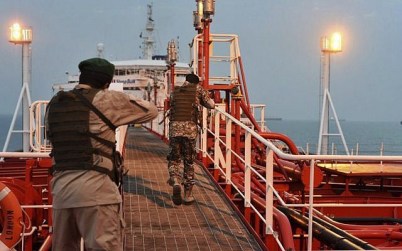
In this Sunday, July 21, 2019 photo, two armed members of Iran’s Revolutionary Guard inspect the British-flagged oil tanker Stena Impero, which was seized in the Strait of Hormuz on Friday by the Guard, in the Iranian port of Bandar Abbas (Morteza Akhoondi/Mehr News Agency via AP)

The ship seizures came after British Royal Marines helped to impound a tanker carrying Iranian oil off the British overseas territory of Gibraltar on July 4, alleging it was destined for EU-sanctioned Syria, an accusation Iran denies.

Calling the US the main source of tensions in the region, Hatami, the Iranian foreign minister, called on Gulf countries to enter “constructive talks” to provide maritime security by themselves.

Also Thursday, the commander of the Revolutionary Guard warned that a new war in the region would include Iran’s regional proxy groups, Hamas and Hezbollah, and would result in the “collapse” of Israel.

In comments carried by the semi-official Tasnim news agency, Gen. Hossein Salami said an “[axis of] power has been shaped in Syria, Lebanon, Palestine and elsewhere, and the enemy is mindful that any new war may pose a full-blown threat against the Zionist regime and put it in the path to an irreversible collapse.”

“I am confident that today, the Zionists and regional allies are not interested in a war because they know that the geography of such war would be broad, and they know the result [in advance],” he said.

The Islamic Republic funds the armed wings of the Gaza-based terrorist groups Hamas and Palestinian Islamic Jihad, as well as the Lebanon-based Hezbollah.

Salami said Hezbollah fighters had gained “power and experience” in recent years, and were capable of “resoundingly” defeating Israel in the next war.
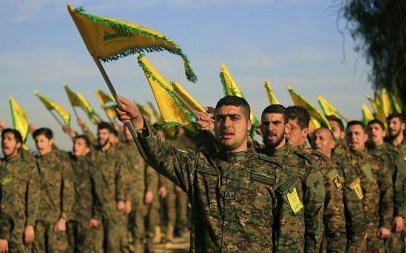
Hezbollah fighters hold flags, as they attend the memorial of slain leader Sheik Abbas al-Mousawi, killed by an Israeli airstrike in 1992, in Tefahta village, south Lebanon, February 13, 2016. (Mohammed Zaatari/AP)

Israeli intelligence officials reportedly believe the Hamas group and Tehran have come to an agreement that would see Iranian proxies in Gaza open a front against Israel in the south in the event of fighting breaking out with Hezbollah along its northern border.

The Haaretz daily last week quoted a senior security official as saying the intelligence establishment estimates Hamas and Islamic Jihad will try to force Israel to move its forces and air defense systems to the south at the expense of troops fighting in the north.

The official said that Israel believes Iran has increased its involvement in the Strip in order to turn Hamas into its operational arm against Israel.
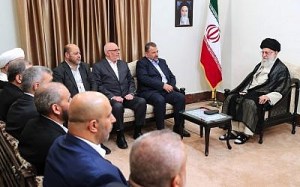
Supreme Leader Ayatollah Ali Khamenei, right, meets Hamas deputy chief, Saleh al-Arouri, second right, and the Hamas delegation, in Tehran, Iran, July 22, 2019. (Office of the Iranian Supreme Leader via AP)

On Monday, Channel 12 news reported that Iran offered to significantly increase its monthly financial aid to Hamas and Islamic Jihad in exchange for intelligence on Israeli missile capabilities.

Iran’s Supreme Leader Ayatollah Ali Khamenei expressed willingness to raise its monthly financial backing to the terror group to an unprecedented $30 million per month during talks with top Hamas officials in Tehran last month.

In 2018, Hebrew-language media outlets quoted Palestinian sources who said  Iran’s payments to Hamas at the time amounted to $70 million per year (less than $6 million per month).

It was not immediately clear if the offer was strictly conditioned on the intelligence provided by the terror groups. The Hamas members said they would convey it to the movement’s leaders in Gaza.
 

Israel Is Proving why the F 35 Stealth Fighter Is Nearly Unstoppable 

August 8, 2019

Can Israel’s Deadly F-35s Really Bomb Iran?  Do they have the range?

by Dario Leone

Israel has also carried out hundreds of strikes in neighboring Syria against what it says are Iranian and Hezbollah military targets.​

On Jul. 9, 2019 Israeli Prime Minister Benjamin Netanyahu warned Tehran that Israeli Air Force (IAF) F-35I fighter jets can reach “anywhere in the Middle East,” following threats against his country in recent weeks by senior Iranian officials, The Times of Israel reports.

“Lately, Iran has been threatening Israel with destruction,” Netanyahu said, standing in front of an F-35 Adir jet during a visit to the Nevatim Air Base, where he had meetings with IDF Chief of Staff Lt. Gen. Aviv Kohavi and IAF Chief Maj. Gen. Amikam Norkin. “It should remember that these planes can reach every place in the Middle East, including Iran, and of course also Syria.”

The F-35I can’t reach Iran unassisted, but it could conduct operations there with in-air refueling, a capability possessed by IAF.

Norkin said last year said Israel had used the fifth generation fighter jet in operations in the Middle East for the first time. Although at the time, Norkin did not revealed in which countries the aircraft had been used, rumours sparked that Islamic Republic of Iran Air Force (IRIAF) commander Brigadier General Farzad Ismaili, who had been in office since 2010, has been fired by Iran’s Supreme Leader Ayatollah Ali Khamenei after he kept secret that IAF F-35 stealth fighters had violated Iran’s airspace in March 2018.

Israel has long seen Iran as its greatest threat, while Iranian officials regularly threaten to destroy the Jewish state.

On Jul. 1, a senior Iranian lawmaker said Israel would be destroyed rapidly if the US attacked the Islamic Republic.

“If the US attacks us, only half an hour will remain of Israel’s lifespan,” said Mojtaba Zolnour, chairman of Iranian Parliament’s National Security and Foreign Policy Commission, in comments carried by the Mehr news agency.

Similarly, in a June 20 interview on Iraq’s Alnujaba TV, translated by the Middle East Media Research Institute (MEMRI) monitoring group and posted to social media Sunday, former Iranian defense minister Gen. Hossein Dehghan said Iran’s military could destroy US military bases in the region and annihilate Israel.

“Our missiles can totally obliterate those bases,” Dehghan said. “Israel knows that Iran will erase its entity and uproot it from existence in case of a war.”

On Sunday, Netanyahu called an announcement by Iran that it would exceed the uranium enrichment cap set by the troubled accord a “very dangerous step.” He urged European countries to sanction Iran in response.

On Jul. 8, Iran breached the enrichment cap as it seeks to press other parties into keeping their side of the bargain under the nuclear deal.

Netanyahu opposed the accord and urged US President Donald Trump to withdraw from it, which he eventually did. Despite having opposed the deal, Netanyahu is now calling on European nations to enforce its parameters as he and the US seek to further pressure Iran.

Israel has also carried out hundreds of strikes in neighbouring Syria against what it says are Iranian and Hezbollah military targets.

Israel has been the first country outside the US to acquire the F-35 fifth-generation fighter, of which it could take up to 75.

Israel has praised the Lockheed Martin F-35 as a “game-changer.”

All planes ordered by IAF belong to the F-35A variant named F-35I Adir (Mighty) in Israel and are operated by the IAF’s Golden Eagle Squadron, based at Nevatim.


Off Topic:  Erdogan says he’ll ‘eliminate’ Syria Kurd militia, operation coming ‘very soon’ 

August 7, 2019

Source: Erdogan says he’ll ‘eliminate’ Syria Kurd militia, operation coming ‘very soon’ | The Times of Israel

Turkish president warns of imminent offensive against US-backed group, saying ‘drying up the terrorist swamp in northern Syria is our top priority’

Turkey's President Recep Tayyip Erdogan inspects a military honor guard before addressing his supporters in Bursa, Turkey, August 4, 2019 (Presidential Press Service via AP, Pool)

Turkey’s President Recep Tayyip Erdogan inspects a military honor guard before addressing his supporters in Bursa, Turkey, August 4, 2019 (Presidential Press Service via AP, Pool)

ISTANBUL, Turkey — Turkey and the US were on a collision course Tuesday as President Recep Tayyip Erdogan threatened to “eliminate” a Kurdish militia in northern Syria — a move deemed “unacceptable” by the Pentagon.

Erdogan has repeatedly warned that it is preparing an offensive into Syria against the Kurdish YPG militia, which the US has supported as the main fighting force against the Islamic State group.

“Turkey has the right to eliminate all threats against its national security,” he said in a televised speech in Ankara.

“God willing, we will carry the process started with [previous offensives into Syria] to the next stage very soon.”

Turkish President Recep Tayyip Erdogan speaks during a rally to commemorate an attempted coup, at the Ataturk International Airport in Istanbul on July 15, 2019. (Ozan Kose/AFP)

US defense officials have been locked in talks with their counterparts in the Turkish capital since early Monday, trying to hash out a buffer zone deal that would persuade Turkey to hold off on a military attack.

“Clearly we believe any unilateral action by them would be unacceptable,” US Defense Secretary Mark Esper told reporters in Tokyo on a trip through Asia.

“And so what we are trying to do now is work out with them an arrangement to address their concerns and I am hopeful we will get there… what we are trying to do is prevent unilateral incursions,” he said.

But so far, Turkey has been unimpressed with US “safe zone” proposals which it says do not keep the YPG far enough away from the Turkish border.

It sees the YPG as an offshoot of the Kurdish PKK, which has fought a bloody separatist insurgency inside Turkey for the past 35 years.

“Turkey expects steps from the US befitting of a NATO ally and strategic partner,” Erdogan said.

“Drying up the terrorist swamp in northern Syria is our top priority.”

‘Erdogan is serious’

Turkish media outlets have often shown images in recent weeks of military convoys heading for the border area, carrying equipment and fighting units.

Turkey has twice carried out unilateral offensives into northern Syria against the Islamic State group and YPG, in 2016 and 2018 respectively.

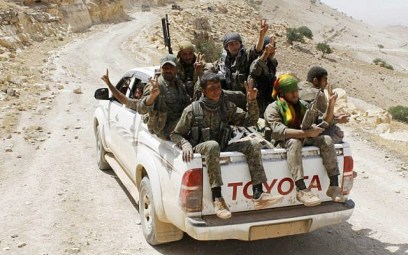
Kurdish fighters of the YPG flash victory signs as they sit on their pickup on their way to battle against the Islamic State, near Kezwan mountain, northeast Syria, May 20, 2015. (The Kurdish fighters of the People’s Protection Units via AP/File)

Aldar Khalil, a top Kurdish political official in northeast Syria, told AFP on Monday that “Erdogan is serious and will embark on an attack at the first opportunity”.

“If Turkey is not deterred and a consensus is not reached for an international decision to prevent it, it will definitely be on the offensive.”

Khalil said the Kurds were “flexible” on the peace talks, and had offered a five-kilometer (three-mile) buffer zone, but that this had been rejected by Turkey, which wants to push the YPG much further back from the border.

Washington could stop any “attack with a single word… but it seems they don’t want to pressure Turkey more than needed,” he said.


Israel involved in US-led naval mission in Strait of Hormuz — foreign minister 

August 7, 2019

Source: Israel involved in US-led naval mission in Strait of Hormuz — foreign minister | The Times of Israel

Israel Katz quoted telling Knesset committee that Israeli participation helping counter Iran, boost ties with Gulf states

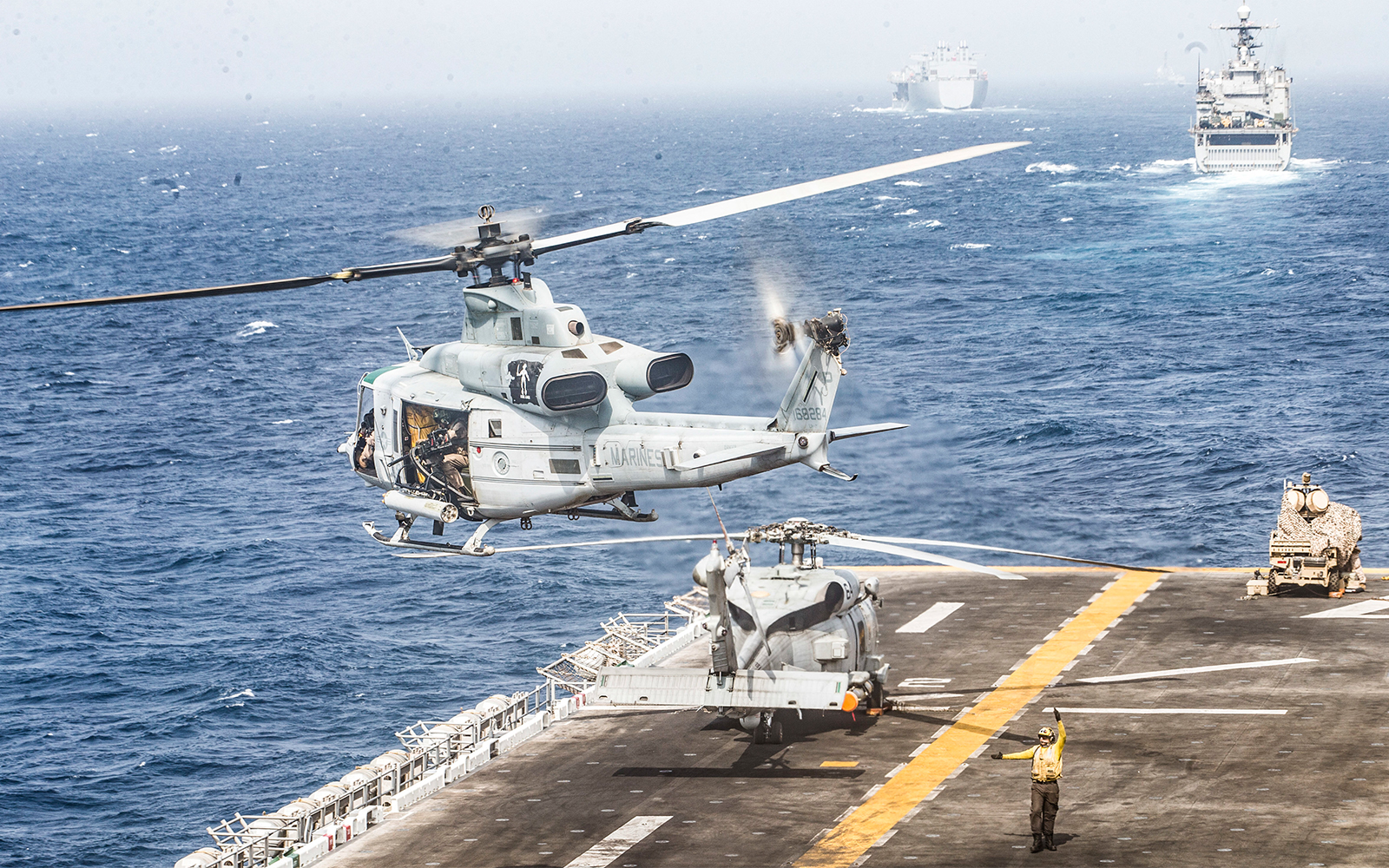
Illustrative: A UH-1Y Venom helicopter takes off from the flight deck of the amphibious assault ship USS Boxer in the Strait of Hormuz, July 18, 2019. (US Marine Corps photo by Lance Cpl. Dalton Swanbeck/Released)

Illustrative: A UH-1Y Venom helicopter takes off from the flight deck of the amphibious assault ship USS Boxer in the Strait of Hormuz, July 18, 2019. (US Marine Corps photo by Lance Cpl. Dalton Swanbeck/Released)

Foreign Minister Israel Katz said Tuesday that Israel was involved in a US-led naval mission to provide maritime security in the Strait of Hormuz, where Iran recently seized merchant ships.

Speaking at a closed session of the Knesset Foreign Affairs and Defense Committee, Katz said Israel was assisting the mission with intelligence and other unspecified fields, the Ynet news reported.

He said the mission was in Israel’s strategic interest of countering Iran and boost ties with Gulf countries.

According to the Israeli news site, Katz told the committee that he instructed his ministry to work to include Israel in the mission after a recent visit to Abu Dhabi. The foreign minister was said to have discussed this at the time with an unnamed senior Emirati official, with whom he discussed the “Iranian threat.”

Katz also reportedly praised Britain’s announcement Monday that it would join the mission, making it the only country so far to officially do so.

The report did not specify whether Katz said Israel would send naval vessels to take part in the US-led mission. A report from the Kan public broadcaster last month said that Israel was not expected to send ships, but would provide intelligence.

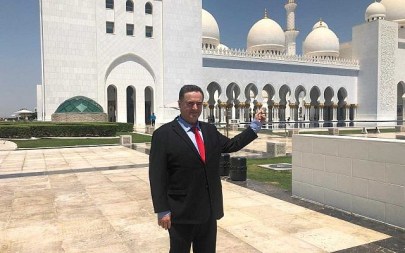
In this photo released on July 1, 2019, Foreign Minister Israel Katz visits the Sheikh Zayed Grand Mosque Center in Abu Dhabi, United Arab Emirates. (Courtesy Katz’s office)

The United States has thus far struggled to piece together an international coalition to protect cargo ships traveling through the Strait of Hormuz, with allies concerned about being dragged into conflict with Iran.

Tensions have risen in the Gulf since the US decided in May 2018 to withdraw from a landmark accord to limit Iran’s nuclear program and began to reintroduce sanctions.

Announcing its participation in the US-led mission, Britain’s Ministry of Defense said it “will draw largely on assets already in the region.” It said the Royal Navy will work alongside the US Navy to escort vessels through the Strait of Hormuz, which sits at the mouth of the Persian Gulf, a shipping channel for one-fifth of all global crude exports.

Two Royal Navy warships are currently in the region, the frigate HMS Montrose and the destroyer HMS Duncan. The Montrose is due to leave for planned repairs later this month.

Britain has been giving UK-flagged vessels in the region a naval escort since the Iran’s Revolutionary Guards seized a British-flagged oil tanker last month. Some Iranian officials suggested the seizure of the Stena Impero was retaliation for the seizure of an Iranian oil tanker off the British overseas territory of Gibraltar.

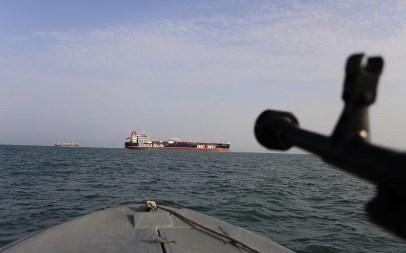
In this July 21, 2019 photo, a speedboat of the Iran’s Revolutionary Guard moves around a British-flagged oil tanker Stena Impero which was seized in the Strait of Hormuz on Friday by the Guard, in the Iranian port of Bandar Abbas. (Morteza Akhoondi/Mehr News Agency via AP)

But even as ships were seized in the narrow maritime thoroughfare, countries have been reticent about a US plan to send in military escorts.

On Sunday, Australia became the latest ally seeming to give the plan a wide berth.

Australian Defense Minister Linda Reynolds told the visiting US secretaries of state and defense that their “very serious” and “complex” request would be given “very serious consideration” — but stopped short of offering a full response.

Washington floated the idea of a naval coalition in June, after multiple attacks on ships in the Gulf, which the United States had blamed on Iran — but which Tehran denies.

The plan was to have each country provide a military escort for its ships, with US military providing a security backstop, monitoring the zone of operations and providing command and control.

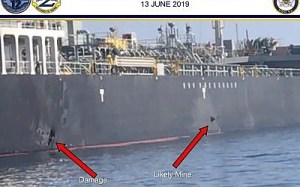
This June 13, 2019, image released by the US military’s Central Command, shows damage and a suspected mine on the Kokuka Courageous in the Gulf of Oman near the coast of Iran. (U.S. Central Command via AP)

Mark Esper, the US defense secretary, said the United States had gotten “various degrees of response,” adding “I think there’ll be some announcements coming out in the coming days.”

Referencing the prospect of European-only cooperation, Esper plaid down a bifurcation of effort.

“I think the purpose remains the same whether it’s an operation conducted under the United States command and control, or conducted by somebody else, a European partnership,” he said.

Paris, Berlin and London plan to coordinate and share information in the Gulf to reinforce maritime security, but without deploying additional assets, according to French Defense Minister Florence Parly.

Germany has distanced itself from a military operation in the Strait of Hormuz, considering it could hinder European efforts to reach a diplomatic solution with Iran.


Israel’s Amos 17 satellite successfully launched by SpaceX – DEBKAfile

August 7, 2019

Source: Israel’s Amos 17 satellite successfully launched by SpaceX – DEBKAfile

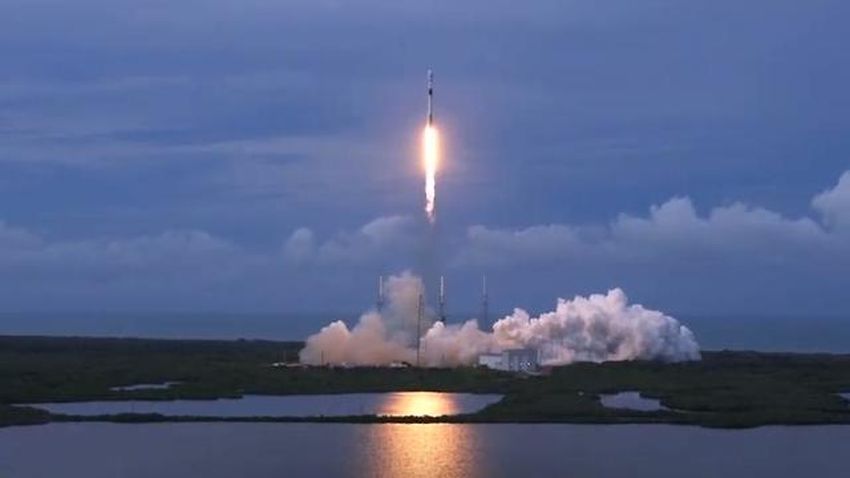
The Amos 17 communications satellite was boosted by a SpaceX Falcon 9 rocket from Cape Canaveral, Florida, early Wednesday.

The successful launch into orbit over the Africa continent came three years after Amos 6 was destroyed by an explosion on the Falcon launch pad. This time, SpaceX was extra careful and delayed the launch of Amos 17 for three days over a suspected malfunction in the rocket engines.

DEBKAfile: This communications satellite will supply Israel’s intelligence services with data on Iran after a three-year gap during which they made do with makeshift technical devices.

The $250m satellite built by Boeing is now operating autonomously and due to reach a point 36,000km above the earth’s surface in 11 days.