Source: Turkey announces ‘trilateral summit’ on Syria with Russia and Iran – World News – Jerusalem Post
The meeting will take place in August.
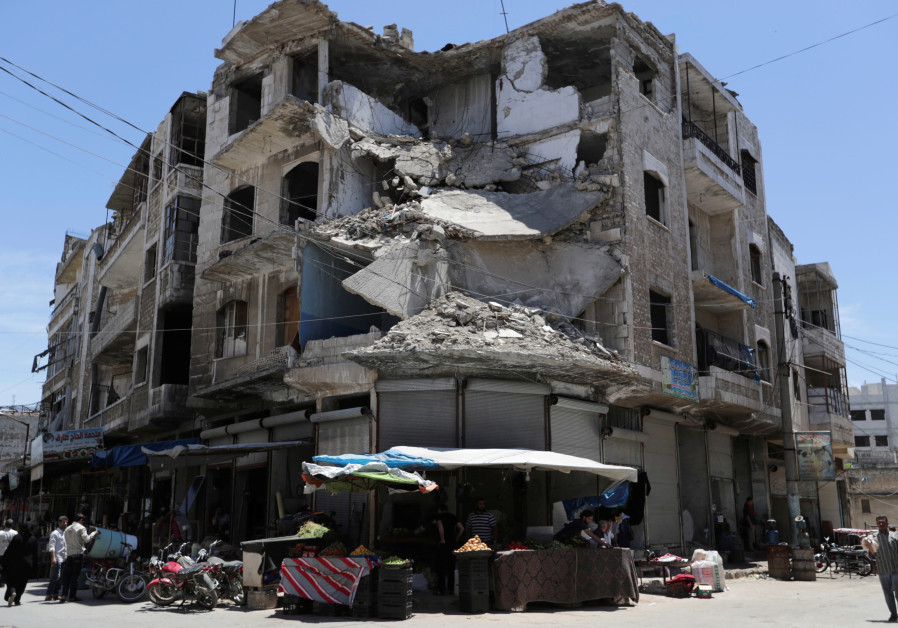
There are also numerous extremist fighters in Idlib, many linked to Al-Qaeda. A US airstrike on June 30 targeted Al Qaeda in northern Syria. Turkey has been backing the Syrian rebels for years, but since 2016 it has played an increasing role in Syria, eventually taking over Afrin and setting up observation points in Idlib. Syrian regime forces and Turkish forces have recently exchanged fire near an observation point, leading to concerns there could be a wider war.
In the past, these discussions have achieved important discussions of ceasefires and a kind of road map for ending the eight-year Syrian Civil War. However the next meeting also comes amid Turkey-US tensions and also tensions between Israel and Iran over Syria, and the US and Iran. Russia, Turkey and Iran therefore have many things in common in difficult relationships with Washington. That means they may increasingly see eye to eye on Syria even if Russia and Iran are on one side of the Syrian conflict and Turkey ostensibly on the other.
All of them oppose the US role in eastern Syria.
“Islamic Iran in its 40-year history has never initiated hostilities in any battles but has also never hesitated in responding to bullies,” Rezai said on his Twitter account.

DUBAI – Iran should seize a British oil tanker if an Iranian tanker detained off Gibraltar earlier this week is not released immediately, a senior Revolutionary Guards commander said in a tweet on Friday.
British Royal Marines seized the supertanker Grace 1 on Thursday for trying to take oil to Syria in violation of EU sanctions, a dramatic step that drew Tehran’s fury and could escalate its confrontation with the West.
“Islamic Iran in its 40-year history has never initiated hostilities in any battles but has also never hesitated in responding to bullies,” Rezai said on his Twitter account.
Iranian Foreign Ministry spokesman Abbas Mousavi said on Thursday that the Iranian oil tanker was carrying crude oil from Iran, according to the state news agency IRNA.
The Grace 1 was impounded off Gibraltar, a British territory on the southern tip of Spain, after sailing around Africa, the long route from the Middle East to the mouth of the Mediterranean.
While the European Union has banned oil shipments to war-torn Syria, a close ally of Iran, since 2011, it had never seized a tanker at sea. Unlike the United States, Europe does not have broad sanctions against Iran.
Source: US: Detention of tanker loaded with Iranian crude is ‘excellent news’ | The Times of Israel
Panamanian-flagged carrier is believed to be in violation of EU sanctions against war-ravaged Assad regime
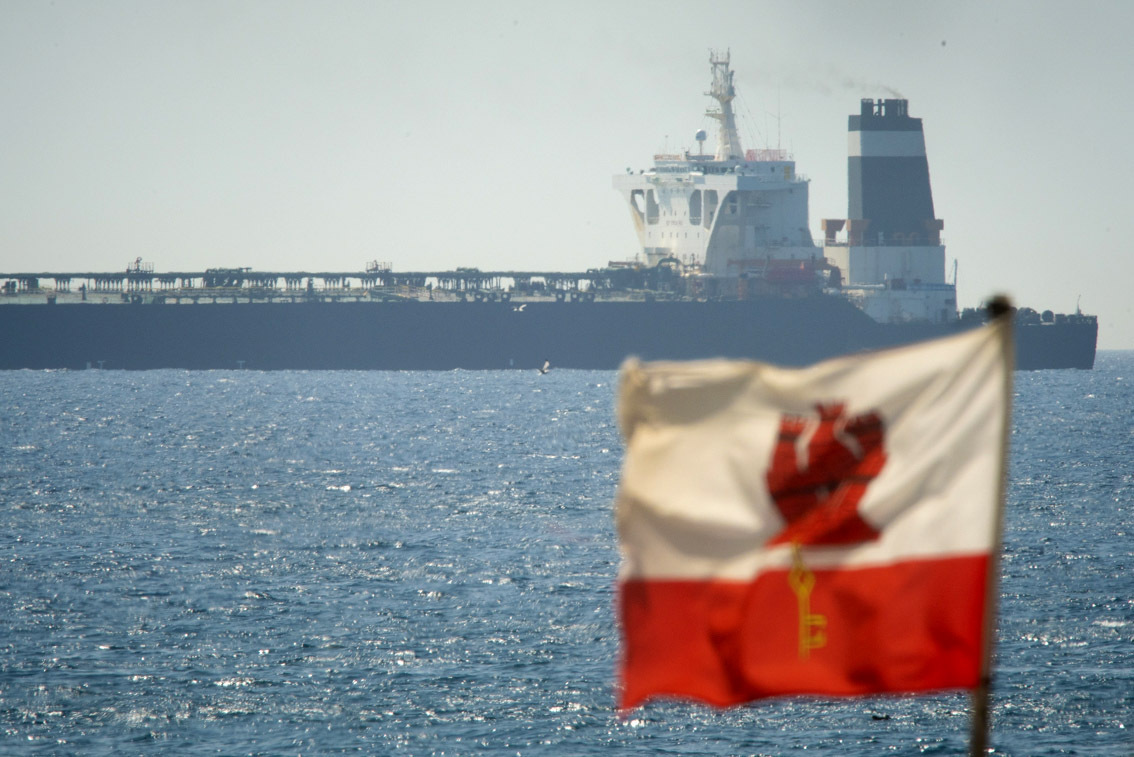
WASHINGTON — White House National Security Advisor John Bolton applauded the interception by Britain’s Gibraltar Thursday of a supertanker believed to be carrying Iranian crude oil to Syria, saying the ship was breaking international sanctions.
“Excellent news: UK has detained the supertanker Grace I laden with Iranian oil bound for Syria in violation of EU sanctions,” Bolton tweeted.
“America & our allies will continue to prevent regimes in Tehran & Damascus from profiting off this illicit trade,” he said.
Iran condemned the detention of the tanker as an “illegal interception,” but Gibraltar Chief Minister Fabian Picardo said in a statement that the cargo was believed destined for the Banyas Refinery in Syria, which is subject to European sanctions.
“That refinery is the property of an entity that is subject to European Union sanctions against Syria,” he said.
The 330 meter (1,000 feet) Grace 1 tanker was halted in the early hours of Thursday by police and customs agencies in Gibraltar, a tiny overseas British territory on Spain’s southern tip.
They were aided by a detachment of British Royal Marines.
Source: Iran demands ‘immediate release’ of tanker held in Gibraltar, summons UK envoy | The Times of Israel
Iranian foreign ministry denounces interception of ship suspected of violating EU sanctions, accuses Britain of acting at behest of the US
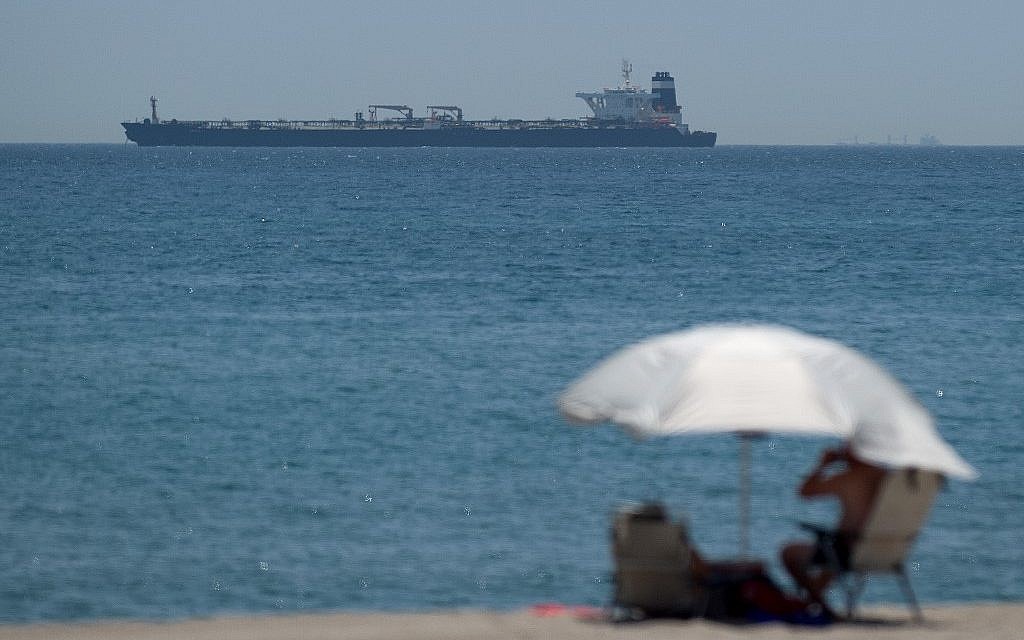
TEHRAN, Iran — Iran demanded Friday that Britain immediately release an oil tanker it has detained in Gibraltar, accusing it of acting at the bidding of the United States.
A senior foreign ministry official “described the UK move as unacceptable” in a meeting with British ambassador Rob Macaire, who had been summoned to hear a formal protest, the ministry said in a statement.
He “called for the immediate release of the oil tanker, given that it has been seized at the request of the US, based on the information currently available,” the statement added.
Authorities in Gibraltar, a British overseas territory on Spain’s southern tip at the western entrance to the Mediterranean, said they suspected the tanker was carrying crude to Syria in violation of EU sanctions.
The detention of the 330-meter (1,000-feet) Grace 1 vessel comes at a sensitive time in Iran-EU ties as the bloc mulls how to respond to Tehran announcing it is poised to breach the uranium enrichment limit it agreed to in a troubled 2015 nuclear deal.

The Grace 1 tanker was halted in the early hours of Thursday by police and customs agencies in Gibraltar, aided by a detachment of British Royal Marines.
The ship was detained 2.5 miles (four kilometers) south of Gibraltar in what it considers British waters, although Spain, which lays claim to the territory, says they are Spanish.
It was boarded when it slowed down in a designated area used by shipping agencies to ferry goods to vessels.
“We have reason to believe that the Grace 1 was carrying its shipment of crude oil to the Banyas refinery in Syria,” Gibraltar’s Chief Minister Fabian Picardo said in a statement.
“That refinery is the property of an entity that is subject to European Union sanctions against Syria.
“We have detained the vessel and its cargo,” Picardo said.
Spanish Foreign Minister Josep Borrell told reporters the vessel was detained at the request of the United States.
In a statement, Britain’s Foreign Office said “we welcome this firm action by the Gibraltarian authorities, acting to enforce the EU Syria Sanctions regime.”
European Union sanctions against war-torn Syria have been in force since late 2011.
The 28-member bloc has imposed sanctions on Syrian officials including government ministers over their role in the “violent repression” of civilians.
It has frozen the assets of around 70 entities and introduced an embargo on Syrian oil, investment restrictions and a freeze on Syrian central bank assets within the EU.
The tanker’s detention comes just days after Iran announced it would exceed the uranium enrichment limit set up as part of the 2015 deal to avoid it building up to the level required for a nuclear warhead.
Tehran took the action in response to Washington abandoning the nuclear deal last year and hitting Iran’s crucial oil exports and financial transactions with biting sanctions.
The unilateral move has sent tensions in the Gulf soaring as the administration of US President Donald Trump forges ahead with a policy of “maximum pressure” against Iran in coordination with its Middle East allies Israel and Saudi Arabia.
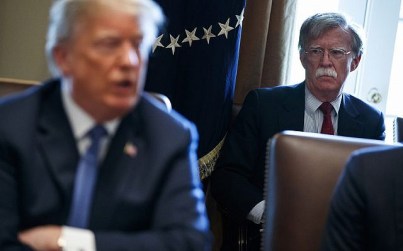
White House National Security Advisor John Bolton, a champion of the hawkish policy towards Tehran, applauded the interception of the supertanker.
“Excellent news: UK has detained the supertanker Grace I laden with Iranian oil bound for Syria in violation of EU sanctions,” Bolton tweeted.
According to specialized shipping trade publication Lloyd’s List, which analyses vessel-tracking data, the 1997-built ship is laden with Iranian oil.
It reported that the ship loaded oil off Iran in April and sailed around the Cape of Good Hope in South Africa.
Source: Gibraltar detains Syria-bound supertanker with Iranian oil

MADRID (AP) — Authorities in Gibraltar said they intercepted Thursday an Iranian supertanker believed to be breaching European Union sanctions by carrying a shipment of Tehran’s crude oil to war-ravaged Syria.
A senior Spanish official said the operation was requested by the United States. Iran’s state-run IRNA news agency described the incident as “an illegal seizure of an Iranian oil tanker.”
Gibraltar port and law enforcement agencies, assisted by Britain’s Royal Marines, boarded the Grace 1 early Thursday, authorities on the British overseas territory at the tip of Spain said in a statement.
It added that the vessel was believed to be headed to the Baniyas Refinery in Syria, a government-owned facility under the control of Syrian President Bashar Assad and subject to the EU’s Syrian Sanctions Regime.
The EU and others have imposed sanctions on Assad’s government over its continued crackdown against civilians. They currently target 270 people and 70 entities.
Spain’s caretaker foreign minister Josep Borrell said the tanker was stopped by British authorities after a request from the United States.
Iran later summoned the British ambassador in Tehran to answer questions about the operation. Iranian Foreign Ministry spokesman Abbas Mousavi said in a tweet that Rob Macaire was summoned over the “illegal interception” of the ship.
Mousavi later called the ship’s seizure “odd and destructive.” ″It can cause an increase in tensions in the region,” he said in a live telephone interview on state television Thursday night.
In Madrid, Borrell told reporters that Spain is assessing the implications of the operation because the detention took place in waters it considers its own.
Britain insists Gibraltar is part of the United Kingdom but Spain argues that it is not, and the tanker operation risks offending the Spanish.
“We’re looking into how this (operation) affects our sovereignty,” said Borrell, who was nominated earlier this week to become the EU’s foreign policy chief.
The Gibraltar authorities didn’t confirm the origin of the ship’s cargo but Lloyd’s List, a publication specializing in maritime affairs, reported this week that the Panama-flagged large carrier was laden with Iranian oil.
According to a U.N. list, the ship is owned by the Singapore-based Grace Tankers Ltd.
The vessel likely carried just over 2 million barrels of Iranian crude oil, the data firm Refinitv said. Tracking data showed that the tanker made a slow trip around the southern tip of Africa before reaching the Mediterranean, it said.
The tanker’s detention comes at a particularly sensitive time as tensions between the U.S. and Iran grow over the unraveling of a 2015 nuclear deal, which President Donald Trump withdrew from last year. Trump has also slapped sanctions onto Iran and recently approved the passage of a carrier group, bombers and fighter jets to the Persian Gulf.
In recent days, Iran has broken through the limit the deal put on its stockpile of low-enriched uranium and plans on Sunday to boost its enrichment. Meanwhile, oil tankers near the Strait of Hormuz have been targeted in mysterious attacks as Iranian-backed rebels in Yemen launch bomb-laden drones into Saudi Arabia. The U.S. has rushed thousands of additional troops, an aircraft carrier, B-52 bombers and F-22 fighters to the region, raising fears of a miscalculation sparking a wider conflict. Last month Iran shot down a U.S. surveillance drone, further stoking those fears.
Iran’s intelligence minister said Thursday that any negotiations with the U.S. would have to be approved by Supreme Leader Ayatollah Ali Khamenei and would require the lifting of U.S. sanctions. Khamenei has until now ruled out talks with the U.S., saying that Washington cannot be trusted.
On Thursday, the official IRNA news agency quoted Information Minister Mahmoud Alavi as saying “if the supreme leader permits, negotiations between Iran and the United States will be held.” He added, however, that Tehran would not negotiate under pressure.
There was no immediate reaction to the tanker’s detention from Syria, which has suffered severe fuel shortages as a result of the civil war and Western sanctions that have crippled the country’s oil industry, once the source of 20 percent of government revenues.
Iran, which has provided vital military support to Assad, extended a $3 billion credit line for oil supplies beginning in 2013 but the Iranian aid dwindled as Washington restored tough sanctions. In November, the U.S. Treasury Department added a network of Russian and Iranian companies to its blacklist for shipping oil to Syria and warned of “significant risks” for those violating the sanctions.
Fabian Picardo, Chief Minister of Gibraltar, which has in the past been a transit port for energy shipments without known buyers, said he has informed the EU about developments.
In a statement, the British government welcomed the “firm action” by authorities in Gibraltar.
___
Jon Gambrell reported from Tehran. AP reporters Zeina Karam in Beirut and Danica Kirka in London contributed to this report.

I can say—not as a patriotic bromide, but with full knowledge of the necessary metaphysical, epistemological, ethical, political and esthetic roots—that the United States of America is the greatest, the noblest and, in its original founding principles, the only moral country in the history of the world.
Since the golden age of Greece, there has been only one era of reason in twenty-three centuries of Western philosophy. During the final decades of that era, the United States of America was created as an independent nation. This is the key to the country—to its nature, its development, and its uniqueness: the United States is the nation of the Enlightenment.
America’s founding ideal was the principle of individual rights. Nothing more—and nothing less. The rest—everything that America achieved, everything she became, everything “noble and just,” and heroic, and great, and unprecedented in human history—was the logical consequence of fidelity to that one principle. The first consequence was the principle of political freedom, i.e., an individual’s freedom from physical compulsion, coercion or interference by the government. The next was the economic implementation of political freedom: the system of capitalism.
The most profoundly revolutionary achievement of the United States of America was the subordination of society to moral law. The principle of man’s individual rights represented the extension of morality into the social system—as a limitation on the power of the state, as man’s protection against the brute force of the collective, as the subordination of might to right. The United States was the first moral society in history. All previous systems had regarded man as a sacrificial means to the ends of others, and society as an end in itself. The United States regarded man as an end in himself, and society as a means to the peaceful, orderly, voluntary co-existence of individuals. All previous systems had held that man’s life belongs to society, that society can dispose of him in any way it pleases, and that any freedom he enjoys is his only by favor, by the permissionof society, which may be revoked at any time. The United States held that man’s life is his by right(which means: by moral principle and by his nature), that a right is the property of an individual, that society as such has no rights, and that the only moral purpose of a government is the protection of individual rights.
It took centuries of intellectual, philosophical development to achieve political freedom. It was a long struggle, stretching from Aristotle to John Locke to the Founding Fathers. The system they established was not based on unlimited majority rule, but on its opposite: on individual rights, which were not to be alienated by majority vote or minority plotting. The individual was not left at the mercy of his neighbors or his leaders: the Constitutional system of checks and balances was scientifically devised to protect him from both. This was the great American achievement—and if concern for the actual welfare of other nations were our present leaders’ motive, this is what we should have been teaching the world.
Source: Trump warns Iran nuclear threats will ‘come back to bite you’ | The Times of Israel
President lashes out at Tehran after Rouhani vows to step up uranium enrichment if there is no new nuclear deal
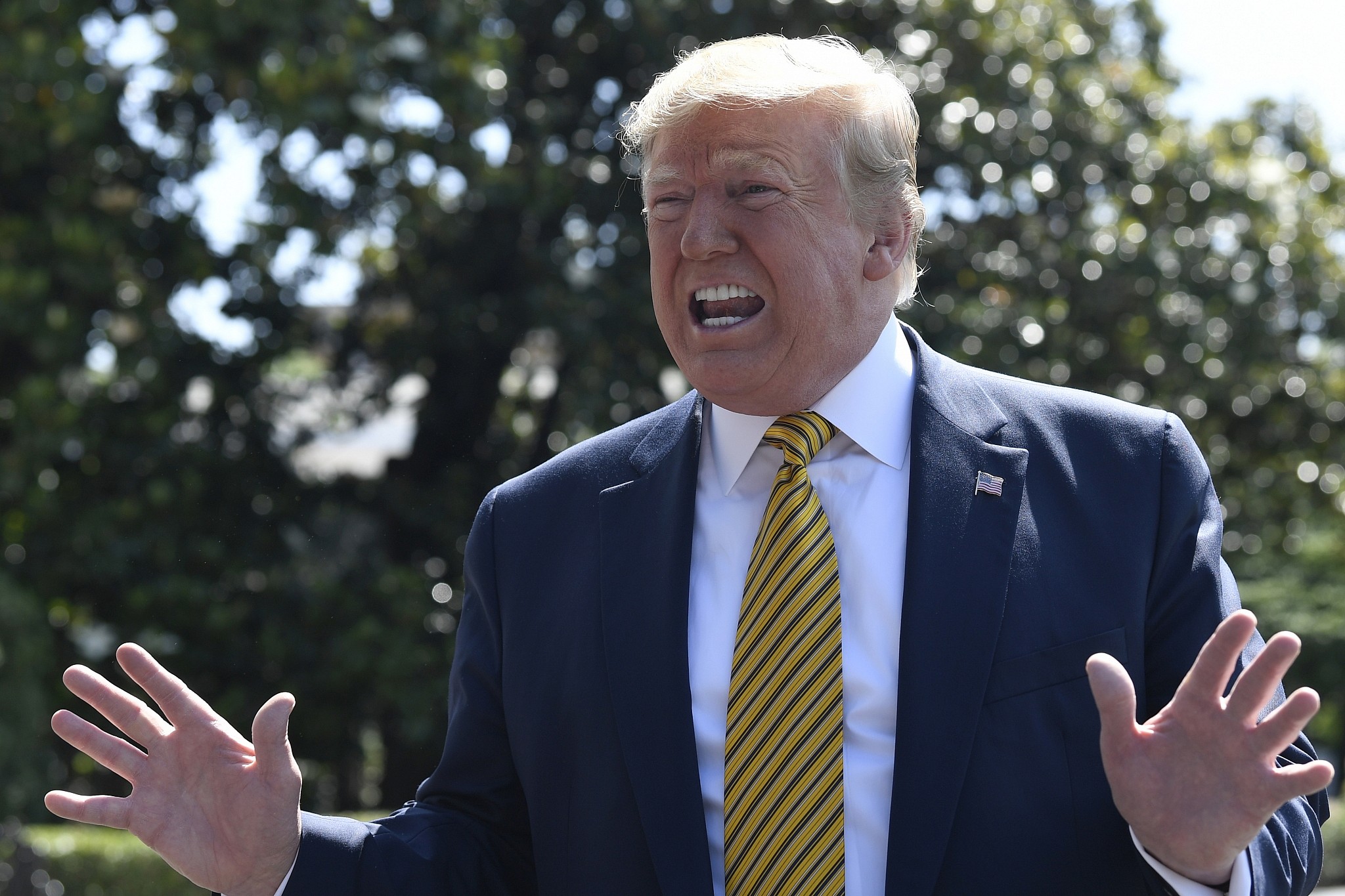
WASHINGTON — US President Donald Trump warned Iran on Wednesday its threats could “come back to bite” after Tehran vowed to exceed the maximum uranium enrichment level allowed by a landmark 2015 nuclear accord.
“Iran has just issued a New Warning. Rouhani says that they will Enrich Uranium to ‘any amount we want’ if there is no new Nuclear Deal,” Trump tweeted, referring to Iran’s President Hassan Rouhani.
“Be careful with the threats, Iran. They can come back to bite you like nobody has been bitten before!”
Iran is acting on its May 8 threat to suspend parts of the agreement in response to Trump’s reimposition of crippling sanctions after withdrawing from it in May last year.
 Donald J. Trump
✔@realDonaldTrump
Iran has just issued a New Warning. Rouhani says that they will Enrich Uranium to “any amount we want” if there is no new Nuclear Deal. Be careful with the threats, Iran. They can come back to bite you like nobody has been bitten before!
Rouhani said Wednesday’s decision to exceed the enrichment limit was in response to failure by other parties to the deal to keep up their promises and provide Iran relief from the US sanctions.
“On July 7, our enrichment level will no longer be 3.67 percent. We will put aside this commitment. We will increase (the enrichment level) beyond 3.67 percent to as much as we want, as much as is necessary, as much as we need,” Rouhani told a cabinet meeting.
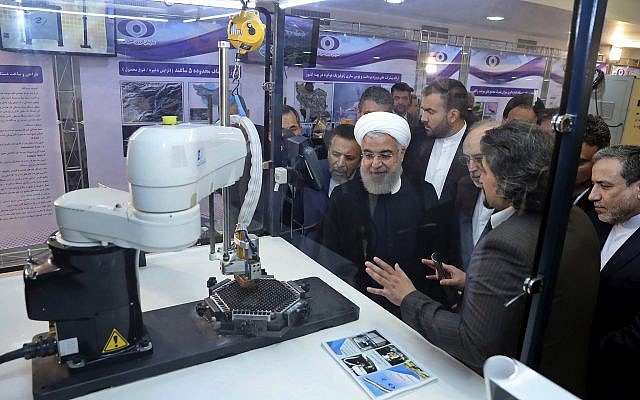
The enrichment maximum set in the agreement is sufficient for power generation but far below the more than 90 percent level required for a nuclear warhead.
Iran insists that it is not violating the deal, citing terms of the agreement allowing one side to temporarily abandon some of commitments if it deems the other side is not respecting its part of the accord.
Rouhani stressed that Iran’s action would be reversed if the other parties to the nuclear deal made good on their side of the bargain — relief from sanctions.
“We will remain committed to the (nuclear deal) as long as the other parties are committed,” he said.
“We will act on the JCPOA 100 percent the day that the other party acts 100 percent (too),” he added using the deal’s acronym.
Iran has sought to pressure the other parties — Britain, China, France, Germany and Russia — to save the deal.
France reacted quickly by warning Iran that it would “gain nothing” by leaving the deal and said “challenging the agreement would only increase tensions already high” in the Middle East.
On May 8, Iran announced it would no longer respect the limits set on the size of its stockpiles of enriched uranium and heavy water, and threatened to abandon further nuclear commitments, including exceeding the agreed uranium enrichment maximum from July 7.
Rouhani said Iran will also deliver on its threat to resume construction of a heavy water reactor after July 7 and will bring it to the condition that “according to you, is dangerous and can produce plutonium”.
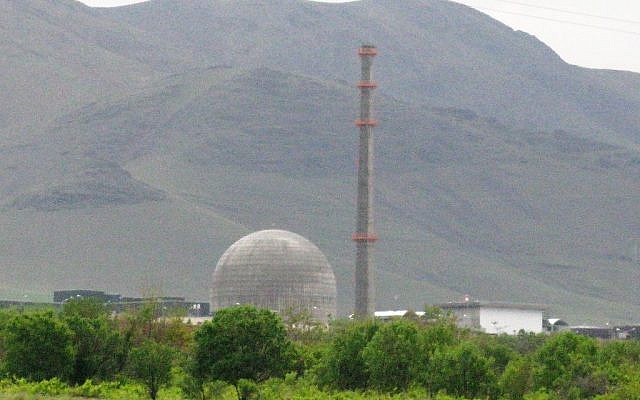
But all these measures can be reversed in “hours” if the other parties “live up to their commitments”, he said.
Trump had warned Monday that Iran is “playing with fire” after Tehran said it had exceeded the limit set on its enriched uranium stockpile.
Rouhani said it was the US that started the fire and Washington has to “put it out” by returning to the nuclear deal.
His adviser, Hesamodin Ashena, warned Trump against listening to hawks in his administration, hinting aggression against Iran could make him a “one-term president”.
“We have unseated an American president in the past, we can do it again,” he tweeted, referring to Jimmy Carter whose bid for a second term was marred by the Iran hostage crisis in 1980.
Israel urged European states to slap sanctions on Iran for abandoning its nuclear commitments.
Russia voiced regret but said the move was a consequence of US pressure, which has pushed the deal towards collapse.
The diplomatic chiefs of Britain, France, Germany and the EU said they were “extremely concerned” and urged Iran to reverse its decision.
Europe has sought to save the nuclear deal by setting up a payment mechanism known as INSTEX which is meant to help Iran skirt the US sanctions.
Rouhani dismissed the mechanism as “hollow”, saying it was useless to Iran because it failed to provide for financing of purchases of Iranian oil.
He took issue with the EU for calling on Iran to stay committed to the deal.
The deal “is either good or bad. If it’s good, everyone should stay committed to it,” not just Iran, Rouhani said.




 anneinpt
 artaxes
 danmillerinpanama
 davidking1530
 Peter Hofman
 Joseph Wouk
 Peter
Peter Louisiana Steve
 WarSclerotic
Recent Comments