Archive for July 2019

Britain wins early European support for Hormuz naval mission

July 24, 2019

Source: Britain wins early European support for Hormuz naval mission – www.israelhayom.com

France, Italy and Denmark give initial support for a British plan for a European-led naval mission to ensure safe shipping for commercial vessels sailing through the strategic waterway. Iran: Foreign powers should leave securing shipping lanes to us.

France, Italy, and Denmark gave initial support for a British plan for a European-led naval mission to ensure safe shipping through the Strait of Hormuz, proposed after Iran’s seizure of a British-flagged tanker, three senior EU diplomats said on Tuesday.

The cautious backing at a meeting of EU envoys in Brussels contrasts sharply with the lukewarm response shown by European allies to a similar American call first voiced at NATO in late June, when countries feared they could make US -Iranian tensions worse.

“Britain’s request, rather than Washington’s, makes it easier for Europeans to rally round this,” one senior EU diplomat said. “Freedom of navigation is essential, this is separate from the US campaign of maximum pressure on Iran.”

Britain tested the idea to senior EU diplomats at a meeting in Brussels, saying it would not involve the European Union, NATO or the United States directly, the diplomats said.

It was the first formal European meeting since British Foreign Secretary Jeremy Hunt outlined the plans to parliament on Monday to protect the Strait, through which a fifth of the world’s oil passes.

Britain raised the plan after Friday’s capture of the Stena Impero tanker by Iranian commandos at sea.

British Foreign Office and defense officials have also discussed a possible mission, which would likely involve not just ships but aircraft too, directly with their Italian, Spanish, French and German counterparts.

A senior German diplomat in Berlin said Foreign Minister Heiko Maas was in close contact with his British and French counterparts, Hunt and Jean-Yves Le Drian, to “contribute to the security” of the Gulf including on maritime security.

The Netherlands is also assessing the British proposal, while a Spanish official said Madrid has held talks with London and was studying the idea.

Iran has rejected the proposal and says foreign powers should leave securing shipping lanes to Tehran and others in the region. Saudi Arabia, Iran, the United Arab Emirates, Kuwait and Iraq export most of their crude via the Strait.

Despite an American push to protect the vital shipping lane, US President Donald Trump said on Tuesday the United States paid for a route it did not use it as much as in the past.

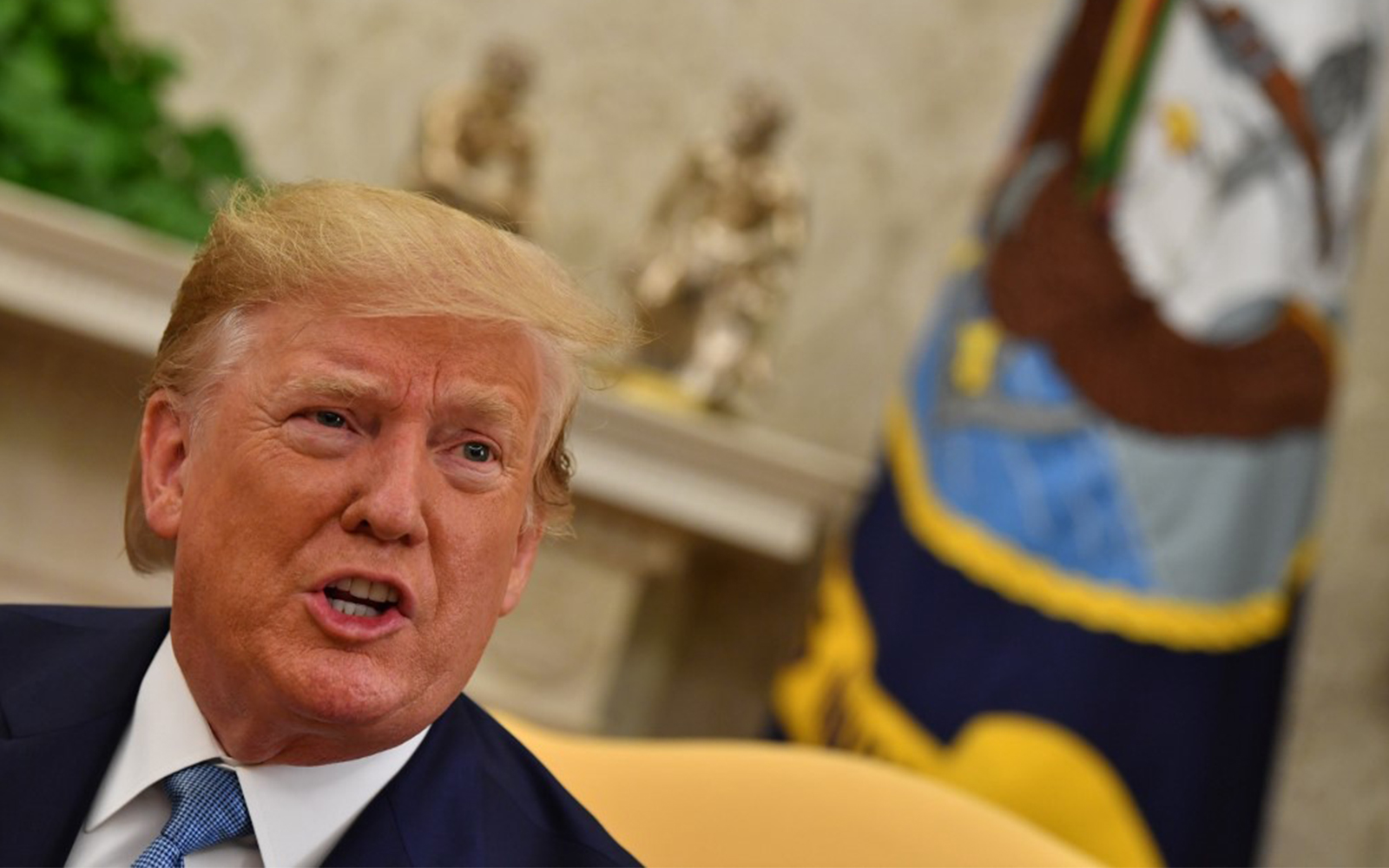
“We don’t need it. We’ve become an exporter,” he said at an event in Washington, referring to the United States’ rising energy exports. “We’re the ones that policed it. We never get reimbursed,” he said, suggesting it was up to China and Japan to do more.

Given Britain’s plans to quit the EU, the mission will strive to be a looser coalition than that of the bloc’s anti-piracy naval mission, Atalanta, off the coast of Somalia and could also involve non-EU countries such as Norway.

China has a military base in Djibouti, although there has been no discussion to involve Beijing, diplomats said.

Britain aims to have further meetings with EU capitals including Stockholm, the diplomats said, while at the EU meeting in Brussels, Poland and Germany also showed interest.

The mission could be run by a joint Franco-British command, one of the envoys said. Britain has a naval base in Oman, while France has one in the United Arab Emirates.

Any mission would still need parliamentary approval in some EU countries, diplomats said.

Last Friday’s capture of the Stena Impero appears to have given Europeans new impetus. The European Union recently had informal discussions about an EU mission to patrol the strategic waters off Iran and Oman.

Any future mission would patrol waters, lead surveillance efforts and escort commercial vessels and coordinate with naval vessels in the area. Any force would need to work with the United States, the world’s dominant military power.

“There are still questions: to what extent should we draw on American help? We would need to talk to them,” one envoy said.

A US request for an international mission to protect shipping, aired at a NATO defense ministers’ meeting in Brussels on June 27, was resisted by France and Germany. They worried that the US -led military alliance would be dragged into a possible confrontation with Iran.

Britain, France and Germany, with support from the rest of the EU, are trying to save the 2015 nuclear accord between Iran and major powers, under which Tehran undertook to curb its nuclear program in exchange for the lifting of international sanctions.

Tension has mounted since Trump quit the pact last year and reimposed sanctions on Iran, crippling its economy, in an attempt to negotiate a new, broader deal with Tehran.

The Europeans, who will discuss the state of the nuclear deal on Sunday in Vienna, along with China and Russia, reject the US approach.


 

Off Topic – Study: Americans don’t know much about Jews, but love them anyway

July 24, 2019

Source: Study: Americans don’t know much about Jews, but love them anyway | The Times of Israel

( Americans are by far and away the people Israelis love the most. – JW )

Pew survey finds Jews are most liked religious group in US and are also the most knowledgeable about world religions; Muslims and atheists rated least liked

Illustrative photo of ultra-Orthodox Jews in Brooklyn, New York. (Mendy Hechtman/Flash90)

Illustrative photo of ultra-Orthodox Jews in Brooklyn, New York. (Mendy Hechtman/Flash90)

JTA — US Jews know more about religion in general than their non-Jewish neighbors, a new survey shows.

Americans who are not Jewish, meanwhile, don’t know a lot about Judaism. But they like Jews more than any other religious group. And they think there are more Jews in the country than there actually are. The more non-Jews know about Jews, the more they like them.

The data comes out of a new survey on what Americans know about religion published Tuesday by the Pew Research Center. The survey asked a group of diverse Americans a set of 32 questions about religion, ranging from knowledge of the Bible and Christianity to knowledge of Judaism and other religions.

Ten of the questions related to Judaism in some way: four asked directly about Jewish history, practice and texts; five were about the Hebrew Bible; and one was about the size of America’s Jewish population.

The survey was conducted February 4-19 and included a total of nearly 11,000 respondents. The margin of error for the whole group was 1.5 percent. The margin of error for the Jewish sample was 8.6%.

Here are three takeaways from the survey.

Children sitting at the Park East Synagogue, a Modern Orthodox congregation in New York City, March 3, 2017. (Drew Angerer/Getty Images, via JTA)

Americans don’t know a lot about Judaism.

Out of four questions on Judaism, non-Jewish Americans got a dismal score: They averaged less than one out of four correct. Besides Jews themselves, atheists did the best on the Jewish questions, averaging 1.3 correct answers.

None of the questions on Judaism received a majority of correct answers:

  • 29% of respondents knew that the Jewish Sabbath (Shabbat) begins on Friday night.
  • 27% knew Kabbalah (Jewish mysticism) was associated with Judaism.
  • 24% knew that Rosh Hashanah is the Jewish New Year.
  • 13% knew Maimonides was a Jewish scholar.
  • Older Americans did better on all of these questions than the youth. Forty percent of those 65 and older, for example, knew that the Jewish Sabbath begins on Friday night, compared to 18 percent of respondents aged 18 to 29.

Jews did much better on these questions than non-Jews, averaging 3.1 correct out of four. Nearly 90 percent knew that Shabbat begins on Friday night, almost 80 percent knew Kabbalah is Jewish, 82 percent knew Rosh Hashanah is the Jewish New Year and 58 percent knew that Maimonides was Jewish.

In this July 16, 2010 photo, members of the religious group Minyan Tehillah look at a Torah scroll as they prepare for Shabbat services at Harvard Radcliffe Hillel, in Cambridge, Massachusetts. (AP Photo/Lisa Poole)

Americans as a whole also didn’t know how many Jews live in the country. Fewer than one in five knew that Jews are less than 5 percent of Americans. A quarter thought Jews were more than 5 percent of Americans, and the rest of the respondents didn’t know.

But Jews know a lot about religion.

Jews didn’t only outscore their non-Jewish counterparts when it came to Jewish knowledge. They outscored everyone when it came to general religious knowledge, too.

Besides the questions on Jewish practice, history and text, seven questions were about Christianity, nine were about the Bible, including the New Testament, nine were about “world religions,” two were about atheism and agnosticism, and two were about religion in the United States.

Jews were the only religiously affiliated group to get a majority of the questions right. On average, Jews got 18.7 questions right out of 32, as opposed to a national average of 14.2. Atheists and agnostics also got a majority of questions right, but the closest religiously affiliated group was evangelical Christians, who got an average of 15.5 correct.

Jews scored highest, the survey said, “even after controlling for levels of education and other key demographic characteristics such as race, age and gender.”

Jews also scored high on world religions and on knowledge of atheism and agnosticism. Ninety percent, for example, knew that atheists don’t believe in God. More than 85 percent knew that Ramadan is an Islamic holy month and that Mecca is an Islamic holy city.

Los Angeles Mayor Antonio Villaraigosa,2nd from left front, participates in Rosh Hashana services at the Temple Isaiah on Sept 30, 2008, in Los Angeles. (AP Photo/Nick Ut)

They were above average when it came to knowledge of the Bible (including the New Testament) and knowledge of Christianity. On the question of who saved the Jews from murder by appealing to the king (an occasion marked by the Jewish holiday of Purim), 66 percent of Jews correctly responded “Esther,” as opposed to 28 percent of Americans as a whole.

The more Americans know Jews, the more they like them.

As other surveys have shown, Americans tend to have warm feelings toward Jews. Asked to rate religious groups on a thermometer scale, from 1 to 100, Jews got an average rating of 63, the highest of any group. Forty-one percent rated Jews at 67 or higher, while 8 percent rated Jews 33 or lower.

Atheists and Muslims scored lowest, both with an average thermometer score of 49.

The more Americans knew about religion in general, and Judaism in particular, the more they liked Jews. Those who answered 25 or more questions correctly, for example, gave Jews an average rating of 70.

And those who know Jews personally also rated them higher. The respondents who know Jews gave Jews an average rating of 66, versus 56 from those who do not know any Jews.


British vessel transits strait where Iran seized tanker 

July 24, 2019

Source: British vessel transits strait where Iran seized tanker | The Times of Israel

Warship shadows BW Elm as it crosses Strait of Hormuz, in first since Tehran took a UK-flagged tanker last week amid soaring tensions

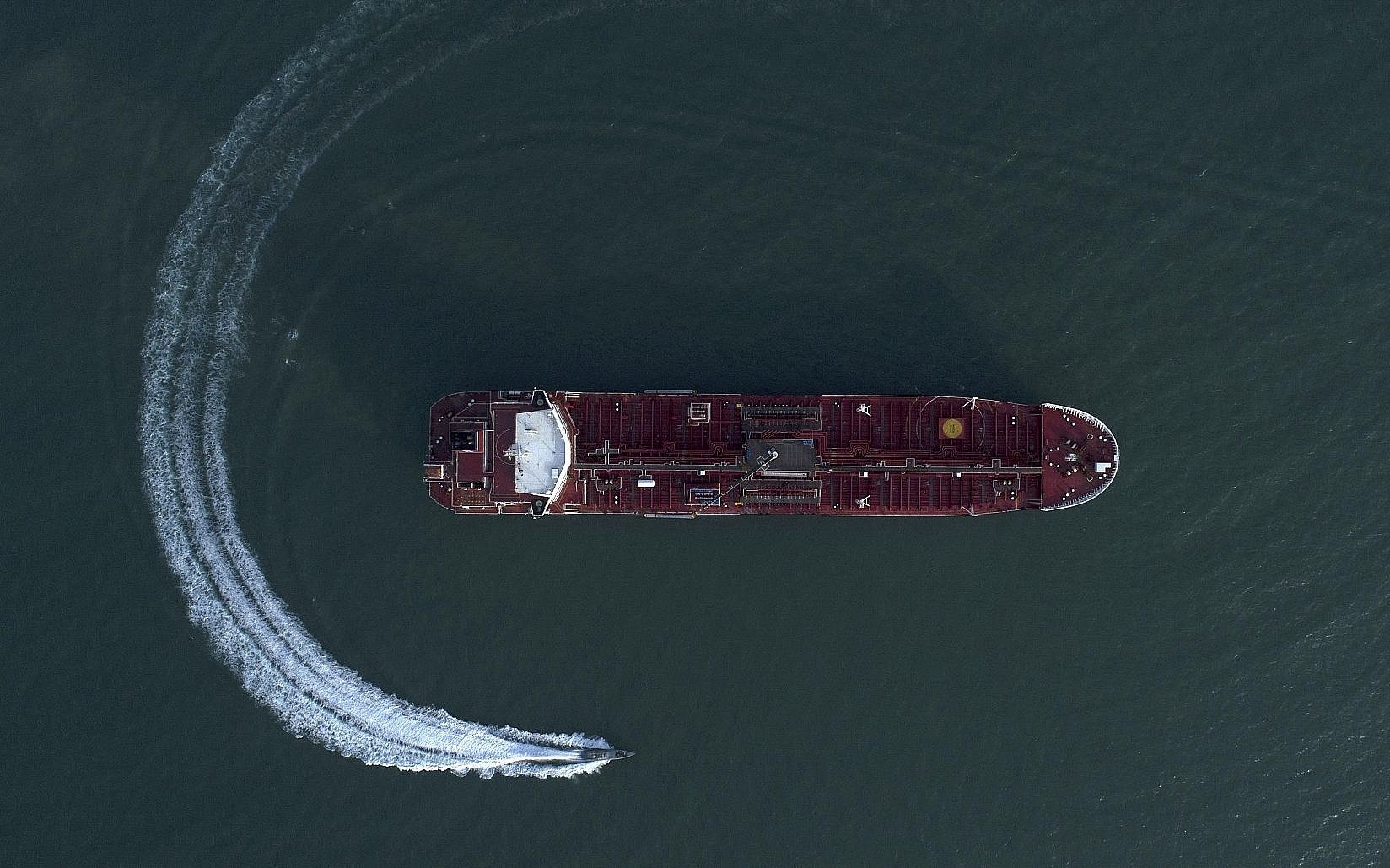
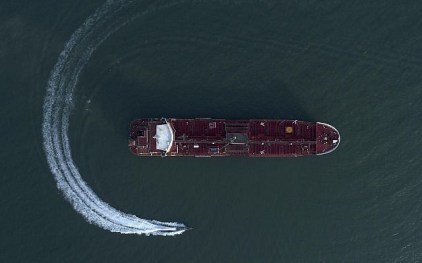
In this July 21, 2019 photo, an aerial view shows a speedboat of Iran’s Revolutionary Guard moving around the British-flagged oil tanker Stena Impero which was seized in the Strait of Hormuz on Friday by the Guard, in the Iranian port of Bandar Abbas. (Morteza Akhoondi/Tasnim News Agency via AP)

DUBAI, United Arab Emirates (AP) — A large British-flagged vessel transited the Strait of Hormuz and arrived at a port in Qatar on Wednesday in the first such passage made by a British ship of its size since Iran seized a UK-flagged tanker last week, according to maritime tracking data.

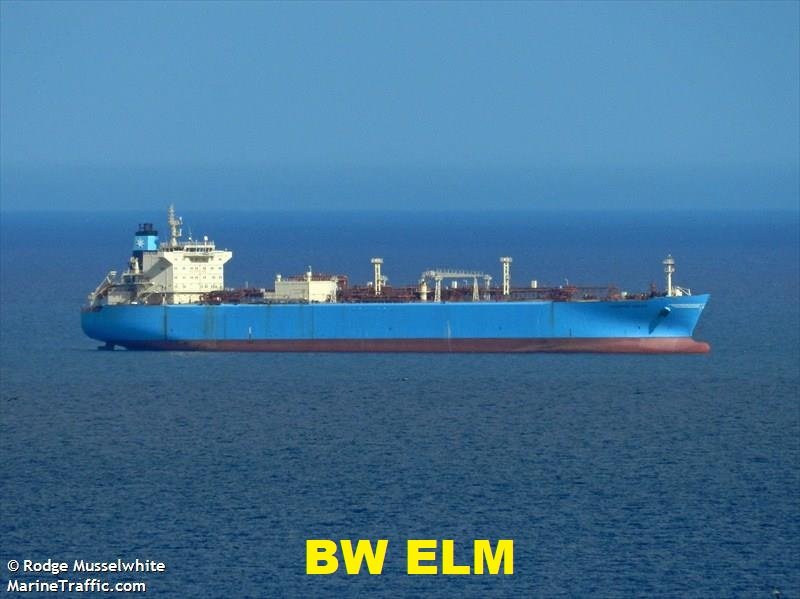
Maritime publication Lloyd’s List identified the vessel as the BW Elm and reported that a British warship, likely the HMS Montrose, closely shadowed the large liquefied petroleum gas carrier but that the Royal Navy did not provide a direct escort.

The Ministry of Defense declined to specifically comment on the transit and referred to recent comments made by Foreign Secretary Jeremy Hunt, in which he confirmed the HMS Montrose has accompanied more than 30 ships over the last ten days through the strait.

Britain this week announced plans to develop and deploy a Europe-led “maritime protection mission” to safeguard shipping in the area. It comes as Boris Johnson prepares to assume office as prime minister on Wednesday.

One-fifth of global crude passes through the shipping corridor, making it an internationally important chokepoint for global energy supplies from Gulf exporters.

crown dependency pol@CROWNDPN

Royal Navy ‘shadows’ UK-flagged ship through Hormuz in first transit since tanker seizure
BW Group’s Isle of Man-flagged carrier BW Elm made the passage on Tuesday, despite UK government guidance to avoid the route @IoMShipRegistry @LloydsList http://bit.ly/2JK7cP0 

View image on Twitter
Data on tracking site Marine Traffic showed the commercial BW Elm ship arrived at a port in Qatar early Wednesday after transiting the strait on Tuesday. The UK government has advised British-flagged ships to avoid the Strait of Hormuz.

In a statement to the AP, the ship’s owner BW LPG declined to comment on specifics, but noted protection by the navy.

“BW LPG is grateful for the UK and international community for their naval presence in the area providing security to merchant vessels transiting through the Straits of Hormuz,” the company said, adding that it is operating “at our highest security protocol.”

Iran’s seizure of the British-flagged Stena Impero and its crew of 23 on Friday heightened tensions in the Persian Gulf after a spate of incidents that have threatened security in the Strait of Hormuz, which lies between Iran and Oman.

In past weeks, Iran has shot down a US spy drone, US officials say military cyberforces struck Iranian computer systems that handle missile and rocket launchers, and six oil tankers were sabotaged near the strait.

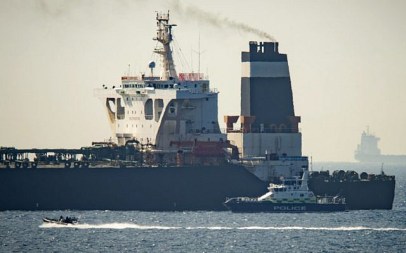
The Grace 1 super tanker in the British territory of Gibraltar, July 4, 2019. (AP Photo/Marcos Moreno)

Iranian officials meanwhile reiterated their denial that any Iranian drones were intercepted, after the US military said Tuesday that it took aim at two of them last week.

US Central Command said one Iranian drone crashed into the sea after the USS Boxer took “defensive action” against it last Thursday. It said the Boxer also “engaged” a second Iranian drone at the same time, but could not confirm it was destroyed.

Iran’s defense minister, Gen. Amir Hatami, told reporters Wednesday that “if someone claims he should provide evidence,” adding that “none of our drones have been intercepted.”

The current tensions stem from US President Donald Trump’s decision last year to pull the country from Iran’s nuclear accord with world powers and reinstate sweeping sanctions. The US has also expanded its military presence in the region.

Iranian officials have alleged the Stena Impero was seized after it violated international maritime law by turning off its signaling for longer than is allowed and passing through the wrong channels.

However, Iranian officials have also suggested the ship was seized in response to Britain’s role in impounding an Iranian supertanker two weeks earlier off the coast of Gibraltar, a British overseas territory. The UK says the tanker was suspected of violating sanctions on oil shipments to Syria.


France stresses need for Iran to respect nuclear accord 

July 24, 2019

Source: France stresses need for Iran to respect nuclear accord | The Times of Israel

Paris urges Tehran to ‘make the needed gestures’ to save pact amid soaring tensions, and with remaining signatories set to meet Sunday

French Foreign Minister Jean-Yves Le Drian gives a press conference with his Moroccan counterpart in Rabat on June 8, 2019. (FADEL SENNA / AFP)

French Foreign Minister Jean-Yves Le Drian gives a press conference with his Moroccan counterpart in Rabat on June 8, 2019. (FADEL SENNA / AFP)

PARIS, France (AP) — French authorities in a meeting Tuesday with an Iranian envoy stressed the need for Tehran to quickly respect the 2015 nuclear accord it has breached and “make the needed gestures” to deescalate mounting tensions in the Persian Gulf region.

A statement by the French Foreign Ministry said Seyed Abbas Araghchi gave a message to President Emmanuel Macron from Iranian leader Hassan Rouhani. Macron and Rouhani spoke last Thursday.

Foreign Minister Jean-Yves Le Drian, who met with Araghchi, is working with European partners on an observation mission to ensure maritime security in the Gulf, where tensions have mounted after Iran’s seizure last Friday of a UK-flagged oil tanker.

Le Drian made no mention of a Europe-led “maritime protection mission” announced a day earlier by his British counterpart, Jeremy Hunt, offering instead what seems to be a softer version.

France is working “at this moment on a European initiative” with Britain and Germany, he told lawmakers, without elaborating. “This vision is the opposite of the American initiative, which is … maximum pressure” against Iran.

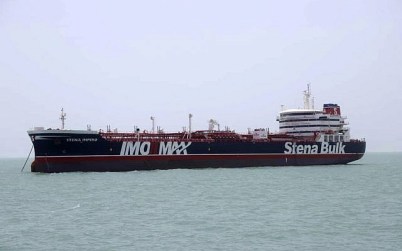
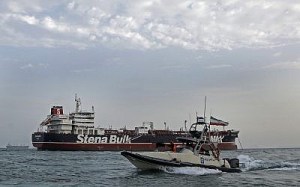
The British-flagged oil tanker Stena Impero which was seized by the Iran’s Revolutionary Guard on Friday is photographed in the Iranian port of Bandar Abbas, July 20, 2019 (Tasnim News Agency/via AP)

Foreign Ministry spokeswoman Agnes Von der Muhll said at a briefing that the initiative involves “appropriate means of surveillance” aimed at “increased understanding of the situation at sea” to facilitate traffic in a waterway that is critical to the global economy.

Iran’s seizure Friday of British oil tanker Steno Impero and its 23-member crew in the Strait of Hormuz aggravated tensions that were already mounting with Iran’s breaching of a 2015 Iran nuclear accord among world powers.

US President Donald Trump withdrew the country from the accord last year, reinstating sanctions on Iran and raising tensions.

Nations still party to the shaky Iran nuclear deal plan to meet in Vienna on Sunday to see to what extent the agreement can be saved. The European Union said the meeting of China, Russia, Britain, France and Germany, chaired by the EU, “will examine issues linked to the implementation of the (nuclear deal) in all its aspects.”

Iran began openly exceeding the uranium enrichment levels set in the accord to try to pressure Europe into offsetting the economic pain of US sanctions.

Le Drian stressed the need for diplomacy to deescalate volatile tensions, which he has said previously could lead to “an accident.”


Rouhani: Iran open to negotiations but not at cost of ‘surrender’ 

July 24, 2019

Source: Rouhani: Iran open to negotiations but not at cost of ‘surrender’ | The Times of Israel

Comments by Iranian president appear to rule out renewed nuclear talks with US unless sanctions on Tehran are lifted

In this photo released by the official website of the office of the Iranian Presidency, President Hassan Rouhani speaks in a meeting during his provincial tour to the North Khorasan, Iran, July 14, 2019. (Iranian Presidency Office via AP)

In this photo released by the official website of the office of the Iranian Presidency, President Hassan Rouhani speaks in a meeting during his provincial tour to the North Khorasan, Iran, July 14, 2019. (Iranian Presidency Office via AP)

Iranian President Hassan Rouhani said Wednesday his country was open to holding talks on its nuclear program but would not be browbeaten into doing so.

“We are fully ready for fair, legal negotiation based on respect and dignity to resolve problems, but we will not surrender under the name of negotiation,” he said during a cabinet meeting, according to his official website.

Rouhani appeared to be reiterating comments from earlier this month that he was willing to negotiate with the United States if it first lifts sanctions and rejoins the 2015 international accord meant to limit Iran’s nuclear program.

The US has been waging a “maximum pressure” campaign on Iran since President Donald Trump withdrew from the nuclear deal last year, reimposing tough sanctions in a bid to return Tehran to the negotiating table.

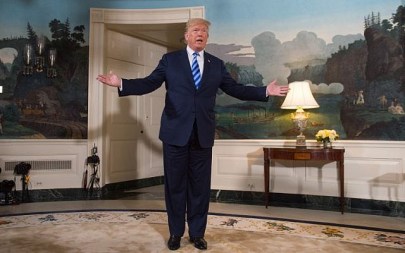
US President Donald Trump speaks to the press after announcing his decision to withdraw from the nuclear deal with Iran during a speech from the Diplomatic Reception Room at the White House on May 8, 2018. (AFP Photo/Saul Loeb)

At the cabinet meeting, Rouhani touted his government’s role in brokering the agreement, noting the windfall Iran received from the lifting of longstanding sanctions after it took effect. He went on to hit out at rivals Israel and Saudi Arabia for opposing the deal and welcoming Trump’s withdrawal.

“Recently, Saudi Arabia and the prime minister of the Zionist regime announced that they played a part in the United States’ withdrawal from the JCPOA, not to mention the extremists inside the US,” Rouhani said, using the acronym for the deal’s official name.

“Of course, their actions proved that the JCPOA was [too] heavy for Zionists and the regional reactionaries to bear,” he added.

Rouhani addressed Iran’s recent decision to violate the deal’s caps on the amount of uranium it can hold and what level it can enrich it to, saying the impact of US sanctions on the Islamic Republic’s lucrative oil exports led it to reassess its approach.

“We acted cautiously toward the US withdrawal until we could sell our oil to the amount we desired, but since they began their fully-fledged sanctions against our oil, we are in new conditions; therefore, we made firm decisions to reduce our commitments under the new conditions,” he said.

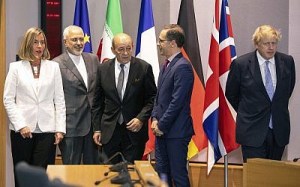
From left, European Union foreign policy chief Federica Mogherini, Iranian Foreign Minister Javad Zarif, French Foreign Minister Jean-Yves Le Drian, German Foreign Minister Heiko Maas and then British Foreign Secretary Boris Johnson, during a meeting of the foreign ministers at the Europa building in Brussels, on May 15, 2018. (AP Photo/Olivier Matthys, Pool)

The deal’s European signatories — Britain, France and Germany — have been seeking to coax Iran into reversing its violations of the agreement, with Tehran demanding economic concessions for doing so.

Along with the three European countries, Iranian allies China and Russia are also parties to the UN-ratified agreement.

Rouhani also commented on tensions in the Persian Gulf in the wake of Iran’s seizure last week of a UK-flagged tanker in retaliation for Britain’s impounding of a vessel off Gibraltar suspected of transporting oil to Syria in violation of EU sanctions.

“We will not allow anyone to cause disturbances in the Persian Gulf and the Strait of Hormuz,” the Mehr news agency reported him as saying.

A series of attacks on oil tankers in the Gulf region, as well as Iran’s downing of a US military drone, have turned the area into a powder keg.

AFP contributed to this report.


Iranian news agency blames Israel for death of UN nuclear watchdog chief

July 24, 2019

Source: Iranian news agency blames Israel for death of UN nuclear watchdog chief | The Times of Israel

Government-linked Tasnim claims Yukiya Amano was killed for refusing to bow to pressure from Jerusalem and Washington

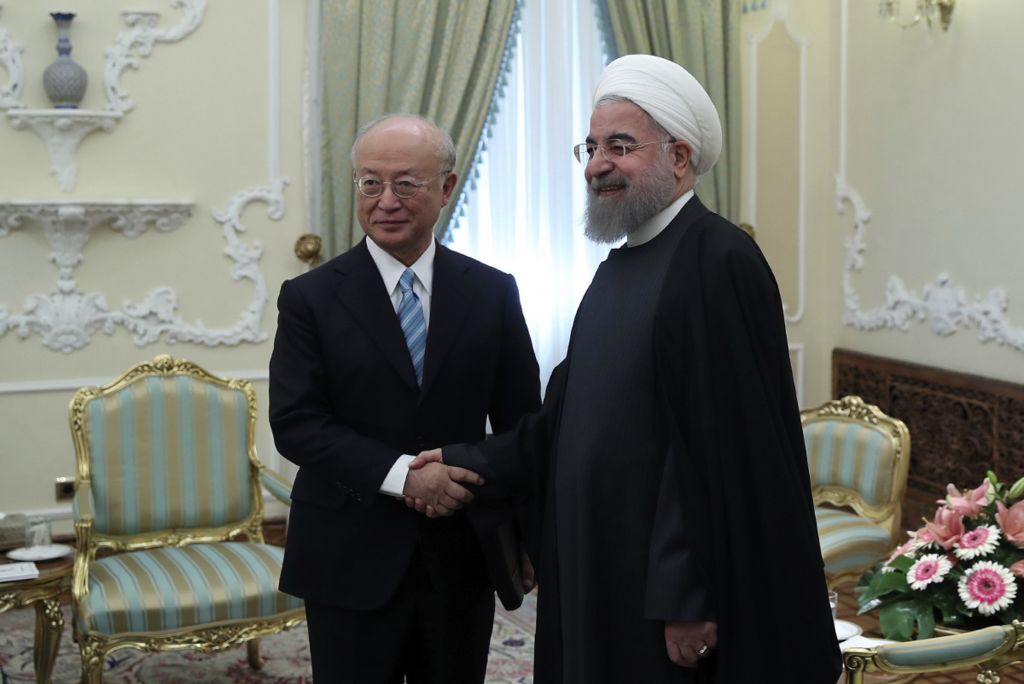
In this photo released by official website of the office of the Iranian Presidency, President Hassan Rouhani, right, and Director General of the International Atomic Energy Agency, IAEA, Yukiya Amano shake hands for media at the start of their meeting at the Presidency office in Tehran, Iran, Sunday, December 18, 2016. (Iranian Presidency Office/AP)

Iran’s semi-official Tasnim news agency claimed Wednesday that Israel was responsible for the death of UN nuclear watchdog chief Yukiya Amano several days ago at the age of 72.

The Tehran-based outlet, which defines its mission as “defending the Islamic Revolution against negative media propaganda campaign [sic],” cited unnamed “informed sources” who insisted that Amano, a Japanese diplomat who was extensively involved in negotiations over Iran’s controversial nuclear program, had been “eliminated” after refusing to buckle to “heavy pressure” from Jerusalem and Washington.

The news of Amano’s death comes at a time of increasing concerns and escalating tensions over Iran’s nuclear program, after US President Donald Trump left a 2015 deal with world powers that restricted the country’s nuclear uranium enrichment.

Amano was heavily involved in the years-long negotiations that led to the landmark Iran nuclear deal.

“There is evidence that the Trump administration and the Israeli regime were constantly pressuring the Japanese diplomat to accuse Iran of violation of the 2015 nuclear deal,” the report said.

But Amano refused “to open a false case against Iran on the nuclear issue,” Tasnim quoted its sources as saying.

The Iranian mouthpiece offered no proof for its assertions.

The International Atomic Energy Agency announced Amano’s death on Monday. He had wide experience in disarmament, non-proliferation diplomacy and nuclear energy, and had been chief of the key UN agency that regulates nuclear issues worldwide since 2009. The IAEA Secretariat did not give a cause of death for Amano, or say where or when he died.

Two European diplomats, who spoke on condition of anonymity, said he had cancer.

A graduate of the Tokyo University Faculty of Law, Amano joined the Japanese Foreign Ministry in 1972 and was posted to jobs in Belgium, France, Laos, Switzerland, and the United States. At the Foreign Ministry, Amano was chief of the Disarmament, Non-Proliferation and Science Department from 2002 until 2005. He then served as Japan’s representative to the IAEA until his election as director general in July 2009, including a stint as chair of its board of governors in 2005-2006.

Agencies contributed to this report.


Iranian news agency blames Israel for death of UN nuclear watchdog chief 

July 24, 2019

Source: Iranian news agency blames Israel for death of UN nuclear watchdog chief | The Times of Israel

Government-linked Tasnim claims Yukiya Amano was killed for refusing to bow to pressure from Jerusalem and Washington

In this photo released by official website of the office of the Iranian Presidency, President Hassan Rouhani, right, and Director General of the International Atomic Energy Agency, IAEA, Yukiya Amano shake hands for media at the start of their meeting at the Presidency office in Tehran, Iran, Sunday, December 18, 2016. (Iranian Presidency Office/AP)

Iran’s semi-official Tasnim news agency claimed Wednesday that Israel was responsible for the death of UN nuclear watchdog chief Yukiya Amano several days ago at the age of 72.

The Tehran-based outlet, which defines its mission as “defending the Islamic Revolution against negative media propaganda campaign [sic],” cited unnamed “informed sources” who insisted that Amano, a Japanese diplomat who was extensively involved in negotiations over Iran’s controversial nuclear program, had been “eliminated” after refusing to buckle to “heavy pressure” from Jerusalem and Washington.

The news of Amano’s death comes at a time of increasing concerns and escalating tensions over Iran’s nuclear program, after US President Donald Trump left a 2015 deal with world powers that restricted the country’s nuclear uranium enrichment.

Amano was heavily involved in the years-long negotiations that led to the landmark Iran nuclear deal.

“There is evidence that the Trump administration and the Israeli regime were constantly pressuring the Japanese diplomat to accuse Iran of violation of the 2015 nuclear deal,” the report said.

But Amano refused “to open a false case against Iran on the nuclear issue,” Tasnim quoted its sources as saying.

The Iranian mouthpiece offered no proof for its assertions.

The International Atomic Energy Agency announced Amano’s death on Monday. He had wide experience in disarmament, non-proliferation diplomacy and nuclear energy, and had been chief of the key UN agency that regulates nuclear issues worldwide since 2009. The IAEA Secretariat did not give a cause of death for Amano, or say where or when he died.

Two European diplomats, who spoke on condition of anonymity, said he had cancer.

A graduate of the Tokyo University Faculty of Law, Amano joined the Japanese Foreign Ministry in 1972 and was posted to jobs in Belgium, France, Laos, Switzerland, and the United States. At the Foreign Ministry, Amano was chief of the Disarmament, Non-Proliferation and Science Department from 2002 until 2005. He then served as Japan’s representative to the IAEA until his election as director general in July 2009, including a stint as chair of its board of governors in 2005-2006.

Agencies contributed to this report.


Syria: Israel strikes three targets near southern border – DEBKAfile

July 24, 2019

Source: Syria: Israel strikes three targets near southern border – DEBKAfile

The Syrian news agency reports that Israeli air-missile strikes hit at least three targets in the south, near its Golan order, early Wednesday, July 24: One was Tal al-Harra hill, home to Syrian military units, as well as A-Rutha west of Damascus and the Quneitra region. Syrian air defenses responded to all the incoming raids.

DEBKAfile’s military sources report that for two months, relative quiet reigned in all three sectors, largely due to Russian and Syrian efforts to drive pro-Iranian and Hizballah-linked forces out. Moscow and Damascus assured Israel that the border situation was under control. Nonetheless, Iran and Hizballah never gave up on their drive to return to their former bases or maintain operational ties with the local militias under their thumb. Most recently, they have been targeting Russian military police contingents in the southern districts, especially Daraa. The Russians report a roadside bomb attack on one of their convoys – although local sources attest to at least five.

Elements linked to the Iranian Revolutionary Guards and Hizballah are again infiltrating southern Syria, taking advantage of the transfer of Syrian troops stationed there to reinforce the units battling jihadist rebels in Hama on the outskirts of the northern province of Idlib. The Syrian army is stretched too thinly to fight on two simultaneous fronts.  Furthermore, some of the Russian forces, mostly Chechens, have been sent back home. Hizballah and other pro-Iranian elements are therefore creeping back to their old bases and regrouping for attacks inside Israel.


Britain says it is planning European-led protection force in Persian Gulf 

July 23, 2019

Source: Britain says it is planning European-led protection force in Persian Gulf | The Times of Israel

UK foreign minister calls seizure of tanker by Iran an act of state piracy; Tehran releases video of crew, in apparent bid to show they are unharmed

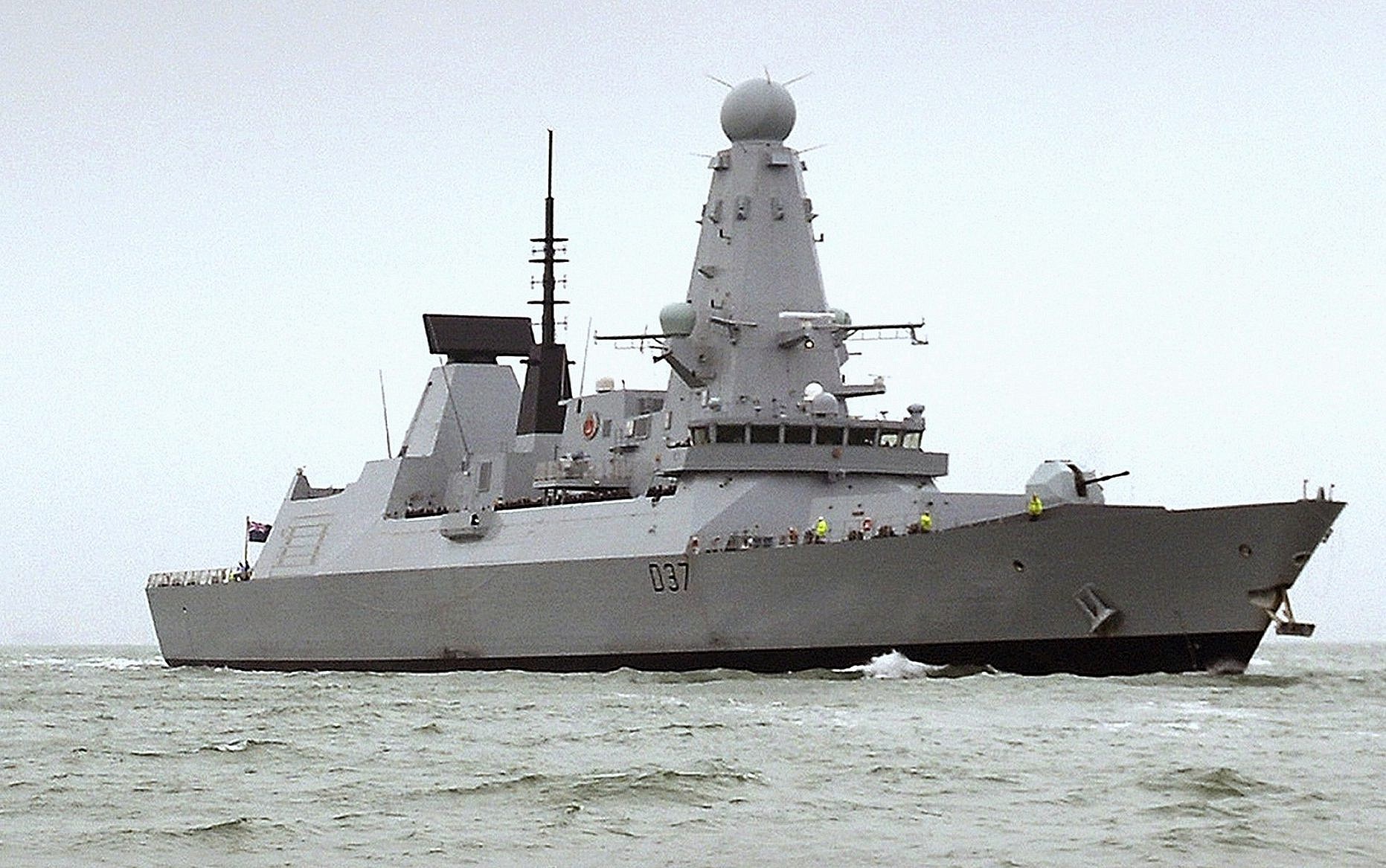
A file photo of the HMS Duncan, a Type 45 Destroyer, which will relieve HMS Montrose in the Persian Gulf as Iran threatens to disrupt shipping (Ben Sutton/UK Ministry of Defence via AP)

British Foreign Secretary Jeremy Hunt on Monday said the UK wanted to establish a European-led maritime protection force for the Gulf but emphasized that London was not seeking a confrontation with Iran.

“We will now seek to put together a European-led maritime protection mission to support the safe passage of both crew and cargo in this vital region,” Hunt told parliament after Iranian authorities seized a British-flagged tanker in the Gulf on Friday.

“We will seek to establish this mission as quickly as possible,” he said, adding: “It will not be part of the US maximum pressure policy on Iran.”

Hunt described Friday’s incident as an act of “state piracy.”

Hunt also said that a British warship, HMS Duncan, that is being dispatched to the region, would arrive by July 29, joining the HMS Montrose currently in the Gulf.

According to the foreign secretary, all British-flagged ships would be asked to give the British authorities notice when they plan to pass through the Strait of Hormuz, where Friday’s incident happened, “to enable us to offer the best protection we can.”

But he added: “It is, of course, not possible for the Royal Navy to provide escorts for every single ship or indeed eliminate all risks of piracy.”

UK Prime Minister Theresa May earlier chaired an emergency security session to discuss how to respond to Iran’s seizure of the ship in the Strait of Hormuz and how to secure shipping in the sensitive region, which is vital to the world’s oil supply.

Iran released new video showing the ship’s crew for the first time on Monday, an apparent attempt to show they were unharmed. None of the 23 are British nationals. The crew is mostly Indian, and also includes Filipino, Russian and Latvian nationals.

May’s official spokesman, James Slack, said Iran seized the ship under false and illegal pretenses and it needs to release it and its crew immediately. Iranian officials have suggested the seizure was in response to Britain’s role in seizing an Iranian oil tanker two week earlier.

Slack said giving an individual naval escort to all UK-flagged ships is not an option because of the volume of traffic. But he denied cuts have made the Royal Navy too small.

“We have the largest military budget in Europe, and we are investing in a world-class Royal Navy,” he said.

Britain is considering a number of options to raise the economic and diplomatic pressure on Iran, but officials say military operations are not being considered at the moment.

The tanker crisis is unfolding in the final days of May’s leadership. The Conservative Party plans to name her successor Tuesday, and the new prime minister — either front-runner Boris Johnson or Hunt — is expected to take office Wednesday.

Friday’s seizure of the Stena Impero came amid heightened tensions between the US and Iran stemming from US President Donald Trump’s decision last year to pull the US from Iran’s nuclear accord with world powers and reinstate sweeping sanctions on Iran.

Iranian officials say the seizure of the British oil tanker was a justified response to the Royal Navy’s role impounding its Grace 1 supertanker with some 2 million barrels of crude off the coast of Gibraltar, a British overseas territory located on the southern tip of Spain.

Two armed members of Iran’s Revolutionary Guard on July 21, 2019 inspect the British-flagged oil tanker Stena Impero, which was seized in the Strait of Hormuz on Friday by the Guard, in the Iranian port of Bandar Abbas. (Morteza Akhoondi/Mehr News Agency via AP)

Iran’s government spokesman Ali Rabiei said Monday that there are diplomatic solutions to the current crisis, but he also defended Iran’s actions.

“When you illegally seize a ship in Gibraltar… we don’t deem it as necessary to show tolerance,” he said. “Some countries have asked for the immediate release of the British tanker. Well, we ask those countries to make the same request to Britain first.”

Britain says it acted lawfully off the Gibraltar coast to prevent illegal oil shipments to Syria that would have violated European Union sanctions while Iran broke international maritime law by forcing the Stena Impero to change course and go to Iran.

Britain says the tanker was in Omani waters at the time, which Iran disputes.

In the newly released video on Monday, the Stena Impero crew is seen dressed in red uniforms and seated around a table onboard as an unidentified Iranian man is heard thanking them for their cooperation. A cameraman is heard telling them not to look at the camera.

It wasn’t clear if the crew was under duress to take part in the filming.

Other choreographed shots show a man checking on the ship, the crew sharing a laugh and talking next to a coffee machine inside the ship. The crew’s chefs are seen preparing food. Another video released by Iran’s state broadcaster shows Iran’s flag hoisted on the ship’s bridge.

Meanwhile, officials in Gibraltar say the ship’s crew has been kept on board the vessel since its seizure July 4. Four Indian crewmembers, including the ship’s captain, were arrested, but not charged, and were then bailed. Gibraltar says they have been in contact with their families are receiving consular support. The crew is comprised of Indian, Pakistani and Ukrainian nationals.

An aerial view shows a speedboat of Iran’s Revolutionary Guard moving around the British-flagged oil tanker Stena Impero, which was seized in the Strait of Hormuz on Friday by the Guard, in the Iranian port of Bandar Abbas (Morteza Akhoondi/Tasnim News Agency via AP)

As the nuclear deal between Tehran and world powers unravels, the US has expanded its military presence in the region, while Iran has begun openly exceeding the uranium enrichment levels set in the accord to try to pressure Europe into alleviating the pain caused by the sanctions.

European nations are trying to save the nuclear deal and have tried to come up with ways to keep trading with Iran but have run smack into Trump’s sanctions, which also target Iranian oil exports.

Britain is adding to its military profile in the region, but it does not have the naval resources that would be needed to protect all of its shipping interests. More than 400 transits through the Strait of Hormuz were made last year by UK associated ships.

An Islamic Revolutionary Guard Corp ship patrolling around the British-flagged tanker Stena Impero as it’s anchored off the Iranian port city of Bandar Abbas, July 21, 2019. (Hasan Shirvani/Mizan News Agency/AFP)

On Sunday, an audio released by maritime security risk firm Dryad Global showed that a British frigate was too far away from the targeted tanker to keep it from being diverted into an Iranian port, despite UK efforts to keep it from being boarded.

In the audio, a British naval officer from the HMS Montrose patrolling the area is heard telling the Iranian patrol boat: “Please confirm that you are not intending to violate international law by unlawfully attempting to board the MV Stena.”

His words did nothing to deter the Iranians.

Iran’s Revolutionary Guard released video of the seizure, showing Iranian commandos in black ski masks and fatigues rappelling from a helicopter onto the vessel.


Trump says chance of making a deal with Iran is dwindling 

July 23, 2019

Source: Trump says chance of making a deal with Iran is dwindling | The Times of Israel

US president brands Tehran world’s top ‘state of terror,’ warns Washington prepared for the worst

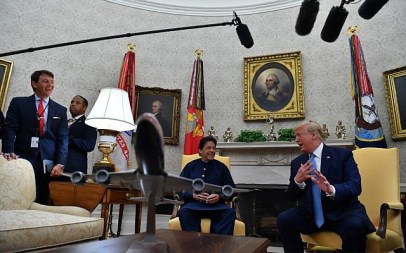
US President Donald Trump speaks during a meeting with Pakistani Prime Minister Imran Khan in the Oval Office at the White House in Washington, DC, on July 22, 2019. 
(Nicholas Kamm/AFP)

US President Donald Trump speaks during a meeting with Pakistani Prime Minister Imran Khan in the Oval Office at the White House in Washington, DC, on July 22, 2019. (Nicholas Kamm/AFP)

WASHINGTON — US President Donald Trump said Monday that chances of negotiating with Iran were dwindling, as he cited increasing tensions in the Gulf and blasted Tehran as the world’s top “state of terror.”

The president cited a series of recent conflicts involving the Islamic Republic, including the downing of US and Iranian drones and, most recently, Tehran’s announcement that it arrested 17 people in connection to a CIA spy ring, a claim Trump rejected as “lies.”

“Frankly it’s getting harder for me to want to make a deal with Iran, because they behave very badly,” Trump told reporters in the Oval Office, as visiting Pakistani Prime Minister Imran Khan sat at his side.

“I’ll tell you it could go either way, very easily,” Trump added. “And I’m OK either way it goes.”

Washington and Tehran have been at loggerheads since May 2018, when Trump unilaterally withdrew the United States from a landmark 2015 deal that put curbs on Iran’s nuclear program in exchange for sanctions relief.

US President Donald Trump speaks during a meeting with Pakistani Prime Minister Imran Khan in the Oval Office at the White House in Washington, DC, on July 22, 2019. (Nicholas Kamm/AFP)

On Monday, Trump ramped up the rhetoric, attacking Iran’s government as “a religious regime that is badly failing,” and saying the country has “tremendous problems economically.”

He also used menacing language, saying the United States was “ready for the absolute worst.”

“We are very geared up. They are really the number one state of terror in the world,” Trump said.

The aggressive remarks came as Washington announced it was placing a leading Chinese oil importer on its sanctions blacklist for trading in Iranian crude.

“As part of that maximum pressure campaign, I am announcing that the United States is imposing sanctions on the Chinese entity Zhuhai Zhenrong and its chief executive Youmin Li,” US Secretary of State Mike Pompeo said in a speech.

“They violated US law by accepting crude oil,” he added.

The sanctions seek to constrict Zhuhai Zhenrong’s access to global financial markets by banning any US individual or business — including financial institutions with US entities, like most global banks — from doing business with the company.