Archive for April 2019

Iran: Revolutionary Guards are only against ‘Zionists’ and ‘imperialists’ 

April 18, 2019

Source: Iran: Revolutionary Guards are only against ‘Zionists’ and ‘imperialists’ – Middle East – Jerusalem Post

“The roots of our problems are the Zionist regime and American imperialism,” Iranian president Hassan Rouhani declared during a military ceremony.

BY JERUSALEM POST STAFF
 APRIL 18, 2019 12:28
Iran: Revolutionary Guards are only against 'Zionists' and 'imperialists'

Israel has long noted that Iran threatens not only them but other regional states, but Iranian President Hassan Rouhani announced Thursday his Islamic Revolutionary Guard Corps will merely be used against “Zionists” and “American imperialists” and not other Middle Eastern states, Reuters reported.

“The roots of our problems are the Zionist regime and American imperialism,” Rouhani declared during a military ceremony in ceremony in Tehran where missiles, submarines, armored vehicles and other army equipment were displayed.

“I want to tell the regional countries that the armed forces of the Islamic Republic of Iran are not against you and your national interests. They stand against invaders,” he added, according to a translation of the speech from Reuters.
Iran funds several proxy armies including Hamas in Gaza, Hezbollah in Lebanon and Shiite militias in Iraq. The mostly Shiite Muslim nation’s disagreements with the Sunni Muslim world has driven Arab Gulf nations such as Oman to build closer ties with the Jewish state despite the Arab-Israeli conflict. Prime Minister Benjamin Netanyahu visited Oman in October. However also on Thursday, Iran and Oman held a joint naval exercise and performed maritime rescue operations in the Gulf, Fars news agency reported.
The US declared the Revolutionary Guard a foreign terrorist organization on Monday, something Iran vehemently denies. “We seek regional security and stability, countries’ sovereignty and end of terrorism and their activities in this region,” Rouhani stated.
He called the declaration “abhorrent,” adding “insulting the Revolutionary Guards is an insult to all (Iranian) armed forces, and an insult to Iranian great nation.”
US President Donald Trump said the new designation “recognizes the reality that Iran is not only a state sponsor of terrorism, but that the IRGC actively participates in, finances, and promotes terrorism as a tool of statecraft.”
The Islamic Revolutionary Guard Corps (IRGC) is a branch of Iran’s Armed Forces founded after the 1979 revolution which turned the country from a Western ally to an Islamic republic.


Zarif slams US policy as Netanyahu firsters, blames Israel for Yemen war 

April 18, 2019

Source: Zarif slams US policy as Netanyahu firsters, blames Israel for Yemen war – Middle East – Jerusalem Post

Blaming Israel for the US support of Saudi Arabia’s war in Yemen represents a new stretch, even for the Iranian regime.

BY SETH J. FRANTZMAN
 APRIL 18, 2019 12:40
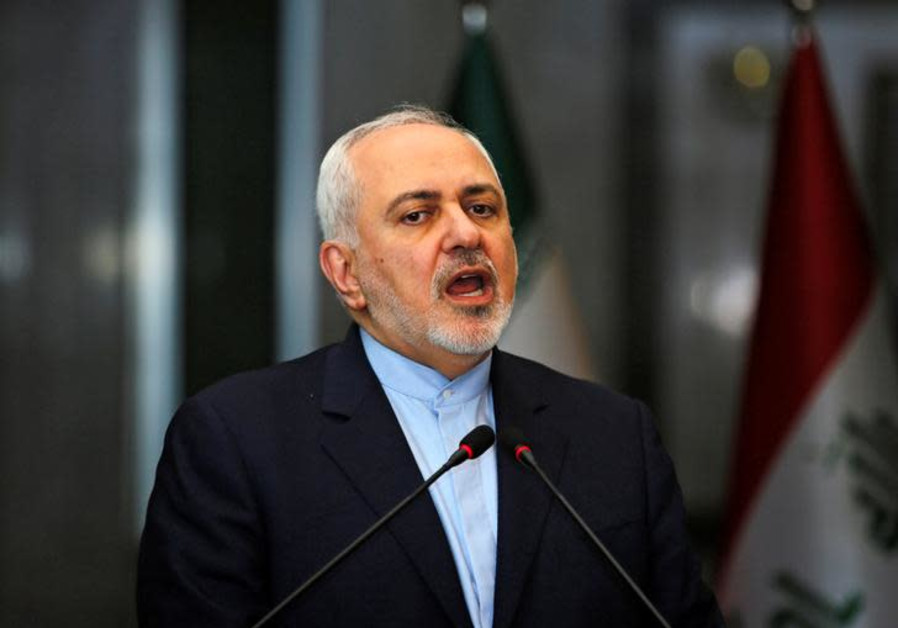
Iranian Foreign Minister Mohammad Javad Zarif

Iranian Foreign Minister Javad Zarif has a new term for US policy in the Middle East: “Netanyahu Firsters,” he writes on Twitter. In his latest claim he alleges that even though the US Congress wants to stop blaming Israel for the US support of Saudi Arabia’s war in Yemen, this charge represents a new stretch, even for the Iranian regime. “US support for the Saudi-led war in Yemen, the “petrofinanced #NetanyahuFirsters and their enabler in the White House will continue – with American lives and against US interests – to push for forever wars.”

Zarif coined the hashtag in order to play into recent controversial antisemitic innuendos in the US that attempt to blame Israel for US policies. For instance, on April 13 he wrote: “it’s not about the money: [US President] Donald Trump confessed US has spent $7 trillion here, only to worsen the situation, it’s Netanyahu Firsters always making the wrong choice in his service.” The “not about the money” quote is supposed to conjure up memories of US Congresswoman Ilhan Omar’s controversial “it’s about the Benjamins” tweet.

Iran increasingly wants to take advantage of discussions in the US in which Netanyahu has been condemned for his policies by Democratic presidential candidates. With discussions about “foreign allegiance” and “dual loyalty” already percolating, Iran hopes to present the US administration as having a “Netanyahu First” policy, which is supposed to be in contrast to an “America first” policy that Trump had once promised.

In a April 8 tweet, Zarif blamed the US decision to label Iran’s Islamic Revolutionary Guard Corps a terrorist group on “Netanyahu Firsters who have long agitated for FTO [Foreign Terrorist Organization] designation of the IRGC.” Zarif showed a photo of Trump with Sheldon Adelson, a well-known pro-Israel philanthropist.

The Zarif term doesn’t seem to be catching on yet, at least in part because it is difficult to pronounce and not particularly easy to remember or write. Nevertheless, it illustrates the Iranian regime’s careful study of US politics and its attempt to design its messaging mostly for a US audience. Posting photos of Adelson and referencing the “all about the Benjamins” tweet doesn’t resonate anywhere else in the world except in the US. This shows that Iran must be concerned about the Trump administration’s recent moves. It also shows that the Islamic republic hopes it can find support in Congress, particularly in its latest tweet alleging that while Congress wants to end the war in Yemen, Trump and his “Netanyahu first” policy want to continue it.

Blaming Israel for the US support of Saudi Arabia’s war in Yemen represents a new stretch, even for the Iranian regime. It shows how Tehran no longer even wants to pretend to blame those directly involved, such as the Iranian-backed Houthi rebels in Yemen. Iran has supplied missile technology to the Houthis who target Saudi Arabia. But it wants to distract from this by blaming the war on Israel backers. It thinks that Israel is such a toxic issue in US politics that blaming the Jewish state for everything will resonate. So far few have bought into the Zarif line, but Iran is clearly studying the US political landscape and hoping to become part of US partisan politics.


Lebanese FM meets with senior Israeli officials in Moscow – report 

April 18, 2019

Source: Lebanese FM meets with senior Israeli officials in Moscow – report – Middle East – Jerusalem Post

Saudi newspaper ‘Elaph’ reported that the two “discussed borders” and mutual interests including Syria and Iran.

BY ILANIT CHERNICK
 APRIL 18, 2019 10:14
Lebanese FM meets with senior Israeli officials in Moscow - report

Lebanese Foreign Minister Gebran Bassil has reportedly met with a senior official in Moscow and “discussed borders,” Saudi Arabian newspaper Elaph reported.

The source told Elaph that the meeting lasted about two hours under the auspices of Russia. The two sides discussed issues of mutual interest, including the Syrian issue, the Assad regime and the issue of Iranian weapons factories in Lebanon.

The Israeli official reportedly told Bassil that Israel does not see Lebanon as an enemy, but will not hesitate to strike Iranian and Hezbollah interests in Lebanon.

The report also claimed that the Lebanese minister had asked the Israeli’s “to stop threatening Lebanon because of Hezbollah, saying that Hezbollah is part of the components of Lebanon and the Lebanese state will know how to accommodate all parties and groups under its sovereign.”

The source also told Elpah that the Lebanese minister discussed the issue of US sanctions on Lebanon with the Israeli official and asked him to mediate with the Americans about sanctions imposed on Lebanon, and asked the official to mediate with the American side and not to rush with the imposition of the sanctions, and to give Lebanon time to prepare for it.

In February, Prime Minister Benjamin Netanyahu told a group of UN ambassadors that “Iran has proxies…One of them is Hezbollah.”

“Hezbollah just joined the government of Lebanon. That’s a misnomer; they actually control the government of Lebanon,” Netanyahu said. “It means that Iran controls the government of Lebanon.”

Late last year, Israel launched a short operation named Northern Shield to neutralize cross-border Hezbollah attack tunnels.
At the time of the operations launch, Netanyahu made it clear that Hezbollah would

In September, during his speech to the UN, Netanyahu revealed that Hezbollah, together with Iran, had set up a number of precision missile factories in Beirut. “In Lebanon, Iran supports Hezbollah in building secret facilities and precision missiles capable of hitting deep inside Israel, with missiles with a precision of 10 meters,” Netanyahu said, adding that “Hezbollah uses innocent people in Beirut as shields.”

Netanyahu made it clear in his speech that “Israel knows what you are doing and where you are doing, and will not let you get away with it.”

Maariv contributed to this report.


Did Israel use the supersonic Rampage to strike Iranian targets in Syria?

April 18, 2019

Source: Did Israel use the supersonic Rampage to strike Iranian targets in Syria? – Middle East – Jerusalem Post

Israel allegedly struck an Iranian missile factory in Syria’s Masyaf on Saturday.

BY ANNA AHRONHEIM
 APRIL 18, 2019 16:45
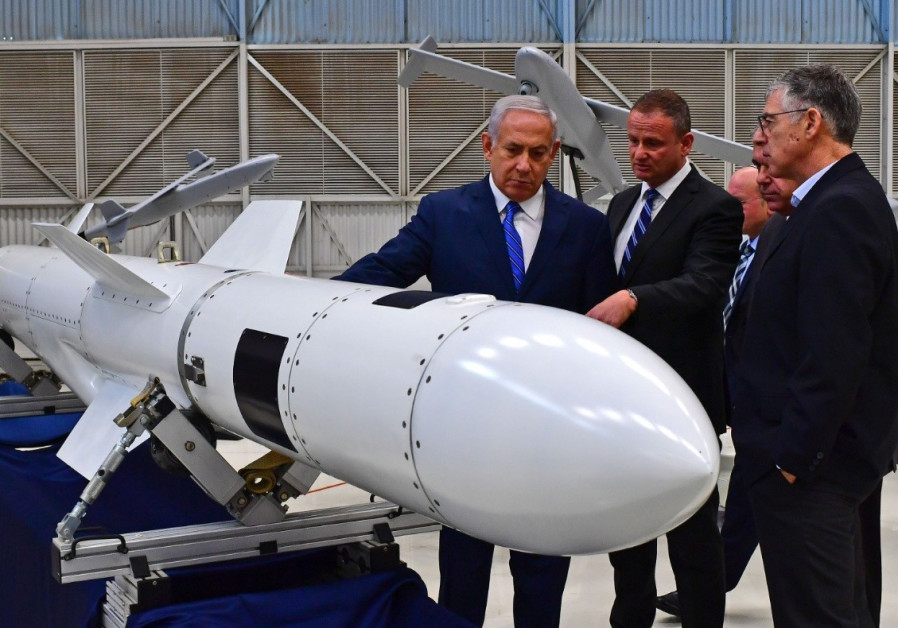
Prime Minister Benjamin Netanyahu inspects a missile at Israel Aerospace Industries.

Israel’s Air Force reportedly used the supersonic Rampage stand-off air-to-surface missiles for the first time during a strike on Iranian positions in Syria last week, foreign media has reported.
Israel allegedly struck a possible Iranian surface-to-surface missile factory in a Syrian base in Masyaf on Saturday. Satellite images released by Israeli intelligence firm ImageSat International (ISI) showed the complete destruction of the factory.
“The main industrial structures were completely destroyed, including the main hangar and the adjacent three production hangers and buildings. The rest of the structures were affected and damaged by the blast,” ISI said, adding that they “assess that all the elements and/or equipment which were inside were completely destroyed as well.”
According to Syria’s SANA news agency, Israeli jets fired the missiles from Lebanese airspace at about 2:30 Saturday morning.
The factory, ISI said, is located in the vicinity of other facilities likely linked to Iran’s surface-to-surface missile project in Syria , which had previously been struck in alleged Israeli strikes carried out over the past two years.
Dubbed “The Rampage,” after a popular video-game, the missile is a supersonic, long-range, accurate air-to-ground assault missile with a warhead, rocket engine and advanced navigation suit which allow for precision targeting.
Amit Haimovich, director of marketing and business development for IAI’s MALAM engineering unit, told The Jerusalem Post in June that due to the combination of the Rampage’s speed and physical-form factor, “it can be detected but it is very hard to intercept.”
“If you take the Middle East arena and areas protected by air defense systems, the whole point of this missile is that it can target within standoff ranges” without threatening the launching platform, he said.
The missile can be fitted to the Israel Air Force’s F-15, F-16 and F-35 fighter jets, and is meant to be dropped outside areas protected by air-defense systems. The 4.7-meter-long missile, which weighs 570 kg., is guided by a GPS system, giving it the ability to be operated in any weather conditions as well as during the day or night.
The targets that best fit the capabilities of the missile include communication and command centers, air force bases, maintenance centers, infrastructure and valuable field targets protected by anti-aircraft batteries.
The Rampage also features a warhead which was designed for optimal penetration capabilities, allowing for the destruction of targets inside bunkers.
The factory allegedly struck by Israel is also in the vicinity of Russian-made S-300 missile-defense systems, which were deployed to Syria by Moscow. Satellite images released by ISI have shown three out of the four systems erected in Masyaf, with one launcher covered by a camouflage net.
While the systems are still believed to be in the hands of the Russians and not manned by the Syrian military, the advanced S-300 is a major upgrade to Syrian air defenses and would pose a threat to Israeli jets on missions, since the long-range missile-defense system can track objects such as aircraft and ballistic missiles over a range of 300 km.


‘Readiness and Change’: Kohavi reveals his expensive plans for the IDF 

April 18, 2019

Source: ‘Readiness and Change’: Kohavi reveals his expensive plans for the IDF | The Times of Israel

Three months into his term, army chief proposes multi-year program for improving the military, including greater use of artificial intelligence and merging combat units

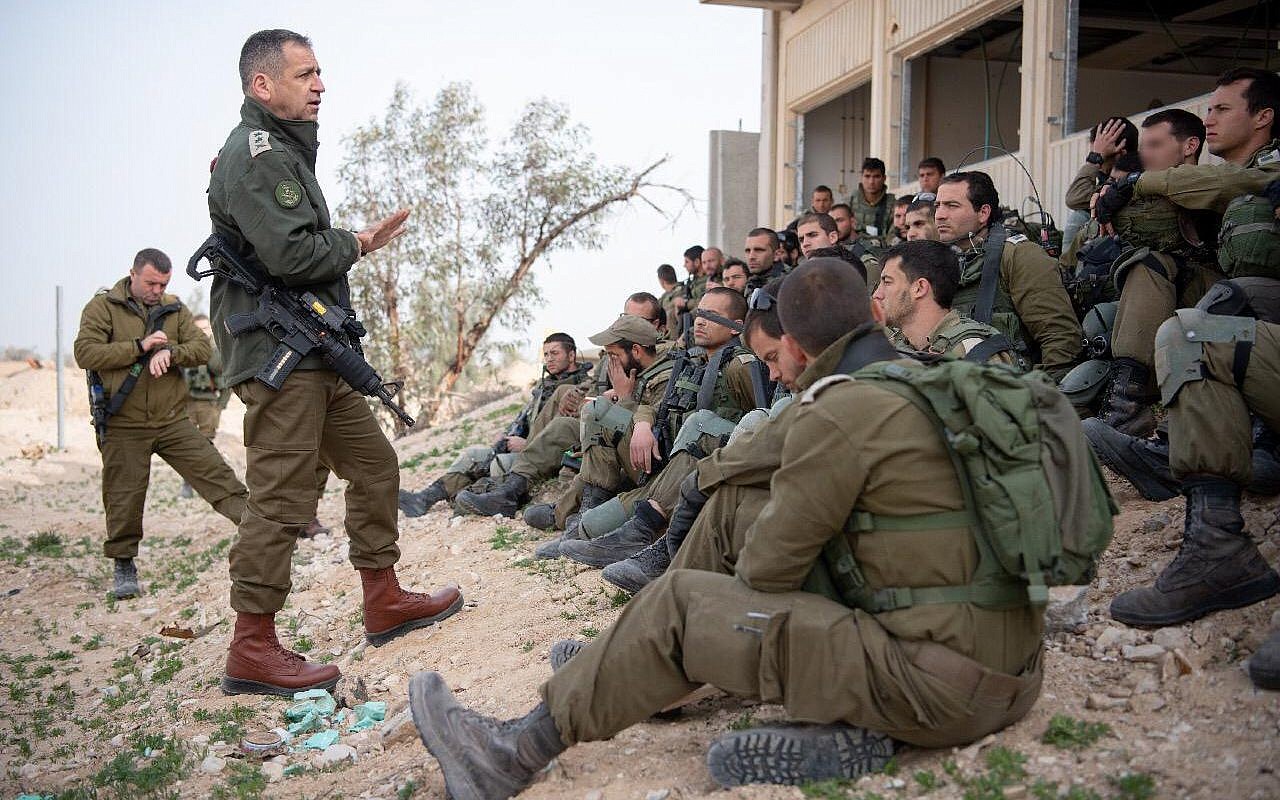
In a photo released by the Israel Defense Forces on February 26, 2019, Chief of Staff Aviv Kohavi (2nd-L) speaks with soldiers taking part in a snap drill at the Tzeelim base in southern Israel simulating a future military conflict in the Gaza Strip. (Israel Defense Forces)

In a photo released by the Israel Defense Forces on February 26, 2019, Chief of Staff Aviv Kohavi (2nd-L) speaks with soldiers taking part in a snap drill at the Tzeelim base in southern Israel simulating a future military conflict in the Gaza Strip. (Israel Defense Forces)

Three months into his tenure as chief of staff, Lt. Gen. Aviv Kohavi set out the framework for his multi-year plan to improve the Israel Defense Forces, some parts of which will be rolled out shortly, while others will require budgetary and legislative approvals before they can be implemented.

According to the IDF, Kohavi’s plan, known as “Readiness and Change,” focuses on continuing and strengthening two existing trends within the military: greater distribution of technology and intelligence throughout the military and better cooperation between its various different branches and units.

“Readiness and Change” appears to be concerned with shorter-term changes to the military that are designed to quickly boost efficacy — what the military typically refers to as “lethality” — whereas the previous chief of staff Lt. Gen. (res.) Gadi Eisenkot’s multi-year Gideon plan was aimed at longer-term, structural changes within the IDF.

Kohavi’s plan will also include the creation of a unit within the IDF Planning Directorate, headed by a brigadier general, to be known as “Fighting methods and modernity” — or by its Hebrew acronym Shiluah — that will focus on integrating new techniques and technology into the IDF, the army said.

A moment before an Israeli missile destroys a Syrian SA-22 air defense system on May 10, 2018. (Israel Defense Forces)

A new target-picking task force will also be established, bringing together Military Intelligence, the Israeli Air Force and the three regional commands. The task force will comprise existing elements of those units and will also expand the use of technology — namely artificial intelligence and big data — in identifying potential targets for military strikes.

“This will improve the number and quality of the targets in the different regions,” the military said Thursday.

While Kohavi’s plans are meant to affect the entire military, the main beneficiaries of the proposals are the IDF’s ground forces — infantry, tanks, artillery, and combat engineering — which have been at the center of both public and internal military debate in the past year concerning their preparedness for war.

In order to increase the ground forces capabilities, the military plans to provide them additional resources, particularly in the form of anti-tank guided missiles and greater access to air power.

“This will strengthen the fighting force of the combat soldier, will defeat the enemy and will very powerfully and very quickly deny [the enemy] of its capabilities,” the military said.

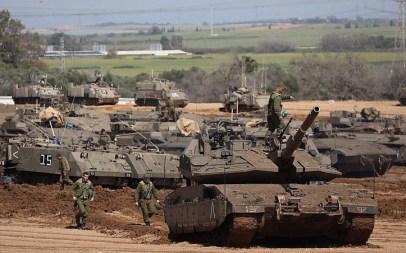
IDF tanks stationed near the Israeli Gaza border on March 26, 2018. (Yonatan Sindel/Flash90)

These additional, expensive resources will require budgetary approval from the government.

Another potentially costly proposal from “Readiness and Change” is a plan to connect nearly all branches and units of the military to an IDF intranet, allowing intelligence and operational information to be shared far more quickly than today.

A task force within the IDF General Staff will lead the project, the army said.

“This comes from an understanding that advancing this issue will allow better collaboration and connectivity throughout the military and will connect all the troops and platforms on the battlefield to one another,” the IDF said.

Illustrative. An IDF soldier from the C4I Corps types on a computer. (IDF Spokesperson’s Unit)

Kohavi also called for the implementation of an existing planwithin the military to form a combined unit made up of infantry, combat engineering, artillery, air force and intelligence. Currently, the various units regularly collaborate with one another but are kept structurally separate; under the plan, which was first proposed under Eisenkot, the elements will be brought under one roof.

“This will be the model for the future changes in the maneuvering units,” the military said, using its term for ground forces.

Toward the end of his first year as IDF chief, in late 2015, Eisenkot began rolling out his Gideon Plan, which was aimed at increasing the military’s efficiency and cutting waste.

The Gideon Plan came under significant criticism in recent years, chiefly by former military ombudsman Maj. Gen. (res.) Yitzhak Brick, who claimed that it was contributing to a decline in the IDF’s preparedness for war and in the quality of its officers.


IDF shoots down targets in test of Patriot, Iron Dome air defense systems

April 18, 2019

Source: IDF shoots down targets in test of Patriot, Iron Dome air defense systems | The Times of Israel

Military declares exercise a success, saying it checked the preparedness of aerial defense soldiers and missile batteries

The Israeli Air Force conducted successful live-fire tests of its Patriot and Iron Dome missile defense systems on Tuesday, the military said.

The exercise had been subjected to the military censor until Wednesday evening.

“Air defense soldiers from the Israeli Air Force conducted successful interceptions of targets at various heights and ranges,” the Israel Defense Forces said in a statement.

The Patriot air defense system is meant to intercept both incoming aircraft and long-range ballistic missiles, while the Iron Dome is designed to shoot down short-range rocket and mortar attacks, as well as some aircraft.

Illustrative: In this handout file photo provided by the Israeli Army on February 22, 2001, a Patriot anti-missile missile is launched on the last day of joint five-day US-Israeli military exercise in the Negev desert. (Israel Defense Forces/AFP)

The Air Force said the exercise, which was conducted in central Israel, was meant to test the preparedness of its air defense and technical units, as well as the air defense batteries themselves.

The IDF said the exercise was part of its annual training schedule.

Two foreign military delegations visited the exercise, the military said, refusing to specify the two countries.

“The delegations came to watch the exercise and to study its results. The delegations will take part in a panel discussion that will focus on professional matters and inter-military cooperation,” the IDF said.

Israel maintains a multi-tiered air defense system that is designed to protect the country’s strategic assets from aerial attack.

An Iron Dome anti-missile battery is seen near the southern Israeli city of Beersheba on December 27, 2014. (Flash90)

The lowest layer is the Iron Dome system, capable of intercepting short-range rockets, small unmanned aerial vehicles and mortar shells like those that have been fired at Israel from the Gaza Strip or from southern Lebanon.

The middle tier is made up of David’s Sling, which is meant to defend against missiles like the Iranian Fateh 110 and its Syrian equivalent, the M600, both of which have seen extensive use in the Syrian civil war and are known to be in the Hezbollah terrorist group’s arsenal.

At the top are the Patriot, Arrow 2 and Arrow 3 systems, which are intended to engage long-range ballistic missiles. The Patriot has also been used on a number of occasions against incoming aircraft.

Last July, the Patriot system shot down a Syrian fighter jet that traveled two kilometers into Israeli airspace, the military said.


Iran president urges Mideast states to ‘drive back Zionism’ 

April 18, 2019

Source: Iran president urges Mideast states to ‘drive back Zionism’ | The Times of Israel

Rouhani says problems of the region ’caused by others,’ calls on Muslims to restore the ‘historical right of Palestine’

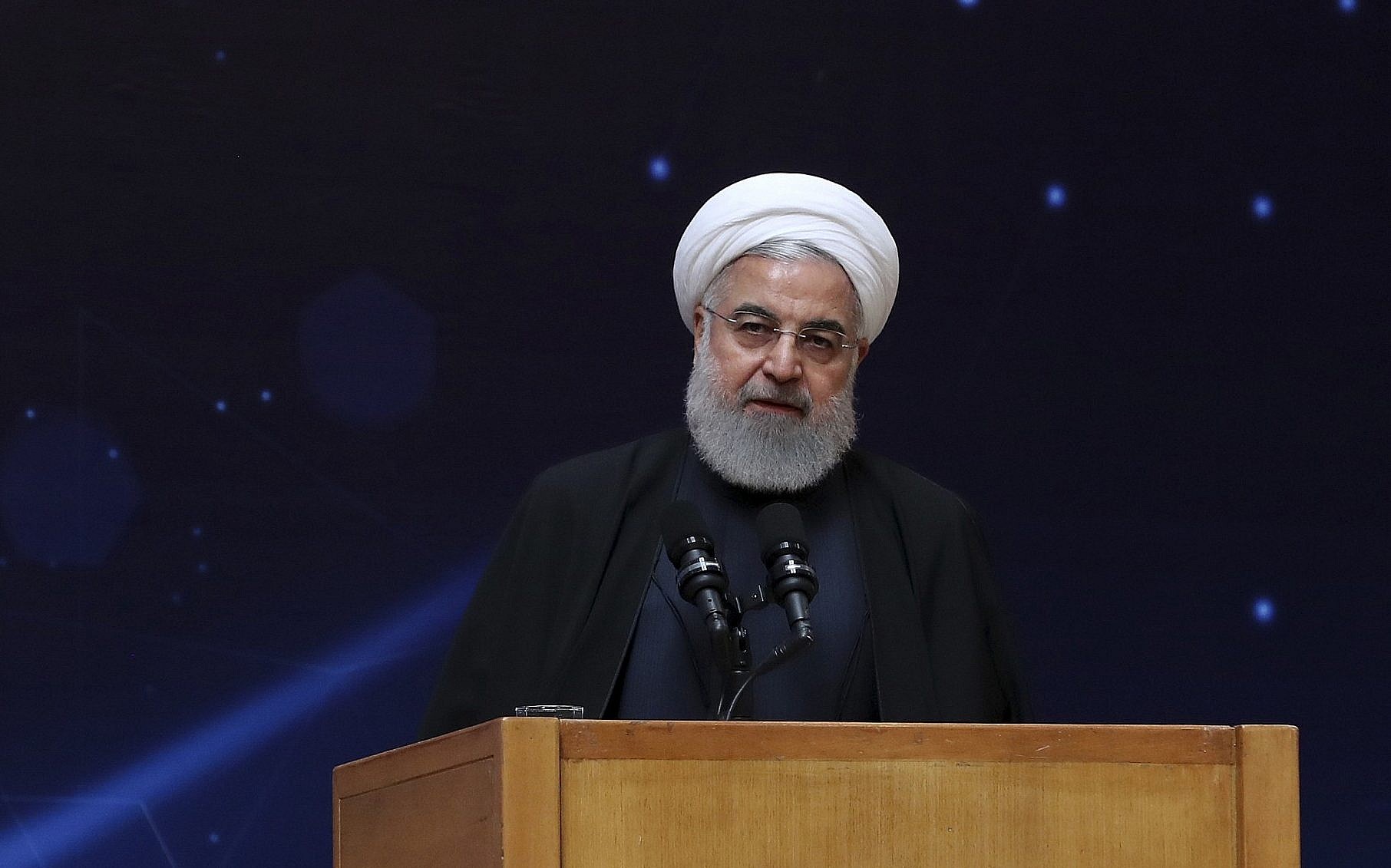
Iranian President Hassan Rouhani at a ceremony commemorating “National Day of Nuclear Technology” in Tehran, Iran on, April 9, 2019. (Iranian Presidency Office via AP)

TEHRAN, Iran (AFP) — Iran’s President Hassan Rouhani called on Middle East states on Thursday to “drive back Zionism,” in an Army Day tirade against the Islamic republic’s arch-foe Israel.

Speaking flanked by top general as troops paraded in a show of might, Rouhani also sought to reassure the region that the weaponry on display was for defensive purposes and not a threat.

“The region’s nations have lived alongside each other for centuries and never had a problem… If there is a problem, it is caused by others,” he said in the speech broadcast live on state television. “Let us stand together, be together and rid the region of the aggressor’s presence.”

Rouhani assured neighboring countries that Iran’s armed forces are “never against you or your national interests” but are “standing against the aggressors.”

“The power of our armed forces is the power of the region’s countries, the Islamic world”, he said. “If we have a problem in the region today, its roots are either with Zionism or America’s arrogance.”

Rouhani called on Muslim nations to band together and “restore the historical right of the nation of Palestine,” saying that “Zionism … has been committing crimes in the region for the past 70 years.”

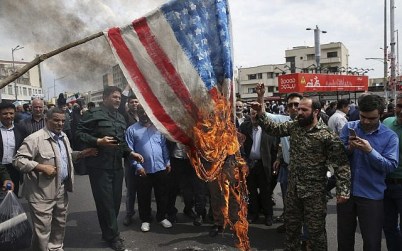
Protesters burn a representation of the American flag during a rally against the US’s decision to designate Iran’s powerful Revolutionary Guards as a foreign terrorist organization, after their Friday prayers at the Enqelab-e-Eslami (Islamic Revolution) square in Tehran, Iran on April 12, 2019. (AP/Vahid Salemi)

“The final victory will surely be with the righteous,” he said.

Iran’s annual Army Day celebrations are an opportunity for the military to show off its latest weapons but also for its political leaders to try to reassure the region and the international community that they are for defensive purposes only.

The military parade was held next to the south Tehran mausoleum of the Islamic Republic’s founder Ayatollah Ruhollah Khomeini. It showcased Iran’s latest weaponry, including the domestically designed and manufactured Kowsar fighter jet, which was first unveiled last year.

‘Cancerous tumor’

Diatribes against Israel are standard fare of the official speeches, although some, such as a call by Rouhani’s firebrand predecessor Mahmoud Ahmadinejad for Israel to be “wiped off the map,” have triggered international condemnation.

Rouhani has previously called Israel a “cancerous tumor,” and called on Muslim governments to unite against it and its US ally.

Iran does not recognize Israel and opposition to the Jewish state has been a central tenet of official policy since the 1979 revolution.

Iran has supported Palestinian radical groups that lay claim to all of historic Palestine and has vociferously opposed the now moribund Middle East peace process under which the Palestinians won autonomy in some of the territories captured by Israel in the Six Day War of 1967.

Iranian officials have warned repeatedly that Israel will soon cease to exist, but have usually been careful to underline that that will come about not through a direct attack by Iran.

“In 25 years’ time, with the grace of God, no such thing as the Zionist regime will exist in the region,” supreme leader Ayatollah Ali Khamenei said in 2015.

Syria tensions

The presence of Iran’s Revolutionary Guards in Syria supporting President Bashar Assad’s forces in the eight-year civil war has sharply increased tensions between the two countries.

Israel has said publicly that it has carried out hundreds of air and missile strikes targeting the forces of Iran and its Lebanese ally Hezbollah in Syria.

Prime Minister Benjamin Netanyahu has vowed that he will never allow Iran to establish a long-term military presence in Israel’s northeastern neighbor.

Netanyahu has also been an outspoken opponent of a landmark nuclear deal Iran signed with major powers in 2015 and was the leading supporter of US President Donald Trump’s decision to withdraw from it and reimpose crippling economic sanctions last year.

Washington has sought to forge an anti-Iran axis in the Middle East bringing together Israel and the Gulf Arab states to make common cause against what they see as Iranian “meddling” in the region.

Last week, Washington placed Iran’s Revolutionary Guards on its blacklist of “foreign terrorist organizations,” the first time it had imposed the sanction on a military arm of a foreign government.


IDF general: Hezbollah still planning Galilee invasion, despite anti-tunnel op

April 18, 2019

Source: IDF general: Hezbollah still planning Galilee invasion, despite anti-tunnel op | The Times of Israel

Commander of Ground Forces predicts decisive Israeli victory in a future war with Hezbollah and Lebanon, vows to destroy Syria’s Russian-made S-300s if used to repel Israeli raids

Maj. Gen. Yoel Strick, head of the IDF Northern Command, in an undated photograph. (Israel Defense Forces)

Maj. Gen. Yoel Strick, head of the IDF Northern Command, in an undated photograph. (Israel Defense Forces)

The new commander of the IDF’s Ground Forces said Thursday the Lebanese terrorist group Hezbollah was still planning to carry out a surprise invasion of northern Israel, despite the recent Israeli operation to uncover and destroy an extensive network of cross-border attack tunnels dug by the Iran-backed militia.

Maj. Gen. Yoel Strick was tapped to lead the military’s Ground Forces in February, amid increased criticism charging that Israeli troops were not prepared for war. His comments came less than four months months after the IDF concluded its anti-tunnel operation along the Lebanese border.

“Hezbollah still has plans to invade the Galilee,” he told the Ynet news site in an interview, referring to entering Israeli territory through a cross-border tunnel network. “Of course we won’t allow that to happen, we will thwart these plans.”

In December, Israel accused Hezbollah of digging cross-border tunnels into its territory from southern Lebanon and launched an operation to destroy them.

According to the army, Hezbollah had planned to use the tunnels to kidnap or kill civilians or soldiers, and to seize a slice of Israeli territory in the event of any hostilities.

The IDF did not given a total figure for the tunnels found, though it announced in January that six were destroyed during the course of the operation.

Strick also voiced support for declaring war on Lebanon.

“In the next war, it would be a mistake for us to distinguish between the state of Lebanon and Hezbollah, since Hezbollah is a political actor and part of the government,” Strick said.

Israeli soldiers stand around the opening of a hole that leads to a tunnel that the army says was dug by the Hezbollah terror group across the Israel-Lebanon border, near Metula, on December 19, 2018. (AP Photo/Sebastian Scheiner)

In such a conflict, “if it were up to me, I would recommend declaring war on Lebanon and Hezbollah,” he said. “I have no doubt what the outcome will be… It will be a decisive victory.”

Strick also addressed Israel’s efforts to combat Iranian troops in Syria, saying the ongoing airstrikes have been “very effective” in limiting Tehran’s military entrenchment near the Israeli border.

“In the area referred to as ‘southern Syria,’ our operations have been very effective, and they have actually pushed the Iranians out [of that area],” he said.

“In those places, Iran’s presence is so weak it,s almost nonexistent,” he said, adding that Iranian forces are entrenched elsewhere in Syria.

Strick also threatened to destroy Syria’s S-300 system if were to be used against Israeli fighter jets, regardless of the potential blowback Jerusalem would face from Russia, which provided its ally Syria with the powerful air defense battery.

“I don’t see our freedom of operation as being diminished,” he said. “If these batteries are used, the air force will eliminate that threat. We know how to do it.”

“It’s a legitimate course of action that is in accordance with the rules of engagement, and I assume that it will happen,” Strick told the news site, though he conceded the move could “complicate” relations with Moscow.

In recent years, Israel has carried out hundreds of airstrikes in Syria against targets linked to Iran, which alongside Hezbollah and Russia, are fighting on behalf of the regime of Syrian President Bashar Assad.

Israel has accused Iran of seeking to establish a military presence in Syria that could threaten Israeli security, and of attempting to transfer advanced weaponry to Hezbollah in Lebanon.

This once quiet fight has become increasingly public in recent months, with each side issuing public threats.


Italy: Terrorist presence on migrants boats from Libya now a certainty 

April 18, 2019

Source: Italy: Terrorist presence on migrants boats from Libya now a certainty – www.israelhayom.com

Reiterating that “no docking will be allowed on Italian shores,” Italian Interior Minister Matteo Salvini says, “Islamic terrorist infiltration is no longer a risk, it has become a certainty.”

“Islamic terrorist infiltration is no longer a risk, it has become a certainty: it is therefore my duty to reiterate that no docking will be allowed on Italian shores,” he said in a radio interview on Wednesday.

Salvini, leader of the anti-immigrant Northern League party, refused to say if Italy’s stance could change in case of a full-fledged war in Libya after the flare-up in the cycle of anarchy gripping the country since dictator Moammar Gadhafi was toppled in 2011.


Sources: US officials dispute administration’s Iran arms control report 

April 18, 2019

Source: Sources: US officials dispute administration’s Iran arms control report – www.israelhayom.com

Officials wonder if report, was published on State Department website, removed, then republished politicizes and slants assessments about Iran • Document makes no mention of U.S. reports about Iranian compliance with international agencies.

A new Trump administration report on international compliance with arms control accords provoked a dispute with U.S. intelligence agencies and some State Department officials concerned that the document politicizes and slants assessments about Iran, five sources with knowledge of the matter said.

U.S. President Donald Trump is intensifying a drive to contain Iran’s power in the Middle East, which has raised fears that his administration wants to topple the Tehran government or lay the groundwork to justify military action.

The administration says it is trying to halt Iranian “malign behavior” in its support for Islamist militants in the region and denies seeking the overthrow of the Islamic republic’s government.

The clash among U.S. officials emerged on Tuesday when the State Department posted on its website, and then removed, an unclassified version of an annual report to Congress assessing compliance with arms control agreements that the sources saw as skewed Iran.

The report’s publication follows the administration’s formal designation on Monday of the Islamic Revolutionary Guards Corps, Iran’s elite paramilitary and foreign espionage unit, as a foreign terrorist organization.

Washington also has piled on tough economic sanctions following Trump’s withdrawal from the 2015 nuclear deal between Iran and world powers. The administration also is waging a propaganda campaign, including over social media, aimed at fueling popular anger against Iran’s government.

Several sources said the report, which reappeared without explanation on Wednesday, made them wonder if the administration was painting Iran in the darkest light possible, much as the George W. Bush administration used bogus and exaggerated intelligence to justify its 2003 invasion of Iraq.

A State Department spokeswoman defended the judgment on Iran, saying in an email that it was “informed by careful assessment of all relevant information.”

The report was published to meet a mandatory April 15 deadline by which it had to go to Congress, the department said. A more comprehensive unclassified version will be provided after the completion of a review of what information in the classified report can be made public, the spokeswoman said.

The department did not address the internal dispute over the report or concerns of politicization.

The unclassified “Adherence to and compliance with arms control, nonproliferation and disarmament agreements and commitments” report omitted assessments of Russian compliance with landmark accords such as the Intermediate-range Nuclear Forces (INF) Treaty and the New START arms control treaty.

The State Department spokeswoman said that the U.S. position that Russia is in violation of the INF Treaty “is clear.”

The report also failed to include detailed assessments published in previous years of whether Iran, Myanmar, North Korea, Syria and other nations complied with the Nuclear Non-Proliferation Treaty (NPT). Instead, the report replaced those assessments with a five-paragraph section entitled “country concerns.”

The section made no mention of judgments by U.S. intelligence agencies and the International Atomic Energy Agency that Iran ended a nuclear weapons program in 2003 and has complied with the 2015 deal that imposed restrictions on its civilian nuclear program.

Instead, it said Iran’s retention of a nuclear archive disclosed last year by Israel raised questions about whether Tehran might have plans to resume a nuclear weapons program.

It added that any such effort would violate the NPT, as would any Iranian retention of undeclared nuclear material, though it offered no evidence that Iran had done either.

“It’s piling inference upon inference here to try to create a scary picture,” said a congressional aide, who requested anonymity to discuss the issue, as did the other sources. The aide added that by stripping out much of the report’s normal content, the documents largely had become about Iran.

“There is significant concern that the entire sort of purpose … was to help build a case for military intervention in Iran in a way that seems very familiar,” the source said, referring to the Bush administration’s use of erroneous intelligence before the invasion of Iraq 16 years ago that ousted President Saddam Hussein.

The 12-page report, down from last year’s 45-page document, reflected a disagreement between Assistant Secretary of State Yleem Poblete, whose office is charged with its drafting, and her boss, Undersecretary of State Andrea Thompson, three of the sources said.

Two sources said Poblete had sought to include information such as news stories and opinion pieces in the report, which traditionally is based on legal analyses of U.S. intelligence reports.

The State Department did not comment on Poblete’s role.

“And it had other obvious errors,” said a former U.S. official familiar with the matter. A draft of the unclassified version had included classified information, the official said. “It’s been described to me as just a big food fight within the department over an initially inadequate draft.”

A second former U.S. official said he believed that the report was being used to advance the Trump administration’s views on Iran rather than to reflect information gathered by intelligence agencies and assessments of that information by State Department experts.

“This ‘trends’ section is adding a political tinge or politicizing the report,” said the fourth source on condition of anonymity, saying the administration seemed to be using a once objective report “to back up subjective assertions.”

While saying they did not know why the report had been so abbreviated, removed and then restored from the website, analysts asked if there was an effort underway to demonize Iran.

“The worst case, of course, would be that we are observing signs of a politicization of intelligence for the purpose of serving what the top of the administration would like to accomplish,” said nuclear expert Hans Kristensen of the Federation of American Scientists in Washington.

“We have seen … that in the past with the (Iraq) war,” he said. “This is a potential warning sign about that.”