Archive for April 2019

U.S. looking to sign new agreement with Iran: Brian Hook

April 23, 2019

Source: U.S. looking to sign new agreement with Iran: Brian Hook – World News – Jerusalem Post

“You can either work with the United States, or you can work with Iran, but you can’t do both,” Hook told the Saudi-owned television news channel.

BY MAAYAN JAFFE-HOFFMAN
 APRIL 23, 2019 06:21
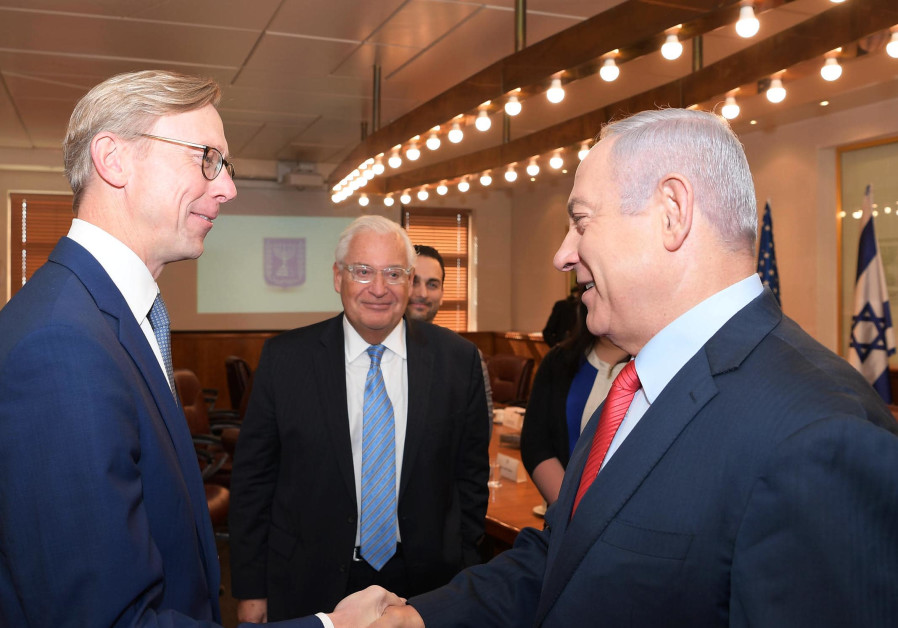
Prime Minister Benjamin Netanyahu meets with US envoy Brian Hook and US Ambassador David Friedman

The United States is looking to sign a new agreement with Iran that covers its nuclear and missile programs, the country’s regional aggression, and the arbitrary detention of foreign nationals, which include Americans, according to US Special Representative for Iran Brian Hook.

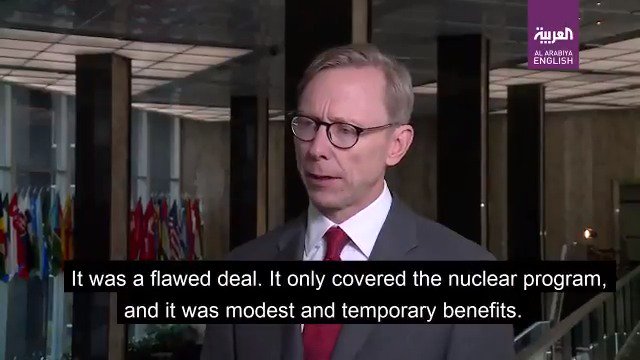
In an interview with Al Arabiya English, Hook said, “That is the kind of deal we need. We are ready to negotiate something like that.”

Hook was speaking Monday, the same day that Washington declared it would start ending waivers to Tehran’s oil customers.
“You can either work with the United States, or you can work with Iran, but you can’t do both,” Hook told the Saudi-owned television news channel.

Embedded video

Al Arabiya English

@AlArabiya_Eng

The US needs an agreement that covers Iran’s “nuclear program, their missile program, their regional aggression, and the arbitrary detention of foreign nationals which include Americans,” the US Special Representative for Iran tells Al Arabiya.https://english.alarabiya.net/en/features/2019/04/22/Brian-Hook-Countries-can-either-work-with-US-or-Iran-but-not-both.html 

He noted that the United States has denied the Iranian regime more than $10 billion in revenue and expects that number to increase dramatically, with the support of Saudi Arabia and the United Arab Emirates, countries that Hook said, “share a lot of the United States’ national security goals when it comes to Iran.”

“Yes, we had very good meetings with both of the Saudis and the Emiratis,” he continued. “So, it’s in our interest and it’s in their interest to deny the Iranian regime the revenue it needs to fund its foreign policy.

“And now Saudi Arabia has been very helpful, increasing its production as it did many months ago in order to offset the loss of Iranian crude, and they’ll continue to be helpful,” he said. “So, there’s a convergence of interest, especially with Arab nations, Israel, the United States, many of our European allies. We want a more peaceful Iran, and that’s up to Iran. They can either start behaving more peacefully or they can watch their economy crumble.”
The White House officially announced Monday its intention to end sanctions waivers on eight countries that are still trading oil with Iran, increasing the “maximum pressure” campaign against the Islamic Republic. Current exemptions are set to expire in early May.
Some of the countries that are slated to be affected are allies such as India. Other countries that will be affected include China and Turkey, which could open new friction.
The goal of the sanctions is not only to create a more peaceful Iranian regime, but also to suck the economic life out of the terror organization Hezbollah, which is predominantly funded by Iran, though it also receives money from business investments, donor networks and money laundering activities.
“What we are doing is making it harder for Hezbollah to meet payroll, because 70% of Hezbollah’s revenue comes from the Iranian regime,” Hook told Al Arabiya. “Historically Iran gives Hezbollah $700 million a year, that’s 70% of their budget.”
The State Department designated Hezbollah a Foreign Terrorist Organization in October 1997, and as a Specially Designated Global Terrorist in October 2001.
Hook noted that in March, the leader of Hezbollah made a public appeal for donations and it was the first time in history they’ve had to do that.
On Monday, the US Department of State announced a new program that will offer up to $10 million rewards for information leading to the disruption of the global financial mechanisms of Hezbollah. It is the first time that the department is offering a reward for information regarding Hezbollah’s financial networks.


Netanyahu congratulates new Ukraine president, invites him to Israel 

April 23, 2019

Source: Netanyahu congratulates new Ukraine president, invites him to Israel | The Times of Israel

PM also phones outgoing leader Petro Poroshenko to thank him for Israel support, ambassador says

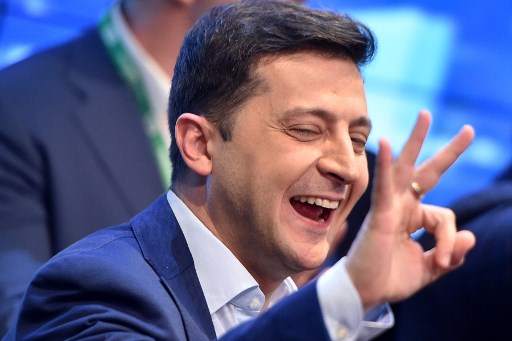
Ukrainian comedian and presidential candidate Volodymyr Zelensky reacts after the announcement of the first exit poll results in the second round of Ukraine’s presidential election, at his campaign headquarters in Kiev, on April 21, 2019. (Genya SAVILOV / AFP)

Prime Minister Benjamin Netanyahu called Ukraine’s newly elected president Volodymyr Zelensky on Monday and invited him to visit Israel.

Netanyahu “congratulated him for his victory, expressed his hope to continue the good relations between our countries and invited him to visit Israel,” according to Israel’s Ambassador to Ukraine Joel Lion.

“In another phone call, Netanyahu thanked outgoing Ukrainian President Poroshenko for his friendship toward the State of Israel and the Jewish people,” he added.

Israel and Ukraine in January signed a free trade agreement as Poroshenko visited Jerusalem.

Ukraine President Petro Poroshenko, left, shakes hands with Prime Minister Benjamin Netanyahu after the signing of a free trade agreement in the Prime Minister’s office in Jerusalem, January 21, 2019. (Jim Hollander/Pool via AP)

Zelensky, a 41-year-old comic with no political experience, was elected Sunday on promises of change but has generally stood by the Western-oriented course of defeated president Poroshenko. Zelensky hailed his victory as a sign to people in post-Soviet nations that “everything is possible,” but he also has said he wants better relations with Russia.

The leaders of the United States, the European Union, Germany and France also phoned Zelenskiy, who is Jewish, to give their congratulations.

US State Department spokeswoman Morgan Ortagus said that Zelensky’s victory showed Ukraine’s “vibrant democracy” after “five years of unrelenting Russian aggression.”

“The United States maintains steadfast support for Ukraine’s sovereignty and territorial integrity within its international borders and will continue to stand with Ukraine as it undertakes essential reforms,” she said in a statement.

“We look forward to working with President-elect Volodymyr Zelensky to advance our two nations’ shared goal of a secure, prosperous, democratic and free Ukraine,” she said.

Russia has taken a wait-and-watch approach to Zelensky, with the Kremlin saying it was too early for President Vladimir Putin to congratulate him.

Moscow “respects the choice of the Ukrainian people” and will wait for concrete steps by the new Ukrainian leader before making judgments, Peskov said.

Following the victory of Zelensky, Ukraine will become the only country in the world besides Israel whose president and prime minister are both Jewish.

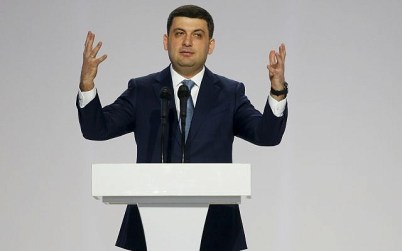
When Zelensky is sworn in as president, his prime minister — at least for a while and possibly until the parliamentary elections scheduled to take place sometime later this year — will be Volodymyr Groysman, a Jewish politician who was the mayor of the city of Vinnytsia.

Last year, Israel’s government singled out Ukraine as a regional trouble spot in the Israeli government’s annual report on anti-Semitism.

Ukrainian Prime Minister Volodymyr Groysman gestures as he speaks at a meeting of Ukrainian President Petro Poroshenko’s supporters in Kiev, Ukraine, on January 29, 2019. (AP Photo/Efrem Lukatsky)

Poroshenko’s government greatly encouraged glorification of those troops and leaders as fighters for Ukrainian freedom who it insisted sided with Germany only in order to fight against the Russian-controlled Soviet Union.

Zelensky has said only that he personally does not favor the veneration of people like Bandera, whom he described as “a hero to some Ukrainians.” It was a markedly reserved formulation compared to the unreserved endorsement of figures like Bandera by officials under Poroshenko.

In 2016, Netanyahu canceled the Israel visit of Groysman as a consequence of Kiev voting in a favor of an anti-settlements resolution at the United Nations Security Council.

The two countries, however, later reconciled.


Hezbollah chief says Israel’s ground forces unprepared for war 

April 23, 2019

Source: Hezbollah chief says Israel’s ground forces unprepared for war | The Times of Israel

Hassan Nasrallah says Jewish state will not be able to clinch victory with air power alone; mocks failure to thwart Gaza rocket fire at Tel Aviv

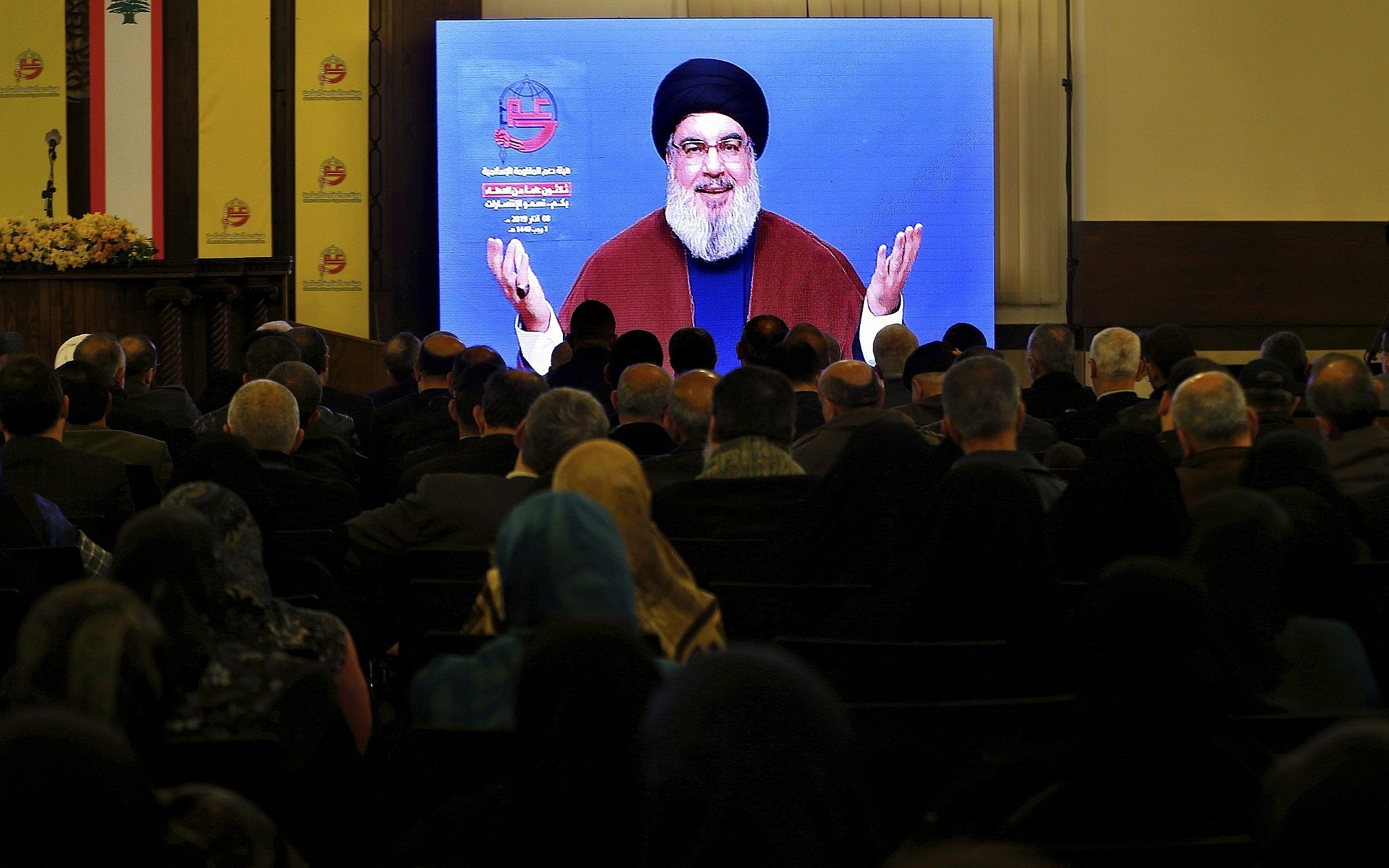
Supporters of the Iranian-backed Hezbollah terror group listen to a speech of Hezbollah leader Sayyed Hassan Nasrallah, via a video link, in a southern suburb of Beirut, Lebanon, March 8, 2019. (AP Photo/Bilal Hussein)

Hezbollah leader Hassan Nasrallah on Monday claimed Israel’s ground forces were unprepared for a military offensive in Lebanon and the Jewish state could no longer win battles solely from the air.

In a speech, he estimated that Israel would not seek to initiate a conflict with the neighboring country, as its home front is not prepared to withstand missiles fired by Hezbollah at its major cities.

“I lean in the direction that Israel is unlikely to carry out a war on Lebanon,” mused Nasrallah, whose Iran-backed terror group last fought with Israel in 2006. “This is my personal opinion.”

“The Israelis say the home front is not ready. Any theoretical Israeli war needs a ground operation to achieve its desired goal. The era in which the air force decides the battle is over. This has become one of the military axioms in the world. If Israel starts a war, it needs a ground operation to achieve its goal for the war,” he continued.

To underline his view, the Hezbollah chief mocked the Israeli response to two rounds of rocket fire at Tel Aviv and the area in mid-March, which were not intercepted by the missile defense system Iron Dome.

“We saw how two missiles were fired by mistake from Gaza and landed in the Tel Aviv surroundings, and then another missile was shot off from Gaza and landed north of Tel Aviv; all the Israeli measures were not able to do anything,” he said.

During his speech, Nasrallah rebuffed as false a report that he had met with senior commanders and warned that the likelihood of war with Israel over the summer was high. According to the Kuwaiti report, he said Hezbollah could suffer severe casualties and he himself might be killed.

Nasrallah also condemned the United States for ending sanction waiversfor countries that purchase oil from Iran on Monday, calling it a reminder that the US “is the real enemy, the first enemy, and the biggest enemy.”

“Israel, the takfiri organizations, terrorists, murderers, and those who launch wars are nothing more than tools of the American project, aggression and tyranny,” he said.

Nasrallah’s speech came days after the new commander of the IDF’s Ground Forces said Hezbollah was still planning to carry out a surprise invasion of northern Israel, despite the recent Israeli operation to uncover and destroy an extensive network of cross-border attack tunnels dug by the militia.

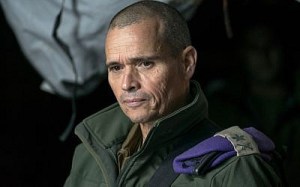
Maj. Gen. Yoel Strick was tapped to lead the military’s Ground Forces in February, amid increased criticism charging that Israeli troops were not prepared for war. His comments came less than four months months after the IDF concluded its anti-tunnel operation along the Lebanese border.

Maj. Gen. Yoel Strick, head of the IDF Northern Command, in an undated photograph. (Israel Defense Forces)

“Hezbollah still has plans to invade the Galilee,” he told the Ynet news site, in an interview on Thursday, referring to entering Israeli territory through a cross-border tunnel network. “Of course, we won’t allow that to happen. We will thwart these plans.”

In December, Israel accused Hezbollah of digging cross-border tunnels into its territory from southern Lebanon and launched an operation to destroy them.

According to the army, Hezbollah had planned to use the tunnels to kidnap or kill civilians or soldiers, and to seize a slice of Israeli territory in the event of any hostilities.

The IDF did not give a total figure for the tunnels found, though it announced in January that six were destroyed during the course of the operation.

Strick also voiced support for declaring war on Lebanon as a whole in Israel’s next fight against Hezbollah.

“In the next war, it would be a mistake for us to distinguish between the state of Lebanon and Hezbollah, since Hezbollah is a political actor and part of the government,” Strick said.

In such a conflict, “if it were up to me, I would recommend declaring war on Lebanon and Hezbollah,” he said. “I have no doubt what the outcome will be… It will be a decisive victory.”

In March, recently retired IDF chief of staff Gadi Eisenkot said that Israel came close to all-out conflict with Hezbollah during his tenure.

Israel last fought a war with Hezbollah in 2006, but tensions along the northern border have remained high. Israel has carried out airstrikes in Syria for years, to prevent weapons transfers to the Iran-backed terror group.

“The Hezbollah threat is a serious threat,” Eisenkot told the conference. “It is a strong organization that has gained experience in running large operations and wants to prepare an attack plan to conquer the Galilee and bring 5,000 fighters underground” into Israel.

The threat of war with Hezbollah had increased during the last three years, he said.


Off Topic: Jordan Peterson – Personal Responsibility – April 2019

April 22, 2019

I spoke at a Heritage Foundation event in New York City in April 2019. Genevieve Wood and I discussed reasons for the apparently increasing attractiveness of socialist ideas in America and the (countervailing) importance and meaningful of personal responsibility, as well as considering why communicating that import appears to be appealing to such a large number of people.


Iranian President Rouhani declares joint border ‘reaction force’ with Pakistan

April 22, 2019
https://www.rt.com/news/457203-irans-president-rouhani-announces-joint/
© AFP / Stringer / Iranian Presidency
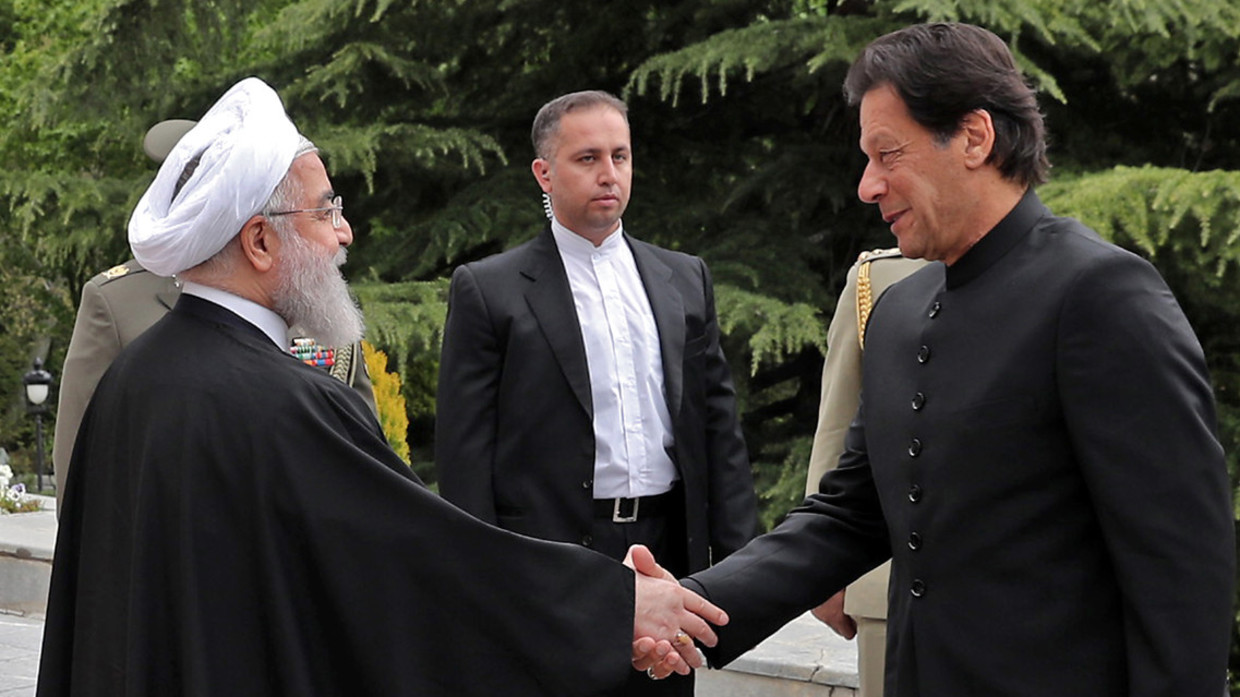
Iran and Pakistan to create a joint ‘reaction force’ on the border between the two countries, Iran’s President Hassan Rouhani said.

The announcement came during a two-day visit to Iran by Pakistani Prime Minister Imran Khan, the first of his tenure.

Iran and Pakistan share a 959km land border. Tehran has been complaining for years about recurring attacks by Pakistani militants on Iranian security forces, with the latest episode reported in February.

The future force, which was announced by the two leaders during a joint media conference after a meeting, is intended to boost border security and foster bilateral ties.

The remote border area has many mountains and is difficult to control. Extremist groups, based on both sides of the border, have been causing trouble for Iranians for quite some time, but Pakistani authorities see them as a problem as well, Vladimir Sazhin, senior research fellow at Russia’s Institute for Oriental Studies, told RT. So it’s quite natural for the two nations to coordinate their efforts in this area.

“Both sides would benefit from it,” he said. “I don’t expect it to be a separate force per se but rather a mechanism for sharing intelligence on what is happening in the area… Iranian border forces won’t tolerate a Pakistani command and Pakistani forces won’t tolerate an Iranian command. It will be a consultative body, I believe.”

The February suicide bombing attack killed 27 members of the Revolutionary Guards in Iran’s Sistan and Baluchestan province. Rouhani last month demanded decisive actions from Pakistan to crack down on “anti-Iranian terrorists” on its territory.

The Sunni jihadist group Jaish al-Adl (Army of Justice), which Tehran accused of perpetrating the bombing against its armed forces, is blamed by Pakistan for targeting its troops in its own Balochistan province last week. The attackers killed 14 members of the security forces. Pakistani officials said the group’s base of support extends into the Iranian border territory where the militants have “training and logistic camps”.

Palestinian Authority: We’ll retract recognition of Israel

April 22, 2019

PA threatens to cease security coordination with Israel if freeze on terror funds continues.

Arutz Sheva Staff, 22/04/19 14:59
Issam Rimawi/Flash 90  Mahmoud Al-Aloul

Palestinian Authority (PA) Vice Chairman Mahmoud Aloul on Monday said that if Israel continues freezing tax funds, the PA will cease security coordination with Israel and retract its recognition of the State of Israel, Israel Hayom reported.

Israel’s cabinet in February approved the implementation of the freeze on funds to the Palestinian Authority. The law, which passed in July 2018 with a majority of 87 Knesset members, offset 502,697,000 shekels ($138,426,818) from funds transferred from Israel to the PA.

Last month, PA employees received 50% of their salaries, while terrorists and their families continued to receive their salaries as usual.

“The leadership plans to retract recognition of Israel and cease coordination on security matters with the occupation’s forces,” Aloul told the Shehab news agency.

Aloul also blamed the US for the situation, saying that “the American government decided to escalate matters in the area after transferring its Embassy to Jerusalem, and it actively encourages the Israeli settlement enterprise. Right now, Israel is planning to annex parts of the West Bank.”

“Due to these events, the status quo we relied on for our relationship may disappear soon. The leadership is expected to announce that we will not accept the situation continuing as it is, and we will soon announce drastic measures.”

Aloul also said that the leaders of Arab countries, including Turkey, are planning the next steps together with Abbas.

Abbas, he said, plans to meet the leaders of Muslim and African countries in order to garner support for his next steps.

Off Topic:  Zelensky win makes Ukraine 1st country outside Israel with Jewish PM, president 

April 22, 2019

Source: Zelensky win makes Ukraine 1st country outside Israel with Jewish PM, president | The Times of Israel

( This, in one of the most historically antisemitic countries in the world. – JW )

Marvels one columnist: ‘Imagine, a pure-blooded Jew with the appearance of a Sholom Aleichem protagonist wins by a landslide in a country that glorifies Nazi criminals’

Ukrainian comedian and presidential candidate Volodymyr Zelensky reacts after the announcement of the first exit poll results in the second round of Ukraine's presidential election at his campaign headquarters in Kiev on April 21, 2019. (Photo by Sergei GAPON / AFP)

Ukrainian comedian and presidential candidate Volodymyr Zelensky reacts after the announcement of the first exit poll results in the second round of Ukraine’s presidential election at his campaign headquarters in Kiev on April 21, 2019. (Photo by Sergei GAPON / AFP)

JTA — Following the victory of Volodymyr Zelensky in Ukraine’s presidential elections, the country will become the only one in the world besides Israel whose president and prime minister are both Jewish.

When Zelensky is sworn in as president, his prime minister — at least for a while and possibly until the parliamentary elections scheduled to take place sometime later this year — will be Volodymyr Groysman, a Jewish politician who was the mayor of the city of Vinnytsia.

To some of incumbent Petro Poroshenko’s critics, the landslide success of the vague campaign by the politically inexperienced Zelensky, a comedian, was not surprising in light of widespread resentment over the persistence of corruption under Poroshenko, who was elected in 2014 on a platform that vowed remedial action on exactly that front.

More unusual to some, however, was how Zelensky’s appears to have won the elections so decisively in spite of how his Jewish ancestry – his mother, Rima, is Jewish and he has jokingly referred to this during the campaign — is well known in Ukraine.

After all, Russia and other critics claim Ukrainian society has a serious anti-Semitism problem and legacy.

Ukrainian Prime Minister Volodymyr Groysman gestures as he speaks at a meeting of Ukrainian President Petro Poroshenko’s supporters in Kiev, Ukraine, Tuesday, Jan. 29, 2019. (AP Photo/Efrem Lukatsky)

“Imagine, a pure-blooded Jew with the appearance of a Sholom Aleichem protagonist wins by a landslide in a country where the glorification of Nazi criminals is enacted into law,” wrote Avigdor Eskin, a Russian-Israeli columnist, in an analysis published earlier this month by the Regnum news agency.

Eskin in column on Zelensky downplayed allegations of widespread anti-Semitism in Ukraine, attributing much of the attention to the problem in media and beyond to propaganda by Russia, which is involved in an armed conflict over territory with Ukraine.

But Eskin’s statement about Ukrainian laws glorifying Nazi criminals is not inaccurate, and Russia is not alone in criticizing Ukraine over this and other issues connected to anti-Semitism.

Last year, Israel’s government singled out Ukraine as a regional trouble spot in the Israeli government’s annual report on anti-Semitism.

“A striking exception in the trend of decrease in anti-Semitic incidents in Eastern Europe was Ukraine, where the number of recorded anti-Semitic attacks was doubled from last year and surpassed the tally for all the incidents reported throughout the entire region combined,” the report said. The authors of the report counted more than 130 reported anti-Semitic incidents in Ukraine in 2017, they said.

Also last year, more than 50 US Congress members condemned Ukrainian legislation that they said “glorifies Nazi collaborators” and therefore goes even further than Poland’s controversial laws limiting what can be said about local complicity during the Holocaust.

A letter signed by the US lawmakers stated, “It’s particularly troubling that much of the Nazi glorification in Ukraine is government-supported.” It noted ceremonies, gestures and legislation venerating leaders of the UPA and OUN militias, who fought alongside Nazi Germany during World War II and whose troops participated in atrocities against Jews and other victims.

Poroshenko’s government greatly encouraged glorification of those troops and leaders as fighters for Ukrainian freedom who it insisted sided with Germany only in order to fight against the Russian-controlled Soviet Union.

Several cities across Ukraine named streets for the Nazi-collaborator Stepan Bandera, who prior to Poroshenko’s time in office was openly glorified only in the country’s west.
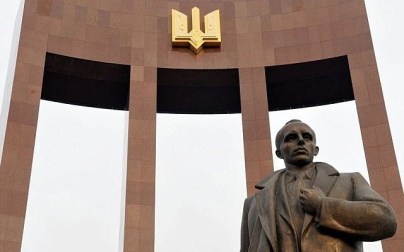
A statue of Stepan Bandera in Lviv, Ukraine, September 2014. (Courtesy Andrey Syasko/via JTA)

Meanwhile, in the western city of Lviv, nationalists became emboldened enough to celebrate with city authorities’ permission the anniversary of the 14th Galician division of the Waffen SS. The anniversary events featured men parading in Nazi SS uniforms on the street.

Such sights would have been unthinkable under Viktor Yanukovych, the corrupt president who was deposed in a 2013 revolution that ended with Poroshenko’s election. Careful to alienate neither ethnic Russians in Ukraine nor its powerful neighbor to the east, Yanukovych was less tolerant of this nationalist phenomenon.

On this subject, Zelensky has said only that he personally does not favor the veneration of people like Bandera, whom he described as “a hero to some Ukrainians.” It was a markedly reserved formulation compared to the unreserved endorsement of figures like Bandera by officials under Poroshenko.
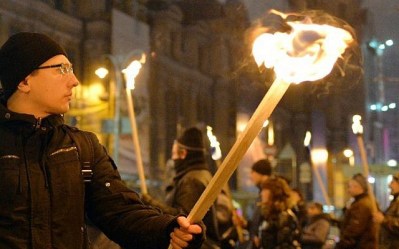
Thousands of Ukrainian nationalists hold a torchlight procession across Kiev in honor of Stepan Bandera, a World War II anti-Soviet insurgent, on January 1, 2015 (photo credit: AFP/Genya Savilov)

The presidential campaign itself has featured some anti-Semitism.

In some far-right circles, Zelensky’s work in a television stationed owned by the Jewish billionaire Igor Kolomoisky was proof of his belonging to a “Jewish cabal.” But it made Zelensky popular with other nationalists who appreciated Kolomoisky’s reputation as a fiery patriot.

Alexander Paliy, an influential political analyst supporting Poroshenko, last month stirred controversy when he wrote on Facebook that, despite his “respect” for Jews and some Russians, “The president of Ukraine should be Ukrainian and Christian, like the absolute majority of Ukrainians.”

Such rhetoric is shocking to many of Ukraine’s 300,000-odd Jews, whose ancestors suffered murderous anti-Semitism in Ukraine for centuries before, during and decades after the Holocaust.

The French-Jewish philosopher Bernard-Henri Lévy also referenced Ukrainian Jew’s bloody history in an interview with Zelensky, the 41-year-old son of scientists who lived near major Soviet army bases in Ukraine, that he published earlier this month in the Le Point weekly.

“His Judaism. It’s extraordinary that the possible future president of the country of the Shoah by Bullets and Babi Yar is a self-affirmed Jew from a family of survivors from Kryvy Rih near Dnipro – the land of pogrom if ever there was one,” Levy wrote. “This postmodern kid, is he new proof that the virus of anti-Semitism has been contained” after the revolution, Levy added.

Not denying his Jewish ancestry, Zelensky declined to explore it at length in the interview, Levy wrote. On this subject, he replied with typical self-deprecating humor, telling Levy: “The fact that I am Jewish barely makes 20 in my long list of faults.”

Zelensky, whose mother, Rima, is Jewish, has ingratiated himself with the Ukrainian public with such jokes as the star of “Servant of the People” – a primetime television show where he portrays a teacher thrust by an unlikely chain of events to become Ukraine’s president. He announced his candidacy in January, becoming an instant favorite.

Volodymyr Zelensky, Ukrainian actor and candidate reacts after debates between in the weekend presidential run-off at the Olympic stadium in Kiev, Ukraine, April 19, 2019. (AP Photo/Vadim Ghirda)

This popularity has allowed Zelensky to both win on an unusually vague platform and distinguish himself from his professional politician rivals, with their proclivity to hyperbole and nationalist slogans.

For example, when a reporter asked him how he would deal with Russian President Vladimir Putin, Zelensky reverted to his comic roots, saying “I would speak to him at eye level.” It was a reference to him and Putin being at least three inches shorter than Poroshenko, a 6-footer.

Zelensky opaqueness means a high level of uncertainty, Dolinsky, the Jewish community leader, said.

“We will need to wait and see what kind of president Zelensky turns out to be,” said Dolinsky, who was an outspoken critic of some policies of the Poroshenko administration. “What is clear is that Poroshenko’s attempt to appeal to nationalism has failed. Ukrainians said they wanted change. And I am feeling optimistic.”
 

Iran’s supreme leader picks new Revolutionary Guard chief 

April 22, 2019

Source: Iran’s supreme leader picks new Revolutionary Guard chief – www.israelhayom.com

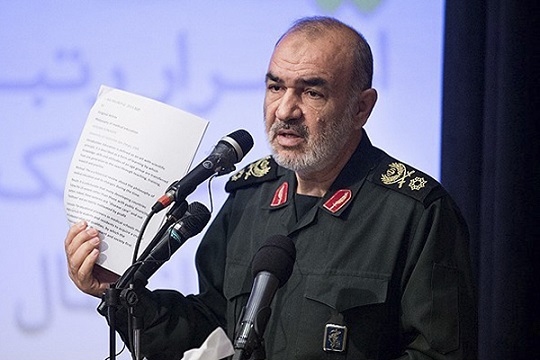
Days after U.S. designates elite group a foreign terrorist organization, Ayatollah Ali Khamenei appoints Hossein Salami to replace Mohammad Ali Jafari as head of Revolutionary Guard Corps.

Iran’s Supreme Leader Ayatollah Ali Khamenei has replaced the head of the influential Revolutionary Guard Corps, state TV reported on Sunday, days after the United States designated the elite group a foreign terrorist organization.

The TV station did not give a reason for the change when it announced the appointment of Hossein Salami to the position and his promotion to the rank of major general. Salami, a 59-year-old who joined the Guard at the outbreak of the bloody 1980s Iran-Iraq war, later rose in the ranks to head its air forces.

He served as deputy commander of the Guards for years and is known for issuing threats against Israel and the United States.

“The Supreme Leader has appointed Salami as the new commander-in-chief of the Guards, who will replace Mohammad Ali Jafari,” it said.

A statement from Khamenei’s office praised Jafari and said he picked Salami based on the outgoing commander’s advice.

Jafari had held the post since September 2007.

U.S. President Donald Trump on April 8 designated the Guards a terrorist organization, in an unprecedented step that drew Iranian condemnation and raised concerns about retaliatory attacks on U.S. forces. The designation took effect on April 15.

Tehran retaliated by naming the U.S. Central Command as a terrorist organization and the U.S. government as a sponsor of terrorism.

On April 13, Salami was quoted by Iran’s semiofficial Tasnim news agency as saying that he and the IRGC were proud of being designated a terrorist group by Washington.

The IRGC, created by late Ayatollah Ruhollah Khomeini during Iran’s 1979 Islamic Revolution, is more than a military force. It is also an industrial empire with political clout and is loyal to the supreme leader.

Comprising an estimated 125,000-strong military with army, navy and air units, the Guards also command the Basij, a religious volunteer paramilitary force, and control Iran’s missile programs. The Guards’ overseas Quds forces have fought Iran’s proxy wars in the region.

The IRGC is in charge of Iran’s ballistic missile and nuclear programs. Tehran has warned that it has missiles with a range of up to 2,000 kilometers (1,200 miles), putting Israel and U.S. military bases in the region within reach.

Salami, born in 1960, said in January that Iran’s strategy was to wipe “the Zionist regime” off the political map, Iran’s state TV reported.

“We announce that if Israel takes any action to wage a war against us, it will definitely lead to its own elimination,” Salami said after an Israeli attack on Iranian targets in Syria in January, Iranian media reported.

Israel, which Islamic Iran refuses to recognize, backed Trump’s move in May to quit a 2015 international deal on Iran’s nuclear program and welcomed Washington’s reimposition of sanctions on Tehran.


Off Topic:  Jewish comedian Zelensky wins Ukrainian presidential race by landslide: exit poll 

April 22, 2019

Source: Jewish comedian Zelensky wins Ukrainian presidential race by landslide: exit poll – www.israelhayom.com

In poll, Volodymyr Zelensky wins 73% of the vote; 25% of voters support incumbent Petro Poroshenko.

Ukrainian comedian Volodymyr Zelensky has won the second round of a presidential election against incumbent Petro Poroshenko by a landslide, a national exit poll showed on Sunday.

The poll said Zelensky had won 73% of the vote and that Poroshenko had won just 25% of the vote.

Ukrainians voted on Sunday in a presidential runoff as the nation’s incumbent leader struggled to fend off a strong challenge by the comedian, who denounced corruption and played the role of president in a TV sitcom.

Zelensky, who is of Jewish descent, has said that religion is a personal matter and plays no part in his campaign. If elected, he would become the country’s first Jewish president.


Sources: US to sanction nations for importing Iranian oil

April 22, 2019

Source: Sources: US to sanction nations for importing Iranian oil – www.israelhayom.com

Trump administration to end sanctions waivers for Japan, South Korea, Turkey, China and India when they expire May 2, according to three U.S. officials. Move aimed at further ramping up pressure on Iran by strangling revenue it gets from oil exports.

Washington is poised to tell five nations, including allies Japan, South Korea and Turkey, that they will no longer be exempt from U.S. sanctions if they continue to import oil from Iran, officials said Sunday.

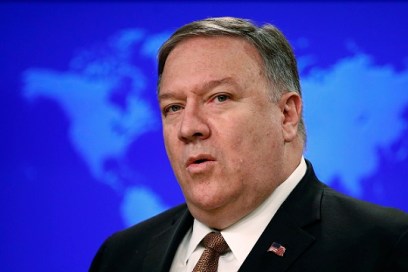
U.S. Secretary of State Mike Pompeo plans to announce on Monday that the administration will not renew sanctions waivers for the five countries when they expire on May 2, three U.S. officials said. The others are China and India.

It was not immediately clear if any of the five would be given additional time to wind down their purchases or if they would be subject to U.S. sanctions on May 3 if they do not immediately halt imports of Iranian oil.

The officials were not authorized to discuss the matter publicly and spoke on condition of anonymity ahead of Pompeo’s announcement.

The decision not to extend the waivers, which was first reported by The Washington Post, was finalized on Friday by U.S. President Donald Trump, according to the officials. They said it is intended to further ramp up pressure on Iran by strangling the revenue it gets from oil exports.

The administration granted eight oil sanctions waivers when it re-imposed sanctions on Iran after Trump pulled the U.S. out of the landmark 2015 nuclear deal. They were granted in part to give those countries more time to find alternate energy sources but also to prevent a shock to global oil markets from the sudden removal of Iranian crude.

U.S. officials now say they do not expect any significant reduction in the supply of oil given production increases by other countries, including the U.S. itself and Saudi Arabia.

Since November, three of the eight – Italy, Greece and Taiwan – have stopped importing oil from Iran. The other five, however, have not, and have lobbied for their waivers to be extended.

NATO ally Turkey has made perhaps the most public case for an extension, with senior officials telling their U.S. counterparts that Iranian oil is critical to meeting their country’s energy needs. They have also made the case that as a neighbor of Iran, Turkey cannot be expected to completely close its economy to Iranian goods.