Archive for April 2019

Off Topic:  U.S. air force strikes ISIS fighters in Somalia, killing three 

April 27, 2019

Source: U.S. air force strikes ISIS fighters in Somalia, killing three – Middle East – Jerusalem Post

A witness said missiles struck two wells on the outskirts of Timirshe village, some 60km southeast of Puntland’s commercial capital Bosaso.

BY REUTERS
 APRIL 27, 2019 14:27
Policemen security forces secure the scene where al-Shabaab militia stormed a government building

BOSASO – A US air strike killed three fighters from the Islamic State in the Somalia’s semi-autonomous Puntland region on Friday, a US military official said, two weeks after the group’s deputy leader was killed in a strike.

A witness said missiles struck two wells on the outskirts of Timirshe village, some 60km southeast of Puntland’s commercial capital Bosaso.

The US military has sharply stepped up its campaign of air strikes in Somalia since President Donald Trump took office, saying it has killed more than 800 militants in two years.

“This air strike eliminated ISIS-Somalia members staged in a remote location in northern Somalia,” Maj. Gen. Gregg Olson, US Africa Command (AFRICOM) director of operations, said in an emailed statement on Saturday.

AFRICOM also claimed responsibility for the killing of IS deputy Abdulhakim Dhuqub on April 14.

Somalia has been riven by civil war and Islamist militancy since 1991 when clan warlords overthrew a dictator before turning on each other.

“We heard the crash of four missiles on the outskirts of Timirshe village,” resident Ahmed Nur told Reuters by telephone.

Recommended videos

He said the wells were used by militants from both IS and their more powerful Islamist rivals al Shabaab, an al Qaeda affiliate who have been fighting Somalia’s UN-backed government for years.

Al Shabaab was pushed out of the capital Mogadishu in 2011, but retains a strong presence in parts of southern and central Somalia.

It has frequently clashed with the much smaller IS force in the north who are thought to number fewer than 200 fighters.

A Puntland intelligence official said the air strike targeted both groups.

“There are casualties and we are investigating. In recent battles al Shabaab captured three bases from IS,” he told Reuters by telephone, requesting anonymity.


Russian envoy: ‘Israel to release Syrian prisoners as part of deal for Baumel’ 

April 27, 2019

Source: Russian envoy: ‘Israel to release Syrian prisoners as part of deal for Baumel’ | The Times of Israel

Official says a number of Syrians held in Israeli jails will be freed after the body of IDF soldier Zachary Baumel, missing since 1982, was returned to Israel earlier this month

Israeli soldiers carry the coffin of Zachary Baumel at the Mount Herzl Military cemetery in Jerusalem on April 4, 2019. (Hadas Parush/Flash90)

Israeli soldiers carry the coffin of Zachary Baumel at the Mount Herzl Military cemetery in Jerusalem on April 4, 2019. (Hadas Parush/Flash90)

A senior Russian official said Saturday that the operation to recover the remains of an IDF serviceman lost in a 1982 battle was in Damascus’s interests as Syrian prisoners will be released from Israeli prisons.

The body of tank commander Zachary Baumel, presumably killed in the First Lebanon War’s Battle of Sultan Yacoub almost 37 years ago, was brought from Syria to Israel earlier this month.

“In Russia we are very sensitive to the search for missing and dead people, even from World War II,” Alexander Lavrentiev told Russia’s RT broadcaster, according to the Ynet news site.

“For this reason, when the decision to surrender the body was made, we thanked the Syrian side for their understanding,” he said.

Zachary Baumel. (JTA/Courtesy Miriam Baumel)

“But this action was not unilateral — Israel made a decision, which it will have to carry out later, to release some of the Syrian citizens who are in Israeli jails,” added Lavrentiev, who serves as President Vladimir Putin’s special envoy to Syria.

Lavrentiev did not go into detail about why the Syrian citizens were being held in Israel.

“This was an act of interest for the Syrian side. We will not do anything that is contrary to Syria’s interests, but only things that serve them,” he said.

Syria has vehemently denied Putin’s claim that Damascus had aided in the search and recovery operation to return Baumel to Israel.

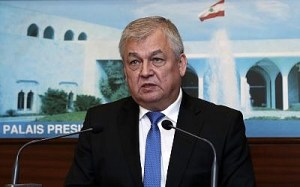
In this photo released by Lebanon’s official government photographer Dalati Nohra, Russia’s special presidential envoy to Syria Alexander Lavrentiev, speaks to journalist at the presidential palace, in Baabda east of Beirut, Lebanon, July 26, 2018 (Dalati Nohra via AP)

A Syria-based official with Palestinian terror group Popular Front for the Liberation of Palestine — General Command, said that insurgents who were in control of the Palestinian refugee camp of Yarmouk in Damascus up until last year excavated graves in search of the remains of the three missing soldiers — Baumel and comrades Zvi Feldman and Yehuda Katz. The group has made a similar claim in the past.

Syrian Information Minister Imad Sara claimed at the time on state TV that Russia had also not been involved. “What we believe is that the entire operation was carried out between Israel and the armed terrorist groups in Syria.”

During a joint press conference with Prime Minister Benjamin Netanyahu in Moscow earlier this month, Putin said “Russian Army soldiers found the body in coordination with the Syrian military.”

Public involvement in the return of the remains to Israel would be embarrassing for the Syrian government, which is technically at war with Israel.

Putin is a key backer of Syrian dictator Bashar Assad, helping him quash a massive civil war over the last several years, and has also maintained mostly positive ties with Israel.

In 2016, Moscow gave Israel a tank which had been captured during the same June 11, 1982 battle between Israeli and Syrian forces near the Lebanese border town of Sultan Yacoub. Israel said 21 soldiers were killed and five were captured, including two later returned alive.

Tank commander Baumel, a Brooklyn-born immigrant, was one of three Israeli soldiers whose bodies were never recovered following the skirmish.

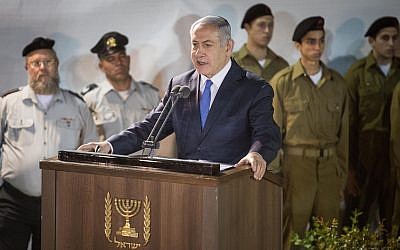
Prime Minister Benjamin Netanyahu speaks during the funeral of Zachary Baumel at the Mount Herzl military cemetery in Jerusalem on April 4, 2019. (Hadas Parush/Flash90)

Though Baumel, Feldman and Katz were generally believed to have been killed in the battle, there was also speculation and reports that they were captured by the Syrian military in Sultan Yacoub and brought to Damascus. Feldman and Katz remain officially listed as missing in action, though they are also presumed killed.

Baumel was buried in an emotional ceremony at Jerusalem’s Mount Herzl military cemetery.

A senior diplomatic official, who asked not to be named, said at the time that the operation was evidence of the “special” connection between Jerusalem and Moscow, and that Russia’s help would not have a “diplomatic price tag” linked to the situation in Syria.


Off Topic:  New missile gap leaves U.S. scrambling to counter China 

April 25, 2019

Source: New missile gap leaves U.S. scrambling to counter China – World News – Jerusalem Post

Captain James Fanell, a former U.S. Navy intelligence chief, told Reuters that China now has “the most advanced ballistic missile force in the world.”

BY REUTERS
 APRIL 25, 2019 14:46
FILE PHOTO - Military vehicles carrying DF-21D ballistic missiles roll to Tiananmen Square

ZHUHAI, China – Chinese President Xi Jinping has elevated his country’s missile forces to a level where they pose an unprecedented challenge to the aircraft carriers and bases that form the backbone of American military primacy in Asia, a Reuters special report reveals today.

Many of the missiles in Beijing’s arsenal now rival or outperform those of the United States, puncturing the protective umbrella that for decades America has afforded its regional allies South Korea, Japan and Taiwan.

Captain James Fanell, a former U.S. Navy intelligence chief, told Reuters that China now has “the most advanced ballistic missile force in the world” and has “the capacity to overwhelm the defensive systems we are pursuing.”

Critically, China has forged a monopoly in one class of conventional missiles that enable it to strike at U.S. aircraft carriers off its coast and at bases in Japan or even Guam in the Pacific Ocean. Under a Cold War-era treaty between the U.S. and Russia, neither country has been allowed to develop these weapons – land-based, intermediate-range ballistic and cruise missiles with a range between 500 and 5,500 kilometers (3,418 miles). But China, which isn’t a signatory to the treaty, has been deploying these rockets in massive numbers.

Today’s special report is part of “The China Challenge,” a Reuters series on how Xi Jinping is reshaping and rejuvenating China’s military, the People’s Liberation Army (PLA), by filling its top ranks with loyal allies and enhancing its missile, naval and nuclear capabilities.

Previously in “The China Challenge” – Inside Xi’s remaking of the world’s largest fighting force: https://reut.rs/2Uzr9z4

In the event of a confrontation in the seas off its coast, Chinese military brass say they now have the means with which to keep American carriers at bay. “We cannot defeat the United States at sea,” a retired PLA colonel told Reuters. “But we have missiles that specifically target aircraft carriers to stop them from approaching our territorial waters if there were conflict.”

That is a potentially dramatic development, signaling that China is able to deter U.S. intervention as it expands its control in the South China Sea, steps up naval and air sorties around Taiwan, and extends its operations into areas it disputes with Japan.

With the United States suddenly finding itself on the wrong side of the missile gap, American military planners face a new and daunting scenario. Because some of China’s anti-ship missiles now outrange the fighter jets aboard U.S. carriers, they could neutralize American flattops in a conflict. If these carriers are forced to operate outside the range of their aircraft, they would be far less potent.

The United States, which has long been preoccupied with wars in the Middle East and Afghanistan, is now rushing to claw back the advantage. President Trump announced on Feb. 1 that Washington would withdraw from its missile treaty with Russia in six months, clearing the way for the U.S. to begin building the ground-launched missiles banned for more than three decades.

China’s Ministry of National Defense, the U.S. Indo-Pacific Command and the Pentagon did not respond to questions from Reuters.


U.S. called on to boycott German cars until Hezbollah banned from Germany 

April 25, 2019

Source: U.S. called on to boycott German cars until Hezbollah banned from Germany – Middle East – Jerusalem Post

Merkel’s administration is vehemently opposed to banning Hezbollah’s entire organization in Germany, where at least 950 Hezbollah members operate.

BY BENJAMIN WEINTHAL
 APRIL 25, 2019 04:42
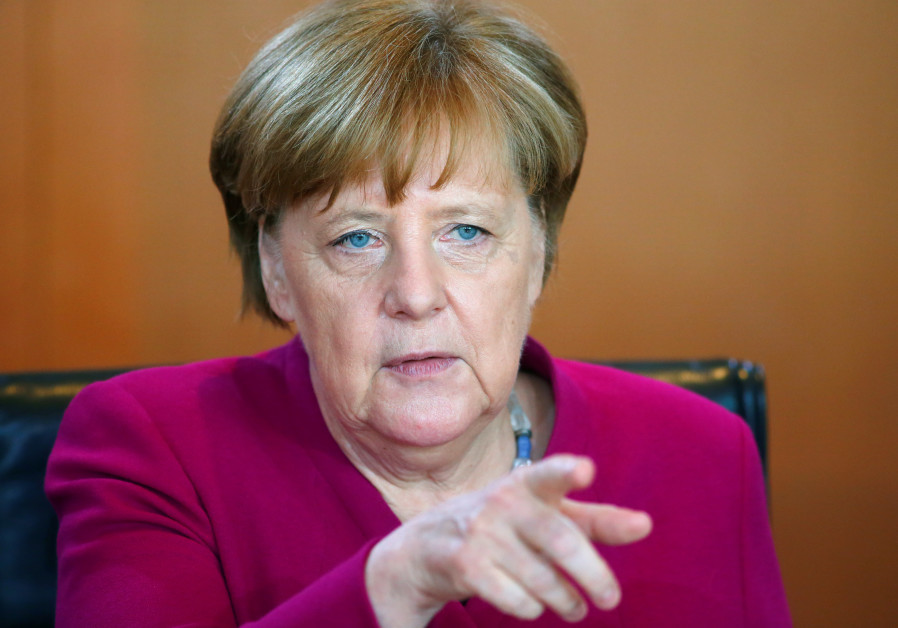
Angela Merkel gestures during a cabinet meeting in Berlin

The newly formed Committee to Ban Hezbollah in Germany called on US consumers to boycott German automobiles in an advertisement in The Jewish Journal of Greater Los Angeles, after German Chancellor Angela Merkel rejected outlawing Hezbollah.

The advertisement declares, “Boycott the German car industry until Hezbollah is banned in Germany.”

The full-page advertisement will run for the next four weeks in The Jewish Journal and leads with the statement: “On June 25, 1996, at 9:50 p.m., Hezbollah, Iran’s terrorist arm, murdered 19 American airmen at the Khobar Towers in Dharan, Saudi Arabia.”

The advertisement in the community weekly reads: “Yet Germany allows Hezbollah to operate openly on its soil. It’s time to send a message to the German government. Americans will not buy their cars while it allows the murderers of our soldiers to raise money, recruit and propagandize on German soil.”

Merkel’s administration is vehemently opposed to banning Hezbollah’s entire organization in Germany, where at least 950 Hezbollah members operate.

The Jerusalem Post examined German intelligence reports from 2018 stating that Hezbollah operatives recruit new members, transfer funds to the terrorist entity in Lebanon, and spread lethal antisemitic and jihadi ideologies in the federal republic.

The advertisement ends with a quote from famed US president Abraham Lincoln’s Gettysburg Address: “…that we here highly resolve that these dead shall not have died in vain.”

A picture of the memorial at Patrick Air Force Base for the 19 American airmen murdered by Hezbollah is shown in the advertisement.
A spokesman for the Committee to Ban Hezbollah told the Post that, “Hezbollah is the biggest terrorist threat in the world because it is state-backed.”

The spokesman said the committee plans to send the advertisement to German diplomats and managers of German automobile companies in the US such as Damler, BMW, Volkswagen, Audi and Porsche.

The committee is slated to also send the ads to mayors in cities where German car plants are situated and to the embassies of Gulf countries.

The spokesman said that the fact that “Hezbollah and Iranians have killed American troops is intolerable.”

Hezbollah is Iran’s chief terrorist proxy in the Middle East.

US Ambassador to Germany Richard Grenell is pressing for the German government to designate Hezbollah as a terrorist organization. Sources say that he brings it up at every meeting he attends with German officials.

The United Kingdom outlawed Hezbollah’s so-called political wing in February. The EU and Germany have merely prescribed Hezbollah’s military wing as a terrorist entity. The US, Canada, the UK, the Netherlands, the Arab League and Israel classify all of Hezbollah a terrorist organization, without dividing the entity into military and political wings.

Merkel has rejected appeals from both the US and the Israeli governments to also designate Hezbollah’s political wing a terrorist entity. Niels Annen, a deputy German foreign minister, said Hezbollah is necessary for stability because it is a part of the Lebanese government. Germany’s foreign ministry, represented by Annen, participated in a ceremony in February to honor Iran’s Islamic revolution.

In 2012, Hezbollah blew up an Israeli tour bus in Burgas, Bulgaria, murdering five Israelis and their Muslim Bulgarian bus driver.

Merkel told Israel’s Knesset last year that the security of the Jewish state is “non-negotiable” for her government.


Israel Air Force opens second F-35 squadron 

April 25, 2019

Source: Israel Air Force opens second F-35 squadron – Israel News – Jerusalem Post

The squadron will be called “Defenders of the Negev.”

BY ANNA AHRONHEIM
 APRIL 25, 2019 13:49
F35 Adir fighter jet

The Israeli Air Force opened a second squadron of F-35 stealth fighter jets, The Jerusalem Post learned on Thursday.

The squadron will be called “Defenders of the Negev.”

Built by Lockheed Martin, the jets have an extremely low radar signature allowing the jet to operate undetected deep inside enemy territory as well as evade advanced missile defense systems like the S-300 and S-400 missile defense systems, which have been deployed in countries such as Syria.

With close air-support capabilities and a massive array of sensors, pilots of the stealth jet have an unparalleled access to information while in the air.

The Israel Air Force currently has 14 F-35 Adir aircraft and is expected to receive a total of 50 planes to make two full squadrons by 2024.

With a need to keep ahead of increased threats in the Middle East, the Israeli Air Force is set to decide within the coming months to place orders on several new aircraft to upgrade its ageing squadrons.

The IAF is also now considering whether to purchase an additional 25 F-35s to give the Jewish state a total of 75 stealth fighter jets.

While the F-35I has advantages such as intelligence gathering, the F-15IA’s assets closely match most missions carried out by the IAF such as dealing with enemy missile launch sites or terror targets on its northern or southern borders.

Although the F-35 is considered one of the world’s most advanced fighter jet, the stealth aircraft is limited in the weapons they are able to carry as they have to be stored in internal munition boxes in order to maintain a low radar signature.

And in parallel to the fifth-generation air crafts, the IAF needs to retain it’s qualitative military edge and modernize an essential squadron of it’s fighter fleet. Most of the IAF’s F-15s are over  30 years old with the majority acquired in the second half of the 1970s and while a more advanced squadron of the F-15, the F-15I arrived in Israel in the 1990s.

The F-15IA model that the IAF is leaning towards purchasing is one of the most advanced and cost-effective fighter planes ever to be built, with various upgrades to the earlier models such as more efficient engines and fly-by-wire avionics-which is considered the biggest change to the jet in 20 years.

Officials believe that a force mix of F-35I Adirs along with a squadron of F-15IA would allow Israel to carry out a number of complex operations, including any possible confrontation with Iran on its borders.


USS Abraham Lincoln deploys opposite Syria, US envoy to Russia aboard – DEBKAfile

April 25, 2019

Source: USS Abraham Lincoln deploys opposite Syria, US envoy to Russia aboard – DEBKAfile

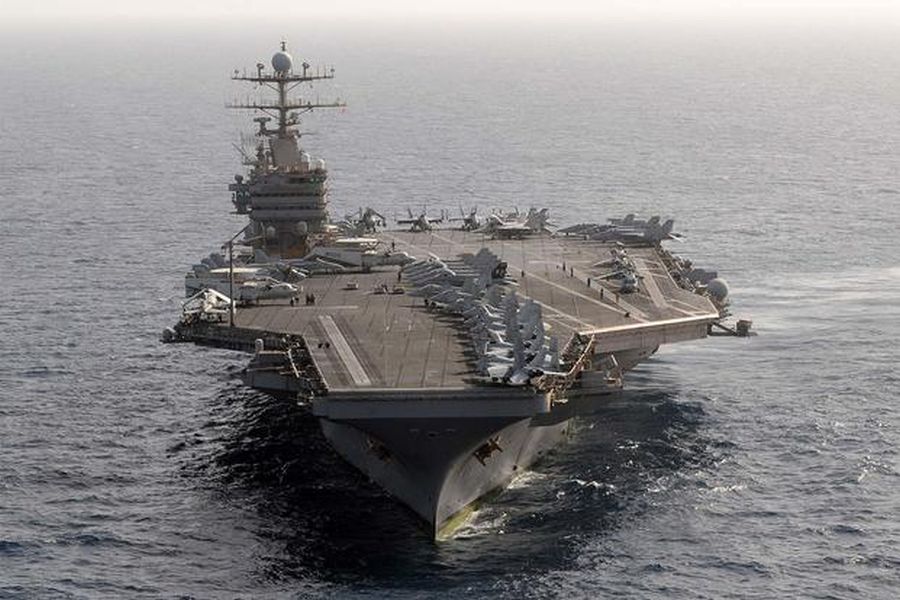
Accompanied by 10 warships, the USS Abraham Lincoln carrier on Wednesday, April 24, deployed opposite the Syrian coast in a dramatic show of strength against Russia and Iran. The effect was underlined by the revelation from US Navy sources of the presence on the carrier’s command bridge of none other than US ambassador to Moscow Jon Huntsman. His message needed no commentary: “When you have 200,000 tons of diplomacy cruising the Mediterranean, this is forward-operating diplomacy – nothing else need be said.”

There is no precedent even in the Cold War years between America and Soviet Russia of a US ambassador being planted on a front line against Russian and Iranian forces in the Middle East. The US Navy communique reported that Ambassador Huntsman was inspecting the operations of “9.000 crew and Marines and the 130 warplanes on the decks of the Lincoln and other vessels of the strike group.”

DEBKAfile’s military sources: This show of US military-backed diplomatic muscle was timed for Thursday, April 25, when President Vladimir Putin and North Korean leader were about to sit down for their first summit in the eastern Russian city of Vladivostok, This meeting was seen in Washington as Putin’s challenge of the nuclear negotiation channel set up by President Donald Trump with the North Korean dictator.

The Lincoln’s deployment facing the Syrian coast was also the Trump administration’s answer to the three top Iranians, supreme leader Ayatollah Ali Khamenei, President Hassan Rouhani and Foreign Minister Mohammed Javad Zarif, who Wednesday threatened America with harsh retribution for the sanctions that were blocking its oil exports.

Added to this, on Wednesday, Moscow advised Ukrainian separatists supported by Russia in their battle against the central government in Kiev that the red tape would be cleared from the path of any of those fighters who sought Russian citizenship. This was seen in Washington as a half-step towards Russia’s annexation of another part of Ukraine after Crimea. The State Department issued this statement: “Russia, through this highly provocative action, is intensifying its assault on Ukraine’s sovereignty and national integrity.”

On \Tuesday, April 23, DEBKAfile was first to break the news of the arrival in the Mediterranean of two US carriers and their strike groups – the USS Abraham Lincoln and the USS John C. Stennis, and reported that they are operating with the US Sixth Fleet in conjunction with allied navies.


Egypt and Iran vie for influence in Gaza 

April 25, 2019

Source: Egypt and Iran vie for influence in Gaza – www.israelhayom.com

The clash of interests between these two regional Middle Eastern powers seems clear; Egypt wishes to see Gaza calm and cut off from Islamic State-affiliated terror networks in the Sinai, which also threaten Egyptian security as a whole. Iran sees Gaza as one more base from which it can exercise its influence and threaten Israel and regional stability.

At the start of April, Hebrew media outlets quoted unnamed Israeli security officials as saying the Iranian-backed Palestinian Islamic Jihad terror faction, whose rocket arsenal is larger even than that of Hamas, was planning a significant attack on Israeli targets.

The information appeared to achieve its goal of discouraging the perpetrators, and no attack transpired. But the fact that Islamic Jihad was reportedly planning an incident that could have hampered Egyptian attempts to restore calm to the Gaza Strip could hint at a wider struggle taking place within Gaza between Egypt and Iran.

Hamas, which rules over Gaza, has reportedly faced demands from Egypt in recent months to decide whether it “takes its orders from Tehran or continues to implement the understandings for calm” formulated by the head of Egyptian intelligence Abbas Kamel.

The clash of interests between these two regional Middle Eastern powers seems clear; Egypt wishes to see Gaza calm, stable and cut off from Islamic State-affiliated terror networks in the Sinai Peninsula, which also threaten Egyptian security as a whole.

Iran sees Gaza as one more base from which it can exercise its radical influence and encourage the growth of a terrorist army that threatens Israel and regional stability.

Iran transfers $100 million a year to the military wings of Hamas and Islamic Jihad collectively, according to Israeli estimates.

Boaz Ganor, executive director of the International Institute for Counter-Terrorism at the Interdisciplinary Center in Herzliya, recalled that with the signing of the 1979 Israeli-Egyptian peace treaty, Cairo had no interest in retaking Gaza.

Egypt’s President Anwar Sadat “understood the problematic nature of this territory, which is the most crowded in the world, and racked with poverty, fundamentalism and a lack of a sovereign ruler,” said Ganor. As a result, Sadat did not demand a return of Egyptian rule over Gaza, despite the fact that Egypt controlled the territory prior to the 1967 Six-Day War.

“What Sadat understood, [current Egyptian President Abdel-Fattah] el-Sissi also understands, although in a different manner,” Ganor told JNS. “El-Sissi understands that the Strip contains many risks to Egypt within it. Hamas, which controls Gaza, is tied by the umbilical cord to its mother movement—the Muslim Brotherhood—who are Sissi’s loathed and strategic enemies.”

El-Sissi has identified a process of Iranian infiltration into Gaza via its proxy, PIJ, “and is concerned by the growth of a forward Iranian post on the northern border of Egypt,” assessed Ganor.

Another source of concern for El-Sissi is the fact that IS in Sinai is linked to fellow Salafi-jihadist elements in Gaza. These security and political factors, as well as Egyptian concerns over the prospect of a new armed conflict erupting between Israel and Hamas on Egypt’s border, have all led to “massive Egyptian intervention and a will to be active in what is taking place in the Strip,” said Ganor. Israel, for its part, is in favor of this intervention and has even requested it over the years.

Yet Iran is trying to neutralize Egyptian influence in Gaza, Ganor noted, while looking to tighten its links with its Gazan proxies. Tehran is trying to transfer funds and weapons into Gaza. “It also seeks to instruct its proxies to disrupt every process that can lead to calm,” said Ganor.

Tehran’s relationship with Hamas is somewhat more complicated.

Ganor said that “Iran’s influence on Hamas is significant, but much smaller than its influence on Hezbollah. Hamas zealously safeguards its independence and does not view itself as being obligated to Iranian interests.”

The Iranian branch in Gaza

Lt. Col. (ret.) Michael Segall, a senior analyst at the Jerusalem Center for Public Affairs, described Islamic Jihad as a “kind of Iranian branch inside the Gaza Strip.”

Former Islamic Jihad leader Ramadan Salah, as well its current chief, Ziad Nakhalah, are both frequent visitors to Iran, where they are “familiar guests,” stated Segall, a former head of the Iran Branch at the Israel Defense Forces’ Military Intelligence Directorate.

With Iran training Islamic Jihad fighters in the Islamic Republic, the organization is an “explicit proxy of Iran, in contrast to Hamas, which is under Iranian influence but has its own agenda and is more independent,” he said.

Despite this Iranian influence, Egypt has far more at stake in Gaza, which is at its back door. “Whatever happens in Sinai directly influences Egypt. Iran, meanwhile, is distant, and tries to activate its influence in Gaza by remote control,” said Segall.

He summed up the Iranian proxy strategy as follows: “The more Israel bleeds on its borders, the less it can engage Iran directly.” And the Iranians would like the same thing to happen in the West Bank, with Iranian Supreme Leader Ayatollah Ali Khamenei calling for terror factions there to be armed just like they are in Gaza.

“This is [a] central component in [the] Iranian doctrine. It’s about asymmetric warfare. Gaza, Lebanon and Syria have become part of Iran’s asymmetric warfare doctrine,” said Segall.

Islamic Jihad has used Iranian-made sniper rifles to fire at the IDF, as well as advanced bombs. It manufactures rockets with Iranian know-how – all part of Iran’s attempt to “sharpen its influence and leave its footprint” in Gaza.

Segall positioned Gaza as one layer in a broader “Iranian war, which plays out in other places, including Yemen, where the Houthis operate against Saudi Arabia, firing missiles against it. It is very similar to what is happening in Gaza. The Iranians work with a proxy toolbox against the Saudis, the Egyptians and Gulf states. This is not limited to Gaza.”

While Iran has the power to activate Islamic Jihad to disrupt Egyptian mediation efforts or spark a new conflict, the terrorist group also faces pressure from Hamas, which can force its will on it, including through the force of arms, according to Segall.

“I think that on the day they receive their order from Iran, Islamic Jihad will obey and cash in its checks, which it received over the years from the Iranians,” he said.

This article is reprinted with permission from JNS.org.


US cranks up sanctions against Hezbollah

April 25, 2019

Source: US cranks up sanctions against Hezbollah – www.israelhayom.com

Treasury takes steps against two people and three companies accused of helping the Shiite group evade US sanctions.

The U.S. Treasury, moving to boost pressure on Hezbollah, imposed sanctions on Wednesday against two people and three firms that Washington accuses of being involved in schemes to help the armed Shiite group backed by Iran evade American sanctions.

The Treasury’s Office of Foreign Assets Control (OFAC) said it was targeting Belgium-based Wael Bazzi because he acted on behalf of his father Mohammad Bazzi, a Hezbollah financier.

OFAC also took action against two Belgian companies and a British-based firm controlled by Bazzi.

In addition, the U.S. Treasury designated Lebanon-based Hassan Tabaja, who it said had acted on behalf of his brother Adham Tabajha, also a Hezbollah financier. The U.S. action freezes their assets and property and prevents U.S. citizens and businesses from dealing with them.

The two men and three businesses were targeted for sanctions under U.S. regulations aimed at suspected terrorists or those who support them, the Treasury said in a statement. Hezbollah is considered a foreign terrorist organization by the United States.

“The Treasury is relentlessly pursuing Hezbollah’s financial facilitators by dismantling two of Hezbollah’s most important financial networks,” Treasury Undersecretary Sigal Mandelker said in a statement.

“By targeting Hassan Tabaja and Wael Bazzi and their European-based companies, this administration is continuing to disrupt all avenues of financial support relied upon by Hezbollah,” he said.

The U.S. State Department earlier this week offered a reward of up to $10 million for information that could help disrupt Hezbollah’s financing.

The move to boost pressure on the group comes at a time of growing U.S. concern about its role in the Lebanese government. Hezbollah’s regional clout has expanded as it has sent fighters to Middle East conflicts, including the war in Syria, where it supported President Bashar Assad.


Lebanese defense minister: We will bomb Israel’s airport if it attacks 

April 25, 2019

Source: Lebanese defense minister: We will bomb Israel’s airport if it attacks – www.israelhayom.com

“If Israel bombards our airport, we will bombard its airport; if it strikes our oil facilities, we will strike its oil facilities,” Defense Minister Elias Bou Saab warns while touring country’s south, which borders with Israel.

Lebanon’s Defense Minister Elias Bou Saab on Wednesday threatened to strike targets in Israel if it attacks Lebanese territory, Hezbollah’s Al Manar satellite network reported.

“If Israel bombards our airport, we will bombard its airport; if it strikes our oil facilities, we will strike its oil facilities,” Saab reportedly said while touring his country’s southern region that borders Israel.

Saab also ruled out the possibility of Israeli starting a war with Lebanon, claiming that the Lebanese military has the deterrence power to prevent it.

In February, U.S. Ambassador to Lebanon Elizabeth Richard expressed concerns over Hezbollah’s growing role in the country’s new cabinet, adding that the Iran-backed organization continues to make its own “national security decisions” that “endanger the rest of the country.”

The U.S. views Hezbollah as a terrorist group, but is a strong supporter of Lebanon’s national army, supplying it with arms worth hundreds of millions of dollars in recent years. In mid-February, the American Embassy in Lebanon said the U.S. had delivered laser-guided rockets valued at more than $16 million to the Lebanese army.

Richard said last year alone, the United States provided more than $825 million in assistance, an increase from the year before.

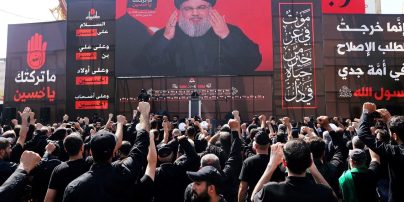
On Monday, Hezbollah leader Hassan Nasrallah said that if Israel wants to wage a war against his terrorist organization, which is based in southern Lebanon, it will need to launch a ground invasion that it currently isn’t prepared for.

“I am leaning toward the conclusion that Israel is unlikely to carry out a war on Lebanon. I personally think that it is unlikely they will do so because… its home front is not prepared,” Nasrallah said in a televised speech.


Iranian minister: Trump’s aim is talks, Bolton wants conflict 

April 25, 2019

Source: Iranian minister: Trump’s aim is talks, Bolton wants conflict – www.israelhayom.com

U.S. President Donald Trump’s wants to “bring us to our knees to talk” – but national security adviser John Bolton and key U.S. allies in the Mideast want “regime change at the very least” and the “disintegration of Iran,” says Iran’s FM Mohammad Zarif.

Iran’s top diplomat said on Wednesday that U.S. President Donald Trump’s aim “is to bring us to our knees to talk” – but national security adviser John Bolton and key U.S. allies in the Mideast want “regime change at the very least” and the “disintegration of Iran.”

Iranian Foreign Minister Mohammad Javad Zarif said he doubts Trump wants conflict because the president ran on a campaign promise “not to waste another $7 trillion in our region in order to make the situation only worse.”

But Zarif said what he called “the B team” – Bolton, Prime Minister Benjamin Netanyahu, Saudi Arabia’s Crown Prince Mohammed bin Salman and Abu Dhabi Crown Prince Mohammed bin Zayed – is trying “to push Iran to take action” as a pretext for “crazy” and “adventurous” U.S. actions.

“President Trump has a plan, but he’s being lured into not a plan but a trap,” Zarif warned in a question-and-answer session at the Asia Society. “It will cost another $7 trillion and even a greater disaster.”

Zarif said “it’s not a crisis yet, but it’s a dangerous situation,” adding that “accidents, plotted accidents are possible.”

The Trump administration re-imposed sanctions on Iran, including on its energy sector, last November, after pulling America out of the landmark 2015 nuclear deal between Iran and six world powers.

The U.S. designation of Iran’s Revolutionary Guard as a terrorist group earlier this month – the first ever for an entire division of another government – added another layer of sanctions to the powerful paramilitary force, making it a crime under U.S. jurisdiction to provide the guard with material support.

On Monday, Trump announced the U.S. will no longer exempt any countries from U.S. sanctions if they continue to buy Iranian oil, a decision that primarily affects the five remaining major importers: China and India and U.S. treaty allies Japan, South Korea and Turkey.

The move is part of the administration’s “maximum pressure” campaign on Iran that aims to eliminate all of its revenue from oil exports which the U.S. says funds destabilizing activity throughout the Mideast and beyond.

Hours before Trump’s announcement, Iran reiterated its long-running threat to close the Strait of Hormuz if it’s prevented from using the crucial waterway in the Persian Gulf –through which about a third of all oil traded at sea passes. The U.S. Navy has in the past accused Iranian patrol boats of harassing American warships in the waterway.

“We believe that Iran will continue to sell its oil,” Zarif said when asked about the waivers and keeping the Strait of Hormuz open.

“We will continue to find buyers for our oil and we will continue to use the Straits of Hormuz as a safe transit passage for the sale of our oil. That is our intention and that is what we believe will happen,” he said.

“But if the United States takes the crazy measure of trying to prevent us from doing that, then it would be prepared for the consequences,” Zarif said.

What does “prevent” mean?

“The B team wants the United States to take crazy measures. And it won’t be the first time that the United States has taken adventurous measures,” Zarif replied.

The Iranian minister said he thinks Trump wants a deal “but I think he’s doing the wrong thing” by maximizing pressure, stressing that “Iranians are allergic to pressure.”

Addressing Trump, he said: “Try the language of respect. … It won’t kill you, believe me.”

Zarif said he came back to the Foreign Ministry after resigning because “we diplomats never give up hope.”

“I don’t think anybody would envy my position, particularly when I have to deal with the B team,” he said, adding to laughter, “I wish it was the A team at least.”

“I have to do whatever I can to prevent conflict, to see if we can resolve conflict peacefully, diplomatically,” Zarif said. “And I have a lot of hope.”

Zarif also commented on other world issues, such as Iran’s own fight against the Islamic State group.

“ISIS has been airlifted from Iraq and Syria into Afghanistan. You see one example of it unfortunately in the barbaric attack on Easter Sunday in Sri Lanka. But unfortunately, the people of Afghanistan are seeing incident after incident, terrorist attack after terrorist attack by ISIS … in order to create the sectarian war that ISIS has been looking for … since 2002.”

Regarding the U.S. election in 2020, Zarif said: “Believe me, we have not invested in a 2020 Democratic victory. Some people believe that we are looking for a Democratic victory. Democratic governments have been as hostile to Iran as Republican governments. … It’s just waiting for the White House to become rational, with a Republican or a Democrat.”