Archive for April 2019

Syria says Israeli airstrike on military position wounds 6

April 14, 2019

Source: Syria says Israeli airstrike on military position wounds 6 – www.israelhayom.com

Several buildings destroyed in alleged attack near town of Masyaf, Syria’s state news agency reports. Rights group says 17 wounded, several dead. Iranian delegation was reportedly touring military sites in the area at the time of the strike.

SANA quoted an unnamed military official as saying the airstrike near the town of Masyaf, in Hama province, hit a military academy widely known as the Accounting School. It said Israeli warplanes fired missiles toward Syria from Lebanon’s airspace and that Syrian air defenses shot down some of the missiles.

The Britain-based Syrian Observatory for Human Rights said the Israeli airstrikes hit three targets, wounding 17 Syrian soldiers. It said there were also deaths, but it was not immediately clear how many were killed and whether they were Iranians or Iran-sponsored fighters. It said the strikes targeted the Accounting School as well as a missile development center in a village near Masyaf and a nearby military base run by Iran-backed fighters.

According to Syrian media outlets, at the time of the airstrike in Masyaf, an Iranian delegation was touring military sites in the area. One of the wounded, the reports said, is a Syrian Brig. Gen. Suheil Salman al-Hassan, who commands the Syrian army’s elite “Tiger Forces.”

The IDF declined to comment. Israel does not usually comment on reports concerning its airstrikes in neighboring Syria, though it has recently acknowledged striking Iranian targets there. The last such strikes that Israel announced were in late March.

Iran is a close ally of Syrian President Bashar Assad and has sent military advisers, as well as thousands of fighters from across the region, to help his forces in the eight-year conflict.

Israel considers Iran its biggest threat and has said it will not tolerate an Iranian military presence on its borders.

The most serious wave of airstrikes on Syria this year occurred in January, when the IDF hit several Iranian targets, saying it was responding to an Iranian missile attack a day earlier. The Iranian launch followed a rare Israeli daylight air raid near the Damascus International Airport.


Netanyahu’s security outlook: No existential threat to Israel 

April 14, 2019

Source: Netanyahu’s security outlook: No existential threat to Israel – www.israelhayom.com

In upcoming article, former National Security Council head Jacob Nagel discusses nonclassified parts of Prime Minister Benjamin Netanyahu’s security and defense outlook • Netanyahu does not see any existential threat to Israel right now, and wants to keep it that way.

In a professional article due to be published in the U.S., former acting National Security Adviser Jacob Nagel reveals additional nonclassified parts of Netanyahu’s security and defense outlook.

One of Netanyahu’s underlying assumptions is that there is currently no existential threat facing the state of Israel, Iranian threats notwithstanding. Nagel writes that Netanyahu thinks this situation should be maintained.

Another point of the outlook is the need to protect the homefront and vital national infrastructure and government institutions in light of tactics shifts by the enemy

A third major aspect of Netanyahu’s outlook is that Israel must transition to a state of ongoing warfare rather than preparing for wars characterized by outbursts of extreme violence, such as those Israel fought in the early years of its existence.

The defense establishment considers a well-organized and written security and defense doctrine to be a tool of utmost importance when it comes to force building. Nagel states in his article that it is rare for a prime minister to compose his own security and defense outlook.

The last complete defense outlook for Israel was compiled by David Ben-Gurion and approved by the government in 1953. Since then, no other doctrine has been approved, although attempts have been made over the years to update the Ben-Gurion document.


IDF stands down reinforcements deployed to Gaza border amid calm

April 14, 2019

Source: IDF stands down reinforcements deployed to Gaza border amid calm | The Times of Israel

Military says it remains ‘highly prepared and ready to act quickly,’ after reassigning troops sent to the south during last month’s increased violence

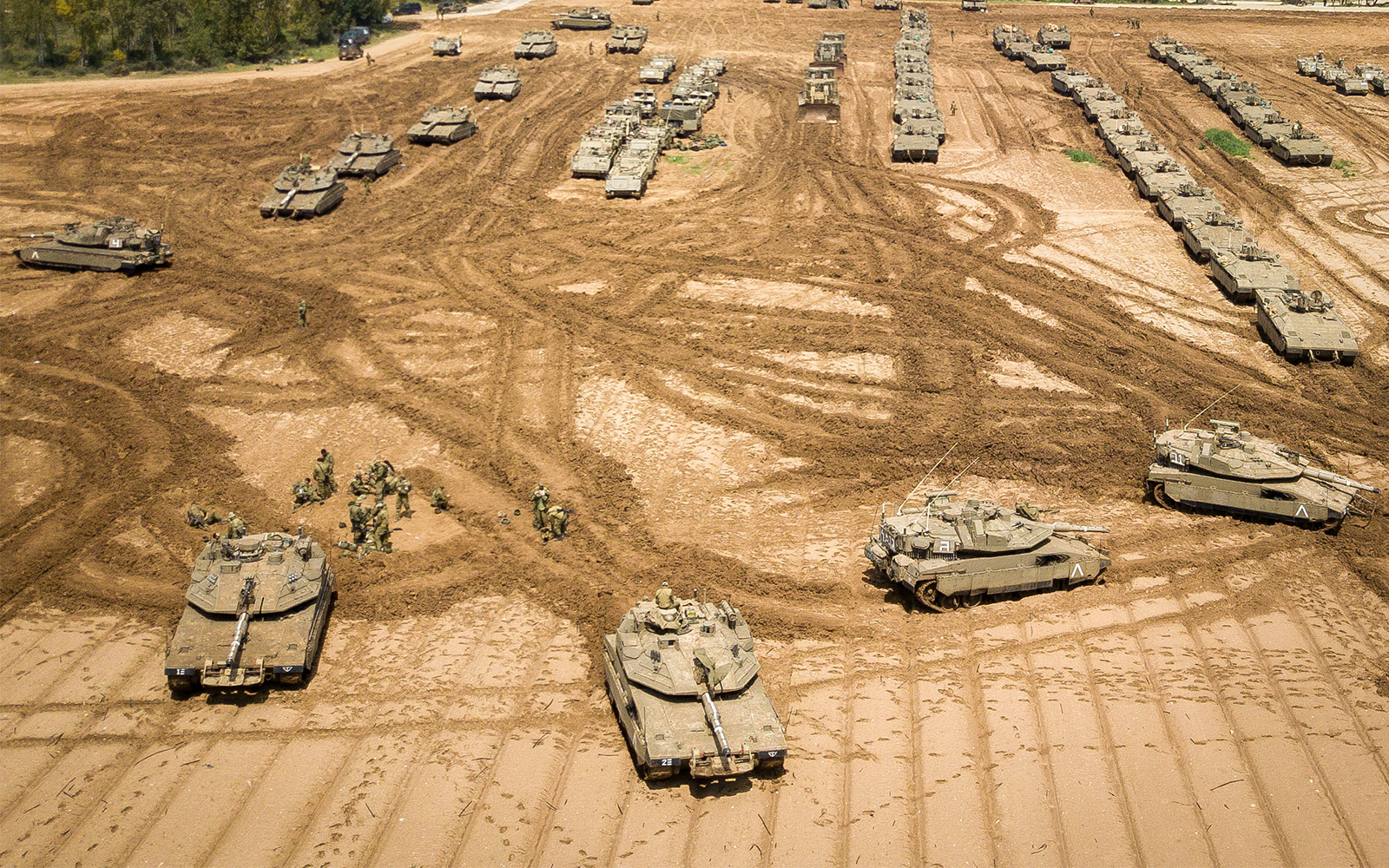
IDF tanks stationed near the Gaza border, March 27, 2019. (Dudi Modan/Flash90)

The Israel Defense Forces on Sunday said it was standing down the extra forces deployed to the Gaza border region during an uptick in violence last month.

“The IDF continues to be highly prepared to act quickly according to need and situation assessment,” the military said in a statement.

During the flareup the military had deployed two additional brigades to the Gaza Division, along with an artillery battalion, fleets of drones, and field intelligence units. Reservists were also called up from air defense, intelligence and other select units. The troops were sent to the south ahead of protests on March 30 to mark Land Day and the anniversary of the “March of Return” protests, and after a rocket fired from the enclave destroyed a residential building in central Israel, injuring seven people.

Amid peak tensions, senior commanders had been preparing for a variety of scenarios, including the possibility of a deterioration of violence to the point of a large-scale ground operation.

The brigades were brought to the Gaza border region from planned training exercises. On Sunday, they were given orders to return to their usual schedules.

The decision came amid a significant decrease in the level of violence along the border. The number of balloon-borne explosive and incendiary devices flown over the border has dropped in recent weeks, though attacks have not stopped entirely. Nightly riots have ended, and the weekly protests on the border have been held farther from the security fence.

IDF tanks stationed near the Israeli Gaza border on March 26, 2018. (Yonatan Sindel/Flash90)

Egypt, the United Nations and Qatar have recently worked to broker ceasefire understandings between Israel and Hamas, which, if finalized, would provide for an end to violence emanating from the Strip in exchange for the Jewish state easing some of its restrictions on the movement of people and goods into and out of the coastal enclave.

Israel says limitations on movement aim to prevent Hamas and other terror groups from transferring into Gaza weapons and materials used to construct tunnels and fortifications.

There appeared to be a breakthrough in the ceasefire efforts at the anniversary protests, when Palestinians in Gaza maintained relative calm along the border during large demonstrations.

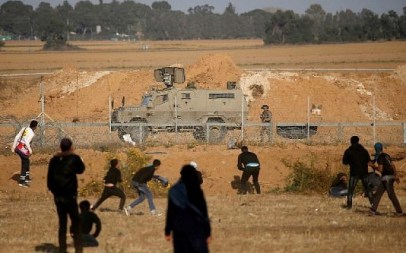
Illustrative: Palestinians confront Israeli forces near the border with Israel, east of Khan Younis in the southern Gaza Strip, on April 12, 2019. (Said Khatib/AFP)

Israel, in turn, reopened its two crossings with Gaza and significantly expanded the permitted fishing area around the coastal enclave.

Last year on Land Day — March 30 — Palestinians in the Gaza Strip launched the “Great March of Return,” a series of weekly protests and riots along the security fence. Israel maintains that Hamas appropriated the campaign for nefarious purposes, using the civilian protesters as cover for violent military activities.

Land Day marks a 1976 decision by the Israeli government to seize thousands of dunams of Arab-owned land in the Galilee region of northern Israel.

A senior leader of Hamas, the terror group that rules the Gaza Strip and is sworn to Israel’s destruction, on Wednesday dismissed the outcome of Israel’s election as irrelevant, as near-final results, later confirmed, showed that Prime Minister Benjamin Netanyahu’s right-wing bloc had won a clear majority in the Knesset vote.

“All parties are faces of one coin, the coin of occupation,” said Khalil al-Hayya.

He said there was “no difference” between the Israeli parties, and pledged that Gaza’s Hamas rulers — who are committed to Israel’s destruction — would continue seeking to “end the occupation and achieve our national goals.”

On Friday, Palestinians said a 15-year-old was shot and killed during weekly protests along the Gaza Strip border as rioters threw rocks and fire bombs at IDF troops, who responded with tear gas and live fire. Some 7,400 Palestinians gathered for the demonstrations at several sites along the border.


Trump warns Putin of US umbrella over Israeli strikes on Iranian targets in Syria – DEBKAfile

April 13, 2019

Source: Trump warns Putin of US umbrella over Israeli strikes on Iranian targets in Syria – DEBKAfile

Tehran had no reason to expect Russian Pantsir, S-300 or S-400 air defense missiles to begin knocking out the Israeli aircraft targeting Iranian military sites in Syria. Some analysts reported that Iran was disappointed by the silence of the Russian systems when, according to Syrian sources, Israeli aircraft from Lebanese air space struck locations, in the Hama region early Saturday, April 13.

DEBKAfile’s military and intelligence sources reveal that the Russians were quietly strengthened in their three-year policy of non-interference by a message from President Donald Trump to President Vladimir Putin through back-channels. Putin was warned to continue to turn a blind eye to Israeli raids on Iranian targets in Syria. The message implied that the Israeli Air Force was for the first time operating under an American aerial umbrella.
Prime Minister Binyamin Netanyahu knew about the Trump message before he sat down with Putin in the Kremlin on April 4. He was there to adapt the military coordination arrangements between Israel and Russia to the relocation of Iranian command enters and stores from Damascus to Aleppo. The Israeli Air Force targeted the new locations for the first time on Feb. 27.

The US guarantee of aerial support was first arranged at the end of 2018 between US Secretary of State Mike Pompeo and Netanyahu in his dual role as defense minister. But only now was it brought to the attention of the Russian president.

Had the prime minister gone public on this deal before the April 9 general election, he would have been accused of inappropriately boosting his Likud party’s prospects. For that reason, Netanyahu and Putin abstained from going into specifics of the new arrangements when they met, having earlier covered them discreetly in their phone conversation a few days before their meeting.

Russian Defense Minister Sergei Shoigu and his staff were conspicuously absent from the Israeli leader’s Moscow talks on April 4. They were demonstrating the reservations they have about American intervention in the bilateral Russian-Israeli understandings over the IAF’s targeting of military assets and arms shipments in Syria. As of now, the Russian military in Syria is barred from interfering in Israel’s anti-Iran offensive by the threat of American reprisals. At the same time, neither Washington nor Moscow is keen on a military flare-up occurring in Syria, certainly not one involving the Iranian military or its allied Shiite militias, especially Hizballah.

The Iranians were furious when the Russian military made no move to defend their sites against Israel’s latest attack on the military facilities they share with the Syrians in and around Masyaf in the western Hama province. Syrian State media reported that several buildings were destroyed, including a military academy, and that Syrian air defenses shot down some of the Israeli missiles. Syrian opposition sources cited three Israeli targets and 17 casualties, including deaths, but it was not immediately clear whether they were Syrian or pro-Iranian militia fighters. DEBKAfile adds that one of the targets was a factory for upgrading the precision of surface missiles supplied by Iran to Hizballah.


Syria says Israeli strike targets ‘military position’ in western Hama province

April 13, 2019

Source: Syria says Israeli strike targets ‘military position’ in western Hama province | The Times of Israel

State media claims some missiles intercepted by air defenses; several buildings destroyed and three ‘fighters’ injured in area believed to house Iranian, Hezbollah forces

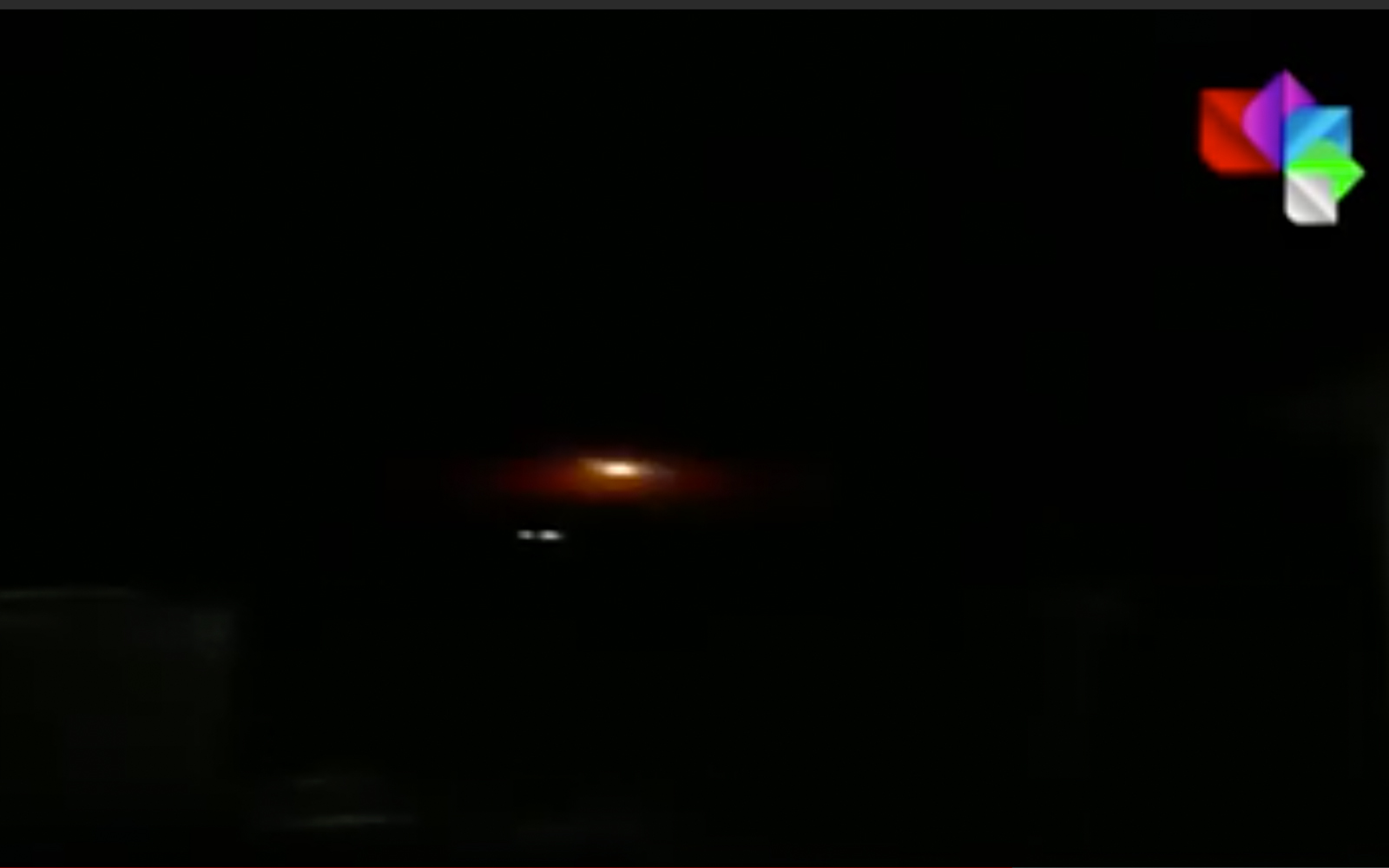
This screenshot from a video released by Syria’s official news agency SANA allegedly shows Syrian air defenses firing on Israeli missiles in the province of Hama, April 13, 2019. (YouTube screenshot)

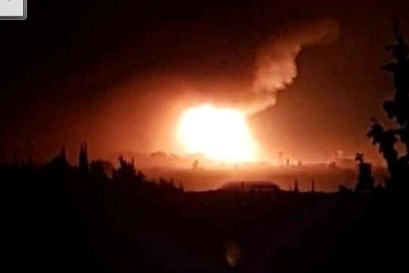
Syrian state media said Israel carried out an air strike on military targets near the city of Masyaf in western Hama province overnight Friday-Saturday.

Syria’s official state news agency SANA said Israel Air Force jets fired missiles while flying from Lebanese airspace, destroying several buildings and injuring three people. Syrian opposition sources said the targeted sites served Iranian forces and their Lebanese proxy, Hezbollah.

“Around 2:30 am (2330 GMT Friday)… the Israeli air force carried out a strike targeting one of our military positions in the town of Masyaf,” SANA quoted a military source as saying.

SANA said Syrian air defenses intercepted some of the missiles.

“The enemy missiles were dealt with and some of them were shot down before reaching their target, resulting in the damage of a few buildings and the injury of three fighters,” SANA said, according to a Reuters report.

Earlier, SANA had reported explosions in the area’s countryside.

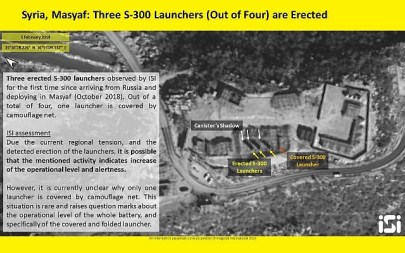
In February, an Israeli satellite imagery analysis company said that Syria’s powerful S-300 air defense system was “probably operational” in the area of Masyaf, where the recent strike reportedly occurred. The system would pose a potential threat to Israel’s aerial campaign against Iran in the country.

The firm, ImageSat International, based this assessment on multiple images of the anti-aircraft battery, which showed three of its four launchers in a raised position, signaling that they are likely ready to be used by the Syrian military.

Israel has threatened to destroy the S-300 system if it is used against its fighter jets, regardless of the potential blowback Jerusalem would face from Russia, which provided Syria with the powerful air defense battery.

Satellite photos released by ImageSat International appear to show three out of four missile launchers of the S-300 air defense system in the raised position in Masyaf on February 5, 2019. (ImageSat International)

Last month, Israel allegedly attacked Iranian targets near the northern city of Aleppo. SANA said at the time that the airstrike targeted several bases near an industrial zone by the airport and that air defenses had managed to intercept several incoming missiles.

Acting Foreign Minister Israel Katz appeared to confirm last month’s attack, saying in an interview with Israel Radio late last month that “as far as Iran knows, it’s Israel” that carried out the strike, and went on to say that it was a “challenging” operation.

The strikes come at a time of heightened tensions between Israel and Syria, following last month’s decision by the US administration to recognize Israel’s control over the Golan Heights it captured from Syria in 1967. The decision sparked condemnation and protests in Syria.

Israel in recent years has carried out hundreds of airstrikes in Syria against targets linked to Iran, which alongside its proxies and Russia is fighting on behalf of the regime of Syrian President Bashar Assad.

Israel has accused Iran of seeking to establish a military presence in Syria that could threaten Israeli security, and attempting to transfer advanced weaponry to the Hezbollah terror group in Lebanon.

AFP contributed to this report.


Iranian forces said killed in reported Israeli airstrikes on Syria military site

April 13, 2019

Source: Iranian forces said killed in reported Israeli airstrikes on Syria military site | The Times of Israel

London-based Syrian Observatory for Human Rights says 17 people injured in raid near city of Masyaf as jets target missile development center, training camp

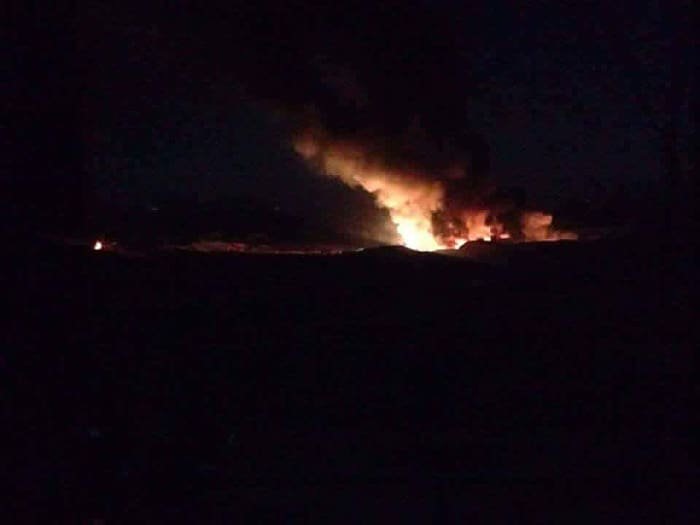
A screengrab circulating on social media purporting to show an alleged Israeli air strike targeting Iranian assets in the Syrian city of Masyaf on April 13, 2019. (Screengrab/Twitter)

A screengrab circulating on social media purporting to show an alleged Israeli air strike targeting Iranian assets in the Syrian city of Masyaf on April 13, 2019. (Screengrab/Twitter)

A number of Iranian forces were reportedly killed in an airstrike on a Syrian military position near the city of Masyaf in western Hama province overnight Friday-Saturday. Syrian state media said Israeli jets carried out the raid in the middle of the night, firing missiles while flying in Lebanese airspace.

Syria’s official state news agency SANA said Israel targeted a military site in the area, but that Syrian air defenses intercepted the attack, downing some of the missile fired. The regime mouthpiece said the interception resulted in the destruction of several buildings and the wounding of three “fighters.” The area is known to house Iranian forces and their Lebanese proxy, Hezbollah.

According to a report by the London-based Syrian Observatory for Human Rights in Arabic, Iranian “elements” and pro-Iranian militants were killed in the alleged attack, and 17 people were injured.

Israel does not regularly comment on alleged strikes in Syria, though it has acknowledged some operations.

The Observatory said Saturday that the strike targeted a Syrian military college in the town and two buildings used by Iranian forces in nearby villages — a development center for medium-range missiles in Zawi and a training camp in Sheikh Ghadban.

Iran has been one of the top military backers of Syrian President Bashar Assad’s regime in the over nine-year-long civil war in the country, as has been its Lebanese proxy, the Hezbollah terror group.

SANA quoted a military source as saying on Saturday, “Around 2:30 am (2330 GMT Friday)… the Israeli air force carried out a strike targeting one of our military positions in the town of Masyaf,” adding that Syrian air defenses intercepted some of the missiles.

“The enemy missiles were dealt with and some of them were shot down before reaching their target, resulting in the damage of a few buildings and the injury of three fighters,” SANA said, according to a Reuters report.

Earlier, SANA had reported explosions in the area’s countryside.

Israel is said to have previously struck the area near Masyaf, home to a Syrian scientific research center. Western officials have long associated the Scientific Studies and Research Center near Masyaf, known as CERS, with the manufacture of chemical arms.

In July last year, Israeli jets reportedly targeted a missile production facility in Masyaf, where a leading Syrian chemical weapons and missile scientist was killed earlier that month in a car bombing attributed to Israel.

File: Satellite image of CERS facility near Masyaf (screen capture: Google Earth)

In September 2018, satellite photos published by an Israeli intelligence firm purported to show the establishment of an Iranian surface-to-surface missile factory in the area of Wadi al-Uyun, near Masyaf. The photos, which were shared by ImageSat International, were said to show a facility resembling Iran’s Parchin facility, which has been linked to the Islamic Republic’s ballistic missile and nuclear programs.

The site was likely not targeted due to its close proximity to a Russian S-400 anti-aircraft battery, which is considered to be one of the most advanced air defense systems in the world.

In February, ImageSat International said Syria’s powerful S-300 air defense system was “probably operational” in the area of Masyaf. The system would pose a potential threat to Israel’s aerial campaign against Iran in the country.

The firm based this assessment on multiple images of the anti-aircraft battery, which showed three of its four launchers in a raised position, signaling that they are likely ready to be used by the Syrian military.

Israel has threatened to destroy the S-300 system if it is used against its fighter jets, regardless of the potential blowback Jerusalem would face from Russia, which provided Syria with the powerful air defense battery.

Satellite photos released by ImageSat International appear to show three out of four missile launchers of the S-300 air defense system in the raised position in Masyaf on February 5, 2019. (ImageSat International)

Last month, Israel allegedly attacked Iranian targets near the northern city of Aleppo. SANA said at the time that the airstrike targeted several bases near an industrial zone by the airport and that air defenses had managed to intercept several incoming missiles.

Acting Foreign Minister Israel Katz appeared to confirm last month’s attack, saying in an interview with Israel Radio late last month that “as far as Iran knows, it’s Israel” that carried out the strike, and went on to say that it was a “challenging” operation.

The strikes come at a time of heightened tensions between Israel and Syria, following last month’s decision by the US administration to recognize Israel’s control over the Golan Heights it captured from Syria in 1967. The decision sparked condemnation and protests in Syria.

Israel in recent years has carried out hundreds of airstrikes in Syria against targets linked to Iran and Hezbollah.

Israel has accused Iran of seeking to establish a military presence in Syria that could threaten Israeli security, and attempting to transfer advanced weaponry to Hezbollah


Iran’s malign activities amid natures’ wrath- Jerusalem Studio 413 

April 12, 2019


Trump’s Golan move irks Lebanese who lay claim to land held by Israel 

April 12, 2019

Source: Trump’s Golan move irks Lebanese who lay claim to land held by Israel | The Times of Israel

Residents near border still hope to win Shebaa Farms from Israel, though some politicians say claims are an excuse for Hezbollah to retain weapons

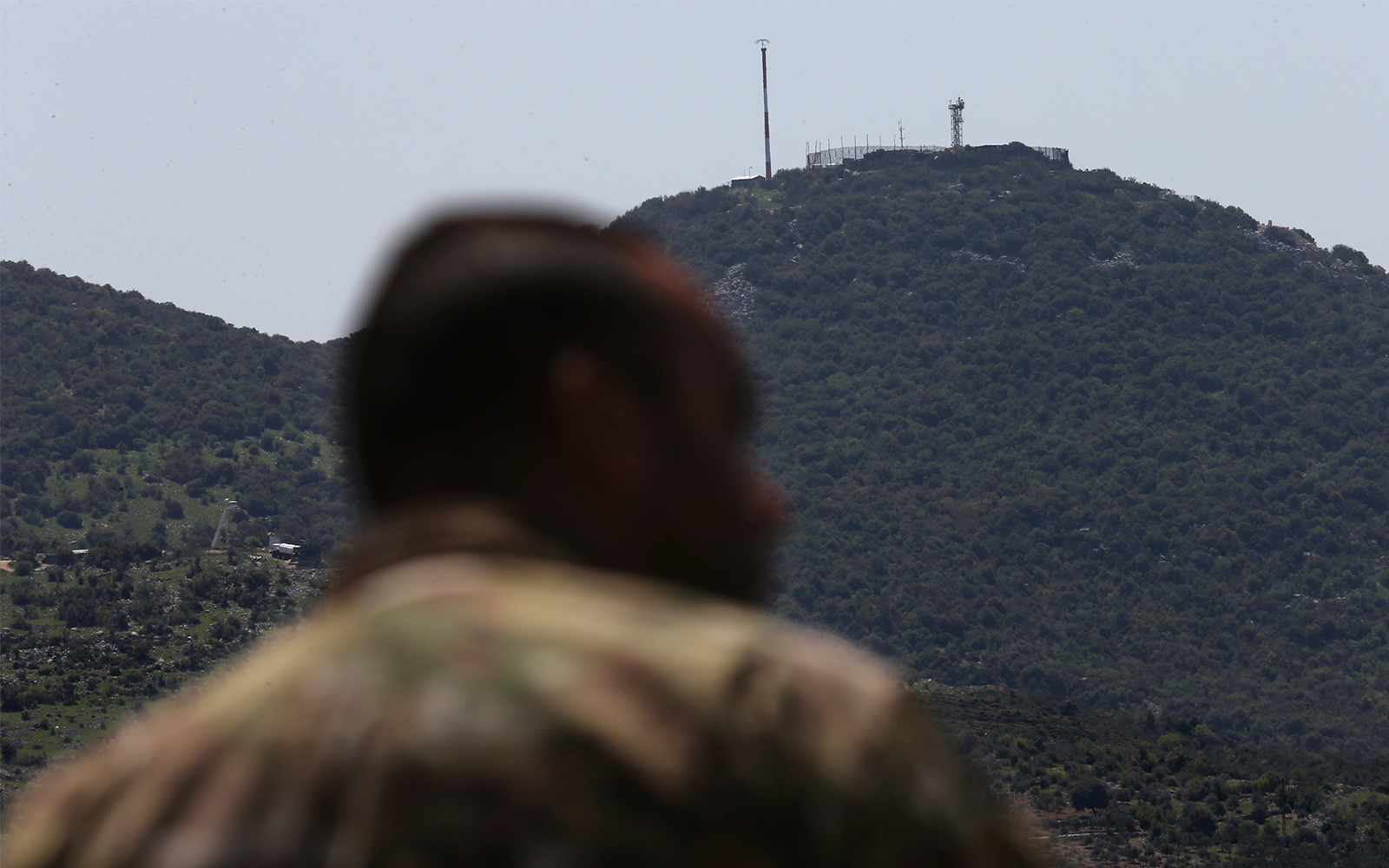
An Israeli military position is seen on a hill over Kfar Chouba, southeast Lebanon. April 9, 2019. (AP Photo/Hussein Malla)

An Israeli military position is seen on a hill over Kfar Chouba, southeast Lebanon. April 9, 2019. (AP Photo/Hussein Malla)

CHEBAA, Lebanon (AP) — Akram Kanaan looked toward an Israeli military position on a snow-capped mountain that overlooks the village of Chebaa in southern Lebanon, pointing toward the scenic area captured by Israel more than five decades ago. No matter how long it takes, he said, it will eventually return to Lebanon’s sovereignty.

Like many others in this area where the borders of Lebanon, Syria and Israel meet, Kanaan — a member of Chebaa’s municipal council — is angry about US President Donald Trump’s decision to recognize Israel’s sovereignty over the Golan Heights, seized from Syria in the 1967 Six Day War and effectively annexed in 1981. The American president had no right to give Israel lands that belong to Syria and Lebanon, he said.

“These are Arab territories that will be liberated sooner or later the way the south was liberated,” said Kanaan, standing near Chebaa’s main school as its buses left the compound at the end of a school day.

Trump’s move last month has caused concern among Lebanese officials that it would mean also recognizing Shebaa Farms and nearby Kfar Chouba hills, captured along with the Golan, as Israeli territory. Lebanese President Michel Aoun said the US recognition undermines Lebanon’s claim to the territory.
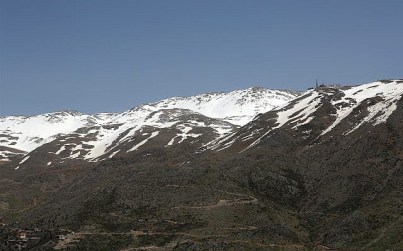
An Israeli military position, right, is seen on the top of Mount Hermon in the Israeli-controlled Golan Heights, where the borders between Israel, Syria and Lebanon meet. April 9, 2019. (AP Photo/Hussein Malla)

The origin of the dispute over ownership of the Shebaa Farms dates back to the French colonial period, when France drew maps of the area without officially demarcating the border.

Following an 18-year operation, Israel withdrew from south Lebanon in 2000, but held on to the farms. Hezbollah claimed the withdrawal to be incomplete and demanded, along with the Lebanese government, that Israel withdraw. Israel rejected the demands, saying the land was Syrian when it was captured in 1967. Syria has held an ambiguous position and generally refuses to demarcate the border before Israel withdraws from the Golan.

The UN, which doesn’t recognize Israel’s sovereignty over the Golan, has said Lebanon’s claim is to be settled along with the Golan’s fate.

The territory is controversial, even among Lebanese themselves.

Although most Lebanese agree that the Shebaa Farms and Kfar Chouba hills are part of their country, anti-Syrian politicians have suggested it serves as a pretext for Hezbollah to hang on to its weapons and have called for the demarcation of the Lebanon-Syria border, a demand repeated by Prime Minister Saad Hariri on Wednesday even as he said the territory is Lebanese.

Politicians allied with the Syrian government say there is no need for such demarcation.

The area this week looked more like a tourist attraction, albeit deserted, rather than a front line, with rivers and springs flowing, birds chirping and shepherds leading their herds in the mostly green area amid clear weather.

According to Kanaan, the total size of the Lebanese area still held by Israel since June 1967 is about 250 square kilometers (96 square miles) or about 2.5 percent of Lebanon’s total territories.

An Indian U.N. peacekeeper passes next his armored personnel carrier near Chebaa farms in southeast Lebanon, April 9, 2019. (AP Photo/Hussein Malla)

Kanaan said the area is owned by Lebanese citizens and that many of them have documents proving their ownership registered in the Lebanese coastal city of Sidon, the provincial capital of south Lebanon.

Arab countries have unanimously rejected the US recognition of Israeli control over the Golan, calling the Trump administration’s policies unfairly biased toward Israel.

On the edge of Chebaa, shepherds were seen taking their herds of sheep and goats near a fence built by Israel. About every 100 meters (109 yards) white and blue barrels marked the so-called blue line, or the border that the UN drew after Israel’s withdrawal in 2000.

The area has been calm since August 2006, after a UN Security Council resolution ended a 34-day war between Israel and Lebanon’s Hezbollah terror group.

Soldiers at Lebanese army checkpoints on roads leading to Chebaa and Kfar Chouba checked the identity cards of people visiting the area to make sure no strangers enter. White UN vehicles with light blue flags could be seen along the fence that marks the border.

Near al-Naqar lake, three UN peacekeepers stood outside their armored personnel carrier keeping an eye on any suspicious move. Next to them stood a giant poster with a picture of late Egyptian president Gamal Abdul-Nasser and one of his famous quotes that reads: “What was taken by force can only be regained by force.”
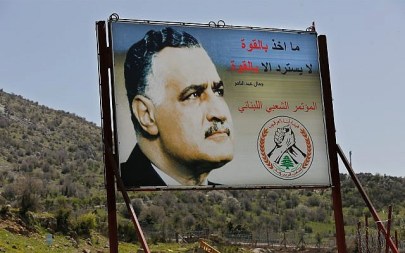
A poster shows the late Egyptian leader Gamal Abdul-Nasser, near Chebaa farms, southeast Lebanon. The text reads: “What was taken by force can only be regained by force.” April 9, 2019. (AP Photo/Hussein Malla)

Andrea Tenenti, spokesperson for the UN force in southern Lebanon known as UNIFIL, said the issue of Chebaa is one that is “discussed in New York at UN headquarters and not part of our mandate. Nevertheless, the position of member states is not necessarily the position of the United Nations,” Tenenti said when asked about Trump’s decision.

“Nothing has changed, and we are continuing with our work in the south of Lebanon, to monitor the cessation of hostilities and to work closely with the Lebanese army,” he said.

In nearby Kfar Chouba, shops were open in its main square where a group of people gathered at the main bakery, while others bought freshly picked vegetables and fruits.

“With deep regret, this guy who is called Trump who is the president of the United States of America, the most important country in the world, is acting like a thug,” said grocer Riad Khalifeh, who was 23 when Israeli forces captured the hills overlooking his hometown of Kfar Chouba in 1967.

“Who gave you the right to give a land that belongs to me or to Palestine or to Syria to an enemy that is occupying it?” Khalifeh asked.
 

US sanctions Lebanese group laundering Hezbollah money

April 12, 2019

Source: US sanctions Lebanese group laundering Hezbollah money | The Times of Israel

Network accused of laundering millions of dollars of drug money across multiple countries to help finance terror group

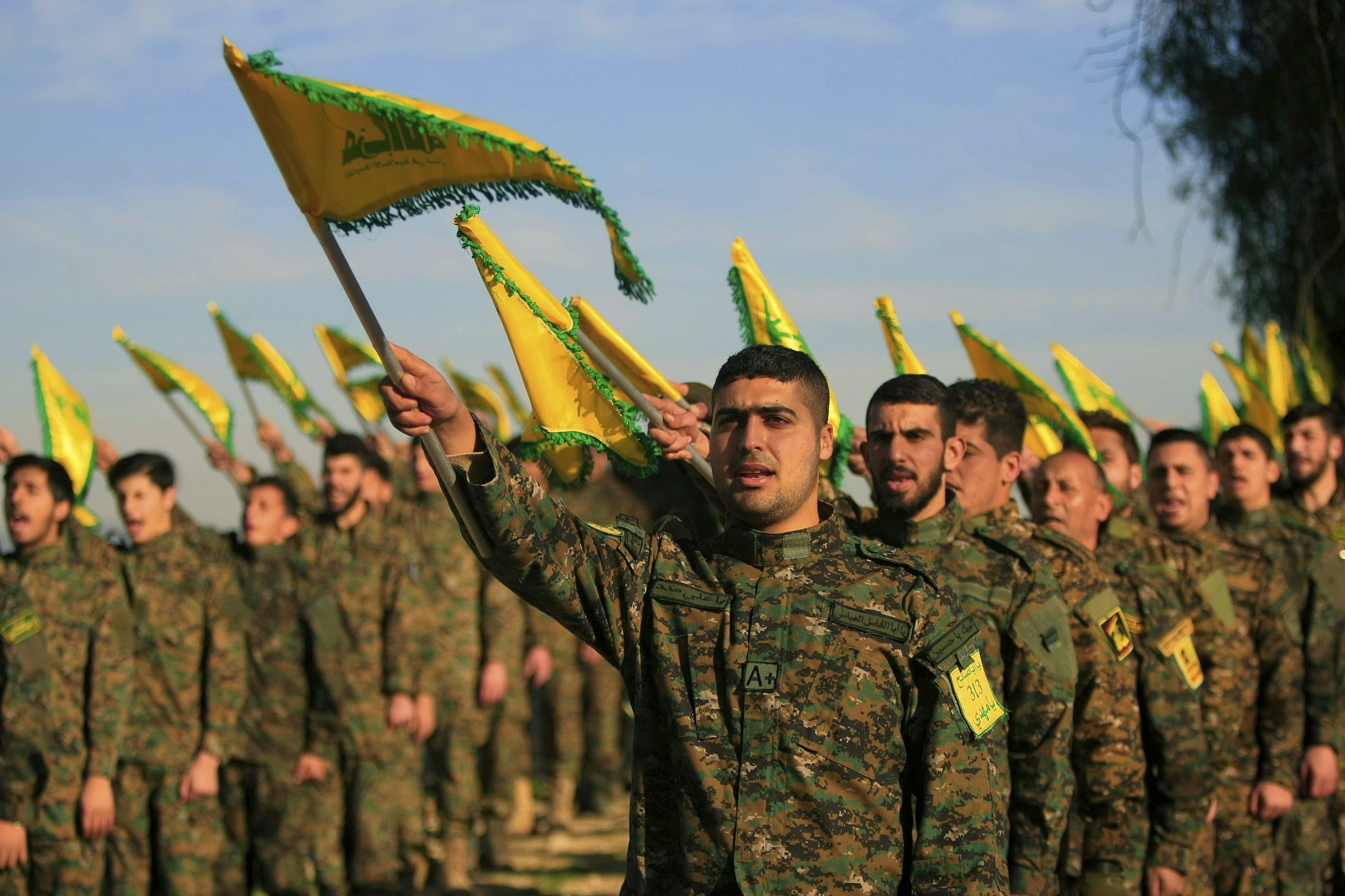
Hezbollah fighters hold flags, as they attend the memorial of their slain leader Sheik Abbas al-Mousawi, who was killed by an Israeli airstrike in 1992, in Tefahta village, south Lebanon, February 13, 2016. (Mohammed Zaatari/AP)

Hezbollah fighters hold flags, as they attend the memorial of their slain leader Sheik Abbas al-Mousawi, who was killed by an Israeli airstrike in 1992, in Tefahta village, south Lebanon, February 13, 2016. (Mohammed Zaatari/AP)

WASHINGTON – US officials on Thursday announced sanctions on a Lebanese network accused of laundering millions of dollars for “drug kingpins” and helping finance Hezbollah, the Iran-backed Shiite movement that Washington labels a terrorist organization.

The US Treasury Department said it has added Lebanese national Kassem Chams to its blacklist, along with two related entities: the “Chams Money Laundering Organization” and Chams Exchange, a money service business in Lebanon.

“Kassem Chams and his international money laundering network move tens of millions of dollars a month in illicit narcotics proceeds on behalf of drug kingpins and facilitate money movements for Hezbollah,” the Treasury said in a statement.

The Chams network moves money to and from multiple countries including Australia, Brazil, Colombia, France, Italy, Lebanon, the Netherlands, Spain, the United States and Venezuela, according to the department.

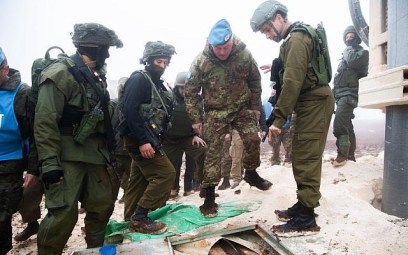
Israeli soldiers show UNIFIL commander Maj. Gen. Stefano Del Col a Hezbollah tunnel that penetrated Israeli territory from southern Lebanon, on December 6, 2018. (Israel Defense Forces)

The sanctions are part of the administration’s “unprecedented campaign to prevent Hezbollah and its global terror affiliates from profiting off violence, corruption, and the drug trade,” Treasury under secretary Sigal Mandelker said.

The department’s Office of Foreign Assets Control said Chams Exchange operates under license and supervision of the Central Bank of Lebanon (BdL) “despite US authorities long suspecting it” of significant money laundering.

The Treasury said it remains committed to working with BdL “to eliminate access to the Lebanese financial system by narcotics traffickers, money launderers, and terrorist groups such as Hezbollah.”

Israeli soldiers Nov. 4, 2009 unpack rockets seized by Israeli authorities on a ship near Cyprus that defense officials said was carrying hundreds of tons of weapons from Iran bound for Hezbollah. (AP/Tsafrir Abayov )

US President Donald Trump’s administration has accused Iran of taking provocative measures to destabilize the Middle East.

It has increased sanctions on the Islamic republic in order to undercut its revenues and to financially squeeze regional allies like the Lebanese Hezbollah.

Earlier this week Washington designated Iran’s elite Islamic Revolutionary Guard Corps as a terrorist organization.


Chanting ‘death to Israel,’ Iranians rally against US blacklisting of Guard 

April 12, 2019

Source: Chanting ‘death to Israel,’ Iranians rally against US blacklisting of Guard | The Times of Israel

Thousands of worshipers gather after Friday prayers, burning American and Israeli flags; Iranian general warns move puts US forces ‘in danger’

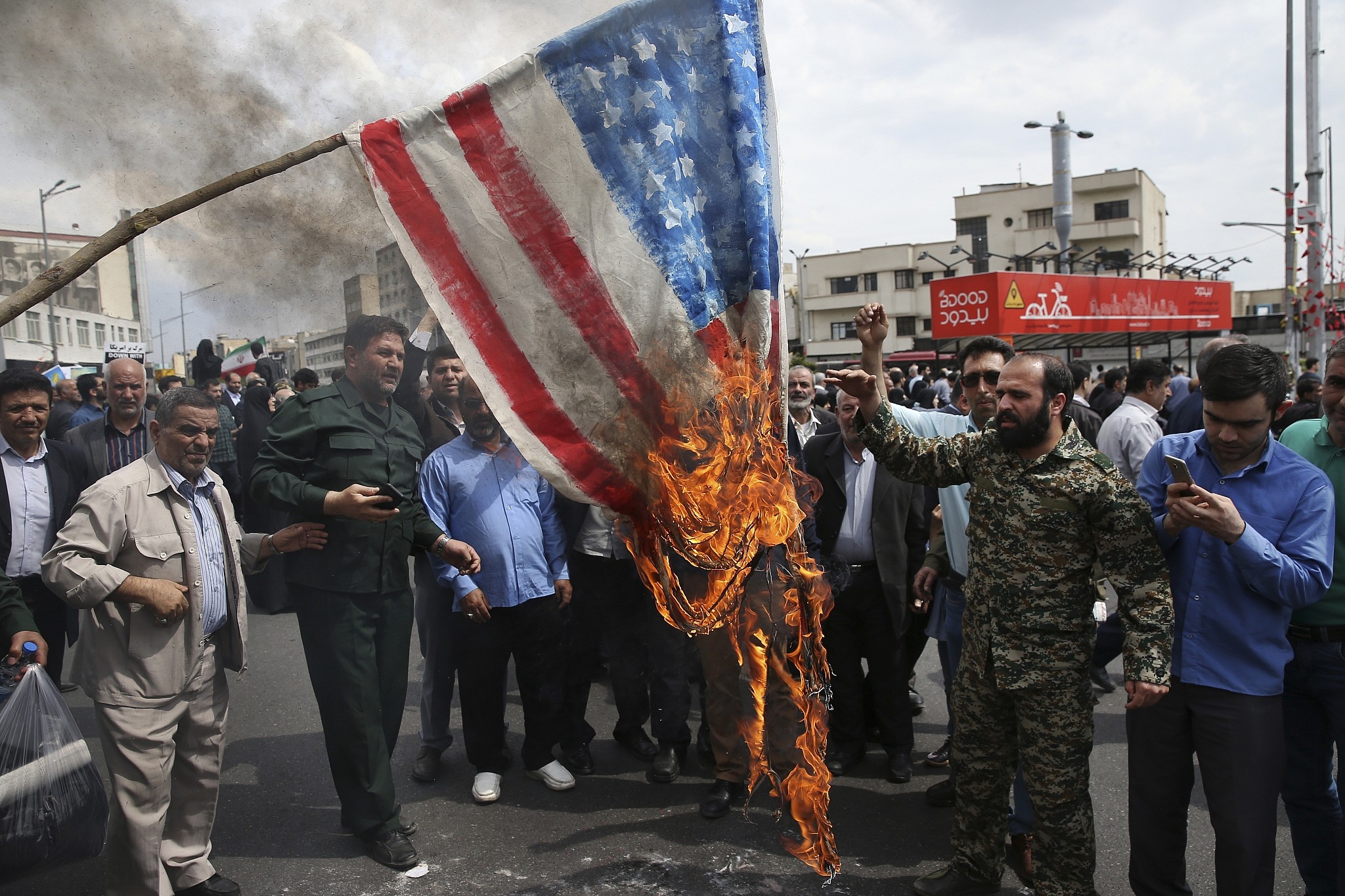
Protesters burn a representation of the American flag during a rally against the US's decision to designate Iran's powerful Revolutionary Guards as a foreign terrorist organization, after their Friday prayers at the Enqelab-e-Eslami (Islamic Revolution) square in Tehran, Iran on April 12, 2019. (AP/Vahid Salemi)

Protesters burn a representation of the American flag during a rally against the US’s decision to designate Iran’s powerful Revolutionary Guards as a foreign terrorist organization, after their Friday prayers at the Enqelab-e-Eslami (Islamic Revolution) square in Tehran, Iran on April 12, 2019. (AP/Vahid Salemi)

TEHRAN — Iranians rallied on Friday against the US’s decision to designate the country’s powerful Revolutionary Guards as a foreign terrorist organization.

Thousands of worshippers came out of mosques after prayers and burned flags of both the US and Israel while also chanting traditional anti-US and anti-Israel slogans at such rallies of “Death to America” and “Death to Israel.”

State media said similar demonstrations took place in other Iranian cities and towns on Friday.

The US government this week designated the Revolutionary Guard as a terrorist group to increase pressure on Iran, isolate it further and prompt authorities to divert some of the financial resources Tehran uses to fund militant activity in the Middle East and beyond.

اسماعیل الهام‌پی@Esi_elhampe

همه با هم پیر و جوان هم صدا با سراسر کشور لبیک به هشتگ دست در دست سبزپوشان حریم ولایت با پاسداری از انقلاب اسلامی بپردازیم

Iran responded by designating all US forces as terrorist and labeling the US a “supporter of terrorism.”

Also Friday, Foreign Minister Mohammad Javad Zarif sent a letter to the UN Security Council and Secretary-General Antonio Guterres stressing that Iran would hold the US accountable for any future provocations against the Iranian Revolutionary Guard Corps, or IRGC.

According to the state-run IRNA news agency, Zarif said the US and “several puppet governments will bear responsibility for dangerous consequences of the adventurism.”

“The provocative move will raise tensions to an uncontrollable level and increase threats in the region,” he said, adding that the Revolutionary Guard is at the forefront in fighting terrorism and extremism.

The commander of Iranian ground troops, Brig. Gen. Kioomars Heidari, said the US decision was self-destructive as the Americans “have put their own forces, particularly the US Central Command, in danger across the world.”

US President Donald Trump said his administration’s “unprecedented” designation “recognizes the reality that Iran is not only a state sponsor of terrorism, but that the IRGC actively participates in, finances, and promotes terrorism as a tool of statecraft.”

It was the first time that Washington has branded part of a foreign government a terrorist group, meaning that anyone who deals with the Islamic Revolutionary Guard Corps could face prison in the United States.

The Islamic Revolutionary Guard Corps was formed after the 1979 Islamic Revolution with a mission to defend the clerical regime, and the force has amassed strong power both at home and abroad. The Guards’ prized unit is the Quds Force, which supports Iran-backed forces around the region, including Syrian President Bashar Assad and Lebanese terrorist group Hezbollah.