Archive for April 2019

Israel’s national security adviser to meet with Bolton for Iran talks

April 15, 2019

Source: Israel’s national security adviser to meet with Bolton for Iran talks | The Times of Israel

Trump’s national security adviser says he and Meir Ben-Shabbat will discuss ‘shared commitment to countering Iranian malign activity and other destabilizing actors’

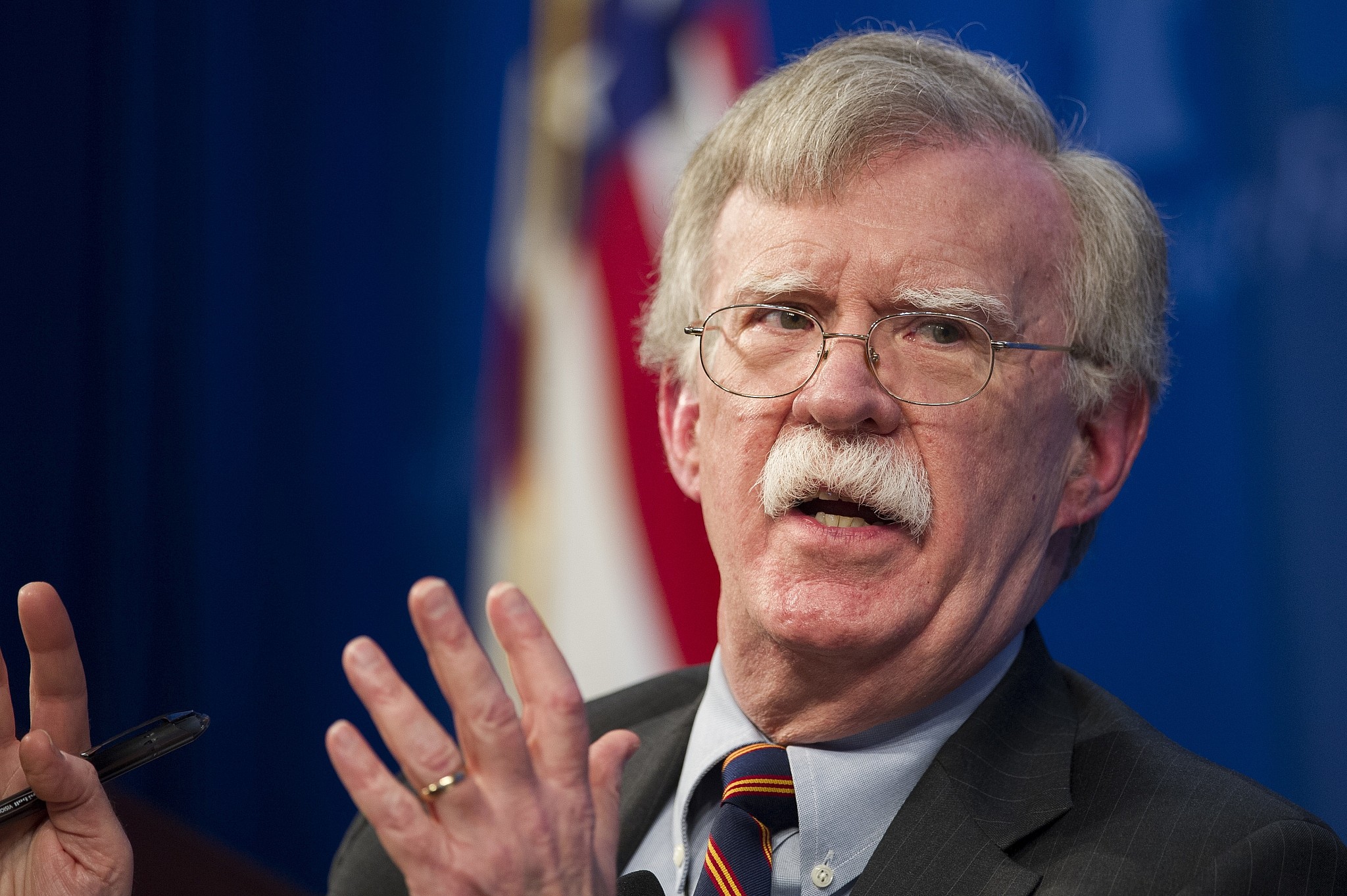
US National Security Advisor John Bolton unveils the Trump Administration’s Africa Strategy at the Heritage Foundation in Washington, December 13, 2018. (Cliff Owen/AP)

National Security Council head Meir Ben-Shabbat will meet with his US counterpart John Bolton on Monday in Washington to discuss Iran and “other destabilizing actors.”

Bolton tweeted Sunday that he and Ben-Shabbat will discuss their “shared commitment to countering Iranian malign activity & other destabilizing actors in the Middle East and around the world.”

The Kan public broadcaster reported that the two security advisers will also talk about the growing concern in the United States over Chinese investment in Israeli infrastructure projects.

US President Donald Trump last month reportedly warned Prime Minister Benjamin Netanyahu that if Israel does not curb its ties with China, its security relationship with the United States could suffer.

National Security Adviser Meir Ben-Shabbat. (Amos Ben Gerschom/GPO)

US Secretary of State Mike Pompeo similarly issued a stark warning to Israel that the close security ties between the two nations could be reduced over Jerusalem’s growing cooperation with Beijing.

Kan also reported the delegation for the trip to the United States includes senior officials from the defense and foreign ministries, as well as the IDF, Mossad and other bodies.

Known as a hawkish proponent of American military confrontation, Bolton has previously urged an attack on Tehran’s nuclear facilities.

Bolton visited Israel in January to reassure Jerusalem over Trump’s order for the withdrawal of American troops from Syria, vowing that Washington would remain “very supportive” of Israeli strikes against Iranian targets in the country.

Netanyahu on Sunday seemed to hint that Israel was responsible for an airstrike in central Syria over the weekend that reportedly targeted an Iranian-linked weapons factory.

Israel maintains that Iran is seeking to establish a military presence in Syria and attempting to transfer advanced weaponry to the Hezbollah terror group, its proxy in Lebanon and Syria.

In recent years, the IDF has carried out hundreds of airstrikes in Syria against targets linked to Iran, which alongside its proxies and Russia is fighting on behalf of the regime of Syrian President Bashar Assad.

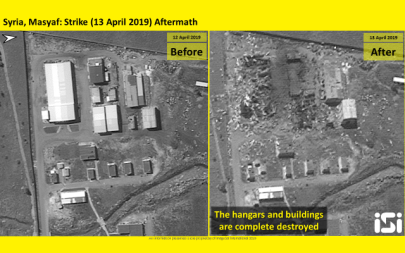
On Sunday, a satellite imaging firm released pictures of the aftermath of the Saturday morning raid that showed a large hanger and three adjacent structures flattened in the bombardment. ImageSat International said the missile facility targeted in the strike was built between 2014 to 2016, adjacent to an existing Syrian military base outside Masyaf.

Satellite photos released by ImageSat International shows the aftermath of an airstrikes attributed to Israel that targeted a Syrian military base in Masyaf in the Hama province on April 12, 2019. (ImageSat International)

The recent strikes come at a time of heightened tensions between Israel and Syria, following last month’s decision by the US administration to recognize Israel’s control over the Golan Heights. The decision sparked condemnation and protests in Syria.


The people have spoken. They want to live in Netanyahu’s Israel

April 15, 2019

Source: The people have spoken. They want to live in Netanyahu’s Israel | The Times of Israel

Israelis were not under-informed or unfairly swayed. They knew what they’d get with a 5th term of Netanyahu. The result was the highest vote ever for right & ultra-Orthodox parties

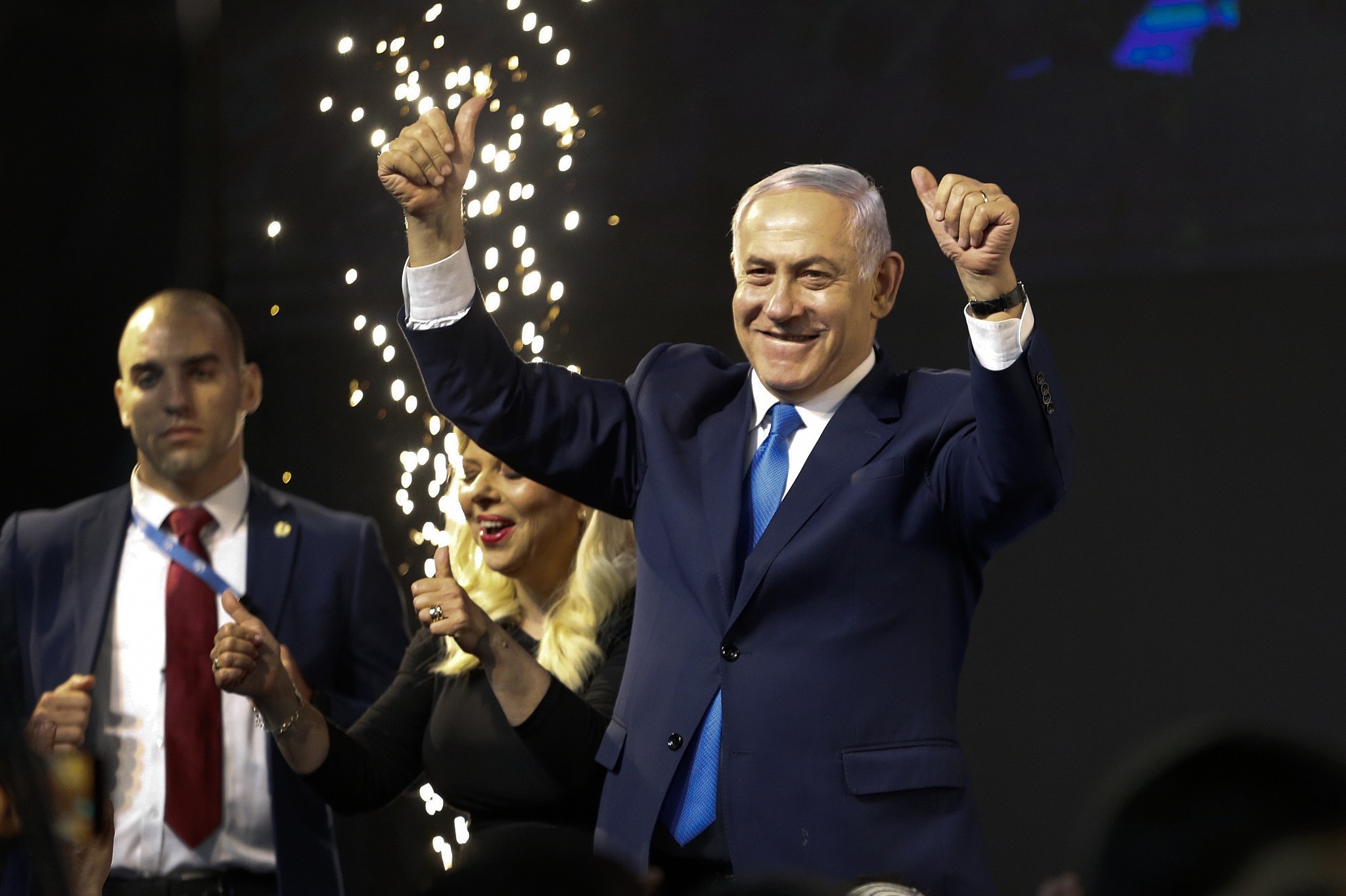
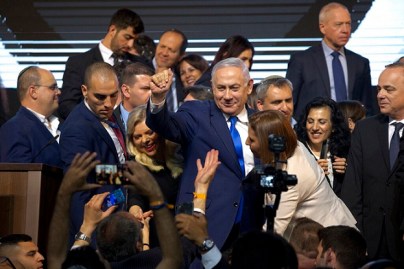
Prime Minister Benjamin Netanyahu waves to supporters at a victory event after polls for general elections closed in Tel Aviv,, April 9, 2019. (AP Photo/Ariel Schalit)

Prime Minister Benjamin Netanyahu waves to supporters at a victory event after polls for general elections closed in Tel Aviv,, April 9, 2019. (AP Photo/Ariel Schalit)

The people have spoken. And a week after the elections, with the president now in the midst of consultations with our newly elected politicians ahead of the formation of our next government, it’s worth taking a closer look at what the people actually said.

They knew that Benjamin Netanyahu was facing criminal charges in three cases, unless he could persuade the attorney general of his innocence. They knew that he had castigated the opposition, the media, the cops and the state prosecutors for purportedly seeking to frame him as part of a political vendetta to oust him. They knew that, if reelected, he might try to use existing or new legislation to avoid being prosecuted, and would likely seek to stay on as prime minister even if he were to be prosecuted. And that, if reelected, he would make the case that the public had given him a mandate to offset the state prosecutors’ recommendations that he be put on trial.

They knew. And 26.45% of the voting Israeli public chose Likud — a vast number, by Israeli standards, 1,139,079 out of the 4,306,520 legitimate ballots cast nationwide.

The people have spoken. Not all the people. But more than enough of them.

They knew that they had a clear alternative to four more years of a Netanyahu-led Israel, embodied in a party led by three former IDF chiefs of staff — an unprecedented assemblage of security expertise, in a country where security concerns always figure at the very top of voting considerations. They saw Netanyahu portray that party, Benny Gantz’s Blue and White, as a group of weak leftists. Even though it included Netanyahu’s own former Likud defense minister Moshe Ya’alon, whose public positions are more hawkish than those of Netanyahu, and even though Netanyahu in 2013 extended Gantz’s term as IDF chief by an additional year in the most overt illustration possible of the confidence he then had in Gantz’s security leadership capabilities.

Members of the Blue White political party Benny Gantz (second left), Moshe Yaalon (right), Gabi Ashkenazi (left) and Yair Lapid hold a press conference at the party headquarters in Tel Aviv, on April 10, 2019, a day after the elections. (Flash90)

They watched Netanyahu’s Likud depict Gantz as mentally unstable. They watched Netanyahu attempt to make political capital out of a bizarre saga involving the reported Iranian hacking of Gantz’s phone — a saga in which Gantz and his colleagues did not provide a clear-cut explanation of what had gone on. They watched Gantz veer between an attempted statesmanlike, high-ground approach to beating Netanyahu and a lower-ground trading of insults and accusations.

They watched Netanyahu broker a deal that legitimized the Kahanist Otzma Yehudit party as part of a new Union of Right-Wing Parties that would partner Netanyahu in any new Likud-led coalition. They watched URWP’s Bezalel Smotrich declare he’d set his heart on becoming minister of education. They watched the New Right’s Ayelet Shaked vow to curb the power of the Supreme Court if she continued as justice minister.

They watched. And they made their choice. Very few voters from the right of the political spectrum threw their support behind Gantz and the other generals. While Blue and White also topped the million-vote count — 1,124,805 — much of its support came from the center and the now decimated Labor, and that wasn’t enough to thwart Netanyahu’s fifth election victory.

The people have spoken. Not all the people. But more than enough of them.

They recognized other likely and possible implications of another Netanyahu victory. He’d vowed in the final days of the campaign to extend Israeli sovereignty to all West Bank settlements — a move that, if realized, would have major consequences for what was once called the peace process. It was clear his most reliable coalition partners would be the two ultra-Orthodox parties, Shas and United Torah Judaism — on whose behalf he reluctantly froze the Western Wall compromise deal, and whose key agenda items include making Israel more Shabbat-observant and minimizing the number of young ultra-Orthodox males required to share the rights and responsibilities of military and national service.

Self-evidently, enough Israeli voters either share this agenda or are not deterred by it. Enough to hand Netanyahu another term.

The people have spoken.

Residents of the Gaza envelope communities of southern Israel have for years complained about Netanyahu’s policies in dealing with Hamas. They have protested that the government has turned them into rocket fodder. Sderot, the most rocket-battered city of all, voted 43.52% for Netanyahu’s Likud. (The next most popular party was Yisrael Beytenu at 10.14%.) To the east of Gaza, Netivot voted 32.46% Likud (second only to 33.35% Shas.) Ashkelon, to the north, voted 42.61% Likud (followed by Blue and White at 15.62%). By contrast, kibbutzim and moshavim in the Gaza periphery area generally voted overwhelmingly for Blue and White.

The people have spoken.

Early on election day, reports started circulating about Likud-paid activists bringing hidden cameras into polling stations in Arab areas. Some of those involved have since acknowledged that they were indeed acting on behalf of Likud; a PR agency has claimed responsibility, saying it was hired by Likud; the Likud party’s lawyer, on the day, claimed the operation was open and legal, and necessary to ensure the “integrity” of the vote in districts ostensibly prone to voter fraud; Netanyahu himself championed the use of public cameras for the same purpose. (Needless to say, the Central Elections Committee has its own, nonpartisan procedures for preventing election fraud.) In fact, ruled the judge overseeing the elections, the deployment of the cameras was illicit; the equipment was ordered removed.

Israel’s voters watched and read about all these developments in real time.

Some analysts have suggested that the camera gambit depressed Arab turnout — it’s not comfortable showing up to do your democratic duty, as members of a minority that was traduced by the prime minister on the previous election day, when you hear on the news that you’re going to be filmed in the process by his supporters. Arab turnout does appear to have been down last week (an estimated 52%) as compared to 2015 (an estimated 63.7%). And while the Joint (Arab) List won 13 seats in the last Knesset, its constituent parties, now running in two separate lists, managed only 10 this time.

But if the camera ploy worked to Netanyahu’s advantage, possibly costing his political rivals a seat or three, and maybe boosting support for a Likud seen to be taking on the Arabs, there was a more dramatic arithmetical factor on the right-hand side of the spectrum that worked against him. Between Naftali Bennett and Ayelet Shaked’s New Right (138,491 votes, or 3.22% of the national total) and Moshe Feiglin’s Zehut (117,670 votes; 2.73% of the national total), a staggering 6% of right-wing votes went down the drain — a potential six or seven more Knesset seats for a Netanyahu-led coalition. And yet Netanyahu still has a clear, if complex, path (involving reconciling the ultra-Orthodox parties with the fiercely secular Avigdor Liberman’s Yisrael Beytenu) to a 65-strong coalition.

Over 57% of counted votes went to right-wing and ultra-Orthodox parties (Likud; Shas; UTJ; Yisrael Beytenu; United Right-Wing Parties; Kulanu; The New Right; Zehut, and Gesher). This is the highest proportion in Israeli history. Only 34% went to centrist and left of center Zionist parties (Blue and White, Labor and Meretz).

The two ultra-Orthodox parties, it is worth noting, had repeatedly stressed in the run-up to polling day that they would only consider joining a Netanyahu-led coalition. Even when the polls closed and for a brief moment Gantz was claiming victory on the basis of a predictably inaccurate exit poll, UTJ rushed to say that it would go into the opposition with Netanyahu rather than partner with Gantz.

Menachem Begin, center, speaks to supporters at his party headquarters in Tel Aviv, on May 18, 1977, as they celebrate the Likud Bloc’s election to government after 29 years of Israeli Labor Party rule. (AP Photo)

By way of comparison, the 2015 elections saw over 56% voting for right-wing and ultra-Orthodox parties (Likud, Kulanu, Jewish Home, Shas, Yisrael Beytenu and Yachad). In 2013, the comparable figure was 48% (Likud, Jewish Home, Shas, UTJ, Otzma LeYisrael). In 2009, it was 54% (Likud, Yisrael Beytenu, Shas, UTJ, National Union and Jewish Home).

Going way back to 1977, when Menachem Begin’s Likud first won power, the comparable proportion was about 53% — and that’s including the then-relatively centrist National Religious Party, which had partnered with Labor-led governments for the past three decades.

The people have spoken.

Were some worried by Gantz’s warnings that Netanyahu is turning Israel into Turkey — becoming our un-oustable leader, gradually marginalizing opposition, taking control of ever more of the media, bending the cops and the prosecutors and the courts to his will? Doubtless, many were. But not enough to unseat him.

Prime Minister Benjamin Netanyahu holds a voting slip for his Likud party in a video filmed at a beach in Netanya on election day, April 9, 2019. (Screen capture: YouTube)

The people saw Gantz caught by a camera in his car, toward the end of election day, looking exhausted. They saw Netanyahu, sweating in his suit on the beach at Netanya, imploring potential supporters to get out of the sea and vote Likud.

The people saw everything, internalized what they chose to internalize, and made their decision. No nefarious forces, as far as we know, skewed these elections. The public was not under-informed; nor was it disaffected. The turnout was a healthy 67.8% (compared to 61.4% in the 2016 US presidential elections, or 66.1% in 2015’s British parliamentary elections).

The people want to live in Benjamin Netanyahu’s Israel.

The people have spoken. Not all the people. But more than enough of them.

Israelis’ choice. Israelis’ consequences.


A victory for the Netanyahu paradigm 

April 15, 2019

Source: A victory for the Netanyahu paradigm – www.israelhayom.com

Israeli voters have embraced Netanyahu’s view that the territorial concessions and a peace process are not the key to making Israel stronger. Gantz’s loss proves that the Left cannot successfully obscure its views.

The people around Prime Minister Benjamin Netanyahu were well aware of the dire situation. Just after 4 p.m., after Netanyahu had gotten the impression that things were truly out of control, he took to Facebook and aired live videos showing his angst over people failing to vote, imploring them to go to the nearest voting booth.

The schedule he had for the remaining hours of Election Day was scrapped and instead, he became fully invested in energizing grassroots activists. It was as if Netanyahu was Shimon Peres in 1996.

Back then, in the afternoon hours of Election Day, Peres had come to the realization that despite being a shoo-in for another term according to the polls, something was not right. Something big.

Peres realized that his voters had simply decided to stay home and refused to heed the party headquarters’ pleas to go out and exercise their right to vote. Peres then decided to go to the party headquarters and started calling activists as if he were a low-level campaign official and his facial expression said it all: He was worried.

Netanyahu, unlike Peres, was not worried about losing because he knew he would still be able to form a coalition no matter what happened, but he was worried that Blue and White would get more seats than Likud and the media would simply launch an all-out assault against him to ensure that President Reuven Rivlin would have an excuse to give Blue and White leader Benny Gantz the first shot at forming a government and deny him a fifth term.

This was not unlike what Netanyahu felt in 2009. Back then, after Kadima had gotten one more seat than Likud,  he was convinced that then-President Shimon Peres would go out of his way to task the centrist party with forming a government. But Netanyahu pre-empted this by clandestinely forming a de facto coalition of 65 MKs, essentially forcing Peres’ hand.

In the midst of the nerve-wracking drama on Election Day, there was some relief when his old friend Rabbi David Nachshon called him.

“I am calling to inform you that you have nothing to worry about. The late Lubavitcher rebbe told you that you have nothing to worry about because God would always be on your side if you chose the right path even if all other MKs were against you.”

A large smile appeared on Netanyahu’s face and he replied, “Not only were 119 MKs against me but world leaders were against me until recently; I have withstood enormous and unprecedented pressure for the people of Israel.”

The rabbi retorted: “You will continue doing great things for the people of Israel; you have the rebbe’s promise: You will win today.”

The fundamental reason for Netanyahu’s victory this week, which is also the reason for his rivals’ failure, is purely ideological. Netanyahu is the first leader in several decades to position Israel as a force to be reckoned with on the diplomatic stage.

He has done this with unprecedented success and without holding peace talks with the Arabs over territory, a mirror image of the Left’s paradigm that peace talks are key to diplomatic stature.

The Left has long warned, even during Netanyahu’s years as prime minister, that Israel would become an international pariah if it refused to hold talks with the Arabs and that a “diplomatic tsunami” would hit us if we did not change course.

However, Netanyahu called the Left’s bluff. Not only has he shown that there was no point in handing over territory to the Arabs, but he has also managed to make himself a member of an elite club of leaders of major powers, alongside Donald Trump, Vladimir Putin and Angela Merkel. He has done that over the course of 10 years without even once sitting down to hold peace talks with the Arabs.

Gantz tried to obscure his unpopular ideological views but he failed to convince a single person that he shared Netanyahu’s view that there was no point in holding negotiations with the Palestinians. He could not utter the phrase, “I will not evict a single settler.”

He also gave up on any traditional Jewish theme to his campaign. He may be slightly more traditional than Netanyahu in private, but while Netanyahu kept mentioning his love of Judaism and its followers, Gantz’s campaign advisers forgot to present voters with their candidate’s Jewish side in the few months he got national exposure.

This meant that Gantz’s campaign only appealed to one side of the political divide, a side that may have many seats but lacks a majority among the public. This election, like the one in 2015, proved that you cannot fake your way to victory, you cannot obscure your views and say there is no difference between Left and Right and just assume people accept this as gospel.

Gantz failed to provide even one good reason for why right-wing voters should abandon Netanyahu and park their vote with him. His main message, perhaps the only one he actually campaigned on, was that he was not plagued with corruption, unlike his rival (allegedly). However, Netanyahu knew how to communicate with his voters in a way that Gantz could not.

When Gantz pressed hard in the campaign to implicate Netanyahu in the so-called “submarine affair,” he failed to realize that he was stepping on a land mine. His was so eager to besmirch Netanyahu over his alleged role in that affair that he failed to realize that no one was listening to him except the voters he already had.

The other side was ignoring the noise he and others in Blue and White were making all across Israel in virtually every studio. Not only that; it appears that Gantz’s constant pounding only antagonized Netanyahu voters who were holding back their anger.

There was a feeling that law enforcement officials were clandestinely doing all they could to unseat politicians who were not falling into line with their agenda. This feeling was no longer just limited to people who believe in conspiracies, it had permeated most of the Right.

The investigations into Netanyahu only intensified that feeling of injustice and persecution to a degree that was never seen before. Voters, who took great offense from the attorney general’s inclination to indict Netanyahu, the ongoing allegations against Netanyahu regarding the submarine affair and the various other accusations on his finances, decided to express this sentiment at the ballot box.

In fact, this feeling has now permeated the Left as well. Attorney Danny Cohen has served in a host of positions in the Labor party, including as its chief legal counsel. In 1996, he voted for Peres, and voted for Labor in every election since. That is, until this Tuesday. For the first time in more than 20 years, he voted Likud.

“I have never been a Netanyahu fan,” he told Israel Hayom. “And even though I appreciate his work on the world stage, I didn’t vote for him because of this. I voted for him this time, despite the hard feeling, because I could no longer tolerate the fact that law enforcement agencies had simply gone off the rails in their quest against him. Someone must restrain them.”

A day after the election, Blue and White held a meeting at the bloc’s headquarters. The melancholy among the newly elected MKs was palpable.

They were asked to place their phones outside the room. After making a statement, Gantz asked everyone to speak from their heart, with comments on what they should do next. It was like an after-action report in the military.

Then Gantz and his co-chairman, Yair Lapid, talked with reporters outside. Each communicated a completely different, even contradicting, message.

Lapid shut the door on a unity government, vowing that Blue and White was going to serve in the opposition and would not creep its way into the cabinet but instead make Netanyahu’s life a living hell. Lapid is truly convinced that Netanyahu’s days as prime minister are numbered, perhaps six months at most, because of the potential indictment.

Gantz, who refused to hear what voters had to say a day earlier, was not as determined to serve on the opposition benches. He muttered a few words on the various scenarios that lay ahead but refused to commit himself to the opposition and to making Netanyahu’s life a living hell.

The fact that Gantz won 35 seats three months after just entering politics is very impressive, but this is meaningless if you cannot become prime minister. Only the final outcome matters.

Lapid wrongly assumed the largest party would get to form a government and Gantz followed along.

But this thesis was wrong on two levels: first, because it forced Gantz to campaign against other left-wing parties that would have been his natural coalition partners, while also undermining the possibility of striking a de facto alliance with Arab parties that would deny Netanyahu a governing majority; and second, because Gantz’s Blue and White failed to get more seats than Likud.

Gantz, deep down, probably wants to get the defense portfolio. Netanyahu will have to be loyal to his coalition partners on the Right but it would not be a stretch if Gantz eventually joined, along with 14 of his party members.

Netanyahu would be very happy to see Blue and White unravel into the three parties that formed it but will not actively try to trigger this. It will probably happen anyway because its members are not keen to spend their days in various Knesset committees as opposition MKs.

As far as Lapid is concerned, the bloc will stay intact and he will do his utmost to make sure there is a united opposition. Lapid will benefit regardless of what happens to Blue and White.

If everyone stays together, he would have a legitimate claim to the party’s leadership come the next election. If it disintegrates and Gantz joins the government with his loyalists, Lapid would automatically become the head of the opposition and the Left’s de facto challenger to Netanyahu.

Netanyahu wants stability and has already indicated that he would like to serve out his entire fifth term. The coalition agreements he will draft might include provisions that refer, explicitly or implicitly, to the scenario in which he stands on trial.

Netanyahu won’t have to seek special legislation to protect him, he could simply include a provision in the agreement that prohibits parties from leaving the coalition so long as Netanyahu can legally serve as prime minister (that is, until he had exhausted the appeals process).

The weakest link as far as he is concerned is Yisrael Beytenu. Party leader Avigdor Lieberman wants to exact revenge from Netanyahu, not just because of the circumstances that led to his departure from the Defense Ministry.

He wants revenge because of the reports that Netanyahu tried to keep him from entering the Knesset by courting Russian votes and spreading the rumor that he would not pass the electoral threshold. Lieberman went overseas a day after the election, as he has done before, leaving Netanyahu to his own devices.

Netanyahu needs Lieberman and he will likely be willing to pay the price for having him on board: the defense portfolio.

The real headache is getting Lieberman to stay on board once other coalition partners start pushing through measures to which he objects (chiefly among them, the haredi effort to modify the new conscription bill).

The next Knesset may be the one that finally passes legislation that clearly defines the powers of the executive and judicial branches in a way that gives the Knesset the final say on crucial matters.

Kulanu leader Moshe Kahlon has already indicated that he would support such a measure. Such legislation would also defuse the tension on the haredi conscription bill. After all, the reason it was drafted in the first place was that the High Court forced the Knesset to do so.

If the bill no longer has to meet the standards set by the High Court, then it can accommodate both Lieberman and the haredim and be approved at a pace that is comfortable for all coalition partners.

One of the most colossal mistakes of this election was the decision taken by Naftali Bennett and Ayelet Shaked, who decided to leave the helm of Habayit Hayehudi and form the New Right. The big surprise is not their failure to get any Knesset seats but the fact that practically every poll had them crossing the electoral threshold in the first place.

It was never quite clear whom they were courting and what votes they could count on. Yes, there are many who admire Shaked and Bennett, but why did they have the impression they would deliver them Knesset seats?

The New Right lacked a voter based, unlike Habayit Hayehudi, which could count on national religious voters.

Those who are not religious could vote for Likud and Kahlon, leaving Bennett in the lurch. He failed to convince voters that he could, and should, be defense minister.

Shaked had a good track record as justice minister but she failed to convince right-wing voters that she was better than the Likud’s Yariv Levin or Habayit Hayehudi’s Bezalel Smotrich. It appears that voters choose their party based on whom they would like to see as prime minister, not according to their preferred justice minister.

Labor officials were shocked just how arrogant Chairman Avi Gabbay could be. In his concession speech on Tuesday night, after it became clear that he had led his party to an electoral catastrophe, he had many things to say but not once did he own his failure.

Gabbay is not about to tender his resignation or change course, despite party activists demanding he do so now, more than a year before the party deadline.

Labor’s charter gives leaders about a year to stay on the job if they fail to win an election but the election outcome was no failure – it was a total meltdown.

Under their plan, MK Amir Peretz would assume the leadership position as an interim chairman, as he is the oldest MK in the party.

Peretz has yet to decide whether he would take that role (if offered), and this may have to do with his emerging bid to become president in two years, when Rivlin’s term ends.

 

US designation of IRGC as terror group risks escalation 

April 15, 2019

Source: US designation of IRGC as terror group risks escalation – www.israelhayom.com

The Iranian revolt, however, toppled not only an icon of U.S. power in the Middle East and a monarch, but also created an alternative form of Islamic governance that included a degree of popular sovereignty.

The stakes in the Middle East couldn’t be higher. Suspicion that America’s intent is to change the regime in Tehran, rather than the officially stated U.S. goal of forcing Iran to curb its ballistic-missile program and support for militias in Lebanon, Gaza and Yemen, was heightened with last week’s decision to designate the Iranian Revolutionary Guards Corps as a terrorist organization.

The move marks the first time that America has labeled a branch of a foreign government a terrorist entity, particularly in this case a branch that affects millions of Iranian citizens, among them conscripts for whom the IRGC is an option.

“Today’s unprecedented move to designate the IRGC as a foreign terrorist organization demonstrates our commitment to maximize pressure on the Iranian regime until it ceases using terrorism as a tool of statecraft,” tweeted U.S. President Donald Trump’s National Security Adviser John Bolton.

The designation effectively blocks Trump’s potential successor from returning to the 2015 international accord that curbed Iran’s nuclear program, complicates any diplomatic effort to resolve differences and changes the rules of engagement in theaters like Syria, where U.S. and Iranian forces operate in close proximity to one another.

“Through this, some U.S. allies are seeking to ensure a U.S.-Iran war or to, at a minimum, trap them in a permanent state of enmity,” said Trita Parsi, head of the National Iranian American Council, referring to Saudi Arabia and Israel.

The designation was likely to embolden advocates in Washington, Saudi Arabia and Israel of a more aggressive covert war against Iran that would seek to stoke unrest among the Islamic Republic’s ethnic minorities, including Baloch, Kurds and Iranians of Arab descent.

Both Saudi Arabia and Israel were quick to applaud the U.S. move. Israeli Prime Minister Benjamin Netanyahu, on the eve of a hard-fought election, claimed credit for the suggestion to designate the IRGC. The official Saudi news agency asserted that the decision reflects the kingdom’s repeated demands to the international community regarding the necessity of confronting terrorism supported by Iran.

The risk of an accident or unplanned incident spiraling out of control and leading to military confrontation was heightened by Iran’s response, which was to declare the U.S. military in the greater Middle East a terrorist entity.

The U.S. move and the Iranian response potentially put U.S. military personnel in the Gulf as well as elsewhere in the region in harm’s way.

The designation also ruled out potential tacit U.S.-Iranian cooperation on the ground as occurred in Iraq in the fight against Islamic State and in Afghanistan. That cooperation inevitably involved the IRGC.

Beyond geopolitical and military risks, the designation increases economic pressure on Iran because the IRGC is not only an army but also a commercial conglomerate with vast interests in construction, engineering and manufacturing. It remains unclear, however, to what degree the sanctions will affect the IRGC, which is already heavily sanctioned and does much of its business in cash and through front companies.

U.S. policy, even before the IRGC designation, had already raised the specter of a nuclear race in the Middle East. The designation increases the chances that Iran will walk away from the nuclear agreement. Saudi Arabia is already putting in place the building blocks for its own nuclear program in anticipation of Iran abandoning the agreement and returning to its full-fledged, pre-2015 enrichment project.

The IRGC goes to the heart of the Iranian regime. It was formed to protect the regime immediately after the 1979 revolution, at a time when Iran’s new rulers had reason to distrust the military of the toppled shah. Some of the shah’s top military and security commanders discussed crushing the revolution at a dinner on New Year’s Eve 1978, some six weeks before the shah’s regime fell. It was the shah’s refusal to endorse their plan that foiled it. The shah feared that large-scale bloodshed would dim the chances of his exiled son ever returning to Iran as shah.

The IRGC has since developed into a key pillar of Iran’s defense strategy, which seeks to counter perceived covert operations by the United States, Saudi Arabia and Israel by supporting proxies across the Middle East. This strategy has proven both effective and costly. That cost has been raised by Iran’s failure to address fears that the strategy is an effort to export its revolution and topple the region’s conservative regimes, particularly in the Gulf.

To be sure, the Iranian revolution constituted a serious threat to autocratic rulers. It was a popular revolt like those that occurred more than 30 years later in the Arab world. The Iranian revolt, however, toppled not only an icon of U.S. power in the Middle East and a monarch but also created an alternative form of Islamic governance that included a degree of popular sovereignty.

The revolution unleashed a vicious cycle that saw Gulf states fund the eight-year Iran-Iraq war in the 1980s, in which up to one million people died; Saudi Arabia wage a four-decade, $100 billion campaign to globally propagate ultra-conservative, anti-Shi’ite, anti-Iranian strands of Islam; repeated attempts to stoke ethnic tensions among Iran’s disgruntled minorities, and Iranian countermeasures, including support for proxies across the Middle East and violent attacks against Americans, Israelis, Jews and regime opponents around the world.

“Given that the IRGC is already sanctioned by the U.S. Treasury, this step is both gratuitous and provocative. It will also put countries such as Iraq and Lebanon in even more difficult situations as they have no alternative but to deal with the IRGC. It will strengthen calls by pro-Iran groups in Iraq to expel U.S. troops,” said Barbara Slavin, an Iran expert at Washington’s Atlantic Council.

This article is reprinted with permission from JNS.org.


Iran protests to France over diplomat’s nuclear comments 

April 15, 2019

Source: Iran protests to France over diplomat’s nuclear comments – www.israelhayom.com

Iran angry after French envoy claims “it’s false” to say Iran would be allowed to enrich uranium in 2025, after major restrictions expire.

Iran protested to France on Sunday over comments by the French ambassador in Washington concerning Tehran’s right to enrich uranium after 2025.

Tehran agreed under a 2015 deal with world powers to restrict its nuclear program in return for the lifting of sanctions that had crippled its economy.

Some of these limits are due to be removed after 10 years, and some others after 15 years.

However, U.S. President Donald Trump withdrew from the deal last year, saying one of the defects in the accord is that limits on the Iranian nuclear program start to expire.

On Saturday, France’s ambassador to the United States, Gérard Araud, said on Twitter: “It’s false to say that at the expiration of the JCPOA (the nuclear deal), Iran will be allowed to enrich uranium,” adding that sanctions could be reimposed.

Iran says its nuclear program is for peaceful energy and medical purposes and that it has the right to process uranium for reactor fuel under the Nuclear Non-Proliferation Treaty, a global pact to prevent the spread of atomic arms.

Iranian Deputy Foreign Minister Abbas Araqchi said Araud’s comments were “a major violation of the object and purpose of the JCPOA,” adding they needed “immediate clarification by Paris, or we act accordingly.”

Iran also protested to the incoming French ambassador in Tehran, who had just handed his credentials to the government.

Araud, who previously took part in nuclear talks with Iran, is due to retire on April 20. His comments about Iran were not visible on his Twitter account a few hours after Iran’s protest.

The French government was not immediately available for comment.

Other signatories to the nuclear deal, Britain, China, France, Germany and Russia, are still trying to salvage the accord, despite the U.S. withdrawal.

France, Britain and Germany have set up a new mechanism for non-dollar trade with Iran to counter renewed U.S. sanctions.

Foreign Minister Mohammad Javad Zarif complained on Sunday about the delay in the implementation of the mechanism, urging Europe to make it operational as soon as possible.


Belarusian, North Korean missile engineers killed or injured in Israel’s air raid of Masyaf – DEBKAfile

April 15, 2019

Source: Belarusian, North Korean missile engineers killed or injured in Israel’s air raid of Masyaf – DEBKAfile

The Israeli air strike on the Scientific Studies and Research Center in the Syrian town of Masyaf on Saturday, April 13,  is reported by Western intelligence sources to have killed and wounded in addition to Iranian and Syrian military officers, a number foreign missile experts hired to upgrade their missiles.

Among them were missile scientists from Belarus and North Korea who were employed in different departments of the large industrial complex outside Masyaf in western Syria. Those sources disclose that, whereas Israeli has raided the complex before, this time the attack was massive and, unlike before, gutted most of its installations. Especially targeted were the sections working on the upgrade of Syrian and Hizballah surface missiles, the production of solid fuel for those missiles and the departments focusing on installing new guidance instruments to enhance their precision. North Korean engineers were working on the production of solid fuel, while Belarusians were in the pay of Syria’s Organization of Technological Industries. Behind the fancy title is an organization that specializes in breaking the UN-US embargo against the employment of expert manpower in Syria’s military production and the sale of military hardware to the Assad regime. Most of the Belarussians working at Masyaf were provided by the Belvneshpromservice whose military ties with Damascus go back years. On Feb. 27, Israel struck Iran’s newly established command centers and weapons stores in Aleppo.


Off Topic:  Democrats’ war on Netanyahu isn’t compatible with a pro-Israel stance 

April 14, 2019

Source: Democrats’ war on Netanyahu isn’t compatible with a pro-Israel stance – www.israelhayom.com

By seeking to override or ignore the will of Israeli democracy, they are accelerating the breakdown of the rapidly eroding bipartisan consensus in favor of the Jewish state.

When leaders of Tammany Hall – the legendary Democratic machine that ran New York City for more than a century – would be confronted with an occasional electoral setback, their usual response was to deride it by claiming that if their handpicked candidates didn’t win, then “it ain’t democratic.”

That’s pretty much the reaction of much of the Democratic Party to the results of Israel’s election. Prominent Democrats have greeted the victory of the man who was the bitter foe of President Barack Obama and, just as bad, the close friend and ally of President Donald Trump with a mixture of dismay and horror.

We’re all entitled to our opinions about the outcomes of elections. But this revulsion on the part of Democrats for the democratically expressed will of the Israeli people is likely to widen the divisions in their party about attitudes regarding the Jewish state. Even more troubling is that it increases the likelihood that support for Israel will be an issue in the 2020 presidential election. That will accelerate the crackup of what is already a rapidly eroding bipartisan coalition in favor of Israel.

The key talking point for pro-Israel Democrats for the last 25 years has been the claim that Republicans are undermining the bipartisan pro-Israel consensus by seeking to portray themselves as better friends to the Jewish state than their opponents. This is a somewhat dubious argument because the main purpose of such claims was to distract voters from the fact that the left wing of the Democratic Party was drifting towards being either highly critical or downright hostile to Israel.

But with Netanyahu being re-elected for a fourth consecutive term, more and more Democrats are dropping the pretense that we all still agree about Israel, and instead are adopting stances that condemn the prime minister as someone who is unworthy of support, or even more, assert that they know better about what is good for Israel than the Israelis.

There isn’t anything new about this since it was, in essence, the way the Obama administration regarded Israel throughout its eight years in office. Obama believed not only that more “daylight” between the two allies was better for Israel than steadfast support, but also that the Jewish state needed to be “saved from itself” with respect to the conflict with the Palestinians. He was just as indifferent to Israel’s credible fears about efforts to appease Iran via a one-sided nuclear deal.

Yet when faced with Obama’s changes of U.S. foreign policy that were clearly aimed at undermining the alliance with Israel, most Democrats chose not to protest.

The arguments about what it means to be pro-Israel have only grown more divisive since Trump took office. Acknowledging the truth that Trump is the most pro-Israel president to date is a difficult pill for Democrats, who despise the president, to swallow. So rather than concentrate their fire on other issues, many simply argue that supporting Israel and respecting the will of its voters represent betrayals of the alliance. This takes the form of bogus claims that Netanyahu’s election is a sign of a decline of Israeli democracy, rather than an expression of it.

That this is absurd and illogical doesn’t deter them. Some of their points are also deeply hypocritical. Suffice it to say that no matter what you think of Netanyahu’s electoral maneuver that enabled supporters of the late Rabbi Meir Kahane to join another electoral list (though in the end, those Kahanists were not elected to the Knesset), Democrats who don’t mind rationalizing the behavior or benefiting from the votes of anti-Semitic, BDS-supporting colleagues like Reps. Ilhan Omar (D-Minnesota) and Rashida Tlaib (D-Michigan) have no standing to criticize him on this issue.

More importantly, their position is rooted in the even more outrageous notion that Democrats understand the conflict with the Palestinians better than the Israeli people.

It’s important to remind those who make this argument that the Israeli political parties that clung to the illusion that Obama was right about the Palestinians and the two-state solution – namely, Labor and Meretz – got approximately 8.25% of the vote on April 9. They have been discredited by the reality of Palestinian intransigence that has somehow evaded the notion of Israel’s Democratic critics.

In 2020, the odds are that whoever it is the Democrats nominate will be someone inclined to bash Netanyahu and to treat the judgment of Israel’s voters about their security with disdain. This means that Israel will become a campaign issue for Trump, who will highlight his support for the Jewish nation, a position that is still backed by a clear majority of Americans.

Once this issue becomes fodder for campaign rhetoric from both sides, it will be a mortal blow to the pro-Israel consensus. And if the Democrats win, it will mean U.S.-Israel relations in the years that follow will make the spats between Obama and Netanyahu look like a picnic.

Democrats will try to blame this on Trump, but as with Obama’s stance on the Palestinians and Iran, such arguments will be utterly disingenuous. If Democrats want to preserve the pro-Israel consensus, then they need to be supportive of Israel, understanding of its exterior and interior security dilemmas, and respectful of the democratically expressed will of its people. More to the point, they cannot make common cause with those who seek – as some on the left wing of the Democrats do – to delegitimize or oppose the existence of Israel.

If Democrats can’t manage to respect Israel’s voters or refrain from seeking to override their judgment, they shouldn’t complain about the demise of a consensus that they themselves have chosen to abandon.

This article is reprinted with permission from JNS.org.


Acceptance of Israeli action in Syria 

April 14, 2019

Source: Acceptance of Israeli action in Syria – www.israelhayom.com

The Russians and the Syrian regime, albeit more discreetly, have reservations about Iran’s presence in the country. The sense in Israel, therefore, is that a window of opportunity now exists for pushing Iran out of Syria or at least significantly minimizing its activities there.

The attack attributed to Israel’s air force early Saturday indicates that Israeli policy in Syria hasn’t changed now that the elections are over: No to Iranian entrenchment, and no to precision missiles in the hands of Hezbollah.

The target, according to Syrian media outlets, was located in the city of Masyaf, in Hama province. The Israeli air force, the reports said, has attacked various facilities, used by Iranian forces, in the same area at least five times over the past two years.

This time, it appears, the main target was the site where the Iranians have manufactured precision missiles for Hezbollah. We can assume the missiles were earmarked for transfer to Lebanon although Iran also intends to arm its other Shiite militias operating in Syria with similar missiles.

Hezbollah’s precision missile project, which Iran is carrying out, lies at the heart of Israeli activity in recent years. Iran wants Hezbollah to have precision capabilities – Prime Minister Benjamin Netanyahu, last year, mentioned a precision radius of approximately 10 yards – and simultaneously extend the range of some of the terrorist group’s missiles. Israel has already been blamed for several attacks on facilities where this activity is occurring, including the attack last September in western Syria that triggered the chain of events which led to the downing of a Russian spy plane by Syrian army air defenses.

The attack early Saturday morning went smoothly from an Israeli perspective – neither Syria nor Russia responded in a significant manner. We can glean from this that Russia has come to terms, for now, with this activity, as long as it doesn’t endanger Russian forces stationed in Syria. The Israeli air force is likely taking pains to avoid, as much as possible, any friction with Syrian surface-to-air batteries, in order to circumvent further scenarios that could spark another diplomatic clash with Russia.

Israel’s policy of being proactive against Iran and its proxies is also unlikely to change for the time being. Regardless, the new government – and the next defense minister – will have to re-examine this activity within the context of new developments in Syria as it concludes its eight-year civil war; along with possible Iranian military intervention in Iraq and efforts to relocate its precision missile factories to Lebanon. In the past year, Israel has exposed four such factories – three of these, which were built secretly in Beirut, were revealed by Netanyahu in his speech to the U.N. General Assembly. The fourth factory, according to various news outlets, was reported in March to the Americans, who addressed the matter with the Lebanese government.

The sense in Israel is that a window of opportunity now exists for pushing Iran out of Syria or at least significantly minimizing its activities there. This window, beyond Russian reservations over Iranian activity (not to mention the Syrian regime’s own reservations, although these aren’t voiced publicly), is open because of American support and last week’s designation of Iran’s Revolutionary Guards as a terrorist organization by the Trump administration. The hope in Israel is that a combination of military, diplomatic, economic and media-related activity can now thwart Iran’s machinations.


The Arab world and Israel’s election

April 14, 2019

Source: The Arab world and Israel’s election – www.israelhayom.com

Netanyahu’s re-election hasn’t sparked any discernible uproar and we can assume that some Arab leaders even breathed a sigh of relief upon learning he would continue serving as prime minister. These rulers want stability and fear any hint of change.

For Nasrallah and his friends, the election results indicate the continuation and perhaps even intensification of Israel’s aggressive and determined policy, with American backing and tacit agreement from Moscow, in the aim of preventing Iran from establishing a presence in Syria. Various reports in the months leading up to the election, whereby Tehran sought to influence the results by sparking a conflagration in Gaza and perhaps other fronts, hinted at the mood of Nasrallah and his Iranian masters. This Iranian gambit, however, if indeed there was one, failed. Israel, together with its Arab partners, didn’t fall for the Iranian trap and Tehran and Beirut have no choice but to look toward the future with concern.

This concern on the part of Nasrallah and his patrons in Iran is especially noteworthy considering the fact that the Israeli election barely roused any interest in the Arab world, which is mired in its own problems. In recent weeks, the “Arab spring” has erupted anew in several Muslim countries, leading to the downfall of Algerian President Abdelaziz Bouteflika after two decades of rule and Sudanese President Omar al-Bashir after three decades in power. Alongside these two countries, which until recently were perceived as symbols of stability after being spared nearly a decade ago by the initial Arab spring, a bloody civil war continues to rage in Yemen and even in Syria civil unrest continues to fester despite appearances that it has been subdued by the Assad regime.

In this reality of a fractured Arab world crumbling under the weight of its own problems, Israel is viewed as a stable, credible and powerful force, hence numerous regional leaders are choosing to lean on the Jewish state in an effort to ensure calm and stability.

In the past, the Arab world closely followed Israeli elections, which were always widely covered in the Arab press. Arab rulers never concealed their preferred candidates. These leaders traditionally supported Israeli candidates they perceived as potential partners, either in their fight against extremists or efforts to promote peace. For example, Egyptian President Anwar Sadat supported Prime Minister Menachem Begin, his partner in signing the Camp David Accords, in the 1981 election.

This time, however, many in the Arab world assumed that little would change regardless of the election outcome in Israel. Moreover, Netanyahu’s re-election hasn’t sparked any discernible uproar and we can assume that some Arab leaders even breathed a sigh of relief upon learning he would continue serving as prime minister. These rulers want stability and fear any hint of change. They also don’t hide their desire for Israeli leadership that is perceived as aggressive and even militant toward Iran, not to mention well-accepted by the White House and capable of advancing their interests in Washington.

These Arab leaders, therefore, identify a confluence of interests between themselves and Israel and want Israel to be stable and even strong. This is a development of utmost importance in Israeli-Arab relations. It is safe to assume, therefore, that this trend, which has unfolded over the past decade, will become even more prominent with the next Israeli government.

The Arab world’s lack of interest in Israel’s election and, more importantly, the desire to maintain the status quo, also testify to the waning importance and centrality of the Palestinian issue. Many of the Arab regimes are again unwilling to fight and are certainly unwilling to sacrifice their own interests, on behalf of the Palestinians.

This reality could help advance regional and international peace initiatives, chief among them the Trump administration’s “deal of the century,” which it plans to unveil soon. Many Arab regimes also have an interest in peace and stability and are quite possibly more willing than ever to pressure the Palestinians to achieve this goal.


Trump’s clear view of the Golan Heights 

April 14, 2019

Source: Trump’s clear view of the Golan Heights – www.israelhayom.com

International law does not license aggressors to launch risk-free wars.

The Middle East is vast and, within it, Israel is no more than a speck, a shard, a sliver clinging to the easternmost shore of the Mediterranean Sea. At present, it is the only nation in the region that is free and democratic, with rights guaranteed to all its citizens, including its significant Arab and Muslim minorities. Saying that will make some people angry, but it’s a fact.

Israel’s Arab and Muslim neighbors attempted to prevent the birth – or, more precisely, rebirth – of the Jewish state. Additional wars aimed at Israel’s annihilation followed. Israelis defended themselves, acquiring territories from their attackers in the process.

Over the years, Israelis have exited most of those territories, and terrorists have entered. In the Sinai Peninsula, the largest territory the Israelis conquered in a defensive war and then returned (in exchange for a peace treaty), Israelis now assist Egyptians in their fight against self-proclaimed jihadis.

When the first war against Israel stopped in 1949, an armistice line – not a lawful international border – separated Israel from Syria. Soon after, Syrian soldiers in the Golan Heights began shelling Israeli farms and villages in the Galilee below.

In 1967, Syria attacked Israel from the Golan Heights. At the end of what became known as the Six-Day War, Israel was in possession of two-thirds of the strategic plateau, 500 square miles, an area roughly the size of Phoenix, Arizona.

Israelis were open to a “land-for-peace” deal with Syria, but the Arab League promptly issued its “Three No’s”: “no peace with Israel, no recognition of Israel, no negotiations with it.”

The next attempt to exterminate Israel was the Yom Kippur War of 1973. Syrian tanks overran much of the Golan, then were pushed back in the fierce battles that followed.

Eight years later, with Syria uninterested in making peace, Israel annexed the wuthering Heights. Last month, U.S. President Donald Trump decided it was time for the United States to officially recognize the reality “that the Golan Heights are part of the State of Israel.”

As expected, Israel’s Western critics and enemies, coteries often difficult to differentiate, expressed outrage. Arab countries denounced the move, too, though with minimal vehemence.

That’s not surprising: Syria, under the Bashar Assad dictatorship, has become a dependency of the Islamic Republic of Iran, a jihadi, neo-imperialist, Persian/Shia regime that threatens the region’s Arab/Sunni states. It is not in their interest to see their enemy strengthened, or the enemy of their enemy weakened.

You should know that no one who identifies as Palestinian lives in the Golan. Syrian Arabs fled. The Druze who stayed on, currently numbering about 20,000, receive the same social benefits as Israeli citizens and are eligible for full Israeli citizenship.

You’ve doubtless seen claims that Israel’s annexation of the Golan violates international law, in particular, U.N. Security Council Resolution 242, passed in November 1967. But 242 is not a Chapter 7 resolution – the only resolutions that can establish international law. Other resolutions are statements of (often purposely ambiguous) diplomatic consensus or recommendations. It is an error – or a fraud – to regard them as globalist legislation.

What’s more, the phrase you’ll hear quoted, the resolution’s assertion of the “inadmissibility of the acquisition of territory by war,” was not meant to license aggressors to wage wars with impunity.

Harvard law professor emeritus Alan Dershowitz has observed: “No country in history has ever given back to a sworn enemy, militarily essential territory that has been captured in a defensive war.”

In testimony before Congress last July, legal scholar Eugene Kontorovich noted that the U.N. Charter “expressly reaffirms the legality of a defensive war. Since defensive war is not illegal, it follows that the defender’s territorial gains from such a war would not be illegal.”

That should be obvious given the many territorial gains and losses in Europe following World War II – the conflict which both preceded and inspired the drafting of the U.N. Charter.

Ignored by Israel’s critics: Resolution 242 also emphasizes that “every State in the area” has the “right to live in peace within secure and recognized boundaries free from threats or acts of force.”

Tehran is egregiously violating that right by attempting to establish military bases in Syria in order to open a third front against Israel, in addition to the fronts it supports in Lebanon and Gaza. Why do Israel’s detractors say nothing about that? I suspect you know the answer.

By recognizing Israeli sovereignty in the Golan, Trump – with Rep. Mike Gallagher, Sen. Ted Cruz and Sen. Tom Cotton leading a bipartisan effort to pass supporting congressional resolutions – has not just demonstrated fairness and bolstered the security of America’s most reliable ally. He’s also given a boost to any future Palestinian-Israeli peace process.

You don’t get that? I’ll explain. So long as the hard men of Hamas and Fatah are encouraged to believe that destroying Israel remains a realistic goal, they will not agree to end the conflict – no matter how beneficial that might be for the average Palestinian.

Only if they are convinced that there is more to lose than gain by prolonging their war against Israel and that driving the Jews into the sea is an impossible dream, might they resign themselves to what they regard as the shameful alternative: serious negotiations leading to compromises (on both sides) culminating in a situation rare in the long and bloody history of the Middle East: independent nations peacefully coexisting.