In this undated photo released by Sepahnews, the website of the Iranian Revolutionary Guard, Gen. Hossein Salami speaks in a meeting in Tehran, Iran (Sepahnews via AP)
The new head of Iran’s hardline Islamic Revolutionary Guards Corps on Monday said the country wouldn’t negotiate with the United States while it maintains economic sanctions on his country.
“By putting economic pressure on Iran, America wants to force us to enter talks with this country … any negotiation under the circumstances is surrendering to America and it will never happen,” Brig. Gen. Hossein Salami said, according to Reuters.
Last week, Foreign Minister Mohammad Javad Zarif warned the United States of “consequences” if it prevents Tehran from selling oil, after Washington ended sanction exemptions over the Islamic Republic’s energy exports.
President Hassan Rouhani said Iran would be willing to negotiate with the US if it reverses economic sanctions and apologizes for its “illegal” actions.
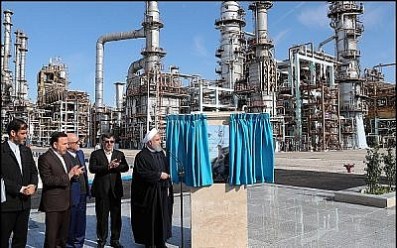
Iranian President Hassan Rouhani dedicates the final phase of a new oil refinery in the city of Bandar Abbas, Iran, February 18, 2019. (Official website photo)
Rouhani said reports that Iran had rebuffed American offers to negotiate were untrue.
Last Monday the US announced that, in a bid to reduce Iran’s oil exports to zero, it would from May 2 end the waivers that had been been granted to eight countries including India, China, South Korea and Turkey on buying Iranian crude when it reimposed sanctions on Iran in November.
The move targets the Islamic Republic’s main economic earner and adds to sanctions pressure that has built up under Trump, who pulled his country out of a 2015 international deal aimed at curbing Iran’s nuclear program. It will choke off more than $50 billion of annual Iranian income, which the US says the country uses to fund destabilizing activity in the Middle East and beyond.
Earlier this month the US designated the IRGC a terror organization, the first time it has ever blacklisted an entire military branch. Tehran has raged against the move, and responded by labeling the US military a terror group under its own designation.
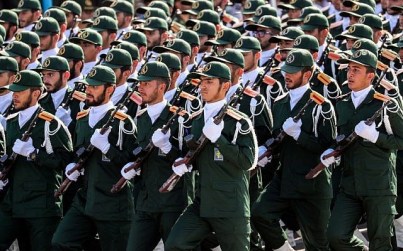
Members of Iran’s Revolutionary Guard Corps (IRGC) march during the annual military parade marking the anniversary of the outbreak of the 1980-1988 war with Iraq, in the capital Tehran on September 22, 2018. (AFP/STR)
The Islamic Revolutionary Guard Corps was formed after the 1979 Islamic Revolution, with a mission to defend the clerical regime, and the force has amassed great power both at home and abroad. The Guards’ prized unit is the Quds Force, headed by powerful general Qassem Soleimani, which supports Iran-backed forces around the region, including Syrian President Bashar Assad and Lebanese terrorist group Hezbollah. It also oversees the country’s ballistic missile program and runs its own intelligence operations.
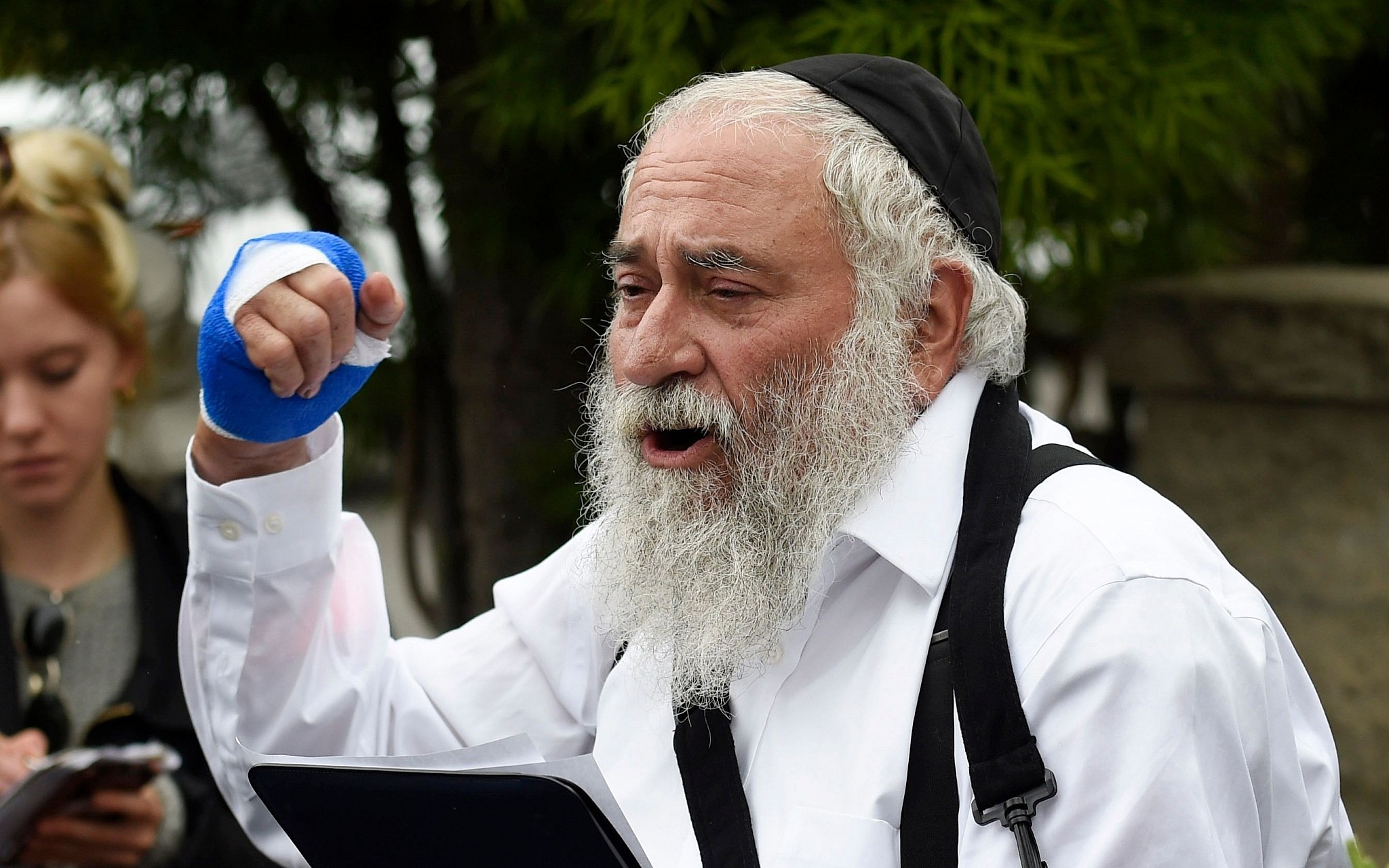
Rabbi Yisroel Goldstein speaks at a news conference at the Chabad of Poway synagogue, April 28, 2019, in Poway, California. (AP Photo/Denis Poroy)
POWAY, California — Jonathan Morales, an armed off-duty US Customs and Border Patrol agent who recently discovered his Jewish roots, was among the worshipers at Chabad of Poway on Saturday when John Earnest entered the synagogue near San Diego during Passover services and began shooting.
The 19-year-old gunman killed Lori Gilbert-Kaye, 60, and wounded three people: Rabbi Yisroel Goldstein, 8-year-old Noya Dahan and her uncle, Almog Peretz.
“Morales recently discovered his Jewish roots. He would travel three and a half hours from [the California town of] El Centro to pray with us at our shul,” Goldstein told media at a Sunday press conference outside the synagogue. “He felt this was his house of worship. And many times I said, ‘Jonathan, you work for the border patrol. Please arm yourself when you are here; we never know when we will need it.’”
US President Donald Trump spoke with Goldstein on Sunday and took to Twitter to praise the rabbi and Morales, writing: “He may have been off duty but his talents for Law Enforcement weren’t!”
Donald J. Trump
✔@realDonaldTrump
Sincerest THANK YOU to our great Border Patrol Agent who stopped the shooter at the Synagogue in Poway, California. He may have been off duty but his talents for Law Enforcement weren’t!
As for why there weren’t any active duty guards at the synagogue, in an earlier interview with CNN Goldstein said, “Unfortunately, we couldn’t afford to have an armed security officer at every service, so whenever we had extra help, we were grateful for it.”
In a moment that Goldstein referred to as “miraculous,” Earnest’s gun jammed, and congregant Oscar Stewart, a 51-year-old Army veteran, and Morales attempted to subdue the gunman. Morales was also able to open fire and give pursuit.
Suspected San Diego shooter John Earnest (YouTube screenshot)
After Earnest fled the building, Morales followed in his own vehicle and shot and hit Earnest’s car. Earnest soon turned himself in to law enforcement.
On Sunday, Goldstein, his two hands in fresh blue bandages, gave a detailed recounting of Saturday’s harrowing shooting in Poway, a suburban town just north of San Diego.
“I was preparing for my sermon, I walked out of the sanctuary and into the lobby and I saw my dear friend Lori Kaye,” said Goldstein. “I walked into the banquet hall to wash my hands, walked two or three footsteps and I heard a loud bang.”
That bang was the sound of the first shots fired by Earnest, a college student who entered the Chabad House undetected amid a flow of mourners who were gathering for Yizkor, the traditional memorial service held on the final day of Passover.
“I turned around and saw something indescribable,” Goldstein continued. “Here is a young man standing with a rifle pointing right at me. He had sunglasses on. I couldn’t see his eyes, I couldn’t see his soul.”
The rabbi said that when he saw the shooter he initially froze, then raised his hands to cover his face. Two of his fingers were blown off; one was reattached by surgeons at Palomar Medical Center in San Diego late Saturday.
Gilbert-Kaye, whom relatives and friends on Saturday described as a woman of unconditional love and unbounded generosity, was the only fatality of Earnest’s mass shooting.
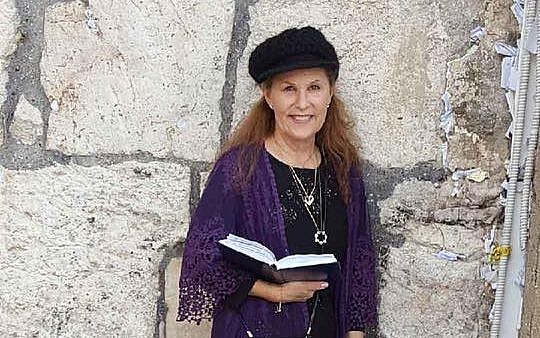
Lori Gilbert-Kaye. (Facebook)
Goldstein took several minutes to thank San Diego County law enforcement and to praise the wellspring of warmth and support that the local community has offered in light of the tragedy.
A chain of miracles
In a remarkable series of events, the rabbi and a handful of congregants were able to save a group of children playing in the adjacent banquet hall, preventing a full-fledged massacre.
“I ran [to gather the children],” Goldstein says. “My granddaughter, who is four and a half years old, saw her grandpa with a bleeding hand. She saw me shouting, ‘Get out! Get out!’ She didn’t deserve to see her grandfather like that.”
Aided by Peretz, an Israeli war veteran who was also at Chabad of Poway with his family Sunday, Goldstein was able to usher the children out of the banquet hall with the shooter in pursuit.
But in what Goldstein referred to as a “miracle,” Earnest’s gun jammed. Even while Morales was still on Earnest’s trail, congregants — who had been gathered in the sanctuary and would have made easy targets for Earnest had his gun not jammed — fled to Chabad’s front entrance.
Noya Dahan, 8, rides on the shoulders of her father, Israel Dahan, at a candlelight vigil held for victims of the Chabad of Poway synagogue shooting, April 28, 2019, in Poway, California (AP Photo/Denis Poroy)
Goldstein’s hand was bleeding badly and his two fingers were dangling by cartilage. “I grabbed a prayer shawl,” he said, wrapped his wounds, and stood on a chair to address his congregation.
“I said, ‘I gotta do something,’” he said. “I said to our congregation: ‘Am Yisrael chai [The People of Israel live]. We are a Jewish nation that will stand tall and we will not let anyone or anything take us down.’”
Farewell to an ‘angel’
“Lori took the bullet for all of us. She died to protect all of us. She didn’t deserve to die,” Goldstein said.
Gilbert-Kaye was one of the congregation’s oldest and most devoted members, the rabbi told media. A former employee of Wells Fargo, she was instrumental in helping Chabad secure the loan for the building in the early 1990s. She and her husband Howard were so close with the rabbi and his wife that two weeks ago they flew to New York City for Goldstein’s youngest daughter’s wedding, and danced together with the bride.
Roneet Lev, friend of Chabad of Poway shooting victim Lori Gilbert-Kaye, April 28, 2019. (Debra Kamin/Times of Israel)
Her generosity and kindness was lauded on Sunday by Roneet Lev, who was at the Chabad of Poway to mourn. Lev described herself as Kaye’s best friend.
“Lori Kaye is an angel on this planet,” Lev said. “She’s touched many lives in her own life. Not just in this community but throughout the entire world.”
Describing a woman who always carried gifts cards and greeting cards to offer as presents and who would regularly purchase extra coffees and donuts for homeless people on the street, Lev explained that Kaye was at Chabad of Poway to say the first Kaddish mourner’s prayer for her mother, who had recently died.
Kaye’s daughter Hannah lives in Los Angeles and had driven down to be with her mother for the service.
Lev offered hope and optimism as she spoke of her friend.
“Even in this horrible, painful event, we know good will come out of it,” Lev said. “Lori is known for bringing out the good in people. And look at these flowers. Look at this law enforcement. Look at the good people of San Diego. Lori is now bringing them together.”
Noya Dahan, 8, who moved with her family moved to Poway, California from Gaza border area in search of a safer life, was wounded in Saturday’s shooting attack. In 2015, vandals daubed swastikas on the family’s car.
Police secure the scene of a shooting incident at the Congregation Chabad synagogue in Poway, California, Saturday | Photo: Reuters
For one family caught up in the California synagogue shooting, a move from Israel to the United States in search of a safer life has been a journey “from fire to fire.”
Israel Dahan and three of his five children were at Sabbath services at Congregation Chabad in Poway, near San Diego, on Saturday when a gunman opened fire, killing a woman and wounding three others in what local authorities deemed a hate crime.
Dahan, speaking on Israel Radio on Sunday, said his family was no stranger to violence, having lived in Israel in Sderot, a town on the Gaza border that has been a frequent target of Palestinian rocket attacks.
“We came from fire to fire,” he said. “We left Sderot because of the shelling. My house was hit several times. My mother’s house, my mother-in-law’s house were hit several times. I was also wounded several times. … We wanted to move far away.”
Dahan’s 8-year-old daughter, Noya, was wounded in the synagogue shooting, on the last day of Passover, as was his brother-in-law.
“I began to shout that people should flee,” Dahan said about the initial moments of the attack. “Thank God his gun jammed.”
Eden Dahan, Noya’s mother, said her brother Almog saved the lives of her daughter and the other children in the synagogue. Eden said her neighbor’s 5-year-old daughter Yuli began to run toward the shooter and Almog had been hit by a bullet when he ran over to her and picked her up.
“He grabbed her and ran toward my girls. He found Noya, my daughter, grabbed her hand with Yuli still in his arms and as soon as he grabbed Noya, he sustained shrapnel from the bullet. She sustained it near her eye and was wounded in the leg. With all of the mayhem and the blood, he ran with them toward the synagogue’s emergency exit.” She said Almog took all the children to the rabbi’s house next door.
According to Eden, it was at this point that Almog realized his niece Leanne was missing and he risked his life to go back into the synagogue to look for her. Eden noted that Leanne had gotten locked inside a bathroom stall and had been unable to get out.
“Almog saved my daughters, he saved all the children. He just didn’t think about anything except how to save the children. He’s a hero. It’s just crazy.”
Authorities identified the alleged gunman as a 19-year-old San Diego resident and said his weapon apparently malfunctioned after the first rounds he fired.
Israel Dahan said his family had been living in Poway for the past three years, and that it was not the first time they had been the victim of a hate crime.
In 2015, the Dahans were residing in Mira Mesa, about 10 miles from Poway, when swastikas were daubed on their house and vehicle during the Passover holiday.
A local news report at the time said the family moved to the United States in 2014 seeking a safer environment for their children.
“But that’s life,” Israel said, recalling the swastika incident and how he had briefly locked eyes with the synagogue assailant.
Asked whether he regretted their move from Israel, he said: “No. We love America. … It can happen anywhere – in any mall, and in any hospital and in any family gathering and in any place. We are strong. We were born to be strong.”
Five of Iran’s top leaders have threatened to close the Strait of Hormuz to oil traffic. Why is President Donald Trump unfazed in his resolve to tighten sanctions on the Islamic Republic?
On Sunday, April 28, Iran’s armed forces chief of staff Gen. Mohammed Bagheri said: “We are not after closing the Strait of Hormuz. If our oil does not go through the strait, other countries’ oil will certainly not cross the strait too.” Bagheri was echoing supreme leader Ayatollah Ali Khamenei, President Hassan Rouhani, foreign minister Mohammed Javad Zarif and Guards Navy chief Rear Adm. Alireza Tangsiri.
Unfazed by this collective threat, the Trump administration has not backed off from its decision to cancel the oil embargo exemptions granted to eight of Iran’s biggest oil importers, including China, India and South Korea. In fact, a new set of penalties are in store.
DEBKAfile’s sources report that the cancellation of the waivers will slash Iran’s oil sales down from 1.1m barrels per day to half a million. But that’s just for starters. The next round of penalties aims to lower the figure to zero.
No one in Washington or the Middle East expects the Iranians to take the loss of their primary source of income lying down. And so the US is making plans accordingly.
On Saturday, April 27, US Central Command chief Gen. Kenneth McKenzie stated: “The United States would deploy the necessary resources to counter any dangerous actions by Iran.”
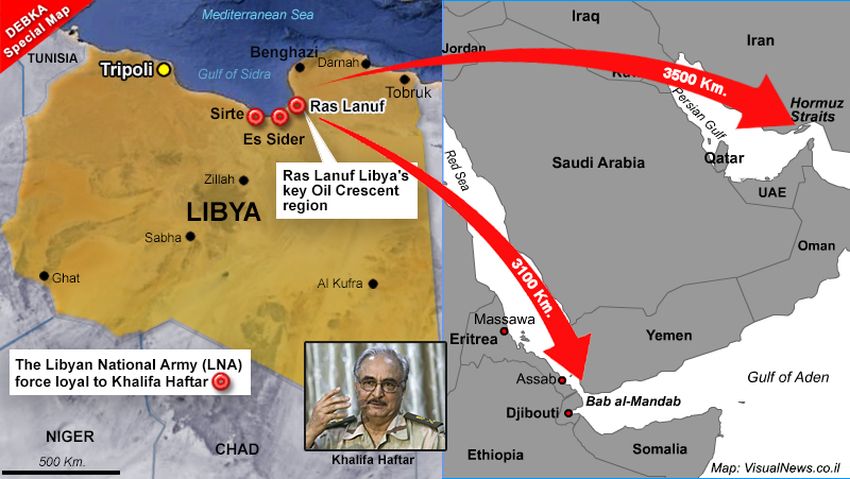
The US administration is in full-flight of an effort to replace Iranian oil with alternative energy supplies to the world markets while holding oil prices down from flying out of control. Even the partial closure of the two energy choke points for exported Gulf oil – at the Strait of Hormuz or the Bb al-Mandeb entrance to the Red Sea – is liable to send oil prices shooting up. For instance, each added dollar on the world energy market adds $4bn of extra revenue to the coffers of the Russian government, which is itself under US sanction.
Saudi Arabia and the other oil-rich Gulf nations are currently in no position to raise output to cover the loss from Iran – mainly because of their commitments to OPEC and Moscow. The Trump administration therefore cast about for a regular, preferably stable, source for at least half a million barrels of all a day to cover the shortfall. The solution was found in Washington’s first intervention in the Libyan crisis since Trump’s predecessor Barack Obama contrived the downfall of Muammar Qaddafi.
On April 4, President Trump put in a phone call to Gen. Khalifa Haftar, head of the Libyan National Army (LNA) militia fighting to conquer the Libyan capital, Tripoli. At this peak moment of the turbulent Libyan civil war, Haftar, backed by Russia, Egypt, the UAE and France, is fighting to unseat the national government sponsored by the UN and Italy. Trump and his advisers reckon that Haftar’s LNA, which already controls Libya’s eastern and southern oil fields, is capable of also seizing its main oil terminals at Ras Lanuf and Es Sidr on the Mediterranean (see map).
On Sunday, April 24, as the battles for these key targets between the LNA and government forces intensified, US Republican Senator Lindsey Graham said in an interview to Face the Nation that this was having an “unnerving effect in the region.”
To secure the port facilities of Ras Lanuf, in Libya’s key Oil Crescent region and one of the world’s crucial maritime oil export points, Haftar on Sunday sent an Alkarama patrol vessel to the port. The oil trade in the country divided by the civil war is operated by the National Oil Corporation (NOC), which tries to position itself as a neutral side in a conflict between the LNA and the Government of National Accord (GNA), operating across the entire country, sending the profits to the Tripoli-based central bank, but also a portion to public servants in the LNA-controlled lands
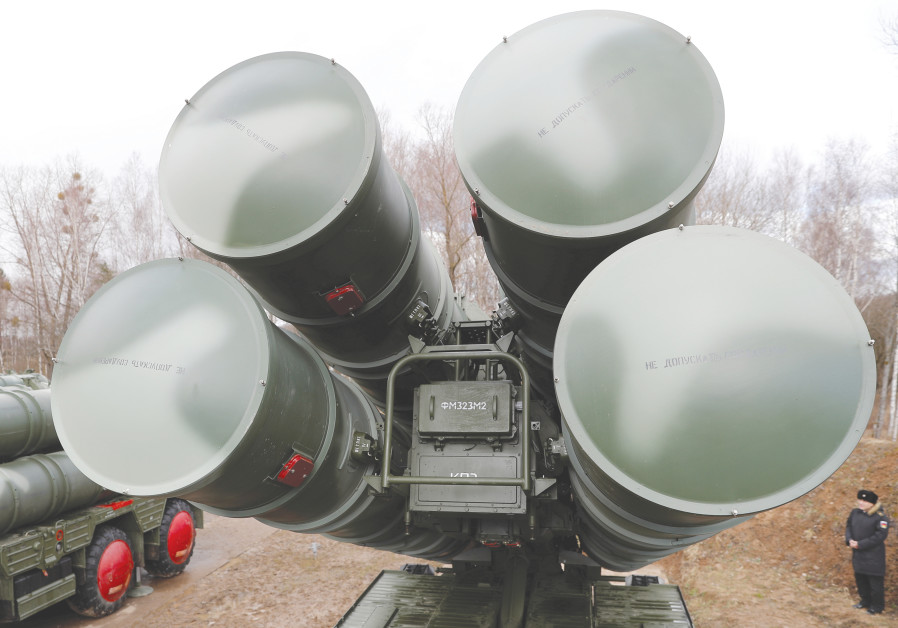
WHAT WOULD Turkey trade for this. (photo credit: REUTERS)
Turkey’s purchase of Russia’s S-400 defense system has long been a burden not only for the United States but for NATO, too, the security bloc in which Turkey is a member.
NATO was created to counter Soviet threats. Today it aims to do the same as Russia extends its influence across Europe, Africa and the Middle East. Its members are sovereign states with the right to have normal relations with any nation, even Russia. But its members also have the obligation to not undermine the interests of the alliance. Turkey’s purchase of the very military equipment the alliance was created to deter undermines the interests of NATO.
The situation is not complicated. No NATO member can purchase defense systems that are incompatible with NATO defense systems, especially if the missiles were created to shoot down fighter jets like the American F-35.
Turkey’s list of bad decisions against US national security interests is never-ending: from evading Iranian sanctions, standing against designating the IRGC a terrorist organization, condemning the US recognition of US Embassy to Jerusalem and its recognition of Israel’s sovereignty over the Golan Heights, supporting Venezuela’s Maduro regime, threating America’s Kurdish partners in Syria and more.
One must ask itself: Why does America need enemies when it has an “ally” like Turkey? Why is Erdogan so adamant on purchasing our adversaries’ weapons, even as the US gave Ankara an option to purchase the Patriot missile system, a much more sophisticated choice?
The answer may not seem obvious, but as Kurds, we understand Erdogan’s devious tactics.
Erdogan wants American’s to move out of the way in Syria so he can have his way with the Kurds, with an intent to slaughter them.
Erdogan is dragging his feet. This is not about America or his country’s defense needs. The United States has gone out of its way to appease his Islamist government, even after multiple warnings. For Erdogan is threatening a shift toward the East, as he has already done and will continue to do, unless America lets go of the Kurds.
But the reality is that Turkey, with or without Erdogan, needs America, Europe and NATO. And if America wishes so, it can shut down the Turkish economy with a blink of an eye, as it nearly did with very basic sanctions in 2018. In addition, Turkey is already in a recession, so threatening the US is not very smart on Erdogan’s part.
Turkey’s policy toward the same Kurds who defeated the Islamic State caliphate, the same Kurds that sacrificed over 11,000 fighters and had nearly 8,000 wounded, should be condemned.
The biggest loser of the defeat of the caliphate is not ISIS itself, but Erdogan. He counted on the radical group to wipe out the Kurds, as we witnessed in 2014 in Kobani. With the threat of Erdogan from the North, ISIS and the Assad regime, the Syrian Democratic Forces (SDF) composed of majority Kurds shattered Erdogan’s dream.
Erdogan’s biggest fear is another autonomous Kurdish region similar to that of the Kurdistan region of Iraq, created by the US in 1991 after it imposed a no-fly zone. There are more than 20 million Kurds in Turkey; the fear that they will demand the same is unfathomable to any Turkish government.
The Russian S-400 is set to be delivered in July, though Erdogan has threatened to move the delivery date sooner. He has also declared that the purchase is complete and that he will not go back on the deal.
Due to the reality on the ground, and in the interest of US national security, those in Washington must see Turkey for what it is: an unreliable burden on NATO and America. Erdogan is unlikely to change any time soon and may never. Therefore we must approach his government with realistic expectations and stop going out of our way to attempt to change it.
America must continue to protect the Kurds in Syria. They are not up for bartering. Set up a no-fly zone for northeast Syria and recognize the Syrian Democratic Council as the best and proven alternative to the Assad regime. And finally, call Erdogan’s bluff so that he cannot use the Kurdish card in America as he has done in Turkey to gain political points.
The writer is director of the Kurdistan Project at the Endowment for Middle East Truth (EMET). He is a Middle East analyst born in Kirkuk who educates Capitol Hill lawmakers on the Kurdish plight. Follow him on Twitter @D_abdulkader.
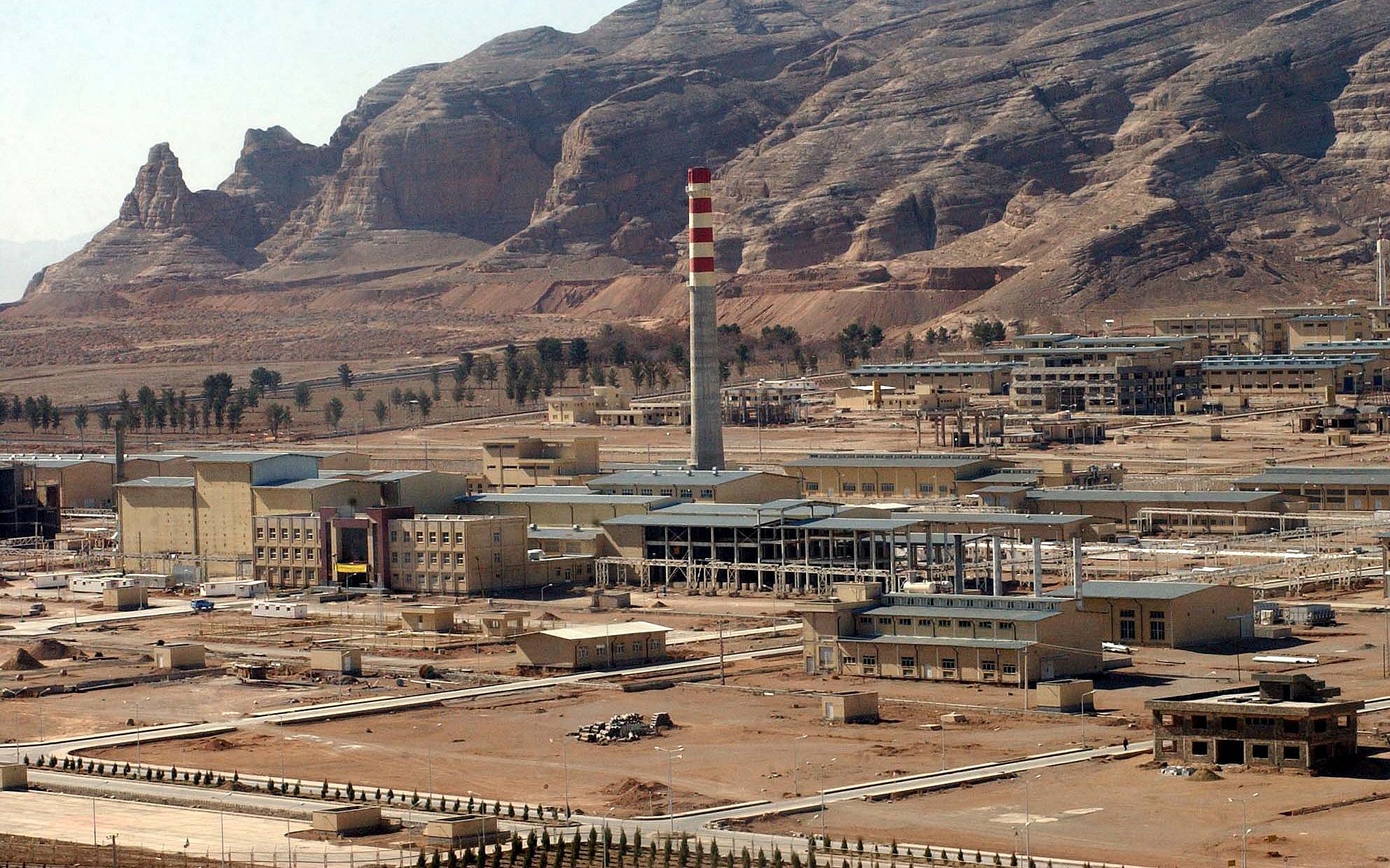
Iran’s uranium conversion facility near Isfahan, which reprocesses uranium ore concentrate into uranium hexafluoride gas, which is then taken to Natanz and fed into the centrifuges for enrichment, March 30, 2005. (AP/Vahid Salemi)
TEHRAN, Iran — Iran’s Foreign Minister Mohammad Javad Zarif has said leaving the nuclear Non-Proliferation Treaty is one of the “many options” Tehran has to retaliate against US sanctions, state media reported Sunday.
The United States has imposed a raft of sanctions against the Islamic Republic since US President Donald Trump withdrew last year from the 2015 Iran nuclear deal with world powers.
“The Islamic Republic has many options… (leaving) the NPT is one of them,” Zarif said in remarks to Iranian reporters in New York aired by state television.
Iran’s Foreign Minister Mohammad Javad Zarif on the CBS program Face the Nation, April 27, 2019. (YouTube screenshot)
State news agency IRNA said Zarif was asked why he had not touted leaving the nuclear treaty as one of Iran’s possible reactions during his trip, as he had done so previously.
“The country’s officials are deliberating” the different options and measures, Zarif replied, adding that the possibility of leaving the NPT was among those options. He did not list the other options.
Iran has branded the US sanctions “illegal” and Zarif warned on Wednesday that there would be consequences should Iran be barred from selling its oil.
The 2015 Iran nuclear deal with six world powers — Britain, China, France, Russia, the United States and Germany — had given the Islamic Republic sanctions relief in exchange for curbs on its nuclear program.
Speaking to Fox News Sunday, Zarif claimed Israel, US National Security Adviser John Bolton, Saudi Arabia,and the United Arab Emirates were pushing a reluctant Trump into war.
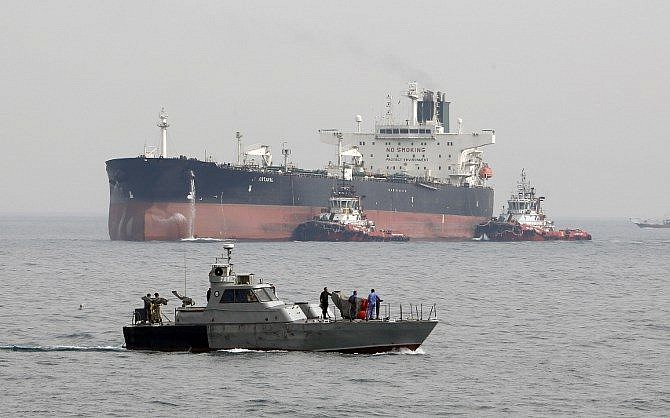
An Iranian military speedboat patrols the waters as a tanker prepares to dock at the oil facility on Khark Island, Iran, on March 12, 2017. (Atta Kenare/AFP)
TEHRAN, Iran — Iran’s top general on Sunday warned that Tehran could close the strategic Strait of Hormuz shipping route if it faces more “hostility,” as the US tightens up sanctions, the semi-official ISNA news agency reported.
“We are not after closing the Strait of Hormuz, but if the hostility of enemies increase, we will be able to do so,” armed forces Chief of Staff Mohammad Bagheri told ISNA.
“Also, if our oil does not go through the strait, other countries’ oil will certainly not cross the strait too,” he added.
The statement came after Washington said on Monday that it would start imposing sanctions on countries, such as India, China and Turkey, that buy Iranian oil.
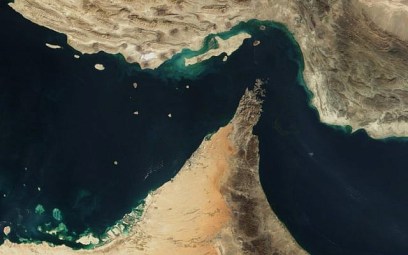
Satellite view of the Strait of Hormuz with Iran on top and Gulf states including Dubai, UAE, Muscat and Abu Dhabi below. (NASA/Public domain)
Eight countries were initially given six-month reprieves after the United States reimposed sanctions on Iran in November, following US President Donald Trump’s decision to withdraw from the 2015 nuclear accord.
Iranian officials have repeatedly warned that the Islamic Republic could shut down the strait, a vital shipping lane for international oil supplies, should it find its national interests or security threatened.
“We believe Iran will continue to sell its oil … (and) use the Strait of Hormuz. But if the United States takes the crazy measure of trying to prevent us from doing that, then it should be prepared for the consequences,” Foreign Minister Mohammad Javad Zarif said on Wednesday.
“It is in our vital national security interest to keep the Persian Gulf open, to keep the Strait of Hormuz open. We have done that in the past and we will continue to do that in the future,” he added.










 anneinpt
 artaxes
 danmillerinpanama
 davidking1530
 Peter Hofman
 Joseph Wouk
 Peter
Peter Louisiana Steve
 WarSclerotic
Recent Comments