Archive for March 2019

Haniyeh: Our behaviour at march of the million depends on our demands 

March 29, 2019

Source: Haniyeh: Our behaviour at march of the million depends on our demands – Arab-Israeli Conflict – Jerusalem Post

BY TAMAR BEERI
 MARCH 29, 2019 15:32
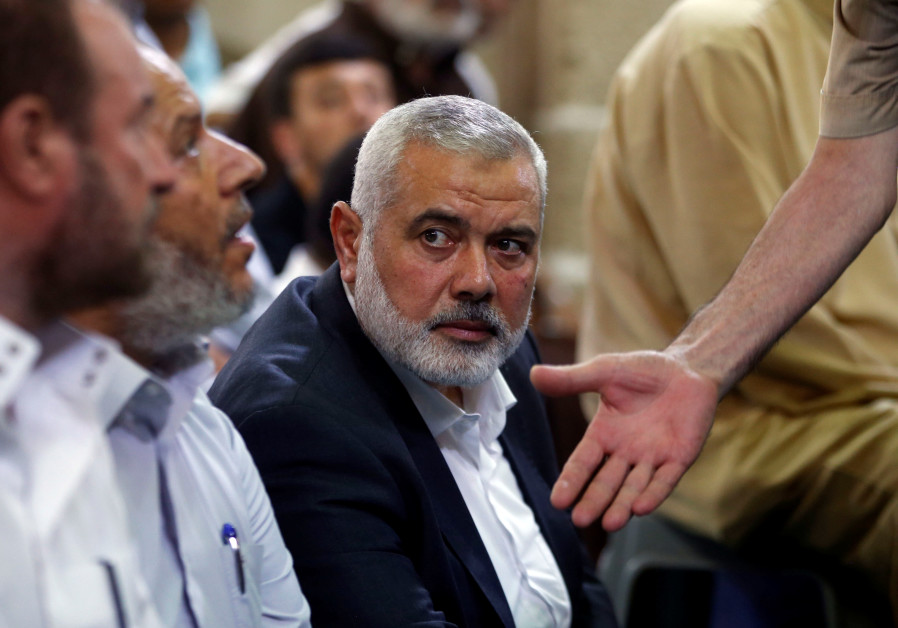
Hamas Chief Ismail Haniyeh looks on as he attends the funeral of Palestinian Hamas militants

Hamas leader Ismail Haniyeh spoke on Friday afternoon regarding the negotiations with Israel mediated by Egypt, explaining that the behavior of Hamas at march of the million will depend on their demands being met.

“We continue our discussions today with our Egyptian brothers and with the participation of the factions,” Haniyeh said. “We are completing our earlier discussions so as to achieve our goal. We stand at a crossroads and a deep examination of Israeli stances, as well as Israel’s response to the needs of our nation.”

Haniyeh explained that based on decisions made at these deliberations, they will “determine the way in which the situation will pan out at the march of the million of Land Day.”

“We are in the final stretch of the road, which will have a serious impact on the decisions of Hamas and the factions and especially on the future,” he stated.

“We are working with our Egyptian brothers to find a solution to the humanitarian crisis in Gaza to end the suffering of our people and establish their dignity in their country,” Haniyeh said. “All of this will be achieved by reaching some serious understandings that will be respected by the enemy, understandings which include the need for a ceasefire, the entrance of humanitarian aide and the implementation of projects, the opening of crossings and fishing, employment programs and treatment of electricity problems and more, by way of the removal of the siege over the Gaza Strip.”

Haniyeh said that Hamas continues to “coordinate intensely with our brothers in Qatar.”


Hamas and Israel risk another Gaza war in deadly game of chicken

March 29, 2019

Source: Hamas and Israel risk another Gaza war in deadly game of chicken | The Times of Israel

As the threat of violence looms over border protests planned for Saturday, Egypt is scrambling to avoid another bloody conflict

Fire and smoke around buildings in Gaza City during reported Israeli strikes on March 25, 2019. (Mahmud Hams/AFP)

Fire and smoke around buildings in Gaza City during reported Israeli strikes on March 25, 2019. (Mahmud Hams/AFP)

In the lead-up to this Saturday, when tens of thousands of Palestinians are expected to take part in protests along the Gaza border to commemorate both Land Day and the first anniversary of the “Great March of Return,” Hamas and Israel appear to be playing a high-stakes game of chicken, with each side — in both word and deed — threatening all-out war against the other.

As an Egyptian military intelligence delegation shuttles back and forth between Tel Aviv and Gaza to broker a ceasefire agreement between the two sides, Hamas is attempting to extract the greatest possible concessions from Israel using the specter of a punishing assault on the Israeli home front just before a national election — one that it knows would also cost Gaza dearly.

Though the main stated goal of the past year’s protests — the right for Gazan refugees and their descendants to return to their ancestral villages in Israel and the West Bank — is almost surely a nonstarter with Jerusalem, Hamas is hoping for Israel and Egypt to lift their blockade of the Strip, which the two countries maintain is necessary to prevent terror groups from importing weapons into the coastal enclave.

Israel, in turn, is looking to restore calm to the communities surrounding the Gaza Strip — meaning an end not only to rocket fire but to all violence along the border, including the riots along the security fence and the airborne incendiary and explosive devices — while also denying its enemy, Hamas, a victory, but says it is prepared for war if these talks fail.

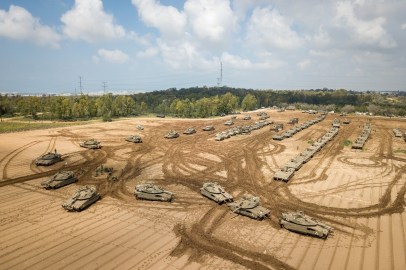
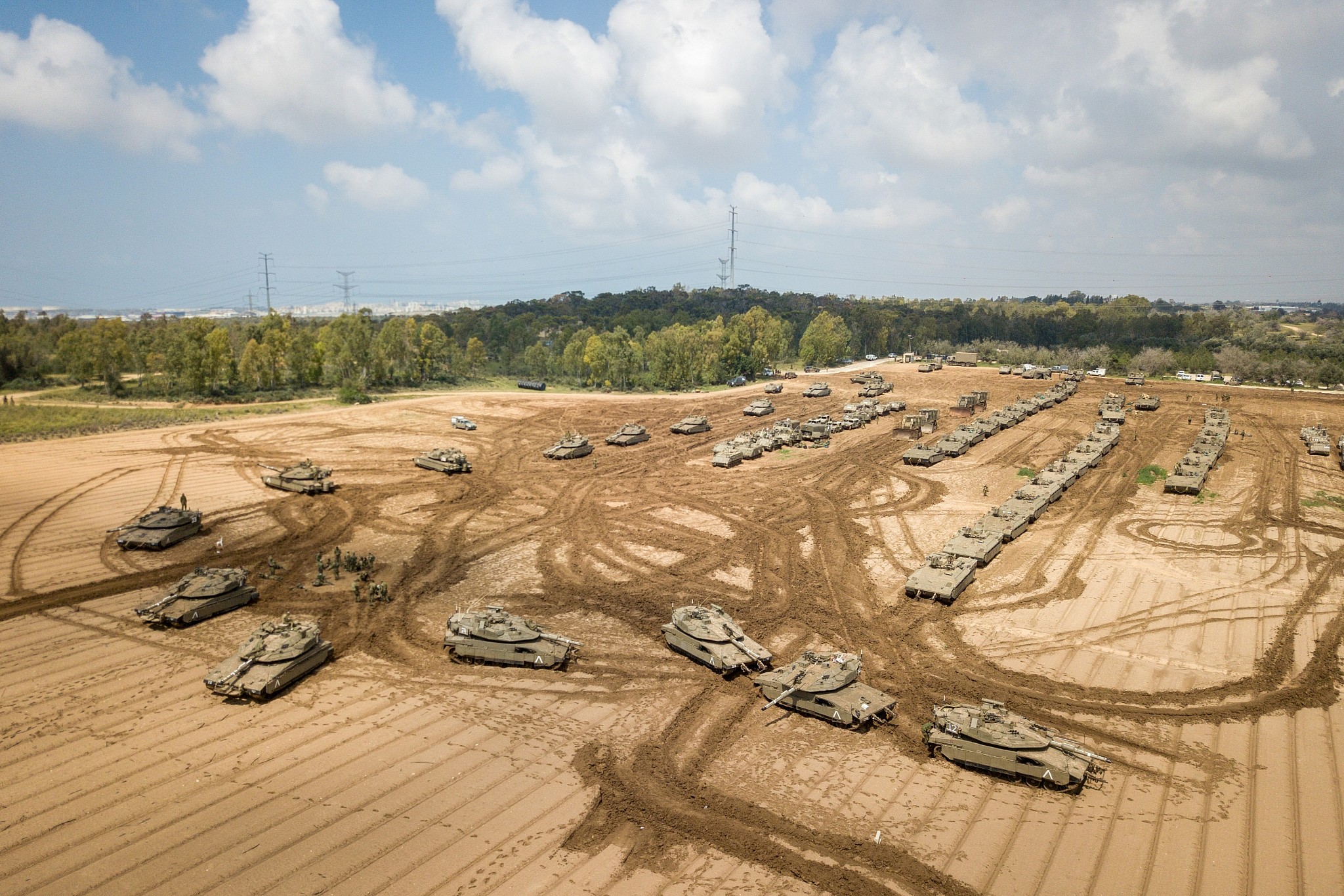
IDF tanks stationed near the Israel-Gaza border on March 27, 2019. (Dudi Modan/Flash90)

“I recently ordered that units be reinforced and that additional [armored] vehicles be dispatched in preparation for an extensive campaign. All citizens of Israel know that if an extensive campaign is necessary, we will go into it strong and secure, after all other possibilities have been exhausted,” Prime Minister Benjamin Netanyahu said in a statement Thursday.

Also on Thursday, Hamas officials said their group would only agree to an Egypt-mediated ceasefire with Israel after the protests for Land Day, the annual commemoration of the expropriation of Arab-owned land by the Israeli government in the northern region of Galilee in 1976.

The group is trying to paint Israel’s stubbornness and threats of force as the result of the ruling Likud’s election campaign, a fairly dubious assertion as another bout in Gaza — what would be Netanyahu’s third in under seven years — is as liable to negatively effect the prime minister’s re-election chances as help them.

The Islamist terror group is desperate for a victory in order to justify its reign over the beleaguered coastal enclave. Over 11 years into Hamas’s rule, the majority of young people in the Strip are unemployed, electricity is available for just a few hours per day and potable water is scarce.

Hamas’s latest gambit in its fight against the Jewish state, the March of Return protests, which began March 30, 2018, has resulted in nearly 200 people — both civilians and combatants — killed by Israeli gunfire, according to a recent UN report, but has yielded few to no significant achievements for the terror group.

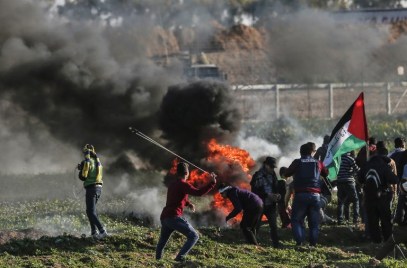
Palestinians burn tires during a demonstration near the fence along the border with Israel, east of Gaza City, on February 22, 2019.(Photo by MAHMUD HAMS / AFP)

In recent weeks, residents of the Strip have started voicing their anger with Hamas, holding demonstrations in the streets against the economic conditions in Gaza. The terror group has responded with swift and harsh crackdowns to quell the unrest, sending its security forces to beat protesters and conduct mass arrests.

As the one-year anniversary of the March of Return protests approaches, Hamas and other terror groups in the Strip have stepped up their violent activities against the State of Israel: Scores of balloon-borne incendiary and explosive devices have been launched across the border; so-called “confusion units” set off powerful explosives during nightly riots along the security fence to frighten the Israelis living nearby; and, this week, Hamas fired a powerful, long-range rocket deep into Israel, destroying a home and injuring seven, followed by dozens of additional projectiles in response to Israeli retaliatory strikes.

Somewhat out of the public eye, Hamas members serving sentences in Israeli prisons have also been increasingly violent, stabbing two guards earlier this week, injuring one of them seriously. Israel has also been cracking down on Hamas prisoners, isolating them, searching their cells, and blocking the use of illegally smuggled cellphones.

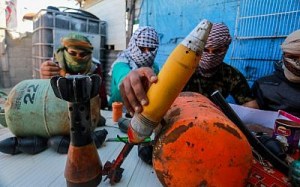
Palestinians prepare explosive devices to use in nighttime clashes along the border with Israel, at a house in al-Bureij refugee camp in the Gaza Strip, on March 7, 2019. (Abed Rahim Khatib/Flash90)

Israeli officials, along with Hamas’s rival the Palestinian Authority, have accused the terror group of trying to use violence against the Jewish state as a way to channel the frustration and disaffection that Gazans feel over their squalid living conditions and economic instability.

The Israeli military is preparing for the possibility that Saturday’s protests will be some of the most violent yet. Though Hamas is referring to the Land Day demonstrations as the “million-man march,” only a few tens of thousands of people are expected to participate. The weather, which is currently predicted to be cold, rainy and windy, may help keep the numbers even lower than that.

Throughout the past year, these riots have seen attempts to breach the Gaza security fence en masse, explosive devices thrown across the border and, in a few cases, shooting attacks on Israeli troops, including one in July that killed IDF soldier Aviv Levi.

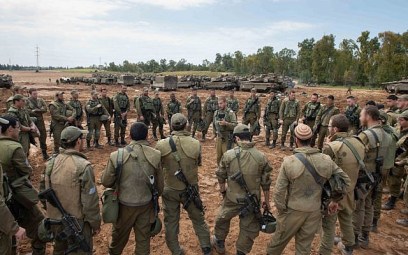
The Israel Defense Forces is not counting on precipitation to prevent Saturday’s riots and has deployed an additional three brigades — two infantry, one armored — to the Gaza border, along with an artillery battalion. The military also called up reservists for air defenses and other select units, and weekend leave for troops in the Southern Command has been canceled.

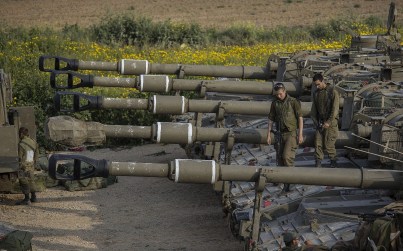
Israeli soldiers sit on top of mobile artillery near the border with the Gaza Strip, in southern Israel, March 27, 2019. (AP Photo/Tsafrir Abayov)

On Saturday, hundreds of snipers will be deployed along the security fence, supported by tanks, aircraft and infantrymen.

“IDF troops have completed operational preparations for the events of Land Day in the southern region and are continuing to increase preparedness for a possible escalation of violence caused by violent and terrorist acts during [the protests],” the army said.


Israel said to warn Hamas any error could lead to war, as IDF preps for violence

March 29, 2019

Source: Israel said to warn Hamas any error could lead to war, as IDF preps for violence | The Times of Israel

After overnight siren sends southern residents scrambling for bomb shelters in false alarm, some leave the area ahead of possible uptick in violence over the weekend

IDF tanks stationed near the Israel-Gaza border on March 27, 2019. (Dudi Modan/Flash90)

As the Israeli military continued its preparations for a possible outbreak of violence at protests along the Gaza border planned for Saturday, an Egyptian delegation reportedly told Hamas that any mistake it makes could lead to war.

The Israeli military said Thursday it is readying for protests along the Gaza border planned for Saturday, Palestinians’ Land Day, and a possible outbreak of violence. Land Day also marks a year since the start of weekly violent protests along the Israel-Gaza border, known as the March of Return, which at times have escalated into exchanges of fire between Israel and Palestinian terror groups in the coastal enclave, most recently earlier this week.

An Egyptian military intelligence delegation has been working to broker a ceasefire between Israel and Hamas ahead of the mass protest, amid fears that clashes along the border could snowball into a larger conflagration.

On Thursday, the delegation passed a message from Israel to Hamas, telling the Gaza-ruling terror group: “Any mistake you make on Saturday could lead to war,” Channel 12 news reported.

Israeli troops take up positions near the Gaza border on March 26, 2019. (Israel Defense Forces)

According to the report, Hamas is planning a mass transportation operation for Saturday, picking up protesters from 38 locations in the enclave and shuttling them to five sites along the border. Field hospitals have reportedly been set up at various points, and medical facilities in the Strip are on an emergency footing.

Prime Minister Benjamin Netanyahu said he’d ordered the military to prepare for an “extensive campaign” should Egypt-brokered ceasefire negotiations fail.

Ahead of the protests and riots expected for the weekend, the Israel Defense Forces deployed three additional brigades to the Gaza Division, along with an artillery battalion, and called up reservists from air defense and other select units.

According to the Walla news site, senior commanders are preparing for a variety of scenarios, including the possibility of deterioration to the point of a large-scale ground operation.

The military canceled weekend leave for all combat soldiers stationed in the Southern Command and published a video it said showed troops in recent days preparing for fighting inside Gaza, including training for urban warfare and house-to-house fighting similar to the conditions in the Strip.

A number of residents of Israeli communities along the Gaza border have chosen to leave the area for the weekend ahead of the planned demonstrations.

“We mainly want the children to be far from all these events,” one resident told the Ynet news site.”This time we decided because of the preparations, which are expected to be very tense, we just want to go outside and breathe, all of us together as a community and return at the end of the fighting.

“It’s the safest for everyone — the army must act as much as necessary — but mainly allows us peace of mind after very tense days, sirens and missiles,” the resident added.

A falsely triggered rocket alarm sent Israelis on the border region scrambling for bomb shelters early Friday morning, amid sky-high tensions along the frontier.

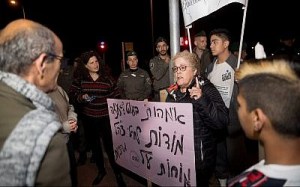
Residents of southern Israel protest over the government’s response to rocket fire from the Gaza Strip, at the entrance to city of Sderot, on March 26, 2019. (Yonatan Sindel/Flash90)

The Israel Defense Forces said the rocket siren, which sounded in the Eshkol region just before 1 a.m., was a false alarm.

It did not say what triggered the siren, which went off following a day of low-level violence along the border, following a flare-up of cross-border fire earlier in the week.

The siren came as Gazans were reportedly holding low-scale nighttime riots along the border, which often include the throwing of improvised explosives at the border fence and at Israeli troops across the volatile border. In the past, the explosives have managed to set off rocket alarms.

On Thursday, an Israeli drone fired at a group of Palestinians launching balloon-borne incendiary devices into Israel from the northern Gaza Strip, lightly injuring three of them, according to local media reports.

Throughout the day, several incendiary devices attached to balloons landed in the Eshkol and Sha’ar Hanegev regions of southern Israel.

Violence this week started after a rocket fired from Gaza struck a farming community in central Israel early Monday, leveling a home and injuring seven people, including two small children.

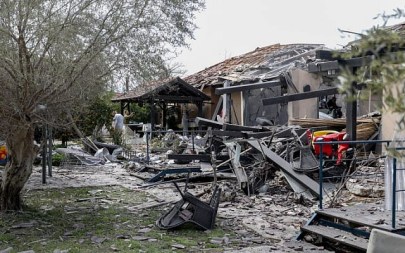
Israeli security forces inspect the scene of a house that was hit by a rocket fired from the Gaza Strip in the town of Mishmeret in central Israel on March 25, 2019. (Noam Revkin Fenton/Flash90)

Israeli warplanes subsequently carried out dozens of bombing runs and Gazans fired some 60 projectiles at southern Israel, with the violence only waning before dawn Wednesday.

A senior member of Hamas’s military wing said Thursday that the rockets recently fired from the Gaza Strip toward central Israel launched on their own due to the terror group’s heightened war footing.

Saturday, Palestinian Land Day, marks a 1976 decision by the Israeli government to seize thousands of dunam of Arab-owned land in the Galilee region of northern Israel.

Last year on Land Day, Palestinians in the Gaza Strip launched the Great March of Return, a series of weekly protests and riots along the security fence that have at times seen the participation of tens of thousands of Palestinians. Israel maintains that the Hamas terror group appropriated the campaign for nefarious purposes, using the civilian protesters as cover for violent activities.

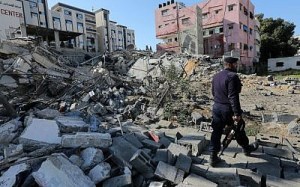
A picture taken on March 26, 2019, shows a Hamas policeman standing guard next to the rubble of a building in Gaza City that was targeted the night before by an Israeli air raid. (Mahmud Hams/AFP)

Some 30,000 Palestinians participated in the first protest event, held on March 30 2018. Fifteen Palestinians were killed in clashes with IDF soldiers protecting the border. Since then over 180 Palestinians have been killed in border violence, according to February figures from the UN Human Rights Council. Hamas has claimed dozens of the dead as members.

Israeli defense officials — as well as Hamas’s political foe, the Palestinian Authority — accuse the terror group of encouraging the border riots in an effort to distract from its failures in governing the Gaza Strip, a crowded patch of land with crushing unemployment, limited access to electricity and potable water, and few economic prospects.


Hamas officials back Egypt’s plan for Gaza border calm ahead of massive protest

March 29, 2019

Source: Hamas officials back Egypt’s plan for Gaza border calm ahead of massive protest | The Times of Israel

In reported deal, protesters to stay several hundred meters from border, Israel won’t fire unless they approach fence

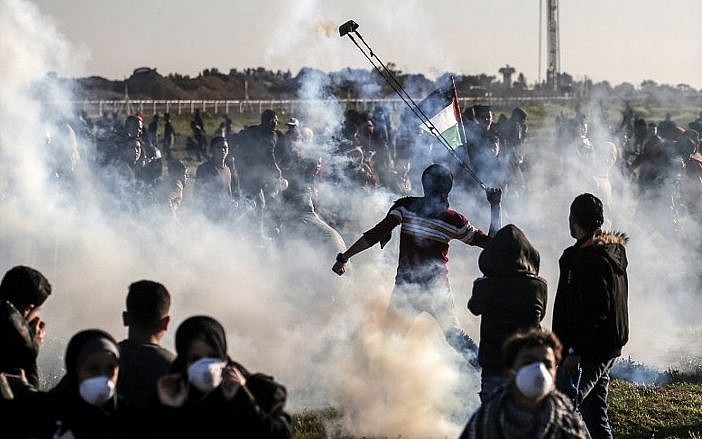
Illustrative: A Palestinian uses a slingshot to fling back a tear gas canister thrown by Israeli forces during clashes at the fence along the border with Israel, east of Gaza City, on March 8, 2019. (Mahmud Hams/AFP)

Illustrative: A Palestinian uses a slingshot to fling back a tear gas canister thrown by Israeli forces during clashes at the fence along the border with Israel, east of Gaza City, on March 8, 2019. (Mahmud Hams/AFP)

Hamas has backed an Egyptian proposal to foster calm on the Israel-Gaza border ahead of expected major protests, two officials from the terrorist group said Friday.

There was no immediate comment from the Israeli side on the potential agreement, and the leader of the Gaza terror group confirmed that work was ongoing on “serious understandings” that will ease the humanitarian condition in the Strip.

Tens of thousands of Palestinians are expected to gather Saturday for the first anniversary of the often violent protests along the border.

An Egyptian delegation held talks with Hamas and other factions in Gaza in meetings that stretched into the early hours of Friday, the officials said.

A Hamas official who took part in the meetings told AFP on condition of anonymity they had backed an Egyptian proposal that will see protesters stay several hundred meters from the border.

Hamas-backed attacks in the West Bank would also cease, the official said. In exchange, “the Egyptians informed us that the (Israelis) promised to ease their measures.”

IDF tanks stationed near the Israel-Gaza border on March 27, 2019. (Dudi Modan/Flash90)

In particular, the Israelis will not fire on protesters unless they approach the border fence and will also allow Qatar to increase the amount of aid it funnels into the Gaza Strip.

His remarks were confirmed by a second Hamas official. Meanwhile, Ismail Haniyeh, Hamas’s leader, issued a statement emphasizing the concessions that his organization expected from Israel under an Egyptian-brokered agreement.

“We are working with our brothers in Egypt through the Egyptian delegation currently here in Gaza to resolve the humanitarian crisis in Gaza in a way that ensures an end to our people’s suffering and strengthens their dignity,” he said.

“We are working to do this by reaching serious understandings that will be respected by the enemy, especially as pertains to it halting its fire and aggression, allowing the entry of humanitarian aid, implementing projects, opening crossings and expanding the fishing zone, cash for work projects, and dealing with issues such as electricity,” Haniyeh said.
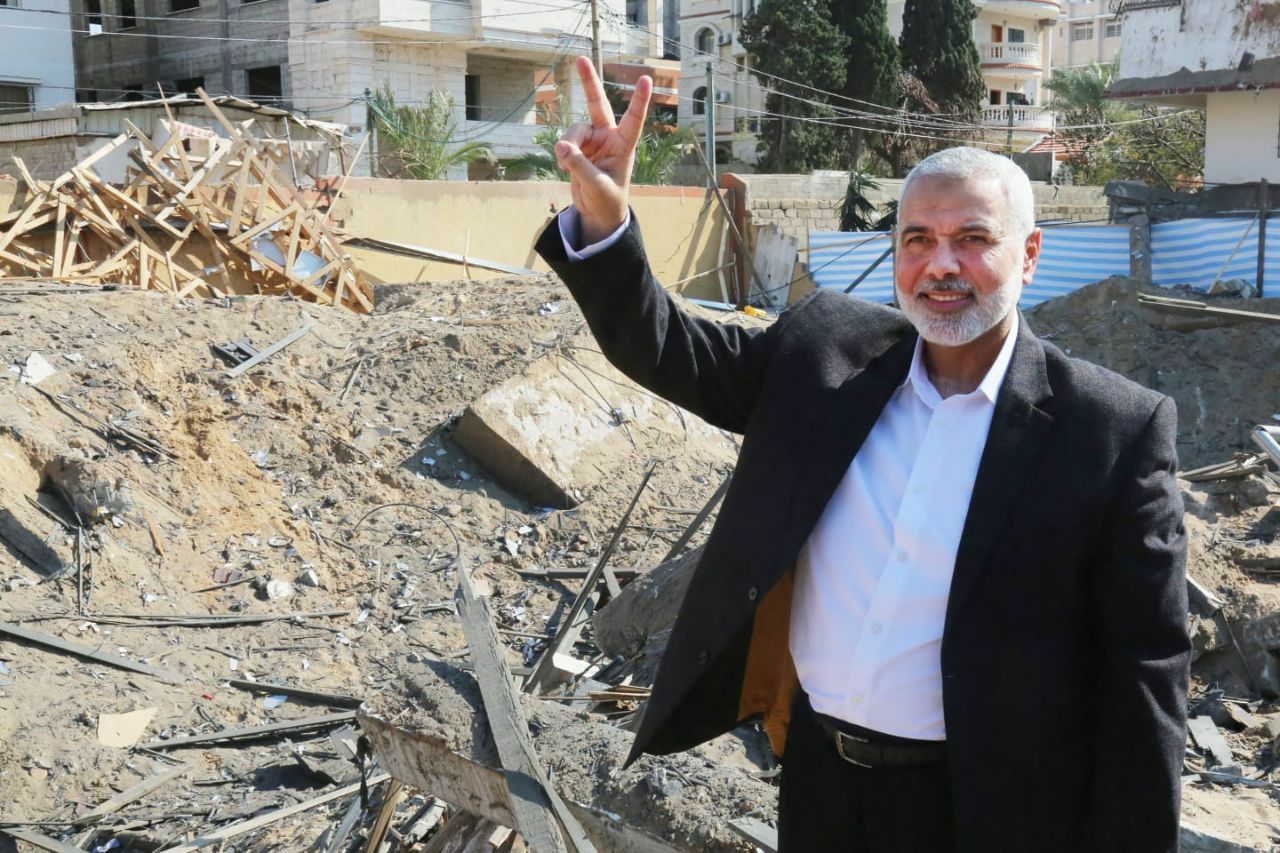
Hamas chief Ismail Haniyeh flashes a ‘v for victory’ sign on March 27, 2019, next to the rubble of what was once his office in Gaza City, which was destroyed in an Israeli airstrike two days earlier. (Hamas)

“We will continue our marathon talks with the Egyptian brothers, which have been ongoing since the day before yesterday and include the national factions, in order to complete all prior dialogue and achieve the desired goal,” he said, adding that the situation was at a “crossroads” and the coming hours would be significant.

“All options are on the table,” Haniyeh said.

The comments came as the Israeli military continued its preparations for a possible outbreak of violence at the protests and after an Egyptian delegation reportedly told Hamas that any mistake it makes could lead to war.

The Israeli military said Thursday it is readying for protests along the Gaza border planned for Saturday, Palestinians’ Land Day, and a possible outbreak of violence. Land Day also marks a year since the start of weekly violent protests along the Israel-Gaza border, known as the March of Return, which at times have escalated into exchanges of fire between Israel and Palestinian terror groups in the coastal enclave, most recently earlier this week.

An Egyptian military intelligence delegation has been working to broker a ceasefire between Israel and Hamas ahead of the mass protest, amid fears that clashes along the border could snowball into a larger conflagration.

On Thursday, the delegation passed a message from Israel to Hamas, telling the Gaza-ruling terror group: “Any mistake you make on Saturday could lead to war,” Channel 12 news reported.

Israeli troops take up positions near the Gaza border on March 26, 2019. (Israel Defense Forces)

According to the report, Hamas is planning a mass transportation operation for Saturday, picking up protesters from 38 locations in the enclave and shuttling them to five sites along the border. Field hospitals have reportedly been set up at various points, and medical facilities in the Strip are on an emergency footing.

Prime Minister Benjamin Netanyahu said he’d ordered the military to prepare for an “extensive campaign” should Egypt-brokered ceasefire negotiations fail.

Ahead of the protests and riots expected for the weekend, the Israel Defense Forces deployed three additional brigades to the Gaza Division, along with an artillery battalion, and called up reservists from air defense and other select units.

According to the Walla news site, senior commanders are preparing for a variety of scenarios, including the possibility of deterioration to the point of a large-scale ground operation.

The military canceled weekend leave for all combat soldiers stationed in the Southern Command and published a video it said showed troops in recent days preparing for fighting inside Gaza, including training for urban warfare and house-to-house fighting similar to the conditions in the Strip.

A number of residents of Israeli communities along the Gaza border have chosen to leave the area for the weekend ahead of the planned demonstrations.

A tense calm settled over the region Wednesday morning after an outbreak of violence that started after a rocket fired from Gaza struck a farming community in central Israel early Monday, leveling a home and injuring seven people, including two small children.

Israeli warplanes subsequently carried out dozens of bombing runs and Gazans fired some 60 projectiles at southern Israel, with the violence only waning before dawn Wednesday.
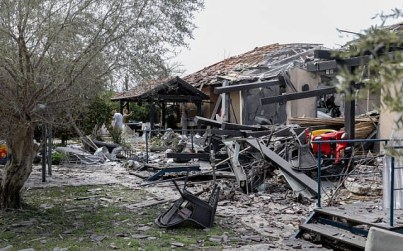
Israeli security forces inspect the scene of a house that was hit by a rocket fired from the Gaza Strip in the town of Mishmeret in central Israel on March 25, 2019. (Noam Revkin Fenton/Flash90)

Saturday, Palestinian Land Day, marks a 1976 decision by the Israeli government to seize thousands of dunam of Arab-owned land in the Galilee region of northern Israel.

Last year on Land Day, Palestinians in the Gaza Strip launched the Great March of Return, a series of weekly protests and riots along the security fence that have at times seen the participation of tens of thousands of Palestinians. Israel maintains that the Hamas terror group appropriated the campaign for nefarious purposes, using the civilian protesters as cover for violent activities.
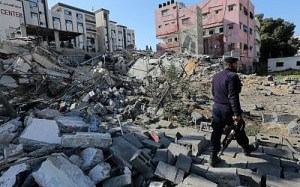
A picture taken on March 26, 2019, shows a Hamas policeman standing guard next to the rubble of a building in Gaza City that was targeted the night before by an Israeli air raid. (Mahmud Hams/AFP)

Some 30,000 Palestinians participated in the first protest event, held on March 30 2018. Fifteen Palestinians were killed in clashes with IDF soldiers protecting the border. Since then over 180 Palestinians have been killed in border violence, according to February figures from the UN Human Rights Council. Hamas has claimed dozens of the dead as members.

Israeli defense officials — as well as Hamas’s political foe, the Palestinian Authority — accuse the terror group of encouraging the border riots in an effort to distract from its failures in governing the Gaza Strip, a crowded patch of land with crushing unemployment, limited access to electricity and potable water, and few economic prospects.

Adam Rasgon and Judah Ari Gross contributed to this report. 
 

IDF at peak readiness in Gaza sector, adds reinforcements after failed Egyptian truce bid – DEBKAfile

March 29, 2019

Source: IDF at peak readiness in Gaza sector, adds reinforcements after failed Egyptian truce bid – DEBKAfile

Israel’s armed forces around Gaza are at peak readiness for Hamas’ “March of the Million” on Friday and Saturday, March 30-31. On Thursday, the IDF further ramped up the force piling up on the Gaza border with additional ground troops and artillery units.

DEBKAfile’s military sources report that the Egyptian intelligence officers shuttling between Tel Aviv and Gaza City for days failed to broker an agreement for an Israeli-Hamas truce. Neither party was willing to make commitments as to its response should the “March of the Million” rage out of control.

Hamas adamantly refused to guarantee that the mass demonstration would be peaceful, or to rein in attacks on Israeli troops like those which have plagued southern Israel in the past year. Neither would the Palestinian terrorist group ruling the Gaza Strip agree to halt its incendiary balloon assaults on Israeli civilian locations or even rocket fire.

Israel’s answer was to refuse to make any promises about how the IDF would respond if Hamas’ and allied groups’ violent conduct continued.


This IS hamas !

March 29, 2019

Hamas: “Scatter the enemies’ body parts, make the skulls fly in the sky” (CONTAINS GRAPHIC IMAGES)

Israel makes generous offer to Hamas

March 29, 2019

Will Hamas drag us into another round of launches, rockets and red alerts less than two weeks before Israeli elections?

Arutz Sheva Staff, 29/03/19 15:26
http://www.israelnationalnews.com/News/News.aspx/261117
Flash 90

Approaching a lull? Not according to newspaper headlines Friday morning which announced tensions, high alert, army deployment and the transfer of IDF forces to the south of Israel.

The Egyptian delegation is negotiating with Hamas to try to restore calm, but it’s not at all certain that the terrorist organization will accept the offer. Instead, we may be dragged into another round of launches, rockets and red alerts less than two weeks before Israeli elections.

“I see the logic of Hamas which says it’s time to set the facts,” Arab affairs commentator Zvi Yehezkeli said on Channel 13 News on Friday. “Imagine yourself facing an enemy that has more military capabilities than you and you only have the patience, the stubbornness and the ability to harass the enemy.”

For those who may have already managed to forget, a summary of recent episodes: Hamas fired a rocket which hit Israel and destroyed a house in the Sharon area and Israel attacked Gaza in return. As far as Israel is concerned, the story is closed. As far as Hamas is concerned – it’s not.

“The profit of Hamas at the moment is related to the improvement of conditions on the day after,” Yehezkeli explained. “They want an agreement and this is what the Egyptian mediator discussed with them Thursday night.”

“The mediator proffered a very generous offer, which includes increasing their fishing area, opening the crossings and bringing in goods that have been banned since Operation Protective Edge – cement, iron and other building materials. However, Hamas is currently refusing the offer.”

“A year after they initiated these protests, Hamas is reaping the benefits. They found something that bothers us and we don’t know what the future holds,” Yehezkeli said.

An agreement or an escalation is currently on the agenda. According to Yehezkeli, if an agreement is reached and the state of Israel pays a little more money to silence Gaza, Hamas will hold quiet demonstrations devoid of violence, and if the negotiations fail, the violent demonstrations on the fence will continue as usual.

“Yahya Sinwar will tell the Gazans to break through the fence and harass the IDF soldiers. Israeli snipers will shoot them, Israel will be humiliated again and on Tuesday we’ll see them reach an agreement until the next missile,” Yehezkeli said.

And the next missile will come – that’s definite – the question is only when.

“There will be a missile,” Yehezkeli said. “I don’t know whether it will before the elections but there will definitely be another missile because they broke the psychological barrier of firing at the center of Israel. But as I said, everything very much depends on an agreement. If there’s no agreement and we continue these tensions, we’ll see a missile heading towards the center of the country.”

And what about the IDF forces deployed in the south of Israel? According to Yehezkeli, they’re there only for the sake of “being seen and feared.”

“I don’t know how quickly the armored forces and the tanks will enter Gaza. I think that they’re currently only there as a threat to Hamas to accept our proposal. It’s a bit embarrassing, but ultimately it can be solved with money. Hamas wanted money and its goal was achieved – it fired at the center, it received money, quiet for quiet. We’ll go to elections and the day after we’ll wake up to the Gaza problem.”

Extortion eventually pays off…

“Of course,” Yehezkeli quickly retorted. “There were no demonstrations on the fence a year ago. Since the demonstrations began, you know how much money and how much attention Hamas has received? How many donations from the world? How much attention from Qatar, the Arab countries and Egypt? Extortion definitely pays off.”

“[Former Hamas leader Sheikh] Ahmed Yassin wrote in the 1980s that in actuality, there are no forces here. Israel is a strong country with nuclear power and planes and Hamas lacks these abilities. How do they have the courage to start up with Israel? Precisely because Israel won’t use its weapons against them.”

“It’s not that they have the courage,” Yehezkeli asserted. “They simply don’t see Israel as strong and this is our weak point. They know that we really won’t shoot at Gaza because we’ll use the ‘tap on the roof’ procedure and we’ll make a thousand calculations before we act. They kill their people which we would never dare to do. They trust that Israel will be responsible and that’s where they get their courage to act.”

“Hamas sees this as a battle of minds between two societies – a Western society that sanctifies time, routine and the value of life with a Middle Eastern society that has all the time in the world, has no weapons and will always harass us until we say ‘enough.’ It’s not a matter of courage, but it’s a matter of two conflicting approaches.”

An agreement or not – one way or another – the next time missiles are fired at the center and Hamas will quickly declare that the missile was launched unintentionally, don’t be so quick to believe it. “Yesterday they admitted that the missile was not a mistake after all,” Yehezkeli concluded.

Haniyeh: Our behaviour at march of the million depends on our demands being met

March 29, 2019
By Tamar Beeri
March 29, 2019 15:32

https://www.jpost.com/Breaking-News/Haniyeh-Our-behaviour-at-march-of-the-million-depends-on-our-demands-being-met-585158

Hamas Chief Ismail Haniyeh looks on as he attends the funeral of Palestinian Hamas militants who were killed in Israeli tank fire, at a mosque in Gaza City July 26, 2018. (photo credit: MOHAMMED SALEM/REUTERS)

Hamas leader Ismail Haniyeh spoke on Friday afternoon regarding the negotiations with Israel mediated by Egypt, explaining that the behavior of Hamas at march of the million will depend on their demands being met.

“We continue our discussions today with our Egyptian brothers and with the participation of the factions,” Haniyeh said. “We are completing our earlier discussions so as to achieve our goal. We stand at a crossroads and a deep examination of Israeli stances, as well as Israel’s response to the needs of our nation.”

Haniyeh explained that based on decisions made at these deliberations, they will “determine the way in which the situation will pan out at the march of the million of Land Day.”

“We are in the final stretch of the road, which will have a serious impact on the decisions of Hamas and the factions and especially on the future,” he stated.

We are working with our Egyptian brothers to find a solution to the humanitarian crisis in Gaza to end the suffering of our people and establish their dignity in their country,” Haniyeh said. “All of this will be achieved by reaching some serious understandings that will be respected by the enemy, understandings which include the need for a ceasefire, the entrance of humanitarian aide and the implementation of projects, the opening of crossings and fishing, employment programs and treatment of electricity problems and more, by way of the removal of the siege over the Gaza Strip.”

Haniyeh said that Hamas continues to “coordinate intensely with our brothers in Qatar.”

Sinwar’s knockout victory over Netanyahu

March 29, 2019
Opinion: Every round of fighting with Hamas only serves to further illuminate how empty the prime minister’s policies are when it comes to our enemies in the south, and how incapable he is of solving the problem of Hamas once and for all
https://www.ynetnews.com/articles/0,7340,L-5485916,00.html

“We are back in control of the situation,” Benjamin Netanyahu said as he departed from Washington on Monday, as if there had been an event back home that demanded his urgent care.

For doing what he actually did in Gaza, Netanyahu could have definitely stayed in the US, delivered his AIPAC speech and given an interview in his fancy English. Even Immigration and Absorption Minister Yoav Galant could have handled the events in Gaza, such as they were.

Benjamin Netanyahu and Donald Trump at the White House (Photo: Reuters)

Benjamin Netanyahu and Donald Trump at the White House (Photo: Reuters)

Five years have passed since 2014’s Operation Protective Edge. Five years in which our “Mr. Security” has not done a single thing to match the achievements of the military operation on the political Level.

Instead, he has let Hamas’ leader in Gaza Yahya Sinwar do whatever he pleases. For when Sinwar wants peace, there is peace, and when he wants war, there is war. Everyone in Gaza must surely be familiar with Netanyahu’s drill by now: We bomb them, they rocket us, and the prime minister agrees to a cease-fire.

Air strikes on the Gaza Strip on Monday night (Photo: AFP) (Photo: AFP)

Air strikes on the Gaza Strip on Monday night (Photo: AFP)

For years – and especially in the past year – residents of the south have been living through a never-ending nightmare of uncertainty. No one in Netanyahu’s government cares for them.

It is absurd for southerners to wish for missiles on central Israel merely so that warplanes will be ordered out of their hangars. Even in the midst of the latest round of hostilities they offered to withstand rocket attacks and stay in shelters until Hamas was defeated.

The residents of southern Israel have learned from bitter experience. They too know that “Mr. Security” has nothing to offer. And what is worse is that he has no desire to resolve the situation in Gaza.

Which has led is to where we are now. For not wanting to do anything leads to an enemy on the other side of the Gaza fence that is only getting stronger, is not afraid to launch rockets of ever-increasing range, and is more than familiar with Netanyahu’s habit of delivering a blow from the air, flexing his muscles and rushing to declare a cease-fire.

The house in Mishmeret demolished by the rocket

The house in Mishmeret demolished by the rocket

The only good thing that can be said about Netanyahu’s handling of the Gaza mess is that he doesn’t let the show drag on for too long, and quickly ceases fire. He knows that there no clear end to this movie and therefore prefers to shout “cut” after the first scene.

When Netanyahu signed the 2011 deal for the release IDF soldier Gilad Shalit from Hamas captivity, he probably did not predict that one of the prisoners he freed for the hostage – Yahya Sinwar – would become the bitterest of rivals and lay bare his inability to protect his country.

Sinwar brought a new kind of leadership to Gaza and turned Hamas into an organization that calls the shots. On the other side, Netanyahu has lead Israel to a policy of retaliation and instead of initiation.

Hamas leader Yahya Sinwar

Hamas leader Yahya Sinwar

As of now, in the battle between Netanyahu and Sinwar, the latter has won by a knockout. He is teaching his people and the rest of the leaders in the region that you can launch rockets at Israel and ultimately ou will get a suitcase full of money. Every time Sinwar does this, he further erodes Israel’s standing, and further illuminates how empty the prime minister’s policies are when it comes to our enemies in the south.

Netanyahu was probably walking the red carpets of the White House and embracing the leader of the free world while Sinwar was hiding in a tunnel from Israeli airstrikes. But while Netanyahu may have been playing a winner on TV, the real victor was not him.


Report: Israel Capitulates, Will Grant Concessions, Ease Restrictions, in Return for Quiet in Gaza

March 28, 2019

https://www.jewishpress.com/news/eye-on-palestine/hamas/report-israel-capitulates-will-grant-concessions-ease-restrictions-in-return-for-quiet-in-gaza/2019/03/28/
Photo Credit: Abed Rahim Khatib / Flash90
Arabs participating in the “Great March of Return” demonstration near the Gaza border, March 22, 2019.

Talal Abu Trifa, a member of the Political Bureau of the Democratic Front for the Liberation of Palestine, on Thursday revealed details of the meeting held by the Egyptian security delegation in the Gaza Strip, the Hamas leadership, and the local terror factions Wednesday night, in which Egypt announced that Israel was willing to grant concessions to the Gaza Strip in exchange for quiet in the south, Channel 13 reported.

According to Abu Trifa, at the meeting, which lasted until after midnight, the Egyptians said Jerusalem had expressed willingness to comply with Hamas demands regarding the expansion of fishing areas to 18 miles, rehabilitation of the electricity lines in the Gaza Strip, and allowing the flow goods and money into the Strip.

Israel also expressed its readiness to allow the export of goods from the Gaza Strip.

These concessions will be given in return for the return of quiet to the south, including the cessation of rocket launches and the cessation of the firing of incendiary balloons, as well as the removal of the mobs of Arab rioters to a distance of 300 yards from the border fence.

In addition, Abu Trifa said that the Egyptian security delegation would continue to conduct rounds between Israel and the terror factions until after Friday, in order to closely monitor the “march of the million” planned for Saturday’s Land Day, which follows Friday’s one-year anniversary of the border fence riots.

Last night, the Egyptian delegation met with Hamas chairman Yahya Sinwar, and conveyed a message from Israel that his organization must stop firing rockets and incendiary balloons, and also stop the demonstrations at the fence.

Sinwar responded that he would only stop firing rockets, and demanded in return that Israel stop attacking the Gaza Strip in response to the balloons carrying explosive charges.

Hamas is expected to respond to Israel’s offer of a truce in the coming hours.

Thursday night, IDF units completed their deployment in the Gaza perimeter, and the fighters are preparing for the demonstrations along the fence on Friday, which should indicate if Hamas is willing to grant Israel’s request for quiet.

Sderot mayor Alon Davidi said on Thursday that “every day that goes by, we understand that eventually there will be an operation in Gaza, because this way we will not be able to continue, it’s clear to everyone.”