Archive for March 2019

Hezbollah, Iran condemn Britain for outlawing terrorist group 

March 3, 2019

Source: Hezbollah, Iran condemn Britain for outlawing terrorist group – Israel Hayom

Hezbollah slams U.K. Parliament’s decision to outlaw it in its entirety, saying it has a political and popular force in Lebanon • Britain’s move means  support for  Hezbollah will be a criminal offense and could carry a 10-year prison sentence.

Associated Press, Reuters and Israel Hayom Staff // published on 03/03/2019
   
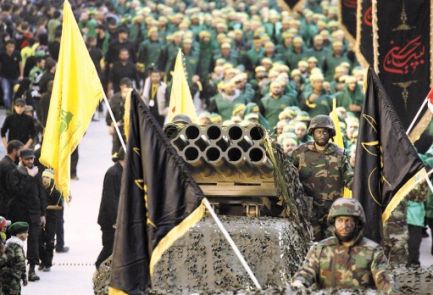
Hezbollah forces march in Lebanon 


The Lebanese Shiite organization Hezbollah on Friday strongly rejected the British government’s move to ban it as a terrorist organization, calling the measure an “insult” to the Lebanese people and evidence of subservience to the United States.

The House of Commons approved the government’s motion to outlaw Hezbollah in its entirety on Friday. The legislation passed days after the Home Secretary Sajid Javid determined it was impossible to distinguish between Hezbollah’s political and military activities.

In a statement issued in Beirut in response to the vote, Hezbollah said it is a “resistance” movement against Israeli occupation but also a political and popular force with representatives in the Lebanese parliament and government.

“The British government, by adopting this decision, has insulted the feelings, emotions and will of the Lebanese people which consider Hezbollah to be a significant political and popular force and granted it large representation in parliament and in the new government,” the statement said.

It was the first comment by the Iran-backed group on Britain’s move earlier this week to ban Hezbollah as a terrorist group, accusing it of further destabilizing the Middle East.

The British government’s decision means being a member of, or inviting support for, Hezbollah will be a criminal offense, carrying a sentence of up to 10 years in prison. Until now, the military wing of the Lebanon-based group has been outlawed in Britain, but not its political arm.

Hezbollah – Arabic for Party of God – is a Shiite Muslim movement that emerged during the early 1980s to fight Israel, with financial backing from Iran. The group maintains a formidable military force that rivals the Lebanese army. It is also a powerful political force that participated in elections, has members in parliament and the government, and dominates the country’s politics.

The U.S. and others accuse the group of destabilizing the region through its military intervention in Syria on the side of President Bashar Assad’s government.

The Hezbollah statement added that the U.K. decision is proof that the British government is “merely a puppet” that does the bidding of its American “masters.”

“No country in the world that embraces terrorism, funds and supports it has the right to accuse Hezbollah or any other resistance movement of being terrorist,” it said.

Long the most powerful group in Lebanon, Hezbollah’s influence has expanded at home and in the region. It controls three of 30 ministries in the government led by Western-backed Prime Minister Saad Hariri, the largest number ever.

Iran also criticized Britain over the weekend, saying the decision ignored both the will of a large portion of the Lebanese people and the Tehran-backed group’s role in fighting Islamic State.

“This British measure signifies deliberately ignoring a large part of the Lebanese people and the legitimacy and the legal position of Hezbollah in Lebanon’s administrative and political structure,” Iran’s Foreign Ministry spokesman Bahram Qasemi was quoted as saying by state-run Islamic Republic News Agency.

“In addition to … helping preserve Lebanon’s territorial integrity over recent decades, Hezbollah has been one of the pillars of the fight against terrorism and terrorist groups such as Islamic State in the region,” Qasemi added.


Likud, after AG’s decision to indict: ‘We’re going to war’ 

March 3, 2019

Source: Likud, after AG’s decision to indict: ‘We’re going to war’ – Israel Hayom

PM Netanyahu summons Likud ministers, MKs to a strategy meeting focusing on legal issues and ongoing attempt to brand the Blue and White list as Left • Opponents of Netanyahu slam his conduct after Attorney General Avichai Mendelblit’s announcement.

Yehuda Shlezinger and Yair Altman // published on 03/03/2019
   
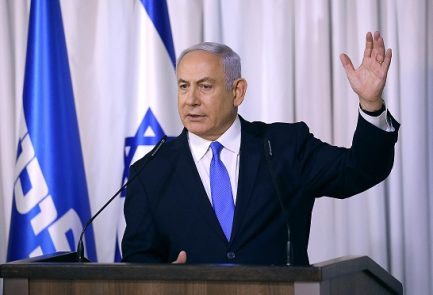
Prime Minister Benjamin Netanyahu 


This past weekend was particularly tense for the Likud party following Attorney General Avichai Mendelblit’s announcement on Thursday that he plans to indict Prime Minister Benjamin Netanyahu in three cases of alleged corruption.

Following Mendelblit’s announcement of the counts on which he intends to indict Netanyahu, pending a pre-indictment hearing, Netanyahu summoned several Likud ministers and MKs to his residence in Jerusalem to discuss what the Likud’s campaign strategy will be, given the shadow of the looming indictments.

Those present included Public Security Minister Gilad Erdan, Science and Technology Minister Ofir Akunis, MK Amir Ohana, coalition chairman David Amsalem, former coalition chairman David Bitan, party candidate Nir Barkat and various members of the campaign staff. When the meeting was over, participants said the atmosphere had been positive and that they would be “going to war.”

The meeting opened with a discussion of the legal issues presented by Mendelblit’s decision to indict Netanyahu, pending a hearing. The MKs were told – and asked to pass on in any media appearances they would be making this week – that Mendelblit and State Attorney Shai Nitzan had buckled to pressure from left-wing activists and the media to indict Netanyahu.

The participants in the meeting were reminded of the meetings Yesh Atid leader Yair Lapid and former Hatnuah leader Tzipi Livni held with Yedioth Ahronoth publisher Arnon “Noni” Mozes, and the fact that none of the 43 MKs who had supported a bill designed to shut down Israel Hayom – initiated at the prompting of Mozes – had been investigated. The participants were also reminded of the case against former State Attorney Ruth David, who was suspected of accepting illicit gifts, which was closed.

“There is one law for Netanyahu and another law for everyone else,” one participant said.

According to one of the people in the meeting, “The prime minister looks sure of himself about the attorney general’s decision. He is convinced that he will blow apart the allegations during the hearing.”

The second part of the meeting focused on political matters, particularly an ongoing attempt to brand the Blue and White list, headed by former IDF chief Benny Gantz, as left-wing.

When the meeting was over, Akunis said, “The 2019 election will decide the main question – Bibi or [Arab MK Ahmad] Tibi. The weekend polls, which gave 61 seats to the Left under Gantz and Lapid – but only with the support of the Arab parties – are clear proof that in contrast to the lies being spread by the Blue and White party, they would have no government without Tibi, MK Ayman Odeh, and their pals.

“Anyone who is willing to see members of the Arab parties in the government and the coalition should vote for Gantz, Lapid, and [Moshe] Ya’alon. It’s a close race that will decide the fate of the Land of Israel for years to come,” Akunis said.

Meanwhile, Netanyahu’s attacks on the State Attorney’s Office last Thursday were met less than enthusiastically by the judicial system. Speaking after Mendelblit announced his decision, Netanyahu accused Nitzan of “selective law enforcement” and Tel Aviv District Attorney Liat Ben-Ari of having frozen an investigation against Tzipi Livni after the Knesset election was brought forward.

Actually, a court at the time overruled a decision that Nitzan was enforcing the law selectively. Livni herself was never a suspect in the case in which suspicions about the Kadima party were being investigated, and Ben-Ari was never involved in any decisions about that case.

“Netanyahu chose to make an incorrect use of facts to sully the reliability of the State Attorney’s office and claim that it has ties to the Left,” officials in the legal system said over the weekend, mentioning that Nitzan had been at the office for some 30 years and had appeared before the High Court of Justice many times to defend the government’s position on issues such as demolishing homes of terrorists; deporting terrorists; and in favor of construction in Judea and Samaria.

Mendelblit also sent a letter of thanks to the 23 prosecutors who were part of the Netanyahu cases.

“This is certainly not a happy day but it is a very important day for a society that upholds the rule of law,” Mendelblit wrote.

“The debates were handled outstandingly and I am proud of you and the work process you led. Without your devoted, professional work, I would not have been able to fulfill my obligation to the citizens of the country,” Mendelblit’s letter said.

Meanwhile, other factions continued to criticize Netanyahu’s conduct after Mendelblit made his announcement about the planned indictments.

Speaking at a town hall event in Modiin on Saturday, chairman of the Labor Party Avi Gabbay said, “The election campaign is about the life of Prime Minister Netanyahu vs. the life of the state. I am very disturbed by what will happen here by the time the election is held,” Gabbay said.

“Netanyahu is doing everything to save himself from an indictment. He wants to win the election so he can pass the ‘French Law’ and anchor his freedom, so he could do anything,” Gabbay added.

Blue and White list candidate Maj. Gen. (res.) Orna Barbivai said at a different town hall meeting in Nes Ziona that “a prime minister who is elected to serve the citizens, but who is busy handling his defense against such serious indictments that involve corruption, must step aside and allow the ruling party to deal with the burning issues in Israeli society.”


The Putin-Netanyahu deal to remove foreign forces from Syria breaks new ground for both – DEBKAfile

March 3, 2019

Source: The Putin-Netanyahu deal to remove foreign forces from Syria breaks new ground for both – DEBKAfile

When President Vladimir Putin sat down with Prime Minister Binyamin Netanyahu on Feb. 27, the US envoy Jared Kushner was in Ankara and two days earlier, Bashar Assad arrived in Tehran on a surprise visit.

All the parties involved in Syria were on the move to break the deadlock on Syria’s future. And for the first time, Israel’s leader was given a place at the table by the Russian president.

The only Iranian officials who knew the Syrian leader was coming on Monday, Feb. 25 were supreme leader Ayatollah Ali Khamenei and Iran’s Middle East commander Gen. Qassem Soleimani. No word leaked from their tightly closed-door conversations. However, the ayatollah is believed to have directed Assad to hand over to Iranian firms all the contracts for his country’s vast reconstruction projects and to turn away all oil-rich Arab emirates funding propositions.

In Moscow, Israel’s Military Intelligence chief, Maj. Gen. Tamir Hayman spread before Putin maps showing Iranian military sites in Syria. Netanyahu’s main object in meeting Putin at this time was to prevent Iran from establishing a military presence in Syria. The Russian leader replied that both Jerusalem and Moscow have a common goal, which is “to return the situation in Syria to what it was before the eight-year long civil war.”

This was a landmark departure for both. Its epic significance was shouted down by Israel’s tempestuous election campaign and the attorney general’s ruling on the bribery case against the prime minister. What happened in Moscow was that Netanyahu broke with the conventional wisdom of his own intelligence chiefs, who consistently claimed that Assad had lost the war and that the IDF had destroyed 90 percent of Iran’s military structures in Syria. Admitting that neither was realistic, he struck a deal with Putin for setting up a joint Russian-Israeli commission for the removal of all foreign forces from Syria.

For Putin this was an audacious albeit calculated move. If Assad, whose regime he had saved, could fly to Tehran without a word to Moscow, Putin was ready to introduce Israel into discussions on the future of Syria. After last month’s talks with Iran’s Hassan Rouhani and Turkey’s Tayyip Erdogan in Sochi, the Russian president was bringing Netanyahu into the equation.

The prime minister also trod on new terrain when he agreed to talk with the Russian president on ways to remove “all foreign forces” from Syria – American as well as Iranian – and  even to discuss the security arrangements to prevail after they were gone.

As for Jared Kushner’s meetings that same Wednesday with Erdogan, the official word was that they discussed the US Israeli-Palestinian peace plan. What they really talked about was the creation of a Turkish-led buffer zone in northern Syria and the sale of US Patriot air defense missiles for the Turkish army, provided Erdogan cancelled his S-400 missile deal with Moscow.

Therefore, while in Ankara, Kushner discussed with Erdogan the introduction of Turkish troops into Syria (on certain conditions), in Moscow, Netanyahu and Putin laid plans for the withdrawal of all foreign troops. It will take a while to find out whether these discussions lead anywhere or peter out like so many other moves on Syria.

It will be interesting to see if Netanyahu can serve as a bridge between Donald Trump and Putin on the Syrian question. The US president’s hands are tied by the conspiracy climate in Washington around any connection with Moscow. Netanyahu too is hobbled by the charged atmosphere over the allegations against him and his challengers’ loud calls for his resignation. Nevertheless, while both are severely hampered for seizing bold new initiatives, Putin has opened a door .


US-backed fighters advance against Islamic State in its last Syrian territory

March 2, 2019

Source: US-backed fighters advance against Islamic State in its last Syrian territory | The Times of Israel

Syrian Democratic Forces report heavy clashes in area of Baghouz, on the east bank of the Euphrates River; aid group says over 10,000 civilians evacuated since February 20

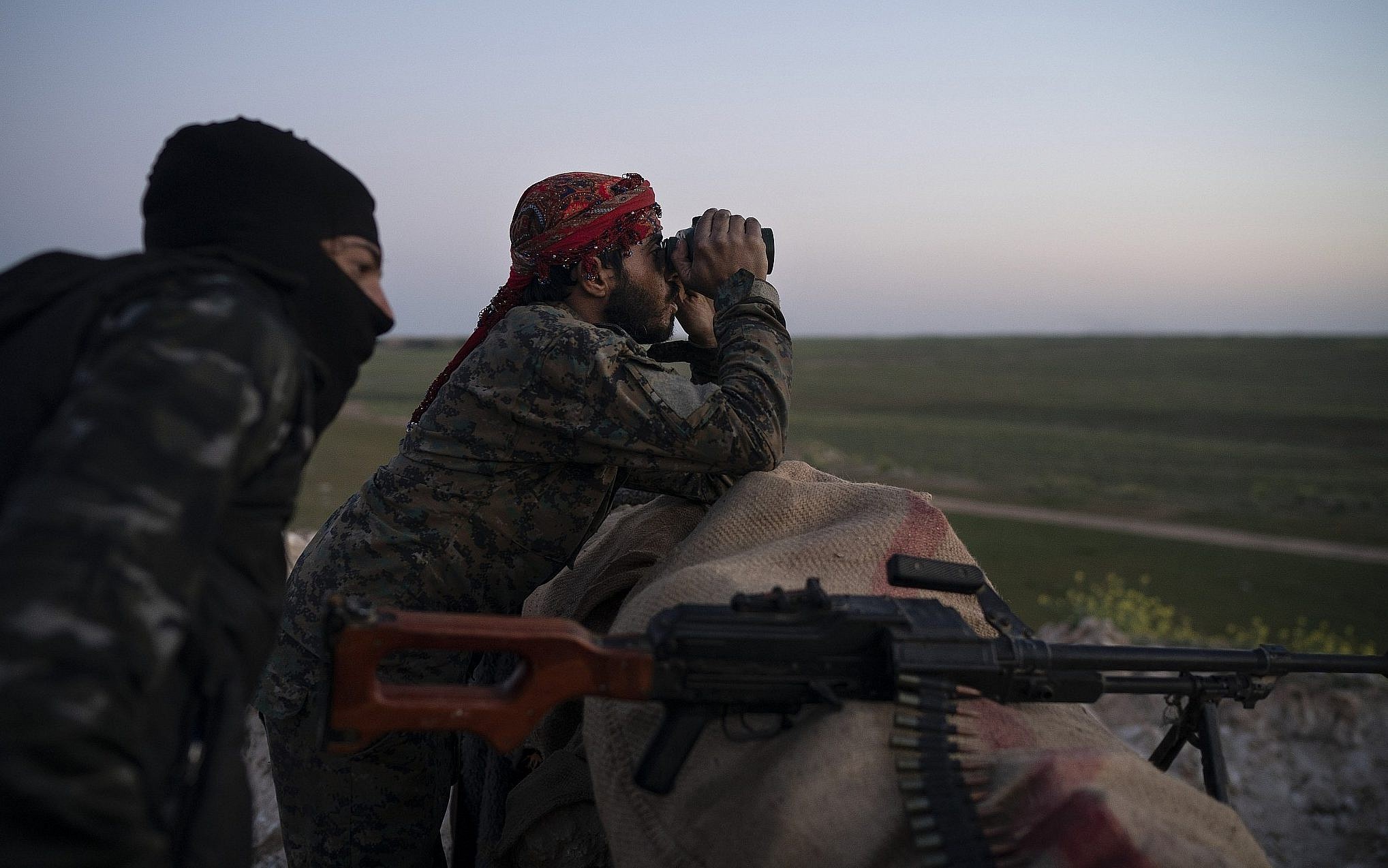
In this Tuesday, Feb. 19, 2019 file photo, US-backed Syrian Democratic Forces fighters watch as an airstrike hits territory still held by Islamic State in the desert outside Baghouz, Syria (AP Photo/Felipe Dana, File)

AL-OMAR OIL FIELD BASE, Syria — A spokesman for the US-backed force fighting the Islamic State group in eastern Syria says fighters are waging intense battles with the group, advancing on two fronts in the last area they control.

Mustafa Bali of the Kurdish-led Syrian Democratic Forces tweeted Saturday that “heavy clashes” are taking place in the area on the east bank of the Euphrates River.

Bali said three SDF fighters were wounded.

The SDF on Friday evening resumed military operations to liberate the last piece of territory held by IS in the province of Deir el-Zour after evacuating thousands of civilians and hostages who had been besieged inside.

Zana Amedi, an SDF commander, told The Associated Press that “an active ground force” is advancing into IS-held territories as the jihadists resort to sniper fire and booby-traps.

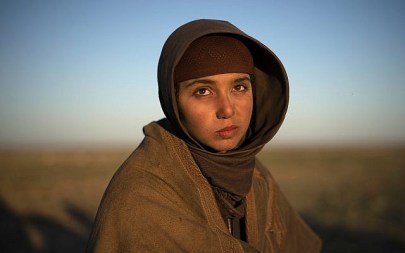
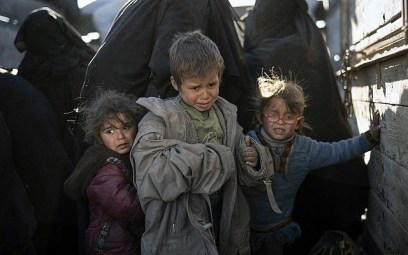
A girl waits to be screened by US-backed Syrian Democratic Forces (SDF) after being evacuated out of the last territory held by Islamic State militants, in the desert outside Baghouz, Syria, Friday, March 1, 2019. (AP Photo/Felipe Dana)

“Those left inside are fighters who do not wish to surrender,” Bali told The Associated Press.

The military campaign to uproot the militants from the eastern banks of the Euphrates River began in September, pushing them down toward this last corner in the village of Baghouz, near the Iraqi border. The military operation was halted on February 12 as the SDF said a large group of civilians and hostages were holed up in the territory, which sits atop caves and tunnels where they had been hiding.

The remaining speck of IS-controlled land in Baghouz village is also along the Euphrates from one side and the desert near the Iraqi border from the other. Thousands of civilians were living in a tent encampment and houses along the riverside.

Over the last two weeks, thousands of civilians have been evacuated, many of them women and children in desperate conditions. The only aid group at the evacuation site, the Free Burma Rangers, estimated that at least 10,000 civilians have left the IS pocket since February 20, in trips organized by the SDF.

The evacuees, who included IS family members, said food was running low and clean water and medicine were scarce. Despite its demise, many defended what remained of the group’s territorial hold, which once spanned a third of Iraq and Syria.

As they trickled out, SDF and coalition officials screened them. Women and children were transferred to camps miles away. Men suspected of links to the militant group were taken into custody at other facilities.

Women and children exit the back of a truck as they arrive at a US-backed Syrian Democratic Forces (SDF) screening area after being evacuated out of the last territory held by Islamic State, in the desert outside Baghouz, Syria, Friday, March 1, 2019. (AP Photo/Felipe Dana)

US President Donald Trump said Thursday that IS has lost “100 percent” of the territory it once controlled in Syria, but officials estimate there are hundreds of militants left in the small patch of territory in Baghouz, and that they will likely fight till the end.

Bali would not speculate on how long the military operation might take but said he expects a “fierce battle.”

He said the battles are expected to take place in a very small area that includes a complex network of tunnels, as well as suicide bombers and land mines.

“The battle to finish off what is left of Daesh has started,” said SDF commander Adnan Afrin, using the Arabic acronym for IS.

Afrin said he expects “resistance” from the remaining fighters who are likely to deploy all their weapons, including suicide bombers.

He said most of the remaining fighters are Europeans, Asians, Iraqis and Arabs from the area.

On Friday, the smallest batch of evacuees, just over 200, came out of the pocket in around six trucks used to transport sheep. About 10 trucks sent to the perimeter of the IS pocket came back empty, and drivers said no more evacuees came out after hours of waiting.

The evacuees Friday included wounded men but were mostly women and children. There were Russians, Indonesians, Bosnians, Dagestani, Kazaks, Egyptians, Syrians and Iraqis. They dragged along few belongings, distraught children and broken spirits.

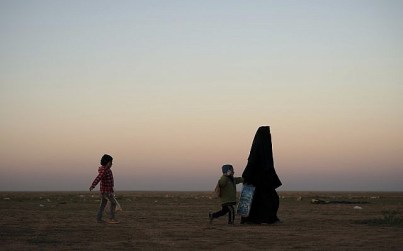
A woman walks with her children at a US-backed Syrian Democratic Forces (SDF) screening area after being evacuated out of the last territory held by Islamic State, in the desert outside Baghouz, Syria, Friday, March 1, 2019. (AP Photo/Felipe Dana)

Umm Mohammed — or mother of Mohammed — a 38-year-old Syrian, left Baghouz with her three children Friday but her husband stayed behind in support of IS. “There are many fighters and families inside,” she said. “The Islamic State is weak only in Baghouz but elsewhere it is expanding and growing.”

The capture of the last pocket still held by IS fighters in Baghouz would mark the end of a devastating four-year global campaign to end the group’s hold on territory in Syria and Iraq — their so-called “caliphate” that at the height of the group’s power in 2014 controlled nearly a third of both Iraq and Syria.

It would allow Trump to begin withdrawing the estimated 2,000 US troops from Syria, a decision he accounced in December — though last week he partially reversed course and agreed to keep a residual force of perhaps a few hundred troops as part of an international effort to stabilize northeastern Syria.

The resumption of military operations against IS breaks a dayslong standoff while the civilians were being evacuated. In the last week alone, 13,000 people, most of them women and children, arrived at the al-Hol camp in Hassakeh province which now houses approximately 45,000 people, according to the United Nations.

In a statement Friday, the UN cited reports that more than 84 people, two thirds of them young children under five years of age, have died since December on their way to al-Hol camp after fleeing the group in Syria’s Deir el-Zour province.

“Many of the arrivals are exhausted, hungry and sick,” according to Jens Laerke, spokesman of the UN Office for the Coordination of Humanitarian Affairs, at a news briefing in Geneva.


French ISIS member linked to Paris nightclub attack killed in Syria 

March 1, 2019

Source: French ISIS member linked to Paris nightclub attack killed in Syria – Israel Hayom

U.S.-led coalition reports Fabien Clain, linked to 2015 shooting at Bataclan nightclub that killed 130, was killed in airstrike in village of Baghouz, one of Islamic State’s last strongholds • Syrian Democratic Forces report mass grave outside Baghouz.

Associated Press and Israel Hayom Staff // published on 01/03/2019
   
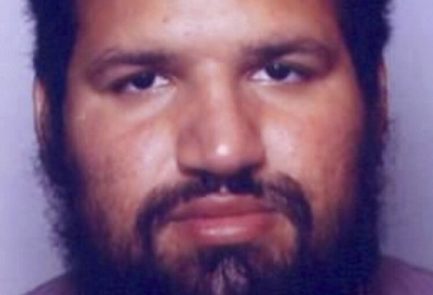
A screen grab from the Interpol wanted persons web page shows a portrait for Fabien Clain. 


The U.S.-led coalition against the Islamic State group said Thursday that a prominent French militant who is one of Europe’s most wanted members of the extremist group has been killed in an airstrike in Syria.

The coalition tweeted that a strike killed Fabien Clain, who is linked to the 2015 attacks on Paris, in the Syrian village of Baghouz on the banks of the Euphrates River, where the group is making its last stand.

Coalition spokesman Col. Sean Ryan said the airstrike occurred on Feb. 20, but gave no further details.

French authorities did not immediately comment on the announcement, but said last week they were working on verifying reports that Clain had been killed.

The day after the Nov. 13, 2015 attacks on Paris, Clain’s voice announced in a recording that the Islamic State group claimed responsibility for the onslaught. The attacks killed 130 people at the Bataclan concert hall, cafes and the national stadium.

Clain was believed to have been in Syria since 2015. Officials suspect that a number of French extremists remain holed up in Baghouz.

From a self-proclaimed caliphate that once stretched over large areas of Syria and Iraq, the Islamic State group has been reduced to a tiny speck of land in the village of Baghouz, where a few hundred ISIS members are holed up with family members and other civilians who are among the group’s most determined supporters, many of whom traveled to Syria from all over the world.

SDF officials have denied there were negotiations with the fighters, some of whom had asked for an exit.

SDF commanders on Thursday said they have freed 24 of their fighters held by ISIS, and uncovered a mass grave near Baghouz.

Adnan Afrin, a spokesman for the Syrian Democratic Forces, said the grave unearthed a few days ago outside Baghouz contains the remains of men and women but said the number of bodies and their identities remain unclear.

“An investigation is still underway to determine their nationality and the manner of killing,” said Afrin, adding they were looking into reports that they may be Yazidis or Islamic State fighters.

A video posted by Kurdish-run Furat FM TV on Wednesday showed several bodies dug out from a pit – mostly women and children.

A station executive, Salah Youssef, said those in the mass grave appear to have been shot in the head. He said authorities are investigating whether the bodies are those of women and children who had refused to stay under ISIS rule and were shot as they tried to escape, or belonged to ISIS fighters who were killed fighting the SDF. Youssef said there are reports of more than one mass grave.

Thousands of civilians, many of them women and children, have evacuated the area in the past few weeks on foot, many saying they had paid smugglers to get out.

But for the past week, trucks have brought out in intermittent batches hundreds of civilians, mostly members of Islamic State families and wounded men, in an organized evacuation amid a truce in the fighting.

Afrin said his forces managed to free 24 SDF fighters from the extremist group’s hold while evacuating civilians from the area in the past days. The SDF fighters were taken hostage by ISIS during recent fighting.

In a video released by the SDF press office Thursday, the leader of the force Mazloum Kobani is seen meeting with a number of newly released fighters. One of the soldiers said they had spent 22 days in captivity.

Kobani said “the main reason” military operations against ISIS have stopped is to allow for the liberation of more hostages. He added that a full victory against ISIS is days away.

“They think themselves very strong but it is not like this,” he said.

The fate of a number of foreign hostages and Syrian and Iraqi detainees by Islamic State also remains unknown as the group’s territory has shrunk. SDF officials said they are probing whether some of those hostages may still be in the hands of the militants in Baghouz.

In recent days, at least 13 Yazidi children, including two girls, were released from inside the Islamic State pocket.

Recapturing Baghouz would mark an end to the militants’ territorial rule, but few believe that will end the threat posed by an organization that still stages and inspires attacks through sleeper cells in both Syria and Iraq and that has active affiliates in Egypt, West Africa and elsewhere. The group also has a presence online, using social media to recruit new members and promote its attacks.

In Geneva, U.N.-backed investigators focusing on Syria expressed concern that Islamic State fighters and their affiliates are being held by U.S. troops and Syrian opposition forces without proper legal protections.

The Independent International Commission of Inquiry on the Syrian Arab Republic presented its findings based on investigations conducted over the past six months saying that in areas under the control of the SDF, thousands of women, men and children “continued to be unlawfully interned or detained, some of them held in deplorable conditions in makeshift camps unfit to meet their basic needs.”

The report released in Geneva on Thursday said there is a concern that ISIS “terrorists and their affiliates are being held incommunicado by SDF and American forces without adequate judicial guarantees, conditions that are conducive to detainee abuse.”

Officials from the Kurdish-led administration had no immediate comment on the report.


Poll: Gantz widens his lead but the Right still has more total seats

March 1, 2019

Source: Poll: Gantz widens his lead but the Right still has more total seats – Israel Hayom

Israel Hayom-i24NEWS poll predicts 38 seats for Blue and White party, 29 for Likud • Poll shows that Blue and White leader Benny Gantz would have difficulty forming a coalition • Most respondents oppose or are unsure about unity government.

Yehuda Shlezinger // published on 01/03/2019
   
Even if the Blue and White list under Benny Gantz wins the most votes in the election, he will be unable to form a governing coalition, the latest Israel Hayom-i24NEWS poll suggests 


The center-left Blue and White list might be widening its lead over the Likud but still has no chance of forming the next government, a new poll by Israel Hayom and i24NEWS suggests.

The poll predicted 38 seats for Blue and White, under the leadership of Benny Gantz and Yair Lapid, compared to 29 seats for Prime Minister Benjamin Netanyahu’s Likud party.

The Union of Right-Wing Parties (comprising Habayit Hayehudi-National Union and the far-right Otzma Yehudit) was projected to win nine seats, making it the third-largest party, and one more than the eight seats projected for the New Right under Education Minister Naftali Bennett and Justice Minister Ayelet Shaked.

This means that despite his current lead in the polls, Gantz would still be unable to assemble a governing coalition, because parties on the Right have more total seats than parties on the Left. For example, if Gantz were to join forces with Labor, Meretz and even Finance Minister Moshe Kahlon’s Kulanu party – which is hovering just at the minimum electoral threshold with four projected seats – after the election, he would still only have 55 total seats, whereas a right-wing government would have 62 seats with Kahlon.

According to the poll, Labor and the Arab list Ta’al-Hadash would win seven seats each. Shas, United Torah Judaism, and Meretz were predicted to win six seats each.

The poll predicted that Yisrael Beytenu and MK Orly Levy-Abekasis’s Gesher party would fail to pass the minimum threshold.

When asked who they thought was most qualified to serve as prime minister, 43% of respondents picked Prime Minister Benjamin Netanyahu, compared to 36% who picked Gantz and 21% who picked a different candidate or said they did not know.

The poll also asked respondents whether they thought that a unity government under both Likud and the Blue and White party should be established after the election, 28% responded in favor of a unity government, 40% opposed the idea and 32% said they did not know.

The poll also asked Gantz supporters whom they supported in the last Knesset election, and only 10% said they had voted for Likud. More than half (58%) said they voted for Labor, 17% voted for Kulanu and 13% voted for the Joint Arab List.


How will the attorney general’s decision affect the election?

March 1, 2019

Source: How will the attorney general’s decision affect the election? – Israel Hayom

Die-hard supporters will cast their ballots for the prime minister’s party no matter what. But what about Netanyahu supporters who trust the attorney general or those who wouldn’t have voted for Netanyahu but don’t want to be bullied?

Mati Tuchfeld // published on 01/03/2019
   
Some voters will shift toward or away from Prime Minister Benjamin Netanyahu as a result of the attorney general’s announcement of planned indictments. But how many? 


After Prime Minister Benjamin Netanyahu’s defense and the opposition’s attack, one question remains in politics: to what extent will Attorney General Avichai Mendelblit’s decision to indict Netanyahu affect the election results? As of now, no one seems to know.

Netanyahu’s supporters, the ones who believe that the justice system has joined forces with the Left and that they made a joint decision to persecute Netanyahu until they brought him down – were not only not surprised on Thursday at the attorney general’s news, they even held fast to their position. They are voters worth a few dozen seats who will put a Likud ballot in the box in April, even if 100 more cases are opened against Netanyahu by the time of the April election. Thursday’s decision certainly didn’t influence them.

On the other hand, those who oppose Netanyahu and long to see him toppled had no need of Mendelblit and his detailed 56-page letter to think that Netanyahu needs to go. In this case, too, they represent a few dozen Knesset seats who will give their votes to the opposition and would have done so even if Mendelblit had cleared Netanyahu of every charge.

The decision will influence, if at all, those who have supported the prime minister thus far but whose support cracked following Mendelblit’s announcement. They think that the police, the State Attorney’s Office and everyone else involved in the investigations involving Netanyahu were affected by outside interests but they trust Mendelblit. If he decides there was bribery, then there probably was, they think. This group should leave the Likud starting Friday morning and we can expect to see that in the next batch of polls. But no one really knows how many people like that there are. Who are they, these folks who until now supported Netanyahu in spite of all the suspicions, investigations and leaks that have been laid out before them for months but who, starting Thursday, abandoned him and decided that as far as they are concerned, he can no longer be prime minister? Are there 1,000 people like this? 100,000? Who knows? The next polls will tell us.

A mirror image of this phenomenon also exists. There are people who never thought of voting for Netanyahu, but on Thursday decided to. They thought the persecution had gone too far. They were nauseated by the crowing in the TV studios. No one will educate them or try to force them into artificial horror or to believe that on Thursday, Israeli democracy died. There are people like these. But we have no idea how many.

The next round of polls will be of vital importance and we need to look not only at the battle between Likud and the Blue and White party but also at how the blocs are realigned. Likud voters could cross lines and put the next right-wing coalition in danger.


Mendelblit: Prime minister broke law in talks with Yedioth Ahronoth 

March 1, 2019

Source: Mendelblit: Prime minister broke law in talks with Yedioth Ahronoth – Israel Hayom

Mozes’ actions attempted bribery, Mendelblit says.

Avi Cohen // published on 01/03/2019
   
Yedioth Ahronoth publisher Arnon “Noni” Mozes 


Attorney General Avichai Mendelblit made harsh accusations against Prime Minister Benjamin Netanyahu on Thursday when he informed his lawyers that he seeks to indict Netanyahu in Case 2,000 (as well as in two other cases) pending a pre-indictment hearing.

Case 2,000 focuses on an illicit deal Netanyahu allegedly tried to strike with Mozes under which Yedioth Ahronoth would soften its aggressive anti-Netanyahu stance in return for the prime minister working to pass legislation that would help Yedioth financially or use his influence to curtail Israel Hayom, Yedioth’s rival.

Mendelblit said Netanyahu will face one count of fraud and breach of trust if the indictment is eventually served, whereas Mozes will face one count of attempted bribery.

In his letter to Netanyahu’s lawyers, Mendelblit said that even though Netanyahu “did not ask or condition the receipt of a bribe he did not turn down Mozes’ suggestion, and chose to continue to talk with him extensively on the terms of his proposed bribery scheme. ”

According to Mendelblit, between 2008 and 2014, Netanyahu held extensive meetings with Mozes in three separate periods, during which they talked on the terms of their emerging deal.

After the first series of talks, in 2009, Mendelblit said Netanyahu talked with the owner of Israel Hayom Sheldon Adelson and asked to scrap the planned rollout of its weekend edition that year.

But this was unsuccessful and Mozes, according to Mendelblit, made it clear to Netanyahu that if the paper continued to print a weekend edition, Yedioth would print negative pieces on the prime minister and his family.

Mendelblit further said that after the Knesset election in 2013, Netanyahu arranged six or seven meetings with Mozes, of which there is no official record in his schedule.

During those meetings, the two supposedly agreed that Netanyahu would ask Adelson to end Israel Hayom’s free distribution or reduce it, in exchange for favorable coverage in Yedioth. But according to Mendelblit, Adelson refused to heed both options.

The third round of talks were in 2014 was the most critical, Mendelblit told Netanyahu’s lawyers. Two of those talks, held at the Prime Minister’s Office in Jerusalem, were secretly recorded by Netanyahu or his staff.

During those talks, the two allegedly discussed possible legislation that would curtail Israel Hayom’s activity and reduce its distribution by about a third.

According to Mendelblit, after those meetings, Netanyahu’s lawyer and cousin David Shimron warned him that he must make sure that his actions would not be tied to Mozes’ request lest he gives Mozes a quid pro quo.

Mendelblit says Netanyahu did not plan to follow through on this legislation, but he nevertheless refused to rule it out. “You did not end the conversation, but rather chose to present him with a realistic option of using your powers to promote legislation that would be of benefit to him and in line with the proposed bribe,” Mendelblit said.

Mozes’ lawyers issued a statement Thursday saying: “Mozes did not offer a bribe. A comprehensive view of the complex discourse between the two, as we will present before the attorney general during the hearing, does not support a criminal interpretation but rather contradicts it.”


Case 4,000 includes most serious count against PM: Bribery 

March 1, 2019

Source: Case 4,000 includes most serious count against PM: Bribery – Israel Hayom

According to Attorney General Avichai Mendelblit, the several instances in which PM Netanyahu is suspected of trading his authority as prime minister and communications minister for favorable coverage on news site Walla comprise accepting bribes.

Itsik Saban // published on 01/03/2019
   
A screenshot of a 2015 video in which Prime Minister Netanyahu warns voters that Arabs are flooding to the polls “in droves.” He reportedly asked the Walla site to keep the video on its homepage for hours on election day 


The most serious charge Prime Minister Benjamin Netanyahu could face in the three cases of alleged corruption in which Attorney General Avichai Mendelblit has decided to indict him pending a hearing is bribery for Case 4,000.

Case 4,000 centers around the Bezeq telecommunications corporation and the Walla news website, which Bezeq owns. Netanyahu, who held the communications portfolio until February 2017, is suspected of having offered Bezeq controlling shareholder Shaul Elovitch corporate benefits worth hundreds of millions of shekels in exchange for favorable coverage of him and his family on Walla.

According to Mendelblit, from December 2012 until January 2017, Netanyahu and Elovitch had a “give and take” agreement that included Elovitch offering Netanyahu favors by acquiescing to the latter’s request for flattering coverage on Walla. In addition, Netanyahu is suspected of having used his authority as communications minister to provide benefit Elovitch’s business interests.

Elovitch and his wife, Iris, are suspected of offering Netanyahu bribes in the form of positive coverage on Walla and of interfering with the investigation and failure to cooperate with investigators when questioned.

In the opinion of the attorney general, slanting coverage of Netanyahu and his family on Walla comprised “a significant illicit favor for Netanyahu, given the important he saw in improving the media coverage about him and given the wide reach of what is published on the Walla website, which allowed Netanyahu to spread his messages.”

According to Mendelblit’s decision to indict pending a hearing, Netanyahu took the unusual step of asking the Elovitches for positive coverage, knowing that if they complied, it would be in exchange for him taking steps in an official capacity and he would be asked or could be asked to promote Elovitch’s various interests, which is what transpired.

According to the evidence collected in the investigation, Elovitch provided Netanyahu with favors, with the expectation and understanding that Netanyahu would use his power, status, and authority to promote matters that would benefit Elovitch’s business interests.

Netanyahu’s request for favorable coverage on Walla reportedly included the publication of messages the prime minister wanted to put out. One example the attorney general presented was a request by Netanyahu that Walla run a video clip in a prominent place on the site on the day of the 2015 Knesset election, in which he warned that Arabs were flooding to the polls “in droves.” Netanyahu reportedly asked that the video stay on Walla’s homepage for several hours.

As prime minister and communications minister, Netanyahu had the authority to grant permits for certain business activities carried out by the Bezeq group. In light of the field in which the Bezeq group operates and given the corporation’s special status in the country’s communications market, the Bezeq group was subject to regulation determined by the Communications Ministry.

For Mendelblit, what brought the hammer down in Case 4,000 was Shaul and Iris Elovitch’s compliance with Netanyahu’s requests by applying heavy pressure on Walla director Ilan Yeshua, who then pressured the site editors and reports to cooperate, although they wanted to operate based on the accepted norms of journalism. However, starting in January 2017, when Netanyahu and his associates began to worry about a possible investigation, as did the Elovitches, the contact between the two couples dropped considerably. The Elovitches even allegedly asked Yeshua to interfere with the investigation.

Mendelblit said that in exchange for their alleged interference at Walla, Netanyahu took steps to provide Elovitch with regulatory benefits that included removing former Communications Minister Gilad Erdan from his position after Elovitch complained about how Erdan was treating the Bezeq group and approved steps that Bezeq needed to take to complete to issue bonds for Bicom Systems group, which Elovitch controls.

Netanyahu is also suspected of approving a merger between Bezeq and the Yes satellite TV company that would have been of major financial importance to Elovitch, as it would have allowed it to pay off the enormous debt his Eurocom group owed to various banks.

Mendelblit’s report also touches on a meeting Netanyahu reportedly held with Elovitch at the latter’s request, so Elovitch could present Netanyahu with a timeline for the merger and ask him to fast-track the approval.

According to Mendelblit, after the meeting, Netanyahu instructed attorney Eitan Tzafrir, whom he had appointed chief of staff to the communications minister, to work to promote the Bezeq-Yes deal and force Communications Ministry officials, including Director General Avi Berger, to comply with his instructions.

Later, Mendelblit’s report claims, Netanyahu fired Berger for opposing Elovitch’s requests and replaced him with Shlomo Filber, an associate with no background in the communications field, and told Filber to promote the Bezeq-Yes merger and moderate a price reduction in the retail communications market to benefit Elovitch. Mendelblit reports that Netanyahu took these steps over the objection of professionals in the field.

In response to the allegations laid out by Mendelblit, the legal team representing Shaul and Iris Elovitch said: “We have received a summons to a hearing. We will study it and all the material from the investigation, and consider our next steps. We are convinced that Shaul and Iris Elovitch have done nothing wrong.”


Freedom of the press was almost lost 

March 1, 2019

Source: Freedom of the press was almost lost – Israel Hayom

Ariel Kahana

Lt is impossible not to be filled with rage at Prime Minister Benjamin Netanyahu in light of the facts and accusations the attorney general has leveled at him. The most serious of the three cases of alleged corruption involving Netanyahu is not the one in which he is accused of bribery, but actually Case 2,000, which has to do with the publication you are reading right now.

The collusion Netanyahu is accused of cooking up with Yedioth Ahronoth publisher Arnon “Noni” Mozes is serious not because the purpose was to weaken Israel Hayom, but because if the deal had succeeded, it would have shaken the foundations of Israeli democracy.

It’s no secret that Israel Hayom, then as well as now, has taken a positive line about Netanyahu and his policies. This was intentional, the result of similar ideologies and worldviews. However, if Netanyahu and Mozes had managed to “turn the ship around,” as they reportedly said in the series of meetings they held, it would have meant that the two biggest newspapers in the country would have been unduly influenced by the prime minister. From there, it’s not too far a leap to the loss of freedom of the press, and that is the worst part of this case.

But the question is whether such a terrible act can be judged in court. After all, Case 2,000 came into being because, until Israel Hayom started giving Yedioth a run for its money, the market for Israeli public opinion was run like a cartel.

Yedioth Ahronoth was a monopoly in its field and was even defined as such by the Anti-Trust Authority. Yedioth boosted and dropped politicians based on various considerations, including business ones. No one dared to take it on. It is impossible not to ask why, of all the deals Mozes made in the days he worked with politicians – including the proposed anti-Israel Hayom bill or his secret meetings with Yesh Atid leader Yair Lapid, his excellent relations with Tzipi Livni and more and more going back decades – only his alleged deal with Netanyahu is being put under a legal microscope?

That exact same question pertains to Cases 1,000 and 4,000, too. If accepting presents from friends is illegal, would the police and the State Attorney’s Office be so kind as to clarify whether the late President Shimon Peres returned the many gifts he was given? Would they look into who supplied the late Prime Minister Yitzhak Rabin’s wife, Leah, with appropriate clothing, and how? Would they explain why former Prime Minister Ehud Olmert’s pens were acceptable, but Netanyahu’s cigars are not? Would they give us an answer about why the enormous benefits former Communications Minister Dalia Itzik gave business mogul Haim Saban were not worth of being investigated, then or now? And of course, could they give a serious answer to the question of why regulatory benefits to the Bezeq telecom company in exchange for favorable coverage on a Bezeq-owned website (Walla) are considered bribery, whereas the bill that several MKs and ministers supported that was solely designed to prop up the bleeding Yedioth was never investigated at all?

These questions echo even before Netanyahu has responded to the counts in the indictments. Those answers, no matter how repulsive some of the acts Netanyahu is alleged to have committed are, could change everything. Because we must remember that guilt or innocence are not decided on TV screens or on the front pages of newspapers or at least aren’t supposed to be. There are plenty of instances where a conviction seemed like a sure thing but ended with the suspect – including some public officials – being exonerated.

That is what happened to Alon Hassan, Yaakov Neeman and Avigdor Lieberman and in one of the cases against Olmert. So despite the media carnival, everyone should take a deep breath and let things play out. Even in times like these, everyone is presumed innocent until they are proven guilty. Yes, even Bibi.