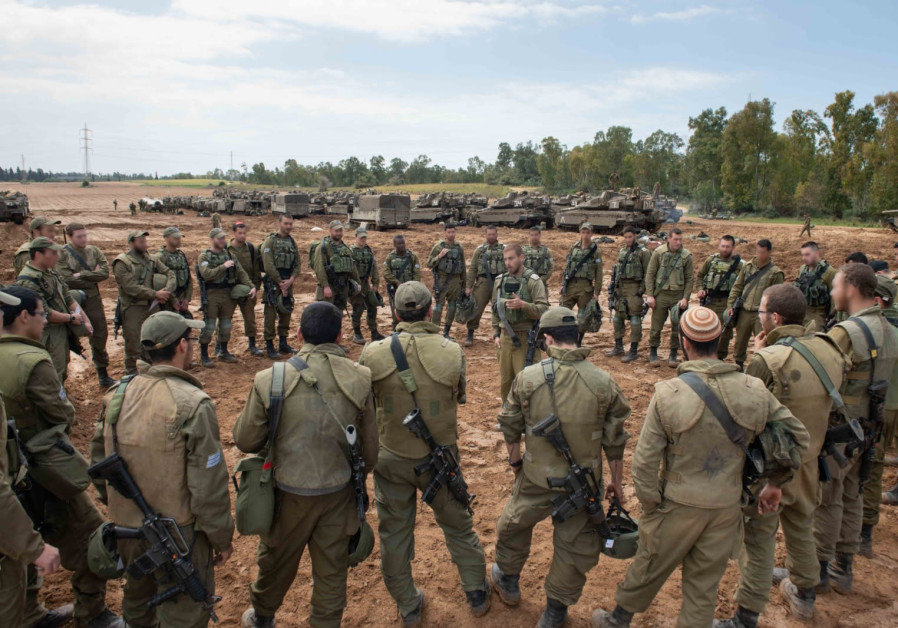
IDF Chief of Staff Aviv Kochavi and soldiers prepare for expected escalation along the Gaza border, March 29, 2019.. (photo credit: IDF SPOKESPERSON’S UNIT)
IDF Chief of Staff Lt.-Gen. Aviv Kochavi examined the readiness of troops ahead of expected violent riots on the Gaza border fence, the military said Friday evening.
“The Chief of Staff examined the preparedness in the Gaza Division area along the border fence and the main centers of disturbances in the area,” the IDF said in a statement, adding that during his visit Kochavi was presented with assessments of the troops and their response to various scenarios which could occur during the Land Day on Saturday.
Kochavi, who visited the Gaza Division met with the Head of the Southern Command Maj.-Gen. Hertzi Halevi, Commander of the Gaza Division Brig.-Gen. Eliezer Toledano, Brig.-Gen. Oded Basiok Commander of the 162nd Division , Commander of the Ga’ash Formation Brig.-Gen. Avi Gil, as well as other brigade commanders.
Basik, the IDF said, presented Kochavi with the readiness of the troops who had been deployed as part of reinforcements earlier in the week and with various operational plans for various scenarios of escalation.
Kochavi spoke with the commanders of the brigades and other commanders ahead of the events while observing the possible developments during and after them and the IDF’s plans to confront these events.
“IDF troops continue to prepare for an escalation with a wide range of operational plans and are prepared for all events,” the IDF said.
The IDF said Thursday that troops had completed their operational preparations for the “Land Day” events and that a Division Headquarters, three infantry Brigades and an artillery unit were deployed to enhance the Southern Command.
In addition, the military said that the leave of all combat units that are currently assigned to the Southern Command has been cancelled.
“The forces are conducting briefings, readiness checks and training for a variety of possible scenarios,” read the IDF statement.
Israel’s security establishment is bracing for thousands of Palestinians to riot across the West Bank and Gaza Strip, marking Land Day and the one year anniversary of The Great Return March demonstrations along the Gaza front.
Hamas leader Ismail Haniyeh called on “our Palestinian people in Gaza, the occupied West Bank, and abroad to participate in Land Day (March 30) and take part in the million-man march.”
Land Day commemorates the Israeli government’s expropriation of Arab-owned land in the Galilee on March 30 1976. Six unarmed Arab citizens were killed and hundreds wounded and arrested in the ensuing riots and confrontations with the IDF and police.
Last year on Land Day, Palestinians in the Gaza Strip began The Great Return Marches with thousands of Gazans violently demonstrating along the security fence with Israel demanding an end to the 12-year long blockade of the coastal enclave.
Head of IDF District Coordination and Liaison (DCL) to Gaza Iyad Sarhan commented on the expected escalations, saying that “the IDF will not stand for attempts at harming citizens, soldiers and the security fence. Any such violation will result in a severe response.”
Sarhan was addressing the citizens of Gaza directly through Elmonsk, the Arabic-language Facebook page of the Coordinator of Government Activities in the Territories.
Sarhan made a point to mention that Hamas wasted their money on violent disturbances and pointless marches on the fence every Friday. He explained that the marches “did not advance or contribute” to the citizens of Gaza, “but only caused deaths and injuries as a result of the violent nature and terrorist acts of the demonstrations, which are completely absent from the definition of ‘nonviolence.'”
“Your blood is more precious than all these marches,” he wrote to the Gaza residents.
“The State of Israel is determined to continue to defend its citizens and will not tolerate rocket fire and terrorist acts,” Sarhan continued. “Any such violation would provoke a harsh response. Protect your souls, keep away and keep innocent people away from the points of friction and terror in the Gaza Strip.”
Iran is doubling down on its explosive investment in Gaza: Islamic Jihad. An impoverished Hamas faces a militant, rejectionist and increasingly untamable rival, flush with cash and determined to trigger war with Israel
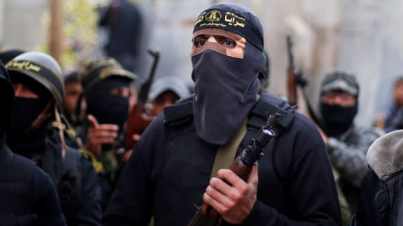
Islamic Jihad militants attend the funeral of Palestinian Jehad Hararah who was killed at the Israeli-Gaza border fence, in Gaza City. March 23, 2019\ MOHAMMED SALEM/ REUTERS
As the dust settles after the last week of escalation between Israel and Gaza, neither Hamas nor Netanyahu have managed to score a substantial victory or breakthrough. However, another political faction in Gaza is steadily ascending to stardom on the back of those latest events: Palestinian Islamic Jihad.
Although some local commentators, and Hamas itself, have suggested the rocket launched at Tel Aviv last Monday that triggered this round was an accident, Islamic Jihad refused to disclaim the rocket attack, instead opting to aggravate the situation in the hope of making political capital. Its newly appointed leader, Ziad Nakhala, declared: “We will respond harshly” if Israel retaliated.
As the Israeli bombardment of Gaza was nearing, the Egyptian intelligence conveyed a message to Hamas that Israel’s retaliation wouldn’t be serious if militant groups in Gaza didn’t respond to Israel’s first round of airstrikes. They warned that firing more projectiles on Israel would likely ignite a war.
Hamas got the message and bit its tongue. But again Islamic Jihad abandoned Gaza’s factional consensus and launched a barrage of primitive projectiles on Israel’s south that it filmed with great delight and almost instantly released to the public.
An emergency responder inspecting a damaged house after it was hit by a rocket fired from Gaza in the village of Mishmeret, north of Tel Aviv on March 25, 2019AFP
This certainly wasn’t the first time the Islamic Jihad knowingly embarrassed Hamas and decidedly challenged its red lines at the risk of blowing everything up in Gaza. Two weeks previously, two similar primitive projectiles were also “accidentally” launched on Tel Aviv by Hamas members. The latter, being keen to maintain its indirect negotiations for cease-fire with Israel undisturbed, not only apologized for the incident immediately, but also arrested those of its own operatives it considered responsible.
Islamic Jihad wasted no time, and issued an statement intending to intimidate: “Despite the Egyptian efforts…we raise our readiness and state of alert to fight against the occupation.”
Hamas leader Musa Abu Marzouq publicly denounced the IJ’s “escalatory statement” and called out its “politicized rockets” that “must be stopped.” That came after top Hamas leader Ismael Haniya met with Nakhala a few weeks before in Cairo, and asked him to respect the cease-fire arrangements in Gaza, in the wake of Islamic Jihad launching two projectiles on Israel during the same month to retaliate against Israeli airstrikes in Syria that hit Iranian targets.
This one-upmanship between Hamas – determined to assert rigid control over Gaza – and Islamic Jihad – determined to disobey and defy orders -follows a clear pattern that has been forming ever since the mediated talks between Israel and Hamas had begun to bear limited fruit: Israel had allowed the physical transfer of cash from Qatar to fund Hamas employees, and allowed fuel to enter the besieged enclave.
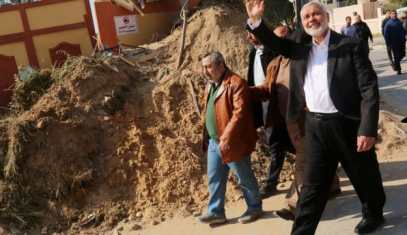
Hamas chief Ismail Haniyeh visits his office that was targeted in an Israeli air strike, in Gaza City March 27, 2019\ HANDOUT/ REUTERS
That tension is built-in to the wildly diverging ideologies espoused by Hamas and the Islamic Jihad. Hamas is an extension of the Muslim Brotherhood school of thought, Islamic Jihad embraces the Islamic revolution of Iran.
Hamas believes in the importance of the PLO and is desperate to wrest the Palestinian Authority out of Fatah’s control; Islamic Jihad doesn’t recognize the PLO at all as the sole representative of the Palestinian people, rejects the Palestinian Authority and the peace process, and rejects Hamas’ pursuit of a permanent cease-fire in Gaza.
As former IJ leader Ramadan Shalah stated, such a ceasefire would “exclude Gaza from the conflict and boost Israel’s efforts to swallow the West Bank undisrupted.”
Both armed groups have managed to coexist, and even operating from the same command and control room ( the “Palestinian factions’ operation room”) for more than a decade, by sharing the privileges of dominating Gaza’s ruling class.
They co-operate according to a quid pro quo. In return for compliance, cooperation and support, Hamas granted Islamic Jihad personnel a superior status over the rest of Gaza’s population, including putting IJ leaders above the law, and allowing their movement to operate, recruit and parade freely and develop its military capacity unconstrained.
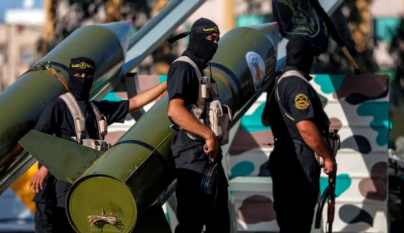
Members of the Palestinian Islamic Jihad movement march during a military parade, Gaza City, Gaza, October 4, 2018.AFP
As a result, both groups have endeavored to act in consensus in regard to decisions to confront Israel, though Hamas retained superior power and dominance over Islamic Jihad. This balance was maintained thanks to the relatively moderate leadership of Ramadan Shalah.
However, this all changed when Shalah suddenly went AWOL from the political scene in April 2018, and was succeeded by an uneducated, stubborn and militaristic leader, Ziad Nakhallah, best known for pledging blind and eternal loyalty to Iran, and in particular to the Revolutionary Gurads’ Quds Force.
Nakhallah has speeded up the transformation of his group into a more or less an Iranian proxy, operated by an on/off switch by Tehran to stir up trouble in Gaza whenever Iran needs to create a distraction, retaliation or send a message.
In recent months, Iran has expressed its disapproval of a possible long-term Hamas-Israeli cease-fire. That’s not a scenario that plays to Tehran’s interests: An Israel that no longer needs to deal with Gaza would allow it more time, energy and resources to fight the Iranian presence in Syria.
Its wholehearted opposition to both Palestinian reconciliation and to an Israeli-Hamas truce has meant that Iran’s embrace of Hamas has loosened. That led Tehran no option but to inflate Islamic Jihad to the point where it would engage in a battle of equal strength with Hamas. That boost is intended to push Islamic Jihad towards stealing the right to decide about war or peace away from Hamas.
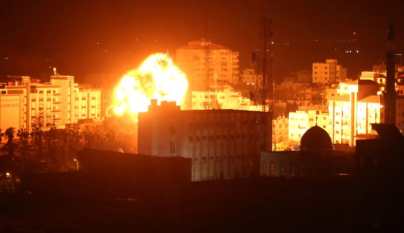
A ball of fire billows above buildings in Gaza City during reported Israeli strikes on March 25, 2019AFP
While Iran’s financial support for Hamas has dramatically decreased over the last decade, its support to the Islamic Jihad has dramatically increased, to an almost insane extent.
Hamas militants haven’t received any salaries for several months, thanks to the movement’s financial hardships. The movement now relies almost purely on funding generated from taxes and smuggling tunnel revenue. In contrast, Islamic Jihad is so flush with cash that it handed out increases to the $250 monthly stipends of its members.
This has evoked so much jealousy inside Hamas that a few of its young members have even defected to join Islamic Jihad for the superior financial comfort it offers.
As Islamic Jihad thrives financially, the longstanding status quo with Hamas is breaking down. Hamas is used to buying Islamic Jihad’s compliance – but that’s no longer paying off. In other words, Islamic Jihad is becoming increasingly untamable.
Joining forces with Hamas, and fueled by concern about Islamic Jihad’s unpredictability, Egypt is exerting enormous pressure on the Islamic Jihad for it to step back into line. For now, that seems like an unattainable goal. Islamic Jihad is running to exploit every opportunity, big or small, to keep Gaza on track to another war against Israel.
Islamic Jihad’s leaders, and their puppet-masters in Tehran, still think that’s the best chance they have of shaking up the cosy Hamas-Israel status quo and to forcibly liberate Gaza from the blockade, while proudly and uncompromisingly replacing Hamas as the vanguard of the Palestinian “armed resistance.”
Muhammad Shehada is a writer and civil society activist from the Gaza Strip and a student of Development Studies at Lund University, Sweden. He was the PR officer for the Gaza office of the Euro-Med Monitor for Human Rights. Twitter: @muhammadshehad2
If the president is to finish the job, he can’t be held back by what may be an illusory threat of gas-price hikes and let the ayatollahs off the hook now that he has their backs to the wall. Tehran, as well as its satellites, are getting desperate.
Jonathan S. Tobin // published on 29/03/2019
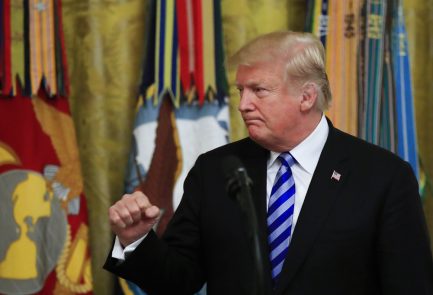
U.S. President Donald Trump at a White House event marking the 35th anniversary of the Hezbollah attack that killed 241 U.S. Marines, last October
| Photo: AP
With weeks to go until the deadline to make a decision, the debate inside the Trump administration is heating up. The choice involves whether to continue to allow eight foreign nations to go on selling oil to Iran via waivers that allow them to legally evade the sanctions the United States reimposed when U.S. President Donald Trump pulled out of the nuclear deal with Tehran.
But ironically the argument for ending the waivers got a boost this week from a source that is hostile to Trump’s tough policy towards Iran: The New York Times. In an article filed by Beirut bureau chief Ben Hubbard, the Times reported that, contrary to the predictions of Trump’s critics, the sanctions that have been enforced in the last year have had a discernible impact on the Iranians. Among those most feeling the pinch from the austerity imposed by American restrictions on commerce with Iran are the terrorist groups that it funds.
According to the article, the sanctions have created an economic crisis for Tehran that has caused it to cut down on the money it spends on funding terrorists, as well as the barbarous Bashar Assad regime that it has helped prop up via military intervention in the Syrian civil war.
As Hubbard wrote: “The golden days are gone and will never return,” said a fighter with an Iranian-backed militia in Syria who recently lost a third of his salary and other benefits. “Iran doesn’t have enough money to give us.”
Even Hezbollah leader Hassan Nasrallah conceded the impact U.S. sanctions have been having on the ability of his Iranian masters to fund his group’s misdeeds. He lamented that the sanctions are “a form of war” and implored members of his group tasked with “fundraising” – a term that has a very different meaning for the Shiite terror group than for charitable organizations that don’t consider kidnapping and extortion an essential element of their appeals – to redouble their efforts.
The Obama administration lifted sanctions and gave thousands of waivers to companies and countries to do business with Iran, despite U.S. laws that forbade such conduct. The Trump administration has tried to shut down both legal methods of commerce with the ayatollah’s regime, as well as ferreting out illegal scams. Just this week the Treasury Department announced that it had disrupted a billion-dollar currency trading scheme that Tehran used to help fund its military adventures on the part of the Iranian Revolutionary Guard Corps.
But so long as Iran still is able to count on countries like China, India, Japan, Turkey, Italy, Greece, South Korea and Taiwan to buy its oil, it will retain the ability to go on funding terror and military efforts aimed at achieving regional hegemony. That money also enables these brutal theocrats to help keep the restive Iranian people from threatening the regime.
With the Iranian economy tanking, this would seem to be exactly the right moment for the United States to tighten the noose around Tehran to the point where even countries like France and Germany, which have put their own financial interests above that of the collective security of the West, will understand that they must stop trying to prop up their Iranian business partners.
But in spite of the success, the U.S. sanctions have achieved, the Trump administration is reportedly split on the issue of ending the oil-sale waivers. According to one report published in Bloomberg, the argument has pitted National Security Adviser John Bolton against the State Department.
The argument against ending the waivers is a matter of economics and politics. Those who are counseling Trump to leave them in place say that cutting off the final sources of Iranian crude could cause a spike in global prices. That threat is made credible by the economic collapse of Venezuela and the sanctions that are being imposed on Nicolás Maduro’s illegitimate socialist regime. The combination of the two could lead to an increase in U.S. gas prices this summer. That would render Trump vulnerable to charges from Democrats that the heretofore-strong economic performance he has presided over is about to take a turn for the worse.
That’s why some of his advisers are cautioning him to show patience and slowly build the sanctions under the assumption that he has six years to squeeze the Iranians, rather than just two.
Against that are arrayed the arguments of both the National Security Council and chief economic advisor Larry Kudlow. They say that with oil now at rock-bottom prices due to the glut on the market, there will never be a better moment to pressure Iran.
The question of whether Trump really has only until January 2021 to accomplish his mission of rolling back Obama’s appeasement of Iran is not one that can be answered now. But the notion that the United States can carry out a policy aimed at isolating the regime in a half-hearted fashion is not one that makes sense. The goal of the administration is to force Iran to cease its ballistic-missile tests, end its support for terrorism, roll back its effort to create a land bridge to the Mediterranean and be dragged back to the table to renegotiate the disastrous nuclear deal that gave it a legal path to a bomb. None of that is possible while the waivers stand.
Obama enriched Iran by unfreezing assets and ending sanctions. That put weapons and money in the hands of Hezbollah and the IRGC. That also helped other terror groups, such as the Palestinian Islamic Jihad and the Houthis in Yemen, create more grave threats to regional security.
As Hezbollah’s complaints prove, the first stage of sanctions has begun to work. If Trump is to finish the job, he can’t be held back by what may be an illusory threat of gas-price hikes and let the ayatollahs off the hook now that he has their backs to the wall.
This article is reprinted with permission from JNS.org.
Hamas says ‘marathon of talks’ with Egypt continue and coming hours crucial, as Egypt demands Hamas take ‘active steps’ to prevent conflict.
Chana Roberts, 29/03/19 15:20
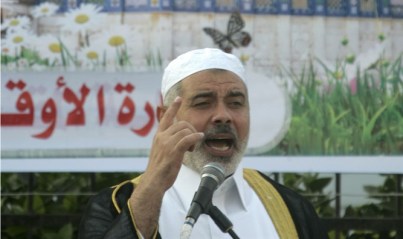
Hamas leader Ismail Haniyeh
Flash 90
Hamas leader Ismail Haniyeh hinted that if talks do not succeed soon, war may break out.
“We are continuing the marathon of talks with Egypt in order to reach serious understandings that Israel will honor,” Haniyeh said. “We are at a crossroads, and the coming hours will decide which direction we’ll take.”
Earlier this week, Hamas claimed that Israel “refused” to come to an agreement.
On Thursday night, Egyptian intelligence officials warned Hamas that “any mistakes on your part on Saturday may lead to war with Israel.”
According to Mako, the Egyptians told Hamas that it was their efforts which prevented a war from breaking out a few days ago. Now, they said, Hamas needs to take active and significant steps in order to prevent conflict.
Egypt’s demands from Hamas included, among other things, stationing Hamas members along the border fence in order to prevent masses of Gazans from infiltrating Israel and to prevent weapons from reaching the border area.
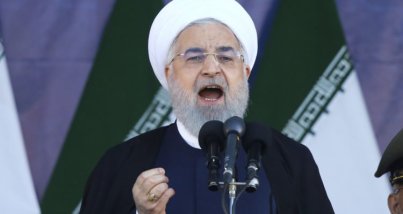
Iran’s President Hassan Rouhani, Sept. 22, 2018. (AP/Ebrahim Noroozi)
Hassan Rouhani vowed on Friday that Iran would challenge Trump’s decision to recognize Israeli sovereignty over the Golan Heights, which the Jewish state gained control over 52 years ago.
By Associated Press and World Israel News Staff
Iran’s president Hassan Rouhani said Friday that Iranians would “resist” the Trump administration’s recognition of Israel’s sovereignty over the Golan Heights, territory the Jewish state won in battle during the 1967 Six-Day War.
During that conflict, Israel staved off an onslaught of four Arab armies, defeating them all and gaining control of the Golan Heights to prevent Syria from continuing to use the strategically important territory to attack Israel.
Rouhani said cryptically that Iranians “should resist” U.S. recognition and “that way gain victory” over the U.S. and Israel. Among political Islamists such as Iran and its terror proxies, the term “resistance” is frequently a code-word for violence.
President Donald Trump’s formal recognition last week of Israel’s sovereignty over the Golan sparked condemnation from Syria and several other states in the region, but Mideast experts such as Ahmed Abd Rabou predicted that leaders attending the Arab Summit this Sunday would pay no more than lip service to the situation.
“It will be just a very strong, theatrical, nice, maybe strong statement,” said Rabou, a visiting professor of international affairs at the University of Denver. “But I doubt that this will have a true political effect.”
Meanwhile, Iranian Foreign Minister Mohammad Javad Zarif claimed on Thursday the decision is a reminder to Arab and Muslim countries that U.S. and Israel “will steal your lands.”
The Iranian regime is sworn to Israel’s destruction, supporting Syria’s brutal dictator and Islamic terror groups like Hamas and Lebanon’s Hezbollah.
A former Obama administration official said the administration orchestrated the delaying of a controversial anti-Israel United Nations resolution until after the 2016 presidential election, knowing it would pass when the United States abstained.
The official’s claim contradicts on-the-record denials by Obama administration officials, who attacked critics at the time who suggested they were involved in its drafting.
Speaking anonymously to the New York Times, the official said the White House feared putting pressure on Hillary Clinton to either condemn or defend the resolution against Israeli settlements and potentially upset Jewish donors during her election fight against Donald Trump. The U.S. decision to abstain on U.N. Security Council resolution 2334 was widely viewed as a parting shot by Obama at Israeli Prime Minister Benjamin Netanyahu.
“There is a reason the U.N. vote did not come up before the election in November,” the former official said, in a portion of the report flagged by Jewish Insider. “Was it because you were going to lose voters to Donald Trump? No. It was because you were going to have skittish donors. That, and the fact that we didn’t want Clinton to face pressure to condemn the resolution or be damaged by having to defend it.”
The official said fear of donor wrath dictated not only “what was done but what was not done, and what was not even contemplated.”
Former U.S. Ambassador to Israel Dan Shapiro strongly denied the anonymous quote, telling Jewish Insider it was a “garbage claim” and the administration, as it professed at the time, was caught by surprise by the Egyptian-Palestinian drafted resolution.
The U.N. Security Council voted 14-0 on Resolution 2334 on Dec. 23, 2016, to demand a halt to settlement construction in the West Bank and East Jerusalem, deeming both areas to be illegally occupied by Israel. East Jerusalem is home to the Western Wall of the Temple Mount, a Jewish holy site.
U.N. Ambassador Samantha Power could have killed the resolution with the veto power of a permanent member, but she essentially voted yes by abstaining, delighting the Palestinian Authority and infuriating Israel.
Netanyahu was unequivocal at the time in his accusation of Obama’s involvement, saying “we have no doubt that the Obama administration initiated it, stood behind it, coordinated its versions and insisted upon its passage.”
Obama officials strongly denied the administration played any role in the resolution’s timing, including then-Secretary of State John Kerry, in a December 2016 speech eviscerating Israeli settlement policies and Netanyahu’s government for an “extreme” agenda.
“We also strongly reject the notion that somehow the United States was the driving force behind this resolution,” Kerry said. “The Egyptians and Palestinians had long made clear to all of us, to all of the international community, their intention to bring a resolution to a vote before the end of the year. And we communicated that to the Israelis and they knew it anyway. The United States did not draft or originate this resolution, nor did we put it forward.”
He acknowledged telling other countries that the U.S. would consider abstention on the vote if it was “balanced,” calling such diplomacy “standard practice.”
The Free Beaconreported Vice President Joe Biden denied accusations he personally lobbied foreign leaders to support the resolution. Sources told Tablet and the Free Beacon Biden spoke to Ukrainian President Petro Poroshenko and pressured him to vote “yes,” but Biden’s national security adviser Colin Kahl said no such phone calls took place.
Kahl was one of the leading voices behind the initial decision to remove recognizing Jerusalem as Israel’s capital from the 2012 Democratic platform.
Obama deputy national security adviser Ben Rhodes also denied it in a CNN interview shortly after the vote, blaming the Israeli settlement policy for making a two-state solution “impossible” but saying the administration didn’t know anything about the language of the resolution until it was put forward. Only then, Rhodes said, did Obama instruct Power to abstain.
Egypt withdrew its sponsorship from the resolution after Trump, then the president-elect, called the Egyptian president and urged him not to go forward. The resolution was eventually sponsored by New Zealand, Malaysia, Venezuela and Senegal.
A foreign policy expert involved in the fight over the resolution at the time told the Free Beacon “everyone in DC” knew Rhodes worked the phones against the Israelis to push the resolution with reporters.
“He was absolutely furious with the Egyptians for not wanting to destroy their relationship with Israel by advancing the resolution,” the official said. “This one was emotional and personal for him.”
Rhodes came under fire in 2016 when a lengthy New York Timesprofile quoted him boasting of creating an “echo chamber” of know-nothing reporters to sell the Iran nuclear deal.
Administration spokesman Ned Price tweeted at the time that reports of a secret meeting between U.S. and Palestinian officials to orchestrate the anti-Israel resolution were false. Egyptian media reported Kerry and National Security Adviser Susan Rice expressed willingness to Palestinians to support a “balanced” resolution and accused Netanyahu of trying to destroy a two-state solution.
Ned Price (NARA)
✔@Price44
We’ve been clear the alleged meeting incl @AmbassadorRice & @JohnKerry described in this document never occurred. Account is 100% false.
The Hill
✔@thehill
Leaked documents claim to prove collusion between U.S., Palestinians on U.N. votehttp://hill.cm/427AG6X
This is a total fabrication. This meeting never occurred.
Gal Berger גל ברגר
✔@galberger
Palestinian top official just confirmed to me that there were 2 separated meetings with Kerry and Susan Rice
Obama defended the abstention in remarks to a New York City synagogue last year, saying it was in keeping with U.S. values and maintaining credibility with the rest of the world.
A writer for the Brookings Institution think tank guessed as early as October 2016 that Obama had a “surprise” to settle a score with Netanyahu once Obama was a lame duck. One of the possible ways: “Abstain on a Palestinian move to bring a new draft resolution branding settlements as illegal (a revised version of the 2011 draft resolution, which the United States vetoed) to a vote at the Security Council.”
Support for Israel from Democrats has dwindled dramatically in favor of increased support for the Palestinians over the past decade, while Republican support for Israel has grown stronger. Netanyahu and Trump are strong allies, while Netanyahu and Obama were often at loggerheads, particularly over the latter’s support for the Iran nuclear deal.
One Obama official anonymously called Netanyahu a “chickenshit” who had “no guts” in 2014, and the White House was enraged by Netanyahu’s 2015 address to Congress, at the invitation of Speaker John Boehner (R., Ohio), to attack the nuclear deal as dangerous and ill-conceived.
Rhodes, now an MSNBC contributor, told the Times he and other officials wanted the administration to take an even tougher stance against Israel while in office but they were handcuffed by “the donor class.”
“The Washington view of Israel-Palestine is still shaped by the donor class,” Rhodes said. “The donor class is profoundly to the right of where the activists are, and frankly, where the majority of the Jewish community is.”
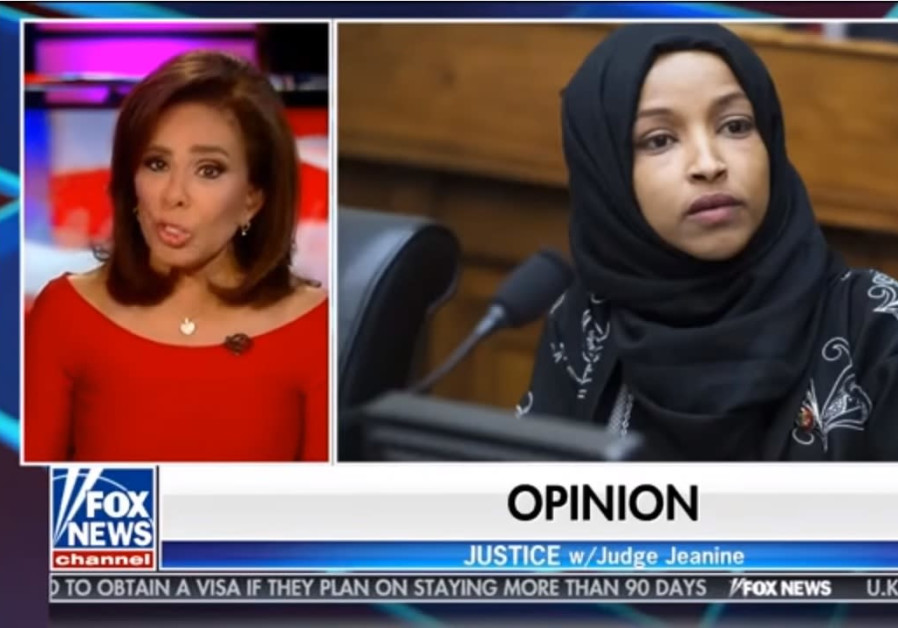
Justice with Judge Jeanine, the top rated show on the American cable news network, has been off the air for the past two weeks after Pirro made an issue of Omar’s comments regarding the pro-Israel community.
US President Donald Trump personally called for Fox News to reinstate Pirro during a May 27 interview with long-time Fox News host Sean Hannity, to which Hannity replied, “she’s back Saturday.”
Pirro, whose top-rated weekly show covers American politics and the Middle East, discussed the firestorm over Omar’s anti-Israel rhetoric which many said bordered on overt antisemitism. On her March 9 show, Pirro blasted Omar for questioning the loyalty of American Jews by rhetorically asking if her Muslim faith means she is more loyal to Islam.
“Omar wears a hijab which according to the Quran 33:59 tells women to cover so they won’t get molested. Is her adherence to this Islamic doctrine indicative of her adherence to Sharia law which in itself is antithetical to the United States constitution?”
Pirro’s comments drew complaints of Islamophobia, and a rare condemnation from her own network.
Fox News never officially suspended Pirro, but bumped her Saturday program for a special broadcast two weeks in a row.
Pirro was born in New York to Lebanese parents and served as a court judge and district attorney. She is the author of five books, the latest titled, Liars, Leakers, and Liberals: The Case Against the Anti-Trump Conspiracy. Her Fox News show has aired since 2011 with consistent high ratings.
Donald J. Trump
✔@realDonaldTrump
Bring back @JudgeJeanine Pirro. The Radical Left Democrats, working closely with their beloved partner, the Fake News Media, is using every trick in the book to SILENCE a majority of our Country. They have all out campaigns against @FoxNews hosts who are doing too well. Fox …..
Ilhan Omar, Democratic representative of the 5th district of Minnesota assumed office in January. Born in Somalia to a Muslim family, she is a member of the powerful House of Representatives foreign relations committee.
Categories: Uncategorized
Comments:Comments Off on Off Topic: Jeanine Pirro to return says Fox News host during Trump interview
The last Iranian oil cargo onboard supertanker Kisogawa is expected to arrive at Chiba, Japan, on April 9, the data showed.
BY REUTERS
MARCH 29, 2019 08:18
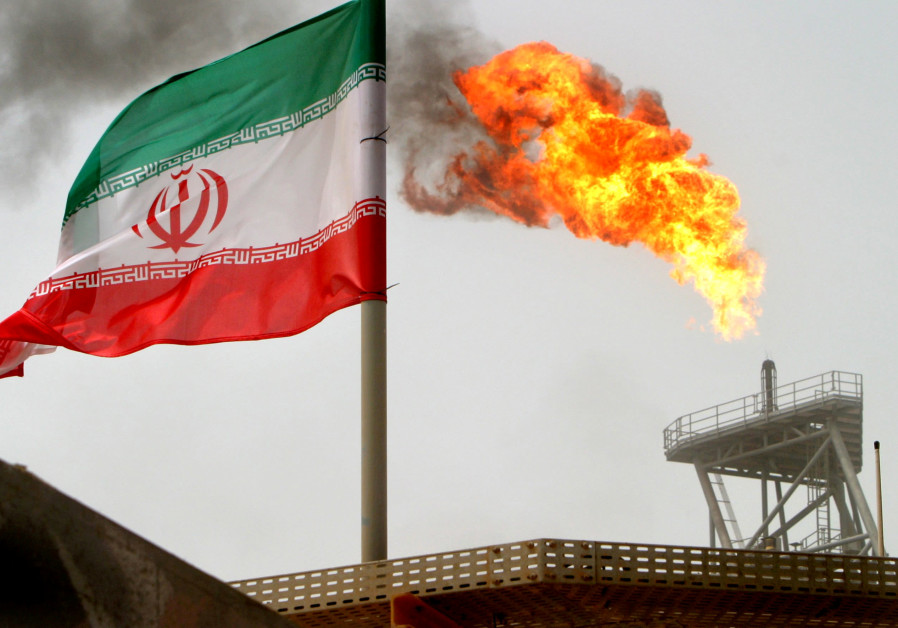
A gas flare on an oil production platform in the Soroush oil fields is seen alongside an Iranian flag in the Persian Gulf, Iran, July 25, 2005. (photo credit: RAHEB HOMAVANDI/REUTERS)
TOKYO – Japanese refineries have put a halt on imports of Iranian oil after buying 15.3 million barrels between January and March ahead of the expiry of a temporary waiver on US sanctions, according to industry sources and data on Refinitiv Eikon.
The waiver, which allowed Japan to buy some Iranian oil for another 180 days, expires in early May. However, Japanese refiners want to ensure enough time for all cargoes already loaded to arrive in Japan and for payments to be completed.
“We think it would be difficult to keep on lifting Iranian oil after March,” a Fuji Oil spokesman said, noting that banks and insurance companies want to make sure all the transactions and deliveries are done well before the waivers expire.
The last Iranian oil cargo onboard supertanker Kisogawa is expected to arrive at Chiba, Japan, on April 9, the data showed.
However, Washington granted temporary exemptions to Iran’s biggest oil clients – Japan, China, India, South Korea, Taiwan, Italy, Greece and Turkey.
Refiners in Japan, the world’s fourth-biggest oil consumer, had stopped loading Iranian oil by mid-September, and only resumed loading in late January after banks received government assurances about processing payments to Iran.
Japan has loaded 15.3 million barrels of Iranian crude in the first three months this year, which is equivalent to 86,430 barrels per day (bpd) during the six-month waiver period, according to Refinitiv data and Reuters calculations.
This represents a 33 percent drop from an average of 129,300 bpd that Japanese companies lifted between January and September last year before the sanctions kicked in, Refinitiv data showed.
The drop was more than the 20 percent reduction in supplies that Washington was said to have sought from each country over the six-month waiver period.
Japanese refiners have been pushing the government to seek an extension of the US sanctions waivers after the initial exemption period expires.
Japanese officials and their US counterparts met earlier this month in Washington to discuss the US sanctions.
“I think the waiver could be extended, but maybe for a smaller volume and for a smaller number of countries,” said Takayuki Nogami, chief economist at Japan Oil, Gas and Metals National Corp.
“If the US government does not extend the waiver, it could push crude oil prices up significantly as the gasoline season approaches and it could hurt Trump’s reputation,” he said.
On Wednesday, Japan extended state-backed insurance to cover imports of oil from Iran for another year.
A man holds a laptop computer as cyber code is projected on him. (photo credit: KACPER PEMPEL/REUTERS)
Microsoft says it has seized 99 Iranian websites used to steal confidential information and launch cyber attacks.
In a report by the Associated Press, Microsoft said that it had been tracking and watching the group of hackers for almost six years – since 2013.
The group used websites and links disguised to look like popular internet sites ncluding Microsoft and its LinkedIn, Outlook and Windows products to try and steal information from reporters, activists, groups, and political dissidents in the Middle East, including those “protesting oppressive regimes,” Microsoft confirmed in court filing.
The hackers were found to be from Iran but “not specifically to its government,” AP reported. Tehran has also denied being involved in hacking-related sandals in the past.
Speaking to AP, security researcher at Atlanta-based Secureworks, Allison Wikoff, said it is one of the “more active Iranian threat groups” she has observed.
She added Microsoft’s take down was “a big win” using a practice known as “sinkholing,” which involves taking over adversary domains and analyzing their traffic to protect against future attacks.
In the past, Microsoft has taken hackers to court. It used a similar strategy to “sinkholing” in 2016 to seize fake domains created by Russia-backed hackers.
IDF troops in action near the Gaza Strip. (photo credit: IDF)
With a violent week behind it, Israel’s security establishment is bracing for thousands of Palestinians to riot this weekend across the West Bank and Gaza Strip, marking Land Day and the one-year anniversary of the Great March of Return demonstrations along the Gaza front.
Hamas leader Ismail Haniyeh called on “our Palestinian people in Gaza, the occupied West Bank and abroad to participate in Land Day [March 30] and take part in the million-man march.”
Land Day commemorates the Israeli government’s expropriation of Arab-owned land in the Galilee on March 30, 1976. Six unarmed citizens were killed and hundreds wounded and arrested in the ensuing riots and confrontations with the IDF and police.
Last year on Land Day, Palestinians in the Gaza Strip began their Great March of Return with thousands of Gazans violently demonstrating along the security fence with Israel, demanding an end to the 12-year-long blockade of the coastal enclave.
Close to 300 Gazans have been killed in the past year, including women and children as well as medics and journalists.
In late January, an IDF officer was lightly wounded after he was struck in his helmet by sniper fire along the Gaza Strip security fence, with PIJ claiming responsibility. The officer was struck near Kibbutz Kissufim, the same area where Staff Sgt. Aviv Levi was fatally shot in the chest by sniper fire. Levi was the first soldier killed along the Gaza front since Operation Protective Edge in 2014. Another soldier was struck by sniper fire in the area less than a week after Levi was killed.
The reinforcement of IDF troops began on Monday, following the firing of a long-range rocket which destroyed a home in Moshav Mishmeret, some 120 km from where it was launched in Rafah.
Chief of Staff Lt.-Gen. Aviv Kochavi ordered the mobilization of a divisional brigade and three regular brigades, as well as the call up of additional reserve forces. He also canceled the exchange of IDF battalions in multiple regions that had been scheduled for later this week.
A quick drive to Israel’s South reveals the tanks and armored personnel carriers parked in fields close to the Gaza border waiting for the order to enter Gaza.
But the order to begin a ground operation never materialized. Instead a shaky ceasefire was reached.
But the IDF did not cancel the deployment of the extra troops. The army is anticipating an exceptionally violent weekend along the fence, not only on Friday when the usual riots take place, but also on Saturday when Palestinians will mark both the one-year anniversary of the Great March of Return and Land Day.
On Wednesday, Kochavi visited the Gaza Division and met with Brig.-Gen. Eliezer Toledano, along with the head of the Southern Command Maj.-Gen. Herzi Halevi.
“During the situational assessment, the chief of staff was briefed on the readiness of troops and for various scenarios, as well as on the readiness of the additional troops that arrived in the past few days,” the IDF said in a statement, adding that operational plans were also discussed.
The IDF is not ruling out any scenario for this upcoming weekend, including the breaching of the security fence by thousands of rioters and Hamas operatives who would try to abduct soldiers or civilians and bring them back inside the Hamas-run enclave.
As such, the IDF has also deployed additional snipers who have been stationed to defend against Gazan sniper fire and explosive devices thrown by Palestinians. Unmanned aerial devices with observation equipment and crowd control measures, as well as combat helicopters, have also been deployed.
During the violent weekly protests, Gazans have been burning tires and hurling stones and marbles, as well as other types of violence which include the throwing of grenades and improvised explosive devices (including military-grade explosives) towards troops. Ball bearings and other projectiles are also launched by high-velocity slingshots towards Israeli forces along the border.
In addition, mines and booby-trapped explosive devices with delayed detonation devices are also laid along the fence during the riots under the cover of smoke and crowds, and “pose a direct threat to the lives and safety of IDF forces operating in the border area,” the military said.
In response to the protests, the IDF has already “substantially” increased its forces deployed on the Gaza border and all troops have undergone “specially developed trainings designed to replicate the expected elements of the Gaza border events.” Israel has also stationed counter-terrorism forces in communities along the Gaza border in order to rapidly respond to any infiltration or military attacks.
The IDF has also deployed Iron Dome missile defense systems across the country should Gazan groups launch rockets towards Israel’s home front.
The IDF has also constructed sand berms to provide defenses for IDF forces along the border, and also dug long trenches and laid barbed wire behind these berms in an attempt to delay crowds and vehicles from reaching Israeli civilian communities following any large-scale infiltration.
The military is also currently developing a fortified vehicle that can shoot water at great distances. Once operational, it is expected these water cannons will help with riot control.
Kochavi – who was recently sworn in as the military’s top officer – has prioritized the southern front as one which could explode into war at any moment, and has visited the Southern Command dozens of times, where he’s met with senior officers and approved operational plans for war, including setting up a centralized administrative unit to prepare a list of potential targets in Gaza should war break out.
While the calm has held since Monday, the tinderbox remains highly combustible. All that is needed is a spark to ignite a conflagration.












 anneinpt
 artaxes
 danmillerinpanama
 davidking1530
 Peter Hofman
 Joseph Wouk
 Peter
Peter Louisiana Steve
 WarSclerotic
Recent Comments