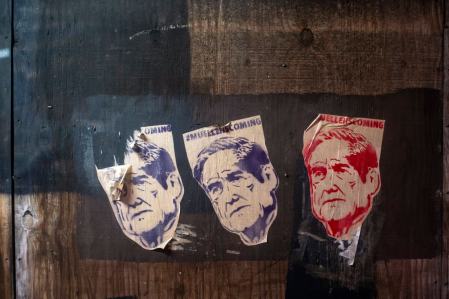
Note to readers: in light of news that Special Prosecutor Robert Mueller’s investigation is complete, I’m releasing this chapter of Hate Inc. early, with a few new details added up top.
Nobody wants to hear this, but news that Special Prosecutor Robert Mueller is headed home without issuing new charges is a death-blow for the reputation of the American news media.
As has long been rumored, the former FBI chief’s independent probe will result in multiple indictments and convictions, but no “presidency-wrecking” conspiracy charges, or anything that would meet the layman’s definition of “collusion” with Russia.
With the caveat that even this news might somehow turn out to be botched, the key detail in the many stories about the end of the Mueller investigation was best expressed by the New York Times:
A senior Justice Department official said that Mr. Mueller would not recommend new indictments.
The Times tried to soften the emotional blow for the millions of Americans trained in these years to place hopes for the overturn of the Trump presidency in Mueller. Nobody even pretended it was supposed to be a fact-finding mission, instead of an act of faith.
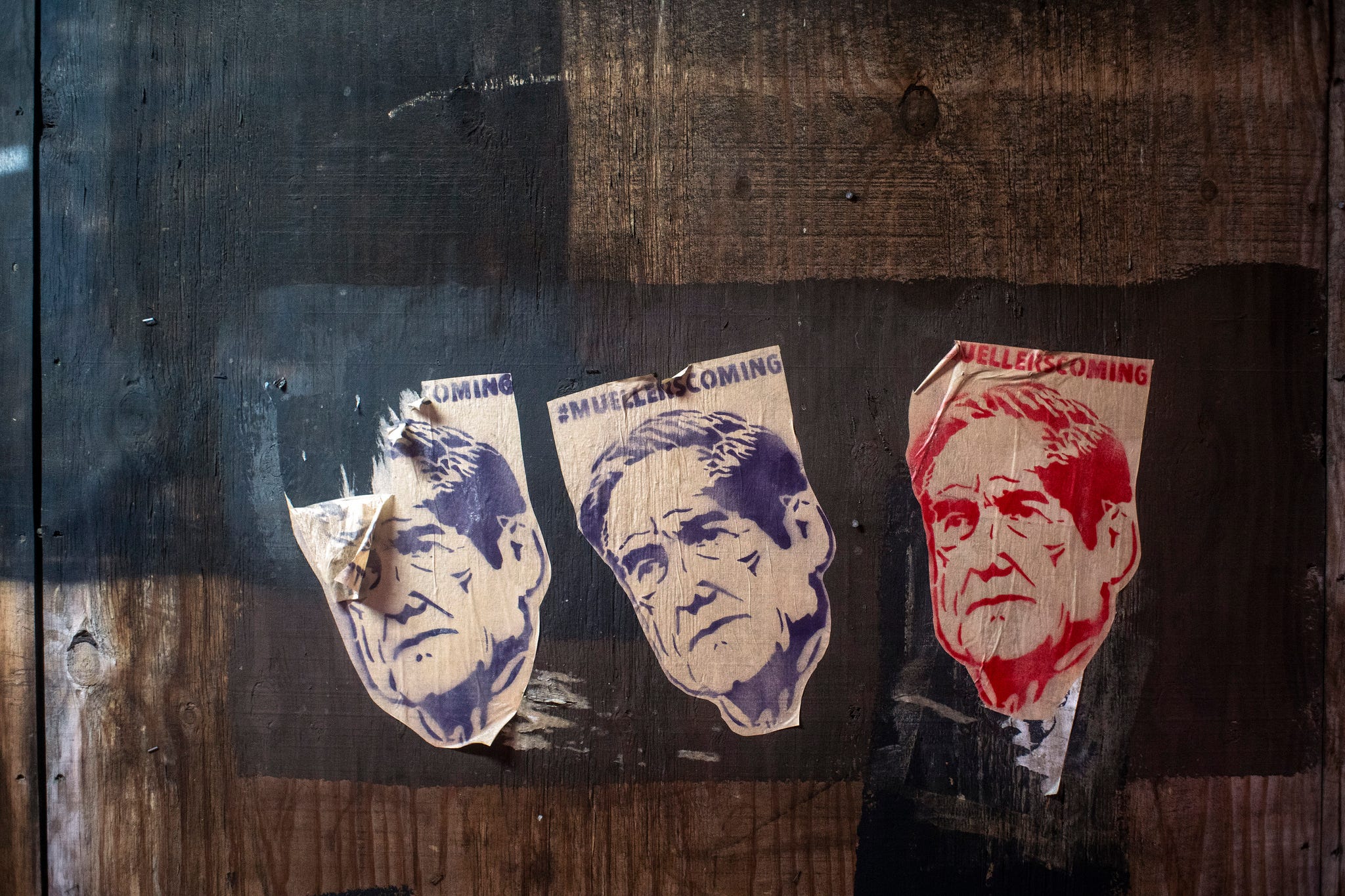
The Special Prosecutor literally became a religious figure during the last few years, with votive candles sold in his image and Saturday Night Live cast members singing “All I Want for Christmas is You” to him featuring the rhymey line: “Mueller please come through, because the only option is a coup.”
The Times story today tried to preserve Santa Mueller’s reputation, noting Trump’s Attorney General William Barr’s reaction was an “endorsement” of the fineness of Mueller’s work:
In an apparent endorsement of an investigation that Mr. Trump has relentlessly attacked as a “witch hunt,” Mr. Barr said Justice Department officials never had to intervene to keep Mr. Mueller from taking an inappropriate or unwarranted step.
Mueller, in other words, never stepped out of the bounds of his job description. But could the same be said for the news media?
For those anxious to keep the dream alive, the Times published its usual graphic of Trump-Russia “contacts,” inviting readers to keep making connections. But in a separate piece by Peter Baker, the paper noted the Mueller news had dire consequences for the press:
It will be a reckoning for President Trump, to be sure, but also for Robert S. Mueller III, the special counsel, for Congress, for Democrats, for Republicans, for the news media and, yes, for the system as a whole…
This is a damning page one admission by the Times. Despite the connect-the-dots graphic in its other story, and despite the astonishing, emotion-laden editorial the paper also ran suggesting “We don’t need to read the Mueller report” because we know Trump is guilty, Baker at least began the work of preparing Times readers for a hard question: “Have journalists connected too many dots that do not really add up?”
The paper was signaling it understood there would now be questions about whether or not news outlets like themselves made a galactic error by betting heavily on a new, politicized approach, trying to be true to “history’s judgment” on top of the hard-enough job of just being true. Worse, in a brutal irony everyone should have seen coming, the press has now handed Trump the mother of campaign issues heading into 2020.
Nothing Trump is accused of from now on by the press will be believed by huge chunks of the population, a group that (perhaps thanks to this story) is now larger than his original base. As Baker notes, a full 50.3% of respondents in a poll conducted this month said they agree with Trump the Mueller probe is a “witch hunt.”
Stories have been coming out for some time now hinting Mueller’s final report might leave audiences “disappointed,” as if a President not being a foreign spy could somehow be bad news.
Openly using such language has, all along, been an indictment. Imagine how tone-deaf you’d have to be to not realize it makes you look bad, when news does not match audience expectations you raised. To be unaware of this is mind-boggling, the journalistic equivalent of walking outside without pants.
There will be people protesting: the Mueller report doesn’t prove anything! What about the 37 indictments? The convictions? The Trump tower revelations? The lies! The meeting with Don, Jr.? The financial matters! There’s an ongoing grand jury investigation, and possible sealed indictments, and the House will still investigate, and…
Stop. Just stop. Any journalist who goes there is making it worse.
For years, every pundit and Democratic pol in Washington hyped every new Russia headline like the Watergate break-in. Now, even Nancy Pelosi has said impeachment is out, unless something “so compelling and overwhelming and bipartisan” against Trump is uncovered it would be worth their political trouble to prosecute.
The biggest thing this affair has uncovered so far is Donald Trump paying off a porn star. That’s a hell of a long way from what this business was supposedly about at the beginning, and shame on any reporter who tries to pretend this isn’t so.
The story hyped from the start was espionage: a secret relationship between the Trump campaign and Russian spooks who’d helped him win the election.
The betrayal narrative was not reported at first as metaphor. It was not “Trump likes the Russians so much, he might as well be a spy for them.” It was literal spying, treason, and election-fixing – crimes so severe, former NSA employee John Schindler told reporters, Trump “will die in jail.”
In the early months of this scandal, the New York Times said Trump’s campaign had “repeated contacts” with Russian intelligence; the Wall Street Journal told us our spy agencies were withholding intelligence from the new President out of fear he was compromised; news leaked out our spy chiefs had even told other countries like Israel not to share their intel with us, because the Russians might have “leverages of pressure” on Trump.
CNN told us Trump officials had been in “constant contact” with “Russians known to U.S. intelligence,” and the former director of the CIA, who’d helped kick-start the investigation that led to Mueller’s probe, said the President was guilty of “high crimes and misdemeanors,” committing acts “nothing short of treasonous.”
Hillary Clinton insisted Russians “could not have known how to weaponize” political ads unless they’d been “guided” by Americans. Asked if she meant Trump, she said, “It’s pretty hard not to.” Harry Reid similarly said he had “no doubt” that the Trump campaign was “in on the deal” to help Russians with the leak.
None of this has been walked back. To be clear, if Trump were being blackmailed by Russian agencies like the FSB or the GRU, if he had any kind of relationship with Russian intelligence, that would soar over the “overwhelming and bipartisan” standard, and Nancy Pelosi would be damning torpedoes for impeachment right now.
There was never real gray area here. Either Trump is a compromised foreign agent, or he isn’t. If he isn’t, news outlets once again swallowed a massive disinformation campaign, only this error is many orders of magnitude more stupid than any in the recent past, WMD included. Honest reporters like ABC’s Terry Moran understand: Mueller coming back empty-handed on collusion means a “reckoning for the media.”
Of course, there won’t be such a reckoning. (There never is). But there should be. We broke every written and unwritten rule in pursuit of this story, starting with the prohibition on reporting things we can’t confirm.
#Russiagate debuted as a media phenomenon in mid-summer, 2016. The roots of the actual story, i.e. when the multi-national investigation began, go back much further, to the previous year at least. Oddly, that origin tale has not been nailed down yet, and blue-state audiences don’t seem terribly interested in it, either.
By June and July of 2016, bits of the dossier compiled by former British spy Christopher Steele, which had been funded by the Democratic National Committeethrough the law firm Perkins Coie (which in turn hired the opposition research firm Fusion GPS), were already in the ether.
The Steele report occupies the same role in #Russiagate the tales spun by Ahmed Chalabi occupied in the WMD screwup. Once again, a narrative became turbo-charged when Officials With Motives pulled the press corps by its nose to a swamp of unconfirmable private assertions.
Some early stories, like a July 4, 2016 piece by Franklin Foer in Slate called “Putin’s Puppet,” outlined future Steele themes in “circumstantial” form. But the actual dossier, while it influenced a number of pre-election Trump-Russia news stories (notably one by Michael Isiskoff of Yahoo! that would be used in a FISA warrant application), didn’t make it into print for a while.
Though it was shopped to at least nine news organizations during the summer and fall of 2016, no one bit, for the good reason that news organizations couldn’t verify its “revelations.”
The Steele claims were explosive if true. The ex-spy reported Trump aide Carter Page had been offered fees on a big new slice of the oil giant Rosneft if he could help get sanctions against Russia lifted. He also said Trump lawyer Michael Cohen went to Prague for “secret discussions with Kremlin representatives and associated operators/hackers.”
Most famously, he wrote the Kremlin had kompromat of Trump “deriling” [sic] a bed once used by Barack and Michelle Obama by “employing a number of prostitutes to perform a ‘golden showers’ (urination) show.”
This was too good of a story not to do. By hook or crook, it had to come out. The first salvo was by David Corn of Mother Jones on October 31, 2016: “A Veteran Spy Has Given the FBI Information Alleging a Russian Operation to Cultivate Donald Trump.”
The piece didn’t have pee, Prague, or Page in it, but it did say Russian intelligence had material that could “blackmail” Trump. It was technically kosher to print because Corn wasn’t publishing the allegations themselves, merely that the FBI had taken possession of them.
A bigger pretext was needed to get the other details out. This took place just after the election, when four intelligence officials presented copies of the dossier to both President-Elect Trump and outgoing President Obama.
From his own memos, we know FBI Director James Comey, ostensibly evincing concern for Trump’s welfare, told the new President he was just warning him about what was out there, as possible blackmail material:
I wasn’t saying [the Steele report] was true, only that I wanted him to know both that it had been reported and that the reports were in many hands. I said media like CNN had them and were looking for a news hook. I said it was important that we not give them the excuse to write that the FBI has the material or [redacted] and that we were keeping it very close-hold [sic].
Comey’s generous warning to Trump about not providing a “news hook,” along with a promise to keep it all “close-held,” took place on January 6, 2017. Within four days, basically the entire Washington news media somehow knew all about this top-secret meeting and had the very hook they needed to go public. Nobody in the mainstream press thought this was weird or warranted comment.
Even Donald Trump was probably smart enough to catch the hint when, of all outlets, it was CNN that first broke the story of “Classified documents presented last week to Trump” on January 10.
At the same time, Buzzfeed made the historic decision to publish the entire Steele dossier, bringing years of pee into our lives. This move birthed the Russiagate phenomenon as a never-ending, minute-to-minute factor in American news coverage.
Comey was right. We couldn’t have reported this story without a “hook.” Therefore the reports surrounding Steele technically weren’t about the allegations themselves, but rather the journey of those allegations, from one set of official hands to another. Handing the report to Trump created a perfect pretext.
This trick has been used before, both in Washington and on Wall Street, to publicize unconfirmed private research. A short seller might hire a consulting firm to prepare a report on a company he or she has bet against. When the report is completed, the investor then tries to get the SEC or the FBI to take possession. If they do, news leaks the company is “under investigation,” the stock dives, and everyone wins.
This same trick is found in politics. A similar trajectory drove negative headlines in the scandal surrounding New Jersey’s Democratic Senator Bob Menendez, who was said to be under investigation by the FBI for underage sex crimes (although some were skeptical). The initial story didn’t hold up, but led to other investigations.
Same with the so-called “Arkansas project,” in which millions of Republican-friendly private research dollars produced enough noise about the Whitewater scandal to create years of headlines about the Clintons. Swiftboating was another example. Private oppo isn’t inherently bad. In fact it has led to some incredible scoops, including Enron. But reporters usually know to be skeptical of private info, and figure the motives of its patrons into the story.
The sequence of events in that second week of January, 2017 will now need to be heavily re-examined. We now know, from his own testimony, that former Director of National Intelligence James Clapper had some kind of role in helping CNN do its report, presumably by confirming part of the story, perhaps through an intermediary or two (there is some controversy over whom exactly was contacted, and when).
Why would real security officials help litigate this grave matter through the media? Why were the world’s most powerful investigative agencies acting like they were trying to move a stock, pushing an private, unverified report that even Buzzfeed could see had factual issues? It made no sense at the time, and makes less now.
In January of 2017, Steele’s pile of allegations became public, read by millions. “It is not just unconfirmed,” Buzzfeed admitted. “It includes some clear errors.”
Buzzfeed’s decision exploded traditional journalistic standards against knowingly publishing material whose veracity you doubt. Although a few media ethicistswondered at it, this seemed not to bother the rank-and-file in the business. Buzzfeed chief Ben Smith is still proud of his decision today. I think this was because many reporters believed the report was true.
When I read the report, I was in shock. I thought it read like fourth-rate suspense fiction (I should know: I write fourth-rate suspense fiction). Moreover it seemed edited both for public consumption and to please Steele’s DNC patrons.
Steele wrote of Russians having a file of “compromising information” on Hillary Clinton, only this file supposedly lacked “details/evidence of unorthodox or embarrassing behavior” or “embarrassing conduct.”
We were meant to believe the Russians, across decades of dirt-digging, had an emptykompromat file on Hillary Clinton, to say nothing of human tabloid headline Bill Clinton? This point was made more than once in the reports, as if being emphasized for the reading public.
There were other curious lines, including the bit about Russians having “moles” in the DNC, plus some linguistic details that made me wonder at the nationality of the report author.
Still, who knew? It could be true. But even the most cursory review showed the report had issues and would need a lot of confirming. This made it more amazing that the ranking Democrat on the House Intelligence Committee, Adam Schiff, held hearings on March 20, 2017 that blithely read out Steele report details as if they were fact. From Schiff’s opening statement:
According to Christopher Steele, a former British intelligence officer who is reportedly held in high regard by U.S. Intelligence, Russian sources tell him that Page has also had a secret meeting with Igor Sechin (SEH-CHIN), CEO of Russian gas giant Rosneft… Page is offered brokerage fees by Sechin on a deal involving a 19 percent share of the company.
I was stunned watching this. It’s generally understood that members of congress, like reporters, make an effort to vet at least their prepared remarks before making them public.
But here was Schiff, telling the world Trump aide Carter Page had been offered huge fees on a 19% stake in Rosneft – a company with a $63 billion market capitalization – in a secret meeting with a Russian oligarch who was also said to be “a KGB agent and close friend of Putin’s.”
(Schiff meant “FSB agent.” The inability of #Russiagaters to remember Russia is not the Soviet Union became increasingly maddening over time. Donna Brazile still hasn’t deleted her tweet about how “The Communists are now dictating the terms of the debate.” )
Schiff’s speech raised questions. Do we no longer have to worry about getting accusations right if the subject is tied to Russiagate? What if Page hadn’t done any of these things? To date, he hasn’t been charged with anything. Shouldn’t a member of congress worry about this?
A few weeks after that hearing, Steele gave testimony in a British lawsuit filed by one of the Russian companies mentioned in his reports. In a written submission, Steele said his information was “raw” and “needed to be analyzed and further investigated/verified.” He also wrote that (at least as pertained to the memo in that case) he had not written his report “with the intention that it be republished to the world at large.”
That itself was a curious statement, given that Steele reportedly spoke with multiple reporters in the fall of 2016, but this was his legal position. This story about Steele’s British court statements did not make it into the news much in the United States, apart from a few bits in conservative outlets like The Washington Times.
I contacted Schiff’s office to ask if the congressman if he knew about Steele’s admission that his report needed verifying, and if that changed his view of it at all. The response (emphasis mine):
The dossier compiled by former British intelligence officer Christopher Steele and which was leaked publicly several months ago contains information that may be pertinent to our investigation. This is true regardless of whether it was ever intended for public dissemination. Accordingly, the Committee hopes to speak with Mr. Steele in order to help substantiate or refute each of the allegations contained in the dossier.
Schiff had not spoken to Steele before the hearing, and read out the allegations knowing they were unsubstantiated.
The Steele report was the Magna Carta of #Russiagate. It provided the implied context for thousands of news stories to come, yet no journalist was ever able to confirm its most salacious allegations: the five year cultivation plan, the blackmail, the bribe from Sechin, the Prague trip, the pee romp, etc. In metaphorical terms, we were unable to independently produce Steele’s results in the lab. Failure to reckon with this corrupted the narrative from the start.
For years, every hint the dossier might be true became a banner headline, while every time doubt was cast on Steele’s revelations, the press was quiet. Washington Post reporter Greg Miller went to Prague and led a team looking for evidence Cohen had been there. Post reporters, Miller said, “literally spent weeks and months trying to run down” the Cohen story.
“We sent reporters through every hotel in Prague, through all over the place, just to try to figure out if he was ever there,” he said, “and came away empty.”
This was heads-I-win, tails-you-lose reporting. One assumes if Miller found Cohen’s name in a hotel ledger, it would have been on page 1 of the Post. The converse didn’t get a mention in Miller’s own paper. He only told the story during a discussion aired by C-SPAN about a new book he’d published. Only The Daily Caller and a few conservative blogs picked it up.
It was the same when Bob Woodward said, “I did not find [espionage or collusion]… Of course I looked for it, looked for it hard.”
The celebrated Watergate muckraker – who once said he’d succumbed to “groupthink”in the WMD episode and added, “I blame myself mightily for not pushing harder” – didn’t push very hard here, either. News that he’d tried and failed to find collusion didn’t get into his own paper. It only came out when Woodward was promoting his book Fear in a discussion with conservative host Hugh Hewitt.
When Michael Cohen testified before congress and denied under oath ever being in Prague, it was the same. Few commercial news outlets bothered to take note of the implications this had for their previous reports. Would a man clinging to a plea deal lie to congress on national television about this issue?
There was a CNN story, but the rest of the coverage was all in conservative outlets – the National Review, Fox, The Daily Caller. The Washington Post’s response was to run an editorial sneering at “How conservative media downplayed Michael Cohen’s testimony.”
Perhaps worst of all was the episode involving Yahoo! reporter Michael Isikoff. He had already been part of one strange tale: the FBI double-dipping when it sought a FISA warrant to conduct secret surveillance of Carter Page, the would-be mastermind who was supposed to have brokered a deal with oligarch Sechin.
In its FISA application, the FBI included both the unconfirmed Steele report and Isikoff’s September 23, 2016 Yahoo! story, “U.S. Intel Officials probe ties between Trump adviser and Kremlin.” The Isikoff story, which claimed Page had met with “high ranking sanctioned officials” in Russia, had relied upon Steele as an unnamed source.
This was similar to a laundering technique used in the WMD episode called “stove-piping,” i.e. officials using the press to “confirm” information the officials themselves fed the reporter.
But there was virtually no non-conservative press about this problem apart from a Washington Post story pooh-poohing the issue. (Every news story that casts any doubt on the collusion issue seems to meet with an instantaneous “fact check” in the Post.) The Post insisted the FISA issue wasn’t serious among other things because Steele was not the “foundation” of Isikoff’s piece.
Isikoff was perhaps the reporter most familiar with Steele. He and Corn of Mother Jones, who also dealt with the ex-spy, wrote a bestselling book that relied upon theories from Steele, Russian Roulette, including a rumination on the “pee” episode. Yet Isikoff in late 2018 suddenly said he believed the Steele report would turn out to be “mostly false.”
Once again, this only came out via a podcast, John Ziegler’s “Free Speech Broadcasting” show. Here’s a transcript of the relevant section:
Isikoff: When you actually get into the details of the Steele dossier, the specific allegations, you know, we have not seen the evidence to support them. And in fact there is good grounds to think some of the more sensational allegations will never be proven, and are likely false.
Ziegler: That’s…
Isikoff: I think it’s a mixed record at best at this point, things could change, Mueller may yet produce evidence that changes this calculation. But based on the public record at this point I have to say that most of the specific allegations have not been borne out.
Ziegler: That’s interesting to hear you say that, Michael because as I’m sure you know, your book was kind of used to validate the pee tape, for lack of a better term.
Isikoff: Yeah. I think we had some evidence in there of an event that may have inspired the pee tape and that was the visit that Trump made with a number of characters who later showed up in Moscow, specifically Emin Agalarov and Rob Goldstone to this raunchy Las Vegas nightclub where one of the regular acts was a skit called “Hot For Teacher” in which dancers posing as college Co-Ed’s urinated – or simulated urinating on their professor. Which struck me as an odd coincidence at best. I think, you know, it is not implausible that event may have inspired…
Ziegler: An urban legend?
Isikoff: …allegations that appeared in the Steele dossier.
Isikoff delivered this story with a laughing tone. He seamlessly transitioned to what he then called the “real” point, i.e. “the irony is Steele may be right, but it wasn’t the Kremlin that had sexual kompromat on Donald Trump, it was the National Enquirer.”
Recapping: the reporter who introduced Steele to the world (his September 23, 2016 story was the first to reference him as a source), who wrote a book that even he concedes was seen as “validating” the pee tape story, suddenly backtracks and says the whole thing may have been based on a Las Vegas strip act, but it doesn’t matter because Stormy Daniels, etc.
Another story of this type involved a court case in which Webzilla and parent company XBT sued Steele and Buzzfeed over the mention their firm in one of the memos. It came out in court testimony that Steele had culled information about XBT/Webzilla from a 2009 post on CNN’s “iReports” page.
Asked if he understood these posts came from random users and not CNN journalists who’d been fact-checked, Steele replied, “I do not.”
This comical detail was similar to news that the second British Mi6 dossier released just before the Iraq invasion had been plagiarized in part from a thirteen year-old student thesis from California State University, not even by intelligence people, but by mid-level functionaries in Tony Blair’s press office.
There were so many profiles of Steele as an “astoundingly diligent” spymaster straight out of LeCarre: he was routinely described like a LeCarre-ian grinder like the legendary George Smiley, a man in the shadows whose bookish intensity was belied by his “average,” “neutral,” “quiet,” demeanor, being “more low-key than Smiley.” One would think it might have rated a mention that our “Smiley” was cutting and pasting text like a community college freshman. But the story barely made news.
This has been a consistent pattern throughout #Russiagate. Step one: salacious headline. Step two, days or weeks later: news emerges the story is shakier than first believed. Step three (in the best case) involves the story being walked back or retracted by the same publication.
That’s been rare. More often, when explosive #Russiagate headlines go sideways, the original outlets simply ignore the new development, leaving the “retraction” process to conservative outlets that don’t reach the original audiences.
This is a major structural flaw of the new fully-divided media landscape in which Republican media covers Democratic corruption and Democratic media covers Republican corruption. If neither “side” feels the need to disclose its own errors and inconsistencies, mistakes accumulate quickly.
This has been the main difference between Russiagate and the WMD affair. Despite David Remnick’s post-invasion protestations that “nobody got [WMD] completely right,” the Iraq war was launched against the objections of the 6 million or more people who did get it right, and protested on the streets. There was open skepticism of Bush claims dotting the press landscape from the start, with people like Jack Shafer tearing apart every Judith Miller story in print. Most reporters are Democrats and the people hawking the WMD story were mostly Republicans, so there was political space for protest.
Russiagate happened in an opposite context. If the story fell apart it would benefit Donald Trump politically, a fact that made a number of reporters queasy about coming forward. #Russiagate became synonymous with #Resistance, which made public skepticism a complicated proposition.
Early in the scandal, I appeared on To The Point, a California-based public radio show hosted by Warren Olney, with Corn of Mother Jones. I knew David a little and had been friendly with him. He once hosted a book event for me in Washington. In the program, however, the subject of getting facts right came up and Corn said this was not a time for reporters to be picking nits:
So Democrats getting overeager, overenthusiastic, stating things that may not be [unintelligible] true…? Well, tell me a political issue where that doesn’t happen. I think that’s looking at the wrong end of the telescope.
I wrote him later and suggested that since we’re in the press, and not really about anything except avoiding “things that may not be true,” maybe we had different responsibilities than “Democrats”? He wrote back:
Feel free to police the Trump opposition. But on the list of shit that needs to be covered these days, that’s just not high on my personal list.
Other reporters spoke of an internal struggle. When the Mueller indictment of the Internet Research Agency was met with exultation in the media, New Yorker writer Adrian Chen, who broke the original IRA story, was hesitant to come forward with some mild qualms about the way the story was being reported:
“Either I could stay silent and allow the conversation to be dominated by those pumping up the Russian threat,” he said, “or I could risk giving fodder to Trump and his allies.”
After writing, “Confessions of a Russiagate Skeptic,” poor Blake Hounsell of Politicotook such a beating on social media, he ended up denouncing himself a year later.
“What I meant to write is, I wasn’t skeptical,” he said.
Years ago, in the midst of the WMD affair, Times public editor Daniel Okrent noted the paper’s standard had moved from “Don’t get it first, get it right” to “Get it first and get it right.” From there, Okrent wrote, “the next devolution was an obvious one.”
We’re at that next devolution: first and wrong. The Russiagate era has so degraded journalism that even once “reputable” outlets are now only about as right as politicians, which is to say barely ever, and then only by accident.
Early on, I was so amazed by the sheer quantity of Russia “bombshells” being walked back, I started to keep a list. It’s well above 50 stories now. As has been noted by Glenn Greenwald of the Intercept and others, if the mistakes were random, you’d expect them in both directions, but Russiagate errors uniformly go the same way.
In some cases the stories are only partly wrong, as in the case of the famed “17 intelligence agencies said Russia was behind the hacking” story (it was actually four: the Director of National Intelligence “hand-picking” a team from the FBI, CIA, and NSA).
In other cases the stories were blunt false starts, resulting in ugly sets of matching headlines:
“Russian operation hacked a Vermont utility”
Washington Post, December 31, 2016.
“Russian government hackers do not appear to have targeted Vermont utility”
Washington Post, Jan. 2, 2017.
“Trump Campaign Aides had repeated contacts with Russian Intelligence,” published by the Times on Valentine’s Day, 2017, was an important, narrative-driving “bombshell” that looked dicey from the start. The piece didn’t say whether the contact was witting or unwitting, whether the discussions were about business or politics, or what the contacts supposedly were at all.
Normally a reporter would want to know what the deal is before he or she runs a story accusing people of having dealings with foreign spies. “Witting” or “Unwitting” ought to be a huge distinction, for instance. It soon after came out that people like former CIA chief John Brennan don’t think this is the case. “Frequently, people who are on a treasonous path do not know they’re on a treasonous path,” he said, speaking of Trump’s circle.
This seemed a dangerous argument, the kind of thing that led to trouble in the McCarthy years. But let’s say the contacts were serious. From a reporting point of view, you’d still need to know exactly what the nature of such contacts were before you run that story, because the headline implication is grave. Moreover you’d need to know it well enough to report it, i.e. it’s not enough to be told a convincing story off-the-record, you need to be able to share with readers enough so that they can characterize the news themselves.
Not to the Times, which ran the article without the specifics. Months later, Comey blew up this “contacts” story in public, saying, “in the main, it was not true.“
As was the case with the “17 agencies” error, which only got fixed when Clapper testified in congress and was forced to make the correction under oath, the “repeated contacts” story was only disputed when Comey testified in congress, this time before the Senate Intelligence Committee. How many other errors of this type are waiting to be disclosed?
Even the mistakes caught were astounding. On December 1, 2017, ABC reporter Brian Ross claimed Trump “as a candidate” instructed Michael Flynn to contact Russia. The news caused the Dow to plummet 350 points. The story was retracted almost immediately and Ross was suspended.
Bloomberg reported Mueller subpoenaed Trump’s Deutsche Bank accounts; the subpoenas turned out to be of other individuals’ records. Fortune said C-SPAN was hacked after Russia Today programming briefly interrupted coverage of a Maxine Waters floor address. The New York Times also ran the story, and it’s still up, despite C-SPAN insisting its own “internal routing error” likely caused the feed to appear in place of its own broadcast.
CNN has its own separate sub-list of wrecks. Three of the network’s journalists resigned after a story purporting to tie Trump advisor Anthony Scaramucci to a Russian investment fund was retracted. Four more CNN reporters (Gloria Borger, Eric Lichtblau, Jake Tapper and Brian Rokus) were bylined in a story that claimed Comey was expected to refute Trump’s claims he was told he wasn’t the target of an investigation. Comey blew that one up, too.
In another CNN scoop gone awry, “Email pointed Trump campaign to WikiLeaks documents,” the network’s reporters were off by ten days in a “bombshell” that supposedly proved the Trump campaign had foreknowledge of Wikileaks dumps. “It’s, uh, perhaps not as significant as what we know now,” offered CNN’s Manu Raju in a painful on-air retraction.
The worst stories were the ones never corrected. A particularly bad example is “After Florida School Shooting, Russian ‘Bot’ Army Pounced,” from the New York Times on Feb 18, 2018. The piece claimed Russians were trying to divide Americans on social media after a mass shooting using Twitter hashtags like #guncontrolnow, #gunreformnow and #Parklandshooting.
The Times ran this quote high up:
“This is pretty typical for them, to hop on breaking news like this,” said Jonathon Morgan, chief executive of New Knowledge, a company that tracks online disinformation campaigns. “The bots focus on anything that is divisive for Americans. Almost systematically.”
About a year after this story came out, Times reporters Scott Shane and Ann Blinder reported that the same outfit, New Knowledge, and in particular that same Jonathon Morgan, had participated in a cockamamie scheme to fake Russian troll activity in an Alabama Senate race. The idea was to try to convince voters Russia preferred the Republican.
The Times quoted a New Knowledge internal report about the idiotic Alabama scheme:
We orchestrated an elaborate ‘false flag’ operation that planted the idea that the Moore campaign was amplified on social media by a Russian botnet…
The Parkland story was iffy enough when it came out, as Twitter disputed it, and another of the main sources for the initial report, former intelligence official Clint Watts, subsequently said he was “not convinced” on the whole “bot thing.”
But when one of your top sources turns out to have faked exactly the kind of activity described in your article, you should at least take the quote out, or put an update online. No luck: the story remains up on the Times site, without disclaimers.
Russiagate institutionalized one of the worst ethical loopholes in journalism, which used to be limited mainly to local crime reporting. It’s always been a problem that we publish mugshots and names of people merely arrested but not yet found guilty. Those stories live forever online and even the acquitted end up permanently unable to get jobs, smeared as thieves, wife-beaters, drunk drivers, etc.
With Russiagate the national press abandoned any pretense that there’s a difference between indictment and conviction. The most disturbing story involved Maria Butina. Here authorities and the press shared responsibility. Thanks to an indictment that initially said the Russian traded sex for favors, the Times and other outlets flooded the news cycle with breathless stories about a redheaded slut-temptress come to undermine democracy, a “real-life Red Sparrow,” as ABC put it.
But a judge threw out the sex charge after “five minutes” when it turned out to be based on a single joke text to a friend who had taken Butina’s car for inspection.
It’s pretty hard to undo public perception you’re a prostitute once it’s been in a headline, and, worse, the headlines are still out there. You can still find stories like “Maria Butina, Suspected Secret Agent, Used Sex in Covert Plan” online in the New York Times.
Here a reporter might protest: how would I know? Prosecutors said she traded sex for money. Why shouldn’t I believe them?
How about because, authorities have been lying their faces off to reporters since before electricity! It doesn’t take much investigation to realize the main institutional sources in the Russiagate mess – the security services, mainly – have extensive records of deceiving the media.
As noted before, from World War I-era tales of striking union workers being German agents to the “missile gap” that wasn’t (the “gap” was leaked to the press before the Soviets had even one operational ICBM) to the Gulf of Tonkin mess to all the smears of people like Martin Luther King, it’s a wonder newspapers listen to whispers from government sources at all.
In the Reagan years National Security Adviser John Poindexter spread false stories about Libyan terrorist plots to The Wall Street Journal and other papers. In the Bush years, Dick Cheney et al were selling manure by the truckload about various connections between Iraq and al-Qaeda, infamously including a story that bomber Mohammed Atta met with Iraqi intelligence officials in Prague.
The New York Times ran a story that Atta was in Prague in late October of 2001, even giving a date of the meeting with Iraqis, April 8, or “just five months before the terrorist attacks.” The Prague story was another example of a tale that seemed shaky because American officials were putting the sourcing first on foreign intelligence, then on reporters themselves. Cheney cited the Prague report in subsequent TV appearances, one of many instances of feeding reporters tidbits and then selling reports as independent confirmation.
It wasn’t until three years later, in 2004, that Times reporter James Risen definitively killed the Atta-in-Prague canard (why is it always Prague?) in a story entitled “No evidence of meeting with Iraqi.” By then, of course, it was too late. The Times also held a major dissenting piece by Risen about the WMD case, “C.I.A. Aides Feel Pressure in Preparing Iraqi Reports,” until days after war started. This is what happens when you start thumbing the scale.
This failure to demand specifics has been epidemic in Russiagate, even when good reporters have been involved. One of the biggest “revelations” of this era involved a story that was broken first by a terrible reporter (the Guardian’s Luke Harding) and followed up by a good one (Jane Mayer of the New Yorker). The key detail involved the elusive origin story of Russiagate.
Mayer’s piece, the March 12, 2018 “Christopher Steele, the Man Behind The Trump Dossier” in the New Yorker, impacted the public mainly by seeming to bolster the credentials of the dossier author. But it contained an explosive nugget far down. Mayer reported Robert Hannigan, then-head of the GCHQ (the British analog to the NSA) intercepted a “stream of illicit communications” between “Trump’s team and Moscow” at some point prior to August 2016. Hannigan flew to the U.S. and briefed CIA director John Brennan about these communications. Brennan later testified this inspired the original FBI investigation.
When I read that, a million questions came to mind, but first: what did “illicit” mean?
If something “illicit” had been captured by GCHQ, and this led to the FBI investigation (one of several conflicting public explanations for the start of the FBI probe, incidentally), this would go a long way toward clearing up the nature of the collusion charge. If they had something, why couldn’t they tell us what it was? Why didn’t we deserve to know?
I asked the Guardian: “Was any attempt made to find out what those communications were? How was the existence of these communications confirmed? Did anyone from the Guardian see or hear these intercepts, or transcripts?”
Their one-sentence reply:
The Guardian has strict and rigorous procedures when dealing with source material.
That’s the kind of answer you’d expect from a transnational bank, or the army, not a newspaper.
I asked Mayer the same questions. She was more forthright, noting that, of course, the story had originally been broken by Harding, whose own report said “the precise nature of these exchanges has not been made public.”
She added that “afterwards I independently confirmed aspects of [Harding’s piece] with several well-informed sources,” and “spent months on the Steele story [and] traveled to the UK twice for it.” But, she wrote, “the Russiagate story, like all reporting on sensitive national security issues, is difficult.”
I can only infer she couldn’t find out what “illicit” meant despite proper effort. The detail was published anyway. It may not have seemed like a big deal, but I think it was.
To be clear, I don’t necessarily disbelieve the idea that there were “illicit” contacts between Trump and Russians in early 2015 or before. But if there were such contacts, I can’t think of any legitimate reason why their nature should be withheld from the public.
If authorities can share reasons for concern with foreign countries like Israel, why should American voters not be so entitled? Moreover the idea that we need to keep things secret to protect sources and methods and “tradecraft” (half the press corps became expert in goofy spy language over the last few years, using terms like “SIGINT” like they’ve known them their whole lives), why are we leaking news of our ability to hear Russian officials cheering Trump’s win?
Failure to ask follow-up questions happened constantly with this story. One of the first reports that went sideways involved a similar dynamic: the contention that some leaked DNC emails were forgeries.
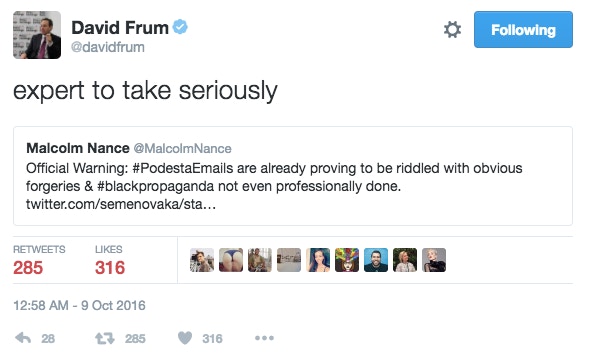
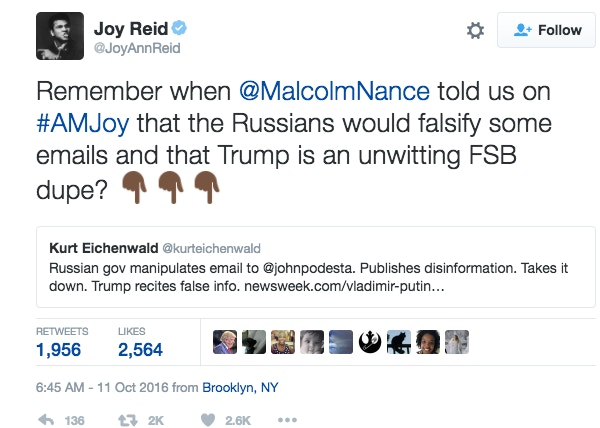
MSNBC’s “Intelligence commentator” Malcolm Nance, perhaps the most enthusiastic source of questionable #Russiagate news this side of Twitter conspiracist Louise Mensch, tweeted on October 11, 2016: “#PodestaEmails are already proving to be riddled with obvious forgeries & #blackpropaganda not even professionally done.”
As noted in The Intercept and elsewhere, this was re-reported by the likes of David Frum (a key member of the club that has now contributed to both the WMD and Russiagate panics) and MSNBC host Joy Reid. The reports didn’t stop until roughly October of 2016, among other things because the Clinton campaign kept suggesting to reporters the emails were fake. This could have been stopped sooner if examples of a forgery had been demanded from the Clinton campaign earlier.
Another painful practice that became common was failing to confront your own sources when news dispositive to what they’ve told you pops up. The omnipresent Clapper told Chuck Todd on March 5, 2017, without equivocation, that there had been no FISA application involving Trump or his campaign. “I can deny it,” he said.
It soon after came out this wasn’t true. The FBI had a FISA warrant on Carter Page. This was not a small misstatement by Clapper, because his appearance came a day after Trump claimed in a tweet he’d had his “wires tapped.” Trump was widely ridiculed for this claim, perhaps appropriately so, but in addition to the Page news, it later came out there had been a FISA warrant of Paul Manafort as well, during which time Trump may have been the subject of “incidental” surveillance.
Whether or not this was meaningful, or whether these warrants were justified, are separate questions. The important thing is, Clapper either lied to Todd, or else he somehow didn’t know the FBI had obtained these warrants. The latter seems absurd and unlikely. Either way, Todd ought to been peeved and demanded an explanation. Instead, he had Clapper back on again within months and gave him the usual softball routine, never confronting him about the issue.
Reporters repeatedly got burned and didn’t squawk about it. Where are the outraged stories about all the scads of anonymous “people familiar with the matter” who put reporters in awkward spots in the last years? Why isn’t McClatchy demanding the heads of whatever “four people with knowledge” convinced them to double down on the Cohen-in-Prague story?
Why isn’t every reporter who used “New Knowledge” as a source about salacious Russian troll stories out for their heads (or the heads of the congressional sources who passed this stuff on), after reports they faked Russian trolling? How is it possible NBC and other outlets continued to use New Knowledge as a source in stories identifying antiwar Democrat Tulsi Gabbard as a Russian-backed candidate?
How do the Guardian’s editors not already have Harding’s head in a vice for hanging them out to dry on the most dubious un-retracted story in modern history – the tale that the most watched human on earth, Julian Assange, had somehow been visited in the Ecuadorian embassy by Paul Manafort without leaving any record? I’d be dragging Harding’s “well placed source” into the office and beating him with a hose until he handed them something that would pass for corroborating evidence.
The lack of blowback over episodes in which reporters were put in public compromised situations speaks to the overly cozy relationships outlets had with official sources. Too often, it felt like a team effort, where reporters seemed to think it was their duty to take the weight if sources pushed them to overreach. They had absolutely no sense of institutional self-esteem about this.
Being on any team is a bad look for the press, but the press being on team FBI/CIA is an atrocity, Trump or no Trump. Why bother having a press corps at all if you’re going to go that route?
This posture all been couched as anti-Trump solidarity, but really, did former CIA chief John Brennan – the same Brennan who should himself have faced charges for lying to congress about hacking the computers of Senate staff – need the press to whine on his behalf when Trump yanked his security clearance? Did we need the press to hum Aretha Franklin tunes, as ABC did, and chide Trump for lacking R-E-S-P-E-C-T for the CIA? We don’t have better things to do than that “work”?
This catalogue of factual errors and slavish stenography will stand out when future analysts look back at why the “MSM” became a joke during this period, but they were only a symptom of a larger problem. The bigger issue was a radical change in approach.
A lot of #Russiagate coverage became straight-up conspiracy theory, what Baker politely called “connecting the dots.” This was allowed because the press committed to a collusion narrative from the start, giving everyone cover to indulge in behaviors that would never be permitted in normal times.
Such was the case with Jonathan Chait’s #Russiagate opus, “PRUMP TUTIN: Will Trump be Meeting With his Counterpart – or his Handler?” The story was also pitched as “What if Trump has been a Russian asset since 1987,” which recalls the joke from The Wire: “Yo, Herc, what if your mother and father never met?” What if isn’t a good place to be in this business.
This cover story (!) in New York magazine was released in advance of a planned “face-to-face” summit between Trump and Putin, and posited Trump had been under Russian control for decades. Chait noted Trump visited the Soviet Union in 1987 and came back “fired up with political ambition.” He offered the possibility that this was a coincidence, but added:
Indeed, it seems slightly insane to contemplate the possibility that a secret relationship between Trump and Russia dates back this far. But it can’t be dismissed completely.
I searched the Chait article up and down for reporting that would justify the suggestion Trump had been a Russian agent dating back to the late eighties, when, not that it matters, Russia was a different country called the Soviet Union.
Only two facts in the piece could conceivably have been used to support the thesis: Trump met with a visiting Soviet official in 1986, and visited the Soviet Union in 1987. That’s it. That’s your cover story.
Worse, Chait’s theory was first espoused in Lyndon Larouche’s “Elephants and Donkeys” newsletter in 1987, under a headline, “Do Russians have a Trump card?” This is barrel-scraping writ large.
It’s a mania. Putin is literally in our underpants. Maybe, if we’re lucky, New York might someday admit its report claiming Russians set up an anti-masturbation hotline to trap and blackmail random Americans is suspicious, not just because it seems absurd on its face, but because its source is the same “New Knowledge” group that admitted to faking Russian influence operations in Alabama.
But what retraction is possible for the Washington Post headline, “How will Democrats cope if Putin starts playing dirty tricks for Bernie Sanders (again)?” How to reverse Rachel Maddow’s spiel about Russia perhaps shutting down heat across America during a cold wave? There’s no correction for McCarthyism and fearmongering.
This ultimately will be the endgame of the Russia charade. They will almost certainly never find anything like the wild charges and Manchurian Candidate theories elucidated in the Steele report. But the years of panic over the events of 2016 will lead to radical changes in everything from press regulation to foreign policy, just as the WMD canard led to torture, warrantless surveillance, rendition, drone assassination, secret budgets and open-ended, undeclared wars from Somalia to Niger to Syria. The screw-ups will be forgotten, but accelerated vigilance will remain.
It’s hard to know what policy changes are appropriate because the reporting on everything involving the Russian threat in the last two to three years has been so unreliable.
I didn’t really address the case that Russia hacked the DNC, content to stipulate it for now. I was told early on that this piece of the story seemed “solid,” but even that assertion has remained un-bolstered since then, still based on an “assessment” by the intelligence services that always had issues, including the use of things like RT’s “anti-American” coverage of fracking as part of its case. The government didn’t even examine the DNC’s server, the kind of detail that used to make reporters nervous.
We won’t know how much of any of this to take seriously until the press gets out of bed with the security services and looks at this whole series of events all over again with fresh eyes, as journalists, not political actors. That means being open to asking what went wrong with this story, in addition to focusing so much energy on Trump and Russia.
The WMD mess had massive real-world negative impact, leading to over a hundred thousand deaths and trillions in lost taxpayer dollars. Unless Russiagate leads to a nuclear conflict, we’re unlikely to ever see that level of consequence.
Still, Russiagate has led to unprecedented cooperation between the government and Internet platforms like Facebook, Twitter, and Google, all of which are censoring pages on the left, right, and in between in the name of preventing the “sowing of discord.” The story also had a profound impact on the situation in places like Syria, where Russian and American troops have sat across the Euphrates River from one another, two amped-up nuclear powers at a crossroads.
As a purely journalistic failure, however, WMD was a pimple compared to Russiagate. The sheer scale of the errors and exaggerations this time around dwarfs the last mess. Worse, it’s led to most journalists accepting a radical change in mission. We’ve become sides-choosers, obliterating the concept of the press as an independent institution whose primary role is sorting fact and fiction.
We had the sense to eventually look inward a little in the WMD affair, which is the only reason we escaped that episode with any audience left. Is the press even capable of that kind of self-awareness now? WMD damaged our reputation. If we don’t turn things around, this story will destroy it.





















 anneinpt
 artaxes
 danmillerinpanama
 davidking1530
 Peter Hofman
 Joseph Wouk
 Peter
Peter Louisiana Steve
 WarSclerotic
Recent Comments