Archive for March 26, 2019

A soldier, a statesman and a star

March 26, 2019

Source: A soldier, a statesman and a star – Israel Hayom

Dror Eydar

It was interesting to hear Benny Gantz address the AIPAC conference. With customary America patience, the large audience waited in line for the security checks.

And then he took the podium. Pleasant on the eyes, gesturing with his hands, talking as a teacher would to his students. It was a reasonable speech if somewhat bland. Nothing more. He discussed (almost) all the issues that every speaker before him had already exhausted: the Holocaust, our strength in unity, peace, immigration, family, the Jewish people’s common historical destiny, Israel takes care of all Jews across the globe, the Western Wall belongs to everyone and no to a Kahanist government; the unbreakable alliance between Israel and the United States, and thanks to President Donald Trump for thus far giving us recognition of Jerusalem and the Golan Heights. (There was nothing about the historic withdrawal from the nuclear deal with Iran, which was a gift of equal importance. Why mention Netanyahu?) And then he issued a warning to Iran, Hezbollah, Hamas and all other thorns in our side. The applause from the crowd was somewhat restrained. There were scattered standing ovations. It didn’t electrify or ooze with charisma. There was even a joke or two sprinkled in. It was all well and good. He’s still an unknown commodity and didn’t give the impression that he felt at home.

2.

The interesting part of his speech was outlining Blue and White’s diplomatic policies, which are the same policies, more or less, as Netanyahu’s: a united Jerusalem; the Jordan Valley as a security buffer; the IDF will remain solely responsible for security (in other words, rejection of international peacekeeping forces), and “we will never retreat from the Golan Heights.” He didn’t offend anyone but also didn’t show how he was different from the Likud. These policies are more compatible with Moshe Ya’alon’s, although Gantz apparently leans more to the left of them, more in the vein of Yesh Atid MK Ofer Shelah. But we are in the home stretch before elections and every word counts. The running theme throughout his speech was “I’m a soldier” and “I have dedicated my life to the State of Israel and the Jewish people.” It was reminiscent of a speech Yitzhak Rabin gave at the White House back in the day: “I, I.D. No. 30743….” And now, Gantz wants us to similarly extrapolate that just as he commanded and led in the army, he can do the same with the country. What about the economy, technology, foreign policy and other critical areas – does military experience ensure success?

3.

And then U.S. Vice President Mike Pence took the stage and repeatedly brought the crowd to its feet. He also touched on the same topics but in his own colorful manner. He mentioned Trump often and discussed the current administration’s uncompromising commitment to Israel. Indeed, the list of accomplishments and gestures of friendship toward Jerusalem is long – not just withdrawing from the Iran nuclear deal or recognizing Jerusalem and the Golan but shuttering the PLO’s offices in Washington after the Palestinian Authority refused to stop paying salaries to terrorists and their families, and cutting American payments to the United Nations, UNRWA and more. He mentioned Netanyahu in the same breath as Trump, as it pertains to the recognition of Israeli sovereignty over the Golan Heights.

And then he changed gears to assail the leftist radicalization of the Democratic Party, to the point of unabashed anti-Semitism in the House of Representatives. Most interesting was his call for those who attack the relationship between Israel and the U.S. to be barred from sitting on the Foreign Affairs Committee of the House of Representatives. It was a response to the anti-Semitic sentiments voiced by Rep. Ilhan Omar. She and her ilk sought to isolate those who support Israel and to mark them as disloyal and as seeking to undermine U.S. interests. Pence instead turned the spotlight back around, to isolate them as suspects in their own right. It’s clear the Democratic presidential candidates are afraid of the progressives and thus avoided appearing at AIPAC (Pence said they “boycotted” the conference), and addressed them directly: “Anyone who aspires to the highest office in the land should not be afraid to stand with the strongest supporters of Israel in America.”

4.

Similar to all of Pence’s important speeches to Jewish audiences, here too he mixed in some Hebrew. He said the U.S. and Israel were more than friends, partners or allies – but a family (using the Hebrew word “mishpucha” for family). Wonderful. And the next time disagreements arise between Israel and the administration, we must remember that family members do disagree on occasion, regardless of their obvious loyalty to it. To better understand Pence, one needs to remember that he is a religious person and his support for Israel stems from his Christian faith. It is also the source for the idea of family: two faiths stemming from the same root. He ended his speech with a blessing for his fellow Americans: “May the Lord bless you and keep you. May His countenance shine upon you and be gracious unto you. And may all your ways be paths of peace.”

And then Nikki Haley approached the podium and the stadium shook from the ovation. She is still the star of the conference. She, too, touched all the basic bases. But what does it matter? The entire crowd was on its feet the majority of the time, cheering her on. She deserves it. Netanyahu won’t address the conference this year. It’s a shame. Someone already tweeted that the AIPAC conference without Netanyahu is like an omelet without eggs.

Dror Eydar has been appointed Israeli ambassador to Italy.

Trump officially recognizes Israeli sovereignty on Golan Heights 

March 26, 2019

Source: Trump officially recognizes Israeli sovereignty on Golan Heights – Israel Hayom

U.S. President Trump says move cements Israel’s ability to defend itself from regional threats should a broad Arab-Israeli peace deal ever be reached • U.N.: Israel’s annexation of the Golan Heights “null and void and without international legal effect.”

News Agencies and Israel Hayom Staff // published on 26/03/2019
   
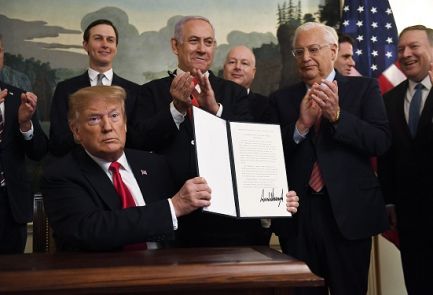
U.S. President Donald Trump holds up a proclamation recognizing Israel’s sovereignty over the Golan Heights, as Prime Minister Benjamin Netanyahu looks on at the White House, Monday 


U.S. President Donald Trump signed a historic proclamation on Monday recognizing Israel’s sovereignty over the Golan Heights.

Standing alongside Prime Minister Benjamin Netanyahu at the White House, Trump made formal a move he announced in a surprise tweet last week.

The president said it was time for the U.S. to take the step after 52 years of Israeli control of the strategic highlands on the border with Syria. The U.S. is the first country to recognize Israel’s sovereignty over the Golan, which the rest of the international community regards as Israeli-occupied.

Syria and neighboring Lebanon denounced the move, and at least two NATO members, Canada and Turkey, said they would not follow suit.

Trump said his decision would cement the Jewish state’s ability to defend itself from regional threats should a broad Arab-Israeli peace deal ever be reached. Trump’s action also likely gives Netanyahu a political boost ahead of what’s expected to be a close Israeli election.

During his 90-minute visit to the White House, reporters and photographers were invited to see Netanyahu at least four times, including his arrival at the South Lawn and in the Oval Office.

Israel has long argued that the strategically important area has, for all practical purposes, been fully integrated into Israel since it was captured from Syria in the 1967 Six-Day War and that control of the strategic plateau is needed as protection from Iran and its allies in Syria.

“Today, aggressive acts by Iran and terrorist groups, including Hezbollah in southern Syria continue to make the Golan Heights a potential launching ground for attacks on Israel,” Trump said in the proclamation.

The proclamation noted the “unique circumstances” presented by the Golan, language that appeared to be aimed at countering criticism that the recognition would be used by other countries to justify control of disputed territory, such as Russia’s 2014 annexation of Ukraine’s Crimea region.

But criticism was speedy and intense.

Syria slammed the U.S. step as “blatant aggression” on its sovereignty and territorial integrity. The foreign ministry said Trump’s move represented the “highest level of contempt for international legitimacy” and showed that Washington was “the main enemy” of Arabs.

Lebanon, which Secretary of State Mike Pence visited over the past weekend, said that the Golan Heights is “Syrian Arab” territory and that “no country can falsify history by transferring” land from one country to another.

Saudi Arabia denounced U.S. President Donald Trump’s recognition of Israel’s 1981 annexation of the Golan Heights, a statement released by the Saudi Press Agency said early on Tuesday.

“Attempts to impose fait accompli do not change the facts,” the statement said. It said the Golan Heights was an “occupied Syrian Arab land in accordance with the relevant international resolutions.”

“It will have significant negative effects on the peace process in the Middle East and the security and stability of the region,” it said.

The Saudi Press Agency report described Monday’s declaration as a clear violation of the United Nations Charter and of international law.

Kuwait and Bahrain said they regretted the decision while Qatar called on Israel to end its occupation of the Golan Heights and comply with international resolutions.

Canada also expressed opposition.

“In accordance with international law, Canada does not recognize permanent Israeli control over the Golan Heights. Canada’s long-standing position remains unchanged,” the Canadian foreign ministry said. “Annexation of territory by force is prohibited under international law.”

Turkey’s foreign minister said that the U.S. had ignored international law and that the decision would further increase tensions in the region.

And, at the United Nations, U.N. spokesman Stephane Dujarric said U.N. chief António Guterres adheres to Security Council resolutions that Israel’s annexation of the Golan Heights is “null and void and without international legal effect.”

Amnesty International called the decision “irresponsible, reckless and yet another example of the Trump administration violating international law and consensus by condoning Israel’s illegal annexation.”

Eric Goldstein, deputy Middle East and North Africa director at Human Rights Watch, said Trump seems to want to “drive a wrecking ball” through international law that protects the people who live in “occupied Golan Heights.” He said it could embolden other “occupying states to double down on their own land grabs, settlements and plunder of resources.”

Netanyahu, even as he was somberly cutting short his visit to Washington to deal with a rocket attack in central Israel, was elated by Trump’s move.

“Israel has never had a better friend than you,” he told the president.

Netanyahu noted a series of steps Trump has taken since assuming office, including his withdrawal from the 2015 Iran nuclear deal, recognition of Jerusalem as Israel’s capital and moving the U.S. Embassy there from Tel Aviv.

In addition to signaling U.S. support for Israel’s security, the decision appeared to show Trump’s support for Netanyahu, who is up for re-election April 9. Netanyahu is facing a tough challenge from a popular former military chief and reeling from a series of corruption allegations. He has repeatedly sought to focus attention on his foreign policy record and strong ties with Trump.

The two leaders met as the Israeli military was striking Hamas targets in the Gaza Strip in response to a rocket that hit a house north of Tel Aviv, injuring seven people.

In a speech to the American Israel Public Affairs Committee earlier Monday, U.S. Vice President Mike Pence said the rocket attack “proves that Hamas is not a partner for peace.” Pence told AIPAC that “Hamas is a terrorist organization that seeks the destruction of Israel, and the United States will never negotiate with terrorist Hamas.”

Netanyahu arrived in Washington on Sunday for what was to have been a three-day visit but announced early Monday he would leave early to take charge of the response to the rocket.


Fragile calm emerges following day of clashes in Gaza 

March 26, 2019

Source: Fragile calm emerges following day of clashes in Gaza – Israel Hayom

In a statement to Palestinian media, terrorist groups vow to stop rocket fire into Israel and “commit to Egyptian mediation efforts” if Israel stops airstrikes • Israel on high alert; schools near the border closed • IDF “prepared for various scenarios.”

Reuters and Israel Hayom Staff // published on 26/03/2019
   
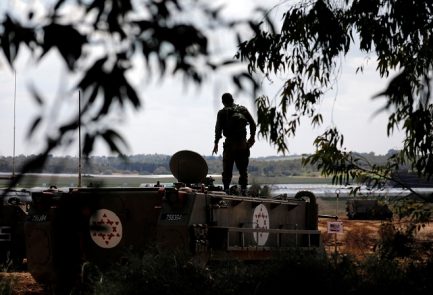
An Israeli soldier stands atop an armored personnel carrier near the Gaza border, Tuesday 

Palestinian terrorist groups in Gaza announced a tentative truce with Israel on Tuesday morning after a day of clashes that continued well into Monday night.

In a statement to the Palestinian media, they announced they would stop their rocket fire into Israel and “commit to mediation efforts undertaken by Egypt aimed at reaching a full truce.” They conditioned this on Israel halting its retaliatory strikes.

Israel has yet to respond, although a tense calm has so far been maintained Tuesday and the Israel Defense Forces said in a statement it remained “prepared for various scenarios.”

Israel remained on high alert, with schools near the border kept closed and residents instructed to stay near bomb shelters.

The fighting on Monday was triggered by a rocket attack on Mishmeret in central Israel, which destroyed a home and injured several family members.

During the height of clashes Monday, sirens sounded in Israeli towns near the border because of repeated rocket attacks, sending residents running for shelter.

The Israel Defense Forces, which amassed extra troops and tanks along the border, said it struck a variety of Hamas targets, including the office of Hamas political bureau chief (and former prime minister) Ismail Haniyeh.

Hamas, the Islamist terrorist group that controls Gaza, and smaller Palestinian factions issued a late-night statement that Egypt had mediated a cease-fire but the rocket fire continued until Tuesday morning, when the factions issued the new cease-fire statement.

The escalation came just two weeks before the April 9 election, in which Prime Minister Benjamin Netanyahu is campaigning on a tough line against Hamas.

Netanyahu cut short a visit to the United States and left to Israel on Monday night.

“Israel will not tolerate this. I will not tolerate this,” Netanyahu said on Monday. “And as we speak … Israel is responding forcefully to this wanton aggression.”


Not time for a ground operation 

March 26, 2019

Source: Not time for a ground operation – Israel Hayom

Meir Indor

The following is a contradictory approach to Gaza, from a hawkish perspective:

  • Any comprehensive military operation – should be postponed until after the election, barring extreme developments. The response to rocket fire on Gaza-area communities must be the same as a rocket attack on Tel Aviv, Israel’s southern residents have justifiably shouted. The opposite is also true. We haven’t launched a war thus far and we won’t do so now because a rocket hit the Sharon region. After the election, bereaved families of the fallen and wounded will more readily accept that an operation was ordered free of political and personal interests, devoid of pressure from groups on WhatsApp, Facebook and various political rivals.
  • The enemy cannot be allowed to dictate the national agenda. The missile that was fired at the Sharon region was an entirely predictable “election terror attack.” Although Islamic Jihad pulled the trigger, the orders came from Tehran. The Iranians, who are operating in our area through Hamas and Islamic Jihad, have a clear interest in presenting the Netanyahu government as weak, in order to topple it and its leader.
  • The prime minister was right to shorten his trip to the United States and return to Israel. The decision was mostly for show – but a necessary show. In my estimation, he could have stayed in the U.S. rather than allow Hamas to disrupt his visit but, facing a contrarian press, there appeared to be little recourse.In retrospect, there are also benefits: The prime minister “isn’t ignoring the public’s feelings.” From home, after convening the relevant security forums, he will manage and explain Israel’s response.
  • As part of the response leading up to the election on April 9, Israel must gradually reinstate the policy of targeted assassinations against terrorist leaders. We must also target terrorist operatives in the field, who on a daily basis approach the Gaza border fence under the guise of protesters. To this end, there is no need to cross the border with tanks and soldiers. We can exploit our technological advantage for pinpoint attacks from the air, not just against weapons warehouses but against terrorist units.
  • And what will happen after the election? Although segments of the Left will continue pushing for the transfer of Gaza to the control of Mahmoud Abbas, this option should be rejected outright. Our soldiers are not a spear for the Palestinian Authority and PLO. The scope of the PA’s leadership should not be expanded, as it already causes us enough problems with the terrorists it harbors and encourages with money.

The ideal solution is the restoration of Israeli control over Gaza, as constituted prior to the Oslo Accords and a return to the days when women from Netivot shopped in Khan Younis and the residents of Gush Katif received their driver’s licenses in Rafah. Until, of course, the warriors for peace and the dreamers came along and welcomed Yasser Arafat and his armed regiments from Tunisia.

Lt. Col. (ret.) Meir Indor in the head of the Almagor Terror Victims Association.


Israel must end this round with tangible gains 

March 26, 2019

Source: Israel must end this round with tangible gains – Israel Hayom

Yoav Limor

Over the past year, Israel has tried to avoid reaching a major confrontation with Hamas.

The weekly riots that begun last March have occasionally resulted in violent clashes, but Israel has repeatedly chosen to de-escalate, knowing full well that a full-fledged war will exact a heavy military and economic price and won’t address the underlying problems in the Gaza Strip.

Likewise, Hamas wanted to avoid a real confrontation that would have only increased the despair in Gaza.

But in recent days Hamas has apparently changed its posture. There can be several reasons for this: the ongoing protests on the streets of Gaza; Egypt’s unwillingness to mediate an intra-Palestinian reconciliation; the insufficient cash from Qatar; Israel’s new measures against Hamas prisoners, and perhaps the realization that the election season is an opportune moment to extract concessions from Israel without going into war.

Whatever the reason,  Hamas has chosen to play with fire. Hamas claimed that it “accidentally” fired rockets on central Israel some ten days ago, but using this same excuse for Monday’s rocket on Mishmeret is would have a been over the top.

This time around, Israel knew it had no choice but to retaliate, particularly because of the Israeli casualties. This time around, it was imperative to act because Israel’s deterrence had significantly eroded.

As of Monday, Israel was still trying to make sure things would not spiral out of control. Israel’s airstrikes were intense but limited; Israel wanted to exact a price from Hamas, but it didn’t want all hell to break loose (not yet at least).

If Hamas acts with a similar degree of restraint, perhaps this round of escalation – the umpteenth such round over the past year – will not become war.

Israel sent two brigades to the border on Monday to prepare for a potential major confrontation. The move was also a message to Hamas that it should think twice before it enters a futile misadventure.

Likewise, Hamas’ rocket attack on Monday was a message to Israel. It was a warning that the terrorist group could have just as easily hit the Ben Gurion International Airport and other strategic assets. Another terrorist group, the Palestinian Islamic Jihad, can also do the same.

Israel is operating under the assumption that Hamas would like to avoid an all-out war with Israel, but Hamas’ senior commanders went into hiding on Monday.

Israel has also taken various steps to prepare for any eventuality. This saw the deployment of Iron Dome batteries and the reinforcement of troops near border communities, in case Hamas would to launch a cross-border attack or kidnap Israelis through its tunnels.

As is the case with every round of hostilities, the first 24 hours are the most critical because this period defines the rules of the game. It is also the period where both sides either demonstrate their determination to go to war or seek a face-saving calm.

Israel will likely try to make sure this latest escalation ends with actual gains. It cannot let Hamas’ repeated harassment of border communities with airborne incendiary devices go unpunished.

Israel must also change the rules of the game by creating a secure perimeter near the border fence that would be off-limits to rioters. And above all, Israel must extract a clear cut statement from Hamas in which it would pledge not to engage in rocket fire and prevent others from doing so.

Such a statement would only be issued if Hamas feels it has something to lose. Israel must not yield on this because otherwise, the hostilities will erupt again.

Israeli air force bombs three symbols of Hamas rule in Gaza. Sderot home hit. Hamas offers truce – DEBKAfile

March 26, 2019

Source: Israeli air force bombs three symbols of Hamas rule in Gaza. Sderot home hit. Hamas offers truce – DEBKAfile

Israel’s major counter-terror operation in the Gaza Strip was confined in its early stage to air strikes against empty Hamas government buildings. DEBKAfile’s military sources note six features of the operation:

1. The air force alone is conducting this stage of the Israeli offensive with fighter jets, helicopters and drones. The boosted ground forces massed outside the Gaza border fence are being held back for a later stage depending on how the operation unfolds.

2.  Three Hamas internal security and intelligence command centers were struck in Gaza City as week as the Hamas leader Ismail Haniyeh’s bureau. They had all be evacuated in good time after the iDF sent warning rockets as part of its ”knock on roof” policy for minimizing civilian casualties.

3. No Hamas casualties are so far reported, indicating the IDF is still keeping its counter-terror offensive law key.

4. Haniyeh’s bureau was struck as a message from the IDF that if the conflict is drawn out, Haniyeh and other high-ranking Hamas officials or commanders may be targeted in person.

5. Within short hours, Hamas and Islamic Jihad retaliated with a massive rocket barrage against Sderot, which knocked over a home. Their payback could extend to other parts of Israel during the night.

6. Following this attack, Hamas claimed a truce had been agreed, which Israel has not confirmed.


Likud minister: There’s no perfect solution for Gaza

March 26, 2019

Minister Yuval Steinitz says ‘nearly impossible’ to fix Oslo, but past decade has been ‘best ever’ for Israel from a security standpoint.

Yehonatan Gottlieb, 26/03/19 10:34
Yonatan Sindel/Flash 90

Energy Minister Yuval Steinitz (Likud) on Tuesday morning told Channel 13 that from a security standpoint, the past decade has been the best since Israel’s founding.

During the interview, Steinitz said that there is “deep strategical thinking” with regards to the issues of Gaza and Iran, but that “there is no perfect solution for the Gaza problem.”

“What was created by Oslo and the Disengagement, and first and foremost by the historical mistake that I also supported at the time, as a leftist – Oslo, is difficult and nearly impossible to fix. But we are doing our best, and the fact is that even though we’re not able to rest, the past decade has been Israel’s best from a security perspective.”

Regarding Hamas’ claim of a ceasefire, Steinitz said, “From our perspective, all options are open. We reserve the right to choose any option, and we’ll see where this leads. We respond with a heavy hand – Gaza shook last night.”

He also noted that despite the rocket attacks and the damage to two family homes, “when you look at the big picture, the past decade has been Israel’s best ever from a security standpoint, with the fewest number of people killed and injured.”

Mideast Daily News Poll: American Jews Most Anti-Trump, Least Likely to be Republican

March 26, 2019
By Michael Friedson | The Media Line

March 17, 2019

Poll: American Jews Most Anti-Trump, Least Likely to be Republican

President Donald Trump and First Lady Melania Trump, alongside Rabbi Jeffrey Myers, place stones and flowers on a memorial as they pay their respects at the Tree of Life Synagogue in Pittsburgh, Pennsylvania, October 30, 2018 (Photo: SAUL LOEB/AFP/Getty Images)

American Jews are more anti-Trump than Catholics, Protestants, Agnostics or Atheists; and are the least likely of all the groups to enroll as Republicans. In a Gallup poll conducted last week, only 28 percent of Jewish respondents were favorable to President Trump against 71 percent of Jewish voters oppose him. When compared to the groups listed above, American Jews are most negative toward President Trump. Polls conduced following the 2018 midterm elections returned similar results, showing 78 percent saying they voted for Democrats and only 17 percent supporting Republicans. The president is known to have expressed his confusion over his rejection by Jewish voters in light of his declaration that Jerusalem is the capital of the Jewish state and his moving of the United States Embassy from Tel Aviv to Jerusalem. Although he clearly wants to convince Jewish voters to vote Republican, there is no indication so far that he has discovered the key to making that happen.

Air Force hits enemy targets after 30 rockets pound Israel 

March 26, 2019

Source: Air Force hits enemy targets after 30 rockets pound Israel – Israel News – Jerusalem Post

Despite talks of a cease-fire late Monday night rockets continued to be shot into Israel from Gaza.

BY BEN BRESKY, JERUSALEM POST STAFF
 MARCH 26, 2019 04:01

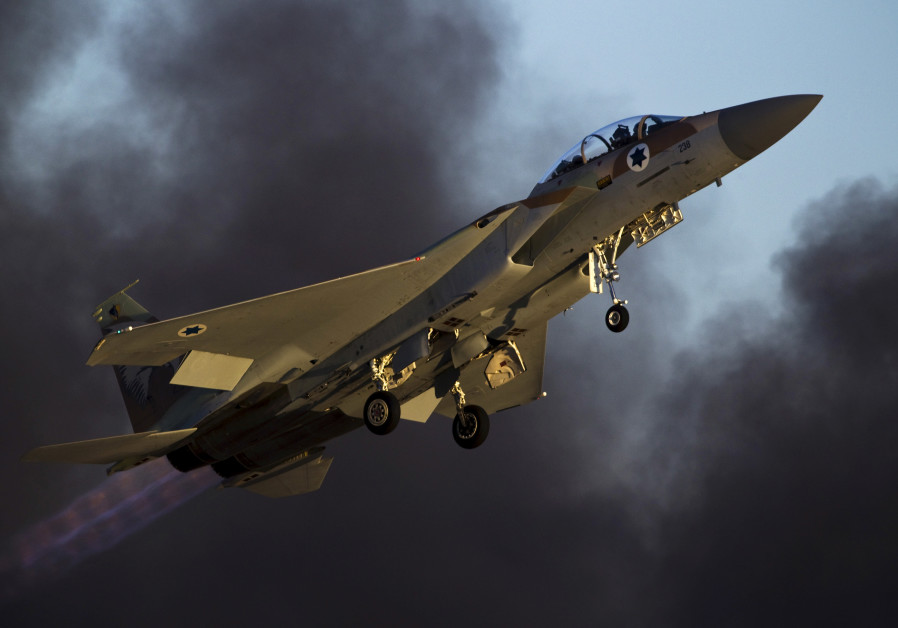
An Israeli air force F-15 fighter jet flies during an exhibition as part of a graduation ceremony

Israel Defense Force fighter jets attacked 15 enemy targets early Tuesday morning, the IDF spokesperson announced as the rocket attacks on Israel’s southern communities continued into a second day.
The targets include a military compound belonging to the Hamas terrorist organization in Beit Hanun and a military compound belonging to the Palestinian Islamic Jihad terrorist organization in Beit Lahiya.

Over 30 rockets were shot into Israeli airspace, some being taken out mid-air by the Iron Dome defense system and others hitting open areas. The red alert siren sounded throughout the night Tuesday in Sderot, the Eshkol Regional Council, the Hof Ashkelon Regional Council and the Shaar Hanegev Regional Council, where a spokeswoman for the cluster of communities said power was cut due to the attacks.

Many residents reportedly slept in bomb shelters, as communities in the Gaza belt region have 15 seconds from the time the “tzeva adom” or “code red” warning siren is sounded until rocket impact.
The latest wave of rockets caused no injuries or property damage, said Adi Meiri, spokeswoman for Shaar Hanegev Regional Council but some residents were treated for shock.

School has been cancelled for Tuesday in the city of Ashkelon and the Hof Ashkelon Regional Council, areas that have been hit by rockets in past flare-ups, the Ministry of Education announced following recommendations from the Home Front Command.

The escalation started early Monday morning when Hamas launched a rocket that flew toward the center of the country, slamming into a private home in Kfar Saba. Seven people were injured and four dogs were killed. Located in the Sharon region, Kfar Saba, unlike the southern region, does not border on Gaza attesting to the range of the Gaza rockets.

Prime Minister Benjamin Netanyahu cancelled his scheduled speech at the AIPAC policy conference in Washington and boarded a plane home to Israel Tuesday. “We gave a very strong, very powerful response,” he stated of the retaliatory attacks on Gaza following the destruction of the home on Monday. “Hamas needs to know that we will not hesitate to enter and take the necessary steps,” he added.
Elected officials across the spectrum have weighed in on the current security situation, including MK Moti Yogev, a member of the Foreign Affairs and Defense Committee, who warned that a ceasefire with Hamas would not be enough of a deterrent.

“The destruction of terrorist homes is good,” said Yogev in a tweet late Monday night, referring to the actions the IDF has taken against terrorists in the West Bank, “but in the Gaza Strip it is not enough.”

He said that a ceasefire in the face of continued rocket attacks, “violates Israel’s commitment to its citizens. Deterrence resides only when the leaders of terror are given a price that they will not be able to withstand.”

Education Minister Naftali Bennett, chairman of the New Right  stated, “a ceasefire at these moments will be a tailwind for terrorism. There is no country in the world that would not charge a price for missiles shot at its citizens, and there is no country in the world whose blood is as empty as we have been in recent days. Bombing empty buildings endangers Israel’s deterrence and brings the next missiles at us.”

Itamar Ben-Gvir of the Otzma Yehudit faction of the Union of Right-Wing Parties called for Israel to return to Gush Katif, the bloc of Gaza Jewish communities evicted in 2005.

Gaza was a territory of Israel from 1967 until the 2005 Disengagement, a unilateral move by the Israeli government, which removed all Israeli settlements, seen as obstacles to peace, and IDF forces from Gaza. The Palestinian population centers in Gaza had been under Palestinian Authority jurisdiction since the Oslo Accords of the mid 1990s.

A year after the Disengagement, Hamas usurped control from the Palestinian Authority. Since then, three major conflicts have occurred between Hamas and Israel: Operation Cast Lead in 2008–09, Operation Pillar of Defense in 2012 and Operation Protective Edge in 2014.