Archive for March 25, 2019

IDF blames Hamas for rocket launch, sends reinforcements to Gaza border

March 25, 2019

Source: IDF blames Hamas for rocket launch, sends reinforcements to Gaza border | The Times of Israel

Two additional brigades sent to border area, air defense reservists called up ahead of expected clashes following direct hit on central Israeli home that injured 7

Illustrative. IDF forces gather in southern Israel following clashes in the Gaza Strip on November 13, 2018. (Hadas Parush/Flash90)

Illustrative. IDF forces gather in southern Israel following clashes in the Gaza Strip on November 13, 2018. (Hadas Parush/Flash90)

The Israeli military deployed two additional brigades to the Gaza region and called up reservists for air defense units following a rocket attack that struck a home in central Israel, injuring seven people, including two infants.

IDF Spokesperson Ronen Manelis said the rocket was fired from a Hamas launchpad in the southern Gaza town of Rafah. He did not respond to claims made by the terror group via the Egyptian military that the projectile was launched accidentally.

“We are not commenting on our intelligence assessments at this time,” another IDF spokesperson said.

Following the rocket attack, IDF Chief of Staff Aviv Kohavi conducted a situational assessment with the head of the Shin Bet security service and other senior defense officials.
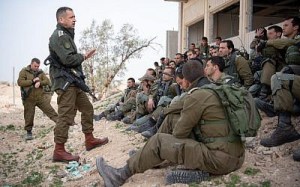
In a photo released by the Israel Defense Forces on February 26, 2019, Chief of Staff Aviv Kohavi (2nd-L) speaks with soldiers taking part in a snap drill at the Tzeelim base in southern Israel simulating a future military conflict in the Gaza Strip. (Israel Defense Forces)

After the meeting, Kohavi ordered the two reinforcement brigades be sent to the Gaza Division, representing over 1,000 additional soldiers deployed to the area, a significant troop increase.

The two brigades — one infantry and the other armored — had been conducting training exercises, which were cut short in light of the rocket attack.

A small number of reservists were also called in to serve on Iron Dome missile defense systems and other select units, the army said.

The Israel Defense Forces refused to comment directly on why its air defense systems had failed to intercept the incoming rocket, but indicated that it was because an Iron Dome battery had not been deployed in the area.

The military said the rocket that struck the home in the central Israeli town of Mishmeret was a variety produced by Hamas, known as a J80, which has a range of 120 kilometers (75 miles).

Following the rocket attack, Palestinian terror groups began evacuating their positions throughout the Gaza Strip ahead of expected Israeli counter-strikes.

Israeli military officials met with the heads of local governments in the communities around the Gaza Strip to prepare them for the planned retaliatory strikes against terrorist targets in the coastal enclave — and the expected Palestinian responses to these counterattacks.

Senior Israeli officials told reporters on Monday that a forceful retaliation to the early morning rocket attack was forthcoming, but it appeared to be delayed by Egyptian attempts to broker a ceasefire and Prime Minister Benjamin Netanyahu’s ongoing visit to the United States.

The Hamas terror group told an Egyptian military intelligence delegation that the rocket had been fired accidentally — though Israeli officials reportedly scoffed at this version of events.

As of noon on Monday there were no special safety instructions given to residents of the Gaza periphery, an IDF spokesperson said, though this may change with the start of an Israeli counterattack.

In light of the rocket strike, Israel also closed its two Gaza crossings — Kerem Shalom, which is used for goods, and the pedestrian Erez Crossing — until further notice, Israel’s military liaison to the Palestinians Maj. Gen. Kamil Abu Rukun said.

Abu Rukun, known as Coordinator of Government Activities in the Territories, also announced Monday that Israel would be restricting the permitted fishing zone around the coastal Gaza Strip in light of the attack.

The early morning attack on Mishmeret, located over 100 kilometers (60 miles) from the southern tip of the Gaza Strip from where the rocket was fired, represented a significant increase in the level of violence from the coastal enclave, following weeks of heightened tensions and border clashes, as well as skirmishes in Israeli jails between Palestinian security prisoners and prison guards.

This attack on Mishmeret was the farthest-reaching rocket attack from the enclave since the 2014 Gaza war.
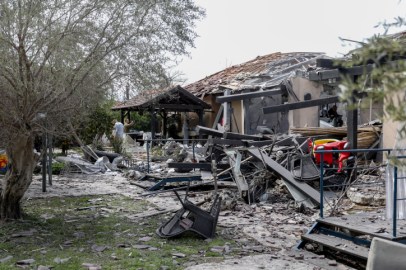
Israeli security forces inspect the scene of a house that was hit by a rocket fired from the Gaza Strip in the town of Mishmeret in central Israel on March 25, 2019. (Noam Revkin Fenton/Flash90)

There are fears that violence will ramp up this week, with Hamas hoping to draw hundreds of thousands of rioters to the fence at the weekend to mark a year of so-called March of Return protests, which began March 30, 2018.

Prime Minister Benjamin Netanyahu, who is currently in the US for the annual AIPAC conference, cut his trip short and planned to return to Israel, following a meeting with US President Donald Trump later in the day.

Screen capture of Prime Minister Benjamin Netanyahu in a Hebrew-language video released by his office from Washington on March 25, 2019, telling Israelis he would be heading back home following a Gaza rocket attack earlier in the day. (Courtesy PMO)

“There was a criminal attack on the State of Israel, and we will respond forcefully,” Netanyahu said in a statement, following a discussion with the IDF chief of staff, national security adviser, head of the Shin Bet security service and other senior defense officials.

Following the attack, candidates from across the political spectrum lambasted Netanyahu’s Gaza policies and demanding a forceful response to the rocket attack.

The Gaza-ruling Hamas reportedly told an Egyptian military intelligence delegation that the rocket had been fired mistakenly. The terror group made similar claims of an “accident” about a rocket attack on Tel Aviv earlier this month and one that hit a home in Beersheba in October.
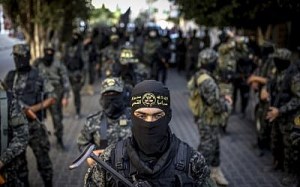
Members of the Iran-backed Palestinian Islamic Jihad terror group march during a military parade in Gaza City, October 4, 2018. (Anas Baba/AFP Photo)

Following the attack, the head of the Palestinian Islamic Jihad, Ziyad al-Nakhalah, warned Israel against conducting a counterattack, saying “we caution the Zionist enemy against carrying out attacks against the Gaza Strip. [Israel’s] leaders must know that we will respond forcefully to their aggression.”

The rocket was fired from the Gaza Strip shortly after 5 a.m., hitting the residential building, injuring seven people, including two infants, and leveling the structure, officials said.

Police said the projectile caused the building to catch fire, and shrapnel from the rocket attack also caused significant damage to the surrounding area, as fragments hit a gas tank outside the building.
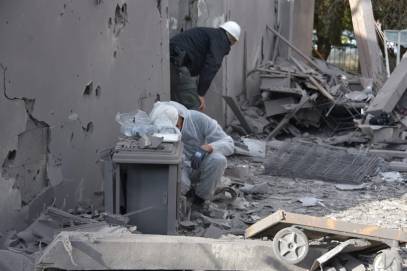
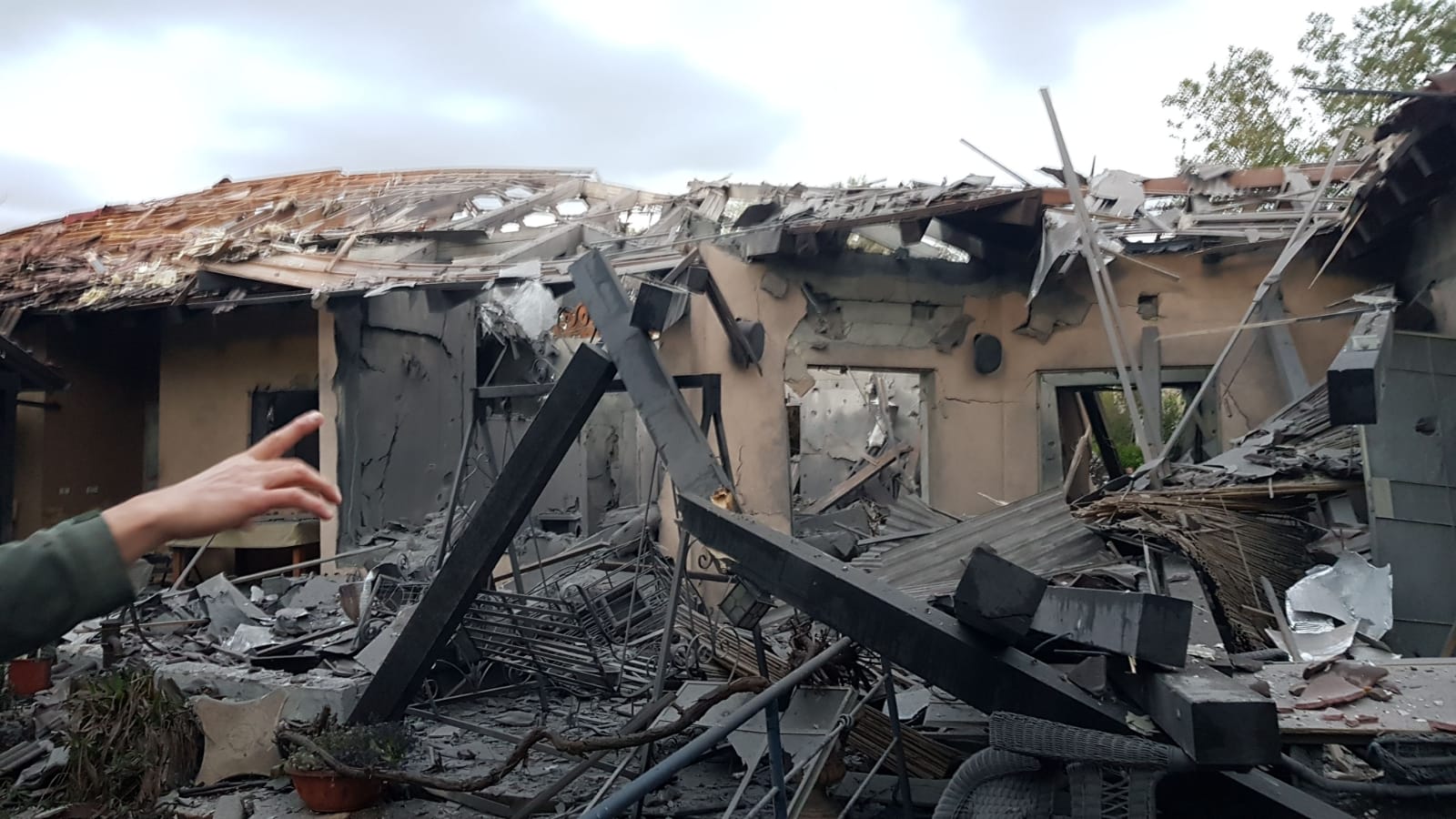
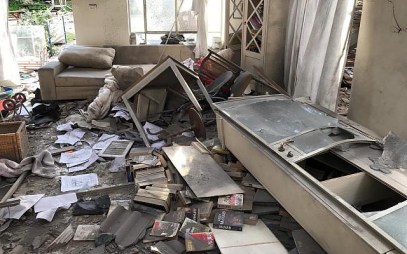
Police inspect a home in the central Israeli town of Mishmeret that was destroyed in a rocket attack from the Gaza Strip on March 25, 2019. (Israel Police)

A 59-year-old woman was moderately injured in the attack, with light burns, shrapnel wounds and trauma from the blast. A 30-year-old woman was also moderately wounded, with shrapnel hitting her leg. The other people in the building — a 30-year-old man, 12-year-old girl, 3-year-old boy and 18-month-old baby — sustained light wounds, MDA said.

They were taken to Kfar Saba’s Meir Medical Center for treatment. Several others in the area were treated for anxiety attacks and light injuries from falling while running to bomb shelters.

A home in the central Israeli town of Mishmeret, which was destroyed in a rocket attack from the Gaza Strip on March 25, 2019. (Fired and Rescue Services)

A dog belonging to one of the families in the building was also apparently killed in the rocket strike.

Schools in the Sharon region opened as usual Monday despite the attack, though the Education Ministry said teachers would hold a special session with students to discuss the issue.

Recent weeks have seen escalating tensions in the Gaza Strip, as its de facto rulers the Hamas terror group feuds with both Israel and the West Bank-based Palestinian Authority. Domestically, the terror group has also faced protests and increased criticism as humanitarian conditions in the Strip continue to deteriorate.

On Sunday night, an Israeli tank targeted two Hamas posts along the Gaza border, following a number of cross-border attacks throughout the day, the military said. On Saturday night, Israeli military aircraft bombed Hamas targets in Gaza after a rocket alarm sounded in some Israeli communities bordering the Strip, triggered by a powerful improvised bomb thrown at the border during late-night riots. A Palestinian was killed by Israeli fire during the clashes early Sunday, authorities in the Strip said. The 24-year-old man was fatally shot in the chest and two others were wounded, the Hamas-run health ministry said.

Israel says the demonstrations, night-time riots, airborne explosive and incendiary attacks are orchestrated by Hamas in order to provide cover for the organization’s nefarious activities along the security fence, including infiltration attempts, the planting of explosives and attacks on Israeli soldiers.

Their organizers have said the protests aim to achieve the “return” of Palestinian refugees and their descendants to lands that are now part of Israel, and pressure the Jewish state to lift its restrictions on the movement of people and goods into and out of the coastal enclave.

Israeli officials say the return of Palestinian refugees and their descendants would destroy Israel’s Jewish character. They also maintain that the restrictions on movement are in place to prevent Hamas and other terrorist groups from smuggling weapons into the Strip.

 

Netanyahu vows to respond ‘forcefully’ to rocket attack, cuts short US trip

March 25, 2019

Source: Netanyahu vows to respond ‘forcefully’ to rocket attack, cuts short US trip | The Times of Israel

After expected Monday signing of US Golan declaration at White House, PM to return to Israel ‘to oversee our response’ to Gaza attack

Screen capture of Prime Minister Benjamin Netanyahu in a Hebrew-language video released by his office from Washington on March 25, 2019, telling Israelis he would be heading back home following a Gaza rocket attack earlier in the day. (Courtesy PMO)

Prime Minister Benjamin Netanyahu cut short his trip to the United States on Monday after a rocket fired from Gaza struck a residential building in central Israel early Monday morning, injuring at least seven people, including two infants, and leveling the structure.

“A few minutes ago I finished a briefing and consultation with the chief of staff [of the IDF], the head of the Shin Bet and the national security adviser,” Netanyahu said in a hastily released video from Washington. “This was a criminal attack on Israel and we will respond forcefully,” he vowed.

He said he would linger in Washington just long enough to meet US President Donald Trump on Monday morning local time, “and immediately afterward return to Israel to oversee our response first-hand.”

The prime minister is to meet Trump at the White House on Monday for the expected signing of an order recognizing Israel’s sovereignty over the Golan Heights.

He will also conduct a “working meeting” with Trump, which will focus on “Iranian aggression, Iran’s attempts to establish military bases in Syria, and how to prevent Iran from obtaining nuclear weapons,” according to an earlier statement from the Prime Minister’s Office. “The two will also discuss strengthening security and intelligence cooperation.”

A home in the central Israeli town of Mishmeret, which was destroyed in a rocket attack from the Gaza Strip on March 25, 2019. (Fired and Rescue Services)

On Tuesday morning, Netanyahu was set to address some 18,000 people at the American Israel Public Affairs Committee annual policy conference in Washington, and in the evening was due to attend a dinner at the White House.


Germany refuses to disclose Iranian attempts to buy nuclear, missile tech 

March 25, 2019

Source: Germany refuses to disclose Iranian attempts to buy nuclear, missile tech – Middle East – Jerusalem Post

BY BENJAMIN WEINTHAL
 MARCH 25, 2019 02:22
Germany refuses to disclose Iranian attempts to buy nuclear, missile technology

Washington, D.C. — The German foreign ministry declined to reveal statistics covering illegal Iranian efforts to secure nuclear and missile technology across Europe, according to a March 18 ministry letter reviewed by The Jerusalem Post.

“A statistic in the field of foreign trade is not kept at the [German] customs criminal office,” in connection with the Iranian regime’s attempts to obtain the technology, wrote German state minister Niels Annen in the letter.

FoxNews.com reported on Germany’s concealment of important data that could establish Iranian regime violations of the 2015 nuclear deal, formally called the Joint Comprehensive Plan of Action, and sanctions targeting the Islamic Republic’s missile program.

In late February, the German Left Party sent a parliamentary query to the federal government, asking for the number of cases, inquiries, and the results covering Iran’s violations of sanctions conducted by Germany’s customs criminal office between 2015 and 2018.

The social democratic deputy foreign minister Niels Annen, who is considered sympathetic to Iran’s clerical regime and celebrated the Iranian revolution in late February at Tehran’s embassy in Berlin, wrote that the government’s disclosure policy has not changed.

However, according to a March 19 German-language T-online report, the reporter Jonas Mueller-Töwe wrote that the German government‘s failure to provide transparency about Iran’s possible violations of sanctions contradicts the country’s past practice.

Mueller-Töwe said that Annen’s claim that the disclosure policy has not changed “is not correct.”

The T-online article reported that “until 2004, the federal government had the data of the Customs Criminal Office still country-specific and detailed in their arms export reports” covering goods involved, the investigations jumpstarted and their results.

“We have nothing to add to the reply of Minister of State Annen,” a spokesperson for German Chancellor Angela Merkel said in a statement to Fox News.

A spokesperson for Germany’s foreign ministry reiterated to Fox News the European Council position from February regarding Iran’s rocket program: “The Council is also gravely concerned by Iran’s ballistic missile activity and calls upon Iran to refrain from these activities, in particular ballistic missile launches that are inconsistent with UN Security Council resolution 2231. Iran continues to undertake efforts to increase the range and precision of its missiles, together with increasing the number of tests and operational launches.”

The EU Council added, “These activities deepen mistrust and contribute to regional instability. The Council calls on Iran to take all the necessary measures to fully respect all relevant UN Security Council resolutions related to the transfer of missiles and relevant material and technology to state and non-state actors in the region. In a broader context, the Council also recalls its longstanding serious concern at the regional military build-up.”

The Post reviewed a German intelligence report from 2018 that wrote, “Iran continued to undertake, as did Pakistan and Syria, efforts to obtain goods and know-how to be used for the development of weapons of mass destruction and to optimize corresponding missile delivery systems.”

One explanation for Germany’s refusal to disclose the statistics on Iranian regime violations of the JCPOA and sanctions could be Berlin’s flourishing trade relationship with Iran. A second explanation might be the Merkel administration’s intense devotion to preserving the JCPOA. Violations of the JCPOA and sanctions could jeopardize the Iran deal that Merkel has prioritized as an overarching priority for her government.


At least 7 injured, including 2 infants, in Gaza rocket attack on central Israel 

March 25, 2019

Source: At least 7 injured, including 2 infants, in Gaza rocket attack on central Israel | The Times of Israel

One projectile directly hits residential building in the Sharon region, leveling it and starting fire; army investigating who’s behind the launch

A home in the central Israeli town of Mishmeret, which was destroyed in a rocket attack from the Gaza Strip on March 25, 2019. (courtesy)

A home in the central Israeli town of Mishmeret, which was destroyed in a rocket attack from the Gaza Strip on March 25, 2019. (courtesy)

A rocket fired from the Gaza Strip struck a residential building in central Israel early Monday morning, injuring at least seven people, including two infants, and leveling the structure, officials said.

The attack triggered air raid sirens at approximately 5:20 a.m. throughout the Sharon and Emek Hefer regions north of Tel Aviv, the army said.

According to the military, the rocket was fired from the Gaza Strip, where last week two rockets were also fired at Tel Aviv, in what was described at the time as an apparent “mistake” by the Hamas terror group.

The Iron Dome missile defense system did not appear to have been activated by the rocket attack. The military said it was still investigating the matter.

There are fears that violence will ramp up this week, with Hamas hoping to draw hundreds of thousands of rioters to the fence at the weekend to mark a year of so-called March of Return protests, which began March 30, 2018.

Police said the projectile early Monday struck a building in the community of Mishmeret, on the Sharon plain, causing it to catch fire. The shrapnel from the rocket attack also caused significant damage to the surrounding area.

Firefighters and search-and-rescue workers arrived at the scene to extinguish the blaze and look for any survivors who might be trapped in the destroyed building, the fire department said.

This attack on Mishmeret, located over 80 kilometers (50 miles) from the Gaza Strip, was the farthest reaching rocket attack from the enclave since the 2014 Gaza war, during which projectiles reached as far north as the city of Haifa.

The distance of the attack and significant damage caused by the impact indicated that it was conducted by one of the larger terror groups in Gaza — either the Strip’s de facto rulers Hamas or the Iran-backed Palestinian Islamic Jihad — who have access to the types of long-range projectiles with heavy warheads necessary for such an attack.

Initial assessments of the attack indicated that the Iranian-designed Fajr-5 rocket was likely used in the attack though this has yet to be confirmed.

As of 7 a.m. Monday, no terror groups in the enclave have taken responsibility for the rocket launch.

The Israeli military said it was investigating the source of the rocket attack.

There were no immediate reports of an Israeli retaliation.

Prime Minister Benjamin Netanyahu, who is currently in the United States for the AIPAC conference, was informed of the attack and planned to discuss the matter with the IDF chief of staff, national security adviser and other senior defense officials.

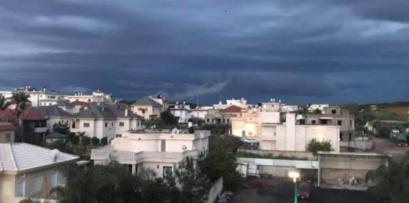
Smoke rising from the scene of a rocket strike in central Israel on March 25, 2019. (courtesy)

According to the Magen David Adom ambulance service, at least seven people who lived in the building were injured in the attack.

A 59-year-old woman was moderately injured in the attack, with light burns, shrapnel wounds and trauma from the blast. A 30-year-old woman was also moderately wounded, with shrapnel hitting her leg. The other people in the building — a 30-year-old man, 12-year-old girl, 3-year-old boy and 18-month-old baby — sustained light wounds, MDA said.

They were taken to Kfar Saba’s Meir Medical Center for treatment.

Several others in the area were treated for anxiety attacks and light injuries from falling while running to bomb shelters.

A dog belonging to one of the families in the building was also apparently killed in the rocket strike.

Recent weeks have seen escalating tensions in the Gaza Strip, as its de facto rulers the Hamas terror group feuds with both Israel and the West Bank-based Palestinian Authority. Domestically, the terror group has also faced protests and increased criticism as humanitarian conditions in the Strip continue to deteriorate.

On March 14, two rockets from the Gaza Strip were fired at Tel Aviv, landing in open areas and causing no direct injury. In response, Israeli war planes hit over 100 Hamas targets in the Gaza Strip later that night.

The following day, after a brief exchange of fire, both sides reportedly agreed to a ceasefire.

Israeli officials later said the Hamas rocket launch appeared to have been a “mistake” caused by low-level operatives accidentally pressing a launch button on projectiles that were preemptively aimed at Tel Aviv for use in future conflicts — though this explanation was not universally accepted in Jerusalem.

In the 11 days since the rocket attacks on Tel Aviv, terror groups in the Strip have stepped up violence along the Gaza border, launching dozens of balloon-borne incendiary and explosive devices into southern Israel and conducting nightly riots along the security fence that are meant to disrupt the lives of Israeli civilians living near Gaza and the soldiers stationed there.

On Sunday night, an Israeli tank targeted two Hamas posts along the Gaza border, following a number of cross-border attacks throughout the day, the military said.

That afternoon, a shepherd was lightly injured by a balloon-borne incendiary device flown, into southern Israel from the Gaza Strip, local authorities said.

A short while later, an explosive device that was also apparently flown into southern Israel from the Gaza Strip detonated in a community in the Sha’ar Hanegev region, causing neither injury nor damage, a regional spokesperson said.

On Saturday night, Israeli military aircraft bombed Hamas targets in Gaza after a rocket alarm sounded in some Israeli communities bordering the Strip, triggered by a powerful improvised bomb thrown at the border during late-night riots.

A Palestinian was killed by Israeli fire during the clashes early Sunday, authorities in the Strip said. The 24-year-old man was fatally shot in the chest and two others were wounded, the Hamas-run health ministry said.

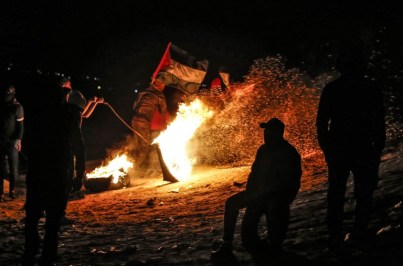
Palestinian protesters take part in a night demonstration near the fence along the border with Israel, in Rafah in the southern Gaza Strip, on March 19, 2019. (SAID KHATIB / AFP)

On Friday, several thousand Palestinians took part in violent protests on the Gaza-Israel border, throwing explosive devices and rocks at Israeli soldiers who responded with tear gas and occasional live fire.

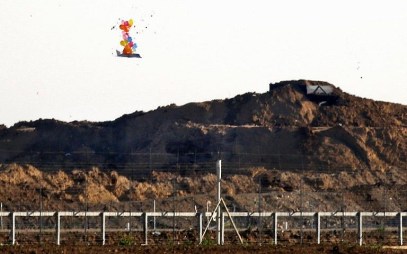
Balloons carry a make-shift drone-shaped object flying over the border with Israel east of Gaza City, after it was launched by Palestinians during clashes along the security fence, on March 22, 2019. (Said Khatib/AFP)

Israel says the demonstrations are orchestrated by Hamas in order to provide cover for the organization’s nefarious activities along the security fence, including infiltration attempts, the planting of explosives and attacks on Israeli soldiers.

Their organizers have said the protests aim to achieve the “return” of Palestinian refugees and their descendants to lands that are now part of Israel, and pressure the Jewish state to lift its restrictions on the movement of people and goods into and out of the coastal enclave.

Israeli officials say the return of Palestinian refugees and their descendants would destroy Israel’s Jewish character. They also maintain that the restrictions on movement are in place to prevent Hamas and other terrorist groups from smuggling weapons into the Strip.