Archive for March 24, 2019

Off Topic: Netanyahu touts peerless ties with Trump as he leaves on pre-election trip to DC

March 24, 2019

Source: Netanyahu touts peerless ties with Trump as he leaves on pre-election trip to DC | The Times of Israel

Iran, Golan Heights recognition to top agenda in two White House meetings sandwiching AIPAC appearance, two weeks before Israelis head to the polls
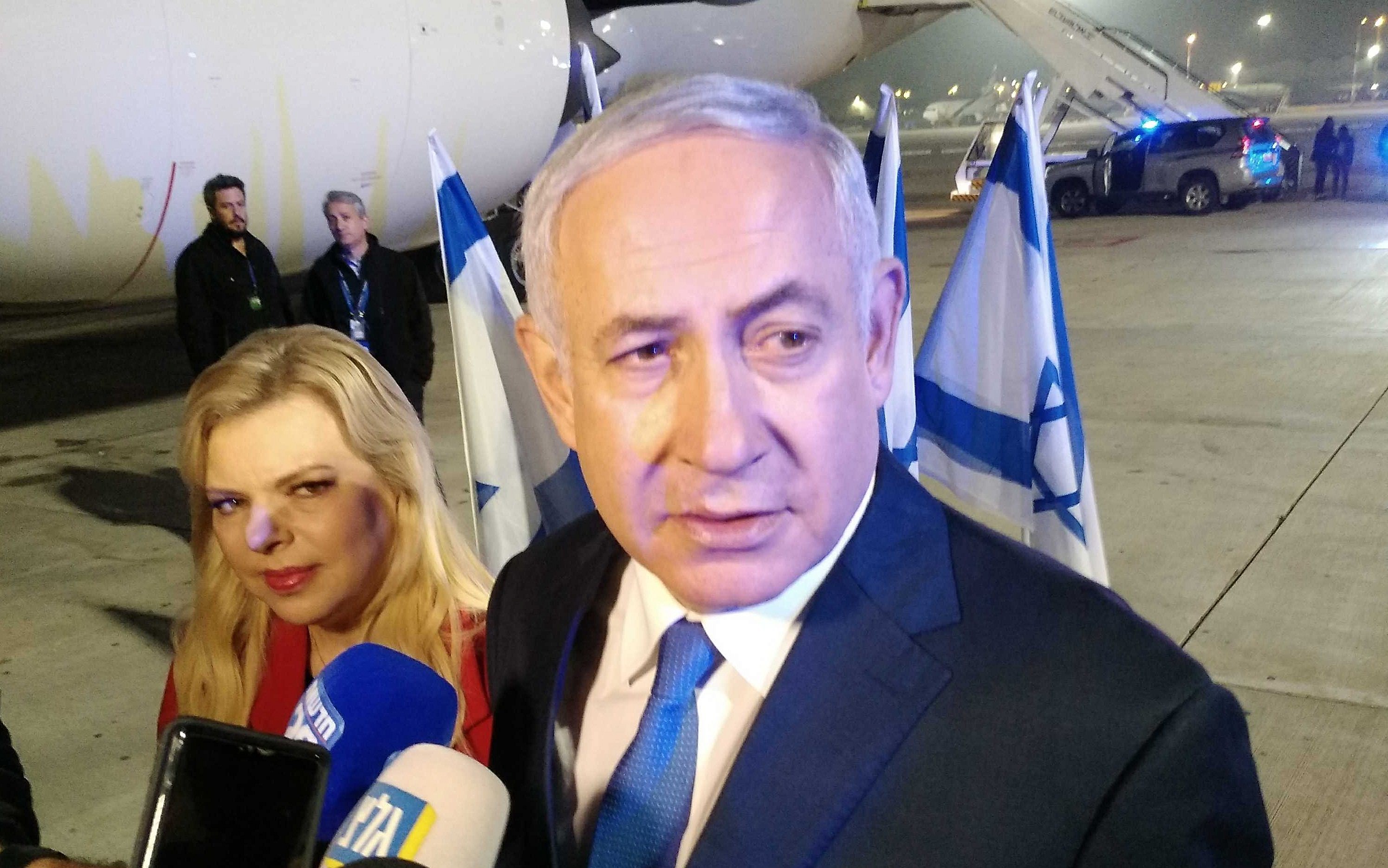
Prime Minister Benjamin Netanyahu, and his wife Sara, speaking to reporters before flying to Washington early on March 24, 2019. Raphael Ahren/Times of Israel)

Prime Minister Benjamin Netanyahu, and his wife Sara, speaking to reporters before flying to Washington early on March 24, 2019. Raphael Ahren/Times of Israel)

Prime Minister Benjamin Netanyahu hailed the exceptionalism of US-Israel relations as he headed early Sunday morning to Washington, where he will meet with US President Donald Trump and deliver an address at AIPAC’s annual Policy Conference two weeks before Israeli elections.

Addressing reporters as he boarded his Boeing 777 en route to Washington, Netanyahu said his relationship with Trump surpassed his ties with any world leaders and with any bond between Israel and the US before.

“Never — never — has there been a relationship like this between an Israeli prime minister and an American president. It’s a very, very important asset for the State of Israel, and it is important that [this relationship] continues to serve us.”

Netanyahu traveled to Washington two weeks before Israeli voters will head to the polls on April 9, after a campaign that has seen Netanyahu tout his diplomatic successes and his close bond with Trump.

The US president enjoys high levels of support among Israelis and has been praised in Israel for recognizing Jerusalem as the country’s capital and pulling out of the 2015 international nuclear deal meant to limit Iran’s nuclear program, which Netanyahu strongly opposed.

A Likud party campaign poster depicting US President Donald Trump and Prime Minister Benjamin Netanyahu shaking hands is seen in Tel Aviv on February 3, 2019. (Roy Alima/Flash90)

On Thursday, Trump backed US recognition of Israeli sovereignty over the Golan Heights and his top diplomat accompanied the prime minister to the Western Wall, in moves widely expected to help Netanyahu at the polls.

The prime minister will drive the point home with his four-day Washington trip, which will feature two meetings with Trump. His main challenger, Benny Gantz of the Blue and White party, will also be in Washington for the AIPAC conference but was not invited to the White House.

Netanyahu said that Trump’s stated intention to recognize Israeli sovereignty over the Golan Heights would be on top of the agenda for his meetings with the president.

“I am going to talk with President Trump about the Golan, about his historic state, about Syria, about the ongoing pressure on Iran and additional sanctions on Iran, which they have added and will add, about security and intelligence cooperation that is unprecedented.”
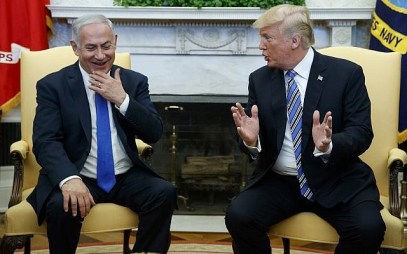
US President Donald Trump (R) meets with Prime Minister Benjamin Netanyahu in the Oval Office of the White House, March 5, 2018. (AP Photo/Evan Vucci)

While Netanyahu is in town, Trump is expected to sign an official US declaration recognizing Israeli sovereignty over the Golan Heights.

Israeli TV reports said Friday that White House officials were currently drafting such a document.
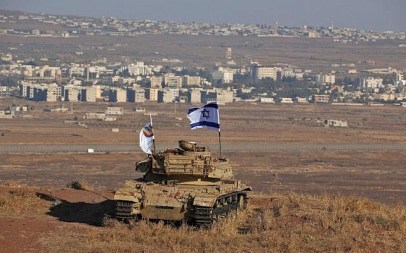
Photo taken on October 18, 2017 shows an Israeli flag fluttering above the wreckage of an Israeli tank sitting on a hill in the Golan Heights and overlooking the border with Syria. (Photo by JALAA MAREY / AFP)

On Thursday, Trump announced, in a tweet, that it was “time for the United States to fully recognize Israel’s Sovereignty over the Golan Heights,” upending decades of US policy on the matter.

Netanyahu and his delegation are due in Washington early Sunday morning, but there are no events planned for that day, according to the itinerary of the trip sent to the traveling press.

On Monday, he will conduct a “working meeting” with Trump, which will focus on “the Iranian aggression, Iran’s attempts to establish military bases in Syria, and how to prevent Iran from obtaining nuclear weapons,” according to the Prime Minister’s Office. “The two will also discuss strengthening security and intelligence cooperation.”

On Tuesday evening, Trump will host Netanyahu and his wife Sara for a second time, in the framework of a dinner. Though diplomatic protocol determines state dinners can only be given to heads of state, the dinner will still have many of the trappings of one, according to reports.
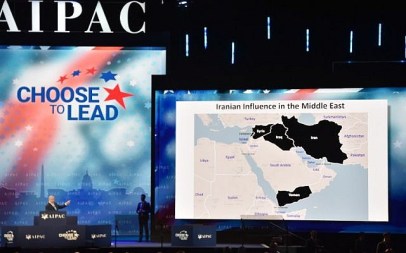
Israeli Prime Minister Benjamin Netanyahu speaks during the American Israel Public Affairs Committee policy conference in Washington, DC, on March 6, 2018. (AFP / Nicholas Kamm)

Earlier that day, at 9:30 A.M. Netanyahu is set to address some 18,000 people at the America Israel Public Affair’s Committee annual policy conference, whose motto this year is “Connected for Good.”

Many Israeli politicians and more than dozen US administration officials are also slated to speak at the three-day conference. Most notably among them are Gantz, who will address the conference on Monday, and US Vice President Mike Pence.

After his speech, Netanyahu will hold a series of political meetings on Capitol Hill, including with Senate Majority Leader Mitch McConnell and Senate Minority Leader Chuck Schumer. He will also meet Speaker of the House of Representatives Nancy Pelosi and minority leader Kevin McCarthy.

Netanyahu will stay at the Blair’s House, the official White House guest residence, while in Washington.

Times of Israel staff contributed to this report.
 

Israel bombs Hamas as Gazans step up nighttime rioting along border

March 24, 2019

Source: Israel bombs Hamas as Gazans step up nighttime rioting along border | The Times of Israel

Strike comes after explosive hurled at border sets off rocket siren, as Hamas-run ‘confusion unit’ threatens to expand night protests

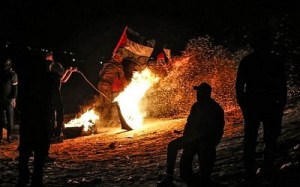
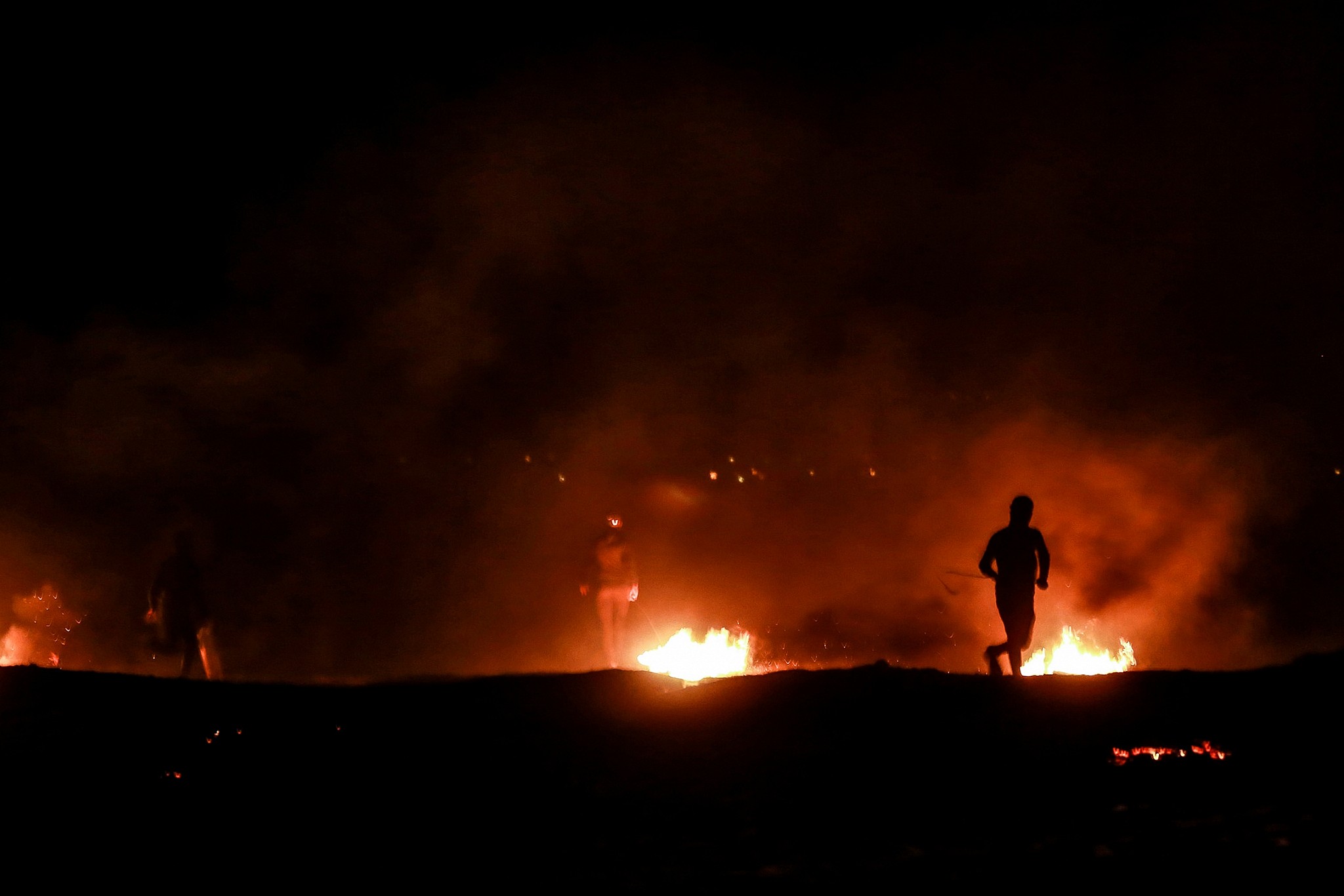
Palestinian protesters burn tires during a night protest near the border with Israel, east of Rafah in the southern Gaza Strip, on March 19, 2019. (Abed Rahim Khatib/ Flash90)

Palestinian protesters burn tires during a night protest near the border with Israel, east of Rafah in the southern Gaza Strip, on March 19, 2019. (Abed Rahim Khatib/ Flash90)

Israeli military aircraft bombed Hamas targets in the Gaza strip early Sunday as Palestinians rioted along the border in renewed nighttime demonstrations.

The strikes came less than an hour after a rocket alarm sounded in some Israeli communities bordering the strip, triggered by an improvised bomb thrown at the border.

The Israel Defense Forces said aircraft struck two Hamas reconnaissance posts in response to “the multitude of [explosive] devices that were thrown and exploded during the night.”

There were no immediate reports of injuries from the strikes. Four Palestinians were reported injured, including one seriously, by Israeli live fire during the border riots earlier in the night.

Palestinian protesters take part in a night demonstration near the fence along the border with Israel, in Rafah in the southern Gaza Strip, on March 19, 2019. (SAID KHATIB / AFP)

Nighttime riots in Gaza have been led by so-called “confusion units” organized by the Hamas terror group, the Strip’s de facto ruler. On Saturday, the unit said it would step up activities, with a week of nightly riots from 7 p.m. until dawn along the border and more airborne incendiary devices launched into Israel. It said the move was in response to the deaths of two Palestinians shot by troops during border riots Friday.

During the nightly demonstrations, participants generally set off loud explosives or sounds grenades, burn tires and throw rocks at Israeli troops on the other side of the security fence.

Israeli soldiers typically respond with tear gas and, in some cases, live fire.

On Saturday, Israeli military aircraft launched a pair of strikes at Palestinian cells flying incendiary balloons from the southern Gaza Strip into Israel, the army said.

Four Palestinians were injured in the strikes.

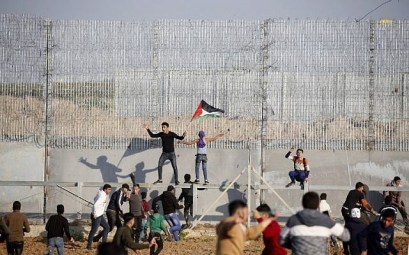
On Friday, several thousand Palestinians took part in violent protests on the Gaza-Israel border, throwing explosive devices and rocks at Israeli soldiers who responded with tear gas and occasional live fire.

Palestinians riot on the border fence with Israel east of Gaza City on March 22, 2019. (Said Khatib/AFP)

Recent weeks have seen an uptick of incendiary balloons launched from the coastal enclave, after a drop-off in attacks following an unofficial truce between Israel and the Gaza-ruling Hamas terror group in November.

The launch of incendiary and explosive devices into Israel tied to kites and helium-filled balloons became a common tactic in violent protests along the Gaza border over the past year, burning thousands of acres of farmland and nature reserves, and killing livestock and other animals.

No Israelis have been injured by the recent balloon attacks, though damage was caused to a home in the Eshkol region last month.

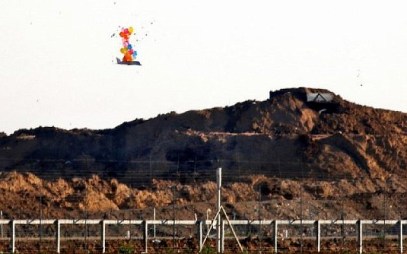
This picture taken on March 22, 2019 shows a balloons carrying a make-shift drone-shaped object flying over the border with Israel east of Gaza City, after it was set loose by Palestinian protesters during a protest by the fence. (Said KHATIB / AFP)

There are fears that violence will ramp up later this month when Hamas is hoping to draw hundreds of thousands of rioters to the fence Friday to mark a year of so-called March of Return protests.

Israel says the demonstrations are orchestrated by Hamas, which vocally supports them, sending free buses to the border and providing food and internet to participants — as well as money for those injured in them — in order to provide a cover for the organization’s nefarious activities along the security fence, including infiltration attempts, the planting of explosives and attacks on Israeli soldiers.

Their organizers have said the protests aim to achieve the “return” of Palestinian refugees and their descendants to lands that are now part of Israel, and pressure the Jewish state to lift its restrictions on the movement of people and goods into and out of the coastal enclave.

Israeli officials hold that the return of Palestinian refugees and their descendants would destroy Israel’s Jewish character. They also maintain that the restrictions on movement are in place to prevent Hamas and other terrorist groups from smuggling weapons into the Strip.

The sides are said to be engaged in Egyptian mediated ceasefire talks.


US boosts forces in Iraq/Syria, backing recognition of Israeli sovereignty over Golan – DEBKAfile

March 24, 2019

Source: US boosts forces in Iraq/Syria, backing recognition of Israeli sovereignty over Golan – DEBKAfile

Exclusive: The US has continued to buttress its military presence in E. Syria and W. Iraq in six bases, since the buildup was first reported by DEBKAfile on March 9. On March 20, President Donald Trump confirmed the decision to leave 400 US troops in Syria – 200 in the north and 200 at Al Tanf on the Jordanian border. (

He did not speak about 200 on the Israeli border, as widely reported.) Two days earlier, Gen. Joseph Danford, Chairman of the US Joint Chiefs of Staff, denied a Wall Street Journal report that the US planned to leave 1,000 soldiers in Syria, while unnamed US military sources spoke of 1,500 American troops that would remain in North Syria.

DEBKAfile’s military and intelligence sources have sorted out the conflicting reports and can confirm that the US has substantially boosted its military strength in both countries and distributed the strength among six bases:

Three are located in Iraq. For the first time since ISIS was defeated there in early 2016, US Marines have been posted to a base near the Iraqi town of Ramadi, capital of the western governorate of Anbar and 1110km from Baghdad. (See attached map.).

Reinforcements have also reached the US K1 military base near Kirkuk. Earlier this year, the US army converted this facility into its main depot for the intake of American troops and equipment withdrawn from Syria. Since the withdrawal has wound down, K1 has been built up for controlling the northern sector of the Iraqi-Syrian border from Iraqi Kurdistan.

The third US base consolidated in Iraq this week was the big Ayn al-Asad Airbase (which President Trump visited last Christmas).

A glance at the attached map reveals that by dint of their newly-reinforced and deployed strength, US forces in Iraq are able to afford the American Middle East command full control of central, western and northern Iraq.

The US bases augmented in Syria this month are located in three regions:

The southern Al Tanf base, just 24km west of the Syrian-Jordanian-Iraq border junction, has been strengthened with additional Marine and artillery forces.

Al Raqqa, the Islamic State’s stronghold in Syria until its ouster by US-backed Kurdish forces in 2017, is the second base.

And the third is the US air base at Remelin northeast of Hasakeh, the Syrian Kurds’ political center.

The six bases are focal points of US military command control of around 1,500 sq.km of territory between Ramadi in central Iraq, up to Hasakeh in northern Syria, and down south to Al Tanf. This wedge of land is bisected down the center by the Iraqi-Syria border.

The new US military deployment in Syria and Iraq gives substance to President Trump’s statement that the time has come to recognize Israeli sovereignty over the Golan. Most significantly, it is a high impediment for the plan hatched between Tehran and the Assad regime to go forward without delay for the establishment of an Iranian land bridge to the Mediterranean after first reopening the Iraqi-Syrian border. Iranian, Syrian and Iraqi generals began planning this project when they met on March 18 in Damascus.