Archive for March 13, 2019

Iran warns of firm response if Israel acts against its oil shipments

March 13, 2019

Source: Iran warns of firm response if Israel acts against its oil shipments – Israel Hayom

Following PM Netanyahu’s warning that Israel’s navy could act against Iranian oil smuggling, Iran’s defense minister says such intervention would be considered “piracy” • Maritime experts say Iran has used a variety of measures to evade U.S. sanctions.

Reuters and Israel Hayom Staff // published on 13/03/2019
   
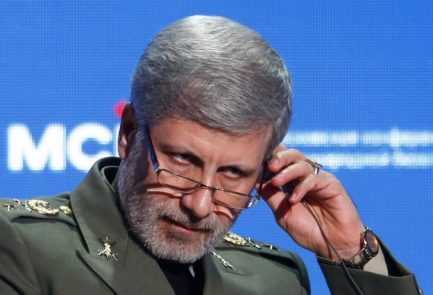
Iranian Defense Minister Amir Hatami 


Iran will respond firmly to any Israeli naval action against its oil shipments, Iran’s defense minister said on Wednesday, in comments that came a week after Prime Minister Benjamin Netanyahu said the Israeli navy could act against Iranian oil smuggling to evade U.S. sanctions.

Iran’s Minister of Defense Amir Hatami was quoted by state news agency IRNA as saying that Tehran had the military capabilities to confront any Israeli intervention, and said the international community would also not accept such action.

Hatami said such confrontation would be considered “piracy” and warned that “if it happens, we will firmly respond.”

“The Iranian armed forces certainly have the capabilities to protect the country’s shipping lines in the best way against any possible threat,” Hatami said.

According to maritime experts, Iran has used a variety of measures to evade sanctions, including changing the names of ships or flag registries, switching off location transponders on ships and conducting ship-to-ship transfers offshore and away from large trade hubs.

Iran’s navy has extended its reach in recent years, dispatching vessels to the Indian Ocean and the Gulf of Aden. They intervened on Friday to repel pirates who attacked an Iranian oil tanker in the Gulf of Aden.

The Israeli navy, whose largest vessels are missile corvettes and a small submarine fleet, is mostly active in the Mediterranean and Red seas.

Iran has one of the world’s biggest tanker fleets in the world.

In November, U.S. Special Representative for Iran Brian Hook called Iranian vessels a “floating liability,” saying the U.S. sanctions would bar them from international insurance markets, making them a risk for ports and canals which allow them access.

Iranian officials have threatened to block the Strait of Hormuz, a major oil shipping route in the Gulf, if the United States attempts to stop the Islamic republic’s oil exports.


Israeli officials: Exposure an embarrassment for Hezbollah 

March 13, 2019

Source: Israeli officials: Exposure an embarrassment for Hezbollah – Israel Hayom

Public Security Minister Gilad Erdan: This is not a time for Hezbollah to start a conflict with Israel • Strategic Affairs Minister Yisrael Katz: We will not take any action necessary to prevent threats • Former GOC Northern Command: This is nothing new.

Israel Hayom Staff // published on 13/03/2019
   
Public Security Minister Gilad Erdan: Syrian President Bashar Assad could lose stability if he allows Hezbollah to entrench itself on the Israeli border 


The exposure of a Hezbollah network on the border between Israel and Syria is a “message for Hezbollah, the president of Syria, and the entire international community,” Public Security Minister Gilad Erdan said Wednesday.

Speaking to Army Radio, Erdan said that a few months ago, Israel had launched an operation to eradicate Hezbollah’s cross-border tunnels in northern Israel and that Syrian President Bashar Assad “could lose stability in Syria if he allows Hezbollah to entrench itself on the Israeli border.”

Erdan went on to say that “the legitimacy of the Israeli strikes in Syria is part of its coordination with Russia. For Hezbollah, this is not a time at which it wants a conflict with Israel. Our battle against them is being waged diplomatically and in people’s minds.”

“Today, we presented the world with [Hezbollah’s] involvement in terrorism on the Israeli border. That pushes Hezbollah into embarrassment and silence, not toward a conflict with us. If we get into a conflict, the residents of Lebanon and Syria will pay the price. They [Hezbollah] are the ones who will have to explain themselves to the international community,” Erdan said.

Strategic Affairs Minister Yisrael Katz addressed the exposure of the Hezbollah network in an interview to Kan radio.

“The organization there began once the Syrian civil war was mostly over. We are waging an ongoing battle against attempts by Iran and Hezbollah to gain a foothold in Syria and establish a terrorist front against Israel in the Golan Heights. We will not hesitate to take any action necessary to prevent threats,” Katz said.

Yisrael Beytenu leader and former Defense Minister Avigdor Lieberman said in a tweet: “A meal for the IDF for its intelligence work in the North, and shame on the government and the cabinet for its ineffectiveness in the South.”

Former GOC Northern Command Maj. Gen. (res.) Amiram Levin told Kan Radio that the news about the Hezbollah organization on the border was “a tempest in a teapot. It looks like the IDF is being used to set a political agenda. There’s nothing new here. Hezbollah tried to establish itself and do all sort of things. There is nothing new and no new threat here.”

MK Ofer Shelah (Blue and White), a member of the Knesset Foreign Affairs and Defense Committee, said, “Hezbollah’s foothold on the Golan Heights is more proof of [Prime Minister] Netanyahu’s political failure. The IDF is fighting a successful battle against Iran, but without a diplomatic presence, [Russian President] Putin is arranging things in Syria with Iran and its allies, not with us. In the north, like the south, Bibi is afraid to take the offense and we are paying the price.”


IDF: Clandestine Hezbollah unit operating on Golan 

March 13, 2019

Source: IDF: Clandestine Hezbollah unit operating on Golan – Israel Hayom

Unit has been building a terrorist network near the Israel-Syria border since last summer without the knowledge of Syrian President Bashar Assad • IDF officials hope that exposing its existence will force Assad to terminate the threat in its infancy.

Lilach Shoval, News Agencies and Israel Hayom Staff // published on 13/03/2019
   
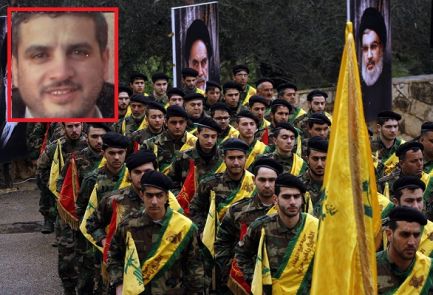
Hezbollah fighters march in southern Lebanon. Inset: Ali Mussa Daqduq 


A secret Hezbollah unit, which it calls “the Golan file,” has been building a terrorist network near the Israeli-Syrian border on the Golan Heights, the IDF revealed on Wednesday.

At this stage, the unit focuses primarily on gathering intelligence on the IDF, but intelligence officials say it could also carry out operations against Israel in the future.

The network includes dozens of operatives and is headed by Ali Mussa Daqduq, who joined Hezbollah in 1983 and served in a number of operational positions in southern Lebanon during the IDF presence in the area, as well as other parts of the Middle East.

In Iraq, Daqduq, also known as Abu Hassin Sajd, was imprisoned by American forces after an operation he commanded led to the kidnapping and execution of five American soldiers. Daqduq’s fate had vexed American officials after they were forced to hand him over to Baghdad after failing to secure a custody deal ahead of the U.S. military’s withdrawal from the country.

At the time, the White House said it had received assurances from Baghdad that Daqduq would be tried for allegedly orchestrating the 2007 kidnapping. But an Iraqi court cleared him of the charges, citing a lack of evidence.

Last summer Daqduq was sent by Hezbollah to Syria to establish the “Golan file.”

According to Israeli intelligence officials, Daqduq’s unit has been so heavily compartmentalized that even the Assad regime in Syria, and even many elements within Hezbollah itself, were unaware of its existence.

The hope in the IDF is that exposing the unit’s existence will lead the Damascus regime to terminate its activities in Syria.

This is not Hezbollah’s first attempt at establishing a terrorist network on the Golan Heights. In May of 2013, Syrian President Bashar Assad opened the Golan frontier to Hezbollah to act against Israel, in an effort to divert attention from raging Syrian civil war. Consequently, the Shiite terrorist group initiated campaigns to build terrorist networks in the area, and by 2015 had carried out several terrorist attacks against Israeli forces. According to foreign reports, the men tasked with spearheading these operations, Samir Kuntar and Jihad Mughniyeh, were both assassinated by Israel.

With the end of the civil war in Syria and the return of Assad’s forces to the Golan frontier, Hezbollah had lost its legitimacy to maintain a presence there. The organization’s leadership, however, decided to establish the secret unit regardless, with better operational capabilities than before, to act against Israel when ordered.

The assessment within the IDF is that the unit’s operatives, many of whom formerly served under Kuntar and Mughniyeh and live in villages near the Israel border, are well equipped and could try transferring additional weapons from Lebanon or use Iranian stockpiles already in Syria.

As stated, the Syrian president was unaware of the unit’s existence until now, and IDF officials believe he will view it unfavorably, to say the least, as it undermines his authority.

It is important to note that currently there are no concrete warnings of terrorist attacks emanating from the Golan Heights frontier, and one of the main reasons the IDF chose to expose the unit’s existence now was to nip the threat in its infancy.

“We are revealing the [terrorist] infrastructure] in such a manner that will knock [Hezbollah] off its chair,” a senior IDF officer said.


The IDF’s exposure of Hizballah’s Golan unit ties in with US plans to deal with pro-Iranian militias around Iraqi-Syrian border – DEBKAfile

March 13, 2019

Source: The IDF’s exposure of Hizballah’s Golan unit ties in with US plans to deal with pro-Iranian militias around Iraqi-Syrian border – DEBKAfile

Israel’s military spokesman Wednesday, March 13, disclosed that Hizballah had planted a terrorist unit on the Syrian Golan for conducting attacks on Israel. The “Golan file” was discovered by the IDF Northern Command intelligence arm.

It was so secret that Syria’s President Bashar Assad was not informed, said the statement. The unit under the command of Ali Musa Daqduq is said to defer directly to Hizballah chief Hassan Nasrallah. IDF Col. Amit Fischer, head of the Bashan division and the Golan sector, reported that the Hizballah unit is still getting organized and is meanwhile engaged in intelligence-gathering on Israeli troop deployments and mapping out routes and targets.
DEBKAfile assumes that the IDF high command had its own reasons for making this disclosure at this time since it is not new. Hizballah has never paused in its attempts to establish terrorist structures on the Syrian Golan with a view to opening a second front against Israel if attacked. Its presence has been consistently covered by DEBKAfile for eight months, ever last July, when the IDF allowed Syrian army units to take over rebel-held regions opposite Israel’s Golan border. Our military sources revealed at the time that Hizballah fighters were integrated in the Syrian units, disguised in Syrian army uniforms, and setting up observation posts and terrorist teams opposite IDF positions. It was those Hizballah posts near Quneitra and the Syrian Druze village of Al Khader that Israel tanks shelled in early February.

Our analysts offer some explanation for the IDF’s “revelations” at this time.
March 13 marks two months since Israel wound up its “Operation Northern Shield” for eliminating Hizballah’s cross-border tunnels from Lebanon, an operation which, incidentally, had little effect on the balance of strength between Israel and Hizballah.

Underlining the Hizballah threat from southwestern Syria will no doubt contribute to the campaign launched by Prime Minister Binyamin Netanyahu and US Senators Lindsey Graham and Ted Cruz for gaining congressional recognition of Israeli sovereignty over the Golan.
But there is another, military, factor at work: US forces in Syria and Iraq are gearing up for action against the Iraqi-Shiite militia concentrations swarming through western Iraq and eastern Syria. On March 9, this site exclusively reported US reinforcements streaming to the front on both sides of the border.

Of especial interest are the three elements left out of the IDF disclosure. We list them below:

  1. Background is lacking on Ali Musa Daqduq, commander of the Hizballah’s “Golan file” unit.
  2. The two overseers of the operation, Iran and its Middle East commander, Al Qods Chief Gen. Qassem Soleimani, don’t rate a mention.

3. Neither does the Iraqi Shiite militia, Asaib Ahl al-Haq (the Khazali Network), which is closely allied to the Lebanese Hizballah and on March 7 issued a “call for resistance against the US presence in the region.” Daqduq has close ties with this militia and has a history with its commander Qais al-Khazali.
Daduq himself is a Lebanese Shiite who was employed as a senior Hizballah operational activist in Lebanon from 1983. In May 2006, he was sent to Tehran to assist the Revolutionary Guards Al Qods external terrorist arm train and organize the Iraqi Shiite militias for battle against the US and its coalition allies.
After that, he continued to work closely with Gen. Soleimani in the role of adviser to the Khazali Network. Daqduq took part in the Shiite militia’s operations in southern Iraq under orders from Soleimani. One of them took place on Jan. 20, 2007 against the regional coordination command in Karbala, in which four American soldiers were kidnapped and murdered.
Taking all this information into account, the Golan operation uncovered by the Israeli military on March 13 should be counted as an Iranian-Shiite-Hizballah project with three notorious commanders, Iran’s Qassem Soleimani, Iraq’s Qais al-Khazali and Lebanon’s Hassan Nasrallah.