Archive for February 2019

Kushner: US peace plan very detailed, will focus on borders

February 26, 2019

Source: Kushner: US peace plan very detailed, will focus on borders – Israel Hayom

Senior White House adviser, to Sky News Arabia: “We focused on what prevents Palestinians from using full potential and Israelis from integrating in region” • Plan would tackle few issues, offer “realistic and fair solutions” to improve people’s lives.

Ariel Kahana // published on 26/02/2019
   
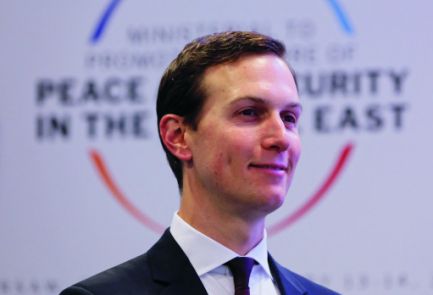
Senior Adviser to the President Jared Kushner 


White House senior adviser Jared Kushner unveiled the general themes of U.S. President Donald Trump’s peace plan on Monday, saying it would put a big emphasis on improving the conditions of both Israelis and Palestinians.

“We were not able to convince people from both sides on a compromise,” Kushner told Sky News Arabia in an interview. “Therefore, we did not focus a lot on the issues, despite our deep knowledge of them. We focused instead on what prevents the Palestinian people from using their full potential, and what prevents the Israeli people from integrating properly in the entire region.” But despite this, he said that “the American peace plan is very detailed and will focus on drawing the border and resolving the core issues.”

The Trump administration has been in the works for the past two years, but the administration’s peace team, led by Kushner, has repeatedly dismissed various reports on its supposed content, saying they are false and misleading. The plan is due to be released after the April 9 Israel election.

Kushner added his team “tried to find realistic and fair solutions … to allow people to have better lives” and that the plan will focus on four ways to achieve that goal.


Zarif bows out amid desperate regime bid to save Iran’s economy from meltdown – DEBKAfile

February 26, 2019

Source: Zarif bows out amid desperate regime bid to save Iran’s economy from meltdown – DEBKAfile

Mohammad Javad Zarif, the driving force behind Iran’s 2015 nuclear deal with Barack Obama, quits amid the regime’s struggle to survive the Trump era, DEBKAfile reports.  In six years, this polished, articulate diplomat, esteemed in Washington and Brussels, typically “apologized for his “shortcomings… during his time as foreign minister…” when he announced his resignation on Instagram on Monday, Feb. 25.

His exit marks the onset of large-scale dismissals of high regime officials amid the desperate deliberations that DEBKAfile’s Iranian and intelligence sources report are ongoing in Tehran for the past fortnight, on how to save the tottering economy from meltdown, under the crippling weight of the sanctions that US President Donald Trump imposed on Iran’s oil exports after he tore up the nuclear deal last May.

President Hassan Rouhani’s head may also be on the block now that his ally Zarif is gone. Our sources find evidence that Iran’s leaders have accepted that they have no choice but to engage the Trump administration and bring Tehran back to the negotiating table. They are looking for a diplomat on the lines of North Korea’s Kim Jong-un who they see as the right man to deal with Donald Trump.

That the regime in Tehran is in the throes of a major policy overhaul for its next steps was also signaled by the surprise visit of Syrian President Bashar Assad on the same Monday. Our sources report that he was invited to meet supreme leader Ayatollah Ali Khamenei for the first time for a briefing on the Islamic regime’s next steps as they pertain to Syria. He was accompanied by Iran’s supreme Middle East commander, the Al Qods chief Brig. Gen. Qassem Soleimani, which should set off alarm bells in Israel. It indicates strongly that the ayatollahs intend to come to the table with the US from a position of strength – not weakness.


 Israel’s Yasam Eilat Security Forces Unit 

February 24, 2019


Understanding the U.S. flip-flop on Syria – ANALYSIS 

February 24, 2019

Source: Understanding the U.S. flip-flop on Syria – ANALYSIS – Middle East – Jerusalem Post

Trump also reaffirmed in early February that the US would continue to use air power against ISIS and use Iraq as a base against ISIS and to watch Iran.

BY SETH J. FRANTZMAN
 FEBRUARY 24, 2019 17:32
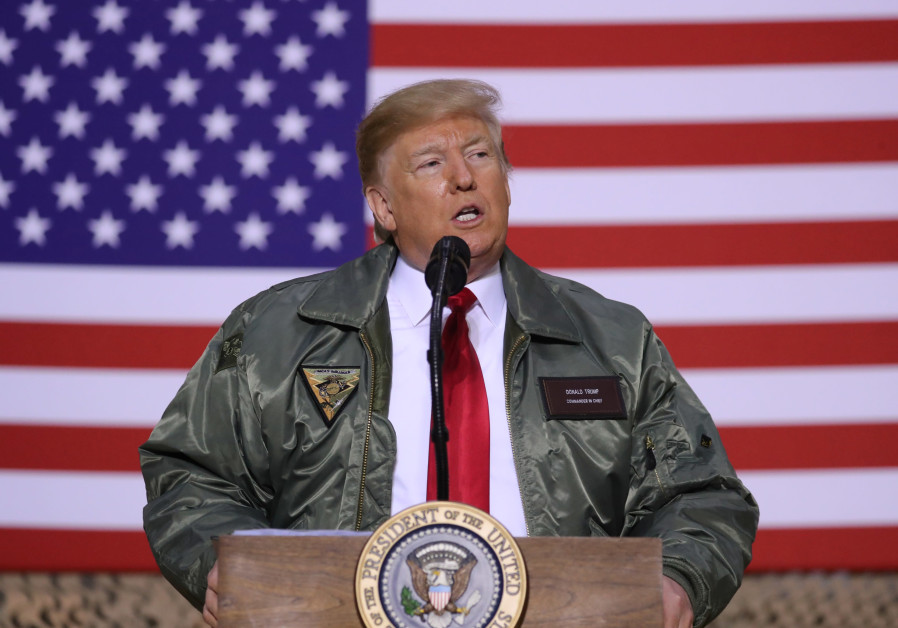
U.S. President Donald Trump delivers remarks to U.S. troops in an unannounced visit to Al Asad Air B

US President Donald Trump announced that the US had defeated ISIS on December 19 and that the US would end its presence in Syria. Two months later, the White House said that a small peacekeeping force of around 200 troops would remain in Syria. The flip-flops keep people guessing about what the US long-term plan is. It has also kept Trump’s own administration officials trying to keep up with and explain the changing policy, to make it seem consistent.

It began on December 12 when Turkish President Recep Tayyip Erdogan gave a speech indicating that “there is no longer any such threat as Daesh [ISIS] in Syria. We know this pretext is a stalling tactic.” Two days later, Erdogan spoke to Trump, who decided to withdraw US forces after Turkey asked why the US was still in Syria. This played to Trump’s desires to leave Syria, a promise he had made months before. Despite objections from his Secretary of Defense James Mattis and others, Trump pushed through the decision. By December 19, he had ordered a full and rapid withdrawal. It was supposed to take 60 to 100 days, officials indicated.

Trump told US troops in Iraq during a speech on December 26 that the US presence in Syria was not open-ended. Once ISIS strongholds were clear, he wanted the troops home. He said the US would remain in Iraq to watch for any ISIS resurgence and also to “watch over Iran.” The Pentagon indicated that it had begun returning troops “as we transition to the next phase of the campaign.” This was the way in which the US officials sought to spin the announcement, as part of a planned withdrawal and a new phase of the campaign which would involve stabilization. Trump also made sure to emphasize that there would be a “strong, deliberate and orderly withdrawal of US forces from Syria.”

US Senator Lindsey Graham, who had slammed Trump’s decision, spoke to the president on December 30. He said the Kurds should be protected and Iran should not win as the US withdraws. It appeared the US withdrawal would slow down. He mentioned a “buffer zone” on the border between Syria and Turkey. He flew to Turkey on January 18 to have further discussions.

On January 6, National Security Advisor John Bolton said that the US would not leave Syria until ISIS was fully defeated and the Kurds, who are key allies in the war on ISIS, were protected. Turkey had been threatening a military operation against the Kurdish People’s Protection Units in Syria, a group that was part of the Syrian Democratic Forces, the main US partner in Syria. The Bolton comments appeared to push back the US timeline on withdrawal to several more months. This was considered a change from the White House.

On January 11, reports of the first US military equipment began. Turkey, concerned about the rapidity of the US withdrawal, put out a statement on January 15 saying that in discussions with Trump the priority in Syria was to combat ISIS. They also talked increasing trade to $75 billion.

On February 8, the Wall Street Journal reported that the US would leave Syria by April. The new changes in the withdrawal date came as the US-led coalition of 79 member countries and groups came to Washington for a February 6 meeting. US Secretary of State Mike Pompeo told the assembled countries that while Trump had announced that the US was withdrawing, that was “not the end of America’s fight.” In fact, it was a “drawdown of troops” and was a “tactical change, it is not a change in the mission.” Pompeo made it clear that the US would be making requests to coalition partners to enable the effort to continue.

The US began asking allies, particularly in NATO and Europe, to contribute to its “buffer zone” concept along the border with Turkey. Trump also reaffirmed in early February that the US would continue to use air power against ISIS and use Iraq as a base against ISIS and to watch Iran.

After the coalition meeting, US acting Defense Secretary Pat Shanahan went to Iraq for meetings, and then headed for a meeting of NATO defense ministers in Brussels on February 13, while Pompeo flew to the Warsaw Summit to discuss Iran. The next day, February 15, Graham told the Munich Security Conference that the US was searching for more support from allies in Syria. Trump tweeted that European countries should take back 800 foreign ISIS fighters held in Syria.

Days after the Munich Security Conference, as it looked like the US was on shaky ground getting Europeans to send more troops to Syria, with several countries indicating they wouldn’t send troops if the US left, Trump spoke to Erdogan again. They discussed the US withdrawal. Trump was also discussing keeping several hundred troops in Syria, in the Tanf base in southern Syria and in eastern Syria. When he announced his intentions on February 22, he said it was not a reversal of policy. Graham called it part of an “international stabilizing force.” It would ensure a “safe zone” in Syria along the border with Turkey and prevent a new conflict. The Pentagon also said these troops would have special capabilities, such as intelligence gathering ability, as force multipliers for the rest of the allies who would keep troops.

The developing changes in US policy in Syria are now connected to several different policies. The US wants ISIS to be fully defeated and that means investing in “stabilization.” This includes training local security. The US wants to protect the SDF from a Turkish military operation and also work with Turkey. Turkey’s defense minister went to Washington on February 22 to discuss details on cooperation. The SDF had also sent a delegation to Washington in late January and early February to encourage the US to slow down its withdrawal.

The US also wants to try to repatriate some of the 800 foreign ISIS fighters so that they are not a burden on the SDF. In addition, the US wants to make sure Iran does not benefit from the US withdrawal. It has looked with hesitation on indications that the SDF would be forced to sign a deal with the Syrian regime or Russia if the US leaves. That would mean Iran would benefit. To prevent that, the US has agreed to stay and to anchor a “stabilization” force.

However, Turkey still wants control over the buffer zone or “safe zone,” and this final aspect of what comes next has not been hammered out. NATO allies would prefer to work with Turkey, but the SDF do not want Turkey controlling part of northern Syria, as they already control Afrin. Russia has hinted that it could play a role and has praised the US withdrawal. Turkey has also signed a statement with Russia and Iran on February 13 praising the US withdrawal, only to also seek to work with the US.

The US is now trying to both withdraw and stay in Syria, and please both its partners and allies, while both Russia and Iran look on, waiting for any sign that US policy cannot do both. Turkey has hedged its bets, waiting to see if it can pressure the US regarding the safe zone, or if it might need to work with Russia.


In first, Iran says cruise missile launched from submarine during drill

February 24, 2019

Source: In first, Iran says cruise missile launched from submarine during drill | The Times of Israel

Tehran conducts test with new Fateh submarine during 3-day exercise in Persian Gulf, in addition to destroyers, surveillance planes and helicopters; range of projectile is unknown

Iran has launched a cruise missile from a submarine for the first time during an ongoing annual military drill in the Strait of Hormuz, Iranian media reported Sunday.

The semi-official Fars news agency reported the launch and released an image showing a green submarine on the surface of the water launching an orange missile. It said other submarines have the same capability. It did not detail the missile’s range.

Iran debuted a domestically constructed submarine as well as a new destroyer Friday as part of the large-scale three-day naval drill in the Persian Gulf, state media reported.

Tehran had announced the launch of the Fateh submarine (Farsi for “Conqueror”) earlier this month. It said Fateh was the country’s first submarine in the semi-heavy category, and the first capable of firing cruise missiles.

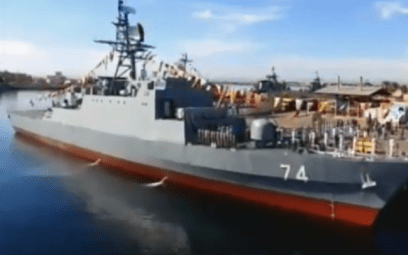
The Sahand destroyer has a helicopter landing pad, is 96 meters (105 yards) long and can cruise at 25 knots. It is equipped with surface-to-surface and surface-to-air missiles as well as anti-aircraft batteries and sophisticated radar and radar evading capabilities, according to a report on state TV.

Iran’s new Sahand destroyer (YouTube screenshot)

Navy chief Rear Admiral Hossein Khanzadi said “The exercise will cover confronting a range of threats, testing weapons, and evaluating the readiness of equipment and personnel,” in remarks on state television translated by Reuters.

“Submarine missile launches will be carried out… in addition to helicopter and drone launches from the deck of the Sahand destroyer,” he said.

The exercise aims to evaluate the navy’s equipment, practice launching weapons and “enable the troops to gain readiness for a real battle,” he added.

Iran frequently touts its military arsenal, much of which is manufactured locally because of international sanctions. The Strait of Hormuz, at the mouth of the Persian Gulf, is a crucial bottleneck for global energy supplies, with about a third of all oil traded by sea passing through it.

Submarines, warships, helicopters and surveillance planes participated in the three-day drill, dubbed “Velayat-97,” which concludes later Sunday. On Saturday, Iran launched surface-to-surface missiles.

The show of military might comes at a time of heightened tensions with Iran’s main regional rival Saudi Arabia and with Washington, which last year withdrew from the 2015 nuclear deal with Iran and reimposed sanctions on the Islamic Republic.

American forces routinely pass through the Strait of Hormuz, which has seen tense encounters between them and Iranian forces in the past.


Iran claims to foil bid by unnamed ‘enemies’ to sabotage missiles

February 24, 2019

Source: Iran claims to foil bid by unnamed ‘enemies’ to sabotage missiles | The Times of Israel

New York Times had reported Trump administration pushed secret program aimed at sabotaging Iranian ballistic program

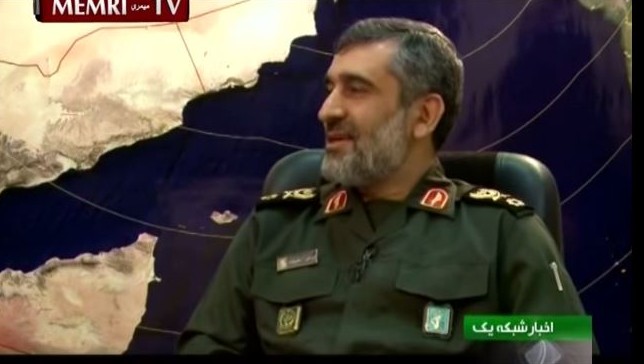
Commander of the Islamic Revolution Guards Corps (IRGC) Aerospace Force Brigadier General Amir Ali Hajizadeh. (screen capture: YouTube/MEMRITVVideos)

TEHRAN — Iran’s Revolutionary Guards on Sunday accused “enemies” of the Islamic Republic of trying to sabotage the country’s missiles so that they would “explode mid-air” but said the bid was foiled.

“They tried as best as they could to sabotage a small part which we import so that our missiles would not reach their target and explode mid-air,” Fars news agency reported, quoting the Guards’ aerospace commander Amir Ali Hajizadeh.

“But they couldn’t do a damn thing because we had seen this coming from the start and had reinforced this sector,” he added, accusing Iran’s “enemies” of sabotage without naming any specific country.

Iran reined in most of its nuclear program under a landmark 2015 deal with major powers in return for sanctions relief, but has continued to develop its ballistic missile technology.

Earlier this month The New York Times reported that the administration of US President Donald Trump was pushing a secret program aimed at sabotaging Iranian rockets and missiles.

It said Washington was trying to “slip faulty parts and materials into Iran’s aerospace supply chains” as part of a campaign to undercut Tehran’s military.

In May, Trump withdrew from the nuclear deal  known as the Joint Comprehensive Plan of Action, or JCPOA, and reimposed sanctions on Tehran.

UN Security Council Resolution 2231 — adopted just after the nuclear deal — calls on Iran “not to undertake any activity related to ballistic missiles designed to be capable of delivering nuclear weapons.”

Tehran insists that its missile program is “purely defensive” and compliant with the resolution but it has developed medium-range ballistic missiles capable of reaching arch-foe Israel.

Hajizadeh, whose remarks were also reported by Tasnim news agency, said similar sabotage attempts had happened before and targeted Iran’s nuclear and oil sectors.


Iran’s president faces calls to resign over economic crisis

February 24, 2019

Source: Iran’s president faces calls to resign over economic crisis | The Times of Israel

Rouhani’s inability to rein in rising cost of living and hyper-inflation causes anger among ordinary Iranians, who are not reaping benefits of nuclear deal

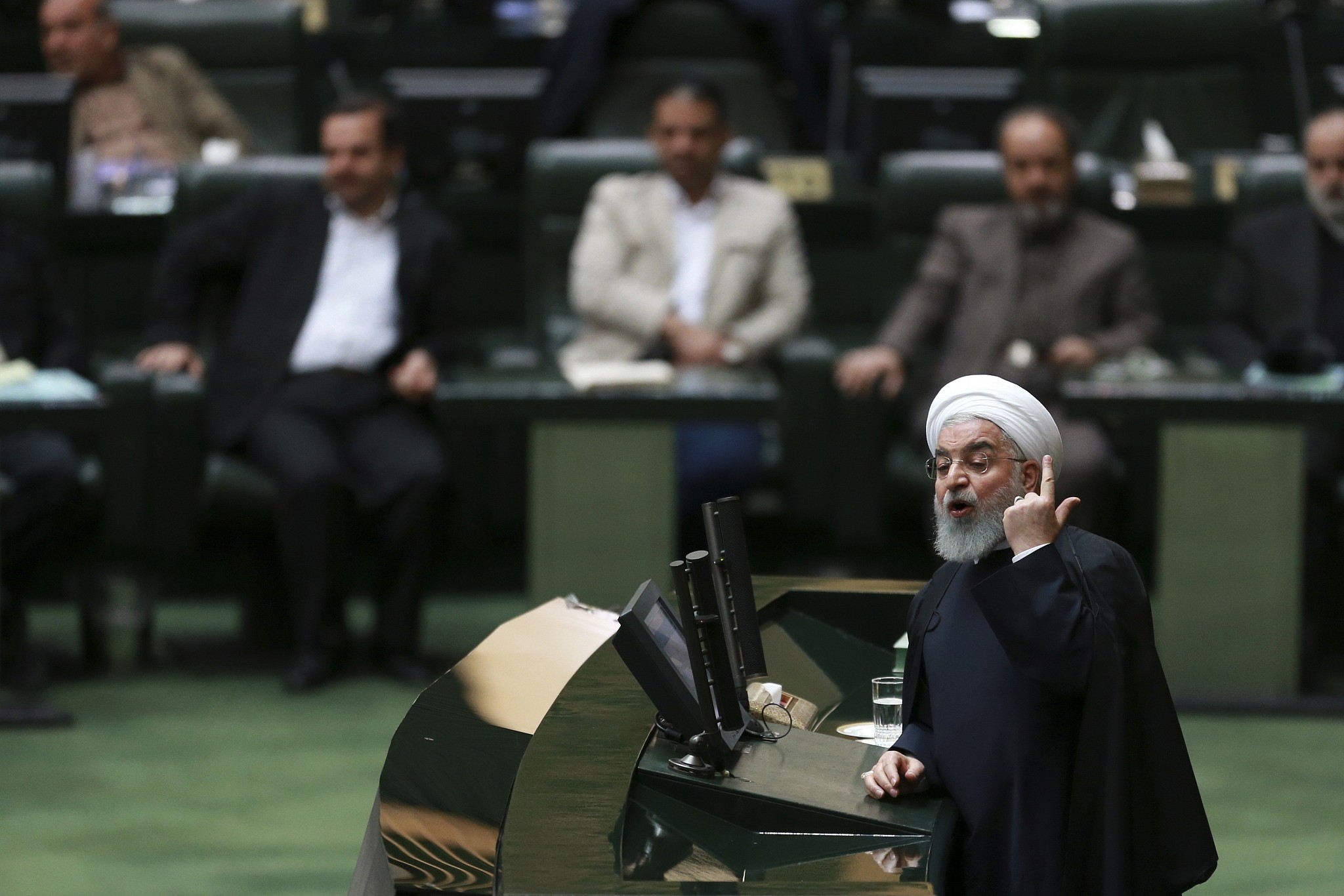
Iranian President Hassan Rouhani speaks in parliament, in Tehran, Iran, on February 4, 2019 (AP Photo/Vahid Salemi)

Iranian President Hassan Rouhani speaks in parliament, in Tehran, Iran, on February 4, 2019 (AP Photo/Vahid Salemi)

TEHRAN, Iran (AP) — As Iran marked the 40th anniversary of its Islamic Revolution, a white-turbaned Shiite cleric at one commemoration targeted President Hassan Rouhani, a fellow clergyman, with this sign: “You who are the cause of inflation; we hope you won’t last until spring.”

Already lashed by criticism over his collapsing nuclear deal and renewed tensions with the US, the relatively moderate Rouhani faces anger from clerics, hard-line forces and an ever-growing disaffected public that now threatens his position.

Iranian presidents typically see their popularity erode during their second four-year terms, but analysts say Rouhani is particularly vulnerable because of the economic crisis assailing the country’s rial currency, which has hurt ordinary Iranians and emboldened critics to openly call for his ouster.

Though such a move has happened only once in the Islamic Republic’s four-decade history, the popular discontent heard on streets throughout Iran could now make it possible.

“I don’t care who is in the presidential palace: a cleric, a general or anybody else,” said Qassim Abhari, who sells hats and socks on the streets of Tehran. “We need someone who creates jobs and firmly pushes the brake pedal on rising prices.”

It’s been a long fall for Rouhani, who secured the 2015 nuclear deal after two years in office and won the praise of Iranians, who flooded the streets to celebrate it. Under the deal, Iran limited its enrichment of uranium in exchange for the lifting of economic sanctions.

But the benefits of the deal never reached much of the Iranian public. Even before President Donald Trump pulled America from the accord in May, uncertainty over its future caused the rial to crater, fueling sporadic, nationwide protests.

Now the rial is dropping again, down to 133,000 to $1. It had been 32,000 to the dollar at the time of the deal. On social media, hard-liners share price lists showing food staples like beans, rice and tomato paste rising as much as 238 percent.

People walk around the Grand Bazaar in Tehran, Iran, February 7, 2019 (AP Photo/Vahid Salemi)

Hard-liners stopped parliament speaker Ali Larijani, an ally of Rouhani, from addressing a crowd in Karaj, only 40 kilometers (25 miles) west of Tehran. Rouhani’s Foreign Minister Mohammad Javad Zarif, typically collected, appeared visibly frustrated at times during a recent security conference in Munich.

Hassan Abbasi, a retired general in Iran’s hard-line Revolutionary Guard, which answers to Supreme Leader Ayatollah Ali Khamenei, gave a speech after Karaj saying he believed people will spit on Rouhani, Larijani and Zarif in the streets over the nuclear deal after they leave office. He said they are “shivering” over the accord’s collapse.

“Mr. Hassan Rouhani, Mr. Zarif and Mr. Larijani, go to hell,” Abbasi said to applause.

Tension between hard-liners and more-moderate forces within Iran are nothing new. The Islamic Republic’s political structure muddles who wields power between paramilitary forces within the Guard and the country’s civilian government. Reformist President Mohammad Khatami faced similar pressures in his second term, which then gave way to hard-line populist President Mahmoud Ahmadinejad.

But Khatami didn’t face the same grinding economic pressure, or an American president like Donald Trump, whose administration has taken a maximalist approach toward pressuring Tehran. Analysts say that only further weakens Rouhani’s hand.

“You, Mr. President, have only 15 to 20 percent of the power” within Iran’s government, the pro-Rouhani daily newspaper Jomhouri Eslami said in a January editorial. “You cannot run the country with this amount of power and be accountable for all its difficulties and problems.”

Rouhani himself seemed to acknowledge the pressure he faces during a visit to the Iranian port city of Bandar Abbas on Monday.

“Presidential elections happen every four years,” he said. “When people voted for a particular viewpoint, all should go after that and support” it.

Nine hard-line lawmakers have put forward a measure to disqualify Rouhani as president. His dismissal would require two-thirds of parliament’s 290 members, but there is a precedent. In 1981, parliament disqualified the liberal Abolhassan Banisadr as president, and then Supreme Leader Ayatollah Ruhollah Khomeini dismissed him.
Iranian shoppers walk through the Grand Bazaar in Tehran, on February 7, 2019 (AP Photo/Vahid Salemi)

Iranian law also allows Rouhani to resign, and criminal charges could push him from his post. His brother, Hossein Fereidoun, is on trial over corruption charges that his supporters call politically motivated.

Mahmoud Vaezi, a spokesman for Rouhani, on Wednesday dismissed those pursuing impeachment as belonging to “a group in parliament that opposes everything.” However, they aren’t the only source of pressure.

Reformists, those who want to change Iran’s political system from the inside, have grown increasingly disenchanted with Rouhani over his inability to end the house arrests of opposition leaders Mir Hossein Mousavi and Mahdi Karroubi. Rouhani ran for election in 2013 and 2017 promising to free the two leaders of the 2009 Green Movement.

Meanwhile, hard-line clerics have opposed his administration’s efforts to join international anti-money-laundering conventions, fearing that could cut off support to Lebanon’s Hezbollah militant group and others. State television, long controlled by hard-liners, has played up speeches by military officials and increasingly airs segments glorifying those who fought in the 1980s war in Iraq.

“When Rouhani will not be in power, people will choose his alternative,” said hard-line lawmaker and cleric Mojtaba Zolnouri, who signed onto the Rouhani impeachment effort. “Whoever people choose, we welcome.”

Rouhani’s four-year term runs until 2021. But Tehran-based political-economic analyst Saeed Leilaz echoed the sentiments of many in saying the next few weeks could prove crucial to the embattled president. Some have suggested even ending the position of president and returning to a parliamentary system.

“In the spring, parallel with intensifying pressures and problems, Rouhani may resign or the (government’s) structure may change,” he said.


Iranian official: ‘End of his political life’ if Netanyahu attacks 

February 24, 2019

Source: Iranian official: ‘End of his political life’ if Netanyahu attacks – Israel Hayom

Ali Shamkhani, a close ally of Ayatollah Ali Khamenei, hints Iran could respond more forcefully to Israeli strikes in Syria • Report: Britain’s MI6 chief secretly visited Israel last week over concerns that Iran “is getting ready” to breach nuclear deal.

News Agencies and Israel Hayom Staff // published on 24/02/2019
   
The head of Iran’s National Security Council Ali Shamkhani 


Iran has “achieved 90% of [its] goals in Syria,” Secretary of Iran’s Supreme National Security Council Ali Shamkhani, a close ally of Iran’s Supreme Leader Ayatollah Ali Khamenei, said on Saturday.

“There will be important developments in promoting deterrence capability of the resistance front in Syria,” Shamkhani said when asked about Israel’s “possible future attacks” in Syria.

Israel, increasingly concerned that its enemy Iran may establish a long-term military presence in neighboring Syria, says it has carried out over 200 attacks against Iranian targets in Syria the last two years.

Defying Israeli threats that its forces in Syria might be targeted if they do not leave the country, Shamkhani said Iran will continue to provide military advisers to support Syrian President Bashar Assad’s forces for as long as necessary.

“Iran is capable of confronting any military threat … [U.S. President Donald] Trump and Israel are well aware of Iran’s military might,” Shamkhani said. “They know that they cannot enter a war with Iran. That is why they publicly threaten Iran.”

Hinting that Iran and its allies would respond more forcefully to Israeli strikes, Shamkhani added: “We have made arrangements to protect our red line in the area of human casualties caused by any act of aggression and invasion. We will soon witness a major upheaval in upgrading the deterrent power of resistance in Syria.”

He also said he did not believe Prime Minister Benjamin Netanyahu was seeking a military confrontation with Iranian forces in Syria, in light of upcoming Knesset elections.

“If Netanyahu gets entangled in several fronts simultaneously, he will definitely end his shaky political life in the runup to the elections. I don’t think that he [Netanyahu] would be so silly,” Shamkhani said.

Meanwhile, Israel’s Channel 13 reported Friday that Britain’s MI6 intelligence chief Alexander Younger secretly visited Israel last week for talks with his Israeli counterparts about concerns that Iran may be considering breaching the 2015 nuclear deal.

Younger, according to the report, arrived in Israel on Monday and met with the head of Israel’s Mossad intelligence agency, Yossi Cohen, and other intelligence officials.

Israel, the report said, has assessed that Iran is “making preparations” within the provisions of the 2015 nuclear deal, and is “getting ready” but has not yet made the political decision to pursue a nuclear bomb.

Shamkhani also said that Iran had many options to neutralize the re-imposition of U.S. sanctions on its oil exports.

“Apart from closing [the] Strait of Hormuz, we have other options to stop oil flow if threatened,” he said.

“Iran has plans in place that will neutralize the illegal U.S. sanctions against Iran’s oil exports,” Shamkhani said. “We have many ways to sell our oil.”

The restoration of sanctions is part of a wider effort by Trump to force Iran to further curb its nuclear and missile programs as well as its support for proxy forces in Yemen, Syria, Lebanon and other parts of the Middle East.

Washington had been pushing governments to cut imports of Iranian oil to zero. But, fearing a price spike, it granted waivers to eight Iranian oil buyers when the sanctions on oil imports started last November.

Carrying one-third of the world’s seaborne oil every day, the Strait of Hormuz links Middle East crude producers to key markets in Asia Pacific, Europe, North America and beyond.

“There are multiple ways to make that [blockage of Hormuz] happen. We hope we would not be forced to use them,” Shamkhani said.


War will likely rise from the south 

February 24, 2019

Source: War will likely rise from the south – Israel Hayom

Prof, Eyal Zisser

In his speech at the Munich Security Conference last week, Iranian Foreign Minister Mohammad Javad Zarif warned that the risk of war with Israel was greater than ever. This remark shouldn’t be taken lightly, even when it comes from a position of weakness and distress.

After all, Zarif launched his warning, or threat rather, amid the backdrop of Iran’s severe economic crisis, and it is part of Tehran’s efforts to exacerbate the growing rift between Europe and the Trump administration over the international community’s approach to the Iranian threat.

Europe, as we know, believes in conciliation (only when it comes to dictators, of course), while the Americans want to amplify the pressure – strictly economic for now – on Iran.

Furthermore, we should note that Zarif, along with his boss, Iranian President Hassan Rouhani, are not in the inner circle of Iran’s true decision makers when it comes to the country’s national security, foreign subversion, and terrorist efforts. These questions are discussed and answered by Iran’s supreme leader, Ayatollah Ali Khamenei, together with the commanders of the Islamic Revolutionary Guard Corps, who do as they please without heeding Rouhani or his foreign minister. It could very well be that Zarif, perhaps fearing the direction things are going, is actually warning the international community about the intentions of his superiors.

Either way, it appears that Washington’s pressure on Iran is working, to the chagrin of Europe. In Syria, the Iranians are temporarily pulling their forces away from the Israeli border, although they have not conceded their strategic goal of establishing a foothold there and turning the war-torn country into a forward base of operations against Israel.

In Lebanon, too, Iran’s local client, Hezbollah, has seen better days. The economic crisis in Iran is eroding support for the organization even among Shiites. Regardless, they don’t want another war with Israel that is sure to be just as devastating, or even more so, than the previous one. In his recent speeches, Hezbollah leader Hassan Nasrallah has looked like someone whose prime has passed. It isn’t surprising that Israeli journalists are the only one paying attention to him anymore, and even they are dubious about his performances. Indeed, even Nasrallah can fool some of the people all of the time, and all of the people some of the time, but he cannot fool all of the people all the time.

The only arena where there is a real concern of violence or even conflagration is the Gaza frontier. The IDF, it was reported last week, believes Hamas could ignite the flames along the border and beyond, in an effort to improve its negotiating position and perhaps spur international intervention forcing Israel to allow money and other aid into Gaza. The resurgence of border riots and the recent trickle of rockets from Gaza into Israel are a testament to this assessment.

It appears that the understandings, reached on the basis of allowing Qatari cash into Gaza, have rather crumbled and failed to facilitate peace and quiet. While protection money can buy temporary quiet, it always awakens the appetite for more money.

In this case, too, Hamas is speaking but Iran is pulling the strings. Hamas has good reasons to spark flames, even at a low intensity, because it wants to improve its negotiating position. Palestinian Islamic Jihad, on the other hand, is fanning the flames under the encouragement and perhaps even orders of Tehran. This terrorist organization has chosen to put its fate in Iran’s hands, which isn’t only uncustomary in the Palestinian arena but the entire Sunni world.

The Palestinian Authority feared confronting Hamas back in the day, for which it lost control of Gaza. Hamas, too, could come to learn that its attempts to dance at two weddings – on the one hand to reach understandings with Israel and on the other to escalate tensions along the border, either on its own or through Islamic Jihad – will only strengthen the rival group and make it a far more significant force; perhaps one that could even compete with Hamas.

Consequently, it appears we will not have peace and quiet on the Gaza border. The coming months, before Israel’s general election in early April and after, will continue to see rising tensions, outbreaks of violence and concerns of an impending all-out conflagration.

Eyal Zisser is a lecturer in the Middle East History Department at Tel Aviv University.


Iran lays out 16-point war plan for the supreme goal of toppling Netanyahu – DEBKAfile

February 24, 2019

Source: Iran lays out 16-point war plan for the supreme goal of toppling Netanyahu – DEBKAfile

Iran’s National Security Adviser Ali Shamkhani Saturday, Feb. 23, unveiled a plan to overthrow the prime minister Binyamin Netanyahu by a full-scale war from Syria and other “resistance fronts.” Tehran’s overt intervention in Israel’s April 9 election named the Israeli prime minister’s removal as the strategic goal of the “resistance axis.”

A day earlier, a senior IRGC general Brig. Gen. Amir Ali Hajizadeh claimed that Iran had hacked and seized control of half a dozen US drones over Syria and Iraq.

DEBKAfile highlights the salient elements of Shamkhani’s war plan as laid out in his interview with the Tasnim news agency:

  • Iran, Russia and Hizballah have “upgraded their deterrent power of resistance in Syria.”
  • Israel’s government military and intelligence l\officials “are well aware of this” although not the general public.
  • This upgrade will soon be apparent. DEBKAfile: He is seems to be referring to the impending deployment in Syria and possibly Lebanon of Iranian Bavar-373 air defense systems which are a replica of the Russian S-300s. Our sources reported on Feb. 11 that Iran was planning to deliver armed drones to Syria, which Gen. Hajizadeh was apparently suggesting.
  • Iran is ready to counter Israeli operations in Iraq too.
    The Netanyahu government has threatened in the past to extend its military operations into Iraq, if Tehran uses local pro-Iranian Shiite militias to shoot missiles into Israel.
  • Shamkhani attempted to turn the situation on its head when he asserted that if Netanyahu goes to war on multiple “resistance axis” fronts – Gaza, Lebanon, Syria and Iraq – “he will end his shaky political life in the run-up to the elections.” The truth is that ending Netanyahu’s political life is Tehran’s overriding goal and it is ready to go to war to achieve it.

The points Shamkhani made in his interview with Tasnim are summed up here:

  1. The lawful presence in Syria is the “basic principle” of the Islamic Republic.
  2. Iran will stay in Syria as long as its presence is required by the legitimate Syrian government.
  3. Israeli attacks serve the interests of terrorists.
  4. “The Zionist regime crossed the red line by targeting the forces of Iran and the resistance front in a series of strikes in Syria.”
  5. “Accordingly, we responded to the Israeli attack on T-4 [airbase in Syria] and dealt a heavy blow to them [the Zionists].
    DEBKAfile recalls that Iran retaliated for Israel’s T-4 attack on April 10, 2018 on May 10 with a 32-rocket barrage against Israel from southeastern Syria. None reach their targets. They either blew up over Syria or were intercepted in midair before landing.
  6. We have made arrangements to protect our red line in the area of human casualties caused by any act of aggression or invasion.”
  7. Plans to prevent human casualties from Israel attacks have been devised “in cooperation with the Syrian army and the set of allies in that country.”
    This is a reference to the Russian and Hizballah forces which have worked with Iran to spread the newly “upgraded deterrent” shield over Syria.
  8. “We will soon witness a major upheaval in upgrading the deterrent power of resistance in Syria.”
  9. “I believe that the Zionist regime’s officials, particularly their military and intelligence officials, are well aware of this,”
  10. “The method for tackling the Zionist regime’s attacks on Syria and the axis of resistance in 2019 will be significantly different from the combat methods in the past.”
  11.  “The Zionist regime will not seek a war in Syria’s northern fronts because it is too weak in that region.” Iran has considered a “prevention scenario” in several stages according to developments.
  12. “If Netanyahu gets entangled in several fronts simultaneously, he will definitely end his shaky political life in the run-up to the elections. I don’t think that he would be so silly.”
  13. Israeli attacks have “failed to block the achievement of the axis of resistant’s purposes in Syria.”
  14. “We have accomplished more than 90 percent of our objectives. Israel’s punitive strikes [on Syria] have had no strategic impact and the resistance continued to press ahead with its activities.”
  15. “The axis of resistance’s great success debunks the Israeli regime’s false claims of its intelligence capabilities in Syria.”
  16. “The Zionist regime once tried to target a missile storage depot in Syria and raided instead a barn of rolled carpets,” which was an “unforgivable scandal in terms of military operations.”